Search Results: "gt"

30 October 2026

Reproducible Builds (diffoscope): diffoscope 336 released

The diffoscope maintainers are pleased to announce the release of diffoscope version 336. This version includes the following changes:
[ Chris Lamb ]
* Drop Recommends: guix from the diffoscope-minimal package.
  (Closes: #1114739)
You find out more by visiting the project homepage.

26 October 2026

Enrico Zini: Sandboxing pre-commit

pre-commit is a tool that is often a prerequisite for contributing to Python upstream projects. It installs as a git pre-commit hook and runs various checks on commit, using tools installed in a set of virtualenvs that it automatically manages. In other words, it is a Remote Code Execution engine running with the permissions of your own user, and with read and write access to all your information (including, say, ~/.ssh or ~/.netrc). If you are lucky, and for as long as you're lucky, it will perform useful tasks on your code. The recent eMudhra certificate situation, where I learnt how Python, as well as several other ecosystems, likes to embed CA certificate bundles in virtualenvs, caused my tolerance for this to lower to a point where I felt the need to limit pre-commit's reach. However, I didn't want to end up with another containerized OS tree that it's then my responsibility to manage, and I tried to go the bubblewrap way, so that the environment where pre-commit runs will get the same security updates as the rest of my system. The result is a pre-commit wrapper script that: Here's a breakdown of the bwrap options I used so far. Set up usual filesystem expectations:
    --ro-bind /usr /usr \
    --symlink usr/bin /bin \
    --symlink usr/lib64 /lib64 \
    --symlink usr/lib /lib \
    --proc /proc \
    --dev /dev \
Make the working directory and pre-commit's environments storage available and writable:
    --bind $ CURDIR  "$GUEST_DIR" \
    --bind ~/.cache/pre-commit "/home/$ USER /.cache/pre-commit" \
    --chdir "$GUEST_DIR" \
Forward git's configuration:
    --ro-bind /etc/gitconfig /etc/gitconfig \
    --ro-bind ~/.gitconfig /home/$ USER /.gitconfig \
Make .git writable (pre-commit needs to stash, for example), but use a tmpfs overlay so that the writes don't persist:
    --overlay-src "$CURDIR/.git" \
    --tmp-overlay "$GUEST_DIR/.git" \
Remove access to everything except the above. Prevent keystroke injection at the terminal. Propagate ^C.
    --unshare-all \
    --new-session \
    --die-with-parent
If network is needed:
    --share-net \
    --ro-bind /etc/resolv.conf /etc/resolv.conf \
    --ro-bind /etc/ssl/certs/ca-certificates.crt /etc/ssl/certs/ca-certificates.crt
To run it, you can set up the wrapper script to run with a higher priority in $PATH, but you need to edit .git/hooks/pre-commit to remove the first branch of the if that, frustratingly, tries to run it as python3 -m pre_commit. I'm looking forward to a time where it becomes stadard practice to manage user commands this way: why should a desktop solitaire game have access to ~/.ssh? Or network? Why is it still normal, in 2026, to run a Desktop system like that?

Russell Coker: CEO Impersonation Fraud

In discussion about my post on banks and phones [1] questions were asked about CEO impersonation (link to an article on the security blog Krebs on Security about it) [2]. CEO fraud (or more generally executive fraud) is a subset of Business Email Compromise fraud which allegedly loses Australian businesses $84M/year [3]. The numbers vary a lot depending on what is counted, is it just attacks where money is lost or do situations where the bank reverses the transaction count? There s a lot of secrecy around this because of reputation issues related to fraud, a company that gets defrauded might be regarded as an unreliable business partner. Also in terms of interpreting results there are organisations that want to promote the idea that it s a major crime that could cost you everything unless you pay us to improve your security . My experience of these things is that at one company I worked for someone had gained access to an executive mailbox and setup rules to move mail from certain senders to a mailbox that wouldn t be checked (maybe .Sent or .Spam or something I can t remember the details) as well as forwarding it to an address the attacker controlled. That meant that the executive wouldn t see email from the scam targets while the email gets forwarded to the attackers. At the time it appeared that Office 365 didn t have any features for sending automatic audit alerts for such changes. I think that all changes to executive email accounts should trigger alerts to the corporate security team (in that case me). One would hope that such exploitation would be a major wake-up call for the company but it wasn t. It was never discovered how the attacker got access to the account, I presume it was by compromising a personal computer of the executive which they used for company purposes. Having a strong separation of hardware used for work and hardware for personal use is a really good thing. At the same company every time the CEO went on a scheduled trip there would be email sent impersonating him claiming that money needed to be transferred. It was never discovered how the attackers knew when he was on a trip. Was the CEO telling people on LinkedIn about his plans or something? Was his calendar shared to someone outside the company? Was there an employee leaking information? We never found out and surprisingly the executive team didn t think this was a problem. It s not necessarily bad for the CEO to publicise their trips even if that alerts hostile parties, but everyone needs to know what the situation is. An unexplained attack is more concerning than a known attack that can be predicted and dealt with. The role of CEO has a unique combination of being able to authorise funds transfers while also being able to reject other security methods. You can tell a line manager that they need to follow the process for a $10 purchase but you can t necessarily tell the CEO that they need to follow the process for $100,000. Even if the CEO always follows the process for funds transfers you have to convince all the people involved in funds transfers that the CEO will follow the process and any unexpected email demanding an immediate transfer should be rejected. A final problem is getting executives to understand the importance of computer security. My experience is that getting a CTO to adhere to good security practices can be a challenge and that even on the rare occasions someone like me gets to communicate with the CEO it s not possible to convince them to change anything. Most computer security problems end up as people problems.

Maytham Alsudany: Defending websites from scraper hell

Otto Kek l inen: Debcraft v1.0 released: Easy, fast and secure way to build Debian packages

Featured image of post Debcraft v1.0 released: Easy, fast and secure way to build Debian packagesDebcraft is a tool that automates most of the repetitive and error-prone steps related to Debian packaging. It makes it easy to build .deb packages from source without having to manually prepare build environments. It clearly shows what changed in the build artifacts between two builds, automates parts of importing new upstream versions, and can automatically apply repetitive fixes to the packaging source code, including committing them in git. While doing all of this, it also explains what it does and helps users learn best practices in Debian packaging, making the overall experience much easier and more fun than with any other tool before, while also being secure and fast.

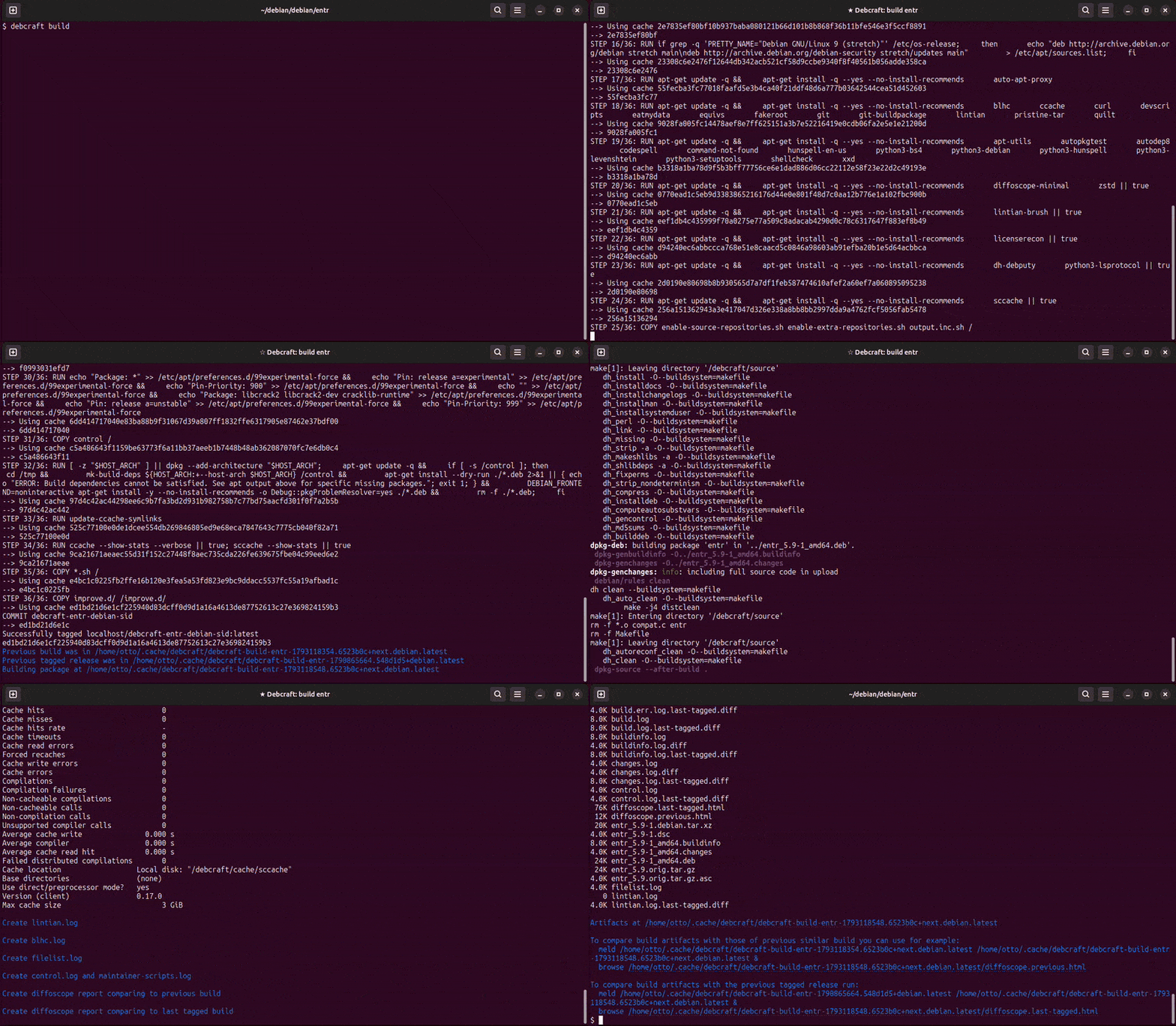
Try out Debcraft 1.0 now! Debcraft can be installed simply by running apt install debcraft on a recent version of Debian or Ubuntu. Check with debcraft --version that you have 1.0.0 or newer. The latest version can also always be installed from source at salsa.debian.org/debian/debcraft (does not require compiling anything). Running debcraft build in a Debian packaging git repository for the entr package

Benefits Debcraft was designed to offer the following three main benefits:

Easy
  • Build any Debian/Ubuntu package by simply running debcraft build in the checked-out Debian packaging git repository.
  • If the orig upstream source code tarball is neither already present nor available on a pristine-tar branch, the exact upstream tarball is downloaded from the Debian archive.
  • Users are spared from having to manually prepare ahead or maintain build environments. Debcraft builds create a container on-the-fly (both Podman and Docker supported), built using the target Debian or Ubuntu suite in debian/changelog and with exact build dependencies from debian/control.
  • Commands debcraft improve, debcraft test and debcraft update automate recurring package maintenance tasks and help maintainers produce high-quality, up-to-date packages, run Salsa CI, pass autopkgtest in Debian CI, and stay in sync across Debian archives and packaging git repositories.
  • The command output is (relatively) easy to read, and it also teaches users about Debian packaging in context.

Fast
  • Container layer caching is utilized to make builds and re-builds blazingly fast.
  • If an apt-cacher-ng instance or equivalent is present, it will automatically be used.
  • Debian packages that support ccache or sccache build even faster.

Secure
  • The build phase happens inside hermetic containers with no network access. This ensures all dependencies are properly managed and that the built binaries are as trustworthy as the source code they were built from.
  • Using containers also protects the host system from getting polluted with extra development libraries, and adds an extra layer of protection to prevent anything malicious in the source code from accessing secrets on the host system.
  • The additional logs provided by Debcraft also help audit changes in Debian package sources and build artifacts.
See the Debcraft README.md for details on how this was implemented. I also previously wrote Debcraft - Easiest way to modify and build Debian packages, which explains the motivation and design in more detail.

Result of many years of development The first commit in the git repository is from 2020 under the name debuildr. The project was renamed to Debcraft in a commit on December 8th, 2023. I have been developing this tool fairly actively since 2024 and using it for all my packaging, dogfooding so to say. There have also been plenty of collaborators. In total, 13 people have contributed code across 21 MRs and PRs on Salsa.d.o, GitLab.com and GitHub.com. Now, in October 2026, it was time to release Debcraft v1.0 as it has had extensive real-world use and iteration based on countless different packages and multiple users. Users have included both experienced fellow Debian Developers and lots of people who just started learning how Debian packaging works. As I mentor dozens of new contributors to Debian, I have seen that the latter group seems to benefit the most from Debcraft and its ease of use and built-in guidance, while to the more experienced developers the main benefit is having less details to remember and doing less mistakes.

Contributions welcome! Try it: apt install debcraft, then run debcraft build in a checked-out Debian packaging repository. If you run into a problem, file a report or submit an improvement. New contributors can look for issues marked good first issue. The code is intentionally written entirely in shell script to keep the barrier to code contribution as low as possible. It is also very easy to debug, as any command can be run with --debug to emit step-by-step information about what it is doing, and being Bash scripts, injecting set -x anywhere in the code will emit an even more detailed trace of every subcommand executed.
By the way, if you aspire to become a Debian Developer, and want to follow my examples in using state-of-the-art tooling and collaborate using salsa.debian.org, feel free to reach out for mentorship. I am glad to see more people contribute to Debian!

25 October 2026

Russell Coker: Banks and Phones

The Problem For years there have been ongoing issues with SMS being used as a security mechanism for important things including financial services. The problem with this is that access to a phone number is not very well secured, the business model of phone stores is based on having a price of service that doesn t allow the amounts of money spent on security and training that organisations such as banks can spend and are legally required to spend. The way things work now is that SMS is a second factor of authentication for banks and other traditional financial companies as well as for services involving cryptocurrencies such as bitcoin. To gain unauthorised access to SMS an attacker can physically steal a phone or SIM or they can trick an employee of a phone store into replacing the SIM or attack the computers of the telco to gain access to replace SIMs. SMS authentication is also used for many services which have indirect access to financial service. For example when I m employed in a sysadmin role I may get given admin access to the email server used for the CEO s email and have it default to using the phone number of my personal phone for authentication. So while my personal phone doesn t give the potential for defrauding much money I own it does give the potential for being used for defrauding however much money the CEO can authorise which may be significantly greater than my net worth. Hardware Security Devices The best thing to do for securing such things is to use hardware security devices like FIDO keys, of which there is a wide range that cost less than $50. The problem with acceptance of such things is lack of general knowledge and lack of forced requirements to use them. The vast majority of banks (including all banks in Australia AFAIK) have chosen not to require hardware security devices because of the cost. It has been widely claimed that 20% of the customers of a typical bank make 120% of the profit 80% of the customers lose money for the bank. While I m not in a position to know the accuracy of that most banks seem to have implemented monthly fees for accounts below a certain minimum balance to discourage less profitable customers. If there were banking regulations requiring hardware security devices then the costs would be passed on to people who really can t afford an extra $50 per year in banking fees to pay for it. It might be a good option for the government to require personal presence at the bank or a hardware security device for transfers of more than $1000. That would allow kids and minimum wage workers to have bank accounts without excessive fees while forcing a higher level of security for larger transfers. I really should use the hardware security devices I own more, although they are mostly only usable on systems I run. Improving Phone Store Security The problems of employees of phone stores being tricked or bribed to giving attackers access to someone s phone service could be addressed by introducing new regulations about security at phone stores. I think this isn t a viable option as the amount of work required to develop new procedures, train staff, and implement more secure systems is significant. Also the stores used for selling phones aren t the type of secure buildings that are used for banks so some construction work would be required and many phone stores in small towns would no longer be economically viable and would be shut down. I think we should have legislation to require better security for phone stores as there is a lot of scope to do things better without the expense of bank type security. Crimes that involve stealing phone service don t just hurt people who want a regular phone service, they hurt the community by facilitating other crimes. How Virtual Telcos Work In Australia there are 3 companies providing the full mobile phone service, Telstra, TPG (which bought Vodafone), and Optus. There are many virtual telcos that use those services. The virtual telcos are companies that will sell a phone service but use one of the 3 companies to provide the actual connection. The backend mobile service run by the big 3 has appeared to be secure, but probably doesn t have the protect $200m of bitcoin level of security. When you get a phone service you are issued a SIM or given a QR code for an eSIM by a company that has SIMs issued by the big 3. That company can then replace your SIM if it s damaged, lost, or stolen by using a level of security that it deems appropriate, which probably isn t very secure. Most of the news about SIM swapping attacks comes from other countries and it s shown that the security of virtual telcos in the US is quite insecure and probably Australian companies aren t any better. To transfer a service to another virtual telco you used to be able to do it with just knowing the invoice number of your last invoice but in recent times you receive a SMS on your old SIM to confirm that you wish to change. That could be viable for any crime that involves stealing a phone today and stealing money tomorrow. But for most attacks that involve stealing a phone number transferring to a different virtual telco isn t a good option. Another possibility for crime that I haven t seen reported yet is to steal eSIMs. It s unreasonably difficult (although not impossible) to steal an eSIM once it s installed in a phone. But stealing an eSIM before it gets installed is much easier. Kogan and Aldi email eSIMs to customers which is very vulnerable to attack and should be illegal. Telstra and Optus use an app to install an eSIM which could be quite secure if implemented properly. TPG uses a web page and QR code or an app which again could be quite secure. Currently the iPhone 17 Air is apparently the only phone released world-wide without support for physical SIMs. When phones that have no support for physical SIMs become common people may have to make the security of eSIM delivery a factor when choosing a telco. Banks as Virtual Telcos or SIM Providers I think that in the near future the best thing to do to improve security involving the phone system would be to have the banks run virtual telco businesses or manage the supply of SIMs for virtual telcos. Then getting a SIM replaced would require the same security as changing access to a bank account and a lot of problems related to stealing phone service would be solved. Banks wouldn t need to provide all phone services, just services to customers who want to use it which would be everyone who considers themself to be at risk of fraud. I don t think that this would be a great solution, but I think it s better than anything else that s likely to get used by a sufficient number of people in the near future. What Will Happen This blog post is mostly a thought experiment on ways of improving overall computer security in society. It can be read as advocacy for hardware security tokens. I don t expect anything to be done to improve these issues. I expect that banks will continue with their current security mechanisms (including SMS authentication) and just accepting a certain amount of fraud as the cost of doing business. For large fraud they can try to claw the money back or blame the customer to avoid having to pay. It s not impossible to solve these things, I had a hardware device issued to me by a Dutch bank about 25 years ago but countries like Australia and the US are much more than 25 years behind. I expect most people to regard whatever security they have on their bank account to be sufficient and that they will be happy to use the same for everything else. So we will continue to have things like SMS on a personal phone used to secure important corporate access to data and then people will be shocked when something goes wrong. To make things even more exciting if a criminal takes over the phone number of the sysadmin to access the CEO s email then there may be no-one to call to get the access restored. We can add rampant financial fraud to the list for the AI related world economic crash that s about to happen.

24 October 2026

Maytham Alsudany: The "old" way of collaborating is better

Maytham Alsudany: Control your own mail

Why

23 October 2026

Amin Bandali: Living healthier

Earlier this week I had a coaching session with Protesilaos, where we focused on health and wellness. I took some notes during our call, which I expand on here, and share with Prot's permission. I've been paying more serious attention to my health this year, and our discussion was in the context of me striving to live a healthier life. These notes are shared in the hope of being useful and are not professional advice; for medical advice please consult a licensed physician. Update 24 October 2026: Prot published a note about our discussion on his website: Healthier lifestyle with Amin Bandali
Exercise Life in today's fast-paced world can feel busier than ever, where every day is packed with a myriad of activities and tasks that need to be done, or tempting distractions that pop up seemingly randomly, with hardly a moment to spare. Despite that, or perhaps because of that, it's worthwhile to make time for ourselves and the various aspects of our health. As embodied souls, our bodies condition our minds. We take care of our body so we can take care of our mind. As humans we evolved for an active lifestyle out of survival necessity. In today's society many of us have sedentary office jobs that involve sitting for long periods of time. It's especially important that we try and make time for some regular physical activity like exercising and resistance training, to help build and retain muscle mass and mobility as we age. Fitness does not have to be the end goal that takes over our life, though there is nothing wrong with that if fitness is one's central goal e.g. as a personal trainer. Rather, for someone like me with other primary goals, my reason to exercise is to help live a healthier life, so I could spend quality time with my loved ones and carry out my responsibilities with a healthy body and mind. Prot mentioned that our health is directly dependent on the following four factors: Thus compromising any of these - for example, eating greasy food or drinking alcohol - would undermine the gains from exercising. While pursuing fitness, it's important to have sustained effort so that the body remains active and the mind is not distracted, and equally important to have sustainable effort so that we don't suffer injuries and not make the pursuit of fitness burdensome financially. Calisthenics is a key part of the strength training activities Prot practices, in addition to the physically intensive work he does on his land.
Calisthenics [...] is a form of strength training that utilizes an individual's body weight as resistance to perform multi-joint, compound movements with little or no equipment. Calisthenics are popular for their convenience, as they require little to no equipment and can be performed anywhere. Calisthenics, Wikipedia
Calisthenics can be done progressively, starting small and building in intensity and duration over time. It is also economically/financially sustainable. These calisthenic exercises are a good starting point (barring existing injuries in the related areas): Aim to perform each exercise in 3 sets of 10 repetitions, but it's perfectly okay to start with fewer and gradually build up. The exercises should be done around the same time everyday, so that there is enough time for the muscles to rest and recover for the next day. Doing them at night then again the next morning, for instance, would be too short of a time period and not enough for the body to recover. It's also vital to get enough sleep each night to make sure the body can properly rest and be energized the next day. Food As mentioned earlier, it's crucial to pair exercise with a healthy diet. I found Prot's programming metaphor for food interesting: similar to how it takes more time and effort for us to process and understand complex source code, breaking down and processing complex foods is similarly more difficult for the body. Prot does not eat fried food, and recommends avoiding sauces as much as possible: greasy, salty, and creamy extras make food more irresistible. They tend to make one want to eat more than what the body needs, and are to be avoided in isolation but especially in combination. In keeping ingredients close to their natural states, not overdoing things, and not eating more than the body needs, Prot extends his philosophy of simplicity and moderation to cooking. In addition to eating healthy meals, we need to apply similar consideration to snacks: avoiding overly salty or sugary snacks, and choosing healthier ones. Nuts can make great snacks in small quantities, especially almonds and walnuts, if one's not allergic. In addition to the inherent healthiness of the food or snack, Prot also suggests paying attention to methods of preparation. For instance, regarding concentration or distillation: juices, even when freshly squeezed from fruits, might have more of the fruits' sugar than its pulp and other beneficial parts. Additionally, chewing triggers biological responses in our body which for example can reduce stress, and release satiety hormones to help avoid overeating. So, Prot suggests to just eat the fruits themselves. Regarding weight loss, it will occur naturally as we introduce exercise into our routine, and pay closer attention to what we eat and drink. It's important to lose the weight slowly to condition our body to the new reality as it changes. Shortcuts tend to either not work, or have negative consequences. By going through the process slowly and with regularity, we gradually retrain our muscle memories and adjust our habits so we can maintain the lower weight and the healthier lifestyle. Regularity is key: it's better do a little everyday, than do a lot on only two days. It helps us develop the attitude that the exercise is part of our regular effort that we do consistently all the time. Working on wellness and living healthier is a matter of moderation, and building capacity over time. I will give it the time and attention it needs, without rushing, and enjoy the journey to becoming a healthier version of myself. Take care, and so long for now.

Reproducible Builds (diffoscope): diffoscope 335 released

The diffoscope maintainers are pleased to announce the release of diffoscope version 335. This version includes the following changes:
[ Chris Lamb ]
* Support the dumppdf binary being called dumppdf.py on the host system.
* Update copyright years.
* Fix a silly "prepend" typo.
You find out more by visiting the project homepage.

20 October 2026

Thadeu Lima de Souza Cascardo: Restricting device memory usage on Linux 7.3

Linux cgroups has been used for a while to group processes and control their access to certain system resources. One of those resources is memory, through the use of memcg. That control is dynamic, allowing for cgroups to setup a minimal and a maximal amount of memory, as well as low and high thresholds, which will control the reclaim process. But what about device memory that is not available as system RAM? Memory that is not available to the Linux page allocator? One of those device memories is GPU VRAM. That's where the dmem cgroup controller comes in. Introduced in Linux 6.14, it was first adopted by the Intel Xe driver. In Linux 6.15, AMD amdgpu driver also adopted it. In 7.3, it was adopted by nouveau. Such a cgroup controller allows the system to be configured such that a workload, be it a browser, a game, or another GPU rendering process can have some minimal VRAM available. Or it can prevent one of these processes from using all VRAM, preventing your compositor from using it, for example. Let's go through the system knobs that are available to control this and what's new in Linux 7.3. dmem regions and dmem.capacity Since a given system might have multiple GPUs, there might be multiple device memory regions. So, on dmem, each such region is described by a name. Every dmem cgroup setting file will contain one line per region. One of those files shows the capacity of each region in bytes and is present only in the root cgroup. After enabling the dmem cgroup with the following command:
# echo +dmem > /sys/fs/cgroup/cgroup.subtree_control
One can inspect the capacity of any available regions by looking at dmem.capacity at the root cgroup:
# cat /sys/fs/cgroup/dmem.capacity
drm/0000:03:00.0/vram 8573157376
That shows that the GPU at PCI address 0000:03:00.0 has a 8176MiB VRAM dmem region. dmem settings When introduced at 6.14, the following settings were available. dmem.current In every dmem cgroup, including the root cgroup, the dmem.current is a read-only file that shows the current usage of each region by the given cgroup.
# cat /sys/fs/cgroup/user.slice/dmem.current
drm/0000:03:00.0/vram 292757504
Here, it shows that user.slice cgroup is currently using above 292 MB of VRAM.
# cat /sys/fs/cgroup/dmem.current
drm/0000:03:00.0/vram 311377920
Here, we can check that total system usage is above 311 MB. dmem.max Excluding the root cgroup, dmem cgroups can control the maximal number of bytes that can be allocated from a region by processes in that cgroup. If an allocation moves the usage above the max setting, it will be refused. In that case, the allocation might be attempted at system memory or it might trigger eviction, depending on the allocation parameters and the driver. Here, the max value has special meaning, which is unrestricted usage.
# echo drm/0000:03:00.0/vram 536870912 > /sys/fs/cgroup/user.slice/dmem.max
# cat /sys/fs/cgroup/user.slice/dmem.max
drm/0000:03:00.0/vram 536870912
# echo drm/0000:03:00.0/vram max > /sys/fs/cgroup/user.slice/dmem.max
# cat /sys/fs/cgroup/user.slice/dmem.max
drm/0000:03:00.0/vram max
dmem.min dmem.min, also not available on the root cgroup, will control the eviction process - when memory needs to be moved out of VRAM to make room for other VRAM allocations. If an object belongs to a cgroup which is using less than its min setting, it will not be considered for eviction. It effectively works as a hard protection such that the cgroup can use at least the minimal setting. Given multiple cgroups may set a minimal value that exceeds the device memory capacity, it computes an effective minimal depending on the hierarchy. dmem.low While dmem.min works as a hard limit, dmem.low is a soft limit that will prevent eviction in case other objects from different cgroups are available for eviction. That is, the system will try to evict from different, possibly unprotected cgroups, before it tries to evict from a cgroup if evicting would leave its usage below the value set as dmem.low. Recent developments in Linux 7.3 Some new changes have been recently introduced in the dmem cgroup controller and its integration with GPUs. One of those is a new read-only file, dmem.peak, which was introduced to allow the peak usage of a region in a cgroup to be inspected. Also, Linux 7.3 fixed certain scenarios where a given cgroup would not be able to allocate VRAM up to its minimal or low limits if other processes had already allocated most of VRAM, even though they had no such limits set. Changing multiple regions' settings in a single write was possible before 7.3, but it was prone to failures which would not be reported to userspace and might have left the values partially updated. Starting with 7.3, only one region may be updated per write. And, finally, prior to 7.3, setting dmem.max in a cgroup that was using more than the new setting would silently fail. Now, there is a mechanism that allows a reclaim mechanism to be triggered. That way, when a process writes to dmem.max and sets a maximal value below the current usage, it will wait (unless O_NONBLOCK is used) for the reclaim process to move objects out of VRAM until the usage gets below the maximal value. If that is not possible for some reason, the setting will still be in place, restricting further alloctions by that cgroup.


Russell Coker: Cixin Liu is a Bad Person

The Chinese author Cixin Liu [1] is most known for his book The Three Body Problem and it s sequels. One of the main plot elements in the book is that every species in the universe is cool with genocide and willing to commit genocide as a preemptive strike against any star system found to contain intelligent life. It s not unreasonable to think that some planets may be by run societies like that, if one star system in 10,000 had a technological society and one society in 10,000 is run by depraved autocratic governments that would make 1,000+ planets in our galaxy that are run by genocidal groups! To think that every single society wants to commit genocide at every opportunity says a lot about every person who makes such claims. If you believe that everyone wants to do something then it must be something you really want to do. If there s something you really don t want to do then you will be able to imagine a system of government where the majority of citizens vote against doing it. Even in the more horrible parts of human history there hasn t been a genocide comparable to destroying and entire star system, genocide is usually based on slavery and large scale armed robbery. To just commit large scale genocide with a side effect of destroying valuable resources without any investigation or attempts at negotiation just based on fear of others is an extreme that I don t think humans have reached in history. The Daleks are portrayed as a perverse extreme of xenophobia but even with the low budget SciFi trend of depicting aliens as mostly having a common belief system they managed to show some Daleks going against their system from time to time. Cixin Liu is a very talented writer but his attitude towards genocide has caused him to write SciFi with a major plot point that s not great by Dr Who standards. Overall his short stories are much better than the three novels he is most known for. But he shows his ass in some of them too. One notable example is a short story where a significant plot point is declaring a right to sex (for men) which involves government sponsored sex workers. A right to sex conflicts with a sex workers right to refuse sex for a potential client who is undesirable in some way. Regardless of opinions on whether sex work should be permitted I hope that the vast majority of voters in every jurisdiction can agree that sex workers shouldn t be forced to do things that they don t want to do. Some writers like George Orwell create deliberately fictional scenarios that they hope to inspire opposition to bad ideas, I m sure that many proposed laws have failed to get enacted after being described as Orwellian . But describing a fictional horror situation as inevitable is a way of driving support for such things. It s particularly noteworthy when written by a citizen of a country that s involved in genocide. A possible counter argument would be but he is living in a repressive country and can t oppose his government . But when Herg (the author of the Tintin graphic novels) was threatened about the consequences of writing another book like King Ottokar s Sceptre [2] he didn t write books in favour of authoritarianism, he just avoided the topic by writing about visiting the moon instead. I don t think that people living in China now should be expected to publicly oppose evil things done by their government, but when they go out of their way to support such things it s their choice and we should note that they made that choice. I m not saying that people shouldn t read his work as his short stories are definitely worth reading. But the Three Body Problem series really isn t that good, he prevented many potentially interesting situations from happening by having every interaction between different species be based around genocide or the potential for it. Being a horrible person also made him a less capable SciFi author.

18 October 2026

Dirk Eddelbuettel: myman 0.12.0 on CRAN: Two new waves!

Another new and exciting version of our still-new package myman reached CRAN this morning, and has been built for r2u and on r-universe. The matching Python package has also been updated. The package offers twenty one hundred eighty four My man posts by Kevin Kruse made on bsky during the summer of 2026. Each wave picked at one particular public persona. This package wrapse these up in the style of packages like fortunes or gaussfacts. This release regroups two new waves of posts mocking, respectively, Peter Thiel and Michael Tracy, and make a small update to continuous integration. The short NEWS entry for this release follows.

Changes in version 0.12.0 (2026-10-18)
  • New waves eleven (100 posts) and twelve (100 posts) made last week; total is now 2184 posts
  • Small update to continuous integration

Courtesy of my CRANberries, there is also a diffstat report for the most recent release. More information is available at the repository or the package page.

This post by Dirk Eddelbuettel originated on his Thinking inside the box blog. If you like this or other open-source work I do, you can sponsor me at GitHub.

Ludovic Rousseau: New version of pcsc-lite: 2.5.3

I have just released a new version of pcsc-lite 2.5.3. pcsc-lite is a Free Software implementation of the PC/SC (also known as WinSCard) API for Unix systems. It provides an API for using smart cards and smart card readers.
Changes:
2.5.3: Ludovic Rousseau
18 October 2026
  • pcscd.service: preserve card sessions across polkit restarts
  • correctly decode all ATRs (fix the fix suggested by AI)
  • Fix authorization for uid > 65536

17 October 2026

Dirk Eddelbuettel: RcppArmadillo 15.6.2-1 on CRAN: New Upstream

armadillo image Armadillo is a powerful and expressive C++ template library for linear algebra and scientific computing. It aims towards a good balance between speed and ease of use, has a syntax deliberately close to Matlab, and is useful for algorithm development directly in C++, or quick conversion of research code into production environments. RcppArmadillo integrates this library with the R environment and language and is widely used by (currently) 1370 other packages on CRAN, downloaded 49.4 million times (per the partial logs from the cloud mirrors of CRAN), and the CSDA paper (preprint / vignette) by Conrad and myself has been cited 735 times according to Google Scholar. This versions updates to the 15.6.2 upstream Armadillo release made yesterday. It, along with 15.6.1 release we incorporated earlier, addresses only minor issues and should not present any user-facing changes. As usual, we did run full reverse-depdency checks against the over 1300 ackages, and did not find anything. As usual, we aim to accommodate the desired CRAN cadences for uploads and try not to exceed six in six months so we did not ship 15.6.1-1 there. The package has also already been updated for Debian, built for r2u and r-universe, and will build shortly at CRAN for the different binary releases. All changes since the last CRAN release follow.

Changes in RcppArmadillo version 15.6.2-1 (2026-10-16)
  • Upgraded to Armadillo release 15.6.2 (Medium Roast Cortado)
    • Faster inplace addition of eye() expressions

Changes in RcppArmadillo version 15.6.1-1 [github-only] (2026-10-02)
  • Upgraded to Armadillo release 15.6.1 (Medium Roast Cortado)
    • Fix for failures in pinv() when using the (non-default) "std" method

Courtesy of my CRANberries, there is a diffstat report relative to previous release. More detailed information is on the RcppArmadillo page. Questions, comments etc should go to the rcpp-devel mailing list off the Rcpp R-Forge page.

This post by Dirk Eddelbuettel originated on his Thinking inside the box blog. If you like this or other open-source work I do, you can sponsor me at GitHub.

16 October 2026

Dirk Eddelbuettel: RcppSimdJson 0.1.17 on CRAN: Updates

A brand new release 0.1.17 of the RcppSimdJson package is now on CRAN, and has been built for r2u and on r-universe. RcppSimdJson wraps the fantastic and genuinely impressive simdjson library by Daniel Lemire and collaborators. Via very clever algorithmic engineering to obtain largely branch-free code, coupled with modern C++ and newer compiler instructions, it results in parsing gigabytes of JSON parsed per second which is quite mindboggling. The best-case performance is faster than CPU speed as use of parallel SIMD instructions and careful branch avoidance can lead to less than one cpu cycle per byte parsed; see the video of the talk by Daniel Lemire at QCon. This release is a small increment relative to the 0.1.6 release last week that got us (upstream) version 5.0.2 with many notable changes and sizeable speed gains on all fronts, including the interface from R. However, this failed to compile at CRAN on macOS x86_64 as the machine is setup for only partial support of C++20: no ranges, no concepts. So we now test, and fall back to C++17 if the test compilation fails. Upstream, meanwhile, already got to 5.0.5 which is included. It also gets us improved handling of disabling pragmas which we hope will survive CRAN checks. The brief NEWS entry for this release follows.

Changes in version 0.1.17 [unreleased] (2026-10-xx)
  • Compilation starts with a C++20 feature test; if this fails C++17 is used (Dirk in #111 fixing #110)
  • simdjson was upgraded to version 5.0.5 (Daniel in #112)

Courtesy of my CRANberries, there is also a diffstat report for this release. For questions, suggestions, or issues please use the issue tracker at the GitHub repo.

This post by Dirk Eddelbuettel originated on his Thinking inside the box blog. If you like this or other open-source work I do, you can now sponsor me at GitHub.

Reproducible Builds (diffoscope): diffoscope 334 released

The diffoscope maintainers are pleased to announce the release of diffoscope version 334. This version includes the following changes:
[ Chris Lamb ]
* Fix a crash when using the latest versions of Androguard. Thanks, hc!
  (Closes: reproducible-builds/diffoscope#434)
You find out more by visiting the project homepage.

Freexian Collaborators: Monthly report about Debian Long Term Support, September 2026 (by Santiago Ruano Rinc n)

The Debian LTS Team, funded by Freexian s Debian LTS offering, is pleased to report its activities for September.

Activity summary During the month of September, 20 contributors have been paid to work on Debian LTS (links to individual contributor reports are located below). The team released 41 DLAs fixing 1854 CVEs. In September, the Debian LTS Team was back to focusing on a single release: Debian 12 ( bookworm ). Debian 11 ( bullseye ) reached the end of its Long Term Support on 31 August 2026, and Freexian now provides its security maintenance under the Extended LTS offer. It is important to highlight the hard work done behind the scenes of the Front Desk fellows, whose role was fulfilled during September by Emilio, Emmanuel, Sylvain, Thorsten and Utkarsh. Besides the very high activity doing daily triage on dozens of packages and CVEs, Front Desk fellows spent much of their time answering questions and coordinating with people outside the Freexian team about update proposals. The team published several notable updates:
  • jbig2dec (DLA-4779-1), prepared by Andreas Henriksson, fixes CVE-2026-38076, where missing input checks could lead to a denial of service. It is to note that this library is used by different tools, such as ghostscript.
  • linux-6.12 (DLA-4788-1), uploaded by Ben Hutchings, fixing 414 CVEs in the bookworm backport of Linux kernel version 6.12.
  • lxml (DLA-4799-1), prepared by Guilhem Moulin, fixes four vulnerabilities in this widely used python XML/HTML library. The issues may yield to exposing local files.
  • nginx (DLA-4784-1), issued by Carlos Henrique Lima Melara ( charles ), fixing three memory-safety bugs in this popular web server and reverse proxy, which may result in denial of service, memory disclosure or potentially the execution of arbitrary code.
  • openssl (DLA-4795-1), by Arnaud Rebillout, fixing six vulnerabilities, including an out-of-bounds heap write in CMS decryption and an authentication tag verification bypass in ChaCha20-Poly1305/AES-OCB decryption. This update brings bookworm to OpenSSL 3.0.22, the last upstream release of the 3.0 series, which was reached its upstream EOL on 7 Sep 2026. Further fixes will be backported by the Debian LTS Team from more recent releases.
  • redis DLA-4794-1, by Chris Lamb, fixing vulnerabilities that could yield to arbitrary code execution
Contributions from other Debian fellows beyond the Freexian LTS Team:
  • Thomas Goirand, Keystone released by Emilio as DLA-4767-1
  • Thomas also prepared glance and swift updates, whose respective DLA-4800-1 and DLA-4801-1 were issued by Charles
  • Matthew Vernon uploaded a pcre2 security update, and Emilio issued its DLA-4772-1
  • Otto Kek l inen uploaded a xz-utils update, released as DLA-4783-1 by Sylvain
  • Salvatore Bonaccorso published a linux (6.1) update released as DLA-4777-1
  • Xavier Guimard prepared a lemonldap-ng, released as DLA-4797-1. Additionally, Sylvain sent DLA-4734-1 at the beginning of the month for the upload made on August.
  • Xavier also released DLA-4766-1 for cyrus-imapd.
  • Simon Quigley uploaded DLA-4803-1 to fix multiple issues in ruby-oj.
  • Finally, Ivo Marino proposed bookworm updates for cjose, git-lfs, caddy, libgit2, libwebsockets, libssh and unbound. Some of Ivo s proposals are still pending for a review.
Thank you so much to the developers above for these valuable contributions. The LTS Team has also contributed with updates to the latest Debian releases for the following packages:
  • ruby-jwt, prepared by Abhijith and released as DSA-6547-1
  • urwid, proposed for a point-release update by Abhijith (#1148950)
  • puma, proposed for a point-release update by Abhijith (#1149582)
  • tomcat10, and tomcat9 (which is actually backported to released suites) by Bastien
  • nodejs, prepared by Bastien and released as (DSA-6517-1).
If you benefit from Debian, especially throughout its full 5-year lifecycle, please consider becoming a sponsor of Debian LTS. You can find more information here: https://www.freexian.com/lts/debian/.

Individual Debian LTS contributor reports

Thanks to our sponsors Sponsors that joined recently are in bold.

15 October 2026

Matthew Garrett: Epic's EAC2 v2 seems fairly easily bypassable

Epic just announced the upcoming version 2 of their Linux implementation of Easy Anti-Cheat. It s based on using the Linux eBPF security module to monitor what s happening, and then a bunch of extra infrastructure to make sure this can t be bypassed. The core part of this is requiring secure boot be enabled (ensuring that modified kernels can t be used), using measured boot to verify that secure boot is enabled and which keys are used (to prevent you from just signing your own modified kernel), and then doing remote attestation, a mechanism where the TPM generates a signed copy of the boot measurements and passes that off to a server which verifies it came from a real TPM, verifies that you have secure boot enabled and are using the right keys, and presumably then allows you into the game. This is all fine as long as you can prove that the measurements provided are real, and that s actually a lot harder than you might think. First, we can simply make up our own quote signed with our own key and say that it came from a TPM. This is avoided by every TPM having an Endorsement Key (or EK) and an associated certificate, with that certificate being signed by the TPM vendor. If you have a list of all the legitimate TPM vendors and their CA keys, you can verify that the measurements came from a real TPM. Easy enough. So we need to get the measurements from a real TPM, and the one on our motherboard contains the measurements that were generated by the firmware and bootloader, and we can t reset those at runtime without resetting the TPM, which oh huh there s actually nothing stopping us from doing that at runtime, as long as we have access to the hardware. Many desktop boards have the TPM on a small plugin module with a standard pinout that includes a reset pin. Simply short that to ground briefly and the TPM is back in its initial state, and userland can write whatever measurements it wants to it. Boot a modified kernel which lies to the eBPF code? As long as you replay the expected log values from a boot with secure boot on and a trusted kernel, the TPM will still happily provide a legitimate set of measurements that ll satisfy the checker. What if the TPM is less accessible, either because it s mounted directly to the motherboard or it s inside the CPU or chipset? That s going to be trickier. But here s the thing. The quote needs to come from a TPM, but not necessarily the TPM on your motherboard. TPMs these days are usually connected via the Serial Peripheral Interface, usually referred to as SPI. Microchip make a USB to SPI bridge, and there s a Linux driver. Wire one of those up with an appropriate header and you can plug in an easily available TPM module intended for plugging into a motherboard, and now we tell the kernel to ignore the motherboard TPM and make /dev/tpmrm0 point at the USB one and program it with a set of trusted measurements and once again everything is going to look just fine (yes obviously the eBPF code can look for this, but we re running a modified kernel so we can just lie to the eBPF code). Remote attestation on PCs just doesn t work that well in environments where you can t associate a specific TPM with a specific system, which is basically everywhere except enterprises. But maybe that doesn t matter and cheaters wouldn t be willing to spend the $20 or so it d take to produce one of these things? That would seem somewhat surprising, but it s not impossible. And obviously any server-side cheat detection that triggers could then block that specific TPM, meaning they d need to go and get another TPM, and maybe that ends up being enough to discourage people from bothering. From a practical level, this may be sufficient. But at a technical level? It s not great.

14 October 2026

Dirk Eddelbuettel: qlcal 0.1.4 on CRAN: Fresh Upstream Updates

The twenty-second release of the qlcal package arrivied at CRAN yesterday, and has been built for r2u as well as on r-universe. qlcal delivers the calendaring parts of QuantLib. It is provided (for the R package) as a set of included files, so the package is self-contained and does not depend on an external QuantLib library (which can be demanding to build). qlcal covers over seventy country / market calendars and can compute holiday lists, its complement (i.e. business day lists) and much more. Examples are in the README at the repository, the package page, and course at the CRAN package page. This release is based on the changes in the QuantLib 1.44 release also made yesterday. It includes two new calendars for Malaysia and the Philippines, updates to around a dozen calendars, and a few other updates to internal files. Maxmilian Muecke spotted and fixed a few small bugs just as he did for the RQuantLib release we made yesterday; this is equally appreciated! The full details from NEWS.Rd follow.

Changes in version 0.1.4 (2026-10-13)
  • Add missing market calendars for Poland, Russia, Romania, Indonesia (Maximilian Muecke in #21)
  • Add (semi-deprecated) alternate separators '::' for Israel and New Zealand markets (Maximilian Muecke in #22)
  • Fix several typos across source, configuration and documentation files (Maximilian Muecke in #23)
  • Synchronize with QuantLib 1.44, add two new calendars, update several others, and update general utility files (Dirk in #24)

Courtesy of my CRANberries, there is a diffstat report for this release. See the project page and package documentation for more details, and more examples.

This post by Dirk Eddelbuettel originated on his Thinking inside the box blog. If you like this or other open-source work I do, you can sponsor me at GitHub.

Next.

Previous.