Russ Allbery: Review: Rise of the Warrior Cop
| Publisher: | PublicAffairs |
| Copyright: | 2013 |
| ISBN: | 1-61039-212-4 |
| Format: | Kindle |
| Pages: | 336 |
| Publisher: | PublicAffairs |
| Copyright: | 2013 |
| ISBN: | 1-61039-212-4 |
| Format: | Kindle |
| Pages: | 336 |
The following contributors got their Debian Developer accounts in the last two months:
I was a police officer for nearly ten years and I was a bastard. We all were.
We've detected that JavaScript is disabled in your browser. Would you like to proceed to legacy Twitter?
As nationwide protests over the deaths of George Floyd and Breonna Taylor are met with police brutality, John Oliver discusses how the histories of policing ...
La morte di Stefano Cucchi avvenne a Roma il 22 ottobre 2009 mentre il giovane era sottoposto a custodia cautelare. Le cause della morte e le responsabilit sono oggetto di procedimenti giudiziari che hanno coinvolto da un lato i medici dell'ospedale Pertini,[1][2][3][4] dall'altro continuano a coinvolgere, a vario titolo, pi militari dell Arma dei Carabinieri[5][6]. Il caso ha attirato l'attenzione dell'opinione pubblica a seguito della pubblicazione delle foto dell'autopsia, poi riprese da agenzie di stampa, giornali e telegiornali italiani[7]. La vicenda ha ispirato, altres , documentari e lungometraggi cinematografici.[8][9][10]
La morte di Giuseppe Uva avvenne il 14 giugno 2008 dopo che, nella notte tra il 13 e il 14 giugno, era stato fermato ubriaco da due carabinieri che lo portarono in caserma, dalla quale venne poi trasferito, per un trattamento sanitario obbligatorio, nell'ospedale di Varese, dove mor la mattina successiva per arresto cardiaco. Secondo la tesi dell'accusa, la morte fu causata dalla costrizione fisica subita durante l'arresto e dalle successive violenze e torture che ha subito in caserma. Il processo contro i due carabinieri che eseguirono l'arresto e contro altri sei agenti di polizia ha assolto gli imputati dalle accuse di omicidio preterintenzionale e sequestro di persona[1][2][3][4]. Alla vicenda dedicato il documentario Viva la sposa di Ascanio Celestini[1][5].
Il caso Aldrovandi la vicenda giudiziaria causata dall'uccisione di Federico Aldrovandi, uno studente ferrarese, avvenuta il 25 settembre 2005 a seguito di un controllo di polizia.[1][2][3] I procedimenti giudiziari hanno condannato, il 6 luglio 2009, quattro poliziotti a 3 anni e 6 mesi di reclusione, per "eccesso colposo nell'uso legittimo delle armi";[1][4] il 21 giugno 2012 la Corte di cassazione ha confermato la condanna.[1] All'inchiesta per stabilire la cause della morte ne sono seguite altre per presunti depistaggi e per le querele fra le parti interessate.[1] Il caso stato oggetto di grande attenzione mediatica e ha ispirato un documentario, stato morto un ragazzo.[1][5]
Federico Aldrovandi (17 July 1987 in Ferrara 25 September 2005 in Ferrara) was an Italian student, who was killed by four policemen.[1]
24 Giugno 2020
LWN published today yet another great piece of writing, Loaded terms
in free software. I am sorry, the
content will not be immediately available to anybody following at
home, as LWN is based on a subscription model But a week from now,
the article will be open for anybody to read. Or you can ask me (you
most likely can find my contact addresses, as they are basically
everywhere) for a subscriber link, I will happily provide it.
In consonance with the current mood that started with the killing of
George Floyd
and sparked worldwide revolts against police brutality, racism (mostly
related to police and law enforcement forces, but social as well) and
the like, the debate that already started some months ago in technical
communities has re-sparked:
We have many terms that come with long histories attached to them, and
we are usually oblivious to their obvious meaning. We? Yes, we, the
main users and creators of technology. I never felt using master and
slave to refer to different points of a protocol, bus, clock or
whatever (do refer to the Wikipedia article for a fuller
explanation)
had any negative connotations but then again, those terms have never
tainted my personal family. That is, I understand I speak from a
position of privilege.
A similar although less heated issue goes around the blacklist and
whitelist terms, or other uses that use white to refer to good,
law-abiding citizens, and black to refer to somewhat antisocial uses
(i.e. the white hat and black hat hackers).
For several years, this debate has been sparking and dying off. Some
important changes have been made Particularly, in 2017 the Internet
Software Consortium started recommending Primary and
Secondary,
Python dropped master/slave pairs after a quite thorough and deep
review throughout 2018, GitHub
changed the default branch from master to main earlier this
week. The
Internet Engineering Task Force has a draft (that lapsed and thus
sadly didn t become an RFC, but still, is archived), Terminology,
Power and Oppressive
Language
that lists suggested alternatives:
There are also many other relationships that can be used as metaphors, Eglash s research calls into question the accuracy of the master-slave metaphor. Fortunately, there are ample alternatives for the master-slave relationship. Several options are suggested here and should be chosen based on the pairing that is most clear in context:I ll add that I think we Spanish-speakers are not fully aware of the issue s importance, because the most common translation I have seen for master/slave is maestro/esclavo: Maestro is the word for teacher (although we do keep our slaves in place). But think whether it sounds any worse if you refer to device pairs, or members of a database high-availability cluster, or whatever as Amo and Esclavo. It does sound much worse I cannot add much of value to this debate. I am just happy issues like this are being recognized and dealt with. If the topic interests you, do refer to the LWN article! Some excrepts: I consider the following to be the core of Jonathan Corbet s writeup:
- Primary-secondary
- Leader-follower
- Active-standby
- Primary-replica
- Writer-reader
- Coordinator-worker
- Parent-helper
Recent events, though, have made it clear even to those of us who were happy to not question this view that the story of slavery and the wider racist systems around it is not yet finished. There are many people who are still living in the middle of it, and it is not a nice place to be. We are not so enlightened as we like to think we are. If there is no other lesson from the events of the last few weeks, we should certainly take to heart the point that we need to be listening to the people who have been saying, for many years, that they are still suffering. If there are people who are telling us that terms like slave or blacklist are a hurtful reminder of the inequities that persist in our society, we need to accept that as the truth and act upon it. Etymological discussions on what, say, master really means may be interesting, but they miss the point and are irrelevant to this discussion.Part of a comment by user yokem_55:
Often, it seems to me that the replacement words are much more descriptive and precise than the old language. Allowlist is far more obviously a list of explicitly authorized entities than whitelist . Mainline has a more obvious meaning of a core stream of development than master . The benefit of moving past this language is more than just changing cultural norms, it s better, more precise communication across the board.Another spot-on comment, by user alan:
From my perspective as a Black American male, I think that it s nice to see people willing to see and address racism in various spheres. I am concerned that some of these steps will be more performative than substantial. Terminology changes in software so as to be more welcoming is a nice thing. Ensuring that oppressed minorities have access to the tools and resources to help reduce inequity and ensuring equal protection under the laws is better. We ll get there one day I m sure. The current ask is much simpler, its just to stop randomly killing and terrorizing us. Please and thank you.So Maybe the protests of this year caught special notoriety because the society is reacting after (or during, for many of us) the lockdown. In any case, I hope for their success in changing the planet s culture of oppression.
| Series: | Francesca #2 |
| Publisher: | Candlewick Press |
| Copyright: | 2010 |
| Printing: | 2011 |
| ISBN: | 0-7636-5458-2 |
| Format: | Kindle |
| Pages: | 330 |
Package: file
Version: 1:5.19-2
Severity: important
User: debian-edu@lists.debian.org
Usertags: debian-edu
Conclusion
Overall, I was quite happy that the BoF has been attended by so many people and to see that there is quite "a lobby" in Debian. Let's dive into the work and make Debian 10 the first Debian, that mentions the Remote Desktop in its release notes.
Let's, in fact, release Debian 10 as the first Debian with the official announcement as an operating system for the Remote Desktop (like the Fedora people did already for Fedora 20).
ErrorDocument 400 directive pointing to a cgid script
in worker mode).
Still, it was a serious regression and I found a part of the nasty
long patch we worked on back then that was faulty, and introduced a
small fix to correct that. The proposed package unfortunately
didn't yield any feedback, and I can only assume it will work okay for
people. The result is the DLA-841-2 upload which fixes the
regression. I unfortunately didn't have time to work on the remaining
CVEs affecting apache2 in LTS at the time of writing.
The name comes from what snakes and other animals do to "create a new snake": they shed their skin. This is not so appropriate for snakes, as it's just a way to rejuvenate their skin, but is especially relevant for anthropods since then "ecdysis" may be associated with a metamorphosis:It was an interesting exercise to go back into older projects and factor out interesting code. The process is not complete yet, as there are older projects I'm still curious in reviewing. A bunch of that code could also be factored into upstream project and maybe even the Python standard library. In short, this is stuff I keep on forgetting how to do: a properEcdysis is the moulting of the cuticle in many invertebrates of the clade Ecdysozoa. Since the cuticle of these animals typically forms a largely inelastic exoskeleton, it is shed during growth and a new, larger covering is formed. The remnants of the old, empty exoskeleton are called exuviae. WikipediaSo this project is metamorphosed into others when the documentation templates, code examples and so on are reused elsewhere. For that reason, the license is an unusally liberal (for me) MIT/Expat license. The name also has the nice property of being absolutely unpronounceable, which makes it unlikely to be copied but easy to search online.
setup.py config, some fancy argparse extensions and so on. Instead
of having to remember where I had written that clever piece of code, I
now shove it in the crazy chaotic project where I can find it again in
the future.
set builtin: for small
items, it is basically as fast as a bloom filter. Of course, when
the item size grows larger, its memory usage explodes, but in this
case it turned out to be sufficient and bloom filter completely
overkill and confusing.
Oh, and thanks to those efforts, I got admitted in the beetbox
organization on GitHub! I am not sure what I will do with that
newfound power: I was just scratching an itch, really. But hopefully
I'll be able to help here and there in the future as well.
Two days ago one of the most influential logician of the 20th century has passed away, Gaisi Takeuti ( ). I had the pleasure to meet this excellent man, teacher, writer, thinker several times while he was the president of the Kurt G del Society.
I don t want to recall his achievements in mathematical logic, in particular proof theory, because I am not worth to write about such a genius. I want to recall a few personal stories from my own experience.
I came into contact with Prof. Takeuti via is famous book Proof Theory, which my then Professor, now colleague and friend Matthias Baaz used for teaching us students proof theory. Together with Shoenfield s Mathematical Logic these two books became the foundation of my whole logic education. Now again in print, back then the Proof Theory was a rare precious. Few prints did remain in the library, and over the years one by one disappeared, until the last copy we had access to was my copy where I had scribbled pages and pages of notes and proofs. Matthias later on used these copies for his lectures, I should have written on the back-side!
I remember well my first meeting with Prof. Takeuti: I was on the Conference on Internationalization in 2003 in Tsukuba, long before I moved to Japan. Back then I was just finishing my PhD and without much experience. When I arrived in the hotel, without fail there was a message of Prof. Takeuti inviting me for dinner the following day. We had dinner in a specialty restaurant of his area, together with is lovely wife. I was soo nervous about Japanese manners and stuttered Japanese phrases just to be stopped by Prof. Takeuti pouring himself a glass of sake and telling me: Relax, and forget the rules and fill your own glass when you want to. I am well aware that this liberal attitude didn t extend to Japanese colleagues, where he, descendant from a Samurai family, was at times very, extremely strict.
The dinner was decided upon already, not easy since I was still strict vegetarian back than (now I would have enjoyed the dinner much more!), but for the last course we could decide. I remember with a smile how Prof. Takeuti suggested in Japanese various sweets, just to be interrupted by his wife with No Gaisi, no! . I asked what is going on and she explained that he wants to order a Japanese sweet for me I agreed, and that was probably the worst dish I had in Japan. Slippy noodles swimming in a cold broth, to be picked with chopsticks and put into a semi-sweet soja-sauce. I finished it, but it wasn t good. I should have thought twice when Prof. Takeuti s wife ordered a normal fruit salad.
Scientifically he was simply a genius and famous for not reading a lot but reinventing everything. One of my research areas, G del logics, was reinvented by him as Intuitionistic Fuzzy Logic (for an overview see my talk at the Collegium Logicum 2016: G del Logics a short survey). But I want to recall one of my favorite articles of him: A Conservative Extension of Peano Arithmetic . This was published as part 2 of Volume 17 of Publications of the Mathematical Society of Japan, retypeset pdf is available here, JSTOR page. Therein he develops classical (real and complex) analysis over Peano s arithmetic. He shows that any arithmetical theorem proved in analytic number theory is a theorem in Peano s arithmetic. The proof uses Gentzen s cut elimination theorem, the center piece of modern proof theory.
With Georg Kreisel having passed away in 2015, and now Gaisi Takeuti, we loose two of the greatest, if not the greatest minds in logic.
| 1984: Library Edition | Novel by George Orwell, cover picture by Google Search result |
[Many Americans are] hurt, and they re scared, and they feel like a lot of the United States just slammed the door in their faces. The status quo is not working for people. Technocratic government by political elites is not working for people. Business as usual is not working for people. Minor tweaks to increasingly arcane systems is not working for people. People are feeling lost in bureaucracy, disaffected by elections that do not present a clear alternate vision, and depressed by a slow slide into increasingly dismal circumstances. Government is not doing what we want it to do for us. And people are getting left behind. The left in the United States (of which I m part) has for many years been very concerned about the way blacks and other racial minorities are systematically pushed to the margins of our economy, and how women are pushed out of leadership roles. Those problems are real. But the loss of jobs in the industrial heartland, the inability of a white, rural, working-class man to support his family the way his father supported him, the collapse of once-vibrant communities into poverty and despair: those problems are real too. The status quo is not working for anyone except for a few lucky, highly-educated people on the coasts. People, honestly, like me, and like many of the other (primarily white and male) people who work in tech. We are one of the few beneficiaries of a system that is failing the vast majority of people in this country.Russ is, of course, right. The Democrats have been either complicit in policies damaging to many, or ineffective in preventing them. They have often appeared unconcerned with the plight of people outside cities (even if that wasn t really the case). And it goes deeper. When s the last time you visited Kansas? I live in Kansas. The nearest paved road is about a 3-mile drive from my home. The nearest town, population 600, is a 6-mile drive. My governor whom I did not vote for cut taxes on the wealthy so much that our excellent local schools have been struggling for years. But my community is amazing, full of loving and caring people, the sort of people who you know you ll be living with for 40 years, and so you make sure you get along well with. I have visited tourist sites in Berlin, enjoyed an opera and a Broadway show in New York, taken a train across the country to Portland, explored San Francisco. I ve enjoyed all of them. Many rural people do get out and experience the world. I have been in so many conversations where I try to explain where I live to people that simply cannot fathom it. I have explained how the 18 acres I own is a very small amount where I am. How, yes, I do actually have electricity and Internet. How a bad traffic day is one where I have to wait for three cars to go past before turning onto the paved road. How I occasionally find a bull in my front yard, how I can walk a quarter mile and be at the creek on the edge of my property, how I can get to an airport faster than most New Yorkers and my kids can walk out the front door and play in a spot more peaceful than Central Park, and how all this is way cheaper than a studio apartment in a bad part of San Francisco. It is rare indeed to see visitors actually traveling to Kansas as a destination. People have no concept of the fact that my mechanic would drop everything and help me get my broken-down car to the shop for no charge, that any number of neighbors or uncles would bring a tractor and come plow the snow off my 1/4-mile driveway out of sheer kindness, that people around here really care for each other in a way you don t see in a city. There are people that I know see politics way differently than me, but I know them to be good people. They would also do anything for a person in need, no matter who they are. I may find the people that they vote for to be repugnant, but I cannot say I ve looked this person in the eyes and they are nothing but deplorable. And so, people in rural areas feel misunderstood. And they are right. Some perspectives on Trump As I ve said, I do find Trump to be deplorable, but not everyone that voted for him is. How, then, do people wind up voting for him? The New Yorker had an excellent story about a man named Mark Frisbie, owner of a welding and fab shop. The recession had been hard on his business. His wife s day-care center also closed. Health care was hard to find, and the long, slow decline had spanned politicians of every stripe. Mark and his wife supposedly did everything they were supposed to: they worked hard, were honest, were entrepreneurial, and yet he had lost his business, his family house, his health coverage, everything. He doesn t want a handout. He wants to be able to earn a living. Asked who he d vote for, he said, Is none of the above an option? The Washington Post had another insightful article, about a professor from Madison, WI interviewing people in rural areas. She said people would often say: All the decisions are made in Madison and Milwaukee and nobody s listening to us. Nobody s paying attention, nobody s coming out here and asking us what we think. Decisions are made in the cities, and we have to abide by them. She pushed back, hard, on the idea that Trump supporters are ignorant, and added that liberals that push that line of thinking are only making the problem worse. I would agree; seeing all the talk about universities dis-inviting speakers that don t hew to certain political views doesn t help either. A related article talks about the lack of empathy for Trump voters. And then we have a more recent CNN article: Where Tump support and Obamacare use soar together, explaining in great detail how it can be logical for someone to be on Obamacare but not like it. We can all argue that the Republicans may have as much to do with that as anything, but the problem exists. And finally, a US News article makes this point:
His supporters realize he s a joke. They do not care. They know he s authoritarian, nationalist, almost un-American, and they love him anyway, because he disrupts a broken political process and beats establishment candidates who ve long ignored their interests. When you re earning $32,000 a year and haven t had a decent vacation in over a decade, it doesn t matter who Trump appoints to the U.N., or if he poisons America s standing in the world, you just want to win again, whoever the victim, whatever the price. According to the Republican Party, the biggest threat to rural America was Islamic terrorism. According to the Democratic Party it was gun violence. In reality it was prescription drug abuse and neither party noticed until it was too late.Are we leaving people out? All this reminded me of reading about Donald Knuth, the famous computer scientist and something of the father of modern computing, writing about his feelings of trepidation about sharing with his university colleagues that he was working on a project related to the Bible. I am concerned about the complaints about the PC culture , because I think it is good that people aren t making racist or anti-semitic jokes in public anymore. But, as some of these articles point out, in many circles, making fun of Christians and conservatives is still one of the accepted targets. Does that really help anything? (And as a Christian that is liberal, have all of you that aren t Christians so quickly forgotten how churches like the Episcopals blazed the way for marriage equality many years ago already?) But they don t get a free pass I have found a few things, however, absolutely scary. One was an article from December showing that Trump voters actually changed their views on Russia after Trump became the nominee. Another one from just today was a study on how people reacted when showed inauguration crowd photos. NPR ran a story today as well, on how Trump is treating journalists like China does. Chilling stuff indeed. Conclusion So where does this leave us? Heading into uncertain times, for sure, but perhaps just maybe with a greater understanding of our neighbors. Perhaps we will all be able to see past the rhetoric and polarization, and understand that there is something, well, normal about each other. Doing that is going to be the only way we can really take our country back.
A Safe and Happy New Year to all.

Incredible India from http://incredibleindiacampaign.com
Eligibility International Travellers whose sole objective of visiting India is recreation , sight-seeing , casual visit to meet friends or relatives, short duration medical treatment or casual business visit.https://indianvisaonline.gov.in/visa/tvoa.html That this facility is being given to 130 odd countries is better still
Albania, Andorra, Anguilla, Antigua & Barbuda, Argentina, Armenia, Aruba, Australia, Austria, Bahamas, Barbados, Belgium, Belize, Bolivia, Bosnia & Herzegovina, Botswana, Brazil, Brunei, Bulgaria, Cambodia, Canada, Cape Verde, Cayman Island, Chile, China, China- SAR Hong-Kong, China- SAR Macau, Colombia, Comoros, Cook Islands, Costa Rica, Cote d lvoire, Croatia, Cuba, Czech Republic, Denmark, Djibouti, Dominica, Dominican Republic, East Timor, Ecuador, El Salvador, Eritrea, Estonia, Fiji, Finland, France, Gabon, Gambia, Georgia, Germany, Ghana, Greece, Grenada, Guatemala, Guinea, Guyana, Haiti, Honduras, Hungary, Iceland, Indonesia, Ireland, Israel, Jamaica, Japan, Jordan, Kenya, Kiribati, Laos, Latvia, Lesotho, Liberia, Liechtenstein, Lithuania, Luxembourg, Madagascar, Malawi, Malaysia, Malta, Marshall Islands, Mauritius, Mexico, Micronesia, Moldova, Monaco, Mongolia, Montenegro, Montserrat, Mozambique, Myanmar, Namibia, Nauru, Netherlands, New Zealand, Nicaragua, Niue Island, Norway, Oman, Palau, Palestine, Panama, Papua New Guinea, Paraguay, Peru, Philippines, Poland, Portugal, Republic of Korea, Republic of Macedonia, Romania, Russia, Saint Christopher and Nevis, Saint Lucia, Saint Vincent & the Grenadines, Samoa, San Marino, Senegal, Serbia, Seychelles, Singapore, Slovakia, Slovenia, Solomon Islands, South Africa, Spain, Sri Lanka, Suriname, Swaziland, Sweden, Switzerland, Taiwan, Tajikistan, Tanzania, Thailand, Tonga, Trinidad & Tobago, Turks & Caicos Island, Tuvalu, UAE, Ukraine, United Kingdom, Uruguay, USA, Vanuatu, Vatican City-Holy See, Venezuela, Vietnam, Zambia and Zimbabwe.This should make it somewhat easier for any Indian organizer as well as any participants from any of the member countries shared. There is possibility that this list would even get longer, provided we are able to scale our airports and all and any necessary infrastructure that would be needed for International Visitors to have a good experience. What has been particularly interesting is to know which ports of call are being used by International Visitors as well as overall growth rate
The Percentage share of Foreign Tourist Arrivals (FTAs) in India during November, 2016 among the top 15 source countries was highest from USA (15.53%) followed by UK (11.21%), Bangladesh (10.72%), Canada (4.66%), Russian Fed (4.53%), Australia (4.04%), Malaysia (3.65%), Germany (3.53%), China (3.14%), France (2.88%), Sri Lanka (2.49%), Japan (2.49%), Singapore (2.16%), Nepal (1.46%) and Thailand (1.37%).And port of call
The Percentage share of Foreign Tourist Arrivals (FTAs) in India during November 2016 among the top 15 ports was highest at Delhi Airport (32.71%) followed by Mumbai Airport (18.51%), Chennai Airport (6.83%), Bengaluru Airport (5.89%), Haridaspur Land check post (5.87%), Goa Airport (5.63%), Kolkata Airport (3.90%), Cochin Airport (3.29%), Hyderabad Airport (3.14%), Ahmadabad Airport (2.76%), Trivandrum Airport (1.54%), Trichy Airport (1.53%), Gede Rail (1.16%), Amritsar Airport (1.15%), and Ghojadanga land check post (0.82%) .The Ghojadanga land check post seems to be between West Bengal, India and Bangladesh. Gede Railway Station is also in West Bengal as well. So all and any overlanders could take any of those ways.Even Hardispur Land Check post comes in the Bengal-Bangladesh border only. In the airports, Delhi Airport seems to be attracting lot more business than the Mumbai Airport. Part of the reason I *think* is the direct link of Delhi Airport to NDLS via the Delhi Airport Express Line . The same when it will happen in Mumbai should be a game-changer for city too. Now if you are wondering why I have been suddenly talking about visas and airports in India, it came because Hong Kong is going to Withdraw Visa Free Entry Facility For Indians. Although, as rightly pointed out in the article doesn t make sense from economic POV and seems to be somewhat politically motivated. Not that I or anybody else can do anything about that. Seeing that, I thought it was a good opportunity to see how good/Bad our Government is and it seems to be on the right path. Although the hawks (Intelligence and Counter-Terrorist Agencies) will probably become a bit more paranoid , their work becomes tougher.
What we did at the Debian Edu / Skolelinux gathering in November 2016 in Oslo
From November 25 to 27 some people met in the hackerspace bitraf in downtown Oslo. On Saturday and Sunday we met in the morning and hacked and translated all day until we went for dinners in the evening. Despite the short time I think we managed to get a lot done and had good fun, so I'm hoping we'll have another gathering in 2017!
Debian Edu / Skolelinux is currently in better shape regarding the upcoming Debian release than we ever have been, which is pretty awesome. Today, on December 21st, all our changes are in Stretch, except for debian-edu-artwork.git, which awaits a desktop-base upload to unstable the only thing missing is being able to install Debian Edu using our profiles from official media releasing Debian Edu Stretch on the same day as Debian Stretch would be a huge success though!
These are the notes taken in a pad (thanks riseup!) during the meeting:
Phil Hands worked on


DebConf16
Firstly, thanks to everyone who came out and added their own uniqueness and expertise to the pool. The feedback received so far has been very positive and I feel that the few problems we did experience was dealt with very efficiently. Having a DebConf in your hometown is a great experience, consider a bid for hosting a DebConf in your city!
DebConf16 Open Festival (5 August)
The Open Festival (usually Debian Open Day) turned out pretty good. It was a collection of talks, a job fair, and some demos of what can be done with Debian. I particularly liked Hetzner s stand. I got to show off some 20 year old+ Super Mario skills and they had some fun brain teasers as well. It s really great to see a job stand that s so interactive and I think many companies can learn from them.
The demo that probably drew the most attention was from my friend Georg who demoed some LulzBot Mini 3D Printers. They really seem to love Debian which is great!At #Debconf? Join the #HetznerSA #Supermariobros challenge and stand a chance to win a case of #Leagueofbeers pic.twitter.com/DpkOj6wmZb HetznerSA Careers (@HetznerCareers) July 2, 2016
LulzBot Mini #3Dprinters were on the scene at @DebConf Open Festival in South Africa. We re powered by @debian! pic.twitter.com/AOBS64ZtiJ LulzBot (@lulzbot3D) July 13, 2016DebConf (6 August to 12 August) If I try to write up all my thoughts and feeling about DC16, I ll never get this post finished. Instead, here as some tweets from DebConf that other have written:
@o0karen0o delivering today s #DebConf16 keynote pic.twitter.com/hG1wD5MBhH Michael Banck (@mbanck) July 3, 2016
Great to see Sicelo Mhlongo speaking about issues using @debian in Swaziland #debconf16 pic.twitter.com/U6z7HA8zd5 Neil McGovern (@nmcgovern) July 7, 2016
What happened at #DebConf16 yesterday? Sandstorm Principles talking about the freedom to choose #software #sandbox pic.twitter.com/ltYaw3dAmP Obsidian Systems (@obsidianza) July 5, 2016
All @DebConf end with similar feelings: we re an incredible crowd working together for a incredibly important cause. https://t.co/DYuUWT5eKt Didier Raboud (@OdyX_) July 9, 2016
My congratulations to the #DebConf video team. As usual, they are doing an amazing work at #DebConf16Day Trip We had 3 day trips:
Marcelo Santana (@mgsantana) July 8, 2016
Here is my monthly update covering what I have been doing in the free software world (previously):
Whilst anyone can inspect the source code of free software for malicious flaws, most GNU/Linux distributions provide binary (or "compiled") packages to end users. The motivation behind the Reproducible Builds effort is to allow verification that no flaws have been introduced either maliciously and accidentally during this compilation process by promising identical binary packages are always generated from a given source.
Presented a talk entitled "Reproducible Builds" talk at Software Freedom Kosova, in Prishtina, Republic of Kosovo.
I filed my 2,500th bug in the Debian BTS: #840972: golang-google-appengine: accesses the internet during build.
In order to build packages reproducibly, one not only needs identical sources but also some external and sharable definition of the environment used for a particular build, stipulating such things such as the version numbers of the required build-dependencies. It is not currently clear how to handle these .buildinfo files after the archive software has processed them and how to make them available to the world so I started development on a proof-of-concept server to see what issues arise in practice. It is available at buildinfo.debian.net.
Chaired an IRC meeting and ran a poll to determine a regular time .
Submitted two design proposals to our wiki page.
Improvements to our tests.reproducible-builds.org testing framework:
Two Factor authentication and general improvement of my security infrastructure was long on my todo list. Some month ago I finally purchased a Yubikey NEO from Yubico and try to consistently use it as second factor, as well as gpg signing/encrypting device.
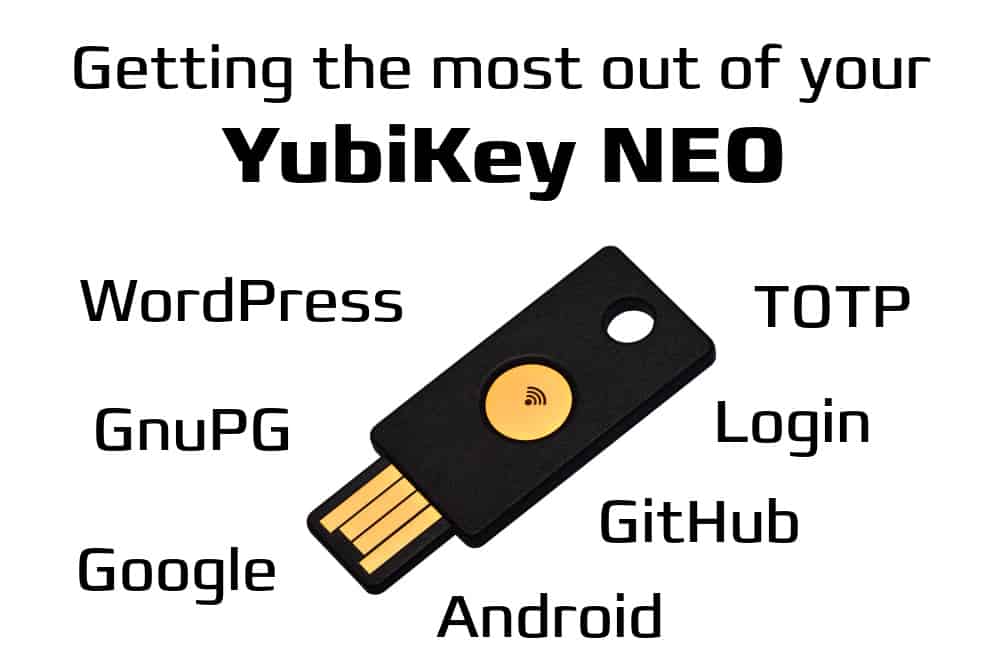
I am trying to get the best out of my Yubikey NEO by using as many of its functionality, in particular: Smartcard for my GNuPG keys, OTP similar to Google Authenticator and similar, as well as challenge-response for additional login security, as well as all that over NFC to not keep keys/passwords on my mobile phone.
While there are loads of guides (see the previous article on GnuPG for some of them), many of them are out-of-date for current distributions and GnuPG etc. So I tried to collect all I could find not the least to have a place to look it up in case I forget it again.
The Hardware
The Yubikey NEO is a great peace of hardware. I not even remotely understand how they manage that this little beast can do all these things and still work out without mixing things up. As far as I understand (please correct me) it has three independent circuits of communication:
$ ykpersonalize -m86 Firmware version 3.4.3 Touch level 1792 Unconfigured The USB mode will be set to: 0x86 Commit? (y/n) [n]: y $ |
SUBSYSTEMS=="usb", ATTRS idVendor =="1050", ATTRS idProduct =="0116", TAG+="uaccess" |
$ ykpersonalize -2 -ochal-resp -ochal-hmac -ohmac-lt64 -oserial-api-visible ... Commit? (y/n) [n]: y $ |
$ mkdir $HOME/.yubico $ ykpamcfg -2 -v ... Stored initial challenge and expected response in '/home/norbert/.yubico/challenge-123456'. $ |
Challenge: I am currently searching for a method to replace the second factor of they key optionally with a different authentication method, like a very difficult passphrase. This way I could log in even without my key, but in this case would need the complicated passphrase. From my reading of the pam manuals it seems to be possible, and I am planning to use pam_ssh and a specific login key with a complicated passphrase. I will report back when this is done.
YubiOATH (TOTP) Time based One Time Passwords (aka Google Authenticator style)
Without any setup whatsoever this worked out of the box. I use the Yubico Authenticator on my Android phone, and the dedicated application for the Linux desktop to create second factors for all kind of applications. Currently I am using it with Google login, Github, DropbBox, and WordPress (via the Two Factor plugin which can also be tweaked to use the NEO key as USB key via the FIDO U2F).
Challenge: If I start the Yubico Personalization GUI, I see two free slots so where are the TOTPs computed? That also means that I have one slot free and for now I don t know what to do with it
Yubikey OpenGPG applet setup
The Yubikeys support OpenPGP, and the applet is pre-installed (afaik), meaning you can directly configure the key and upload your keys. Here I use gpg2 (2.1) as it seems to better support card operations. To not interfere with the current gpg setup I use a temporary gpg home:
$ mkdir gpgtmp $ chmod go-rwx gpgtmp $ gpg2 --homedir gpgtmp --list-keys gpg: keybox 'gpgtmp/pubring.kbx' created gpg: gpgtmp/trustdb.gpg: trustdb created |
$ gpg-connect-agent --homedir gpgtmp --hex "scd apdu 00 f1 00 00" /bye" gpg-connect-agent: no running gpg-agent - starting '/usr/bin/gpg-agent' gpg-connect-agent: waiting for the agent to come up ... (5s) gpg-connect-agent: connection to agent established D[0000] 01 00 10 90 00 ..... OK |
$ gpg2 --homedir gpgtmp --card-edit Reader ...........: 1050:0116:X:0 Application ID ...: D2760001240102000006036457190000 Version ..........: 2.0 Manufacturer .....: Yubico Serial number ....: 03645719 Name of cardholder: [not set] Language prefs ...: [not set] Sex ..............: unspecified URL of public key : [not set] Login data .......: [not set] Signature PIN ....: forced Key attributes ...: rsa2048 rsa2048 rsa2048 Max. PIN lengths .: 127 127 127 PIN retry counter : 3 3 3 Signature counter : 0 Signature key ....: [none] Encryption key....: [none] Authentication key: [none] General key info..: [none] gpg/card> admin Admin commands are allowed gpg/card> passwd gpg: OpenPGP card no. D2760001240102000006036457190000 detected 1 - change PIN 2 - unblock PIN 3 - change Admin PIN 4 - set the Reset Code Q - quit Your selection? 3 PIN changed. 1 - change PIN 2 - unblock PIN 3 - change Admin PIN 4 - set the Reset Code Q - quit Your selection? 1 PIN changed. 1 - change PIN 2 - unblock PIN 3 - change Admin PIN 4 - set the Reset Code Q - quit Your selection? q gpg/card> quit |
gpg/card> name Cardholder's surname: Preining Cardholder's given name: Norbert gpg/card> sex Sex ((M)ale, (F)emale or space): M gpg/card> lang Language preferences: de gpg/card> login Login data (account name): norbert gpg/card> url URL to retrieve public key: https://www.preining.info/preining-norbert.asc gpg/card> list Reader ...........: 1050:0116:X:0 Application ID ...: D2760001240102000006036457190000 Version ..........: 2.0 Manufacturer .....: Yubico Serial number ....: 03645719 Name of cardholder: Norbert Preining Language prefs ...: de Sex ..............: male URL of public key : https://www.preining.info/preining-norbert.asc Login data .......: norbert Signature PIN ....: forced Key attributes ...: rsa2048 rsa2048 rsa2048 Max. PIN lengths .: 127 127 127 PIN retry counter : 3 3 3 Signature counter : 0 Signature key ....: [none] Encryption key....: [none] Authentication key: [none] General key info..: [none] gpg/card> quit |
$ gpg2 --edit-key $MASTERKEY
gpg (GnuPG) 2.1.11; Copyright (C) 2016 Free Software Foundation, Inc.
This is free software: you are free to change and redistribute it.
There is NO WARRANTY, to the extent permitted by law.
Secret key is available.
sec rsa4096/0x6CACA448860CDC13
created: 2010-09-14 expires: 2017-02-06 usage: SC
trust: ultimate validity: ultimate
ssb rsa4096/0xD1D2BD14810F62B3
created: 2010-09-14 expires: 2017-02-06 usage: E
ssb rsa2048/0xEC00B8DAD32266AA
created: 2016-02-07 expires: 2017-02-06 usage: S
ssb rsa2048/0xBF361ED434425B4C
created: 2016-02-07 expires: 2017-02-06 usage: E
ssb rsa2048/0x9C7CA4E294F04D49
created: 2016-02-07 expires: 2017-02-06 usage: A
[ultimate] (1). Norbert Preining <norbert@preining.info>
[ultimate] (2) Norbert Preining <preining@logic.at>
[ultimate] (3) Norbert Preining <preining@debian.org>
[ultimate] (4) Norbert Preining <preining@jaist.ac.jp>
[ultimate] (5) [jpeg image of size 4185]
gpg> key 2
sec rsa4096/0x6CACA448860CDC13
created: 2010-09-14 expires: 2017-02-06 usage: SC
trust: ultimate validity: ultimate
ssb rsa4096/0xD1D2BD14810F62B3
created: 2010-09-14 expires: 2017-02-06 usage: E
ssb* rsa2048/0xEC00B8DAD32266AA
created: 2016-02-07 expires: 2017-02-06 usage: S
ssb rsa2048/0xBF361ED434425B4C
created: 2016-02-07 expires: 2017-02-06 usage: E
ssb rsa2048/0x9C7CA4E294F04D49
created: 2016-02-07 expires: 2017-02-06 usage: A
[ultimate] (1). Norbert Preining <norbert@preining.info>
[ultimate] (2) Norbert Preining <preining@logic.at>
[ultimate] (3) Norbert Preining <preining@debian.org>
[ultimate] (4) Norbert Preining <preining@jaist.ac.jp>
[ultimate] (5) [jpeg image of size 4185]
gpg> keytocard
Please select where to store the key:
(1) Signature key
(3) Authentication key
Your selection? 1
sec rsa4096/0x6CACA448860CDC13
created: 2010-09-14 expires: 2017-02-06 usage: SC
trust: ultimate validity: ultimate
ssb rsa4096/0xD1D2BD14810F62B3
created: 2010-09-14 expires: 2017-02-06 usage: E
ssb* rsa2048/0xEC00B8DAD32266AA
created: 2016-02-07 expires: 2017-02-06 usage: S
ssb rsa2048/0xBF361ED434425B4C
created: 2016-02-07 expires: 2017-02-06 usage: E
ssb rsa2048/0x9C7CA4E294F04D49
created: 2016-02-07 expires: 2017-02-06 usage: A
[ultimate] (1). Norbert Preining <norbert@preining.info>
[ultimate] (2) Norbert Preining <preining@logic.at>
[ultimate] (3) Norbert Preining <preining@debian.org>
[ultimate] (4) Norbert Preining <preining@jaist.ac.jp>
[ultimate] (5) [jpeg image of size 4185]
gpg> key 2
sec rsa4096/0x6CACA448860CDC13
created: 2010-09-14 expires: 2017-02-06 usage: SC
trust: ultimate validity: ultimate
ssb rsa4096/0xD1D2BD14810F62B3
created: 2010-09-14 expires: 2017-02-06 usage: E
ssb rsa2048/0xEC00B8DAD32266AA
created: 2016-02-07 expires: 2017-02-06 usage: S
ssb rsa2048/0xBF361ED434425B4C
created: 2016-02-07 expires: 2017-02-06 usage: E
ssb rsa2048/0x9C7CA4E294F04D49
created: 2016-02-07 expires: 2017-02-06 usage: A
[ultimate] (1). Norbert Preining <norbert@preining.info>
[ultimate] (2) Norbert Preining <preining@logic.at>
[ultimate] (3) Norbert Preining <preining@debian.org>
[ultimate] (4) Norbert Preining <preining@jaist.ac.jp>
[ultimate] (5) [jpeg image of size 4185]
gpg> key 3
sec rsa4096/0x6CACA448860CDC13
created: 2010-09-14 expires: 2017-02-06 usage: SC
trust: ultimate validity: ultimate
ssb rsa4096/0xD1D2BD14810F62B3
created: 2010-09-14 expires: 2017-02-06 usage: E
ssb rsa2048/0xEC00B8DAD32266AA
created: 2016-02-07 expires: 2017-02-06 usage: S
ssb* rsa2048/0xBF361ED434425B4C
created: 2016-02-07 expires: 2017-02-06 usage: E
ssb rsa2048/0x9C7CA4E294F04D49
created: 2016-02-07 expires: 2017-02-06 usage: A
[ultimate] (1). Norbert Preining <norbert@preining.info>
[ultimate] (2) Norbert Preining <preining@logic.at>
[ultimate] (3) Norbert Preining <preining@debian.org>
[ultimate] (4) Norbert Preining <preining@jaist.ac.jp>
[ultimate] (5) [jpeg image of size 4185]
gpg> keytocard
Please select where to store the key:
(2) Encryption key
Your selection? 2
sec rsa4096/0x6CACA448860CDC13
created: 2010-09-14 expires: 2017-02-06 usage: SC
trust: ultimate validity: ultimate
ssb rsa4096/0xD1D2BD14810F62B3
created: 2010-09-14 expires: 2017-02-06 usage: E
ssb rsa2048/0xEC00B8DAD32266AA
created: 2016-02-07 expires: 2017-02-06 usage: S
ssb* rsa2048/0xBF361ED434425B4C
created: 2016-02-07 expires: 2017-02-06 usage: E
ssb rsa2048/0x9C7CA4E294F04D49
created: 2016-02-07 expires: 2017-02-06 usage: A
[ultimate] (1). Norbert Preining <norbert@preining.info>
[ultimate] (2) Norbert Preining <preining@logic.at>
[ultimate] (3) Norbert Preining <preining@debian.org>
[ultimate] (4) Norbert Preining <preining@jaist.ac.jp>
[ultimate] (5) [jpeg image of size 4185]
gpg> key 3
sec rsa4096/0x6CACA448860CDC13
created: 2010-09-14 expires: 2017-02-06 usage: SC
trust: ultimate validity: ultimate
ssb rsa4096/0xD1D2BD14810F62B3
created: 2010-09-14 expires: 2017-02-06 usage: E
ssb rsa2048/0xEC00B8DAD32266AA
created: 2016-02-07 expires: 2017-02-06 usage: S
ssb rsa2048/0xBF361ED434425B4C
created: 2016-02-07 expires: 2017-02-06 usage: E
ssb rsa2048/0x9C7CA4E294F04D49
created: 2016-02-07 expires: 2017-02-06 usage: A
[ultimate] (1). Norbert Preining <norbert@preining.info>
[ultimate] (2) Norbert Preining <preining@logic.at>
[ultimate] (3) Norbert Preining <preining@debian.org>
[ultimate] (4) Norbert Preining <preining@jaist.ac.jp>
[ultimate] (5) [jpeg image of size 4185]
gpg> key 4
sec rsa4096/0x6CACA448860CDC13
created: 2010-09-14 expires: 2017-02-06 usage: SC
trust: ultimate validity: ultimate
ssb rsa4096/0xD1D2BD14810F62B3
created: 2010-09-14 expires: 2017-02-06 usage: E
ssb rsa2048/0xEC00B8DAD32266AA
created: 2016-02-07 expires: 2017-02-06 usage: S
ssb rsa2048/0xBF361ED434425B4C
created: 2016-02-07 expires: 2017-02-06 usage: E
ssb* rsa2048/0x9C7CA4E294F04D49
created: 2016-02-07 expires: 2017-02-06 usage: A
[ultimate] (1). Norbert Preining <norbert@preining.info>
[ultimate] (2) Norbert Preining <preining@logic.at>
[ultimate] (3) Norbert Preining <preining@debian.org>
[ultimate] (4) Norbert Preining <preining@jaist.ac.jp>
[ultimate] (5) [jpeg image of size 4185]
gpg> keytocard
Please select where to store the key:
(3) Authentication key
Your selection? 3
sec rsa4096/0x6CACA448860CDC13
created: 2010-09-14 expires: 2017-02-06 usage: SC
trust: ultimate validity: ultimate
ssb rsa4096/0xD1D2BD14810F62B3
created: 2010-09-14 expires: 2017-02-06 usage: E
ssb rsa2048/0xEC00B8DAD32266AA
created: 2016-02-07 expires: 2017-02-06 usage: S
ssb rsa2048/0xBF361ED434425B4C
created: 2016-02-07 expires: 2017-02-06 usage: E
ssb* rsa2048/0x9C7CA4E294F04D49
created: 2016-02-07 expires: 2017-02-06 usage: A
[ultimate] (1). Norbert Preining <norbert@preining.info>
[ultimate] (2) Norbert Preining <preining@logic.at>
[ultimate] (3) Norbert Preining <preining@debian.org>
[ultimate] (4) Norbert Preining <preining@jaist.ac.jp>
[ultimate] (5) [jpeg image of size 4185]
gpg> key 4
sec rsa4096/0x6CACA448860CDC13
created: 2010-09-14 expires: 2017-02-06 usage: SC
trust: ultimate validity: ultimate
ssb rsa4096/0xD1D2BD14810F62B3
created: 2010-09-14 expires: 2017-02-06 usage: E
ssb rsa2048/0xEC00B8DAD32266AA
created: 2016-02-07 expires: 2017-02-06 usage: S
ssb rsa2048/0xBF361ED434425B4C
created: 2016-02-07 expires: 2017-02-06 usage: E
ssb rsa2048/0x9C7CA4E294F04D49
created: 2016-02-07 expires: 2017-02-06 usage: A
[ultimate] (1). Norbert Preining <norbert@preining.info>
[ultimate] (2) Norbert Preining <preining@logic.at>
[ultimate] (3) Norbert Preining <preining@debian.org>
[ultimate] (4) Norbert Preining <preining@jaist.ac.jp>
[ultimate] (5) [jpeg image of size 4185]
gpg> save |
The other open question is what to use the other available slot of the Yubikey for? I thought about some passwords (possible), but I don t feel to happy about having my password issued with the press of a key.
But all in all, I like the setup much more than before and not having any GnuPG key on the laptop is a big plus.
Next.