after the rather intensive last week, this
week was more business as usual. here's the list:
As this year's admin, I wrote up the following summary which has now been
posted at the R site in the appropriate slot. My thanks to
this year's students, fellow mentors and everybody else who helped to make it
happen.
f:R^m -> R^n, through Automatic Differentiation (AD). Numerical evaluation of derivatives has widespread uses in many
fields. rdx will implement two modes for the computation of derivatives, the Forward and Reverse modes of AD, combining
which we can efficiently compute Jacobians and Hessians. Higher order derivatives will be evaluated through Univariate
Taylor Propagation.
Delivered:
Two packages
radx: forward automatic differentiation in R and
tada: templated automatic differentiation in C++ were created; see
this blog post for details.
Last modified: Wed Sep 22 19:39:43 CDT 2010
Remember the one rc bug a daysactivities from Steinar and Zack? Well, maybe I won't make to one rc bug per day, but at least I could blog about some of my recent activities. Maybe it motivates some others? #553248
libnel-dev: missing-dependency-on-libc needed...
missing symbols in library
Links against libclamav
Unmet Recommends on extremetuxracer-racer
FTBFS on kfreebsd-*: need to define type GLUTesselatorFunction
planetpenguin-racer-extras: Outdated; needs restructured and updated to be usefull
aegir-provision: /etc/aegir/drushrc.php PHP error,
aegir-provision: /etc/aegir and /etc/aegir/drushrc.php file permissions
kernel-patch-nfs-ngroups: doesn't apply anymore
mediatomb allows anyone to browse and export the whole filesystem
jamin: Ships files in /usr/lib64/
init.d script fails under Squeeze with insserv due to lack of run level definitions
dibbler-client: after removing package with dselect impossible to purge it.
havp 0.91-1.1~volatile1 still haven't show up in lenny-volatile yet.
hplip: text missing at the bottom of a page on HP DJ 5550
Various people observed in a long thread on debian-devel that the grub2 package was in a bit of a mess in terms of its release-critical bug count, and Jordi and Stefano both got in touch with me directly to gently point out that I probably ought to be doing something about it as one of the co-maintainers.
Actually, I don't think grub2 was in quite as bad a state as its 18 RC bugs suggested. Of course every boot loader failure is critical to the person affected by it, not to mention that GRUB 2 offers more complex functionality than any other boot loader (e.g. LVM and RAID), and so it tends to accumulate RC bugs at rather a high rate. That said, we'd been neglecting its bug list for some time; Robert and Felix have both been taking some time off, Jordi mostly only cared about PowerPC and can't do that any more due to hardware failure, and I hadn't been able to pick up the slack.
Most of my projects at work for the next while involve GRUB in one way or another, so I decided it was a perfectly reasonable use of work time to do something about this; I was going to need fully up-to-date snapshots anyway, and practically all the Debian grub2 bugs affect Ubuntu too. Thus, with the exception of some other little things like releasing the first Maverick alpha, I've spent pretty much the last week and a half solidly trying to get the grub2 package back into shape, with four uploads so far.
The RC issues that remain are:
upgrade-from-grub-legacy problems (#547944, #550477):upgrade-from-grub-legacy, and I should be able to unpick the bugs this way.
mdadm switched its default from the old 0.90 format which GRUB understood. Felix put together a branch implementing the hard parts of this a while back, and I've been trying to finish it off. The hard bit is dealing with device naming, especially as the new-format and rather more useful names under /dev/md/ don't show up during d-i after creating RAID volumes; I think this is because we always create them as /dev/md0 etc. It's looking tractable, though.
grub-install not being properly run (#557425 and many other sub-RC bugs):device.map files (#575076 and other sub-RC bugs):device.map in general. It was fine in the 1990s but it's hopeless now. Unfortunately there are still a small number of problems with running entirely without one, and one of my patches to help is controversial upstream, so we probably won't get to that for squeeze. In the meantime we'll probably just need some extra sanity-checking and robustness in the event that there's an incorrect or out-of-date device.map lying around, which we may just be able to do in the maintainer scripts or something if necessary.
grub-emu on sparc as a workaround.
grub-mkconfig a bit more robust in the event that the root filesystem isn't one that GRUB understands (#561855, #562672), and I'd quite like to write some more documentation.
On the upside, progress has been good. We have multiple terminal support thanks to a new upstream snapshot (#506707), update-grub runs much faster (#508834, #574088), we have DM-RAID support with a following wind (#579919), the new scheme with symlinks under /dev/mapper/ works (#550704), we have basic support for btrfs / as long as you have something GRUB understands properly on /boot (#540786), we have full info documentation covering all the user-adjustable settings in /etc/default/grub, and a host of other smaller fixes. I'm hoping we can keep this up.
If you'd like to help, contact me, especially if there's something particular that isn't being handled that you think you could work on. GRUB 2 is actually quite a pleasant codebase to work on once you get used to its layout; it's certainly much easier to fix bugs in than GRUB Legacy ever was, as far as I'm concerned. Thanks to tools like grub-probe and grub-fstest, it's very often possible to fix problems without needing to reboot for anything other than a final sanity check (although KVM certainly helps), and you can often debug very substantial bits of the boot loader - the bits that actually go wrong - using standard tools such as strace and gdb. Upstream is helpful and I've been able to get many of the problems above fixed directly there. If you have a sound knowledge of C and a decent level of understanding of the environment a boot loader needs to operate in - or for that matter specialist knowledge of interesting device types - then you should be able to find something to do.
Over the last few months I ve been working for Igalia, as an intern, fixing regressions in Epiphany, which extends to WebKitGTK+ sometimes. Surely a dream job: working on my favourite projects, on a great company, surrounded by great teammates and friends.
I m happy about it, really really happy. I love this job, totally, completely!. I ve had the chance to learn a lot. Here I d like to share some things I have learned so far, I look forward to post again with more ideas, but meanwhile here you have two.
Different timezones are hard
The time when I find most of the Igalia crew online is between 2am and 12pm. Of course this doesn t mean you can t find them past 12pm, but it s already 7pm or 8pm in Europe then. I m on UTC-5 and Spain is on UTC+1 or (now) UTC+2.
You probably agree that asking anyone to wake up at 7am in summer is unrealistic. Luckily, Igalia doesn t make me pass a turing test everyday at a fixed time. This rocks.

Valpara so, Chile
I love it when people understand that a happy hacker working at midnight is better than an unhappy hacker working on a set in stone schedule. Kudos to Igalia for that.
Your code should explain and defend itself
My written expression teacher says Your text should be good enough to explain and defend itself . This applies to code too. I confirmed this at the expense of Xan s patience.
It s a common situation: when the maintainer reviews your patch you are not around to explain it, or present the rationale you put into the change. The solution? well, simple, your patch and commit log should explain by themselves.

Don t just post a patch and do this.
Review it yourself.
I saw, after realising how much ping-pong Xan and I had to play to get a patch in, that my patches lacked a harder review by myself before being posted. You have to be your first reviewer.
Be a severe judge of your patch, ask yourself if you would accept such a patch, if you would like a commit message like that, if that variable name is really good, if someone could quickly grasp what s it all about, etc. Get into the flippy flops of the maintainer, don t assume everything is obvious to everyone.
A few hours ago, I sent the following to both the R development list and the informal R / GSoC list:
Date: Mon, 26 Apr 2010 15:27:29 -0500
To: R Development List <r-devel>
CC: gsoc-r <gsoc-r>
Subject: R and the Google Summer of Code 2010 -- Please welcome our new students!
From: Dirk Eddelbuettel <edd>
Earlier today Google finalised student / mentor pairings and allocations for
the Google Summer of Code 2010 (GSoC 2010). The R Project is happy to
announce that the following students have been accepted:
Colin Rundel, "rgeos - an R wrapper for GEOS", mentored by Roger Bivand of
the Norges Handelshoyskole, Norway
Ian Fellows, "A GUI for Graphics using ggplot2 and Deducer", mentored by
Hadley Wickham of Rice University, USA
Chidambaram Annamalai, "rdx - Automatic Differentiation in R", mentored by
John Nash of University of Ottawa, Canada
Yasuhisa Yoshida, "NoSQL interface for R", mentored by Dirk Eddelbuettel,
Chicago, USA
Felix Schoenbrodt, "Social Relations Analyses in R", mentored by Stefan
Schmukle, Universitaet Muenster, Germany
Details about all proposals are on the R Wiki page for the GSoC 2010 at
http://rwiki.sciviews.org/doku.php?id=developers:projects:gsoc2010
The R Project is honoured to have received its highest number of student
allocations yet, and looks forward to an exciting Summer of Code. Please
join me in welcoming our new students.
At this time, I would also like to thank all the other students who have
applied for working with R in this Summer of Code. With a limited number of
available slots, not all proposals can be accepted -- but I hope that those
not lucky enough to have been granted a slot will continue to work with R and
towards making contributions within the R world.
I would also like to express my thanks to all other mentors who provided for
a record number of proposals. Without mentors and their project ideas we
would not have a Summer of Code -- so hopefully we will see you again next
year.
Regards,
Dirk (acting as R/GSoC 2010 admin)
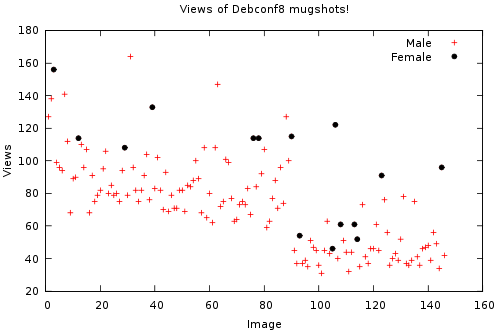
In a comment to my previous blog post, I linked to the DebConf photo gallery page with the DebConf8 mugshots. Felix Brandt, a friend of mine, noticed the per-picture view statistics there and plotted them, differentiating between male and female. He finds that the number of views on an image gives a fairly good indication of the sex (or gender?) of the person in question:
The most notable exception is the image of bubulle. He does not even look feminine. Maybe it s because he s like a mother to us Debianers, always kind and always helpful? :-)
This observation fits my experience when I created a top-100-statistic of individual picture page views of my personal gallery: I got a collection of pretty much all pictures of girls in bikinis, lying at some beach, across the various pages and years, and hardly any other picture. I won t post these top-100 here, as I don t want to additionally increase the effect...
:)
Poking around the web site for Law in Contemporary Society, a class taught this semester by Eben Moglen, (who is counsel for the Free Software Foundation and founder of the Software Freedom Law Center), i found Felix Cohen's Trancendental Nonsense and the Functional Approach, which (according to wikipedia) is one of "the most-cited law review articles ever written". I haven't read the whole thing yet (and i'm neither a lawyer nor a philosopher) but it's fascinating reading. And from what i've read so far, it's a strong push toward directly addressing the values that lie hidden beneath our technical or mechanical decisions, and to avoid mistaking technical success or skill with a worthwhile outcome and clear goals at a societal level. This is something we software developers and system administrators struggle with as well (or at least i think we should). It's neat to get my head around these concepts from a different intellectual sphere, and a different era (74 years ago!) when the technical and mechanical tools i work with didn't exist in anything like their present form. This kind of reading makes me wonder what works from Computer Science or Systems Engineering or Information Technology will have this kind of exhortative power and social relevance so far into the future. Do you have a favorite (or abhorred?) text from your field that offers the kind of moral and technical challenges that Cohen's work does?Tags: law, moglen, philosophy
Some more information about my current research for flights to Debconf. First of all, the conditions:
Up until recently, I’ve been supporting John Connolly as candidate for city council. In addition to the recent concerns about anonymous mailings, I’m now getting hammered by his auto-dialer. I’ve received four prerecorded phone calls today and yesterday reminding me to vote for Connolly. (By contrast, I got one real human phone call from a Michael Flaherty supporter.) Now with a few hours left to vote, I’m on the fence. I wish this guy would leave me alone.
In the meantime, a WBUR interview claims that Felix Arroyo is the most vulnerable candidate (something I’ve never heard elsewhere). If that’s the case, I’m tempted to just bullet-vote for Felix.
I hope this last-minute vacillation doesn’t make me an idgit voter.
5pm update: three more automated phone calls! One for Murphy from Consalvo; and two for Connolly (one from Tobin, the other I forget). They’re pulling out all the stops, only at the last minute. I wonder who the dismal weather (and poor turnout) favors.
7pm update: three or four more calls, now including real humans! My wife figured out part of the reason we’re getting so many — separate calls each for her and me, even though it’s all on the same phone number.
In any case, we’ve all voted now. I did end up including Connolly in my votes despite these over-the-top tactics. I guess it shows, at least, that he’s well organized.
Technorati Tags: Boston, City Council, Felix Arroyo, John Connolly
I was quoted in a recent Needham Times article regarding my complaints with the T:
But Adam Rosi-Kessel, a Roslindale resident who takes the Needham Line to his job in the financial district, said 15- to 20-minute delays have kept him from getting to work before 9 a.m. since May. Now Rosi-Kessel, a lawyer who biked to work when he lived in Jamaica Plain, is thinking about trading in his Charlie Card again. It used to be, living here in Roslindale, the train was always the fastest way to get in, he said. Now, it s slowed down to the point where it s starting to get competitive with biking again.I’m glad they got my biking quote. Here’s the part I don’t understand (emphasis added):
Massachusetts Bay Transportation Authority spokeswoman Lydia Rivera said Needham Line delays have been caused by construction work and speed restrictions on tracks that don t go anywhere near Needham. In order to maximize train use, the T often transfers trains between tracks, rather than leaving underused trains empty in the MBTA yard. The method helps the T get trains where they re needed most, but it also means a delay on one track can slow service on a seemingly unrelated track. It s a Catch-22, Rivera said.I don’t think the T spokesperson knows what a “Catch-22″ is. I refer those interested to the Wikipedia article on the subject, but it is nicely summarized there as “heads I win, tails you lose.” The T’s problem is not a logical paradox, but some combination of inadequate resources and poor organization. Can someone please help them out? Also on Boston local topics: I’ve received several unattributed mailings lately related to the city council election that do not facially promote any particular candidate. Today’s mailing attacked Stephen Murphy for repeatedly trying (and failing) to win some other office or get some other job than City Councilor. The return address was 31 Milk Street, which is the address of many different businesses. A few days ago, I received another unattributed mailing bemoaning how long it has been since an at-large city councilor came from the Parkway Area (my neighborhood), but not mentioning any candidate in particular. My guess is these mailings are all meant to support John Connolly, a West Roxbury resident, attorney, and ostensibly good guy. I was feeling pretty happy about the possibility of Connolly replacing Murphy on the Council (I have to admit some unfair prejudice in that the only house in our neighborhood I’ve ever seen prominently posting a sign in support of Bush also features a Murphy billboard). But these questionable campaign tactics are giving me pause. Does anyone know anything more about this? In any case, here are my endorsements for next week’s election, notwithstanding the concern outlined above: (1) Felix Arroyo, (2) John Connolly, and (3) Sam Yoon.
Next.