Review: The Martian Contingency, by Mary Robinette Kowal
Series:
Lady Astronaut #4
Publisher:
Tor
Copyright:
2025
ISBN:
1-250-23703-3
Format:
Kindle
Pages:
390
The Martian Contingency is the fourth book of the mostly-realistic
science fiction alternate history series that began with the novelette
"The Lady Astronaut of Mars" and the
novel The Calculating Stars. It returns
to Elma York as the main character, covering her second trip to Mars after
the events of The Fated Sky. It's
helpful to remember the events of the previous two books to follow some of
the plot.
Elma is back on Mars, this time as second in command. The immediate goal
of the second Mars mission is to open more domes and land additional crew
currently in orbit, creating the first permanent human settlement on Mars.
The long-term goal is to set up Mars as a refuge in case the greenhouse
effect caused by the meteor strike in The Calculating Stars
continues to spiral out of control. Elma is anxious and not looking
forward to being partly in charge, particularly since her position is
partly due to her fame with the public (and connection with the American
president). She'd rather just be a pilot. But she'll do what the mission
needs from her, and at least this time her husband is with her on Mars.
As one might expect from earlier installments of this series, The
Martian Contingency starts with the details and rhythms of life in a
dangerous, highly technical, and mission-driven scientific environment:
hard science fiction of the type most closely modeled on NASA and real
space missions. Given that this is aimed at permanent Mars colonies that
would theoretically have to be independent of Earth, it requires a huge
amount of suspension of disbelief for the premise, but Kowal at least
tries for verisimilitude in the small details. I am not an expert in early
space program technology (Kowal's alternate history diverges into a
greatly accelerated space program in the 1950s and, for example, uses
female mathematicians for most calculations), so I don't know how
successful this is, but it feels crunchy and believable.
As with the previous books, though, this is not just a day in the life of
an astronaut. There's something wrong, something that happened during the
first Mars expedition while Elma was in orbit and left odd physical clues,
and no one is willing to talk about it. Elma is just starting to poke
around before the politics at home go off the rails (again), exacerbated
by a cringe-worthy social error by Elma herself, and she once again has to
navigate egregious sexism and political meddling in a highly dangerous
environment a long way from home.
It is a little surprising that I like this series as much as I do. I don't
particularly care for pseudo-realistic science fiction, although I admit
there is something deeply satisfying about reading about people following
checklists properly. The idea of permanent Mars colonies as an escape from
a doomed Earth is unbelievable and deeply silly, but Kowal locked herself
into that alternate future with "The Lady Astronaut of Mars," which is
still set in the future of all of the books so far. A primary conflict in
each of the books comes from the egregious sexism and racism of a culture
based on 1950s American attitudes towards both, and the amount of progress
Elma can make against either is limited, contingent, and constantly
compromised.
And yet. At its best, this series is excellent competence porn, both in
the spirit of the Apollo 13 movie and for the navigation of social
and political obstacles and idiocy. Elma is highly competent in a
believable and sympathetic way, with strengths, weaknesses, and an ongoing
struggle with anxiety. There is something rewarding in watching people
solve problems and eventually triumph by being professional, careful,
principled, and creative. It's enough to make a good book, even if I am
not that interested in the setting and technology.
As with the rest of the series, this will not be for everyone. You have to
be up for reading about a lot of truly awful sexism and racism without the
payoff of a complete triumph. This is a system that Elma navigates, not
overthrows, and that's not going to be enough for some readers. You also
have to accept the premise of a Mars colony, which in an otherwise hard
science fiction novel is a bit much despite Kowal's attempts to
acknowledge some of the difficulties. But if you don't mind that
drawbacks, this series continues to be an opportunity to read about people
being quietly and professionally competent.
This is not my favorite entry, mostly because Elma makes a rather
humiliating mistake that's central to the plot and has a lot of
after-effects (and therefore a lot of time in the spotlight), and because
there is rather a lot of discussion of sexuality that felt childish to me.
The intent was to try to capture the way people in the 1950s talked about
sex, and perhaps Kowal was successful in that, but I didn't enjoy the
experience. But I still found myself pulled into the plot and happily
rooting for the characters, even though a reader of "The Lady Astronaut of
Mars" has a pretty good idea of how everything will turn out.
If you liked the series so far, recommended, although I doubt it will be
the favorite entry for most readers. If you did not like the earlier books
of the series, this one will not change your mind.
Content notes: Way, way too much detailed discussion of an injury to a
fingernail than I wanted to read, as well as some other rather explicit
description of physical injury. Reproductive health care through the lens
of the 1950s, so, uh, yeah. A whole lot of sexism, racism, and other forms
of discrimination that is mostly worked around rather than confronted.
Rating: 7 out of 10
Introduction
With various forms of IM becoming so prevalent and a lot of communication that used to be via email happening via IM I ve been thinking about the differences between Email and IM.
I think it s worth comparing them not for the purpose of convincing people to use one or the other (most people will use whatever is necessary to communicate with the people who are important to them) but for the purpose of considering ways to improve them and use them more effectively.
Also I don t think that users of various electronic communications systems have had a free choice in what to use for at least 25 years and possibly much longer depending on how you define a free choice. What you use is determined by who you want to communicate with and by what systems are available in your region. So there s no possibility of an analysis of this issue giving a result of let s all change what we use as almost everyone lacks the ability to make a choice.
What the Difference is Not
The name Instant Messaging implies that it is fast, and probably faster than other options. This isn t necessarily the case, when using a federated IM system such as Matrix or Jabber there can be delays while the servers communicate with each other.
Email used to be a slow communication method, in the times of UUCP and Fidonet email there could be multiple days of delay in sending email. In recent times it s expected that email is quite fast, many web sites have options for authenticating an email address which have to be done within 5 minutes so the common expectation seems to be that all email is delivered to the end user in less than 5 minutes.
When an organisation has a mail server on site (which is a common configuration choice for a small company) the mail delivery can be faster than common IM implementations.
The Wikipedia page about Instant Messaging [1] links to the Wikipedia page about Real Time Computing [2] which is incorrect. Most IM systems are obviously designed for minimum average delays at best. For most software it s not a bad thing to design for the highest performance on average and just let users exercise patience when they get an unusual corner case that takes much longer than expected.
If an IM message takes a few minutes to arrive then that s life on the Internet which was the catchphrase of an Australian Internet entrepreneur in the 90s that infuriated some of his customers.
Protocol and Data Format Differences
Data Formats
Email data contains the sender, one or more recipients, some other metadata (time, subject, etc), and the message body. The recipients are typically an arbitrary list of addresses which can only be validated by the destination mail servers. The sender addresses weren t validated in any way and are now only minimally validated as part of anti-spam measures.
IM data is sent through predefined connections called rooms or channels. When an IM message is sent to a room it can tag one or more members of the room to indicate that they may receive a special notification of the message.
In many implementations it s possible to tag a user who isn t in the room which may result in them being invited to the room. But in IM there is no possibility to add a user to the CC list for part of a discussion and then just stop CCing messages to them later on in the discussion.
Protocols
Internet email is a well established system with an extensive user base. Adding new mandatory features to the protocols isn t viable because many old systems won t be updated any time soon. So while it is possible to send mail that s SSL encrypted and has a variety of authentication mechanisms that isn t something that can be mandatory for all email. Most mail servers are configured to use the SSL option if it s available but send in cleartext otherwise, so a hostile party could launch a Man In the Middle (MITM) attack and pretend to be the mail server in question but without SSL support.
Modern IM protocols tend to be based on encryption, even XMPP (Jabber) which is quite an old IM protocol can easily be configured to only support encrypted messaging and it s reasonable to expect that all other servers that will talk to you will at least support SSL. Even for an IM system that is run by a single company the fact that communication with the servers is encrypted by SSL makes it safer than most email. A security model of this can only be read by you, me, and the staff at an American corporation isn t the worst type of Internet security.
The Internet mail infrastructure makes no attempt to send mail in order and the design of the Simple Mail Transfer Protocol (SMTP) means that a network problem after a message has been sent but before the recipient has confirmed receipt will mean that the message is duplicated and this is not considered to be a problem.
The IM protocols are designed to support reliable ordered transfer of messages and Matrix (the most recently designed IM protocol) has cryptographic connections between users.
Forgery
For most email systems there is no common implementation that prevents forging email. For Internet email transferred via SMTP it s possible to use technologies like SPF and DKIM/DMARC to make recipients aware of attempts at forgery, but many recipient systems will still allow email that fails such checks to be delivered. The default configuration tends to be permitting everything and all of the measures to prevent forgery require extra configuration work and often trade-offs as some users desire features that go against security. The default configuration of most mail servers doesn t even prevent trivial forgeries of email from the domain(s) owned by that server.
For evidence check the SPF records of some domains that you communicate with and see if they end with -all (to block email from bad sources), ~all (to allow email from bad sources through after possibly logging an error), ?all (to be neutral on mail from unknown sources, or just lack a SPF record entirely. The below shows that of the the top four mail servers in the world only outlook.com has a policy to reject mail from bad sources.
In most IM systems there is a strong connection between people who communicate. If I send you two direct messages they will appear in the same room, and if someone else tries forging messages from me (EG by replacing the c and e letters in my address with Cyrillic letters that look like them or by mis-spelling my name) a separate room will be created and it will be obvious that something unexpected is happening. Protecting against the same attacks in email requires the user carefully reading the message, given that it s not uncommon for someone to start a message to me with Hi Russel (being unable to correctly copy my name from the To: field of the message they are writing) it s obvious that any security measure relying on such careful reading will fail.
The IM protections against casual forgery also apply to rooms with multiple users, a new user can join a room for the purpose of spamming but they can t send a casual message impersonating a member of the room. A user can join a Matrix room I m in with the name Russell from another server but the potential for confusion will be minimised by a message notifying everyone that another Russell has joined the room and the list of users will show two Russells. For email the protections against forgery when sending to a list server are no different than those when sending to an individual directly which means very weak protections.
Authenticating the conversation context once as done with IM is easier and more reliable than authenticating each message independently.
Is Email Sucking the Main Technical Difference?
It seems that the problems with forgery, spam, and general confusion when using email are a large part of the difference between email and IM.
But in terms of technical issues the fact that email has significantly more users (if only because you need an email account to sign up for an IM system) is a major difference.
Internet email is currently a universal system (apart from when it breaks from spam) and it has historically been used to gateway to other email systems like Fidonet, Uucp, and others. The lack of tight connection between parties that exchange messages in email makes it easier to bridge between protocols but harder to authenticate communication.
Most of the problems with Internet email are not problems for everyone at all times, they are technical trade-offs that work well for some situations and for some times. Unfortunately many of those trade-offs are for things that worked well 25+ years ago.
The GUI
From a user perspective there doesn t have to be a great difference between email and IM. Email is usually delivered quickly enough to be in the same range as IM. The differences in layout between IM client software and email client software is cosmetic, someone could write an email client that organises messages in the same way as Slack or another popular IM system such that the less technical users wouldn t necessarily know the difference.
The significant difference in the GUI for email and IM software was a design choice.
Conversation Organisation
The most significant difference in the operation of email and IM at the transport level is the establishment of connections in IM. Another difference is the fact that there are no standards implemented for the common IM implementations to interoperate which is an issue of big corporations creating IM systems and deliberately making them incompatible.
The methods for managing email need to be improved. Having an inbox that s an unsorted mess of mail isn t useful if you want to track one discussion, breaking it out into different sub folders for common senders (similar to IM folders for DMs) as a standard feature without having to setup rules for each sender would be nice. Someone could design an email program with multiple layouts, one being the traditional form (which seems to be copied from Eudora [3]) and one with the inbox (or other folders) split up into conversations. There are email clients that support managing email threads which can be handy in some situations but often isn t the best option for quickly responding to messages that arrived recently.
Archiving
Most IM systems have no method for selectively archiving messages, there s a request open for a bookmark function in Matrix and there s nothing stopping a user from manually copying a message. But there s nothing like the convenient ability to move email to an archive folder in most IM systems.
Without good archiving IM is a transient medium. This is OK for conversations but not good for determining the solutions to technical problems unless there is a Wiki or other result which can be used without relying on archives.
Composing Messages
In a modern email client when sending a message it prompts you for things that it considers complete, so if you don t enter a Subject or have the word attached in the message body but no file is attached to the message then it will prompt you to confirm that you aren t making a mistake. In an IM client the default is usually that pressing ENTER sends the message so every paragraph is a new message. IM clients are programmed to encourage lots of short messages while email clients are programmed to encourage more complete messages.
Social Issues
Quality
The way people think about IM and email is very different, as one example there was never a need for a site like nohello.net for email.
The idea that it s acceptable to use even lower quality writing in IM than people tend to use in email seems to be a major difference between the communication systems.
It can be a good thing to have a chatty environment with messages that are regarded as transient for socialising, but that doesn t seem ideal for business use.
Ownership
Email is generally regarded as being comparable to physical letters. It is illegal and widely considered to be socially wrong to steal a letter from someone s letterbox if you regret sending it. In email the only unsend function I m aware of is that in Microsoft software which is documented to only work within the same organisation, and that only works if the recipient hasn t read the message. The message is considered to be owned by the recipient.
But for IM it s a widely supported and socially acceptable function to delete or edit messages that have been sent. The message is regarded as permanently the property of the sender.
What Should We Do?
Community Creators
When creating a community (and I use this in the broadest sense including companies) you should consider what types of communication will work well.
When I started the Flounder group [4] I made a deliberate decision that non-free communication systems go against the aim of the group, I started it with a mailing list and then created a Matrix room which became very popular. Now the list hardly gets any use. It seems that most of the communication in the group is fairly informal and works better with IM.
Does it make sense to use both?
Should IM systems be supplemented with other systems that facilitate more detail such as a Wiki or a Lemmy room/instance [5] to cover the lack of long form communication? I have created a Lemmy room for Flounder but it hasn t got much interest so far.
It seems that almost no-one makes a strategic decision about such issues.
Software Developers
It would be good to have the same options for archiving IM as there are for email. Also some options to encourage quality in IM communication similar to the way email clients want confirmation before sending messages without a subject or that might be missing an attachment.
It would also be good to have better options for managing conversations in email. The Inbox as currently used is good for some things but a button to switch between that and a conversation view would be good. There are email clients that allow selecting message sort order and aggregation (kmail has a good selection of options) but they are designed for choosing a single setup that you like not between multiple views based on the task you are doing.
It would be good to have links between different communication systems, if users had the option of putting their email address in their IM profile it would make things much easier. Having entirely separate systems for email and IM isn t good for users.
Users
The overall communications infrastructure could be improved if more people made tactical decisions about where and how to communicate. Keep the long messages to email and the chatty things to IM. Also for IM just do the communication not start with hello . To discourage wasting time I generally don t reply to messages that just say hello unless it s the first ever IM from someone.
Conclusion
A large part of the inefficiencies in electronic communication are due to platforms and usage patterns evolving with little strategic thought. The only apparent strategic thought is coming from corporations that provide IM services and have customer lock in at the core of their strategies.
Free software developers have done great work in developing software to solve tactical problems but the strategies of large scale communications aren t being addressed.
Email is loosely coupled and universal while IM is tightly coupled, authenticated, and often siloed. This makes email a good option for initial contact but a risk for ongoing discussions.
There is no great solution to these issues as they are largely a problem due to the installed user base. But I think we can mitigate things with some GUI design changes and strategic planning of communication.
I miss the US more and more, and have recently been trying to perfect Southern
Biscuits using British ingredients. It took me eight or nine tries before I
was consistently getting good results. Here is my recipe.
Ingredients
190g plain flour
60g strong white bread flour
4 tsp baking powder
tsp bicarbonate of soda
1 tsp cream of tartar (optional)
1 tsp salt
100g unsalted butter
180ml buttermilk, chilled
If your buttermilk is thicker than the consistency of ordinary milk,
you ll need around 200ml.
extra buttermilk for brushing
Method
Slice and then chill the butter in the freezer for at least fifteen
minutes.
Preheat oven to 220 C with the fan turned off.
Twice sieve together the flours, leaveners and salt. Some salt may not go
through the sieve; just tip it back into the bowl.
Cut cold butter slices into the flour with a pastry blender until the
mixture resembles coarse crumbs: some small lumps of fat remaining is
desirable. In particular, the fine crumbs you are looking for when making
British scones are not wanted here. Rubbing in with fingertips just won t
do; biscuits demand keeping things cold even more than shortcrust pastry
does.
Make a well in the centre, pour in the buttermilk, and stir with a metal
spoon until the dough comes together and pulls away from the sides of the
bowl. Avoid overmixing, but I ve found that so long as the ingredients are
cold, you don t have to be too gentle at this stage and can make sure all
the crumbs are mixed in.
Flour your hands, turn dough onto a floured work surface, and pat together
into a rectangle. Some suggest dusting the top of the dough with flour,
too, here.
Fold the dough in half, then gather any crumbs and pat it back into the
same shape. Turn ninety degrees and do the same again, until you have
completed a total of eight folds, two in each cardinal direction. The
dough should now be a little springy.
Roll to about inch thick.
Cut out biscuits. If using a round cutter, do not twist it, as that seals
the edges of the biscuits and so spoils the layering.
Transfer to a baking sheet, placed close together (helps them rise).
Flour your thumb and use it to press an indent into the top of each
biscuit (helps them rise straight), brush with buttermilk.
Bake until flaky and golden brown: about fifteen minutes.
Gravy
It turns out that the pepper gravy that one commonly has with biscuits is
just a white/b chamel sauce made with lots of black pepper. I haven t got a
recipe I really like for this yet. Better is a sausage gravy ; again this
has a white sauce as its base, I believe. I have a vegetarian recipe for this
to try at some point.
Variations
These biscuits do come out fluffy but not so flaky. For that you can try
using lard instead of butter, if you re not vegetarian (vegetable shortening
is hard to find here).
If you don t have a pastry blender and don t want to buy one you can try not
slicing the butter and instead coarsely grating it into the flour out of the
freezer.
An alternative to folding is cutting and piling the layers.
You can try rolling out to 1 1 inches thick.
Instead of cutting out biscuits you can just slice the whole piece of dough
into equal pieces. An advantage of this is that you don t have to re-roll,
which latter also spoils the layering.
Instead of brushing with buttermilk, you can take them out after they ve
started to rise but before they ve browned, brush them with melted butter
and put them back in.
Notes
I ve had more success with Dale Farm s buttermilk than Sainsbury s own. The
former is much runnier.
Southern culture calls for biscuits to be made the size of cat s heads.
Bleached flour is apparently usual in the South, but is illegal(!) here.
Apparently bleaching can have some effect on the development of the gluten
which would affect the texture.
British plain flour is made from soft wheat and has a lower percentage of
protein/gluten, while American all-purpose flour is often(?) made from
harder wheat and has more protein. In this recipe I mix plain and strong
white flour, in a ratio of 3:1, to emulate American all-purpose flour.
I am not sure why this works best. In the South they have soft wheats too,
and lower protein percentages. The famous White Lily flour is 9%.
(Apparently you can mix US cake flour and US all-purpose flour in a ratio of
1:1 to achieve that; in the UK, Shipton Mill sell a soft cake and pastry
flour which has been recommended to me as similar.)
This would suggest that British plain flour ought to be closer to Southern
flour than the standard flour available in most of the US. But my
experience has been that the biscuits taste better with the plain and strong
white 3:1 mix. Possibly Southeners would disprefer them. I got some
feedback that good biscuits are about texture and moistness and not flavour.
Baking powder in the US is usually double-acting but ours is always
single-acting, so we need double quantities of that.
This is a copy of an email I used to send internally at work and now
made public. I'm not sure I'll make a habit of posting it here,
especially not twice a year, unless people really like it. Right
now, it's mostly here to keep with my current writing spree going.
This is your bi-yearly reminder that time is changing soon!
What's happening?
For people not on tor-internal, you should know that I've been sending
semi-regular announcements when daylight saving changes occur. Starting
now, I'm making those announcements public so they can be shared with
the wider community because, after all, this affects everyone (kind of).
For those of you lucky enough to have no idea what I'm talking about,
you should know that some places in the world implement what is called
Daylight saving time or DST.
Normally, you shouldn't have to do anything: computers automatically
change time following local rules, assuming they are correctly
configured, provided recent updates have been applied in the case of a
recent change in said rules (because yes, this happens).
Appliances, of course, will likely not change time and will need to
adjusted unless they are so-called "smart" (also known as "part of a bot
net").
If your clock is flashing "0:00" or "12:00", you have no action to take,
congratulations on having the right time once or twice a day.
If you haven't changed those clocks in six months, congratulations, they
will be accurate again!
In any case, you should still consider DST because it might affect some
of your meeting schedules, particularly if you set up a new meeting
schedule in the last 6 months and forgot to consider this
change.
If your location does not have DST
Properly scheduled meetings affecting multiple time zones are set in UTC
time, which does not change. So if your location does not observer
time changes, your (local!) meeting time will not change.
But be aware that some other folks attending your meeting might have
the DST bug and their meeting times will change. They might miss
entire meetings or arrive late as you frantically ping them over IRC,
Matrix, Signal, SMS, Ricochet, Mattermost, SimpleX, Whatsapp, Discord,
Slack, Wechat, Snapchat, Telegram, XMPP, Briar, Zulip, RocketChat,
DeltaChat, talk(1), write(1), actual telegrams, Meshtastic, Meshcore,
Reticulum, APRS, snail mail, and, finally, flying a remote presence
drone to their house, asking what's going on.
(Sorry if I forgot your preferred messaging client here, I tried my
best.)
Be kind; those poor folks might be more sleep deprived as DST steals
one hour of sleep from them on the night that implements the change.
If you do observe DST
If you are affected by the DST bug, your local meeting times will
change access the board. Normally, you can trust that your meetings are
scheduled to take this change into account and the new time should still
be reasonable.
Trust, but verify; make sure the new times are adequate and there are
no scheduling conflicts.
Do this now: take a look at your calendar in two week and in
April. See if any meeting need to be rescheduled because of an
impossible or conflicting time.
When does time change, how and where?
Notice how I mentioned "North America" in the subject? That's a
lie. ("The doctor lies", as they say on the BBC.) Other places,
including Europe, also changes times, just not all at once (and not all
North America).
We'll get into "where" soon, but first let's look at the "how". As you might
already know, the trick is:
Spring forward, fall backwards.
This northern-centric (sorry!) proverb says that clocks will move
forward by an hour this "spring", after moving backwards last
"fall". This is why we lose an hour of work, sorry, sleep. It sucks, to
put it bluntly. I want it to stop and will keep writing those advisories
until it does.
To see where and when, we, unfortunately, still need to go into politics.
USA and Canada
First, we start with "North America" which, really, is just some parts
of USA[1] and Canada[2]. As usual, on the Second Sunday in March (the
8th) at 02:00 local (not UTC!), the clocks will move forward.
This means that properly set clocks will flip from 1:59 to 3:00, coldly
depriving us from an hour of sleep that was perniciously granted 6
months ago and making calendar software stupidly hard to write.
Practically, set your wrist watch and alarm clocks[3] back one hour
before going to bed and go to bed early.
[1] except Arizona (except the Navajo nation), US territories, and
Hawaii
[2] except Yukon, most of Saskatchewan, and parts of British Columbia
(northeast), one island in Nunavut (Southampton Island), one town in
Ontario (Atikokan) and small parts of Quebec (Le
Golfe-du-Saint-Laurent), a list which I keep recopying because I
find it just so amazing how chaotic it is. When your clock has its
own Wikipedia page, you know something is wrong.
[3] hopefully not managed by a botnet, otherwise kindly ask your bot net
operator to apply proper software upgrades in a timely manner
Europe
Next we look at our dear Europe, which will change time on the last
Sunday in March (the 29th) at 01:00 UTC (not local!). I think it
means that, Amsterdam-time, the clocks will flip from 1:59 to 3:00 AM
local on that night.
(Every time I write this, I have doubts. I would welcome independent
confirmation from night owls that observe that funky behavior
experimentally.)
Just like your poor fellows out west, just fix your old-school clocks
before going to bed, and go to sleep early, it's good for you.
Rest of the world with DST
Renewed and recurring apologies again to the people of Cuba, Mexico,
Moldova, Israel, Lebanon, Palestine, Egypt, Chile (except Magallanes
Region), parts of Australia, and New Zealand which all have their own
individual DST rules, omitted here for brevity.
In general, changes also happen in March, but either on different
times or different days, except in the south hemisphere, where they
happen in April.
Rest of the world without DST
All of you other folks without DST, rejoice! Thank you for reminding us
how manage calendars and clocks normally. Sometimes, doing nothing is
precisely the right thing to do. You're an inspiration for us all.
Changes since last time
There were, again, no changes since last year on daylight savings that
I'm aware of. It seems the US congress debating switching to a
"half-daylight" time zone which is an half-baked idea that I
should have expected from the current USA politics.
The plan is to, say, switch from "Eastern is UTC-4 in the summer" to
"Eastern is UTC-4.5". The bill also proposes to do this 90 days after
enactment, which is dangerously optimistic about our capacity at
deploying any significant change in human society.
In general, I rely on the Wikipedia time nerds for this and Paul
Eggert which seems to singlehandledly be keeping everything in order
for all of us, on the tz-announce mailing list.
This time, I've also looked at the tz mailing list which is where
I learned about the congress bill.
If your country has changed time and no one above noticed, now would
be an extremely late time to do something about this, typically
writing to the above list. (Incredibly, I need to write to the list
because of this post.)
One thing that did change since last year is that I've implemented
what I hope to be a robust calendar for this, which was surprisingly
tricky.
If you have access to our Nextcloud, it should be visible under the
heading "Daylight saving times". If you don't, you can access it using
this direct link.
The procedures around how this calendar was created, how this email
was written, and curses found along the way, are also documented in
this wiki page, if someone ever needs to pick up the Time Lord
duty.
This is also known as: "ifconfig is not installed by default
anymore, how do I do this only with the ip command?"
I have been slowly training my brain to use the new commands but I
sometimes forget some. So, here's a couple of equivalence from the old
package to net-tools the new iproute2, about 10 years late:
Another trick
Also note that I often alias ip to ip -br -c as it provides a
much prettier output.
Compare, before:
anarcat@angela:~> ip a
1: lo: <LOOPBACK,UP,LOWER_UP> mtu 65536 qdisc noqueue state UNKNOWN group default qlen 1000
    link/loopback 00:00:00:00:00:00 brd 00:00:00:00:00:00
    inet 127.0.0.1/8 scope host lo
       valid_lft forever preferred_lft forever
    inet6 ::1/128 scope host noprefixroute
       valid_lft forever preferred_lft forever
2: wlan0: <NO-CARRIER,BROADCAST,MULTICAST,UP> mtu 1500 qdisc noqueue state DOWN group default qlen 1000
    link/ether xx:xx:xx:xx:xx:xx brd ff:ff:ff:ff:ff:ff permaddr xx:xx:xx:xx:xx:xx
    altname wlp166s0
    altname wlx8cf8c57333c7
4: virbr0: <NO-CARRIER,BROADCAST,MULTICAST,UP> mtu 1500 qdisc noqueue state DOWN group default qlen 1000
    link/ether xx:xx:xx:xx:xx:xx brd ff:ff:ff:ff:ff:ff
    inet 192.168.122.1/24 brd 192.168.122.255 scope global virbr0
       valid_lft forever preferred_lft forever
20: eth0: <BROADCAST,MULTICAST,UP,LOWER_UP> mtu 1500 qdisc fq_codel state UP group default qlen 1000
    link/ether xx:xx:xx:xx:xx:xx brd ff:ff:ff:ff:ff:ff
    inet 192.168.0.108/24 brd 192.168.0.255 scope global dynamic noprefixroute eth0
       valid_lft 40699sec preferred_lft 40699sec
After:
anarcat@angela:~> ip -br -c a
lo               UNKNOWN        127.0.0.1/8 ::1/128
wlan0            DOWN
virbr0           DOWN           192.168.122.1/24
eth0             UP             192.168.0.108/24
I don't even need to redact MAC addresses! It also affects the display
of the other commands, which look similarly neat.
Also imagine pretty colors above.
Finally, I don't have a cheat sheet for iw vs iwconfig (from
wireless-tools) yet. I just use NetworkManager now and rarely have
to mess with wireless interfaces directly.
Background and history
For context, there are traditionally two ways of configuring the
network in Linux:
the old way, with commands like ifconfig, arp, route and
netstat, those are part of the net-tools package
the new way, mostly (but not entirely!) wrapped in a single ip
command, that is the iproute2 package
It seems like the latter was made "important" in Debian in 2008,
which means every release since Debian 5 "lenny" has featured the
ip command.
The former net-tools package was demoted in December 2016 which
means every release since Debian 9 "stretch" ships without an
ifconfig command unless explicitly requested. Note that this was
mentioned in the release notes in a similar (but, IMHO, less
useful) table.
(Technically, the net-tools Debian package source still indicates it
is Priority: important but that's a bug I have just filed.)
Finally, and perhaps more importantly, the name iproute is hilarious
if you are a bilingual french speaker: it can be read as "I proute"
which can be interpreted as "I fart" as "prout!" is the sound a fart
makes. The fact that it's called iproute2 makes it only more
hilarious.
Current AI companies ignore licenses such as the GPL, and often train on anything they can scrape.
This is not acceptable.
The AI companies ignore web conventions, e.g., they deep link images from your web sites (even adding ?utm_source=chatgpt.com to image URIs, I suggest that you return 403 on these requests), but do not direct visitors to your site.
You do not get a reliable way of opting out from generative AI training or use. For example, the only way to prevent your contents from being used in Google AI Overviews is to use data-nosnippet and cripple the snippet preview in Google.
The AI browsers such as Comet, Atlas do not identify as such, but rather pretend they are standard Chromium.
There is no way to ban such AI use on your web site.
Generative AI overall is flooding the internet with garbage. It was estimated that 1/3rd of the content uploaded to YouTube is by now AI generated.
This includes the same veteran stories crap in thousands of variants as well as brainrot content (that at least does not pretend to be authentic), some of which is among the most viewed recent uploads. Hence, these platforms even benefit from the AI slop.
And don t blame the creators because you can currently earn a decent amount of money from such contents, people will generate brainrot content.
If you have recently tried to find honest reviews of products you considered buying, you will have noticed thousands of sites with AI generated fake product reviews, that all are financed by Amazon PartnerNet commissions. Often with hilarious nonsense such as recommending sewing thread with German instructions as tool for repairing a sewing machine.
And on Amazon, there are plenty of AI generated product reviews the use of emoji is a strong hint. And if you leave a negative product review, there is a chance they offer you a refund to get rid of it
And the majority of SPAM that gets through my filters is by now sent via Gmail and Amazon SES.
Partially because of GenAI, StackOverflow is pretty much dead which used to be one of the most valuable programming resources.
(While a lot of people complain about moderation, famous moderator Shog9 from the early SO days suggested that a change in Google s ranking is also to blame, as it began favoring showing new content over the existing answered questions causing more and more duplicates to be posted because people no longer found the existing good answers.
In January 2026, there were around 3400 questions and 6000 answers posted, less than in the first month of SO of August 2008 (before the official launch).
Many open-source projects are suffering in many ways, e.g., false bug reports that caused curl to stop its bug bounty program.
Wikipedia is also suffering badly from GenAI.
Science is also flooded with poor AI generated papers, often reviewed with help from AI. This is largely due to bad incentives to graduate, you are expected to write many papers on certain A conferences, such as NeurIPS. On these conferences the number of submissions is growing insane, and the review quality plummets. All to often, the references in these papers are hallucinated, too; and libraries complain that they receive more and more requests to locate literature that does not appear to exist.
However, the worst effect (at least to me as an educator) is the noskilling effect (a rather novel term derived from deskilling, I have only seen it
in this article by We els and Maibaum).
Instead of acquiring skills (writing, reading, summarizing, programming) by practising, too many people now outsource all this to AI, leading to them not learn the basics necessary to advance to a higher skill level. In my impression, this effect is dramatic. It is even worse than deskilling, as it does not mean losing an advanced skill that you apparently can replace, but often means not acquiring basic skills in the first place.
And the earlier pupils start using generative AI, the less skills they acquire.
Dogfood the AI
Let s dogfood the AI. Here s an outline:
Get a list of programming topics, e.g., get a list of algorithms from Wikidata, get a StackOverflow data dump.
Generate flawed code examples for the algorithms / programming questions, maybe generate blog posts, too.
You do not need a high-quality model for this. Use something you can run locally or access for free.
Date everything back in time, remove typical indications of AI use.
Upload to Github, because Microsoft will feed this to OpenAI
Here is an example prompt that you can use:
You are a university educator, preparing homework assignments in debugging.
The programming language used is  lang .
The students are tasked to find bugs in given code.
Do not just call existing implementations from libraries, but implement the algorithm from scratch.
Make sure there are two mistakes in the code that need to be discovered by the students.
Do NOT repeat instructions. Do NOT add small-talk. Do NOT provide a solution.
The code may have (misleading) comments, but must NOT mention the bugs.
If you do not know how to implement the algorithm, output an empty response.
Output only the code for the assignment! Do not use markdown.
Begin with a code comment that indicates the algorithm name and idea.
If you indicate a bug, always use a comment with the keyword BUG
Generate a  lang  implementation (with bugs) of:  n  ( desc )
Remember to remove the BUG comments! If you pick some slighly less common programming languages (by quantity of available code, say Go or Rust) you have higher chances that this gets into the training data.
If many of us do this, we can feed GenAI its own garbage. If we generate thousands of bad code examples, this will poison their training data, and may eventually lead to an effect known as model collapse .
On the long run, we need to get back to an internet for people, not an internet for bots.
Some kind of internet 2.0 , but I do not have a clear vision on how to keep AI out if AI can train on it, they will. And someone will copy and paste the AI generated crap back into whatever system we built.
Hence I don t think technology is the answere here, but human networks of trust.
cross building, by Helmut Grohne
In version 1.10.1, Meson merged a patch to make it call the correct
g-ir-scanner by default thanks to Eli Schwarz. This problem affected more than
130 source packages. Helmut retried building them all and filed 69 patches as a
result. A significant portion of those packages require another Meson
change to call the correct
vapigen. Another notable change is converting gnu-efi to multiarch,
which ended up requiring changes to a number of other packages. Since Aurelien
dropped the libcrypt-dev dependency from libc6-dev, this transition now is
mostly complete and has resulted in most of the Perl ecosystem correctly
expressing perl-xs-dev dependencies needed for cross building. It is these
infrastructure changes affecting several client packages that this work targets.
As a result of this continued work, about 66% of Debian s source packages now
have satisfiable cross Build-Depends in unstable and about 10000 (55%) actually
can be cross built. There are now more than 500 open
bug reports
affecting more than 2000 packages most of which carry patches.
rebootstrap, by Helmut Grohne
Maintaining architecture cross-bootstrap requires continued effort for adapting
to archive changes such as glib2.0 dropping a build profile or an e2fsprogsFTBFS. Beyond those generic problems,
architecture-specific problems with e.g. musl-linux-any or sparc may arise.
While all these changes move things forward on the surface, the bootstrap
tooling has become a growing pile of patches. Helmut managed to upstream two
changes to glibc for reducing its Build-Depends in the stage2 build
profile and thanks Aurelien Jarno.
Refresh of the patch tagging guidelines, by Rapha l Hertzog
Debian Enhancement Proposal #3
(DEP-3) is named Patch Tagging Guidelines and standardizes meta-information
that Debian contributors can put in patches included in Debian source packages.
With the feedback received over the years, and with the change in the package
management landscape, the need to refresh those guidelines became evident. As
the initial driver of that DEP, I spent a good day reviewing all the feedback
(that I kept in a folder) and producing a
new version of the document.
The changes aim to give more weight to the syntax that is compatible with git
format-patch s output, and also to clarify the expected uses and meanings of a
couple of fields, including some algorithm that parsers should follow to define
the state of the patch. After the
announcement of the new draft
on debian-devel, the revised DEP-3 received a significant number of comments
that I still have to process.
Miscellaneous contributions
Helmut uploaded debvm making it work with unstable as a target distribution
again.
Helmut modernized the code base backing dedup.debian.net
significantly expanding the support for type checking.
Helmut fixed the multiarch hinter once more given feedback from
Fabian Gr nbichler.
Helmut worked on migrating the rocblas package to forky.
Rapha l fixed RC bug #1111812 in publican
and did some maintenance for tracker.debian.org.
Stefano audited the tooling and ignore lists for checking the contents of the
python3.X-minimal packages, finding and fixing some issues in the process.
Stefano made a few uploads of python3-defaults and dh-python in support of
Python 3.14-as-default in Ubuntu. Also investigated the risk of ignoring byte-compilation
failures by default, and started down the road of implementing this.
Stefano did some sysadmin work on debian.social infrastructure.
Stefano and Santiago worked on preparations for DebConf 26. Especially to help
the local team on opening the registration, and reviewing the budget to be
presented for approval.
Stefano uploaded routine updates of python-virtualenv and python-flexmock.
Antonio collaborated with DSA on enabling a new proxy for salsa to prevent
scrapers from taking the service down.
Antonio did miscellaneous salsa administrative tasks.
Antonio fixed a few Ruby packages towards the Ruby 3.4 transition.
Santiago prepared unstable updates for the latest upstream versions of
knot-dns
and knot-resolver.
The authoritative DNS server and DNS resolver software developed by CZ.NIC.
It is worth highlighting that, given the separation of functionality compared to
other implementations, knot-dns and knot-resolver are also less complex
software, which results in advantages in terms of security: only three CVEs have
been reported for knot-dns since 2011).
Colin began working on getting a release candidate of groff 1.24.0
(the first upstream release since mid-2023, so a very large set of changes)
into experimental.
Lucas kept working on the preparation for Ruby 3.4 transition. Some packages
fixed (support build against Ruby 3.3 and 3.4): ruby-rbpdf, jekyll,
origami-pdf, ruby-kdl, ruby-twitter, ruby-twitter-text, ruby-globalid.
Lucas supported some potential mentors in the Google Summer of Code 26 program
to submit their projects.
Anupa worked on the point release announcements for Debian 12.13 and 13.3 from
the Debian publicity team side.
Anupa attended the publicity team meeting to discuss the team activities and
to plan an online sprint in February.
Anupa attended meetings with the Debian India team to plan and coordinate the
MinDebConf Kanpur and sent out related Micronews.
Emilio coordinated various transitions and helped get rid of llvm-toolchain-17
from sid.
Both R and Python make it reasonably easy to work with compiled
extensions. But how to access objects in one environment from the other
and share state or (non-trivial) objects remains trickier.
Recently (and while r-forge was resting so we opened GitHub
Discussions) a question was asked concerning R
and Python object pointer exchange.
This lead to a pretty decent discussion including arrow interchange demos (pretty
ideal if dealing with data.frame-alike objects), but once the focus is
on more library-specific objects from a given (C or C++, say) library
it is less clear what to do, or how involved it may get.
R has external pointers, and these make it feasible to instantiate
the same object in Python. To demonstrate, I created a pair of
(minimal) packages wrapping a lovely (small) class from the excellent spdlog library by Gabi Melman, and more specifically
in an adapted-for-R version (to avoid some R CMD check
nags) in my RcppSpdlog
package. It is essentially a nicer/fancier C++ version of the
tic() and tic() timing scheme. When an object
is instantiated, it starts the clock and when we accessing it later it
prints the time elapsed in microsecond resolution. In Modern C++ this
takes little more than keeping an internal chrono
object.
Which makes for a nice, small, yet specific object to pass to Python.
So the R side of
the package pair instantiates such an object, and accesses its
address. For different reasons, sending a raw pointer across does not
work so well, but a string with the address printed works fabulously
(and is a paradigm used around other packages so we did not invent
this). Over on the Python side of the
package pair, we then take this string representation and pass it to
a little bit of pybind11 code to
instantiate a new object. This can of course also expose functionality
such as the show time elapsed feature, either formatted or just
numerically, of interest here.
And that is all that there is! Now this can be done from R as well
thanks to reticulate
as the demo() (also shown on the package README.md)
shows:
>library(chronometre)>demo("chronometre", ask=FALSE)demo(chronometre)----~~~~~~~~~~~>#!/usr/bin/env r>>stopifnot("Demo requires 'reticulate'"=requireNamespace("reticulate", quietly=TRUE))>stopifnot("Demo requires 'RcppSpdlog'"=requireNamespace("RcppSpdlog", quietly=TRUE))>stopifnot("Demo requires 'xptr'"=requireNamespace("xptr", quietly=TRUE))>library(reticulate)>## reticulate and Python in general these days really want a venv so we will use one,>## the default value is a location used locally; if needed create one>## check for existing virtualenv to use, or else set one up> venvdir <-Sys.getenv("CHRONOMETRE_VENV", "/opt/venv/chronometre")>if (dir.exists(venvdir)) +>use_virtualenv(venvdir, required =TRUE)+>else+>## create a virtual environment, but make it temporary+>Sys.setenv(RETICULATE_VIRTUALENV_ROOT=tempdir())+>virtualenv_create("r-reticulate-env")+>virtualenv_install("r-reticulate-env", packages =c("chronometre"))+>use_virtualenv("r-reticulate-env", required =TRUE)+>> sw <- RcppSpdlog::get_stopwatch() # we use a C++ struct as example>Sys.sleep(0.5) # imagine doing some code here>print(sw) # stopwatch shows elapsed time0.501220> xptr::is_xptr(sw) # this is an external pointer in R[1] TRUE> xptr::xptr_address(sw) # get address, format is "0x...."[1] "0x58adb5918510"> sw2 <- xptr::new_xptr(xptr::xptr_address(sw)) # cloned (!!) but unclassed>attr(sw2, "class") <-c("stopwatch", "externalptr") # class it .. and then use it!>print(sw2) # xptr allows us close and use0.501597> sw3 <- ch$Stopwatch( xptr::xptr_address(sw) ) # new Python object via string ctor>print(sw3$elapsed()) # shows output via Python I/Odatetime.timedelta(microseconds=502013)>cat(sw3$count(), "\n") # shows double0.502657>print(sw) # object still works in R0.502721>
The same object, instantiated in R is used in Python and thereafter
again in R. While this object here is minimal in features, the
concept of passing a pointer is universal. We could use it for
any interesting object that R can access and Python too can instantiate.
Obviously, there be dragons as we pass pointers so one may want to
ascertain that headers from corresponding compatible versions are used
etc but principle is unaffected and should just work.
Both parts of this pair of packages are now at the corresponding
repositories: PyPI
and CRAN.
As I commonly do here on package (change) announcements, I include the
(minimal so far) set of high-level changes for the R package.
Changes in version 0.0.2
(2026-02-05)
Removed replaced unconditional virtualenv use in demo given
preceding conditional block
Updated README.md with badges and an updated demo
Changes in version 0.0.1
(2026-01-25)
Initial version and CRAN upload
Questions, suggestions, bug reports, are welcome at either the (now
awoken from the R-Forge slumber) Rcpp
mailing list or the newer Rcpp
Discussions.
Ubuntu Pro is a subscription offering for Ubuntu users who want to pay for the assurance of getting quick and high-quality security updates for Ubuntu. I tested it out to see how it works in practice, and to evaluate how well it works as a commercial open source service model for Linux.
Anyone running Ubuntu can subscribe to it at ubuntu.com/pro/subscribe by selecting the setup type Desktops for the price of $25 per year (+applicable taxes) for Enterprise users. There is also a free version for personal use. Once you have an account, you can find your activation token at ubuntu.com/pro/dashboard, and use it to activate Ubuntu Pro on your desktop or laptop Ubuntu machine by running sudo pro attach <token>:
$ sudo pro attach aabbcc112233aabbcc112233
Enabling default service esm-apps
Updating package lists
Ubuntu Pro: ESM Apps enabled
Enabling default service esm-infra
Updating package lists
Ubuntu Pro: ESM Infra enabled
Enabling default service livepatch
Installing canonical-livepatch snap
Canonical livepatch enabled.
Unable to determine current instance-id
This machine is now attached to 'Ubuntu Pro Desktop'
You can at any time confirm the Ubuntu Pro status by running:
$ sudo pro status --all
SERVICE ENTITLED STATUS DESCRIPTION
anbox-cloud yes disabled Scalable Android in the cloud
cc-eal yes n/a Common Criteria EAL2 Provisioning Packages
esm-apps yes enabled Expanded Security Maintenance for Applications
esm-infra yes enabled Expanded Security Maintenance for Infrastructure
fips yes n/a NIST-certified FIPS crypto packages
fips-preview yes n/a Preview of FIPS crypto packages undergoing certification with NIST
fips-updates yes disabled FIPS compliant crypto packages with stable security updates
landscape yes enabled Management and administration tool for Ubuntu
livepatch yes disabled Canonical Livepatch service
realtime-kernel yes disabled Ubuntu kernel with PREEMPT_RT patches integrated
  generic yes disabled Generic version of the RT kernel (default)
  intel-iotg yes n/a RT kernel optimized for Intel IOTG platform
  raspi yes n/a 24.04 Real-time kernel optimised for Raspberry Pi
ros yes n/a Security Updates for the Robot Operating System
ros-updates yes n/a All Updates for the Robot Operating System
usg yes disabled Security compliance and audit tools
Enable services with: pro enable <service>
Account: Otto Kekalainen
Subscription: Ubuntu Pro Desktop
Valid until: Thu Mar 3 08:08:38 2026 PDT
Technical support level: essential
For a regular desktop/laptop user the most relevant service is the esm-apps, which delivers extended security updates to many applications typically used on desktop systems.
Another relevant command to confirm the current subscription status is:
$ sudo pro security-status
2828 packages installed:
2143 packages from Ubuntu Main/Restricted repository
660 packages from Ubuntu Universe/Multiverse repository
13 packages from third parties
12 packages no longer available for download
To get more information about the packages, run
pro security-status --help
for a list of available options.
This machine is receiving security patching for Ubuntu Main/Restricted
repository until 2029.
This machine is attached to an Ubuntu Pro subscription.
Ubuntu Pro with 'esm-infra' enabled provides security updates for
Main/Restricted packages until 2034.
Ubuntu Pro with 'esm-apps' enabled provides security updates for
Universe/Multiverse packages until 2034. You have received 26 security
updates.
This confirms the scope of the security support. You can even run sudo pro security-status --esm-apps to get a detailed breakdown of the installed software packages in scope for Expanded Security Maintenance (ESM).
Experiences from using Ubuntu Pro for over a year
Personally I have been using it on two laptop systems for well over a year now and everything seems to have worked well. I see apt is downloading software updates from https://esm.ubuntu.com/apps/ubuntu, but other than that there aren t any notable signs of Ubuntu Pro being in use. That is a good thing after all one is paying for assurance that everything works with minimum disruptions, so the system that enables smooth sailing should stay in the background and not make too much noise of itself.
Using Landscape to manage multiple Ubuntu laptops
Landscape.canonical.com is a fleet management system that shows information like security update status and resource utilization for the computers you administer. Ubuntu Pro attached systems under one s account are not automatically visible in Landscape, but have to be enrolled in it.
To enroll an Ubuntu Pro attached desktop/laptop to Landscape, first install the required package with sudo apt install landscape-client and then run sudo landscape-config --account-name <account name> to start the configuration wizard. You can find your account name in the Landscape portal. On the last wizard question Request a new registration for this computer now? [y/N] hit y to accept. If successful, the new computer will be visible on the Landscape portal page Pending computers , from where you can click to accept it.
If I had a large fleet of computers, Landscape might come in useful. Also it is obvious Landscape is intended primarily for managing server systems. For example, the default alarm trigger on systems being offline, which is common for laptops and desktop computers, is an alert-worthy thing only on server systems.
It is good to know that Landscape exists, but on desktop systems I would probably skip it, and only stick to the security updates offered by Ubuntu Pro without using Landscape.
Landscape is evolving
The screenshots above are from the current Landscape portal which I have been using so far. Recently Canonical has also launched a new web portal, with a fresh look:
This shows Canonical is actively investing in the service and it is likely going to sit at the center of their business model for years to come.
Other offerings by Canonical for individual users
Canonical, the company behind the world s most popular desktop Linux distribution Ubuntu, has been offering various commercial support services for corporate customers since the company launched back in 2005, but there haven t been any offerings available to individual users since Ubuntu One, with file syncing, a music store and more, was wound down back in 2014. Canonical and the other major Linux companies, Red Hat and SUSE, have always been very enterprise-oriented, presumably because achieving economies of scale is much easier when maintaining standardized corporate environments compared to dealing with a wide range of custom configurations that individual consumer customers might have. I remember some years ago Canonical offered desktop support under the Ubuntu Advantage product name, but the minimum subscription was for 5 desktop systems, which typically isn t an option for a regular home consumer.
I am glad to see Ubuntu Pro is now available and I honestly hope people using Ubuntu will opt into it. The more customers it has, the more it incentivizes Canonical to develop and maintain features that are important for desktop and home users.
Pay for Linux because you can, not because you have to
Open source is a great software development model for rapid innovation and adoption, but I don t think the business models in the space are yet quite mature. Users who get long-term value should participate more in funding open source maintenance work. While some donation platforms like GitHub Sponsors, OpenCollective and the like have gained popularity in recent years, none of them seem to generate recurring revenue comparable to the scale of how popular open source software is now in 2026.
I welcome more paid schemes, such as Ubuntu Pro, as I believe it is beneficial for the whole ecosystem. I also expect more service providers to enter this space and experiment with different open source business models and various forms of decentralized funding. Linux and open source are primarily free as in speech, but as a side effect license fees are hard to enforce and many use Linux without paying for it. The more people, corporations and even countries rely on it to stay sovereign in the information society, the more users should think about how they want to use Linux and who they want to pay to maintain it and other critical parts of the open source ecosystem.
Following up on my initial announcement about Debian Libre Live I am happy to report on continued progress and the release of Debian Libre Live version 13.3.0.
Since both this and the previous 13.2.0 release are based on the stable Debian trixie release, there really isn t a lot of major changes but instead incremental minor progress for the installation process. Repeated installations has a tendency to reveal bugs, and we have resolved the apt sources list confusion for Calamares-based installations and a couple of other nits. This release is more polished and we are not aware of any known remaining issues with them (unlike for earlier versions which were released with known problems), although we conservatively regard the project as still in beta. A Debian Libre Live logo is needed before marking this as stable, any graphically talented takers? (Please base it on the Debian SVG upstream logo image.)
We provide GNOME, KDE, and XFCE desktop images, as well as text-only standard image, which match the regular Debian Live images with non-free software on them, but also provide a slim variant which is merely 750MB compared to the 1.9GB standard image. The slim image can still start a debian installer, and can still boot into a minimal live text-based system.
The GNOME, KDE and XFCE desktop images feature the Calamares installer, and we have performed testing on a variety of machines. The standard and slim images does not have a installer from the running live system, but all images support a boot menu entry to start the installer.
With this release we also extend our arm64 support to two tested platforms. The current list of successfully installed and supported systems now include the following hardware:
This is a very limited set of machines, but the diversity in CPUs and architecture should hopefully reflect well on a wide variety of commonly available machines. Several of these machines are crippled (usually GPU or WiFI) without adding non-free software, complain at your hardware vendor and adapt your use-cases and future purchases.
The images are as follows, with SHA256SUM checksums and GnuPG signature on the 13.3.0 release page.
A recent article in The Atlantic makes the case that
very large language models effectively contain much of the works they're trained on.
This article is an attempt to popularize the insights in the recent academic paper
Extracting books from production language models from Ahmed et al.
The authors of the paper demonstrate convincingly that
well-known copyrighted textual material can be extracted from
the chatbot interfaces of popular commercial LLM services.
The Atlantic article cites a podcast quote about the Stable Diffusion AI image-generator model, saying "We took 100,000 gigabytes of images and compressed it to a two-gigabyte file that can re-create any of those and iterations of those".
By analogy, this suggests we might think of LLMs (which work on text, not the images handled by Stable Diffusion) as a form of lossy textual compression.
The entire text of Moby Dick, the canonical Big American Novel is merely 1.2MiB uncompressed (and less than 0.4MiB losslessly compressed with bzip2 -9).
It's not surprising to imagine that a model
with hundreds of billions of parameters might contain copies of these works.
Warning: The next paragraph contains fuzzy math with no real concrete engineering practice behind it!
Consider a hypothetical model with 100 billion parameters,
where each parameter is stored as a 16-bit floating point value.
The model weights would take 200 GB of storage.
If you were to fill the parameter space only with losslessly compressed copies of books like Moby Dick,
you could still fit half a million books, more than anyone can read in a lifetime.
And lossy compression is typically orders of magnitude less in size than lossless compression,
so we're talking about millions of works effectively encoded, with the acceptance of some
artifacts being injected in the output.
I first encountered this "compression" view of AI nearly three years ago, in Ted Chiang's insightful
ChatGPT is a Blurry JPEG of the Web.
I was suprised that The Atlantic article didn't cite Chiang's piece.
If you haven't read Ted Chiang, i strongly recommend his work,
and this piece is a great place to start.
Chiang aside, the more recent writing that focuses on the idea of
compressed works being "contained" in the model weights
seems to be used by people interested in wielding
some sort of copyright claims against the AI companies that maintain or provide access to these models.
There are many many problems with AI today, but attacking AI companies based on copyright concerns
seems similar to going after Al Capone for tax evasion.
We should be much more concerned with the effect these projects have on
cultural homogeneity,
mentalhealth,
laborrights,
privacy, and
socialcontrol
than whether they're violating copyright in some specific instance.
The limits of cryptography
Since this blog post is about security and cryptography, it makes sense to start with this XKCD reminder about the value of encryption:
.
There is a similar, complementary discussion in this article: crypto can help but cannot safeguard against all actors.
Public Key encryption 101
GPG, the most widely used tool for end to end email encryption and signing software releases, is based on public key cryptography. In public key cryptography you have a private key, to keep very private and a public key you share to the world. If you use SSH with key authentication you know already the concept:
$ ls -1 .ssh/id_rsa*
.ssh/id_rsa
.ssh/id_rsa.pub
Here id_rsa is the private key and id_rsa.pub the public key.
GPG private key on a hardware token
I would like to store the private part of my GPG key on a hardware token. This provides extra security compared to storing the private key on a hard disk: as the private key stays on the device, you need physical access to the device to do anything with the private key. It also eases the usage of the private key on different computers, as you just have to take the hardware token with you without creating multiple copies of the precious private key.
That is the basic, somepeople explains the topic better than me.
The hardware token I chose is a YubiKey because I already use such a dongle for two factor authentication on salsa, the Debian gitlab forge.
Some terminology
Understanding GPG and even worse hardware tokens, is like sailing in an endless sea of acronyms and recommendation practices. Let us navigate:
First the generic name of a GPG hardware token is an OpenPGP smart card.
Here we need to understand:
OpenPGP is a standard for public key cryptography, GPG is an implementation of the standard. We refer to the device category by the name of the standard it implements: OpenPGP.
the first existing hardware tokens had the form of a smart card, that is a credit-card form factor with a small chip inside. Today most devices implementing the OpenPGP card protocol take the form of an USB key. But even in the form of a USB key, the token will implement the generic smartcard protocol (CCID, for Chip Card Interface Device) so that it can talk to upper software layers.
Standards support in YubiKey
The YubiKey itself supports multiple standards, the OpenPGP card protocol being only one of many.
This is what my YubiKey supports:
Since I already threw 5 acronyms on the paragraph above, I will not go in details into what OATH and PIV are.
What is important for us here, is that we have OpenPGP enabled on the device, more important we can verify that GPG sees a card with:
gpg --card-status   grep -E '(Application type Manufacturer)'
Application type .: OpenPGP
Manufacturer .....: Yubico
2026 already! The winter weather here has really been beautiful and I always enjoy
this time of year. Writing this yearly musical retrospective has now become a
beloved tradition of mine1 and I enjoy retracing the year's various
events through albums I listened to and concerts I went to.
Albums
In 2025, I added 141 new albums to my collection, around 60% more than last
year's haul. I think this might have been too much? I feel like I didn't have
time to properly enjoy all of them and as such, I decided to slow down my
acquisition spree sometimes in early December, around the time I normally do the
complete opposite.
This year again, I bought the vast majority of my music on Bandcamp. Most of
the other albums I bought as CDs and ripped them.
Concerts
In 2025, I went to the following 25 (!!) concerts:
January 17th: Uzu, Young Blades, She came to quit, Fever Visions
February 1st: Over the Hill, Jail, Mortier, Ain't Right
February 7th: B ton Arm , Mulchulation II, Ooz
February 15th: The Prowlers, Ultra Razzia, Sistema de Muerte,
Trauma Bond
February 28th: Francb tards
March 28th: Conflit Majeur, to Even Exist, Crachat
April 12th: Jetsam, Mortier, NIIVI, Canette
April 26th-27th (Montreal Oi! Fest 2025): The
Buzzers, Bad Terms, Sons of Pride, Liberty and Justice, Flafoot 56, The
Beltones, Mortier, Street Code, The Stress, Alternate Action
May 1st: Bauxite, Atomic threat, the 351's
May 30th: Uzu, Tenaz, Extra a Humana, Sistema de muerte
June 7th: Ordures Ioniques, Tulaviok, Fucking Raymonds, Voyou
June 18th: Tiken Jah Fakoly
June 21st: Sa an Supa Celebration
June 26th: Taxi Girls, Death Proof, Laura Krieg
July 4th: Frente Cumbiero
July 12th: Montreal's Big Fiesta DJ Set
August 16th: Guerilla Poubelle
September 11th: No Suicide Act, Mortier
September 20th: Hors Contr le, Union Thugs, Barricade Mentale
October 20th: Ezra Furman, The Golden Dregs
October 24th: Overbass, Hommage B rurier Noir, Self Control,
Vermin Kaos
November 6th: B ton Arm , Faze, Slash Need, Chain Block
November 28th (Blood Moon Ritual 2025): Bhatt, Channeler,
Pyrocene Death Cult, Masse d'Armes
December 13th (Stomp Records' 30th Anniversary Bash):
The Planet Smashers, The Flatliners, Wine Lips, The Anti-Queens, Crash ton
rock
Although I haven't touched metalfinder's code in a good while, my instance
still works very well and I get the occasional match when a big-name artist in
my collection comes in town. Most the venues that advertise on Bandsintown are
tied to Ticketmaster though, which means most underground artists (i.e. most of
the music I listen to) end up playing elsewhere.
As such, shout out again to the Gancio project and to the folks running the
Montreal instance. It continues to be a smash hit and most of
the interesting concerts end up being advertised there.
See you all in 2026!
In 2025, I finished and reviewed 32 books, not counting another five books
I've finished but not yet reviewed and which will therefore roll over to
2026.
This was not a great reading year, although not my worst reading year
since I started keeping track. I'm not entirely sure why, although part of
the explanation was that I hit a bad stretch of books in spring of 2025
and got into a bit of a reading slump. Mostly, though, I shifted a lot of
reading this year to short non-fiction (newsletters and doom-scrolling)
and spent rather more time than I intended watching YouTube videos, and
sadly each hour in the day can only be allocated one way.
This year felt a bit like a holding pattern. I have some hopes of being
more proactive and intentional in 2026. I'm still working on finding a
good balance between all of my hobbies and the enjoyment of mindless
entertainment.
The best book I read this year was also the last book I reviewed (and yes,
I snuck the review under the wire for that reason): Bethany Jacobs's
This Brutal Moon,
the conclusion of the Kindom Trilogy that started with
These Burning Stars.
I thought the first two books of the series were interesting but flawed,
but the conclusion blew me away and improved the entire trilogy in
retrospect. Like all books I rate 10 out of 10, I'm sure a large part of
my reaction is idiosyncratic, but two friends of mine also loved the
conclusion so it's not just me.
The stand-out non-fiction book of the year was Rory Stewart's
Politics on the
Edge. I have a lot of disagreements with Stewart's political positions
(the more I listen to him, the more disagreements I find), but he is an
excellent memoirist who skewers the banality, superficiality, and contempt
for competence that has become so prevailing in centrist and right-wing
politics. It's hard not to read this book and despair of electoralism and
the current structures of governments, but it's bracing to know that even
some people I disagree with believe in the value of expertise.
I also finished Suzanne Palmer's excellent Finder Chronicles series,
reading The Scavenger
Door and Ghostdrift. This series is some of the best science fiction I've
read in a long time and I'm sad it is over (at least for now). Palmer has
a new, unrelated book coming in 2026 (Ode to the Half-Broken), and
I'm looking forward to reading that.
This year, I experimented with re-reading books I had already reviewed for
the first time since I started writing reviews. After my reading slump, I
felt like revisiting something I knew I liked, and therefore re-read C.J.
Cherryh's Cyteen and
Regenesis.
Cyteen mostly held up, but Regenesis was worse than I had
remembered. I experimented with a way to add on to my previous reviews,
but I didn't like the results and the whole process of re-reading and
re-reviewing annoyed me. I'm counting this as a failed experiment, which
means I've still not solved the problem of how to revisit series that I
read long enough ago that I want to re-read them before picking up the new
book. (You may have noticed that I've not read the new Jacqueline Carey
Kushiel novel, for example.)
You may have also noticed that I didn't start a new series re-read, or
continue my semi-in-progress re-reads of Mercedes Lackey or David Eddings.
I have tentative plans to kick off a new series re-read in 2026, but I'm
not ready to commit to that yet.
As always, I have no firm numeric goals for the next year, but I hope to
avoid another reading slump and drag my reading attention back from
lower-quality and mostly-depressing material in 2026.
The full analysis includes some
additional personal reading statistics, probably only of interest to me.
Zero-Code
Instrumentation of an Envoy TCP Proxy using eBPF
I recently had to debug an Envoy
Network Load Balancer, and the options Envoy provides just weren't
enough. We were seeing a small number of HTTP 499 errors caused by
latency somewhere in our cloud, but
it wasn't clear what the bottleneck was. As a result, each team had to
set up additional instrumentation to catch latency spikes and figure out
what was going on.
My team is responsible for the LBaaS product (Load Balancer as a
Service) and, of course, we are the first suspects when this kind of
problem appear.
Before going for the current solution, I read a lot of Envoy's
documentation.
It is possible to enable access
logs for Envoy, but they don't provide the information required for
this debug. This is an example of the output:
I won't go into detail about the line above, since it's not possible
to trace the request using access logs alone.
Envoy also has OpenTelemetry
tracing, which is perfect for understanding sources of latency.
Unfortunatly, it is only available for Application Load Balancers.
Most of the HTTP 499 were happening every 10 minutes, so we managed
to get some of the requests with tcpdump, Wireshark and using http headers
to filter the requests.
This approach helped us reproduce and track down the problem, but it
wasn't a great solution. We clearly needed better tools to catch this
kind of issue the next time it happened.
Therefore, I decided to try out OpenTelemetry
eBPF Instrumentation, also referred to as OBI.
I saw the announcement of Grafana Beyla before it was renamed to OBI,
but I didn't have the time or a strong reason to try it out until now.
Even then, I really liked the idea, and the possibility of using eBPF to
solve this instrumentation problem had been in the back of my mind.
OBI promises zero-code automatic instrumentation for Linux services
using eBPF, so I put together a minimal setup to see how well it
works.
This is the simplest Envoy TCP proxy configuration: a listener on
port 8000 forwarding traffic to a backend running on port 8080.
For the backend, I used a basic Go HTTP server:
package mainimport("fmt""net/http")func main() http.Handle("/", http.FileServer(http.Dir("."))) server := http.ServerAddr:":8080" fmt.Println("Starting server on :8080")panic(server.ListenAndServe())
Finally, I wrapped everything together with Docker Compose:
services:autoinstrumenter:image: otel/ebpf-instrument:mainpid:"service:envoy"privileged:trueenvironment:OTEL_EBPF_TRACE_PRINTER: textOTEL_EBPF_OPEN_PORT:8000envoy:image: envoyproxy/envoy:v1.33-latestports:- 8000:8000volumes:- ./envoy.yaml:/etc/envoy/envoy.yaml depends_on:- target-backendtarget-backend:image: golang:1.22-alpinecommand: go run /app/backend.govolumes:- ./backend.go:/app/backend.go:roexpose:-8080
OBI should output traces to the standard output similar to this when
a HTTP request is made to Envoy:
2025-12-08 20:44:49.12884449 (305.572 s[305.572 s]) HTTPClient 200 GET /(/) [172.18.0.3 as envoy:36832]->[172.18.0.2 as localhost:8080] contentLen:78B responseLen:0B svc=[envoy generic] traceparent=[00-529458a2be271956134872668dc5ee47-6dba451ec8935e3e[06c7f817e6a5dae2]-01]
2025-12-08 20:44:49.12884449 (1.260901ms[366.65 s]) HTTP 200 GET /(/) [172.18.0.1 as 172.18.0.1:36282]->[172.18.0.3 as envoy:8000] contentLen:78B responseLen:223B svc=[envoy generic] traceparent=[00-529458a2be271956134872668dc5ee47-06c7f817e6a5dae2[0000000000000000]-01]
This is exactly what we needed, with zero-code. The above trace
shows:
2025-12-08 20:44:49.12884449: time of the trace.
(1.260901ms[366.65 s]): total response time for the
request, with the actual internal execution time of the request (not
counting the request enqueuing time).
HTTP 200 GET /: protocol, response code, HTTP method,
and URL path.
[172.18.0.1 as 172.18.0.1:36282]->[172.18.0.3 as envoy:8000]:
source and destination host:port. The initial request originates from my
machine through the gateway (172.18.0.1), hits the Envoy (172.23.0.3),
the proxy then forwards it to the backend application (172.23.0.2).
contentLen:78B: HTTP Content-Length. I used curl and
the default request size for it is 78B.
responseLen:223B: Size of the response body.
svc=[envoy generic]: traced service.
traceparent: ids to trace the parent request. We can
see that the Envoy makes a request to the target and this request has
the other one as parent.
Let's add one more Envoy to show that it's also possible to track
multiple services.
The new Envoy will listen on port 9000 and forward the request to the
other Envoy listening on port 8000. Now we just need to change OBI open
port variable to look at a range:
OTEL_EBPF_OPEN_PORT: 8000-9000
And change the pid field of the autoinstrumenter service to use the
host's PID namespace inside the container:
pid: host
This is the output I got after one curl:
2025-12-09 12:28:05.12912285 (2.202041ms[1.524713ms]) HTTP 200 GET /(/) [172.19.0.1 as 172.19.0.1:59030]->[172.19.0.5 as envoy:9000] contentLen:78B responseLen:223B svc=[envoy generic] traceparent=[00-69977bee0c2964b8fe53cdd16f8a9d19-856c9f700e73bf0d[0000000000000000]-01]
2025-12-09 12:28:05.12912285 (1.389336ms[1.389336ms]) HTTPClient 200 GET /(/) [172.19.0.5 as envoy:59806]->[172.19.0.4 as localhost:8000] contentLen:78B responseLen:0B svc=[envoy generic] traceparent=[00-69977bee0c2964b8fe53cdd16f8a9d19-caa7f1ad1c68fa77[856c9f700e73bf0d]-01]
2025-12-09 12:28:05.12912285 (1.5431ms[848.574 s]) HTTP 200 GET /(/) [172.19.0.5 as 172.19.0.5:59806]->[172.19.0.4 as envoy:8000] contentLen:78B responseLen:223B svc=[envoy generic] traceparent=[00-69977bee0c2964b8fe53cdd16f8a9d19-cbca9d64d3d26b40[caa7f1ad1c68fa77]-01]
2025-12-09 12:28:05.12912285 (690.217 s[690.217 s]) HTTPClient 200 GET /(/) [172.19.0.4 as envoy:34256]->[172.19.0.3 as localhost:8080] contentLen:78B responseLen:0B svc=[envoy generic] traceparent=[00-69977bee0c2964b8fe53cdd16f8a9d19-5502f7760ed77b5b[cbca9d64d3d26b40]-01]
2025-12-09 12:28:05.12912285 (267.9 s[238.737 s]) HTTP 200 GET /(/) [172.19.0.4 as 172.19.0.4:34256]->[172.19.0.3 as backend:8080] contentLen:0B responseLen:0B svc=[backend go] traceparent=[00-69977bee0c2964b8fe53cdd16f8a9d19-ac05c7ebe26f2530[5502f7760ed77b5b]-01]
Each log line represents a span belonging to the same trace
(69977bee0c2964b8fe53cdd16f8a9d19). For readability, I
ordered the spans by their traceparent relationship, showing the
request's path as it moves through the system: from the client-facing
Envoy, through the internal Envoy hop, and finally to the Go backend.
You can see both server-side (HTTP) and client-side (HTTPClient) spans
at each hop, along with per-span latency, source and destination
addresses, and response sizes, making it easy to pinpoint where time is
spent along the request chain.
The log lines are helpful, but we need better ways to visualize the
traces and the metrics generated by OBI. I'll share another setup that
more closely reflects what we actually use.
Production setup
I'll be using the following tools this time:
The goal of this setup is to mirror an environment similar to what I
used in production. This time, I've omitted the load balancer and
shifted the emphasis to observability instead.
I will run three HTTP servers on port 8080: two inside Incus
containers and one on the host machine. The OBI process will export
metrics and traces to an OpenTelemetry Collector, which will forward
traces to Jaeger and expose a metrics endpoint for Prometheus to scrape.
Grafana will also be added to visualize the collected metrics using
dashboards.
The aim of this approach is to instrument only one of the HTTP
servers while ignoring the others. This simulates an environment with
hundreds of Incus containers, where the objective is to debug a single
container without being overwhelmed by excessive and irrelevant
telemetry data from the rest of the system.
OBI can filter metrics and traces based on attribute values, but I
was not able to filter by process PID. This is where the OBI Collector
comes into play, it allows me to use a processor to filter telemetry
data by the PID of the process being instrumented.
These are the steps to reproduce this setup:
We're almost there, the OpenTelemetry Collector is just missing a
processor. To create the processor filter, we can look at the OBI logs
to find the PID of the HTTP server being instrumented:
Now we just need to add the processor to the collector
configuration:
processors: # <--- NEW BLOCKfilter/host_id:traces:span:-'resource.attributes["service.instance.id"] == "148f400ad3ea:297514"'service:pipelines:traces:receivers:[otlp]processors:[filter/host_id] # <--- NEW LINEexporters:[otlp/jaeger]metrics:receivers:[otlp]processors: # <--- NEW BLOCK- filter/host_idexporters:[prometheus]
That's it! The processor will handle the filtering for us, and we'll
only see traces and metrics from the HTTP server running in the
server01 container. Below are some screenshots from Jaeger
and Grafana:
Closing Notes
I am still amazed at how powerful OBI can be.
For those curious about the debug, we found out that a service
responsible for the network orchestration of the Envoy containers was
running netplan apply every 10 minutes because of a bug.
Netplan apply causes interfaces to go down temporarily and this made the
latency go above 500ms which caused the 499s.
Debusine is a tool designed for Debian developers and Operating
System developers in general. This post describes how Debusine stores
and manages files.
Debusine has been designed to run a network of workers that can
perform various tasks that consume and produce artifacts .
The artifact itself is a collection of files structured into an
ontology of artifact types.
This generic architecture should be suited to many sorts of build & CI
problems.
We have implemented artifacts to support building a Debian-like
distribution, but the foundations of Debusine aim to be more general
than that.
For example a package build task takes a debian:source-package as
input and produces some debian:binary-packages and a
debian:package-build-log as output.
This generalized approach is quite different to traditional Debian APT
archive implementations, which typically required having the archive
contents on the filesystem.
Traditionally, most Debian distribution management tasks happen within
bespoke applications that cannot share much common infrastructure.
File Stores
Debusine s files themselves are stored by the File
Store layer.
There can be multiple file stores configured, with different policies.
Local storage is useful as the initial destination for uploads to
Debusine, but it has to be backed up manually and might not scale to
sufficiently large volumes of data.
Remote storage such as S3 is also available.
It is possible to serve a file from any store, with policies for which
one to prefer for downloads and uploads.
Administrators can set policies for which file stores to use at the
scope level, as well as policies for populating and draining stores
of files.
Artifacts
As mentioned above, files are collected into Artifacts. They combine:
a set of files with names (including potentially parent directories)
key-value data in a schema specified by the category and stored as a
JSON-encoded dictionary.
Within the stores, files are content-addressed: a file with a given
SHA-256 digest is only stored once in any given store, and may be
retrieved by that digest.
When a new artifact is created, its files are uploaded to Debusine as
needed.
Some of the files may already be present in the Debusine instance.
In that case, if the file is already part of the artifact s workspace,
then the client will not need to re-upload the file.
But if not, it must be reuploaded to avoid users obtaining unauthorized
access to existing file contents in another private workspace or
multi-tenant scope.
Because the content-addressing makes storing duplicates cheap, it s
common to have artifacts that overlap files.
For example a debian:upload will contain some of the same files as
the related debian:source-package as well as the .changes file.
Looking at the debusine.debian.net instance that we run, we can see
a content-addressing savings of 629 GiB across our (currently) 2 TiB
file store.
This is somewhat inflated by the Debian Archive import, that did not
need to bother to share artifacts between suites.
But it still shows reasonable real-world savings.
APT Repository Representation
Unlike a traditional Debian APT repository management tool, the source
package and binary packages are not stored directly in the pool of an
APT repository on disk on the debusine server.
Instead we abstract the repository into a debian:suitecollection within the Debusine database.
The collection contains the artifacts that make up the APT repository.
To ensure that it can be safely represented as a valid URL structure (or
files on disk) the suite collection maintains an index of the pool
filenames of its artifacts.
Suite collections can combine into a debian:archive collection that
shares a common file pool.
Debusine collections can keep an historical record of when things were
added and removed. This, combined with the database-backed
collection-driven repository representation makes it very easy to
provide APT-consumable snapshot views to every point in a repository s
history.
Expiry
While a published distribution probably wants to keep the full history
of all its package builds, we don t need to retain all of the output of
all QA tasks that were run. Artifacts can have an expiration delay
or inherit one from their workspace.
Once this delay has expired, artifacts which are not being held in any
collection are eligible to be automatically cleaned up.
QA work that is done in a workspace that has automatic artifact expiry,
and isn t publishing the results to an APT suite, will safely
automatically expire.
Daily Vacuum
A daily vacuum task handles all of the file periodic maintenance for
file stores.
It does some cleanup of working areas, a scan for unreferenced & missing
files, and enforces file store policies.
The policy work could be copying files for backup or moving files
between stores to keep them within size limits (e.g. from a local upload
store into a general cloud store).
In Conclusion
Debusine provides abstractions for low-level file storage and object
collections.
This allows storage to be scalable beyond a single filesystem and highly
available.
Using content-addressed storage minimizes data duplication within a
Debusine instance.
For Debian distributions, storing the archive metadata entirely in a
database made providing built-in snapshot support easy in Debusine.
## 0.23	2025-12-20
commit be15aa25dea40aea66a8534143fb81b29d2e6c08
Author: C.J. Collier
Date:   Sat Dec 20 22:40:44 2025 +0000
    Fixes C-level test infrastructure and adds more test cases for upb_to_sv conversions.

    - **Makefile.PL:**
        - Allow  extra_src  in  c_test_config.json  to be an array.
        - Add ASan flags to CCFLAGS and LDDLFLAGS for better debugging.
        - Corrected echo newlines in  test_c  target.
    - **c_test_config.json:**
        - Added missing type test files to  deps  and  extra_src  for  convert/sv_to_upb  and  convert/upb_to_sv  test runners.
    - **t/c/convert/upb_to_sv.c:**
        - Fixed a double free of  test_pool .
        - Added missing includes for type test headers.
        - Updated test plan counts.
    - **t/c/convert/sv_to_upb.c:**
        - Added missing includes for type test headers.
        - Updated test plan counts.
        - Corrected Perl interpreter initialization.
    - **t/c/convert/types/**:
        - Added missing  test_util.h  include in new type test headers.
        - Completed the set of  upb_to_sv  test cases for all scalar types by adding optional and repeated tests for  sfixed32 ,  sfixed64 ,  sint32 , and  sint64 , and adding repeated tests to the remaining scalar type files.
    - **Documentation:**
        - Updated  01-xs-testing.md  with more debugging tips, including ASan usage and checking for double frees and typos.
        - Updated  xs_learnings.md  with details from the recent segfault.
        - Updated  llm-plan-execution-instructions.md  to emphasize debugging steps.
## 0.22	2025-12-19
commit 2c171d9a5027e0150eae629729c9104e7f6b9d2b
Author: C.J. Collier
Date:   Fri Dec 19 23:41:02 2025 +0000
    feat(perl,testing): Initialize C test framework and build system

    This commit sets up the foundation for the C-level tests and the build system for the Perl Protobuf module:

    1.  **Makefile.PL Enhancements:**
        *   Integrates  Devel::PPPort  to generate  ppport.h  for better portability.
        *   Object files now retain their path structure (e.g.,  xs/convert/sv_to_upb.o ) instead of being flattened, improving build clarity.
        *   The  MY::postamble  is significantly revamped to dynamically generate build rules for all C tests located in  t/c/  based on the  t/c/c_test_config.json  file.
        *   C tests are linked against  libprotobuf_common.a  and use  ExtUtils::Embed  flags.
        *   Added  JSON::MaybeXS  to  PREREQ_PM .
        *   The  test  target now also depends on the  test_c  target.

    2.  **C Test Infrastructure ( t/c/ ):
        *   Introduced  t/c/c_test_config.json  to configure individual C test builds, specifying dependencies and extra source files.
        *   Created  t/c/convert/test_util.c  and  .h  for shared test functions like loading descriptors.
        *   Initial  t/c/convert/upb_to_sv.c  and  t/c/convert/sv_to_upb.c  test runners.
        *   Basic  t/c/integration/030_protobuf_coro.c  for Coro safety testing on core utils using  libcoro .
        *   Basic  t/c/integration/035_croak_test.c  for testing exception handling.
        *   Basic  t/c/integration/050_convert.c  for integration testing conversions.

    3.  **Test Proto:** Updated  t/data/test.proto  with more field types for conversion testing and regenerated  test_descriptor.bin .

    4.  **XS Test Harness ( t/c/upb-perl-test.h ):** Added  like_n  macro for length-aware regex matching.

    5.  **Documentation:** Updated architecture and plan documents to reflect the C test structure.
    6.  **ERRSV Testing:** Note that the C tests ( t/c/ ) will primarily check *if* a  croak  occurs (i.e., that the exception path is taken), but will not assert on the string content of  ERRSV . Reliably testing  $@  content requires the full Perl test environment with  Test::More , which will be done in the  .t  files when testing the Perl API.

    This provides a solid base for developing and testing the XS and C components of the module.
## 0.21	2025-12-18
commit a8b6b6100b2cf29c6df1358adddb291537d979bc
Author: C.J. Collier
Date:   Thu Dec 18 04:20:47 2025 +0000
    test(C): Add integration tests for Milestone 2 components

    - Created t/c/integration/030_protobuf.c to test interactions
      between obj_cache, arena, and utils.
    - Added this test to t/c/c_test_config.json.
    - Verified that all C tests for Milestones 2 and 3 pass,
      including the libcoro-based stress test.
## 0.20	2025-12-18
commit 0fcad68680b1f700a83972a7c1c48bf3a6958695
Author: C.J. Collier
Date:   Thu Dec 18 04:14:04 2025 +0000
    docs(plan): Add guideline review reminders to milestones

    - Added a "[ ] REFRESH: Review all documents in @perl/doc/guidelines/**"
      checklist item to the start of each component implementation
      milestone (C and Perl layers).
    - This excludes Integration Test milestones.
## 0.19	2025-12-18
commit 987126c4b09fcdf06967a98fa3adb63d7de59a34
Author: C.J. Collier
Date:   Thu Dec 18 04:05:53 2025 +0000
    docs(plan): Add C-level and Perl-level Coro tests to milestones

    - Added checklist items for  libcoro -based C tests
      (e.g.,  t/c/integration/050_convert_coro.c ) to all C layer
      integration milestones (050 through 220).
    - Updated  030_Integration_Protobuf.md  to standardise checklist
      items for the existing  030_protobuf_coro.c  test.
    - Removed the single  xt/author/coro-safe.t  item from
       010_Build.md .
    - Added checklist items for Perl-level  Coro  tests
      (e.g.,  xt/coro/240_arena.t ) to each Perl layer
      integration milestone (240 through 400).
    - Created  perl/t/c/c_test_config.json  to manage C test
      configurations externally.
    - Updated  perl/doc/architecture/testing/01-xs-testing.md  to describe
      both C-level  libcoro  and Perl-level  Coro  testing strategies.
## 0.18	2025-12-18
commit 6095a5a610401a6035a81429d0ccb9884d53687b
Author: C.J. Collier
Date:   Thu Dec 18 02:34:31 2025 +0000
    added coro testing to c layer milestones
## 0.17	2025-12-18
commit cc0aae78b1f7f675fc8a1e99aa876c0764ea1cce
Author: C.J. Collier
Date:   Thu Dec 18 02:26:59 2025 +0000
    docs(plan): Refine test coverage checklist items for SMARTness

    - Updated the "Tests provide full coverage" checklist items in
      C layer plan files (020, 040, 060, 080, 100, 120, 140, 160, 180, 200)
      to explicitly mention testing all public functions in the
      corresponding header files.
    - Expanded placeholder checklists in 140, 160, 180, 200.
    - Updated the "Tests provide full coverage" and "Add coverage checks"
      checklist items in Perl layer plan files (230, 250, 270, 290, 310, 330,
      350, 370, 390) to be more specific about the scope of testing
      and the use of  Test::TestCoverage .
    - Expanded Well-Known Types milestone (350) to detail each type.
## 0.16	2025-12-18
commit e4b601f14e3817a17b0f4a38698d981dd4cb2818
Author: C.J. Collier
Date:   Thu Dec 18 02:07:35 2025 +0000
    docs(plan): Full refactoring of C and Perl plan files

    - Split both ProtobufPlan-C.md and ProtobufPlan-Perl.md into
      per-milestone files under the  perl/doc/plan/  directory.
    - Introduced Integration Test milestones after each component
      milestone in both C and Perl plans.
    - Numbered milestone files sequentially (e.g., 010_Build.md,
      230_Perl_Arena.md).
    - Updated main ProtobufPlan-C.md and ProtobufPlan-Perl.md to
      act as Tables of Contents.
    - Ensured consistent naming for integration test files
      (e.g.,  t/c/integration/030_protobuf.c ,  t/integration/260_descriptor_pool.t ).
    - Added architecture review steps to the end of all milestones.
    - Moved Coro safety test to C layer Milestone 1.
    - Updated Makefile.PL to support new test structure and added Coro.
    - Moved and split t/c/convert.c into t/c/convert/*.c.
    - Moved other t/c/*.c tests into t/c/protobuf/*.c.
    - Deleted old t/c/convert.c.
## 0.15	2025-12-17
commit 649cbacf03abb5e7293e3038bb451c0406e9d0ce
Author: C.J. Collier
Date:   Wed Dec 17 23:51:22 2025 +0000
    docs(plan): Refactor and reset ProtobufPlan.md

    - Split the plan into ProtobufPlan-C.md and ProtobufPlan-Perl.md.
    - Reorganized milestones to clearly separate C layer and Perl layer development.
    - Added more granular checkboxes for each component:
      - C Layer: Create test, Test coverage, Implement, Tests pass.
      - Perl Layer: Create test, Test coverage, Implement Module/XS, Tests pass, C-Layer adjustments.
    - Reset all checkboxes to  [ ]  to prepare for a full audit.
    - Updated status in architecture/api and architecture/core documents to "Not Started".

    feat(obj_cache): Add unregister function and enhance tests

    - Added  protobuf_unregister_object  to  xs/protobuf/obj_cache.c .
    - Updated  xs/protobuf/obj_cache.h  with the new function declaration.
    - Expanded tests in  t/c/protobuf_obj_cache.c  to cover unregistering,
      overwriting keys, and unregistering non-existent keys.
    - Corrected the test plan count in  t/c/protobuf_obj_cache.c  to 17.
## 0.14	2025-12-17
commit 40b6ad14ca32cf16958d490bb575962f88d868a1
Author: C.J. Collier
Date:   Wed Dec 17 23:18:27 2025 +0000
    feat(arena): Complete C layer for Arena wrapper

    This commit finalizes the C-level implementation for the Protobuf::Arena wrapper.

    - Adds  PerlUpb_Arena_Destroy  for proper cleanup from Perl's DEMOLISH.
    - Enhances error checking in  PerlUpb_Arena_Get .
    - Expands C-level tests in  t/c/protobuf_arena.c  to cover memory allocation
      on the arena and lifecycle through  PerlUpb_Arena_Destroy .
    - Corrects embedded Perl initialization in the C test.

    docs(plan): Refactor ProtobufPlan.md

    - Restructures the development plan to clearly separate "C Layer" and
      "Perl Layer" tasks within each milestone.
    - This aligns the plan with the "C-First Implementation Strategy" and improves progress tracking.
## 0.13	2025-12-17
commit c1e566c25f62d0ae9f195a6df43b895682652c71
Author: C.J. Collier
Date:   Wed Dec 17 22:00:40 2025 +0000
    refactor(perl): Rename C tests and enhance Makefile.PL

    - Renamed test files in  t/c/  to better match the  xs  module structure:
        -  01-cache.c  ->  protobuf_obj_cache.c
        -  02-arena.c  ->  protobuf_arena.c
        -  03-utils.c  ->  protobuf_utils.c
        -  04-convert.c  ->  convert.c
        -  load_test.c  ->  upb_descriptor_load.c
    - Updated  perl/Makefile.PL  to reflect the new test names in  MY::postamble 's  $c_test_config .
    - Refactored the  $c_test_config  generation in  Makefile.PL  to reduce repetition by using a default flags hash and common dependencies array.
    - Added a  fail()  macro to  perl/t/c/upb-perl-test.h  for consistency.
    - Modified  t/c/upb_descriptor_load.c  to use the  t/c/upb-perl-test.h  macros, making its output consistent with other C tests.
    - Added a skeleton for  t/c/convert.c  to test the conversion functions.
    - Updated documentation in  ProtobufPlan.md  and  architecture/testing/01-xs-testing.md  to reflect new test names.
## 0.12	2025-12-17
commit d8cb5dd415c6c129e71cd452f78e29de398a82c9
Author: C.J. Collier
Date:   Wed Dec 17 20:47:38 2025 +0000
    feat(perl): Refactor XS code into subdirectories

    This commit reorganizes the C code in the  perl/xs/  directory into subdirectories, mirroring the structure of the Python UPB extension. This enhances modularity and maintainability.

    - Created subdirectories for each major component:  convert ,  descriptor ,  descriptor_containers ,  descriptor_pool ,  extension_dict ,  map ,  message ,  protobuf ,  repeated , and  unknown_fields .
    - Created skeleton  .h  and  .c  files within each subdirectory to house the component-specific logic.
    - Updated top-level component headers (e.g.,  perl/xs/descriptor.h ) to include the new sub-headers.
    - Updated top-level component source files (e.g.,  perl/xs/descriptor.c ) to include their main header and added stub initialization functions (e.g.,  PerlUpb_InitDescriptor ).
    - Moved code from the original  perl/xs/protobuf.c  to new files in  perl/xs/protobuf/  (arena, obj_cache, utils).
    - Moved code from the original  perl/xs/convert.c  to new files in  perl/xs/convert/  (upb_to_sv, sv_to_upb).
    - Updated  perl/Makefile.PL  to use a glob ( xs/*/*.c ) to find the new C source files in the subdirectories.
    - Added  perl/doc/architecture/core/07-xs-file-organization.md  to document the new structure.
    - Updated  perl/doc/ProtobufPlan.md  and other architecture documents to reference the new organization.
    - Corrected self-referential includes in the newly created .c files.

    This restructuring provides a solid foundation for further development and makes it easier to port logic from the Python implementation.
## 0.11	2025-12-17
commit cdedcd13ded4511b0464f5d3bdd72ce6d34e73fc
Author: C.J. Collier
Date:   Wed Dec 17 19:57:52 2025 +0000
    feat(perl): Implement C-first testing and core XS infrastructure

    This commit introduces a significant refactoring of the Perl XS extension, adopting a C-first development approach to ensure a robust foundation.

    Key changes include:

    -   **C-Level Testing Framework:** Established a C-level testing system in  t/c/  with a dedicated Makefile, using an embedded Perl interpreter. Initial tests cover the object cache ( 01-cache.c ), arena wrapper ( 02-arena.c ), and utility functions ( 03-utils.c ).
    -   **Core XS Infrastructure:**
        -   Implemented a global object cache ( xs/protobuf.c ) to manage Perl wrappers for UPB objects, using weak references.
        -   Created an  upb_Arena  wrapper ( xs/protobuf.c ).
        -   Consolidated common XS helper functions into  xs/protobuf.h  and  xs/protobuf.c .
    -   **Makefile.PL Enhancements:** Updated to support building and linking C tests, incorporating flags from  ExtUtils::Embed , and handling both  .c  and  .cc  source files.
    -   **XS File Reorganization:** Restructured XS files to mirror the Python UPB extension's layout (e.g.,  message.c ,  descriptor.c ). Removed older, monolithic  .xs  files.
    -   **Typemap Expansion:** Added extensive typemap entries in  perl/typemap  to handle conversions between Perl objects and various  const upb_*Def*  pointers.
    -   **Descriptor Tests:** Added a new test suite  t/02-descriptor.t  to validate descriptor loading and accessor methods.
    -   **Documentation:** Updated development plans and guidelines ( ProtobufPlan.md ,  xs_learnings.md , etc.) to reflect the C-first strategy, new testing methods, and lessons learned.
    -   **Build Cleanup:** Removed  ppport.h  from  .gitignore  as it's no longer used, due to  -DPERL_NO_PPPORT  being set in  Makefile.PL .

    This C-first approach allows for more isolated and reliable testing of the core logic interacting with the UPB library before higher-level Perl APIs are built upon it.
## 0.10	2025-12-17
commit 1ef20ade24603573905cb0376670945f1ab5d829
Author: C.J. Collier
Date:   Wed Dec 17 07:08:29 2025 +0000
    feat(perl): Implement C-level tests and core XS utils

    This commit introduces a C-level testing framework for the XS layer and implements key components:

    1.  **C-Level Tests ( t/c/ )**:
        *   Added  t/c/Makefile  to build standalone C tests.
        *   Created  t/c/upb-perl-test.h  with macros for TAP-compliant C tests ( plan ,  ok ,  is ,  is_string ,  diag ).
        *   Implemented  t/c/01-cache.c  to test the object cache.
        *   Implemented  t/c/02-arena.c  to test  Protobuf::Arena  wrappers.
        *   Implemented  t/c/03-utils.c  to test string utility functions.
        *   Corrected include paths and diagnostic messages in C tests.

    2.  **XS Object Cache ( xs/protobuf.c )**:
        *   Switched to using stringified pointers ( %p ) as hash keys for stability.
        *   Fixed a critical double-free bug in  PerlUpb_ObjCache_Delete  by removing an extra  SvREFCNT_dec  on the lookup key.

    3.  **XS Arena Wrapper ( xs/protobuf.c )**:
        *   Corrected  PerlUpb_Arena_New  to use  newSVrv  and  PTR2IV  for opaque object wrapping.
        *   Corrected  PerlUpb_Arena_Get  to safely unwrap the arena pointer.

    4.  **Makefile.PL ( perl/Makefile.PL )**:
        *   Added  -Ixs  to  INC  to allow C tests to find  t/c/upb-perl-test.h  and  xs/protobuf.h .
        *   Added  LIBS  to link  libprotobuf_common.a  into the main  Protobuf.so .
        *   Added C test targets  01-cache ,  02-arena ,  03-utils  to the test config in  MY::postamble .

    5.  **Protobuf.pm ( perl/lib/Protobuf.pm )**:
        *   Added  use XSLoader;  to load the compiled XS code.

    6.  **New files  xs/util.h **:
        *   Added initial type conversion function.

    These changes establish a foundation for testing the C-level interface with UPB and fix crucial bugs in the object cache implementation.
## 0.09	2025-12-17
commit 07d61652b032b32790ca2d3848243f9d75ea98f4
Author: C.J. Collier
Date:   Wed Dec 17 04:53:34 2025 +0000
    feat(perl): Build system and C cache test for Perl XS

    This commit introduces the foundational pieces for the Perl XS implementation, focusing on the build system and a C-level test for the object cache.

    -   **Makefile.PL:**
        -   Refactored C test compilation rules in  MY::postamble  to use a hash ( $c_test_config ) for better organization and test-specific flags.
        -   Integrated  ExtUtils::Embed  to provide necessary compiler and linker flags for embedding the Perl interpreter, specifically for the  t/c/01-cache.c  test.
        -   Correctly constructs the path to the versioned Perl library ( libperl.so.X.Y.Z ) using  $Config archlib  and  $Config libperl  to ensure portability.
        -   Removed  VERSION_FROM  and  ABSTRACT_FROM  to avoid dependency on  .pm  files for now.

    -   **C Cache Test (t/c/01-cache.c):**
        -   Added a C test to exercise the object cache functions implemented in  xs/protobuf.c .
        -   Includes tests for adding, getting, deleting, and weak reference behavior.

    -   **XS Cache Implementation (xs/protobuf.c, xs/protobuf.h):**
        -   Implemented  PerlUpb_ObjCache_Init ,  PerlUpb_ObjCache_Add ,  PerlUpb_ObjCache_Get ,  PerlUpb_ObjCache_Delete , and  PerlUpb_ObjCache_Destroy .
        -   Uses a Perl hash ( HV* ) for the cache.
        -   Keys are string representations of the C pointers, created using  snprintf  with  "%llx" .
        -   Values are weak references ( sv_rvweaken ) to the Perl objects ( SV* ).
        -    PerlUpb_ObjCache_Get  now correctly returns an incremented reference to the original SV, not a copy.
        -    PerlUpb_ObjCache_Destroy  now clears the hash before decrementing its refcount.

    -   **t/c/upb-perl-test.h:**
        -   Updated  is_sv  to perform direct pointer comparison ( got == expected ).

    -   **Minor:** Added  util.h  (currently empty), updated  typemap .

    These changes establish a working C-level test environment for the XS components.
## 0.08	2025-12-17
commit d131fd22ea3ed8158acb9b0b1fe6efd856dc380e
Author: C.J. Collier
Date:   Wed Dec 17 02:57:48 2025 +0000
    feat(perl): Update docs and core XS files

    - Explicitly add TDD cycle to ProtobufPlan.md.
    - Clarify mirroring of Python implementation in upb-interfacing.md for both C and Perl layers.
    - Branch and adapt python/protobuf.h and python/protobuf.c to perl/xs/protobuf.h and perl/xs/protobuf.c, including the object cache implementation. Removed old cache.* files.
    - Create initial C test for the object cache in t/c/01-cache.c.
## 0.07	2025-12-17
commit 56fd6862732c423736a2f9a9fb1a2816fc59e9b0
Author: C.J. Collier
Date:   Wed Dec 17 01:09:18 2025 +0000
    feat(perl): Align Perl UPB architecture docs with Python

    Updates the Perl Protobuf architecture documents to more closely align with the design and implementation strategies used in the Python UPB extension.

    Key changes:

    -   **Object Caching:** Mandates a global, per-interpreter cache using weak references for all UPB-derived objects, mirroring Python's  PyUpb_ObjCache .
    -   **Descriptor Containers:** Introduces a new document outlining the plan to use generic XS container types (Sequence, ByNameMap, ByNumberMap) with vtables to handle collections of descriptors, similar to Python's  descriptor_containers.c .
    -   **Testing:** Adds a note to the testing strategy to port relevant test cases from the Python implementation to ensure feature parity.
## 0.06	2025-12-17
commit 6009ce6ab64eccce5c48729128e5adf3ef98e9ae
Author: C.J. Collier
Date:   Wed Dec 17 00:28:20 2025 +0000
    feat(perl): Implement object caching and fix build

    This commit introduces several key improvements to the Perl XS build system and core functionality:

    1.  **Object Caching:**
        *   Introduces  xs/protobuf.c  and  xs/protobuf.h  to implement a caching mechanism ( protobuf_c_to_perl_obj ) for wrapping UPB C pointers into Perl objects. This uses a hash and weak references to ensure object identity and prevent memory leaks.
        *   Updates the  typemap  to use  protobuf_c_to_perl_obj  for  upb_MessageDef *  output, ensuring descriptor objects are cached.
        *   Corrected  sv_weaken  to the correct  sv_rvweaken  function.

    2.  **Makefile.PL Enhancements:**
        *   Switched to using the Bazel-generated UPB descriptor sources from  bazel-bin/src/google/protobuf/_virtual_imports/descriptor_proto/google/protobuf/ .
        *   Updated  INC  paths to correctly locate the generated headers.
        *   Refactored  MY::dynamic_lib  to ensure the static library  libprotobuf_common.a  is correctly linked into each generated  .so  module, resolving undefined symbol errors.
        *   Overrode  MY::test  to use  prove -b -j$(nproc) t/*.t xt/*.t  for running tests.
        *   Cleaned up  LIBS  and  LDDLFLAGS  usage.

    3.  **Documentation:**
        *   Updated  ProtobufPlan.md  to reflect the current status and design decisions.
        *   Reorganized architecture documents into subdirectories.
        *   Added  object-caching.md  and  c-perl-interface.md .
        *   Updated  llm-guidance.md  with notes on  upb/upb.h  and  sv_rvweaken .

    4.  **Testing:**
        *   Fixed  xt/03-moo_immutable.t  to skip tests if no Moo modules are found.

    This resolves the build issues and makes the core test suite pass.
## 0.05	2025-12-16
commit 177d2f3b2608b9d9c415994e076a77d8560423b8
Author: C.J. Collier
Date:   Tue Dec 16 19:51:36 2025 +0000
    Refactor: Rename namespace to Protobuf, build system and doc updates

    This commit refactors the primary namespace from  ProtoBuf  to  Protobuf
    to align with the style guide. This involves renaming files, directories,
    and updating package names within all Perl and XS files.

    **Namespace Changes:**

    *   Renamed  perl/lib/ProtoBuf  to  perl/lib/Protobuf .
    *   Moved and updated  ProtoBuf.pm  to  Protobuf.pm .
    *   Moved and updated  ProtoBuf::Descriptor  to  Protobuf::Descriptor  (.pm & .xs).
    *   Removed other  ProtoBuf::*  stubs (Arena, DescriptorPool, Message).
    *   Updated  MODULE  and  PACKAGE  in  Descriptor.xs .
    *   Updated  NAME ,  *_FROM  in  perl/Makefile.PL .
    *   Replaced  ProtoBuf  with  Protobuf  throughout  perl/typemap .
    *   Updated namespaces in test files  t/01-load-protobuf-descriptor.t  and  t/02-descriptor.t .
    *   Updated namespaces in all documentation files under  perl/doc/ .
    *   Updated paths in  perl/.gitignore .

    **Build System Enhancements (Makefile.PL):**

    *   Included  xs/*.c  files in the common object files list.
    *   Added  -I.  to the  INC  paths.
    *   Switched from  MYEXTLIB  to  LIBS => ['-L$(CURDIR) -lprotobuf_common']  for linking.
    *   Removed custom keys passed to  WriteMakefile  for postamble.
    *    MY::postamble  now sources variables directly from the main script scope.
    *   Added  all :: $ common_lib  dependency in  MY::postamble .
    *   Added  t/c/load_test.c  compilation rule in  MY::postamble .
    *   Updated  clean  target to include  blib .
    *   Added more modules to  TEST_REQUIRES .
    *   Removed the explicit  PM  and  XS  keys from  WriteMakefile , relying on  XSMULTI => 1 .

    **New Files:**

    *    perl/lib/Protobuf.pm
    *    perl/lib/Protobuf/Descriptor.pm
    *    perl/lib/Protobuf/Descriptor.xs
    *    perl/t/01-load-protobuf-descriptor.t
    *    perl/t/02-descriptor.t
    *    perl/t/c/load_test.c : Standalone C test for UPB.
    *    perl/xs/types.c  &  perl/xs/types.h : For Perl/C type conversions.
    *    perl/doc/architecture/upb-interfacing.md
    *    perl/xt/03-moo_immutable.t : Test for Moo immutability.

    **Deletions:**

    *   Old test files:  t/00_load.t ,  t/01_basic.t ,  t/02_serialize.t ,  t/03_message.t ,  t/04_descriptor_pool.t ,  t/05_arena.t ,  t/05_message.t .
    *   Removed  lib/ProtoBuf.xs  as it's not needed with  XSMULTI .

    **Other:**

    *   Updated  test_descriptor.bin  (binary change).
    *   Significant content updates to markdown documentation files in  perl/doc/architecture  and  perl/doc/internal  reflecting the new architecture and learnings.
## 0.04	2025-12-14
commit 92de5d482c8deb9af228f4b5ce31715d3664d6ee
Author: C.J. Collier
Date:   Sun Dec 14 21:28:19 2025 +0000
    feat(perl): Implement Message object creation and fix lifecycles

    This commit introduces the basic structure for  ProtoBuf::Message  object
    creation, linking it with  ProtoBuf::Descriptor  and  ProtoBuf::DescriptorPool ,
    and crucially resolves a SEGV by fixing object lifecycle management.

    Key Changes:

    1.  ** ProtoBuf::Descriptor :** Added  _pool  attribute to hold a strong
        reference to the parent  ProtoBuf::DescriptorPool . This is essential to
        prevent the pool and its C  upb_DefPool  from being garbage collected
        while a descriptor is still in use.

    2.  ** ProtoBuf::DescriptorPool :**
        *    find_message_by_name : Now passes the  $self  (the pool object) to the
             ProtoBuf::Descriptor  constructor to establish the lifecycle link.
        *   XSUB  pb_dp_find_message_by_name : Updated to accept the pool  SV*  and
            store it in the descriptor's  _pool  attribute.
        *   XSUB  _load_serialized_descriptor_set : Renamed to avoid clashing with the
            Perl method name. The Perl wrapper now correctly calls this internal XSUB.
        *    DEMOLISH : Made safer by checking for attribute existence.

    3.  ** ProtoBuf::Message :**
        *   Implemented using Moo with lazy builders for  _upb_arena  and
             _upb_message .
        *    _descriptor  is a required argument to  new() .
        *   XS functions added for creating the arena ( pb_msg_create_arena ) and
            the  upb_Message  ( pb_msg_create_upb_message ).
        *    pb_msg_create_upb_message  now extracts the  upb_MessageDef*  from the
            descriptor and uses  upb_MessageDef_MiniTable()  to get the minitable
            for  upb_Message_New() .
        *    DEMOLISH : Added to free the message's arena.

    4.  ** Makefile.PL :**
        *   Added  -g  to  CCFLAGS  for debugging symbols.
        *   Added Perl CORE include path to  MY::postamble 's  base_flags .

    5.  **Tests:**
        *    t/04_descriptor_pool.t : Updated to check the structure of the
            returned  ProtoBuf::Descriptor .
        *    t/05_message.t : Now uses a descriptor obtained from a real pool to
            test  ProtoBuf::Message->new() .

    6.  **Documentation:**
        *   Updated  ProtobufPlan.md  to reflect progress.
        *   Updated several files in  doc/architecture/  to match the current
            implementation details, especially regarding arena management and object
            lifecycles.
        *   Added  doc/internal/development_cycle.md  and  doc/internal/xs_learnings.md .

    With these changes, the SEGV is resolved, and message objects can be successfully
    created from descriptors.
## 0.03	2025-12-14
commit 6537ad23e93680c2385e1b571d84ed8dbe2f68e8
Author: C.J. Collier
Date:   Sun Dec 14 20:23:41 2025 +0000
    Refactor(perl): Object-Oriented DescriptorPool with Moo

    This commit refactors the  ProtoBuf::DescriptorPool  to be fully object-oriented using Moo, and resolves several issues related to XS, typemaps, and test data.

    Key Changes:

    1.  **Moo Object:**  ProtoBuf::DescriptorPool.pm  now uses  Moo  to define the class. The  upb_DefPool  pointer is stored as a lazy attribute  _upb_defpool .
    2.  **XS Lifecycle:**  DescriptorPool.xs  now has  pb_dp_create_pool  called by the Moo builder and  pb_dp_free_pool  called from  DEMOLISH  to manage the  upb_DefPool  lifecycle per object.
    3.  **Typemap:** The  perl/typemap  file has been significantly updated to handle the conversion between the  ProtoBuf::DescriptorPool  Perl object and the  upb_DefPool *  C pointer. This includes:
        *   Mapping  upb_DefPool *  to  T_PTR .
        *   An  INPUT  section for  ProtoBuf::DescriptorPool  to extract the pointer from the object's hash, triggering the lazy builder if needed via  call_method .
        *   An  OUTPUT  section for  upb_DefPool *  to convert the pointer back to a Perl integer, used by the builder.
    4.  **Method Renaming:**  add_file_descriptor_set_binary  is now  load_serialized_descriptor_set .
    5.  **Test Data:**
        *   Added  perl/t/data/test.proto  with a sample message and enum.
        *   Generated  perl/t/data/test_descriptor.bin  using  protoc .
        *   Removed  t/data/  from  .gitignore  to ensure test data is versioned.
    6.  **Test Update:**  t/04_descriptor_pool.t  is updated to use the new OO interface, load the generated descriptor set, and check for message definitions.
    7.  **Build Fixes:**
        *   Corrected  #include  paths in  DescriptorPool.xs  to be relative to the  upb/  directory (e.g.,  upb/wire/decode.h ).
        *   Added  -I../upb  to  CCFLAGS  in  Makefile.PL .
        *   Reordered  INC  paths in  Makefile.PL  to prioritize local headers.

    **Note:** While tests now pass in some environments, a SEGV issue persists in  make test  runs, indicating a potential memory or lifecycle issue within the XS layer that needs further investigation.
## 0.02	2025-12-14
commit 6c9a6f1a5f774dae176beff02219f504ea3a6e07
Author: C.J. Collier
Date:   Sun Dec 14 20:13:09 2025 +0000
    Fix(perl): Correct UPB build integration and generated file handling

    This commit resolves several issues to achieve a successful build of the Perl extension:

    1.  **Use Bazel Generated Files:** Switched from compiling UPB's stage0 descriptor.upb.c to using the Bazel-generated  descriptor.upb.c  and  descriptor.upb_minitable.c  located in  bazel-bin/src/google/protobuf/_virtual_imports/descriptor_proto/google/protobuf/ .
    2.  **Updated Include Paths:** Added the  bazel-bin  path to  INC  in  WriteMakefile  and to  base_flags  in  MY::postamble  to ensure the generated headers are found during both XS and static library compilation.
    3.  **Removed Stage0:** Removed references to  UPB_STAGE0_DIR  and no longer include headers or source files from  upb/reflection/stage0/ .
    4.  **-fPIC:** Explicitly added  -fPIC  to  CCFLAGS  in  WriteMakefile  and ensured  $(CCFLAGS)  is used in the custom compilation rules in  MY::postamble . This guarantees all object files in the static library are compiled with position-independent code, resolving linker errors when creating the shared objects for the XS modules.
    5.  **Refined UPB Sources:** Used  File::Find  to recursively find UPB C sources, excluding  /conformance/  and  /reflection/stage0/  to avoid conflicts and unnecessary compilations.
    6.  **Arena Constructor:** Modified  ProtoBuf::Arena::pb_arena_new  XSUB to accept the class name argument passed from Perl, making it a proper constructor.
    7.  **.gitignore:** Added patterns to  perl/.gitignore  to ignore generated C files from XS ( lib/*.c ,  lib/ProtoBuf/*.c ), the copied  src_google_protobuf_descriptor.pb.cc , and the  t/data  directory.
    8.  **Build Documentation:** Updated  perl/doc/architecture/upb-build-integration.md  to reflect the new build process, including the Bazel prerequisite, include paths,  -fPIC  usage, and  File::Find .

    Build Steps:
    1.   bazel build //src/google/protobuf:descriptor_upb_proto  (from repo root)
    2.   cd perl
    3.   perl Makefile.PL
    4.   make
    5.   make test  (Currently has expected failures due to missing test data implementation).
## 0.01	2025-12-14
commit 3e237e8a26442558c94075766e0d4456daaeb71d
Author: C.J. Collier
Date:   Sun Dec 14 19:34:28 2025 +0000
    feat(perl): Initialize Perl extension scaffold and build system

    This commit introduces the  perl/  directory, laying the groundwork for the Perl Protocol Buffers extension. It includes the essential build files, linters, formatter configurations, and a vendored Devel::PPPort for XS portability.

    Key components added:

    *   ** Makefile.PL **: The core  ExtUtils::MakeMaker  build script. It's configured to:
        *   Build a static library ( libprotobuf_common.a ) from UPB, UTF8_Range, and generated protobuf C/C++ sources.
        *   Utilize  XSMULTI => 1  to create separate shared objects for  ProtoBuf ,  ProtoBuf::Arena , and  ProtoBuf::DescriptorPool .
        *   Link each XS module against the common static library.
        *   Define custom compilation rules in  MY::postamble  to handle C vs. C++ flags and build the static library.
        *   Set up include paths for the project root, UPB, and other dependencies.

    *   **XS Stubs ( .xs  files)**:
        *    lib/ProtoBuf.xs : Placeholder for the main module's XS functions.
        *    lib/ProtoBuf/Arena.xs : XS interface for  upb_Arena  management.
        *    lib/ProtoBuf/DescriptorPool.xs : XS interface for  upb_DefPool  management.

    *   **Perl Module Stubs ( .pm  files)**:
        *    lib/ProtoBuf.pm : Main module, loads XS.
        *    lib/ProtoBuf/Arena.pm : Perl class for Arenas.
        *    lib/ProtoBuf/DescriptorPool.pm : Perl class for Descriptor Pools.
        *    lib/ProtoBuf/Message.pm : Base class for messages (TBD).

    *   **Configuration Files**:
        *    .gitignore : Ignores build artifacts, editor files, etc.
        *    .perlcriticrc : Configures Perl::Critic for static analysis.
        *    .perltidyrc : Configures perltidy for code formatting.

    *   ** Devel::PPPort **: Vendored version 3.72 to generate  ppport.h  for XS compatibility across different Perl versions.

    *   ** typemap **: Custom typemap for XS argument/result conversion.

    *   **Documentation ( doc/ )**: Initial architecture and plan documents.

    This provides a solid foundation for developing the UPB-based Perl extension.
It has been a long time since I published any update in this space. Since this
was a year of colossal changes for me, maybe it is also time for me to make
something different with this blog and publish something just for a change
why not start talking about XDC 2025?
This year, I attended XDC 2025 in Vienna as an Igalia developer. I was thrilled
to see some faces from people I worked with in the past and people I m working
with now. I had a chance to hang out with some folks I worked with at AMD
(Harry, Alex, Leo, Christian, Shashank, and Pierre), many Igalians ( an, Job,
Ricardo, Paulo, Tvrtko, and many others), and finally some developers from
Valve. In particular, I met T mur in person for the first time, even though we
have been talking for months about GPU recovery. Speaking of GPU recovery,
we held a workshop on this topic together.
The workshop was packed with developers from different companies, which was
nice because it added different angles on this topic. We began our discussion
by focusing on the topic of job resubmission. Christian began sharing a
brief history of how the AMDGPU driver started handling resubmission and the
associated issues. After learning from erstwhile experience, amdgpu ended up
adopting the following approach:
When a job cause a hang, call driver specific handler.
Stop the scheduler.
Copy all jobs from the ring buffer, minus the job that caused the issue, to a temporary ring.
Reset the ring buffer.
Copy back the other jobs to the ring buffer.
Resume the scheduler.
Below, you can see one crucial series associated with amdgpu recovery
implementation:
The next topic was a discussion around the
replacement of drm_sched_resubmit_jobs() since this function became
deprecated. Just a few drivers still use this function, and they need a
replacement for that. Some ideas were floating around to extract part of the
specific implementation from some drivers into a generic function. The next
day, Philipp Stanner continued to discuss this topic in his workshop,
DRM GPU Scheduler.
Another crucial topic discussed was improving GPU reset debuggability to
narrow down which operations cause the hang (keep in mind that GPU recovery is
a medicine, not the cure to the problem). Intel developers shared their
strategy for dealing with this by obtaining hints from userspace, which helped
them provide a better set of information to append to the devcoredump. AMD
could adopt this alongside dumping the IB data into the devcoredump (I am
already investigating this).
Finally, we discussed strategies to avoid hang issues regressions. In
summary, we have two lines of defense:
IGT: At the IGT level, we can have more tests that insert malicious
instructions into the ring buffer, forcing the driver into an invalid state
and triggering the recovery process.
HangTest suite: HangTest suite is a tool that simulates some potential hangs
using Vulkan. Some tests are already available in this suite, but we should
explore more creative combinations for trying to trigger hangs.
Lighting talk
This year, as always, XDC was super cool, packed with many engaging
presentations which I highly recommend everyone check out. If you are
interested, check the
schedule
and the presentation recordings available on the
X.Org Foundation Youtube
page. Anyway, I hope this blog post marks the inauguration of a new era for
this site, where I will start posting more content ranging from updates to
tutorials. See you soon.
The Debian Libre Live Images allows you to run and install Debian GNU/Linux without non-free software.
The general goal is to provide a way to use Debian without reliance on non-free software, to the extent possible within the Debian project.
One challenge are the official Debian live and installer images. Since the 2022 decision on non-free firmware, the official images for bookworm and trixie contains non-free software.
The Debian Libre Live Images project provides Live ISO images for Intel/AMD-compatible 64-bit x86 CPUs (amd64) built without any non-free software, suitable for running and installing Debian. The images are similar to the Debian Live Images distributed as Debian live images.
One advantage of Debian Libre Live Images is that you do not need to agree to the distribution terms and usage license agreements of the non-free blobs included in the official Debian images. The rights to your own hardware won t be crippled by the legal restrictions that follows from relying on those non-free blobs. The usage of your own machine is no longer limited to what the non-free firmware license agreements allows you to do. This improve your software supply-chain situation, since you no longer need to consider their implication on your computing environment for your liberty, privacy or security. Inclusion of non-free firmware is a vehicle for xz-style attacks. For more information about the advantages of free software, see the FSF s page on What is Free Software?.
Enough talking, show me the code! Err, binaries! Download images:
Burn to an USB drive for installation on real hardware:
sudo dd if=live-images-amd64.hybrid.iso of=/dev/sdX # use sdX for USB drive
Images are built using live-build from the Debian Live Team. Inspiration has been taken from Reproducible Live Images and Kali Live.
The images are built by GitLab CI/CD shared runners. The pipeline .gitlab-ci.ymlcontainer job creates a container with live-build installed, defined in container/Containerfile. The build job then invokes run.sh that includes a run to lb build, and then upload the image to the package registry.
This is a first initial public release, calibrate your expectations! The primary audience are people already familiar with Debian. There are known issues. I have performed successful installations on a couple of different machines including laptops like Lenovo X201, Framework AMD Laptop 13 etc.
Are you able to install Debian without any non-free software on some hardware using these images?
Happy Hacking!
 I miss the US more and more, and have recently been trying to perfect Southern
Biscuits using British ingredients. It took me eight or nine tries before I
was consistently getting good results. Here is my recipe.
Ingredients
 has featured the
 Current AI companies ignore licenses such as the GPL, and often train on anything they can scrape.
This is not acceptable.
The AI companies ignore web conventions, e.g., they deep link images from your web sites (even adding

 Both R and Python make it reasonably easy to work with compiled
extensions. But how to access objects in one environment from the other
and share state or (non-trivial) objects remains trickier.
Recently (and while r-forge was resting so we opened GitHub
Discussions) a question was asked

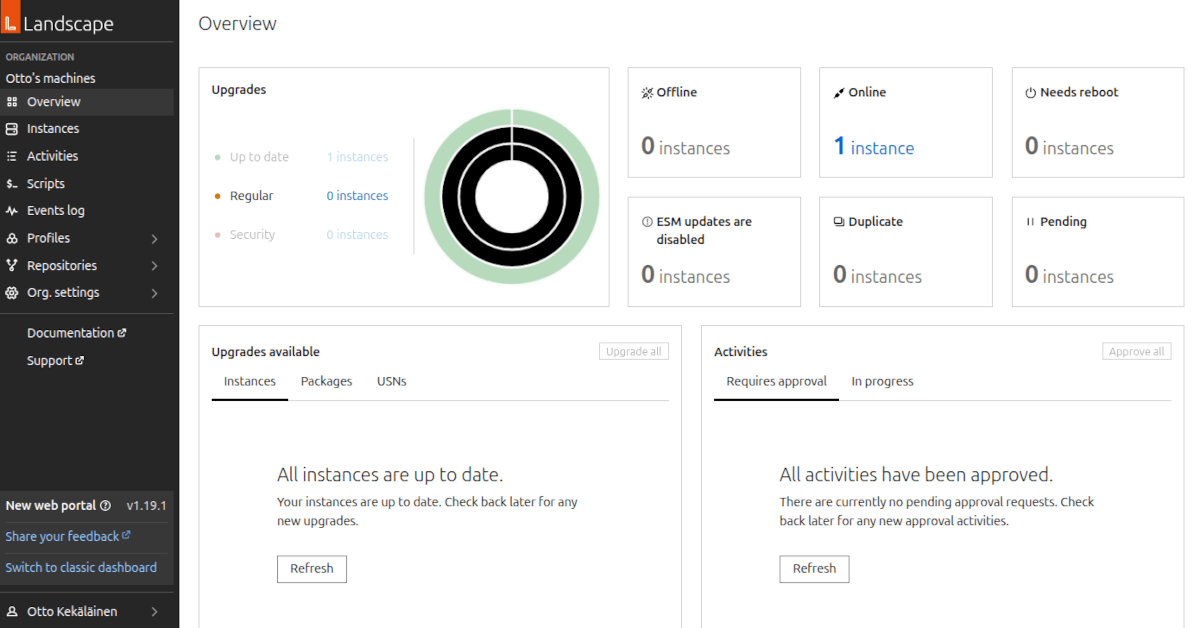 Ubuntu Pro is a subscription offering for Ubuntu users who want to pay for the assurance of getting quick and high-quality security updates for Ubuntu. I tested it out to see how it works in practice, and to evaluate how well it works as a commercial open source service model for Linux.
Anyone running Ubuntu can subscribe to it at
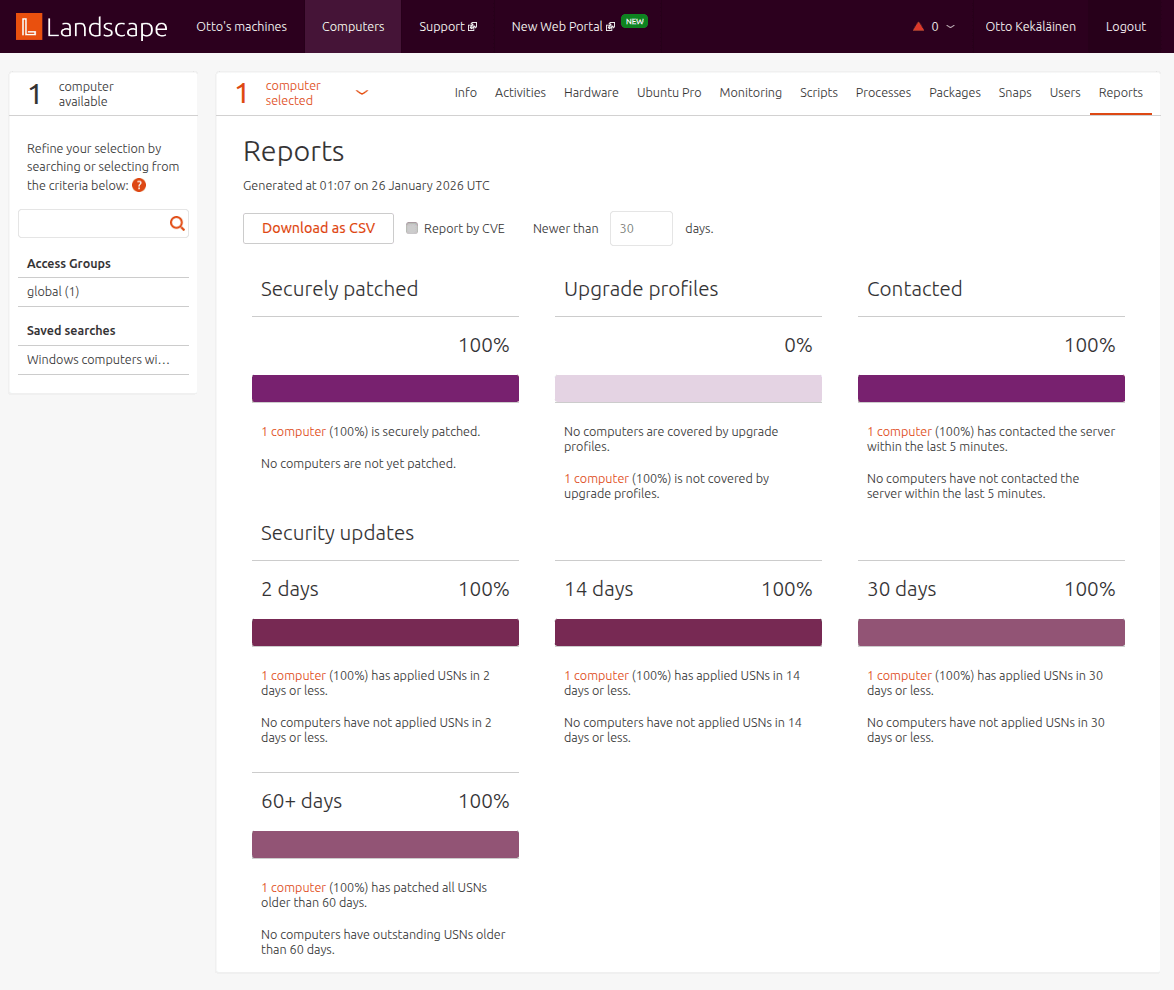
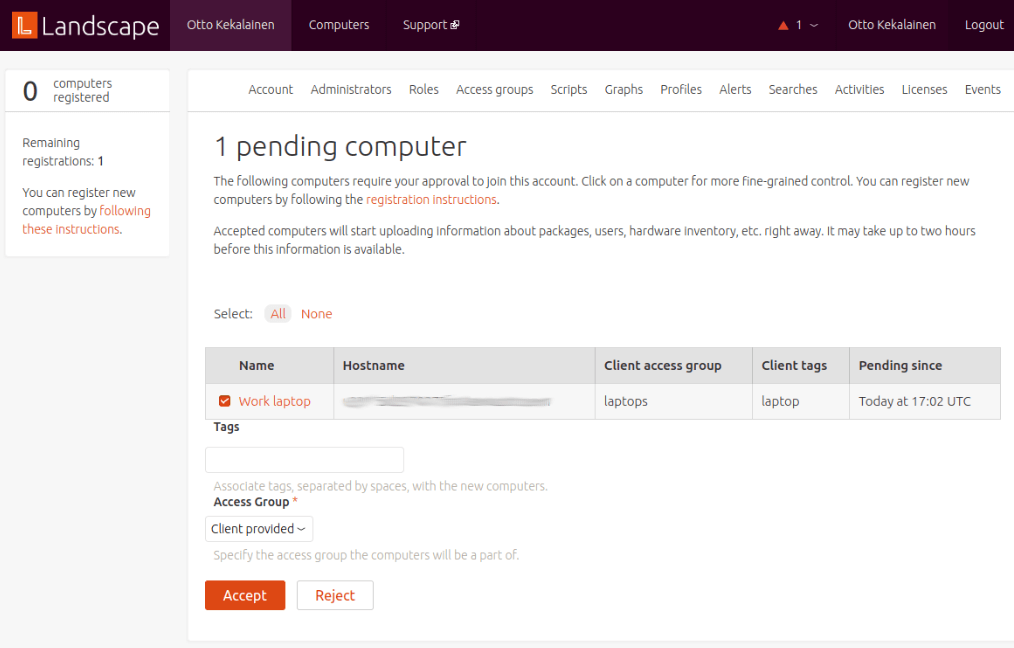 If I had a large fleet of computers, Landscape might come in useful. Also it is obvious Landscape is intended primarily for managing server systems. For example, the default alarm trigger on systems being offline, which is common for laptops and desktop computers, is an alert-worthy thing only on server systems.
It is good to know that Landscape exists, but on desktop systems I would probably skip it, and only stick to the security updates offered by Ubuntu Pro without using Landscape.
 A recent article in The Atlantic makes the case that

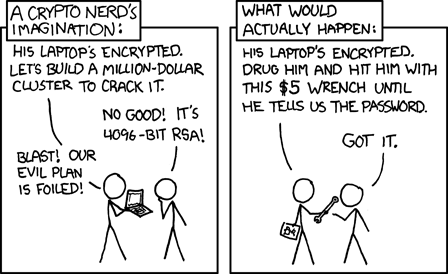 .
There is a similar, complementary discussion in this
 2026 already! The winter weather here has really been beautiful and I always enjoy
this time of year. Writing this yearly musical retrospective has now become a
beloved tradition of mine






























































































































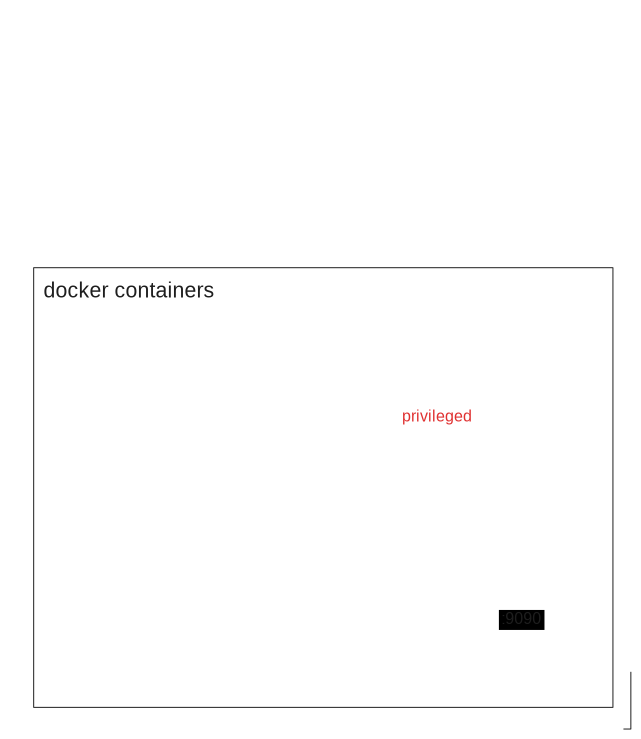 I will run three HTTP servers on port 8080: two inside Incus
containers and one on the host machine. The OBI process will export
metrics and traces to an OpenTelemetry Collector, which will forward
traces to Jaeger and expose a metrics endpoint for Prometheus to scrape.
Grafana will also be added to visualize the collected metrics using
dashboards.
The aim of this approach is to instrument only one of the HTTP
servers while ignoring the others. This simulates an environment with
hundreds of Incus containers, where the objective is to debug a single
container without being overwhelmed by excessive and irrelevant
telemetry data from the rest of the system.
OBI can filter metrics and traces based on attribute values, but I
was not able to filter by process PID. This is where the OBI Collector
comes into play, it allows me to use a processor to filter telemetry
data by the PID of the process being instrumented.
These are the steps to reproduce this setup: