Search Results: "edd"

23 June 2026

Dirk Eddelbuettel: tl-0.0.1 on CRAN: New Package

A new small package of mine just hit CRAN. The tl package wraps the (also very new) rspdlite package (announced last week) to offer a lightweight and consistent logging interface from both R and C++ that is also tiny, fast, capable thanks to rspdlite. The rspdlite announcement is a good place to get a first glimpse at that package; the upstream spdlite repo has all the details (for the C++ side of things). With tl we follow the same idea that our spdl package introduced: a simple consistent interface via just the tl:: prefix and the appropropriate logging level. In other words tl::debug("Alert -- foo is at ' '", foo) will work from both R and C++ (given a variable foo, and in the case of C++ an extra semicolon). Just give it a try, and see how it goes. The package is still young and small. The NEWS entry for this release is also very simple and just announces that we have a release. More details are in the ChangeLog and the GitHub repo.

Changes in version 0.0.1 (2025-06-17)
  • Initial CRAN upload

This post by Dirk Eddelbuettel originated on his Thinking inside the box blog. If you like this or other open-source work I do, you can sponsor me at GitHub.

21 June 2026

Dirk Eddelbuettel: RcppArmadillo 15.4.0-1 on CRAN: New Upstream Minor

armadillo image Armadillo is a powerful and expressive C++ template library for linear algebra and scientific computing. It aims towards a good balance between speed and ease of use, has a syntax deliberately close to Matlab, and is useful for algorithm development directly in C++, or quick conversion of research code into production environments. RcppArmadillo integrates this library with the R environment and language and is widely used by (currently) 1282 other packages on CRAN, downloaded 47.1 million times (per the partial logs from the cloud mirrors of CRAN), and the CSDA paper (preprint / vignette) by Conrad and myself has been cited 697 times according to Google Scholar. This versions updates to the 15.4.0 upstream Armadillo release made on Thursday. We had run a complete reverse-dependency check leading up to it, asserting there were no issues with packages dependent on it. As it sometimes goes with that many packages involved, one CRAN package reported one test failure. And it turned out to be both unrelated and pre-existing. But sorting this out over one round of email delayed things by a day. And then I went cycling for a good cause so this announcement post comes a little later than usual. The package has also been updated for Debian, built for r2u, and by now also at CRAN for the different binary releases. All changes since the last CRAN release follow.

Changes in RcppArmadillo version 15.4.0-1 (2026-06-17)
  • Upgraded to Armadillo release 15.4.0 (Medium Roast Agave)
    • Added fill::nan, fill::pos_inf, fill::neg_inf as optional fill forms for the Mat class
    • Added .push_back() for appending elements to vectors
    • Faster handling of find() within .elem()
    • Faster element-wise min() and max()
    • Faster conv_to when element types of input and output objects are the same

Courtesy of my CRANberries, there is a diffstat report relative to previous release. More detailed information is on the RcppArmadillo page. Questions, comments etc should go to the rcpp-devel mailing list off the Rcpp R-Forge page.

This post by Dirk Eddelbuettel originated on his Thinking inside the box blog. If you like this or other open-source work I do, you can sponsor me at GitHub. You can also sponsor my Tour de Shore 2026 ride in support of the Maywood Fine Arts Center.

17 June 2026

Dirk Eddelbuettel: rspdlite 0.1.0-1 on CRAN: New Package!

Very happy to share that a new package rspdlite arrived on CRAN today in its inaugural version 0.1.0-1. It wraps and provides the (header-only) C++20 library spdlite which its author describes (aptly) as tiny, fast, capable. Just like its bigger sibbling spdlog (which we wrapped as rcppspdlog), it is written by Gabi Melman. However, with a focus on C++20 and compile-time configuration, it is lighter, nimbler and faster. It is also still a fairly young project so changes may occur. I have been working on this for about a month, and it is ready for use by R and C++. It contains the initial upstream release 0.1.0, and I plan to follow the upstream versioning making this first release as 0.1.0-1. The package itself provides the headers for use from other C++ projects (i.e. mostly other packages), as well as a simple R wrapper so that logging can occur from either C++ or R. It will generally access the single logger instance in a compilation unit. So for a package built against these header it would be shared library of that package. At present we provide the basic logging level setters and getters, formatting accessors, and two (compile-time) options of a null logger and a file-based logger. More options are availble from the C++ level, multiple logging sinks are but one example. Some examples are provided in the package as an R example and a C++ example; these are probably best examined from the sources. The NEWS entry for this release is simply and just announces that we have a release. More details are in the ChangeLog and the GitHub repo.

Changes in version 0.1.0-1 (2025-06-08)
  • Initial complete version and CRAN upload

This post by Dirk Eddelbuettel originated on his Thinking inside the box blog. If you like this or other open-source work I do, you can sponsor me at GitHub. You can also sponsor my Tour de Shore 2026 ride in support of the Maywood Fine Arts Center.

15 June 2026

Dirk Eddelbuettel: rbenchmark 1.0.1 on CRAN: New(ly Adopted) Package!

Quick note to share that rbenchmark is back on CRAN! The rbenchmark package makes it easy to benchmark (and compare) simple R expressions. This package has been on CRAN for many years. At one point fourteen years ago it appeared to be rudderless so I offered help but things realigned. Now it was just tossed off CRAN, taking a number of packages depending on it with it (as shown in this CRANberries skeet listing a set of removed packages) so I offered again to help, and CRAN agreed. So here we are. So far I just made a number of small editing changes, added CI support, and enable dbsr-universe coverage . I do not expect to change the package materially. So far the package has no NEWS file either so maybe glance at the ChangeLog at the git repo.

This post by Dirk Eddelbuettel originated on his Thinking inside the box blog. If you like this or other open-source work I do, you can sponsor me at GitHub. You can also sponsor my Tour de Shore 2026 ride in support of the Maywood Fine Arts Center.

9 June 2026

Otto Kek l inen: SpacemiT K3 is a compelling RISC-V AI CPU, but difficult to buy

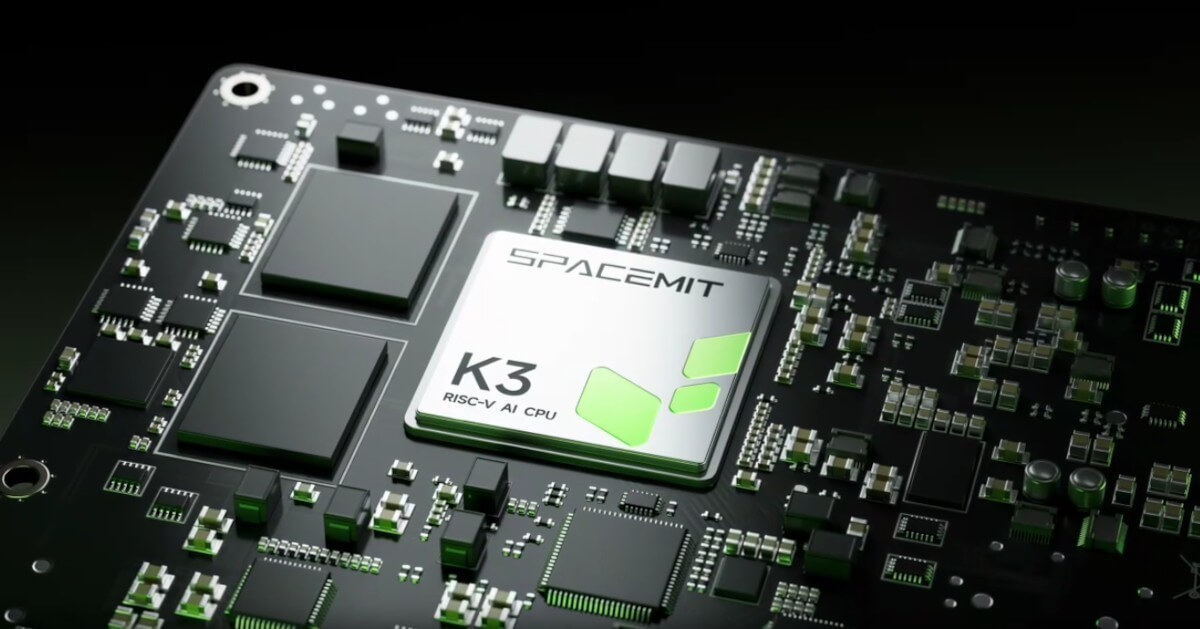
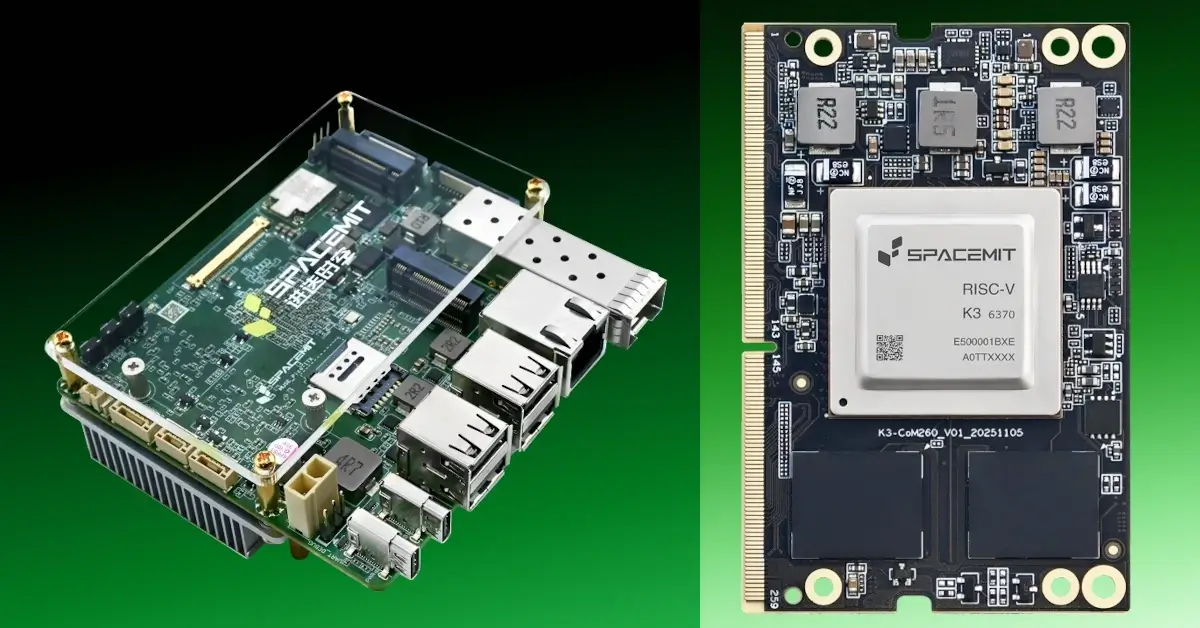
Featured image of post SpacemiT K3 is a compelling RISC-V AI CPU, but difficult to buyThe RISC-V CPU architecture has been gaining a lot of popularity since it launched in 2014, and now that the industry is standardizing on the RVA23 level that includes vector support as a mandatory extension, we are likely to see a lot more edge- and IoT devices with the ability to run local LLMs at reasonable speed, and most importantly at very compelling prices. SpacemiT is a Chinese RISC-V CPU manufacturer that launched on May 11th, 2026, their long-anticipated next-gen RISC-V AI chip K3. It is among the earliest RISC-V CPUs that adhere to the RVA23 standard and performance-wise it is quite capable, providing 130 KDMIPS general computing power, 60 TOPS on INT4 which translates to about 15 tokens per second when running a 30 billion parameter large language model. The aspect that really makes it stand out is: SpacemiT also develops their own Debian-based Linux distribution Bianbu OS, and seems to have collaboration going on with the wider community. Their community site seems active, and they also have a dedicated X account @spacemit_riscv and Reddit account r/spacemit_riscv posting relevant progress info on Linux kernel upstreaming activities. The X account is also responsive, as evidenced by its replies to my questions. Canonical lists the SpacemiT K3 pico-ITX and K3 CoM260 Kit on its official Ubuntu for RISC-V partner-built hardware page, which strengthens the perception that upstream Linux support is being taken seriously. The SpacemiT folks also gave an interesting talk at the 2026 Ubuntu Summit that includes a peek into their roadmap with future K3, K7 and K9 models. For technical details, see SpacemiT s K3 pico-ITX documentation, the Jetson Orin Nano-compatible K3 CoM260 board documentation and documentation of the K3 processor itself. The SpacemiT K3 pico-ITX board and the K3 CoM260 board side-by-side (not to scale)

Comparing the resellers SpacemiT does not sell anything directly to consumers. Instead you need to buy a board that includes the K3 chip from an integrator. Currently the main resellers are: All of the above are Chinese companies that ship to customers both inside and outside China. DeepComputing stands out as the only one that actually has done real integration and ships the K3 on a custom board, while the others simply resell the SpacemiT-produced K3 pico-ITX and K3 CoM260 Kit.

Milk-V Milk-V is a RISC-V specialized integrator, as the name already implies. They sell the K3 under the name Jupiter2. Of all the K3 pico-ITX reseller product pages, the Jupiter2 presentation is the nicest and most detailed. Unfortunately their order page at arace.tech only states that it is a pre-order with no information about shipping schedule, taxes, or other details like what SSD is included (if any). Based on the pictures it does ship with a Milk-V branded case. The 32 GB RAM lists at 504 EUR, which is a very reasonable price. The @MilkV_Official account on X recently promoted the K3.

Documentation and support As of this writing, the Milk-V Jupiter2 documentation site is just a stub and has no actual content, and only two links to the SpacemiT K3 documentation site. For support there is a web forum with a dedicated Jupiter2 section. There is also a Matrix space, but unlike their other products, there is no dedicated Jupiter (neither v1 nor v2) channel.

Community size and open source involvement At least one prior Milk-V product was certified by Canonical, which indicates there is some collaboration in progress. Canonical also lists the Milk-V Titan on its official Ubuntu for RISC-V partner-built hardware page.

Sipeed The Sipeed K3 announcement is well written (in English) with all the relevant details and links to additional PDF manuals. However, their main page at sipeed.com says nothing about the K3, so one must know the subpage URL to access it. They offer both the K3 CoM260 kit compatible with Jetson Orin Nano carrier boards, and the stand-alone K3 pico-ITX-sized motherboard. The CoM260 kit is only 10 USD cheaper than the full pico-ITX motherboard, so choosing the latter is a no-brainer if starting from scratch. The pico-ITX model with 32 GB DDR5 RAM sells for 639 USD. The product page does not mention anything about hard disk size, so you don t really know exactly what you will be getting if placing an order. There is no indication about case, Wi-Fi antennas or power supply either, so most likely they are not included. Their store.sipeed.com website does not work at all, and their Taobao and AliExpress stores are not public and only accessible to registered users. The order page also says nothing about shipping time, delivery time, or taxes. The X account @SipeedIO is active and recently posted pictures of shipments in progress.

Documentation and support The main documentation wiki does not yet have any K3 content at the time of writing. There is a Discord channel for general RISC-V discussion, and their MaixHub also has a discussion board, but I didn t find anything K3-specific.

Community size and open source involvement Sipeed has had at least one of their previous devices certified by Canonical, which indicates they are active in the community. Note that the other RISC-V company SiFive that also has had hardware certified and officially supported by Canonical is a different company, despite the very similar name.

Banana Pi Banana Pi announced that they offer both the K3 CoM260 kit and the K3 pico-ITX motherboard version. Their product page for the K3 confusingly shows a MediaTek product in the page banner rather than the SpacemiT K3. Based on the product description and the fact they renamed the product as BPI-SM10, it seems to ship with some carrier board. The product pictures look identical to the SpacemiT documentation and there is no picture of the carrier board, and details are very sparse. The pico-ITX version with 8 GB RAM and 128 GB SSD sells for 293 USD and the CoM260 developer kit with the same specs sells for 287 USD and the 32 GB RAM with 128 GB SSD model sells for 595 USD. The shop page shows only five orders so far and items are currently out of stock. As there was no 32 GB RAM version of the pico-ITX available at all, this isn t an option for me as I want to run 30B parameter models that need the larger memory version. Of all of these resellers, the Banana Pi website seems the most outdated. It does not have a search feature, it is not mobile-friendly, pictures can t be pinched to zoom in and so forth. Product names are also almost all identical, and as the product listings only show the beginning of the product name, figuring out what product is what requires extra effort that just makes the online purchase experience plain bad.

Documentation and support I was only able to find the documentation page for the CoM260 kit, but none for the pico-ITX version. For support there is a forum, but the category list does not show any section for K3, and the forum search prohibits using the search term k3 as too short.

Community size and open source involvement Banana Pi has a long history in the ARM single-board computer market, but their presence in the RISC-V ecosystem is still growing. Their X account @sinovoip has posted only once about the K3 and otherwise promotes their ARM boards. However, their community culture page does express a commitment to open hardware in general, but there is no visible K3-specific community activity.

Firefly Firefly s K3 product page is comprehensive. Based on the details, they do not offer the K3 pico-ITX variant at all, but only the K3 CoM260 board inside the AIBOX-K3 Firefly RISC-V Edge Mini PC product. This is a feature-complete offering with a Jetson Orin Nano carrier board and case. The AIBOX-K3 with 32 GB RAM and 128 GB SSD in a case sells for 689 USD in their own Firefly.store. Unfortunately it only has HDMI and there is no USB-C with DisplayPort support, which is a deal-breaker for me personally. Interestingly, Firefly also offers rack-mounted servers with K3 as the CPU.

Documentation and support The wiki link on the product page is broken. The Firefly wiki does have a section for the AIBOX-K3, but it too has a broken link. It seems that as of the time of writing, there is no wiki section for this product yet. For support there is a web forum, which does have at least one K3 thread covering guides such as Hermes Agent installation, though broader K3-specific sections are still sparse.

Community size and open source involvement Firefly s X account @TeeFirefly has had no posts since 2024, and their GitLab/T-Firefly shows mostly 2024 activity, with only one repository updated in 2025 and nothing in 2026. Historically they have built a moderate community around their ARM-based Rockchip boards, with active forums and wiki contributions for those product lines. Their RISC-V K3 offerings are newer, and likely need a lot more polish to be attractive products overall.

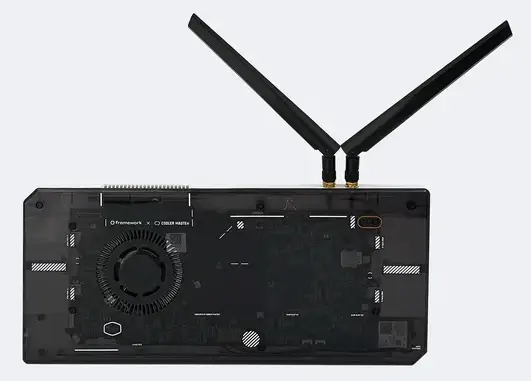
DeepComputing Last, but certainly not least, is the laptop manufacturer DeepComputing that offers a Framework laptop compatible motherboard with the SpacemiT K3 chip. They also sell the plain motherboard, or with the Cooler Master case, which allows one to easily connect it to an external monitor and keyboard and use it as a desktop computer. The plain board with 32 GB RAM and no SSD sells for about 882 EUR. Shipping of the first batch is expected to start by end of June 2026. Their X account @DeepComputingio promotes this DC-ROMA RISC-V Mainboard III as their flagship product, so they seem to put a lot of effort into it. The overall product design and packaging seems good. Of all the K3 resellers and integrators that I was able to find, DeepComputing is the only one that actually designs their own boards with the K3 processor, while all the other vendors above are simply reselling the vanilla K3 boards with or without a case. After reviewing all these options I decided to buy the DC-ROMA RISC-V Mainboard III for Framework Laptop 13 with 32 GB RAM, 1 TB SSD and the Cooler Master case, totalling about 1100 EUR.

Documentation and support DeepComputing maintains product information for their RISC-V hardware at github.com/DC-DeepComputing/Framework, with documentation of the newest Mainboard III (FML13V05) still being finalized ahead of the first batch shipment. They provide community support through Discord and web forum, although the latter has very little activity.

Community size and open source involvement DeepComputing has established itself as a pioneer in RISC-V laptops, beginning with the DC-ROMA. I have seen their stand at FOSDEM, which shows they are genuinely active in the open source community. Canonical lists DeepComputing s first mainboard / FML13V01 on its official Ubuntu for RISC-V partner-built hardware page, and it seems likely that they will continue to collaborate with Canonical with the new model once it ships. While the underlying Linux enablement depends on SpacemiT s upstream efforts, DeepComputing s involvement helps bridge the gap between reference hardware and consumer-ready products. DeepComputing K3 board in the Cooler Master case

Conclusion After weighing all the options, I ended up placing an order with DeepComputing for their custom K3 board with the Cooler Master case. Despite the premium price, the active community support and the properly documented promise of a complete, working system made it easy to place an order with confidence. The SpacemiT K3 is poised to be one of the most significant RISC-V chips for local AI workloads, thanks to its RVA23 compliance and high tokens per second potential. Yet the buying experience in mid-2026 remains fragmented and incomplete. Hopefully this is just because the product is new, and they will get the purchase experience polished soon. What struck me most during this process was how poor the customer experience is across nearly all of these vendor websites: broken links, missing search functions, outdated product banners, pages that show the wrong product entirely, and no information about shipping times, stock levels, taxes, and so on. One wonders why these companies don t fully invest in their web presence. Personally I would assume they likely have enough customers already, primarily through domestic channels like Taobao and JD.com, that they do not feel any pressure to improve their international-facing sites. However, I did also review what was offered on Taobao, and the product details were very incomplete there too. Taobao, however, has a built-in live chat with almost all sellers, which can be used to ask questions and thus compensate for missing product details. I don t fully understand why the sales process seems unpolished. The websites feel almost like an afterthought a checkbox to claim global reach while the real business apparently happens elsewhere via closed platforms or via inaccessible reseller channels. It is a frustrating reminder that in the RISC-V hardware world, the technology may be open and global, but the purchase experience is less so.

7 June 2026

Dirk Eddelbuettel: RQuantLib 0.4.27 on CRAN: Small Extension

A new minor release 0.4.27 of RQuantLib, the first in over a year, arrived on CRAN a couple of minutes ago, has just now been uploaded to Debian, and is being built for r2u as well. QuantLib is a rather comprehensice free/open-source library for quantitative finance. RQuantLib connects (some parts of) it to the R environment and language, and has been part of CRAN for nearly twenty-three years (!!) as it was one of the first packages I uploaded to CRAN. This release of RQuantLib brings an update to the interface for all equity options, vanilla and exotics as well as implied volatilities. We now support the option maturity via either an actual maturity date, or the (fractional business-day years) numeric. This uses a clever little Rcpp trick I should discuss in a separate blog post. We also re-ran compileAttributes() to re-create the RcppExports.cpp file now using a slightly improved way of calling Rf_error for an ongoing Rcpp transition, and did some more standard maintenance. The details from the NEWS file follow as usual.

Changes in RQuantLib version 0.4.27 (2026-06-07)
  • All equity option functions can now take either a (fractional) time span to expiry or a given date, and accept a daycounter setter.
  • Two very old schedule helpers had a superfluous try/catch removed.
  • The continuous integration setup received a minor update.
  • The RcppExports.cpp file was updated to aid a Rcpp transition.

Courtesy of my CRANberries, there is also a diffstat report for the this release. As always, more detailed information is on the RQuantLib page. Questions, comments etc should go to the rquantlib-devel mailing list. Issue tickets can be filed at the GitHub repo.

This post by Dirk Eddelbuettel originated on his Thinking inside the box blog. If you like this or other open-source work I do, you can now sponsor me at GitHub.

4 June 2026

Reproducible Builds: Reproducible Builds in May 2026

Welcome to the May 2026 report from the Reproducible Builds project. These reports outline what we ve been up to over the past month, highlighting items of news from elsewhere in the increasingly-important area of software supply-chain security. As ever, if you are interested in contributing to the Reproducible Builds project, please see the Contribute page on our website. In this month s report, we cover:

  1. Debian to ship reproducible packages in forky and beyond
  2. Holger Levsen on reproducing official Debian packages
  3. Reproducible Builds 2026 summit to be held in Gothenburg, Sweden
  4. Kettle: Attested Builds for Verifiable Software
  5. New rebuilderd version announced
  6. Reproducible open source messengers
  7. Distribution work
  8. Misc news
  9. Patches
  10. Documentation updates


Debian to ship reproducible packages in forky and beyond In a huge change in Debian s reproducibility policy, the Debian Release Team announced that:
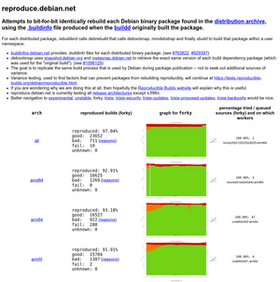
we ve decided it s time to say that Debian must ship reproducible packages. Since yesterday, we have enabled our migration software to block migration of new packages that can t be reproduced [on reproduce.debian.net] or existing packages in testing that regress in reproducibility.
That is to say, if newly-uploaded packages are not reproducible, they won t be considered candidates for inclusion in the next stable release of Debian codenamed forky. (Some exceptions may be granted.) This news generated a number of articles and comments in various news outlets:

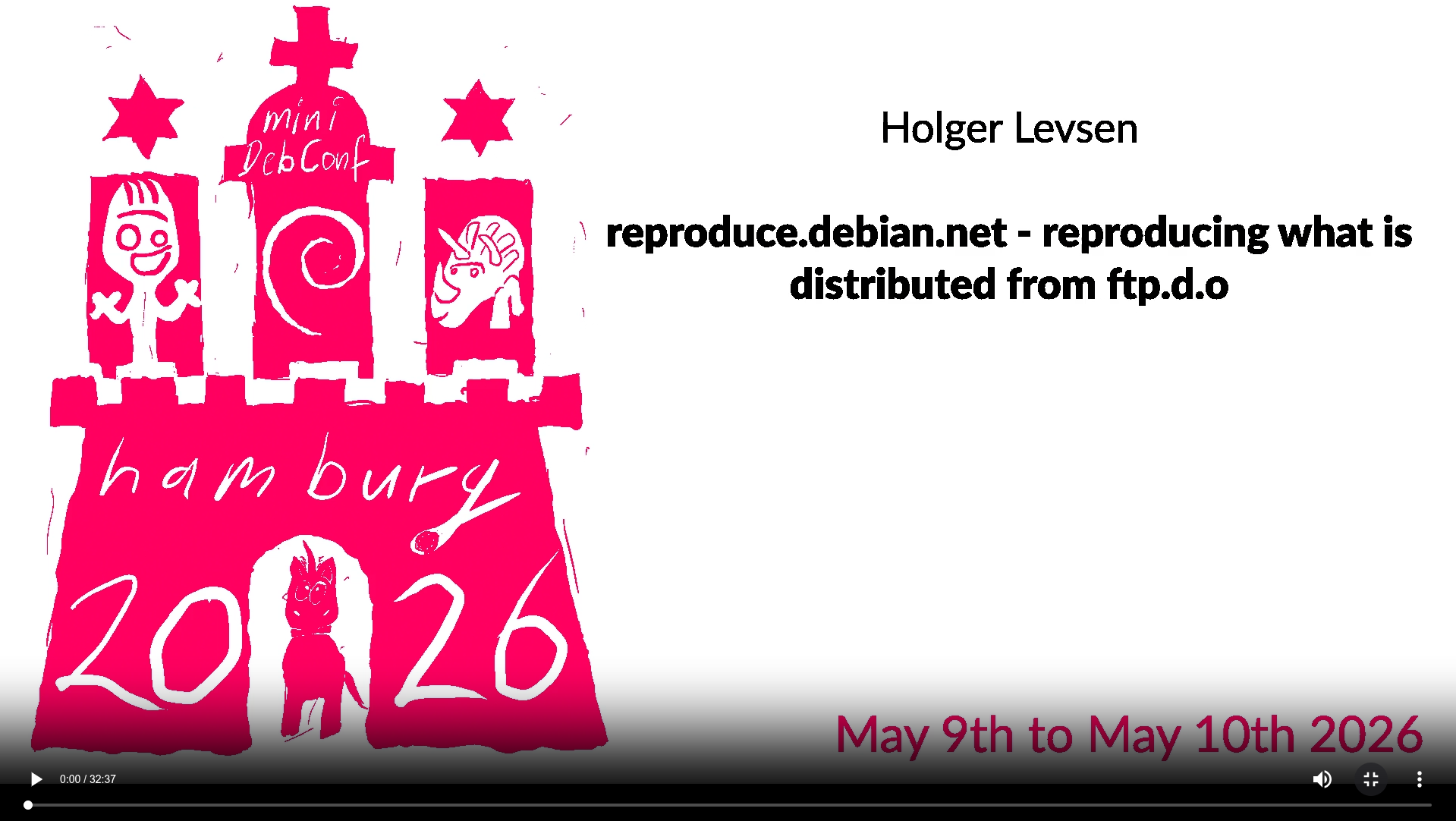
Holger Levsen on reproducing official Debian packages Reproducible Builds developer Holger Levsen gave a talk at the 2026 Hamburg MiniDebconf this year on the topic of reproduce.debian.net - reproducing what is distributed from ftp.d.o. Holger s talk announced that Debian intends to ship only reproducible packages in forky and beyond (see above), but also talked more broadly about reproducible builds, our testing framework and the Debian archive. That is to say, moving away from testing whether a package is reproducible in a theoretical sense (eg. whether we can build it twice in different environments and achieve the same result in our test system), and attempting to reproduce the same .deb files in the official Debian archive itself. This small-sounding distinction is actually essential, as this is the only means through which the reproducible builds technique can determine whether build systems are compromised are not. A video (32m37s) of the talk is available, as are Holger s slides.

Reproducible Builds 2026 summit to be held in Gothenburg, Sweden As initially announced in March 2026, we will be having our yearly Reproducible Builds summit 2026 in Gothenburg Sweden, from September 22 until 24, followed by two days of hacking! Further information will be provided on our website and on the rb-general mailing list very soon.

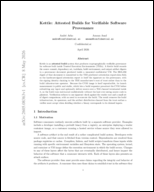
Kettle: Attested Builds for Verifiable Software Andr Arko and Amean Asad published a paper this month on Kettle, a build system that produces cryptographically verifiable provenance for software built inside Trusted Execution Environments :
A Kettle build records the source commit, dependency set, toolchain, build environment and output artifact digests in a provenance document produced inside a measured confidential VM. The SHA-256 digest of that document is committed to the TEE platform s attestation report-data field, so the hardware-signed attestation report is itself the signature on the provenance, with the signing identity chaining to the TEE manufacturer s root of trust rather than to the build infrastructure operator. Because the CVM image is itself reproducible, its launch measurement is public and stable, which lets a build requester pre-attest the CVM before submitting any input and optionally deliver source over a TLS channel terminated inside it, so the build runs end-to-end confidentially without the host ever seeing source code in plaintext.
A PDF of the paper is available online.

New rebuilderd version announced rebuilderd, our server designed for monitoring the official package repositories of Linux distributions and attempt to reproduce the observed results there; it powers, amongst other things, reproduce.debian.net. A new version, 0.27.0, was released this month, with the following headline changes:
  • Improved .udeb support
  • Breaking changes in pkg sync configuration
  • Manual cleanup needed for Arch Linux instances
As kpcyrd s announcement mentions:
The new rebuilderd package is currently available in the extra-testing repository. Note the Arch Linux package is upgraded from v0.25.0 from v0.27.0; please be patient with the database migrations on first restart, and make yourself familiar with the breaking changes in v0.26.0 too.

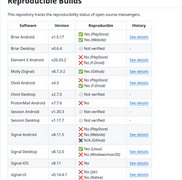
Reproducible open source messengers GitHub developer BarbossHack is maintaining an repository/page on GitHub to track reproducibility status of open source messengers .

Distribution work In Debian this month, the loong64 architecture was added to reproduce.debian.net. This is a 64-bit Reduced Instruction Set Computer (RISC) instruction set architecture developed by Loongson. Vagrant Cascadian performed Non-Maintainer Uploads (NMUs) in Debian for several packages with outstanding patches over a year old. These included rocdbgapi, onevpl-intel-gpu, python-pytest-shell-utilities, python-mt-940 and pympress. On tests.reproducible-builds.org, Vagrant Cascadian fixed the huge spike in build failures by adding passwd to the base tarballs, and re-enabled building gcc and binutils packages with PGO (Profile Guided Optimization) and LTO (Link Time Optimization) to avoid giving a false sense of reproducibility. Inconsistencies on the reproducibility of the condor package were brought up on the Debian reproducible-builds mailing list. Following a hunch, Vagrant Cascadian eventually identified the issue was related to embedded kernel versions which was then fixed upstream and fixed in Debian as well. Lastly, 40 reviews of Debian packages were added, 68 were updated and 75 were removed this month adding to our knowledge about identified issues. A number of issue types were updated, such as the addition of a new sphinx_reading_durations toolchain issue [ ], a golang_mango_generates_manpages_with_build_date issue [ ] and a random_offset_id_in_cython_linetrace [ ]. In addition, the timestamps_in_qhc issue was refocused to timestamps_in_qhc [ ].
In Fedora, Jelle van der Waa submitted a request for an official Fedora rebuilderd package which was reviewed by Neal Gompa.
Lastly, Bernhard M. Wiedemann posted another openSUSE monthly update for their reproducibility work there.

Misc news On our mailing list this month:

Patches The Reproducible Builds project detects, dissects and attempts to fix as many currently-unreproducible packages as possible. We endeavour to send all of our patches upstream where applicable or possible. This month, we wrote a large number of such patches, including:

Documentation updates


Finally, if you are interested in contributing to the Reproducible Builds project, please visit our Contribute page on our website. However, you can get in touch with us via:

2 June 2026

Ben Hutchings: FOSS activity in 2025

This was a particularly busy month for me in terms of Debian contributions. It started with a week in Hamburg for the MiniDebConf. I talked to many colleagues face-to-face and worked on various bugs and maintenance tasks. I m pleased to have finally found the time to reproduce and fix the boot-time crashes in the parallel port subsystem that have been reported many times recently. A series of easily exploited kernel LPE (local privilege execution) issues were published this month, mostly with very little coordination with distributions. Salvatore and I had to upload fixes for these at roughly weekly intervals. All of these fixes needed to be applied to 4 different upstream branches (currently 5.10, 6.1, 6.12, and 7.0) and 7 Debian branches (including backports).

Ben Hutchings: FOSS activity in May 2026

This was a particularly busy month for me in terms of Debian contributions. It started with a week in Hamburg for the MiniDebConf. I talked to many colleagues face-to-face and worked on various bugs and maintenance tasks. I m pleased to have finally found the time to reproduce and fix the boot-time crashes in the parallel port subsystem that have been reported many times recently. A series of easily exploited kernel LPE (local privilege execution) issues were published this month, mostly with very little coordination with distributions. Salvatore and I had to upload fixes for these at roughly weekly intervals. All of these fixes needed to be applied to 4 different upstream branches (currently 5.10, 6.1, 6.12, and 7.0) and 7 Debian branches (including backports).

29 May 2026

Dirk Eddelbuettel: RcppArmadillo 15.2.7-1 on CRAN: Micro Upstream Update

armadillo image Armadillo is a powerful and expressive C++ template library for linear algebra and scientific computing. It aims towards a good balance between speed and ease of use, has a syntax deliberately close to Matlab, and is useful for algorithm development directly in C++, or quick conversion of research code into production environments. RcppArmadillo integrates this library with the R environment and language and is widely used by (currently) 1272 other packages on CRAN, downloaded 46.6 million times (per the partial logs from the cloud mirrors of CRAN), and the CSDA paper (preprint / vignette) by Conrad and myself has been cited 693 times according to Google Scholar. This versions updates to the 15.2.7 upstream Armadillo release made today. The package has already been updated for Debian, and built for r2u. As the upstream was modest, we for once skipped reverse-dependency checks. That bet paid off as CRAN found no issues among the over 1270 reverse dependencies. However, one package referenced a package archived today, hence invisible to CRAN and triggered a (false positive) NOTE of reference to non-existing package . We came close. Anyway, the package made it CRAN shortly thereafter following the standard brief email exchange explaining the false-positive nature of the NOTE. All changes since the last CRAN release follow.

Changes in RcppArmadillo version 15.2.7-1 (2026-05-29)
  • Upgraded to Armadillo release 15.2.7 (Medium Roast Deluxe)
    • More efficient checks for aliasing

Courtesy of my CRANberries, there is a diffstat report relative to previous release. More detailed information is on the RcppArmadillo page. Questions, comments etc should go to the rcpp-devel mailing list off the Rcpp R-Forge page.

This post by Dirk Eddelbuettel originated on his Thinking inside the box blog. If you like this or other open-source work I do, you can sponsor me at GitHub. You can also sponsor my Tour de Shore 2026 ride in support of the Maywood Fine Arts Center.

23 May 2026

Amin Bandali: Thinking about life - chat with Protesilaos

In the recent weeks I've been engaging Prot as a coach to help review my new ffs package for GNU Emacs as I worked on preparing it for inclusion in GNU ELPA, as well as discussing other Emacs- and life-related topics. UPDATE 2026-05-23 22:39:15 -0400: Prot also published an article about our session on his website: https://protesilaos.com/commentary/2026-05-23-life-issues-and-philosophy-amin-bandali/ In our nearly 2-hour conversation, we discussed at length and in depth various aspects of life in the current times. For instance, feeling overwhelmed in the face of innumerable things happening at once, with technology changing our perception and making events feel proximate and imminent. We talked about seasonality and rhythms in life, including in relation to burnout and knowing our own limitations, and descriptive vs prescriptive thinking when reflecting on the expectations we may place on our self when comparing our self to others through the lens of our necessarily-incomplete impressions and glimpses of their lives. We discussed absence or loss as a dual to presence or persistence in the process of life. How with our memories and through embodying the philosophy and teachings of departed loved ones their essence and legacy continues to live on within us. But also loss in the sense of us losing parts of our self in life-defining moments while preserving other parts and gaining new ones, being liberated of some of the burdens of our past self and in effect becoming someone else in the process. In being true to our self, we talked about humans as multi-faceted beings and the importance of expressing and giving a voice to these different aspects of our self, and keeping alive that child-like sense of awe and wonder. To live a life where the pace and rhythms of our environment are in sync with our internal rhythms, and to not give others undue power over us or our happiness through trying to live according to their prescribed standards or expectations. I also learned more about Prot's practical philosophy of situational awareness in life, not merely as a means for survival, but also as a way of appreciating all of the beauty that surrounds us, and a method for gaining the knowledge and skills to apply what we learn from patterns in one area of life to other areas. We concluded our session with a mention to the concept of sanctity, to set aside a sacred time or place for our self wherein no distractions are allowed, where we can unwind, rest, and recharge for whatever comes next. Here is the video recording of our session, which I share with Prot's permission: You can view or download the full-resolution video from the Internet Archive. Like Prot, I am invigorated and inspired to live a full, honest life. To do my best, do what I do in earnest, and make the best of what I have. Take care, and so long for now.

21 May 2026

Steve McIntyre: Secure Boot and Microsoft CA Rollover - a heads-up for distributions

Background I'm a member of the EFI team in Debian, and I've done much of the work for Debian to support UEFI Secure Boot (SB) in recent years. We have included that support for a number of releases now, starting back with Debian 10 (aka Buster). I'm also a long-time accredited member of the shim-review team, the group that checks and approves shim binaries before Microsoft will sign them. See the Debian wiki for lots of background details about Secure Boot and how we do things in Debian. Secure Boot depends on signatures, which are verified during boot using a chain of X.509 certificates. The root certificate(s) in the chain are embedded in computer firmware, then later software such as shim can add more certificates to extend the trust. Easy, right? The problem - certificates expire... Microsoft administer the most widespread Secure Boot root certificates, and have been doing so since the very beginning of UEFI Secure Boot as a concept. The Microsoft UEFI CA certificates are included in just about every x86 and x86-64 computer shipped, and also in quite a lot of arm64 machines too. (The fact that Microsoft is therefore a gatekeeper for Linux running under Secure Boot on most machines is very unpopular in some quarters, but this is just a fact of life in the world we live in. None of the following will affect you if you're using Secure Boot with your own keys only.) The current certificates have been around since 2011: 1. Windows Production PCA 2011 (used for signing Windows components)
  Subject: C=US, ST=Washington, L=Redmond, O=Microsoft Corporation, CN=Microsoft Windows Production PCA 2011
  Validity
    Not Before: Oct 19 18:41:42 2011 GMT
    Not After : Oct 19 18:51:42 2026 GMT
This expires in October this year, ~5 months from now. 2. Third Party Marketplace Root (used for signing option ROMs and other software)
  Subject: C=US, ST=Washington, L=Redmond, O=Microsoft Corporation, CN=Microsoft Corporation UEFI CA 2011
  Validity
    Not Before: Jun 27 21:22:45 2011 GMT
    Not After : Jun 27 21:32:45 2026 GMT
For Linux folks, this second certificate is more interesting - it is the root of the certificate chain that Microsoft use when signing shim for Linux distributions This CA expires 5 weeks from today. OMG!!! Will all my existing Secure Boot machines stop booting? Almost definitely not, no. The specification for UEFI Secure Boot expects that valid dates on certificates should not be enforced for signatures here. All that matters here is the signatures themselves. Modulo buggy firmware, existing signed binaries should continue just fine. New CAs to be aware of Microsoft have published three new CAs: 1. A new CA used for signing device option ROMs
  Subject: C=US, O=Microsoft Corporation, CN=Microsoft Option ROM UEFI CA 2023
  Validity
    Not Before: Oct 26 19:02:20 2023 GMT
    Not After : Oct 26 19:12:20 2038 GMT
2. A new CA used for signing Windows components
  Subject: C=US, O=Microsoft Corporation, CN=Windows UEFI CA 2023
  Validity
    Not Before: Jun 13 18:58:29 2023 GMT
    Not After : Jun 13 19:08:29 2035 GMT
3. A new CA used for signing other software (e.g. shim)
  Subject: C=US, O=Microsoft Corporation, CN=Microsoft UEFI CA 2023
  Validity
    Not Before: Jun 13 19:21:47 2023 GMT
    Not After : Jun 13 19:31:47 2038 GMT
New machines and updated older machines will most likely have all of these new CAs installed. New machines are already shipping that only include the new CAs; they will not trust older software and this has already started causing problems for some users. Isn't this is all a bit short notice? Yes it is. :-( A common rule of thumb when deploying CA certificates is to start the process of replacement ("rollover") when a certificate reaches half of its lifetime. Unfortunately, Microsoft have done this very late. They generated new keys in 2023, but didn't start signing shim and other third-party software with the UEFI CA until October 2025. If I'm a distro developer, what should I do? If you already have an old shim signed by Microsoft for your distribution from before October 2025, then it will only be signed using the older CA that expires soon. On newer machines, your users will already not be able to boot your distro with Secure Boot enabled. If you want your users to be able to use Secure Boot in future, you will need to get a new shim build submitted, reviewed and signed using the new CA. However, that signed build will not work on older machines unless they have had the new CAs installed. This is also likely to cause problems for some users. You should encourage your users to update their systems NOW before things break for them. There is an interim solution which will work, but only if you're quick! Microsoft are currently returning shim binaries signed using both the old CA and the new CA. More specifically, for every binary that is submitted they will return two: one signed with each CA. If you use these directly, you'll need to plan to publish: and explain to your users how they'll need to pick one. Good luck with that! However, it is possible to extract signatures from those signed shim binaries and attach them all onto one shim, giving you the Holy Grail here - a single shim that will boot on the vast majority of machines. Indeed, this is what I'm planning on doing in Debian. So-called "dual-signed" shims may provoke issues with buggy firmware, so be aware that you may have to deal with this too. But take heart: early testing by various distro folks with a dual-signed Fedora shim did not show any problems. You have 5 weeks and counting... Microsoft have promised to continue signing with the old CA as long as possible, right up to the last day. They understand how awkward things are going to be otherwise, and are trying to help here as much as possible. In the shim-review team, we have been expecting to see a surge of shim submissions before the old CA expires, to make the most of the "Holy Grail" dual-signed shims described above. But we've been really surprised that this has not been happening. So, this blog is a wake-up call for people doing Secure Boot with shim. Even if you're not going to be ready to ship a new shim binary to your users, you should really try to get a new build prepared and signed NOW so that you have it available to tide you over through the coming CA transition. Don't leave it too late. If you're not sure what to do, ask me and the other shim-review folks. We're happy to give advice. But don't delay. You have 5 weeks and counting. How to make a dual-signed shim binary Microsoft only ship binaries with a single signature included. To make things work, extract those signatures using sbattach --detach (from the sbsigntools source package, available in most distributions. Then apply those signatures one at a time to your shim binary, using sbattach --attach. Simple, really. There's one strong recommendation here: order the signatures on your shim oldest first - that way, old buggy firmware implementations that potentially don't look for more than one signature will find the old signature first. pesign can also handle moving signatures around, but I chose sbsigntools when doing this work myself. If you're looking to see how others handle multiple signed shim binaries, feel free to look at the Debian shim-signed package for examples. The repo is https://salsa.debian.org/efi-team/shim-signed.git. References I'll add more links here in the coming weeks.

Dirk Eddelbuettel: nanotime 0.3.15 on CRAN: Coping

Another very minor update, now at 0.3.15, for our nanotime package is now on CRAN, and has been built for r2u and Debian. nanotime relies on the RcppCCTZ package (as well as the RcppDate package for additional C++ operations) and offers efficient high(er) resolution time parsing and formatting up to nanosecond resolution, using the bit64 package for the actual integer64 arithmetic. Initially implemented using the S3 system, it has benefitted greatly from a rigorous refactoring by Leonardo who not only rejigged nanotime internals in S4 but also added new S4 types for periods, intervals and durations. This release adjusts the package for the maybe overly hasty switch R 4.6.0 has undertaken with respect to using C++20 as a default C++ compilation standard. I am of course largely in favour of such a switch to more modern C++. But I am also cognizant of the fact that not all compilers and machines are ready. And just as I have already seen one other package fail to compile on a particular CRAN system (!!) under C++20, this package all of a sudden, and only on that same system, started to throw two (harmless) compiler warnings. We could call these erroneous as newer versions of the same compiler do not throw them but it does not matter. The decision to default to C++20 has been made, and now we live with it. But maybe some hardware platforms should be moved behind the barn. Either way, this release both adds an explicit cast to two lines that may not really need it (but this will not hurt) and also dials the compilation standard down to C++17 on one particular platform. So once again there are no user-facing changes, or behavioural changes or enhancements, in this release. The NEWS snippet below has the fuller details.

Changes in version 0.3.15 (2026-05-21)
  • Add extra const_cast as one CRAN machine with more ancient setup whines otherwise and is obviously less C++20 ready than it thinks
  • tools/configure also checks where this is being built and as needed' downgrades the compilation to C++17

Thanks to my CRANberries, there is a diffstat report for this release. More details and examples are at the nanotime page; code, issue tickets etc at the GitHub repository and all documentation is provided at the nanotime documentation site.

This post by Dirk Eddelbuettel originated on his Thinking inside the box blog. If you like this or other open-source work I do, you can now sponsor me at GitHub. You can also sponsor my Tour de Shore 2026 ride in support of the Maywood Fine Arts Center.

15 May 2026

Amin Bandali: FFS code review and Emacs extensibility with Protesilaos

In the recent weeks I've been engaging Prot as an Emacs coach to help with doing review passes over my upcoming ffs package as I work on polishing and documenting it in preparation for offering it for inclusion in GNU ELPA. UPDATE 2026-05-15 08:50:10 -0400: Prot also published an article about our session on his website: https://protesilaos.com/codelog/2026-05-15-emacs-amin-bandali-ffs-display-buffer-org-capture/ Today we had our third session where we started by reviewing and talking about my recent changes to ffs, then ventured to other Emacs-related topics with the overarching theme of the flexibility and extensibility of GNU Emacs, including display-buffer-alist, keyboard macros, defining a custom ox-bhtml Org export backend derived from Org's ox-html for ultimate flexibility when exporting my site's pages from Org to HTML, Org capture, plain text files and Emacs's diary and how it compares to org-agenda, and keeping a journal with the help of Emacs. Here is the video recording of our session, which I share with Prot's permission: You can view or download the full-resolution video from the Internet Archive. Lastly, here is the snippet Prot shared for having Isearch treat space as a wildcard, helpful for more easily matching multiple parts of a line:
(setq search-whitespace-regexp ".*?")
(setq isearch-lax-whitespace t)
(setq isearch-regexp-lax-whitespace nil)
Take care, and so long for now.

Freexian Collaborators: Debian Contributions: Detecting undeclared file conflicts, contributors.debian.org mini-sprint, security-tracker performance and more! (by Anupa Ann Joseph)

Debian Contributions: 2026-04 Contributing to Debian is part of Freexian s mission. This article covers the latest achievements of Freexian and their collaborators. All of this is made possible by organizations subscribing to our Long Term Support contracts and consulting services.

Undeclared file conflicts, by Helmut Grohne The duplication checker, the Multi-Arch hinter, and the /usr-move analyzer share significant parts of their code. While the /usr-move transition is complete, the other tools needed a bit of love. Helmut added Python type annotations, slightly improved the performance of the duplication website and shared more code between these tools. Building upon this Helmut looked into file conflicts of various kinds such as unrelated packages installing overlapping files, file type conflicts, mismatching directory metadata and shared files of Multi-Arch: same packages with varying content. Implementing reliable detection proved to be difficult due to the amount of corner cases. So Helmut semi-manually filed bugs. In that process, it became apparent that binNMUs do not reproduce SOURCE_DATE_EPOCH across architectures and therefore some shared files embedding the build date would vary in content. Additionally, a significant number of reports required further correspondence.

contributors.debian.org mini-sprint, by Enrico Zini Enrico Zini met with Mattia Rizzolo to continue the work started at DebConf 25 on crediting contributions done via salsa, and to catch up with accumulated site issues. Building on the same kind of infrastructure used to notify tag2upload, salsa.debian.org triggers a webping on pushes and merge request activity, which causes a small JSON payload to be queued in a private directory on contributors.debian.org. We worked on processing, filtering and aggregating the files in the queue into a private, staging database table. When configuring a data source on the site, it is now possible to configure automated submission of contributions from information in the staging table. This makes it significantly simpler to credit contributors for all teams that use Salsa as their code repository and coordination tool, as the site can take care of the data mining for you. See more details in the sprint report posted to debian-devel-announce.

MiniDebConf Campinas, by Lucas Kanashiro, Santiago Ruano Rinc n and Antonio Terceiro MiniDebConf Campinas was held between April 23rd and 25th, at the State University of Campinas, and was preceded by a MiniDebcamp between April 20th and 22nd. Freexian was Gold sponsor for the event, and Freexian collaborators were active contributors to the conference success. Lucas and Santiago delivered a talk about Debian LTS during MiniDebConf Campinas 2026, where they described how the LTS project benefits Debian users and developers, while strengthening Debian itself. Lucas and Antonio delivered a talk about internship programs in Debian during MiniDebConf Campinas 2026, with the goal of getting students interested in working in and with Debian. Lucas took part in the MiniDebConf Campinas content team, reviewing/accepting talks and building the schedule. Antonio led a session where he invited the audience to weigh in on current controversies in Debian. The session presented playful elements as colored signs to denote agree/disagree, and was not recorded, to help people feel more comfortable about speaking up. He might be convinced to lead a similar session at the next DebConf. Antonio also organized a debate to discuss the consequences of new Brazilian regulation for the protection of children and adolescents in digital spaces for Debian and other free operating systems, but also for the free software community in general. This session was very fruitful and will lead into further actions, as one of the main outcomes was the realization that the free software community must follow the discussion leading up to similar regulations more closely to avoid being caught by surprise when they come into effect.

security-tracker performance, by Helmut Grohne and Emilio Pozuelo Monfort Prompted by spontaneous influx of web requests on Freexian s security-tracker back in February, we considered the options for managing that demand. One of our mitigations was making it faster. To that end, Helmut sent two MRs towards improving the situation. There are four notable improvements. The use of Python s str.translate generally speeds up rendering of larger templates. Indexing the CVE names avoids a costly sequential table scan. Avoiding FFI calls while sorting and reducing the queryset speeds up the source package view. Emilio reviewed and deployed the changes on to the Debian instance. Together these changes provide a twofold speedup on both Freexian s and Debian s instance on average.

dput-ng data loss bug, by Colin Watson Ian Jackson (not affiliated with Freexian) reported that dput-ng could lose data when using the local install method, which could cause misleading results in tests of other packages; they also filed an initial merge request to fix it. Colin improved this to isolate its tests properly, and uploaded it.

Miscellaneous contributions
  • Lucas coordinated the src:valkey update to version 9 in unstable with a potential co-maintainer.
  • Lucas provided a security update for src:valkey targeting trixie .
  • Thorsten did two uploads of foo2zjs, one to fix a bug and one to improve packaging. As there have been several CVEs published for cups he also did an upload of a new upstream version. Unfortunately this introduces a regression and another upload was needed to take care of a crash. The patch for one CVE also broke a test script, which is used by lots of printing packages in Debian. As a result some autopkgtest runs failed. This could be fixed as well and the only remaining issue that needs some more investigation is related to cups-pdf. It is also worth mentioning that some issues related to the apparmor configuration of cups could be resolved.
  • Helmut sent patches for 11 cross build failures.
  • Helmut sent a MR for enabling the new mainline YT6801 ethernet Linux driver and it is now working fine with Debian s 7.x kernels.
  • Helmut upgraded a crossqa.debian.net autobuilder to trixie .
  • Carles using po-debconf-manager, improved Catalan translations: reviewed 2 packages, submitted 3 packages, deleted 5 packages.
  • Carles did further code developments for check-relations: steps towards making it production ready when the initial round of reports are analyzed. New show-package (information) command, improvements for report_missing cases, added support for ignoring packages for specific reasons, added unit tests, added CI. Used it to open 39 new bugs. Also followed up different open bugs
  • Rapha l completed the French translation of Zulip for the release of version 12.0. Zulip is a nice 100% free software threaded communication platform for distributed teams.
  • Stefano did routine uploads of python-pipx, python-mitogen, platformdirs, python-authlib, python-discovery, distro-info-data, python-virtualenv, python-certifi, python-wheel, pypy3.
  • Stefano uploaded distro-info-data updates to stable and oldstable proposed updates, with the latest Ubuntu release.
  • Stefano took part in DebConf 26 preparation meetings.
  • Stefano prepared DebConf s online video streaming infrastructure for MiniDebConf Campinas, and configured the Debian reimbursement system to handle their travel bursary claims.
  • Stefano helped MiniDebConf Hamburg prepare their website for 2027.
  • Stefano did some sysadmin work on debian.social infrastructure.
  • Stefano reviewed Matthias python3.15 packaging and rebased his work on top of it.
  • Antonio implemented several improvements to the Debian CI platform, including but not limited to adding support for dark mode, dropping compatibility with ActiveRecord < 7 which is no longer shipped in Debian stable, and generating content-based links to static assets, in two parts.
  • Antonio debugged a general slowness in salsa, caused by loss of IPv6 connectivity between the salsa host and the remote object storage in the cloud , which is a problem due to an open upstream bug in gitlab.
  • Santiago reviewed different changes to the Salsa CI pipeline, including the new uscan test job, prepared by Tha s Rebou as Araujo, and the final review to introduce faketime testing, made by quila Macedo.
  • Santiago continued helping the DebConf 26 local team to prepare the conference.
  • Emilio updated libxpm to address a security issue.
  • Colin finished upgrading groff to 1.24.1; 1.24.0 and 1.24.1 were the first upstream releases since 2023 and had extensive changes, so this took some time to get right.
  • Colin released bookworm and trixie fixes for CVE-2026-3497 in openssh, and issued the corresponding BSA-130 for trixie-backports.
  • Colin upgraded openssh to 10.3p1.
  • Anupa worked on the accounting tasks for MiniDebConf Kanpur and prepared and submitted a report to the fiscal host.

9 May 2026

Dirk Eddelbuettel: RcppSpdlog 0.0.29 on CRAN: Small Enhancement

Version 0.0.29 of RcppSpdlog arrived on CRAN today, has been uploaded to Debian and built for r2u. The (nice) documentation site has been refreshed too. RcppSpdlog bundles spdlog, a wonderful header-only C++ logging library with all the bells and whistles you would want that was written by Gabi Melman, and also includes fmt by Victor Zverovich. You can learn more at the nice package documention site. This release features a rewritten internal routine unpacking the R variadic arguments into C++ variadic template arguments. This in turn allows to turn back to std::format in C++ mode when C++20 is used. We also adjust for the not-quite-ready-for-this state of the x86-64 based macOS machine at CRAN. It is running a compiler and SDK choice that cannot fully deal with C++20, so we dial compilation on it down to C++17. Similarly, and as we found out after the release, Ubuntu jammy is also too old to default to std::format so we need to add a better detection here too so that we can also fall back to the included fmt there. The NEWS entry for this release follows.

Changes in RcppSpdlog version 0.0.29 (2026-05-08)
  • Some small continuous integration updates
  • The internal formatter was rewritten as a recursive generator of variadic templates.
  • Switch back to std::format with C++20, but force inferior macos-release-x86_64 to use C++17 rather than default C++20 which fails

Courtesy of my CRANberries, there is also a diffstat report detailing changes. More detailed information is on the RcppSpdlog page, or the package documention site.

This post by Dirk Eddelbuettel originated on his Thinking inside the box blog. If you like this or other open-source work I do, you can sponsor me at GitHub.

8 May 2026

Amin Bandali: FFS code review with Protesilaos

In the recent weeks I've been engaging Prot as an Emacs coach to help with doing review passes over my upcoming ffs package as I work on polishing and documenting it in preparation for offering it for inclusion in GNU ELPA. Yesterday we had our second session focused on ffs, which I recorded and share publicly with everyone with Prot's permission, so that others can also benefit from Prot's insights and experience as we discuss various aspects of Emacs package development with the concrete example of ffs. Here is the video recording of our session: You can view or download the full-resolution video from the Internet Archive. I addressed most of Prot's feedback about ffs from our first session, and I'll be working on the changes we discussed in this session in the next days. In the last third of the video we switched topics to discuss a few Emacs-related tangents including adding a 'padding' effect for the mode line and its constructs, and distilling and separating the easily-reusable package-like parts of one's Emacs configuration from the actual configuration of those parts (e.g. the distinction of prot-lisp and prot-emacs-modules in Prot's Emacs configuration). For mode line padding, here is the snippet I'm using with Prot's doric-themes:
(doric-themes-with-colors
  (custom-set-faces
    (mode-line
     ((t :box (:line-width 6 :color ,bg-shadow-intense))))
    (mode-line-inactive
     ((t :box (:line-width 6 :color ,bg-shadow-subtle))))
    (mode-line-highlight
     ((t :box (:color ,bg-shadow-intense))))))
Take care, and so long for now.

7 May 2026

Reproducible Builds: Reproducible Builds in April 2026

Welcome to our April 2026 report from the Reproducible Builds project! Our reports outline what we ve been up to over the past month, highlighting items of news from elsewhere in the increasingly-important area of software supply-chain security. As ever, if you are interested in contributing to the Reproducible Builds project, please see the Contribute page on our website. In this month s report, we cover:

  1. Tor stateless relays and Reproducible Builds
  2. Civil Infrastructure Platform celebrates 10 years of supporting industrial grade Linux
  3. Reproducible Builds at LinuxFest NorthWest
  4. Reproducibility issues in Rust binaries that embed random bytes
  5. Distribution work
  6. Patches
  7. diffoscope development
  8. Documentation updates
  9. Misc news


Tor stateless relays and Reproducible Builds An interesting post was published on Tor Project blog by Osservatorio Nessuno OdV this month on stateless relays . These are stateless, diskless operating systems that are designed to be used as Tor exit relays. According to the post, which is titled A Server That Forgets: Exploring Stateless Relays:
For relay operators, this approach raises the security bar by enforcing better behaviors by design: [ ]
  1. Reproducibility. A system that doesn t change between reboots is easier to verify and, eventually, to reproduce and audit.
Furthermore, using a Trusted Platform Module (TPM), could allow for greater integrity in the future:
Transparency logs. Once you have a measured boot chain, you can publish it. A relay operator provides a recipe for a reproducible build; anyone can recompute the expected hash and verify it matches what the TPM reports. An append-only transparency log can make these attestations publicly auditable. The Tor community could run an independent monitor to track this across the relay fleet.

Civil Infrastructure Platform celebrates 10 years of supporting industrial grade Linux Congratulations to the Civil Infrastructure Platform (CIP) for reaching their 10-year anniversary last month. CIP has been a supporter of Reproducible Builds for many years, and we have collaborated on a number of technical issues that overlap. As Chris Lamb mentions in CIP s press release:
The collaboration between the Reproducible Builds project and CIP highlights a critical shift in how we approach industrial software. Through verifiability, CIP ensures that the open source foundation of our critical infrastructure is not only sustainable but also demonstrably secure. This commitment to transparency is vital for the trust and resilience required by critical systems over decades of operation.

Reproducible Builds at LinuxFest NorthWest Vagrant Cascadian and Chris Lamb hosted a table in the exposition hall at LinuxFest NorthWest 2026 this month in Bellingham, WA, USA, introducing many people to Reproducible Builds and answering questions both days of the conference. In addition, Vagrant presented Beyond Trusting Open Source Software on Sunday afternoon, exploring the intersection of Free/Open Source Software, Reproducible Builds and Bootstrappable builds, and how they all reinforce each other. Vagrant s slides are available online, including source code to build them reproducibly.

Reproducibility issues in Rust binaries that embed random bytes Reproducible Builds developer kpcyrd opened a ticket on the Rustsec issue tracker regarding binaries that deliberately inject random bytes into their binaries as a secret seed for a Hash Collision DoS mitigation. As kpcyrd notes in his message, this causes issues for reproducibility, and because the relevant end-user binaries are mostly distributed pre-compiled through package managers, those binaries (and by extension the secret seed) are public knowledge . kpcyrd goes on to note:
This is somewhat unique to Rust because Python/JavaScript doesn t compile binaries, and Go (to my knowledge) is too restrictive during build for any library to pull something like this.

Distribution work In Arch Linux this month, Robin Candau and Mark Hegreberg worked at adding a new repro tag/version to the Arch Linux Docker images providing a bit-for-bit reproducible image. Robin also shared a related announcement and implementation details on our mailing list. Arch Linux developer Robin Candau posted a blog post announcing that Arch Linux Now Has a Bit-for-Bit Reproducible Docker Image . Robin mentions one interesting caveat:
to ensure reproducibility, the pacman [package manager] keys have to be stripped from the image, meaning that pacman is not usable out of the box in this image. While waiting to find a suitable solution to this technical constraint, we are therefore providing this reproducible image under a dedicated tag as a first milestone. [ ]
The blog post was also discussed on Hacker News.
In Debian this month, 24 reviews of Debian packages were added, 7 were updated and 16 were removed this month adding to our knowledge about identified issues. Vagrant Cascadian performed Non-Maintainer Uploads (NMUs) in Debian for several packages with outstanding patches over a year old jakarta-jmeter, wxmplot, critcl, vcsh and magic-wormhole-transit-relay. In addition, Reproducible Builds developer Jochen Sprickerhof filed a bug against the APT package manager to request that APT should ignore [a] 0 epoch when downloading or installing with a version specifier . This is related to the special-case handling of the optional epoch prefix in Debian package version numbers.
In NixOS, Julien Malka presented Lila: Decentralized Build Reproducibility Monitoring for the Functional Package Management Model, a paper written together with Arnout Engelen at the Mining Software Repositories (MSR) ACM conference, where it was awarded the MSR 2026 FOSS Impact Award. Congratulations!
Lastly, in openSUSE, Michael Schroeder added reproducibility verification support in the Open Build Service [ ] and Bernhard M. Wiedemann posted another openSUSE monthly update for their reproducibility work there.

Patches The Reproducible Builds project detects, dissects and attempts to fix as many currently-unreproducible packages as possible. We endeavour to send all of our patches upstream where applicable or possible. This month, we wrote a large number of such patches, including:

diffoscope development diffoscope is our in-depth and content-aware diff utility that can locate and diagnose reproducibility issues. This month, Chris Lamb made a number of changes, including preparing and uploading versions, 316, 317 and 318 to Debian.
  • Chris Lamb:
    • Bump Standards-Version to 4.7.4. [ ]
    • Correct ordering of python3-guestfs architecture restrictions. [ ]
    • Limit python3-guestfs Build-Dependency to architectures that are not i386. [ ]
    • Try to fix PYPI_ID_TOKEN debugging. [ ]
  • Holger Levsen:
    • Add ppc64el to the list of python3-guestfs architecture whitelist. (Closes: #1132974). [ ]
In addition, Vagrant Cascadian updated diffoscope in GNU Guix to version 317.

Documentation updates Yet again, there were a number of improvements made to our website this month including:
  • Manuel Jacob:
    • Fix some minor wording issues on the Stable inputs page, and update information about the sorting behavior of GNU Make [ ].
    • On the Archives page, remove information about deterministic archives in historical Fedora versions [ ], add a note about .tar file portability [ ] and correct a section about .tar PAX headers [ ].
  • Mattia Rizzolo:
  • kpcyrd:
  • ktecho:

Misc news On our mailing list this month:
  • Timo Pohl posted our list inviting people to online group discussions with 4-6 participants each to talk about your perception of terms and requirements for reproducibility. As Timo notes:
    During our research of the existing literature, as well as my experience at the Reproducible Builds Summit 2025 in Vienna, we noticed that some of the terminology in the field is not used consistently across different groups of people, and that the precise meaning of some core terms like reproducibility of an artifact in itself is not uniform.
    As Timo mentions, the sessions will last roughly 90 minutes and will be rewarded with 50 per participant.
  • kpcyrd posted to the list asking for assistance with fixing an issue after updating the flake.lock file for their repro-env project.
  • Aman Sharma of the KTH Royal Institute of Technology, Sweden, posted to our list in order to share that Eric Cornelissen, a PhD student in KTH s CHAINS group, is maintaining an open-source project to monitor the reproducibility of GitHub Actions:
    The goal of the project is to assess whether GitHub Actions can be reproduced. Currently, it focuses on two types of Actions: JavaScript-based actions and Docker-based actions (composite actions are not considered). For JavaScript actions, the project rebuilds the distributed files and compares them bit-by-bit with the repository contents. For Docker actions, it rebuilds images from the Dockerfile and checks for semantic equivalence, using diffoci, across builds.


Finally, if you are interested in contributing to the Reproducible Builds project, please visit our Contribute page on our website. However, you can get in touch with us via:

5 May 2026

Amin Bandali: Emacs Chat with Sacha Chua

Yesterday I joined Sacha Chua for a new episode of her Emacs Chat podcast, where we talked about Emacs and life. I gave a quick tour of my Emacs configuration, discussing at length my configurations for EXWM (Emacs X Window Manager) among other topics like Emacs's facility for visually indicating buffer boundaries in the fringe by setting indicate-buffer-boundaries and my convenience configuration macros. The above video is provided with closed captions and the below transcript courtesy of Sacha with minor fixes and formatting by me. I've included some of Sacha's screenshots from our chat, you can see the rest on the episode's page on Sacha's blog. A few links from our chat: It was a lot of fun - thanks again for having me, Sacha! Take care, and so long for now.

Transcript

1 May 2026

Dirk Eddelbuettel: binb 0.0.8 on CRAN: Maintenance

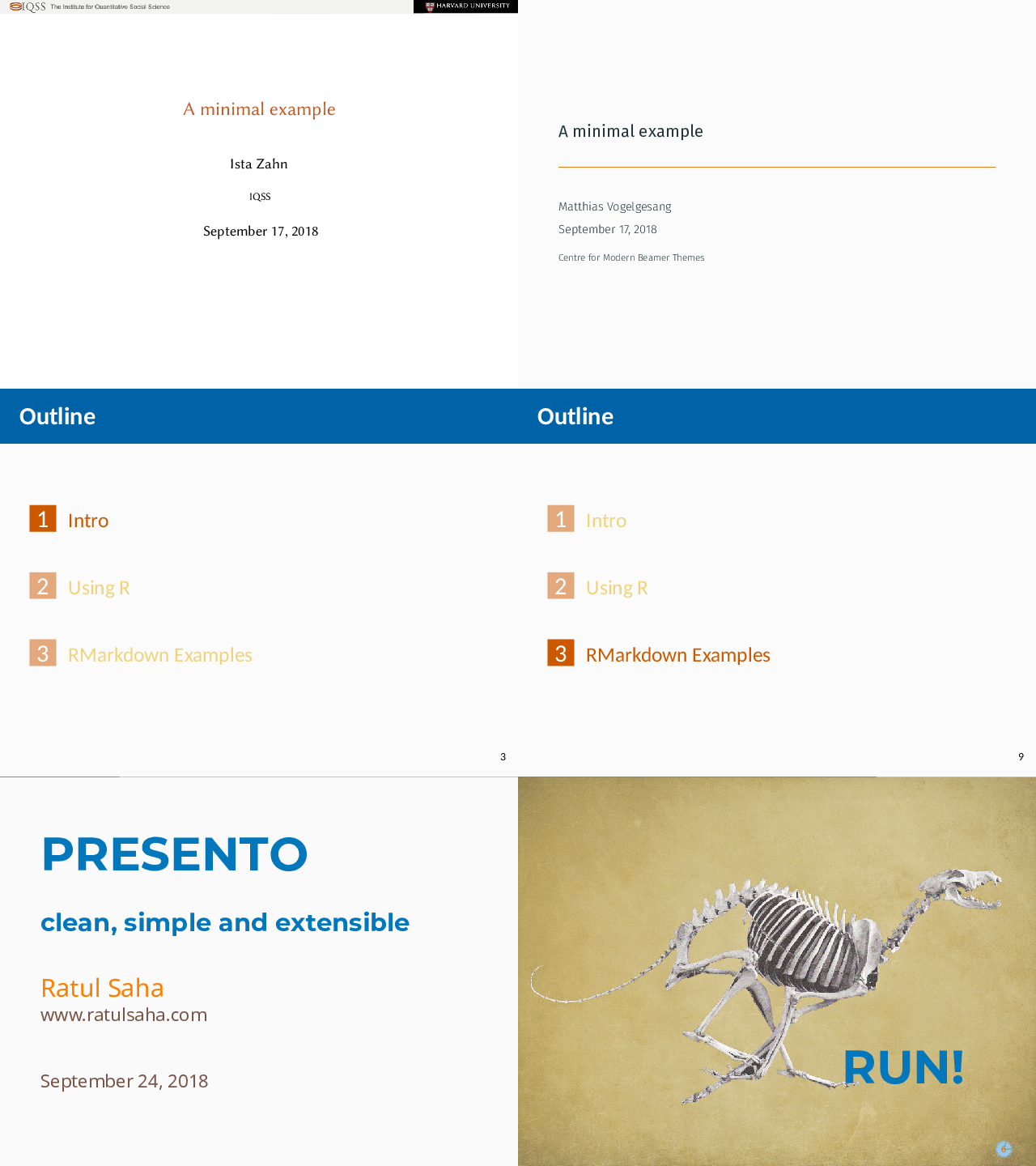
The eight release of the binb package, and first in two years, is now on CRAN and in r2u. binb regroups four rather nice themes for writing LaTeX Beamer presentations much more easily in (R)Markdown. As a teaser, a quick demo combining all four themes is available; documentation and examples are in the package. This release contains regular internal updates to continuous integration, URLs reference and switch to Authors@R. The trigger for the release, though, was a small updated need when very recent pandoc versions (as shipped with RStudio) are used which require a new variable declaration in the LaTeX template files in order to process uncaptioned tables. The summary of changes follows.

Changes in binb version 0.0.8 (2026-05-01)
  • Small updates to documentation URLs and continuous integration
  • The package now uses Authors@R in DESCRIPTION
  • Newer pandoc versions are accommodated by adding a required counter variable in the latex template file

CRANberries provides a summary of changes to the previous version. For questions or comments, please use the issue tracker at the GitHub repo.

This post by Dirk Eddelbuettel originated on his Thinking inside the box blog. If you like this or other open-source work I do, you can sponsor me at GitHub. You can also sponsor my Tour de Shore 2026 ride in support of the Maywood Fine Arts Center.

Next.

Previous.