Antoine Beaupr : The supposed decline of copyleft
At DebConf17, John Sullivan, the
executive director of the FSF, gave a talk on the supposed decline of
the use of copyleft licenses use free-software projects. In his
presentation, Sullivan
questioned the notion that permissive licenses, like the BSD or MIT
licenses, are gaining ground at the expense of the traditionally
dominant copyleft licenses from the FSF. While there does seem to be a
rise in the use of permissive licenses, in general, there are several
possible explanations for the phenomenon.
When the rumor mill starts
Sullivan gave a recent example of the claim of the decline of copyleft
in an article on
Opensource.com by Jono
Bacon from February 2017 that showed a histogram of license usage
between 2010 and 2017 (seen below).
When the rumor mill starts
Sullivan gave a recent example of the claim of the decline of copyleft
in an article on
Opensource.com by Jono
Bacon from February 2017 that showed a histogram of license usage
between 2010 and 2017 (seen below).
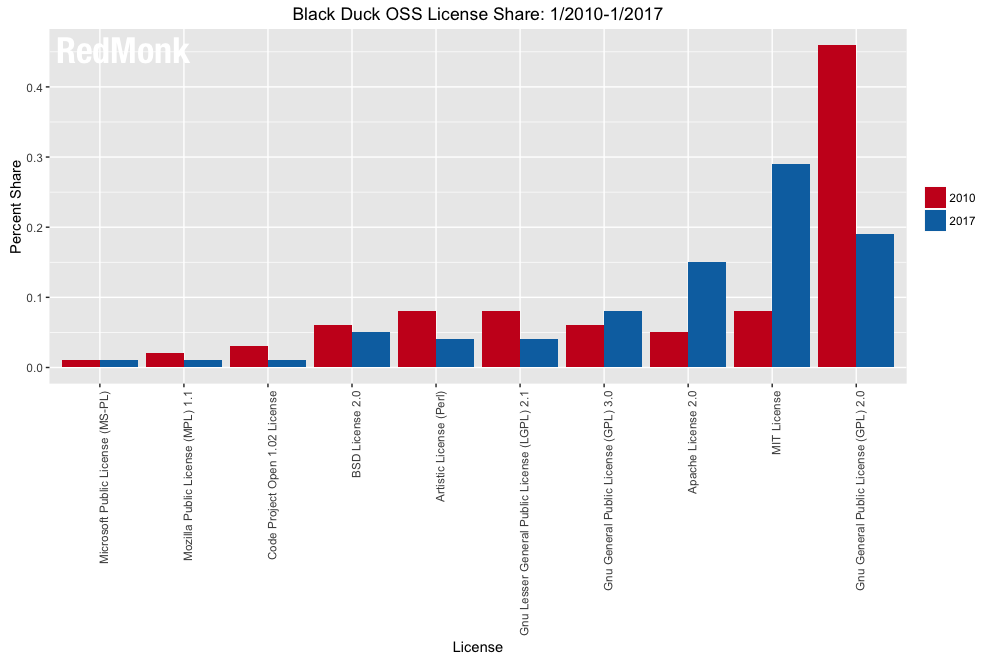
From that, Bacon elaborates possible reasons for the apparent decline of
the GPL. The graphic used in the article was actually generated by
Stephen O'Grady in a January article, The State Of Open Source
Licensing,
which said:
In Black Duck's sample, the most popular variant of the GPL version
2 is less than half as popular as it was (46% to 19%). Over the same
span, the permissive MIT has gone from 8% share to 29%, while its
permissive cousin the Apache License 2.0 jumped from 5% to 15%.
Sullivan, however, argued that the methodology used to create both
articles was problematic. Neither contains original research: the graphs
actually come from the Black Duck
Software "KnowledgeBase" data,
which was partly created from the old Ohloh web site now known as Open
Hub.
To show one problem with the data, Sullivan mentioned two free-software
projects, GNU Bash and GNU Emacs, that had been showcased on the front
page of Ohloh.net in 2012. On the site, Bash was (and still
is)
listed as GPLv2+, whereas it
changed
to GPLv3 in 2011. He also claimed that "Emacs was listed as licensed
under GPLv3-only, which is a license Emacs has never had in its
history", although I wasn't able to verify that information from the
Internet archive. Basically, according to Sullivan, "the two projects
featured on the front page of a site that was using [the Black Duck]
data set were wrong". This, in turn, seriously brings into question the
quality of the data:
I reported this problem and we'll continue to do that but when someone
is not sharing the data set that they're using for other people to
evaluate it and we see glimpses of it which are incorrect, that should
give us a lot of hesitation about accepting any conclusion that comes
out of it.
Reproducible observations are necessary to the establishment of solid
theories in science. Sullivan didn't try to contact Black Duck to get
access to the database, because he assumed (rightly, as it turned out)
that he would need to "pay for the data under terms that forbid you to
share that information with anybody else". So I wrote Black Duck myself
to confirm this information. In an email interview, Patrick Carey from
Black Duck confirmed its data set is proprietary. He believes, however,
that through a "combination of human and automated techniques", Black
Duck is "highly confident at the accuracy and completeness of the data
in the KnowledgeBase". He did point out, however, that "the way we track
the data may not necessarily be optimal for answering the question on
license use trend" as "that would entail examination of new open source
projects coming into existence each year and the licenses used by them".
In other words, even according to Black Duck, its database may not be
useful to establish the conclusions drawn by those articles. Carey did
agree with those conclusions intuitively, however, saying that "there
seems to be a shift toward Apache and MIT licenses in new projects,
though I don't have data to back that up". He suggested that "an
effective way to answer the trend question would be to analyze the new
projects on GitHub over the last 5-10 years." Carey also suggested that
"GitHub has become so dominant over the recent years that just looking
at projects on GitHub would give you a reasonable sampling from which to
draw conclusions".
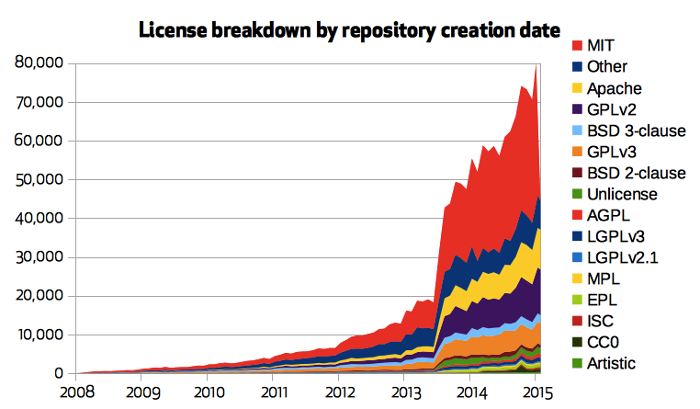
Indeed, GitHub published a
report
in 2015 that also seems to confirm MIT's popularity (45%), surpassing
copyleft licenses (24%). The data is, however, not without its own
limitations. For example, in the above graph going back to the inception
of GitHub in 2008, we see a rather abnormal spike in 2013, which seems
to correlate with the launch of the
choosealicense.com site, described by
GitHub as "our first pass at making open source licensing on GitHub
easier".
In his talk, Sullivan was critical of the initial version of the
site
which he described as biased toward permissive licenses. Because the
GitHub project creation page links to the site, Sullivan explained that
the site's bias could have actually influenced GitHub users' license
choices. Following a
talk
from Sullivan at FOSDEM 2016, GitHub addressed the problem later that
year by
rewording parts of the front page to be more accurate, but that any
change in license choice obviously doesn't show in the report produced
in 2015 and won't affect choices users have already made. Therefore,
there can be reasonable doubts that GitHub's subset of software projects
may not actually be that representative of the larger free-software
community.
In search of solid evidence
So it seems we are missing good, reproducible results to confirm or
dispel these claims. Sullivan explained that it is a difficult problem,
if only in the way you select which projects to analyze: the impact of a
MIT-licensed personal wiki will obviously be vastly different from, say,
a GPL-licensed C compiler or kernel. We may want to distinguish between
active and inactive projects. Then there is the problem of code
duplication, both across publication platforms (a project may be
published on GitHub and SourceForge for example) but also across
projects (code may be copy-pasted between projects). We should think
about how to evaluate the license of a given project: different files in
the same code base regularly have different licenses often none at all.
This is why having a clear, documented and publicly available data set
and methodology is critical. Without this, the assumptions made are not
clear and it is unreasonable to draw certain conclusions from the
results.
It turns out that some researchers did that kind of open research in
2016 in a paper called "The Debsources Dataset: Two Decades of Free and
Open Source Software"
[PDF]
by Matthieu Caneill, Daniel M. Germ n, and Stefano Zacchiroli. The
Debsources data set is the complete
Debian source code that covers a large history of the Debian project and
therefore includes thousands of free-software projects of different
origins. According to the paper:
The long history of Debian creates a perfect subject to evaluate how
FOSS licenses use has evolved over time, and the popularity of
licenses currently in use.
Sullivan argued that the Debsources data set is interesting because of
its quality: every package in Debian has been reviewed by multiple
humans, including the original packager, but also by the FTP masters to
ensure that the distribution can legally redistribute the software. The
existence of a package in Debian provides a minimal "proof of use":
unmaintained packages get removed from Debian on a regular basis and the
mere fact that a piece of software gets packaged in Debian means at
least some users found it important enough to work on packaging it.
Debian packagers make specific efforts to avoid code duplication between
packages in order to ease security maintenance. The data set covers a
period longer than Black Duck's or GitHub's, as it goes all the way back
to the Hamm 2.0 release in 1998. The data and how to reproduce it are
freely available under a CC
BY-SA 4.0 license.
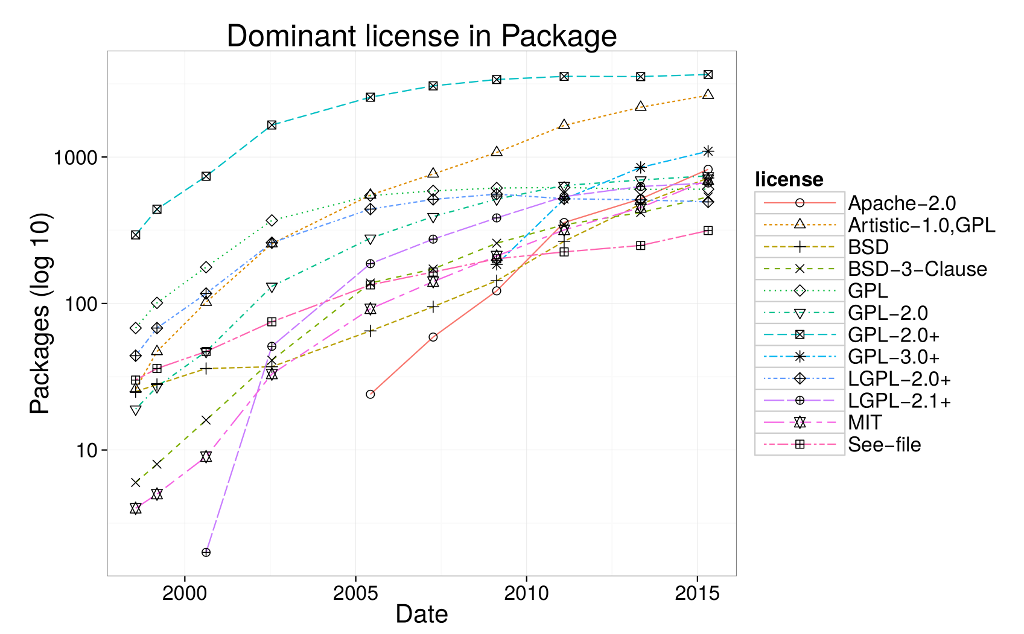
Sullivan presented the above graph from the research paper that showed
the evolution of software license use in the Debian archive. Whereas
previous graphs showed statistics in percentages, this one showed actual
absolute numbers, where we can't actually distinguish a decline in
copyleft licenses. To quote the paper again:
The top license is, once again, GPL-2.0+, followed by:
Artistic-1.0/GPL dual-licensing (the licensing choice of Perl and most
Perl libraries), GPL-3.0+, and Apache-2.0.
Indeed, looking at the graph, at most do we see a rise of the Apache
and MIT licenses and no decline of the GPL per se, although its adoption
does seem to slow down in recent years. We should also mention the
possibility that Debian's data set has the opposite bias: toward GPL
software. The Debian project is culturally quite different from the
GitHub community and even the larger free-software ecosystem, naturally,
which could explain the disparity in the results. We can only hope a
similar analysis can be performed on the much larger Software
Heritage data set eventually, which
may give more representative results. The paper acknowledges this
problem:
Debian is likely representative of enterprise use of FOSS as a base
operating system, where stable, long-term and seldomly updated
software products are desirable. Conversely Debian is unlikely
representative of more dynamic FOSS environments (e.g., modern
Web-development with micro libraries) where users, who are usually
developers themselves, expect to receive library updates on a daily
basis.
The Debsources research also shares methodology limitations with Black
Duck: while Debian packages are reviewed before uploading and we can
rely on the copyright information provided by Debian maintainers, the
research also relies on automated tools (specifically
FOSSology) to retrieve license
information.
Sullivan also warned against "ascribing reason to numbers": people may
have different reasons for choosing a particular license. Developers may
choose the MIT license because it has fewer words, for compatibility
reasons, or simply because "their lawyers told them to". It may not
imply an actual deliberate philosophical or ideological choice.
Finally, he brought up the theory that the rise of non-copyleft licenses
isn't necessarily at the detriment of the GPL. He explained that, even
if there is an actual decline, it may not be much of a problem if
there is an overall growth of free software to the detriment of
proprietary software. He reminded the audience that non-copyleft
licenses are still free software, according to the FSF and the Debian
Free Software Guidelines, so their rise is still a positive outcome.
Even if the GPL is a better tool to accomplish the goal of a
free-software world, we can all acknowledge that the conversion of
proprietary software to more permissive and certainly simpler licenses
is definitely heading in the right direction.
[I would like to thank the DebConf organizers for providing meals for
me during the conference.]
Note: this article first appeared in
the Linux Weekly News.
The long history of Debian creates a perfect subject to evaluate how FOSS licenses use has evolved over time, and the popularity of licenses currently in use.Sullivan argued that the Debsources data set is interesting because of its quality: every package in Debian has been reviewed by multiple humans, including the original packager, but also by the FTP masters to ensure that the distribution can legally redistribute the software. The existence of a package in Debian provides a minimal "proof of use": unmaintained packages get removed from Debian on a regular basis and the mere fact that a piece of software gets packaged in Debian means at least some users found it important enough to work on packaging it. Debian packagers make specific efforts to avoid code duplication between packages in order to ease security maintenance. The data set covers a period longer than Black Duck's or GitHub's, as it goes all the way back to the Hamm 2.0 release in 1998. The data and how to reproduce it are freely available under a CC BY-SA 4.0 license.
Sullivan presented the above graph from the research paper that showed the evolution of software license use in the Debian archive. Whereas previous graphs showed statistics in percentages, this one showed actual absolute numbers, where we can't actually distinguish a decline in copyleft licenses. To quote the paper again:
The top license is, once again, GPL-2.0+, followed by: Artistic-1.0/GPL dual-licensing (the licensing choice of Perl and most Perl libraries), GPL-3.0+, and Apache-2.0.Indeed, looking at the graph, at most do we see a rise of the Apache and MIT licenses and no decline of the GPL per se, although its adoption does seem to slow down in recent years. We should also mention the possibility that Debian's data set has the opposite bias: toward GPL software. The Debian project is culturally quite different from the GitHub community and even the larger free-software ecosystem, naturally, which could explain the disparity in the results. We can only hope a similar analysis can be performed on the much larger Software Heritage data set eventually, which may give more representative results. The paper acknowledges this problem:
Debian is likely representative of enterprise use of FOSS as a base operating system, where stable, long-term and seldomly updated software products are desirable. Conversely Debian is unlikely representative of more dynamic FOSS environments (e.g., modern Web-development with micro libraries) where users, who are usually developers themselves, expect to receive library updates on a daily basis.The Debsources research also shares methodology limitations with Black Duck: while Debian packages are reviewed before uploading and we can rely on the copyright information provided by Debian maintainers, the research also relies on automated tools (specifically FOSSology) to retrieve license information. Sullivan also warned against "ascribing reason to numbers": people may have different reasons for choosing a particular license. Developers may choose the MIT license because it has fewer words, for compatibility reasons, or simply because "their lawyers told them to". It may not imply an actual deliberate philosophical or ideological choice. Finally, he brought up the theory that the rise of non-copyleft licenses isn't necessarily at the detriment of the GPL. He explained that, even if there is an actual decline, it may not be much of a problem if there is an overall growth of free software to the detriment of proprietary software. He reminded the audience that non-copyleft licenses are still free software, according to the FSF and the Debian Free Software Guidelines, so their rise is still a positive outcome. Even if the GPL is a better tool to accomplish the goal of a free-software world, we can all acknowledge that the conversion of proprietary software to more permissive and certainly simpler licenses is definitely heading in the right direction.
[I would like to thank the DebConf organizers for providing meals for me during the conference.] Note: this article first appeared in the Linux Weekly News.

 Home office minister Amber Rudd recently suggested British firms should
 All this racism, it's just not cricket. Or is it? One of the most remarkable cricketers to play for England in recent times,
 In fact, after Brexit, people like Venables and Thompson will remain in Britain while
 What does "maximum control" over other human beings mean to you?
The new British PM has said she wants "
 Echoes of the Third Reich
Most people associate acts of mass murder with the Germans who lived in the time of Adolf Hitler. These are the stories told over and and over again in movies, books and the press.
Look more closely, however, and it appears that the vast majority of Germans were not in immediate contact with the gas chambers. Even Gobels' secretary writes that
 There is no middle ground between "soft" and "hard" brexit
An important point for British citizens and foreigners in the UK to consider today is that there is no compromise between a "soft" Brexit and a "hard" Brexit. It is one or the other. Anything less (for example, a deal that is "better" for British companies and worse for EU citizens) would imply that the British are a superior species and it is impossible to imagine the EU putting their stamp on such a deal. Anybody from the EU who is trying to make a life in the UK now is playing a game of Russian Roulette - sure, everything might be fine if it morphs into "soft" Brexit, but if Theresa May has her way, at some point in your life, maybe 20 years down the track, you could be rounded up by the gestapo and thrown behind bars for a parking violation.


 Last month, we released
 Back in 2010, inspired by
 Once again, Ryan Neily and I met last month for our annual hike. This year, to give our aging knees a break, we visited the


 This week I have been gathered with 38 KDE people in Randa, Switzerland. Randa is a place in a valley in the middle of the Alps close to various peaks like Matterhorn. It has been a week of intense hacking, bugfixing, brainstorming and a bit of enjoying the nature.
R is for Reproducible builds
I spent the first couple of days trying to get the Qt Documentation generation tool to reproducible generate documentation. Some of the fixes were of the usual put data in an randomized datastructure, then iterate over it and create output , where the fix is similar well known: Sort the datastructure first. Others were a bit more severe bugs that lead to the documentation to shuffle around the obsolete bit, and the inheritance chains. Most of these fixes have been reviewed and submitted to the Qt 5.6 branch, one is still


 Following Ivans
 Regarding Internet Explorer it jumped in my face with a strange error message that recommended to enable
TLS 1.0, 1.1 and 1.2 in the options menu. Of course that's already enable. I'll try to take a look at the
handshake next week, but I bet we've to accept for the moment that IE will not work with so many SANs.
Would be interesting to try out Windows 10 with Spartan, but well I'm not that interested in Windows to
invest more time on that front. Other TLS implementations, like Java, would be also interesting to test.
 I attended DebConf 15 last week. After being on semi-vacation from Debian for the last few months, recovering after the end of my second DPL term, it was great to be active again, talk to many people, and go back to doing technical work. Unfortunately, I caught the debbug quite early in the week, so I was not able to make it as intense as I wanted, but it was great nevertheless.
I still managed to do quite a lot:
 Well, here are the stats for the final week of the
 Pevious articles are here:
 Debconf15 started yesterday and as expected, talk rooms are always fully crowded! I had to stand up in a couple of talks and I watched another couple of them from outside thanks to


