Search Results: "dpk"

8 November 2024

Thomas Lange: Using NIS (Network Information Service) in 2024

The topic of this posting already tells you that an old Unix guy tells stories about old techniques. I'm a happy NIS (formerly YP) user since 30+ years. I started using it with SunOS 4.0, later using it with Solaris and with Linux since 1999. In the past, a colleague wasn't happyly using NIS+ when he couldn't log in as root after a short time because of some well known bugs and wrong configs. NIS+ was also much slower than my NIS setup. I know organisations using NIS for more than 80.000 user accounts in 2024. I know the security implications of NIS but I can live with them, because I manage all computers in the network that have access to the NIS maps. And NIS on Linux offers to use shadow maps, which are only accessible to the root account. My users are forced to use very long passwords. Unfortunately NIS support for the PAM modules was removed in Debian in pam 1.4.0-13, which means Debian 12 (bookworm) is lacking NIS support in PAM, but otherwise it is still supported. This only affects changing the NIS password via passwd. You can still authenticate users and use other NIS maps. But yppasswd is deprecated and you should not use it! If you use yppasswd it may generate a new password hash by using the old DES crypt algorithm, which is very weak and only uses the first 8 chars in your password. Do not use yppasswd any more! yppasswd only detects DES, MD5, SHA256 and SHA512 hashes, but for me and some colleagues it only creates weak DES hashes after a password change. yescrypt hashes which are the default in Debian 12 are not supported at all. The solution is to use the plain passwd program. On the NIS master, you should setup your NIS configuration to use /etc/shadow and /etc/passwd even if your other NIS maps are in /var/yp/src or similar. Make sure to have these lines in your /var/yp/Makefile:
PASSWD      = /etc/passwd
SHADOW      = /etc/shadow
Call make once, and it will generate the shadow and passwd map. You may want to set the variable MINUID which defines which entries are not put into the NIS maps. On all NIS clients you still need the entries (for passwd, shadow, group,...) that point to the nis service. E.g.:
passwd:         files nis systemd
group:          files nis systemd
shadow:         files nis
You can remove all occurences of "nis" in your /etc/pam.d/common-password file. Then you can use the plain passwd program to change your password on the NIS master. But this does not call make in /var/yp for updating the NIS shadow map. Let's use inotify(7) for that. First, create a small shell script /usr/local/sbin/shadow-change:
#! /bin/sh
PATH=/usr/sbin:/usr/bin
# only watch the /etc/shadow file
if [ "$2" != "shadow" ]; then
  exit 0
fi
cd /var/yp   exit 3
sleep 2
make
Then install the package incron.
# apt install incron
# echo root >> /etc/incron.allow
# incrontab -e
Add this line:
/etc    IN_MOVED_TO     /usr/local/sbin/shadow-change $@ $# $%
It's not possible to use IN_MODIFY or watch other events on /etc/shadow directly, because the passwd command creates a /etc/nshadow file, deletes /etc/shadow and then moves nshadow to shadow. inotify on a file does not work after the file was removed. You can see the logs from incrond by using:
# journalctl _COMM=incrond
e.g.
Oct 01 12:21:56 kueppers incrond[6588]: starting service (version 0.5.12, built on Jan 27 2023 23:08:49)
Oct 01 13:43:55 kueppers incrond[6589]: table for user root created, loading
Oct 01 13:45:42 kueppers incrond[6589]: PATH (/etc) FILE (shadow) EVENT (IN_MOVED_TO)
Oct 01 13:45:42 kueppers incrond[6589]: (root) CMD ( /usr/local/sbin/shadow-change /etc shadow IN_MOVED_TO)
I've disabled the execution of yppasswd using dpkg-divert
# dpkg-divert --local --rename --divert /usr/bin/yppasswd-disable /usr/bin/yppasswd
chmod a-rwx /usr/bin/yppasswd-disable
Do not forget to limit the access to the shadow.byname map in ypserv.conf and general access to NIS in ypserv.securenets. I've also discovered the package pamtester, which is a nice package for testing your pam configs.

10 October 2024

Freexian Collaborators: Debian Contributions: Packaging Pydantic v2, Reworking of glib2.0 for cross bootstrap, Python archive rebuilds and more! (by Anupa Ann Joseph)

Debian Contributions: 2024-09 Contributing to Debian is part of Freexian s mission. This article covers the latest achievements of Freexian and their collaborators. All of this is made possible by organizations subscribing to our Long Term Support contracts and consulting services.

Pydantic v2, by Colin Watson Pydantic is a useful library for validating data in Python using type hints: Freexian uses it in a number of projects, including Debusine. Its Debian packaging had been stalled at 1.10.17 in testing for some time, partly due to needing to make sure everything else could cope with the breaking changes introduced in 2.x, but mostly due to needing to sort out packaging of its new Rust dependencies. Several other people (notably Alexandre Detiste, Andreas Tille, Drew Parsons, and Timo R hling) had made some good progress on this, but nobody had quite got it over the line and it seemed a bit stuck. Colin upgraded a few Rust libraries to new upstream versions, packaged rust-jiter, and chased various failures in other packages. This eventually allowed getting current versions of both pydantic-core and pydantic into testing. It should now be much easier for us to stay up to date routinely.

Reworking of glib2.0 for cross bootstrap, by Helmut Grohne Simon McVittie (not affiliated with Freexian) earlier restructured the libglib2.0-dev such that it would absorb more functionality and in particular provide tools for working with .gir files. Those tools practically require being run for their host architecture (practically this means running under qemu-user) which is at odds with the requirements of architecture cross bootstrap. The qemu requirement was expressed in package dependencies and also made people unhappy attempting to use libglib2.0-dev for i386 on amd64 without resorting to qemu. The use of qemu in architecture bootstrap is particularly problematic as it tends to not be ready at the time bootstrapping is needed. As a result, Simon proposed and implemented the introduction of a libgio-2.0-dev package providing a subset of libglib2.0-dev that does not require qemu. Packages should continue to use libglib2.0-dev in their Build-Depends unless involved in architecture bootstrap. Helmut reviewed and tested the implementation and integrated the necessary changes into rebootstrap. He also prepared a patch for libverto to use the new package and proposed adding forward compatibility to glib2.0. Helmut continued working on adding cross-exe-wrapper to architecture-properties and implemented autopkgtests later improved by Simon. The cross-exe-wrapper package now provides a generic mechanism to a program on a different architecture by using qemu when needed only. For instance, a dependency on cross-exe-wrapper:i386 provides a i686-linux-gnu-cross-exe-wrapper program that can be used to wrap an ELF executable for the i386 architecture. When installed on amd64 or i386 it will skip installing or running qemu, but for other architectures qemu will be used automatically. This facility can be used to support cross building with targeted use of qemu in cases where running host code is unavoidable as is the case for GObject introspection. This concludes the joint work with Simon and Niels Thykier on glib2.0 and architecture-properties resolving known architecture bootstrap regressions arising from the glib2.0 refactoring earlier this year.

Analyzing binary package metadata, by Helmut Grohne As Guillem Jover (not affiliated with Freexian) continues to work on adding metadata tracking to dpkg, the question arises how this affects existing packages. The dedup.debian.net infrastructure provides an easy playground to answer such questions, so Helmut gathered file metadata from all binary packages in unstable and performed an explorative analysis. Some results include: Guillem also performed a cursory analysis and reported other problem categories such as mismatching directory permissions for directories installed by multiple packages and thus gained a better understanding of what consistency checks dpkg can enforce.

Python archive rebuilds, by Stefano Rivera Last month Stefano started to write some tooling to do large-scale rebuilds in debusine, starting with finding packages that had already started to fail to build from source (FTBFS) due to the removal of setup.py test. This month, Stefano did some more rebuilds, starting with experimental versions of dh-python. During the Python 3.12 transition, we had added a dependency on python3-setuptools to dh-python, to ease the transition. Python 3.12 removed distutils from the stdlib, but many packages were expecting it to still be available. Setuptools contains a version of distutils, and dh-python was a convenient place to depend on setuptools for most package builds. This dependency was never meant to be permanent. A rebuild without it resulted in mass-filing about 340 bugs (and around 80 more by mistake). A new feature in Python 3.12, was to have unittest s test runner exit with a non-zero return code, if no tests were run. We added this feature, to be able to detect tests that are not being discovered, by mistake. We are ignoring this failure, as we wouldn t want to suddenly cause hundreds of packages to fail to build, if they have no tests. Stefano did a rebuild to see how many packages were affected, and found that around 1000 were. The Debian Python community has not come to a conclusion on how to move forward with this. As soon as Python 3.13 release candidate 2 was available, Stefano did a rebuild of the Python packages in the archive against it. This was a more complex rebuild than the others, as it had to be done in stages. Many packages need other Python packages at build time, typically to run tests. So transitions like this involve some manual bootstrapping, followed by several rounds of builds. Not all packages could be tested, as not all their dependencies support 3.13 yet. The result was around 100 bugs in packages that need work to support Python 3.13. Many other packages will need additional work to properly support Python 3.13, but being able to build (and run tests) is an important first step.

Miscellaneous contributions
  • Carles prepared the update of python-pyaarlo package to a new upstream release.
  • Carles worked on updating python-ring-doorbell to a new upstream release. Unfinished, pending to package a new dependency python3-firebase-messaging RFP #1082958 and its dependency python3-http-ece RFP #1083020.
  • Carles improved po-debconf-manager. Main new feature is that it can open Salsa merge requests. Aiming for a lightning talk in MiniDebConf Toulouse (November) to be functional end to end and get feedback from the wider public for this proof of concept.
  • Carles helped one translator to use po-debconf-manager (added compatibility for bullseye, fixed other issues) and reviewed 17 package templates.
  • Colin upgraded the OpenSSH packaging to 9.9p1.
  • Colin upgraded the various YubiHSM packages to new upstream versions, enabled more tests, fixed yubihsm-shell build failures on some 32-bit architectures, made yubihsm-shell build reproducibly, and fixed yubihsm-connector to apply udev rules to existing devices when the package is installed. As usual, bookworm-backports is up to date with all these changes.
  • Colin fixed quite a bit of fallout from setuptools 72.0.0 removing setup.py test, backported a large upstream patch set to make buildbot work with SQLAlchemy 2.0, and upgraded 25 other Python packages to new upstream versions.
  • Enrico worked with Jakob Haufe to get him up to speed for managing sso.debian.org
  • Rapha l did remove spam entries in the list of teams on tracker.debian.org (see #1080446), and he applied a few external contributions, fixing a rendering issue and replacing the DDPO link with a more useful alternative. He also gave feedback on a couple of merge requests that required more work. As part of the analysis of the underlying problem, he suggested to the ftpmasters (via #1083068) to auto-reject packages having the too-many-contacts lintian error, and he raised the severity of #1076048 to serious to actually have that 4 year old bug fixed.
  • Rapha l uploaded zim and hamster-time-tracker to fix issues with Python 3.12 getting rid of setuptools. He also uploaded a new gnome-shell-extension-hamster to cope with the upcoming transition to GNOME 47.
  • Helmut sent seven patches and sponsored one upload for cross build failures.
  • Helmut uploaded a Nagios/Icinga plugin check-smart-attributes for monitoring the health of physical disks.
  • Helmut collaborated on sbuild reviewing and improving a MR for refactoring the unshare backend.
  • Helmut sent a patch fixing coinstallability of gcc-defaults.
  • Helmut continued to monitor the evolution of the /usr-move. With more and more key packages such as libvirt or fuse3 fixed. We re moving into the boring long-tail of the transition.
  • Helmut proposed updating the meson buildsystem in debhelper to use env2mfile.
  • Helmut continued to update patches maintained in rebootstrap. Due to the work on glib2.0 above, rebootstrap moves a lot further, but still fails for any architecture.
  • Santiago reviewed some Merge Request in Salsa CI, such as: !478, proposed by Otto to extend the information about how to use additional runners in the pipeline and !518, proposed by Ahmed to add support for Ubuntu images, that will help to test how some debian packages, including the complex MariaDB are built on Ubuntu. Santiago also prepared !545, which will make the reprotest job more consistent with the result seen on reproducible-builds.
  • Santiago worked on different tasks related to DebConf 25. Especially he drafted the fundraising brochure (which is almost ready).
  • Thorsten Alteholz uploaded package libcupsfilter to fix the autopkgtest and a dependency problem of this package. After package splix was abandoned by upstream and OpenPrinting.org adopted its maintenance, Thorsten uploaded their first release.
  • Anupa published posts on the Debian Administrators group in LinkedIn and moderated the group, one of the tasks of the Debian Publicity Team.
  • Anupa helped organize DebUtsav 2024. It had over 100 attendees with hand-on sessions on making initial contributions to Linux Kernel, Debian packaging, submitting documentation to Debian wiki and assisting Debian Installations.

29 September 2024

Vasudev Kamath: Signing the systemd-boot on Upgrade Using Dpkg Triggers

In my previous post on enabling SecureBoot, I mentioned that one pending improvement was signing the systemd-boot EFI binary with my keys on every upgrade. In this post, we'll explore the implementation of this process using dpkg triggers. For an excellent introduction to dpkg triggers, refer to this archived blog post. The source code mentioned in that post can be downloaded from alioth archive. From /usr/share/doc/dpkg/spec/triggers.txt, triggers are described as follows:
A dpkg trigger is a facility that allows events caused by one package but of interest to another package to be recorded and aggregated, and processed later by the interested package. This feature simplifies various registration and system-update tasks and reduces duplication of processing.
To implement this, we create a custom package with a single script that signs the systemd-boot EFI binary using our key. The script is as simple as:
#!/bin/bash
set -e
echo "Signing the new systemd-bootx64.efi"
sbsign --key /etc/secureboot/db.key --cert /etc/secureboot/db.crt \
       /usr/lib/systemd/boot/efi/systemd-bootx64.efi
echo "Invoking bootctl install to copy stuff"
bootctl install
Invoking bootctl install is optional if we have enabled systemd-boot-update.service, which will update the signed bootloader on the next boot. We need to have a triggers file under the debian/ folder of the package, which declares its interest in modifications to the path /usr/lib/systemd/boot/efi/systemd-bootx64.efi. The trigger file looks like this:
# trigger 1 interest on systemd-bootx64.efi
interest-noawait /usr/lib/systemd/boot/efi/systemd-bootx64.efi
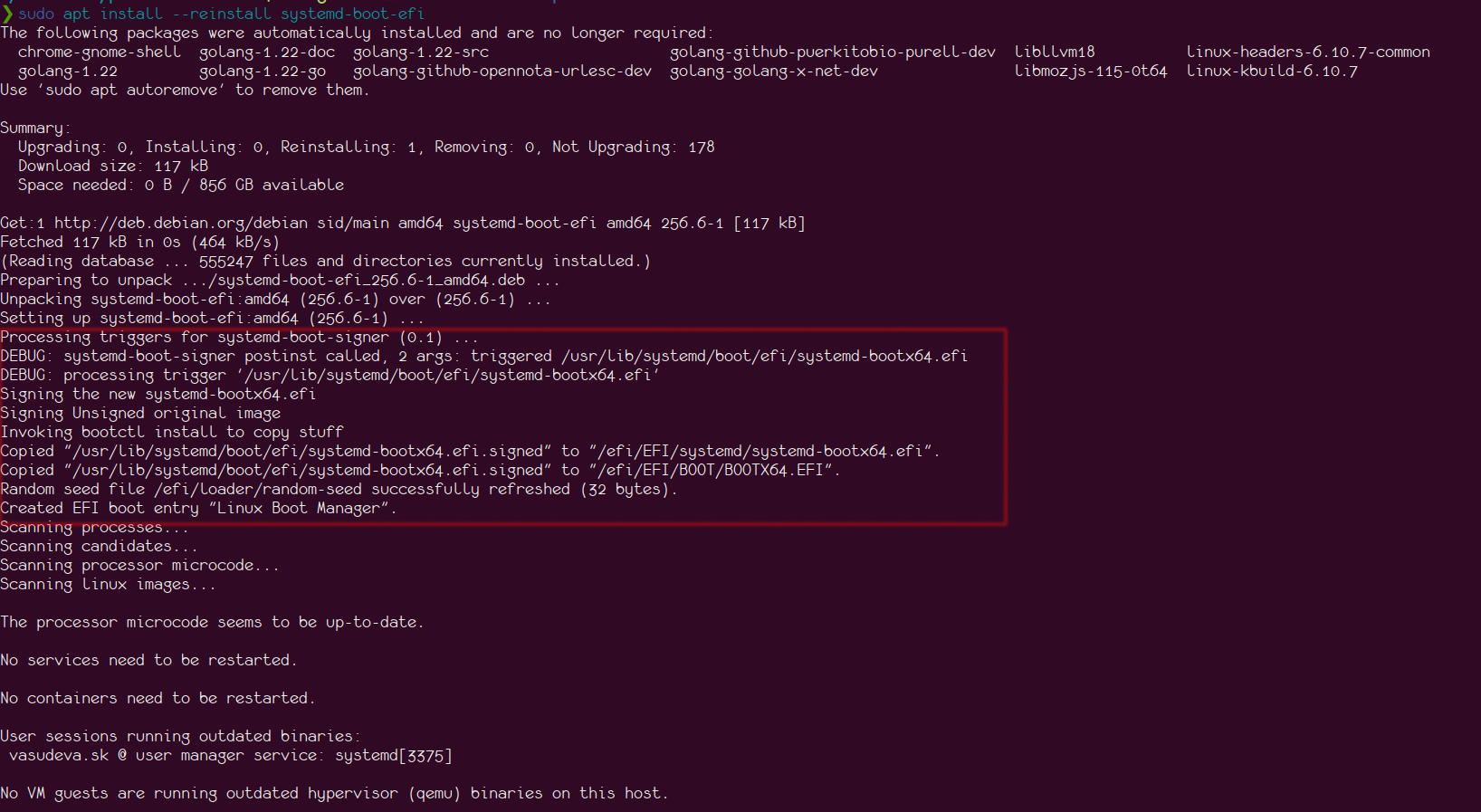
You can read about various directives and their meanings that can be used in the triggers file in the deb-triggers man page. Once we build and install the package, this request is added to /var/lib/dpkg/triggers/File. See the screenshot below after installation of our package: installed trigger To test the functionality, I performed a re-installation of the systemd-boot-efi package, which provides the EFI binary for systemd-boot, using the following command:
sudo apt install --reinstall systemd-boot-efi
During installation, you can see the debug message being printed in the screenshot below: systemd-boot-signer triggered To test the systemd-boot-update.service, I commented out the bootctl install line from the above script, performed a reinstallation, and restarted the systemd-boot-update.service. Checking the log, I saw the following:
Sep 29 13:42:51 chamunda systemd[1]: Stopping systemd-boot-update.service - Automatic Boot Loader Update...
Sep 29 13:42:51 chamunda systemd[1]: Starting systemd-boot-update.service - Automatic Boot Loader Update...
Sep 29 13:42:51 chamunda bootctl[1801516]: Skipping "/efi/EFI/systemd/systemd-bootx64.efi", same boot loader version in place already.
Sep 29 13:42:51 chamunda bootctl[1801516]: Skipping "/efi/EFI/BOOT/BOOTX64.EFI", same boot loader version in place already.
Sep 29 13:42:51 chamunda systemd[1]: Finished systemd-boot-update.service - Automatic Boot Loader Update.
Sep 29 13:43:37 chamunda systemd[1]: systemd-boot-update.service: Deactivated successfully.
Sep 29 13:43:37 chamunda systemd[1]: Stopped systemd-boot-update.service - Automatic Boot Loader Update.
Sep 29 13:43:37 chamunda systemd[1]: Stopping systemd-boot-update.service - Automatic Boot Loader Update...
Indeed, the service attempted to copy the bootloader but did not do so because there was no actual update to the binary; it was just a reinstallation trigger. The complete code for this package can be found here. With this post the entire series on using UKI to Secureboot with Debian comes to an end. Happy hacking!.

24 September 2024

Vasudev Kamath: Note to Self: Enabling Secure Boot with UKI on Debian

Note

This post is a continuation of my previous article on enabling the Unified Kernel Image (UKI) on Debian.

In this guide, we'll implement Secure Boot by taking full control of the device, removing preinstalled keys, and installing our own. For a comprehensive overview of the benefits and process, refer to this excellent post from rodsbooks.
Key Components To implement Secure Boot, we need three essential keys:
  1. Platform Key (PK): The top-level key in Secure Boot, typically provided by the motherboard manufacturer. We'll replace the vendor-supplied PK with our own for complete control.
  2. Key Exchange Key (KEK): Used to sign updates for the Signatures Database and Forbidden Signatures Database.
  3. Database Key (DB): Used to sign or verify binaries (bootloaders, boot managers, shells, drivers, etc.).
There's also a Forbidden Signature Key (dbx), which is the opposite of the DB key. We won't be generating this key in this guide.
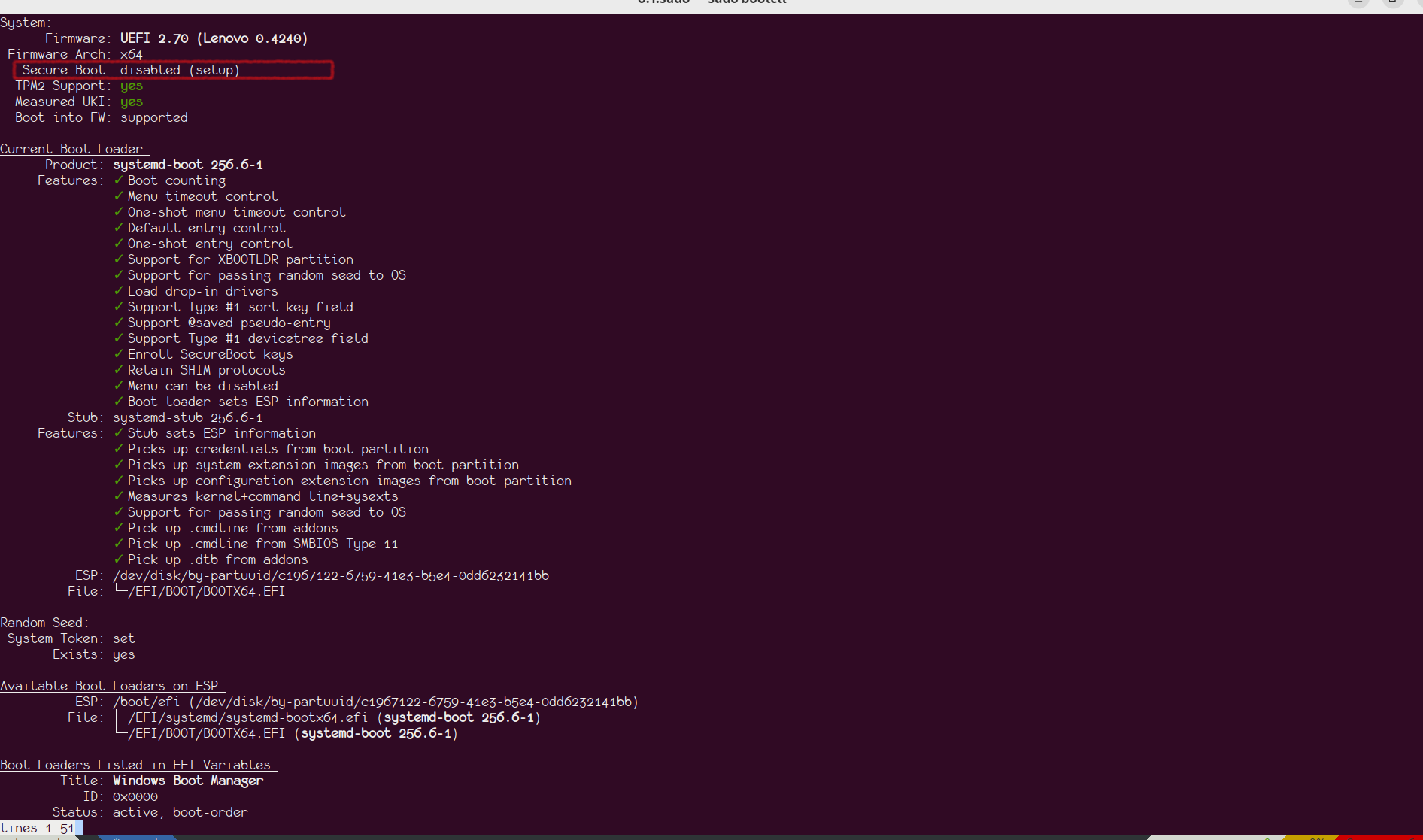
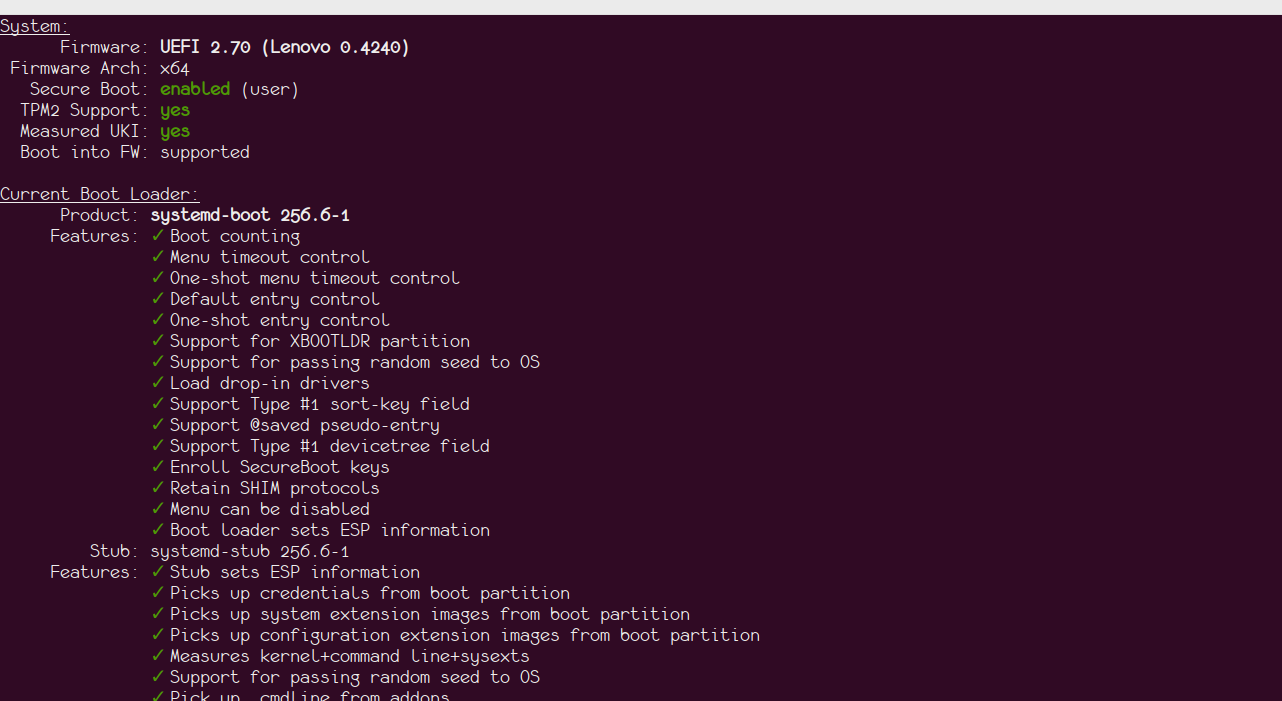
Preparing for Key Enrollment Before enrolling our keys, we need to put the device in Secure Boot Setup Mode. Verify the status using the bootctl status command. You should see output similar to the following image: UEFI Setup mode
Generating Keys Follow these instructions from the Arch Wiki to generate the keys manually. You'll need the efitools and openssl packages. I recommend using rsa:2048 as the key size for better compatibility with older firmware. After generating the keys, copy all .auth files to the /efi/loader/keys/<hostname>/ folder. For example:
  sudo ls /efi/loader/keys/chamunda
db.auth  KEK.auth  PK.auth
Signing the Bootloader Sign the systemd-boot bootloader with your new keys:
sbsign --key <path-to db.key> --cert <path-to db.crt> \
   /usr/lib/systemd/boot/efi/systemd-bootx64.efi
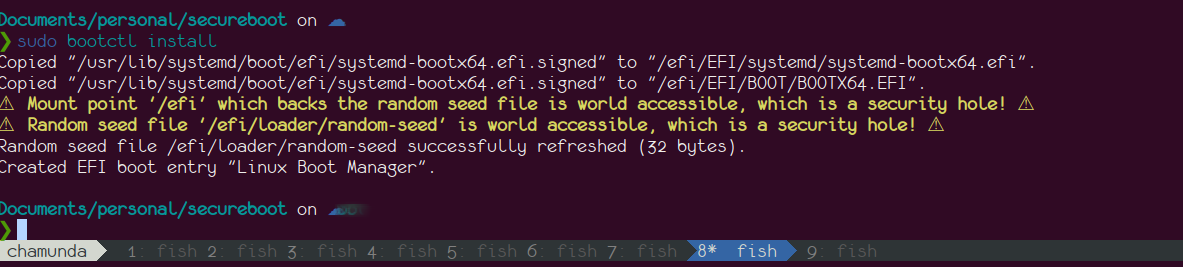
Install the signed bootloader using bootctl install. The output should resemble this: bootctl install

Note

If you encounter warnings about mount options, update your fstab with the umask=0077 option for the EFI partition.

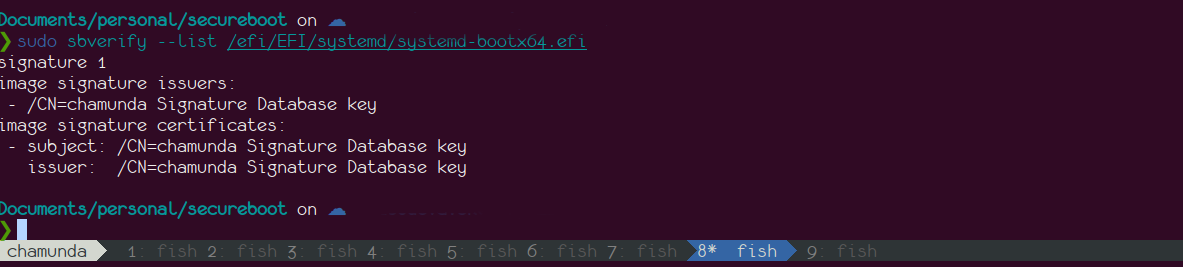
Verify the signature using sbsign --verify: sbsign verify
Configuring UKI for Secure Boot Update the /etc/kernel/uki.conf file with your key paths:
SecureBootPrivateKey=/path/to/db.key
SecureBootCertificate=/path/to/db.crt
Signing the UKI Image On Debian, use dpkg-reconfigure to sign the UKI image for each kernel:
sudo dpkg-reconfigure linux-image-$(uname -r)
# Repeat for other kernel versions if necessary
You should see output similar to this:
sudo dpkg-reconfigure linux-image-$(uname -r)
/etc/kernel/postinst.d/dracut:
dracut: Generating /boot/initrd.img-6.10.9-amd64
Updating kernel version 6.10.9-amd64 in systemd-boot...
Signing unsigned original image
Using config file: /etc/kernel/uki.conf
+ sbverify --list /boot/vmlinuz-6.10.9-amd64
+ sbsign --key /home/vasudeva.sk/Documents/personal/secureboot/db.key --cert /home/vasudeva.sk/Documents/personal/secureboot/db.crt /tmp/ukicc7vcxhy --output /tmp/kernel-install.staging.QLeGLn/uki.efi
Wrote signed /tmp/kernel-install.staging.QLeGLn/uki.efi
/etc/kernel/postinst.d/zz-systemd-boot:
Installing kernel version 6.10.9-amd64 in systemd-boot...
Signing unsigned original image
Using config file: /etc/kernel/uki.conf
+ sbverify --list /boot/vmlinuz-6.10.9-amd64
+ sbsign --key /home/vasudeva.sk/Documents/personal/secureboot/db.key --cert /home/vasudeva.sk/Documents/personal/secureboot/db.crt /tmp/ukit7r1hzep --output /tmp/kernel-install.staging.dWVt5s/uki.efi
Wrote signed /tmp/kernel-install.staging.dWVt5s/uki.efi
Enrolling Keys in Firmware Use systemd-boot to enroll your keys:
systemctl reboot --boot-loader-menu=0
Select the enroll option with your hostname in the systemd-boot menu. After key enrollment, the system will reboot into the newly signed kernel. Verify with bootctl: uefi enabled
Dealing with Lockdown Mode Secure Boot enables lockdown mode on distro-shipped kernels, which restricts certain features like kprobes/BPF and DKMS drivers. To avoid this, consider compiling the upstream kernel directly, which doesn't enable lockdown mode by default. As Linus Torvalds has stated, "there is no reason to tie Secure Boot to lockdown LSM." You can read more about Torvalds' opinion on UEFI tied with lockdown.
Next Steps One thing that remains is automating the signing of systemd-boot on upgrade, which is currently a manual process. I'm exploring dpkg triggers for achieving this, and if I succeed, I will write a new post with details.
Acknowledgments Special thanks to my anonymous colleague who provided invaluable assistance throughout this process.

19 September 2024

Vasudev Kamath: Note to Self: Enabling Unified Kernel Image on Debian

Note

These steps may not work on your system if you are using the default Debian installation. This guide assumes that your system is using systemd-boot as the bootloader, which is explained in the post linked below.

A unified kernel image (UKI) is a single executable that can be booted directly from UEFI firmware or automatically sourced by bootloaders with little or no configuration. It combines a UEFI boot stub program like systemd-stub(7), a Linux kernel image, an initrd, and additional resources into a single UEFI PE file. systemd-boot already provides a hook for kernel installation via /etc/kernel/postinst.d/zz-systemd-boot. We just need a couple of additional configurations to generate the UKI image.
Installation and Configuration
  1. Install the systemd-ukify package:

    sudo apt-get install systemd-ukify
    
  2. Create the following configuration in /etc/kernel/install.conf:

    layout=uki
    initrd_generator=dracut
    uki_generator=ukify
    
    This configuration specifies how to generate the UKI image for the installed kernel and which generator to use.
  3. Define the kernel command line for the UKI image. Create /etc/kernel/uki.conf with the following content:

    [UKI]
    Cmdline=@/etc/kernel/cmdline
    
Generating the UKI Image To apply these changes, regenerate the UKI image for the currently running kernel:
sudo dpkg-reconfigure linux-image-$(uname -r)
Verification Use the bootctl list command to verify the presence of a "Type #2" entry for the current kernel. The output should look similar to this:
bootctl list
      type: Boot Loader Specification Type #2 (.efi)
     title: Debian GNU/Linux trixie/sid (2d0080583f1a4127ac0b073b1a9d3e61-6.10.9-amd64.efi) (default) (selected)
        id: 2d0080583f1a4127ac0b073b1a9d3e61-6.10.9-amd64.efi
    source: /boot/efi/EFI/Linux/2d0080583f1a4127ac0b073b1a9d3e61-6.10.9-amd64.efi
  sort-key: debian
     linux: /boot/efi/EFI/Linux/2d0080583f1a4127ac0b073b1a9d3e61-6.10.9-amd64.efi
   options: systemd.gpt_auto=no quiet root=LABEL=root_disk ro systemd.machine_id=2d0080583f1a4127ac0b073b1a9d3e61
      type: Boot Loader Specification Type #2 (.efi)
     title: Debian GNU/Linux trixie/sid (2d0080583f1a4127ac0b073b1a9d3e61-6.10.7-amd64.efi)
        id: 2d0080583f1a4127ac0b073b1a9d3e61-6.10.7-amd64.efi
    source: /boot/efi/EFI/Linux/2d0080583f1a4127ac0b073b1a9d3e61-6.10.7-amd64.efi
  sort-key: debian
     linux: /boot/efi/EFI/Linux/2d0080583f1a4127ac0b073b1a9d3e61-6.10.7-amd64.efi
   options: systemd.gpt_auto=no quiet root=LABEL=root_disk ro systemd.machine_id=2d0080583f1a4127ac0b073b1a9d3e61
      type: Automatic
     title: Reboot Into Firmware Interface
        id: auto-reboot-to-firmware-setup
    source: /sys/firmware/efi/efivars/LoaderEntries-4a67b082-0a4c-41cf-b6c7-440b29bb8c4f
Cleanup and Reboot Once the "Type #2" entries are generated, remove any "Type #1" entries using the bootctl unlink command. After this, reboot your system to boot from the UKI-based image.
Future Considerations The primary use case for a UKI image is secure boot. Signing the UKI image can also be configured in the settings above, but this guide does not cover that process as it requires setting up secure boot on your system.

10 September 2024

Ben Hutchings: FOSS activity in August 2024

8 September 2024

Antonio Terceiro: gotcha: using ccache in Debian package builds

Before I upload packages to Debian, I always do a full build from source under sbuild. This ensures that the package can build from source on a clean environment, implying that the set of build dependencies is complete. But when iterating on a non-trivial package locally, I will usually build the package directly on my Debian testing system, and I want to take advantage of ccache to cache native (C/C++) code compilation to speed things up. In Debian, the easiest way to enable ccache is to add /usr/lib/ccache to your $PATH. I do this by doing something similar to the following in my ~/.bashrc:
export PATH=/usr/lib/ccache:$PATH
I noticed, however, that my Debian package builds were not using the cache. When building the same small package manually using make, the cache was used, but not when the build was wrapped with dpkg-buildpackage. I tracked it down to the fact that in compatibility level 13+, debhelper will set $HOME to a temporary directory. For what's it worth, I think that's a good thing: you don't want package builds reaching for your home directory as that makes it harder to make builds reproducible, among other things. This behavior, however, breaks ccache. The default cache directory is $HOME/.ccache, but that only gets resolved when ccache is actually used. So we end up starting with an empty cache on each build, get a 100% cache miss rate, and still pay for the overhead of populating the cache. The fix is to explicitly set $CCACHE_DIR upfront, so that by the time $HOME gets overriden, it doesn't matter anymore for ccache. I did this in my ~/.bashrc:
export CCACHE_DIR=$HOME/.ccache
This way, $HOME will be expanded right there when the shell starts, and by the time ccache is called, it will use the persistent cache in my home directory even though $HOME will, at that point, refer to a temporary directory.

12 August 2024

Freexian Collaborators: Debian Contributions: autopkgtest/incus builds, live-patching, Salsa CI, Python 3.13 (by Stefano Rivera)

Debian Contributions: 2024-07 Contributing to Debian is part of Freexian s mission. This article covers the latest achievements of Freexian and their collaborators. All of this is made possible by organizations subscribing to our Long Term Support contracts and consulting services.

autopkgtest/Incus build streamlining, by Colin Watson Colin contributed a change to allow maintaining Incus container and VM images in parallel. Both of these are useful (containers are faster, but some tests need full machine isolation), and the build tools previously didn t handle that very well. This isn t yet in unstable, but once it is, keeping both flavours of unstable images up to date will be a simple matter of running this regularly:
RELEASE=sid autopkgtest-build-incus images:debian/trixie
RELEASE=sid autopkgtest-build-incus --vm images:debian/trixie

Linux live-patching, by Santiago Ruano Rinc n In collaboration with Emmanuel Arias, Santiago continued the work on the support for applying security fixes to the Linux kernel in Debian, without the need to reboot the machine. As mentioned in the previous month report, kpatch 0.9.9-1 (and 0.9.9-2 afterwards) was uploaded to unstable in July, closing the Intent to Salvage (ITS) bug. With this upload, the remaining RC bugs were solved, and kpatch was able to transition to Debian testing recently. Kpatch is expected to be an important component in the live-patching support, since it makes it easy to build a patch as a kernel module. Emmanuel and Santiago continued to work on the design for Linux live-patching and presented the current status in the DebConf24 presentation.

Salsa CI, by Santiago Ruano Rinc n To be able to add RISC-V support and to avoid using tools not packaged in Debian (See #331), the Salsa CI pipeline first needed to move away from kaniko to build the images used by the pipeline. Santiago created a merge request to use buildah instead, and it was merged last month. Santiago also prepared a couple of more MRs related to how the images are built: initial RISC-V support, that should be merged after improving how built images are tested. The switch to buildah introduced a regression in the work-in-progress MR that adds new build image so the build job can run sbuild. Santiago hopes to address this regression and continue with the sbuild-related MRs in August. Additionally, Santiago also contributed to the install docker-cli instead of docker.io in the piuparts image MR, and reviewed others such as reprotest: Add append-build-command option, fix failure at manual pipeline run when leaving RELEASE variable empty and Fix image not found error on image building stage.

Python 3.13 Betas, by Stefano Rivera As Python 3.13 is approaching the first release, Stefano has been uploading the beta releases to Debian unstable. Most of these have uncovered small bugs that needed to be investigated and fixed. Stefano also took the time to review the current patch set against cPython in Debian. Python 3.13 isn t marked as a supported Python release in Debian s Python tooling, yet, so nothing has been built against it, yet. Now that the Python 3.12 transition has completed, the next task will be to start trying to build Debian s Python module packages against Python 3.13, to estimate the work required to transition to 3.13 in unstable.

Miscellaneous contributions
  • Carles Pina updated the packages python-asyncclick, python-pyaarlo and prepared updates for python-ring-doorbell and simplemonitor.
  • Carles Pina updated (reviewing or translating) Catalan translations for adduser, apt-listchanges, debconf and shadow.
  • Colin merged OpenSSH 9.8, and prepared a corresponding release note for DSA support now being disabled. This version included some substantial changes to split the server into a listener binary and a per-session binary, and those required some corresponding changes in the GSS-API key exchange patch. Sorting out the details of this and getting it to work again took some time.
  • Colin upgraded 11 Python packages to new upstream versions, and modernized the build process and/or added non-superficial autopkgtests to several more.
  • Rapha l Hertzog tweaked tracker.debian.org s debci task to work around changes in the JSON output. He also improved tracker.debian.org s ability to detect bounces due to spam to avoid unsubscribing emails that are not broken, but that are better than Debian at rejecting spam.
  • Helmut Grohne monitored the /usr-move transition with few incidents. A notable one is that some systems have ended up with aliasing links that don t match the ones installed by base-files which could lead to an unpack error from dpkg. This is now prevented by having base-files.preinst error out.
  • Helmut investigated toolchain bootstrap failures with gcc-14 in rebootstrap but would only discover the cause in August.
  • Helmut sent a MR for the cross-exe-wrapper requested by Simon McVittie for gobject-introspection. It is a way of conditionally requesting qemu-user when emulation is required for execution during cross compilation.
  • Helmut sent three patches for cross build failures.
  • Thorsten Alteholz uploaded packages lprint and magicfilter to fix RC-bugs that appeared due to the introduction of gcc-14.
  • Santiago continued to work on activities related to the DebConf24 Content Team, including reviewing the schedule and handling updates on it.
  • Santiago worked on preparations for the DebConf25, to be held in Brest, France, next year. A video of the BoF presented during DebConf24 can be found here.
  • Stefano worked on preparations for DebConf24, and helped to run the event.

8 August 2024

Louis-Philippe V ronneau: A Selection of DebConf24 Talks

DebConf24 is now over! I'm very happy I was able to attend this year. If you haven't had time to look at the schedule yet, here is a selection of talks I liked.
What happens if I delete setup.py?: a live demo of upgrading to PEP-518 Python packaging A great talk by Weezel showcasing how easy it is to migrate to PEP-518 for existing Python projects. This is the kind of thing I've been doing a lot when packaging upstream projects that still use setup.py. I encourage you to send this kind of patch upstream, as it makes everyone's life much easier.
Debian on Chromebooks: What's New and What's Next? A talk by Alper Nebi Yasak, who has done great work on running Debian and the Debian Installer on Chromebooks. With Chromebooks being very popular machines in schools, it's nice to see people working on a path to liberate them.
Sequoia PGP, sq, gpg-from-sq, v6 OpenPGP, and Debian I had the chance to see Justus' talk on Sequoia an OpenPGP implementation in Rust at DebConf22 in Kosovo. Back then, the conclusion was that sq wasn't ready for production yet. Well it seems it now is! This in-depth talk goes through the history of the project and its goals. There is also a very good section on the current OpenPGP/LibrePGP schism.
Chameleon - the easy way to try out Sequoia - OpenPGP written in Rust A very short talk by Holger on Chameleon, a tool to make migration to Sequoia easier. TL;DW: apt install gpg-from-sq
Protecting OpenPGP keyservers from certificate flooding Although I used to enjoy signing people's OpenPGP keys, I completely gave up on this practice around 2019 when dkg's key was flooded with bogus certifications and have been refusing to do so since. In this talk, Gunnar talks about his PhD work on fixing this issue and making sure we can eventually restore this important function on keyservers.
Bits from the DPL Bits from the DPL! A DebConf classic.
Linux live patching in Debian Having to reboot servers after kernel upgrades is a hassle, especially with machines that have encrypted disk drives. Although kernel live patching in Debian is still a work in progress, it is encouraging to see people trying to fix this issue.
"I use Debian BTW": fzf, tmux, zoxide and friends A fun talk by Samuel Henrique on little changes and tricks one can make to their setup to make life easier.
Ideas to Move Debian Installer Forward Another in-depth talk by Alper, this time on the Debian Installer and his ideas to try to make it better. I learned a lot about the d-i internals!
Lightning Talks Lighting talks are always fun to watch! This year, the following talks happened:
  1. Customizing your Linux icons
  2. A Free Speech tracker by SFLC.IN
  3. Desktop computing is irrelevant
  4. An introduction to wcurl
  5. Aliasing in dpkg
  6. A DebConf art space
  7. Tiny Tapeout, Fomu, PiCI
  8. Data processing and visualisation in the shell

Is there a role for Debian in the post-open source era? As an economist, I've been interested in Copyright and business models in the Free Software ecosystem for a while. In this talk, Hatta-san and Bruce Perens discuss the idea of alternative licences that are not DFSG-free, like Post-Open.

9 July 2024

Simon Josefsson: Towards Idempotent Rebuilds?

After rebuilding all added/modified packages in Trisquel, I have been circling around the elephant in the room: 99% of the binary packages in Trisquel comes from Ubuntu, which to a large extent are built from Debian source packages. Is it possible to rebuild the official binary packages identically? Does anyone make an effort to do so? Does anyone care about going through the differences between the official package and a rebuilt version? Reproducible-build.org s effort to track reproducibility bugs in Debian (and other systems) is amazing. However as far as I know, they do not confirm or deny that their rebuilds match the official packages. In fact, typically their rebuilds do not match the official packages, even when they say the package is reproducible, which had me surprised at first. To understand why that happens, compare the buildinfo file for the official coreutils 9.1-1 from Debian bookworm with the buildinfo file for reproducible-build.org s build and you will see that the SHA256 checksum does not match, but still they declare it as a reproducible package. As far as I can tell of the situation, the purpose of their rebuilds are not to say anything about the official binary build, instead the purpose is to offer a QA service to maintainers by performing two builds of a package and declaring success if both builds match. I have felt that something is lacking, and months have passed and I haven t found any project that address the problem I am interested in. During my earlier work I created a project called debdistreproduce which performs rebuilds of the difference between two distributions in a GitLab pipeline, and display diffoscope output for further analysis. A couple of days ago I had the idea of rewriting it to perform rebuilds of a single distribution. A new project debdistrebuild was born and today I m happy to bless it as version 1.0 and to announces the project! Debdistrebuild has rebuilt the top-50 popcon packages from Debian bullseye, bookworm and trixie, on amd64 and arm64, as well as Ubuntu jammy and noble on amd64, see the summary status page for links. This is intended as a proof of concept, to allow people experiment with the concept of doing GitLab-based package rebuilds and analysis. Compare how Guix has the guix challenge command. Or I should say debdistrebuild has attempted to rebuild those distributions. The number of identically built packages are fairly low, so I didn t want to waste resources building the rest of the archive until I understand if the differences are due to consequences of my build environment (plain apt-get build-dep followed by dpkg-buildpackage in a fresh container), or due to some real difference. Summarizing the results, debdistrebuild is able to rebuild 34% of Debian bullseye on amd64, 36% of bookworm on amd64, 32% of bookworm on arm64. The results for trixie and Ubuntu are disappointing, below 10%. So what causes my rebuilds to be different from the official rebuilds? Some are trivial like the classical problem of varying build paths, resulting in a different NT_GNU_BUILD_ID causing a mismatch. Some are a bit strange, like a subtle difference in one of perl s headers file. Some are due to embedded version numbers from a build dependency. Several of the build logs and diffoscope outputs doesn t make sense, likely due to bugs in my build scripts, especially for Ubuntu which appears to strip translations and do other build variations that I don t do. In general, the classes of reproducibility problems are the expected. Some are assembler differences for GnuPG s gpgv-static, likely triggered by upload of a new version of gcc after the original package was built. There are at least two ways to resolve that problem: either use the same version of build dependencies that were used to produce the original build, or demand that all packages that are affected by a change in another package are rebuilt centrally until there are no more differences. The current design of debdistrebuild uses the latest version of a build dependency that is available in the distribution. We call this a idempotent rebuild . This is usually not how the binary packages were built originally, they are often built against earlier versions of their build dependency. That is the situation for most binary distributions. Instead of using the latest build dependency version, higher reproducability may be achieved by rebuilding using the same version of the build dependencies that were used during the original build. This requires parsing buildinfo files to find the right version of the build dependency to install. We believe doing so will lead to a higher number of reproducibly built packages. However it begs the question: can we rebuild that earlier version of the build dependency? This circles back to really old versions and bootstrappable builds eventually. While rebuilding old versions would be interesting on its own, we believe that is less helpful for trusting the latest version and improving a binary distribution: it is challenging to publish a new version of some old package that would fix a reproducibility bug in another package when used as a build dependency, and then rebuild the later packages with the modified earlier version. Those earlier packages were already published, and are part of history. It may be that ultimately it will no longer be possible to rebuild some package, because proper source code is missing (for packages using build dependencies that were never part of a release); hardware to build a package could be missing; or that the source code is no longer publicly distributable. I argue that getting to 100% idempotent rebuilds is an interesting goal on its own, and to reach it we need to start measure idempotent rebuild status. One could conceivable imagine a way to rebuild modified versions of earlier packages, and then rebuild later packages using the modified earlier packages as build dependencies, for the purpose of achieving higher level of reproducible rebuilds of the last version, and to reach for bootstrappability. However, it may be still be that this is insufficient to achieve idempotent rebuilds of the last versions. Idempotent rebuilds are different from a reproducible build (where we try to reproduce the build using the same inputs), and also to bootstrappable builds (in which all binaries are ultimately built from source code). Consider a cycle where package X influence the content of package Y, which in turn influence the content of package X. These cycles may involve several packages, and it is conceivable that a cycle could be circular and infinite. It may be difficult to identify these chains, and even more difficult to break them up, but this effort help identify where to start looking for them. Rebuilding packages using the same build dependency versions as were used during the original build, or rebuilding packages using a bootsrappable build process, both seem orthogonal to the idempotent rebuild problem. Our notion of rebuildability appears thus to be complementary to reproducible-builds.org s definition and bootstrappable.org s definition. Each to their own devices, and Happy Hacking! Addendum about terminology: With idempotent rebuild I am talking about a rebuild of the entire operating system, applied to itself. Compare how you build the latest version of the GNU C Compiler: it first builds itself using whatever system compiler is available (often an earlier version of gcc) which we call step 1. Then step 2 is to build a copy of itself using the compiler built in step 1. The final step 3 is to build another copy of itself using the compiler from step 2. Debian, Ubuntu etc are at step 1 in this process right now. The output of step 2 and step 3 ought to be bit-by-bit identical, or something is wrong. The comparison between step 2 and 3 is what I refer to with an idempotent rebuild. Of course, most packages aren t a compiler that can compile itself. However entire operating systems such as Trisquel, PureOS, Ubuntu or Debian are (hopefully) a self-contained system that ought to be able to rebuild itself to an identical copy. Or something is amiss. The reproducible build and bootstrappable build projects are about improve the quality of step 1. The property I am interested is the identical rebuild and comparison in step 2 and 3. I feel the word idempotent describes the property I m interested in well, but I realize there may be better ways to describe this. Ideas welcome!

10 May 2024

Reproducible Builds: Reproducible Builds in April 2024

Welcome to the April 2024 report from the Reproducible Builds project! In our reports, we attempt to outline what we have been up to over the past month, as well as mentioning some of the important things happening more generally in software supply-chain security. As ever, if you are interested in contributing to the project, please visit our Contribute page on our website. Table of contents:
  1. New backseat-signed tool to validate distributions source inputs
  2. NixOS is not reproducible
  3. Certificate vulnerabilities in F-Droid s fdroidserver
  4. Website updates
  5. Reproducible Builds and Insights from an Independent Verifier for Arch Linux
  6. libntlm now releasing minimal source-only tarballs
  7. Distribution work
  8. Mailing list news
  9. diffoscope
  10. Upstream patches
  11. reprotest
  12. Reproducibility testing framework

New backseat-signed tool to validate distributions source inputs kpcyrd announced a new tool called backseat-signed, after:
I figured out a somewhat straight-forward way to check if a given git archive output is cryptographically claimed to be the source input of a given binary package in either Arch Linux or Debian (or both).
Elaborating more in their announcement post, kpcyrd writes:
I believe this to be the reproducible source tarball thing some people have been asking about. As explained in the README, I believe reproducing autotools-generated tarballs isn t worth everybody s time and instead a distribution that claims to build from source should operate on VCS snapshots instead of tarballs with 25k lines of pre-generated shell-script.
Indeed, many distributions packages already build from VCS snapshots, and this trend is likely to accelerate in response to the xz incident. The announcement led to a lengthy discussion on our mailing list, as well as shorter followup thread from kpcyrd about bootstrapping Autotools projects.

NixOS is not reproducible Morten Linderud posted an post on his blog this month, provocatively titled, NixOS is not reproducible . Although quickly admitting that his title is indeed clickbait , Morten goes on to clarify the precise guarantees and promises that NixOS provides its users. Later in the most, Morten mentions that he was motivated to write the post because:
I have heavily invested my free-time on this topic since 2017, and met some of the accomplishments we have had with Doesn t NixOS solve this? for just as long and I thought it would be of peoples interest to clarify[.]

Certificate vulnerabilities in F-Droid s fdroidserver In early April, Fay Stegerman announced a certificate pinning bypass vulnerability and Proof of Concept (PoC) in the F-Droid fdroidserver tools for managing builds, indexes, updates, and deployments for F-Droid repositories to the oss-security mailing list.
We observed that embedding a v1 (JAR) signature file in an APK with minSdk >= 24 will be ignored by Android/apksigner, which only checks v2/v3 in that case. However, since fdroidserver checks v1 first, regardless of minSdk, and does not verify the signature, it will accept a fake certificate and see an incorrect certificate fingerprint. [ ] We also realised that the above mentioned discrepancy between apksigner and androguard (which fdroidserver uses to extract the v2/v3 certificates) can be abused here as well. [ ]
Later on in the month, Fay followed up with a second post detailing a third vulnerability and a script that could be used to scan for potentially affected .apk files and mentioned that, whilst upstream had acknowledged the vulnerability, they had not yet applied any ameliorating fixes.

Website updates There were a number of improvements made to our website this month, including Chris Lamb updating the archive page to recommend -X and unzipping with TZ=UTC [ ] and adding Maven, Gradle, JDK and Groovy examples to the SOURCE_DATE_EPOCH page [ ]. In addition Jan Zerebecki added a new /contribute/opensuse/ page [ ] and Sertonix fixed the automatic RSS feed detection [ ][ ].

Reproducible Builds and Insights from an Independent Verifier for Arch Linux Joshua Drexel, Esther H nggi and Iy n M ndez Veiga of the School of Computer Science and Information Technology, Hochschule Luzern (HSLU) in Switzerland published a paper this month entitled Reproducible Builds and Insights from an Independent Verifier for Arch Linux. The paper establishes the context as follows:
Supply chain attacks have emerged as a prominent cybersecurity threat in recent years. Reproducible and bootstrappable builds have the potential to reduce such attacks significantly. In combination with independent, exhaustive and periodic source code audits, these measures can effectively eradicate compromises in the building process. In this paper we introduce both concepts, we analyze the achievements over the last ten years and explain the remaining challenges.
What is more, the paper aims to:
contribute to the reproducible builds effort by setting up a rebuilder and verifier instance to test the reproducibility of Arch Linux packages. Using the results from this instance, we uncover an unnoticed and security-relevant packaging issue affecting 16 packages related to Certbot [ ].
A PDF of the paper is available.

libntlm now releasing minimal source-only tarballs Simon Josefsson wrote on his blog this month that, going forward, the libntlm project will now be releasing what they call minimal source-only tarballs :
The XZUtils incident illustrate that tarballs with files that are not included in the git archive offer an opportunity to disguise malicious backdoors. [The] risk of hiding malware is not the only motivation to publish signed minimal source-only tarballs. With pre-generated content in tarballs, there is a risk that GNU/Linux distributions [ship] generated files coming from the tarball into the binary *.deb or *.rpm package file. Typically the person packaging the upstream project never realized that some installed artifacts was not re-built[.]
Simon s post goes into further details how this was achieved, and describes some potential caveats and counters some expected responses as well. A shorter version can be found in the announcement for the 1.8 release of libntlm.

Distribution work In Debian this month, Helmut Grohne filed a bug suggesting the removal of dh-buildinfo, a tool to generate and distribute .buildinfo-like files within binary packages. Note that this is distinct from the .buildinfo generation performed by dpkg-genbuildinfo. By contrast, the entirely optional dh-buildinfo generated a debian/buildinfo file that would be shipped within binary packages as /usr/share/doc/package/buildinfo_$arch.gz. Adrian Bunk recently asked about including source hashes in Debian s .buildinfo files, which prompted Guillem Jover to refresh some old patches to dpkg to make this possible, which revealed some quirks Vagrant Cascadian discovered when testing. In addition, 21 reviews of Debian packages were added, 22 were updated and 16 were removed this month adding to our knowledge about identified issues. A number issue types have been added, such as new random_temporary_filenames_embedded_by_mesonpy and timestamps_added_by_librime toolchain issues. In openSUSE, it was announced that their Factory distribution enabled bit-by-bit reproducible builds for almost all parts of the package. Previously, more parts needed to be ignored when comparing package files, but now only the signature needs to be deleted. In addition, Bernhard M. Wiedemann published theunreproduciblepackage as a proper .rpm package which it allows to better test tools intended to debug reproducibility. Furthermore, it was announced that Bernhard s work on a 100% reproducible openSUSE-based distribution will be funded by NLnet. He also posted another monthly report for his reproducibility work in openSUSE. In GNU Guix, Janneke Nieuwenhuizen submitted a patch set for creating a reproducible source tarball for Guix. That is to say, ensuring that make dist is reproducible when run from Git. [ ] Lastly, in Fedora, a new wiki page was created to propose a change to the distribution. Titled Changes/ReproduciblePackageBuilds , the page summarises itself as a proposal whereby A post-build cleanup is integrated into the RPM build process so that common causes of build irreproducibility in packages are removed, making most of Fedora packages reproducible.

Mailing list news On our mailing list this month:
  • Continuing a thread started in March 2024 about the Arch Linux minimal container now being 100% reproducible, John Gilmore followed up with a post about the practical and philosophical distinctions of local vs. remote storage of the various artifacts needed to build packages.
  • Chris Lamb asked the list which conferences readers are attending these days: After peak Covid and other industry-wide changes, conferences are no longer the must attend events they previously were especially in the area of software supply-chain security. In rough, practical terms, it seems harder to justify conference travel today than it did in mid-2019. The thread generated a number of responses which would be of interest to anyone planning travel in Q3 and Q4 of 2024.
  • James Addison wrote to the list about a quirk in Git related to its core.autocrlf functionality, thus helpfully passing on a slightly off-topic and perhaps not of direct relevance to anyone on the list today note that might still be the kind of issue that is useful to be aware of if-and-when puzzling over unexpected git content / checksum issues (situations that I do expect people on this list encounter from time-to-time) .

diffoscope diffoscope is our in-depth and content-aware diff utility that can locate and diagnose reproducibility issues. This month, Chris Lamb made a number of changes such as uploading versions 263, 264 and 265 to Debian and made the following additional changes:
  • Don t crash on invalid .zip files, even if we encounter their badness halfway through the file and not at the time of their initial opening. [ ]
  • Prevent odt2txt tests from always being skipped due to an (impossibly) new version requirement. [ ]
  • Avoid parens-in-parens in test skipping messages. [ ]
  • Ensure that tests with >=-style version constraints actually print the tool name. [ ]
In addition, Fay Stegerman fixed a crash when there are (invalid) duplicate entries in .zip which was originally reported in Debian bug #1068705). [ ] Fay also added a user-visible note to a diff when there are duplicate entries in ZIP files [ ]. Lastly, Vagrant Cascadian added an external tool pointer for the zipdetails tool under GNU Guix [ ] and proposed updates to diffoscope in Guix as well [ ] which were merged as [264] [265], fixed a regression in test coverage and increased verbosity of the test suite[ ].

Upstream patches The Reproducible Builds project detects, dissects and attempts to fix as many currently-unreproducible packages as possible. We endeavour to send all of our patches upstream where appropriate. This month, we wrote a large number of such patches, including:

reprotest reprotest is our tool for building the same source code twice in different environments and then checking the binaries produced by each build for any differences. This month, reprotest version 0.7.27 was uploaded to Debian unstable) by Vagrant Cascadian who made the following additional changes:
  • Enable specific number of CPUs using --vary=num_cpus.cpus=X. [ ]
  • Consistently use 398 days for time variation, rather than choosing randomly each time. [ ]
  • Disable builds of arch:any packages. [ ]
  • Update the description for the build_path.path option in README.rst. [ ]
  • Update escape sequences for compatibility with Python 3.12. (#1068853). [ ]
  • Remove the generic upstream signing-key [ ] and update the packages signing key with the currently active team members [ ].
  • Update the packaging Standards-Version to 4.7.0. [ ]
In addition, Holger Levsen fixed some spelling errors detected by the spellintian tool [ ] and Vagrant Cascadian updated reprotest in GNU Guix to 0.7.27.

Reproducibility testing framework The Reproducible Builds project operates a comprehensive testing framework running primarily at tests.reproducible-builds.org in order to check packages and other artifacts for reproducibility. In April, an enormous number of changes were made by Holger Levsen:
  • Debian-related changes:
    • Adjust for changed internal IP addresses at Codethink. [ ]
    • Automatically cleanup failed diffoscope user services if there are too many failures. [ ][ ]
    • Configure two new nodes at infomanik.cloud. [ ][ ]
    • Schedule Debian experimental even less. [ ][ ]
  • Breakage detection:
    • Exclude currently building packages from breakage detection. [ ]
    • Be more noisy if diffoscope crashes. [ ]
    • Health check: provide clickable URLs in jenkins job log for failed pkg builds due to diffoscope crashes. [ ]
    • Limit graph to about the last 100 days of breakages only. [ ]
    • Fix all found files with bad permissions. [ ]
    • Prepare dealing with diffoscope timeouts. [ ]
    • Detect more cases of failure to debootstrap base system. [ ]
    • Include timestamps of failed job runs. [ ]
  • Documentation updates:
    • Document how to access arm64 nodes at Codethink. [ ]
    • Document how to use infomaniak.cloud. [ ]
    • Drop notes about long stalled LeMaker HiKey960 boards sponsored by HPE and hosted at ETH. [ ]
    • Mention osuosl4 and osuosl5 and explain their usage. [ ]
    • Mention that some packages are built differently. [ ][ ]
    • Improve language in a comment. [ ]
    • Add more notes how to query resource usage from infomaniak.cloud. [ ]
  • Node maintenance:
    • Add ionos4 and ionos14 to THANKS. [ ][ ][ ][ ][ ]
    • Deprecate Squid on ionos1 and ionos10. [ ]
    • Drop obsolete script to powercycle arm64 architecture nodes. [ ]
    • Update system_health_check for new proxy nodes. [ ]
  • Misc changes:
    • Make the update_jdn.sh script more robust. [ ][ ]
    • Update my SSH public key. [ ]
In addition, Mattia Rizzolo added some new host details. [ ]

If you are interested in contributing to the Reproducible Builds project, please visit our Contribute page on our website. However, you can get in touch with us via:

13 April 2024

Paul Tagliamonte: Domo Arigato, Mr. debugfs

Years ago, at what I think I remember was DebConf 15, I hacked for a while on debhelper to write build-ids to debian binary control files, so that the build-id (more specifically, the ELF note .note.gnu.build-id) wound up in the Debian apt archive metadata. I ve always thought this was super cool, and seeing as how Michael Stapelberg blogged some great pointers around the ecosystem, including the fancy new debuginfod service, and the find-dbgsym-packages helper, which uses these same headers, I don t think I m the only one. At work I ve been using a lot of rust, specifically, async rust using tokio. To try and work on my style, and to dig deeper into the how and why of the decisions made in these frameworks, I ve decided to hack up a project that I ve wanted to do ever since 2015 write a debug filesystem. Let s get to it.

Back to the Future Time to admit something. I really love Plan 9. It s just so good. So many ideas from Plan 9 are just so prescient, and everything just feels right. Not just right like, feels good like, correct. The bit that I ve always liked the most is 9p, the network protocol for serving a filesystem over a network. This leads to all sorts of fun programs, like the Plan 9 ftp client being a 9p server you mount the ftp server and access files like any other files. It s kinda like if fuse were more fully a part of how the operating system worked, but fuse is all running client-side. With 9p there s a single client, and different servers that you can connect to, which may be backed by a hard drive, remote resources over something like SFTP, FTP, HTTP or even purely synthetic. The interesting (maybe sad?) part here is that 9p wound up outliving Plan 9 in terms of adoption 9p is in all sorts of places folks don t usually expect. For instance, the Windows Subsystem for Linux uses the 9p protocol to share files between Windows and Linux. ChromeOS uses it to share files with Crostini, and qemu uses 9p (virtio-p9) to share files between guest and host. If you re noticing a pattern here, you d be right; for some reason 9p is the go-to protocol to exchange files between hypervisor and guest. Why? I have no idea, except maybe due to being designed well, simple to implement, and it s a lot easier to validate the data being shared and validate security boundaries. Simplicity has its value. As a result, there s a lot of lingering 9p support kicking around. Turns out Linux can even handle mounting 9p filesystems out of the box. This means that I can deploy a filesystem to my LAN or my localhost by running a process on top of a computer that needs nothing special, and mount it over the network on an unmodified machine unlike fuse, where you d need client-specific software to run in order to mount the directory. For instance, let s mount a 9p filesystem running on my localhost machine, serving requests on 127.0.0.1:564 (tcp) that goes by the name mountpointname to /mnt.
$ mount -t 9p \
-o trans=tcp,port=564,version=9p2000.u,aname=mountpointname \
127.0.0.1 \
/mnt
Linux will mount away, and attach to the filesystem as the root user, and by default, attach to that mountpoint again for each local user that attempts to use it. Nifty, right? I think so. The server is able to keep track of per-user access and authorization along with the host OS.

WHEREIN I STYX WITH IT Since I wanted to push myself a bit more with rust and tokio specifically, I opted to implement the whole stack myself, without third party libraries on the critical path where I could avoid it. The 9p protocol (sometimes called Styx, the original name for it) is incredibly simple. It s a series of client to server requests, which receive a server to client response. These are, respectively, T messages, which transmit a request to the server, which trigger an R message in response (Reply messages). These messages are TLV payload with a very straight forward structure so straight forward, in fact, that I was able to implement a working server off nothing more than a handful of man pages. Later on after the basics worked, I found a more complete spec page that contains more information about the unix specific variant that I opted to use (9P2000.u rather than 9P2000) due to the level of Linux specific support for the 9P2000.u variant over the 9P2000 protocol.

MR ROBOTO The backend stack over at zoo is rust and tokio running i/o for an HTTP and WebRTC server. I figured I d pick something fairly similar to write my filesystem with, since 9P can be implemented on basically anything with I/O. That means tokio tcp server bits, which construct and use a 9p server, which has an idiomatic Rusty API that partially abstracts the raw R and T messages, but not so much as to cause issues with hiding implementation possibilities. At each abstraction level, there s an escape hatch allowing someone to implement any of the layers if required. I called this framework arigato which can be found over on docs.rs and crates.io.
/// Simplified version of the arigato File trait; this isn't actually
/// the same trait; there's some small cosmetic differences. The
/// actual trait can be found at:
///
/// https://docs.rs/arigato/latest/arigato/server/trait.File.html
trait File  
/// OpenFile is the type returned by this File via an Open call.
 type OpenFile: OpenFile;
/// Return the 9p Qid for this file. A file is the same if the Qid is
 /// the same. A Qid contains information about the mode of the file,
 /// version of the file, and a unique 64 bit identifier.
 fn qid(&self) -> Qid;
/// Construct the 9p Stat struct with metadata about a file.
 async fn stat(&self) -> FileResult<Stat>;
/// Attempt to update the file metadata.
 async fn wstat(&mut self, s: &Stat) -> FileResult<()>;
/// Traverse the filesystem tree.
 async fn walk(&self, path: &[&str]) -> FileResult<(Option<Self>, Vec<Self>)>;
/// Request that a file's reference be removed from the file tree.
 async fn unlink(&mut self) -> FileResult<()>;
/// Create a file at a specific location in the file tree.
 async fn create(
&mut self,
name: &str,
perm: u16,
ty: FileType,
mode: OpenMode,
extension: &str,
) -> FileResult<Self>;
/// Open the File, returning a handle to the open file, which handles
 /// file i/o. This is split into a second type since it is genuinely
 /// unrelated -- and the fact that a file is Open or Closed can be
 /// handled by the  arigato  server for us.
 async fn open(&mut self, mode: OpenMode) -> FileResult<Self::OpenFile>;
 
/// Simplified version of the arigato OpenFile trait; this isn't actually
/// the same trait; there's some small cosmetic differences. The
/// actual trait can be found at:
///
/// https://docs.rs/arigato/latest/arigato/server/trait.OpenFile.html
trait OpenFile  
/// iounit to report for this file. The iounit reported is used for Read
 /// or Write operations to signal, if non-zero, the maximum size that is
 /// guaranteed to be transferred atomically.
 fn iounit(&self) -> u32;
/// Read some number of bytes up to  buf.len()  from the provided
 ///  offset  of the underlying file. The number of bytes read is
 /// returned.
 async fn read_at(
&mut self,
buf: &mut [u8],
offset: u64,
) -> FileResult<u32>;
/// Write some number of bytes up to  buf.len()  from the provided
 ///  offset  of the underlying file. The number of bytes written
 /// is returned.
 fn write_at(
&mut self,
buf: &mut [u8],
offset: u64,
) -> FileResult<u32>;
 

Thanks, decade ago paultag! Let s do it! Let s use arigato to implement a 9p filesystem we ll call debugfs that will serve all the debug files shipped according to the Packages metadata from the apt archive. We ll fetch the Packages file and construct a filesystem based on the reported Build-Id entries. For those who don t know much about how an apt repo works, here s the 2-second crash course on what we re doing. The first is to fetch the Packages file, which is specific to a binary architecture (such as amd64, arm64 or riscv64). That architecture is specific to a component (such as main, contrib or non-free). That component is specific to a suite, such as stable, unstable or any of its aliases (bullseye, bookworm, etc). Let s take a look at the Packages.xz file for the unstable-debug suite, main component, for all amd64 binaries.
$ curl \
https://deb.debian.org/debian-debug/dists/unstable-debug/main/binary-amd64/Packages.xz \
  unxz
This will return the Debian-style rfc2822-like headers, which is an export of the metadata contained inside each .deb file which apt (or other tools that can use the apt repo format) use to fetch information about debs. Let s take a look at the debug headers for the netlabel-tools package in unstable which is a package named netlabel-tools-dbgsym in unstable-debug.
Package: netlabel-tools-dbgsym
Source: netlabel-tools (0.30.0-1)
Version: 0.30.0-1+b1
Installed-Size: 79
Maintainer: Paul Tagliamonte <paultag@debian.org>
Architecture: amd64
Depends: netlabel-tools (= 0.30.0-1+b1)
Description: debug symbols for netlabel-tools
Auto-Built-Package: debug-symbols
Build-Ids: e59f81f6573dadd5d95a6e4474d9388ab2777e2a
Description-md5: a0e587a0cf730c88a4010f78562e6db7
Section: debug
Priority: optional
Filename: pool/main/n/netlabel-tools/netlabel-tools-dbgsym_0.30.0-1+b1_amd64.deb
Size: 62776
SHA256: 0e9bdb087617f0350995a84fb9aa84541bc4df45c6cd717f2157aa83711d0c60
So here, we can parse the package headers in the Packages.xz file, and store, for each Build-Id, the Filename where we can fetch the .deb at. Each .deb contains a number of files but we re only really interested in the files inside the .deb located at or under /usr/lib/debug/.build-id/, which you can find in debugfs under rfc822.rs. It s crude, and very single-purpose, but I m feeling a bit lazy.

Who needs dpkg?! For folks who haven t seen it yet, a .deb file is a special type of .ar file, that contains (usually) three files inside debian-binary, control.tar.xz and data.tar.xz. The core of an .ar file is a fixed size (60 byte) entry header, followed by the specified size number of bytes.
[8 byte .ar file magic]
[60 byte entry header]
[N bytes of data]
[60 byte entry header]
[N bytes of data]
[60 byte entry header]
[N bytes of data]
...
First up was to implement a basic ar parser in ar.rs. Before we get into using it to parse a deb, as a quick diversion, let s break apart a .deb file by hand something that is a bit of a rite of passage (or at least it used to be? I m getting old) during the Debian nm (new member) process, to take a look at where exactly the .debug file lives inside the .deb file.
$ ar x netlabel-tools-dbgsym_0.30.0-1+b1_amd64.deb
$ ls
control.tar.xz debian-binary
data.tar.xz netlabel-tools-dbgsym_0.30.0-1+b1_amd64.deb
$ tar --list -f data.tar.xz   grep '.debug$'
./usr/lib/debug/.build-id/e5/9f81f6573dadd5d95a6e4474d9388ab2777e2a.debug
Since we know quite a bit about the structure of a .deb file, and I had to implement support from scratch anyway, I opted to implement a (very!) basic debfile parser using HTTP Range requests. HTTP Range requests, if supported by the server (denoted by a accept-ranges: bytes HTTP header in response to an HTTP HEAD request to that file) means that we can add a header such as range: bytes=8-68 to specifically request that the returned GET body be the byte range provided (in the above case, the bytes starting from byte offset 8 until byte offset 68). This means we can fetch just the ar file entry from the .deb file until we get to the file inside the .deb we are interested in (in our case, the data.tar.xz file) at which point we can request the body of that file with a final range request. I wound up writing a struct to handle a read_at-style API surface in hrange.rs, which we can pair with ar.rs above and start to find our data in the .deb remotely without downloading and unpacking the .deb at all. After we have the body of the data.tar.xz coming back through the HTTP response, we get to pipe it through an xz decompressor (this kinda sucked in Rust, since a tokio AsyncRead is not the same as an http Body response is not the same as std::io::Read, is not the same as an async (or sync) Iterator is not the same as what the xz2 crate expects; leading me to read blocks of data to a buffer and stuff them through the decoder by looping over the buffer for each lzma2 packet in a loop), and tarfile parser (similarly troublesome). From there we get to iterate over all entries in the tarfile, stopping when we reach our file of interest. Since we can t seek, but gdb needs to, we ll pull it out of the stream into a Cursor<Vec<u8>> in-memory and pass a handle to it back to the user. From here on out its a matter of gluing together a File traited struct in debugfs, and serving the filesystem over TCP using arigato. Done deal!

A quick diversion about compression I was originally hoping to avoid transferring the whole tar file over the network (and therefore also reading the whole debug file into ram, which objectively sucks), but quickly hit issues with figuring out a way around seeking around an xz file. What s interesting is xz has a great primitive to solve this specific problem (specifically, use a block size that allows you to seek to the block as close to your desired seek position just before it, only discarding at most block size - 1 bytes), but data.tar.xz files generated by dpkg appear to have a single mega-huge block for the whole file. I don t know why I would have expected any different, in retrospect. That means that this now devolves into the base case of How do I seek around an lzma2 compressed data stream ; which is a lot more complex of a question. Thankfully, notoriously brilliant tianon was nice enough to introduce me to Jon Johnson who did something super similar adapted a technique to seek inside a compressed gzip file, which lets his service oci.dag.dev seek through Docker container images super fast based on some prior work such as soci-snapshotter, gztool, and zran.c. He also pulled this party trick off for apk based distros over at apk.dag.dev, which seems apropos. Jon was nice enough to publish a lot of his work on this specifically in a central place under the name targz on his GitHub, which has been a ton of fun to read through. The gist is that, by dumping the decompressor s state (window of previous bytes, in-memory data derived from the last N-1 bytes) at specific checkpoints along with the compressed data stream offset in bytes and decompressed offset in bytes, one can seek to that checkpoint in the compressed stream and pick up where you left off creating a similar block mechanism against the wishes of gzip. It means you d need to do an O(n) run over the file, but every request after that will be sped up according to the number of checkpoints you ve taken. Given the complexity of xz and lzma2, I don t think this is possible for me at the moment especially given most of the files I ll be requesting will not be loaded from again especially when I can just cache the debug header by Build-Id. I want to implement this (because I m generally curious and Jon has a way of getting someone excited about compression schemes, which is not a sentence I thought I d ever say out loud), but for now I m going to move on without this optimization. Such a shame, since it kills a lot of the work that went into seeking around the .deb file in the first place, given the debian-binary and control.tar.gz members are so small.

The Good First, the good news right? It works! That s pretty cool. I m positive my younger self would be amused and happy to see this working; as is current day paultag. Let s take debugfs out for a spin! First, we need to mount the filesystem. It even works on an entirely unmodified, stock Debian box on my LAN, which is huge. Let s take it for a spin:
$ mount \
-t 9p \
-o trans=tcp,version=9p2000.u,aname=unstable-debug \
192.168.0.2 \
/usr/lib/debug/.build-id/
And, let s prove to ourselves that this actually mounted before we go trying to use it:
$ mount   grep build-id
192.168.0.2 on /usr/lib/debug/.build-id type 9p (rw,relatime,aname=unstable-debug,access=user,trans=tcp,version=9p2000.u,port=564)
Slick. We ve got an open connection to the server, where our host will keep a connection alive as root, attached to the filesystem provided in aname. Let s take a look at it.
$ ls /usr/lib/debug/.build-id/
00 0d 1a 27 34 41 4e 5b 68 75 82 8E 9b a8 b5 c2 CE db e7 f3
01 0e 1b 28 35 42 4f 5c 69 76 83 8f 9c a9 b6 c3 cf dc E7 f4
02 0f 1c 29 36 43 50 5d 6a 77 84 90 9d aa b7 c4 d0 dd e8 f5
03 10 1d 2a 37 44 51 5e 6b 78 85 91 9e ab b8 c5 d1 de e9 f6
04 11 1e 2b 38 45 52 5f 6c 79 86 92 9f ac b9 c6 d2 df ea f7
05 12 1f 2c 39 46 53 60 6d 7a 87 93 a0 ad ba c7 d3 e0 eb f8
06 13 20 2d 3a 47 54 61 6e 7b 88 94 a1 ae bb c8 d4 e1 ec f9
07 14 21 2e 3b 48 55 62 6f 7c 89 95 a2 af bc c9 d5 e2 ed fa
08 15 22 2f 3c 49 56 63 70 7d 8a 96 a3 b0 bd ca d6 e3 ee fb
09 16 23 30 3d 4a 57 64 71 7e 8b 97 a4 b1 be cb d7 e4 ef fc
0a 17 24 31 3e 4b 58 65 72 7f 8c 98 a5 b2 bf cc d8 E4 f0 fd
0b 18 25 32 3f 4c 59 66 73 80 8d 99 a6 b3 c0 cd d9 e5 f1 fe
0c 19 26 33 40 4d 5a 67 74 81 8e 9a a7 b4 c1 ce da e6 f2 ff
Outstanding. Let s try using gdb to debug a binary that was provided by the Debian archive, and see if it ll load the ELF by build-id from the right .deb in the unstable-debug suite:
$ gdb -q /usr/sbin/netlabelctl
Reading symbols from /usr/sbin/netlabelctl...
Reading symbols from /usr/lib/debug/.build-id/e5/9f81f6573dadd5d95a6e4474d9388ab2777e2a.debug...
(gdb)
Yes! Yes it will!
$ file /usr/lib/debug/.build-id/e5/9f81f6573dadd5d95a6e4474d9388ab2777e2a.debug
/usr/lib/debug/.build-id/e5/9f81f6573dadd5d95a6e4474d9388ab2777e2a.debug: ELF 64-bit LSB shared object, x86-64, version 1 (SYSV), dynamically linked, interpreter *empty*, BuildID[sha1]=e59f81f6573dadd5d95a6e4474d9388ab2777e2a, for GNU/Linux 3.2.0, with debug_info, not stripped

The Bad Linux s support for 9p is mainline, which is great, but it s not robust. Network issues or server restarts will wedge the mountpoint (Linux can t reconnect when the tcp connection breaks), and things that work fine on local filesystems get translated in a way that causes a lot of network chatter for instance, just due to the way the syscalls are translated, doing an ls, will result in a stat call for each file in the directory, even though linux had just got a stat entry for every file while it was resolving directory names. On top of that, Linux will serialize all I/O with the server, so there s no concurrent requests for file information, writes, or reads pending at the same time to the server; and read and write throughput will degrade as latency increases due to increasing round-trip time, even though there are offsets included in the read and write calls. It works well enough, but is frustrating to run up against, since there s not a lot you can do server-side to help with this beyond implementing the 9P2000.L variant (which, maybe is worth it).

The Ugly Unfortunately, we don t know the file size(s) until we ve actually opened the underlying tar file and found the correct member, so for most files, we don t know the real size to report when getting a stat. We can t parse the tarfiles for every stat call, since that d make ls even slower (bummer). Only hiccup is that when I report a filesize of zero, gdb throws a bit of a fit; let s try with a size of 0 to start:
$ ls -lah /usr/lib/debug/.build-id/e5/9f81f6573dadd5d95a6e4474d9388ab2777e2a.debug
-r--r--r-- 1 root root 0 Dec 31 1969 /usr/lib/debug/.build-id/e5/9f81f6573dadd5d95a6e4474d9388ab2777e2a.debug
$ gdb -q /usr/sbin/netlabelctl
Reading symbols from /usr/sbin/netlabelctl...
Reading symbols from /usr/lib/debug/.build-id/e5/9f81f6573dadd5d95a6e4474d9388ab2777e2a.debug...
warning: Discarding section .note.gnu.build-id which has a section size (24) larger than the file size [in module /usr/lib/debug/.build-id/e5/9f81f6573dadd5d95a6e4474d9388ab2777e2a.debug]
[...]
This obviously won t work since gdb will throw away all our hard work because of stat s output, and neither will loading the real size of the underlying file. That only leaves us with hardcoding a file size and hope nothing else breaks significantly as a result. Let s try it again:
$ ls -lah /usr/lib/debug/.build-id/e5/9f81f6573dadd5d95a6e4474d9388ab2777e2a.debug
-r--r--r-- 1 root root 954M Dec 31 1969 /usr/lib/debug/.build-id/e5/9f81f6573dadd5d95a6e4474d9388ab2777e2a.debug
$ gdb -q /usr/sbin/netlabelctl
Reading symbols from /usr/sbin/netlabelctl...
Reading symbols from /usr/lib/debug/.build-id/e5/9f81f6573dadd5d95a6e4474d9388ab2777e2a.debug...
(gdb)
Much better. I mean, terrible but better. Better for now, anyway.

Kilroy was here Do I think this is a particularly good idea? I mean; kinda. I m probably going to make some fun 9p arigato-based filesystems for use around my LAN, but I don t think I ll be moving to use debugfs until I can figure out how to ensure the connection is more resilient to changing networks, server restarts and fixes on i/o performance. I think it was a useful exercise and is a pretty great hack, but I don t think this ll be shipping anywhere anytime soon. Along with me publishing this post, I ve pushed up all my repos; so you should be able to play along at home! There s a lot more work to be done on arigato; but it does handshake and successfully export a working 9P2000.u filesystem. Check it out on on my github at arigato, debugfs and also on crates.io and docs.rs. At least I can say I was here and I got it working after all these years.

3 April 2024

Joey Hess: reflections on distrusting xz

Was the ssh backdoor the only goal that "Jia Tan" was pursuing with their multi-year operation against xz? I doubt it, and if not, then every fix so far has been incomplete, because everything is still running code written by that entity. If we assume that they had a multilayered plan, that their every action was calculated and malicious, then we have to think about the full threat surface of using xz. This quickly gets into nightmare scenarios of the "trusting trust" variety. What if xz contains a hidden buffer overflow or other vulnerability, that can be exploited by the xz file it's decompressing? This would let the attacker target other packages, as needed. Let's say they want to target gcc. Well, gcc contains a lot of documentation, which includes png images. So they spend a while getting accepted as a documentation contributor on that project, and get added to it a png file that is specially constructed, it has additional binary data appended that exploits the buffer overflow. And instructs xz to modify the source code that comes later when decompressing gcc.tar.xz. More likely, they wouldn't bother with an actual trusting trust attack on gcc, which would be a lot of work to get right. One problem with the ssh backdoor is that well, not all servers on the internet run ssh. (Or systemd.) So webservers seem a likely target of this kind of second stage attack. Apache's docs include png files, nginx does not, but there's always scope to add improved documentation to a project. When would such a vulnerability have been introduced? In February, "Jia Tan" wrote a new decoder for xz. This added 1000+ lines of new C code across several commits. So much code and in just the right place to insert something like this. And why take on such a significant project just two months before inserting the ssh backdoor? "Jia Tan" was already fully accepted as maintainer, and doing lots of other work, it doesn't seem to me that they needed to start this rewrite as part of their cover. They were working closely with xz's author Lasse Collin in this, by indications exchanging patches offlist as they developed it. So Lasse Collin's commits in this time period are also worth scrutiny, because they could have been influenced by "Jia Tan". One that caught my eye comes immediately afterwards: "prepares the code for alternative C versions and inline assembly" Multiple versions and assembly mean even more places to hide such a security hole. I stress that I have not found such a security hole, I'm only considering what the worst case possibilities are. I think we need to fully consider them in order to decide how to fully wrap up this mess. Whether such stealthy security holes have been introduced into xz by "Jia Tan" or not, there are definitely indications that the ssh backdoor was not the end of what they had planned. For one thing, the "test file" based system they introduced was extensible. They could have been planning to add more test files later, that backdoored xz in further ways. And then there's the matter of the disabling of the Landlock sandbox. This was not necessary for the ssh backdoor, because the sandbox is only used by the xz command, not by liblzma. So why did they potentially tip their hand by adding that rogue "." that disables the sandbox? A sandbox would not prevent the kind of attack I discuss above, where xz is just modifying code that it decompresses. Disabling the sandbox suggests that they were going to make xz run arbitrary code, that perhaps wrote to files it shouldn't be touching, to install a backdoor in the system. Both deb and rpm use xz compression, and with the sandbox disabled, whether they link with liblzma or run the xz command, a backdoored xz can write to any file on the system while dpkg or rpm is running and noone is likely to notice, because that's the kind of thing a package manager does. My impression is that all of this was well planned and they were in it for the long haul. They had no reason to stop with backdooring ssh, except for the risk of additional exposure. But they decided to take that risk, with the sandbox disabling. So they planned to do more, and every commit by "Jia Tan", and really every commit that they could have influenced needs to be distrusted. This is why I've suggested to Debian that they revert to an earlier version of xz. That would be my advice to anyone distributing xz. I do have a xz-unscathed fork which I've carefully constructed to avoid all "Jia Tan" involved commits. It feels good to not need to worry about dpkg and tar. I only plan to maintain this fork minimally, eg security fixes. Hopefully Lasse Collin will consider these possibilities and address them in his response to the attack.

Arnaud Rebillout: Firefox: Moving from the Debian package to the Flatpak app (long-term?)

First, thanks to Samuel Henrique for giving notice of recent Firefox CVEs in Debian testing/unstable. At the time I didn't want to upgrade my system (Debian Sid) due to the ongoing t64 transition transition, so I decided I could install the Firefox Flatpak app instead, and why not stick to it long-term? This blog post details all the steps, if ever others want to go the same road. Flatpak Installation Disclaimer: this section is hardly anything more than a copy/paste of the official documentation, and with time it will get outdated, so you'd better follow the official doc. First thing first, let's install Flatpak:
$ sudo apt update
$ sudo apt install flatpak
Then the next step is to add the Flathub remote repository, from where we'll get our Flatpak applications:
$ flatpak remote-add --if-not-exists flathub https://dl.flathub.org/repo/flathub.flatpakrepo
And that's all there is to it! Now come the optional steps. For GNOME and KDE users, you might want to install a plugin for the software manager specific to your desktop, so that it can support and manage Flatpak apps:
$ which -s gnome-software  && sudo apt install gnome-software-plugin-flatpak
$ which -s plasma-discover && sudo apt install plasma-discover-backend-flatpak
And here's an additional check you can do, as it's something that did bite me in the past: missing xdg-portal-* packages, that are required for Flatpak applications to communicate with the desktop environment. Just to be sure, you can check the output of apt search '^xdg-desktop-portal' to see what's available, and compare with the output of dpkg -l grep xdg-desktop-portal. As you can see, if you're a GNOME or KDE user, there's a portal backend for you, and it should be installed. For reference, this is what I have on my GNOME desktop at the moment:
$ dpkg -l   grep xdg-desktop-portal   awk ' print $2 '
xdg-desktop-portal
xdg-desktop-portal-gnome
xdg-desktop-portal-gtk
Install the Firefox Flatpak app This is trivial, but still, there's a question I've always asked myself: should I install applications system-wide (aka. flatpak --system, the default) or per-user (aka. flatpak --user)? Turns out, this questions is answered in the Flatpak documentation:
Flatpak commands are run system-wide by default. If you are installing applications for day-to-day usage, it is recommended to stick with this default behavior.
Armed with this new knowledge, let's install the Firefox app:
$ flatpak install flathub org.mozilla.firefox
And that's about it! We can give it a go already:
$ flatpak run org.mozilla.firefox
Data migration At this point, running Firefox via Flatpak gives me an "empty" Firefox. That's not what I want, instead I want my usual Firefox, with a gazillion of tabs already opened, a few extensions, bookmarks and so on. As it turns out, Mozilla provides a brief doc for data migration, and it's as simple as moving Firefox data directory around! To clarify, we'll be copying data: Make sure that all Firefox instances are closed, then proceed:
# BEWARE! Below I'm erasing data!
$ rm -fr ~/.var/app/org.mozilla.firefox/.mozilla/firefox/
$ cp -a ~/.mozilla/firefox/ ~/.var/app/org.mozilla.firefox/.mozilla/
To avoid confusing myself, it's also a good idea to rename the local data directory:
$ mv ~/.mozilla/firefox ~/.mozilla/firefox.old.$(date --iso-8601=date)
At this point, flatpak run org.mozilla.firefox takes me to my "usual" everyday Firefox, with all its tabs opened, pinned, bookmarked, etc. More integration? After following all the steps above, I must say that I'm 99% happy. So far, everything works as before, I didn't hit any issue, and I don't even notice that Firefox is running via Flatpak, it's completely transparent. So where's the 1% of unhappiness? The Run a Command dialog from GNOME, the one that shows up via the keyboard shortcut <Alt+F2>. This is how I start my GUI applications, and I usually run two Firefox instances in parallel (one for work, one for personal), using the firefox -p <profile> command. Given that I ran apt purge firefox before (to avoid confusing myself with two installations of Firefox), now the right (and only) way to start Firefox from a command-line is to type flatpak run org.mozilla.firefox -p <profile>. Typing that every time is way too cumbersome, so I need something quicker. Seems like the most straightforward is to create a wrapper script:
$ cat /usr/local/bin/firefox 
#!/bin/sh
exec flatpak run org.mozilla.firefox "$@"
And now I can just hit <Alt+F2> and type firefox -p <profile> to start Firefox with the profile I want, just as before. Neat! Looking forward: system updates I usually update my system manually every now and then, via the well-known pair of commands:
$ sudo apt update
$ sudo apt full-upgrade
The downside of introducing Flatpak, ie. introducing another package manager, is that I'll need to learn new commands to update the software that comes via this channel. Fortunately, there's really not much to learn. From flatpak-update(1):
flatpak update [OPTION...] [REF...] Updates applications and runtimes. [...] If no REF is given, everything is updated, as well as appstream info for all remotes.
Could it be that simple? Apparently yes, the Flatpak equivalent of the two apt commands above is just:
$ flatpak update
Going forward, my options are:
  1. Teach myself to run flatpak update additionally to apt update, manually, everytime I update my system.
  2. Go crazy: let something automatically update my Flatpak apps, in my back and without my consent.
I'm actually tempted to go for option 2 here, and I wonder if GNOME Software will do that for me, provided that I installed gnome-software-plugin-flatpak, and that I checked Software Updates -> Automatic in the Settings (which I did). However, I didn't find any documentation regarding what this setting really does, so I can't say if it will only download updates, or if it will also install it. I'd be happy if it automatically installs new version of Flatpak apps, but at the same time I'd be very unhappy if it automatically upgrades my Debian system... So we'll see. Enough for today, hope this blog post was useful!

2 April 2024

Bits from Debian: Bits from the DPL

Dear Debianites This morning I decided to just start writing Bits from DPL and send whatever I have by 18:00 local time. Here it is, barely proof read, along with all it's warts and grammar mistakes! It's slightly long and doesn't contain any critical information, so if you're not in the mood, don't feel compelled to read it! Get ready for a new DPL! Soon, the voting period will start to elect our next DPL, and my time as DPL will come to an end. Reading the questions posted to the new candidates on debian-vote, it takes quite a bit of restraint to not answer all of them myself, I think I can see how that aspect contributed to me being reeled in to running for DPL! In total I've done so 5 times (the first time I ran, Sam was elected!). Good luck to both Andreas and Sruthi, our current DPL candidates! I've already started working on preparing handover, and there's multiple request from teams that have came in recently that will have to wait for the new term, so I hope they're both ready to hit the ground running! Things that I wish could have gone better Communication Recently, I saw a t-shirt that read:
Adulthood is saying, 'But after this week things will slow down a bit' over and over until you die.
I can relate! With every task, crisis or deadline that appears, I think that once this is over, I'll have some more breathing space to get back to non-urgent, but important tasks. "Bits from the DPL" was something I really wanted to get right this last term, and clearly failed spectacularly. I have two long Bits from the DPL drafts that I never finished, I tend to have prioritised problems of the day over communication. With all the hindsight I have, I'm not sure which is better to prioritise, I do rate communication and transparency very highly and this is really the top thing that I wish I could've done better over the last four years. On that note, thanks to people who provided me with some kind words when I've mentioned this to them before. They pointed out that there are many other ways to communicate and be in touch with the community, and they mentioned that they thought that I did a good job with that. Since I'm still on communication, I think we can all learn to be more effective at it, since it's really so important for the project. Every time I publicly spoke about us spending more money, we got more donations. People out there really like to see how we invest funds in to Debian, instead of just making it heap up. DSA just spent a nice chunk on money on hardware, but we don't have very good visibility on it. It's one thing having it on a public line item in SPI's reporting, but it would be much more exciting if DSA could provide a write-up on all the cool hardware they're buying and what impact it would have on developers, and post it somewhere prominent like debian-devel-announce, Planet Debian or Bits from Debian (from the publicity team). I don't want to single out DSA there, it's difficult and affects many other teams. The Salsa CI team also spent a lot of resources (time and money wise) to extend testing on AMD GPUs and other AMD hardware. It's fantastic and interesting work, and really more people within the project and in the outside world should know about it! I'm not going to push my agendas to the next DPL, but I hope that they continue to encourage people to write about their work, and hopefully at some point we'll build enough excitement in doing so that it becomes a more normal part of our daily work. Founding Debian as a standalone entity This was my number one goal for the project this last term, which was a carried over item from my previous terms. I'm tempted to write everything out here, including the problem statement and our current predicaments, what kind of ground work needs to happen, likely constitutional changes that need to happen, and the nature of the GR that would be needed to make such a thing happen, but if I start with that, I might not finish this mail. In short, I 100% believe that this is still a very high ranking issue for Debian, and perhaps after my term I'd be in a better position to spend more time on this (hmm, is this an instance of "The grass is always better on the other side", or "Next week will go better until I die?"). Anyway, I'm willing to work with any future DPL on this, and perhaps it can in itself be a delegation tasked to properly explore all the options, and write up a report for the project that can lead to a GR. Overall, I'd rather have us take another few years and do this properly, rather than rush into something that is again difficult to change afterwards. So while I very much wish this could've been achieved in the last term, I can't say that I have any regrets here either. My terms in a nutshell COVID-19 and Debian 11 era My first term in 2020 started just as the COVID-19 pandemic became known to spread globally. It was a tough year for everyone, and Debian wasn't immune against its effects either. Many of our contributors got sick, some have lost loved ones (my father passed away in March 2020 just after I became DPL), some have lost their jobs (or other earners in their household have) and the effects of social distancing took a mental and even physical health toll on many. In Debian, we tend to do really well when we get together in person to solve problems, and when DebConf20 got cancelled in person, we understood that that was necessary, but it was still more bad news in a year we had too much of it already. I can't remember if there was ever any kind of formal choice or discussion about this at any time, but the DebConf video team just kind of organically and spontaneously became the orga team for an online DebConf, and that lead to our first ever completely online DebConf. This was great on so many levels. We got to see each other's faces again, even though it was on screen. We had some teams talk to each other face to face for the first time in years, even though it was just on a Jitsi call. It had a lasting cultural change in Debian, some teams still have video meetings now, where they didn't do that before, and I think it's a good supplement to our other methods of communication. We also had a few online Mini-DebConfs that was fun, but DebConf21 was also online, and by then we all developed an online conference fatigue, and while it was another good online event overall, it did start to feel a bit like a zombieconf and after that, we had some really nice events from the Brazillians, but no big global online community events again. In my opinion online MiniDebConfs can be a great way to develop our community and we should spend some further energy into this, but hey! This isn't a platform so let me back out of talking about the future as I see it... Despite all the adversity that we faced together, the Debian 11 release ended up being quite good. It happened about a month or so later than what we ideally would've liked, but it was a solid release nonetheless. It turns out that for quite a few people, staying inside for a few months to focus on Debian bugs was quite productive, and Debian 11 ended up being a very polished release. During this time period we also had to deal with a previous Debian Developer that was expelled for his poor behaviour in Debian, who continued to harass members of the Debian project and in other free software communities after his expulsion. This ended up being quite a lot of work since we had to take legal action to protect our community, and eventually also get the police involved. I'm not going to give him the satisfaction by spending too much time talking about him, but you can read our official statement regarding Daniel Pocock here: https://www.debian.org/News/2021/20211117 In late 2021 and early 2022 we also discussed our general resolution process, and had two consequent votes to address some issues that have affected past votes: In my first term I addressed our delegations that were a bit behind, by the end of my last term all delegation requests are up to date. There's still some work to do, but I'm feeling good that I get to hand this over to the next DPL in a very decent state. Delegation updates can be very deceiving, sometimes a delegation is completely re-written and it was just 1 or 2 hours of work. Other times, a delegation updated can contain one line that has changed or a change in one team member that was the result of days worth of discussion and hashing out differences. I also received quite a few requests either to host a service, or to pay a third-party directly for hosting. This was quite an admin nightmare, it either meant we had to manually do monthly reimbursements to someone, or have our TOs create accounts/agreements at the multiple providers that people use. So, after talking to a few people about this, we founded the DebianNet team (we could've admittedly chosen a better name, but that can happen later on) for providing hosting at two different hosting providers that we have agreement with so that people who host things under debian.net have an easy way to host it, and then at the same time Debian also has more control if a site maintainer goes MIA. More info: https://wiki.debian.org/Teams/DebianNet You might notice some Openstack mentioned there, we had some intention to set up a Debian cloud for hosting these things, that could also be used for other additional Debiany things like archive rebuilds, but these have so far fallen through. We still consider it a good idea and hopefully it will work out some other time (if you're a large company who can sponsor few racks and servers, please get in touch!) DebConf22 and Debian 12 era DebConf22 was the first time we returned to an in-person DebConf. It was a bit smaller than our usual DebConf - understandably so, considering that there were still COVID risks and people who were at high risk or who had family with high risk factors did the sensible thing and stayed home. After watching many MiniDebConfs online, I also attended my first ever MiniDebConf in Hamburg. It still feels odd typing that, it feels like I should've been at one before, but my location makes attending them difficult (on a side-note, a few of us are working on bootstrapping a South African Debian community and hopefully we can pull off MiniDebConf in South Africa later this year). While I was at the MiniDebConf, I gave a talk where I covered the evolution of firmware, from the simple e-proms that you'd find in old printers to the complicated firmware in modern GPUs that basically contain complete operating systems- complete with drivers for the device their running on. I also showed my shiny new laptop, and explained that it's impossible to install that laptop without non-free firmware (you'd get a black display on d-i or Debian live). Also that you couldn't even use an accessibility mode with audio since even that depends on non-free firmware these days. Steve, from the image building team, has said for a while that we need to do a GR to vote for this, and after more discussion at DebConf, I kept nudging him to propose the GR, and we ended up voting in favour of it. I do believe that someone out there should be campaigning for more free firmware (unfortunately in Debian we just don't have the resources for this), but, I'm glad that we have the firmware included. In the end, the choice comes down to whether we still want Debian to be installable on mainstream bare-metal hardware. At this point, I'd like to give a special thanks to the ftpmasters, image building team and the installer team who worked really hard to get the changes done that were needed in order to make this happen for Debian 12, and for being really proactive for remaining niggles that was solved by the time Debian 12.1 was released. The included firmware contributed to Debian 12 being a huge success, but it wasn't the only factor. I had a list of personal peeves, and as the hard freeze hit, I lost hope that these would be fixed and made peace with the fact that Debian 12 would release with those bugs. I'm glad that lots of people proved me wrong and also proved that it's never to late to fix bugs, everything on my list got eliminated by the time final freeze hit, which was great! We usually aim to have a release ready about 2 years after the previous release, sometimes there are complications during a freeze and it can take a bit longer. But due to the excellent co-ordination of the release team and heavy lifting from many DDs, the Debian 12 release happened 21 months and 3 weeks after the Debian 11 release. I hope the work from the release team continues to pay off so that we can achieve their goals of having shorter and less painful freezes in the future! Even though many things were going well, the ongoing usr-merge effort highlighted some social problems within our processes. I started typing out the whole history of usrmerge here, but it's going to be too long for the purpose of this mail. Important questions that did come out of this is, should core Debian packages be team maintained? And also about how far the CTTE should really be able to override a maintainer. We had lots of discussion about this at DebConf22, but didn't make much concrete progress. I think that at some point we'll probably have a GR about package maintenance. Also, thank you to Guillem who very patiently explained a few things to me (after probably having have to done so many times to others before already) and to Helmut who have done the same during the MiniDebConf in Hamburg. I think all the technical and social issues here are fixable, it will just take some time and patience and I have lots of confidence in everyone involved. UsrMerge wiki page: https://wiki.debian.org/UsrMerge DebConf 23 and Debian 13 era DebConf23 took place in Kochi, India. At the end of my Bits from the DPL talk there, someone asked me what the most difficult thing I had to do was during my terms as DPL. I answered that nothing particular stood out, and even the most difficult tasks ended up being rewarding to work on. Little did I know that my most difficult period of being DPL was just about to follow. During the day trip, one of our contributors, Abraham Raji, passed away in a tragic accident. There's really not anything anyone could've done to predict or stop it, but it was devastating to many of us, especially the people closest to him. Quite a number of DebConf attendees went to his funeral, wearing the DebConf t-shirts he designed as a tribute. It still haunts me when I saw his mother scream "He was my everything! He was my everything!", this was by a large margin the hardest day I've ever had in Debian, and I really wasn't ok for even a few weeks after that and I think the hurt will be with many of us for some time to come. So, a plea again to everyone, please take care of yourself! There's probably more people that love you than you realise. A special thanks to the DebConf23 team, who did a really good job despite all the uphills they faced (and there were many!). As DPL, I think that planning for a DebConf is near to impossible, all you can do is show up and just jump into things. I planned to work with Enrico to finish up something that will hopefully save future DPLs some time, and that is a web-based DD certificate creator instead of having the DPL do so manually using LaTeX. It already mostly works, you can see the work so far by visiting https://nm.debian.org/person/ACCOUNTNAME/certificate/ and replacing ACCOUNTNAME with your Debian account name, and if you're a DD, you should see your certificate. It still needs a few minor changes and a DPL signature, but at this point I think that will be finished up when the new DPL start. Thanks to Enrico for working on this! Since my first term, I've been trying to find ways to improve all our accounting/finance issues. Tracking what we spend on things, and getting an annual overview is hard, especially over 3 trusted organisations. The reimbursement process can also be really tedious, especially when you have to provide files in a certain order and combine them into a PDF. So, at DebConf22 we had a meeting along with the treasurer team and Stefano Rivera who said that it might be possible for him to work on a new system as part of his Freexian work. It worked out, and Freexian funded the development of the system since then, and after DebConf23 we handled the reimbursements for the conference via the new reimbursements site: https://reimbursements.debian.net/ It's still early days, but over time it should be linked to all our TOs and we'll use the same category codes across the board. So, overall, our reimbursement process becomes a lot simpler, and also we'll be able to get information like how much money we've spent on any category in any period. It will also help us to track how much money we have available or how much we spend on recurring costs. Right now that needs manual polling from our TOs. So I'm really glad that this is a big long-standing problem in the project that is being fixed. For Debian 13, we're waving goodbye to the KFreeBSD and mipsel ports. But we're also gaining riscv64 and loongarch64 as release architectures! I have 3 different RISC-V based machines on my desk here that I haven't had much time to work with yet, you can expect some blog posts about them soon after my DPL term ends! As Debian is a unix-like system, we're affected by the Year 2038 problem, where systems that uses 32 bit time in seconds since 1970 run out of available time and will wrap back to 1970 or have other undefined behaviour. A detailed wiki page explains how this works in Debian, and currently we're going through a rather large transition to make this possible. I believe this is the right time for Debian to be addressing this, we're still a bit more than a year away for the Debian 13 release, and this provides enough time to test the implementation before 2038 rolls along. Of course, big complicated transitions with dependency loops that causes chaos for everyone would still be too easy, so this past weekend (which is a holiday period in most of the west due to Easter weekend) has been filled with dealing with an upstream bug in xz-utils, where a backdoor was placed in this key piece of software. An Ars Technica covers it quite well, so I won't go into all the details here. I mention it because I want to give yet another special thanks to everyone involved in dealing with this on the Debian side. Everyone involved, from the ftpmasters to security team and others involved were super calm and professional and made quick, high quality decisions. This also lead to the archive being frozen on Saturday, this is the first time I've seen this happen since I've been a DD, but I'm sure next week will go better! Looking forward It's really been an honour for me to serve as DPL. It might well be my biggest achievement in my life. Previous DPLs range from prominent software engineers to game developers, or people who have done things like complete Iron Man, run other huge open source projects and are part of big consortiums. Ian Jackson even authored dpkg and is now working on the very interesting tag2upload service! I'm a relative nobody, just someone who grew up as a poor kid in South Africa, who just really cares about Debian a lot. And, above all, I'm really thankful that I didn't do anything major to screw up Debian for good. Not unlike learning how to use Debian, and also becoming a Debian Developer, I've learned a lot from this and it's been a really valuable growth experience for me. I know I can't possible give all the thanks to everyone who deserves it, so here's a big big thanks to everyone who have worked so hard and who have put in many, many hours to making Debian better, I consider you all heroes! -Jonathan

1 April 2024

Colin Watson: Free software activity in March 2024

My Debian contributions this month were all sponsored by Freexian.

26 March 2024

Emmanuel Kasper: Adding a private / custom Certificate Authority to the firefox trust store

Today at $WORK I needed to add the private company Certificate Authority (CA) to Firefox, and I found the steps were unnecessarily complex. Time to blog about that, and I also made a Debian wiki article of that post, so that future generations can update the information, when Firefox 742 is released on Debian 17. The cacert certificate authority is not included in Debian and Firefox, and is thus a good example of adding a private CA. Note that this does not mean I specifically endorse that CA.
  • Test that SSL connections to a site signed by the private CA is failing
$ gnutls-cli wiki.cacert.org:443
...
- Status: The certificate is NOT trusted. The certificate issuer is unknown. 
*** PKI verification of server certificate failed...
*** Fatal error: Error in the certificate.
  • Download the private CA
$ wget http://www.cacert.org/certs/root_X0F.crt
  • test that a connection works with the private CA
$ gnutls-cli --x509cafile root_X0F.crt wiki.cacert.org:443
...
- Status: The certificate is trusted. 
- Description: (TLS1.2-X.509)-(ECDHE-SECP256R1)-(RSA-SHA256)-(AES-256-GCM)
- Session ID: 37:56:7A:89:EA:5F:13:E8:67:E4:07:94:4B:52:23:63:1E:54:31:69:5D:70:17:3C:D0:A4:80:B0:3A:E5:22:B3
- Options: safe renegotiation,
- Handshake was completed
...
  • add the private CA to the Debian trust store located in /etc/ssl/certs/ca-certificates.crt
$ sudo cp root_X0F.crt /usr/local/share/ca-certificates/cacert-org-root-ca.crt
$ sudo update-ca-certificates --verbose
...
Adding debian:cacert-org-root-ca.pem
...
  • verify that we can connect without passing the private CA on the command line
$ gnutls-cli wiki.cacert.org:443
... 
 - Status: The certificate is trusted.
  • At that point most applications are able to connect to systems with a certificate signed by the private CA (curl, Gnome builtin Browser ). However Firefox is using its own trust store and will still display a security error if connecting to https://wiki.cacert.org. To make Firefox trust the Debian trust store, we need to add a so called security device, in fact an extra library wrapping the Debian trust store. The library will wrap the Debian trust store in the PKCS#11 industry format that Firefox supports.
  • install the pkcs#11 wrapping library and command line tools
$ sudo apt install p11-kit p11-kit-modules
  • verify that the private CA is accessible via PKCS#11
$ trust list   grep --context 2 'CA Cert'
pkcs11:id=%16%B5%32%1B%D4%C7%F3%E0%E6%8E%F3%BD%D2%B0%3A%EE%B2%39%18%D1;type=cert
    type: certificate
    label: CA Cert Signing Authority
    trust: anchor
    category: authority
  • now we need to add a new security device in Firefox pointing to the pkcs11 trust store. The pkcs11 trust store is located in /usr/lib/x86_64-linux-gnu/pkcs11/p11-kit-trust.so
$ dpkg --listfiles p11-kit-modules   grep trust
/usr/lib/x86_64-linux-gnu/pkcs11/p11-kit-trust.so
  • in Firefox (tested in version 115 esr), go to Settings -> Privacy & Security -> Security -> Security Devices.
    Then click Load , in the popup window use My local trust as a module name, and /usr/lib/x86_64-linux-gnu/pkcs11/p11-kit-trust.so as a module filename. After adding the module, you should see it in the list of Security Devices, having /etc/ssl/certs/ca-certificates.crt as a description.
  • now restart Firefox and you should be able to browse https://wiki.cacert.org without security errors

24 March 2024

Niels Thykier: debputy v0.1.21

Earlier today, I have just released debputy version 0.1.21 to Debian unstable. In the blog post, I will highlight some of the new features.
Package boilerplate reduction with automatic relationship substvar Last month, I started a discussion on rethinking how we do relationship substvars such as the $ misc:Depends . These generally ends up being boilerplate runes in the form of Depends: $ misc:Depends , $ shlibs:Depends where you as the packager has to remember exactly which runes apply to your package. My proposed solution was to automatically apply these substvars and this feature has now been implemented in debputy. It is also combined with the feature where essential packages should use Pre-Depends by default for dpkg-shlibdeps related dependencies. I am quite excited about this feature, because I noticed with libcleri that we are now down to 3-5 fields for defining a simple library package. Especially since most C library packages are trivial enough that debputy can auto-derive them to be Multi-Arch: same. As an example, the libcleric1 package is down to 3 fields (Package, Architecture, Description) with Section and Priority being inherited from the Source stanza. I have submitted a MR to show case the boilerplate reduction at https://salsa.debian.org/siridb-team/libcleri/-/merge_requests/3. The removal of libcleric1 (= $ binary:Version ) in that MR relies on another existing feature where debputy can auto-derive a dependency between an arch:any -dev package and the library package based on the .so symlink for the shared library. The arch:any restriction comes from the fact that arch:all and arch:any packages are not built together, so debputy cannot reliably see across the package boundaries during the build (and therefore refuses to do so at all). Packages that have already migrated to debputy can use debputy migrate-from-dh to detect any unnecessary relationship substitution variables in case you want to clean up. The removal of Multi-Arch: same and intra-source dependencies must be done manually and so only be done so when you have validated that it is safe and sane to do. I was willing to do it for the show-case MR, but I am less confident that would bother with these for existing packages in general. Note: I summarized the discussion of the automatic relationship substvar feature earlier this month in https://lists.debian.org/debian-devel/2024/03/msg00030.html for those who want more details. PS: The automatic relationship substvars feature will also appear in debhelper as a part of compat 14.
Language Server (LSP) and Linting I have long been frustrated by our poor editor support for Debian packaging files. To this end, I started working on a Language Server (LSP) feature in debputy that would cover some of our standard Debian packaging files. This release includes the first version of said language server, which covers the following files:
  • debian/control
  • debian/copyright (the machine readable variant)
  • debian/changelog (mostly just spelling)
  • debian/rules
  • debian/debputy.manifest (syntax checks only; use debputy check-manifest for the full validation for now)
Most of the effort has been spent on the Deb822 based files such as debian/control, which comes with diagnostics, quickfixes, spellchecking (but only for relevant fields!), and completion suggestions. Since not everyone has a LSP capable editor and because sometimes you just want diagnostics without having to open each file in an editor, there is also a batch version for the diagnostics via debputy lint. Please see debputy(1) for how debputy lint compares with lintian if you are curious about which tool to use at what time. To help you getting started, there is a now debputy lsp editor-config command that can provide you with the relevant editor config glue. At the moment, emacs (via eglot) and vim with vim-youcompleteme are supported. For those that followed the previous blog posts on writing the language server, I would like to point out that the command line for running the language server has changed to debputy lsp server and you no longer have to tell which format it is. I have decided to make the language server a "polyglot" server for now, which I will hopefully not regret... Time will tell. :) Anyhow, to get started, you will want:
$ apt satisfy 'dh-debputy (>= 0.1.21~), python3-pygls'
# Optionally, for spellchecking
$ apt install python3-hunspell hunspell-en-us
# For emacs integration
$ apt install elpa-dpkg-dev-el markdown-mode-el
# For vim integration via vim-youcompleteme
$ apt install vim-youcompleteme
Specifically for emacs, I also learned two things after the upload. First, you can auto-activate eglot via eglot-ensure. This badly feature interacts with imenu on debian/changelog for reasons I do not understand (causing a several second start up delay until something times out), but it works fine for the other formats. Oddly enough, opening a changelog file and then activating eglot does not trigger this issue at all. In the next version, editor config for emacs will auto-activate eglot on all files except debian/changelog. The second thing is that if you install elpa-markdown-mode, emacs will accept and process markdown in the hover documentation provided by the language server. Accordingly, the editor config for emacs will also mention this package from the next version on. Finally, on a related note, Jelmer and I have been looking at moving some of this logic into a new package called debpkg-metadata. The point being to support easier reuse of linting and LSP related metadata - like pulling a list of known fields for debian/control or sharing logic between lintian-brush and debputy.
Minimal integration mode for Rules-Requires-Root One of the original motivators for starting debputy was to be able to get rid of fakeroot in our build process. While this is possible, debputy currently does not support most of the complex packaging features such as maintscripts and debconf. Unfortunately, the kind of packages that need fakeroot for static ownership tend to also require very complex packaging features. To bridge this gap, the new version of debputy supports a very minimal integration with dh via the dh-sequence-zz-debputy-rrr. This integration mode keeps the vast majority of debhelper sequence in place meaning most dh add-ons will continue to work with dh-sequence-zz-debputy-rrr. The sequence only replaces the following commands:
  • dh_fixperms
  • dh_gencontrol
  • dh_md5sums
  • dh_builddeb
The installations feature of the manifest will be disabled in this integration mode to avoid feature interactions with debhelper tools that expect debian/<pkg> to contain the materialized package. On a related note, the debputy migrate-from-dh command now supports a --migration-target option, so you can choose the desired level of integration without doing code changes. The command will attempt to auto-detect the desired integration from existing package features such as a build-dependency on a relevant dh sequence, so you do not have to remember this new option every time once the migration has started. :)

21 March 2024

Ian Jackson: How to use Rust on Debian (and Ubuntu, etc.)

tl;dr: Don t just apt install rustc cargo. Either do that and make sure to use only Rust libraries from your distro (with the tiresome config runes below); or, just use rustup. Don t do the obvious thing; it s never what you want Debian ships a Rust compiler, and a large number of Rust libraries. But if you just do things the obvious default way, with apt install rustc cargo, you will end up using Debian s compiler but upstream libraries, directly and uncurated from crates.io. This is not what you want. There are about two reasonable things to do, depending on your preferences. Q. Download and run whatever code from the internet? The key question is this: Are you comfortable downloading code, directly from hundreds of upstream Rust package maintainers, and running it ? That s what cargo does. It s one of the main things it s for. Debian s cargo behaves, in this respect, just like upstream s. Let me say that again: Debian s cargo promiscuously downloads code from crates.io just like upstream cargo. So if you use Debian s cargo in the most obvious way, you are still downloading and running all those random libraries. The only thing you re avoiding downloading is the Rust compiler itself, which is precisely the part that is most carefully maintained, and of least concern. Debian s cargo can even download from crates.io when you re building official Debian source packages written in Rust: if you run dpkg-buildpackage, the downloading is suppressed; but a plain cargo build will try to obtain and use dependencies from the upstream ecosystem. ( Happily , if you do this, it s quite likely to bail out early due to version mismatches, before actually downloading anything.) Option 1: WTF, no I don t want curl bash OK, but then you must limit yourself to libraries available within Debian. Each Debian release provides a curated set. It may or may not be sufficient for your needs. Many capable programs can be written using the packages in Debian. But any upstream Rust project that you encounter is likely to be a pain to get working, unless their maintainers specifically intend to support this. (This is fairly rare, and the Rust tooling doesn t make it easy.) To go with this plan, apt install rustc cargo and put this in your configuration, in $HOME/.cargo/config.toml:
[source.debian-packages]
directory = "/usr/share/cargo/registry"
[source.crates-io]
replace-with = "debian-packages"
This causes cargo to look in /usr/share for dependencies, rather than downloading them from crates.io. You must then install the librust-FOO-dev packages for each of your dependencies, with apt. This will allow you to write your own program in Rust, and build it using cargo build. Option 2: Biting the curl bash bullet If you want to build software that isn t specifically targeted at Debian s Rust you will probably need to use packages from crates.io, not from Debian. If you re doing to do that, there is little point not using rustup to get the latest compiler. rustup s install rune is alarming, but cargo will be doing exactly the same kind of thing, only worse (because it trusts many more people) and more hidden. So in this case: do run the curl bash install rune. Hopefully the Rust project you are trying to build have shipped a Cargo.lock; that contains hashes of all the dependencies that they last used and tested. If you run cargo build --locked, cargo will only use those versions, which are hopefully OK. And you can run cargo audit to see if there are any reported vulnerabilities or problems. But you ll have to bootstrap this with cargo install --locked cargo-audit; cargo-audit is from the RUSTSEC folks who do care about these kind of things, so hopefully running their code (and their dependencies) is fine. Note the --locked which is needed because cargo s default behaviour is wrong. Privilege separation This approach is rather alarming. For my personal use, I wrote a privsep tool which allows me to run all this upstream Rust code as a separate user. That tool is nailing-cargo. It s not particularly well productised, or tested, but it does work for at least one person besides me. You may wish to try it out, or consider alternative arrangements. Bug reports and patches welcome. OMG what a mess Indeed. There are large number of technical and social factors at play. cargo itself is deeply troubling, both in principle, and in detail. I often find myself severely disappointed with its maintainers decisions. In mitigation, much of the wider Rust upstream community does takes this kind of thing very seriously, and often makes good choices. RUSTSEC is one of the results. Debian s technical arrangements for Rust packaging are quite dysfunctional, too: IMO the scheme is based on fundamentally wrong design principles. But, the Debian Rust packaging team is dynamic, constantly working the update treadmills; and the team is generally welcoming and helpful. Sadly last time I explored the possibility, the Debian Rust Team didn t have the appetite for more fundamental changes to the workflow (including, for example, changes to dependency version handling). Significant improvements to upstream cargo s approach seem unlikely, too; we can only hope that eventually someone might manage to supplant it.
edited 2024-03-21 21:49 to add a cut tag


comment count unavailable comments

13 March 2024

Freexian Collaborators: Debian Contributions: Upcoming Improvements to Salsa CI, /usr-move, packaging simplemonitor, and more! (by Utkarsh Gupta)

Contributing to Debian is part of Freexian s mission. This article covers the latest achievements of Freexian and their collaborators. All of this is made possible by organizations subscribing to our Long Term Support contracts and consulting services.

/usr-move, by Helmut Grohne Much of the work was spent on handling interaction with time time64 transition and sending patches for mitigating fallout. The set of packages relevant to debootstrap is mostly converted and the patches for glibc and base-files have been refined due to feedback from the upload to Ubuntu noble. Beyond this, he sent patches for all remaining packages that cannot move their files with dh-sequence-movetousr and packages using dpkg-divert in ways that dumat would not recognize.

Upcoming improvements to Salsa CI, by Santiago Ruano Rinc n Last month, Santiago Ruano Rinc n started the work on integrating sbuild into the Salsa CI pipeline. Initially, Santiago used sbuild with the unshare chroot mode. However, after discussion with josch, jochensp and helmut (thanks to them!), it turns out that the unshare mode is not the most suitable for the pipeline, since the level of isolation it provides is not needed, and some test suites would fail (eg: krb5). Additionally, one of the requirements of the build job is the use of ccache, since it is needed by some C/C++ large projects to reduce the compilation time. In the preliminary work with unshare last month, it was not possible to make ccache to work. Finally, Santiago changed the chroot mode, and now has a couple of POC (cf: 1 and 2) that rely on the schroot and sudo, respectively. And the good news is that ccache is successfully used by sbuild with schroot! The image here comes from an example of building grep. At the end of the build, ccache -s shows the statistics of the cache that it used, and so a little more than half of the calls of that job were cacheable. The most important pieces are in place to finish the integration of sbuild into the pipeline. Other than that, Santiago also reviewed the very useful merge request !346, made by IOhannes zm lnig to autodetect the release from debian/changelog. As agreed with IOhannes, Santiago is preparing a merge request to include the release autodetection use case in the very own Salsa CI s CI.

Packaging simplemonitor, by Carles Pina i Estany Carles started using simplemonitor in 2017, opened a WNPP bug in 2022 and started packaging simplemonitor dependencies in October 2023. After packaging five direct and indirect dependencies, Carles finally uploaded simplemonitor to unstable in February. During the packaging of simplemonitor, Carles reported a few issues to upstream. Some of these were to make the simplemonitor package build and run tests reproducibly. A reproducibility issue was reprotest overriding the timezone, which broke simplemonitor s tests. There have been discussions on resolving this upstream in simplemonitor and in reprotest, too. Carles also started upgrading or improving some of simplemonitor s dependencies.

Miscellaneous contributions
  • Stefano Rivera spent some time doing admin on debian.social infrastructure. Including dealing with a spike of abuse on the Jitsi server.
  • Stefano started to prepare a new release of dh-python, including cleaning out a lot of old Python 2.x related code. Thanks to Niels Thykier (outside Freexian) for spear-heading this work.
  • DebConf 24 planning is beginning. Stefano discussed venues and finances with the local team and remotely supported a site-visit by Nattie (outside Freexian).
  • Also in the DebConf 24 context, Santiago took part in discussions and preparations related to the Content Team.
  • A JIT bug was reported against pypy3 in Debian Bookworm. Stefano bisected the upstream history to find the patch (it was already resolved upstream) and released an update to pypy3 in bookworm.
  • Enrico participated in /usr-merge discussions with Helmut.
  • Colin Watson backported a python-channels-redis fix to bookworm, rediscovered while working on debusine.
  • Colin dug into a cluster of celery build failures and tracked the hardest bit down to a Python 3.12 regression, now fixed in unstable. celery should be back in testing once the 64-bit time_t migration is out of the way.
  • Thorsten Alteholz uploaded a new upstream version of cpdb-libs. Unfortunately upstream changed the naming of their release tags, so updating the watch file was a bit demanding. Anyway this version 2.0 is a huge step towards introduction of the new Common Print Dialog Backends.
  • Helmut send patches for 48 cross build failures.
  • Helmut changed debvm to use mkfs.ext4 instead of genext2fs.
  • Helmut sent a debci MR for improving collector robustness.
  • In preparation for DebConf 25, Santiago worked on the Brest Bid.

Next.

Previous.