Search Results: "donald"

27 April 2012

Richard Hartmann: , ,

I have no idea if the literal translation carries over, but to be on the safe side: I like what I've seen up to now. First impressions are always the most honest (and I may have sketchy access to the Internet at best in the coming days) so here goes. I haven't even been here for 24 hours so take everything I say with a sack of salt.

13 September 2011

Christian Perrier: 10 years being Debian Developer - part 4: NM process

So, this story begins in January 2001, when I applied in the Debian New Maintainer Process. I wanted to maintain Geneweb, which I was using to publish my genealogy research results. And I wanted to keep it up-to-date while upstream was doing a quite fast development. Moreover, I quickly noticed that Geneweb had big trouble in respecting the way data is organized on a Debian system, and respect the FHS. How to have weveral users able to publish their data on the same server without compromizing the overall system security, etc. Upstream development didn't really care about that. Daniel de Rauglaudre is an excellent genealogist and developer but he was not interested in making Geneweb clean "the Debian way". For instance, at that time, it wasn't easy to setup a server, where genealogy databases could be published without having to manually launch a daemon in user mode at each reboot. Arranging this was indeed my first contribution. I contributed a few patches to make it easier to turn Geneweb into something FHS-compliant...and I developed init scripts and an organization allowing one to have shared databases after system reboots. That was rapidly a great introduction to Debian maintainer scripts and even security-related challenges. And all this....because I needed it. Basically, in 2001, the geneweb package adopted the organization it still has in Debian and Ubuntu, 10 years later: While doing so, I was going through the New Maintainer Process. The Debian developer who had signed my key was Sam Tardieu, of of those longstanding "Freenix" dudes I was sometimes hanging around. I don't remember who did write my advocacy. Michael Mattice was my first Application Manager. Interestingly, here are the three first questions he asked my as part of the Policy and Procedures check : Mike actually asked the questions on February 17th and I probably answered immediately. Unfortunately it seems that I lost my answers. Maybe they are in some archive somewhere. Would be interesting to see how I ended giving an answer about the TeX exception.:-) Immediately, Mike moved to the Tasks and Skills step and checked my geneweb and lifelines packages (I already prepared a package for that other genealogy software). From my records, he found a few lintian warnings, which I probably made my best to fix, then later on, on March 12th, he answered me that thigns were OK and he was marking the T&S step as passed...handing things over to the NM database, asking me what username I wanted on debian.org (obviously, you know what I answered to this!). Then nothing happened..:-) I was not that impatient, but finally, around June 27th, I politely mailed NM Frontdesk (I guess) to get news...and I got a very quick answer by Martin Michlmayr. Martin was indeed worried about the situation (he told me I was on his radar....fun as, many years later, as many DDs, Martin probably went on mine because of pending localization work..:-)) Finally, Martin decided he was not entirely happy with the (maybe too short) processing for P&P and proposed me (very politely, you know how Martin is!) to do it again. So, some more questions...:-) Here, I have the answers. Really fun ro read. Hang on, pure bubulle style, very verbose! What a bunch of questions..:-). Reading my answers ten years after, I see that some answers are somehow naive but, after all, they're not so bad. I really remember spending hours in writing them (my English was somehow more shaky at that time) The last question was: "Please tell me about about yourself and what you intend to do for Debian". Here, Martin opened a big can of worms..:-) So, you'll learn about this in the next episode..:-)

28 April 2011

Jaldhar Vyas: Now Make Him Dance

Donald Trump you magnificent bastard, you did it. You actually did it. What you did is irrelevant and counterproductive but still gold star and a tick for perseverence. In possibly related news, SETI is closing down their radio telescope array. I don't think I'd want to show this planet off to the neighbors either.

23 March 2011

Kapil Paranjape: John Willard Milnor: Abel Prize 2011

The Abel prize for 2011 has been awarded to John Willard Milnor.[1] In response to a query from Dr. R. Ramachandran who writes about Science and Science Policy for The Hindu'' newspaper group, I wrote the following short piece which others may find interesting as well. Milnor is well-known for his work on topology and geometry. He has also made significant contributions to algebra and even number theory. In addition, he has written a number of books which are loved by graduate students in Mathematics all over the world. One of the striking early results of Milnor was the example he gave of a seven dimensional space which is topologically a sphere but its geometric (differentiable) structure is different. This was the first example of an "exotic sphere". A nice way to state his main result (due to Ajit Sanzgiri) is that "Groups of homotopy spheres are homotopy groups of spheres". Milnor received the Fields' Medal in 1962. In addition, the work of a number of later Fields' medallists such as Donaldson, Thurston, Mori and Voevodsky can be seen as having roots in the work of Milnor.
A more personal perspective The first time I came across the name Milnor was when I heard that the only dimensions in which one can do algebra with division is 1, 2, 4 and 8; I was told that an "easy" proof was based on Characteristic Classes on which Milnor had written a nice book. In later years, I read a number of his other books like Topology from a differentiable viewpoint'', Morse theory'', Isolated singularities of complex hypersurfaces'' and Algebraic K-theory''. These books not only explained the results and definitions, but laid the foundations of my geometric intuition --- the same is probably true for many others in my generation. When I joined TIFR, Raghunathan was full of praise for the work of Milnor and how his deep ideas on differential topology would "lead somewhere". One of the first lectures in our graduate seminar was by Ajit Sanzgiri on Milnor's paper on exotic spheres --- the title of the talk was Groups of homotopy spheres are homotopy groups of spheres''. When Srinivas taught me (algebraic) K-theory, the only available reference text was Milnor's book (Milnor K-theory forms a crucial component of Voevodsky's early 21st century work that won him his Fields Medal!); since then Srinivas has written a more modern and comprehensive book on the topic. Later, when A. J. Parameswaran started work on his Ph.D. under the guidance of Srinivas, AJP and I read Milnor's book on isolated singularities together --- as a prelude to the sequel to Milnor's book (by Looijenga). Much of the modern work on the algebraic theory of singularities (which forms a crucial component of Mori's Fields medal winning work on terminal three dimensional singularities) starts with the notion of "Milnor number" and "Milnor fibrations". If the impact of a mathematician is to be measured not only by his own fantastic results but the great results of others that grow out of his work, then Milnor is certainly one of the greats of the latter half of the twentieth century. Much of the topology and geometry that I have used in my work relies on simpler versions of Milnor's results that were proved by his predecessors. So (unfortunately!) I cannot quote a result that I have proved which actually uses a theorem of Milnor's.
Groups of homotopy spheres are homotopy spheres'' I think the idea of joining two spaces by a tube to make a new space (called connected sum) is due to Whitney or Kervaire. This leads the "algebra of spaces" or to give it its mathematical name "the cobordism group". Milnor showed us how to perform calculations with this group. Another group studied by topologists combines the different ways in which a sphere of one dimension wraps around'' a sphere of a (possibly) different dimension; this is called a homotopy group of the second sphere. Milnor's brilliant idea was to show that in certain cases, the two groups obtained are the same. Said pithily, "Groups of homotopy spheres (exotic spheres)" are the same as "homotopy groups of spheres".
Some remarks A number of people have remarked that what we need in order for institutes like IISER to grow are teaching researchers''. The system of universities in the USA has thrown up a few shining examples --- Richard Feynman in Physics and John Milnor in Mathematics are two names that immediately spring to mind.

[1]The last time I wrote about the Abel Prize was to contribute to a guest post to Rahul Basu's science blog: The Far Side. Unfortunately, Rahul is no longer among us. This post is dedicated to the memory of Rahul Basu.

18 December 2010

Russell Coker: Locked Down Phones and Horrible Telcos

Choosing a PhoneI was considering renewing my Three contract and getting a HTC Desire HD [1]. What I need is a phone that is good for being a ssh client on 3G networks, has a good camera, and has all the fancy Google Apps.In the comments Lon recommended a Norwegian review of phone cameras which gave the Sony Ericsson Xperia X10 a much better review than the HTC Desire HD [2] the Xperia was the highest rating Android camera phone while the Nokia N8 was the best overall.Also the Xperia is a lot cheaper, I can get it on a $29 monthly cap from Virgin as opposed to $44 per month from Three. So just on hardware and price the Xperia beats the Desire HD.One of the advantages of the Xperia from Virgin being cheap is that my wife and I can use the same model of phone. This avoids having to solve two sets of phone related problems and also allows us to do things like swap batteries between the phones based on who can most conveniently charge their phone.The Need for RootBut one problem with e Xperia is that the CyanogenMod images for rooted Android phones can t be installed on an Xperia because the boot loader hasn t yet been cracked [3]. I would like to run CyanogenMod so I can get wireless proxy support, and support for tunneling IP over DNS, ICMP, and OpenVPN.The Three web site claims that they have 3G phone and net access in Bendigo, but on a recent holiday my phone said that it was roaming all the time and I couldn t get net access. I ended up having to use McDonalds Wifi net access which had ports such as 22 blocked and thus forced me to use Iodine IP over DNS to get proper net access. To avoid having to talk my mother through rebooting servers in future I need to have a mobile ssh client that can use all possible protocols. I could carry my EeePC with me all the time, but sometimes it s good to travel light.OTOH, as I feel compelled to fiddle with all my computers it would probably give me a more reliable mobile experience if I was unable to mess with my phone.Why Buying a Phone Outright Isn t ViableA $29 monthly plan is probably the cheapest plan that will do for anyone who uses a phone regularly, I have had a Three $29 plan for the last four years which allows up to $150 of calls to be made in a month and typically use about $60. So any plan which doesn t have such a cap will have to be no more than half the price of Three on a per-minute basis to compete. If I m going to pay $29 per month ($696 over a 24 month contract) then I can use a free phone. If I was to buy a phone then it would cost at least $500 for anything that I like and maybe a lot more.Buying a phone independently of a contract would about double the cost of owning a phone. It s really not a viable option.Therefore I am compelled to buy a phone that is on offer from a Telco. Things like the Nokia N900 are nice devices but as the Telcos don t offer them I can t consider them.No Discount if you Don t get a PhoneThe annoying thing is that the Telcos don t offer a discount if you choose not to get a phone. Obviously buying the hardware costs them some money, so a $29 cap with a phone included should have a matching offer of something less than $29 if you choose not to get the phone from them. I currently have a $29 per month contract with Three, I can renew that for another two years at the same rate and get a half-decent phone for free or I can renew for two years on a $19 per month contract and get a low-end phone for free but I can t get a price that is lower than $19 per month if I decide to keep my current phone.If Three was to offer such a discount then I would consider buying a phone outright over the net and staying with them. But as it is they don t provide good deals for buying a phone and give me an economic incentive to go to another provider. So I will probably use Virgin when my contract runs out in January.Locked PhonesMany Telcos still sell locked phones on a contract. When that happens it s really difficult to get a phone unlocked as the Telco employees usually aren t very helpful. There are a variety of web sites claiming to generate unlock codes for phones, most seem to charge $10 or more for this service and the free ones have a very small range of phones, so getting the unlock code from the Telco seems to be the only option for a phone at the end of it s contract period as it s not worth enough to justify the $10 expense.While some Telcos sell unlocked phones on plans the ones that lock their phones have a chilling effect on the industry. Most people don t test whether their old phone can be used with a different provider they just throw it out the phone stores conveniently provide bins for old phones that are apparently recycled for some good cause.ConclusionIf you make serious use of mobile phones (EG being ready to fix errors reported by Nagios 24*7) then choosing a new phone and plan is one of the most difficult things there is to do. All the plans are quite complicated and every Telco offers a different set of phones. The Telco web sites are usually poorly done, most of them don t have an option to search for Android phones or for phones with a certain minimum resolution they usually don t even state the resolution and use terms such as WQVGA which don t even have a fixed meaning in pixels. When it comes to choosing a plan most Telcos don t have a clear comparison of the different plans, writing your own spreadsheet comparing plan costs is a good idea.The fact that Telcos such as Virgin and Three/Vodaphone allow free calls to other people using the same company makes it even more tricky. I have to discuss my phone plans with several relatives as there is a good incentive for everyone to use the same provider.I think that we need government regulation on the way that phones are bundled. The market for phones that aren t associated with Telco contracts has been destroyed by the anti-competitive behavior of the Telcos.

31 July 2010

Aigars Mahinovs: Debcamp 10 the early days

After I finished an re-read my epic post describing my first day and a half at Debconf10 I suddenly realised that if I continue to describe the rest of 13 days here in such style and verbosity this would become a book, a boring one at that, so I decided to limit myself to 2 posts for Debcamp and then a post a day for the Debconf. But about the first half of the Debcamp week there are things that are as usual and there are things that are not. Let s start with the usual bits: more people arriving every day, evening parties are getting more and more fun and wild (or so people say) and the Internet and power at the hacklabs magically becomes more and more reliable day by day, the cabling mess grows organically trying to spread out evenly and not overload any individual socket, extension cords with non-local plugs appear and spread the load some more, people stress out, volunteer, crash out and repeat. All in all nothing can stop the freight train of few hundred Debian developers determined to have fun. With out own DFSG-free definition of fun. (But this year we appear to be running very close to the edge on volunteers if we run out of those, there will be a train-wreck, so please volunteer!) Now off to the unusual stuff. The City is well it is cool and very, very impressive. It is not terribly different to me at least I am used to such structure of the city: grid based layout of the downtown city (with some parks) and then branching out to separate, but different across-the-river districts and then sprawling out to slightly chaotic suburbs. Riga is very much like New York in the design. The difference is that New York is 10-20 times larger: the areas are 10 times larger, the buildings are 3-4 times higher on average, the streets are 2-3 times wider and yet have more traffic and there are far, far more shops, shows and restaurants. Also there is the subway. It is a great thing in that it hides the size of the city take a bus downtown once, to find out what I mean it takes ages to drive the distance that takes 20 minutes on the subway. I like this city, I am getting a feeling, that I could live here without much problem for me. So far I ve only had this feeling in Riga and Berlin. On the other hand this is USA. I ve so far only encountered one bad thing about it, but it is a pretty big one food. Basically all food that I ve tried so far in the USA has been crap. It was tasty salt, sugars and fat took care on my brain thinking it s food, but underneath that it was pretty crap: there was no texture, no content, no soul. The John Jay cafeteria where we are eating lunch and dinner is better than the most other options, because it is an all-you-can-eat buffet where you can choose your poison and it was also the place where I had the best piece of food in USA so far a slice of pepperoni pizza, that had a bit of taste behind the fat. Also, surprisingly, the fast food options (McDonalds, Burger King, ) are better than the equivalents in Europe, far better. In fact the fast food is cheap and in some cases tastes better than regular food, so there is no wonder why people might prefer it in some situations. So it is easy to see how people just accept shoving bland fast food or bland all-you-can-eat food into their mouths and not think much about it and thus become fat and put undue stress on their health. I expect the average weight of Debian developers to increase by 5 kg by the end of the conference. If you want to prove me wrong, running with bubulle would help you a lot with that. Events downtown. New York is a huge city with a lot of events going on every day, so everyone should be able to find something of interest for them. For me it was the free tickets for tapeings of The Daily Show and The Colbert Report. I got into both of those and for me The Colbert Report was by far the better experience. For one you can not get into Daily Show without a ticket (some tickets show up on the web site on the morning of the shoot around 11am), while 18 people from the stand-by list at Colbert Report got in. At The Daily Show you stand in a live line with ticket holders in one line and stand-by line separate. If you have tickets and arrive around 3pm you should be fine any later than that and you risk to be standing outside even with a ticket. You find that out around 4.30pm when they hand out physical tickets you have one, you get in. If not you might rush over to Colbert Report where a more humane system is used a staffer takes down your name and email on a numbered list and then you can walk around until 5.30pm then they let the ticket holders in and after that call the names of stand-by people that get in. The Colbert Report studio is brighter, more colourful and closer to the action, also it is very rare that cameras block the view from the audience (which is common on The Daily Show). It might have also been my luck when I got on the most boring The Daily Show episode I can remember, ever. The best joke was a woman asking John is she could get a ticket for her friend in August. The warm-up act and crowd control at The Colbert Report was also way better: Colbert staff was hyper, security was ever-present, warm-up was funnier and very engaging (he grilled me for several minutes and I replied making the audience laugh very hard explaining that Latvia was like India of Eastern Europe in regards to IT exports) and Colbert himself was very gracious talking to us out-of-character before the show for a good 10 minutes. Location, location, location. The talk rooms and event rooms and hacklabs are spread out across multiple buildings and there is a lot of other activities going on in those buildings besides Debconf, so moving between place might be confusing for the first day or two. Also the rooms are quite dark that might cause a noise problem for me and the video team as we ll have to up the sensitivity settings on our gear. The video team is working on fixing that by throwing a bit more light on to the speakers. Elevators are wicked fast, but can also be confusing, because the ground floor is on a different number for different buildings it can be G, 1 or even 4. Usually on campus there is a star next to the level with the exit. The dorms. I am in the Carman building and it looks like its interior has not been updated since it was built large ceramic bricks with very visible gaps (for the interior walls), raise-to-open windows, huge aircon fans that take up the whole bottom of the window, plumbing from the 60ies (at least). The security is weird on one hand you have to give your room card to the guard when entering the building, but on the other hand the room cleaning crew can simply forget to close your door after they are done. Like this Thursday I returned to the dorm just before lunch only to find the door of my room open. No one was around and nothing was missing, but it s still worrying. In any case I am steadily uploading photos from Debconf 10 to my Flickr page and new stuff should show up every day.

25 July 2010

Tim Retout: New York

Well, I made it to New York, along with my brother. Yesterday we walked down most of Manhatten Island - we've been staying in the youth hostel on 103rd street, and made our way on foot as far as Battery Park. Along the way, we visited McDonalds (twice) and Starbucks (was that two or three times?), both featuring free wifi and air conditioning. We went up the Rockefeller Tower as well, and got a few photos out of that. It's really quite warm here. It's shorts and sandals weather (just like last year in Spain), and I'm tired of walking in sandals. Interesting differences from the UK: the New York Times crossword is quite different from what we call crosswords. I think Monday's one is meant to be easiest, so perhaps starting with Saturday's was not a good plan. There are water fountains dotted around the city, which is awesome. This morning I went running around Central Park. Except it's tougher than it looks - I'm not sure whether it was the humidity, or the inclines, or not eating anything before setting out... I ended up walking most of the second half, and it took half an hour more than I thought it would. I ran counter(anti-)clockwise - I think it would be better to go clockwise, because there's a hill in the corner with a steep side that I'd prefer to run down rather than up.

25 March 2010

Randall Donald: Considering Retirement

I have been a developer with Debian since 2001 but my work has decreased steadily as my career and home life get busier. I think I'm at a point where I need to create a clean break and take a step away. But here is my problem: I am the only and founding DD on the NVIDIA packaging team. There is a DM now that works on libvdpau but despite attempts to have more DD's join, only Debian users have answered the call on a part-time or patch submitting basis. So does anybody want to take to the packaging of these babies before I mostly likely orphan them? Andres Mejia would of course keep libvdpau. Thank you for your attention.

John Goerzen: Trip part 2: Flight to Hamburg

Note: This post written March 13, and posted after our return. Yesterday was a day of travel. We said goodbye to Jacob and Oliver in the morning. We had thought a lot about how to tell Jacob what was happening and when to tell him. Ultimately, he doesn t really understand time or distance very well yet, and we know that he worries about the unknown. So although he knew about the visit to Indiana for awhile, he didn t know that Terah and I would be going somewhere until th emorning. He wasn t pleased, but seemed to take it well. We told him that we re going to a hotel in Germany and reminded him of other times we ve gone to a hotel. I also reminded him that sometimes a babysitter comes to our house while Terah and I go somewhere else, but we always come back later. That seemed to help. We got to the Indianapolis International Airport in plenty of time for our flight. They have built a completely new terminal building; the old one we were familiar with is now abandoned. The new building is beautiful, sunny, open, and even inspiring. I was impressed. Newark Liberty International, on the other hand, had all the ambiance of a Greyhound station across from the county jail. It reminded me a lot of Chicago Midway, which I used to go through regularly: dark, a bit run down (water stains on the ceilings), and nowhere near enough seating in the gate areas. We wound up standing for an hour before our flight left (late). The food court in Concourse C was something special. As we were witting there, Terah remarked on the constant stream of passengers that walked up to the food court, glanced around, and made a look of THESE are my choices? Which was our exact reaction a few minutes before. Yep, it s the first food court I ve been in where McDonald s was the upscale choice. The sit-down Mexican Cafe had hamburgers with mexi-fries as its main attractions. Terah tried out the dodgy pizza place while I tried out the even more dodgy Chinese/sushi place (I was not silly enough to try sushi there). Ultimately we decided that perhaps the point of the food court was to make us eager for airplane food. The choices in Indianapolis sure put that to shame: TGI Fridays was a real gourmet option compared to the choices in Newark. I was really a bit embarrassed; Newark is a major international airport, and many visitors to the United States will be greeted by a foul-smelling food court and a dingy airport. Yay for being welcoming? Well, really we had a good day of travel and I shouldn t be ragging on the Newark airport so much, so I ll say something positive: there s a pharmacy right behind the food court, which is probably a very convenient location to meet the needs of many diners. Anyhow, our flight left Newark about an hour late, at about 7PM Eastern. As I write this, it s about 7:30 CET (1AM Eastern) and our plane will be on the ground in about an hour. I m excited for the coming week! I got some sleep on the plane, but not a lot. I m hoping that I will have the energy for a good weekend.

22 March 2010

Russell Coker: Links March 2010

Blaise Aguera y Arcas gave an exciting demonstration of new augmented reality mapping software from Microsoft that combines video (including live video) with static mapping data and pictures [1]. This is a significant advance over current mapping systems such as Google Earth but it s not released yet either. It will be interesting to see whether Google or Microsoft gets this released first. The New York Review of Books has an insightful atricle by Garry Kasparov about human/computer chess [2]. It s surprising the degree to which a combination of human and computer chess playing can give a good result. Amateur human chess players plus regular PCs can beat grandmasters with computers or high-end computers with human help. It s apparently the quality of human-computer interaction that determines the quality of play. But the article contains a lot more, I recommend reading it. Daniel Kahneman gave an interesting TED talk about the difference between experiential and memory happyness [3]. As the concept of the moment is so short (about 3 seconds) apparently most people try to optimise their actions for the best memories of being happy. But to do so requires some different strategies. For example a two week vacation gives a memory that s not much different from a one week vacation. Therefore it seems that you would be better off staying in a five star hotel for a week than a four star hotel for two weeks, and eat dinner at a Michelin Star restaurant at least once per holiday even if it means eating at McDonalds on other occasions due to lack of funds. Temple Grandin gave an interesting TED talk The World Needs all Kinds of Minds [4] which mostly focussed on teaching children who are on the Autism spectrum. She is concerned that autistic children won t end up where they belong in Silicon Valley . Anupam Mishra gave an interesting TED talk about how the people of India s Golden desert built structures to harvest and store water [5]. Some of their ideas should be copied in Australia, due to mismanagement and stupidity Australians are failing to survive in much more hospitable places. Michael Tieman wrote an insightful and well researched article about the OSI s rejection of the IIPA s attacks on Open Source [6]. This is worth reading by anyone who wants to make a business or social case for free software. Mark Shuttleworth wrote an interesting post about the new visual style for Ubuntu and Canonical [7]. Apparently this includes the creation of a new font set which will be available for free use. Divorced Before Puberty an informative New York Times article by Nicholas Kristof about the links between treatment of women and terrorism [8]. The New York Times has an interesting article on Human Flesh Searches on the Internet in China [9]. It s basically crowds targetting people to find private information and harass them (similar to what some griefers are known for doing on the English-language part of the Internet). But they seem more interested in vigilante justice than lulz. The New York Times has an informative article about the Cult of Scientology (Co$) [10]. Among other interesting news it suggests that the number of cult victims in the US has dropped from 55,000 to 25,000 in the 2001-2008 time period. Senator Xenophon has called for an inquiry into the crimes committed by the cult and a review of it s tax-exempt status [11]. As always Xenu.net is the authoritative source for information on the Cult of Scientology AKA the Church of Scientology. The New York Times has an interesting article about formally studying the skills related to school teaching [12]. It largely focuses on Doug Lemov s Taxonomy of Effective Teaching describes 49 techniques that improve school results and some other related research. The article also mentions that increasing teacher salaries is not going to help much due to the large number of teachers, it s only professions that employ small numbers of people that can potentially have their overall skills improved by increasing salaries. Andy Wingo wrote an interesting article about Julius Caesar [13] based on the book The Assassination of Julius Caesar: A People s History of Ancient Rome by Michael Parenti. It seems that Caesar was more of a populist than a despot. Interesting article in The Register about the Large Hadron Collider (LHC) [14]. Apparently one 3.5TeV proton beam has as much energy as a British aircraft carrier running at 8 knots.

10 March 2010

Biella Coleman: The Statute of Anne (was actually kinda revolutionary)

Last night, in two different instances I read the claim that the England s first copyright act, the statute of Anne passed in 1710 was never intended to protect authors but to protect the reproducers like printing houses and presses investing in authors implying that printing houses loved the act. After pouring through hundreds of pages of Adrian John s history of piracy, that statement is pretty off and in fact I don t think the Statute was really about printers/booksellers or authors but the public. While licensing had all together lapsed for a period before this statute was passed, and the printing houses and book sellers were indeed clamoring loudly for an official recognition of property in literary works, they wanted a perpetuall right in literary property rooted in common and natural law. Like I am talking here about forever, not like a measly, paltry 14 years. They were not exactly thrilled at this statute (in fact, they were downright pissssssssed off) for it severely limited how long they held a property right over books. In fact, so pissed were they, they challenged the statute, went to court in 1769 (Millar v Taylor) and got what they wanted: a perpetual right to literary work. It took s a fiery Scot and bookseller by the name of Alexander Donaldson (I kind of think of him as the RMS of booksellers; he was quite a rabble rouser) to challenge Millar and he finally got his day in the highest court of the land in 1774 in Donaldson v Beckett and the outcome was that a perpetual right in books was tossed out the window. The court ruled that copyright was a limited statute. One of the lords in the case even stated Knowledge has no value or use for the solitary owner: to be enjoyed it must be communicated. Adrian John s explains the significance of this case in the following way: Copyright, they decided, was not a right of man at all. Indeed, it was almost the very opposite: an artifact, and one that replaced a prior right established by an author s work of creation. . . In terms of revolution principles, liberty won out over property Again the printers booksellers (minus the pirate ones) were not happy a bunch. Unfortunately the subsequent history is one we all know well, one in which booksellers and others with vested interests in copyrights pushed to extend property rights in all sorts of ways to get to where we are today (obviously with a lot of different historical developments), a land, time, period where perpetuity may not be forever but it is long enough to nullify the very public domain envisioned by the first copyright act. However, I think it is nonetheless important to recognize how radical in many respects the first copyright act was: given what the book printers and sellers wanted (and they were a powerful bunch). For those interested in learning more about Alexander Donaldson, I would check out his Some Thoughts on the State of Literary Property, where he rails against the London booksellers for being monopolistic and calling for a limited property right in books.

28 February 2010

Russ Allbery: Review: Coders at Work

Review: Coders at Work, by Peter Seibel
Publisher: Apress
Copyright: 2009
ISBN: 1-4302-1948-3
Format: Trade paperback
Pages: 601
Coders at Work is a collection of edited interviews by Peter Seibel (probably best known previously for his book Practical Common Lisp) of an eclectic and excellent collection of fifteen programmers. It opens with an interview with Jamie Zawinski (one of the original Netscape developers) and closes with Donald Knuth. In between, the interview subjects range in programmer generations from Fran Allen (who started at IBM in 1957) and Bernie Cosell (one of the original ARPANET developers) to Brad Fitzpatrick (LiveJournal founder and original developer). Techniques and preferences also range widely, including two people involved in JavaScript development and standardization (Brendan Eich and Douglas Crockford), a functional programming language designer and developer (Simon Peyton Jones), language designers and standardizers such as Guy Steele, and people like Dan Ingalls who have a different experimental approach to programming than the normal application development focus. All of the interviewees are asked roughly the same basic questions, but each discussion goes in different directions. Seibel does an excellent job letting the interview subjects shape the discussion. Two things immediately stood out for me about this book. First, it's huge, and that's not padding. There are just over 600 pages of content here, much of it fascinating. The discussions Seibel has are broad-ranging, covering topics from the best way to learn programming to history and anecdotes of the field. There's some discussion of technique, but primarily at the level of basic approaches and mindset. One typical question is how each programmer organizes their approach to reading code that isn't familiar with them. Each interviewee is also asked for book recommendations, for their debugging techniques, for their opinions on proving code correct, and how they design code. The participants are so different in their backgrounds and approaches that these conversations go in fifteen different directions. This is one of the most compelling and engrossing non-fiction books I've read. Second, the selection of interview subjects, while full of well-known names in the field, is not the usual suspects. While I'm interested in the opinions of people like Larry Wall and Guido van Rossum, I've already heard quite a lot about how they think about programming. That's material that Coders at Work doesn't need to cover, and it doesn't. Many of the interview subjects here are people I'd heard of only vaguely or not at all prior to this book, often because they work in an area of programming that I'm not yet personally familiar with. Those who I had heard of, such as L. Peter Deutsch, I often knew in only one context (Ghostscript in that case) and was unfamiliar with the rest of their work. This gives the book a great exploratory feel and a lot of originality. There is so much good material here that it's hard to give a capsule review. This is a book I'm highly likely to re-read, taking more detailed notes. There's entertaining snarking from Jamie Zawinski and Brendan Eich, fascinating history of the field (including in gender balance) from Fran Allen, and an intriguing interview with Joe Armstrong (creator of Erlang), who seems to have a far different attitude towards languages and libraries than the other interviewees. Every interview is full of gems, bits of insight that I now want to research or play with. A couple of examples come to mind, just to provide a feel of the sort of insights I took out of the book. In the interview with Joshua Bloch, who does a lot of work on library APIs, he mentions that empathy is one of the most important skills for designing an API. You have to be able to put yourself in the shoes of the programmer who's going to use the API and understand how it will feel to them. This came up in the context of a discussion about different types of programmers, and how programmers can be good at different things; the one who can do low-level deep optimization may not have that sense of empathy. Another example: Bernie Cosell talked about how he did debugging, and how he got a reputation for being a fantastic debugger who was able to fix just about anything. He confessed that he often reached a portion of the code that he didn't understand, that seemed too complex and tricky for what it was attempting to accomplish, and rather than trace through it and try to understand it, he just rewrote it. And after rewriting, the bug was often gone. It wasn't really debugging, but at the same time it's close to the more recent concept of refactoring. Several of the interview subjects commented on a subjective feeling of complexity and how when it gets too high that's a warning sign that code may need to be rethought and rewritten. A third example: I was fascinated by the number of interviewees who said that they used printf, assert, and eyeballs to debug rather than using any more advanced debugging tools. The former Lisp developers would often bemoan the primitiveness of tools like gdb, but many of them found that print statements and thinking hard about the code were usually all that's needed. (There was also a lot of discussion about test suites and test-driven development.) The general consensus was that concurrency problems were the hardest to debug; they made up a disproportional number of the responses to Seibel's question about the hardest bug the programmer ever had to track down. I could go on giving similar examples at great length, but apart from the specific bits of wisdom, the strongest impact this book made on me was emotional. Coders at Work is full of people who love programming and love software, and that enthusiasm, both in general and for specific tools and ideas, comes through very clearly. I found it inspiring. I realized while reading this book, and I suspect I'm not alone among programmers in this, that I largely stopped learning how to program a few years back and have been reusing skills that I already have. Reading Coders at Work gave me a strong push towards finding ways to start learning, experimenting, and trying new techniques again. It also filled me with enthusiasm for the process of programming, which immediately helped my productivity on my own coding projects. This is obviously a book whose primary target audience is practicing programmers, and while it doesn't go too far into language theory, I was relying on remembered terms and structure from my master's degree for a few of the interviews. I think it's approachable for anyone who has a working background in programming and a few languages or a CS degree, but it might be a stretch for someone new to the field. But even someone without any programming knowledge at all would get a lot out of the anecdotes and snapshots of the history of software development. Coders at Work is also full of jumping-off points for some additional research on Google or additional reading in other recommended books. I only have one complaint, which I have to mention in passing: for such a large book full of interesting ideas and book recommendations, the index is wholly inadequate. I tried looking up five or six things in it, including the source of some of the book recommendations that are collected in an appendix, and I struck out every time. It's very hard to find something again in 600 pages, and more attention paid to the index would have been greatly appreciated. But, despite that, for people within the target audience, I cannot recommend this book too highly. Not only was it full of useful information, at the level of programming above the code details that's often the hardest to talk about, but it's consistently entertaining and emotionally invigorating and inspiring. It made the rounds of tech blogs when it was first released, to nearly universal approval, and I can only echo that. If you're a practicing programmer, I don't think you'll regret spending a few weeks reading and thinking about this book. Rating: 10 out of 10

19 February 2010

Matthew Garrett: Pittsburgh

As I mentioned, I headed to Pittsburgh last week to give some talks at CMU and find out something about what they're doing there. Despite the dire weather that had closed the airport the day before, I had no trouble getting into town and was soon safely in a hotel room with a heater that seemed oddly enthusiastic about blasting cold air at me for ten seconds every fifteen minutes. Unfortunately, it seems that life wasn't as easy for everyone - ten minutes after I arrived, I got a phone call telling me that the city had asked CMU to cancel classes the next day.

This turned out to be much less of a problem than I'd expected - whether because of their enthusiasm to learn about ACPI or because they simply hadn't noticed the alert telling them about the cancellation, a decent body of students turned up the next morning. After a brief chat with Mark Stehlik, the assistant dean for undergraduate education, I headed off to the lecture hall. The fact that I can now just plug my laptop into a VGA cable and have my desktop automatically extend itself continues to amaze me, as does OpenOffice's seemingly unerring ability to get confused about which screen should have my content and which should be showing me the next slide. Nevertheless, facts were imparted and knowledge dropped on those assembled. I'm even reasonably sure that the contents were factually accurate, which is a shame because the most attractive part of teaching always struck me as being able to lie to students who will then happily regurgitate whatever you tell them because in case it turns up on the exam. Perhaps this is why I'm safer out of academia.

Lunch offered an opportunity to visit the Red Hat sponsored lab, which was pleasingly located somewhere other than a basement. The guy on the right of the picture is Greg Kesden, the director of undergraduate laboratories in CS there - it was wonderful to get an opportunity to see the machines getting used, and students seemed genuinely appreciative of the facility.

After lunch I spent a while talking to Satya about the Internet Suspend and Resume project. This is an impressive combination of virtualisation and migration, using a Fedora-based live image to bring up an OS on arbitrary hardware before downloading a machine image and launching it. The majority of the data is pulled in on demand, meaning that initial performance can be slow but ensuring that data is only downloaded if it's needed. When the user is finished, the delta between the original image and the new one can be pushed back to the server while remaining cached on the local machine in case the image is used again.

It's an interesting approach, combining the flexibility of thin clients with the advantages of having actually useful computing power at the local end. There's a few functional awkwardnesses, such as some VMs being unhappy if images are migrated between machines with different CPU features, and it obviously benefits from having significant bandwidth. But the idea of being able to combine the convenience of a floating session with the knowledge that you can still keep copies of your data on you is an attractive one, and I'd love a future where I can move my session between my laptop and a desktop.

After that there was some time to talk to Bill Scherlis and Philip Lehman about the software engineering courses that CMU run. Part of the minor in software engineering includes a course requirement to make a meaningful contribution to an existing software project, from design through to submission and upstream acceptance. I had the opportunity to talk to a couple of the students about this and the differences they found between working with the Mozilla and Chrome communities, which I'll try to write up at some point.

Finally I gave a presentation on Fedora and some of the issues that we face in providing a useful OS when patents and recalcitrant hardware vendors do their best to thwart us. Despite the ice outside and the significantly-below-freezing temperatures, enough people turned up that sorties had to be sent out to find extra chairs. It was great to see how interested people were in learning about what we do, although it's probably the case that the free pizza did help encourage people.

After that it was an early trip back to the airport, where I found that my plane was delayed and the only "restaurant" still open was McDonalds. Even so, I left with the feeling that it had been an interesting and educational visit. Many thanks to David Eckhardt, who runs the OS course I presented to and who looked after me all day - thanks too to Joshua Wise who picked me up when David was running late due to the ground being covered with blocks of ice.

16 February 2010

Randall Donald: RFH: nvidia-graphics-drivers -- Developer needed to take on major role in packaging team

Thought I might post this here as well.

Package: wnpp
Severity: normal

Greetings,

I am placing this Request for Help as I can no longer do the majority of
the work on the NVIDIA packages. Although some people have offered time
and work over recent years, there really needs to be another Developer
or Maintainer that can take on a lot of work. Also I feel an injection
of fresh spirit would be helpful in some of the areas requiring an
overhaul. I am not stepping away, however. I just wish to reduce my role
in a way that is more comfortable and beneficial to the team and
project.

Randall Donald

27 January 2010

Jonathan McDowell: Sinful admission

Knowing full well that it will cause many of my readers to tut and roll their eyes at me I derive slight pleasure from confessing that I have now eaten at McDonalds on 6 continents. To make it worse I only did so in Asia and Australia so I could say I had.

It does lead me into a slightly more valid ramble. I'm not particularly bothered about eating on my own. I like food (even if I'm picky about what I like), but I prefer it with company. This means I'm not particularly great about being organised to cook complicated things when I'm on my own; largely the whole thing just turns into dealing with hunger. It also mean I'm bad at finding nice places to eat out while travelling. Which, when you're travelling for a month to some interesting places, is a bit of a bugger. I've got a bit better at actually going to nice places, and trying not to bolt my food into me so I can get out ASAP but instead enjoy it. A book helps. Also places that aren't quite as busy (which if you have no agenda is nicely achieved by letting your body clock desync from the world around you). Unfortunately I didn't really do so until after Hong Kong. Guess I'll just have to go back at some point...

(More on my travels at some point, maybe. I've started the tortuous journey home now.)

22 January 2010

Randall Donald: 190.53 + 173.14.22 = double barrel of fun


The current 190.53 nvidia-graphics-drivers were uploaded to NEW and the latest 173xx legacy branch is now in unstable. Now back to your regularly scheduled Friday

30 December 2009

Christine Spang: Coders at Work

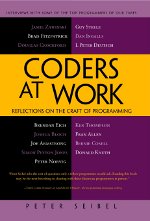
On the train to my parents' house for Christmas I finished up a wild run through the book Coders at Work. The book isn't even mine, but I'd been borrowing it very often, sometimes to the chagrin of its owner, because I could barely put it down. Coders at Work book cover The book is a collection of interviews with 15 great programmers of our time, starting with Jamie Zawinsky and ending with Donald Knuth. It's written in an interview style each interview starts with a brief introduction to the person being interviewed, summarizing what the person is known for and what he or she has accomplished and a few of the highlights of the interview, and then a transcript of the interview follows, with the author/editor, Peter Siebel, will saying something or asking a question, and the interviewee responding. I was skeptical about this format at first because I feel like it can be an easy way out of good editing and make the reader have to do the work of the editor, but on finishing I think that Siebel uses the format to his advantage in this case. For one, the speech format allows the reader to really form a picture of how the person being interviewed speaks and would act in a conversation. Jamie is somewhat bitter and pretty informal. Brad Fitzpatrick is flippant and energetic, his speech littered with profanity and colloquialisms. Others seem more stately and verbose Joe Armstrong's responses can go on for a page or more. In this way, not only do readers learn something about what these greats have learned about programming, but we also feel a bit more like we've met or know them, and can connect to them more as people. I always have this problem where I want to read computer books, but often computer books seem inextricably tied to the computer, so there's this dynamic of reading a bit and then wanting to get on a machine and try something out, write some code, play around especially with books focused on a specific language. Coders at Work retains some of this computer-book dynamic in that I constantly encountered things that I want to investigate or play around with more: Erlang, OCaml, various papers and essays, Knuth's literate programs, and books such as Higher Order Perl and others. Siebel makes a point to ask each person what her short-list of books and papers programmers should read are, so this book is a great source of pointers to other reading material. Unlike a more specific book, however, keeping a list in a notebook was enough to settle the mind to read away-from-a-computer for chapters at a time. It's obvious that despite the interview format, Siebel has done some serious editing. None of the prose is boring to read, and I can't imagine that the text is a straight transcript of how the interviews went. He also has arranged the interviews in an order such that different interviews play off each other. In Branden Eich's interview, for example, he disparages the book Design Patterns:
I never bought the Gamma book. Some people at Netscape did, some of Jamie Zawinski's and my nemeses from another acquisition, they waved it around like the Bible and they were kind of insufferable because they weren't the best programmers.
In the next chapter, Joshua Bloch names it as a book he thinks programmers should read:
Another one, which I have slightly mixed feelings about but I still think everyone should read, is Design Patterns. It gives us a common vocabulary. There are a lot of good ideas in there.
Similar plays, such as Ken Thompson and Fran Allen disagreeing on the badness of C, happen in later chapters, tieing together the different chapters and illustrating how even really good programmers disagree on the Right Thing all the time. Clearly the craft of programming is no settled thing. Besides the general structure of the book being well thought-out, the material is generally thought-provoking and interesting. One thing that stood out to me was Joshua Bloch describing what he called the "empathy gene", which is what a programmer has to have if he's going to be able to design good APIs and programming languages he has to be able to put himself in the shoes of the person who will be using the language or API. This is one thing that differentiates how different programmers can be good at different things. Another thing that stood out to me is that many of those interviewed stated that they don't use much in the way of modern tools and IDEs Joshua Bloch and Simon Peyton-Jones both touch on this, just to name a couple examples, even though some say that they think using these tools would make them more productive, especially when it comes to refactoring. This is a testament to the power of inertia sometimes there is just no chance to be unproductive now in order to be more productive later. Or perhaps just a sign that a programmable text-editor can stand on the same level as a heavier tool in terms of productivity in the right hands. I could go on with examples, but the conclusion here is that I thoroughly enjoyed Coders at Work, and I think it is a book that is well-worth the time spent reading the entire thing.

13 December 2009

Russell Coker: Links December 2009

Dan Gilbert gave an insightful TED talk about our mistaken expectations of happiness [1]. Don Marti has an insightful post about net neutrality and public property [2]. When net access requires access to public property then it should be sold in a neutral manner. Rachel Pike gave an interesting TED talk about the scientific research behind a climate headline [3]. The people who claim to be skeptical of the science should watch this. Mark Peters wrote an interesting article A Happy Writer Is a Lousy Writer about the correlation between emotional state and work quality [4]. Apparently watching a film about cancer will make people more careful and focussed on details. CERIAS has an interesting short article about Firefox security as well as some philosophy on why web browser security generally sucks [5]. Cory Doctorow writes in the Guardian about Peter Mandelson s new stupidity in trying to legislate against file sharing [6]. This is going to seriously damage the economy of every country that implements it. Charles Stross has been blogging a series of non-fiction essays about space colonisation, in The Myth of the Starship he describes how most ideas of space travel are bad and how the word ship is always going to be unsuitable [7]. Brent T. White is an associate professor of law at the University of Arizona who has written an interesting paper about mortgages [8]. He says that anyone who is underwater (IE owing more than the value of their house) should walk away. The credit damage from abandoning a bad mortgage apparently isn t that bad, and there is the possibility of negotiating with the bank to reduce the value of the loan to match the value of the house. Mako is working on a project to allow prisoners to blog [9]. It s basically a snail-mail to web gateway as the prisonsers are not allowed Internet access. PracticalEthicsnews.com has an article about the special status that homeopathy is given [10]. It also notes that homeopathic medicines include arsenic and mercury. Such quackery should be outlawed, a life sentence for homeopathy would be appropriate IMHO. Cory Doctorow wrote an interesting essay about why he is not selling one of his books in audio form (he s giving it away) [11]. He concludes by noting that he wants no license agreement except don t violate copyright law . The fact that he can t get anyone to sell an audio book under such terms is a good demonstration of how broken the marketplace is. Thulasiraj Ravilla gave an inspiring TED talk about the Aravind Eye Care System a program to bring the efficiency of McDonalds to eye surgery [12]. Hopefully that program can spawn similar programs for other branches of medicine and spread to more countries. In many ways they are providing better service (both in quality and speed) than people in first-world countries who pay a lot of money can expect to receive. Scott Kim gave an interesting TED talk about his work designing puzzles [13]. He is also a big fan of social networking, unfortunately (for people like me who don t like social networking) his web site ShuffleBrain.com relies on Facebook. Gordon Brown (UK Prime Minister) gave an inspiring TED talk about global ethic vs the national interest [14], with a particular focus on the global effort required to tackle the climate change problem. Now if only we could get Kevin Rudd to listen to that. Brough has written an interesting analysis of the AT&T network problems that are blamed on the iPhone [15]. His essential claim is that the problem is due to overly large buffers which don t cause TCP implementations to throttle the throughput. This seems similar to my observations of the Three network in Australia where ping times of 8 seconds or more will periodically occur. One particularly nasty corner case with this is when using a local DNS server I can have a DNS packet storm where basic requests time out while BIND uses a significant portion of available bandwidth (including ICMP messages from receiving ports that BIND has closed). To alleviate this I am now using the Google public DNS service [16] (the Three DNS servers never worked properly).

17 November 2009

Biella Coleman: The Winners

These are the winners from my yearly class contest : SERIOUS BABY lol ..sometimes Did I just Get Rejected From McDonalds? (Watch to the end) This is one of my all time favorites funny videos and it has a nice catchy tune and I will also post one of my ALL TIME favorites after I show it in class next week.

Next.

Previous.