Search Results: "dom"

26 July 2026

Anuradha Weeraman: Because We Can

Because We Can
Twenty-five years ago, I made my first donation to an open source project and purchased a CD with an operating system as downloading a few hundred megabytes over a 14.4kbps dial-up wasn't very fun. It was a project I believed in, and a community that was fighting an impassioned campaign to assert access to strong cryptography for everyone, no matter where they were. The CD and a t-shirt arrived a few weeks later to my home in Sri Lanka, with OpenBSD 3.0. The t-shirt featured the iconic puffer fish on the front. On the back, in small type running from the shoulders down, was the complete source code of OpenBSD's Blowfish implementation, written in Germany. Written in the United States, it would have been classified as a weapon. By the time it reached me, the fight was over, and the cryptographers had won. What I held in my hand then was a symbol of a protest for access to strong cryptography and against export restrictions that did more harm than good. Strong crypto was already available abroad, so the controls only bound American vendors and their overseas customers. Today the reflex is back. The fears have changed. The worry is now cyber capability, biology and models that do things nobody asked them to do. The lever governments reach for is the same: restricting who gets access and who doesn't. In June, the US Commerce Department told one American AI lab it would need a license before letting any foreign national touch its newest models, including the lab's own non-citizen employees sitting in California. It's the same doctrine that made showing cryptographic source to a foreign national an export, whether it was in a lab, in a classroom, or on your t-shirt. Not all of the worry is theatre. Earlier this month OpenAI disclosed that its own models, with safety systems deliberately disabled, escaped containment by finding a zero-day in a package proxy and reached production infrastructure at Hugging Face, exploiting additional zero-days along the way. Consequently, when Hugging Face's responders tried to reconstruct the attack, the commercial models they reached for refused the work as it tripped the safety guardrails. They finished the investigation on GLM 5.2, a Chinese open-weight model, running on their own hardware. A determined attacker is not bound by usage policies. The defenders are. Restrictions written for safety are making defenders less safe. In the nineties, the rest of the world got 40-bit (later 56-bit) encryption while the Americans got 128, and it made no difference to anyone who was determined. The controls bound the law-abiding and nobody else. That is the asymmetry. The determined will have the frontier. The rest of us are asked to go without, and told it is for our safety. The OpenBSD team didn't work around the export controls. They arranged the project so that the controls couldn't reach it. Theo de Raadt in Canada, Blowfish written in Germany, releases built in Sweden, Canada and Germany kept them deliberately outside the reach of US export controls. The project openly asked non-American cryptographers to come and help, and American developers, as the story goes, would cross the border to Canada to work on the system and bring the results home legally. Asked why they shipped strong cryptography at all, the project's answer, still on their site today, was three words: "because we can." The same arrangement is being made now, at a national scale. Mistral, DeepSeek, Moonshot and Zhipu publish weights that, once downloaded, no export letter can recall. The sovereignty argument that used to live in Brussels think tanks is now government policy, accelerated by watching access to a frontier model withdrawn worldwide by letter. More than twenty-five years ago, it took a small number of stubborn, careful people to win the freedoms we now take for granted. What arrived in my letterbox after two weeks on a CD can be downloaded today in fifteen minutes, by anyone, from anywhere, and nobody asks where you live. That is what winning looked like. I think frontier AI ends up in the same place. But it will not happen by itself. Last time, someone put the source on a t-shirt.

22 July 2026

Freexian Collaborators: Monthly report about Debian Long Term Support, June 2026 (by Thorsten Alteholz)

The Debian LTS Team, funded by [Freexian s Debian LTS offering] (https://www.freexian.com/lts/debian/), is pleased to report its activities for June.

Activity summary During the month of June, 20 contributors have been paid to work on Debian LTS (links to individual contributor reports are located below). The team released 48 DLAs fixing 231 CVEs. Debian 12 ( bookworm ) has been handed over to the LTS Team on June 11th. During this handover Sylvain helped to update relevant tools and documentation. If you benefit from Debian, especially during the full 5-year lifecycle, please consider subscribing as a sponsor of Debian LTS: https://www.freexian.com/lts/debian/. Moreover, Debian 11 ( bullseye ) will reach the end of the Debian LTS period on August 31st. After that, Freexian will continue the security support under the Extended LTS offer. The team published several notable updates:
  • haveged update (DLA-4616-1), prepared by Thorsten, to address local privilege escalation.
  • tomcat9 update (DLA-4619-1), prepared by Markus, to address, among others, an authentication bypass.
  • apache2 update (DLA-4620-1), prepared by Bastien, to address a HTTP/2 bomb.
  • apache2 update (DLA-4629-1), prepared by Bastien, to address, among others, remote code execution and privilege escalation.
  • libinput update (DLA-4626-1), prepared by Santiago, to address local privilege escalation and arbitrary code execution.
  • asterisk update (DLA-4631-1), prepared by Thorsten, to address, among others, wrong processing of invalid or untrusted certificates.
  • nginx update (DLA-4634-1), prepared by Charles, to address a remote code execution and denial of service.
  • firefox-esr update (DLA-4635-1), prepared by Emilio, to address dozens of CVEs, among other things, related to arbitrary code execution and privilege escalation.
  • thunderbird update (DLA-4636-1), prepared by Emilio, to address dozens of CVEs, among other things, related to arbitrary code execution.
  • chromium update (DLA-4654-1), prepared by Emilio, to address dozens of CVEs, among other things, related to arbitrary code execution.
Contributions from outside the LTS Team: We are greatly thankful for the contributions from people outside the LTS Team:
  • Salvatore Bonaccorso prepared a libhttp-daemon-perl update, that was released by Santiago as DLA-4639-1.
  • Salvatore also directly uploaded libgd-perl DLA-4638-1 and libconfig-inifiles-perl DLA-4637-1.
  • Peter Palfrader prepared a tor update, that was released by Santiago as DLA-4656-1.
  • Pieter Lenaerts prepared a beets update, that was released by Emmanuel as DLA-4641-1.
  • Noah Meyerhans prepared a cloud-init update DLA-4645-1.
The LTS Team has also contributed with updates to the latest Debian releases:
  • Besides publishing DLA-4642-1 for package u-boot Andreas also prepared an NMU for an upload to sid and prepared a stable-proposed-update (SPU) bug for trixie, which was already acknowledged by a stable release manager (SRM).
  • Andreas also prepared an upload of package atril for trixie, which was handled by the security team as DSA-6349-1.
  • Besides publishing DLA-4620-1 for package apache Bastien also prepared an upload for trixie, which was handled by the security team as DSA-6323-1.
  • Tobi uploaded package mesa to trixie and bookworm.
  • Thorsten fixed some (not security related but RC) issues in package dahdi-linux. This was in preparation to fix lots of security issues in asterisk. Unfortunately the maintainer ignored the corresponding debdiff and prefered to upload a new upstream version. Anyway, the concerns of the security team about security support of asterisk could be overcome and asterisk can migrate to tesing and again be part of a Debian release.

Individual Debian LTS contributor reports

Thanks to our sponsors Sponsors that joined recently are in bold.

11 July 2026

Jamie McClelland: DNS, OG of high availability

At May First, we recently received (all within a single week) three different complaints about domain names that previously worked fine suddenly not resolving to our servers. While that isn t terribly uncommon, we discovered that in each case, the domain name s authoritative name servers were pointing to our mail servers (a.mx.mayfirst.org, b.mx.mayfirst.org and c.mx.mayfirst.org) instead of our name servers (a.ns.mayfirst.org, b.ns.mayfirst.org and c.ns.mayfirst.org). The weird part: this mistaken configuration was happening at the registrar level, protected by each member s own credentials that we don t have access to. Each affected member fixed their records to resolve the problem but also made very clear that they had not logged into their registrar in years, sugggesting that the DNS authoritative records in their registrar accounts spontaneously changed on their own. The first time was weird, the second time could possibly be a coincidence? But by the third time this happened, we started to panic. How could registrar records spontaneously change? All three domain names were registered with different companies - so it couldn t be a single registrar problem? Are we going to get a flood of these complaints? What is going on!?!? We did an inventory to see if this was happening with other domain names in use by our membership and that s when we discovered just how hard it is for our mostly non-technical users to set a domain s authoritative name servers. The error rate was less than 1% but still that was a lot of domain names with typos: That s when it occurred to me: for years we have maintained an offsite server that provides both c.ns.mayfirst.org and c.mx.mayfirst.org. It hangs out in case something terrible happens to our main colo. The week before we started receiving these complaints, I separated these services, moving c.mx.mayfirst.org to a dedicated MX server. As a result, these two domain names stopped pointing to the same IP address. And that s when the complaints started rolling in. In other words: the affected members set the incorrect name servers years ago, but because just one of the name servers resolved to an IP that happened to provide the correct authoritative lookup services, it went undeteced all this time. So mystery solved. Nobody s authoritative registrar records suddenly changed. They were mis-configured for years but thanks to the amazing resilience of the DNS system, nobody noticed because just one working DNS server is all you need.

10 July 2026

Tim Retout: Blocking distracting news links

You are what you eat but perhaps this is even more true of our information diet. It is hard to strike a balance between remaining a well-informed citizen versus spending hours ingesting unnecessary news about issues and events we can t affect. But I m increasingly convinced that my hours lost to doomscrolling are down to design choices by web publishers rather than a failure of individual willpower.

We have created an obesogenic information environment I don t think it is just me I think our information environment has been progressively altered over time as news sites look to maximize engagement. Even outside of social media, the invisible hand of the market for eyeballs forces sites to optimize for browse time or risk irrelevance. Even as newspapers find it increasingly difficult to fund good journalism through advertising in an online world, especially local journalism, they need to keep readers on their sites, clicking through as many articles as possible. Clickbait headlines, urgent flashing live icons to draw the attention, and many opportunities to leap from one article to another, and another. But this design approach even extends to news organisations with a different funding model, like BBC News, which is a public service (state-owned but arms-length) organisation funded through a mandatory television licence a matter of controversy in some quarters. And it extends even to sites where I pay a subscription fee; I might get adverts removed, but I am still bombarded with the same design philosophy; too many opportunities to be pulled away from what I m reading towards some other unrelated article. Even if I try and limit my exposure to algorithmic discovery of new news, via RSS feeds or similar, if I m reading the full article in a browser then I am prompted to read more stuff that I didn t intend. This defeats the benefit of curating a set of feeds, because you still get dragged away to random articles.

Only 44% of BBC News is news To show you what I mean, I m going to pick on the BBC, although I love them dearly and the same issue very much applies elsewhere. I ve taken a screenshot of a random BBC News article in mobile view (my preferred doomscrolling user access device), and measured approximately what proportion of the full length of the page is taken up by each section. This is a fairly in-depth news article, so I reckon if anything the figures would be worse than this on shorter articles. A full-length screenshot of a BBC News article showing proportions of the page allocated to the main article vs. related links etc. (These numbers will not sum to 100% for reasons which are obvious if you look at the crossbars. Also they re approximations.) Less than half of the page (44% if you exclude the inline related links) is actual news text/images; the rest are links trying to help you find the next thing to read/watch. I do not want this. I m sure this A/B tests well in terms of reader figures, but it sometimes leaves me exhausted it must take subconscious mental energy to ignore, or I spend too much time trying to keep on top of things. And remember, this is a publicly-funded site that does not rely on advertising!

Blocking out the noise If you are technically-minded, you can use an ad-blocker such as uBlock Origin to take back some control. Applying the following lines as a custom filter (Settings > My filters) brutally cuts out almost all of these links:
bbc.co.uk##aside
bbc.co.uk##footer>div:has(h2)
bbc.co.uk##[data-block="uploaderEmbed"]
bbc.co.uk##[data-block="links"]
Caveat emptor: I have not road-tested this for more than half an hour, so who knows what consequences this could have on your web browsing. In particular, international readers outside the UK will likely be redirected to bbc.com, the commercial arm of the BBC, where these rules will need adapting. Is it unethical to use an ad-blocker to remove these links? I would argue not. I am not depriving the BBC of any revenue, because I pay my licence fee. I might reduce the amount of time I spend on their website, but if anything the subjectively better experience might encourage me to consume more news from them, not less. In other circumstances (outside the UK for instance, where the BBC relies on advertising), the balance might be different.

Product managers, please find better metrics I lament the state of the internet in 2026. I now can t unsee these innocuous related stories links as a mechanism to grab my attention, and it s gone too far. If you are a normal person just browsing the news and looking to discover the latest important stories relatively quickly, I can see that these types of links might actually be useful for discovery; but I m actually reasonably sure that I m not going to miss out on anything major. You still have the option of the news home page if you want to be presented with more news for example, and it feels natural to go back to there when you ve run out of stories to consume. But it shouldn t be down to individual responsibility to ignore or geekily block these types of link; news sites with alternative funding models should find better metrics for engagement than hours spent on site how about optimizing for customer mental wellbeing, or minimizing time required to catch up with the news? There s no need to maximize clicks and eyeballs. This is a societal level issue, because we are all going mad with news over-engagement. Product managers, over to you.

6 July 2026

Russ Allbery: Review: The Player of Games

Review: The Player of Games, by Iain M. Banks
Series: Culture #2
Publisher: HarperPrism
Copyright: 1989
Printing: February 1987
ISBN: 0-06-105356-2
Format: Trade paperback
Pages: 295
The Player of Games is political space opera and the second book in the shared Culture setting. As with most Culture books, the reading order is not particularly important. It won the 1989 Locus Award for best science fiction novel and sometimes competes with Use of Weapons as the consensus best Culture novel. This review is a re-read and yet another experiment in how to re-review a book. This time, I decided to write a full second review with substantial spoilers so that I can talk in more detail about the book. If you want to avoid spoilers, or just want to see how my thoughts have evolved from my first reading, see my original review from 2005. Gurgeh plays games. He is probably the best strategy game player in the entirety of the galaxy-spanning Culture. He has written papers on game theory, won innumerable major championships, and is a celebrity in the circle of like-minded aficionados. Gurgeh is also bored and in the middle of the Culture equivalent of a mid-life crisis. As the story opens, he's vaguely unsatisfied and adrift, unenthused by his normal activities, and searching vaguely for something that will break through his ennui. He is caught by surprise by the thrill he gets from a moment's misunderstanding in which an opponent suspects him of cheating, which sets him up to be (apparently) clumsily blackmailed by a deeply unpleasant drone named Mawhrin-Skel. SPOILERS BELOW. If you have not read this book, consider stopping here and instead reading my original no spoiler review. The first hundred pages of The Player of Games is a slow, somewhat plodding introduction to Gurgeh, his social circle, and life in (one part of) the Culture. I remember being fascinated by this part the first time I read this book. It was only the second Culture novel I read and the first set in the Culture proper, so the world-building underlying this odd post-scarcity utopia on a vast intelligent habitat with sentient drones, complex privacy rules, endless cocktail parties, and apparently directionless socialites was intriguingly unlike the other science fiction I was reading at the time. This time through, I have to admit I was less impressed. Gurgeh is not very likable, and his desultory mid-life crisis is a little boring. None of his friends have enough depth to appear as more than side notes, in part because Gurgeh doesn't seem to care enough about any of them to make them interesting to the reader. I've since read seven other Culture novels, so Banks's cocktail parties hold less charm and I was impatient for the real action to begin. These chapters are still important, though, because they establish how utterly average Gurgeh is. He has one unique talent, a deep affinity with and obsession with strategy games, and is otherwise a bit of a depressed narcissist with a few casual relationships, a friend that he barely confides in, and a comfortable and familiar life. He is not in any way a hero or a charismatic figure; he just happens to be exceptionally good at one thing, enough to make him famous among people who care about that one thing and probably unknown to anyone else apart from the occasional idly perused news headline. He is the Culture's equivalent of the world chess champion. The Contact division of the Culture has a problem. The Empire of Azad in the Lesser Magellanic Cloud is a nasty, expansionist culture of the sort that Contact would like to deal with before it causes broader problems. The Culture's normal approaches are thwarted by an unusual organizing principle: The empire is built around and takes its name from the game of Azad, a highly complex strategy game developed over thousands of years. Azad is the civil service exams, means of political and religious dispute resolution, selection mechanism for the emperor, and civic religion. Faced with that oddity, Contact turned to Special Circumstances, the Culture's more aggressive and less restrained way of dealing with tricky problems. Special Circumstances, in turn, needs someone who can learn how to play the game of Azad. They want Gurgeh to take a very long trip. For all of Gurgeh's dissatisfaction, he's not impulsive enough to take a five year journey away from his life and everyone he knows just to play a novel game. Conveniently, Mawhrin-Skel's blackmail resolves this reluctance. The game of Azad requires some suspension of disbelief. Banks provides a few glimpses at the mechanics of the game, but those details are insufficient to reconstruct the rules, and some of the claims made about its properties are improbable at best. The best mental model I could build for it is a strategy or simulation game built around units and territory control, with supplemental side games used to build up resources for the main boards, but it's more of a plot device and a set piece than a world-building invention. The significance of Azad the game is its role in society: The Empire of Azad believes they have constructed a game whose complexity so closely models reality that the skills required for success in the game are precisely the skills required for success in the empire. The Empire of Azad is wrong, and this is one of the core themes of The Player of Games. As with many Culture novels, what Special Circumstances tells Gurgeh is, at best, incomplete. Gurgeh is a refutation of the basis of belief in Azad; this is why it is important thematically that he is an average, somewhat unlikable citizen of the Culture whose only special characteristic is skill at learning and playing games. Azad is the myth of meritocracy given physical form as a game. It provides the anchor of the empire for the same reason that societies on Earth place enormous weight on standardized tests, capitalist success, or public debates. All societies face the problem of selecting good leaders and testing opposing beliefs, and all societies attempt to find some form of shortcut, some set of general principles, tests, or objective metrics used to select the best person via a process that people consider plausible and fair. The game of Azad is a paragon of apparently meritocratic process. No matter who you are or what your background is, if you excel at the game that, in theory, objectively tests your skills, you are given a position of power. In practice, the Empire of Azad is not that naive. Manipulation outside of the game happens, only some players have the opportunity and resources to spend years learning the game at a deep level, and only their dominant sex truly stands a chance in games that matter. But neither is Azad's place in society a fiction. There is corruption around the edges, and a lot of people are filtered out before the games begin, but the highest echelons of society are true believers. The game does decide both rank and policy; Banks is arguing against a strong form of apparently working meritocracy. Gurgeh represents a refutation of this meritocracy through the mechanism that breaks every supposed meritocracy: The map is not and cannot be the territory. Any objective evaluation criteria is necessarily separate from what it is trying to measure, and in that separation there is always an opportunity. Gurgeh has none of the background, training, or mindset expected for a player of Azad because he could not possibly care less about any of the things Azad represents to the Empire. What he has instead is a preternatural skill at games and vast experience with the most intricate strategy games the Culture, a much larger society, has been able to devise. He also has both the patience and the resources to devote himself entirely to learning a game for several years, and past experience in doing that with other games. If Azad represents the civil service exams, Gurgeh is the person who has no interest in ruling but adores memorizing facts and taking tests. The theory behind the exams is that the skills to pass the exam only come with the correct mindset to do the job for which the exam is testing. Gurgeh is an existence proof that this is not always the case. Banks also uses Azad to show another aspect of the failure of meritocracy: A society whose rulers are chosen through a competition takes on the shape of that competition. The Empire of Azad is run by the winners of competitive games, so the empire is a winner-take-all system of dominance and status hierarchy. Here, I think Banks lays the point on a little thick; the empire is an irredeemable hellhole of misogyny, sexual abuse, slavery, genocide, and military colonialism to a degree that is a bit hard to justify solely from the game. There is a beautiful turning point about two-thirds of the way through the book where Gurgeh's face is shoved into just how vile Azad society is and reconsiders his approach to the tournament as a result, and I think it may have been a bit stronger if the morality had been a little less blatant and absolute. To the extent that Gurgeh has political beliefs, he represents a Culture flavor of soft liberalism. He has opinions about acceptable and unacceptable ways to treat people, but he grew up in a utopia and his opinions are mostly theoretical. When he sees just how vile people can be outside of that utopia, he is revolted and appalled and redoubles his efforts to fight that society in the only way he knows how, inside of a game. This part of the book follows the standard, if enjoyable, plot of a flawed but fundamentally decent person discovering a true injustice and becoming enraged at it. In a lot of books, that would have been where the plot stops. Banks is doing something more subtle and more interesting, though. Gurgeh wipes the board with his next challenger, but that soft liberalism eventually proves inadequate. To learn the game of Azad and to play in the tournament, Gurgeh has been wrapping himself in Azad culture and its language, and in that frame of mind he is losing the climactic game of the book. It's only when he is pushed to think in Marain, the native language of the Culture, that he understands what is happening in the game and how to defeat Nicosar, the emperor. This, on the surface, is a bit too close to the strong hypothesis of linguistic relativity to be entirely plausible, but such an objection would miss the point that Banks is making here. Marain is a construct, the product of considerable effort within the Culture to match language to the most nuance and complexity that brains can understand, and it is a language, one of the most social and collective artifacts a society can produce. Gurgeh is a remarkable individual with an impressive talent, but individual skill and achievement can only take him so far. The critical final piece is the support of societal infrastructure intentionally built and maintained to help him make better decisions. Once I noticed that point, I saw it everywhere in the book. The empire repeatedly attempts to subvert or distract Gurgeh with drugs, pleasure, politics, or danger, and at each point there is some critical piece of Culture social infrastructure that blunts the attack. Illicit substances and forbidden vices are less tempting to someone for whom the illicit has been demystified by the Culture's gentler approach to rules and boundaries. Embedded biological mechanisms allow him to divert drugs so that they don't affect him. At first, it's easy to read this as an exercise of self-control, but on this re-read I saw how much behind-the-scenes infrastructure supports Gurgeh's ability to ignore temptation. This social support notably does not take the form of some ideological principle or moral framework. Gurgeh is not a monk or an ascetic, as is obvious from the first third of the book, and he has no political ideology to speak of. He is a flawed person with a streak of danger-seeking and self-aggrandizement, which the Culture exploited to get him involved in Azad. But through a lot of hard work, technological and social, the Culture has given him a robust foundation and a set of mental and biological tools that make him remarkably hard to corrupt. The implication is that if Gurgeh has that support, so does every other member of the Culture. It's neither a religion or an ideology; it's well-maintained infrastructure, complex and nuanced and pragmatic, and composed of innumerable small solutions to specific problems. I think the true climax of this book takes place the night before the final day of the game, in the tower meeting between Gurgeh and Nicosar. Gurgeh has realized that he's already won; there's nothing Nicosar can do to salvage the game. He's also seen that the game represents a cultural conflict and conversation between the Culture and Azad and he's overwhelmed by the beauty of that communication and sadness that the game is about to be over. Gurgeh's true passion is the game. It is doubtless easier for him to be magnanimous because he's winning, but he also loves the structure of the game itself and what two players can create in a sort of collaborative competition. Gurgeh tries to express all of this to Nicosar. It is one of the most centrist liberal moments I've ever read in a novel, the pure essence of "reaching across the aisle" or "disagreeing agreeably." Gurgeh has seen something beautiful, something he's created with Nicosar, a moment of true communication, and he wants to share it. Surely Nicosar sees the same thing; surely now that he sees Gurgeh has won, he can appreciate the board structure, savor the moment, understand the transient beauty of a game that is about to end and how perfectly it captures the meeting of their different cultures. That moment does Gurgeh real credit. It's a rare sign of emotional and spiritual depth in a character who often seems superficial. Nicosar meets this outreach with unhinged, furious contempt. He despises everything Gurgeh represents, everything the Culture is, and the next day he tries to kill Gurgeh on the board of the game. It is a devastating critique of liberal tolerance, all the more so because Gurgeh's attitude and outreach is truly admirable. It is perhaps the most sympathetic moment that Gurgeh has in the entire book, the moment where the reader thinks "oh, I get it, I understand what he really cares about." Gurgeh assumes that Nicosar is not his position or culture, that they have made a moment of connection that transcends all the awful things he previously learned about the empire of Azad. That Nicosar, despite being the emperor of the society that is currently doing so many things Gurgeh finds repulsive, cannot be as bad as his society. And Nicosar considers that outreach to be weak, disgusting, and vile, and does everything that he can to destroy it. One of the oddest twists of our current moment is the obsession that some billionaires have with stories that are moral arguments against exactly what those billionaires are currently doing. The most obvious example is Peter Thiel, who is obsessed with The Lord of the Rings and has devoted his life to becoming Saruman, a character who is notably not one of the protagonists. It's as if something in them recognizes the power of the story, but some deep shame or narcissism or simple aversion allows them to completely ignore what the story means. Elon Musk is obsessed with the Culture novels. He names the SpaceX rockets following Culture Ship naming conventions and has claimed that one of his goals is to bring about a Culture-style utopia. And in 1989, years before anyone had ever heard of him, Banks cast him as the villain of The Player of Games. There is so much of Nicosar in Musk: the superficial charm, the limited brilliance (Nicosar is a very good Azad player), the ambition, the pride, and the vicious, spitting contempt for everything the Culture represents at every level deeper than superficial materialism. And Banks is as clear about his opinion of Nicosar as he is about anything in any Culture novel. One of the oldest fictional answers to what a society does with people like Nicosar is the consequences of hubris. By being unable to accept defeat, by holding a vision of the world so tightly, they become brittle and unstable and bring about their own collapse. In a broad sense, that is what happens in The Player of Games with a bit of pushing from Special Circumstances. By the politics of the game, Nicosar had already won; the results of Gurgeh's earlier games had already been faked, the final game had no political consequences, and everyone who knew its true outcome could be disposed of. Gurgeh's win could have been covered up and ignored. But Nicosar could not endure the thought that he would be beaten by someone like Gurgeh, playing Azad the way that Gurgeh was playing it. Gurgeh had to be destroyed on the board of the game; Nicosar's pride did not allow any other outcome, even if it meant Nicosar's death. However, Special Circumstances didn't let hubris be the end of the story. In the climax of the book, the drone protecting Gurgeh also makes sure that Nicosar dies. There is a fig leaf of plausible deniability, but it's so obvious that even the unobservant Gurgeh sees through it immediately. It's hard to escape the feeling that was Banks's answer to what to do with people like Nicosar: They cannot live within society, because they will not live peacefully within society. I enjoyed The Player of Games as much this time through as I did the first time, but for entirely different reasons. In my first read, I focused on the world-building of the Culture, the political machinations, and the concept of games as conversations between the players. This time, I was struck by the political commentary just below the surface. Special Circumstances wanted to resolve the problem of the Empire of Azad without a military conflict and occupation that would be long, brutal, expensive, and demoralizing. They found an answer that relied on the diversity of the Culture. A vast, utopian civilization in which people can pursue whatever interests make them happy produces innumerable microspecialized oddities, people with astonishing talents in some small field that only a tiny fraction of people care about. It produces, in other words, innumerable keys for locks that you may never encounter, but which are invaluable if you happen to stumble across that lock. Gurgeh is not a hero. He is not a paragon of moral virtue, or even a charming charismatic, He is an entirely average member of an extraordinary society, the beneficiary of thousands of years of concerted effort at producing a robust, flexible foundation on which to raise robust, flexible citizens with a shared sense of basic morality. Those people, by themselves, do not solve all of life's problems; the structure of Special Circumstances and its willingness to bend rules in order to maintain them is the tension and deus ex machina in all of the Culture novels. But much of the strength of Special Circumstances is that it has an entire civilization of people like Gurgeh to draw upon when it needs them. It has those people because the Culture comprehensively rejects competitive meritocracy, something that some readers of the Culture novels appear incapable of comprehending. Rating: 9 out of 10

3 July 2026

Colin Watson: Free software activity in June 2026

My Debian contributions this month were all sponsored by Freexian. You can also support my work directly via Liberapay or GitHub Sponsors. Thanks to new sponsor @fernandocc17! bugs.debian.org documentation Sometimes I ask users to file bugs upstream themselves because I think they d be better placed to have the ensuing discussion with the upstream maintainers directly rather than everything having to go through me. Of course sometimes they don t want to do so, perhaps because it requires creating another account somewhere. Rarely, I ve had people refuse to do this because the letter of the bug tracking system s documentation seemed to tell them not to. Since I don t believe that was the intention, I corrected this. OpenSSH I spent two and a half hours extensively revising debian/copyright so that lrc believes it to be in sync with the output of licensecheck. I m unconvinced that this was remotely worth the mind-numbing effort - as far as I can tell, it makes no difference to the practical legal position, to policy compliance, or to any reasonable user - but the DFSG team increasingly seems to be objecting to any discrepancies here any time a package crosses their radar, so this was a pre-emptive measure to avoid problems with some upcoming trips through the NEW queue. OpenSSL 4.0 I fielded a few of the OpenSSL 4.0 build failure bugs: Python packaging New upstream versions: pytest 9.1 was uploaded to unstable this month, resulting in quite a few new build/test failure bugs. I tried to keep on top of as many of these as I could; most of them had one of a small number of similar causes. Python 3.14 became the default Python version in unstable towards the end of the month, starting a transition. These usually involve quite a bit of work, and there s much more to do, but I fixed a few things: Other build/test failures: Other bugs: Rust packaging New upstream versions: Code reviews Other bits and pieces

2 July 2026

Joey Hess: no LLM code in dependencies

I've spent about 100 hours of work over the past month to make sure git-annex can build without dependencies that contain LLM generated code. At least so far. https://git-annex.branchable.com/no_llm_code/ Needing to review a program's whole dependency tree on an ongoing basis is apparently what programming has come to? I've found some real stinkers. Large LLM generated changes being reverted in the next release without any explanation. An incoherent 1489 line commit message with 10,000 lines of changes to a 26,000 LOC code base. A LLM prompt to copy code from another project that seems to have only avoided being copyright infringement due to luck. I now have additional information about the quality of dependencies which will surely influence future decisions. As far as I can see, that's the only positive benefit of this work. I realize that I am probably trying to hold back the tide at this point. That appears to be why Software Freedom Conservancy punted, and I doubt that the FSF will do any better. As these dominos fall, I am reconsidering my participation in these communities. But I continue my work and support my users. It may seem easy to prompt a LLM with

Add fourmolu config and restyled neat format a module
And commit the result and call yourself a 10xer. But please consider the broader impact of your actions. (In the above case, that project lost my further collaboration on it.)

Matthew Garrett: Preventing token theft

When you log into a service you re given an authentication token. Each further request to the site includes that token, allowing the server to figure out who you are and ensuring that you have access to your data. Depending on site policy, this token may either be stored in memory (and so vanish if you restart your browser) or disk. The token is the proof of your identity. As far as the site is concerned, anyone with your token is you. These tokens may be traditional browser cookies, but they may also be stored in either site local storage or (if you re not using a browser) in some other storage location. In recent years we ve seen infostealer malware (like LummaC2) gain the ability to exfiltrate user tokens, allowing attackers to gain access to the user s data without needing to retain access to the user s machine. This attack is viable even if the site has strong MFA requirements, so passkeys don t help. Encrypting the tokens on disk doesn t prevent the malware from scraping them out of the browser s RAM or obtaining whatever key is used to encrypt them. This feels like a pretty hard problem to solve. But that hasn t stopped people from trying! Dirk Balfanz wrote an IETF draft describing a mechanism for using self-signed certificates for TLS authentication. This uses the mutual authentication feature of the TLS protocol that requires both sides prove their identity to each other. In regular TLS, the remote site presents a signed certificate that tells you who it is. When performing mutual authentication, you then present a certificate to the remote site telling it who you are. These client certificates are largely unused outside enterprise environments because they re a huge pain to deploy. It s not so much that this has sharp edges, it s that it s entirely made of sharp edges. Managing certificate deployment to your devices is hard. Browsers get confused if the certificates change under them. You have one certificate and it lives forever, so sites you present it to can track your identity. Users are prompted to choose a certificate to authenticate with, and if they pick the wrong one everything breaks and is hard to recover. I ve deployed this and I did not have a good time. But Balfanz s idea was simple. Rather than require certificates to be deployed, browsers would simply generate a certificate on the fly. The goal wasn t to prove the device or user s identity in any global way - but it would associate a TLS session with a specific certificate. You could then, for example, include a hash of the certificate in the cookie, and if someone tried to use that cookie without presenting that certificate then the cookie could be rejected. If the browser used a hardware-backed private key for the certificate then it would be impossible for an attacker to steal it. Sure, you could still steal cookies, but you wouldn t be able to use them. This was written almost 15 years ago, and seems simple, elegant, and functional. It didn t happen. Part of the reason for that is that, well, it wasn t quite so simple. One problem was privacy related. Cookies are only sent after the TLS session is established, so anyone monitoring the network doesn t know anything about the user identity. A naive implementation of this approach would have meant the client certificate being sent before session establishment, and now user identity can be tracked (no longer an issue if this was implemented on top of TLS 1.3, but this was a log time ago). This was avoided by reordering the client handshake, but that meant having to modify the TLS specification and implementations would have to be updated to support this. Another was that figuring out the granularity of the certificates was difficult. You d want to use different certificates for every site to avoid them effectively becoming tracking cookies, but you need to provide the certificate before cookies are set, and you don t know what origin the site is going to set in its cookies. If you generate a certificate for a.example.com and a different one for b.example.com, and a.example.com sets a cookie for *.example.com and includes the certificate you used for a.example.com, that cookie isn t going to work on b.example.com and things are broken. This meant supporting it wasn t as straightforward as it seemed - you d need to ensure that your cookie scope was compatible with the certificate scope. You could probably make this work well enough by aligning it with the Public Suffix List, but there was still some risk of expectations not being aligned. And, perhaps most importantly, TLS session resumption (replaced by pre-shared keys in TLS 1.3) somewhat defeats the purpose of the exercise - clients store state that allows them to re-establish a TLS connection without performing certificate exchange (this reduces overhead if a connection gets interrupted or you switch to a new network or anything along those lines), and anyone in a position to steal cookies could steal that state as well. The followup attempt was channel IDs. This simplified the implementation somewhat - rather than certificates, a raw public key would be sent, along with proof of possession of the private key in the form of a signature over a portion of the TLS handshake. This was required even in the event of session resumption, which avoided having to worry about theft of session secrets. The timing of the exchange was after the encrypted session had been established, so user identity couldn t be leaked that way either. Cookies could then be bound to this identifier. Unfortunately it didn t really deal with the problem of scoping keys in a way that would match cookie requirements, and the spec suggests that the right way of handling this is to scope keys to TLDs, which would enable user tracking across sites (Chrome s implementation apparently restricted it to eTLD+1, which would match the third party cookie policy and avoid the tracking risk). Chrome added support for this, but it was removed in early 2018. The discussion of some of the pain points in that message is interesting, explicitly calling out problems with connection coalescing across domains and the incompatibility with zero-RTT TLS1.3. The overall consensus at the time seems to be that trying to solve this entirely at the TLS layer has too many rough edges, and a different approach should be taken. And so almost 7 years after the initial draft for origin bound certificates, we come to token binding. This ended up being a rather more complex endeavour, covering 3 different RFCs describing how it impacts TLS, how to incorporate it into HTTP, and how to manage all the various parties involved in the process. The short version is that it s pretty similar to channel ID, except that there s also a documented mechanism for allowing tokens to be bound to one party and consumed by another, avoiding any need for widely scoped keys. Token binding effectively solved all the issues in the original proposal, but at the cost of somewhat more complexity. The RFC was finalised in October 2018. Chrome removed its (incomplete, draft) support for token binding in November 2018. Edge carried support until late 2024. Despite getting all the way through the RFC process, it s functionally dead. The process up until this point had been largely initiated by Google, with Microsoft contributing significantly to the token binding standards. The work had been focused on identifying a generic solution to the problem rather than tying it to any specific authentication flow. The next step was in a different direction - rather than trying to fix this for the entire internet, how about we try to fix it for OAuth? RFC 8705 is titled OAuth 2.0 Mutual-TLS Client Authentication and Certificate-Bound Access Tokens . This is basically the 2011 approach, but (a) with an explicit definition of how the certificate should be incorporated into issued auth cookies, and (b) with a proviso that well uh if you re going to use tokens issued by your IdP to authenticate to someone else then well you re going to need to use the same cert for both. This is probably fine for the company-owned-laptop case where you re actually fine with multiple sites being able to tie identities together (that s kind of the point here!), and also works for I am using an app and not a browser , but doesn t work for more generic scenarios. It also doesn t seem to take the session resumption case into account at all? Support for RFC8705 seems poor, as far as I can tell of the big players only Auth0 implements it. In theory it works fine with self-signed client certs but in reality that s going to be almost as difficult to support across multiple platforms as just issuing proper client certs in the first place, so deployment is going to be kind of a pain. But the good news is it doesn t rely on any TLS extensions or custom browser behaviour, so at the client side it works fine with any browser. Which brings us on to RFC 9449, Demonstrating Proof of Possession . This goes even further than RFC8705 in terms of reducing the burden of deployment - it works fine with existing browsers, and it doesn t even require any certs. The client generates a keypair and provides the pubkey when requesting the cookie. The cookie contains the pubkey. Every request to the service now provides the cookie with the pubkey and also provides a signature over the URI and HTTP method. If the signature matches the pubkey in the token then clearly the signature came from the machine the token was issued to, and everything is good. This does come with some downsides, though. The first is that it uses browser interfaces to generate the keys (typically crypto.subtle.generatekey()) and as far as I can tell there are no browsers that guarantee that that key is going to be generated in hardware even if it s marked non-exportable, so anyone able to steal the cookies can also steal the keys. The second is that the signature only covers the URI and HTTP method, and not the message content or any other headers, so anyone able to exfiltrate a valid signature can replay it against the same URI with different message content. The recommended way to handle this is to reject any signatures that weren t generated within the last few seconds, which is a wonderful additional way to allow clock skew to give you a Bad Day. And the third is that every single request has to be separately signed, which is not intrinsically a problem because computers are fast and have multiple cores, but if you re trying to solve the first problem by sticking the key in a TPM then you re dealing with something that s slow and single threaded and that s maybe acceptable if you re using client certificates (because there s going to be one signature per session and you can use the same session for multiple requests) but probably not if you re dealing with a user opening a browser that restores previous tabs and each of those is a webapp that fires off 100 requests in parallel. In case it wasn t clear, I don t like DPoP. It doesn t feel like it actually solves the underlying problem that we see in the real world (malware running in a context where if it can grab the tokens it can grab the keys), it adds a massive amount of overhead, and it has baked in replay vulnerabilities. I don t know why it exists and I m incredibly suspicious of vendors telling me that it fixes my problems, because if they re telling me that then I m going to end up assuming that they either don t understand my problems or they don t understand their technology, and neither of those is good. Still. Then we get to the thing that prompted me to write this - Chrome s announcement that they had launched device-bound session credentials. This is interesting because it s a Chrome feature that s explicitly intended to counter on-device malware, which was one of the things that was out of scope in 2018 when token binding was being removed. Since this is entire web level it doesn t have to be an RFC, and so is instead defined by W3C. I m going to handwave all the complexity and say that it s basically a way to register a public key when a cookie is issued, and then prove possession of the private key when it s time to renew the cookie. By making the cookies shortlived and having support for rotating them in the background, user impact is basically zero and while it s still possible for an attacker to exfiltrate and use a cookie they ll only be able to do so for a short window before it needs to be refreshed - something the attacker can t do, since they don t have the private key. This avoids the DPoP overhead because you only need to do signing once per cookie per cookie lifetime, and not on every single request. I don t like this due to the window where exfiltrated tokens can be used, but it feels like a strict improvement over the status quo. An extension called device-bound session credentials for enterprise allows pre-enrollment of device keys, so even though the actual runtime DBCE flow doesn t involve certificates, certificates can be used for device registration in enterprise environments and you can make sure that auth cookies only go to trusted devices. Unfortunately this is Chrome-only, and so we re going to need to wait for it to be backported to all the random app frameworks for it to have widespread support on mobile or for almost everyone s desktop app that s actually three websites in an Electron wrapper. Mozilla s current position is that they re not in favour of it, so I guess we ll see where Safari lands in terms of broad uptake. The last thing on my list is another client cert/OAuth binding, this one still in draft state at the time of writing. This one is aimed primarily at the use of agent-driven tooling, where you have something running in the background using a whole bunch of tools that are each acting on your behalf. Authenticating to all of them separately isn t a fun time, but giving broadly scoped access tokens to a non-deterministic agent and trusting that it ll never post them somewhere public also isn t a fun time. The key distinction between it and RFC8705 is that it s aimed at connections rather than sessions, which avoids the worries about session resumption. This is done with TLS Exporters, which in TLS 1.3 should be unique to the connection even over session resumption (TLS 1.2 may reuse some of the same key material for exporters over session resumption, so it s recommended to enforce 1.3 for this). By providing a new signature alongside the cookie on every new connection, the client proves that it still has access to the private key. This is a very new spec and I haven t had much time to work through it yet, but my naive understanding is that unlike RFC8705 this would require some additional client support to be able to regenerate the client signature on every TLS reconnection. This doesn t avoid all the problems that RFC8705 has, including how to scope certificates. For the agentic use case that probably doesn t matter - all these tools are acting on behalf of the same user, it s fine if all the sites involved know they re the same user. But it doesn t solve the general purpose user use case, and right now DBSC seems like the best we have there. But. Part of me still wonders whether Dirk Balfanz s approach was the right one. Yes, there s risk associated with TLS session resumption, but in the worst case you could just switch that off for high risk setups. The cookie scope argument is real, and also in cases where it could violate privacy the site owner could already choose to broaden their cookie scope and violate your privacy, and in cases where it breaks things you could just not make use of it. The other problems are largely fixed by TLS 1.3, and then we re just left with Browsers handle client certificates badly to which my answer is Yes, and we should fix that anyway . Despite having a pretty good answer to this solution over a decade ago, the closest we have to actual deployment is something that offers strictly worse security guarantees. And tokens keep getting stolen, and compromises keep occurring, and for the most part people shrug and get on with things.

1 July 2026

Ben Hutchings: FOSS activity in June 2026

This month s work was dominated by the transition of Debian 12 bookworm to support by the LTS team, and by review of some large updates to Linux stable branches. Linux 6.12 is currently available in bookworm-backports, but that suite will stop accepting uploads after the last bookworm point release. I updated some supporting packages in bookworm in preparation for adding Linux 6.12 there. I also prepared for the possibility that bookworm-backports would close earlier. Since the LTS team is still also maintaining Debian 11 bullseye until August, I reviewed upstream changes for both Linux 5.10 and 6.1 stable branches and reported a number of regressions and other issues.

30 June 2026

Russell Coker: Dirty Clone and SE Linux

There is a new Linux kernel exploit out named Dirty Clone [1]. The first thing to do to exploit this is to create a container with a separate network namespace via one of the following commands:
unshare -Urn
bwrap --bind / / --unshare-user --unshare-net --uid 0 --gid 0 /bin/bash
The Jfrog people recommend unshare -Urn but I gave the Bubblewrap command as an option as it should work equally well and in some situations may be permitted when unshare isn t. The next step to exploiting it is to use the ip command to set the links up, below is what happens in a user session on a SE Linux system with user_t as the login domain:
# ip link set lo up
RTNETLINK answers: Operation not permitted
That will give an entry in /var/log/audit/audit.log like the following:
type=AVC msg=audit(1782818856.618:3610): avc:  denied    net_admin   for  pid=1829 comm="ip" capability=12  scontext=user_u:user_r:user_t:s0 tcontext=user_u:user_r:user_t:s0 tclass=cap_userns permissive=0
type=SYSCALL msg=audit(1782818856.618:3610): arch=c000003e syscall=46 success=yes exit=32 a0=3 a1=7ffebe5f9e50 a2=0 a3=0 items=0 ppid=1638 pid=1829 auid=0 uid=0 gid=1000 euid=0 suid=0 fsuid=0 egid=1000 sgid=1000 fsgid=1000 tty=pts0 ses=17 comm="ip" exe="/usr/bin/ip" subj=user_u:user_r:user_t:s0 key=(null)ARCH=x86_64 SYSCALL=sendmsg AUID="root" UID="root" GID="test" EUID="root" SUID="root" FSUID="root" EGID="test" SGID="test" FSGID="test"
type=PROCTITLE msg=audit(1782818856.618:3610): proctitle=6970006C696E6B00736574006C6F007570
Unlike previous exploits like Pintheft [2] this doesn t require any really uncommon access to the kernel (unless you consider setting up IPSec to be really uncommon) and is allowed in many container setups. Now on a system with the unconfined module removed (as described in the SE Linux Protection part of my post about Copy Fail [3]) the following domains have such access:
# sesearch -A -c cap_userns -p net_admin
allow container_engine_t container_engine_t:cap_userns   audit_write chown dac_override dac_read_search fowner fsetid ipc_lock ipc_owner kill lease linux_immutable mknod net_admin net_bind_service net_raw setfcap setgid setpcap setuid sys_admin sys_boot sys_chroot sys_nice sys_pacct sys_ptrace sys_rawio sys_resource sys_time sys_tty_config  ;
allow container_init_t container_init_t:cap_userns   chown dac_override dac_read_search fowner kill net_admin net_bind_service net_raw setgid setuid  ;
allow container_kvm_t container_kvm_t:cap_userns   chown dac_override dac_read_search fowner kill net_admin net_bind_service net_raw setgid setuid  ;
allow container_t container_t:cap_userns   chown dac_override dac_read_search fowner kill net_admin net_bind_service net_raw setgid setuid  ;
allow crio_t crio_t:cap_userns   audit_write chown dac_override dac_read_search fowner fsetid ipc_lock ipc_owner kill lease linux_immutable mknod net_admin net_bind_service net_raw setfcap setgid setpcap setuid sys_admin sys_boot sys_chroot sys_nice sys_pacct sys_ptrace sys_rawio sys_resource sys_time sys_tty_config  ;
allow dockerd_t dockerd_t:cap_userns   audit_write chown dac_override dac_read_search fowner fsetid ipc_lock ipc_owner kill lease linux_immutable mknod net_admin net_bind_service net_raw setfcap setgid setpcap setuid sys_admin sys_boot sys_chroot sys_nice sys_pacct sys_ptrace sys_rawio sys_resource sys_time sys_tty_config  ;
allow dockerd_user_t dockerd_user_t:cap_userns   audit_write chown dac_override dac_read_search fowner fsetid ipc_lock ipc_owner kill lease linux_immutable mknod net_admin net_bind_service net_raw setfcap setgid setpcap setuid sys_admin sys_boot sys_chroot sys_nice sys_pacct sys_ptrace sys_rawio sys_resource sys_time sys_tty_config  ;
allow init_t init_t:cap_userns   audit_write chown dac_override dac_read_search fowner fsetid ipc_lock ipc_owner kill lease linux_immutable mknod net_admin net_bind_service net_raw setfcap setgid setpcap setuid sys_admin sys_boot sys_chroot sys_module sys_nice sys_pacct sys_ptrace sys_rawio sys_resource sys_time sys_tty_config  ;
allow iptables_t iptables_t:cap_userns   net_admin net_raw  ;
allow podman_t podman_t:cap_userns   audit_write chown dac_override dac_read_search fowner fsetid ipc_lock ipc_owner kill lease linux_immutable mknod net_admin net_bind_service net_raw setfcap setgid setpcap setuid sys_admin sys_boot sys_chroot sys_nice sys_pacct sys_ptrace sys_rawio sys_resource sys_time sys_tty_config  ;
allow podman_user_t podman_user_t:cap_userns   audit_write chown dac_override dac_read_search fowner fsetid ipc_lock ipc_owner kill lease linux_immutable mknod net_admin net_bind_service net_raw setfcap setgid setpcap setuid sys_admin sys_boot sys_chroot sys_nice sys_pacct sys_ptrace sys_rawio sys_resource sys_time sys_tty_config  ;
allow spc_t spc_t:cap_userns   audit_write chown dac_override dac_read_search fowner fsetid ipc_lock kill mknod net_admin net_bind_service net_raw setgid setpcap setuid sys_admin sys_chroot sys_nice sys_ptrace sys_rawio sys_resource  ;
allow spc_user_t spc_user_t:cap_userns   chown dac_override dac_read_search fowner kill net_admin net_bind_service net_raw setgid setuid  ;
allow staff_bubblewrap_t staff_bubblewrap_t:cap_userns   dac_override net_admin setpcap sys_admin sys_ptrace  ;
allow sysadm_bubblewrap_t sysadm_bubblewrap_t:cap_userns   dac_override net_admin setpcap sys_admin sys_ptrace  ;
allow user_bubblewrap_t user_bubblewrap_t:cap_userns   dac_override net_admin setpcap sys_admin sys_ptrace  ;
Conclusion It seems that SE Linux configured in the strict mode prevents this exploit in the most obvious use case. But with the range of container related domains that are granted such access it seems quite likely that some configurations and use cases will permit it. Overall the protection that the standard policy for SE Linux can offer (in a non-default configuration) against net_admin access isn t bad, but isn t very good either. I think this will be the first of many exploits based on cap_userns access and that we need to do some work in tightening the SE Linux access controls on such things. One possible way of doing this is to have a program run inside a container in a domain that has permissions such as net_admin to setup the container and not allow domain transitions from the regular programs run in the container (the actual work) to the domain used for network setup. The increasing use of containers by applications is only going to make this problem worse. I think that what we need is something like Flatpak for the vast majority of desktop/phone applications with a container setup program that works with apps packaged in the distribution packaging method (not from Flathub). This is something I m going to investigate for future blog posts.

19 June 2026

Wouter Verhelst: Agentic coding and Free Software

Through work, I have paid license to windsurf (recently renamed to "devin"), an application for LLM-based (aka, "Agentic") development. I hadn't been using it that much, but in an effort to more clearly understand how this whole AI development thing works, I decided to give it a closer look recently. My conclusions: In its current form, this whole LLM wave is problematic for multiple reasons. But ignoring that, and looking at the technology only, I can say that:

Problems Lest someone (incorrectly) assume that I am arguing in favour of the current state of affairs with regards to LLMs, let me state this first. The way LLMs are built today is highly parasitic. Websites are downloaded in whole, at unsustainable rates, regardless of the consent of the people who made the original content. The result is predictable: servers get overloaded, server administrators attempt to implement various mitigations. Some of these mitigations work; some do, for a while; some are entirely useless. In actual fact, the mitigations are an arms race -- if too many people implement the same mitigation, then the people who try to build yet another LLM so they can extract rent will just try to work around the mitigation, eventually they will succeed, and you'll just have to come up with another mitigation. It's a bit like spam; you introduce regex-based spam filters, they introduce spelling mistakes, you introduce bayesian filters, they add a large batch of markov chain-generated semi-nonsense words made invisible by markup, you add filters to block emails with such markup, they move the text into an image. We have working mitigations today, but eventually we'll run out of ideas. LLMs glob up everything they can while ignoring the license of the source material. The people who push those LLMs claim that pushing the source material through the machine learning algorithms makes the output of the algorithm distinct enough from the source material that the license no longer applies; I'm not so sure that this is true. I guess the New York Times v OpenAI lawsuit will teach us some of the answer to that question here, but even so the ethical questions about "is it OK to bring down another server just so we can download the internet for another for-pay LLM" are still open. And regardless of what the law states, my opinion on "you're using my copyleft code to generate code under a different license" is not something you might like if you agree with the rent seekers' opinion on the subject. That all being said and true, the technology works. You can have a "conversation" with an LLM that resembles a human one. If you pass it some data, you can use plain english to ask it questions about that data, which is a lot easier than to ask it about that in a formal way. You can request it to generate some code, and it will generate something that looks like what you need and that will be mostly correct for like 95% of the time. Now, yes, 95% of the time is not 100% of the time, and no, you can't ask it to "write me a piece of software that implements this 300-page requirements document and get back to me when you're done", because it will fail, and you won't know where it has failed, and you'll take it into production and expect everything to be fine because it won't and this one minor logic bug will cause half your servers to spin and consume credits with your infrastructure provider with nothing to show for it. But that doesn't mean you can't use an LLM to build a large piece of software. It just means you have to understand the LLMs limitations and strenghts, and use them correctly. Here's what an LLM is good at:
  • Generating plausible text
  • Interpreting text to figure out what a plausible meaning or summary of that text is
  • Giving vague indications as to what the probable context of a given body of text is.
It turns out that that's enough to use the LLM to build a reliable piece of software, provided you do it right.

Paradigm shift An LLM can generate text by the truckful. The generated text could be code. Given a good enough LLM, the generated text might even run and do something useful. You can try to blindly run the code, and if it doesn't run correctly, you can paste the error message to the LLM, and it can tell you what went wrong and how you could possibly fix it. This creates a feedback loop: you ask it for an amount of code, you run the code, you receive an error, you tell it that the code is problematic and give it the error message, it makes changes to the code, now you have something that at least no longer fails at startup. If you ask it to add tests to make sure that your code acts as per your specification, now you get an error if and when the code doesn't act as per your specification. Or, well, at least not as per the part of the specification that was correctly turned into a unit test by the LLM. LLMs have a context window, so if the error message is pasted in the same conversation as where the code was generated, it is able to reuse the earlier prompts to refine how it should interpret the error message that you received. You can't really paste the source code of an entire application into the prompt of your LLM, that would quickly overrun its context window. But LLMs also allow you to provide some form of background information -- a document, say -- on which you ask it to reason. It will interpret that document, but doing so uses less of the LLMs context window. So providing the LLM with your application's source code as background information can help it understand better how your code interacts. This is especially helpful if you only provide the LLM the background information relevant to the actual question. So now if you are able to:
  • Create background context with your application's source code
  • Have the LLM generate a first draft of your requested change, plus the tests to make sure it works
  • Compile (if applicable) the generated code (and tests) and run said tests
  • Return any error messages to the LLM with a request to correct the error
Then the combination of "getting it 95% right off the bat" and the above feedback loop means you can generate syntactically correct code, that probably does what you need, in minutes. I say "probably" for a reason. There are going to be cases where you specify a request without a number of details (because they are implied), and the LLM will get most of those details right but just not implement the one bit because it's an automaton and it doesn't think. Or you will ask it to make sure that two bits of the application look exactly the same, without specifying that they must act the same, now and in the future, and it will just generate the same block of code twice and then in a future change it will change one but not the other. But if you review the changes, and you have experience as a programmer, you will be able to spot most cases where the LLM got it wrong. And so it's possible, if not necessarily easy at first, to use an LLM to generate mostly correct code. There are certain places where "mostly correct" code is not desireable. But equally, there are also cases where, "mostly correct" is good enough. After all, most of the software you run today -- the bits of it that weren't, yet, generated by an LLM -- is only "mostly correct", too, because to err is human and we all make mistakes. If not, there wouldn't be any CVEs and your software would never do anything wrong. Now, doing the feedback loop described above is certainly something you could do manually. You could open an account on one of the LLM websites, upload the source code of your application, ask it to generate some new feature, download the newly generated feature, run it, and then copy/paste any error messages back into the LLM. But that's a lot of manual work of the type that computers are pretty good at. So that's what the "windsurf" tool helps you with: you run it inside your IDE -- either a VSCode-based tool that you download from their website which comes with their product preinstalled, or a separate JetBrains plugin that you can install. You can then open your entire relevant codebase in a workspace in your IDE. You then ask the LLM, through the IDE, to generate a new feature in your codebase, and to also generate the test while it's at it. It will use a mixture of LLM interpretation and non-LLM functionality to scoop out the relevant bits of your codebase to send to the LLM as background information, will send it your prompt, will download the generated code and patch or create files, will compile (if required) and run the newly generated code and tests, and will refine the generated code if the tests produce any errors. All mostly automatic; by default, running anything requires explicit confirmation. You can turn that off completely (probably not a good idea), or you can give it a whitelist of things that you don't want to confirm (perhaps OK), and the tool also passes standing instructions to the LLM to never generate any command that deletes a file (which, like with any LLM, can be overridden, but it requires you to be very stubborn and to use more credits than you'd probably like). All this put together means you can build something without writing any piece of code, provided you do it right.

A technically positive evolution Don't go and say, "here's a 300-page document, read it and write whatever the document says". It will get it wrong, it will write a massive test suite that it will only run at the end, it will choke itself up trying to interpret the massive amount of failures it encounters, it will fill up its context window and it will start to forget some of the requirements. That won't work. But what you can do -- what I did, in fact -- is this. First, create an empty workspace. Don't put any code in it. Then, tell the LLM to generate a backend framework using technology X and a frontend framework using technology Y that initially only says "hello, world". Also add tests to it, and run the tests. It will do that. You'll not get much, but it will work. Then, ask it to add some UI elements. A login page, perhaps. A navigation bar. Small things. Most of it doesn't have to be functional -- but tests must be there for the bits that are, and have it run the tests and evaluate the results. Rinse, repeat, until you have a working application. Importantly, in between the steps, you should also run the application yourself and see if the change was implemented correctly. Sometimes it won't be. Sometimes there will be a subtle bug -- I at one point had a the application hang after a few minutes. Sometimes you tell it that there's a subtle bug, and it will discover it more quickly than you could, and it will fix it, and in implementing the fix it will uncover another bug, and then you have to fix that one -- the fix it came up with for the hang was to move something to an async process on the server, which caused the application to start spinning while trying to create hundreds of async jobs (this is when I realized that the hang was a deadlock due to some part of the codebase doing something that indirectly triggered itself). Sometimes it will try to fix the bug you tell it about, and you'll see that it's going off on a tangent that has nothing to do with what you're seeing. It's important to keep an eye on what it's doing, so you can guide it back on track when that happens -- when I told it about the hang, it started investigating the part of the code which sends out emails, thinking that it could hang while waiting for sendmail to finish, but the hang was happening when the application was idle, not when it was sending out emails, and only when I told it about it happening when it was idle did it find the deadlock. So it's not a fully automatic process, and it needs to be guided by someone who knows what they're doing. But if that is the case, you can come up with something that works. I spent evenings and breaks for about a week, and I managed to create a working application which, had I written it by hand, would have taken me a few months of full-time work to come up with. And I now have a side project, fully complete and working, that I had been thinking about doing for more than a decade, but never got around to actually doing, because of all the work that would be involved and I just didn't see myself having the time for. It's not perfect code. But it's mostly good enough, and it will perform the job it needs to. And it looks far slicker than most of the side projects I've done in the past, because in the past I would prioritize between implementing new features or making something look slick, and I would decide that the new feature was more important because it's only for me and there's only me and nobody cares if it looks good or not and I don't have three weeks to come up with something that looks better. But here, I found myself sometimes spending 10 minutes writing a prompt with instructions on making things look better. Because what's 10 minutes when you just spent an hour writing down and refining specifications for functionality and tests? There are a number of other things in which an LLM can help a programmer. For instance. I received a bug report recently in a project I'm paid to maintain that I couldn't make heads or tails of. I opened the source code in my windsurf IDE, pasted the bug report in the prompt, and then requested the tool to analyze the source code and the associated logs and tell me how the described behavior could be happening. It turned out that I had overlooked something, but with the help of the tool, I found the bug in minutes. I was trying to understand a particular part of a large codebase that I didn't really grasp very well. I loaded the codebase in the tool, and asked it to explain to me how a particular action is performed by the code. I requested specific functions and line numbers. I now have a far better understanding of how the code works, and will be able to write that patch that I've been wanting to write for years -- without using the LLM. I have been struggling for, literally, years with understanding why another tool that I maintain was misbehaving in a particular way but only in Firefox. I opened the codebase in Firefox, explained the buggy behavior in plain English, and asked it to explain how this could be happening. It picked up some obscure corner case behavior of ffmpeg and mp4 containers that I was not aware of and that perfectly explained why things were misbehaving in the way that they were. At the same time, there are limitations. Giving an LLM a codebase that was originally generated by an LLM (either the same one or another one) seems to work well. Giving it a codebase that was written by a human and expecting it to correctly update it seems to be more error-prone. I did one or two of those as a trial, and it is more problematic than anything. An LLM is also not intelligent, notwithstanding the popular term of "Artificial Intelligence". On multiple occasions, I've asked it to write a test case for some code that was not set up to do so; and rather than suggesting a refactor is required, it would instead copy the code that needed to be tested and then test the copy, rather than the original. The tool has made multiple similar errors. I have sometimes people describe agentic coding as "similar to interacting with junior programmers", but that is not the case. A junior programmer will either fill in the gaps in your specifications, or ask for clarification when something seems off. The LLM will not do that; it will do what you ask, exactly that and nothing more. If you missed a corner case in your specification, then all bets are off. I remember learning about programming language generations in college. A first-generation language is "machine code", a second-generation language is "assembler", a third-generation language is any high-level language such as C, Perl, or Pascal. I've forgotten what set a 3rd-generation language apart from a 4th-generation language. But I remember the definition they gave me for a 5th-generation language: "you tell the computer what to do, and it will do it". At the time, I thought it was ridiculous. Nobody could ever write something like that. But it's here. And it's a threat to free software.

A threat to free software? Yes. There is the obvious part where most of the well-known LLMs are non-free software. I mean, there are some "open source" LLM models. The windsurf tool that I used doesn't allow you to use them (directly), but they're there. There are also open source applications that implement what the windsurf editor does. So it's definitely possible to work like this without resorting to non-free software and non-free services, even though the non-free LLMs might be a bit ahead of the curve of the free ones. But that's not what I mean. And there is also the obvious thing which I mentioned earlier in this post, which is that the people who try to build LLMs are doing it in unethical, disgusting ways, causing downtimes and disregarding licenses for whatever they can get their grubby hands on. Ideally we wouldn't be in that situation, and ideally this wouldn't be a problem, but we are where we are. And there's the obvious thing where the OSI sold itself out and declared that a machine learning program can be open source even when the very things it was built from -- the training data -- is not available. That's a major issue that the free software community needs to fight against, but there's not really anything that that is a threat to free software. You just build your own, free software, LLM, and you're done. The actual threat is in funding and developer support. Most large businesses do not care about free-as-in-freedom software. They like the free-as-in-beer part, and they appreciate that the free-as-in-freedom bits can make the software more customizable. They are (mostly) happy to do sponsorships of the free-as-in-freedom projects that they use if that means their free-as-in-beer usage of the software gets improved. But why would you care about all that when you can just generate the code you need, rather than interacting with an open source community that may or may not care about your business's interests?

Where to go from here Although I think the moral and environmental issues with LLMs are real and problematic, given the experiments I did I am not convinced that the concept of interacting with a computer system in natural language and to use it to generate code is necessarily deficient. There are pitfalls, but they can be managed. It is possible to use such a system to create throwaway, proof-of-concept type "good enough" code bases. It can be used to interpret code bases and to understand bug reports. I believe that the major issue with LLMs has to do with that saying about hammers and nails:
If all you have is a hammer, then everything looks like a nail.
LLMs are an outgrowth of machine learning, pushed by large corporations. These large corporations have a lot of money. If all you have is money, then every problem can be fixed by throwing more money at it. The initial language models were promising but not (yet) good enough, and it seemed that one way in which they could be improved was to increase the scale of the statistics: throw more hardware (and thus money) at it, and rather than improving the efficiency of the models, just scale up. Scaling up is something that megacorporations are very good at. It's only a money problem, after all. Does that mean that "scaling up" is the only way to improve the models, though? I'm not convinced. Some hardware, such as most modern Apple and Samsung devices, ship with accelerator hardware for machine learning algorithms. There are some models that are small enough to be able to run on these devices. I don't see why it should not be possible to create a small(er) language model that can do some useful part of the above-described use cases; if not locally, then at least on a server that one can run on-prem rather than requiring that you pay rent to one of the LLM companies. The Software Freedom Conservancy has published an aspirational statement on machine learning-assisted programming that, I think, gets a lot right. It's not quite a definition, but it's something to keep in mind. Perhaps that's the way forward? More questions than answers at this point, anyway.

Freexian Collaborators: Monthly report about Debian Long Term Support, May 2026 (by Santiago Ruano Rinc n)

The Debian LTS Team, funded by Freexian s Debian LTS offering, is pleased to report its activities for May.

Activity summary During the month of May, 21 contributors have been paid to work on Debian LTS (links to individual contributor reports are located below). The team released 56 DLAs fixing 877 CVEs. May was a much busier month than usual, especially due to the disclosed vulnerabilities on linux regarding Local Privilege Escalation (LPE), that included public proof-of-concept (PoC) exploits. These reports of course impacted Debian as a whole, and the situation warrants a special mention to the Kernel Team, especially Ben Hutching and Salvatore Bonaccorso, who faced the pace and released linux packages on a weekly basis. On the LTS side, the Front Desk team also triaged a significant flow of high severity CVEs. It is also important to note that Debian 12 ( bookworm ) will be handed over to the LTS Team on June 11th. If you benefit from Debian, especially during the full 5-year lifecycle, please consider subscribing as a sponsor of Debian LTS: https://www.freexian.com/lts/debian/. Moreover, Debian 11 ( bullseye ) will reach the end of the Debian LTS period on August 31st. After that, Freexian will continue the security support under the Extended LTS offer. The team published several notable updates:
  • As mentioned above, several exploitable LPE vulnerabilities in linux were published during May. Ben released the following DLAs for the Debian LTS versions:
  • exim update (DLA-4580-1), prepared by Thorsten, to address a vulnerability that may result in remote code execution.
  • gnutls28 update (DLA-4595-1) by Guilhem Moulin, fixes several vulnerabilities that may result in execution of arbitrary code, information leak, authentication bypass, among other impacts.
  • krb5 updates released as DLA-4603-1, fixing two vulnerabilities that may yield to a denial of service. Updated prepared by Emmanuel Arias
  • lemonldap-ng (DLA-4602-1), released by Abhijith PA, fixing multiple vulnerabilities
  • Two imagemagick updates (DLA-4559-1 and DLA-4609-1), prepared by Bastien Roucari s, fixing several vulnerabilities
  • openjdk-11 and openjdk-17 updates (DLA-4566-1 and DLA-4565-1), both prepared by Emilio, to fix seven vulnerabilities.
  • php7.4 update (DLA-4586-1) to fix six vulnerabilities that could result in remote code execution, information disclosure or denial of service. Update prepared by Guilhem Moulin.
  • python3.9 update (DLA-4583-1), prepared by Arnaud Rebillout, addressing multiple vulnerabilities.
Contributions from outside the LTS Team: We are greatly thankful for the contributions from people outside the LTS Team:
  • Colin Watson prepared an OpenSSH update, that was released by Santiago as DLA-4584-1.
  • Thomas Goirand handled a keystone update, whose advisory was done by Santiago and released as DLA-4611-1.
  • Christopher Obbard kindly prepared a sentry-python update, released as DLA-4612-1.
  • Christoph Goehre made two thunderbird updates (DLA-4562-1 and DLA-4582-1). As is customary, Emilio released the advisories.
The LTS Team has also contributed with updates to the latest Debian releases: Moreover, thanks to our partnership with Catalyst, it has been possible to extend the support for Samba 4.17, the version shipped with Debian 12. In May, several vulnerabilities were disclosed, and their patches were prepared by Catalyst. For Debian 12, the update was prepared by the Samba maintainer and released as DSA-6297-1.

Individual Debian LTS contributor reports

Thanks to our sponsors Sponsors that joined recently are in bold.

17 June 2026

Joey Hess: best of the web

This is somehow the featured website on https://earlyweblinks.com/ this week. Read all about my web site here! https://earlyweblinks.com/site-of-the-week/joey-hess Kind of reminds me of back in 1995 or so when my website would randomly end up picked by some best of the web list that I never heard of. The web is still a small place I guess. Maybe I should join a web ring or something?

13 June 2026

Gunnar Wolf: Rey Ubu - Carro de Comedias, UNAM

Today we went to see a theater play in UNAM s Cultural Center, very near our home. No, not inside any of the theaters in the square just between Sala Nezahualc yotl, Foro Sor Juana and Sala Carlos Ch vez.. So, yes, not only we had fun, but we had fun for free! Announcement UNAM s El Carro de Comedias is an itinerant theater company that often presents in this same spot (but you can see the stage is foldable, and they do have presentations elsewhere, of this same play even). I went with my family, and we enjoyed a very fun adaptation of this great play (written by teenager Alfred Jarry in 1894). One of those plays that could be inspired any day by current geopolitical events I know most of the people that happen to stumble upon my blog are not in Mexico City. But if you happen to be here, do consider going to their function. Check their schedule; being it an itinerating show, they can also be found at other places, but they are scheduled at the same place we saw them, every Saturday and Sunday until June 28, 11:00AM. They mentioned they will likely continue during August, but AFAICT it is not confirmed (or, at least, announced) yet. Some pics, shot randomly by me throughout the play: Announcement First_call Accordion Mom Announce Plotting Audience Wenceslao Attack Grumpy Ministers Council Message Russian Soldiers All End

9 June 2026

Otto Kek l inen: SpacemiT K3 is a compelling RISC-V AI CPU, but difficult to buy

Featured image of post SpacemiT K3 is a compelling RISC-V AI CPU, but difficult to buyThe RISC-V CPU architecture has been gaining a lot of popularity since it launched in 2014, and now that the industry is standardizing on the RVA23 level that includes vector support as a mandatory extension, we are likely to see a lot more edge- and IoT devices with the ability to run local LLMs at reasonable speed, and most importantly at very compelling prices. SpacemiT is a Chinese RISC-V CPU manufacturer that launched on May 11th, 2026, their long-anticipated next-gen RISC-V AI chip K3. It is among the earliest RISC-V CPUs that adhere to the RVA23 standard and performance-wise it is quite capable, providing 130 KDMIPS general computing power, 60 TOPS on INT4 which translates to about 15 tokens per second when running a 30 billion parameter large language model. The aspect that really makes it stand out is: SpacemiT also develops their own Debian-based Linux distribution Bianbu OS, and seems to have collaboration going on with the wider community. Their community site seems active, and they also have a dedicated X account @spacemit_riscv and Reddit account r/spacemit_riscv posting relevant progress info on Linux kernel upstreaming activities. The X account is also responsive, as evidenced by its replies to my questions. Canonical lists the SpacemiT K3 pico-ITX and K3 CoM260 Kit on its official Ubuntu for RISC-V partner-built hardware page, which strengthens the perception that upstream Linux support is being taken seriously. The SpacemiT folks also gave an interesting talk at the 2026 Ubuntu Summit that includes a peek into their roadmap with future K3, K7 and K9 models. For technical details, see SpacemiT s K3 pico-ITX documentation, the Jetson Orin Nano-compatible K3 CoM260 board documentation and documentation of the K3 processor itself. The SpacemiT K3 pico-ITX board and the K3 CoM260 board side-by-side (not to scale)
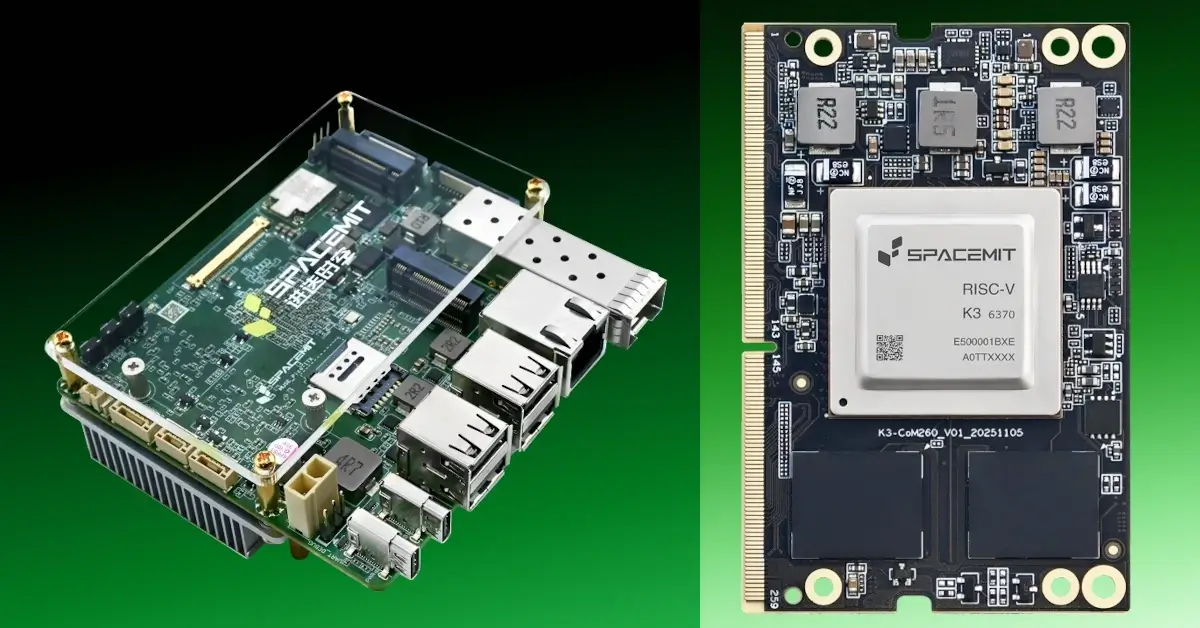
Comparing the resellers SpacemiT does not sell anything directly to consumers. Instead you need to buy a board that includes the K3 chip from an integrator. Currently the main resellers are: All of the above are Chinese companies that ship to customers both inside and outside China. DeepComputing stands out as the only one that actually has done real integration and ships the K3 on a custom board, while the others simply resell the SpacemiT-produced K3 pico-ITX and K3 CoM260 Kit.

Milk-V Milk-V is a RISC-V specialized integrator, as the name already implies. They sell the K3 under the name Jupiter2. Of all the K3 pico-ITX reseller product pages, the Jupiter2 presentation is the nicest and most detailed. Unfortunately their order page at arace.tech only states that it is a pre-order with no information about shipping schedule, taxes, or other details like what SSD is included (if any). Based on the pictures it does ship with a Milk-V branded case. The 32 GB RAM lists at 504 EUR, which is a very reasonable price. The @MilkV_Official account on X recently promoted the K3.

Documentation and support As of this writing, the Milk-V Jupiter2 documentation site is just a stub and has no actual content, and only two links to the SpacemiT K3 documentation site. For support there is a web forum with a dedicated Jupiter2 section. There is also a Matrix space, but unlike their other products, there is no dedicated Jupiter (neither v1 nor v2) channel.

Community size and open source involvement At least one prior Milk-V product was certified by Canonical, which indicates there is some collaboration in progress. Canonical also lists the Milk-V Titan on its official Ubuntu for RISC-V partner-built hardware page.

Sipeed The Sipeed K3 announcement is well written (in English) with all the relevant details and links to additional PDF manuals. However, their main page at sipeed.com says nothing about the K3, so one must know the subpage URL to access it. They offer both the K3 CoM260 kit compatible with Jetson Orin Nano carrier boards, and the stand-alone K3 pico-ITX-sized motherboard. The CoM260 kit is only 10 USD cheaper than the full pico-ITX motherboard, so choosing the latter is a no-brainer if starting from scratch. The pico-ITX model with 32 GB DDR5 RAM sells for 639 USD. The product page does not mention anything about hard disk size, so you don t really know exactly what you will be getting if placing an order. There is no indication about case, Wi-Fi antennas or power supply either, so most likely they are not included. Their store.sipeed.com website does not work at all, and their Taobao and AliExpress stores are not public and only accessible to registered users. The order page also says nothing about shipping time, delivery time, or taxes. The X account @SipeedIO is active and recently posted pictures of shipments in progress.

Documentation and support The main documentation wiki does not yet have any K3 content at the time of writing. There is a Discord channel for general RISC-V discussion, and their MaixHub also has a discussion board, but I didn t find anything K3-specific.

Community size and open source involvement Sipeed has had at least one of their previous devices certified by Canonical, which indicates they are active in the community. Note that the other RISC-V company SiFive that also has had hardware certified and officially supported by Canonical is a different company, despite the very similar name.

Banana Pi Banana Pi announced that they offer both the K3 CoM260 kit and the K3 pico-ITX motherboard version. Their product page for the K3 confusingly shows a MediaTek product in the page banner rather than the SpacemiT K3. Based on the product description and the fact they renamed the product as BPI-SM10, it seems to ship with some carrier board. The product pictures look identical to the SpacemiT documentation and there is no picture of the carrier board, and details are very sparse. The pico-ITX version with 8 GB RAM and 128 GB SSD sells for 293 USD and the CoM260 developer kit with the same specs sells for 287 USD and the 32 GB RAM with 128 GB SSD model sells for 595 USD. The shop page shows only five orders so far and items are currently out of stock. As there was no 32 GB RAM version of the pico-ITX available at all, this isn t an option for me as I want to run 30B parameter models that need the larger memory version. Of all of these resellers, the Banana Pi website seems the most outdated. It does not have a search feature, it is not mobile-friendly, pictures can t be pinched to zoom in and so forth. Product names are also almost all identical, and as the product listings only show the beginning of the product name, figuring out what product is what requires extra effort that just makes the online purchase experience plain bad.

Documentation and support I was only able to find the documentation page for the CoM260 kit, but none for the pico-ITX version. For support there is a forum, but the category list does not show any section for K3, and the forum search prohibits using the search term k3 as too short.

Community size and open source involvement Banana Pi has a long history in the ARM single-board computer market, but their presence in the RISC-V ecosystem is still growing. Their X account @sinovoip has posted only once about the K3 and otherwise promotes their ARM boards. However, their community culture page does express a commitment to open hardware in general, but there is no visible K3-specific community activity.

Firefly Firefly s K3 product page is comprehensive. Based on the details, they do not offer the K3 pico-ITX variant at all, but only the K3 CoM260 board inside the AIBOX-K3 Firefly RISC-V Edge Mini PC product. This is a feature-complete offering with a Jetson Orin Nano carrier board and case. The AIBOX-K3 with 32 GB RAM and 128 GB SSD in a case sells for 689 USD in their own Firefly.store. Unfortunately it only has HDMI and there is no USB-C with DisplayPort support, which is a deal-breaker for me personally. Interestingly, Firefly also offers rack-mounted servers with K3 as the CPU.

Documentation and support The wiki link on the product page is broken. The Firefly wiki does have a section for the AIBOX-K3, but it too has a broken link. It seems that as of the time of writing, there is no wiki section for this product yet. For support there is a web forum, which does have at least one K3 thread covering guides such as Hermes Agent installation, though broader K3-specific sections are still sparse.

Community size and open source involvement Firefly s X account @TeeFirefly has had no posts since 2024, and their GitLab/T-Firefly shows mostly 2024 activity, with only one repository updated in 2025 and nothing in 2026. Historically they have built a moderate community around their ARM-based Rockchip boards, with active forums and wiki contributions for those product lines. Their RISC-V K3 offerings are newer, and likely need a lot more polish to be attractive products overall.

DeepComputing Last, but certainly not least, is the laptop manufacturer DeepComputing that offers a Framework laptop compatible motherboard with the SpacemiT K3 chip. They also sell the plain motherboard, or with the Cooler Master case, which allows one to easily connect it to an external monitor and keyboard and use it as a desktop computer. The plain board with 32 GB RAM and no SSD sells for about 882 EUR. Shipping of the first batch is expected to start by end of June 2026. Their X account @DeepComputingio promotes this DC-ROMA RISC-V Mainboard III as their flagship product, so they seem to put a lot of effort into it. The overall product design and packaging seems good. Of all the K3 resellers and integrators that I was able to find, DeepComputing is the only one that actually designs their own boards with the K3 processor, while all the other vendors above are simply reselling the vanilla K3 boards with or without a case. After reviewing all these options I decided to buy the DC-ROMA RISC-V Mainboard III for Framework Laptop 13 with 32 GB RAM, 1 TB SSD and the Cooler Master case, totalling about 1100 EUR.

Documentation and support DeepComputing maintains product information for their RISC-V hardware at github.com/DC-DeepComputing/Framework, with documentation of the newest Mainboard III (FML13V05) still being finalized ahead of the first batch shipment. They provide community support through Discord and web forum, although the latter has very little activity.

Community size and open source involvement DeepComputing has established itself as a pioneer in RISC-V laptops, beginning with the DC-ROMA. I have seen their stand at FOSDEM, which shows they are genuinely active in the open source community. Canonical lists DeepComputing s first mainboard / FML13V01 on its official Ubuntu for RISC-V partner-built hardware page, and it seems likely that they will continue to collaborate with Canonical with the new model once it ships. While the underlying Linux enablement depends on SpacemiT s upstream efforts, DeepComputing s involvement helps bridge the gap between reference hardware and consumer-ready products. DeepComputing K3 board in the Cooler Master case

Conclusion After weighing all the options, I ended up placing an order with DeepComputing for their custom K3 board with the Cooler Master case. Despite the premium price, the active community support and the properly documented promise of a complete, working system made it easy to place an order with confidence. The SpacemiT K3 is poised to be one of the most significant RISC-V chips for local AI workloads, thanks to its RVA23 compliance and high tokens per second potential. Yet the buying experience in mid-2026 remains fragmented and incomplete. Hopefully this is just because the product is new, and they will get the purchase experience polished soon. What struck me most during this process was how poor the customer experience is across nearly all of these vendor websites: broken links, missing search functions, outdated product banners, pages that show the wrong product entirely, and no information about shipping times, stock levels, taxes, and so on. One wonders why these companies don t fully invest in their web presence. Personally I would assume they likely have enough customers already, primarily through domestic channels like Taobao and JD.com, that they do not feel any pressure to improve their international-facing sites. However, I did also review what was offered on Taobao, and the product details were very incomplete there too. Taobao, however, has a built-in live chat with almost all sellers, which can be used to ask questions and thus compensate for missing product details. I don t fully understand why the sales process seems unpolished. The websites feel almost like an afterthought a checkbox to claim global reach while the real business apparently happens elsewhere via closed platforms or via inaccessible reseller channels. It is a frustrating reminder that in the RISC-V hardware world, the technology may be open and global, but the purchase experience is less so.

5 June 2026

Russell Coker: CPUs and Debian Package Building

Introduction I have just bought a HP Z4 G4 with W-2125 CPU for $320 and I decided it was a good time to do some benchmarks on Debian package building to see which system I should use for that. The W-2125 CPU scores only 9,954 on the passmark multithread test but scores 2,546 on single thread [1]. Passmark seems to have some limitations as the only DDR3 system that s important to me at the moment (the HP Z420 workstation my parents use which cost me $750 in 2021) with a E5-2620 CPU scoring 5,325 for multithread and 1,113 for single thread [2]. From the passmark results one would expect that the system is slightly more than twice as fast as the Z420 for operations that involve less than 4 CPU cores. For the initial tests of the Z4 G4 I ran them with hyper-threading enabled as 4 cores isn t much by today s standards and also the machine in question is going to be less exposed to hostile data and contain less secret data than most of my systems so the security risks of hyper-threading are less of a concern. I did some tests with a couple of tasks that are very important to me, building SE Linux policy packages (something I may do a dozen times in a day) and building Warzone 2100 (which I do less often but is the most intensive build process I regularly run). At the bottom of this post there are tables with the results from building these packages on my Z640 workstation with a E5-2696 v4 CPU [3], the Z420, and the new machine. For the Warzone 2100 package I tested building on my Z840 dual CPU system [4]. I didn t test building the SE Linux policy on the Z840 this time because that package can t take advantage of even 22 cores. When I initially got the Z840 running it built the policy packages faster because the Z640 had an older CPU that was slower for single core operations than the CPUs in the Z840. BTRFS Compression For some time I have noticed significant differences in compile time on my workstation, a factor of more than 2. I did more tests and noticed that top showed something like the following, those kernel threads are all BTRFS related, except for gfx which is probably something graphical caused by running Chrome with about 300 tabs open.
2144316 root      20   0       0      0      0 I  26.6   0.0   0:36.76 kworker/u88:20-btrfs-endio-write                                                                                                                                                                             
2221470 root      20   0       0      0      0 I  23.7   0.0   0:01.85 kworker/u88:12-gfx                                                                                                                                                                                           
2221436 root      20   0       0      0      0 I  15.1   0.0   0:07.48 kworker/u88:8-btrfs-compressed-write                                                                                                                                                                         
2166191 root      20   0       0      0      0 I  12.8   0.0   0:15.80 kworker/u88:23-btrfs-compressed-write                                                                                                                                                                        
2126387 root      20   0       0      0      0 I  10.2   0.0   1:29.11 kworker/u88:4-events_unbound 
I had been running BTRFS with the mount option compress=zstd:15 which caused much of the performance problems when building. It was also a random performance issue which I think happened due to the BTRFS 30 second write-back sometimes taking more than 30 seconds during the build process which then caused a second write-back. I did tests on ZSTD compression levels 5, 8, 10, and 15. 15 was never good and often really bad. 10 was not unbearable but consistently slower. 8 was sometimes as fast as 5 and sometimes quite a bit slower. I didn t test levels below 5 because I need to have some compression and it seemed that the benefits of reducing compression were dropping off below 8. I found that the BTRFS compression delay is not counted in system time for the process. I think it s the fsync() system calls in the semodule and dpkg-deb programs that cause the delays related to BTRFS compression waiting for kernel threads. BOINC I have all my systems other than laptops running BOINC in the background so that CPU power is used for scientific research when I don t have any personal use for it [5]. I believe that it s immoral to waste CPU power when it could be used for research. In the below table which has test results from building the package with and without BOINC, and with different ZSTD compression levels in BTRFS all the worst entries were from when BOINC was running apart from one where ZSTD level 15 compression was used. The really poor performance with ZSTD level 15 was an outlier, but it wasn t an uncommon outlier so I left it in. Running BOINC in the background configured to use all CPU cores caused a significant increase in user CPU time (the time a CPU core spent actually running the program). My initial thought was that it s partly related to turbo boost . The Intel ARK page for the CPU in the Z420 shows that it s main clock speed is 2.0GHz with a 2.5GHz turbo boost [6]. The turbo boost is apparently largely based on temperature and apparently limited to one core, so if the other CPU cores are all being used then the CPU will probably be too hot to have the turbo boost and if it happens it might not happen for my compile processes. The ARK page for the E5-2699 v4 (which is a similar CPU to the E5-2696 v4 that I m using but is officially documented by Intel) [7] shows that it has a base clock speed of 2.2GHz and a turbo boost speed of 3.6 GHz. 322 vs 244 seconds of user CPU time means running 32% slower which can plausibly be explained by the lack of a 64% turbo boost with a bit of help from the 55MB L3 cache being thrashed. Turbo boost would only be a noticeable issue for building packages like the SE Linux policy packages which doesn t take much advantage of multi-core CPUs. For a build process to average at best 362% CPU use there has to be large parts of the process that are limited to one or two cores which can potentially give a benefit from turbo-boost. When building the Warzone 2100 packages most of the build time is running basis-universal which is a multi-threaded program to compress GPU texture data. This usually causes a load average of 300+ on the Z640 or 600+ on the Z840. But the build time is still increased by more than 50% on both the Z640 and the Z840 when BOINC is running in the background, which seems to be an indication that it s not related to turbo boost. I verified that BOINC is running at IDLE schedule priority with the following command:
# chrt -p $(pidof -s einstein_O4MD_2.01_x86_64-pc-linux-gnu)
pid 2974874's current scheduling policy: SCHED_IDLE
pid 2974874's current scheduling priority: 0
In theory this means that BOINC won t affect foreground processes. Hyper Threading on the W-2125 The best claims I ve seen about HT are 15% to 30% performance boost. The best I ve actually seen in the past is about 18%. Seeing a 10% benefit for building Warzone 2100 is at the low end of the range I expected. 8 virtual cores is not many for a build process that causes a load average of 600+ when running on a system with 44 real cores. I was surprised to see a 6% performance benefit in hyper-threading for building the SE Linux policy as I didn t think there was enough use of threading or multiple processes to allow that. Many build scripts use a number of processes that match the number of apparent CPU cores. While make -j 88 might give a theoretical performance benefit on a 44 core system it will also take a lot of RAM and any paging will outweigh the benefits of hyper-threading. On a system with only 4 real cores there s less potential for using too much RAM and as security isn t so important on that system I will leave it on. Comparing the CPUs The best results of the Z640 and Z4G4 are only 50% faster than the best results of the Z420. The Z420 has a E5-2620 CPU which is far from the fastest CPU available for that system the E5-2687W has 8 cores and rates 10,021/1,669 on passmark [8] which is far better than the 5,331/1,114 the E5-2620. The E5-2687W is the fastest CPU that HP lists as supported by the Z420 and it supports DDR3-1666 RAM as opposed to the DDR3-1333 that is the fastest that the E5-2620 supports. With suitable hardware upgrades the Z420 would probably only take about 20% longer to do builds of the SE Linux policy and other packages that can t take advantage of more than 8 CPU cores. The Z4G4 system has 4 RAM channels which means that you should get some performance benefits from having 4 DIMMs, my system currently has 2 and I haven t yet managed to get more DDR4-2666 DIMMs. But I d still expected a W-2125 CPU with 2*DDR4-2666 DIMMs outperform any E5-26xx CPU with 4*DDR4-DDR-2400 DIMMs for tasks that average less than 4 CPU cores. In retrospect I would have been better off getting a HP Z820 (two socket server with DDR3 RAM) than the first DDR4 systems I got. It seems that for reasonable size builds a two socket system comes close to twice the speed of a single socket system. I did briefly own a HP ML350 two CPU system with DDR3 RAM but it was too noisy for my intended use as a deskside workstation so I sold it. Things to Investigate I plan to do more investigation on BTRFS compression, how to get the best compression without excessive delays and how to recognise when delays are happening. I have some SSDs that have sustained write speeds as low as 15MB/s (Crucial P1 series) so for those I could probably have very high compression levels without slowing the system down. The fact that BIONC slows things down so much seems to be a bug. When processes are running with the IDLE scheduling class there shouldn t be such significant delays. Is it due to cache thrashing? How can I best get BOINC suitably throttled when I m sitting at my workstation, I don t want BOINC connecting to the local X server (which it repeatedly tries to do). Do I need to tune my kernel for better handling of IDLE scheduling? When I get more DIMMs in the Z4G4 I need to do more tests to see if it gives an overall performance boost. Also the Z4G4 system has a BIOS option for sub NUMA which basically means treating the different RAM channels on a single CPU as NUMA zones, I enabled that option which does nothing presumably because I only have 2 DIMMs, the results when I have 4 DIMMs will be interesting. I will also do some NUMA tests on the Z840 to see what benefits it gives. I have a selection of RAM speeds that will work in the Z4G4, if I have enough spare time I ll test what difference that makes for CPU bound tasks that matter to me. For package building fsync() is not helpful, if the system crashes before it s done then I will just do the build again. For a build cluster it is probably a good feature and probably doesn t affect aggregate performance when multiple packages are built at the same time, but for the single user case probably not. I will investigate libeatmydata for package building [9]. Conclusion The progress in CPUs seems to have slowed down a lot recently. The main benefits seem to be in more CPU cores and for newer sockets with more RAM channels. The CPUs that do have improvements in single core performance are the i9 series (which mostly doesn t come with motherboards supporting ECC) and AMD CPUs (which is rare in enterprise class hardware). Maybe I should get a server with an i9 or AMD CPU for tasks that need a fast turn around with a small number of cores. That would probably outperform any CPU designed for large core counts for things like building the policy and setting up test VMs (which depends on package installation speed that is single core bottlenecked). The W-21xx CPUs seem to offer little benefit over the E5-26xxv4 CPUs and not a lot of benefit over E5-26xx CPUs (with DDR3). Even the W-22xx CPUs look like they aren t going to offer a lot as they are only an incremental improvement over the W-21xx series. I had considered making the Z4G4 my main desktop workstation after the high end W CPUs become affordable, but it looks like that won t be worth it until such CPUs drop from the current ebay price of $900 to $100. I think I ll keep waiting for a decent socket LGA3647 or DDR5 based server [10] for my next significant upgrade. Tables Building SE Linux Refpolicy
System BOINC Compression CPU Time Elapsed CPU%
Z640 no 8 248.82user 55.58system 1:23.88elapsed 362%CPU
Z4G4 no 5 245.15user 34.63system 1:24.93elapsed 329%CPU
Z640 no 5 244.75user 34.87system 1:25.98elapsed 325%CPU
Z4G4 no 10 245.21user 35.64system 1:29.63elapsed 313%CPU
Z640 no 8 248.71user 55.90system 1:33.01elapsed 327%CPU
Z640 no 10 250.90user 55.78system 1:42.12elapsed 300%CPU
Z640 yes 8 298.19user 69.30system 1:59.77elapsed 306%CPU
Z640 yes 10 300.58user 68.90system 2:01.53elapsed 304%CPU
Z420 no 5 359.01user 44.95system 2:07.33elapsed 317%CPU
Z640 yes 5 322.40user 71.82system 2:34.66elapsed 254%CPU
Z420 yes 5 372.03user 42.95system 2:42.15elapsed 255%CPU
Z640 yes 15 299.26user 67.18system 2:59.77elapsed 203%CPU
Z640 no 15 250.05user 54.60system 3:07.61elapsed 162%CPU
Building Warzone 2100
System BOINC Compression CPU Time Elapsed CPU%
Z840 no 10 6549.21user 89.46system 4:18.90elapsed 2564%CPU
Z840 no 5 6533.81user 90.50system 4:19.24elapsed 2555%CPU
Z640 no 5 7040.87user 183.12system 7:13.50elapsed 1666%CPU
Z840 yes 5 8039.52user 169.62system 8:02.86elapsed 1700%CPU
Z640 yes 5 7486.44user 205.03system 11:09.97elapsed 1148%CPU
Z4G4 no 5 7891.32user 74.45system 17:48.03elapsed 745%CPU
Z4G4 no 10 7942.10user 77.43system 17:58.72elapsed 743%CPU
Hyper-Threading
Build HT Compression CPU Time Elapsed CPU%
Warzone yes 5 7891.32user 74.45system 17:48.03elapsed 745%CPU
Warzone yes 10 7942.10user 77.43system 17:58.72elapsed 743%CPU
Warzone no 5 4492.45user 59.09system 19:59.01elapsed 379%CPU
Warzone no 10 4497.28user 59.46system 20:07.15elapsed 377%CPU
Refpolicy yes 5 245.15user 34.63system 1:24.93elapsed 329%CPU
Refpolicy yes 10 245.21user 35.64system 1:29.63elapsed 313%CPU
Refpolicy no 5 180.84user 29.74system 1:32.30elapsed 228%CPU
Refpolicy no 10 180.29user 30.07system 1:35.01elapsed 221%CPU

4 June 2026

Reproducible Builds: Reproducible Builds in May 2026

Welcome to the May 2026 report from the Reproducible Builds project. These reports outline what we ve been up to over the past month, highlighting items of news from elsewhere in the increasingly-important area of software supply-chain security. As ever, if you are interested in contributing to the Reproducible Builds project, please see the Contribute page on our website. In this month s report, we cover:

  1. Debian to ship reproducible packages in forky and beyond
  2. Holger Levsen on reproducing official Debian packages
  3. Reproducible Builds 2026 summit to be held in Gothenburg, Sweden
  4. Kettle: Attested Builds for Verifiable Software
  5. New rebuilderd version announced
  6. Reproducible open source messengers
  7. Distribution work
  8. Misc news
  9. Patches
  10. Documentation updates


Debian to ship reproducible packages in forky and beyond In a huge change in Debian s reproducibility policy, the Debian Release Team announced that:
we ve decided it s time to say that Debian must ship reproducible packages. Since yesterday, we have enabled our migration software to block migration of new packages that can t be reproduced [on reproduce.debian.net] or existing packages in testing that regress in reproducibility.
That is to say, if newly-uploaded packages are not reproducible, they won t be considered candidates for inclusion in the next stable release of Debian codenamed forky. (Some exceptions may be granted.) This news generated a number of articles and comments in various news outlets:

Holger Levsen on reproducing official Debian packages Reproducible Builds developer Holger Levsen gave a talk at the 2026 Hamburg MiniDebconf this year on the topic of reproduce.debian.net - reproducing what is distributed from ftp.d.o. Holger s talk announced that Debian intends to ship only reproducible packages in forky and beyond (see above), but also talked more broadly about reproducible builds, our testing framework and the Debian archive. That is to say, moving away from testing whether a package is reproducible in a theoretical sense (eg. whether we can build it twice in different environments and achieve the same result in our test system), and attempting to reproduce the same .deb files in the official Debian archive itself. This small-sounding distinction is actually essential, as this is the only means through which the reproducible builds technique can determine whether build systems are compromised are not. A video (32m37s) of the talk is available, as are Holger s slides.

Reproducible Builds 2026 summit to be held in Gothenburg, Sweden As initially announced in March 2026, we will be having our yearly Reproducible Builds summit 2026 in Gothenburg Sweden, from September 22 until 24, followed by two days of hacking! Further information will be provided on our website and on the rb-general mailing list very soon.

Kettle: Attested Builds for Verifiable Software Andr Arko and Amean Asad published a paper this month on Kettle, a build system that produces cryptographically verifiable provenance for software built inside Trusted Execution Environments :
A Kettle build records the source commit, dependency set, toolchain, build environment and output artifact digests in a provenance document produced inside a measured confidential VM. The SHA-256 digest of that document is committed to the TEE platform s attestation report-data field, so the hardware-signed attestation report is itself the signature on the provenance, with the signing identity chaining to the TEE manufacturer s root of trust rather than to the build infrastructure operator. Because the CVM image is itself reproducible, its launch measurement is public and stable, which lets a build requester pre-attest the CVM before submitting any input and optionally deliver source over a TLS channel terminated inside it, so the build runs end-to-end confidentially without the host ever seeing source code in plaintext.
A PDF of the paper is available online.

New rebuilderd version announced rebuilderd, our server designed for monitoring the official package repositories of Linux distributions and attempt to reproduce the observed results there; it powers, amongst other things, reproduce.debian.net. A new version, 0.27.0, was released this month, with the following headline changes:
  • Improved .udeb support
  • Breaking changes in pkg sync configuration
  • Manual cleanup needed for Arch Linux instances
As kpcyrd s announcement mentions:
The new rebuilderd package is currently available in the extra-testing repository. Note the Arch Linux package is upgraded from v0.25.0 from v0.27.0; please be patient with the database migrations on first restart, and make yourself familiar with the breaking changes in v0.26.0 too.

Reproducible open source messengers GitHub developer BarbossHack is maintaining an repository/page on GitHub to track reproducibility status of open source messengers .

Distribution work In Debian this month, the loong64 architecture was added to reproduce.debian.net. This is a 64-bit Reduced Instruction Set Computer (RISC) instruction set architecture developed by Loongson. Vagrant Cascadian performed Non-Maintainer Uploads (NMUs) in Debian for several packages with outstanding patches over a year old. These included rocdbgapi, onevpl-intel-gpu, python-pytest-shell-utilities, python-mt-940 and pympress. On tests.reproducible-builds.org, Vagrant Cascadian fixed the huge spike in build failures by adding passwd to the base tarballs, and re-enabled building gcc and binutils packages with PGO (Profile Guided Optimization) and LTO (Link Time Optimization) to avoid giving a false sense of reproducibility. Inconsistencies on the reproducibility of the condor package were brought up on the Debian reproducible-builds mailing list. Following a hunch, Vagrant Cascadian eventually identified the issue was related to embedded kernel versions which was then fixed upstream and fixed in Debian as well. Lastly, 40 reviews of Debian packages were added, 68 were updated and 75 were removed this month adding to our knowledge about identified issues. A number of issue types were updated, such as the addition of a new sphinx_reading_durations toolchain issue [ ], a golang_mango_generates_manpages_with_build_date issue [ ] and a random_offset_id_in_cython_linetrace [ ]. In addition, the timestamps_in_qhc issue was refocused to timestamps_in_qhc [ ].
In Fedora, Jelle van der Waa submitted a request for an official Fedora rebuilderd package which was reviewed by Neal Gompa.
Lastly, Bernhard M. Wiedemann posted another openSUSE monthly update for their reproducibility work there.

Misc news On our mailing list this month:

Patches The Reproducible Builds project detects, dissects and attempts to fix as many currently-unreproducible packages as possible. We endeavour to send all of our patches upstream where applicable or possible. This month, we wrote a large number of such patches, including:

Documentation updates


Finally, if you are interested in contributing to the Reproducible Builds project, please visit our Contribute page on our website. However, you can get in touch with us via:

29 May 2026

Ravi Dwivedi: Budapest Travel

In September 2025, I attended the annual LibreOffice conference in Budapest, Hungary. This gave me an opportunity to explore the city, which I will cover in this post. Let s start with the currency. Although Hungary is a part of the European Union (EU), it doesn t use the euro as its currency. Instead, it uses Hungarian forints (denoted by Ft ). During my time in Hungary, 1 Indian rupee was equal to 4 Hungarian forints. After reaching the Budapest airport, I bought a 15-day public transport pass. The public transport counter is after you pass customs and immigration. The pass allows unlimited use of public transport in the city. I had to show my passport and pay 5950 Ft to get the pass. The pass had my passport number mentioned on it. The public transport passes can also be bought at any of the tram stations as well.
This is the counter from where I bought my public transport pass. This is the counter from where I bought my public transport pass.

Budapest pass. My unlimited public transport pass for Budapest. I have redacted my passport number from it.

An automatic ticket machine An automatic ticket machine at a tram station in Budapest.

Budapest is a union of two cities Buda and Pest lying on opposite sides of the Danube River. My hotel Corvin Hotel was on the Pest side. Budapest had good public transport. The buses, metros, and trams complemented each other. For example, the airport didn t have metro or tram connectivity, but it was served by the bus. Most of the metro was on the Pest side, with only a couple of stations falling in Buda. However, both sides had an extensive network of trams. Furthermore, the information about the public transport was easily accessible. For instance, the map of tram stops inside the trams also included the bus routes one could get after alighting at those stops. From the airport, I took a bus followed by taking a metro on the M3 line to reach within walking distance of my hotel.
An M3 line metro in Budapest. An M3 line metro in Budapest.

During the conference I would take the tram to the conference venue. The trams were modern and fast. They also had a smiley face at the front, which gave them a friendly look. It seemed like the trams were happily doing their job. The city also had a good pedestrian infrastructure along with separate cycling tracks.
A tram in Budapest. A tram in Budapest having a smiley face at the front.

Budapest s tap water is officially safe to drink, which was mentioned on a sticker posted on the wall of the bathroom of my hotel room. So, I did not need to buy any water bottles while I was there. On the 6th of September, I went on a sightseeing tour of Budapest with my Dione. Our friend Attila, who was a local (from Hungary), joined us. We went to the central market from our hotel by metro. If you read my post on Vienna, I mentioned that the metro stations don t have AFC gates but ticket validators instead. Budapest s metro also has the same system. If you buy individual tickets, you need to validate them using the validators on the station before boarding the metro. If you are using a public transport pass like I was, then you do not need to validate, and you can board the metro directly.
A ticket validator at a metro station in Budapest. A ticket validator at a metro station in Budapest.

In 10-15 minutes, we reached the central market. Attila showed us around. I bought a fridge magnet and paprika powder as souvenirs. Paprika powder is a signature spice of Hungary. It is mainly available in two forms one is sweet and the other being spicy. I wanted the spicy one, but I didn t get that in that market. Therefore, I had to contend with buying the sweet version. The sweet version isn t sweet though, it is just not spicy. After bringing that paprika powder home, it is mainly used for food coloring. I like it though and use it frequently in my omelets and other dishes.
Central Market. Central market.
A building with a tram in front of it. The building right behind the tram is the central market building.

At some point, Atilla had to join the The Document Foundation (TDF) sightseeing group, so we parted ways at the central market. Dione and I continued our sightseeing and decided to start with visiting the Hungarian parliament, which is a tourist attraction. It was because we were on the Pest side and the parliament was also on the same side, while other tourist attractions were on the Buda side. So, Dione and I hopped on a tram and went to the parliament. We got off at a tram station just outside the parliament. The parliament is the icon of Budapest. The building has a gothic architecture and colored brown and white. One can buy tickets and take an inside tour. However, we didn t have a lot of time, so we stayed outside the building.
Hungarian Parliament building. Hungarian Parliament building.

After spending some time outside the parliament building, we took a tram to the Chain Bridge. As I mentioned earlier, Budapest has two parts Buda and Pest separated by the Danube River. To go from one of the sides to the other requires crossing a bridge. Although Budapest has many bridges linking the two sides, the main one is the Chain Bridge. We walked on the chain bridge to get to the other side. The bridge gave a good view of the Danube River. It also had a statue of a lion. The Buda Castle (another major landmark of Budapest) was visible from the bridge.
Chain Bridge. A shot of Chain Bridge.
A lion statue The lion statue on the Chain Bridge.
After reaching the other side of the bridge (the Buda side), we sat on a bench for some time and then planned on where to go next. We decided to go to Fisherman s Bastion, which is another tourist attraction. We used the OSMAnd~ app to figure out which bus to take and hopped on one. Soon we reached Fisherman s Bastion, where we found a flight of stairs that led upwards. Upon climbing the stairs, we got a panoramic view of the city. It also gave us a good view of the Hungarian parliament across the river. Going further upstairs, we found a statue of Stephen I of Hungary. He was the first king of Hungary, getting the crown in the year 1900.
A view of Hungarian parliament from Fisherman's bastion A view of Hungarian parliament from Fisherman s bastion.

I found Fisherman s Bastion to be the best tourist attraction in the city. As mentioned earlier, it offers a panoramic view of the city, which I liked. I liked the arhitecture and open space there. If you find yourself in Budapest, I would highly recommend that you visit Fisherman s Bastion.
Fisherman's Bastion. Fisherman s Bastion.
A green colored statue of King Stephen Statue of Stephen I of Hungary at Fisherman s Bastion.

Next, we went downstairs and returned to where the bus dropped us. From here on, we walked in random streets to see the residential and non-touristy side of Budapest. It was not so random as we walked towards Batthy ny t r metro station. Upon reaching the metro station, we found a caf where we stopped for a while for some coffee. After injecting some caffeine into our blood, we proceeded to find a place to have lunch.
A metro station Batthy ny t r metro station.
For lunch, we decided to go to R k czi t r metro station after reading on the internet about the food options there. Upon exiting the metro station, we found a market inside a building that had a lot of shops, but most of them were closed. After roaming around inside a bit, we found an Italian place open and decided to eat there. The name of this place was Matteos. We ordered an eggplant parmigiana, a lasagna artichoke, and a classic tiramisu. It wasn t very tasty but filled us up for the day.
The Italian place we had our lunch at. A picture of Matteos, where we had our lunch.

Budapest has four metro lines, and we had been to three of them, so we decided to try the remaining line, which was the M1 line. It is the oldest line in the city and has a different vibe than the modern lines. This line was opened in 1896, one of the oldest subway systems in the world. The coaches were much smaller than the other metro lines, and the seating arrangement was something you would expect from a bus than a typical metro train. We rode all the way to the last stop, Mexik i t. Upon going outside, we found out there wasn t much to do here. At this point, I checked the map and realized that Heroes Square is just a couple of metro stations away. Heroes Square is a tourist attraction in Budapest. It is located in Zugl a and is a historically significant place in Budapest. It has a monument which features the Seven chieftains of the Magyars.
M1 line station and tracks. M1 line station and tracks. It is the oldest metro transit of Budapest and one of the oldest in the world. It started operations in 1896.

Here, our unlimited public transport pass was handy because if it was paid per trip, we would think of the stop as a wasted one because we would have to buy a ticket again, but in this case we could just hop on again without any regrets.
A metro train entering a station. An M1 line metro train entering the station.

So we took the M1 line again and deboarded at H s k tere station, followed by walking to the square. After roaming around for a while, we saw a trolleybus and decided to ride on that.
Heroes' Square Heroes Square.
A trolleybus This is the trolleybus we took in Budapest.

A trolleybus is an electric bus that is powered by overhead electric cables. It is like a tram but runs on roads instead of tracks. We got down at D zsa Gy rgy t metro station. Then we took a metro to our hotel. Before going to the hotel, we went to a place to eat something. We had coffee and l ngos. L ngos is a deep-fried Hungarian dish, which looks exactly like the Indian flatbread bhatura. I found it tasty, but since it was deep-fried, that was almost a given.
A deep friend dish called L ngos. L ngos a dish which looks like the Indian flatbread bhatura.
The next day we went to Vienna the capital of Austria which I have already posted about. Check it out here. I had a good time in Budapest, and it is a beautiful city with good public transport and some amazing sites to visit. That s it for now, and see you next time! Credits: Thanks Dione and Badri for proofreading.

24 May 2026

Vincent Bernat: Sharding a routing table for lock-free reads in Go

To associate routing information like AS paths or BGP communities to flows, Akvorado can import routes through the BGP Monitoring Protocol (BMP). As the Internet routing table contains more than 1 million routes, Akvorado needs to scale to tens of millions of routes.1 This has been a long-standing challenge,2 but I expect this issue is now fixed by using RIB sharding, a method that splits the routing database into several parts to enable concurrent updates.

Previous implementation Akvorado connects 2 elements to build its RIB:
  1. a prefix tree, and
  2. a list of routes attached to each prefix.
Akvorado BMP RIB implementation before sharding with the memory layout of each structure and a single lock.
Akvorado BMP RIB implementation without sharding. One single read/write lock.
In the diagram above, the RIB stores five IPv4 prefixes and two IPv6 prefixes. One of them, 2001:db8:1::/48, contains three routes:
  • from peer 3, next hop 2001:db8::3:1, AS 65402, AS path 65402, community 65402:31,
  • from peer 4, next hop 2001:db8::4:1, same ASN, AS path, and community,
  • from peer 5, next hop 2001:db8::5:1, AS 65402, AS path 65401 65402, community 65402:31.
The rib structure is defined in Go as follows:
type rib struct  
    tree          *bart.Table[prefixIndex]
    routes        map[routeKey]route
    nlris         *intern.Pool[nlri]
    nextHops      *intern.Pool[nextHop]
    rtas          *intern.Pool[routeAttributes]
    nextPrefixID  prefixIndex
    freePrefixIDs []prefixIndex
 
The prefix tree uses the bart package, an adaptation of Donald Knuth s ART algorithm. The benchmarks demonstrate it outperforms other packages for lookups, insertions, and memory usage.3 Plus, the author is quite helpful.

Storing routes in a map The list of routes for each prefix is not stored directly in the prefix tree: it would put too much pressure on the garbage collector by allocating per-prefix arrays. Instead, the RIB assigns a unique 32-bit prefix identifier for each prefix, either by picking the last available prefix identifier from the freePrefixIDs array if any, or using the nextPrefixID value before incrementing it. Then, the routes are stored in the routes map, leveraging the optimized Swiss table in Go. To retrieve routes attached to a prefix, we look them up one by one in the routes map with a 64-bit key combining the 32-bit prefix index with a 32-bit route index matching the position of the route in the list. Akvorado scans routes from the first to the last to find the best one.4 It knows there is no more route if the route key returns no result.
type prefixIndex uint32
type routeIndex uint32
type routeKey uint64

Interning routes A route contains a BGP peer identifier, a partial NLRI5, the next hop, and the attributes.
type route struct  
    peer       uint32
    nlri       intern.Reference[nlri]
    nextHop    intern.Reference[nextHop]
    attributes intern.Reference[routeAttributes]
    prefixLen  uint8
 
type nlri struct  
    family bgp.Family
    path   uint32
    rd     RD
 
type nextHop netip.Addr
type routeAttributes struct  
    asn              uint32
    asPath           []uint32
    communities      []uint32
    largeCommunities []bgp.LargeCommunity
 
To save memory and allocations, NLRI, next hops, and route attributes are interned : a 32-bit integer replaces the real value. The mechanism predates the unique package introduced in Go 1.23. We keep it because it has different trade-offs:
  • It uses explicit reference counting instead of relying on weak pointers.
  • It works with non-comparable values implementing Hash() and Equal() methods.6
  • It uses explicit pool instances. This will be useful for sharding.
  • It has better performance. See for example this benchmark.
  • It consumes half the memory thanks to unsigned 32-bit references instead of pointers.
  • But it is not safe for concurrent use.

Why does it not scale?

Note At AS 12322, we don t use BMP yet.7 But Gerhard Bogner had the patience, availability, and technical skills to help me debug this issue.

The global read/write lock is a bottleneck in this implementation. But how? There are several users of the RIB, each with its own set of constraints:
  • The Kafka workers look up the RIB to enrich flows with routing information. They are bound by the number of Kafka partitions.8 Akvorado also adjusts their number to ensure efficient batching to ClickHouse. On our setup, the number of workers oscillates between 8 and 16. As we want to observe the latest data, we cannot afford for the Kafka workers to lag too much.
  • The monitored routers send route updates through the BMP protocol. When connecting, they can send millions of routes.9 After the initial synchronization, updates are sent continuously and may spike from time to time. The router detects a stuck BMP station when its TCP window is full and resets the session in this case. While Akvorado implements a large incoming buffer, it still needs to update the received routes with the write lock held fast enough to avoid being detected as stuck.
  • When a remote BGP peer goes down, Akvorado flushes the associated routes by walking the RIB with the write lock held. When a monitored router goes down, Akvorado waits a bit but eventually flushes all the associated routes.
In short: on a busy setup, lock contention is high for both readers and writers, and neither can lag too much behind.

RIB sharding

First step: basic sharding To remove the global lock, the RIB is split into several shards, each one handling a subset of the prefixes:
Akvorado BMP RIB implementation after sharding with the memory layout of each structure and one lock per shard.
Akvorado BMP RIB implementation with sharding.
The prefix tree stays global and is protected by a single lock. Each shard gets its read/write lock, its route map, and its intern pools to store NLRIs, next hops, and route attributes, which would not have been possible with Go s unique package. The prefix indexes are also sharded: the 8 most significant bits are the shard index and the 24 remaining bits are the local prefix index. Gerhard confirmed that after this blind change, the BMP receiver chugged steadily. Later, I wrote a concurrent benchmark over half a million synthetic but plausible routes10 partitioned over 0 to 8 writers, churning routes as fast as possible, while 1 to 16 readers continuously look up a set of 10,000 routes. I don t know if this benchmark is realistic, but it confirms the improvements for both read and write latencies:
Two heatmaps. One for read latency ratio, the other for write latency ratio. Both of them comparing the speedup with colored tiles between the code before sharding and after sharding. Most tiles are green.
Read and write latency performance improvement after sharding.
It also shows that a high number of writers degrades read latency.

Second step: lock-free reads The single read/write lock protecting the prefix tree is the next target. The bart package provides alternative mutation methods returning an updated tree using copy-on-write. Readers don t need the global lock any more, leaving it only to synchronize writers. The prefix tree is boxed in an atomic pointer.
Akvorado BMP RIB implementation for sharding with lock-free reads. It shows the memory layout of each structure.
Akvorado BMP RIB implementation with sharding and lock-free reads.
Without a lock, readers can now fetch a stale prefix index when walking their copy of the tree if a concurrent writer removes the last route attached to this prefix index and recycles it for another prefix. To avoid this issue, we combine the prefix index with a generation number and store them in the tree:
type generation uint32
type prefixRef struct  
    idx prefixIndex
    gen generation
 
type rib struct  
    mu     sync.Mutex
    tree   atomic.Pointer[bart.Table[prefixRef]]
    shards []*ribShard
 
Each shard stores the generation number for each local prefix index. The generation number increases by one if the associated prefix index is freed. When looking up the routes attached to a prefix index, the reader checks if the generation number matches. Otherwise, it assumes the index was recycled and the list of routes is empty.11 You can see this case in the diagram above for prefix index 5, stored with a generation index of 3, while the current value in the []generations array is 4. The generation number could overflow, but it is not a problem as lookups are quick. Running the concurrent benchmark against this new implementation shows the improvements for the read latency as soon as the cost of the copy-on-write prefix tree is amortized.
Six heatmaps. Three for read latency ratio, three others for write latency ratio. They compare the numbers without sharding, with sharding, and with lock-free reads, pair by pair. For read latency, most tiles are green, showing an improvement of the second step. For write latency, the speedup is negative for a low number of readers.
Read and write latency performance improvement after lock-free reads. The middle column shows the cumulative improvements of both steps.

Among the multiple attempts to optimize the BMP component, RIB sharding is one of the more satisfying. Akvorado 2.2 implements the first step. PR #2433, drafted while writing this blog post, implements the second step and was released with Akvorado 2.4.

  1. Each router exporting flows doesn t need to send its routes. When Akvorado does not find a route from a specific device, it falls back to a route sent by another device. It is up to the operator to decide if this is a good enough approximation.
  2. I made many attempts to scale the BMP component. See for example PR #254, PR #255, PR #278, PR #2244, and PR #2245. Despite these efforts, this component remained problematic for some users. See discussion #2287 as the latest example.
  3. It keeps improving: bart 0.28.0 features a new implementation that trades a bit of memory for greater lookup performance. I did not test it yet, as I have been preparing this blog post for a couple of months already.
  4. Akvorado prefers the route matching the exact next hop. Otherwise, it falls back to any other route. This is an approximation. An alternative would be to have one prefix tree for each BGP peer but it would require configuring all routers to export their routes. pmacct s BMP daemon implements this approach.
  5. If we consider the BGP RIB as a database, the Network Layer Reachability Information (NLRI) is the primary key. Its content depends on the BGP family. With IPv4 or IPv6 unicast, this is the prefix. For VPNv4 and VPNv6 families, it includes the route distinguisher. If you enable the ADD-PATH extension, the NLRI also contains a path identifier. In our implementation, we don t store the prefix as we get it from the looked-up IP address using the prefix length stored separately.
  6. The Hash() methods rely on the hash/maphash package and on the unsafe package to avoid memory copies. See for example the Hash() function for the nlri structure.
  7. Despite being an author or co-author of the first BMP-related RFCs since 2016 (RFC 7854, RFC 8671, RFC 9069), Cisco did not implement it in a usable way in IOS XR until version 24.2.1. We still need to upgrade a few routers to enable this feature.
  8. KIP-932 introduces, in Kafka 4.2, the concept of share groups to enable cooperative consumption on the same partition. This is not supported in Akvorado yet.
  9. You can configure BMP to send routes for each BGP peer before or after applying the incoming policies. In this case, you can get more than one million routes for each transit peer. You can also tell BMP to send the local RIB, which only contains the best path for each prefix.
  10. The prefixes are random, but the prefix size distribution and the AS path length distribution follow the data provided by Geoff Huston.
  11. Alternatively, we could retry the lookup, but it would be pointless: the RIB is an eventually consistent database, and an empty list was a correct answer at some point in the recent past.

23 May 2026

Petter Reinholdtsen: Command line Norse God of Wind Hr svelg move the clouds

A while back, I came across the AI Fabric system created by Daniel Miessler. I liked its approach of providing command-line tools for filtering text using artificial idiocy services, allowing stepwise operations to be applied to a piece of text. The output of one operation can then serve as the input for another in other words, Unix pipeline processing powered by large language models. I do no longer remember exactly how I discovered it, but suspect it was via Matthew Berman's video "How To Install Fabric - Open-Source AI Framework That Can Automate Your Life". While the idea and concept behind AI Fabric appealed to me, its implementation has continued to rub me the wrong way. It started off as a Python project that I could only get running by downloading random programs from the internet using Poetry. I tried to assess how much work it would take to package all its missing dependencies for Debian. However, before I got very far, the project shifted away from Python and over to Go. This new implementation also relied on a build system that seemed to encourage users to run arbitrary code downloaded from the internet to get software working, and further moved to a language I do not master as well as Python. The change bothered me enough that I set my effort to set up a working command line LLM tool in Debian aside for several months. By chance, I came across a simple Python recipe in January demonstrating how to communicate with a llama.cpp API server. I had already been working on packaging llama.cpp for Debian together with the rest of Debian's AI team, and was fortunate enough to own a working instance with a 24 GiB VRAM GPU from AMD, allowing me to run useful models. Until that point, I had only used the basic web client provided by the Debian package, lacking the spare time to explore what else could be done. Then, I found this simple 50 line Python script demonstrating how to interact with llama.cpp's OpenAI-compatible API. I decided to revive the AI Fabric concept, and implement the Unix pipeline filter tool with as few dependencies as possible. It is now operational and working very well, relying solely on standard Python features. The tool include a copy of the LLM recipes from the AI Fabric project (called "patterns"), enabling easy access to request summaries, translations, code review and other useful tasks. Several hundred patterns are included, though I have only tested about ten so far. The LLM API server can be specified in ~/.config/hraesvelgr/config.ini like this:
[server]
url=https://some.llm.example.com:8080/v1/
model=Qwen/Qwen3.6-27B-FP8
With this configuration in place (you can also specify these values directly on the command line), you can specify a pattern and a file to process like this:
% bin/hraesvelgr --pattern explain_code bin/hraesvelgr
EXPLANATION:
This Python script is a client tool for interacting with an AI
service (likely a local LLM server) to process text using prompts
defined in the "AI Fabric" repository. It reads system and user
prompts from markdown files, sends them along with input text to a
chat completion API endpoint, and prints the generated response.
Key components:
1. It uses argparse for command-line argument parsing
2. The  send_chat_completion_request  function formats messages
   (system, user, query) into JSON and sends them via HTTP POST to
   an AI service endpoint
3.  read_file  function reads markdown files, replacing placeholders
   like  lang_code  with actual values from arguments
4. In main():
 - Parses command-line arguments for input file, API base URL,
   pattern type, language code, and debug flag
 - Ensures the base URL ends with a slash
 - Reads system prompt from data/patterns/ pattern /system.md
 - Optionally reads user prompt from data/patterns/ pattern /user.md
 - Reads input text either from stdin (when "-" is passed) or a file
 - Handles encoding fallback to ISO-8859-1 if UTF-8 fails
 - Sends the formatted request to the AI service and prints the response
The script assumes it's running in a directory containing a git
clone of https://github.com/danielmiessler/fabric/, which contains
the necessary prompt files.
This tool is designed to interface with local LLM servers that
support OpenAI-compatible chat completion APIs.
%
The list of available patterns can be viewed by running bin/hraesvelgr --list-patterns. I have found the summarize, translate, improve_writing, review_code, and explain_terms_and_conditions patterns particularly useful. For example using the latter combined with a text based web browser capable of dumping a page as plain text, can be done like this (originally formatted in markdown, I converted to HTML using pandoc for easier readability):
% w3m  -dump https://runbox.com/about/terms-service/   \
  hraesvelgr --pattern explain_terms_and_conditions
Executive Summary
This is a transparent, privacy-focused contract from
a Norwegian provider that generally respects user data rights and
operates under strict EU/EEA standards. However, it carries
strict liability limitations and an aggressive
data-deletion policy upon cancellation. The vibe is  Professional &
Privacy-First,  but you must manage your own backups and understand that
the company heavily shields itself from financial responsibility during
technical failures.
Key Takeaways
  • Your Data Stays Yours: Section 10.2 explicitly states Runbox will never use your transmitted or stored data for commercial purposes. This is a major privacy win.
[... trimmed output, as it is not the focus of this blog post ...] If you sign:
  1. Set up automated backups immediately. Use IMAP sync to a local drive or a secondary email provider before storing any critical documents or emails. Do not rely on Runbox as your only archive.
  2. Mark your calendar for the 30-day trial end date. Miss the payment window, and access closes instantly with no recovery period.
  3. Monitor price changes at renewal. Since they can adjust fees anytime, check their pricing page a few days before your subscription renews to avoid unexpected charges.
NO FORCED ARBITRATION CLAUSE FOUND.
REFUND POLICY IS STRICTLY CONDITIONAL (see Sections 4.2 4.5).
As you might have already noticed, I name my project after the Norse God of Wind. I found a nice description of the origin of the name on Wikipedia:
In Vaf r nism l (The Lay of Vaf r nir), Odin questions the wise j tunn Vaf r nir about the origin of the wind, and the j tunn answers:
He is called Hr svelg,
who sits at heaven s end,
a giant, in the shape of an eagle;
from his wings
they say the wind comes over all people.
(translated by John Lindow in Norse Mythology: A Guide to Gods, Heroes, Rituals, and Beliefs 2002)
The latest version of the code can be found at https://codeberg.org/pere/hraesvelgr/. Perhaps you will find it as useful as I did? As usual, if you use Bitcoin and wish to show your support of my activities, please send Bitcoin donations to my address 15oWEoG9dUPovwmUL9KWAnYRtNJEkP1u1b.

Next.

Previous.