Search Results: "cts"

20 August 2026

Ian Jackson: Open Letter to the Wikimedia Foundation Board

I have just sent an open letter to the Board of the Wikimedia Foundation, the umbrella organisation for Wikipedia (and a number of other projects), expressing my support for Wiki Workers United and the unionisation effort by WMF staff. Here is the letter: To: Board of Trustees, Wikimedia Foundation via Wikimedia_Foundation_Board_noticeboard and WWU
published at https://diziet.dreamwidth.org/21442.html Re: My support for Wiki Workers United Dear Trustees Wikipedia has become one of the pillars of the free and open Internet. Across the world, reliable sources of information are under attack. I'm proud to have played my very small part in the community of editors of English Wikipedia for the last 20 years. I am also proud of my contributions to the Free Software movement, including especially Debian. Debian, whose constitution and package installer I originally wrote, has become one of the technological foundations of the open Internet. Unfortunately, there are signs that the Wikimedia Foundation is not performing its proper role as bulwark against attacks on democracy, including from moneyed interests. Recent events at WMF have been very alarming to me, and seem to form part of a disturbing trend. As a Trustee Director of a UK charity myself, I understand that WMF Trustees must defend the interests of the Foundation. But that cannot mean taking actions that undermine the Foundation's mission. Nor can it mean the deplorable, and even dishonest, practices, that WMF appears to have been engaging in. As a Wikipedian, as a Free Software activist, and as a citizen of the planet, I stand in solidarity with Wiki Workers United. Union- busting must stop immediately. The Foundation should immediately formally recognise the unions in the UK and the US. Further, WMF is an international organisation. Collective decisionmaking needs to be transnational too. WMF should recognise WWU as a negotiating partner worldwide, even if thresholds for formal legal recognition are not met in individual national jurisdictions. Wiki Workers are not the WMF's enemy. WMF needs capable and ideologically committed staff to maintain and operate its highly complex systems, in the face of constant attacks. Staff with principles and a mission are WMF's biggest asset. Dr Ian Jackson
Cambridge, UK
20th August 2026

comment count unavailable comments

19 August 2026

Dirk Eddelbuettel: RcppMsgPack 0.2.5 on CRAN: Minor Maintenance

Another maintenance release of RcppMsgPack got onto CRAN today. MessagePack itself is an efficient binary serialization format. It lets you exchange data among multiple languages like JSON. But it is faster and smaller. Small integers are encoded into a single byte, and typical short strings require only one extra byte in addition to the strings themselves. RcppMsgPack brings both the C++ headers of MessagePack as well as clever code (in both R and C++) Travers wrote to access MsgPack-encoded objects directly from R. This release is once again chiefly maintenance. Besides standard upkeep to the README.md and continuous integration setup we had to add one #include. The clang++-23 compiler, when also running with its own library, now now needs the type_traits.h header file (in the upstream MessagePack code) so we added that. No other changes, so no user-facing changes. Details follow from the NEWS file.

Changes in version 0.2.5 (2026-08-19)
  • Explicitly include header "type_traits.h" to appease clang++-23
  • Standard maintenance updating continuous integration, adding minor helper script, and updating README.md

Courtesy of my CRANberries, there is also a diffstat report for this release. For questions, suggestions, or issues please use the issue tracker at the GitHub repo.

This post by Dirk Eddelbuettel originated on his Thinking inside the box blog. If you like this or other open-source work I do, you can now sponsor me at GitHub.

18 August 2026

John Goerzen: AI in Debian: The Vote, Proposals, and Nuance

Let me start with a hypothesis:
For human developers, using coding LLMs magnifies their difference in skill levels.
I am one that rarely thinks things are always black and white. Back in March, I wrote Artifial Intelligence: Shades of Gray. Since then, I ve had more of a chance to experiment with LLMs myself. I also happen to work for an employer that is taking a very pragmatic approach to LLMs: teams and individuals use it as they see fit, but if they are causing considerable expense, they have to justify it. In various settings, I have seen the egregious examples of AI slop we all know about. As I wrote in March, I have seen it both waste more time than it saves, and save a ton of time. I have come to see that, as a tool, it is most valuable when it is running under the supervision of an experienced engineer. It is at its worst when it has no such supervision; the vibe coding and other low-quality slop we see. A coding agent is like a junior developer or research assistant. When properly supervised, they help projects move along more quickly by letting a senior developer focus on the more difficult, less mundane aspects of the project. But one couldn t expect a junior developer to consistently deliver high-quality code and architecture on their own. Let s put a pin in this idea and look at the story in Debian. LLM use in Debian There is a vote happening in Debian around the use of LLMs. In typical Debian fashion, there are 8 options to choose from, many of them similar. Most of these proposals acknowledge there are different types of tasks done in Debian, but the proposals don t differentiate between them well. Let me do so here. These are some of the LLM-relevant tasks people in Debian perform: I m going to focus my remarks here on packaging upstream software for Debian, since this is by far the most time-consuming developer task project-wide. It matters to our users that we get this right, and packaging quality is one of the things that sets Debian apart from other distros. Packaging things for Debian requires knowledge of some specific tools, such as debhelper, that aren t widely used anywhere else. In most cases, it is fairly rote time-consuming work. In other words, by its design, it requires people with senior-level skills to do grunt work. I can t overstate how massive a burden this grunt work is. I maintain some packages for Go and Rust. By Debian policy, all of those packages dependencies must also exist as Debian packages, and be used to build against. When upstream adopts a newer version of some library, it can unleash cascading dependencies that can take hours to sort out. Worse, the Rust team and the Go team use entirely different ways of managing packages (Go uses one Git repo per package, while Rust has a monorepo with specialized scripts to import Cargo packages and generate Debian ones). On top of that, we can t just modify things like usual; we have to use quilt. And on top of that, I m also a backports maintainer, so all the work (and usually even more) has to be done there also. Now let s pull on that pin from the earlier conversation. This is exactly the kind of scenario that a well-supervised coding LLM is most effective in. I could see a seasoned developer saving hours, maybe even days, by turning over the mundane tasks of managing trees of cascading dependencies over to a coding tool and verifying and directing the process. (Yes, I have been using em-dashes for years; LLMs have copied people like me, not the other way around! This post was not written with any AI assistance.) Actually, this is almost a dream scenario for a coding assistant. The result is time-consuming to formulate but easy to review, which is the opposite of the way these things often go. I can assure you with 100% certainty that humans aren t adding a lot of value in this process. It would be wrong to believe that a human is carefully reading every line of code in dozens of updated or new library packages. The problem set is too big, the time too short, and the code too varied and complex. Coding agents seem to be most effective when there are strong test suites that they can test changes against. Debian builds, especially of modern packages, tend to have this property. Many packages have test suites that are run during build. And, if the package builds in an isolated environment (and especially if its downstream dependencies do also), then there is a decent chance that it s fairly correct. Maybe needing some manual tweaking here and there, but generally a successful build is a reasonable indicator. You can argue that it would make more sense for Debian to just include dependencies in source packages, along with some version information to support security rebuilds, and I d tend to agree with you. But we are where we are. This would be one of the more significant leaps forward in developer productivity, but it complicates things like copyright reviews. Where are LLMs run? What is the environmental impact? Most of the proposals seem to make the assumption that LLMs must always run in some large, hosted datacenter. As I noted in my March article, I have had credible results on even an older GPU running on solar power. That said, it is undeniable that LLMs are fueling a datacenter boom, and this in turn is producing a significant new demand for resources. Most notably for the global scale: electricity, which is sometimes generated using carbon-emitting technologies. Bill McKibben, who has been a leading voice in the fight against climate change since the 1980s, has made some interesting points recently: he s noted that solar power is the fastest kind of generation we can build, and a number of large AI companies are investing heavily in solar, even to the point of fully offsetting new datacenter s needs. On the other hand, he s also noted that some companies are buying inefficient and dirty gas turbines. It is decidedly a mixed bag. The heavy investment in solar can have knock-on positive effects for infrastructure. Obviously, not every picture here is rosy. This analysis doesn t touch on the real land and water use situation, either. On the other hand, if an LLM allows me to do in an hour what I would have done in a day, that s a day of not heating or cooling the work area generally not sustaining a human for the purpose of writing code for Debian. HVAC energy consumption dwarfs my GPU, and I d imagine probably also the slice of LLM energy used. Holistically, I would have to conclude the picture is mixed. It is possible to use LLMs in a pretty green way, and also in a pretty dirty way. Assuming Conditions Never Change A flaw in most of these proposals is they assume that the conditions at this present moment will always hold. In fact, that the conditions at the present moment will not continue is something both AI cheerleaders and AI skeptics agree on. For instance: Ed Zitron has done a ton of research into the financing side of AI, and has concluded that the current model is unsustainable and headed for a significant bubble burst. I m not positioned to personally evaluate those claims, but if that happens, what is the result? Perhaps it is a steeply increasing cost of inference for the frontier models, slower pace of training/evolution for them, etc. In a recent episode of Oxide and Friends, Simon Willison discussed the open weight models that are now available. They have been making remarkable strides in efficiency and capabilities, to the point where $50,000 of hardware can now run high-end open weight models with capabilities that are at least in the same ballpark as the American frontier models. This puts running high-end models locally squarely within reach of universities and small- to medium-sized businesses, with power requirements that can be met with standard commercial solar and wind installations. The lack of nuance in the more restrictive proposals is particularly concerning. Proposal A doesn t allow the use or assitance of LLMs . So it bans my solar-powered GPU. It bans using LLMs to find security issues. It bans all sorts of things that don t seem to be ban-worthy, alongside the things that do. And it codifies it in the very hard-to-change social contract. That proposal, and some like it, seem to imply that all LLM output is bad. I grant you that AI slop is a real and legitimate concern, and many Open Source projects have to deal with it. On the other hand, we have all seen first-hand how the security of the Linux kernel has benefited dramatically from AI analysis. It is certain that black hats are using these tools. If we refuse to use modern security tools, our security will be compromised (and what is the environmental and social impact of THAT?) I find the statement Generative AI is characterized by producing output of a nature that would ordinarily be produced and consumed by humans to be particularly interesting. The same was once said of compilers. The Real Concerns You might think from reading this that I am some AI cheerleader. I m not. I share the ethics of the FLOSS movement, and have for decades. I abhor the power and lack of ethics that many big names in the field are running with at the moment. I ve had to put up Anubis on this blog, for instance. I have personally experienced the effects of AI slop, especially at review time. This is a real problem, though I don t think the more draconian policies are likely to help (the looser you must disclose stand a fighting chance, but I m not sure they would help, either.) Done poorly, AI threatens developer burnout by overwhelming them with poor code and verbose but useless explanations. Done well, AI can help prevent developer burnout by automating tedious and low-value tasks. Shouldn t our goal be that humans submit work to Debian, using tools they prefer, and take responsibility for it? Does it matter if someone uses ed, vim, emacs, or vscode? If they use LSP or just run gcc manually? I d say we benefit from the diversity. Wouldn t we be better off to benefit from the diversity here, and judge work as we always have: on its merits, not what tools were used to create it? Fundamentally, a GR is a long and arduous process. It s not easy to reverse later. Amending the Social Contract is even longer and more arduous (I should know; I may have been the first one to try). The LLM landscape is fast-moving. None of us can really predict where it will be in a year. Will the current market leading companies even still exist? Will it be at all credible to refuse to use AI-assisted security tools? What is the most effective way to deal with AI slop? What level of utility will we be able to achieve with models run locally? Some of these proposals would make sense if drafted in some way short of a GR, which would allow more maneuverability as the landscape changes. Brief analysis of the options Considering the proposals: In favor of nuance I find that black-and-white thinking is almost always something to be avoided. I see it too often. I see it in politics, I see it in our software, I see it in discussions around AI. Are there deeply unethical things happening in AI? Absolutely. Are they doing some impressive things? Also yes. We have accepted this nuance in other areas. For instance, almost all the hardware Debian runs on has closed-source hardware, and has components manufactured or assembled in countries with some of the worst human rights records on the planet. I m not saying this is a great state of affairs. It is something we should speak up about and act upon. But the worse state of affairs would be no Debian because the hardware is impure .

16 August 2026

Vasudev Kamath: Releasing debvulns-exporter and debvulns CLI 0.2.2

I made another minor release with several enhancements: handling non-Debian origin vulnerabilities, improving data caching, and sharing the cache between the debvulns CLI and the exporter. Additionally, there are a few improvements on the dashboard front. Here is a breakdown of what changed.
Handling Vulnerabilities in Non-Debian Origin Packages During the previous release, I noticed that the grafana package which is not in Debian and was installed via an upstream repository was reported as vulnerable with multiple issues. Looking into why this happened, I found that all the CVEs reported in the dashboard were indeed listed on security-tracker.debian.org, but without a fixed version or status description. The logic assumed no fix was available and marked the package as vulnerable on the dashboard.
How Did I Solve This? Google maintains a distributed vulnerability database for open-source projects called osv.dev. I checked the generic vulnerability data for those CVEs on OSV (unbound to any specific distribution) and found that the issues were already fixed in the upstream version I was running. What I needed was a way to differentiate native Debian packages from non-Debian packages, which corresponds to the Origin field in APT metadata.
Pitfall The AI-generated code initially attempted to differentiate package origin using apt_pkg.PackageRecords and its origin field. However, many native Debian packages were incorrectly flagged as non-Debian. On closer inspection, when an upgrade is available for a package, the installed version's origin field can be unset. I had to resolve this by detecting available upgrades and inspecting the candidate version's origin instead, which was implemented in this patch. This solution was proudly crafted by me ;-) (partly because I ran out of API limits and had to wait 6 hours for the next reset).
Caching OSV Data Initially, the AI implemented the exporter to re-download the entire OSV dataset on every run, which was unnecessary. Since vulnerability data does not change rapidly once published, caching it on disk for longer than the standard 24-hour Debian/EPSS cache makes sense. OSV vulnerability data is now cached for 7 days before a refresh is triggered. All cache expiration thresholds remain configurable via CLI flags.
Catch One caveat with this approach: I have not yet verified whether every upstream CVE is tracked on security-tracker.debian.org. In the case of grafana, the entries existed. This feature operates on the assumption that security-tracker.debian.org indexes CVE metadata regardless of whether the package is native to Debian. I plan to re-evaluate this and add fallback handling if that assumption fails.
Unified Cache Directory for CLI and Exporter Another issue was cache segregation: the debvulns CLI utility defaulted to /var/cache/debvulns, while the Prometheus exporter used /var/cache/debvulns-exporter. While harmless when running only one tool, installing both led to duplicated cache storage and redundant network requests. Since the core evaluation logic is identical across both tools, they now share a unified cache directory to eliminate duplicate downloads.
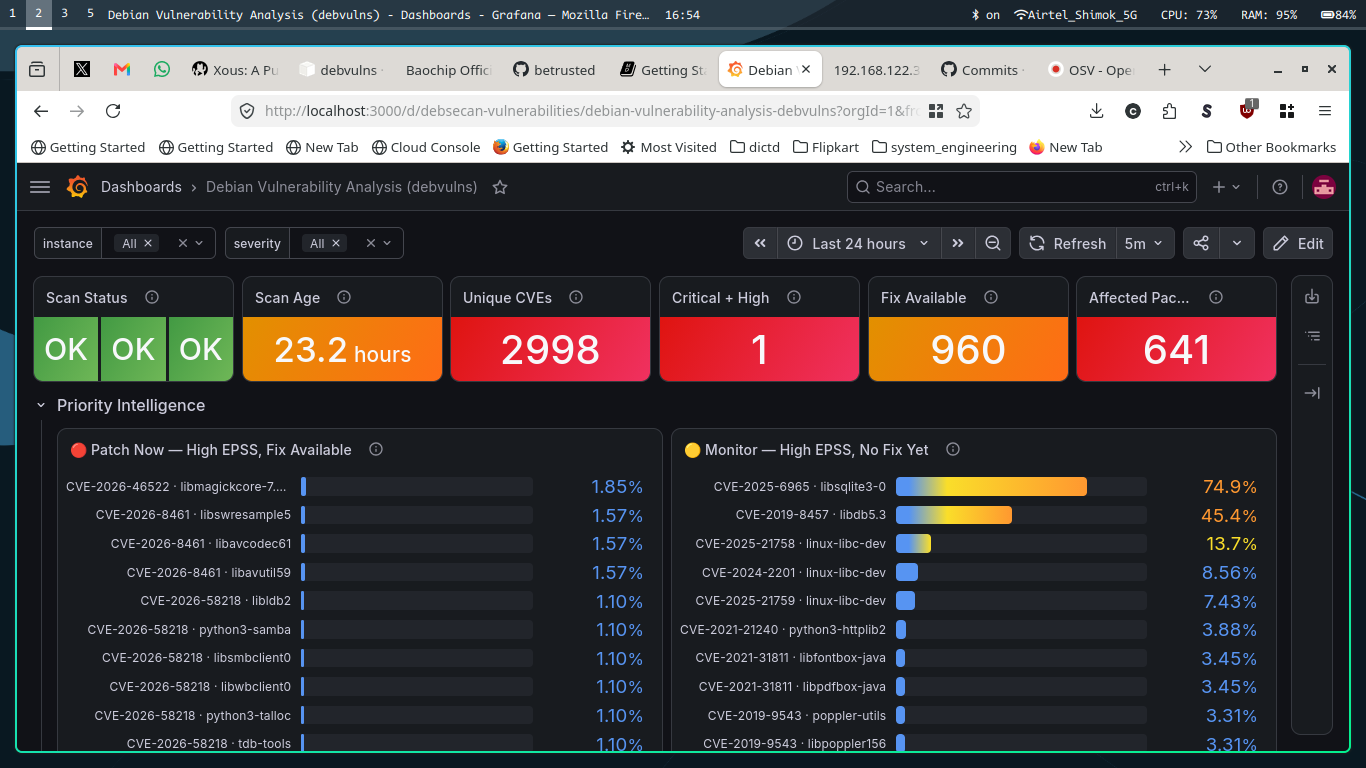
Dashboard Changes During the initial dashboard rollout, my test environment (my laptop alongside Debian 11 and Debian 12 VMs) reported a high aggregated vulnerability count. It was not immediately obvious whether these were distinct vulnerabilities or the same CVEs replicated across all three machines. This mirrors common questions raised during vulnerability reviews:
  • How many unique vulnerabilities are present across the fleet?
  • Which unique packages are affected?
The dashboard has been redesigned to surface unique vulnerability counts alongside affected package lists. The updated dashboard is shown below:
What's Next? A few planned items remain to make debvulns a comprehensive vulnerability reporting toolkit for Debian systems:
  1. Kernel Vulnerability Handling: Currently, installing a patched kernel marks the vulnerability as resolved, even if the system has not rebooted into it. The system remains exposed while the vulnerable kernel is executing in memory. Factoring in running kernel versions is crucial.
  2. Reboot and Service Restart Tracking: Similar to kernel upgrades requiring a reboot, userland library and binary fixes require running services to be restarted. This is typically detected via needrestart. Integrating this behavior directly into debvulns will provide complete visibility in a single dashboard metric.
  3. Debian Packaging: Once the above features are stable, the final step is packaging debvulns for Debian so it can be installed directly from the archive.
Until then, happy hacking.

15 August 2026

Russell Coker: AMD Video Drivers, LLMs, and Debian Kernels

The AMD GPU Problem For a while I ve been having issues with AMD GPUs, video locking up periodically. I blogged about this late last year but I first had noticeable problems early last year [1]. The problems hadn t only concerned my workstation but also my home server which is also used as a workstation. I ve recently upgraded my machines to Debian/Testing, my home server has been generally OK but my workstation has been crashing a lot. Every second day when on kernel 7.1.6 and then when on 7.1.7 it crashed at least once a day. The AMD GPUs I have are [AMD/ATI] Baffin [Radeon RX 460/560D / Pro 450/455/460/555/555X/560/560X] (rev e5) in my main desktop workstation, [AMD/ATI] Lexa [Radeon 540X/550X/630 / RX 640 / E9171 MCM] (rev c1) in my build server, and [AMD/ATI] Baffin [Radeon RX 460/560D / Pro 450/455/460/555/555X/560/560X] (rev cf) in my home server. They aren t new GPUs, but also aren t really old and they all support 4K and better resolution. Chat GPT Was Useful When I googled the errors I was seeing I found nothing useful. On the suggestion of a friend I tried asking ChatGPT. Generally I don t recommend asking LLMs about such things, but it can be a last resort as long as you know what you are doing. ChatGPT asked me to run a number of commands to get information for it to make more informed decisions. I know that the output of lspci and similar commands isn t a risk, but a novice could be tricked into running commands that expose sensitive data. ChatGPT did give me some useful information, not a solution but an indication that the problem was due to driver bugs. Upgrading to Experimental Debian/Experimental is for packages that are expected to have problems and generally aren t recommended even for the people who usually use Debian/Unstable. It s commonly used for packages that are needed to develop other packages, EG new libraries that aren t fully usable but which are needed to package newer versions of applications. I upgraded my workstation to the Debian/Experimental kernel 7.2~rc7-1~exp1 after having tried every other convenient option. Generally I wouldn t recommend that anyone run an Experimental kernel without a really good reason, but crashing more than once a day is a fairly good reason. That kernel has now given me over 4 days of uptime on a system that previously wouldn t last a day. I installed it on my dual-socket build server that has an old AMD GPU in it for test purposes and that also hasn t crashed since. I installed it on my ML test machine which has an Intel B580 Battlemage GPU with 16G of VRAM and was repeatedly getting a kernel panic related to the GPU a few seconds after boot and now it also works correctly. It seems that the 7.1.x kernels have bugs in the AMD video drivers and in some part of the code that affects Intel video drivers and that the bugs in question are fixed in the tree that will become 7.2. I would not recommend anyone who has a 7.1.x kernel working fine for them try 7.2 RC kernels at this time, but anyone who has GPU related problems (particularly Intel and AMD GPUs) should definitely test it out. I also don t recommend upgrading any system with an AMD GPU to Debian/Testing or Debian/Unstable at this time unless you are also prepared to install an Experimental kernel if it becomes necessary. There are a several kernel log dumps related to this after the break (which won t be in RSS feeds). This is mainly for Google so that other people who have such issues can get more useful results out of Google searches than I got. Future Support Options Separate from the issue of whether commercial LLMs like ChatGPT can be useful for solving technical problems there is the issue of whether they are desirable. I think that we really don t want people solving problems in FOSS systems with closed-source LLMs. This leads to loss of privacy, loss of the control users deserve to have over their own systems, and an implied promotion of non-fee software. I think that the ideal would be to have a cross distribution effort to generate training data for a support LLM system which can then be further trained by each distribution for a greater emphasis on distribution specific issues. Errors on AMD GPUs
2026-08-09T23:03:06.004792+10:00 xev kernel: amdgpu 0000:02:00.0: GPU fault detected: 147 0x00024802
2026-08-09T23:03:06.004792+10:00 xev kernel: amdgpu 0000:02:00.0: Process kscreenlocker_g pid 42037 thread kscreenloc:cs0 pid 42044
2026-08-09T23:03:06.004793+10:00 xev kernel: amdgpu 0000:02:00.0: VM_CONTEXT1_PROTECTION_FAULT_ADDR 0x00000800
2026-08-09T23:03:06.004794+10:00 xev kernel: amdgpu 0000:02:00.0: VM_CONTEXT1_PROTECTION_FAULT_STATUS 0x0F048002
2026-08-09T23:03:06.004795+10:00 xev kernel: amdgpu 0000:02:00.0: VM fault (0x02, vmid 7, pasid 130) at page 2048, write from 'TC0' (0x54433000) (72)
2026-08-09T23:03:06.008762+10:00 xev kernel: amdgpu 0000:02:00.0: GPU fault detected: 147 0x00004802
2026-08-09T23:03:06.008768+10:00 xev kernel: amdgpu 0000:02:00.0: Process kscreenlocker_g pid 42037 thread kscreenloc:cs0 pid 42044
2026-08-04T01:13:37.505839+10:00 xev kernel: ------------[ cut here ]------------ 
2026-08-04T01:13:37.505859+10:00 xev kernel: amdgpu 0000:02:00.0: [drm] drm_WARN_ON_ONCE(cur_vblank != vblank->last) 
2026-08-04T01:13:37.505862+10:00 xev kernel: WARNING: CPU: 6 PID: 210534 at drivers/gpu/drm/drm_vblank.c:362 drm_update_vblank_count+0x2f1/0x3c0 [drm] 
2026-08-04T01:13:37.505866+10:00 xev kernel: snd_intel_dspcfg wmi_bmof rc_core snd_intel_sdw_acpi drm_ttm_helper uas realtek snd_usbmidi_lib snd_hda_codec ttm mdio_devres snd_hda_core snd_seq_midi drm_kms_helper usb_storage mc snd_hwdep libphy snd_seq_midi_event intel_uncore snd_pcm_oss i2c_algo_bit serio_raw snd_rawmidi pcspkr snd_mixer_oss i2c_i801 video snd_seq snd_pcm i2c_smbus lpc_ich snd_seq_device mei_me e1000e snd_timer mei snd tpm_infineon soundcore joydev bnx2 wmi button nfsd auth_rpcgss nfs_acl lockd grace sunrpc coretemp br_netfilter bridge stp llc sg ghash_clmulni_intel loop msr i2c_dev drm efi_pstore configfs nfnetlink ip_tables x_tables autofs4 btrfs blake2b_generic dm_crypt dm_mod raid10 raid456 async_raid6_recov async_memcpy async_pq async_xor async_tx libcrc32c xor raid6_pq raid1 raid0 md_mod ext4 crc16 mbcache jbd2 crc32c_generic virtio_blk evdev hid_generic usbhid hid sd_mod xhci_pci xhci_hcd ahci ehci_pci ehci_hcd libahci crc32c_intel libata usbcore aesni_intel nvme psmouse scsi_mod gf128mul crypto_simd nvme_core cryptd 
2026-08-04T01:13:37.505879+10:00 xev kernel: nvme_auth scsi_common usb_common efivarfs 
2026-08-04T01:13:37.505880+10:00 xev kernel: CPU: 6 UID: 1008 PID: 210534 Comm: sshd-session Tainted: G D 6.12.88+deb13-amd64 #1 Debian 6.12.88-1 
2026-08-04T01:13:37.505881+10:00 xev kernel: Tainted: [D]=DIE 
2026-08-04T01:13:37.505883+10:00 xev kernel: Hardware name: Hewlett-Packard HP Z640 Workstation/212A, BIOS M60 v02.61 03/23/2023 
2026-08-04T01:13:37.505884+10:00 xev kernel: RIP: 0010:drm_update_vblank_count+0x2f1/0x3c0 [drm] 
2026-08-04T01:13:37.505885+10:00 xev kernel: Code: 48 8b 5f 50 48 85 db 75 03 48 8b 1f e8 68 eb 2b cf 48 c7 c1 70 3e cb c0 48 89 da 48 c7 c7 f9 6f cb c0 48 89 c6 e8 af d7 a6 ce <0f> 0b e9 4b fe ff ff 48 8b 4c 24 18 e9 31 fe ff ff 31 f6 48 85 db 
2026-08-04T01:13:37.505887+10:00 xev kernel: RSP: 0000:ffffd3cc8681fca0 EFLAGS: 00010082 
2026-08-04T01:13:37.505888+10:00 xev kernel: RAX: 0000000000000000 RBX: ffff8c6b42b13710 RCX: 0000000000000027 
2026-08-04T01:13:37.505889+10:00 xev kernel: RDX: ffff8c89ef521788 RSI: 0000000000000001 RDI: ffff8c89ef521780 
2026-08-04T01:13:37.505890+10:00 xev kernel: RBP: 0000000000000000 R08: 0000000000000000 R09: ffffd3cc8681fb20 
2026-08-04T01:13:37.505891+10:00 xev kernel: R10: ffff8c8a6fef3628 R11: 0000000000000003 R12: 0000000000000000 
2026-08-04T01:13:37.505892+10:00 xev kernel: R13: ffff8c6c07853828 R14: 0000000000000003 R15: 0000000000000000 
2026-08-04T01:13:37.505893+10:00 xev kernel: FS: 00007ffaf2fd5880(0000) GS:ffff8c89ef500000(0000) knlGS:0000000000000000 
2026-08-04T01:13:37.505895+10:00 xev kernel: CS: 0010 DS: 0000 ES: 0000 CR0: 0000000080050033 
2026-08-04T01:13:37.505896+10:00 xev kernel: CR2: 00007fb1718c8000 CR3: 000000074521a004 CR4: 00000000003706f0 
2026-08-04T01:13:37.505897+10:00 xev kernel: Call Trace: 
2026-08-04T01:13:37.505898+10:00 xev kernel:  
2026-08-04T01:13:37.505899+10:00 xev kernel: drm_crtc_accurate_vblank_count+0x41/0xc0 [drm] 
2026-08-04T01:13:37.505900+10:00 xev kernel: dm_pflip_high_irq+0x155/0x330 [amdgpu] 
2026-08-04T01:13:37.505901+10:00 xev kernel: amdgpu_dm_irq_handler+0x85/0x1f0 [amdgpu] 
2026-08-04T01:13:37.505902+10:00 xev kernel: amdgpu_irq_dispatch+0xd2/0x230 [amdgpu] 
2026-08-04T01:13:37.505903+10:00 xev kernel: amdgpu_ih_process+0x84/0x100 [amdgpu] 
2026-08-04T01:13:37.505904+10:00 xev kernel: amdgpu_irq_handler+0x23/0x60 [amdgpu] 
2026-08-04T01:13:37.505905+10:00 xev kernel: __handle_irq_event_percpu+0x4a/0x190
2026-08-04T01:13:37.505907+10:00 xev kernel: handle_irq_event+0x38/0x80 
2026-08-04T01:13:37.505908+10:00 xev kernel: handle_edge_irq+0x8b/0x230 
2026-08-04T01:13:37.505909+10:00 xev kernel: __common_interrupt+0x45/0xe0 
2026-08-04T01:13:37.505910+10:00 xev kernel: common_interrupt+0x42/0xa0 
2026-08-04T01:13:37.505911+10:00 xev kernel: asm_common_interrupt+0x26/0x40 
2026-08-04T01:13:37.505912+10:00 xev kernel: RIP: 0033:0x7ffaf3c5fd7b 
2026-08-04T01:13:37.505913+10:00 xev kernel: Code: 70 c7 00 66 0f 6e f8 c1 ef 02 66 0f 70 f7 e0 83 c7 01 66 0f ef ff 66 0f fa f2 0f 1f 44 00 00 f3 0f 7e 01 66 0f 6f ce 83 c6 01 <48> 83 e9 08 f2 0f 70 c0 1b 66 0f 6f e0 66 0f 6f e8 66 41 0f f9 c0 
2026-08-04T01:13:37.505915+10:00 xev kernel: RSP: 002b:00007fff86a5e0e0 EFLAGS: 00000202 
2026-08-04T01:13:37.505916+10:00 xev kernel: RAX: 0000000000008000 RBX: 0000562614a04050 RCX: 0000562614982ed8 
2026-08-04T01:13:37.505946+10:00 xev kernel: RDX: 0000000000007fe2 RSI: 0000000000000fad RDI: 0000000000002000 
2026-08-04T01:13:37.505948+10:00 xev kernel: RBP: 0000000000000000 R08: 000056261498ac40 R09: 0000000000008000 
2026-08-04T01:13:37.505949+10:00 xev kernel: R10: 0000000000000066 R11: 0000000000007fe1 R12: 0000000000007efa
2026-08-04T01:13:37.505950+10:00 xev kernel: R13: 0000000000008000 R14: 0000000000008000 R15: 000000000000ffe0 
2026-08-04T01:13:37.505951+10:00 xev kernel:  
2026-08-04T01:13:37.505953+10:00 xev kernel: ---[ end trace 0000000000000000 ]--- 
2026-08-04T01:55:40.844110+10:00 xev kernel: pcieport 0000:00:03.3: AER: Multiple Correctable error message received from 0000:00:03.3 
2026-08-04T01:55:40.844130+10:00 xev kernel: pcieport 0000:00:03.3: PCIe Bus Error: severity=Correctable, type=Data Link Layer, (Receiver ID) 
2026-08-04T01:55:40.844132+10:00 xev kernel: pcieport 0000:00:03.3: device [8086:6f0b] error status/mask=00000040/00002000 
2026-08-04T01:55:40.844134+10:00 xev kernel: pcieport 0000:00:03.3: [ 6] BadTLP
2026-08-11T09:33:33.473855+10:00 xev kernel: amdgpu 0000:02:00.0: GPU fault detected: 147 0x00024802
2026-08-11T09:33:33.473871+10:00 xev kernel: amdgpu 0000:02:00.0: Process kscreenlocker_g pid 150905 thread kscreenloc:cs0 pid 150912
2026-08-11T09:33:33.473871+10:00 xev kernel: amdgpu 0000:02:00.0: VM_CONTEXT1_PROTECTION_FAULT_ADDR 0x00000800
2026-08-11T09:33:33.473873+10:00 xev kernel: amdgpu 0000:02:00.0: VM_CONTEXT1_PROTECTION_FAULT_STATUS 0x0F048002
2026-08-11T09:33:33.473873+10:00 xev kernel: amdgpu 0000:02:00.0: VM fault (0x02, vmid 7, pasid 63) at page 2048, write from 'TC0' (0x54433000) (72)
2026-08-11T09:33:33.473874+10:00 xev kernel: amdgpu 0000:02:00.0: GPU fault detected: 147 0x00004802
2026-08-11T09:33:33.473874+10:00 xev kernel: amdgpu 0000:02:00.0: Process kscreenlocker_g pid 150905 thread kscreenloc:cs0 pid 150912
2026-08-11T09:33:33.473875+10:00 xev kernel: amdgpu 0000:02:00.0: VM_CONTEXT1_PROTECTION_FAULT_ADDR 0x00000800
2026-08-11T09:33:33.473876+10:00 xev kernel: amdgpu 0000:02:00.0: VM_CONTEXT1_PROTECTION_FAULT_STATUS 0x0E048002
2026-08-11T09:33:33.473876+10:00 xev kernel: amdgpu 0000:02:00.0: VM fault (0x02, vmid 7, pasid 63) at page 2048, read from 'TC0' (0x54433000) (72)
2026-08-11T09:33:35.481863+10:00 xev kernel: amdgpu 0000:02:00.0: Dumping IP State
2026-08-11T09:33:35.481875+10:00 xev kernel: amdgpu 0000:02:00.0: Dumping IP State Completed
2026-08-11T09:33:35.481875+10:00 xev kernel: amdgpu 0000:02:00.0: [drm] AMDGPU device coredump file has been created
2026-08-11T09:33:35.481876+10:00 xev kernel: amdgpu 0000:02:00.0: [drm] Check your /sys/class/drm/card0/device/devcoredump/data
2026-08-11T09:33:35.481877+10:00 xev kernel: amdgpu 0000:02:00.0: GPU fault detected: 146 0x0110040c
2026-08-11T09:33:35.481877+10:00 xev kernel: amdgpu 0000:02:00.0: Process kscreenlocker_g pid 150905 thread kscreenloc:cs0 pid 150912
2026-08-11T09:33:35.481878+10:00 xev kernel: amdgpu 0000:02:00.0: VM_CONTEXT1_PROTECTION_FAULT_ADDR 0x00000022
2026-08-11T09:33:35.481879+10:00 xev kernel: amdgpu 0000:02:00.0: VM_CONTEXT1_PROTECTION_FAULT_STATUS 0x0E00400C
2026-08-11T09:33:35.481879+10:00 xev kernel: amdgpu 0000:02:00.0: VM fault (0x0c, vmid 7, pasid 63) at page 34, read from 'TC3' (0x54433300) (4)
2026-08-11T09:33:35.489845+10:00 xev kernel: amdgpu 0000:02:00.0: ring gfx timeout, signaled seq=5123619, emitted seq=5123621
2026-08-11T09:33:35.489853+10:00 xev kernel: amdgpu 0000:02:00.0: Process kscreenlocker_g pid 150905 thread kscreenloc:cs0 pid 150912
2026-08-11T09:33:35.489854+10:00 xev kernel: amdgpu 0000:02:00.0: GPU reset begin!. Source: 1
2026-08-11T09:33:35.493839+10:00 xev kernel: amdgpu 0000:02:00.0: [drm] ERROR Failed to initialize parser -125!
2026-08-11T09:33:35.737848+10:00 xev kernel: amdgpu: cp is busy, skip halt cp
2026-08-11T09:33:35.897842+10:00 xev kernel: amdgpu: rlc is busy, skip halt rlc
2026-08-11T09:33:35.897852+10:00 xev kernel: amdgpu 0000:02:00.0: BACO reset
2026-08-11T09:33:36.485849+10:00 xev kernel: amdgpu 0000:02:00.0: GPU reset succeeded, trying to resume
2026-08-11T09:33:36.485859+10:00 xev kernel: amdgpu 0000:02:00.0: [drm] PCIE GART of 256M enabled (table at 0x000000F402000000).
2026-08-11T09:33:36.485860+10:00 xev kernel: amdgpu 0000:02:00.0: VRAM is lost due to GPU reset!
Errors on Battlemage
Aug 11 17:01:47 ami kernel: ------------[ cut here ]------------
Aug 11 17:01:47 ami kernel: xe 0000:23:00.0: [drm] DMC 1 mmio[0]/0x5f074 incorrect (expected 0x96fc0, current 0x0)
Aug 11 17:01:47 ami kernel: WARNING: drivers/gpu/drm/i915/display/intel_dmc.c:696 at assert_dmc_loaded+0x275/0x430 [xe], CPU#0: kworker/0:3/215
Aug 11 17:01:47 ami kernel: Modules linked in: intel_rapl_msr intel_rapl_common intel_uncore_frequency intel_uncore_frequency_common xe(+) skx_edac snd_h>
Aug 11 17:01:47 ami kernel:  msr i2c_dev configfs efi_pstore efivarfs autofs4 btrfs libblake2b raid6_pq xor mpt3sas raid_class scsi_transport_sas megarai>
Aug 11 17:01:47 ami kernel: CPU: 0 UID: 0 PID: 215 Comm: kworker/0:3 Not tainted 7.1.7+deb14-amd64 #1 PREEMPT(lazy)  Debian 7.1.7-1 
Aug 11 17:01:47 ami kernel: Hardware name: HP HP Z4 G4 Workstation/81C5, BIOS P61 v03.00 04/15/2026
Aug 11 17:01:47 ami kernel: Workqueue: sync_wq local_pci_probe_callback
Aug 11 17:01:47 ami kernel: RIP: 0010:assert_dmc_loaded+0x291/0x430 [xe]
Aug 11 17:01:47 ami kernel: Code: 24 10 e8 f2 e5 a3 ce 48 8d 3d bb 85 0d 00 8b 54 24 0c 45 89 e9 45 89 e0 48 89 c6 52 8b 4c 24 2c 51 8b 4c 24 30 48 8b 54>
Aug 11 17:01:47 ami kernel: RSP: 0018:ffffd27ac0b87b80 EFLAGS: 00010282
Aug 11 17:01:47 ami kernel: RAX: ffffffffc1743dfd RBX: ffff8c5b80e54000 RCX: 0000000000000001
Aug 11 17:01:47 ami kernel: RDX: ffff8c5b81df5a10 RSI: ffffffffc1743dfd RDI: ffffffffc1605860
Aug 11 17:01:47 ami kernel: RBP: ffff8c5b86955000 R08: 0000000000000000 R09: 000000000005f074
Aug 11 17:01:47 ami kernel: R10: 0000000000000000 R11: 0000000000091050 R12: 0000000000000000
Aug 11 17:01:47 ami kernel: R13: 000000000005f074 R14: 0000000000000001 R15: 0000000000000000
Aug 11 17:01:47 ami kernel: FS:  0000000000000000(0000) GS:ffff8c673e172000(0000) knlGS:0000000000000000
Aug 11 17:01:47 ami kernel: CS:  0010 DS: 0000 ES: 0000 CR0: 0000000080050033
Aug 11 17:01:47 ami kernel: CR2: 00007ffed1fdcd00 CR3: 0000000ae942a003 CR4: 00000000003706f0
Aug 11 17:01:47 ami kernel: Call Trace:
Aug 11 17:01:47 ami kernel:  
Aug 11 17:01:47 ami kernel:  intel_dmc_enable_pipe+0xe4/0x290 [xe]
Aug 11 17:01:47 ami kernel:  ? drm_crtc_vblank_reset+0x4d/0x120 [drm]
Aug 11 17:01:47 ami kernel:  intel_modeset_setup_hw_state+0xb50/0x1e10 [xe]
Aug 11 17:01:47 ami kernel:  ? intel_display_driver_probe_nogem+0x138/0x1a0 [xe]
Aug 11 17:01:47 ami kernel:  intel_display_driver_probe_nogem+0x138/0x1a0 [xe]
Aug 11 17:01:47 ami kernel:  xe_display_init_early+0xb2/0x140 [xe]
Aug 11 17:01:47 ami kernel:  xe_device_probe+0x3c8/0xb50 [xe]
Aug 11 17:01:47 ami kernel:  ? xe_pm_init_early+0x152/0x160 [xe]
Aug 11 17:01:47 ami kernel:  xe_pci_probe+0xc26/0x1150 [xe]
Aug 11 17:01:47 ami kernel:  local_pci_probe+0x3e/0x90
Aug 11 17:01:47 ami kernel:  local_pci_probe_callback+0x16/0x20
Aug 11 17:01:47 ami kernel:  process_one_work+0x19d/0x3a0
Aug 11 17:01:47 ami kernel:  worker_thread+0x1af/0x320
Aug 11 17:01:47 ami kernel:  ? __pfx_worker_thread+0x10/0x10
Aug 11 17:01:47 ami kernel:  kthread+0xe3/0x120
Aug 11 17:01:47 ami kernel:  ? __pfx_kthread+0x10/0x10
Aug 11 17:01:47 ami kernel:  ret_from_fork+0x2b2/0x340
Aug 11 17:01:47 ami kernel:  ? __pfx_kthread+0x10/0x10
Aug 11 17:01:47 ami kernel:  ret_from_fork_asm+0x1a/0x30
Aug 11 17:01:47 ami kernel:  
Aug 11 17:01:47 ami kernel: ---[ end trace 0000000000000000 ]---

12 August 2026

Reproducible Builds: Reproducible Builds summit 2026 to take place in Gothenburg

This event is happening soon see below for registration instructions!

We are extremely pleased to announce the upcoming Reproducible Builds summit, which will take place from September 22nd 24th 2026 in the city of Gothenburg, Sweden. This year, we are thrilled to host the tenth edition of this exciting event, following the success of previous summits in various iconic locations around the world, including Vienna (2025), Hamburg (2023 2024), Venice (2022), Marrakesh (2019), Paris (2018), Berlin (2017), Berlin (2016) and Athens (2015). If you re excited about joining us this year, please make sure to read the event page which has more details about the event and location. As in previous years, we will be sending invitations to all those who attended our previous summit events or expressed interest to do so. However, even if you do not receive a personal invitation, please do email the organizers and we will find a way to accommodate you.

About the event The Reproducible Builds Summit is a unique gathering that brings together attendees from diverse projects, united by a shared vision of advancing the Reproducible Builds effort. During this enriching event, participants will have the opportunity to engage in discussions, establish connections and exchange ideas to drive progress in this vital field. Our aim is to create an inclusive space that fosters collaboration, innovation and problem-solving.

Schedule Although the exact content of the meeting will be shaped by the participants, the main goals will include:
  • Update & exchange about the status of reproducible builds in various projects.
  • Improve collaboration both between and inside projects.
  • Expand the scope and reach of reproducible builds to more projects.
  • Work together and hack on solutions.
  • Establish space for more strategic and long-term thinking than is possible in virtual channels.
  • Brainstorm designs on tools enabling users to get the most benefits from reproducible builds.
  • Discuss how reproducible builds will be usable and meaningful to users and developers alike.
Logs and minutes will be published after the meeting.

Location & date

Registration instructions Please reach out if you d like to participate in hopefully interesting, inspiring and intense technical sessions about reproducible builds and beyond! We look forward to what we anticipate to be yet another extraordinary event!

11 August 2026

Freexian Collaborators: Debian Contributions: DebConf 26 organization, d-i VLAN support and more! (by Anupa Ann Joseph)

Debian Contributions: 2026-07 Contributing to Debian is part of Freexian s mission. This article covers the latest achievements of Freexian and their collaborators. All of this is made possible by organizations subscribing to our Long Term Support contracts and consulting services.

DebConf 26 organization, by Lucas Kanashiro, Santiago Ruano Rinc n, Stefano Rivera and Antonio Terceiro The 27th Annual Debian Conference was held in Santa Fe, Argentina, and several Freexian fellows were quite busy by being involved in the organization team.
  • Santiago continued helping with duties related to the local team, e.g. preparing or proof-reading some announcements, reviewing the proposed food and the menus for the different diet required.
  • During the conference, Kanashiro and Santiago also carried over tasks related to the content of the conference, including updating the schedule as it became necessary during the event.
  • Stefano worked within the core video team, setting up equipment in talk rooms and coordinating the live video streaming. Stefano also supported the front desk and local organisers as a website developer and conference book-keeper.
  • Antonio kept working on website maintenance, specially in support of the content team. During DebConf he also ran a hands-on workshop to help interested contributors get started with developing the DebConf websites.

d-i VLAN support, by Colin Watson In environments that use IEEE 802.1Q VLANs, some hosts (such as routers attached to trunk ports) may need to apply VLAN tags themselves rather than relying on switches to do so. There has been a long-running request to add support for these to the Debian installer with a proposed patch set put together by several people over the years, and a Freexian customer asked us to help get this over the line. Colin reviewed the latest version of the patch set, applied a number of corrections, added Netplan support, spent some time testing a variety of possible paths through the installer, and landed this. There s also now documentation for this in the next version of the installation guide.

Miscellaneous contributions
  • Carles wrote documentation for installing Mailman3 and migrating from Mailman2. Added it into Mailman3 upstream documentation.
  • Carles, using po-debconf-manager: reviewed 2 packages, submitted 2 packages
  • Carles organized Catalan translation update. Created a Debian Wiki page to have an overview of the work / coordination during next months. Reviewed and submitted some pages.
  • Carles improved the documentation for building the debian.org Web in MR 1154 and MR 1557. Fixed debian-reference documentation. Added sections on Mutt Wiki page (handling of mailto, viewing HTML parts web browser), update and improve bash-completion Wiki page. Added a troubleshooting section in Signal Wiki.
  • Thorsten did another upload of hplip to fix RC bugs. He also spent some time taking care of older bugs. Most of the time such bugs had been fixed in a previous upload but haven t been closed in the BTS. He also uploaded a new upstream version of foomatic-db. Last but not least, he gave some user support with the package epson-inkjet-printer-escpr. There seems to be a new software available for Epson printers. Unfortunately the license is not compatible with DFSG and so this software will never make it into Debian.
  • During DebCamp 26, the Golang team had a dedicated Sprint to transition the Golang toolchain (namely on dh-golang) to make builds aware of the module defined upstream with the aim of solving important issues. To help in these efforts, Santiago made changes in the Salsa CI pipeline and documented on how to use it to check if a package requires adjustments after the toolchain update.
  • Santiago continued co-mentoring Aryan Karamtoth on the Linux livepatching project, specifically providing feedback about the implementation of dlp-tools.
  • Stefano reviewed and merged a migration of Debian reimbursements from wkhtmltopdf to weasyprint, unblocking an upgrade to Debian trixie.
  • Stefano s cPython upstream merge request adding multiarch tags to stable ABI extensions was finally merged.
  • Stefano iterated on his upstream cPython merge request to add CI coverage for Debian s multi-arch expectations.
  • Stefano uploaded Python 3.15.0 beta 4 to Debian experimental.
  • Stefano uploaded Python 3.13 to trixie, fixing a regression in a previous trixie point update he made.
  • Helmut continued to report undeclared file conflicts.
  • Helmut sent patches for three cross build failures.
  • Helmut proposed a MR to port piuparts to pathlib.
  • Antonio has done quite some work on Debian CI, including rebuilding the Debian CI armhf/armel worker VMs, and releasing debci 4.2, implementing a backup scheme, and several improvements to the codebase such as improving the incus-lxc backend in preparation for switching to the upcoming switch to using it by default as announced in the latest bits from the ci.debian.net operators.
  • Emilio helped with transitions, particularly with Python 3.14 as default and Perl 5.42. During the Perl transition, an issue was identified with how britney schedules autopkgtests for binNMUs, and that testing was reverted for the time being.
  • Colin restructured openssh-* binary packages to better support the upcoming GSS-API package split. This caused several autopkgtest regressions in other packages because openssh-server no longer depends on openssh-client, all of which have fixes either pending review or merged now.
  • Lucas started a discussion around the creation of a Debian packaging video course for newcomers in the context of the Outreach team.
  • Lucas reviewed some contributions to ruby3.4 and provided feedback.
  • Anupa worked with Jean-Pierre Giraud on the point release announcements for Debian 13.6 and Debian 12.15.
  • Anupa joined Jean-Pierre Giraud to prepare the Micronews for DebConf 26 press coverage.

10 August 2026

Bits from Debian: DebConf26 Local Team says goodbye

On Saturday 25 July 2026, the annual Debian Developers and Contributors Conference came to a close. The Debian Press team would now like to share this personal and beautiful message from the Santa Fe Local Team. Words from DC26 Local Team DebConf26 is over, and those of us who were part of the Local Team are trying to return to normality , if such a thing exists after organizing a DebConf. This event changed our lives and would not have been possible without the help of many great people. We would especially like to thank everyone who became part of our extended local team. Our endless thanks go to Gunnar who also instigated this whole adventure , Santiago, Nattie, Stefano, and Olasd. Thank you for supporting and guiding us, sharing your experience, and helping us find solutions throughout the entire process. It was also made possible thanks to the great work, strong support and patience of international teams: Fundraising, Bursaries, Content, Video, Treasury, Visa, Website, Accommodation, Front Desk, Cheese and Wine, Publicity as well as all the other teams and individuals who contributed. We apologize if we have forgotten to mention anyone; many people helped make this event possible. Our deepest thanks also go to everyone who joined us in working on the event, especially Fer, Jos , and Juli n, who showed great commitment and took responsibility for several important tasks. We would also like to extend our gratitude to FICH, the Universidad Nacional del Litoral, the institutions, organizations, sponsors, suppliers, and everyone who contributed in one way or another to welcoming the Debian community to Santa Fe. And finally, a very special thank you to our families, to whom we dedicated little time these past few weeks, who supported us on this adventure, enduring the exhaustion, the calls and messages at all hours, and the occasional stressful situation. Always giving us that much-needed, encouraging hug with so much love. These were very intense weeks, during which we tried to give our best so that everyone could enjoy their stay and so that the Debian community had the necessary conditions to meet, work, share knowledge, and continue creating the magic that characterizes community life and the development of Debian. As happens at every DebConf, there were difficulties, unexpected situations, and challenges that required us to improvise, learn, and perform a few juggling acts. There were also moments that will certainly remain as memorable anecdotes: the antisocial room , some gas heaters worthy of a museum, and newly unlocked powers for negotiating with suppliers. We have no evidence, but also no doubt, that for many people the Conference Dinner was one of the best moments of the event. A few ingredients we had hoped would happen naturally were missing, such as more wine nights and at least one in-person football match. During the two weeks of DebConf, we experienced every kind of weather and a wide range of emotions. Above all, however, we saw people enjoying themselves and building friendships, which fills us with pride. Thank you very much to everyone who came and helped DebConf26 leave such a beautiful mark on our hearts. We hope our paths cross again somewhere in life. Best regards, Leonardo, Emmanuel, Mariano, Pablo, and Mart n DebConf26 Local Team About Debian The Debian Project was founded in 1993 by Ian Murdock to be a truly free community project. Since then the project has grown to be one of the largest and most influential Open Source projects. Thousands of volunteers from all over the world work together to create and maintain Debian software. Available in 70 languages, and supporting a huge range of computer types, Debian calls itself the universal operating system. About DebConf DebConf is the Debian Project's developer conference. In addition to a full schedule of technical, social and policy talks, DebConf provides an opportunity for developers, contributors and other interested people to meet in person and work together more closely. It has taken place annually since 2000 in locations as varied as Scotland, Bosnia and Herzegovina, India, Korea, France. More information about DebConf is available from https://debconf.org/. Contact Information For further information, please visit the DebConf26 web page at https://debconf26.debconf.org/ or send mail to press@debian.org.

9 August 2026

Reproducible Builds: Reproducible Builds in July 2026

Welcome to the July 2026 report from the Reproducible Builds project! In our reports, we try to outline the most important things that we have been up to over the past month. As a quick recap about what problem our project intends to solve, whilst anyone may inspect the source code of free software for malicious flaws, almost all software is distributed to end users as pre-compiled binaries. The motivation behind the reproducible builds effort is to ensure no flaws have been introduced during this compilation process by promising identical results are always generated from a given source, thus allowing multiple third-parties to come to a consensus on whether a build was compromised or not. If you are interested in contributing to the project, please visit the Contribute page on our website. In this month s report, we cover:

  1. Tool development
  2. Distribution work
  3. Three new scholarly papers
  4. Patches
  5. Misc news

Tool development diffoscope is our in-depth and content-aware diff utility that can locate and diagnose reproducibility issues. This month, Chris Lamb made the following changes, including preparing and uploading versions 324, 325 and 326 to Debian:
  • Fix tests to work with zipdetails 4.0008. (#1141359)
  • Bump debhelper compatibility level to 13. [ ]
  • Update copyright years. [ ]
In addition, Paul Spooren made changes to allow trailing garbage in Gzip files [ ] and Vagrant Cascadian added an external tool reference for the pedump binary to use the mono package under GNU Guix. [ ]
disorderfs is our FUSE-based filesystem that deliberately introduces non-determinism into system calls to reliably flush out reproducibility issues. This month, Christelle Gloor added the option to sort by ctime as returned by the lstat(2) syscall. [ ], which Chris Lamb uploaded whilst bumping the Standards-Version to version 4.7.4 [ ]. Bernhard Wiedemann also updated disorderfs to version 0.7.0 in openSUSE.
Yet again, there were a number of improvements made to our website this month as well. For example, Chris Lamb, by request of Digital Ocean, changed the target of a referral link so that they can manage incoming referrers [ ] and pushed a number of changes to the Tools page [ ].

Distribution work In Debian this month, 32 reviews of Debian packages were added, 26 were updated and a total of 21 were removed this month, adding to our extensive knowledge about identified issues. A number of issue types were added by Chris Lamb, including:
  • python_towncrier_build_date [ ][ ]
  • log_files_installed_in_package [ ]
  • fontforge_varies_by_timezone [ ][ ]
Chris also added a further note for the build_date_in_manpage_generated_by_spf13_cobra issue. [ ]
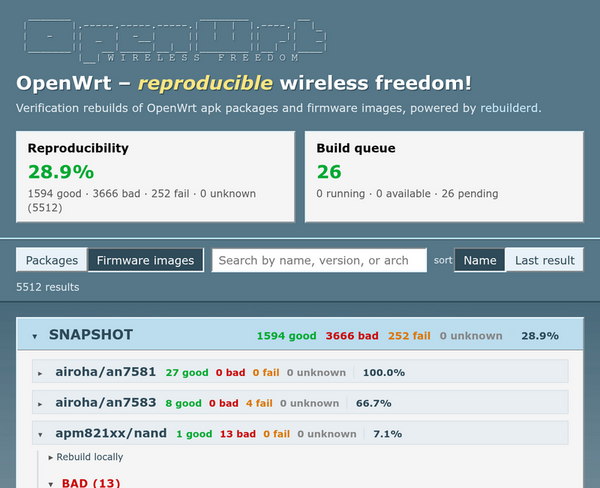
In addition, there is a new page showing verification rebuilds of OpenWrt APK packages and firmware images, powered by rebuilderd:

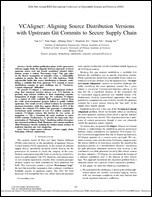
Three new scholarly papers Yan Li, Nan Jiang, Qihang Zhou, Shaowen Xu, Yamin Xie and Xiaoqi Jia of the Chinese Academy of Sciences published a paper titled VCAligner: Aligning Source Distribution Versions with Upstream Git Commits to Secure Supply Chain:
We present VCAligner, a content-based alignment methodology that constructs inverted indexes over VCS histories to precisely map released artifacts to their originating commits, independent of fragile version tags. We evaluated VCAligner on a dataset of 2,984 verifiable PyPI packages derived from the 4,000 most-downloaded projects linked to public GitHub upstreams. Our results reveal a critical weakness in conventional tag-based heuristics: while they appear effective on 85% of the dataset, the residual 15% failure rate generates a catastrophic downstream audit workload of over 10.3 million commits. In contrast, VCAligner reduces this burden by two orders of magnitude ( 158 ), bounding the total workload to under 65,000 commits. Furthermore, we provide the large-scale characterization of Packaging Noise, classifying artifact divergence into structural additions (Path Phantoms) and content mutations (Blob Phantoms), thereby isolating the distinct attack surfaces of malicious injection and code tampering.

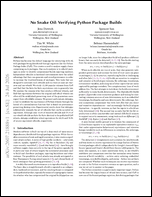
Jens Dietrich and Spencer Sun from the Victoria University of Wellington together with Tim W. White and Behnaz Hassanshahi from Oracle Inc pre-published their paper No Snake Oil: Verifying Python Package Builds (PDF):
Python has become the default language for interacting with AI, with packages being distributed through registries like the Python Package Index (PyPI). This creates a need to analyse supply chains comprising such packages. One such analysis is to rebuild packages in order to identify compromised builds injecting malware. Independent rebuilds in hardened environments have the added advantage that they can generate and record provenance in order to increase the trustworthiness of packages. Two tools that are designed to automate such rebuilds and run them at scale are macaron and oss-rebuild. We study 12,180 popular releases from PyPI and find that the byte-for-byte equivalence rate is generally low. We analyse the reasons why they produce different wheels, and find that equivalence between the original and rebuilt wheels can often still be established, preserving most of the guarantees users expect from rebuildable releases. We present and evaluate daleq4py, a tool to establish the equivalence of Python wheels through the kernel of a normalisation function that is based on provenance-preserving datalog rules. Experimental results show that daleq4py substantially expands the set of rebuilds that can be accepted as equivalent. Although only 15.4% of macaron rebuilds and 19.1% of oss-rebuild rebuilds are byte-for-byte identical to the published PyPI wheels, daleq4py establishes wheel equivalence for 60.2% and 78.9% of source-equivalent rebuilds, respectively.

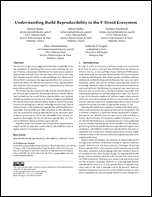
Denise Nanni, Julien Malka, Stefano Zacchiroli and Th o Zimmermann from T l com Paris together with Gabriele D Angelo from the University of Bologna pre-published their paper Understanding Build Reproducibility in the F-Droid Ecosystem (PDF), which was accepted at the 2026 ACM Conference on Reproducibility and Replicability:
The security of open source applications benefits considerably from the possibility of rebuilding their source and verifying the output. F-Droid, a prominent distribution for open source Android applications, systematically rebuilds them from source and tests their bitwise reproducibility at app publishing time. However, F-Droid offers no guarantee that app reproducibility will continue to hold in the future. As software ecosystems evolve, reproducibility may degrade, with potential negative consequences for software preservation and security. We present the first empirical study of build reproducibility in the F-Droid app ecosystem. Analyzing historical reproducibility logs, we find that the overall bitwise reproducibility rate has been steadily increasing over time (as new versions of apps are published). We then evaluate how reproducibility holds in time for fixed app versions, by attempting to rebuild 18 904 app versions that F-Droid had previously confirmed bitwise reproducible, published between September 2018 and February 2026, achieving an 83% rebuild success rate, and identify missing dependencies as the dominant cause of failure, accounting for 76% of non-rebuildable cases. Among successfully rebuilt apps, 94% are also bitwise reproducible-i.e., they still yield bitwise identical artifacts upon rebuild. Together, these results show that while bitwise reproducibility largely holds for apps that can be rebuilt, rebuildability itself is highly sensitive to temporal decay.

Patches The Reproducible Builds project detects, dissects and attempts to fix as many currently-unreproducible packages as possible. We endeavour to send all of our patches upstream where applicable or possible. This month, we wrote a large number of such patches, including:

Misc news On our mailing list this month, Colin Winter of Markovian Protocol wrote to our mailing list on the topic of Reproducible verification for retained logs:
Reproducible builds remove trust in the builder: anyone re-derives the same artifact from the same source, byte for byte. The same shape applies one layer over, to a retained record. Most record-keeping regimes (the EU AI Act s Article 12 logging is the current example) require that events be recorded and logs retained, but not that a retained log be verifiable, by a party who was not present, as unaltered and existing when claimed. That leaves an integrity obligation resting on trusting the party being audited.
(Full thread)

Finally, if you are interested in contributing to the Reproducible Builds project, please visit our Contribute page on our website. However, you can get in touch with us via:

6 August 2026

Bits from Debian: DebConf26 closes in Santa Fe and DebConf27 announced

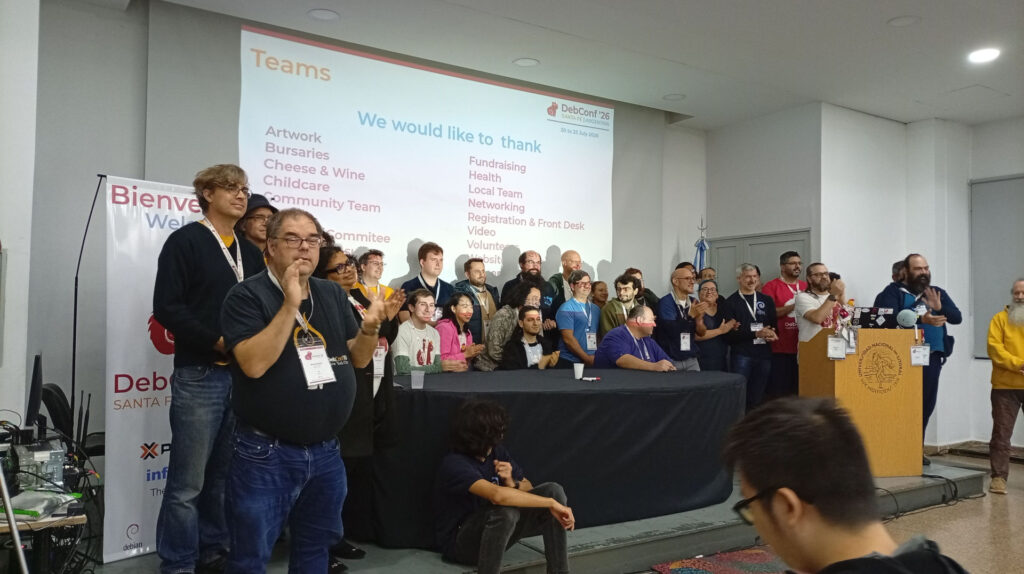
DebConf26 group photo - click to enlarge On Saturday 25 July 2026, the annual Debian Developers and Contributors Conference came to a close. Over 270 attendees representing 35 countries from around the world came together for a combined 90 events (including some which took place during the DebCamp) including more than 27 Talks, 21 Short Talks, 29 Birds of a Feather sessions ("BoF" informal meeting between developers and users), 8 workshops, and activities in support of furthering our distribution and free software, learning from our mentors and peers, building our community, and having a bit of fun. The conference was preceded by the annual DebCamp hacking session held 13 through 19 July where Debian Developers and Contributors convened to focus on their individual Debian-related projects or work in team sprints geared toward in-person collaboration in developing Debian. As has been the case for several years, a special effort has been made to welcome newcomers and help them become familiar with Debian and DebConf by organizing a sprint "New Contributors Onboarding" every day of Debcamp, followed more informally by mentorship during DebConf. Half a dozen new contributors joined the sessions and learned about Debian, free software, packaging and much more. This year, a week-long DebCamp session was dedicated to auditing, patching, and modernizing the Go ecosystem in Debian and enable the transition triggered by the recent upload of dh-golang enabling GO111MODULE=on by default in Experimental. In order to make the conference more accessible for local participants, a local language track was included in the schedule for talks in Spanish, as was done at DebConf19 in Brazil. The actual Debian Developers Conference started on Monday 20 July 2026. In addition to the traditional "Bits from the DPL" talk, the continuous key-signing party, lightning talks, and the announcement of next year's DebConf27, there were several update sessions shared by internal projects and teams. Many of the hosted discussion sessions were presented by our technical core teams with the usual and useful "Meet the Technical Committee", three talks about Linux Kernel, early boot and improving Debian s kernel and installer support for Chromebooks, and about twenty BoFs and talks about Debian packaging policy, Debian infrastructure, security and privacy. This year, and echoing ongoing discussions within the Free Software community, Artificial Intelligence and Age Verification have been the subject of several talks. The Python, Perl, Ruby, Go, and Rust programming language teams also shared updates on their work and efforts. More than 17 BoFs and talks about community, diversity, and local outreach highlighted the work of various teams involved in not just the technical but also the social aspect of our community The schedule was updated each day with planned and ad hoc activities introduced by attendees over the course of the conference. Several traditional activities took place: a poetry performance, the traditional Cheese and Wine party, the Group Photos, and the Day Trip. For those who were not able to attend, most of the talks and sessions were broadcasted live and recorded. One can find the seventy hours of recorded videos available via the conference schedule, or alternatively through this link. Almost all of the sessions facilitated remote participation via IRC and Matrix messaging apps or online collaborative text documents which allowed remote attendees to "be in the room" and ask questions or share comments with the speaker or assembled audience. DebConf26 saw over 341 T-shirts, a day trip, and up to 130 meals planned per day. All of these events, activities, conversations, and streams coupled with our love, interest, and participation in Debian and F/OSS certainly made this conference an overall success both here in Santa Fe, Argentina and online around the world. The DebConf26 website will remain active for archival purposes and will continue to offer links to the presentations and videos of talks and events. Next year, DebConf27 will be held in Asahikawa, Hokkaido, Japan, from Sunday September 5th to Saturday September 11th, 2027. As tradition follows before the next DebConf the local organizers in Japan will start the conference activities with DebCamp with a particular focus on individual and team work towards improving the distribution. DebConf is committed to a safe and welcome environment for all participants. See the web page about the Code of Conduct on the DebConf26 website for more details on this. Debian thanks the commitment of numerous sponsors to support DebConf26, particularly our Platinum Sponsors: Infomaniak, and Proxmox, and our Gold Sponsors : Freexian, and Viridien. We also wish to thank our Video and Infrastructure teams, the DebConf26 and DebConf committees, our host nation of Argentina, and each and every person who helped contribute to this event and to Debian overall. Thank you all for your work in helping Debian continue to be "The Universal Operating System". See you next year! About Debian The Debian Project was founded in 1993 by Ian Murdock to be a truly free community project. Since then the project has grown to be one of the largest and most influential Open Source projects. Thousands of volunteers from all over the world work together to create and maintain Debian software. Available in 70 languages, and supporting a huge range of computer types, Debian calls itself the universal operating system. About DebConf DebConf is the Debian Project's developer conference. In addition to a full schedule of technical, social and policy talks, DebConf provides an opportunity for developers, contributors and other interested people to meet in person and work together more closely. It has taken place annually since 2000 in locations as varied as Scotland, Bosnia and Herzegovina, India, Korea, France. More information about DebConf is available from https://debconf.org/. About Infomaniak Infomaniak is an independent, employee-owned Swiss technology company that designs, develops, and operates its own cloud infrastructure and digital services entirely in Switzerland. With over 300 employees more than 70% engineers and developers the company reinvests all profits into R&D. Its public cloud is built on OpenStack, with managed Kubernetes, Database as a Service, object storage, and sovereign AI services accessible via OpenAI-compatible APIs, all running on its own Swiss infrastructure. Infomaniak also develops a sovereign collaborative suite messaging, email, storage, online office tools, videoconferencing, and a built-in AI assistant developed in-house and as a privacy-respecting solution to proprietary platforms. Open source is central to how Infomaniak operates. Its latest data center (D4) runs on 100% renewable energy and uses no traditional cooling: all the heat generated by its servers is captured and fed into Geneva's district heating network, supplying up to 6,000 homes in winter and hot water year-round. The entire project has been documented and open-sourced at d4project.org. About Proxmox Proxmox develops powerful, yet easy-to-use open-source server solutions. The comprehensive open-source ecosystem is designed to manage divers IT landscapes, from single servers to large-scale distributed data centers. Our unified platform integrates server virtualization, easy backup, and rock-solid email security ensuring seamless interoperability across the entire portfolio. With the Proxmox Datacenter Manager, the ecosystem also offers a "single pane of glass" for centralized management across different locations. Since 2005, all Proxmox solutions have been built on the rock-solid Debian platform. We are proud to return to DebConf26 as a sponsor because the Debian community provides the foundation that makes our work possible. We believe in keeping IT simple, open, and under your control. Contact Information For further information, please visit the DebConf26 web page at https://debconf26.debconf.org/ or send mail to press@debian.org.

Russell Coker: TV Control etc

In 2008 I wrote a blog post The Problem is Too Many Remote Controls [1] about the issues of controlling a TV and related things. It recently got some comments on Mastodon so I think it s time for an update. The first issue I raised was Now it s not uncommon to have separate remote controls for the TV, VCR, DVD player, and the Cable TV box a total of four remote controls which seems to have alleviated. VCRs seem to have almost entirely gone away. The VHS Wikipedia page [2] is worth reading for everyone who hasn t seen a VCR in operation, which I expect to be more than a few readers now and an increasing number over the next 18 years. I personally don t have Cable TV, I own a DVD player which isn t connected to my TV because I haven t used it for years, I don t own a VCR, and I don t watch free to air TV. So I have one remote control for the TV which I use for Netflix and sometimes YouTube. When viewing YouTube on TV there are significantly more adverts and longer adverts. I presume that is because installing an ad-blocker on my TV isn t a viable option for me and it s a total impossibility for most users. Generally my desktop PC is a much better platform for YouTube than my TV, it has a better quality display, is more user friendly (my previous post addressed the difficulty of getting to the data source that s desired), and doesn t require entering search terms via a slow on-screen keyboard. Netflix on Linux is limited to 720p at low bitrate which is obviously of low visual quality while on the TV it s in 4K. I have Netflix so I use that only on the TV. In my previous post I wrote a thought experiment on how to use a cheap laptop ($500 at the time equivalent to $777 in 2025 money according to the Reserve Bank of Australia) to control a $5000 TV ($7770 in 2025 money). Now you can buy a new 65 4K TV for under $800 and a new laptop capable of 4K output for under $400 so the options are very different. For a $800 TV the manufacturer isn t going to develop a remote control interface and Google (who develops the software the TVs run) won t do it because it could reduce their advertising revenue. But a typical home user could setup a cheap laptop connected to their TV via HDMI providing a familiar and efficient user interface for themselves and visitors. For a Windows laptop 4K Netflix should work and for a Linux laptop the options of a laptop for everything apart from Netflix and the TV for Netflix are bearable, two controls are worse than one but better than the 3+ that used to be common. In my previous post I raised the issue that it s often the case that you don t want to stop watching one show while trying to find another . This is still an unsolved problem and is not addressed in modern software. I am not aware of a Linux music player that supports such functionality and this would be much easier for a music player than for a video player where the screen would have to be shared between the interface for finding the next thing to play and the space for playing the end of the current one. Maybe I should file a bunch of wishlist bugs against music players asking for this. I suggested that cable modem and cable TV box could be integrated into a single device. That has not happened, in fact it s got worse. A relative who has Foxtel has a cable modem, a cable TV box, and a Wifi AP with VOIP to provide landline phone service and to make it more exciting the latter two both have bugs that require a periodic hardware reset to fix. Hopefully cable TV will go away in the next 18 years. Regular PCs have become less noisy in recent years. I am currently using a HP Z640 to write this post and I have HP Z840 and HP Z4G4 systems behind me running as servers and the background noise is still very low. The allegedly 8K TV [3] that I have in my lounge room has cooling fans that make more noise than those three high-end HP computers combined. Using a quiet PC like one of those HP systems to drive a TV is a very viable option and I did just that for a couple of years. Kogan has currently got a selection of refurbished Lenovo ThinkStation systems on sale for under $400, they are quiet and would do well for this, it s also nice that Kogan is selling systems with ECC RAM at home user prices. TV does seem to be going away. YouTube and streaming services seem to get more watching time and many people don t use TV at all. Since my previous post the number of streaming services has increased so torrenting offers increasing benefits as no-one wants to subscribe to 6+ services. For anyone who wants to get all the content that interests them while paying the user interface situation is much worse now than it used to be in 2008. If you use KDE on a PC then the kconnect program allows a phone to be used to remotely control some aspects of a PC and has a good interface for pause/resume of a video and seeking 10 seconds forwards/backwards. The interface for controlling volume is hard to get to and doesn t work on my installation. If you want to use a keyboard to start something playing and then a phone for pause control then kdeconnect is a decent option. A comment on my previous post by Michael Croes raised the issue of remote control which is now a solvable problem. Justin also wrote a comment suggesting a Nokia N800 as a remote. Jason suggested a programmable remote, which would be a good option for a power user and a viable option for someone setting things up for their grandparents. But the amount of pain is greater than I m interested in as lounge room TV isn t an important thing to me. It may appeal to more people than having a dedicated lounge room PC though.

4 August 2026

Russell Coker: Monitors for Work

The Corporate Monitor Issue Some time ago I worked in the IT department of a company that had a corporate standard of two 27 FUllHD (either 1920*1080 or 1920*1200) monitors for the desktop. I was pushing to make the standard be one 32 4K monitor or the two cheaper monitors. They ended up making one 27 4K monitor an option which was still a better option for many users than two FullHD monitors due to having twice the pixels even though it had half the screen area. It was a surprise to me when hardly anyone took up that option. One man who worked there brought a wide curved monitor from home and ran with one of the FullHD monitors on each side of that. As an employee in the IT department I had concerns about expensive personal equipment being used in the office regarding who s going to pay the bill if it gets broken. But I was assured that it was his old monitor that he didn t need after buying a better one for gaming at home and he wouldn t be too upset if something happened to it. This isn t the only time I ve witnessed such problems of companies paying large salaries for skilled people and providing poor equipment for them to do the work. One previous time I raised a OH&S issue because the outdated monitors were so blurry but the company determined that the monitors wouldn t cause health problems and spending $150 per employee on better replacements was a waste of money. Computer hardware tends to become cheaper over time and one thing that has become really cheap recently is portable monitors. Kogan has a 15.6 FullHD monitor with USB-C and mini-HDMI inputs for $89 [1]. It wouldn t be difficult for someone to put one of those on each side of the monitor or monitors that their employer provides and put them in a desk drawer at the end of the day to minimise risk. The same Kogan page has a 16 monitor with 2560*1600 resolution for $189. Company Ownership I previously wrote about the potential benefits to companies in not owning all those keyboards, mice, and headsets when they could just give each employee the money and have them buy their own [2]. I don t think we are at the stage where that can be applied to monitors as the cheapest price for a decent monitor is about $500 which takes it out of the disposable price range that keyboards and mice are in. Also from an IT support perspective there are real support issues with monitors and cables having compatibility issues. But paying small amounts of money to reimburse employees who buy cheap portable monitors to supplement their main monitor is a more reasonable option. For some people that will allow noteworthy improvements in work performance. Who Will it Help? I don t think that adding such portable monitors will directly help the majority of workers. I think that to maximise performance and efficiency we need to chase the long tail of improvements. Big monitors, really big monitors (65 at a larger distance), multiple monitors, standing desks, and whatever else people want. There was some research from Microsoft some years ago (back when 27 was a really big monitor) showing that some tasks had a 50% increase in performance with a larger monitor. Now that 27 is about the smallest monitor size commonly available the potential for improvement is reduced. Probably most workers now already have monitors that provide the benefits to them that the big monitors in Microsoft research provided. But there will always be some portion of the user base who will benefit. If you can get a 50% performance boost for 1% of the users that s really worth doing. If you can get a 0.5% benefit for 100% of the users that is also worth doing and will theoretically give equal benefits. Costs of Employees It is claimed that the total cost of an employee including all overheads of management and providing office facilities etc amounts to twice their base salary. If that is the case then a minimum wage employee in Australia costs $100k per year, someone at the low end of the IT pay scale costs $200k, and someone at the high end of the IT scale is around $400k. It seems clearly worthwhile to spend $1000 in hardware purchases for a $100k employee who declares that it will really help their work, anything which is noticeable to the user is going to be more than a 1% difference in performance. For someone at the high end of the IT pay scale spending $40,000 on hardware to improve their performance could pay for itself. This is not only due to direct return on investment but because the people who do such work are often in key roles in important projects. If there s too much work for one person on minimum wage to do then you just hire another person. You can t hire another senior IT person and have them just do the work, it can take months to get up to speed. But as management in corporations seems unable to recognise this cheap hardware employees can afford to buy with their own money can bridge the gap. Job Interviews In future when interviewing for jobs I ll ask about the hardware that s to be used. I won t say I m not interested in this job offer because you don t respect your employees enough to buy adequate hardware , but I may make it a condition of working at a company that the hardware on my desk will not be obsolete.

Dirk Eddelbuettel: #058: Reverse Dependencies Made Easy, Fast, Reliable

Welcome to post 58 in the R4 series. R and the CRAN repositories maintain a very high level of what we might call quality assurrance by requiring that newly-added code does not break any existing dependencies. This is frequently called a reverse-dependency check . For any given CRAN package one can quickly determine it reverse dependencies. Calling tools::package_dependencies(pkgName, reverse=TRUE) will for a scalar or vector-valued argument return a named list with the reverse dependencies. It is then a matter of looping over this list. There are helper functions in base R as well as in contributed packages on and off CRAN. I also wrote my own with package prrd which, while possibly a wee bit specialised and under-documented has served me well to check on Rcpp and related packages which can indeed have a large number of reverse dependencies. I recently looked into one of these contributed runner packages, and while I will refrain from naming its implementation language let me just mention that the term cargo cult may be a real thing here. What go me interested in this was the fact that if one has a simple-to-use runner then the fact that r2u makes it fast, easy, reliable: pick all three (to borrow its slogan) to deal with actual depencies if Ubuntu has indeed been selected as the host. We will maintain the position that if you can in fact integrate with the system-wide package management then any alternative per-repo package management approach not doing so will likely be dominated by an approach that does integrate with the system facilities. Which is what precisely what r2u does, and offers. And why it is used enough to by now have shipped eighty eight million binary packages. So I tested it for the reverse-dependency check task. What I learned by looking into the (much more complicated) runner was that it at the end of the day it hands the actual task of running the reverse dependecies off to a helper function rev_check that is part of the xfun package by Yuhui. I quickly found that besides xfun we would also need its suggested dependency tinytex which in turn would error unless the tlmgr binary was present. So as the sole requirement (on an Ubuntu system with r2u) turns out to be
$ apt install r-cran-xfun r-cran-tinytex texlive-base
where we do it all in one apt call (as root in the container). (Given r2u we could also call install.packages(c("xfun","tinytext")) followed by apt install texlive-base but it is simpler for this setup step to be just one call). With that we are basically done. I did this (twice) using a rocker/r2u container with r2u preinstalled, mounting a local work and scrap directory for the container. In it we expand the package to be tested (i.e. tar xaf pkgName_*tar.gz for a given source package pkgName from CRAN) and then just call with the package name and expanded direcrtory. I.e. I used this call to test my package AsioHeaders (which has just three reverse dependencies) to both name it and to point to the expanded source directory created for this purposed:
> system.time( res <- xfun::rev_check("AsioHeaders", src="AsioHeaders") )
## ... earlier output omitted for brevity here ...
   user  system elapsed 
 35.732   3.333 149.683 
> res
   httpgd ipaddress websocket 
        0         0         0 
> 
and about a good two minutes later I would get the timing result and the summary in variable res. As I checked the current CRAN version, the check was as expected free of concerns or issues. To support this, r2u did indeed go off and install about sixty seven binary packages (and the total includes all binary dependencies fully resolved) delivering on the just works promise by the r2u documentation. As another check, I did the same for RcppAnnoy which has seven reverse dependencies and needed about two hundred CRAN packages to be installed. The full test took just over four minutes with the timing function reporting some nice gains from parallelisation as total user compute time was on the order of just under eight minutes. Again, test results were clean and free of worries as expected:
> system.time( res <- xfun::rev_check("RcppAnnoy", src="RcppAnnoy") )
## ... earlier output omitted for brevity here ...
   user  system elapsed 
471.765 378.220 266.855 
> res
   bbknnR  bigANNOY  blocking     scDHA    Seurat      uwot VectrixDB 
        0         0         0         0         0         0         0 
> 
Overall this was a rather useful quick excursion as it demonstrates that - existing functions can be used to orchestrate a reverse dependency check - with reasonable dependency scale we can do this on a single machine quite easily taking advantage of parallel computing on multi-core machines - using r2u gives us fast, easy, reliable package installation making testing of packages we might not otherwise use or know a breeze - doing this in an ephemeral Docker container facilitates easy build-up of required resources and leaves no side effects behind which might affect our normal development environment

This post by Dirk Eddelbuettel originated on his Thinking inside the box blog. If you like this or other open-source work I do, you can now sponsor me at GitHub.

Petter Reinholdtsen: FreeCAD MCP with llama.cpp, toy or tool?

After seeing a video a few months ago demonstrating how a proprietary CAM solution uses machine learning and large language models to automatically generate CNC instructions, and successfully testing it on a real CNC, I began wondering if the same could be achieved with free software. I still do not know the answer, but I may be getting closer to finding out. Two weeks ago, I came across the video "I Connected Claude AI to FreeCAD (And It Models Parts Like an Engineer)" by Make Form, which introduced me to the FreeCAD MCP project. Even though the video creator apparently believes it is acceptable to download and run random binaries from the Internet on a local machine (his setup uses UCX), I do not. I would probably have left the project alone entirely if I had not noticed that all of its dependencies are already available in Debian. This significantly boosted my motivation, so I set out to test it using packages built from source on Debian rather than relying on untrusted binaries. The first hurdle was that the MCP SDK for Python was not present on my Debian Forky test machine. I initially believed it was missing from Debian altogether, but it has been available in Debian Unstable for about a month and is only absent from Forky because some automated tests fail on architectures like riscv64 and s390. Fortunately, backporting it was straightforward using apt-get source -b python3-mcp . The next hurdle involved an outdated version of the Validators Python library. Since I am a member of Debian's Python team, which maintains this package, updating it to a sufficient version for FreeCAD MCP was relatively easy. I could not upgrade to the latest upstream release due to a new dependency on an Ethereum-related library, so I settled on a 2024 version. With those dependencies in place, I proceeded to create a Debian package for FreeCAD MCP. I had previously submitted a request for packaging of FreeCAD MCP to gauge interest while deciding whether to prioritize maintaining it myself. Because salsa.debian.org blocks access from Tor users like myself, I published my draft packaging scripts in a Git repository on Codeberg as the Debian FreeCAD MCP project and got it working with the FreeCAD 1.1 version in Forky. I initially struggled with the button controls for the MCP feature, which led me to submit a pull request titled "Fixed startup sync of checkable toolbar buttons" proposing a fix. Once this confusion was resolved and the MCP setup was enabled via the GUI, I was able to run FreeCAD completely headless using xvfb-run on a machine without an X server to generate models. I am using a private LLM service running the Debian package of llama.cpp with the Qwen 3.6 model downloaded from Hugging Face, configured with a maximum context window of 105k tokens. I also tested the Bonsai model on my test laptop; initially, its context window was too small (8k and 16k could not accommodate the FreeCAD MCP instructions), but even after increasing it to 32k, it proved useless for generating FreeCAD models so far. I've used Claw Code, Aider and Open Code with my server so far, and for this test I ended up with OpenCode because it was easy to set up to use an MCP. Because none of my LLM services are set up to be multimodal (capable of processing both text and images in this case), I configured the MCP to return only textual feedback from FreeCAD. I am unsure if this is a major limitation, though I suspect it might be. My testing experience remains limited, with no clear successes yet. Part of the issue likely stems from my ability to provide effective instructions for modeling 3D objects (I am relatively new to FreeCAD, English is not my first language, and I lack a precise vocabulary for describing construction features to an LLM). Nevertheless, the LLM has demonstrated the capacity to create 3D models in FreeCAD. In one of my first tests, I asked it to generate a cube and then produce CAM/G-code instructions for a CNC machine. It did output G-code (which remains untested), but I was surprised to find that it bypassed FreeCAD's built-in CAM module entirely and instead generated an external Python script to produce the code. This was not quite what I intended, though my instructions were probably unclear. The Qwen model with OpenCode seems to strongly prefer programming directly; it frequently executes Python snippets inside FreeCAD to achieve its goals rather than using the standard sketch-and-extrude workflow I am accustomed to. In another test, I asked the LLM to create a parameterized pipe assembly to see which of FreeCAD's parametric tools it would choose, but found no evidence of traditional parametric features in the output. When prompted, the LLM explained that the parameters were embedded directly in the Python script used to generate the model, rather than in native FreeCAD features. With more explicit instructions, it eventually created a FreeCAD spreadsheet to manage the parameters. The resulting model looked much closer to my expectations and could have been useful with further refinement. My so far last experiment was less successful: I asked it to design a pipe clamp, but the LLM repeatedly failed to position the clamping screws in a way that would actually secure the brackets around the pipe. It is unclear whether this limitation lies with the model, my prompt, or other factors. Based on my testing so far, I am uncertain whether FreeCAD MCP is merely a fun toy or a genuinely useful tool. I will only commit time to maintaining it in Debian if it proves to be practically valuable. I would welcome feedback from anyone who has experience with the project, preferably via the original request-for-packaging mailing list thread. Alternatively, I am available in the FreeCAD and Debian AI IRC channels for further discussion. As usual, if you use Bitcoin and wish to support my activities, please send donations to 15oWEoG9dUPovwmUL9KWAnYRtNJEkP1u1b.

31 July 2026

Russell Coker: Links July 2026

Bruce Schneier and Nathan E. Sanders wrote a disturbing and informative article about the use of AI by the US government [1]. Bruce Schneier wrote an interesting blog post about corporate liability for AI decisions and the German court ruling about Google s AI summaries [2]. Cybersecurity News has an interesting article about how Pliny the Liberator succeeded in jailbreaking Anthropic s latest LLM to give instructions on writing exploits, writing exploitable code (backdoors?), and making meth [3]. Andrew Pam wrote about the number of cars with internal combustion engines in NSW decreasing for the first time since 1910, EVs are taking over [4]. Cory Doctorow wrote an informative blog post about Facebook s attempts to silence whistleblowers and what a pathetic little loser Zuckerberg is [5]. Scott Santens wrote an insightful article about how to effectively levy taxes in the future when AI significantly reduces the number of workers [6]. Ron Garrett wrote an insightful post about birthright citizenship in the US and his status as a US citizen who was not born there [7]. The BBC has an interesting article about the Scottish Violence Reduction Unit and how treating violence as a disease can significantly address the problem [8]. The LA Times has an interesting article about Covid19 causing cancer that had been in remission to return, sparking some new research into the effects of viruses on mammals [9]. CMU has an interesting video about ways to physically modify QR codes and how they could be used in real life [10]. Tim Retout wrote an informative post about the pervasive forms of advertising on the Internet, even on the BBC s site and how some of it can be blocked [11]. The Intercept Fund is a project to address respiratory illnesses and the long term mostly unnoticed costs they cause to society, we need governments and corporations to get on board with this [12]. The German news site DW has an interesting article about activists registering neo-nazi slang as trademarks to prevent the sale of nazi merchanise which funds racism [13]. The Conversation has an insightful article about how in South Sudan and other war ravaged countries the peace process usually just allocates the spoils of war and therefore encourages more war [14].

Russ Allbery: Review: Painting the Blues in Gretna Green

Review: Painting the Blues in Gretna Green, by Linzi Day
Series: Midlife Recorder #2
Publisher: Linzi Day
Copyright: November 2022
ISBN: 9798360228431
Format: Kindle
Pages: 577
Painting the Blues in Gretna Green is a self-published fantasy novel and the second in the Midlife Recorder series. It picks up immediately after the end of Midlife in Gretna Green. I also read it almost immediately after, so I didn't pay attention to how good the recap of previous events was. As before, this is urban fantasy except not urban. Day calls it paranormal women's fantasy, which I suppose is as good of a genre label as any. The other book I can think of off-hand that would go into that genre would be Nancy Springer's Larque on the Wing, although it is considerably more literary. I suspect I'm going to read this whole series and it's going to be impossible to review these books without talking about Niki's job, so I'm not going to treat that as a spoiler. It's fairly well-advertised in the marketing for the book, so that feels justified. If you're particularly averse to any spoilers, though, you may want to stop reading here until you've gotten to the reveal in the first book. Niki is now officially the Recorder, with the power, advice book, and sentient house to go with it. She's about to face her first test in managing interworld politics: There's something amiss in the world of the Picts. Her allies are dropping hints, there's a petition from a group on the Pict world that she can't make sense of, and although she likes the queen of the Picts, there is a great deal of tension beneath the surface that she doesn't understand. Meanwhile, after the incompetent disaster that she uncovered in the first book, Niki is determined to pick her new staff by her own criteria. The second book leans even harder into giving Niki both a tangled mess created by previous incompetence and enough power to fix it. Watching that happen is very satisfying, particularly when it involves surprising people who are rather too used to getting their own way. I was somewhat less convinced that Niki is getting the right training to make the decisions that she's making. Diplomacy and staff management are real skills that one needs to learn, not just wing on vibes and gut instinct. My love of competence porn occasionally wishes that Niki had a bit more structure around her competence. We do at least get a new fictional self-help book on how to rule that contributes the quotes that open each chapter. Not the ethics and management training that I would have chosen, but it's something! In defense of Niki's technique, it becomes clear in this book that the last few recorders have been far too cautious, conservative, and content with a status quo that involved a minimum of work. One of the delights of this book is that Niki thinks power exists to be used to fix things and is determined to use it, not just sit on it. I had more suspension of disbelief issues with this book than with the first some of the problems Niki is solving seem far too obvious to have been in stasis for this long while also having this easy of a solution, and the level of political power given to the Recorder is a bit unbelievable but it is so satisfying to see Niki cajole and bully people into being sensible. I have no idea if this is intentional on Day's part, but I will not be at all surprised if adult-diagnosed ADHD comes up at some point in this series. The way that Niki's focus jumps, her tendency to veer between focusing on a problem and forgetting about it, and something about the way she switches between trains of thought or misses important context because she's jumping to conclusions is making me wonder. This, to be clear, is not a complaint; I think it makes Niki more relatable and more interesting. It's a good thing that she has a sentient house to serve as her assistant. The glee with which she's delegating any task that involves keeping track of details or following up with other people feels like a bit of an indicator by itself. I did get a bit frustrated with the plot structure of this book. Niki keeps mentioning that a critical petition submitted to her office makes no sense, but it takes half of this (rather long) book before she finally explains to anyone else, even the reader, what's deficient about it. The excuse within the book is that she's having a rather busy day, but by the third time Niki mentions and then fails to do anything about the petition, I was wishing Day would stop bringing it up until she was ready for that part of the plot. This, as with a few issues in the previous book, feels partly like an editing problem. There is something joyful in indulgent, sprawling books, but only up to the point where they become repetitive. Painting the Blues was right at that line, and once again I wish someone had helped Day trim about fifty pages out of it. All that said, and despite having more quibbles with this book than the previous one, this continues to be great fun. It's satisfying wish-fulfillment about fixing long-standing problems and having the power to not have to put up with abusive nonsense and ridiculous bullshit, and I am so here for that. I hope Niki realizes she's eventually going to need more refined skills than a heart-to-heart over wine, but she's learning on the job and I'm happily along for the ride. She's also capable of recognizing skill in other people, and that goes a long way. Recommended if you liked the first one and are in the mood for another fantasy of "no, we're not going to leave it that way, we're going to fix that right now." Followed by Ties that Bond in Gretna Green. Rating: 7 out of 10

Otto Kek l inen: Estonia, the country of the fit and the wit

Featured image of post Estonia, the country of the fit and the witWhile many Western democracies seem to be in a state of decay and are no longer the safe, civilized and prosperous countries they once were, there are still some European countries that are governed well. One of those that stand out is Estonia. Estonia is probably most well known for multiple software companies that originated from there, such as Wise, Bolt, Pipedrive and Skype. The government itself is also famous for being early in issuing government IDs with an embedded smart chip for online authentication already in the 1990s. Via the national portal at eesti.ee all residents can access extensive eServices ranging from viewing their health benefits to filing taxes. Estonia has also been running an e-Residency program since 2014, where they issue digital ID cards to foreigners, making it easy for them to remotely log into the government portals and for example, establish businesses, file annual reports and so forth. Note that the e-Residency is not a path to physical residency. Estonia does, however, have a separate Digital Nomad visa program that makes it easy for non-EU citizens to also physically establish themselves in Estonia, assuming, of course, you meet the criteria, which includes, among others, a minimum monthly income of 3960 from outside Estonia. EU citizens naturally have free mobility inside the EU and can simply get an apartment and register as a resident in Estonia if they so choose. And there are plenty of reasons to do so.
Estonians value health, education and entrepreneurship I moved to Estonia about one and a half years ago. In my observations Estonia strikes me as a country that values health, education (in particular programming and natural sciences) and entrepreneurship highly. I don t know how Estonians achieve it, but they look pretty fit and rarely obese. Estonia has rye bread and sauna in their culture just like Finland, and in addition the flat terrain and well-planned bike routes and extensive network of parks (and pull-up bars everywhere) seem to create an environment where it is easy to live in a healthier way. The consumption of processed foods and candy also seems relatively low among Estonians. The gym chain MyFitness also seems to be present everywhere. Even the Tallinn airport has a calisthenics workout station right at the departure gates, which anyone is free to use while waiting for their flight to take off. One of the top longevity influencers in Europe, Siim Land, is Estonian. Estonia has lots of good bike paths, parks and outdoor gyms There is even a calisthenics station with pull-up bar and more at the departure gates at Tallinn airport Estonians also seem to value the school system highly. The government has been actively raising teacher pay and has a stated goal of reaching 120% of the national average by 2027. The students are also expected to value the education and respect their teachers. According to the TALIS 2024 survey (OECD s international teacher survey), Estonian teachers spend significantly more time on actual teaching and learning and waste less time on interruptions or keeping classroom order compared to the OECD average. This is among the highest rates internationally, meaning they spend relatively little time on maintaining order or dealing with disruptions. While the international education benchmark PISA scores have been dropping globally, Estonia has consistently been climbing the ranks in past decades. In the latest PISA study (from 2022), Estonia ranked number one in Europe for reading, mathematics and science. In the overall results, Estonia ranked seventh globally, only behind countries such as Japan, Korea and Singapore. Valuing entrepreneurship is evident in how the taxation system is set up in Estonia. Famously, in Estonia, companies can defer taxes on annual earnings and reinvest all of their profit in growing the company. Taxes are due only later, when paid out from the company, for example as dividends. For individuals, receiving dividends from any Estonian or foreign company is tax-free as long as the company paying dividends already paid corporate tax on the same income. The tax system is also very simple. For all individuals, all types of income, including salary and capital gains, are always taxed at a flat rate of 22%. This removes the incentive for anyone to try to convert income into different types, setting up holding company structures and other optimizations as there is no gain. All entrepreneurs can simply focus on growing their business and forget extra bureaucracy. There is also no marginal tax rate cliff to stop working at everyone is encouraged to always try to produce as much value as they can. A simple tax system is also reflected in the fact that anyone can easily read all tax rules that apply to individuals in plain English on the Estonian tax authority website, and one does not need to hire any accountants simply to file taxes. Estonia also has a very straightforward investment account system: any person can freely open a self-directed investment account at any brokerage at no extra cost and report it as such to the tax authority, and then use it to save for an apartment, retirement, or other purposes, and defer all income taxes until withdrawal. There are no caps or time limits, and all residents are encouraged to save and invest as much as they can and thus take responsibility for their own wealth accumulation. It seems that culturally Estonians respect people who are active and progress in their careers and businesses more than in other countries. Unlike in Finland, successful people are admired and living on government welfare is not romanticized. At the same time, the government benefits are less generous so people can t live comfortably on them and, for example, many of the asylum seekers Estonia accepted have since left on their own initiative to other European countries in search of better benefits.

Low crime, high trust Another thing that strikes me when walking the streets of Tallinn is that there are no drug addicts, beggars, thugs or the like. The difference compared to, for example, Vancouver (where I lived previously) is stark. In public buildings, people leave their coats and bags hanging in the lobby while visiting. Private houses and apartment block yards are not fenced. In my building, I noticed people even leave their bikes unlocked in the bike shed. I have also seen the staff of a coffee stall in a shopping mall going for a break and leaving everything unattended, not worrying that anyone would take anything while the staff is away. Nobody is stealing anything from the unattended coffee shop while staff is having a break at  lemiste shopping mall This is not just my personal experience. According to the Numbeo crime index, Estonia has one of the lowest crime rates in the world. Also, comparing drug and property crime stats, for example, Finland has twice as much crime per capita, and places like Vancouver in Canada almost five times more. I don t have any clear explanation for why crime is so much lower in Estonia, but some suggest that higher social cohesion and lower levels of welfare contribute to people standing to lose more if they behave antisocially. Compared to Finland, Estonia also more readily jails repeat offenders, and those who are put on trial will experience a swifter court process thanks to simplified legal processes and more efficient governance.

Moving to Estonia: quick checklist Moving to Estonia is very easy for any EU citizen, in particular if your work is not location-dependent (e.g., remote work or an online business) and you are simply looking for the cleanest and safest environment to live in. First, check into a hotel in Tallinn, check out various neighborhoods to figure out what area you like (my favorites are Kalaranna, Kalamaja, Noblessner and Volta) and start browsing available apartments in English at kv.ee. Most professionals speak fluent English, so there should not be any difficulty in reaching out to people by email or phone. Tallinn is famous for the old town The economic boom of recent decades created a lot of new construction, with Kalaranna being among the newest areas The next step is to buy a local prepaid SIM card at e.g., an R-Kiosk or a convenience store as signing up for other matters later on will require an Estonian phone number. Once you have an apartment and e.g., signed a rental agreement, you can register in the population registry online. After that, you have proof you are a local resident with an address and telephone number in Estonia. With local resident status, you can go to the police station to get a local ID card. Don t bother scheduling an appointment, just go to the Tammesaare police station in Tallinn, take a queue number and wait. Once it is your turn, they will guide you on how to use the photo booth, fingerprint registration device, and file your application. A few days later you will receive an email confirming whether your application was accepted, and after a few more days, you will get another email notifying you that your ID card has been printed and is available for pick-up at the same location. This will also be your first practical experience of how fast and efficient the government in Estonia is. Once you have the local ID card, you can use the smart card feature to log into all the government eServices and sort out the rest of the relocation process, such as registering tax residency and getting a family doctor. The main eServices portal in Estonia: eesti.ee
How did Estonia evolve to be like this? After Estonia regained its independence after the fall of the Soviet Union in 1991, the first elected government in 1992 was led by a very progressive 31-year-old Prime Minister Mart Laar, who managed to set up some very good policies and laid the foundation of a society that has evolved well in the decades since. Estonia was very lucky to have people in power in the 1990s who didn t simply copy what other Western countries were doing, but who tried to think about things from first principles and create Estonia s own model for efficient and fair governance. As a post-Soviet country, the population had also been vaccinated against overly socialist and unrealistic ideals, and everyone had a healthy distrust of the government s ability to solve problems and emphasis was placed on people s liberty to work for themselves as they best see fit. The improvement in living standards over the past 35+ years has also been witnessed by the population, and voting behavior supports keeping the country on the same trajectory. General living standards still continue to improve as the nominal wage growth sits at around 6%, clearly above the annual inflation rate of about 3%. In 2026, the Estonian economy is expected to grow about 2.4%, which is faster than the EU average. The growth in Estonia is not the result of any accounting tricks - Estonia is part of the euro and can t print its own currency, nor has it been funding the public sector with excessive debt. With a 24% debt-to-GDP ratio, Estonia consistently ranks as one of the most responsibly managed countries among advanced Western economies. As wages in Estonia soon catch up with the EU average, and higher defence spending has forced the government to raise taxes in recent years, the economic growth that Estonia has enjoyed for 35+ years since it exited the Soviet Union might slow down a bit in future years. The policies that fueled this growth in living standards, however, are likely to stay.

The tiger leap There is one specific government policy in Estonia s history that I think should be highlighted in particular. Estonia was very progressive by announcing the Tiigrih pe (Tiger Leap) program in 1996 with the goal of equipping all schools with computers and teaching all students the basics of programming. This surely had a large influence on why Estonia has so many successful software companies, why the government eServices are so mature that even neighboring countries like Finland are striving to copy the Estonian government s IT architecture called X-road. The Tiigrih pe project was originally suggested in the mid-1990s by Toomas Hendrik Ilves, then ambassador of Estonia to the United States, Canada and Mexico, and later President of Estonia in 2006 2016. While he was a psychologist by education, he was also a self-taught amateur programmer and used his political influence to promote sensible adoption of information technology in both Estonia and the EU. The history of Estonia has several prominent figures who were not lawyers by profession but engineers, scientists and historians who were very practical in their political decisions, which I think is now reflected in how government processes were formed. The video below shows how the Estonian government advertises itself and what values they choose to highlight:

Should other countries adopt policies from Estonia? Of course, not everything is perfect in Estonia either. The fertility rate of 1.16 in Estonia is very low. This trend is present globally, but in Estonia it is way below the EU average. Also, the service culture is something that needs to improve in Estonia. While services are in general fast and efficient, the attitude of people working in cafes and stores does not reflect a willingness to fill in gaps if the standard process falls short, nor are visitors actively made to feel welcome as individual humans, but are treated as mere process inputs. However, many of the things listed earlier I think should be studied by policymakers elsewhere. Societies are complex systems and there is of course no guarantee that copying a single policy to another country with different ethnicities, history and ingrained culture would lead to the same policy outcomes. But considering that Estonia is a small country without favorable geography and no natural resources, and that it started out from a place of total chaos, low economic activity and high crime in 1992 to rise to what it is now in 2026, the success it has seen is surely largely a result of good policies, governance and culture that other countries can and should mimic.

30 July 2026

Clint Adams: not ninpo

The UX of jj's builtin merge editor finally became too much for me. So, I looked at the list of merge tool options, saw vimdiff, and thought, Oh, cool, I know how to use vimdiff. So, I launched jj config edit --user, added a ui section, and set merge-editor to vimdiff. With the new config, I ran jj resolve again. It was at that point that I realized that I do not, in fact, know how to use vimdiff: I only know how to use vimdiff with two buffers. What appeared in my terminal was a 4-pane monstrosity. Why are there four panes? I'm trying to resolve conflicts between only two changes on only one file. For a moment, I nearly go down a rabbit hole, because this says that by default, vimdiff is barely useable [sic]. Should I be installing some addon or a Python script? Apparently there are tradeoffs. I just want to resolve these conflicts without doing line-by-line approvals for how ever many hours that would take. Accordingly, I ran away in terror, installed meld, set merge-editor to meld, and went clicky-clicky in the GUI. I'm not happy using a GUI, but at least it didn't have a mysterious extra buffer to confuse and taunt me.
Posted on 2026-07-30

28 July 2026

Dirk Eddelbuettel: RcppDate 0.0.7: New Upstream

RcppDate ships the featureful date library written by Howard Hinnant to enable use from R packages. This header-only modern C++ library has been in pretty wide-spread use for a while now, and adds to C++11, C++14 and C++17 what is (with minor modifications) the date library in C++20. The RcppDate package adds no extra R or C++ code and can therefore be a zero-cost dependency for any other project; yet a number of other projects decided to re-vendor it resulting in less-efficient duplication. Oh well. C est la vie. This release syncs with upstream release 3.0.5 made yesterday. We also made two routine updates to the continuous integration since the last release a good year ago. The Debian and r2u packages for this new release have already been uploaded too.

Changes in version 0.0.7 (2026-07-27)
  • Updated to upstream version 3.0.5
  • Regular updates to continuous integration setup

Courtesy of my CRANberries, there is also a diffstat report for the most recent release. More information is available at the repository or the package page.

This post by Dirk Eddelbuettel originated on his Thinking inside the box blog. If you like this or other open-source work I do, you can sponsor me at GitHub.

27 July 2026

Jonathan Carter: DebConf26 Santa Fe, Argentina

TL;DR: What a great DebConf! I managed to recharge my Debian batteries, and my talks / BoF sessions all went fine. Already looking forward to DebConf in Japan next year!

DebCamp

The evening before DebCamp started, we had a nice bbq (we taught some locals to call it a braai at an organiser s house and went for a walk around the river as the sun set. It was a very peaceful lead-in to DebCamp.

  • I set up and sent out the call for Forky desktop artwork:
  • Had many nice discussions about various Debian topics with all the Debian people around. It s really fun being around people who are natural problem solvers who care deeply about both technical and social issues. At one point Jonas told me Holy shit, these people are motivated! and I appreciate that so much too!

Debian LTS wine

  • Most of my DebCamp was dedicated to preparing for my demo and main talk that followed at DebConf.
  • Sadly, we had no loopy this year, I just didn t have the time, and the people who stepped up to help last year were either overwhelmed with other issues or couldn t make it. I ll try to make it happen again for next year by kicking it off long before DC27.

View of Santa Fe city from hotel

DebConf

Talk Is it even possible to build a truly universal system installer?

In this talk I do a very quick comparison of system installers based on my experience with them. It s hard to directly compare all of them, since there are so many, and each have their own niche that they attempt to satisfy.

I also introduce Yasi my attempt to answer the question of whether we could build a universal installer, which can also better cover advanced installations, automated installations and niche setups.

It s very early days for the project, and I didn t quite feel ready to share the code with the world, but it was nice that I did a quick demo where I could install a Debian system and the resulting system actually booted up. *phew*.

This is also going to be my main focus for the mid-term future. I aim to have all the basic partitioning options working by the time Debian 14 (Forky) is released, and by the time Debian 15 is released, I have a long list of features that I aim to have working. So, my timeline for having something that s generally useful is around a year from now, and in around 3 years it should be a fully fledged installer that should cover a very large amount of Debian use cases and architectures.

Day Trip

For the day trip, we did a tour across Santa Fe, visited Constituci n de la Naci n Argentina, had lunch where we tried various dishes based on local fish from the river, and then went on a boat ride on the river.

BoF Sessions:

Funding in Free Software Projects: I initially registered this BoF because I m increasingly concerned about how upstreams are asking for donations in their software. I increased the scope to talk about funding in free software in general. It followed Marga s talk about funding, which focussed more about how developers are funded in general. We didn t dive very deep into this, but we certainly need some further discussion (and action) on this within Debian.

Debian Social Team: My most important issue for this team is a carry-over from last year, I want to set up barman (packaged in Debian) for live postgres syncing for our larger databases. For the smaller DBs, doing a daily dump is quite cheap. But for Matrix, it s very expensive in terms if i/o and CPU, so it would be ideal to do less regular complete dumps and use live replication for the first line of redundancy instead.

Images Team: I wasn t initially planning to say much during this session, I have some ideas to reduce both size and count of images, without losing any benefits, but I don t have any work to show for that yet. I ended up talking a lot more than I anticipated, the topics covered were quite good and representative of the current state of Debian images built. I don t have time to create a full summary, so I suggest checking the etherpad / video recording if you re interested.

Some more wine variety during the conference dinner

Debianites in the main hacklab

Rosario

I m spending two days in Rosario before I head home. Exploring a bit, catching up with sleep, finishing this blog post, signing keys and exploring some ideas I made note of during DebConf.

Thank you to the DebConf26 Team!

It was a little surreal not being part of any DebConf team for the first time ever, I ve just been too focussed on getting Yasi ready for my talk (no regrets!). I hope to be more involved again next year, in the meantime, I m very grateful to everyone who has made this happen, you did a stellar job! I hope to see many of you again next year in Japan!

Next.

Previous.