Search Results: "charles"

1 January 2022

Chris Lamb: Favourite books of 2021: Classics

In my three most recent posts, I went over the memoirs and biographies, the non-fiction and fiction I enjoyed in 2021. But in the last of my 2021 book-related posts, however, I'll be going over my favourite classics. Of course, the difference between regular fiction and a 'classic' is an ambiguous, arbitrary and often-meaningless distinction: after all, what does it matter if Hemingway's The Old Man and the Sea (from 1951) is a classic or not? The term also smuggles in some of the ethnocentric gatekeeping encapsulated in the term 'Western canon' too. Nevertheless, the label of 'classic' has some utility for me in that it splits up the vast amount of non-fiction I read in two... Books that just missed the cut here include: Oscar Wilde's The Picture of Dorian Gray (moody and hilarious, but I cannot bring myself to include it due to the egregious antisemitism); Tolstoy's The Kreutzer Sonata (so angry! so funny!); and finally Notes from Underground by Fyodor Dostoevsky. Of significant note, though, would be the ghostly The Turn of the Screw by Henry James.

Heart of Darkness (1899) Joseph Conrad Heart of Darkness tells the story of Charles Marlow, a sailor who accepts an assignment from a Belgian trading company as a ferry-boat captain in the African interior, and the novella is widely regarded as a critique of European colonial rule in Africa. Loosely remade by Francis Ford Coppola as Apocalypse Now (1979), I started this book with the distinct possibility that this superb film adaptation would, for a rare treat, be 'better than the book'. However, Conrad demolished this idea of mine within two chapters, yet also elevated the film to a new level as well. This was chiefly due to how observant Conrad was of the universals that make up human nature. Some of his insight pertains to the barbarism of the colonialists, of course, but Conrad applies his shrewd acuity to the at the smaller level as well. Some of these quotes are justly famous: Ah! but it was something to have at least a choice of nightmares, for example, as well as the reference to a fastidiously turned-out colonial administrator who, with unimaginable horrors occurring mere yards from his tent, we learn he was devoted to his books, which were in applepie order . (It seems to me to be deliberately unclear whether his devotion arises from gross inhumanity, utter denial or some combination of the two.) Oh, and there's a favourite moment of mine when a character remarks that It was very fine for a time, but after a bit I did get tired of resting. Tired of resting! Yes, it's difficult to now say something original about a many-layered classic such as this, especially one that has analysed from so many angles already; from a literary perspective at first, of course, but much later from a critical postcolonial perspective, such as in Chinua Achebe's noted 1975 lecture, An Image of Africa. Indeed, the history of criticism in the twentieth century of Heart of Darkness must surely parallel the social and political developments in the Western world. (On a highly related note, the much-cited non-fiction book King Leopold's Ghost is on my reading list for 2022.) I will therefore limit myself to saying that the boat physically falling apart as it journeys deeper into the Congo may be intended to represent that our idea of 'Western civilisation' ceases to function, both morally as well as physically, in this remote environment. And, whilst I'm probably not the first to notice the potential ambiguity, when Marlow lies to Kurtz's 'Intended [wife]' in the closing section in order to save her from being exposed to the truth about Kurtz (surely a metaphor about the ignorance of the West whilst also possibly incorporating some comment on gender?), the Intended replies: I knew it. For me, though, it is not beyond doubt that what the Intended 'knows' is that she knew that Marlow would lie to her: in other words, that the alleged ignorance of everyday folk in the colonial homeland is studied and deliberate. Compact and fairly easy-to-read, it is clear that Heart of Darkness rewards even the most rudimentary analysis.

Rebecca (1938) Daphne du Maurier Daphne du Maurier creates in Rebecca a credible and suffocating atmosphere in the shape of Manderley, a grand English mansion owned by aristocratic widower Maxim de Winter. Our unnamed narrator (a young woman seemingly na ve in the ways of the world) meets Max in Monte Carlo, and she soon becomes the second Mrs. de Winter. The tale takes a turn to the 'gothic', though, when it becomes apparent that the unemotional Max, as well as potentially Manderley itself, appears to be haunted by the memory of his late first wife, the titular Rebecca. Still, Rebecca is less of a story about supernatural ghosts than one about the things that can haunt our minds. For Max, this might be something around guilt; for our narrator, the class-centered fear that she will never fit in. Besides, Rebecca doesn't need an actual ghost when you have Manderley's overbearing housekeeper, Mrs Danvers, surely one of the creepiest characters in all of fiction. Either way, the conflict of a kind between the fears of the protagonists means that they never really connect with each other. The most obvious criticism of Rebecca is that the main character is unreasonably weak and cannot quite think or function on her own. (Isn't it curious that the trait of the male 'everyman' is a kind of physical clumsiness yet the female equivalent is shorthanded by being slightly slow?) But the na vete of Rebecca's narrator makes her easier to relate to in a way, and it also makes the reader far more capable of empathising with her embarrassment. This is demonstrated best whilst she, in one of the best evocations of this particular anxiety I have yet come across, is gingerly creeping around Manderlay and trying to avoid running into the butler. A surprise of sorts comes in the latter stages of the book, and this particular twist brings us into contact with a female character who is anything but 'credulous'. This revelation might even change your idea of who the main character of this book really is too. (Speaking of amateur literary criticism, I have many fan theories about Rebecca, including that Maxim de Winter's estate manager, Frank Crawley, is actually having an affair with Max, and also that Maxim may have a lot more involvement in Mrs Danvers final act that he lets on.) An easily accessible novel (with a great-but-not-perfect 1940 adaptation by Alfred Hitchcock, Rebecca is a real indulgence.

A Clockwork Orange (1962) Anthony Burgess One of Stanley Kubrick's most prominent tricks was to use different visual languages in order to prevent the audience from immediately grasping the underlying story. In his 1975 Barry Lyndon, for instance, the intentionally sluggish pacing and elusive characters require significant digestion to fathom and appreciate, and the luminous and quasi-Renaissance splendour of the cinematography does its part to constantly distract the viewer from the film's greater meaning. This is very much the case in Kubrick's A Clockwork Orange as well whilst it ostensibly appears to be about a Saturnalia of violence, the 'greater meaning' of A Clockwork Orange pertains to the Christian conception of free will; admittedly, a much drier idea to bother making a film around. This is all made much clearer when reading Anthony Burgess' 1962 original novel. Alex became a 'true Christian' through the experimental rehabilitation process, and even offers to literally turn the other cheek at one point. But as Alex had no choice to do so (and can no longer choose to commit violence), he is incapable of making a free moral choice. Thus, is he really a Man? Yet whilst the book's central concern is our conception of free will in modern societies, it also appears to be a repudiation of two conservative principles. Firstly, A Clockwork Orange demolishes the idea that 'high art' leads to morally virtuous citizens. After all, if you can do a bit of the old ultra-violence whilst listening to the glorious 9th by old Ludvig van, then so much for the oft-repeated claims that culture makes you better as a person. (This, at least, I already knew from personal experience.) The other repudiation in A Clockwork Orange is in regard to the pervasive idea that the countryside is a refuge from crime and sin. By contrast, we see the gang commit their most horrific violence in rural areas, and, later, Alex is taken to the countryside by his former droogs for a savage beating. Although this doesn't seem to quite fit the novel, this was actually an important point for Burgess to include: otherwise his book could easily be read as a commentary on the corrupting influence of urban spaces, rather than of modernity itself. The language of this book cannot escape comment here. Alex narrates most of the book in a language called Nadsat, a fractured slang constructed by Burgess based on Russian and Cockney rhyming slang. (The language is strange for only a few pages, I promise. And note that 'Alex' is a very common Russian name.) Using Nadsat has the effect of making the book feel distinctly alien, but it also prevents it from prematurely aging too. Indeed, it comes as bit of a shock to realise that A Clockwork Orange was published 1962, the same year as The Beatles' released their first single, Love Me Do. I could probably say a whole lot more about this thoroughly engrossing book and its movie adaptation (eg. the meta-textual line in Kubrick's version: It's funny how the colours of the real world only seem really real when you watch them on a screen... appears verbatim in the textual original), but I'll leave it there. The book of A Clockwork Orange is not only worth the investment in the language, but is, again, somehow better than the film.

The Great Gatsby (1925) F. Scott Fitzgerald I'm actually being a little deceitful by including this book here: I cannot really say that The Great Gatsby was a 'favourite' read of the year, but its literary merit is so undeniable (and my respect for Fitzgerald's achievement is deep enough) that the experience was one of those pleasures you feel at seeing anything done well. Here you have a book so rich in symbolic meaning that you could easily confuse the experience with drinking Coke syrup undiluted. And a text that has made the difficulty and complexity of reading character a prominent theme of the novel, as well as a technical concern of the book itself. Yet at all times you have in your mind that The Great Gatsby is first and foremost a book about a man writing a book, and, therefore, about the construction of stories and myths. What is the myth being constructed in Gatsby? The usual answer today is that the book is really about the moral virtues of America. Or, rather, the lack thereof. Indeed, as James Boice wrote in 2016:
Could Wilson have killed Gatsby any other way? Could he have ran him over, or poisoned him, or attacked him with a knife? Not at all this an American story, the quintessential one, so Gatsby could have only died the quintessential American death.
The quintessential American death is, of course, being killed with a gun. Whatever your own analysis, The Great Gatsby is not only magnificently written, but it is captivating to the point where references intrude many months later. For instance, when reading something about Disney's 'princess culture', I was reminded of when Daisy says of her daughter: I hope she'll be a fool that's the best thing of a girl can be in this world, a beautiful little fool . Or the billboard with the eyes of 'Doctor T. J. Eckleburg'. Or the fact that the books in Gatsby's library have never been read (so what is 'Owl Eyes' doing there during the party?!). And the only plain room in Gatsby's great house is his bedroom... Okay, fine, I must have been deluding myself: I love this novel.

22 July 2021

Charles Plessy: Search in Debian's sources

Via my work on the media-types package, I wanted to know which packages were using the media type application/x-xcf, which apparently is not correct (#991158). The https://codesearch.debian.net site gives the answer. (Thanks!) Moreover, one can create a user key, for command-line remote access; here is an example below (the file dcs-apikeyHeader-plessy.txt contains x-dcs-apikey: followed by my access key).
curl -X GET "https://codesearch.debian.net/api/v1/searchperpackage?query=application/x-xcf&match_mode=literal" -H @dcs-apikeyHeader-plessy.txt > result.json
The result is serialised in JSON. Here is how I transformed it to make a list of email addresses that I could easily paste in mutt.
cat result.json  
  jq --raw-output '.[]."package"'  
  dd-list --stdin  
  sed -e '/^ /d' -e '/^$/'d -e 's/$/,/' -e 's/^/  /'

24 May 2021

Charles Plessy: Trying R 4.1

I am trying R 4.1 in a schroot experimental container, while waiting that Bullseye's release will allow the package to be uploaded to Sid and the needed dependencies to be recompiled. The schroot:
sudo debootstrap sid /srv/chroot/r-4.1 http://deb.debian.org/debian
sudo vi /etc/schroot/chroot.d/r-4.1
# Edit it to have something like
    [r-4.1]
    description=R 4.1 (experimental)
    type=directory
    directory=/srv/chroot/r-4.1
    users=  # Here put your username
    root-groups=root
    profile=desktop
    personality=linux
    preserve-environment=true
sudo schroot -c r-4.1
vi /etc/apt/sources.list # To add the experimental distribution
apt update
apt install sudo vim wget
exit
Installation of R:
schroot -c r-4.1
sudo apt install r-base/experimental -texperimental
sudo apt install -texperimental pandoc libxml2-dev libcurl4-openssl-dev git libssl-dev texlive
And RStudio (preview version needed)
wget https://s3.amazonaws.com/rstudio-ide-build/desktop/bionic/amd64/rstudio-1.4.1714-amd64.deb
sudo apt install libnss3 libasound2
sudo dpkg -i rstudio-1.4.1714-amd64.deb 
sudo apt -f install -texperimental

10 April 2021

Charles Plessy: Debian Bullseye: more open

Debian Bullseye will provide the command /usr/bin/open for your greatest comfort at the command line. On a system with a graphical desktop environment, the command should have a similar result as when opening a document from a mouse-and-click file browser. Technically, /usr/bin/open is a symbolic link managed by update-alternatives to point towards xdg-open if available and otherwise run-mailcap.

5 April 2021

Charles Plessy: Debian Analytica

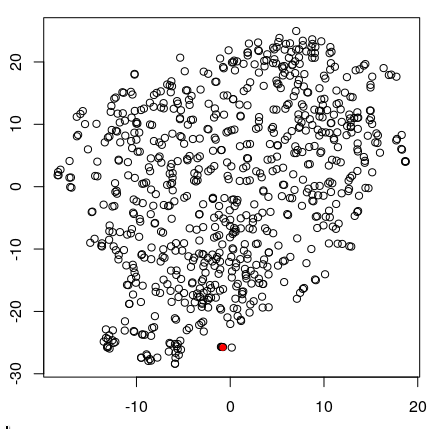
A couple of days ago I wrote on debian-vote@ that a junior analyst could study the tally sheets of our general resolutions and find the cracks in our community. In the end, with a quite na ve approach and a time budget of a few hours, I did not manage anything of interest. The figure below shows one circle per voter and my position as a red dot. The circles are spaces according to the similarity of the vote profiles after I concatenated the results of all GRs until 2010. So if there is something to extract from these data, it will need a more expert analyst This said, I think that our future votes should all be anonymous, and that we should stop distributing that kind of data.

27 March 2021

Charles Plessy: GR toxique

Many quickly reacted to the return of rms to the FSF and asked that he leaves again; some also asked for the whole board of directors to resign and some not. Meanwhile, Debian discusses a general resolution on that matter. Maybe it was not the original intent, but in practice the object of the GR is about FSF's board of directors. Perhaps we will have the result after rms resigns? Like many GRs, it will divide Debian and leave scars, at least a tally sheet of who voted what, and who voted like whom. I think that most other organisations did not go through a process as plenary and collegial, but also heavy and cleaving, to decide which way to go. What if our two DPL candidates would issue a statement that, if elected, they would refuse to fund events linked to the FSF until rms quits again (and also the directors, if that is what the DPL candidate wishes to propose). This would let Debian be part of the wave of reaction on time, and maybe allow us to cancel this GR?

22 February 2021

Charles Plessy: Containers

I was using a container for a bioinformatics tool released two weeks ago, but my shell script wrapping the tools could not run because the container was built around an old version of Debian (Jessie) that was released in 2015. I was asked to use a container for bioinformatics, based on conda, and found one that distributes coreutils, but it did not include a real version of sed. I try Debian's docker image. No luck; it does not contain ps, which my workflow manager needs. But fortunately I eventually figured out that Ubuntu's Docker image contains coreutils, sed and ps together! In the world of containers, this sounds like a little miracle.

7 February 2021

Chris Lamb: Favourite books of 2020

I won't reveal precisely how many books I read in 2020, but it was definitely an improvement on 74 in 2019, 53 in 2018 and 50 in 2017. But not only did I read more in a quantitative sense, the quality seemed higher as well. There were certainly fewer disappointments: given its cultural resonance, I was nonplussed by Nick Hornby's Fever Pitch and whilst Ian Fleming's The Man with the Golden Gun was a little thin (again, given the obvious influence of the Bond franchise) the booked lacked 'thinness' in a way that made it interesting to critique. The weakest novel I read this year was probably J. M. Berger's Optimal, but even this hybrid of Ready Player One late-period Black Mirror wasn't that cringeworthy, all things considered. Alas, graphic novels continue to not quite be my thing, I'm afraid. I perhaps experienced more disappointments in the non-fiction section. Paul Bloom's Against Empathy was frustrating, particularly in that it expended unnecessary energy battling its misleading title and accepted terminology, and it could so easily have been an 20-minute video essay instead). (Elsewhere in the social sciences, David and Goliath will likely be the last Malcolm Gladwell book I voluntarily read.) After so many positive citations, I was also more than a little underwhelmed by Shoshana Zuboff's The Age of Surveillance Capitalism, and after Ryan Holiday's many engaging reboots of Stoic philosophy, his Conspiracy (on Peter Thiel and Hulk Hogan taking on Gawker) was slightly wide of the mark for me. Anyway, here follows a selection of my favourites from 2020, in no particular order:

Fiction Wolf Hall & Bring Up the Bodies & The Mirror and the Light Hilary Mantel During the early weeks of 2020, I re-read the first two parts of Hilary Mantel's Thomas Cromwell trilogy in time for the March release of The Mirror and the Light. I had actually spent the last few years eagerly following any news of the final instalment, feigning outrage whenever Mantel appeared to be spending time on other projects. Wolf Hall turned out to be an even better book than I remembered, and when The Mirror and the Light finally landed at midnight on 5th March, I began in earnest the next morning. Note that date carefully; this was early 2020, and the book swiftly became something of a heavy-handed allegory about the world at the time. That is to say and without claiming that I am Monsieur Cromuel in any meaningful sense it was an uneasy experience to be reading about a man whose confident grasp on his world, friends and life was slipping beyond his control, and at least in Cromwell's case, was heading inexorably towards its denouement. The final instalment in Mantel's trilogy is not perfect, and despite my love of her writing I would concur with the judges who decided against awarding her a third Booker Prize. For instance, there is something of the longueur that readers dislike in the second novel, although this might not be entirely Mantel's fault after all, the rise of the "ugly" Anne of Cleves and laborious trade negotiations for an uninspiring mineral (this is no Herbertian 'spice') will never match the court intrigues of Anne Boleyn, Jane Seymour and that man for all seasons, Thomas More. Still, I am already looking forward to returning to the verbal sparring between King Henry and Cromwell when I read the entire trilogy once again, tentatively planned for 2022.

The Fault in Our Stars John Green I came across John Green's The Fault in Our Stars via a fantastic video by Lindsay Ellis discussing Roland Barthes famous 1967 essay on authorial intent. However, I might have eventually come across The Fault in Our Stars regardless, not because of Green's status as an internet celebrity of sorts but because I'm a complete sucker for this kind of emotionally-manipulative bildungsroman, likely due to reading Philip Pullman's His Dark Materials a few too many times in my teens. Although its title is taken from Shakespeare's Julius Caesar, The Fault in Our Stars is actually more Romeo & Juliet. Hazel, a 16-year-old cancer patient falls in love with Gus, an equally ill teen from her cancer support group. Hazel and Gus share the same acerbic (and distinctly unteenage) wit and a love of books, centred around Hazel's obsession of An Imperial Affliction, a novel by the meta-fictional author Peter Van Houten. Through a kind of American version of Jim'll Fix It, Gus and Hazel go and visit Van Houten in Amsterdam. I'm afraid it's even cheesier than I'm describing it. Yet just as there is a time and a place for Michelin stars and Haribo Starmix, there's surely a place for this kind of well-constructed but altogether maudlin literature. One test for emotionally manipulative works like this is how well it can mask its internal contradictions while Green's story focuses on the universalities of love, fate and the shortness of life (as do almost all of his works, it seems), The Fault in Our Stars manages to hide, for example, that this is an exceedingly favourable treatment of terminal illness that is only possible for the better off. The 2014 film adaptation does somewhat worse in peddling this fantasy (and has a much weaker treatment of the relationship between the teens' parents too, an underappreciated subtlety of the book). The novel, however, is pretty slick stuff, and it is difficult to fault it for what it is. For some comparison, I later read Green's Looking for Alaska and Paper Towns which, as I mention, tug at many of the same strings, but they don't come together nearly as well as The Fault in Our Stars. James Joyce claimed that "sentimentality is unearned emotion", and in this respect, The Fault in Our Stars really does earn it.

The Plague Albert Camus P. D. James' The Children of Men, George Orwell's Nineteen Eighty-Four, Arthur Koestler's Darkness at Noon ... dystopian fiction was already a theme of my reading in 2020, so given world events it was an inevitability that I would end up with Camus's novel about a plague that swept through the Algerian city of Oran. Is The Plague an allegory about the Nazi occupation of France during World War Two? Where are all the female characters? Where are the Arab ones? Since its original publication in 1947, there's been so much written about The Plague that it's hard to say anything new today. Nevertheless, I was taken aback by how well it captured so much of the nuance of 2020. Whilst we were saying just how 'unprecedented' these times were, it was eerie how a novel written in the 1940s could accurately how many of us were feeling well over seventy years on later: the attitudes of the people; the confident declarations from the institutions; the misaligned conversations that led to accidental misunderstandings. The disconnected lovers. The only thing that perhaps did not work for me in The Plague was the 'character' of the church. Although I could appreciate most of the allusion and metaphor, it was difficult for me to relate to the significance of Father Paneloux, particularly regarding his change of view on the doctrinal implications of the virus, and spoiler alert that he finally died of a "doubtful case" of the disease, beyond the idea that Paneloux's beliefs are in themselves "doubtful". Answers on a postcard, perhaps. The Plague even seemed to predict how we, at least speaking of the UK, would react when the waves of the virus waxed and waned as well:
The disease stiffened and carried off three or four patients who were expected to recover. These were the unfortunates of the plague, those whom it killed when hope was high
It somehow captured the nostalgic yearning for high-definition videos of cities and public transport; one character even visits the completely deserted railway station in Oman simply to read the timetables on the wall.

Tinker, Tailor, Soldier, Spy John le Carr There's absolutely none of the Mad Men glamour of James Bond in John le Carr 's icy world of Cold War spies:
Small, podgy, and at best middle-aged, Smiley was by appearance one of London's meek who do not inherit the earth. His legs were short, his gait anything but agile, his dress costly, ill-fitting, and extremely wet.
Almost a direct rebuttal to Ian Fleming's 007, Tinker, Tailor has broken-down cars, bad clothes, women with their own internal and external lives (!), pathetically primitive gadgets, and (contra Mad Men) hangovers that significantly longer than ten minutes. In fact, the main aspect that the mostly excellent 2011 film adaption doesn't really capture is the smoggy and run-down nature of 1970s London this is not your proto-Cool Britannia of Austin Powers or GTA:1969, the city is truly 'gritty' in the sense there is a thin film of dirt and grime on every surface imaginable. Another angle that the film cannot capture well is just how purposefully the novel does not mention the United States. Despite the US obviously being the dominant power, the British vacillate between pretending it doesn't exist or implying its irrelevance to the matter at hand. This is no mistake on Le Carr 's part, as careful readers are rewarded by finding this denial of US hegemony in metaphor throughout --pace Ian Fleming, there is no obvious Felix Leiter to loudly throw money at the problem or a Sheriff Pepper to serve as cartoon racist for the Brits to feel superior about. By contrast, I recall that a clever allusion to "dusty teabags" is subtly mirrored a few paragraphs later with a reference to the installation of a coffee machine in the office, likely symbolic of the omnipresent and unavoidable influence of America. (The officer class convince themselves that coffee is a European import.) Indeed, Le Carr communicates a feeling of being surrounded on all sides by the peeling wallpaper of Empire. Oftentimes, the writing style matches the graceless and inelegance of the world it depicts. The sentences are dense and you find your brain performing a fair amount of mid-flight sentence reconstruction, reparsing clauses, commas and conjunctions to interpret Le Carr 's intended meaning. In fact, in his eulogy-cum-analysis of Le Carr 's writing style, William Boyd, himself a ventrioquilist of Ian Fleming, named this intentional technique 'staccato'. Like the musical term, I suspect the effect of this literary staccato is as much about the impact it makes on a sentence as the imperceptible space it generates after it. Lastly, the large cast in this sprawling novel is completely believable, all the way from the Russian spymaster Karla to minor schoolboy Roach the latter possibly a stand-in for Le Carr himself. I got through the 500-odd pages in just a few days, somehow managing to hold the almost-absurdly complicated plot in my head. This is one of those classic books of the genre that made me wonder why I had not got around to it before.

The Nickel Boys Colson Whitehead According to the judges who awarded it the Pulitzer Prize for Fiction, The Nickel Boys is "a devastating exploration of abuse at a reform school in Jim Crow-era Florida" that serves as a "powerful tale of human perseverance, dignity and redemption". But whilst there is plenty of this perseverance and dignity on display, I found little redemption in this deeply cynical novel. It could almost be read as a follow-up book to Whitehead's popular The Underground Railroad, which itself won the Pulitzer Prize in 2017. Indeed, each book focuses on a young protagonist who might be euphemistically referred to as 'downtrodden'. But The Nickel Boys is not only far darker in tone, it feels much closer and more connected to us today. Perhaps this is unsurprising, given that it is based on the story of the Dozier School in northern Florida which operated for over a century before its long history of institutional abuse and racism was exposed a 2012 investigation. Nevertheless, if you liked the social commentary in The Underground Railroad, then there is much more of that in The Nickel Boys:
Perhaps his life might have veered elsewhere if the US government had opened the country to colored advancement like they opened the army. But it was one thing to allow someone to kill for you and another to let him live next door.
Sardonic aper us of this kind are pretty relentless throughout the book, but it never tips its hand too far into on nihilism, especially when some of the visual metaphors are often first-rate: "An American flag sighed on a pole" is one I can easily recall from memory. In general though, The Nickel Boys is not only more world-weary in tenor than his previous novel, the United States it describes seems almost too beaten down to have the energy conjure up the Swiftian magical realism that prevented The Underground Railroad from being overly lachrymose. Indeed, even we Whitehead transports us a present-day New York City, we can't indulge in another kind of fantasy, the one where America has solved its problems:
The Daily News review described the [Manhattan restaurant] as nouveau Southern, "down-home plates with a twist." What was the twist that it was soul food made by white people?
It might be overly reductionist to connect Whitehead's tonal downshift with the racial justice movements of the past few years, but whatever the reason, we've ended up with a hard-hitting, crushing and frankly excellent book.

True Grit & No Country for Old Men Charles Portis & Cormac McCarthy It's one of the most tedious cliches to claim the book is better than the film, but these two books are of such high quality that even the Coen Brothers at their best cannot transcend them. I'm grouping these books together here though, not because their respective adaptations will exemplify some of the best cinema of the 21st century, but because of their superb treatment of language. Take the use of dialogue. Cormac McCarthy famously does not use any punctuation "I believe in periods, in capitals, in the occasional comma, and that's it" but the conversations in No Country for Old Men together feel familiar and commonplace, despite being relayed through this unconventional technique. In lesser hands, McCarthy's written-out Texan drawl would be the novelistic equivalent of white rap or Jar Jar Binks, but not only is the effect entirely gripping, it helps you to believe you are physically present in the many intimate and domestic conversations that hold this book together. Perhaps the cinematic familiarity helps, as you can almost hear Tommy Lee Jones' voice as Sheriff Bell from the opening page to the last. Charles Portis' True Grit excels in its dialogue too, but in this book it is not so much in how it flows (although that is delightful in its own way) but in how forthright and sardonic Maddie Ross is:
"Earlier tonight I gave some thought to stealing a kiss from you, though you are very young, and sick and unattractive to boot, but now I am of a mind to give you five or six good licks with my belt." "One would be as unpleasant as the other."
Perhaps this should be unsurprising. Maddie, a fourteen-year-old girl from Yell County, Arkansas, can barely fire her father's heavy pistol, so she can only has words to wield as her weapon. Anyway, it's not just me who treasures this book. In her encomium that presages most modern editions, Donna Tartt of The Secret History fame traces the novels origins through Huckleberry Finn, praising its elegance and economy: "The plot of True Grit is uncomplicated and as pure in its way as one of the Canterbury Tales". I've read any Chaucer, but I am inclined to agree. Tartt also recalls that True Grit vanished almost entirely from the public eye after the release of John Wayne's flimsy cinematic vehicle in 1969 this earlier film was, Tartt believes, "good enough, but doesn't do the book justice". As it happens, reading a book with its big screen adaptation as a chaser has been a minor theme of my 2020, including P. D. James' The Children of Men, Kazuo Ishiguro's Never Let Me Go, Patricia Highsmith's Strangers on a Train, James Ellroy's The Black Dahlia, John Green's The Fault in Our Stars, John le Carr 's Tinker, Tailor Soldier, Spy and even a staged production of Charles Dicken's A Christmas Carol streamed from The Old Vic. For an autodidact with no academic background in literature or cinema, I've been finding this an effective and enjoyable means of getting closer to these fine books and films it is precisely where they deviate (or perhaps where they are deficient) that offers a means by which one can see how they were constructed. I've also found that adaptations can also tell you a lot about the culture in which they were made: take the 'straightwashing' in the film version of Strangers on a Train (1951) compared to the original novel, for example. It is certainly true that adaptions rarely (as Tartt put it) "do the book justice", but she might be also right to alight on a legal metaphor, for as the saying goes, to judge a movie in comparison to the book is to do both a disservice.

The Glass Hotel Emily St. John Mandel In The Glass Hotel, Mandel somehow pulls off the impossible; writing a loose roman- -clef on Bernie Madoff, a Ponzi scheme and the ephemeral nature of finance capital that is tranquil and shimmeringly beautiful. Indeed, don't get the wrong idea about the subject matter; this is no over over-caffeinated The Big Short, as The Glass Hotel is less about a Madoff or coked-up financebros but the fragile unreality of the late 2010s, a time which was, as we indeed discovered in 2020, one event away from almost shattering completely. Mandel's prose has that translucent, phantom quality to it where the chapters slip through your fingers when you try to grasp at them, and the plot is like a ghost ship that that slips silently, like the Mary Celeste, onto the Canadian water next to which the eponymous 'Glass Hotel' resides. Indeed, not unlike The Overlook Hotel, the novel so overflows with symbolism so that even the title needs to evoke the idea of impermanence permanently living in a hotel might serve as a house, but it won't provide a home. It's risky to generalise about such things post-2016, but the whole story sits in that the infinitesimally small distance between perception and reality, a self-constructed culture that is not so much 'post truth' but between them. There's something to consider in almost every character too. Take the stand-in for Bernie Madoff: no caricature of Wall Street out of a 1920s political cartoon or Brechtian satire, Jonathan Alkaitis has none of the oleaginous sleaze of a Dominic Strauss-Kahn, the cold sociopathy of a Marcus Halberstam nor the well-exercised sinuses of, say, Jordan Belford. Alkaitis is dare I say it? eminently likeable, and the book is all the better for it. Even the C-level characters have something to say: Enrico, trivially escaping from the regulators (who are pathetically late to the fraud without Mandel ever telling us explicitly), is daydreaming about the girlfriend he abandoned in New York: "He wished he'd realised he loved her before he left". What was in his previous life that prevented him from doing so? Perhaps he was never in love at all, or is love itself just as transient as the imaginary money in all those bank accounts? Maybe he fell in love just as he crossed safely into Mexico? When, precisely, do we fall in love anyway? I went on to read Mandel's Last Night in Montreal, an early work where you can feel her reaching for that other-worldly quality that she so masterfully achieves in The Glass Hotel. Her f ted Station Eleven is on my must-read list for 2021. "What is truth?" asked Pontius Pilate. Not even Mandel cannot give us the answer, but this will certainly do for now.

Running the Light Sam Tallent Although it trades in all of the clich s and stereotypes of the stand-up comedian (the triumvirate of drink, drugs and divorce), Sam Tallent's debut novel depicts an extremely convincing fictional account of a touring road comic. The comedian Doug Stanhope (who himself released a fairly decent No Encore for the Donkey memoir in 2020) hyped Sam's book relentlessly on his podcast during lockdown... and justifiably so. I ripped through Running the Light in a few short hours, the only disappointment being that I can't seem to find videos online of Sam that come anywhere close to match up to his writing style. If you liked the rollercoaster energy of Paul Beatty's The Sellout, the cynicism of George Carlin and the car-crash invertibility of final season Breaking Bad, check this great book out.

Non-fiction Inside Story Martin Amis This was my first introduction to Martin Amis's work after hearing that his "novelised autobiography" contained a fair amount about Christopher Hitchens, an author with whom I had a one of those rather clich d parasocial relationship with in the early days of YouTube. (Hey, it could have been much worse.) Amis calls his book a "novelised autobiography", and just as much has been made of its quasi-fictional nature as the many diversions into didactic writing advice that betwixt each chapter: "Not content with being a novel, this book also wants to tell you how to write novels", complained Tim Adams in The Guardian. I suspect that reviewers who grew up with Martin since his debut book in 1973 rolled their eyes at yet another demonstration of his manifest cleverness, but as my first exposure to Amis's gift of observation, I confess that I was thought it was actually kinda clever. Try, for example, "it remains a maddening truth that both sexual success and sexual failure are steeply self-perpetuating" or "a hospital gym is a contradiction like a young Conservative", etc. Then again, perhaps I was experiencing a form of nostalgia for a pre-Gamergate YouTube, when everything in the world was a lot simpler... or at least things could be solved by articulate gentlemen who honed their art of rhetoric at the Oxford Union. I went on to read Martin's first novel, The Rachel Papers (is it 'arrogance' if you are, indeed, that confident?), as well as his 1997 Night Train. I plan to read more of him in the future.

The Collected Essays, Journalism and Letters: Volume 1 & Volume 2 & Volume 3 & Volume 4 George Orwell These deceptively bulky four volumes contain all of George Orwell's essays, reviews and correspondence, from his teenage letters sent to local newspapers to notes to his literary executor on his deathbed in 1950. Reading this was part of a larger, multi-year project of mine to cover the entirety of his output. By including this here, however, I'm not recommending that you read everything that came out of Orwell's typewriter. The letters to friends and publishers will only be interesting to biographers or hardcore fans (although I would recommend Dorian Lynskey's The Ministry of Truth: A Biography of George Orwell's 1984 first). Furthermore, many of his book reviews will be of little interest today. Still, some insights can be gleaned; if there is any inconsistency in this huge corpus is that his best work is almost 'too' good and too impactful, making his merely-average writing appear like hackwork. There are some gems that don't make the usual essay collections too, and some of Orwell's most astute social commentary came out of series of articles he wrote for the left-leaning newspaper Tribune, related in many ways to the US Jacobin. You can also see some of his most famous ideas start to take shape years if not decades before they appear in his novels in these prototype blog posts. I also read Dennis Glover's novelised account of the writing of Nineteen-Eighty Four called The Last Man in Europe, and I plan to re-read some of Orwell's earlier novels during 2021 too, including A Clergyman's Daughter and his 'antebellum' Coming Up for Air that he wrote just before the Second World War; his most under-rated novel in my estimation. As it happens, and with the exception of the US and Spain, copyright in the works published in his lifetime ends on 1st January 2021. Make of that what you will.

Capitalist Realism & Chavs: The Demonisation of the Working Class Mark Fisher & Owen Jones These two books are not natural companions to one another and there is likely much that Jones and Fisher would vehemently disagree on, but I am pairing these books together here because they represent the best of the 'political' books I read in 2020. Mark Fisher was a dedicated leftist whose first book, Capitalist Realism, marked an important contribution to political philosophy in the UK. However, since his suicide in early 2017, the currency of his writing has markedly risen, and Fisher is now frequently referenced due to his belief that the prevalence of mental health conditions in modern life is a side-effect of various material conditions, rather than a natural or unalterable fact "like weather". (Of course, our 'weather' is being increasingly determined by a combination of politics, economics and petrochemistry than pure randomness.) Still, Fisher wrote on all manner of topics, from the 2012 London Olympics and "weird and eerie" electronic music that yearns for a lost future that will never arrive, possibly prefiguring or influencing the Fallout video game series. Saying that, I suspect Fisher will resonate better with a UK audience more than one across the Atlantic, not necessarily because he was minded to write about the parochial politics and culture of Britain, but because his writing often carries some exasperation at the suppression of class in favour of identity-oriented politics, a viewpoint not entirely prevalent in the United States outside of, say, Tour F. Reed or the late Michael Brooks. (Indeed, Fisher is likely best known in the US as the author of his controversial 2013 essay, Exiting the Vampire Castle, but that does not figure greatly in this book). Regardless, Capitalist Realism is an insightful, damning and deeply unoptimistic book, best enjoyed in the warm sunshine I found it an ironic compliment that I had quoted so many paragraphs that my Kindle's copy protection routines prevented me from clipping any further. Owen Jones needs no introduction to anyone who regularly reads a British newspaper, especially since 2015 where he unofficially served as a proxy and punching bag for expressing frustrations with the then-Labour leader, Jeremy Corbyn. However, as the subtitle of Jones' 2012 book suggests, Chavs attempts to reveal the "demonisation of the working class" in post-financial crisis Britain. Indeed, the timing of the book is central to Jones' analysis, specifically that the stereotype of the "chav" is used by government and the media as a convenient figleaf to avoid meaningful engagement with economic and social problems on an austerity ridden island. (I'm not quite sure what the US equivalent to 'chav' might be. Perhaps Florida Man without the implications of mental health.) Anyway, Jones certainly has a point. From Vicky Pollard to the attacks on Jade Goody, there is an ignorance and prejudice at the heart of the 'chav' backlash, and that would be bad enough even if it was not being co-opted or criminalised for ideological ends. Elsewhere in political science, I also caught Michael Brooks' Against the Web and David Graeber's Bullshit Jobs, although they are not quite methodical enough to recommend here. However, Graeber's award-winning Debt: The First 5000 Years will be read in 2021. Matt Taibbi's Hate Inc: Why Today's Media Makes Us Despise One Another is worth a brief mention here though, but its sprawling nature felt very much like I was reading a set of Substack articles loosely edited together. And, indeed, I was.

The Golden Thread: The Story of Writing Ewan Clayton A recommendation from a dear friend, Ewan Clayton's The Golden Thread is a journey through the long history of the writing from the Dawn of Man to present day. Whether you are a linguist, a graphic designer, a visual artist, a typographer, an archaeologist or 'just' a reader, there is probably something in here for you. I was already dipping my quill into calligraphy this year so I suspect I would have liked this book in any case, but highlights would definitely include the changing role of writing due to the influence of textual forms in the workplace as well as digression on ergonomic desks employed by monks and scribes in the Middle Ages. A lot of books by otherwise-sensible authors overstretch themselves when they write about computers or other technology from the Information Age, at best resulting in bizarre non-sequiturs and dangerously Panglossian viewpoints at worst. But Clayton surprised me by writing extremely cogently and accurate on the role of text in this new and unpredictable era. After finishing it I realised why for a number of years, Clayton was a consultant for the legendary Xerox PARC where he worked in a group focusing on documents and contemporary communications whilst his colleagues were busy inventing the graphical user interface, laser printing, text editors and the computer mouse.

New Dark Age & Radical Technologies: The Design of Everyday Life James Bridle & Adam Greenfield I struggled to describe these two books to friends, so I doubt I will suddenly do a better job here. Allow me to quote from Will Self's review of James Bridle's New Dark Age in the Guardian:
We're accustomed to worrying about AI systems being built that will either "go rogue" and attack us, or succeed us in a bizarre evolution of, um, evolution what we didn't reckon on is the sheer inscrutability of these manufactured minds. And minds is not a misnomer. How else should we think about the neural network Google has built so its translator can model the interrelation of all words in all languages, in a kind of three-dimensional "semantic space"?
New Dark Age also turns its attention to the weird, algorithmically-derived products offered for sale on Amazon as well as the disturbing and abusive videos that are automatically uploaded by bots to YouTube. It should, by rights, be a mess of disparate ideas and concerns, but Bridle has a flair for introducing topics which reveals he comes to computer science from another discipline altogether; indeed, on a four-part series he made for Radio 4, he's primarily referred to as "an artist". Whilst New Dark Age has rather abstract section topics, Adam Greenfield's Radical Technologies is a rather different book altogether. Each chapter dissects one of the so-called 'radical' technologies that condition the choices available to us, asking how do they work, what challenges do they present to us and who ultimately benefits from their adoption. Greenfield takes his scalpel to smartphones, machine learning, cryptocurrencies, artificial intelligence, etc., and I don't think it would be unfair to say that starts and ends with a cynical point of view. He is no reactionary Luddite, though, and this is both informed and extremely well-explained, and it also lacks the lazy, affected and Private Eye-like cynicism of, say, Attack of the 50 Foot Blockchain. The books aren't a natural pair, for Bridle's writing contains quite a bit of air in places, ironically mimics the very 'clouds' he inveighs against. Greenfield's book, by contrast, as little air and much lower pH value. Still, it was more than refreshing to read two technology books that do not limit themselves to platitudinal booleans, be those dangerously naive (e.g. Kevin Kelly's The Inevitable) or relentlessly nihilistic (Shoshana Zuboff's The Age of Surveillance Capitalism). Sure, they are both anti-technology screeds, but they tend to make arguments about systems of power rather than specific companies and avoid being too anti-'Big Tech' through a narrower, Silicon Valley obsessed lens for that (dipping into some other 2020 reading of mine) I might suggest Wendy Liu's Abolish Silicon Valley or Scott Galloway's The Four. Still, both books are superlatively written. In fact, Adam Greenfield has some of the best non-fiction writing around, both in terms of how he can explain complicated concepts (particularly the smart contract mechanism of the Ethereum cryptocurrency) as well as in the extremely finely-crafted sentences I often felt that the writing style almost had no need to be that poetic, and I particularly enjoyed his fictional scenarios at the end of the book.

The Algebra of Happiness & Indistractable: How to Control Your Attention and Choose Your Life Scott Galloway & Nir Eyal A cocktail of insight, informality and abrasiveness makes NYU Professor Scott Galloway uncannily appealing to guys around my age. Although Galloway definitely has his own wisdom and experience, similar to Joe Rogan I suspect that a crucial part of Galloway's appeal is that you feel you are learning right alongside him. Thankfully, 'Prof G' is far less err problematic than Rogan (Galloway is more of a well-meaning, spirited centrist), although he, too, has some pretty awful takes at time. This is a shame, because removed from the whirlwind of social media he can be really quite considered, such as in this long-form interview with Stephanie Ruhle. In fact, it is this kind of sentiment that he captured in his 2019 Algebra of Happiness. When I look over my highlighted sections, it's clear that it's rather schmaltzy out of context ("Things you hate become just inconveniences in the presence of people you love..."), but his one-two punch of cynicism and saccharine ("Ask somebody who purchased a home in 2007 if their 'American Dream' came true...") is weirdly effective, especially when he uses his own family experiences as part of his story:
A better proxy for your life isn't your first home, but your last. Where you draw your last breath is more meaningful, as it's a reflection of your success and, more important, the number of people who care about your well-being. Your first house signals the meaningful your future and possibility. Your last home signals the profound the people who love you. Where you die, and who is around you at the end, is a strong signal of your success or failure in life.
Nir Eyal's Indistractable, however, is a totally different kind of 'self-help' book. The important background story is that Eyal was the author of the widely-read Hooked which turned into a secular Bible of so-called 'addictive design'. (If you've ever been cornered by a techbro wielding a Wikipedia-thin knowledge of B. F. Skinner's behaviourist psychology and how it can get you to click 'Like' more often, it ultimately came from Hooked.) However, Eyal's latest effort is actually an extended mea culpa for his previous sin and he offers both high and low-level palliative advice on how to avoid falling for the tricks he so studiously espoused before. I suppose we should be thankful to capitalism for selling both cause and cure. Speaking of markets, there appears to be a growing appetite for books in this 'anti-distraction' category, and whilst I cannot claim to have done an exhausting study of this nascent field, Indistractable argues its points well without relying on accurate-but-dry "studies show..." or, worse, Gladwellian gotchas. My main criticism, however, would be that Eyal doesn't acknowledge the limits of a self-help approach to this problem; it seems that many of the issues he outlines are an inescapable part of the alienation in modern Western society, and the only way one can really avoid distraction is to move up the income ladder or move out to a 500-acre ranch.

9 August 2020

Charles Plessy: Thank you, VAIO

I use everyday a VAIO Pro mk2 that I bought 5 years ago with 3 years of warranty. It has been a few months that I was noticing that something was slowly inflating inside. In July, things accelerated to the point that its thickness had doubled. After we called the customer service of VAIO, somebody came to pick up the laptop in order to make a cost estimate. Then we learned on the phone that it would be free. It is back in my hands in less than two weeks. Bravo VAIO !

31 May 2020

Enrico Zini: Controversial inventors

Paul-F lix Armand-Delille (3 July 1874 in Fourchambault, Ni vre 4 September 1963) was a physician, bacteriologist, professor, and member of the French Academy of Medicine who accidentally brought about the collapse of rabbit populations throughout much of Europe and beyond in the 1950s by infecting them with myxomatosis.
Charles Franklin Kettering (August 29, 1876 November 25, 1958) sometimes known as Charles "Boss" Kettering[1] was an American inventor, engineer, businessman, and the holder of 186 patents.[2] He was a founder of Delco, and was head of research at General Motors from 1920 to 1947. Among his most widely used automotive developments were the electrical starting motor[3] and leaded gasoline.[4][5] In association with the DuPont Chemical Company, he was also responsible for the invention of Freon refrigerant for refrigeration and air conditioning systems. At DuPont he also was responsible for the development of Duco lacquers and enamels, the first practical colored paints for mass-produced automobiles. While working with the Dayton-Wright Company he developed the "Bug" aerial torpedo, considered the world's first aerial missile.[6] He led the advancement of practical, lightweight two-stroke diesel engines, revolutionizing the locomotive and heavy equipment industries. In 1927, he founded the Kettering Foundation, a non-partisan research foundation. He was featured on the cover of Time magazine on January 9, 1933.
John Charles Cutler (June 29, 1915 February 8, 2003) was a senior surgeon, and the acting chief of the venereal disease program in the United States Public Health Service. After his death, his involvement in several controversial and unethical medical studies of syphilis was revealed, including the Guatemala and the Tuskegee syphilis experiments.
Ivy Ledbetter Lee (July 16, 1877 November 9, 1934) was an American publicity expert and a founder of modern public relations. Lee is best known for his public relations work with the Rockefeller family. His first major client was the Pennsylvania Railroad, followed by numerous major railroads such as the New York Central, the Baltimore and Ohio, and the Harriman lines such as the Union Pacific. He established the Association of Railroad Executives, which included providing public relations services to the industry. Lee advised major industrial corporations, including steel, automobile, tobacco, meat packing, and rubber, as well as public utilities, banks, and even foreign governments. Lee pioneered the use of internal magazines to maintain employee morale, as well as management newsletters, stockholder reports, and news releases to the media. He did a great deal of pro bono work, which he knew was important to his own public image, and during World War I, he became the publicity director for the American Red Cross.[1]

10 May 2020

Enrico Zini: Fraudsters and pirates

Adelheid Luise "Adele" Spitzeder ([ a dl ha t a de l p t tse d ]; 9 February 1832 27 or 28 October 1895), also known by her stage name Adele Vio, was a German actress, folk singer, and con artist. Initially a promising young actress, Spitzeder became a well-known private banker in 19th-century Munich when her theatrical success dwindled. Running what was possibly the first recorded Ponzi scheme, she offered large returns on investments by continually using the money of new investors to pay back the previous ones. At the height of her success, contemporary sources considered her the wealthiest woman in Bavaria.
Anne Bonny (possibly 1697 possibly April 1782)[1][2] was an Irish pirate operating in the Caribbean, and one of the most famous female pirates of all time.[3] The little that is known of her life comes largely from Captain Charles Johnson's A General History of the Pyrates.
Mary Read (1685 28 April 1721), also known as Mark Read, was an English pirate. She and Anne Bonny are two of the most famed female pirates of all time, and among the few women known to have been convicted of piracy during the early 18th century, at the height of the "Golden Age of Piracy".
While piracy was predominantly a male occupation, a minority of pirates were women.[1] On many ships, women (as well as young boys) were prohibited by the ship's contract, which all crew members were required to sign.[2] :303

8 April 2020

David Bremner: Tangling multiple files

I have lately been using org-mode literate programming to generate example code and beamer slides from the same source. I hit a wall trying to re-use functions in multiple files, so I came up with the following hack. Thanks 'ngz' on #emacs and Charles Berry on the org-mode list for suggestions and discussion.
(defun db-extract-tangle-includes ()
  (goto-char (point-min))
  (let ((case-fold-search t)
        (retval nil))
    (while (re-search-forward "^#[+]TANGLE_INCLUDE:" nil t)
      (let ((element (org-element-at-point)))
        (when (eq (org-element-type element) &aposkeyword)
          (push (org-element-property :value element) retval))))
    retval))
(defun db-ob-tangle-hook ()
  (let ((includes (db-extract-tangle-includes)))
    (mapc #&aposorg-babel-lob-ingest includes)))
(add-hook &aposorg-babel-pre-tangle-hook #&aposdb-ob-tangle-hook t)
Use involves something like the following in your org-file.
#+SETUPFILE: presentation-settings.org
#+SETUPFILE: tangle-settings.org
#+TANGLE_INCLUDE: lecture21.org
#+TITLE: GC V: Mark & Sweep with free list
For batch export with make, I do something like
%.tangle-stamp: %.org
    emacs --batch --quick  -l org  -l $ HOME /.emacs.d/org-settings.el --eval "(org-babel-tangle-file \"$<\")"
    touch $@

2 November 2017

Steinar H. Gunderson: Introducing Narabu, part 5: Encoding

Narabu is a new intraframe video codec. You probably want to read part 1, part 2, part 3 and part 4 first. At this point, we've basically caught up with where I am, so thing are less set in stone. However, let's look at what qualitatively differentiates encoding from decoding; unlike in interframe video codecs (where you need to do motion vector search and stuff), encoding and decoding are very much mirror images of each other, so we can intuitively expect them to be relatively similar in performance. The procedure is DCT, quantization, entropy coding, and that's it. One important difference is in the entropy coding. Since our rANS encoding is non-adaptive (a choice made largely for simplicity, but also because our streams are so short) works by first signaling a distribution and then encoding each coefficient using that distribution. However, we don't know that distribution until we've DCT-ed all blocks in the picture, so we can't just DCT each block and entropy code the coefficients on-the-fly. There are a few ways to deal with this: As you can see, tons of possible strategies here. For simplicity, I've ended up with the former, although this could very well be changed at some point. There are some interesting subproblems, though: First of all, we need to decide the data type of this temporary array. The DCT tends to concentrate energy into fewer coefficients (which is a great property for compression!), so even after quantization, some of them will get quite large. This means we cannot store them in an 8-bit texture; however, even the bigger ones are very rarely bigger than 10 bits (including a sign bit), so using 16-bit textures wastes precious memory bandwidth. I ended up slicing the coefficients by horizontal index and then pairing them up (so that we generate pairs 0+7, 1+6, 2+5 and 3+4 for the first line of the 8x8 DCT block, 8+15, 9+14, 10+13 and 11+12 for the next line, etc.). This allows us to pack two coefficients into a 16-bit texture, for an average of 8 bits per coefficient, which is what we want. It makes for some slightly fiddly clamping and bit-packing since we are packing signed values, but nothing really bad. Second, and perhaps surprisingly enough, counting efficiently is nontrivial. We want a histogram over what coefficients are used the more often, ie., for each coefficient, we want something like ++counts[dist][coeff] (recall we have four distinct distributions). However, since we're in a massively parallel algorithm, this add needs to be atomic, and since values like e.g. 0 are super-common, all of our GPU cores will end up fighting over the cache line containing counts[dist][0]. This is not fast. Think 10 ms/frame not fast. Local memory to the rescue again; all modern GPUs have fast atomic adds to local memory (basically integrating adders into the cache, as I understand it, although I might have misunderstood here). This means we just make a suitably large local group, build up our sub-histogram in local memory and then add all nonzero buckets (atomically) to the global histogram. This improved performance dramatically, to the point where it was well below 0.1 ms/frame. However, our histogram is still a bit raw; it sums to 1280x720 = 921,600 values, but we want an approximation that sums to exactly 4096 (12 bits), with some additional constraints (like no nonzero coefficients). Charles Bloom has an exposition of a nearly optimal algorithm, although it took me a while to understand it. The basic idea is: Make a good approximation by multiplying each frequency by 4096/921600 (rounding intelligently). This will give you something that very nearly rounds to 4096 either above or below, e.g. 4101. For each step you're above or below the total (five in this case), find the best single coefficient to adjust (most entropy gain, or least loss); Bloom is using a heap, but on the GPU, each core is slow but we have many of them, so it's better just to try all 256 possibilities in parallel and have a simple voting scheme through local memory to find the best one. And then finally, we want a cumulative distribution function, but that is simple through a parallel prefix sum on the 256 elements. And then finally, we can take our DCT coefficients and the finished rANS distribution, and write the data! We'll have to leave some headroom for the streams (I've allowed 1 kB for each, which should be ample except for adversarial data and we'll probably solve that just by truncating the writes and accepting the corruption), but we'll compact them when we write to disk. Of course, the Achilles heel here is performance. Where decoding 720p (luma only) on my GTX 950 took 0,4 ms or so, encoding is 1,2 ms or so, which is just too slow. Remember that 4:2:2 is twice that, and we want multiple streams, so 2,4 ms per frame is eating too much. I don't really know why it's so slow; the DCT isn't bad, the histogram counting is fast, it's just the rANS shader that's slow for some reason I don't understand, and also haven't had the time to really dive deeply into. Of course, a faster GPU would be faster, but I don't think I can reasonably demand that people get a 1080 just to encode a few video streams. Due to this, I haven't really worked out the last few kinks. In particular, I haven't implemented DC coefficient prediction (it needs to be done before tallying up the histograms, so it can be a bit tricky to do efficiently, although perhaps local memory will help again to send data between neighboring DCT blocks). And I also haven't properly done bounds checking in the encoder or decoder, but it should hopefully be simple as long as we're willing to accept that evil input decodes into garbage instead of flagging errors explicitly. It also depends on a GLSL extension that my Haswell laptop doesn't have to get 64-bit divides when precalculating the rANS tables; I've got some code to simulate 64-bit divides using 32-bit, but it doesn't work yet. The code as it currently stands is in this Git repository; you can consider it licensed under GPLv3. It's really not very user-friendly at this point, though, and rather rough around the edges. Next time, we'll wrap up with some performance numbers. Unless I magically get more spare time in the meantime and/or some epiphany about how to make the encoder faster. :-)

10 September 2017

Charles Plessy: Summary of the discussion on off-line keys.

Last month, there has been an interesting discussion about off-line GnuPG keys and their storage systems on the debian-project@l.d.o mailing list. I tried to summarise it in the Debian wiki, in particular by creating two new pages.

1 June 2017

Russ Allbery: Review: Migration

Review: Migration, by Julie E. Czerneda
Series: Species Imperative #2
Publisher: DAW
Copyright: 2005
ISBN: 0-7564-0260-3
Format: Hardcover
Pages: 453
Migration is the second book of the Species Imperative, and this is the old-fashioned type of trilogy that you very much want to read in order. Start with Survival. There is a (slightly awkward) recap of the previous book at the start, though, if it's been a bit since you read it. In my review of Survival, I praised Czerneda's ability to capture the feel of academic research and the sense of real scientists doing science. I thought I went out on a bit of a limb, not being a scientist myself (just someone who worked at a university for decades), but Czerneda was still holding back. I'm now completely convinced: whatever else this series is, and it contains a lot of politics and world-building and fascinating (if very human-like) aliens, it's some of the best science fiction about practicing scientists I've ever read. I cannot express how much I adore the fact that the center of this book is not space combat, not daring adventure across alien landscapes, but getting a bunch of really smart experts in their field together in a room with good equipment and good computers to chase an intellectual problem from their own individual perspectives. And if Mac is perhaps a bit *too* good at quickly overcoming interpersonal conflict and suspicion, I'll forgive that for the deft sense of politics. Mac's success may be a bit unrealistic, but the direction and thrust of her tactics are spot-on. This is how interactions between smart and curious people often work, at least if they're sufficiently motivated to put aside pettier political infighting. This is also how the dynamics of emergency war rooms work: if you can give people a focus and divide up the work, the results can be amazing. The second best part of the book is Oversight. The first book opened with the latest round of Mac's ongoing war with Charles Mudge III, the oversight board of the neighboring wilderness trust. He shows up again at the start of this book, acting completely consistent to his stubborn idealism shown in Survival, and then develops into one of the best characters in the book. Unexpected allies is one of the tropes I love most in fiction in general, but this one resonates so deeply with the way grudging respect and familiar patterns, even patterns of argument, work on people. Czerneda had me grinning. It's just perfectly in line with Mac's character, her single-minded focus on work that tended to miss a few points of human connection, and the sort of deepening respect that builds up even between adversaries when they know deep inside that they are following different interpretations of the same principles. I'm going to be rather sketchy on the plot, since Migration follows closely on from Survival and is concerned almost entirely with the aftermath of the climactic events at the end of that book. But as you can tell, this is more of Mac, and she's not managed to separate herself from Dhryn problems or from the Ministry of Extra-Solar Affairs. She does, however, get rather far away from Norcoast for a while, an interlude in the wild northern Canadian wilderness that once again proves Czerneda to be the type of writer who can make the quotidian as engrossing as alien dramatics. She's also suffering from nightmares, anxiety, and a lot of circular thinking, making this one of the series that shows the realistic toll of dramatic events on human psychology. There was a bit of a nascent love story in Survival; there's a lot more of that here. It's the one bit of the book that I have mixed feelings about, since it feels a touch unnecessary to me, and therefore a bit intrusive. It also involves a fair bit of love at, well, not first sight but surprisingly fast, which is something I know intellectually that other people think happens, but which always undermines my suspension of disbelief. That said, Czerneda gives Mac a clear tendency in how she forms emotional attachments and sticks with it throughout this series to date, which I do like, and she keeps the romance consistent with that. It thankfully does not get too much in the way of the plot, although I could have done with just a few fewer determined proclamations that the characters won't let love get in the way of doing what they need to do. That quibble aside, this is fantastic stuff that avoids most of the cliches of this sort of story of alien politics and possible war. The focus is firmly on analysis and understanding rather than guns and action, the portrayal of scientists, analysis, and problem-solving is spot on, the aliens are delightfully different (and different from each other within the same alien species, which is important depth), and Mac is a fantastic protagonist. She's vulnerable, wounded, and out of her depth, but she knows how to map new situations to her areas of competence and how to admit when she doesn't know something, and her effectiveness is well-grounded and believable. Oh, and there are some amazing descriptions of the Canadian wilderness that almost make me want to find a secluded cabin without Internet access. (At least if it had all of the convenient technology that Mac's future Earth has.) It's a rare middle book of a trilogy that's better than the first, but this one is. Much better. And I already liked the first book. Highly recommended; I think this is one of Czerneda's best. Followed by Regeneration. Rating: 9 out of 10

5 May 2017

Joachim Breitner: Farewall green cap

For the last two years, I was known among swing dancers for my green flat cap:

Monti, a better model than me

Monti, a better model than me

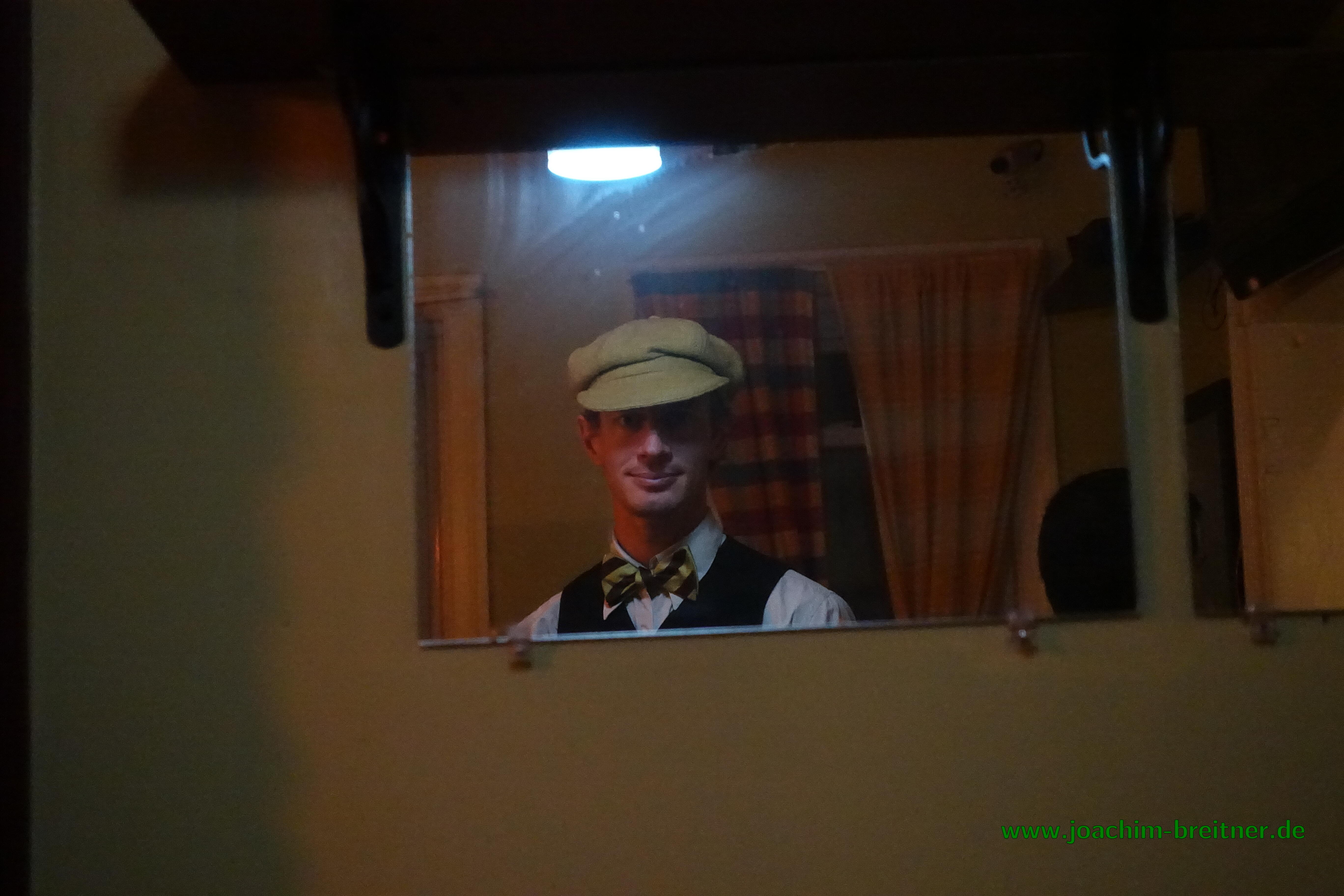
This cap was very special: It was a gift from a good friend who sewed it by hand from what used to be a table cloth of my deceased granny, and it has traveled with me to many corners of the world. Just like last week, when I was in Paris where I attended the Charleston class of Romuald and Laura on Saturday (April 29). The following Tuesday I went to a Swing Social and wanted to put on the hat, and noticed that it was gone. The next day I bugged the manager and the caretaker of the venue of the class (Salles Sainte-Roche), and it seems that the hat was still there, that morning, im Salle Kurtz1, but when I went there it was gone. And that is sad.
The last picture with the hat

The last picture with the hat


  1. How fitting, given that my granny s maiden name is Kurz.

20 February 2017

Norbert Preining: Ryu Murakami Tokyo Decadence

The other Murakami, Ryu Murakami ( ), is hard to compare to the more famous Haruki. His collection of stories reflects the dark sides of Tokyo, far removed from the happy world of AKB48 and the like. Criminals, prostitutes, depression, loss. A bleak image onto a bleak society.
This collection of short stories is a consequent deconstruction of happiness, love, everything we believe to make our lives worthwhile. The protagonists are idealistic students loosing their faith, office ladies on aberrations, drunkards, movie directors, the usual mixture. But the topic remains constant the unfulfilled search for happiness and love.
I felt I was beginning to understand what happiness is about. It isn t about guzzling ten or twenty energy drinks a day, barreling down the highway for hours at a time, turning over your paycheck to your wife without even opening the envelope, and trying to force your family to respect you. Happiness is based on secrets and lies.Ryu Murakami, It all started just about a year and a half ago
A deep pessimistic undertone is echoing through these stories, and the atmosphere and writing reminds of Charles Bukowski. This pessimism resonates in the melancholy of the running themes in the stories, Cuban music. Murakami was active in disseminating Cuban music in Japan, which included founding his own label. Javier Olmo s pieces are often the connecting parts, as well as lending the short stories their title: Historia de un amor, Se fu .
The belief that what s missing now used to be available to us is just an illusion, if you ask me. But the social pressure of You ve got everything you need, what s your problem? is more powerful than you might ever think, and it s hard to defend yourself against it. In this country it s taboo even to think about looking for something more in life.Ryu Murakami, Historia de un amor
It is interesting to see that on the surface, the women in the stories are the broken characters, leading feminists to incredible rants about the book, see the rant^Wreview of Blake Fraina at Goodreads:
I ll start by saying that, as a feminist, I m deeply suspicious of male writers who obsess over the sex lives of women and, further, have the audacity to write from a female viewpoint
female characters are pretty much all pathetic victims of the male characters
I wish there was absolutely no market for stuff like this and I particularly discourage women readers from buying it Blake Fraina, Goodreads review
On first sight it might look like that the female characters are pretty much all pathetic victims of the male characters, but in fact it is the other way round, the desperate characters, the slaves of their own desperation, are the men, and not the women, in these stories. It is dual to the situation in Hitomi Kanehara s Snakes and Earrings, where on first sight the tattooist and the outlaw friends are the broken characters, but the really cracked one is the sweet Tokyo girly.
Male-female relationships are always in transition. If there s no forward progress, things tend to slip backwards.Ryu Murakami, Se fu
Final verdict: Great reading, hard to put down, very much readable and enjoyable, if one is in the mood of dark and depressing stories. And last but not least, don t trust feminist book reviews.

9 February 2017

Charles Plessy: Beware of libinput 1.6.0-1

Since I updated this evening, touch to click with my touchpad is almost totally broken. Fortunately, a correction is pending. update: To reinstall packages version 1.5.5-4 solves the problem in the meantime.

11 December 2016

Charles Plessy: apt purge ifupdown

...oh wow, it still works... I never had realised that network-manager did not need ifupdown.

29 November 2016

Shirish Agarwal: The Iziko South African Museum

This would be a bit long on my stay in Cape Town, South Africa after Debconf16. Before I start, let me share the gallery works, you can see some photos that I have been able to upload to my gallery . It seems we are using gallery 2 while upstream had made gallery 3 and then it sort of died. I actually asked in softwarerecs stackexchange site if somebody knows of a drop-in replacement for gallery and was told/shared about Pwigo . I am sure the admin knows about it. There would be costs to probably migrate from gallery to Pwigo with the only benefit that it would be something which would perhaps be more maintainable. The issues I face with the current gallery system are few things a. There is no way to know how much your progress your upload has taken.
b. After it has submit, it gives a fake error message saying some error has occurred. This has happened on every occasion/attempt. Now I don t know whether it is because I have slow upload speeds or something else altogether. I had shared the error page last time in the blog post hence not sharing again. Although, all the pictures which would be shared in this blog post would be from the same gallery Another thing I would like to share is a small beginner article I wrote about why I like Debian. Another interesting/tit-bit of news I came to know few days back that both Singapore and Qatar have given 96 hours visa free stopovers for Indians for select destinations. Now to start with the story/experience due to some unknown miracle/angel looking upon me I got the chance to go to Debconf16, South Africa. I m sure there was lot of backend discussions but in the end I was given the opportunity to be part of Debcamp and Debconf. While I hope to recount my Debcamp and Debconf experience in another or two blog posts, this would be exclusively the Post-Debconf Experiences I had. As such opportunities to visit another country are rare, I wanted to make the most of it. Before starting from Pune, I had talked with Amey about Visas, about Debconf as he had just been to Debconf15 the year before and various things related to travel. He was instrumental in me having a bit more knowledge about how to approach things. I was also lucky to have both Graham and Bernelle who also suggested, advised and made it possible to have a pleasant stay both during Debcamp and Debconf. The only quibble is I didn t know heaters were being made available to us without any cost. Moving on, a day or two before Debconf was about to conclude, I asked Bernelle s help even though she was battling a burn-out I believe as I was totally clueless about Cape Town. She accepted my request and asked me to look at hostels near Longmarket Street. I had two conditions a. It should not be very far from the airport
b. It should be near to all or most cultural experiences the city has to offer. We looked at hostelworld and from the options listed, it looked like Homebasecapetown looked to be a perfect fit. It was one of the cheaper options and they also had breakfast included in the pricing. I booked through hostelworld for a mixed dorm for 2 days as I was unsure how it would be (the first night effect I have shared about previously) . When I reached there, I found it to be as good as the pictures shared were, the dorm was clean (most important), people were friendly (also important) as well as toilets and shower were also clean while the water was hot, so all in all it was a win-win situation for me. Posters I saw at homebasecapetown While I m not much of an adrenaline-junkie it was nice to know the activities that could be done/taken. Brochures and Condoms just left of main hall. This was again interesting. While apologies for the poor shaky quality of the picture, I believe it is easy to figure out. There were Brochures of the city attractions as well as condoms that people could discreetly use if need be. I had seen such condoms in few toilets during and around Debconf and it felt good that the public were aware and prioritizing safety for their guests and students instead of having fake holier than thou attitudes that many places have. For instance, you wouldn t find something like this in toilets of most colleges in India or anywhere else for that matter. There are few vending machines in what are termed as red light areas or where prostitution is known/infamous to happen and even then most times it is empty. I have 2-3 social workers as friends and they are a source of news on such things. While I went to few places and each had an attraction to it, the one which had my literally eyes out of socket was the Iziko South African Museum . I have been lucky to been quite a few museums in India, the best rated science museum in India in my limited experience has been the Visvesvaraya Industrial & Technological Museum, Bengaluru India . A beer from me if a European can get it right. Don t worry if you mispronounce it, I mispronounce it couple of times till I get it right . Looking up the word Iziko the meaning of the word seems to be the hearth and if you look at the range of collections in the museum, you would think it fits. I was lucky to find couple of friends, one of whom was living at homebase and we decided to go to the museum together. Making friends on the road So Eduardo, my friend on the left and his friend, we went to the museum. While viewing the museum, there were no adjectives to describe it other than Wow and Endless . See fossils of fish-whale-shark ? OR Giant fish-whale-dolphin-shark some million years ago. and Reminder of JAWS ;) While I have more than a few pictures, the point is easily made. It seems almost inconceivable that creatures of such masses actually were on earth. While I played with the model of the jaws of a whale/shark in reality if something like that happened, I would have been fighting for my life. The only thing I missed or could have been better if they had some interactive installations to showcase the now universally accepted Charles Darwin s On the Origin of Species I had never seen anything like this. Sadly, there was nobody around to help us figure out things as I had read that most species of fish don t leave a skeleton behind so how were these models made? It just boggles the mind. Apart from the Science Museum I was also introduced to the bloody history that South Africa had. I saw The 1913 native land act which was not honored . I had been under the impression that India had got a raw deal when it was under British rule but looking at South African history I don t know. While we got our freedom in 1947 they got rid of apartheid about 20 years+ . I talked to lot of young African males and there was lot of naked hostility for the Europeans even today. It was a bit depressing but could relate to their point of view as similar sentiments were echoed by our forefathers. I read in the newspapers and it seemed to be a pretty mixed picture. I can t comment as only South Africans can figure out the way forward. For me, it was enough to know and see that we both had similar political histories as nations. It seemed the racial divide and anger was much more highly pronounced towards Europeans and divisive then the caste divisions here between Indians. I also shared with them my limited knowledge and understanding of the Indian history (as history is re-written all the time) and it was clear to them that we had common/similar pasts. As a result, what was surprising (actually not) is that many South Africans have no knowledge of Indian history. as well otherwise the political differences that South Africa and India has in the current scenario wouldn t have been. In the end, the trip proved to be fun, stimulating, educative, thought-provoking as questions about self-identity , national identity, our place in the Universe kinda questions which should be asked all the time. Thank you Bremmer and the team for letting me experience Cape Town, South Africa, I would have been poorer if I hadn t had the experience.
Filed under: Miscellenous Tagged: #Debconf16, #Dinosaur Fishes, #gallery, #Identity, #Iziko South African Museum, #Nation-state Identity, #pwigo

Next.

Previous.