Search Results: "bam"

30 August 2013

Daniel Pocock: Big decision?

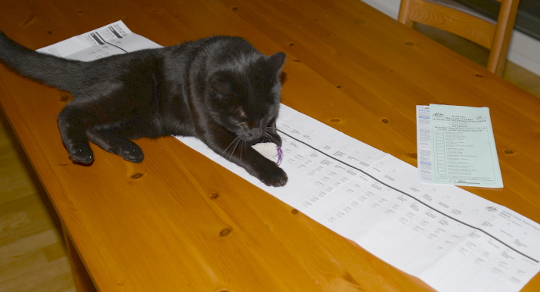
Most people have probably heard that elections are on in Australia. I just received my postal ballot paper the other day and in the spirit of transparency, I'm sharing it here on my blog. Spoilt for choice There are two ballots, one for the Lower House and the other for the Senate. The big one is for the Senate. Our cat is on top of it to help give some perspective on how big it is. Like the columns on a bloated spreadsheet, the parties are designated with symbols from A to AM and then there are some leftover candidates too. Animal instincts With so many candidates to choose from, even our kitty may have found an opportunity in the Animal Justice Party - although that little snack in her claws suggests that she is more interested in the law of the jungle than any political debate. She may want to be wary not to fall under the wheel of the party next to them, Motoring Enthusiasts. The Senate, a place for convicted hackers? The next party in the picture is Wikileaks and their number one candidate, of course, is the first person to successfully claim asylum from Australia, Julian Assange. It's no secret that he has a string of convictions for computer hacking in the 90s and that when US authorities catch up with him, their drone won't just be dropping him a letter demanding a $2,100 penalty fine through the window. So how do they compare? As I contemplate my decision, lets look at the numbers:
Party Seats won in 2010
House of Reps, Senate
Criminal charges against members in last 3 years
Labor Party 72, 31 173, mainly fraud
Liberal/National coalition (conservative) 73, 34 3, including shoplifting and assault
Wikileaks 0 None - Assange is not actually charged with any crime
All of a sudden, in a country that is often the butt of British jokes about convicts, Assange starts to look squeaky clean. He may take further comfort from knowing that out of all those crimes, hacking is the only one that appears to have the presidential seal of approval. Conclusion Whichever way I vote may or may not make so much difference. With so many candidates to choose from though, there is little sign of any quality leadership from any corner of Australian politics. Whether Mr Assange is elected or not, many people will have a chuckle when they realise he almost ended up alongside the Australian Sex Party out of 38 other possible parties randomly distributed across the ballot. Please feel free to comment: which party is the most ridiculous?

7 July 2013

Gregor Herrmann: RC bugs 2013/26-27

not that we have a lack of RC bugs; still, I was a bit lazy in the last two weeks. here's what I've worked on:

7 June 2013

Daniel Pocock: "Do as we say, not as we do"

When I was preparing my blog entry about the Gold Standard in Free communications, I had absolutely no idea that The Guardian (another Ganglia user) would be hot on my heels with dramatic revelations about US Government surveillance of dangerous terrorists and maybe sucking up a little bit of data about a few hundred million of their own citizens and another 90% of the world's population for good measure. Some people even thought I've been a bit paranoid with my concerns about excessive surveillance. However, it is just remarkable to see that in the same week that the trial of Bradley Manning is getting under way for inappropriate use of his employer's computer, the US has been exposed plotting cyber attacks and setting a very bad example for all those little script kiddies out there. Practical questions for every one of us Is it time to start blocking email to and from sites like gmail and hotmail? What about the reports that the US Government was engineering back doors in the OpenBSD operating system? Have any open source projects actually been comprised in this way? Will spammers and other criminals take this as a cue that there is nothing morally wrong with hacking? Have certificate authorities been infiltrated too? They may well be the elephant in the room - while everybody was joking about the NSA key hidden in the depths of Microsoft Windows, maybe one or more of the well known trusted root certificates, right under our noses, is also a back door? The danger is real Anybody wondering about the practical implications of all this data gathering doesn't have to look very far to find out what can go wrong. In the same week as all these things were exposed, there have been more dramatic revelations about law enforcement officers selling private data for their own commercial gain. While the vast majority of police are surely good citizens, every organisation has it's bad apples and as Bradley Manning demonstrated so well, it only takes one person to breach security and enormous volumes of data can end up escaping.

21 February 2013

MJ Ray: In Praise of Consensus

The constitution of the debian operating system project says things like consistent with the consensus of the opinions of the Developers at various points but doesn t say how strong a consensus or how the project will test for consensus. I think those were mistakes, breaking a couple of the conditions for consensus. Wikipedia s understanding of consensus is even worse. Wikipedia seems to treat consensus as a synonym for unanimity. Its testing methods allow an infinite loop to form where the casual observer can t differentiate between a controversial proposal and consensus. I think those were mistakes. These famous-but-imperfect implementations frequently lead to misdirected rants which seem to misunderstand consensus as requiring perpetual bikeshedding. Apache s implementation is rather better and it may surprise you to learn that our co-op is mostly run by consensus. There are two key differences which I feel makes consensus work for us: we ve set limits beforehand on some decisions where we need to act fast where not making a decision would usually be the same as making a bad decision and our methods of testing for consensus are better. We test for consensus with secret-at-vote-time-but-published-after straw polls, or using Crowd Wise by email. I summarise Crowd Wise as follows: gather all ideas plus option 0 (do nothing) if possible, carry out a de Borda (preference) voting round 1, merge/amend/consolidate ideas, voting round 2 if needed. It does still work better if participants put their ego aside a little and co-operate, but it does put limits on non-co-operators. Anyway, as described in Xana/ xana2/ bamamba/ Why Russ is wrong, debian isn t exactly using consensus much at the moment, anyway. Should we try to fix its bugs? Do you know other projects where consensus is working?

31 January 2013

Clint Adams: Why Russ is wrong

After recovering from the shock of seeing consensus spelled correctly for a change, I thought I should respond to some claims of healthiness.

  1. Package fiefdoms waste people's time quite frequently: MIA processing, duplicated effort in DELAYED NMUs, conspiracy and infighting, trying to get an absentee maintainer to respond, the ridiculous things that happen when a maintainer is still around but not doing his job for 3 consecutive years, and so on. Having all packages maintained by "Debian Developers" is a great idea.
  2. The current hierarchy might work better than some lesser evils, but that doesn't mean it's good at all. We should strive toward ZERO hierarchy, not some magical fiction where people imagine themselves wiser than everyone else because their drinking buddies said so.
The anti-consensus features in Debian would better be replaced by a real solution to the problem pervading nearly all free software projects: ego.

26 January 2013

Ben Hutchings: What's in the Linux kernel for Debian 7.0 'wheezy', part 4

The Debian package of the Linux kernel is based on Linux 3.2, but has some additional features. This continues from parts 1, 2 and 3, and covers new and improved hardware support. DRM drivers from Linux 3.4 (proposed) Some recent Intel and AMD graphics chips were not supported well or at all by the DRM (Direct Rendering Manager) drivers in Linux 3.2. Although many bug fixes have been included in 3.2.y stable updates, we are considering updating them to the versions found in Linux 3.4. (We did something similar for Debian 6.0 'squeeze'.) Julien Cristau has been working on this and has prepared binary packages. To install, run as root:
gpg --no-default-keyring --keyring /usr/share/keyrings/debian-keyring.gpg --export 310180050905E40C   apt-key add -
echo deb http://people.debian.org/~jcristau/wheezy-drm34/ ./ > /etc/apt/sources.list.d/jcristau-wheezy-drm34.list
apt-get update
apt-get install linux-image-3.2.0-4.drm-amd64  # or -486, or -686-pae
Please test these and report your results to bug #687442. I would suggest testing suspend/resume (if applicable), use of internal and external displays on laptops, and 3D accelerated graphics (games and compositing window managers such as GNOME Shell). Remember that AMD/ATI graphics chips require the firmware from the firmware-linux-nonfree package for 3D acceleration and many other features. amilo-rfkill driver I wrote a standard rfkill driver for the Fujitsu-Siemens Amilo A1655 and M7440, based on the out-of-tree fsaa1655g and fsam7440 drivers. Unlike those, it should work with the rfkill command, Network Manager, etc. ALPS touchpads Newer touchpads made by ALPS use different protocols for reporting scroll and pinch gestures. Jonathan Nieder backported the changes to support these. Wacom tablets Jonathan Nieder updated the wacom driver to the version in Linux 3.5, adding support for the Intuos5, Bamboo Connect, Bamboo 16FG and various other models. Emulex OneConnect 'Skyhawk' Sarveshwar Bandi at Emulex contributed a backport of the be2net driver from Linux 3.5, adding support for their 'Skyhawk' chip. Marvell Kirkwood Marvell's Kirkwood SoCs have been supported upstream for some time and in Debian since release 6.0 'squeeze'. However new models and boards generally require specific support. Arnaud Patard backported support for the 6282 rev A1 chip found in QNAP TS-x19P II models, and for the Marvell Dreamplug and Iomega Iconnect. Miscellaneous More to come Missing hardware support is an important bug that can be fixed by kernel updates during a freeze and throughout the lifetime of a stable release. If you know that new hardware isn't supported by the Debian kernel, please open a bug report. I can't promise that it will be fixed, but we need to know what's missing. Hardware vendors that maintain their own drivers upstream (not out-of-tree) are especially welcome to contribute tested backports that add support for the latest hardware. Send mail to debian-kernel@lists.debian.org if you have any questions about this.

19 January 2013

Dirk Eddelbuettel: Sing The Truth at Symphony Center

Just back in from an amazing concert at the Chicago Symphony Center. Vocalists Angelique Kidjo, Dianne Reeves and Lizz Wright supported by all-star band of Geri Allen on piano, Romero Lubambo on electric and acoustic guitar, James Genus on electric bass guitar, Munyungo Jackson on percussion and Terri Lyne Carrington on drums (and musical director). The concert alternates between solos and joint pieces with more joy and soul than I heard in a long time. Great evening.

17 January 2013

Russ Allbery: A few last thoughts on Aaron Swartz

Daniel Kahn Gillmor has a very good blog post. You should read it. It includes a thoughtful rebuttal to some of my earlier thoughts about activism. I think I'm developing a richer understanding of where I see boundaries here, but after my last post, I also realized that by focusing on the specific details of what should have been a minor alleged crime, I'm derailing. Swartz did so much else. I made a note to come back to the more theoretical discussion in six months; now isn't the time. Now is the time to celebrate open content and all of the things Swartz achieved. (But thank you very much to the multiple people who have pointed out flaws in my reasoning and attempted approach.) Hopefully, it's also an opportunity to keep the pressure on for a saner and less abusive judicial system that doesn't threaten people with ridiculous and disproportional punishment in order to terrify them into unwarranted plea bargains. The petition I mentioned has reached nearly 40,000 signatures and passed the threshold (at the time it was posted) for forcing a White House response. Probably more importantly, it also seems to be creating the feedback cycle that I was hoping to see: the popularity of the petition is causing this story to stay in the news cycle and continue to be written about, which in turn drives more signatures to the petition. I'm not particularly hopeful that the Obama administration cares about the vast and deep problems with our criminal justice system, but I'm somewhat more hopeful that they, like most politicians, hate news cycles that they don't control. The longer this goes on, the stronger the incentive to find some way to make it go away, which could lead to real disciplinary action. A key committee in the US House of Representatives is starting a formal investigation. One of my local representatives has proposed modifying the US federal law on computer fraud and abuse to remove violations of terms of service from the definition of the crime. (I don't have much hope that this will pass when proposed by the minority party in a fairly hostile House, but the mere act of proposing it keeps the news focus on.) Glenn Greenwald has a (typically long-winded) round-up of news in the Guardian. Note that both Greenwald and Declan McCullagh link directly to the petition in articles in mainstream news outlets. One thing that slacktivism can do is perpetuate a news cycle until it gets more uncomfortable for people in power. It's still nowhere near as effective as the types of activism that Swartz was so good at, but in this specific case I think one gets a reasonable return on one's five-minute investment of effort. I'm going to stop talking about this now, since other people are a lot better at this sort of post than I am. But one last link: the medical community has a related open content problem, and theirs is also killing people. Possibly people you know. If all of this has inspired you, as it has me, to care even more about open content, be watching the push for open access to clinical trial data. More background is in Ben Goldacre's TED talk.

13 January 2013

Russ Allbery: Slacktivism that may actually help

Normally, I'm not that much of a fan of the slacktivist trend of signing pre-canned petitions, signing things that political organizations send in the mail, and so forth. It takes very little effort and therefore carries very little weight. A lot of those efforts are more exercises in helping the signers feel better about themselves. But there is the occasional exception. Most of you probably already know about the death of Aaron Swartz. For those who aren't familiar, see Larry Lessig's article. Swartz suffered from depression (and, seriously, fuck depression it's an awful, horrible disease), but there's little doubt that the ongoing federal prosecution using the full weight of the US district attorney's office to hound him for what amounts to political trespassing was part of what led to his suicide. As it happens, I personally believe that Swartz committed a crime, and probably should have paid some consequence for it (on the order of a fine or some community service). Hooking your devices up to someone else's network without their permission and messing around in their wiring closets (locked or not) is, for me, akin to traipsing into someone's barn or backyard shed without their permission and using some of their tools because you want to use them. And whether or not one likes the current copyright regime (and I don't like it at all), MIT is still in the awkward position of having to work with it. Abusing their license for your political goals is effectively recruiting them into your activism without their permission, and as I've mentioned before, I have a mild obsession with consent. It was a crime. However, it was a minor crime, and that's where this whole situation went completely off the rails. One aspect of a justice system is fairness: uniform application of the laws to everyone. However, another aspect of a justice system is proportionality: punishments that fit the crime. Without ever having been convicted, Swartz was already punished completely out of proportion to what he actually did, both financially and emotionally, by prosecution by the US attorney that went far, far beyond zealous into actively abusive. This despite the fact that the owner of the academic papers that he was downloading as an act of open access activism stated they did not want the case to proceed and asked the US government to drop the charges. I don't think what Swartz did was right, or legal. However, the correct reaction was "look, involuntarily recruiting MIT as an accomplice to your act of civil disobedience is not okay don't ever do that again." Not "you are evil and should be locked up in prison for 35 years." And I'm completely fed up with the disproportionality of our justice system and the practice of ridiculous over-charging of crimes in an attempt to terrify people into bad plea bargains. Which brings me to the slacktivism. This is exactly the sort of situation where popular opinion matters. US attorneys who have lost the faith and support of the population they serve won't keep their jobs. And no one in government particularly wants this case to be splashed across the front pages, or to have to answer questions about the appropriateness or proportionality of the prosecution while people are mourning a dead young man. If we make it clear enough to the Obama administration that people are watching, that this matters, and that we're angry about it, not only is it quite likely there will be consequences for this prosecutor, but it may serve as a deterrant for other prosecutors in the future. There is a petition on WhiteHouse.Gov to remove the district attorney for prosecutorial overreach, and for once taking five minutes to create an account and clicking on a petition may be both useful and appropriate. Taking disciplinary action here is, unlike with a lot of petitions, something that the Obama administration can actually do, directly, without involving the rest of the dysfunctional US government, and without making new law. If you are a US citizen, please consider going to this site and signing it to say that this matters to you and you believe this prosecution was excessive and inappropriate. Please note: you do not have to believe that Swartz died solely or even primarily because of this prosecution to do this. We'll never really know the complex factors behind his death. But this was a burden that he shouldn't have had to deal with. Please also note that you do not have to think he was justified in his behavior to sign this petition. This is not a question of whether what he did should be legal or was ethical. Rather, even assuming it was illegal, it's a question of appropriate punishment and proportionality of response. Whether or not you agree with his political cause, there simply was not enough damage done, to anyone, to warrant this kind of aggressive prosecution. And the direct victims agreed, which was the point at which the district attorney should have scaled way back on their actions or dropped the matter entirely. Not doing so was an abuse of office and position, and that should have consequences. ETA: Corrected "taking" to "using" in the analogy about tools. I was actually thinking "taking and then returning" when I wrote that, but only the first word made it into the post, and ended up creating a confusing parallel with theft that wasn't intended.

26 November 2012

Russell Coker: Links November 2012

Julian Treasure gave an informative TED talk about The 4 Ways Sound Affects US [1]. Among other things he claims that open plan offices reduce productivity by 66%! He suggests that people who work in such offices wear headphones and play bird-songs. Naked Capitalism has an interesting interview between John Cusack and Jonathan Turley about how the US government policy of killing US citizens without trial demonstrates the failure of their political system [2]. Washington s blog has an interesting article on the economy in Iceland [3]. Allowing the insolvent banks to go bankrupt was the best thing that they have ever done for their economy. Clay Shirky wrote an insightful article about the social environment of mailing lists and ways to limit flame-wars [4]. ZRep is an interesting program that mirrors ZFS filesystems via regular snapshots and send/recv operations [5]. It seems that it could offer similar benefits to DRBD but at the file level and with greater reliability. James Lockyer gave a movingTEDx talk about his work in providing a legal defence for the wrongly convicted [6]. This has included overturning convictions after as much as half a century in which the falsely accused had already served a life sentence. Nathan Myers wrote an epic polemic about US government policy since 9-11 [7]. It s good to see that some Americans realise it s wrong. There is an insightful TED blog post about TED Fellow Salvatore Iaconesi who has brain cancer [8]. Apparently he had some problems with medical records in proprietary formats which made it difficult to get experts to properly assess his condition. Open document standards can be a matter of life and death and should be mandated by federal law. Paul Wayper wrote an interesting and amusing post about Emotional Computing which compares the strategies of Apple, MS, and the FOSS community among other things [9]. Kevin Allocca of Youtube gave an insightful TED talk about why videos go viral [10]. Jason Fried gave an interesting TED talk Why Work Doesn t Happen at Work [11]. His main issues are distraction and wasted time in meetings. He gives some good ideas for how to improve productivity. But they can also be used for sabotage. If someone doesn t like their employer then they could call for meetings, incite managers to call meetings, and book meetings so that they don t follow each other and thus waste more of the day (EG meetings at 1PM and 3PM instead of having the second meeting when the first finishes). Shyam Sankar gave an interesting TED talk about human computer cooperation [12]. He describes the success of human-computer partnerships in winning chess tournaments, protein folding, and other computational challenges. It seems that the limit for many types of computation will be the ability to get people and computers to work together efficiently. Cory Doctorow wrote an interesting and amusing article for Locus Magazine about some of the failings of modern sci-fi movies [13]. He is mainly concerned with pointless movies that get the science and technology aspects wrong and the way that the blockbuster budget process drives the development of such movies. Of course there are many other things wrong with sci-fi movies such as the fact that most of them are totally implausible (EG aliens who look like humans). The TED blog has an interesting interview with Catarina Mota about hacker spaces and open hardware [14]. Sociological Images has an interesting article about sporting behaviour [15]. They link to a very funny youtube video of a US high school football team who make the other team believe that they aren t playing until they win [16] Related posts:
  1. Links April 2012 Karen Tse gave an interesting TED talk about how to...
  2. Links March 2012 Washington s Blog has an informative summary of recent articles about...
  3. Links November 2011 Forbes has an interesting article about crowd-sourcing by criminals and...

30 June 2012

Luca Falavigna: FTP Team stats during Wheezy development

Already chilled by Wheezy freeze? It s been a long ride since the release of Squeeze, and your beloved FTP Team tried to assist our tireless developers and contributors at its best. Here are some hot stats to give you a figure about what happened behind the scenes. Since the release of Squeeze, 7462 .changes files with NEW components were processed by dak, with an average of 14.660 NEW packages per day. On the FTP Team side, we had 6877 accepts (13.511 per day), 641 rejects (1.259 per day) and 280 comments to maintainers (0.550 per day). This table represents the activity by single team member:
Login Accepts Rejects Comments
ansgar 407 accepts (0.800 per day) 71 rejects (0.139 per day) 53 comments (0.104 per day)
dak 12 accepts (0.024 per day) 1 rejects (0.002 per day) 0 comments (0.000 per day)
dktrkranz 4319 accepts (8.485 per day) 381 rejects (0.749 per day) 104 comments (0.204 per day)
joerg 100 accepts (0.196 per day) 12 rejects (0.024 per day) 1 comments (0.002 per day)
mhy 214 accepts (0.420 per day) 14 rejects (0.028 per day) 5 comments (0.010 per day)
stew 67 accepts (0.132 per day) 16 rejects (0.031 per day) 7 comments (0.014 per day)
tolimar 1480 accepts (2.908 per day) 93 rejects (0.183 per day) 84 comments (0.165 per day)
twerner 278 accepts (0.546 per day) 53 rejects (0.104 per day) 26 comments (0.051 per day)


Who were the most prolific maintainers who got a NEW processing? Here is our special top ten:
  1. Debian Perl Group (559 accepts)
  2. Debian Haskell Group (491 accepts)
  3. Debian Ruby Extras Maintainers (285 accepts)
  4. Debian Java Maintainers (257 accepts)
  5. Debian Med Packaging Team (164 accepts)
  6. Debian Multimedia Maintainers (160 accepts)
  7. Debian Fonts Task Force (156 accepts)
  8. Debian Javascript Maintainers (137 accepts)
  9. Debian Python Modules Team (129 accepts)
  10. Debian Qt/KDE Maintainers (98 accepts)
That doesn t reflect the real developers, though. Here s our Changed-By top ten:
  1. Clint Adams (216 accepts)
  2. Jonas Smedegaard (208 accepts)
  3. Ben Hutchings (203 accepts)
  4. Joachim Breitner (153 accepts)
  5. TANIGUCHI Takaki (112 accepts)
  6. Alessio Treglia (101 accepts)
  7. David Paleino (95 accepts)
  8. Nicholas Bamber (76 accepts)
  9. Mathieu Parent (68 accepts)
  10. Jeff Breidenbach (63 accepts)
Clint rocks with tons of Haskell packages, followed by Jonas (mostly Perl packages), and Ben (kernel uploads). Italian cabal stands still, with Alessio and David respectively at 6th and 7th place ;)


How long does a package stay in NEW? Some more, some less, but the average is 3 days, 15 minutes and 21 seconds. Now go and check your dak mails to see whether you had a fast processing or not :) liblog4ada 1.2-1 surely had, as it was accepted after 30 seconds! gsoap 2.7.17-1 was not so lucky, it took 103 days, 8 hours, 20 minutes and 43 seconds to clear NEW, but then made its way to the archive. Better late than never ;)


FTP Team is not just accepting NEW packages, but also removing obsolete ones. Here are some details about this task:

FTP Team also took care of override changes:

14 May 2012

Riku Voipio: Mosh - better remote shell

In this age of 3d accelerated desktops and all that fancy stuff, one does not expect practical innovation happening in the remote terminal emulation area. But it has just happened. It is called Mosh, a shorthand for "Mobile Shell". What does it do better than ssh we have learned to love? It doesn't replace ssh, as it still borrows authentication from ssh. But that's cool, as you can keep your ssh authorized keys. Available in Debian unstable,testing and Backports today, and many other systems as well. Hopefully an Android client comes available soon, as the above mentioned advantages seem really tailored for android like mobile systems. Caveat: This is new stuff, and thus hasn't quite been proven to be secure.

23 April 2012

Russell Coker: Links April 2012

Karen Tse gave an interesting TED talk about how to stop police torture as an investigative tool [1]. Mostly it s about training and empowering public defenders. Phil Plait gave an interesting TED talk about how to defend the Earth from asteroids [2]. Julian Baggini wrote an interesting article for the Financial Times about the persecution of Atheists in the US [3]. Charlie Todd of Improv Everywhere gave an amusing TED talk about Improv events that he has run [4]. He is most famous for organising people to wear blue shirts and khaki pants in Best Buy, but he s done lots of other funny things. Paul Zak gave an interesting TED talk about trust, morality, and oxytocin [5]. One of the many interesting fact that he shared is that oxytocin levels can significantly increase when using social networking sites. So people who use Facebook etc are likely to be more trustworthy as well as more trusting. The Occupy the Judge Rotenberg Center movement aims to stop the torture of Autistic children in the US [6], Anonymous is involved in that too. Paul Lewis gave an insightful TED talk about the use of crowdsourced data in news reporting [7]. A lot of the analysis of citizen journalism is based on comparing bloggers with full-time paid journalists, but Paul describes how professional full-time journalistic work can be greatly assisted by random people filming and photographing things that seem noteworthy. Make sure your next phone has the best possible camera phone cameras will never be great but the quality of the camera you have with you is what matters. Sam Harris published an interesting interview with Tim Prowse who is a Baptist minister who faked belief for two years after becoming an atheist [8A]. He also references The Clergy Project a support group for atheists who are current or former members of the clergy [8B]. Cracked has an insightful article about 6 things that rich people need to stop saying [9]. How do the 1% not understand these things? Barack Obama and Nichelle Nichols (who played Lt Uhura in the original Star Treck) give the Vulcan Salute in the White-House [10]. Gabriel Arana wrote an insightful article about his experiences with the ex-gay movement [11]. The therapist who hurt him so much is still doing the same to other victims. S#!T Ignorant People Say To Autistics is an interesting youtube video about ignorant and annoying people [12]. Strangely I ve received little of that myself, I wonder whether women on the Autism Spectrum get a lot more of that than men. At GManCaseFile an ex-FBI agent has written an informative post about how the TSA is failing [13]. The Nieder Family has an interesting article about how patents are being used to prevent the creation of assisted communication (AAC) devices for children [14]. Apparently the company that has the patents wants all AAC devices to be really expensive and profitable for them. This is yet another example of patents doing harm not good. Renew Economy has an informative article by Giles Parkinson about the affect that solar power generation will have on power prices [15]. In short as solar systems produce power when it s most needed (during the day and at the hottest time of the day for warm climates) it will dramatically reduce the auction price for wholesale power. That will hurt the business of the power companies and also allow lower prices on the retail market. Related posts:
  1. Links March 2012 Washington s Blog has an informative summary of recent articles about...
  2. Links February 2012 Sociological Images has an interesting article about the attempts to...
  3. Links April 2010 Sam Harris gave an interesting TED talk about whether there...

24 February 2012

Richard Hartmann: zsh pound-insert

Ben Hutchings writes:
There is an alternative to using C-c, and that is M-#. This adds a '#' to the start of the line, commenting it out, and then behaves as if you pressed Return. The result is that the command is cancelled but still remains on-screen and in your history. You can then copy the command later using the mouse or keyboard.
Naturally, there is a zsh equivalent for this (there always is...): pound-insert. Quoth the manpage:
pound-insert
If there is no # character at the beginning of the buffer, add one to the beginning of each line. If there is one, remove a # from each line that has one. In either case, accept the current line. The INTERACTIVE_COMMENTS option must be set for this to have any usefulness.
So if you want the same for zsh, a simple
bindkey '^[#' pound-insert

is all you need. Update: Clint Adams noted another way to do (almost) the same.

26 January 2012

Aigars Mahinovs: Zombies. Wait, don t run away, yet

I never got the craze for the zombie this and zombie that. I saw the premise as thinner than vampire storyline which in my book only had a good day with Buffy franchise. But then I got Kindle and run out of stuff to read and decided to pick up something less lively and more shambling. And you know what I found there are a few great books hiding behind the zombie label. I read them in the worng order, so to help you guys out, here is the way I would recommend to check out if the zombie genre is interesting to you: Start with World War Z: An Oral History of the Zombie War. It is written as a historical book documenting the memories of people that have survived the world wide zombie apocalipse is a series of escalating short stories. This is a perfect bathroom or bus reading. Each story focuses on how people react (or fail to react) to a radical change in their environment. Zombies are a tool to expose the human condition for this book. The next you could read (or you could even skip this if it get a bit boring for you) is The Zombie Survival Guide: Complete Protection from the Living Dead this is a problem solving book, it basically takes a problem ( ZOMBIES! ) a goal ( I want to survive! ) and describes the logical steps needed to reach the goal in the context of the problem. It is very educational on the issue of problem solving, especially with unusual problems. But it can get boring for people if so, don t give up, but just skip this book for now and move on the the best of them all The third is a trilogy, two books are already published, the third is coming soon first books is Feed (Newsflesh, Book 1) and the second is Deadline (Newsflesh, Book 2). This is a rare gem of modern literature. Basically this is a book set in the world long time after a zombie outbreak (with a good reason why and how it happened) where people have already lived a few decades with the problema and the kids are very used to it. So the book is written from a perspective of a young woman and her brother, who were born after Rising and are now into one of the most dangerous profession journalism. :) Early on they become the first bloggers to be picked to follow a presidential election campagn (book was written before Obama campaign really took off) and it only get wilder from there. I really liked these books. So much so, that I will now explore the other zombie fiction books to see if there possibly is something good there as well. Any recommendations?

15 November 2011

Alastair McKinstry: #Occupy Oakland evicted but .. "Bam. We're back at Oscar Grant Plaza. They spent half a milion dollars to evict us, only to figure out that we won't quit. 2500 people here. Holding General Assembly."

#Occupy Oakland evicted but .. "Bam. We're back at Oscar Grant Plaza. They spent half a milion dollars to evict us, only to figure out that we won't quit. 2500 people here. Holding General Assembly."

23 October 2011

Luca Falavigna: Stats, more stats and, guess what? Even more stats!

We all love stats, don t we? So, here we go! Let s start with a graph: NEW graph It shows the number of packages in the NEW queue since last year. You can see a big drop during April 2011, and a reasonably low rate during the last six months. You could think fellow Debian Developers stopped to upload NEW packages. Sorry, you re wrong! :) Since Squeeze release, 3.832 .changes files with NEW components were processed by dak, with an average of 14,85 NEW packages per day. On the FTP Team side, we had 3.732 accepts (14,47 per day), 339 rejects (1,31 per day) and 178 comments to maintainers (0,69 per day).
Who were the most prolific maintainers who got a NEW processing? Here is our special top ten:
  1. Debian Haskell Group (362 packages)
  2. Debian Perl Group (343 packages)
  3. Debian Java Maintainers (161 packages)
  4. Debian Ruby Extras Maintainers (124 packages)
  5. Debian Multimedia Maintainers (100 packages)
  6. Debian Fonts Task Force (96 packages)
  7. Debian Med Packaging Team (79 packages)
  8. Debian Install System Team (61 packages)
  9. Debian Javascript Maintainers (54 packages)
  10. Debian Python Modules Team (50 packages)
That s bad packaging teams cannot bake cookies!
Let s do the same with Changed By, this time:
  1. Ben Hutchings (159 packages)
  2. Joachim Breitner (138 packages)
  3. Clint Adams (134 packages)
  4. Jonas Smedegaard (124 packages)
  5. TANIGUCHI Takaki (97 packages)
  6. Nicholas Bamber (61 packages)
  7. Alessio Treglia (60 packages)
  8. maximilian attems (54 packages)
  9. David Paleino (51 packages)
  10. Torsten Werner (45 packages)
Much better now go and heat up your ovens, we know who you are ;)
Another nice aspect to look at is the speed of NEW processing. Some maintainers were very happy for a fast NEW processing, someone even complained for having been too quick! :) So, let s find out which upload was the quickest ever. Try to gamble a bit before reading the answer, to see whether you are near to the real value ;) Alessio Treglia, you probably already know, because your gwc_0.21.16~dfsg-1 upload has been processed in 41 seconds (yes, forty-one seconds!). Here s an excerpt from ftp-master log to certify it:
20110516120252 process-upload dak Processing changes file gwc_0.21.16~dfsg-1_amd64.changes
20110516120258 process-upload dak Moving to new gwc_0.21.16~dfsg-1_amd64.changes
20110516120339 process-new tolimar NEW ACCEPT: gwc_0.21.16~dfsg-1_amd64.changes
Alex was the super-fast FTP Team member behind the quickest accept, do you want to beat him? Join FTP Team ;)

30 September 2011

Axel Beckert: Fun facts from the UDD

After spotting an upload of mira, who in turn spotted an upload of abe (the package, not an upload by me aka abe@d.o), mira (mirabilos aka tg@d.o) noticed that there are Debian packages which have same name as some Debian Developers have as login name. Of course I noticed a long time ago that there is a Debian package with my login name abe . Another well-known Debian login and former package name is amaya. But since someone else came up with that thought, too, it was time for finding the definite answer to the question which are the DD login names which also exist as Debian package names. My first try was based on the list of trusted GnuPG keys:
$ apt-cache policy $(gpg --keyring /etc/apt/trusted.gpg --list-keys 2>/dev/null   \
                     grep @debian.org   \
        	     awk -F'[<@]' ' print $2 '   \
                     sort -u) 2>/dev/null   \
                   egrep -o '^[^ :]*'
alex
tor
ed
bam
ng
But this was not satisfying as my own name didn t show up and gpg also threw quite a lot of block reading errors (which is also the reason for redirecting STDERR). mira then had the idea of using the Ultimate Debian Database to answer this question more properly:
udd=> SELECT login, name FROM carnivore_login, carnivore_names
      WHERE carnivore_login.id=carnivore_names.id AND login IN
      (SELECT package AS login FROM packages, active_dds
       WHERE packages.package=active_dds.login UNION
       SELECT source AS name FROM sources, active_dds
       WHERE sources.source=active_dds.login)
      ORDER BY login;
 login                   name
-------+---------------------------------------
 abe     Axel Beckert
 alex    Alexander List
 alex    Alexander M. List  4402020774 9332554
 and     Andrea Veri
 ash     Albert Huang
 bam     Brian May
 ed      Ed Boraas
 ed      Ed G. Boraas [RSA Compatibility Key]
 ed      Ed G. Boraas [RSA]
 eric    Eric Dorland
 gq      Alexander GQ Gerasiov
 iml     Ian Maclaine-cross
 lunar   J r my Bobbio
 mako    Benjamin Hill
 mako    Benjamin Mako Hill
 mbr     Markus Braun
 mlt     Marcela Tiznado
 nas     Neil A. Schemenauer
 nas     Neil Schemenauer
 opal    Ola Lundkvist
 opal    Ola Lundqvist
 paco    Francisco Moya
 paul    Paul Slootman
 pino    Pino Toscano
 pyro    Brian Nelson
 stone   Fredrik Steen
(26 rows)
Interestingly tor (Tor Slettnes) is missing in this list, so it s not complete either At least I m quite sure that nobody maintains a package with his own login name as package name. :-) We also have no packages ending in -guest , so there s no chance that a package name matches an Alioth guest account either

25 May 2011

Russell Coker: Links May 2011

John W. Dean wrote in insightful series of three articles for Findlaw about Authoritarian Conservatives [1]. In summary there are Authoritarian Followers who follow their leader blindly and Authoritarian Leaders who do whatever it takes to gain and maintain power. The Authoritarian mindset lends itself towards right-wing politics. Mick Ebeling gave an inspiring TED talk about his work developing a system to produce art that is controlled by eye movements [2]. The development work was started to support the quadriplegic graffiti artist TEMPT1. Mick s most noteworthy point is that all the hardware design and software are free so anyone can implement it without asking an insurance company or hospital (this is one of the few occasions when a TED speaker has received a standing ovation during a talk). The Eyewriter.org site has the designs and source which is licensed under the GPL [3]. Morgan Spurlock (who is famous for Supersize Me ) gave an amusing TED talk titled The Greatest TED Talk Ever Sold [4]. He provides some interesting information about the brand sponsorship process and his new movie The Greatest Movie Ever Sold . Ralph Langner gave an interesting TED talk about reverse-engineering the Stuxnet worm and discovering that it was targetted at the Iranian nuclear program [5]. The fact that the Stuxnet environment could be turned to other uses such as disrupting power plants is a great concern, particularly as it has special code to prevent automatic safety systems from activating. Angela Belcher gave an interesting TED talk about using nature to grow batteries [6]. She is evolving and engineering viruses to manufacture parts of batteries and assemble them, the aim is to scale up the process to manufacture batteries for the Prius and other large devices at room temperature with no toxic materials. She is also working on biological methods of splitting water into hydrogen and oxygen which has the obvious potential for fuel-cell power and also solar PV cells. As an aside she mentions giving a copy of the Periodic Table to Barack Obama and he told her that he will look at it periodically . Bruce Schnier gave a good overview of the issues related to human perceptions of security in his TED talk about The Security Mirage [7]. There isn t much new in that for people who have been doing computer work but it s good to have an overview of lots of issues. TED has an interesting interview with Gerry Douglas about his work developing touch-screen computer systems for processing medical data in Malawi [8]. This is worth reading by everyone who is involved in software design, many of the things that he has done go against traditional design methods. Mike Matas gave an interesting demo at TED of the first proper digital book [9]. The book is by Al Gore and is run on the iPad/iPhone platform (hopefully they will have an Android version soon). His company is in the business of licensing software for creating digital books. The demonstration featured a mixture of pictures, video, audio, and maps with the pinch interface to move them around. Dr Sommers of Tufts University wrote an interesting post for Psychology Today titled Why it s Never About Race [10]. It seems that there are lots of patterns of people being treated differently on the basis of race but for every specific case no-one wants to believe that racial bias was involved. The Register has an amusing article about what might have happened if Kate had left Prince William at the altar [11]. Fiorenzo Omenetto gave an interesting TED talk about synthetic silk [12]. He is working on developing artificial fibers and solids based on the same proteins as silk which can be used for storing information (DVDs and holograms), medical implants (which can be re-absorbed into the body and which don t trigger an immune response), and cups among other things. Maybe my next tie will have a no pupae were harmed in the production notice. ;) The CDC has released a guide to preparing for a Zombie apocalypse [13], while it s unlikely that Zombies will attack, the same suggestions will help people prepare for the other medical emergencies that involve the CDC. Salon has an interesting article by Glenn Greenwald who interviewed Benjamin Ferencz about aggressive warfare [14]. Benjamin was a prosecutor for war crimes at Nuremberg after WW2 and compares the US actions since 9-11 with what was deemed to be illegal by the standards of WW2. Eli Pariser gave an interesting TED talk about Online Filter Bubbles [15]. He claims that services such as Facebook and Google should give more of a mixture of results rather than targetting for what people want. The problem with this idea is that presenting links that someone doesn t want to click doesn t do any good. It s not as if the filter bubble effect relies on modern media or can be easily solved. Terry Moore gave a TED talk about how to tie shoelaces [16]. Basically he advocates using a doubly-slipped Reef Knot instead of a doubly-slipped Granny Knot. Now I just need to figure out how to tie a doubly-slipped Reef Knot quickly and reliably. Terry uses this as a mathaphor for other ways in which one might habitually do something in a non-optimal way.

15 May 2011

John Goerzen: Napoleon, Winter in May, and Silly String

This is just a diary of a random day sort of post. Nothing all that particularly unusual, but then perhaps if I only blog about the unusual, the typical gets lost. This week started out with temperatures as high at 99F. Today we didn t even reach 60, and tonight will be cold almost to freezing. It s Kansas, so while we remark on the strange weather, we re not particularly surprised by it. This morning, Jacob and Oliver went over to play across the street. Jacob then went with Terah to a birthday party for one of his classmates, while Oliver helped plant some trees with his grandparents. I was at home this morning, which gave me a small but welcome break from the past week: we had something going on 6 out of the last 7 evenings, and little time to do anything else. So I got out the Kindle and read from War and Peace. I started at the kitchen table while eating some granola, and then sat on the couch. The day was cold, windy, and overcast, and I like to use natural light, so there were only a few places to sit with enough light. I sat there reading the account of Napoleon s capture of Moscow in 1812, the characters lives uprooted by those events, and stories of violent mobs forming. And, of course, Tolstoy s essays on the mistake of overstating the importance of famous figures in history were common. I am now about 3/4 through War and Peace, which means I ve read 1,044 pages and have (only) 348 to go. As I got up to try to find slippers or a blanket for my cold feet at one point, I remembered a conversation I had while eating lunch this week. I was reading on the Kindle while reading, and a person I knew happened to walk past. She asked what I was reading. I said simply, War and Peace. There was this stunned silence, so I added, for fun. It s great! Which is true. She said, Oooookay, John, you just enjoy that then and went on her way. This isn t the first time I ve had a conversation like that about this book. It seems to be held up as some example of long, dry, literature that people are made to read but don t want to. I think that only long is accurate here. Anyhow, pretty soon Oliver arrived and, much to my surprise, said Doh! (meaning no ) when I asked him if he was ready for lunch. Instead he stood there looking at me sweetly. Taking a guess, I said, Oliver, would you like to watch train videos? Yeah yeah yeah yeah! So we did. He particularly enjoyed the steam engines today, and eventually was ready for lunch at 12:30. Jacob and Terah got home just as he was finishing. Oliver got his nap, and I played with Jacob for a bit. Ever since he had heard of the British wedding in preschool, he s been interested in weddings, so I showed him pictures from Terah and me at our wedding. This was a big hit. Then he went with Terah to decorate a Sunday School room at church, so I read a bit more Tolstoy. Tolstoy s characters sometimes are prone to not just changes in mood but changes in outlook and worldview changing from cold, logical, and uncaring to warm and loving, or from despair at the vanity and shallowness of humanity to elation at the simple honesty of a peasant and renewed trust in the human spirit. At first I marveled at this tendency in certain characters, but on reflection, and in consideration of the timeline of the novel, which spans several years, it didn t seem quite so strange. Things can happen to change the mood of individuals, or even a country; I can remember the national mood changing after 9/11, and again after Obama s election, for instance. I also felt a contrast with some of the characters who, due to their decisions or circumstances, lost things that mattered while chasing things that weren t as important. I felt fortunate to be at this place, with Jacob, Oliver, and Terah, and decided that we all ought to do something fun in the evening, but hadn t quite figured out what. And about that, the clouds started to break and Oliver woke up from his nap. I went up to his room, and much to his delight, played peekaboo with him for quite awhile. Eventually he was done with that game, but spotted my phone, so I helped guide his finger to launch Youtube and watch a train video over the wifi. This was certainly a Big Deal to him. After Terah and Jacob got back, I figured it was time figure out something fun to do. And what could be more fun, I decided on the spur of the moment, than a drive into town to pick up some cans of Silly String for the boys, neither of which had ever used it before. So we went to a restaurant, then bought the surprise toy (I hadn t told them what it would be beforehand), then went to an ice cream place, and finally back home. Oliver loved it. He needed my help to press the nozzle to make it come out, but still had a great time and shrieked with delight. Jacob then tried out his can, and stood in one place spraying his bright green strings all over the place. Then he took to running around the yard spraying string randomly in every direction until he finally completely emptied out the can. And after that, he gathered up some of the different colors of string and rolled them up into a ball which he was very proud of. A nice day.

Next.

Previous.


