Search Results: "ah"

15 May 2026

Antoine Beaupr : The Four Horsemen of the LLM Apocalypse

I have been battling Large Language Models (LLM1) for the past couple of weeks and have struggled to think about what it means and how to deal with its fallout. Because the fight has come from many fronts, I've come to articulate this in terms of the Four Horsemen of the Apocalypse.
Sound track: Metallica's The Four Horsemen, preferably downloaded from Napster around 2000, but now I guess you get it on YouTube.

War: bot armies Let's start with War. We've been battling bot armies for control of our GitLab server for a while. Bots crawl virtually infinite endpoints on our Git repositories (as opposed to downloading an archive or shallow clone), including our fork of Firefox, Tor Browser, a massive repository. At first, we've tried various methods: robots.txt, blocking user agents, and finally blocking entire networks. I wrote asncounter. It worked for a while. But now, blocking entire networks doesn't work: they come back some other way, typically through shady proxy networks, which is kind of ironic considering we're essentially running the largest proxy network of the world. Out of desperation, we've forced users to use cookies when visiting our site. We haven't deployed Anubis yet, as we worry that bots have broken Anubis anyways and that it does not really defend against a well-funded attacker, something which Pretix warned against in 2025 already. (We have a whole discussion regarding those tools here.) But even that, predictably, has failed. I suspect what we consider bots are now really agents. They run full web browsers, JavaScript included, so a feeble cookie is no match for the massive bot armies.

Side note on LLM "order of battle" We often underestimate the size of that army. The cloud was huge even before LLMs, serving about two thirds of the web. Even larger swaths of clients like government and corporate databases have all moved to the cloud, in shared, but private infrastructure with massive spare capacity that is readily available to anyone who pays. LLMs have made the problem worse by dramatically expanding the capacity of the "cloud". We now have data centers that defy imagination with millions of cores, petabytes of memory, exabytes of storage. I thought that 25 gigabit residential internet in Switzerland could bring balance, but this is nothing compared to the scale of those data centers. Those companies can launch thousands, if not millions of fully functional web browsers at our servers. Computing power or bandwidth are not a limitation for them, our primitive infrastructure is. No one but hyperscalers can deal with this kind of load, and I suspect that they are also struggling, as even Google is deploying extreme mechanisms in reCAPTCHA. This is the largest attack on the internet since the Morris worm but while Robert Tappan Morris went to jail on a felony, LLM companies are celebrated as innovators and will soon be too big to fail.2 Which brings us to the second horsemen, famine.

Famine: shortages All that computing power doesn't come out of thin air: it needs massive amounts of hardware, power, and cooling. Earlier this year, I've heard from a colleague that their Dell supplier refused to even provide a quote before August. Dell! In February, Western Digital's hard drive production for 2026 was already sold out. Hard drives essentially doubled in price within a year, and some have now tripled. A server quote we had in November has now quadrupled, going from 10 thousand to FORTY thousand dollars for a single server. But regular folks are facing real-life shortages as well, as city-size data centers are being built at neck-breaking speed, stealing fresh water and energy from human beings to feed the war machine. We've been scared of losing our jobs, but it seems that Apocalypse has yet to fully materialize. Regardless for engineers, the market feels tighter than it was a couple years ago, and everyone feels on edge that they will just have to learn to operate LLMs to keep their jobs. Update: it turns out I was clearly too optimistic. Cisco is laying off 4,000 or 5% of its staff in a jolly announcement celebrating a record $15.8 billion revenue, and Meta will lay off 8,000 or 10% of its workforce, in horrifying conditions. See also the jobloss.ai tracker which counts 125,000 jobs lost since January 2025, as of May 2026. Which brings us, of course, to Death.

Death: security and copyright Our third horseman is one I did not expect a couple of months ago. Back at FOSDEM, curl's maintainer Daniel Stenberg famously complained about the poor quality of LLM-generated reports but then, a few months later, everyone is scrambling to deal with floods of good reports. In the past two weeks, this culminated in a significant number of critical security issues across multiple projects. Chained together, remote code execution vulnerabilities in Nginx and Apache and two local privilege escalations in the Linux kernel (dirtyfrag and fragnesia) essentially gave anyone root access to any unpatched server to the web. As I write this, another vulnerability dropped, which gives read access to any file to a local user, compromising TLS and SSH private keys. All those vulnerabilities were released without any significant coordination while people scrambled to mitigate. Many people including Linus Torvalds are now considering issues discovered through LLMs to be essentially public. This puts some debates about disclosure processes in perspective, to say the least. But this is not merely the death of the traditional coordinated disclosure process, the C programming language, or the Linux kernel: remember that those bots are trained on a large corpus of copyrighted material. Facebook has trained their models on pirated books and Nvidia has done deals with Anna's Archive to secure access to large swaths of copyrighted material. The US Congress seems to think LLM outputs are not copyrightable, like any other machine outputs. With many people now vibe coding their way out of learning or remembering how computers work, is this the Death of Copyright? And that, of course, brings us to the final horseman: Pestilence.

Pestilence: slop There is a growing meme that programming is essentially over as we know it. That you can simply vibe-code applications from scratch and it's pretty good. Maybe that's true. So far, most of my attempts at resolving any complex problem with a LLM have often failed with bizarre failures. Some worked surprisingly well. Maybe, of course, I am holding it wrong. I personally don't believe LLMs will ever be good enough to produce and maintain software at scale. They're surprisingly good at finding security flaws right now. But what I see is also a lot of Bullshit, with a capital B. It's not lying: it does not "know" anything, so it can't lie. It's misleadingly cohesive and deliberate, but it lacks meaning, intent, will. I have not been confronted with much slop, apart from the lobster Jesus or the yellow man atrocities, and particularly not in my work. But I see what it is doing to my profession: beyond vibe-coding, people are now token-maxxing, and land-grabbing their colleagues. I don't like what LLMs do to our communities, or the fabric of software we live with. Software does not evolve in a void. It is a team effort, be it free software or a corporate product. Generations of humans have carefully built the scaffolding of technology required for modern networks and software to operate, in a convoluted contraption that no single human fully understands anymore. The idea of simply giving up on that understanding entirely and delegating it to an unproven model is not only chilling, it feels just plain stupid. Not stupid as in Skynet, stupid as in "I can't get inside the data center because the authentication system is down". Except we're in a "the power plant doesn't reboot" or "their LLM found an 0day in our slop" kind of stupid.

The fifth horsemen Researching for this article, I looked up the four horsemen and found out they original seems to have been:
  • Famine
  • War
  • Death
  • Conquest (??)
I was surprised. I grew up thinking about the horsemen being Famine, War, Pestilence, and Death. So I went back to my original source which actually claims the horsemen are:
Time has taken its toll on you, the lines that crack your face.
Famine, your body, it has torn through, withered in every place.
Pestilence for what you've had to endure, and what you have put others through
Death, deliverance for you, for sure, now there's nothing you can do
So I guess that makes no sense either, which, fair enough, I shouldn't rely on Metallica for theological references. Especially since that song was originally called Mechanix and was "about having sex at a gas station". Anyways. The point is, there are actually five horsemen, and the fifth one is, in my opinion, Conquest. Those companies (and not "AI", mind you) are taking over the world. I sense a strong connection with the "post-truth" world imposed on us by fascists like Trump and Putin. It's not an accident, it's a power grab part of the Californian Ideology3. Just like Airbnb broke housing, Uber destroyed the transportation and Amazon is taking over retail and server hosting, LLM companies are essentially trying to take over if not everything, at least Cognition as a whole. But the capitalization of those companies (OpenAI and Nvidia in particular) are so far beyond reason that their inevitable collapse will likely lead to a global financial collapse of biblical proportions. Because they will inevitably fail like previous bubbles they are built on. And when they fail, I hope it zips all the way back through the blockchain scam, the ad surveillance system, and the dot com then git me back my internet.

The Tower of Babel While I'm off in the woods hallucinating (ha!) on biblical allegories, I feel there's another sign that the apocalypse is coming. The Tower of Babel myth says that humans tried to create a big tower up to heaven and become god. God confounds their speech and scatters the human race. End of utopia. This is what is happening to our human translators now. LLMs being, after all, Language Models, they are excellent at translation work. So much that the only translators not replaced by LLMs right now are interpreters, who translate vocally in real time. But interpreters are worried about their jobs as well. This concretely means we will lose the human capacity, as a civilization, to translate between each other. It is still an open question whether the remaining revision work will be enough for translators to avoid deskilling, but other research has shown that LLM use leads to cognitive decline, impacts critical thinking, and generally, that deskilling is a common outcome. Ultimately, I think this is where LLMs bring us. Towards collapse. So this is a call to arms. Fight back! Poison bots. Build local real-world communities. Go low tech. Moore's law is dead, make use of it. Patch your shit. Go weird. Refuse slop. Train your brain. Refuse distillation. The horsemen will collapse, but let's not go down with them. Butlerian Jihad!
This article was written without the use of a large language model and should not be used to train one.

Updates
  • A paragraph was added about the job apocalypse, which was of course under-estimate.
  • Why Timnit Gebru was fired is extremely important and interesting. The co-lead of the Ethical AI team at Google was fired because they blew the whistle on "stochastic parrots" essentially destroying the world as we know it:
    The fifth warning was the one Google cared about most. [...] The internet would become a place where the dominant voice was a statistical average of dominant voices, presented as a neutral assistant.
    The warnings from the paper are eerily similar to my horsemen:
    1. predicted the hallucination (pestilence)
    2. bias amplification (war?)
    3. environmental cost (famine)
    4. un-auditable training corpus (death?)
    5. "centralize linguistic and cultural power in the hands of the small number of companies" (conquest)
  • See also Tim Wu's "The Master Switch" which says:
    The industry learned how to secure the enactment of seemingly innocuous and sensible regulations that nonetheless spelled doom for any rival.
    People claim the same about Anthropic.

  1. I prefer "LLM" to Artificial Intelligence, as I don't consider models to have "Intelligence" which goes far beyond the analytical traits we train models for. Intelligence requires embodiment and social interaction; machines lack the innate human skills of empathy, feeling and care, which explains a lot of the evils behind the current trends.
  2. It should be noted that Morris also happened to be one of the founder of Y Combinator where he is in good company with other techno-fascists like Peter Thiel, Sam Altman, and so on. Crime, after all, pays.
  3. Probably a good time to watch All Watched Over by Machines of Loving Grace.

11 May 2026

Freexian Collaborators: Monthly report about Debian Long Term Support, April 2026 (by Thorsten Alteholz)

The Debian LTS Team, funded by Freexian s Debian LTS offering, is pleased to report its activities for April.

Activity summary During the month of April, 21 contributors have been paid to work on Debian LTS (links to individual contributor reports are located below). The team released 37 DLAs fixing 145 CVEs. The team continued preparing security updates in its usual rhythm. Beyond the updates targeting Debian 11 ( bullseye ), which is the current release under LTS, the team also proposed updates for more recent releases (Debian 12 ( bookworm ) and Debian 13 ( trixie )), including Debian unstable. We highlight several notable security updates here below.
  • Andrej Shadura prepared DLA 4525-1 for libyaml-syck-perl to fix a vulnerability related to a memory leak.
  • Andrej also prepared DLA 4551-1 for mbedtls to fix a leak of secrets.
  • Arnaud Rebillout prepared DLA 4532-1 for python3.9 to fix a use-after-free issue in several decompressors.
  • Arnaud also prepared DLA 4533-1 for systemd to fix multiple vulnerabilities, which might be also used to execute arbitrary code.
  • Bastien Roucari s prepared DLA 4529-1 for bind9 to fix a DNSSEC issues, which can cause the resolver to consume excessive CPU.
  • Bastien also prepared DLA 4539-1 for imagemagick to fix 21 vulnerabilities.
  • Emilio Pozuelo Monfort prepared DLA 4535-1 for openssh to fix a potentially execution of arbitrary code.
  • Emilio also Monfort prepared DLA 4526-1, DLA 4546-1 and DLA 4555-1 for firefox-esr to fix 31 vulnerabilities.
  • Jochen Sprickerhof prepared DLA 4524-1 for postgresql-13 to fix multiple vulnerabilities, which might be also used to execute arbitrary code.
  • Sylvain Beucler prepared DLA 4538-1 for perl to fix unauthorized access to data or arbitrary code execution.
  • Thorsten Alteholz prepared DLA 4545-1 for packagekit to fix a local privilege escalation.
  • Thorsten also prepared DLA 4544-1 for ntfs-3g to fix a local privilege escalation.
  • Tobias Frost prepared DLA 4521-1 for libpng1 to fix multiple vulnerabilities, which might be also used to execute arbitrary code.
Contributions from outside the LTS Team:
  • As usual, the thunderbird updates, released as DLA 4534-1 and DLA 4549-1, were prepared by its maintainer Christoph Goehre. This month 28 CVEs has been fixed. Thanks a lot for his continuous contributions. The DLAs have been sent by Emilio.
  • Thanks alot as well to Mathias Behrle for providing DLA 4543-1 for package simpleeval. The DLA has been sent by Santiago.
The LTS Team has also contributed with updates to the latest Debian releases:
  • Andreas Henriksson completed the upload of gvfs for trixie and bookworm
  • Ben Hutchings did uploads of several kernel packages to unstable and the corresponding backports repositories.
  • Sylvain took care of uploads of awstats to trixie and bookworm. He also did the same for 7zip-rar with an upload to bookworm-backports).
Some milestones in the lifecycle of two Debian releases are just around the corner. The support of Debian 12 will be handed over to the LTS team on June 11th 2026. After August 31st, support for Debian 11 will move from Debian LTS to ELTS managed by Freexian.

Individual Debian LTS contributor reports

Thanks to our sponsors Sponsors that joined recently are in bold.

9 May 2026

Jelmer Vernoo : Remove-after Annotations for Debian Files

deb-scrub-obsolete is a tool in the debian-codemods suite that tries to identify and remove cruft automatically. It knows about dummy transitional packages, superseded alternatives, and similar patterns it can detect by querying the archive. But some workarounds are too project-specific for a generic tool to recognise on its own. Developers can leave structured comments in their packaging files that tell deb-scrub-obsolete when a particular line or block can be removed. The Debian Janitor regularly runs various codemods like deb-scrub-obsolete on all vcs-accessible Debian packages. This means that if you leave a remove-after: trixie annotation in your package, you will automatically get a pull request to remove the annotated code once trixie has been released, without needing to remember to do it yourself.
The Comment Format The annotations take the form of specially-formatted comments. For shell files (and by extension most maintainer scripts), a line-level annotation looks like this:
install -m 755 compat-wrapper /usr/lib/foo/  # remove-after: trixie
When trixie has been released, deb-scrub-obsolete will remove that line entirely. The comment can appear anywhere on the line before or after other comments and additional explanatory text can follow:
blah  # Trixie comes with blah built in # remove-after: trixie
For larger sections, block-level annotations bracket the code to remove:
# begin-remove-after: trixie
alternatives --add foo bar
alternatives --add foo bar1
# end-remove-after
These blocks can be nested, which is useful when one outer condition wraps several inner ones with finer-grained timing.
Expressions The initial set of supported expressions is deliberately small. The main one is a Debian release name: remove-after: trixie means once trixie has been released . The condition is checked against distro-info <https://manpages.debian.org/trixie/distro-info/distro-info.1.en.html>_, the same data source that other Debian tooling uses to track release status. The expression language is designed to be monotonic conditions should only ever go from false to true, not back. A workaround that needs to be re-introduced after removal belongs in a new commit, not in an annotation. If deb-scrub-obsolete cannot parse an annotation it finds in a file, it leaves all annotations in that file untouched, to avoid a situation where related blocks are only partially removed. Annotations can also carry a marker name an arbitrary label with no spaces, commas, or the word after which can then be passed to deb-scrub-obsolete on the command line. This makes it possible to trigger removal of a named set of annotations together, useful for coordinated transitions where several packages need to be cleaned up at the same time.
Future Extensions The initial expression set is minimal; the design leaves room for richer conditions. Some candidates under consideration:
  • Whether a particular suite has a new enough version of a package (removing a Build-Depends version constraint once it is satisfied everywhere)
  • Whether a package has been removed from the archive
  • Whether all currently-supported releases contain a new enough version
  • Whether a Debian transition has completed
Compound expressions using and / or are also on the list, for cases where removal depends on multiple conditions being true simultaneously.
Status The annotation format is specified but not yet implemented in deb-scrub-obsolete - it is planned for a future release. If you maintain Debian packages and have opinions on the annotation format or the expression language, feedback is welcome. The specification lives in scrub-obsolete/doc/scrub-annotations.md in the lintian-brush repository. Many thanks to Helmut Grohne for the initial suggestion and feedback on the design.

7 May 2026

Reproducible Builds: Reproducible Builds in April 2026

Welcome to our April 2026 report from the Reproducible Builds project! Our reports outline what we ve been up to over the past month, highlighting items of news from elsewhere in the increasingly-important area of software supply-chain security. As ever, if you are interested in contributing to the Reproducible Builds project, please see the Contribute page on our website. In this month s report, we cover:

  1. Tor stateless relays and Reproducible Builds
  2. Civil Infrastructure Platform celebrates 10 years of supporting industrial grade Linux
  3. Reproducible Builds at LinuxFest NorthWest
  4. Reproducibility issues in Rust binaries that embed random bytes
  5. Distribution work
  6. Patches
  7. diffoscope development
  8. Documentation updates
  9. Misc news


Tor stateless relays and Reproducible Builds An interesting post was published on Tor Project blog by Osservatorio Nessuno OdV this month on stateless relays . These are stateless, diskless operating systems that are designed to be used as Tor exit relays. According to the post, which is titled A Server That Forgets: Exploring Stateless Relays:
For relay operators, this approach raises the security bar by enforcing better behaviors by design: [ ]
  1. Reproducibility. A system that doesn t change between reboots is easier to verify and, eventually, to reproduce and audit.
Furthermore, using a Trusted Platform Module (TPM), could allow for greater integrity in the future:
Transparency logs. Once you have a measured boot chain, you can publish it. A relay operator provides a recipe for a reproducible build; anyone can recompute the expected hash and verify it matches what the TPM reports. An append-only transparency log can make these attestations publicly auditable. The Tor community could run an independent monitor to track this across the relay fleet.

Civil Infrastructure Platform celebrates 10 years of supporting industrial grade Linux Congratulations to the Civil Infrastructure Platform (CIP) for reaching their 10-year anniversary last month. CIP has been a supporter of Reproducible Builds for many years, and we have collaborated on a number of technical issues that overlap. As Chris Lamb mentions in CIP s press release:
The collaboration between the Reproducible Builds project and CIP highlights a critical shift in how we approach industrial software. Through verifiability, CIP ensures that the open source foundation of our critical infrastructure is not only sustainable but also demonstrably secure. This commitment to transparency is vital for the trust and resilience required by critical systems over decades of operation.

Reproducible Builds at LinuxFest NorthWest Vagrant Cascadian and Chris Lamb hosted a table in the exposition hall at LinuxFest NorthWest 2026 this month in Bellingham, WA, USA, introducing many people to Reproducible Builds and answering questions both days of the conference. In addition, Vagrant presented Beyond Trusting Open Source Software on Sunday afternoon, exploring the intersection of Free/Open Source Software, Reproducible Builds and Bootstrappable builds, and how they all reinforce each other. Vagrant s slides are available online, including source code to build them reproducibly.

Reproducibility issues in Rust binaries that embed random bytes Reproducible Builds developer kpcyrd opened a ticket on the Rustsec issue tracker regarding binaries that deliberately inject random bytes into their binaries as a secret seed for a Hash Collision DoS mitigation. As kpcyrd notes in his message, this causes issues for reproducibility, and because the relevant end-user binaries are mostly distributed pre-compiled through package managers, those binaries (and by extension the secret seed) are public knowledge . kpcyrd goes on to note:
This is somewhat unique to Rust because Python/JavaScript doesn t compile binaries, and Go (to my knowledge) is too restrictive during build for any library to pull something like this.

Distribution work In Arch Linux this month, Robin Candau and Mark Hegreberg worked at adding a new repro tag/version to the Arch Linux Docker images providing a bit-for-bit reproducible image. Robin also shared a related announcement and implementation details on our mailing list. Arch Linux developer Robin Candau posted a blog post announcing that Arch Linux Now Has a Bit-for-Bit Reproducible Docker Image . Robin mentions one interesting caveat:
to ensure reproducibility, the pacman [package manager] keys have to be stripped from the image, meaning that pacman is not usable out of the box in this image. While waiting to find a suitable solution to this technical constraint, we are therefore providing this reproducible image under a dedicated tag as a first milestone. [ ]
The blog post was also discussed on Hacker News.
In Debian this month, 24 reviews of Debian packages were added, 7 were updated and 16 were removed this month adding to our knowledge about identified issues. Vagrant Cascadian performed Non-Maintainer Uploads (NMUs) in Debian for several packages with outstanding patches over a year old jakarta-jmeter, wxmplot, critcl, vcsh and magic-wormhole-transit-relay. In addition, Reproducible Builds developer Jochen Sprickerhof filed a bug against the APT package manager to request that APT should ignore [a] 0 epoch when downloading or installing with a version specifier . This is related to the special-case handling of the optional epoch prefix in Debian package version numbers.
In NixOS, Julien Malka presented Lila: Decentralized Build Reproducibility Monitoring for the Functional Package Management Model, a paper written together with Arnout Engelen at the Mining Software Repositories (MSR) ACM conference, where it was awarded the MSR 2026 FOSS Impact Award. Congratulations!
Lastly, in openSUSE, Michael Schroeder added reproducibility verification support in the Open Build Service [ ] and Bernhard M. Wiedemann posted another openSUSE monthly update for their reproducibility work there.

Patches The Reproducible Builds project detects, dissects and attempts to fix as many currently-unreproducible packages as possible. We endeavour to send all of our patches upstream where applicable or possible. This month, we wrote a large number of such patches, including:

diffoscope development diffoscope is our in-depth and content-aware diff utility that can locate and diagnose reproducibility issues. This month, Chris Lamb made a number of changes, including preparing and uploading versions, 316, 317 and 318 to Debian.
  • Chris Lamb:
    • Bump Standards-Version to 4.7.4. [ ]
    • Correct ordering of python3-guestfs architecture restrictions. [ ]
    • Limit python3-guestfs Build-Dependency to architectures that are not i386. [ ]
    • Try to fix PYPI_ID_TOKEN debugging. [ ]
  • Holger Levsen:
    • Add ppc64el to the list of python3-guestfs architecture whitelist. (Closes: #1132974). [ ]
In addition, Vagrant Cascadian updated diffoscope in GNU Guix to version 317.

Documentation updates Yet again, there were a number of improvements made to our website this month including:
  • Manuel Jacob:
    • Fix some minor wording issues on the Stable inputs page, and update information about the sorting behavior of GNU Make [ ].
    • On the Archives page, remove information about deterministic archives in historical Fedora versions [ ], add a note about .tar file portability [ ] and correct a section about .tar PAX headers [ ].
  • Mattia Rizzolo:
  • kpcyrd:
  • ktecho:

Misc news On our mailing list this month:
  • Timo Pohl posted our list inviting people to online group discussions with 4-6 participants each to talk about your perception of terms and requirements for reproducibility. As Timo notes:
    During our research of the existing literature, as well as my experience at the Reproducible Builds Summit 2025 in Vienna, we noticed that some of the terminology in the field is not used consistently across different groups of people, and that the precise meaning of some core terms like reproducibility of an artifact in itself is not uniform.
    As Timo mentions, the sessions will last roughly 90 minutes and will be rewarded with 50 per participant.
  • kpcyrd posted to the list asking for assistance with fixing an issue after updating the flake.lock file for their repro-env project.
  • Aman Sharma of the KTH Royal Institute of Technology, Sweden, posted to our list in order to share that Eric Cornelissen, a PhD student in KTH s CHAINS group, is maintaining an open-source project to monitor the reproducibility of GitHub Actions:
    The goal of the project is to assess whether GitHub Actions can be reproduced. Currently, it focuses on two types of Actions: JavaScript-based actions and Docker-based actions (composite actions are not considered). For JavaScript actions, the project rebuilds the distributed files and compares them bit-by-bit with the repository contents. For Docker actions, it rebuilds images from the Dockerfile and checks for semantic equivalence, using diffoci, across builds.


Finally, if you are interested in contributing to the Reproducible Builds project, please visit our Contribute page on our website. However, you can get in touch with us via:

5 May 2026

Thorsten Alteholz: My Debian Activities in April 2026

Debian LTS/ELTS This was my hundred-forty-second month that I did some work for the Debian LTS initiative, started by Raphael Hertzog at Freexian. During my allocated time I uploaded or worked on: I also did a week of front desk duties and started to work on backports of the cups CVEs. Debian Printing This month I uploaded a new upstream versions: Unfortunately the first upload of cups introduces a regression and another upload was needed to take care of a crash. The patch for one CVE also broke a test script, which is used by lots of printing packages in Debian. As a result some autopkgtest runs failed. This could be fixed as well and the only remaining issue that needs some more investigation is related to cups-pdf. This work is generously funded by Freexian! Debian Lomiri This month I continued to work on unifying packaging on Debian and Ubuntu. This makes it easier to work on those packages independent of the used platform. I also started working on two new packages: lomiri-radio-app and lomiri-fretboardtrainer-app This work is generously funded by Fre(i)e Software GmbH! Debian Astro This month I uploaded a new upstream version or a bugfix version of: Debian IoT This month I uploaded a new upstream version or a bugfix version of: Marcos Talau joined the Debian IoT group, welcome aboard. Debian Mobcom This month I uploaded a new upstream version or a bugfix version of: misc This month I uploaded a new upstream version or a bugfix version of:

30 April 2026

Russell Coker: Links April 2026

Charles Stross wrote an interesting blog post about the apparent desire of super rich people to kill the poor, it seems that the people in power want to make all the conspiracy theories come true [1]. Wouter wrote an insightful blog post about the need for free firmware [2]. Matthew Garrett wrote an interesting blog post about the potential security issues raised by non-free firmware and firmware updates [3]. Which goes well with Wouter s post. Interesting article about fake job adverts with a code sample for the applicant to show their skils which depends on hostile libraries that install a RAT [4]. Do we need Qubes for software development nowadays? Bruce Schneier wrote an insightful and informative article about the two-tiered Internet access scheme in Iran and how it is bad for society [5]. Caleb Hearth gave an interesting talk Don t Get Distracted about the often ignored unethical uses of software [6]. Techdirt has an insightful article from 2025 Fascism For First Time Founders about why it s a bad idea for tech companies to support fascism, this aged very well [7]. Dr. Bret C. Devereaux wrote an informative blog post about why fascists always fail at war, and also authoritarians in general [8]. Bruce Schneier and Nathan Sanders wrote an interesting blog post about the new Japanese political party Team Mirai, we need this sort of party in every country to save democracy [9]. Sam Varghese wrote an insightful article about the current situation in Israel and Iran and the poor performance of Australian journalists in covering the issues [10]. Louis Rossman made a video about the Norwegian Consumer Council s advertising campaign about Enshittification, he includes an excellent advert that the Norwegians produced [11]. Marga Manterola gave a really good talk at Fosdem 2026 Free as in Burned Out: Who Really Pays for Open Source? [12].

28 April 2026

Ravi Dwivedi: A day in Vienna

On the 7th of September 2025, my friend Dione and I had a day trip to Vienna the capital of Austria. We were attending a conference in Budapest, Hungary, which is 250 km from Vienna. So, it was a good opportunity to visit Vienna. We took a morning train from Budapest to Vienna and got back to Budapest by night. However, booking these tickets turned out to be a bit complicated. There were many websites to book the train ticket Hungarian Railways, Austrian Railways, and third-party sites such as Omio. All these websites had different prices for the same ticket. I booked the tickets from the Hungarian Railways website as it was the cheapest. The train from Budapest to Vienna was 13, operated by Eurocity. Also, I had to pay 2 for the seat reservation on top. The train from Vienna to Budapest operated by Railjet was 21, along with 2 extra for reservation again making it 23. The tickets for the two-way journey added up to 38. The cost of these tickets varied depending on when one purchses them: the sooner you purchase, the lower the price. I bought my tickets 15 days ahead of the date of journey and paid just 38. In contrast, Dione booked just one day before her trip and paid around 100 for her tickets. As for the seat reservation, long-distance trains in Europe usually require paying extra for the seat reservation. This ensures that you get your preferred seat, such as a window seat or an aisle seat. Nevertheless, you will get a seat on long-distance trains because they do not sell more tickets than there are seats. Therefore, you will get a seat without reservation as well. However, we reserved our seats so that we can sit together. This helped us more in the return part of the journey from Vienna to Budapest which was more crowded than the train we took from Budapest to Vienna in the morning. On another note, reservation is mandatory on some trains in Europe, but ours wasn t one of them. In addition, people also use rail passes, so an extra charge is required on top for reserving the seats for pass holders. On the other hand, local trains do not require seat reservations in general. Our train s scheduled departure was at 08:55 from the Budapest Kelenfold station. We reached the train station 40 minutes before the train s scheduled departure. The Kelenfold station had free Wi-Fi, which was handy because I didn t have a local SIM.
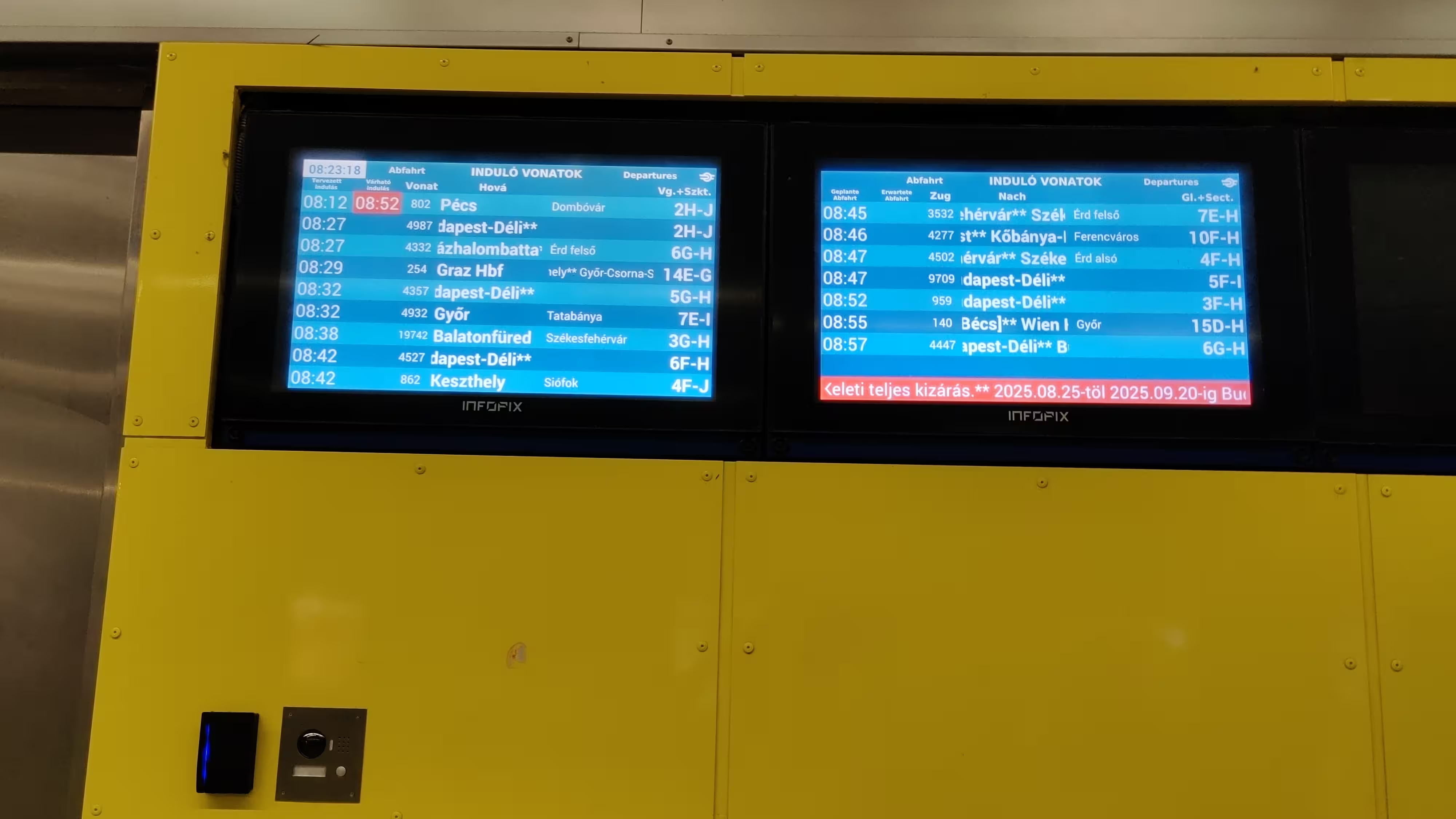
A departures board at Budapest Kelenfold station. A departures board at Budapest Kelenfold station. Photo by Ravi Dwivedi, released under CC-BY-SA 4.0.
A platform on Budapest Kelenfold station. This is platform number 15 of Budapest Kelenfold station where we boarded our train. Photo by Ravi Dwivedi, released under CC-BY-SA 4.0.
Our train arrived on time. I tried to find our coach number but could not find the numbers written anywhere on the side of the coach. Luckily, we were helped by a fellow passenger who directed me to look at the doors, where the numbers were mentioned clearly! Then we got into our compartment and took our respective seats. Our tickets were checked twice - once while the train was in Hungary and the other when in Austria. Showing the PDF of the train ticket on our mobile to the ticket inspector was good enough for the purpose. Austria and Hungary are a part of the open transit Schengen area, which means this was the extent of the border control checks we had to go through.
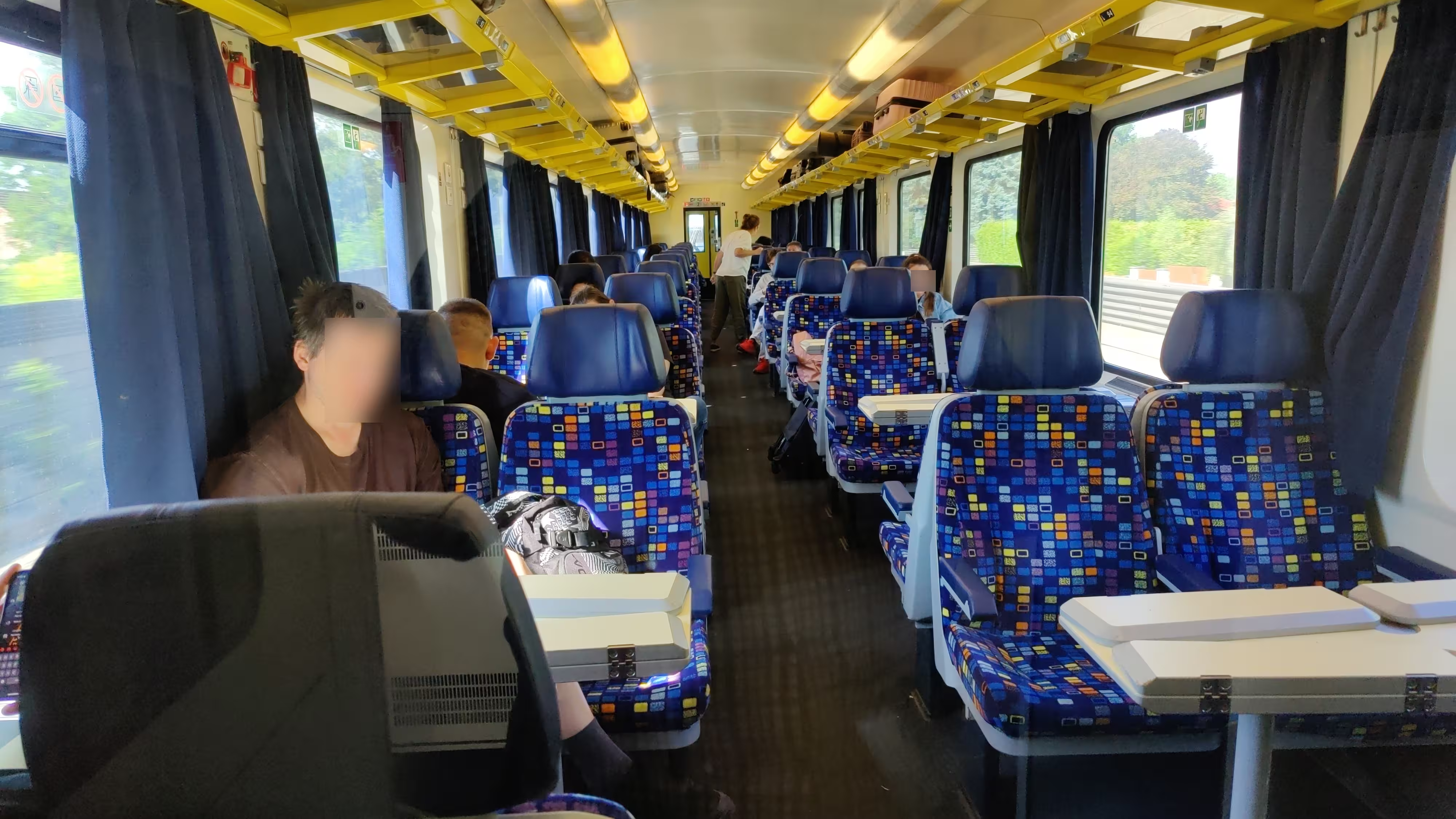
Interior of the train. Interior of our Budapest to Vienna train. Photo by Ravi Dwivedi, released under CC-BY-SA 4.0.
The train also had free Wi-Fi, albeit with poor connection at times. There were no eatery options inside the train. We deboarded at the Wien Hauptbahnhof station in Vienna. The journey was 250 km and took 2.5 hours, reaching Vienna at 11:25, which was the scheduled time.
A blue and white colored train on a railway platform This blue colored train was the one we took for our Budapest to Vienna journey. Photo by Ravi Dwivedi, released under CC-BY-SA 4.0.
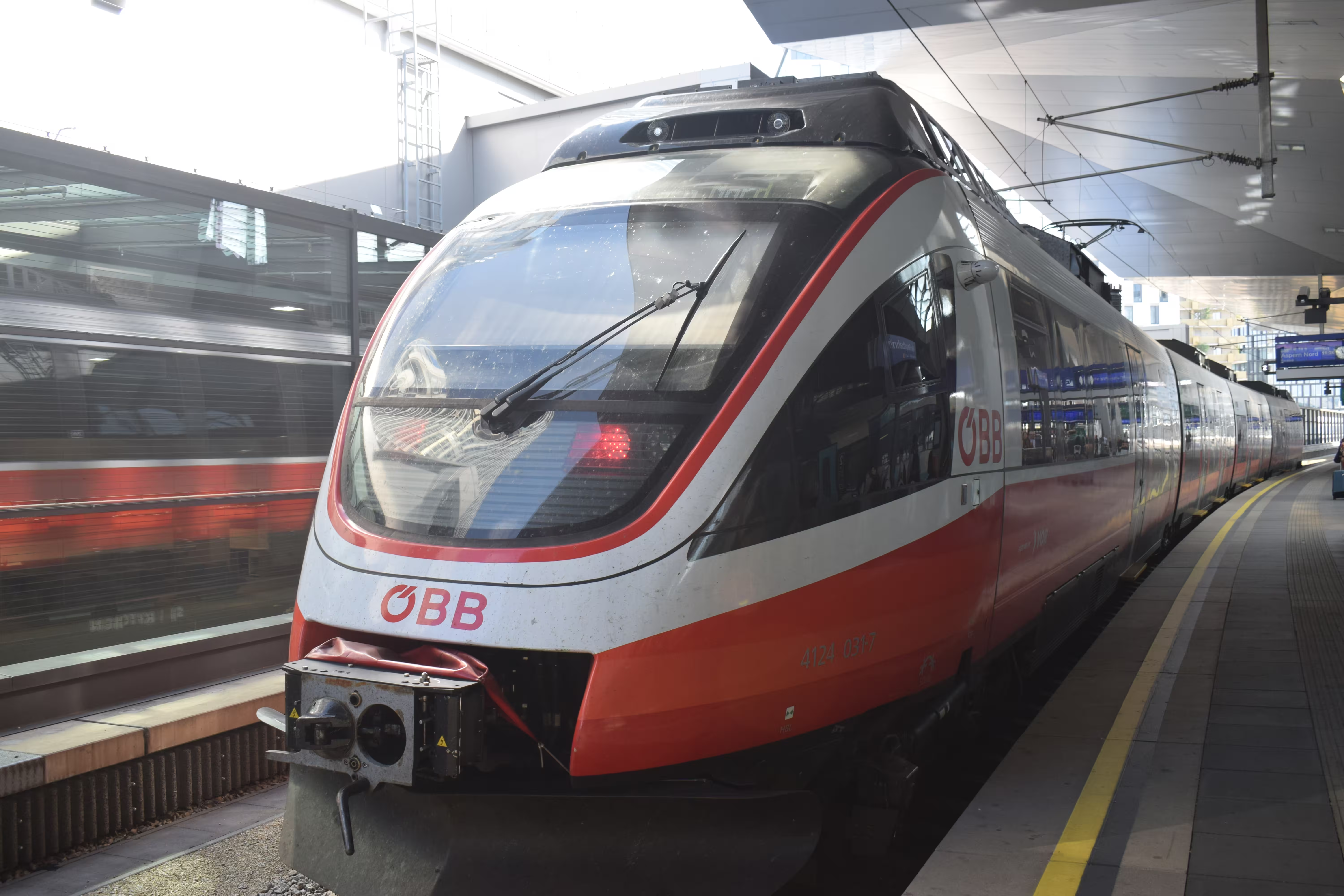
A red colored train standing at the Vienna station An BB train standing at a platform of Vienna train station. BB is the national carrier of Austria. Photo by Ravi Dwivedi, released under CC-BY-SA 4.0.
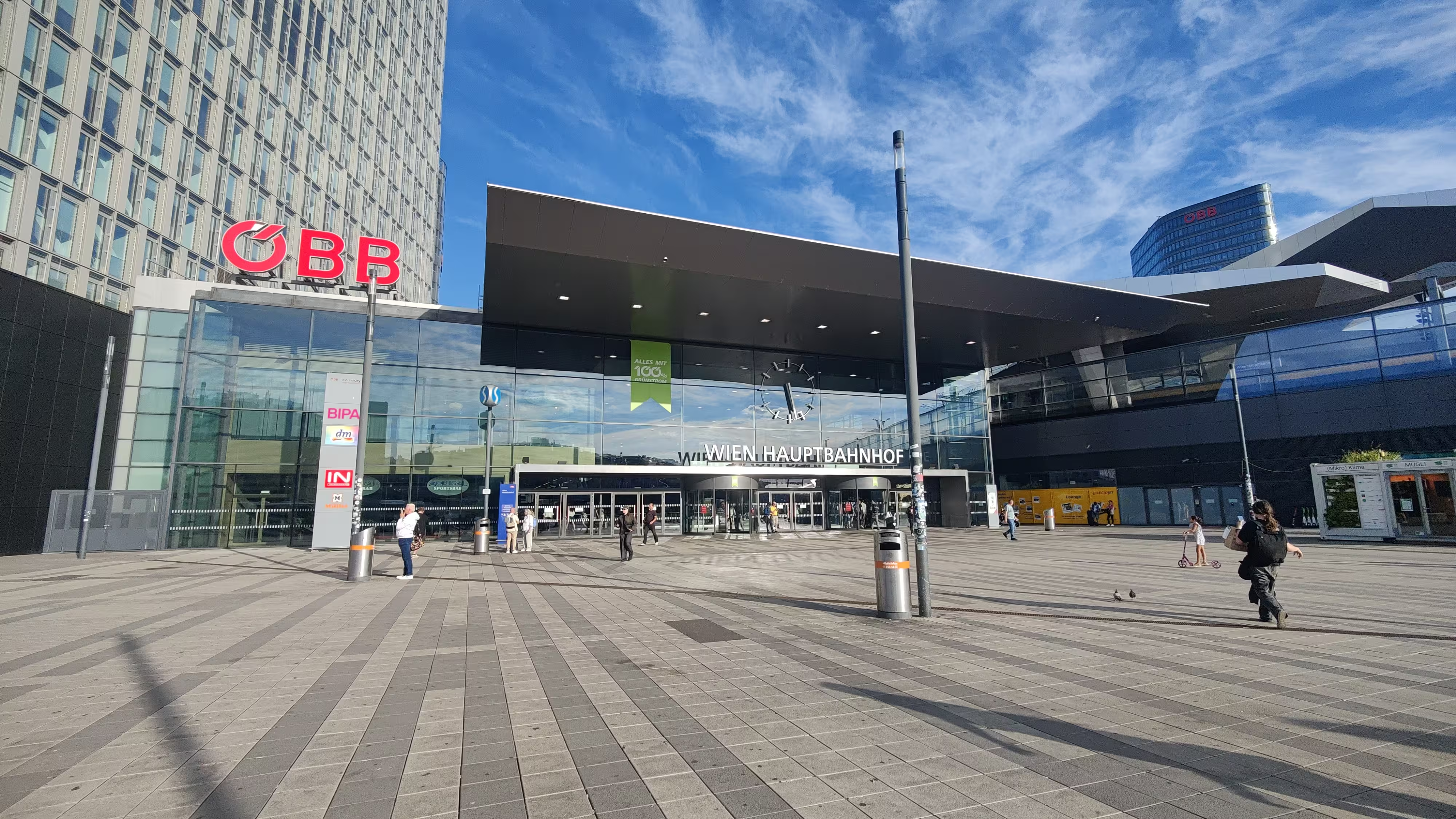
Wien Hauptbahnhof train station Wien Hauptbahnhof train station. Photo by Ravi Dwivedi, released under CC-BY-SA 4.0.
At the station, we bought a 24-hour public transport pass from a ticket machine for 8. The pass includes unlimited access to all the public transport in Vienna for 24 hours. My pass was valid from the 7th of September at 11:34 to the 8th of September at 11:33. A single public transport ticket (from anywhere to anywhere) costs 2.4. A single ticket of 2.4 can be used once on any public transport in Vienna trams, metros, and buses. Therefore, the pass is a good deal if you are going to take at least four public transport trips in a day. Unlike the public transport pass I got in Budapest, the pass in Vienna was anonymous and not tied to the rider s name.
Public transport pass for Vienna. My public transport pass in Vienna.
We wanted to visit the Sch nbrunn Palace. The palace was reachable by subway. In order to get to the subway station, we started by going outside the station. But it was not outside. So we came back inside the station building and realized that the subway was underground. We took the subway and deboarded at the Sch nbrunn subway station the closest one to the palace. The ride was smooth; the train was pretty silent. By the way, like Budapest, there were no AFC gates for boarding the subway in Vienna. The stations had ticket validators instead, where you are supposed to validate your tickets before getting into the subway.
Vienna subway Instead of AFC gates, Vienna has ticket validators as in the picture. You need to tap your ticket in the validator before boarding the subway. Photo by Ravi Dwivedi, released under CC-BY-SA 4.0.
These validators are in place to ensure that you use your ticket only once. Unlike AFC gates, which are present in metros of most of the countries I have been to, the ticket validators don t act as a physical barrier to enter the boarding area. If you board the metro without validating your ticket, you will be facing hefty fines upon getting caught. I have heard that the fine is around 100. On the other hand, if you have a public transport pass like we did, then you don t need to validate it before boarding. In addition, there were no annoying security checks either, unlike in Indian cities. In the Delhi metro, for example, you would need to scan your bags and pass through a security check before getting to the AFC gates.
Vienna subway Vienna subway. Photo by Ravi Dwivedi, released under CC-BY-SA 4.0.
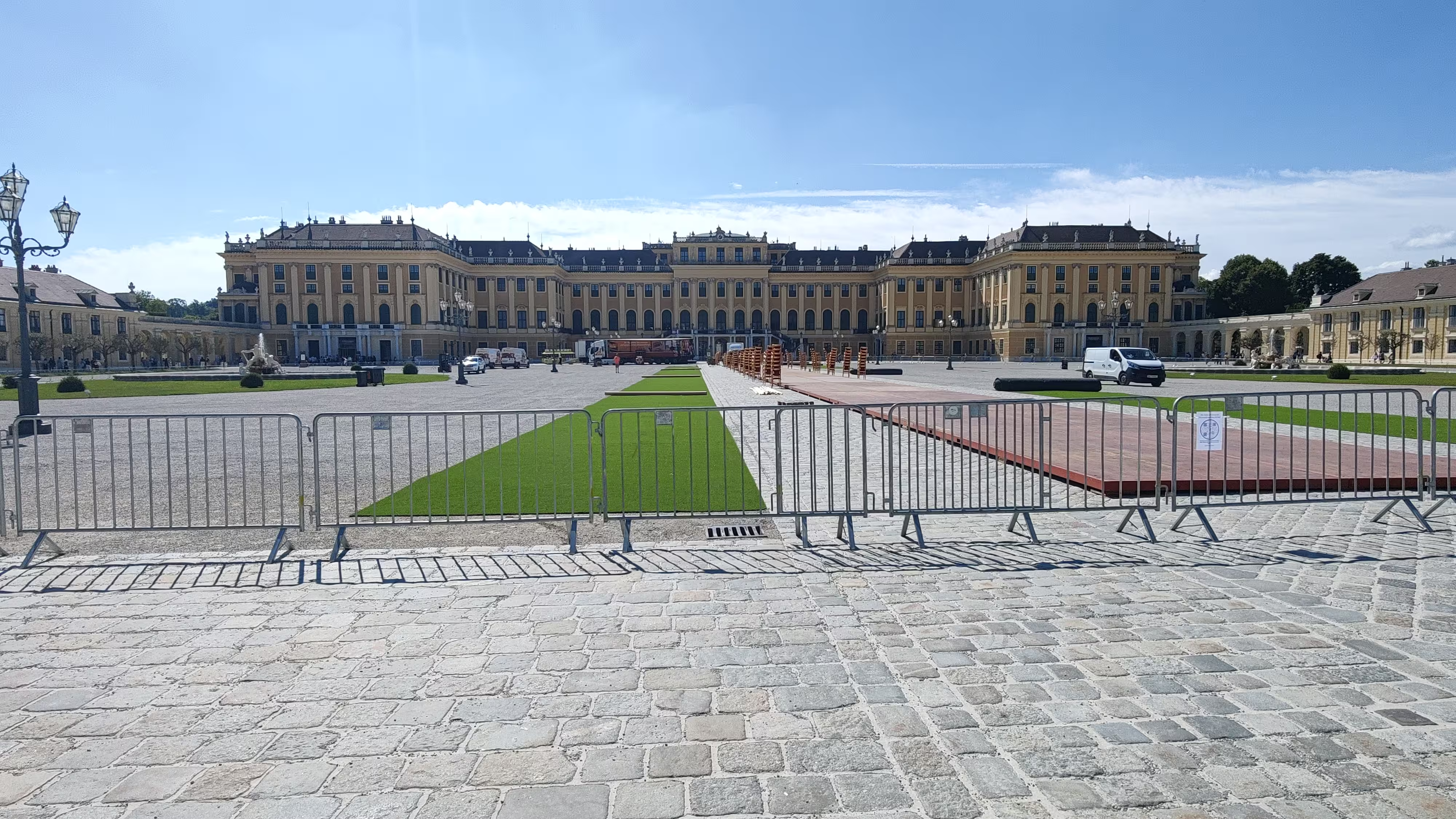
Now back to the story, after alighting at the Sch nbrunn subway station, we walked to the Sch nbrunn Palace. One can roam around outside the palace and click pictures for free. To go inside, however, requires buying tickets. The tickets for the palace can be booked in advance on the internet. We didn t take the tickets in advance, as we decided to visit the palace at the last moment. So we went to the ticket counter and found out that we needed to wait for 1 hour 40 minutes before going inside if we took the tickets at that moment. In addition, one ticket costs 44 (around 4000 Indian rupees). Since we had to return to Budapest in the evening and only had a few hours in the city, we decided not to go inside the palace. Instead, we clicked a few pictures outside the palace.
Photo of Sch nbrunn Palace. Sch nbrunn Palace. Photo by Ravi Dwivedi, released under CC-BY-SA 4.0.
The Sch nbrunn Palace is a UNESCO World Heritage Site and is a historically significant place. It servedas one of the residences of the powerful Habsburg dynasty. The palace looked so good that my friend Dione said, It seemed like the palace was built yesterday . This remark applied to other parts of Vienna we went to. For example, the subway stations also seemed like they were built yesterday.
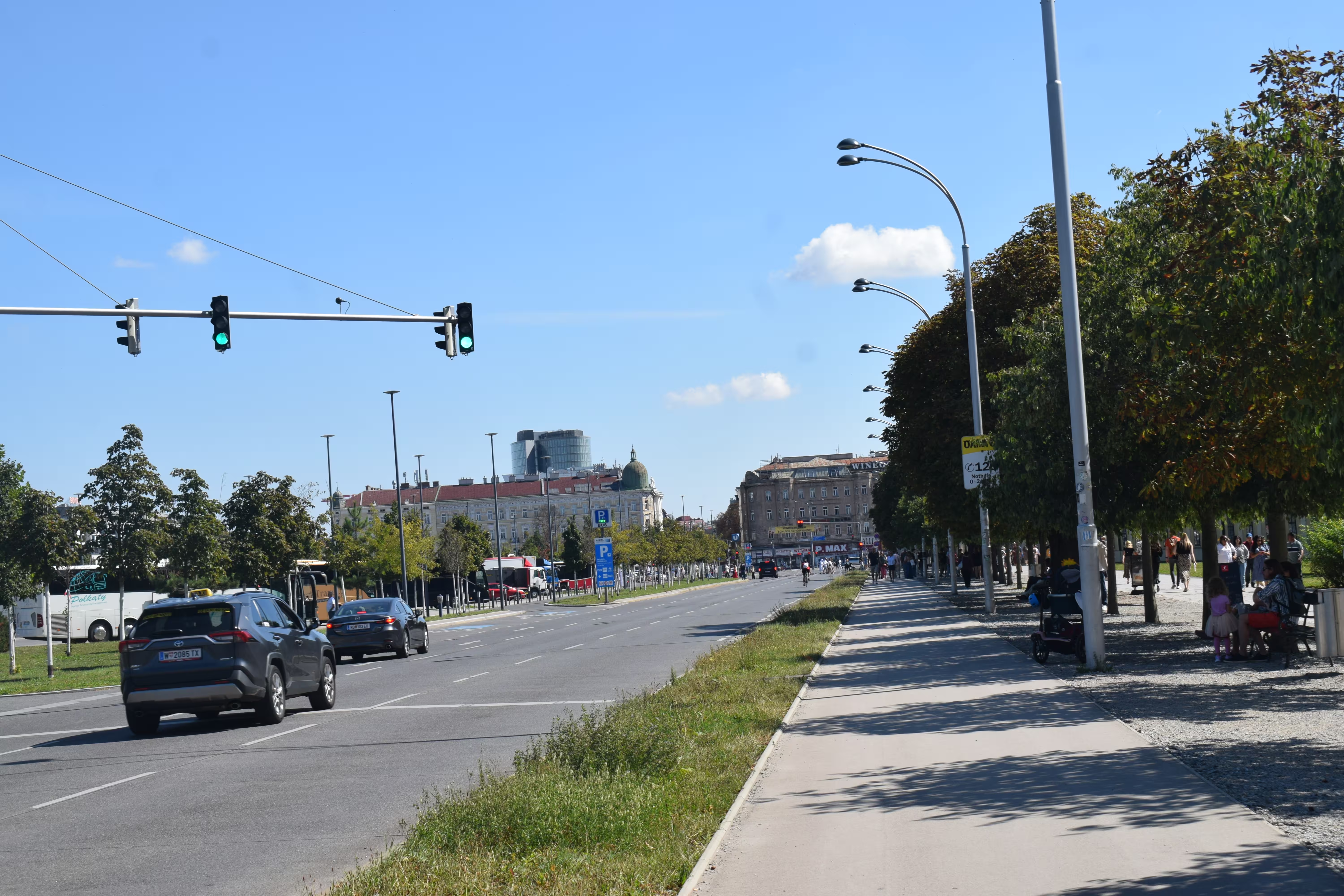
A street near Sch nbrunn Palace. A street near Sch nbrunn Palace. Photo by Ravi Dwivedi, released under CC-BY-SA 4.0.
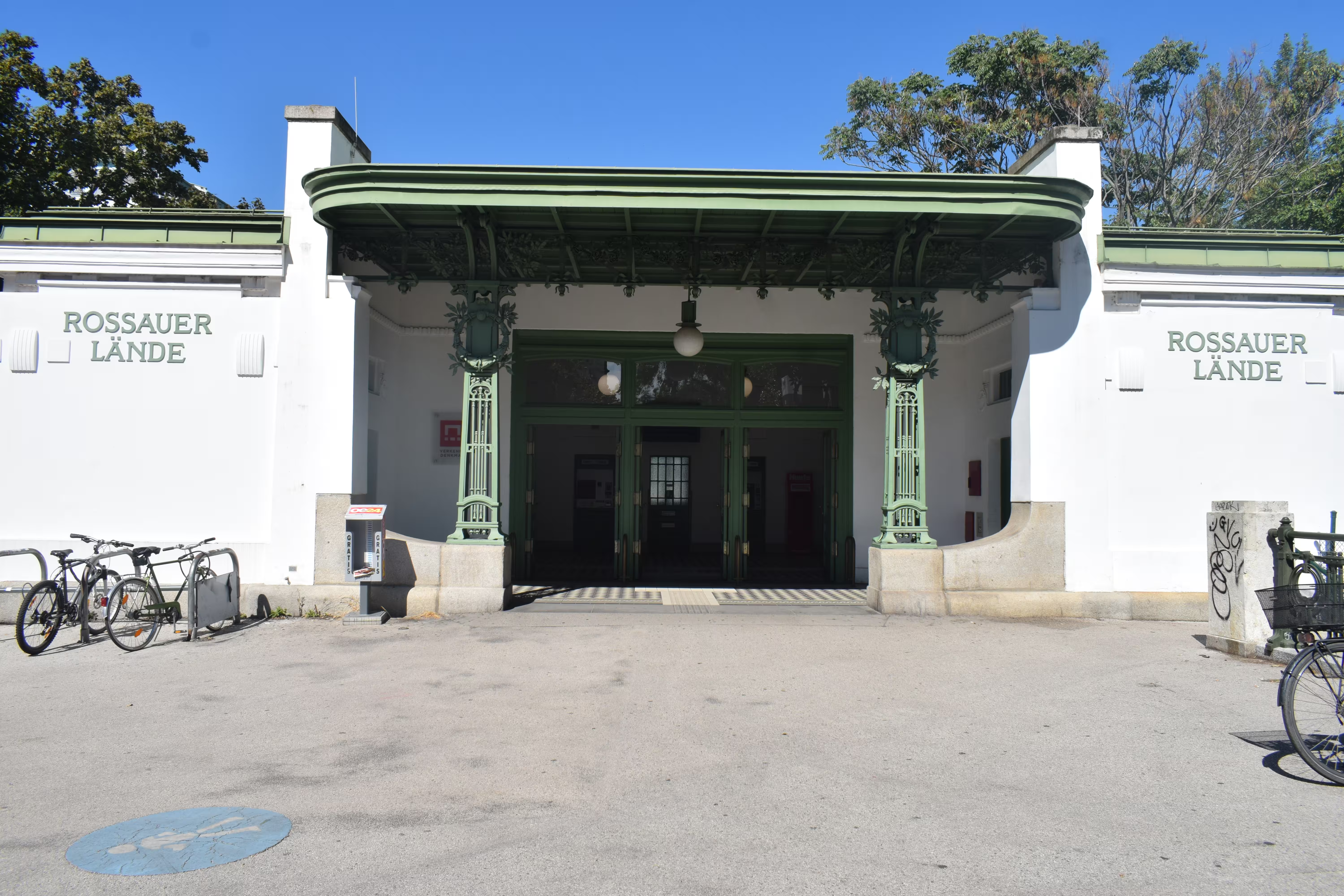
Now, we wanted to go someplace to grab a bite. I asked my friend Urbec for suggestions on where to go. They suggested we visit the steps named Strudlhofstiege, which had the added benefit of being in a neighborhood with good bakeries and buildings. So, we took the subway and deboarded at the Ro auer L nde station, followed by walking around a kilometer to reach the stairs.
A subway station in Vienna. Ro auer L nde subway station. Photo by Ravi Dwivedi, released under CC-BY-SA 4.0.
Platform of the _Ro auer L nde_ subway station. Platform of the Ro auer L nde subway station. Photo by Ravi Dwivedi, released under CC-BY-SA 4.0.
stairs with road in the front and trees in the background. Blue sky can also be seen in the background. The The Strudlhofstiege steps. Photo by Ravi Dwivedi, released under CC-BY-SA 4.0.
On the way, we were also looking for a place to eat. Unfortunately, it was Sunday, and Vienna closes on Sunday. That means most of the shops including bakeries and caf s are closed. Only places like railway stations have shops open on Sundays. By the way, walking around in the streets of Vienna was a treat. The streets were not crowded (as it was not exactly a touristy neighborhood) and had good pedestrian infrastructure, with clean streets and separate cycling tracks. The buildings were also beautiful.
Buildings and streets in Vienna. A random street in Vienna.
Buildings and streets in Vienna. Another street in Vienna.
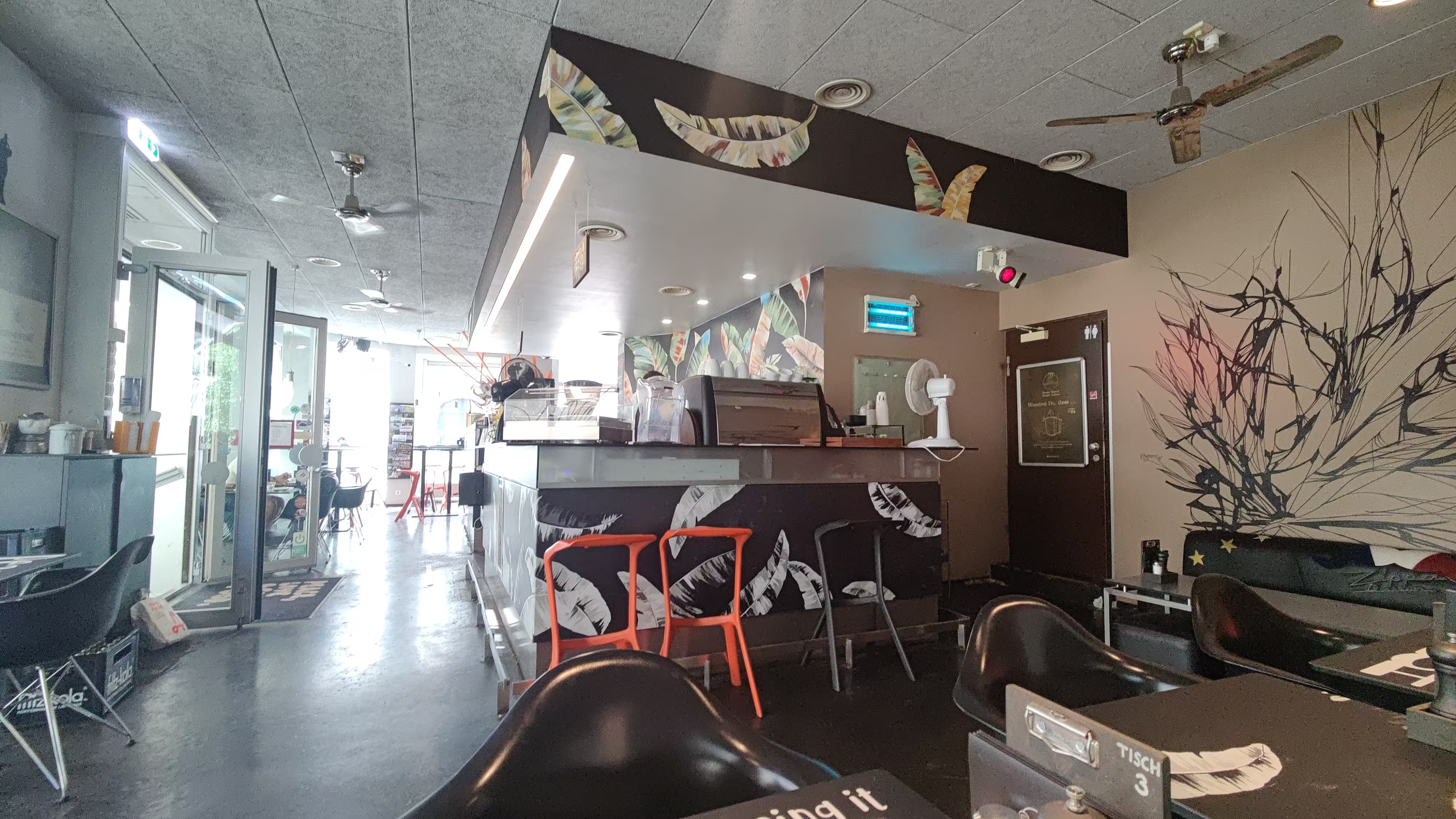
After some walking, we found a restaurant open. I grabbed the menu to check the prices. A lady at the shop asked me what I was doing, and I told her that I was browsing the menu. She said that the menu was in German. I don t know how she knew that we didn t know German, but it seemed like a racist thing to be told. We roamed around further and found a caf by the name of Blue Orange, where we ordered coffee and croissants. When we got our order, the waiter told us that they were having some issues, so they wouldn t charge us for the croissant if it wasn t good.
Picture of a caf . A picture of Blue Orange caf . Photo by Ravi Dwivedi, released under CC-BY-SA 4.0.
My friend and I took a bite, and both of us didn t like the croissant. After some time, the waiter came to us and asked whether the croissant was okay, to which we said no. Therefore, they didn t charge us for the croissant. This was the first time something like this happened to me. It felt like I was in a different world. I added a small tip at the end for this gesture, which I had to put in a jar at the counter. The cappuccino I ordered was 4.50, while the espresso that Dione ordered was 3.60. The croissant would have been 3.60. I remember Paris having cheaper croissants! Then when the waiter brought our drinks out, they automatically gave me the espresso and Dione the cappuccino. Dione found this funny because there is a stereotype in her country (Australia) that men drink strong black coffee, and women drink milky drinks like cappuccinos. She found it interesting that this stereotype seems to exist in Austrian culture too. We hopped on a tram to reach the nearest subway station and went to the Wien Hauptbahnhof station to have something before we caught our return train to Budapest.
Trams with buildings and the blue sky in the background Trams in Vienna. Photo by Ravi Dwivedi, released under CC-BY-SA 4.0.
At the station, I had Esterhazyschnitten and Punschkrapfen (thanks, Urbec, for the suggestion). The lady at the shop warned me that punschkrapfen had alcohol in it, to which I said okay. Esterhazyschnitten was a cake made of almonds, while punschkrapfen was a jam-filled sponge cake, soaked in rum. Esterhazyschnitten was my favorite out of the two. The punschkrapfen was too sweet for my taste.
Punschkrapfen Punschkrapfen. Photo by Ravi Dwivedi, released under CC-BY-SA 4.0.
Esterhazyschnitten Esterhazyschnitten. Photo by Ravi Dwivedi, released under CC-BY-SA 4.0.
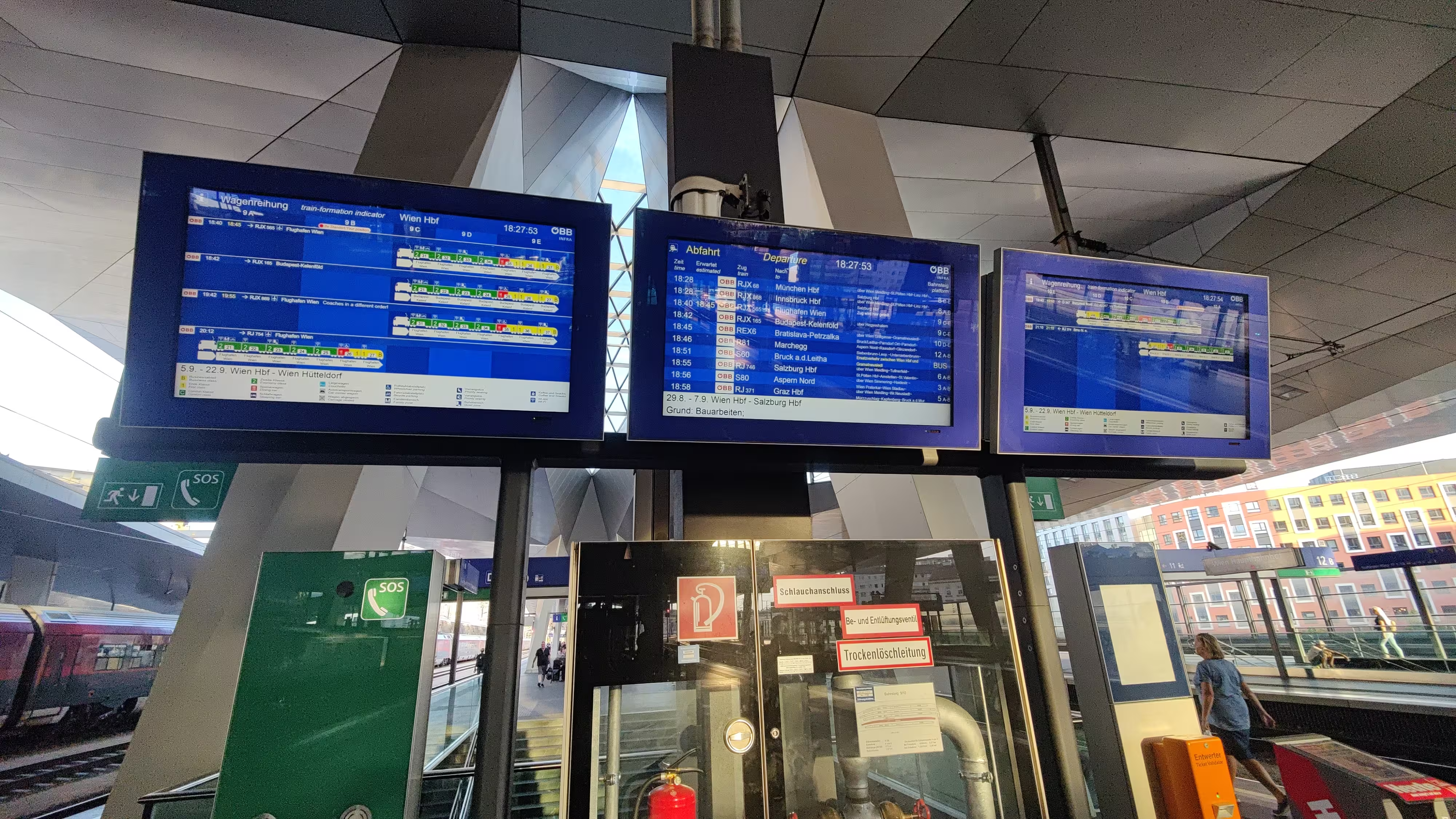
While the station was well-built, there were a couple of things about the Wien Hauptbahnhof station that we didn t like. There were no seats inside the station, so we had to eat outside the building. Also, the toilets needed to be paid for. It costs 50 cents to use the toilets at this station. The Vienna train station had departure boards all over the place. So, we went to the platform our train was to arrive on.
A departure board in Vienna displaying information about the trains Departure boards in Vienna displaying information about the trains. Photo by Ravi Dwivedi, released under CC-BY-SA 4.0.
Platform and tracks at Wien Hauptbahnhof station. Platform and tracks at Wien Hauptbahnhof station. Photo by Ravi Dwivedi, released under CC-BY-SA 4.0.
When our train arrived, we had some difficulty locating our compartment. This train was operated by a different company (Railjet) than the one we took in the morning (Eurocity) from Budapest to Vienna, and we were able to locate the coach numbers using the digital board at the station. Each compartment had a digital board next to it on the station displaying the coach number. However, that wasn t the problem. Even after reading the coach numbers and trying to find ours, it didn t appear where we expected in the sequence. When we were not able to find our coach for a while, we asked a ticket inspector of the train who was standing on the platform. He directed us towards the front side of the train. So we started running to the front side as we didn t know how long the train stops. As we ran toward our coach, we found out that the engine of the back train was connected with the last compartment of the train at the front. At that point, we realized that the train was a combination of two trains. At a later station, the train on the back side parted ways and went towards Vienna Airport.
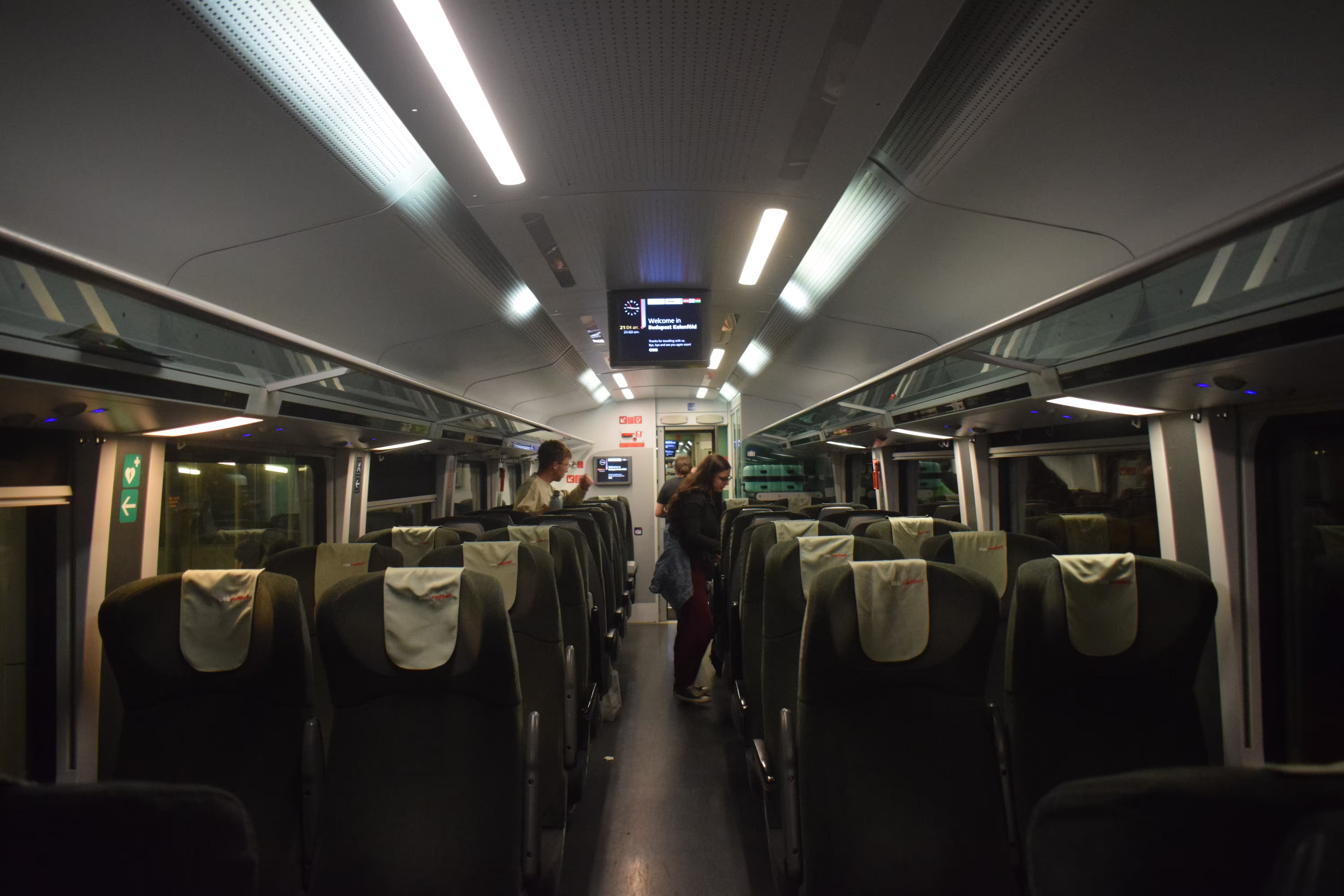
Inside our train. Interior of the train we took from Vienna to Budapest. Photo by Ravi Dwivedi, released under CC-BY-SA 4.0.
A red colored train standing on the platform of Budapest Kelenfold station. This is the train we took for our return journey from Vienna to Budapest. It is standing on a platform in Budapest Kelenfold station. Photo by Ravi Dwivedi, released under CC-BY-SA 4.0.
We had a smooth journey and reached Budapest a couple of hours later. Vienna is a beautiful city; we enjoyed being there, and we would like to visit the city again! That s it for now. Signing off. See you in the next one! Credits: Thanks to Dione and Badri for proofreading.

27 April 2026

Sahil Dhiman: Weekly Notes

Weekly notes is a genre where people chronicle their week on their blogs. Weekly notes are like a window. I love going through these, as they re a steady stream of week on week happenings and progress in people s lives. It shows people making efforts to improve: from basic things like learning to swim or drive, to planning long-term goals such as vacations, moving house, states, or even countries. In some cases, they carry internal monologues, thoughts, and anxieties. These are like a constant nudge for me to work on myself, like them. These are the weekly notes I read nowadays: Most are there on Thejesh s weekly notes planet which autoupdates when new posts arrive, usually starting on Friday evenings, and by Monday, almost everyone has posted. It reminds of a word from The Dictionary of Obscure Sorrows - Kenaway :
the longing to see how other people live their lives when they re not in public; wishing you could tune in to the raw feed of another human existence, in all its messiness and solitude shimmying in place while brushing their teeth, squabbling over where to put the shoes, talking out their problems on solitary commutes if only to give you something to compare your own life against, and figure out whether you re bizarrely normal or normally bizarre.
Close enough.

Russ Allbery: Review: What We Are Seeking

Review: What We Are Seeking, by Cameron Reed
Publisher: Tor
Copyright: 2026
ISBN: 1-250-36474-4
Format: Kindle
Pages: 339
What We Are Seeking is a bit hard to classify beyond science fiction. I think I would call it anthropological science fiction, but it's also a first contact story and a planetary colony story. It is a standalone novel (well, so far as I know; see later in the review for caveats). This is Cameron Reed's second novel after the excellent and memorable cyberpunk novel The Fortunate Fall, first published in 1996 under Reed's former name of Raphael Carter. John Maraintha is a doctor from the world of Essius. He took what he thought was a temporary job on the Free Ship Edgar's Folly, where he's endured considerable culture shock. As the novel opens, John learns that the colonists on Scythia have requested a translator to talk to one of the native life forms, and a doctor since they're down to only one. John will be that doctor. The captain has decided, and by the rules of the free ships, John does not get a choice in the matter. The Scythian colony is about four hundred people, now located in a desert climate since the complex native life forms destroyed their previous settlement. The colonists are a split between Ischnurans and Zandaheans, two other human civilizations from the scatter of colony worlds left after Earth embraced AIs (aiyis here) and turned inward. Both of those groups marry, something John considers a moral abomination. Neither of them seem likely to understand Essian sexual ethics. More devastatingly, John had intended to spend some time as a ship doctor and then return home to a new place in Essian society. Once he lands on Scythia, the chances of that are gone; it is highly unlikely any ship would pick him up again and take him home. I have been trying to find the right books to compare What We Are Seeking with ever since I read it. The best I've come up with are Ursula K. Le Guin (particularly The Dispossessed), Eleanor Arnason's A Woman of the Iron People, and Becky Chambers's To Be Taught, If Fortunate. The start of the book felt like an intentional revisiting of an earlier era of science fiction, with somewhat updated science and politics, but the last half of the book, where the action picks up considerably, is a meditation on gender, social systems, religion, and small-group politics. All of that is mixed with biological exploration and a first-contact story with some quite-alien aliens. This is the sort of novel where the protagonist's culture is as foreign to the reader as any of the other cultures he counters, so the reader is assembling several jigsaw puzzles at once. John is dropped into an established colony with its own social norms and established hierarchies. The one other outsider, the translator Sudharma Jain, is, as his name implies, a Jain who keeps very strict religious observances. Half of the colony is from something akin to a fundamentalist Christian religious sect that practices patriarchy and strict marriage codes. The other half is more gently sexist (but still sexist) and has its own tradition of a third gender that becomes central to the story. John, meanwhile, is a strong believer in the Essian approach to social organization: Any two partners of any gender freely have sex by mutual consent and without obligation, and family is based solely on blood relations. These beliefs do not fit comfortably together, even when people are trying (as they mostly do) to be welcoming. The first half of this book is very slow. This gives all of the characters space to breathe and become comfortable, and the characterization is superb, but it is a book to start when you're in the mood for something slow and observational. There is a plot that gradually becomes apparent, or rather there are several plots that are intertwined, but tension and urgency are mostly reserved for the second half of the book. Instead, the book opens with a lot of close observation of alien flora and fauna and the untangling of subtle social dynamics among the Scythians. There is also a visitor from earth, much to the distress of the Scythians. Earth presence means the ships will not return and the colony may be cut off from any sort of technological resupply. Despite speaking a common language, that visitor is as mutually alien to the other groups as they are to the native flora. Her life is fully integrated with aiyis, giving her essentially godlike powers and the ability to turn off inconvenient emotions and disregard anything she doesn't want to see. What she and the Earth aiyis are doing on the planet is one of the early mysteries. The dialogue in this book is truly excellent. Each characters has their own voice, there are fascinating digressions on different words that lead to tidbits of world-building, and some of the culture-specific idioms are delightful.
"I'm making a mess of this. None of that matters. Let me fall out the window and come in the door again. This is how my story ought to start:"
The challenges for the characters in this story are slow but deep ones: belonging and self-definition, the conflict between cultural tradition and personal circumstance, and the sacrifices required to live with small groups in situations where civil war is viscerally attractive. It has one of the most comprehensive and fascinating treatments of transgender issues that I've read in science fiction. Its commentary on current politics is subtle and estranged in the way that science fiction does best, but still pointed and satisfying. And, well, there are passages like this that I absolutely adore:
"I wouldn't go that far. It could be they are right, the universe we see exists because a mind like ours created it at least, a mind enough like ours that we can say it wants one thing and not another, and when it acts it does so with intent. That's as good an idea as any. But it is certainly not plausible that such a being believes that people everywhere should marry, or that men should never visit men, or no one should become a jess. Look at what they have created. The universe could have been nothing at all, or one atom of hydrogen floating in a void, or a diamond crystal infinite in all directions, if their mind cared for simplicity or tidiness. Instead we have stars and planets and black holes and nebulas. It could have all been cold and dead, but there is life. They could have made one species for each world, or just a few, which could have stayed the same forever, but instead we have millions and millions, all of which are changing every moment, varying among themselves and boiling off in all directions. Such a god is like an artist who fills up a library of sketchbooks with their drawings of strange creatures, and when every scrap of paper in the place is used up, goes back with a different color ink and scribbles over them again. They are obsessed with variation they gorge themselves with it and never grow full. Do you really think a mind like that could want us all to live in the same way?"
I had one problem with this book, though, and for me it was a big one: There is no ending. Reed effectively builds tension, gets me caring about all of the characters, sets up several problems, starts down a path towards resolution, and then the book just... ends. Long-time readers of my reviews will know that I'm a denouement fanatic. I want the scouring of the shire, I want the chapter set in the happily ever after, I want the catharsis of an ending. This made me so grumpy! To be clear, this is not sequel bait (at least so far as I can tell). I can write a philosophical defense of the ending. The types of problems and lives that Reed set up don't have clear endings; this is, to some extent, the point. We muddle through, and then those who come after us muddle through some more, and the cumulative effect is called human civilization. And there is some denouement; Reed doesn't leave the reader at a cliffhanger or anything that egregious. But still, I wanted the happy ending, even though that was unrealistic for the style of story this is, because I'm a happy ending reader. This is not an ending sort of book; it's the sort of book where I get a sinking feeling at the 95% mark because there aren't enough pages left for the number of remaining unresolved problems. I've gotten less annoyed in the days since I finished the book, and I can appreciate the thematic point made by how the book ends, but I still feel like it's worth an advance warning if you're a reader like I am. I would be delighted by a sequel, but it didn't feel like that was the intent. Apart from that, this was both excellent and rather unlike a lot of current science fiction. I think the closest comparison I can make among recent novels I've read is Sue Burke's Semiosis. What We Are Seeking has a similar sort of world-building, but I liked these characters so much more. It felt like a classic literary science fiction novel, but very much written in 2026. Highly recommended, just beware of the lack of closure. Content notes: Sexism, homophobia, stomach illness, and some religious abuse. Rating: 8 out of 10

24 April 2026

Freexian Collaborators: Monthly report about Debian Long Term Support, March 2026 (by Santiago Ruano Rinc n)

The Debian LTS Team, funded by [Freexian s Debian LTS offering] (https://www.freexian.com/lts/debian/), is pleased to report its activities for March.

Activity summary During the month of March, 20 contributors have been paid to work on Debian LTS (links to individual contributor reports are located below). The team released 24 DLAs fixing 250 CVEs. We also welcomed two new members: Lukas M rdian and Emmanuel Arias to the team, who actually started to contribute to the LTS project several months ago. The team continued preparing security updates in its usual rhythm. Beyond the updates targeting Debian 11 ( bullseye ), which is the current release under LTS, the team also proposed updates for more recent releases (Debian 12 ( bookworm ) and Debian 13 ( trixie )), including Debian unstable. We highlight several notable security updates here below.
  • ansible (DLA 4502-1), prepared by Lee Garret in collaboration with Jochen, fixing a vulnerability that allows attackers to bypass unsafe content protections
  • asterisk (DLA 4515-1), prepared by Lukas M rdian, fixing four CVEs that include possible privilege escalations.
  • gimp (DLA 4500-1), prepared by Thorsten, fixing four CVEs related to denial of service or execution of arbitrary code.
  • gst-plugins-base1.0 and gst-plugins-ugly1.0 (DLA-4514-1, DLA-4516-1, respectively), both prepared by Utkarsh, addressing vulnerabilities that may yield to arbitrary code execution.
  • imagemagick, released by Bastien Roucari s (DLA 4497-1) fixing multiple vulnerabilities that could lead to information leaks, bypass of security policies, denial of service or arbitrary code execution.
  • libpng1.6 (DLA 4521-1), prepared by Tobias Frost, fixing an arbitrary code execution vulnerability
  • linux: Ben Hutchings released DLA 4498-1 and DLA 4499-1 for linux 5.10 and linux 6.1, respectively. Those updates especially address the CrackArmor flaw.
  • ruby-rack (DLA 4505-1), prepared by Utkarsh Gupta, addressing two vulnerabilities
  • strongswan (DLA 4512-1), prepared by Thorsten Alteholz, fixing a Denial of Service vulnerability
  • roundcube (DLA 4517-1) prepared by Guilhem Moulin, who discovered that one of the fixes provided by upstream was incomplete.
Contributions from outside the LTS Team: As usual, the thunderbird update, released as DLA 4511-1, was prepared by its maintainer Christoph Goehre. Thanks a lot for his continuous contributions. The LTS Team has also contributed with updates to the latest Debian releases:
  • Andreas Henriksson completed the uploads of glib2.0 for both trixie and bookworm
  • Arnaud Rebillout: python-cryptography for trixie
  • Arnaud and Bastien worked together to prepare a ca-certificates-java release for unstable
  • Bastien completed the upload of gpsd for trixie that was proposed in January.
  • Bastien uploaded a regression update of apache2 for trixie
  • Bastien prepared a zabbix point update for trixie
  • Bastien in collaboration with Markus released netty updates for trixie and bookworm DSA 6160-1
  • Daniel Leidert proposed python-tornado releases for both trixie and bookworm.
  • Daniel also prepared a python-authlib update for trixie
  • Guilhem prepared a mapserver update for bookworm.
  • Lucas Kanashiro proposed merge requests to fix three CVEs in erlang for both trixie and bookworm
  • Sylvain Beucler continued the work to replace p7zip with 7zip in the different supported releases, and proposed a point update for bookworm
  • Tobias prepared trixie and bookworm security updates, released as DSA-6189-1
  • Utkarsh prepared trixie and bookworm security update for ruby-rack, released as DSA-6180-1

Individual Debian LTS contributor reports

Thanks to our sponsors Sponsors that joined recently are in bold.

21 April 2026

Dirk Eddelbuettel: RcppArmadillo 15.2.6-1 on CRAN: Several Updates

armadillo image Armadillo is a powerful and expressive C++ template library for linear algebra and scientific computing. It aims towards a good balance between speed and ease of use, has a syntax deliberately close to Matlab, and is useful for algorithm development directly in C++, or quick conversion of research code into production environments. RcppArmadillo integrates this library with the R environment and language and is widely used by (currently) 1263 other packages on CRAN, downloaded 45.7 million times (per the partial logs from the cloud mirrors of CRAN), and the CSDA paper (preprint / vignette) by Conrad and myself has been cited 683 times according to Google Scholar. This versions updates to the 15.2.5 and 15.2.6 upstream Armadillo releases from, respectively, two and five days ago. The package has already been updated for Debian, and built for r2u. When we ran the reverse-dependency check for 15.2.5 at the end of last week, one package failed. I got in touch with the authors, filed an issue, poked some more, isolated the one line that caused an example to fail and right then 15.2.6 came out fixing just that. It was after all an upstream issue. We used to ran these checks before Conrad made a release, he now skips this and hence needed a quick follow-up release. It can happen. The other big change is that this R package release phases out the dual support for both C++14 or newer (as in current Armadillo) along with a C++11 fallback for more slowly updating packages. I am happy to say that after over eight months of this managed transition (during which CRAN expulsed some laggard packages that were not moving in from C++11) we are now at all packages using C++14 or newer which is nice. And I will take this as an opportunity to stress that one can in fact manage a disruptive API change this way as we just demonstrated. Sadly, R Core does not seem to have gotten that message and rollout of this package was also still a little delayed because of the commotion created by the last minute API changes preceding the R 4.6.0 release later this week. Smaller changes in the package are a switch in pdf vignette production to the Rcpp::asis() driver, and a higher-precision computation in rmultinom() (matching a change made in R-devel during last week in its use of Kahan summation). All detailed changes since the last CRAN release follow.

Changes in RcppArmadillo version 15.2.6-1 (2026-04-20)
  • Upgraded to Armadillo release 15.2.6 (Medium Roast Deluxe)
    • Ensure internally computed tolerances are not NaN
  • The rmultinom deploys 'Kahan summation' as R-devel does now.

Changes in RcppArmadillo version 15.2.5-1 [github-only] (2026-04-18)
  • Upgraded to Armadillo release 15.2.5 (Medium Roast Deluxe)
    • Fix for handling NaN elements in .is_zero()
    • Fix for handling NaN in tolerance and conformance checks
    • Faster handling of diagonal views and submatrices with one row>

  • Sunset the C++11 fallback of including Armadillo 14.6.3 (#504 closing #503)
  • The vignettes have refreshed bibliographies, and are now built using the Rcpp::asis vignette builder (#506)
  • One rmultinom test is skipped under R-devel which has switched to a higher precisions calc
Courtesy of my CRANberries, there is a diffstat report relative to previous release. More detailed information is on the RcppArmadillo page. Questions, comments etc should go to the rcpp-devel mailing list off the Rcpp R-Forge page.

This post by Dirk Eddelbuettel originated on his Thinking inside the box blog. If you like this or other open-source work I do, you can sponsor me at GitHub. You can also sponsor my Tour de Shore 2026 ride in support of the Maywood Fine Arts Center.

16 April 2026

Sahil Dhiman: What is Life (to you)?

It started with a thought: to understand people s perspectives on life and its meaning. So I texted folks, What is life (to you)? . Each of the following list items (-) is a response from a different individual, mostly verbatim.
- A lot
- Everyone has a few universal basic qualities, and some special qualities. To me life is pursuit of exploring world based on those qualities and maturing those qualities as one goes on about exploring world/life with those qualities.
Discovering and enhancing experiences as one goes through them.
- life is endless suffering
- my answer might change daily, but this is what I ve noticed and feel recently. Life is a spectrum with two distinct ends: what we control and what we don t. At birth, the spectrum is largely tilted toward control, but throughout our lives, it gradually shifts toward the other side. Ultimately, as we approach death, we lose all control over any aspect of our existence, reaching the other end of the spectrum.
tho this isn t universal, privilege plays a huge part in what you control tho i believe it holds true for the majority
but yeah man, meaning and purpose are dynamic, it s in their nature to change i can give you a different answer this evening itself xD
- Funeral Monologue from Synecdoche, New York. https://www.youtube.com/watch?v=Z9PzSNy3xj0
- Zindagi ek nadiya hai, Aur mujhe tairna nahi aata
(translation - Life is a river, and I don t know how to swim)
On a more serious note, Life is what you make it out for yourself. The only established truth is that it will end. We can never know if there is something after or if there was something before. So try to live a life that you feel aspired by? But this question was beautifully answered by that book which you had about that dying professor
(Me - He was talking about Tuesday s with Morrie)
- My answer is 42
- One, it s living on your own terms, you define everything for yourself, success, normal, whatever. You get to curate your version of it no matter the societal norms.
It s an accumulation of experiences - friends, parents, work, activities, doing shit loads. Sab try karo- travel, zumba, art, music, workout, sports, dil kara ye karna hai karlo. (translation - If your heart wants to do it, just do it.)
Then I think relationships - all that you ve nurtured, people forget maintaining people because of work. It takes efforts to keep people in your life, everyone that comes has a place in yours, how well thats stays is upto you. You also get to curate your people, who stays who don t. Family toh hai hi (translation - family is there) but everyone else that comes along can make it pretty good.
So I don t want to be 50 and be like chalo ab kuch apne liye karte hai (translation - Come on, now let s do something for ourselves) Do whatever shit you want today. Not everything costs money, and if it does get thrifty
But do keep healthy while doing all of that
- Being alive so that my daughter can grow up and i can help raising her kids as well. Raising kids without mother is tough :P
- Definitively, I feel like Life is a by product of proteins and energy working together. But in a more personal sense, Life is a dumb joke played onto us. It s a rat race. But rats exists because of life and then it becomes a chicken-egg problem
Honestly, I don t give good answers to life questions. I m generally the one asking
Life can be like a box of chocolates, you don t know what you re gonna get untill you experience the chocolate(assuming the chocolates are heterogenous and contains a mix of everything)
Camus once said, Life is a revolt , and one of his students added more spice to it like Life is a revolt against the meaninglessness of existence"
I kinda feel like Life is the pursuit of every person s search for meaning
- Imprisonment waiting for execution
I have one more thought while we are on the topic , game with pre defined starting position and predefined destination , path to reach is a maze
- A phase where you can have a really good time or really bad one, usually the mix of both. A phase where you are prisoner to responsibility and materialistic wants.
It s a hell for you, where you try to create heaven for others. Being born was never your choice, but ending is always in your hands but you are a prisoner. You fear that leaving this world behind will destroy the heavens you created for others and they will be back to hell. But eventually everyone moves on watching the hourglass of their life.
Once you are left with no desires or no one to create heavens for, you look arround yourself. You see everyone chasing something, everyone scared of their limitted life time sliping away yet you want it to end sooner.
Doesn t matter if it was all good till now, or all bad. The other half is waiting for redemption. If it was all good, it s best time to die don t wait for the bad to start. If was all bad, it s still the best time to die what if it was the good one and more worst is waiting for you. We desire to be remembered, yet we want to free from this loop of suffering.
Someone once said, life is a suffering, chose your sufferings.
- Life to me is to live without regrets and live with freedom.
Life is always unpredictable and this unpredictability makes it more interesting and worth it.
- As of now, for the state of mind that I am in , I think for me life is about subtle struggle, subtle inconveniences and yet moving forward cause that s all I know.
I am not sure if any of this has any meaning, but sometimes I feel I was born of a purpose and that the universe has my back.
For me it s about raising my consciousness, understanding people to their depths, gaining moderate material success and helping people to some extend.
I have tried to seek a grander meaning but I have failed.
Life for me is what I make out it.
In my times of great success i rarely think about life for I am busy enjoying it, whatever you may call that state of mind.
- For me its the little things that you enjoy with YOUR people
- Life to me is about living and loving, and doing it in a way that sustains. It s the people who shape you, the work you get absorbed in, the quiet moments in between. There s also the wanting, the drive to figure out what s worth going after and how to get there, but that s just one part of it, not the point of it. And none of it happens in a vacuum. I m aware of the privileges that let me live this way, and I try to hold on to that gratitude. In the end, life has both a material and a non-material side, and a lot of what we do is chasing material things in an attempt to satisfy something non-material within us
- Mere liye (translation - for me) life is staying at my home and studying random economics papers. That s when I enjoy myself the most.
- Very complicated
Some days I wish this life never ended and some time I feel it would be better if it stopped at that moment.
It all depends on the events that happen in the so called life .
So life to me is a string of events that happen anyway and you get to make some decisions which can turn it in any direction and then you wonder how did that happen.
- not forgetting to breathe, learn, eat, game, take a good shit, love, sleep.
- To be honest it changed with time! At 19 it was about freedom, wasn t sure what freedom meant but i wanted that! To be free from everything, maybe because parents still controlled a part of my life. Then came 22-24 where i was working, trying to figure out what i want, the meaning changed from freedom to living for myself. To earn more, to be greedy about myself and pursue whatever would help me gain more steps in my career.
Came my mba life, switched my life from doing for myself to trying everything out to have no regrets. Life meaning was just about living with no regrets, invested, gambled, did everything to earn that tag of yeah, have tried that . Now it has all switched to, it was all just a fake facade. Life turned to having a meaningful life rather than finding meaning in what i am doing. Living for people around me, chhoti chhoti cheezo m khushi (translation - happiness in small things(?)) isn t really a topic of conversation but more of happy thing for me. So it changed, and m quite happy to be honest. Life did show me a lot of failures, but was privileged enough to face those failures. Gained a lot of learnings if not money
Hopeful for more learnings and change meaning of life with time
- A task.
- You have different answers at different times You learn different meanings at different times When you are studying, basically it is about job, finding a partner then it becomes, house, car other things based on your income in between, there can be passion too
Free Software was a passion, electoral politics too, but both kind of faded and I want cooperative and user driven development now (prav - something that motivates me every day) and these days learning Chinese and watching Cdrama takes a huge part of my leisure time it is heavily subjective and also influences by previous experiences people around you, how much influence they have on you
it also depends on if they had to struggle in their life or not, for some life did not give much troubles and trouble itself can be relative people who never had to struggle may find even smallest challenges as troubles like if you own a car, your worry is finding a parking slot
- I am too young to think about lyfe
- A ticket to see the show on earth, I guess
I guess life is different depending on the mood. It is a very broad question.
(Me - What is it in this present mood?)
Learning stuff (like I am learning a new language) and being happy but also to regulate emotions in a world where being optimistic is getting harder each day.
Life is also having a unique set of glasses you wear. Both in terms of looking from your eyeballs and your psychological perspective. Both are unique and cannot be replicated.
It is interesting what people on their deathbed think of life. If I know I am dying, my perspective would change a whole lot.
Life is finishing reading books while we are alive
Life is sleeping after a good XMPP chat
- Dukh dard peeda (translation - surrow pain suffering)
- uhh to word it? life is just like a journey from A to somewhere and its all about what paths you take and what line you get on to me, just a series of short adventures that all connect to a larger sequence until you can t have any more adventures-
(Me - eee, THE END. drop dead, like a coin)
yeaaaah- I am not really for spirituality of an afterlife, to me life just ends at some point, after which point there fails to remain a discernable you, and some X time after which, you will be last remembered, try to make that last time a good one I guess?
(Me - no soul?)
uhhh not in the way most people think of it i guess?
theres just a lot of yous, theres the physical you, there is the idea of you, there is the expectation of you, and one of the undefinable you I would label as the soul maybe? like the part thats not physically you, but also certainly you
(Me - can t say I understood part, but I get you in this sense)
mhm- well its about just questioning who you are more so questioning what life is-, I have sadly spent way too much time trying to figure that out
- Making the best of the time you have
- living a full range of experiences and embracing the good ones, seeing all that the world has to offer. In the end we were always just stardust. Might as well enjoy it when we are stardust with a consciousness of our own.
- For some reason or the Universe s /dev/random I was born here as a biological being, and from my experience I understood living is hard and the best way to live is by embracing it. Loving everyone and everything around you. Be happy and joyful until you naturally say good bye to this world.
- Life is being fucked by everything and you just have to figure out and try to stick to the things worth being fucked for
Note: Following was transcribed from a audio message.
- There are five conditions to become a life to survive in the environment. I think there s five conditions by the biological definitions and reproduction is one of the factor virus is not considered a life form because it cannot reproduce on its own but technically it s kind of a life because it reproduces using the DNA ability this is the biological definition. Do you want a philosophical definition?
My definition is kind of the same except that you get life experiences along with it as a human. Extra benefits is that you are not an NPC. All other organisms are NPCs. But humans can interpret the world and change it to their liking. That is life in the case of a human. But then many humans are mostly NPCs. But they still can change the life. Okay, fuck this. Where is this even going?
A human is an exception in the case of life, because human is not an NPC. Human can interrupt the world, human can change it to its liking, which is why we are such a successful organism on this planet. That is life to me. That s a human. But all of this is kind of meaningless, because the biological impurity of a human being still exists, so you still have the urges to reproduce, which kind of makes it like just another organism. But then, humans are yet to evolve to overcome that biological imperative.
I m grateful for all the replies, outlooks, and subsequent conversations I got to have after this question with everyone. After all, it was a deeply personal question. It does fit in nicely with my definition of life:
Life is all about experiences and all the transient relationships one gets to have with folks we meet on the way.

14 April 2026

Ravi Dwivedi: Hungary Visa

The annual LibreOffice conference 2025 was held in Budapest, Hungary, from the 3rd to the 6th of September 2025. Thanks to the The Document Foundation (TDF) for sponsoring me to attend the conference. As Hungary is a part of the Schengen area, I needed a Schengen visa to attend the conference. In order to apply for a Schengen visa, one needs to get an appointment at VFS Global and submit all the required documents there, which are then forwarded to the embassy. I got an appointment for a Hungary visa at VFS Global in New Delhi for the 24th of July. There were many appointment slots available for the Hungary visa. One could easily get an appointment for the next day at the Delhi center. There were some technical problems on the VFS website, though, as I was unable to upload a scanned copy of my passport while booking the appointment. I got an error saying, Unfortunately, you have exceeded the maximum upload limit. The problem didn t get fixed even after contacting the VFS helpline. They asked me to try in the Firefox browser and deleting all the cache, which I already did. So I created another account with a different email address and phone number, after which I was able to upload my passport and book an appointment. Other conference attendees from India also reported facing some technical issues on the VFS Hungary website. Anyway, I went to the VFS Hungary application center as per my appointment on the 24th of July. Going inside, I located the Hungary visa application counter. There were two applicants ahead of me. When it was my turn, the VFS staff warned me that my passport was damaged. The damage was on the bio-data page. All the details could be seen, but the lamination of the details page wore off a bit. They asked me to write an application to the Embassy of Hungary in New Delhi stating that I insist VFS to submit my application along with describing the damage on my passport. I got a bit worried about my application getting rejected due to the damage. But I decided to gamble my money on this one, as I didn t have time (and energy) to apply for a new passport before this trip. Moreover, I had struck down a couple of fields in my visa application form which were not applicable to me, due to which the VFS staff asked me to fill out another visa application. After this, the application got submitted, and it was 11,000 INR (including the fee to book the appointment at VFS). Here is the list of documents I submitted: It took 2 hours for me to submit my visa application, even though there were only two applicants before me. This was by far the longest time to submit a Schengen visa application for me. Fast-forward to the 30th of July, and I received an email from the Embassy of Hungary asking me to submit an additional document - paid air ticket - for my application. I had only submitted dummy flight tickets, and they were enough for the Schengen visas I applied for until now. This was the first time a country was asking me to submit a confirmed flight ticket during the visa process. I consulted my travel agent on this, and they were fairly confident that I will get the visa if the embassy is asking me to submit confirmed flight tickets. So I asked the travel agent to book the flight tickets. These tickets were 78,000, and the airline was Emirates. Then, I sent the flight tickets to the embassy by email. The embassy sent the visa results on the 6th of August, which I received the next day. My visa had been approved! It took 14 days for me to get the Hungary visa after submitting the application. See you in the next one! Thanks to Badri for proofreading.

10 April 2026

Reproducible Builds: Reproducible Builds in March 2026

Welcome to the March 2026 report from the Reproducible Builds project! These reports outline what we ve been up to over the past month, highlighting items of news from elsewhere in the increasingly-important area of software supply-chain security. As ever, if you are interested in contributing to the Reproducible Builds project, please see the Contribute page on our website.

  1. Linux kernel hash-based integrity checking proposed
  2. Distribution work
  3. Tool development
  4. Upstream patches
  5. Documentation updates
  6. Two new academic papers
  7. Misc news

Linux kernel hash-based integrity checking proposed Eric Biggers posted to the Linux Kernel Mailing List in response to a patch series posted by Thomas Wei schuh to introduce a calculated hash-based system of integrity checking to complement the existing signature-based approach. Thomas original post mentions:
The current signature-based module integrity checking has some drawbacks in combination with reproducible builds. Either the module signing key is generated at build time, which makes the build unreproducible, or a static signing key is used, which precludes rebuilds by third parties and makes the whole build and packaging process much more complicated.
However, Eric s followup message goes further:
I think this actually undersells the feature. It s also much simpler than the signature-based module authentication. The latter relies on PKCS#7, X.509, ASN.1, OID registry, crypto_sig API, etc in addition to the implementations of the actual signature algorithm (RSA / ECDSA / ML-DSA) and at least one hash algorithm.

Distribution work In Debian this month,
  • Lucas Nussbaum announced Debaudit, a new service to verify the reproducibility of Debian source packages :
    debaudit complements the work of the Reproducible Builds project. While reproduce.debian.net focuses on ensuring that binary packages can be bit-for-bit reproduced from their source packages, debaudit focuses on the preceding step: ensuring that the source package itself is a faithful and reproducible representation of its upstream source or Vcs-Git repository.
  • kpcyrd filed a bug against the librust-const-random-dev package reporting that the compile-time-rng feature of the ahash crate uses the const-random crate in turn, which uses a macro to read/generate a random number generator during the build. This issue was also filed upstream.
  • 60 reviews of Debian packages were added, 4 were updated and 16 were removed this month adding to our knowledge about identified issues. One new issue types was added, pkgjs_lock_json_file_issue.
Lastly, Bernhard M. Wiedemann posted another openSUSE monthly update for their work there.

Tool development diffoscope is our in-depth and content-aware diff utility that can locate and diagnose reproducibility issues. This month, Chris Lamb made a number of changes, including preparing and uploading versions, 314 and 315 to Debian.
  • Chris Lamb:
    • Don t run test_code_is_black_clean test in the autopkgtests. (#1130402). [ ]
    • Add some debugging info for PyPI debugging. [ ]
  • Jelle van der Waa:
    • Fix compatibility with LLVM version 22. [ ]
    • Adjust the PGP file detection regular expression. [ ]
  • Michael R. Crusoe:
    • Reformat the source code using Black version 26.1.0 [ ][ ]
In addition, Vagrant Cascadian updated diffoscope in GNU Guix to version 315.
rebuilderd, our server designed monitor the official package repositories of Linux distributions and attempt to reproduce the observed results there; it powers, amongst other things, reproduce.debian.net. A new version, 0.26.0, was released this month, with the following improvements:
  • Much smoother onboarding/installation.
  • Complete database redesign with many improvements.
  • New REST HTTP API.
  • It s now possible to artificially delay the first reproduce attempt. This gives archive infrastructure more time to catch up.
  • And many, many other changes.

Upstream patches The Reproducible Builds project detects, dissects and attempts to fix as many currently-unreproducible packages as possible. We endeavour to send all of our patches upstream where appropriate. This month, we wrote a large number of such patches, including:

Documentation updates Once again, there were a number of improvements made to our website this month including:
  • kpcyrd:
    • Add a new page about Rust specifics. [ ][ ][ ]
  • Robin Candau:
    • Add link to the diffoci Arch Linux package on the Tools page. [ ]
  • Timo Pohl:

Two new academic papers Marc Ohm, Timo Pohl, Ben Swierzy and Michael Meier published a paper on the threat of cache poisoning in the Python ecosystem: Attacks on software supply chains are on the rise, and attackers are becoming increasingly creative in how they inject malicious code into software components. This paper is the first to investigate Python cache poisoning, which manipulates bytecode cache files to execute malicious code without altering the human-readable source code. We demonstrate a proof of concept, showing that an attacker can inject malicious bytecode into a cache file without failing the Python interpreter s integrity checks. In a large-scale analysis of the Python Package Index, we find that about 12,500 packages are distributed with cache files. Through manual investigation of cache files that cannot be reproduced automatically from the corresponding source files, we identify classes of reasons for irreproducibility to locate malicious cache files. While we did not identify any malware leveraging this attack vector, we demonstrate that several widespread package managers are vulnerable to such attacks. A PDF of the paper is available online.
Mario Lins of the University of Linz, Austria, has published their PhD doctoral thesis on the topic of Software supply chain transparency: We begin by examining threats to the software distribution stage the point at which artifacts (e.g., mobile apps) are delivered to end users with an emphasis on mobile ecosystems [and] we next focus on the operating system on mobile devices, with an emphasis on mitigating bootloader-targeted attacks. We demonstrate how to compensate lost security guarantees on devices with an unlocked bootloader. This allows users to flash custom operating systems on devices that no longer receive security updates from the original manufacturer without compromising security. We then move to the source code stage. [Also,] we introduce a new architecture to ensure strong source-to-binary correspondence by leveraging the security guarantees of Confidential Computing technology. Finally, we present The Supply Chain Game, an organizational security approach that enhances standard risk-management methods. We demonstrate how game-theoretic techniques, combined with common risk management practices, can derive new criteria to better support decision makers. A PDF of the paper is available online.

Misc news On our mailing list this month:
  • Holger Levsen announced that this year s Reproducible Builds summit will almost certainly be held in Gothenburg, Sweden, from September 22 until 24, followed by two days of hacking. However, these dates are preliminary and not 100% final an official announcement is forthcoming.
  • Mark Wielaard posted to our list asking a question on the difference between debugedit and relative debug paths based on a comment on the Build path page: Have people tried more modern versions of debugedit to get deterministic (absolute) DWARF paths and found issues with it?


Finally, if you are interested in contributing to the Reproducible Builds project, please visit our Contribute page on our website. However, you can get in touch with us via:

6 April 2026

Thorsten Alteholz: My Debian Activities in March 2026

Debian LTS/ELTS This was my hundred-forty-first month that I did some work for the Debian LTS initiative, started by Raphael Hertzog at Freexian. During my allocated time I uploaded or worked on: I also worked on the check-advisories script and proposed a fix for cases where issues would be assigned to the coordinator instead of the person who forgot doing something. I also did some work for a kernel update and packages snapd and ldx on security-master and attended the monthly LTS/ELTS meeting. Last but not least I started to work on gst-plugins-bad1.0 Debian Printing This month I uploaded a new upstream versions: Several packages take care of group lpadmin in their maintainer scripts. With the upload of version 260.1-1 of systemd there is now a central package (systemd systemd-standalone-sysusers systemd-sysusers) that takes care of this. Other dependencies like adduser can now be dropped. This work is generously funded by Freexian! Debian Lomiri This month I continued to work on unifying packaging on Debian and Ubuntu. This makes it easier to work on those packages independent of the used platform. I am also able to upload Debian packages to the corresponding Ubuntu PPA now. A small bug had to be fixed in the python script to allow the initial configuration in Launchpad. This work is generously funded by Fre(i)e Software GmbH! Debian Astro This month I uploaded a new upstream version or a bugfix version of: I also uploaded lots of indi-drivers (libplayerone, libsbig, libricohcamerasdk, indi-asi, indi-eqmod, indi-fishcamp, indi-inovaplx, indi-pentax, indi-playerone, indi-sbig, indi-mi, libahp-xc, indi-aagcloudwatcher, indi-aok, indi-apogee, libapogee3, indi-nightscape, libasi, libinovasdk, libmicam, indi-avalon, indi-beefocus, indi-bresserexos2, indi-dsi, indi-ffmv, indi-fli, indi-gige, info-gphoto, indi-gpsd, indi-gpsnmea, indi-limesdr, indi-maxdomeii, indi-mgen, indi-rtklib, indi-shelyak, indi-starbook, indi-starbookten, indi-talon6, indi-weewx-json, indi-webcam, indi-orion-ssg3, indi-armadillo-playtypus ) to experimental to make progress with the indi-transition. No problems with those drivers appeared and the next step would be the upload of indi version 2.x to unstable. I hope this will happen soon, as new drivers are already waiting in the pipeline. There have been also four packages, that migrated to the official indi package and are no longer needed as 3rdparty drivers (indi-astrolink4, indi-astromechfoc, indi-dreamfocuser, indi-spectracyber). While working on these packages, I thought about testing them. Unfortunately I don t have enough hardware to really check out every package, so I can upload most of them only as is. In case anybody is interested in a better testing coverage and me being able to provide upstream patches, I would be very glad about hardware donations. Debian IoT This month I uploaded a new upstream version or a bugfix version of: Debian Mobcom This month I uploaded a new upstream version or a bugfix version of: misc This month I uploaded a new upstream version or a bugfix version of: I also sponsored the upload of Matomo. Thanks a lot to William for preparing the package.

31 March 2026

Benjamin Mako Hill: Quote #75514

Although I never submitted to it, I made several appearances in the now-defunct quote database on bash.org (QDB). I m dealing with a broken keyboard now, and went to dig hard to find this classic in the Wayback machine. I thought I would put it back on the web:
<mako> my letter "eye" stopped worng <luca> k, too? <mako> yeah <luca> sounds like a mountain dew spill <mako> and comma <mako> those three <mako> ths s horrble <luca> tme for a new eyboard <luca> 've successfully taen my eyboard apart and fxed t by cleanng t wth alcohol <mako> stop mang fun of me <mako> ths s a laptop!

It was, in fact, horrble.

30 March 2026

Sahil Dhiman: MiniDebConf Kanpur 2026

MiniDebConf Kanpur 2026 was held on 14th and 15th March 2026 at the Indian Institute of Technology Kanpur. Having a Debian conference in the North was something many folks wanted. Ravi started the discussion (with IIT Kanpur folks) almost 7 months before the conference. Lots of folks from Debian India joined in organizing the conference, which was nice. All the meeting notes and discussions were posted on the Debian India mailing list, a first. Despite all the efforts, the conference start was delayed due to logistical issues. Things went fine post Day 1 lunch. We had two days of almost full schedules. disaster s Decentralising Indian Communication was an interesting talk, diving into decentralised communication. IIT Kanpur is a huge campus with nice footpaths and greenery. We got the opportunity to explore their HPC at the Computer Center post conference. Work has already started for MiniDebCamp Kochi. More details can be found on the wiki. Working to make this conference happen was different with all the challenges involved, but overall, everyone was happy with the outcome. MDC K group photo
Group photo. Click to enlarge

28 March 2026

Evgeni Golov: Converting Dovecot password schemes on the fly without (too much) cursing

I finally upgraded my mail server to Debian 13 and, as expected, the Dovecot part was quite a ride. The configuration syntax changed between Dovecot 2.3 (Debian 12) and Dovecot 2.4 (Debian 13), so I started first with diffing my configuration against a vanilla Debian 12 one (this setup is slightly old) and then applied the same (logical) changes to a vanilla Debian 13 one. This mostly went well. Mostly because my user database is stored in SQL and while the Dovecot Configuration Upgrader says it can convert old dovecot-auth-sql.conf.ext files to the new syntax, it only does so for the structure, not the SQL queries themselves. While I don't expect it to be able to parse the queries and adopt them correctly, at least a hint that the field names in userdb changed and might require adjustment would've been cool. Once I got that all sorted, Dovecot would still refuse to let me in:
Error: sql: Invalid password in passdb: Weak password scheme 'MD5-CRYPT' used and refused
Yeah, right. Did I mention that this setup is old? The quick cure against this is a auth_allow_weak_schemes = yes in /etc/dovecot/conf.d/10-auth.conf, but long term I really should upgrade the password hashes in the database to something more modern. And this is what this post is about. My database only contains hashed (and salted) passwords, so I can't just update them without changing the password. And while there are only 9 users in total, I wanted to play nice and professional. (LOL) There is a Converting Password Schemes howto in the Dovecot documentation, but it uses a rather odd looking PHP script, wrapped in a shell script which leaks the plaintext password to the process list, and I really didn't want to remember how to write PHP to complete this task. Luckily, I know Python. The general idea is: To make the plaintext password available to the post-login script, we add '% password ' as userdb_plain_pass to the SELECT statement of our passdb query. The original howto also says to add a prefetch userdb, which we do. The sql userdb remains, as otherwise Postfix can't use Dovecot to deliver mail. Now comes the interesting part. We need to write a script that is executed by Dovecot's script-login and that will update the database for us. Thanks to Python's passlib and mysqlclient, the database and hashing parts are relatively straight forward:
#!/usr/bin/env python3
import os
import MySQLdb
import passlib.hash
DB_SETTINGS =  "host": "127.0.0.1", "user": "user", "password": "password", "database": "mail" 
SELECT_QUERY = "SELECT password_enc FROM mail_users WHERE username=%(username)s"
UPDATE_QUERY = "UPDATE mail_users SET password_enc=%(pwhash)s WHERE username=%(username)s"
SCHEME = "bcrypt"
EXPECTED_PREFIX = "$2b$"
def main():
    # https://doc.dovecot.org/2.4.3/core/config/post_login_scripting.html
    # https://doc.dovecot.org/2.4.3/howto/convert_password_schemes.html
    user = os.environ.get("USER")
    plain_pass = os.environ.get("PLAIN_PASS")
    if plain_pass is not None:
        db = MySQLdb.connect(**DB_SETTINGS)
        cursor = db.cursor()
        cursor.execute(SELECT_QUERY,  "username": user )
        result = cursor.fetchone()
        current_pwhash = result[0]
        if not current_pwhash.startswith(EXPECTED_PREFIX):
            hash_module = getattr(passlib.hash, SCHEME)
            pwhash = hash_module.hash(plain_pass)
            data =  "pwhash": pwhash, "username": user 
            cursor.execute(UPDATE_QUERY, data)
        cursor.close()
        db.close()
if __name__ == "__main__":
    main()
But if we add that as executable = script-login /etc/dovecot/dpsu.py to our imap-postlogin service, as the howto suggests, the users won't be able to login anymore:
Error: Post-login script denied access to user
WAT? Remember that shell script I wanted to avoid? It ends with exec "$@". Turns out the script-login "API" is rather interesting. It's not "pass in a list of scripts to call and I'll call all of them". It's "pass a list of scripts, I'll execv the first item and pass the rest as args, and every item is expected to execv the next one again". With that (cursed) knowledge, the script becomes:
#!/usr/bin/env python3
import os
import sys
import MySQLdb
import passlib.hash
DB_SETTINGS =  "host": "127.0.0.1", "user": "user", "password": "password", "database": "mail" 
SELECT_QUERY = "SELECT password_enc FROM mail_users WHERE username=%(username)s"
UPDATE_QUERY = "UPDATE mail_users SET password_enc=%(pwhash)s WHERE username=%(username)s"
SCHEME = "bcrypt"
EXPECTED_PREFIX = "$2b$"
def main():
    # https://doc.dovecot.org/2.4.3/core/config/post_login_scripting.html
    # https://doc.dovecot.org/2.4.3/howto/convert_password_schemes.html
    user = os.environ.get("USER")
    plain_pass = os.environ.get("PLAIN_PASS")
    if plain_pass is not None:
        db = MySQLdb.connect(**DB_SETTINGS)
        cursor = db.cursor()
        cursor.execute(SELECT_QUERY,  "username": user )
        result = cursor.fetchone()
        current_pwhash = result[0]
        if not current_pwhash.startswith(EXPECTED_PREFIX):
            hash_module = getattr(passlib.hash, SCHEME)
            pwhash = hash_module.hash(plain_pass)
            data =  "pwhash": pwhash, "username": user 
            cursor.execute(UPDATE_QUERY, data)
        cursor.close()
        db.close()
    os.execv(sys.argv[1], sys.argv[1:])
if __name__ == "__main__":
    main()
And the passwords are getting gradually updated as the users log in. Once all are updated, we can remove the post-login script and drop the auth_allow_weak_schemes = yes.

27 March 2026

Paul Tagliamonte: librtlsdr.so for fun and profit

Interested in future updates? Follow me on mastodon at @paul@soylent.green. Posts about hz.tools will be tagged #hztools.
It s well known and universally agreed that radios are cool. Among the contested field of coolest radios, Software Defined Radios (SDRs) are definitely the most interesting to me. Out of all of my (entirely too many) SDRs I own, the rtlsdr is still my #1. It s just good. It s a great price, extremely capable, reliable, well-supported, and compact. Why bother with anything else? Sure, it can t transmit, uses a (fairly weird) 8 bit unsigned integer IQ representation, limited sampling rate, limited frequency range but even with all that, it s still the radio I will pack first. Don t get me wrong, I love my Ettus radios, PlutoSDRs, HackRFs, my AirspyHF+ - they re great! I just always find myself falling back to an rtl-sdr, every time. Perhaps the best reason to use an rtlsdr is the absolutely mind-boggling amount of cool stuff people have written for it. The rtlsdr API is super easy to use, widely supported if you re building on top of existing radio processing frameworks it s still a shock to me when something omits rtlsdr support.

sparky Over the last 7 years, I ve been learning about radios I got my ham radio license (de K3XEC), hacked on some cool stuff where I ve learned how radios work by doing , and even was lucky enough to give my first rf-centric talk at districtcon. Embarrassingly, I still haven t gotten around to learning how the fancy stuff like GNU Radio works. I m sure I m going to love it when I do. As part of this, I ve also cooked up some very unprofessional formats and protocols I use for convenience. Locally, all my on-disk captures are stored in rfcap or more recently arf, while direct SDR access at my house is almost entirely a mix of the widely used rtl-tcp protocol, and my riq protocol (post on this coming soon). Both rtl-tcp and riq operate over the network, so I don t have to bother with plugging things into USB ports, and I can share my radios with my friends. All of that work sits in my current generation of radio processing code, sparky (a reference to spark-gap transmitters), which is a heap of Rust, supporting everything from no_std for embedded experiments, conditional support for interfacing with all the radios I own, and tokio-based async support in addition to blocking i/o for highly concurrent daemons. This quickly advanced beyond my old Go-based code (hz.tools/go-sdr), which I archived so I can focus on learning. I still think Go is a great language to write RF code in but I can t focus on that tech tree anymore. Of course, this now poses a new problem no one supports my format(s) or radio protocol(s), since, well, I m the only one using them. I ve committed a fair amount of my hardware to this setup, and yanking it from the rack to try something out does pose a bit of a pickle. This isn t a huge deal for learning, but it does make it tedious to try out something from the internets.

librtlsdr.so Thankfully, Rust has robust support for wrap[ping itself] in a grotesque simulacra of C s skin and mak[ing its] flesh undulate, which is an attractive nuisance if i ve ever seen one. Naturally, my ability to restrain myself from engaging in ill-advised rf adventures is basically zero, so it s time to do the thing any similarly situated person would do reimplement the API and ABI of librtlsdr.so, backed with sparky instead. Since enumeration of devices is going to be annoying (specifically, they re over the network), I decided early-on to rely on an explicit list of devices via a configuration file. I d rather only load that once so programs don t get confused, so I opted to use a CTOR to run a stub when the ELF is linked at runtime.
// lightly edited for clarity

#[used]
#[expect(unused)]
#[unsafe(link_section = ".init_array")]
pub static INITIALIZE: extern "C" fn() = sparky_rtlsdr_ctor;

#[unsafe(no_mangle)]
pub extern "C" fn sparky_rtlsdr_ctor()  
 let config: Config =  
 if let Ok(config_bytes) = std::fs::read("/etc/sparky-rtlsdr.toml")  
 toml::from_slice(&config_bytes).unwrap()
   else  
 Config   device: vec![]  
  
  ;
 CONFIG.set(config);
 
Next, it s time to start with the basics. Opening and closing a handle using rtlsdr_open and rtlsdr_close. Given we don t control the runtime, and the rtl-sdr device handle is opaque (for good reason!), I opted to smuggle a rust Box<Device> non-FFI safe heap-allocated struct through the device handle pointer, and let C take ownership of the Box. No one should be looking in there anyway.
// lightly edited for clarity

#[unsafe(no_mangle)]
pub unsafe extern "C" fn rtlsdr_open(dev: *mut *mut Handle, index: u32) -> int  
 let config = &CONFIG.device[index as usize];
 let sdr = match config.load()  
 Ok(v) => v,
 Err(err) =>  
 return -1;
  
  ;
 let handle = Box::new(Handle   config, sdr  );
 unsafe   *dev = Box::into_raw(handle)  ;
 0
 

#[unsafe(no_mangle)]
pub unsafe extern "C" fn rtlsdr_close(dev: *mut Handle) -> int  
 let dev = unsafe   Box::from_raw(dev)  ;
 drop(dev);
 0
 
With that in place, we can chip away at the API surface, translating calls as best as we can. I won t bother listing it all, since it s not very interesting but here s an example implementation of rtlsdr_set_sample_rate and rtlsdr_get_sample_rate. These calls are translating from an rtl-sdr frequency (which is a u32 containing the value as Hz) into a sparky Frequency type, and invoking get_sample_rate or set_sample_rate on the device s rust handle. Since each device implements the sparky Sdr trait, the actual underlying device doesn t matter much here.
#[unsafe(no_mangle)]
pub unsafe extern "C" fn rtlsdr_set_sample_rate(dev: *mut Handle, rate: u32) -> int  
 let dev = unsafe   &mut *dev  ;
 let rate = Frequency::from_hz(rate as i64);
 if let Err(err) = dev.sdr.set_sample_rate(dev.channel, rate)  
 return -1;
  
 0
 

#[unsafe(no_mangle)]
pub unsafe extern "C" fn rtlsdr_get_sample_rate(dev: *mut Handle) -> u32  
 let dev = unsafe   &mut *dev  ;
 let freq = match dev.sdr.get_sample_rate(dev.channel)  
 Ok(freq) => freq,
 Err(err) =>  
 return 0;
  
  ;
 freq.as_hz() as u32
 
After repeating this process for the rest of the stubs I could (and otherwise setting error conditions if the functionality is not supported), I was ready to try it out. Within sparky, I patched my MockSDR (basically a Sdr traited Mock type) to implement the same testmode IQ protocol that the RTL-SDR has, and decided to see if rtl_test from apt without any changes could be fooled.
$ rtl_test
No supported devices found.
Great, cool. No devices plugged in. Looks great. Let s try it with my librtlsdr.so LD_PRELOAD-ed into the binary first:
$ LD_PRELOAD=target/release/librtlsdr.so rtl_test
Found 1 device(s):
 0: hz.tools, mock sdr, SN: totally legit no tricks

Using device 0: sparky mock sdr
Supported gain values (0):
Sampling at 2048000 S/s.

Info: This tool will continuously read from the device, and report if
samples get lost. If you observe no further output, everything is fine.

Reading samples in async mode...
^CSignal caught, exiting!

User cancel, exiting...
Samples per million lost (minimum): 0
$
Outstanding. Even more outstandingly, if I change my testmode implementation to skip samples, rtl_test correctly reports the errors I think it s showing promise! On to try the real endgame here let s have our new librtlsdr.so connect to an rtl-tcp endpoint and see if rtl_fm works:
LD_PRELOAD=target/release/librtlsdr.so \
 rtl_fm -d 1 -s 120k -E deemp -M fm -f 90.9M   \
 ffplay -f s16le -ar 120k -i -
Found 2 device(s):
 0: hz.tools, mock sdr, SN: totally legit no tricks
 1: hz.tools, rtl-tcp, SN: node2.rf.lan:1202

Using device 1: sparky rtltcp node2
Tuner gain set to automatic.
Tuned to 91170000 Hz.
Oversampling input by: 9x.
Oversampling output by: 1x.
Buffer size: 7.59ms
Sampling at 1080000 S/s.
Output at 120000 Hz.
And there it was! Not the best audio quality (mostly due to my inability to correctly read the rtl_fm manpage to tune the filter and downsample/oversampling rates to audio), but it s definitely passable. I figured I d try something that was a bit more interesting next gqrx, since it s super handy, I use it a ton, and will definitely amuse me to no end. To my surprise and delight, LD_PRELOAD=target/release/librtlsdr.so gqrx wound up running, and I saw my devices pop right up in the setting menu: Huge. Huge. Amazing. It did crash as soon as I tried to actually use the radio, but after fixing a few dangling bugs in the API surface (and some assumptions I think some underlying gnuradio driver may be making that I need to double check in the code), I was able to get a super solid stream of broadcast fm radio, with gqrx being none the wiser. It thought it was just talking to the device it knows as rtl=1. Nice. I can t wait to try this with the rest of the rtl-sdr based tools I like having around using my riq protocol next. I don t think that ll be worth a post, but hopefully I ll get around to publishing details on that stack next.

epilogue Well. That s it. End of story. A bit anti-climatic, sure. While this new shim will provide me endless minutes of mild amusement, I could see using this to expose my sparky testing utilities via librtlsdr.so my mock sdr driver allows for replaying captures off disk, which could be interesting to make sure that signals are still properly decoded after changes, or instrument performance changes (via SNR, BER, packets observed, etc) on reference samples I have on my NAS. Maybe that ll come in handy one day! Truth be told, I m not sure I actually want to encourage anyone to do this for real (although I think I ll definitely be using it on my LAN to see what happens). I also don t have a repo to share I don t particularly feel with dealing with the secondary effects of publishing sparky (and sparky-rtlsdr) yet, since i m still getting my feet under me on the radio aspect of all this. I ll be sure to post updates if anything changes with this here (tagged sparky) and at @paul@soylent.green. I can t wait to post more about some of the odd sidequests (like this one!) i ve completed over the last few years I ve been waiting to feel confident that my work has matured and was withstood the new problems i ve thrown at it, and it largely has. It s my hope that these projects (and this project in particular) has provided a glimpse into the world of software defined radio for my systems friends, and a bit about systems for my radio friends. It s not all magic, and I hope someone out there feels inclined to have some fun with radios themselves!

Arturo Borrero Gonz lez: New job at Chainguard

Chainguard logo A few months ago, in June 2025, I joined Chainguard, a company focused on software supply chain security. This post is a reflection on how I got here, what I ve been doing, and why this role feels like a natural fit for my interests in Linux and open source technology.

The company and its mission Chainguard s mission is to make the software supply chain secure by default. The company is built around the idea that the software we all depend on from operating system packages to container base images carries hidden risk in the form of vulnerabilities, unverified provenance, and untrusted build processes. The company is perhaps best known for Chainguard Images: a catalog of minimal, hardened container base images that are continuously rebuilt and kept free of known CVEs. Each image is accompanied by a signed SBOM (Software Bill of Materials) and a verifiable provenance attestation, making it possible to cryptographically verify what went into a given image and how it was built. Chainguard has an extensive catalog of software, and maintaining it up-to-date and CVE-free is a significant engineering challenge.

What I do I joined the Chainguard Sustaining Engineering team as a Senior Software Engineer. We are responsible for maintaining packages and images in the software catalog up-to-date and CVE-free. The core of the business, basically. We focus on the horizontal dimension of the catalog (pretty much all packages and images). With +30,000 packages and +2,000 images, this is indeed an interesting task. My role as Debian Developer, and my experiencie in the Debian LTS project was extremely valuable when joning this new team.

Looking ahead Software supply chain is truly a deep topic, gaining more and more relevance every day, especially as new technologies emerge and get adopted everywhere. Since early in my career, I saw a recurrent problem of how companies, enterprises, or even governments, relate to and consume open source software, in a reliable, secure way. I believe Chainguard is doing the right things in the ecosystem, and I m happy to be participating in the effort.

Next.

Previous.