Search Results: "Michael Prokop"

4 November 2011

Michael Prokop: FAI: switch from Subversion to Git

Revision one in the Subversion repository of the FAI project dates back to the 27th of June 2000. Over the last few months we were discussing the switch to Git. At the last FAI meeting we decided to finally switch to Git and I volunteered to drive the migration. Today I officially did the migration. I ve been using git-svn to handle the FAI svn repository for at least as long as I m wearing the FAI stable release manager hat. But the tags, author information, inside my git-svn checkout weren t ready for official publishing yet There are at least two different well known and referenced svn2git implementations out there. I decided to give the one hosted on github a shot because it s mentioned at http://help.github.com/import-from-subversion/. It basically uses git-svn and just does the few annoying steps for you that I d had to do manually otherwise. For more complex repositories the other svn2git implementation might be worth a try, especially since it s supported by the svneverever tool. svneverever supports more flexible rules regarding the repository layout (it was used for switching Gentoo s Portage from Subversion to Git). Luckily we didn t need it in our situation and I had experience with git-svn on the FAI repository already, so Converting the repository was as simple as running:
% svn2git svn://svn.debian.org/svn/fai --authors ../fai-svnauthors
The ../fai-svnauthors file contains all the svnuser = Realname <mail@example.org> mappings to get the author information right. Some 41 minutes later svn2git finished its work. Finally I pushed the result to the FAI repository at github. If you re interested in the repository size of svn vs. git:

8 October 2011

Michael Prokop: Rocking Zsh: directory specific shell profiles Screencast

The Directory specific shell configuration with Zsh is a rocking feature I use in all my projects when working on the command line. I just created a screencast where I m showing this feature in action, including its configuration: <iframe allowfullscreen="allowfullscreen" frameborder="0" height="315" src="http://www.youtube.com/embed/VOHIYhbRIq0?autohide=1&amp;showinfo=0" width="560"></iframe> This embedded video doesn t work for you? Try heading over to YouTube. Since its my first screencast please let me know what you think of it. Waste of time? Want to see further screencasts about Zsh, Grml, ? Is there any other platform than YouTube better suited for such screencasts (for the creator as well as the visitor s point of view)? Is there anything specific I might consider changing in upcoming screencasts?

4 September 2011

Rapha&#235;l Hertzog: My Debian activities in August 2011

This is my monthly summary of my Debian related activities. If you re among the people who made a donation to support my work (91.44 , thanks everybody!), then you can learn how I spent your money. Otherwise it s just an interesting status update on my various projects. Dpkg work When I came back from Debconf, I merged my implementation of dpkg-source --commit (already presented last month). I continued some work on the hardening build flags but it s currently stalled waiting on Kees Cook to provide the required documentation to integrate in dpkg-buildflags(1). Following a discussion held during DebConf, Michael Prokop has been kind enough to setup a git-triggered auto-builder of dpkg (using Jenkins). You can now help us by testing the latest git version. Follow those instructions:
$ wget -O - http://jenkins.grml.org/debian/C525F56752D4A654.asc   sudo apt-key add -
$ sudo sponge /etc/apt/sources.list.d/dpkg-git <<END
deb http://jenkins.grml.org/debian dpkg main
END
$ sudo apt-get update && sudo apt-get upgrade
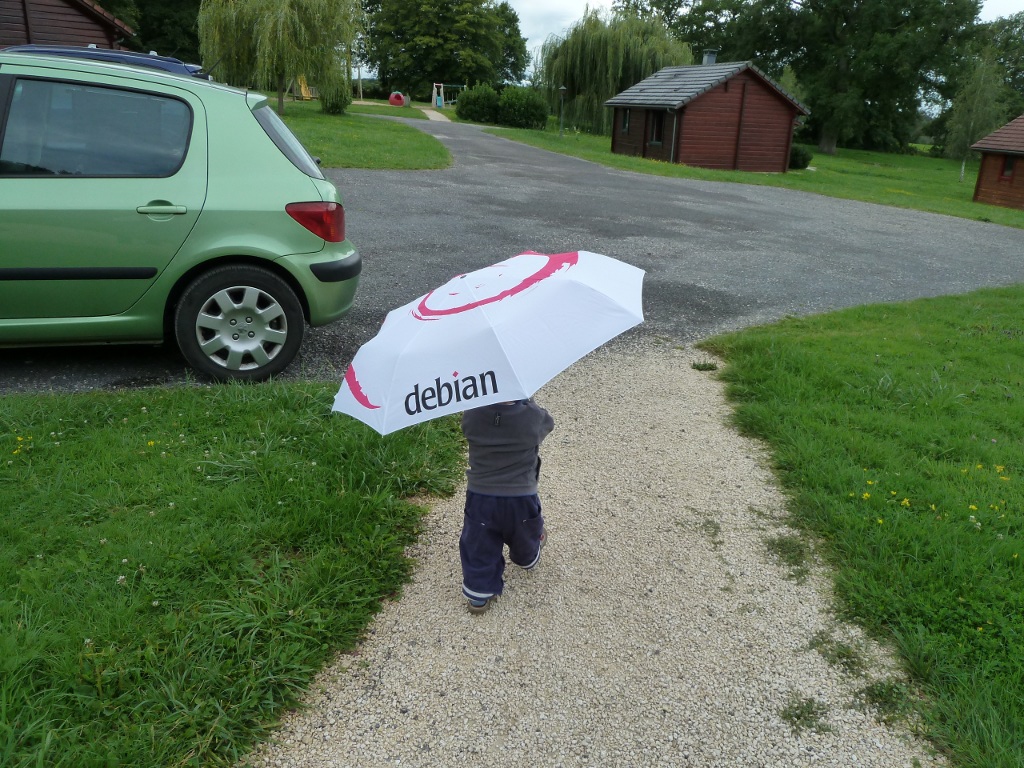
On the bug fixing side I took care of #640198 (minor man page update), #638291 (a fix to correctly handle hardlinks of conffiles), #637564 (the simplification logic of union dependencies was broken in some cases) and #631494 (interrupting dpkg-source while building a native source package left some temporary files around that should have been cleaned). WordPress update I released WordPress 3.2.1 in unstable (after having taken the time to test the updated package on my blog!) and fixed its RC bug (#625773). In the process I discovered a false positive in lintian (I reported it in 637473). Gnome-shell-timer package From time to time, I like to use the Pomodoro Technique. That s why I was an user of timer-applet in GNOME 2. Now with the switch to GNOME 3, I lost this feature. But I recently discovered gnome-shell-timer, a GNOME Shell extension that provides the same features. I created a Debian package of it and quickly filed some bugs while I was testing it (two usability issues and an encoding problem) QA Work During DebConf I met Giovanni Mascellani and he was interested to help the QA team. He started working on the backlog of bugs concerning the Package Tracking System (PTS) and submitted a bunch of patches. I reviewed them and merged them but since they were good, I quickly got lazy and got him added to the QA team so that he can commit his fixes alone. It also helps to build trust when you have had the opportunity to discuss face to face. :-) Vacation That s not so much compared to usual but to my defense I also took 2 weeks of vacation with my family. But somehow even in vacation I can t really forget Debian. Here s my son:
Thanks See you next month for a new summary of my activities.

3 comments Liked this article? Click here. My blog is Flattr-enabled.

27 August 2011

Michael Prokop: Open Source Projects using Jenkins

For a (german) talk I ll be giving soon I was interested in a list of open source projects which use Jenkins. Jenkins is a great open source continuous integration server. I was wondering whether such a list exists but since it doesn t exist yet I created my own and Kohsuke Kawaguchi (creator of Hudson/Jenkins) suggested to blog about it. There we go. :) Open source projects using Jenkins, though Jenkins service not accessible for the public (yet): And Cloudbees hosts some OSS projects providing Jenkins as a service. Update [2011-08-29]: thanks for all the feedback, I ve updated the list accordingly.
If you re aware of another open source project using Jenkins please leave it in the comments, I ll update the list accordingly then.

19 August 2011

Michael Prokop: Use of VCS in Debian packages some stats

Everyone loves stats, ok well at least I do. I was doing some research with regards to package maintenance within the Debian distribution and since the results might be interesting for someone else there we are. On 19th of August 2011 there have been: Therefore ~59% of all packages in Debian/sid are officially managed with a version control system (VCS). Now, which VCS do those packages use?
  1. Svn: 4939
  2. Git: 4377
  3. Darcs: 284
  4. Bzr: 247
  5. Hg: 61
  6. Cvs: 31
  7. Arch: 28
  8. Mtn: 10
I ve retrieved the numbers from the Ultimate Debian Database (UDD). Sadly there s a bug in UDD regarding the Vcs-Type information, see #637524. Therefore I ve extracted a list of 80 packages where a Vcs-Browser header is available but the Vcs-Type entry is empty in UDD. 29 packages of them are managed inside CVS but don t appear as such in UDD, so I manually corrected the number for CVS in the numbers above. The remaining 51 packages have a Vcs-Browser field set but lack the according Vcs-* entry, some of them pointing to upstream VCS instead of the according Debian package repository, some of them result in 404 errors, etc. As a result I ve reported bugs where applicable (#638466, #638468, #638469, #638470, #638471, #638472, #638474, #638475, #638476, #638477, #638479, #638482, #638486, #638488, #638493, #638497, #638501, #638475, #638475, #638502, #638503, #638505, #638506, #638508, #638509, #638510, #638511, #638512, #638513, #638516, #638518, #638519, #638520, #638522, #638523, #638524, #638525, #638526, #638527, #638528, #638529, #638530, #638516, #638531). Disclaimer: I found Debian s Statistics wiki page and Zack s VCS usage stats after starting to play with my own stats. AFAICT Zack s slightly higher numbers are the result of looking at multiple versions for the same source packages, as you ll see when comparing numbers from UDD s sources_uniq view (which I used) with either 1) UDD s sources table, 2) source table count from projectb or 3) Package count from http://$DEBIAN_MIRROR/debian/dists/unstable/ main,contrib,non-free /source/Sources.bz2. Conclusion: 9316 packages are officially managed with Subversion and Git as of today, representing ~94% of the VCS managed packages. This means ~55% of all the Debian (source) packages are available through either a Git or Subversion repository and that s actually the number I was originally interested in. Thanks to Alexander Wirt, Christian Hofstaedter, Gerfried Fuchs, J rg Jaspert and Michael Renner for hints in forming up the final stats results.

29 July 2011

Michael Prokop: The Zsh Pony

I was giving a skills exchange session about Zsh at DebConf 11. I wasn t expected to prepare the session, but since there was no video projector available in the meeting room I started to work on some notes. Looks like I suffer from presentation driven development, so the notes turned out to become bigger than expected. If you re interested in my Zsh pony then head over to grml.org/zsh-pony. PS: I plan to provide the zsh pony at github, but my org-mode file still causes an error 500 at github. Github support is already aware of it. In the meantime I m happy to receive feedback, patches and contributions via mail.

11 July 2011

Michael Prokop: Creating 32bit Debian packages in 64bit environments

i386 systems are dying off and therefore building 32bit Debian packages in 64bit environments is important if you still need packages for i386. For some recent projects I had to set up 64bit-only environments with the need to provide 32bit packages for i386 as well as according i386 Linux kernel packages. 1) Common Debian packages Just prepend the linux32 command to the build commands and use the -a386 option of dpkg-buildpackage(1). So use linux32 dpkg-buildpackage -ai386 , linux32 git-buildpackage -ai386 , linux32 debuild -ai386 , or whatever build tool you prefer to work with. I personally like using git-buildpackage -S together with cowbuilder. When using cowbuilder it s easy to get i386 Debian packages:
# create initial cow base directory, needs to be executed just once:
cowbuilder --create --basepath /var/cache/pbuilder/wheezy32.cow \
   --architecture i386 --distribution wheezy --mirror http://ftp.de.debian.org/debian
# the "debbuildopts -b" says I want a binary-only build, see dpkg-buildpackage(1):
linux32 cowbuilder --build --basepath /var/cache/pbuilder/wheezy32.cow \
   ~/foobar_0.42.dsc --debbuildopts "-b"
2) Debian Kernel packages If you re building your own kernel images you might be aware of setting ARCH for the common make targets, like:
ARCH=i386 make oldconfig
To build a linux-image Debian package you can use upstream s deb-pkg target, like:
ARCH=i386 make deb-pkg
This should provide you according linux-headers, linux-firmware-image, linux-libc-dev and linux-image i386 Debian packages. But if you need the according source and doc packages as well you might prefer make-kpkg of kernel-package instead, using options like:
DEB_HOST_ARCH=i386 setarch i386 make-kpkg --revision "$KERNELVERSION" \
  --cross-compile - --arch=i386 --us --uc --initrd \
  --rootcmd fakeroot kernel-image kernel-headers kernel-doc kernel-source
3) Debian linux-2.6 kernel packages If you re interested in building Debian kernel images the same way as the Debian kernel team does (AKA linux-2.6) make sure to check out the kernel-handbook. After installing essential software packages I had to set up some symlinks for building:
apt-get install build-essential fakeroot devscripts fakeroot
apt-get build-dep linux-2.6
ln -s /usr/bin/gcc-4.4 /usr/bin/i486-linux-gnu-gcc-4.4
ln -s /usr/bin/ld /usr/bin/i486-linux-gnu-ld
ln -s /usr/bin/ar /usr/bin/i486-linux-gnu-ar
ln -s /usr/bin/objcopy /usr/bin/i486-linux-gnu-objcopy
ln -s /usr/bin/nm /usr/bin/i486-linux-gnu-nm
ln -s /usr/bin/objdump /usr/bin/i486-linux-gnu-objdump
ln -s /usr/bin/strip /usr/bin/i486-linux-gnu-strip
Then executing:
apt-get source linux-2.6
cd linux-2.6*
debuild -ai386 -us -uc
provided the according Debian packages (linux-doc, linux-headers, linux-image, linux-libc-dev, linux-manual, linux-patch-debian, linux-source, linux-support and linux-tools). 4) Out-of-tree kernel module packages If you want to build external modules which are available as $MODULENAME-source in Debian (e.g. tp-smapi-source) using module-assistant then use the DEB_HOST_ARCH environment variable, like:
DEB_HOST_ARCH=i386 m-a -v --text-mode -k /home/mika/linux-$KERNELVERSION -l $KERNELVERSION build tp-smapi
If the external module is not available for use with module-assistant then compile the module running:
make -C /lib/modules/$KERNELVERSION/build M=$(pwd)
whereas /lib/modules/$KERNELVERSION/build is pointing to the build directory of your 32bit kernel.

30 May 2011

Michael Prokop: Create virtual disk images using grml-debootstrap

Background: Lars Wirzenius was searching for a tool to create virtual disk images. Turned out I needed something similar to improve the automatic deployment process of a customer s platform installation. Being the author of the mentioned grml-debootstrap tool I started to work on deploying virtual disk images using grml-debootstrap. As a result I just uploaded grml-debootstrap version 0.46 which is the first release being capable of installing virtual disk images. Thanks to great help by Thorsten Glaser also proper Grub integration is working now. Instructions: Grab the most recent grml-debootstrap version (>=0.46) from the grml-testing repository and make sure to install its recommends (kpartx mksh parted qemu-utils). Then just use the vmfile option to activate deployment of a virtual disk image, combined with the target option as usual. To adjust the disk size use the vmsize option. Usage example:
# IMAGE_FILE="/mnt/sda1/qemu.img"
# grml-debootstrap --vmfile --vmsize 3G --target $IMAGE_FILE
I tested it from inside a running Grml live system, which is running inside a KVM image running on a Proxmox VE cluster. I can even invoke KVM/Qemu inside Grml inside KVM to test the image (using remote access e.g. via vncviewer $IP_OF_KVM_HOST:5901 ) running:
# kvm -hda $IMAGE_FILE -m 256 -vnc :1
And the best about it: it just works. :)
As usual: testing and feedback highly welcome.

Michael Prokop: Grml 2011.05 Codename Just Mari

I m proud to be able to announce a new stable release of Grml, the Debian based Live system for system administrators. This release is a very special one for me. On the one hand of course because of the special release name Just Mari , being dedicated to my lovely wife. But it s also special because of the way the release management worked out. I ve been the release manager for Grml since the very beginning, which turned out to be more than 6 years since the first stable release already. I developed grml-live as build framework based on FAI for generating a Grml and Debian based Linux Live system to streamline the build process. Anyway it was mainly me who managed the release chroots, doing the update management during release freeze, editing main web page etc. As I want to make the project as independent from myself as much as possible and to keep the Bus factor in balance we started to improve our project infrastructure so it s not just me who can do this kind of release management. As a result Grml core developer Christian Hofstaedtler became the release sergeant of this release. The release candidate version was even released without myself being available (the release happened behind my back during our marriage). Major work on the final stable release was also done by Grml core developers Ulrich Dangel, Christian Hofstaedtler, Frank Terbeck and Alexander Wirt and I m very happy about that. Kudos guys for all your work and all the hidden efforts going on behind my back. :) The details regarding the new Grml release are available in the official release announcement, get the ISOs from grml.org/download. I hope you enjoy the release as much as I do. Happy hacking!

5 May 2011

Michael Prokop: I am going to DebConf11

* Just registered myself for DebConf11, see you in Banja Luka.

21 April 2011

Michael Prokop: Report from FAI developer meeting 04/2011

Last week a developer meeting of the FAI project took place in Cologne/Germany. Four core developers (project lead Thomas Lange and 3x Michael :) ) met for two days to discuss and work on the FAI project. The first day (2011-04-14) started at 11:45 and lasted until around 21:15, the second day (2011-04-15) started at 11:00 and lasted until 22:00. We made 134 svn commits in those two days. The developer meeting was great, we got tons of stuff done:

6 April 2011

Gerfried Fuchs: The Canterbury Project

The Background If you weren't online last Friday you probably have missed the big news announcement on the various community distribution websites. The main pages of them got replaced by a placeholder announcing the birth of The Canterbury Project. People started to wonder whether it is an April fool's prank or for real. This blog post is meant to shine a bit more light on it and address one comment received about it. If you go to the news item on the Debian site you'll get your answer about that it indeed was an April fool's prank. The idea for doing something in coordination with other distributions came to me when I thought about last year's (or was it already two year's ago?) prank that the various web cartoon sites pulled: they replaced their main page with the page of another cartoonist. My original idea was actually along that lines. So I started to dig up website contacts from different distributions, I was aiming at the big names in the community distribution sector. Given that my time is pretty limited these days with renovating the house we plan to live in soonish I knew I had to let in others in within Debian. I though didn't want to involve too many people, for several reasons: it should be a surprise to as many as possible, but more importantly, I didn't want to shy away other distributions by an overwhelming Debian involvement. That's also part of the reason why I didn't contact many Debian based distributions. So first contacts where made, a dedicated IRC channel used for coordination, and people involved joined in. Then the thing happened which the Free Software community is so well known for: additional ideas came in, two people independently addressed me whether it wouldn't be better that instead of a circle replacement of the frontpage, why not display the same page on all of them. And one of them added that a corresponding news item might make sense. So there we were, having to think about text to put into two things: the news item and the replacement page itself. At this stage Alexander threw in a project name with a background that was adopted. Francesca started with an idea for the news item, I started to put quotes in and asked for ones from the other involved people that fit their distribution well. Klaas came up with a template for the replacement page that we tweaked. Fortunately we ended up being five distributions and the colors of the banner did match the distribution ones rather well (except for one, we had to tweak the color of one banner). The Credits We were all set, and actually everything went fine. And it definitely caught the attention. This blog post goes out in thanks to the following people: I hopefully haven't forgotten anyone. There surely were some more people involved in the other distributions, and I guess the named people weren't aware of all the ones involved inside Debian. Feel free to drop missing names in the comments. Addressing Feedback Finally, let me address one concern raised: someone claimed that the real joke with this prank was that we would consider collaboration to be a joke. Actually, the total opposite is the case here. That it was possible to pull it off should be proof enough that Collaboration Across Borders actually is possible. And the background information put into the news section of the replacement site is real. Also, my personal quote in the news item was meant dead honest. I do believe that DEX has a limited point of view and only tackles part of the problem. Unfortunately, for such efforts to really come to life it takes people with a really long breath and dedication to it. Efforts like the VCS-PKG and the Freedesktop Games effort are more or less stalled. Even though a lot of people do believe in stronger collaboration to be a good thing, the basis is not working out too well. I'm in the fortunate position that for some of the packages I maintain there is exchange between packagers from different distributions to avoid common troubles. If it can't be done in the big it should at least be tried in the small. I want to specifically highlight again one part of the updates in the replacement page: the CrossDistro track at this year's FOSDEM. This one was more than fruitful, on several levels. From what I've heard a lot of discussion happened besides the talks too, and connections got established. It doesn't sound unlikely like this might be done again next year. So again, thanks for enjoying this April fool's prank, thanks to everyone who helped to deliver it, and especially a lot of thanks to the people who this might have got thinking of possibilities to improve on the collaboration front!

/debian permanent link Comments: 8 Flattr this

17 March 2011

Michael Prokop: Grml User Survey 2011 the results

The results of the Grml User Survey 2011 are available. I strongly recommend any open source project to run such a survey. Besides gathering really interesting feedback it s motivating for developers to read what people think about your product. Interesting facts for Planet Debian readers: With a leading 86% our users are Debian users. Further quoting:
Also just a short overview but it seems that the most important reasons for using Grml are:
* Based on Debian
* Command-line interface
* Ships all necessary command-line tools
* Zsh
I personally consider the survey a big success for the Grml project. Thanks to all participants for your feedback.

17 February 2011

Rapha&#235;l Hertzog: People behind Debian: Maximilian Attems, member of the kernel team

Maximilian, along with the other members of the Debian kernel team, has the overwhelming job of maintaining the Linux kernel in Debian. It s one of the largest package and certainly one where dealing with bug reports is really difficult as most of them are hardware-specific, and thus difficult to reproduce. He s very enthusiastic and energetic, and does not fear criticizing when something doesn t please him. You ll see. My questions are in bold, the rest is by Maximilian. Who are you? My name is Maximilian Attems. I am a theoretical physicist in my last year of PhD at the Technical University of Vienna. My main research area is the early phase of a Quark-Gluon Plasma as produced in heavy ion collisions at the LHC at CERN. I am developing simulations that take weeks on the Vienna Scientific Cluster (in the TOP 500 list). The rest of the lab is much less fancy and boils down to straight intel boxes without any binary blobs or external drivers (although lately we add radeon graphics for decent free 3D). Mathematica and Maple are the rare exceptions to the many dev tools of Debian (LaTeX, editors, git, IDE s, Open MPI, ..) found at the institute, as those are unfortunately yet unmatched in Free Software for symbolic computations. The lab mostly runs a combination of Debian stable (testing starting from freeze) for desktops and oldstable/stable for servers. Debian is in use for more than 10 years. So people in the institute know some ups and downs of the project. Newcomers like my room neighbors are always surprised how functional a free Debian Desktop is. :) What s your biggest achievement within Debian? Building lots and lots of kernels together with an growing uptake of the officially released linux images. I joined the Debian kernel team shortly after Herbert Xu departed. I had been upstream Maintainer of the linux-2.6 janitor project for almost a year brewing hundreds of small cleanups with quilt in a tree named kjt for early linux-2.6. In Debian we had lots of fun in sorting out the troubles that the long 2.5 freeze had imposed: Meaning we were sitting on a huge diverging monolithic semi-good patchset. It was great fun to prepare 2.6.8 for Sarge with a huge team enthusiastic in shipping something real close to mainline (You have to imagine that back then you had no stable or longterm release nor any useful free tools like git. This involved passing patches around, hand editing them and seeing what the result does.) From the Sarge install reports a common pattern emerged that the current Debian early userspace was causing lots of boot failures. This motivated me to develop an alternative using the new upstream initramfs features. So I got involved in early userspace. Thanks to large and active development team initramfs-tools got a nice ecosystem. It still tries to be as generic and flexible as possible and thus gains many nice features. Also H. Peter Anvin (hpa) gave me the official co-maintenance of klibc. klibc saw uptake and good patches from Google in the last 2 years. I am proud that the early userspace is working out fairly well these days, meaning you can shuffle discs around and see your box boot. Later on we focused on 2.6.18 for Etch, which turned out to a be good release and picked up by several other distributions. Only very much later we would see such a sync again. With 2.6.26 for Lenny we got somehow unlucky as we just missed the new longterm release by one release. We also pushed for another update very late (during freeze) in the release cycle, which turned out to semi-work as too much things depend on linux-2.6. For Squeeze 2.6.32 got picked thanks to discussions at Portland Linux Plumbers and it turned out to be a good release picked up by many distributions and external patchsets. The long-term support is going very well. Greg KH is doing a great job in collecting various needed fixes for it. Somehow we had hoped that the Squeeze freeze would start sooner and that the freeze duration would be shorter, since we were ready for a release starting from the actual freeze on. The only real big bastard on the cool 2.6.32 sync is Red Hat. Red Hat Enterprise 6.0 is shipping the linux-2.6 2.6.32 in obfuscated form. They released their linux-2.6 as one big tarball clashing with the spirit of the GPL. One can only mildly guess from the changelog which patches get applied. This is in sharp contrast to any previous Red Hat release and has not yet generated the sharp and snide comments in press it deserves. Red Hat should really step back and not make such stupid management moves. Next to them even the semi-maintained Oracle Unbreakable 2.6.32 branch looks better: It is git fetchable. What are your plans and those of the kernel team for Debian Wheezy? Since 2.6.32 many of the used patches landed upstream or are on the way (speakup, Kbuild Debian specific targets, ..). The proper vfs based unionfs is something we d be looking forward. We haven t yet picked the next upstream release we will base Wheezy on, so currently we can happily jump to the most recent ones. There are plans for better interaction with Debian Installer thanks to generating our udebs properly in linux-2.6 source itself. Also we are looking forward to using git as tool of maintenance. We d hope that this will also allow for even better cross distribution collaboration. Concerning early userspace I plan to release an initramfs-tools with more generic userspace for the default case and finally also a klibc only for embedded or tuning cases. What do you like most in Debian? For one thing I do like the 2 year release cycle. It is not too long to have completely outdated software and on the other hand it gives enough time to really see huge progress from release to release. Also at my institute the software is is recent enough without too much admin overhead. For servers the three years support are a bit short, but on the manageable side. I do enjoy a lot the testing distribution. For my personal use it is very stable and thus I mainly run testing on my desktop and work boxes. (Occasionally mixing in things from sid for unbreaking transition or newer security fixes). Debian is independent and not a commercial entity. I think this is its main force and even more important these days. I enjoy using the Debian platform a lot at work thus in return this motivates me to contribute to Debian itself. I also like the fact that we strive for technical correctness. Is there some recurrent problem that hinders the progress of Debian? The New Maintainer process is a strange way to discourage people to contribute to Debian. It is particularly bureaucratic and a huge waste of time both for the applicant and his manager. It should be completely thrown overboard. One needs a more scalable approach for trust and credibility that also enhances the technical knowledge for coding and packaging of the applicant. NM is currently set in stone as any outside critics is automatically rejected. Young and energetic people are crucial for Debian and the long-term viability of the project, this is the reason why I d consider the New Maintainer process as Debian s biggest problem. Note from Rapha l Hertzog: I must say I do not share this point of view on the New Maintainer process, I have witnessed lots of improvements lately thanks to the addition of the Debian Maintainer status, and to the fact that a good history of contribution can easily subsume the annoying Tasks & Skills questionnaire. Another thing I miss is professional graphics input both for the desktop theme and the website. I know that effort has been done there lately and it is good to see movement there, but the end result is still lacking. Another trouble of Debian is its marketing capabilities. It should learn to better sell itself. It is the distribution users want to run and use not the rebranded copies of itself with lock-in sugar . Debian is about choice and it offers plenty of it: it is a great default Desktop. Linus Torvalds doesn t find Debian (and/or Ubuntu) a good platform to hack on the kernel. Do you know why and what can we do about this? The Fedora linux-2.6 receives contributions from several Red Hat employed upstream sub-Maintainers. Thus it typically carries huge patches which are not yet upstream. As a consequence eventual userland troubles get revealed quite quickly and are often seen there first. The cutting edge nature of Fedora rawhide is appealing for many developers. The usual Debian package division of library development files and the library itself is traditionally an entry barrier for dev on Debian. Debian got pretty easily usable these days, although we could and should again improve a lot more in this sector. Personally I think that Linus hasn t tried Debian for years. I have the feeling that the implication of the Debian Kernel team in LKML has been on the rise. Is that true and how do you explain this? Ben Hutchings is the Nr.1 contributor for 2.6.33. He also is top listed as author of patches on stable 2.6.32. Debian is not listed as organization as many send their linux-2.6 patches from their corporate or personal email address and thus it won t be attributed to Debian. There is currently no means to see how many patches get forwarded for the stable tree, but I certainly forwarded more then fifty patches. I was very happy when Greg KH personally thanked me in the 2.6.32.12 release. In the Squeeze kernel, the firmwares have been stripped and moved into separate packages in the non-free section. What should a user do to ensure his system keeps working? There is a debconf warning on linux-2.6 installation. It is quite clear that the free linux-2.6 can t depend on the firmware of the non-free archive (also there is no strict dependency there technically). On the terminal you d also see warnings by update-initramfs on the initramfs generation for drivers included in the initramfs. The debconf warning lists the filename(s) of the missing firmware(s). One can then apt-cache search for the firmware package name and install it via the non-free repository. The check runs against the current loaded modules. The match is not 100% accurate for special cases as the one where the device might be handled well by this driver without firmware, but is accurate enough to warrant the warning. The set of virtualization technologies that the official Debian kernel supports seems to change regularly. Which of the currently available options would you recommend to users who want to build on something that will last? KVM has been a smooth ride from day zero. It almost got included instantly upstream. The uptake it has is great as it sees both dev from Intel and AMD. Together with libvirt it s management is easy. Also the performance of virtio is very good. The linux containers are the thing we are looking forward for enhanced chroots in the Wheezy schedule. They are also manageable by libvirt. Xen being the bad outside boy has an incredible shrinking patchset, thus is fair to expect to see it for Wheezy and beyond. For many it may come a bit late, but for old hardware without relevant CPU it is there. Many tend to overstate the importance of the virtualization tech. I d be much more looking forward to the better Desktop support in newer linux-2.6. The Desktop is important for linux and something that is in heavy use. The much better graphics support of the radeon and nouveau drivers: The performance optimizations thanks to dcache scalability work and the neat automatic task-grouping for the CPU scheduler are very promising features for the usability of the linux desktop. Another nice to have feature is the online defrag of ext4 and its faster mkfs. Even cooler would be better scalability in ext4 (This side seems to have seen not enough effort lately). Is there someone in Debian that you admire for their contributions? Hans Peter Anvin and Ted Tso are a huge source of deep linux-2.6 knowledge and personal wisdom. I do enjoy all sorts of interactions with them. Christoph Hellwig with Matthew Wilcox and also William Irwin for setting up the Debian kernel Team. Several Debian leaders including the previous and the current one for their engagement, which very often happens behind the scene. The Debian Gnome Team work is great, also the interactions have always been always easy and a pleasure. Martin Michlmayr and previously Thiemo Seufer do an incredible job in porting Debian on funny and interesting ARM and MIPS boxes. Debian has a lot of upcoming potential on this area. I m looking forward to other young enthusiastic people in that area. Colin Watson is bridging Debian and Ubuntu, which is an immense task. Michael Prokop bases on Debian an excellent recovery boot CD: http://www.grml.org. I d be happy if any Debian Developer would work as carefully coding and working.
Thank you to Maximilian for the time spent answering my questions. I hope you enjoyed reading his answers as I did. Subscribe to my newsletter to get my monthly summary of the Debian/Ubuntu news and to not miss further interviews. You can also follow along on Identi.ca, Twitter and Facebook.

One comment Liked this article? Click here. My blog is Flattr-enabled.

10 January 2011

Michael Prokop: Grml User Survey 2011

Grml users out there: We are interested in getting your feedback so we can further improve Grml. We are also working on a webpage which lists happy Grml users and also some quotes and use cases. Now we need your help: Please provide your feedback and take part in Grml s user survey!

6 January 2011

Michael Prokop: Booting ISO images from within GRUB2

You might be aware of GRUB s loopback option for booting an ISO, I wrote about it in Boot an ISO via Grub2 more than a year ago. A few months ago Goswin von Brederlow came up with this idea:
grml functions great as rescue system. So it would be nice to have a boot entry for it in grub instead of having to go look for the CD when needed. To make installing and updating simple it would be great if one could install this as a normal debian package which would register itself in grub (and maybe lilo too).
What a lovely idea: no need for a CD or USB stick as long as the bootloader and the harddisk are still working. Minimal manual intervention needed to keep it up2date and working sounds like the perfect rescue system. 8-) Now since end of 2010 a new stable version of sysadmin s favorite live system (AKA Grml 2010.12) is available and the great news is that we came up with two independent solutions known as grml-rescueboot and grub-imageboot. Having shipped them to one of my customers already I d like to write some words about it and why you should also consider using it on all your systems where GRUB2 is available. grml-rescueboot uses GRUB2 and its loopback feature for booting. Grml as well as Ubuntu provide all what s needed out-of-the-box. If you re interested in the details check out Jordan Uggla s excellent Loopback.cfg webpage in the supergrubdisk wiki. The best about it: you can provide custom bootoptions automatically when booting Grml. For example just set CUSTOM_BOOTOPTIONS= ssh=grml2011 in /etc/default/grml-rescueboot and the Grml rescue system will automatically start the OpenSSH server with the specified argument as password for user grml. Of course you can use all the other nifty bootoptions like scripts/netscript/ to further customize your Grml rescue system. [A note to other distributions like Ubuntu: I'd be interested to establish a mechanism to pass kernel options for loopback boot in a standardized way, drop me a note if you're interested in this.] grub-imageboot uses GRUB2 and syslinux memdisk to boot ISOs and floppy images. It doesn t rely on the loopback feature but instead maps the ISO into the memory directly. This is great for Linux ISOs that can t and won t support the the loopback feature (and have everything inside their initrd so the ISO doesn t have to find itself during booting), like BIOS or firmware updates. Also for example FreeDOS and Alpharev are known to work just fine. But sadly memdisk ISO emulation doesn t work with all Linux systems, as documented in the syslinux wiki. The good news is that Grml supports the memdiskfind/phram/mtdblock approach out-of-the-box. As far as I know therefore Grml is the first Debian based live system supporting memdisk ISO boot, though my patches already went to the Debian-Live project so if you re using live-boot >=2.0.14-1 or >=2.0.12-1+grml.04 your live system should be able to boot via memdisk ISO emulation as well. Summary: If you want to boot a Linux system which supports loopback.cfg use grml-rescueboot as its a more powerful tool to boot Linux live systems like Grml and Ubuntu. If you want to boot non-Linux systems (BIOS-/Firmware-Updates/FreeDOS/ .) use grub-imageboot. Alright how do you deploy this solution? Just grab and install grml-rescueboot and/or grub-imageboot. To deploy grml-rescueboot (adjust $VERSION if you want to use another flavour):
# choose Grml version:
VERSION=grml64-medium_2010.12
# create directory
mkdir -p /boot/grml
# download and verify ISO
cd /boot/grml
wget download.grml.org/$ VERSION .iso ,.md5 
md5sum -c $ VERSION .iso.md5
To deploy grub-imageboot:
# choose Grml version:
VERSION=grml64-medium_2010.12
# create directory
mkdir -p /boot/images
# download and verify ISO
cd /boot/images
wget download.grml.org/$ VERSION .iso ,.md5 
md5sum -c $ VERSION .iso.md5
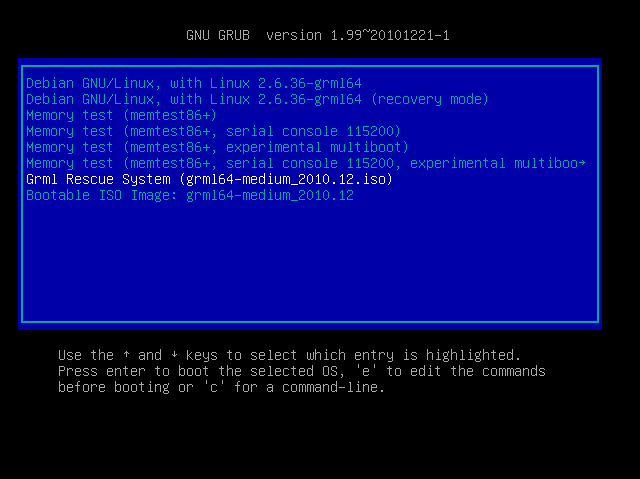
That s it! Now when running update-grub you should get something like:
# update-grub
Generating grub.cfg ...
Found linux image: /boot/vmlinuz-2.6.36-grml64
Found initrd image: /boot/initrd.img-2.6.36-grml64
Found memtest86+ image: /boot/memtest86+.bin
Found memtest86+ multiboot image: /boot/memtest86+_multiboot.bin
  No volume groups found
Found Grml ISO image: /boot/grml/grml64-medium_2010.12.iso
Found memdisk: /boot/memdisk
Found iso image: /boot/images/grml64-medium_2010.12.iso
done
Voil , when rebooting your system you should see something like: Screenshot: grml-rescueboot The Grml Rescue System entry is what grml-rescueboot provides and Bootable ISO Image is what s provided by grub-imageboot. Just select the entry you d like to use, press enter and and you should get the bootsplash of the according ISO. BTW: I ve tested this with Ubuntu 10.10 too, grml-rescueboot works out-of-the-box with the Ubuntu ISO as well, it just doesn t support the memdisk ISO boot by grub-imageboot (yet). Tip: if you want to use grml-rescueboot and grub-imageboot with the same ISOs without having them twice on the disk just point the configuration option IMAGES in /etc/default/grub-imageboot to the according directory (like /boot/grml). Note: if you re using the ext 2,3,4 filesystem on the partition that s being used for /boot please be aware that you need GRUB >=1.98+20100804-12 (newer version is already available in Debian/unstable and hopefully migrates to squeeze in time) or GRUB >=1.99~20101122-1 because of the INDIRECT_BLOCKS support, see #543924 for the details. PS: We think about providing grml-rescueboot and grub-imageboot within official Debian. If you re interested in seeing integration support for other distributions as well please help and drop us a note.
Michael Prokop: Simple DNS in chroots

Update: Ulrich mru Dangel suggested pdnsd as nice alternative to dnsmasq and Cyril KiBi Brulebois pointed out, that it s not necessary to invoke dnsmasq after fresh installation as it s running by default then I adjusted the text accordingly, thanks for the pointers! If /etc/resolv.conf doesn t provide any nameserver entries glibc[1] will automatically initialize the nameserver to the loopback address. This is nice for dealing with chroots without having to manually edit resolv.conf to get working DNS. Just install a basic DNS forwarder like dnsmasq ( apt-get install dnsmasq ) or if it s already on your box just start it ( /etc/init.d/dnsmasq start ). That s it. Now when chrooting into a system without an existing resolv.conf configuration it will give you a working DNS setup without any further work. PS: Grml ships dnsmasq by default and /etc/init.d/dnsmasq start or Start dnsmasq will work out-of-the box. In Ubuntu the dnsmasq package is available only through the universe repository but the dnsmasq-base package (providing e.g. the init script) is shipped by default, so replace the /etc/init.d/dnsmasq command with a simple dnsmasq there. [1] At least the [e]glibc versions provided on Debian and Ubuntu are known to provide this glibc extension. Other libc implementations like dietlibc and uclibc don t seem to provide it, so don t strictly rely on this feature but use it as the icing on the cake.

15 October 2010

Gerfried Fuchs: Open Source Projectmanagement

I wrote the following as a foreword for the great German book Open Source Projektmanagement that Michael Prokop wrote. Unfortunately the foreword didn't manage it in time into the book because of various circumstances. As I'm not a person to throw away already written material, here is it for your reading pleasure. Maybe it makes you consider obtaining a copy of the German language book for yourself!
The Whole is more than the Sum of the Parts When I first met Mika at a Linux conference some years ago I quickly noticed that he had potential. The way he asked questions and tackled issues did impress me. We did meet again at various events, joined forces in various projects and knew that the result would be good. Back in the year 2004 the only real live CD was Knoppix. It always was too sluggish for me because I never really liked KDE and also OpenOffice.org was too bloated for me. I was working since a year at an Internet provider, felt comfortable in the shell and was missing the tools on Knoppix which I used daily. Often enough the frustration with the status quo starts the best projects. And so I had the idea spinning around to start a sysadmin live CD. There was just one problem here: Exactly at the same time Mika had already started such a project. And I knew one thing: it would had been a lost race to compete with him in creating the better live CD. So I joined his team and helped with the best of my knowledge. The name choice alone showed that he was the right person for the job: Grml an expression of the frustration that even he felt which spoke directly to the heart of so many. But it wasn't just the chosen name that showed that Mika was the right person for the job of the project leader. It's always the sum of the parts, no matter how minor they might look. He quickly managed a first release and in light of that also created an event which was fitting for the release of the first version: the OS04 an Open Source event which managed to get Jon Maddog Hall as keynote speaker. Mika managed through his welcoming way to lure more people into helping out. The team grew over the years, further regular releases increased the fan base, not only through the creative release names which are surely one of the parts that helped create the success. He always was open to suggestions for new tools that helped to extend the project. The lived openness did lead among other things to the case that other live CDs started to use the grml build system. JUXlala 2.0 (the system for preschool kids) is just one example. Why do I write primarily about Grml, one could get subliminal advertising probably cheaper? I do it because Grml is an extremely good example of the experience revealed in this book. And even though every project is different, it is still exactly the sum of the parts that leads to the success of a project. And exactly these parts are covered in this book and can be considered for the project at hand and get implemented accordingly. Good luck whether in large or small.
Rhonda

/debian permanent link Comments: 0 Flattr this

18 August 2010

Michael Prokop: DebConf10: done

Picture: Columbia University / New York Finally I m back from DebConf10 in New York. It was the first DebConf I attended and it was just great. Thanks a lot to all involved people for making DebConf such a great event. I had a big todo list for DebCamp and DebConf and managed to get a bunch of work done. Besides several discussions, bug hunting, testing stuff and attending BoFs and talks the work that I could get done for Debian included: My talk about "State of Debian (based) Linux live systems in 2010" went pretty well according to the feedback I got (thanks for that), even though OpenOffice failed horrible once again (one completely broken line on one slide, several broken gradients on several slides in presentation mode, the presenter screen just didn t work at all, ). I just uploaded the slides of my talk (8.4MB, PDF), though they won t be useful without the talk but thanks to the awesome videoteam my talk is available as recording. On the next weekend (August 21st/22nd) you can meet me at FrOSCon/Germany where I ll be at the Grml booth and giving a talk titled "Gute Open-Source-Projekte bestehen aus mehr als nur Code" (english: Good open source projects are more than just code). BTW: What s a wiki? Say whaaaaaat?</insider>

30 July 2010

Michael Prokop: Event: System Administrator Appreciation Day 2010 in New York

On each last Friday of July the annual System Administrator Appreciation Day is taking place. Matt Simmons organized a SysAdmin Day Meetup to celebrate this event in New York. If you re in New York on 30th of July consider registering yourself (it s free and takes just a few seconds). If you are participant of the Debian Conference in New York and are already hacking at the DebCamp you might want to join our group of Debian people who plan to show up, currently consisting of Paul Wise, Lars Wirzenius, Thomas Lange and myself. If you plan to join please ping me so we can show up at the SysAdmin Day Meetup together.

Next.

Previous.