Search Results: "Lucas Nussbaum"

9 April 2014

Lucas Nussbaum: speedtest.net, or how not to do bandwidth tests

While trying to debug a bandwidth problem on a 3G connection, I tried speedtest.net, which ranks fairly high when one searches for bandwidth test on various search engines. I was getting very strange results, so I started wondering if my ISP might be bandwidth-throttling all traffic except the one from speedtest.net tests. After all, that s on a 3G network, and another french 3G ISP (SFR) apparently uses Citrix ByteMobile to optimize the QoE by minifying HTML pages and recompressing images on-the-fly (amongst other things). So, I fired wireshark, and discovered that no, it s just speedtest being a bit naive. Speedtest uses its own text-based protocol on port 8080. Here is an excerpt of a download speed test:

> HI
< HELLO 2.1 2013-08-14.01
> DOWNLOAD 1000000
< DOWNLOAD JABCDEFGHIJABCDEFGHIJABCDEFGHIJABCDEFGHIJABCDEFGHIJABCDEFGHIJABCDEFGHIJABCDEFGHIJABCDEFGHIJABCDEFGHIJABCDEFGHIJABCDEFGHIJABCDEFGHIJABCDEFGHIJABCDEFGHIJABCDEFGHIJABCDEFGHIJABCDEFGHIJABCDEFGHIJABCDEFGHIJABCDEFGHIJABCDEFGHIJABCDEFGHIJABCDEFGHIJABCDEFGHIJABCDEFGHIJABCDEFGHIJABCDEFGHIJABCDEFGHIJABCDEFGHIJABCDEFGHIJABCDEFGHIJABCDEFGHIJABCDEFGHIJABCDEFGHIJABCDEFGHIJABCDEFGHIJABCDEFGHIJABCDEFGHIJABCDEFGHIJABCDEFGHIJABCDEFGHIJABCDEFGHIJABCDEFGHIJABCDEFGHIJABCDEFGHIJABCDEFGHIJABCDEFGHIJABCDEFGHIJABCDEFGHIJABCDEFGHIJABCDEFGHIJABCDEFGHIJABCDEFGHIJABCDEFGHIJABCDEFGHIJABCDEFGHIJABCDEFGHIJABCDEFGHIJABCDEFGHIJABCDEFGHIJABCDEFGHIJABCDEFGHIJABCDEFGHIJABCDEFGHIJABCDEFGHIJABCDEFGHIJABCDEFGHIJABCDEFGHIJABCDEFGHIJABCDEFGHIJABCDEFGHIJABCDEFGHIJABCDEFGHIJABCDEFGHIJABCDEFGHIJABCDEFGHIJABCDEFGHIJABCDEFGHIJABCDEFGHIJABCDEFGHIJABCDEFGHIJABCDEFGHIJABCDEFGHIJABCDEFGHIJABCDEFGHIJABCDEFGHIJABCDEFGHIJABCDEFGHIJABCDEFGHIJABCDEFGHIJABCDEFGHIJABCDEFGHIJABCDEFGHIJABCDEFGHIJABCDEFGHIJABCDEFGHIJABCDEFGHIJABCDEFGHIJABCDEFGHIJABCDEFGHIJABCDEFGHIJABCDEFGHIJABCDEFGHIJABCDEFGHIJABCDEFGHIJABCDEFGHIJABCDEFGHIJABCDEFGHIJABCDEFGHIJABCDEFGHIJABCDEFGHIJABCDEFGHIJABCDEFGHIJABCDEFGHIJABCDEFGHIJABCDEFGHIJABCDEFGHIJABCDEFGHIJABCDEFGHIJABCDEFGHIJABCDEFGHIJABCDEFGHIJABCDEFGHIJABCDEFGHIJABCDEFGHIJABCDEFGHIJABCDEFGHIJABCDEFGHIJABCDEFGHIJABCDEFGHIJABCDEFGHIJABCDEFGHIJABCDEFGHIJABCDEFGHIJABCDEFGHIJABCDEFGHIJABCDEFGHIJABCDEFGHIJABCDEFGHIJABCDEFGHIJABCDEFGHIJABCDEFGHIJABCDEFGHIJABCDEFGHIJABCDEFGHIJABCDEFGHIJABCDEFGHIJABCDEFGHIJABCDEFGHIJABCDEFGHIJABCDEFGHIJABCDEFGHIJABCDEFGHIJABCDEFGHIJABCDEFGHIJABCDEFGHIJABCDEFGHIJABCDEFGHIJABCDEFGHIJABCDEFGHIJABCDEFGHIJABCDEFG
Yeah, right: sequences of ABCDEFGHIJ . How course, extremely easy to compress, which apparently happens transparently on 3G (or is it PPP? but I tried to disable PPP compression, and it did not see any change). It s funny how digging into problems that look promising at first sight often results in big disappointments :-(

1 April 2014

Bits from Debian: Debian Project elects Javier Merino Cacho as Project Leader

This post was an April Fools' Day joke. Alt Red Nose DPL In accordance with its constitution, the Debian Project has just elected Javier Merino Cacho as Debian Project Leader. More than 80% of voters put him as their first choice (or equal first) on their ballot papers. Javier's large majority over his opponents shows how his inspiring vision for the future of the Debian project is largely shared by the other developers. Lucas Nussbaum and Neil McGovern also gained a lot of support from Debian project members, both coming many votes ahead of the None of the above ballot choice. Javier has been a Debian Developer since February 2012 and, among other packages, works on keeping the mercurial package under control, as mercury is very poisonous for trouts. After it was announced that he had won this year's election, Javier said: I'm flattered by the trust that Debian members have put in me. One of the main points in my platform is to remove the "Debian is old and boring" image. In order to change that, my first action as DPL is to encourage all Debian Project Members to wear a clown red nose in public. Among others, the main points from his platform are mainly related to improve the communication style in mailing lists through an innovative filter called aponygisator, to make Debian less "old and boring", as well as solve technical issues among developers with barehanded fights. Betting on the fights will be not only allowed but encouraged for fundraising reasons. Javier also contemplated the use of misleading talk titles such as The use of cannabis in contemporary ages: a practical approach and Real Madrid vs Barcelona to lure new users and contributors to Debian events. Javier's platform was collaboratively written by a team of communication experts and high profile Debian contributors during the last DebConf. It has since evolved thanks to the help of many other contributors.

20 March 2014

Bits from Debian: Debian Project Leader elections 2014

It's again that time of the year for the Debian Project: the elections of its Project Leader! Starting on March 31st, and during the following two weeks, the Debian Developers will vote to choose the person who will guide the project for one year. Among this year's candidates there is the current DPL, Lucas Nussbaum, who admits that "the workload involved in being the DPL is just huge," and motivates his nomination with the need for stability in the project in this release cycle, especially after the difficult decision about the default init system. In his platform, Lucas speaks of technical and social steps to improve the project: from reproducible builds for a more secure archive to a renewed effort to run Debian on new platforms (especially smartphone and tablets); from a more welcoming approach to prospective contributors to an easier collaboration with organizations. The only other candidate left after Gergely Nagy withdrew his nomination, is former Release Manager Neil McGovern. Neil's platform focuses mainly on the need to "ensure that we cater to our users, and there's millions of them. From those running the latest software in unstable, to people who simply want a rock solid core release." In his opinion "the size of Debian is increasing, and will reach a point where we're unable to guarantee basic compatibility with other packages, or the length of time it takes to do so becomes exponentially longer, unless something changes." To fix this problem, Neil proposes the implementation of PPAs (Personal Package Archives), the modernisation of the current build and infrastructure system as well as generally supporting the various teams. The campaigning period will last until March 30th: the candidates are already engaged in debates and discussions on the debian-vote mailing list where they'll reply to questions from users and contributors.

27 February 2014

Lucas Nussbaum: self-hosting my calendar, follow-up

Following my blog post on the topic, I played a bit with various options. But let s explain my use case (which might be quite specific). I need to deal with three main sources of events: Additionally, I follow some ICS feeds for some colleagues and other events.
I tend to access my calendar mostly on my computer, and sometimes on my N900 phone. None of the web interfaces I looked at enabled me to (1) manage different calendars hosted on different CalDav servers; (2) subscribe to ICS feeds; (3) provide a CalDav interface to synchronize my phone. I ended up using a radicale instance for my personal calendar, which was extremely easy to set up. It s unfortunately a bit slow when there are many events (1600 since 2010 in my case), so I ended up importing only future events, and I will probably have to cleanup from time to time. I switched to using IceDove with the Lightning add-on to manage all my calendars and ICS feeds. It s unfortunately slower and less user-friendly than Google Calendar, but I ll live with it. On my N900, I used syncevolution to synchronize my various CalDav calendars. It works fine, but understanding how to configure it is rather tricky due to the number of concepts involved (templates, databases, servers, contexts, ). The synchronization is quite slow (several minutes for the 400-events Zimbra calendar), but works. I also wanted a way to export my calendars to colleagues (both in a free/busy version, and in a full information version). I quickly hacked something using ruby-agcaldav (which is not packaged in Debian, and required quite a few dependencies, but it was easy to generate packages for all of them using gem2deb the situation with other languages did not look better).
The resulting script is:
require 'agcaldav'
require 'date'
cal = AgCalDAV::Client.new(:uri => 'LABCALDAVSERVER', :user => 'xx', :password => "xx")
ev = cal.find_events(:start => '2014-02-01', :end => '2200-01-01') cal = AgCalDAV::Client.new(:uri => 'RADICALESERVER', :user => 'xx', :password => "xx")
ev2 = cal.find_events(:start => '2014-02-01', :end => '2200-01-01') limit = (Time::now - 7*86400).to_datetime # create new empty calendars
ncpriv = Icalendar::Calendar.new
ncpub = Icalendar::Calendar.new (ev + ev2).each do e
next if e.end < limit # drop old events to keep the calendar small # build event for the free/busy calendar
pe = Icalendar::Event.new
pe.start = e.start
pe.end = e.end
pe.klass = "PRIVATE"
pe.transp = e.transp
ncpriv.add(pe) # build event for the calendar with event information
pube = Icalendar::Event.new
pube.start = e.start
pube.end = e.end
pube.transp = e.transp
if not e.klass == "PRIVATE"
pube.summary = e.summary
pube.location = e.location
end
ncpub.add(pube)
end # export free/busy calendar
fd = File::new('xx.ics', 'w')
fd.puts ncpriv.to_ical
fd.close
# export calendar with event information
fd = File::new('yy-Zeeh9bie.ics', 'w')
fd.puts ncpub.to_ical
fd.close
So, mostly everything works. The only thing that doesn't is that I haven't found a way to subscribe to an ICS feed on my N900. Any ideas?

25 February 2014

Lucas Nussbaum: self-hosting my calendar

I m trying to self-host my calendar setup, and I must admit that I m lost between all the different solutions. My requirements are: It does not seem to be possible to find a single framework doing all of the above. AFAIK: What did I miss?

10 February 2014

Bits from Debian: skyrocketing how-can-i-help popcon count

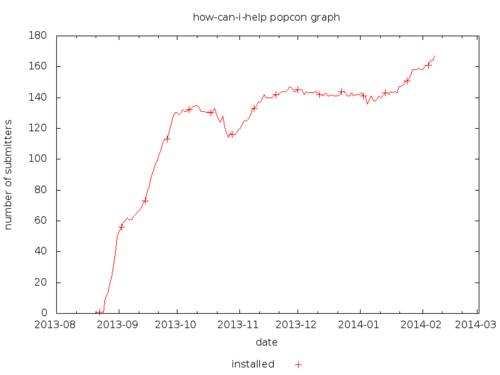
This is a repost from Stefano Zacchiroli's post how-can-i-help by Lucas Nussbaum is one of the best things that happened in the area of attracting contributions to Debian in quite a while. It can be used both as a standalone tool to list opportunities for contributing to Debian which are related to your installed packages, and as an APT hook (which is also the default configuration) that at each upgrade will inform you of new contribution opportunities. how-can-i-help is great for newbies who are looking for ways to give back to Debian which are a good match for their skills: among other things, how-can-i-help shows bugs tagged "gift" related to packages you use. how-can-i-help is also great for experienced developers, as it allows them to find out, in a timely manner, that packages they use are in dire need of help: RC bugs, pending removals, adoptions needed, requests for sponsor, etc. (As highly unscientific evidence: I've noticed a rather quick turnover of RFA/O/ITA bugs on packages installed on my machine. I suspect how-can-i-help is somehow responsible for that, due to the fact that it increases awareness of ongoing package issues directly with the people using them.) So, if you haven't yet, please apt-get install how-can-i-help RIGHT NOW. I daresay that we should aim at installing how-can-i-help by default on all Debian machines, but that might be an ambitious initial goal. In the meantime I'll settle for making how-can-i-help's popcon count skyrocket. As of today, it looks like this: Alt how-can-i-help popularity contest graph 10/02/2014 which is definitely too low for my taste. Please spread the word about how-can-i-help. And let's see what we can collectively do to that graph. how-can-i-help is just a tiny teeny helper, but I'm convinced it can do wonders in liberating dormant contributions to the Debian Project.

Stefano Zacchiroli: apt-get install how-can-i-help

skyrocketing how-can-i-help popcon count how-can-i-help by Lucas Nussbaum is one of the best things that happened in the area of attracting contributions to Debian in quite a while. It can be used both as a standalone tool to list opportunities for contributing to Debian which are related to your installed packages, and as an APT hook (which is also the default configuration) that at each upgrade will inform you of new contribution opportunities. how-can-i-help is great for newbies who are looking for ways to give back to Debian which are a good match for their skills: among other things, how-can-i-help shows bugs tagged "gift" related to packages you use. how-can-i-help is also great for experienced developers, as it allows them to find out, in a timely manner, that packages they use are in dire need of help: RC bugs, pending removals, adoptions needed, requests for sponsor, etc. (As highly unscientific evidence: I've noticed a rather quick turnover of RFA/O/ITA bugs on packages installed on my machine. I suspect how-can-i-help is somehow responsible for that, due to the fact that it increases awareness of ongoing package issues directly with the people using them.) So, if you haven't yet, please apt-get install how-can-i-help RIGHT NOW. I daresay that we should aim at installing how-can-i-help by default on all Debian machines, but that might be an ambitious initial goal. In the meantime I'll settle for making how-can-i-help's popcon count skyrocket. As of today, it looks like this:
how-can-i-help popularity contest graph, 10/02/2014
which is definitely too low for my taste. Please spread the word about how-can-i-help. And let's see what we can collectively do to that graph. how-can-i-help is just a tiny teeny helper, but I'm convinced it can do wonders in liberating dormant contributions to the Debian Project.

17 January 2014

Lucas Nussbaum: RSS feed available in the Debian Maintainer Dashboard

One of my pet projects in Debian is the Debian Maintainer Dashboard. Built on top of UDD, DMD provides a maintainer-centric view to answer the I have a few hours for Debian, what should I do now? question (see example). Christophe Siraut did a lot of great work recently on DMD, rewriting much of the internals. As a result, he also added a RSS feed feature: you can now get notified of new TODO list items by subscribing to that feed. If you have suggestions or comments, please use the debian-qa@ list (see this thread). Thanks, Christophe!

29 November 2013

Keith Packard: Debian TC

Appointed to the Debian Tech Committee I m pleased to announce that I ve been appointed to serve on the Debain Technical Committee. I d like to thank the other committee members and the Debian project leader, Lucas Nussbaum, for giving me this opportunity to serve. I look forward to working within the committee to further Debian s goals as the universal operating system.

7 October 2013

Lucas Nussbaum: talk at Open World Forum

I attended Open World Forum last week (thanks to Inria for funding my travel). It was a fantastic opportunity to meet many people, and to watch great talks. If I had to single out just one talk, it would clearly be John Sullivan s What do you mean you can t Skype?!. On Saturday, I delivered a talk presenting the Debian project. It was my first DPL-ish talk to the general public, so it still needs some tuning, but I think it went quite well (slides available). Next opportunity to talk about Debian: LORIA, Nancy, France, 2013-10-17 13:30 (iPAC seminar).

25 September 2013

Lucas Nussbaum: Software for brainstorm / ideas sharing and voting?

Some time ago, Ubuntu had Ubuntu Brainstorm, a website where non-developers could submit ideas of improvements, and other people could comment and vote on them. I was wondering if there was existing software to deploy a similar service, e.g. as a plugin to popular forum software. I ve found ideascale.com, but relying on the Cloud for that is not acceptable for my planned use. (For clarification: my immediate interest for that is unrelated to Debian work)

21 September 2013

Niels Thykier: Lintian 2.5.18

I have just uploaded Lintian 2.5.18 to unstable. While fixing 22 bugs, it only features 5 new tags. The release also include fixes to some false-positives, such as python:any dependencies triggering python-script-but-no-python-dep, a rewritten README file. We also included a patch to make Lintian accept the Original-Maintainer field by default for non-Debian vendors (even if they do not have a profile and Lintian ends up loading the debian/main profile). We also added support for running Lintian directly from a git checkout or source tree without setting LINTIAN_ROOT (or passing root). Since that was the primary use-case for root that option has now been deprecated. I also had lintian and lintian-info require the include-dir and [no-]user-dir options as the first if given at all. I would like to thank Bastien Roucari s, Gaudenz Steinlin, Gunnar Wolf, J r my Bobbio and Lucas Nussbaum for contributing to Lintian and the many who submitted reports or suggestions for improvements. I would also like to thank Brian hugmeir Fraser, who assisted me in identifying and working around a bug in Perl s glob function when run under threads (filed upstream as RT#119897).

2 September 2013

Francesca Ciceri: Gems from DebConf13 talks

"I think that we need to be better at accepting mistakes. It's OK to not know everything, it's OK to not be perfect right from the start, but it's better to be vocal about things you don't know, things you are unsure, than to just hide it under the carpet and hope nobody will notice."
Lucas Nussbaum, Bits from the DPL "This is my definition for a team: waking up in the morning and realizing that somebody else has solved your problem from yesterday."
Andreas Tille, How to attract new developers for your team
While working on English subtitles for DC13 talks, you can stumble upon some real gems. The subtitling work is progressing nicely: four talks have now subtitles available (you can find them here), thanks to the work of Daniel, Gunnar and myself (as well as the reviews from Justin, Andreas and Michael!). In the meanwhile we created an alioth group and a related repository for the sub team, and there are several subtitles in progress! How can you help?

21 August 2013

Lucas Nussbaum: DebConf was fantastic (not just the view)

So, I m back from DebConf, which probably translated to the 10 busiest days of my life, but also to one of the best times of my life. The Le Camp venue clearly contributed to this success: having everybody at the same place, but at the same time many opportunities for quiet chat or just enjoying the view, was really a good idea. Everybody who made DebConf possible deserve a huge thank you , as well as all attendees: it is really a honor to be a part of such a fantastic community. Now, let s go back to daily life, and to my re-filled Debian TODO list!

16 August 2013

Lucas Nussbaum: Debian birthday

This upload was the first one of my very first package in Debian. It was sponsored by Dafydd Harries, who I ve finally met at DebConf13, and got out of NEW on 2005-08-16. Exactly 8 years ago today. I only realized that yesterday evening, and Debian s birthday feels even more special to me now. Dafydd, it looks like I owe you a lot! :)

Lucas Nussbaum: DebConf

This DebConf is obviously quite special for me, being the DPL. It has really been great so far to talk to meet so many people, and especially to meet so many new Debian contributors or Developers. I m really happy to see that the next generation is ready! :) On Sunday, I delivered my Bits from the DPL talk. The video is available, and I ve finally uploaded the slides (working link here, it seems that Penta ate my slides). I hope you enjoyed it/will enjoy it!

12 August 2013

Richard Hartmann: DebConf13 I

DebConf! The venue here at Le Camp is pretty much perfect. Short walking distances, organic layout of the buildings, and a stunning view of the lake. I would be hard pressed to think of other venues which could be as nice... After arriving Fri/Sat night at 0330, Saturday was spent setting up the Access points: Me prior to pull-ups on the roof beams Access Point in pillow cases This little green valve caused a power outage in the server room, messing with servers, and resetting several switches to old configs. Xtaran had a lot of fun as a result of this. The valve of evil. And water. The ikiwiki BoF on sunday was rather interesting. I will try to publish some notes from this BoF and the other Git-related ones towards the end of the week. The Gitify ALL the things BoF managed to fill the room from "full-ish" over "good thing we don't need the beamer and can use the space in front of the whitescreen" over "out of chairs" over "the chairs from other rooms won't fit any more" to the final state of "people stand around near the walls and in the doors". At a total of 54 people, turnout has been... unexpectedly high.. The BoF started at 1130 and usually, slots are 45 minutes long. We extended our BoF into lunch time (I chose the slot just prior to lunch for precisely that reason) and finally finished at around 1245, i.e. 30 minutes late. After a quick show of hands on if there's interest in another BoF, I applied for and got the next slot, tomorrow at 11:30, once again in BoF room 1 and just before lunch. It's called Gitify EVEN MORE of the things and will expand on use cases and best practices. At a guess, we will focus on managing configurations and photos in default and complex situations. Sadly, neither of those BoF are taped. Afterwards, I had a chance to sit down with Lucas Nussbaum to talk over some points regarding the Debian Trademark Team. Finally, during Why Debian should (or should not) make systemd the default (it probably should not, but that's a different story), my kernel panicked. 3.9 and 3.10 have been less than ideal on my new X1 Carbon, but this was the first panic. I was not even done cussing and Ben Hutchings suddenly appeared on my side, telling me that yes, this particular module (mei) has been causing issues recently. Kernel panic As a closing note, I am really enjoying my first DebConf. Great venue, great people, great content, winebeer and cheese party tonight, and I found out that we have a fire place and fire wood...

11 August 2013

Gregor Herrmann: DebCamp 2013

[no pictures here, just a short report]. Today DebConf, this year's edition of the annual Debian developer conference, started with two inspiring talks about Debian proper, one by Lucas Nussbaum, the other by Joey Hess. This also means that yesterday DebCamp ended, the period preceeding DebConf and dedicated to working on Debian together with others. Here's a short report from my point of view: I arrived here on Tuesday, the first day of DebCamp. I immediately fell in love with the venue, & despite the early stage of setup, everything I needed was working fine for me from the very start. Like in previous years, I used the time to do work in the Debian Perl Group, especially taking advantage of the presence of other team members. That's the great thing about DebCamp & DebConf: collaborating in real-life & real-time, from quickly asking a question over sitting together to think about solutions for a problem to "just" chatting & thereby developping ideas for the future. In the previous days I I really enjoy my time here, & I'm especially happy to meet some people for the first time in meat space. This is only possible due to the generous support of the DebConf sponsors & the immense efforts of the DebConf team. Thank you!
6 May 2013

Sylvestre Ledru: Follow up on Debian & Clang

A week after the Euro LLVM conference, I am glad to share the results I presented and discussed during the event. 1) Parallel building infrastructure using clang instead of gcc Based on the work that Alexander Pashaliyski and I did during the GSoC 2012, we are now able to automatically rebuild each package uploaded in Unstable transparently. Results are published here:
http://buildd-clang.debian.net/
This provides a quick and easy way to any Debian contributors or upstream packaged in Debian to check how the package behaves with clang.
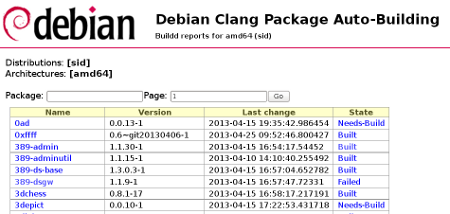
For Debian Developer and maintainer, a per maintainer view is also provided. This will list all packages maintained by a Debian packager. My page as example Here is an example of the list of package:
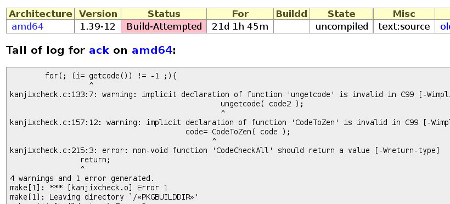
And an example of package failing:
At time of writing, most of the packages in unstable have been rebuilt (16 % are remaining). However, due to resource constraints, only amd64 packages are built. Contact me if you have resources to share for other architectures. Thanks to Paul Wise, the PTS (Debian package tracking system) proposes a link to the clang build logs (failing or not). A repository will be automatically updated with the results of these builds (once I find the time to get into buildd). 2) clang-built repository
Thanks to the Amazon Cloud, with our new DPL (Debian Project Leader), Lucas Nussbaum, we rebuilt unstable last April and published it at the following address:
deb http://clang.debian.net/repository-2013-04-07/ unstable-clang main
This allows some cool stuff like:
$ echo "deb http://clang.debian.net/repository-2013-04-07/ unstable-clang main">>/etc/apt/sources.list
$ apt-get update
$ apt-get install coreutils/unstable-clang
$ ls
$ awk
Note that this repository was only one-shoot and does not get updated. Quality of the binary produced (performance and size) can be tested thanks to this repository. Feedbacks are welcome!

Next.

Previous.