Search Results: "Dirk Eddelbuettel"

20 March 2026

Dirk Eddelbuettel: RcppSpdlog 0.0.28 on CRAN: Micro-Maintenance

Version 0.0.28 of RcppSpdlog arrived on CRAN today, has been uploaded to Debian and built for r2u. The (nice) documentation site has been refreshed too. RcppSpdlog bundles spdlog, a wonderful header-only C++ logging library with all the bells and whistles you would want that was written by Gabi Melman, and also includes fmt by Victor Zverovich. You can learn more at the nice package documention site. This release contains a rebuild RcppExports.cpp to aid Rcpp in the transition towards Rcpp::stop() and away from Rf_error() in its user packages. No othe The NEWS entry for this release follows.

Changes in RcppSpdlog version 0.0.28 (2026-03-19)
  • Regenerate RcppExports.cpp to switch to (Rf_error) aiding in Rcpp transition to Rcpp::stop()

Courtesy of my CRANberries, there is also a diffstat report detailing changes. More detailed information is on the RcppSpdlog page, or the package documention site.

This post by Dirk Eddelbuettel originated on his Thinking inside the box blog. If you like this or other open-source work I do, you can sponsor me at GitHub.

18 March 2026

Dirk Eddelbuettel: tidyCpp 0.0.11 on CRAN: Microfix

And yet another maintenance release of the tidyCpp package arrived on CRAN this morning, just days after previous release which itself came a mere week and a half after its predecessor. It has been built for r2u as well. The package offers a clean C++ layer (as well as one small C++ helper class) on top of the C API for R which aims to make use of this robust (if awkward) C API a little easier and more consistent. See the vignette for motivating examples. This release restores the small CSS file used by the vignette which we, in a last-second decision, omitted from the previous release. Oddly, it only failed under the oldrel i.e. the R from now nearly two years ago. But it was still an unenforced error, and this upload corrects it. Changes are summarized in the NEWS entry that follows.

Changes in tidyCpp version 0.0.11 (2026-03-17)
  • Keep a CSS file in the package to allow vignette build on r-oldrel too

Thanks to my CRANberries, there is also a diffstat report for this release. For questions, suggestions, or issues please use the issue tracker at the GitHub repo.

This post by Dirk Eddelbuettel originated on his Thinking inside the box blog. If you like this or other open-source work I do, you can now sponsor me at GitHub.

17 March 2026

Dirk Eddelbuettel: RcppArmadillo 15.2.4-1 on CRAN: Upstream Update

armadillo image Armadillo is a powerful and expressive C++ template library for linear algebra and scientific computing. It aims towards a good balance between speed and ease of use, has a syntax deliberately close to Matlab, and is useful for algorithm development directly in C++, or quick conversion of research code into production environments. RcppArmadillo integrates this library with the R environment and language and is widely used by (currently) 1235 other packages on CRAN, downloaded 44.9 million times (per the partial logs from the cloud mirrors of CRAN), and the CSDA paper (preprint / vignette) by Conrad and myself has been cited 672 times according to Google Scholar. This versions updates to the 15.2.4 upstream Armadillo release from yesterday. The package has already been updated for Debian, and for r2u. This release, which we as usual checked against the reverse-dependencies, brings minor changes over the RcppArmadillo release 15.2.3 made in December (and described here) by addressing some corner-case ASAN/UBSAN reports (which Conrad, true to his style of course labels as false positive just how he initially responded that he would never add a fix based on such a false report; as always it is best to just watch what does as he is rather good at it, and, written comments notwithstanding, quite responsive) as well as speed-ups for empty sparse matrices. I made one more follow-up refinement on the OpenMP setup which should now just work on all suitable platforms. The detailed changes since the last release follow.

Changes in RcppArmadillo version 15.2.4-1 (2026-03-17)
  • Upgraded to Armadillo release 15.2.4 (Medium Roast Deluxe)
    • Workarounds for bugs in GCC and Clang sanitisers (ASAN false positives)
    • Faster handling of blank sparse matrices
  • Refined OpenMP setup (Dirk in #500)

Courtesy of my CRANberries, there is a diffstat report relative to previous release. More detailed information is on the RcppArmadillo page. Questions, comments etc should go to the rcpp-devel mailing list off the Rcpp R-Forge page.

This post by Dirk Eddelbuettel originated on his Thinking inside the box blog. If you like this or other open-source work I do, you can sponsor me at GitHub.
16 March 2026

Dirk Eddelbuettel: RcppClassicExamples 0.1.4 on CRAN: Maintenance

Another minor maintenance release version 0.1.4 of package RcppClassicExamples arrived earlier today on CRAN, and has been built for r2u. This package illustrates usage of the old and otherwise deprecated initial Rcpp API which no new projects should use as the normal and current Rcpp API is so much better. This release, the first in two and half years, mostly aids Rcpp in moving from Rf_error() to Rcpp::stop() for better behaviour under error conditions or excections. A few other things were updated in the interim such as standard upgrade to continuous integration, use of Authors@R, and switch to static linking and an improved build to support multiple macOS architectures. No new code or features. Full details below. And as a reminder, don t use the old RcppClassic use Rcpp instead.

Changes in version 0.1.4 (2026-03-16)
  • Continuous integration has been updated several times
  • DESCRIPTION now uses Authors@R
  • Static linking is enforced, RcppClassic (>= 0.9.14) required
  • Calls to Rf_error() have been replaced with Rcpp::stop()
  • Updated versioned dependencies

Thanks to CRANberries, you can also look at a diff to the previous release.

This post by Dirk Eddelbuettel originated on his Thinking inside the box blog. If you like this or other open-source work I do, you can now sponsor me at GitHub.

15 March 2026

Dirk Eddelbuettel: RcppClassic 0.9.14 on CRAN: Minor Update

A maintenance release 0.9.14 of the RcppClassic package arrived earlier today on CRAN, and has been built for r2u. This package provides a maintained version of the otherwise deprecated initial Rcpp API which no new projects should use as the normal and current Rcpp API is so much better. A few changes had cumulated up since the last release in late 2022. We updated continuous integration scripts a few times, switched to Authors@R in DESCRIPTION, and rejigged build scripts a little to accommodate both possible build architectures for macOS. We also updated the vignette by updating all reference and switching the new asis vignette builder now available in Rcpp. CRANberries also reports the changes relative to the previous release from 3 1/2 years ago. Questions, comments etc should go to the rcpp-devel mailing list off the R-Forge page.

This post by Dirk Eddelbuettel originated on his Thinking inside the box blog. If you like this or other open-source work I do, you can now sponsor me at GitHub.

Dirk Eddelbuettel: tidyCpp 0.0.10 on CRAN: Even More Maintenance

Yet another maintenance release of the tidyCpp package arrived on CRAN this morning, a mere week and a half after the previous release. It has been built for r2u as well. The package offers a clean C++ layer (as well as one small C++ helper class) on top of the C API for R which aims to make use of this robust (if awkward) C API a little easier and more consistent. See the vignette for motivating examples. This release, just like the preceding one less than two weeks ago, had its hand forced by an overnight change in R-devel. The breakage this created has since been reverted in R-devel but as the writing is on the wall are now removing the definition involving these accessors preemptively. We were also missing version checks for two newly added alternates. Changes are summarized in the NEWS entry that follows.

Changes in tidyCpp version 0.0.10 (2026-03-15)
  • Hide five accessors as underlying macros removed from Rinternals
  • Preemptively hide another accessor
  • Ensure two definitions are conditional on R 4.5.0 or later

Thanks to my CRANberries, there is also a diffstat report for this release. For questions, suggestions, or issues please use the issue tracker at the GitHub repo.

This post by Dirk Eddelbuettel originated on his Thinking inside the box blog. If you like this or other open-source work I do, you can now sponsor me at GitHub.

13 March 2026

Dirk Eddelbuettel: RcppCNPy 0.2.15 on CRAN: Maintenance

Another maintenance release of the RcppCNPy package arrived on CRAN today, and has already been built as an r2u binary. RcppCNPy provides R with read and write access to NumPy files thanks to the cnpy library by Carl Rogers along with Rcpp for the glue to R. The changes are minor and similar to other recent changes. We aid Rcpp in the transition away from calling Rf_error() by relying in Rcpp::stop() which has better behaviour and unwinding when errors or exceptions are encountered. So once again no user-facing changes. Full details are below.

Changes in version 0.2.15 (2026-03-13)
  • Replaced Rf_error with Rcpp::stop in three files
  • Maintenance updates to continuous integration

CRANberries also provides a diffstat report for the latest release. As always, feedback is welcome and the best place to start a discussion may be the GitHub issue tickets page. If you like this or other open-source work I do, you can now sponsor me at GitHub.

This post by Dirk Eddelbuettel originated on his Thinking inside the box blog. Please report excessive re-aggregation in third-party for-profit settings.

12 March 2026

Dirk Eddelbuettel: RcppBDT 0.2.8 on CRAN: Maintenance

Another minor maintenance release for the RcppBDT package is now on CRAN, and had been built as binary for r2u. The RcppBDT package is an early adopter of Rcpp and was one of the first packages utilizing Boost and its Date_Time library. The now more widely-used package anytime is a direct descentant of RcppBDT. This release is again primarily maintenance. We aid Rcpp in the transition away from calling Rf_error() by relying in Rcpp::stop() which has better behaviour and unwinding when errors or exceptions are encountered. No feature or interface changes. The NEWS entry follows:

Changes in version 0.2.8 (2026-03-12)
  • Replaced Rf_error with Rcpp::stop in three files
  • Maintenance updates to continuous integration

Courtesy of my CRANberries, there is also a diffstat report for this release. For questions, suggestions, or issues please use the issue tracker at the GitHub repo.

This post by Dirk Eddelbuettel originated on his Thinking inside the box blog. If you like this or other open-source work I do, you can now sponsor me at GitHub.

11 March 2026

Dirk Eddelbuettel: RcppDE 0.1.9 on CRAN: Maintenance

Another maintenance release of our RcppDE package arrived at CRAN, and has been built for r2u. RcppDE is a port of DEoptim, a package for derivative-free optimisation using differential evolution, from plain C to C++. By using RcppArmadillo the code became a lot shorter and more legible. Our other main contribution is to leverage some of the excellence we get for free from using Rcpp, in particular the ability to optimise user-supplied compiled objective functions which can make things a lot faster than repeatedly evaluating interpreted objective functions as DEoptim does (and which, in fairness, most other optimisers do too). The gains can be quite substantial. This release is again maintenance. We aid Rcpp in the transition away from calling Rf_error() by relying in Rcpp::stop() which has better behaviour and unwinding when errors or exceptions are encountered. We also overhauled the references in the vignette, added an Armadillo version getter and made the regular updates to continuous integration. Courtesy of my CRANberries, there is also a diffstat report. More detailed information is on the RcppDE page, or the repository.

This post by Dirk Eddelbuettel originated on his Thinking inside the box blog. If you like this or other open-source work I do, you can sponsor me at GitHub.

9 March 2026

Dirk Eddelbuettel: nanotime 0.3.13 on CRAN: Maintenance

Another minor update 0.3.13 for our nanotime package is now on CRAN, and has been uploaded to Debian and compiled for r2u. nanotime relies on the RcppCCTZ package (as well as the RcppDate package for additional C++ operations) and offers efficient high(er) resolution time parsing and formatting up to nanosecond resolution, using the bit64 package for the actual integer64 arithmetic. Initially implemented using the S3 system, it has benefitted greatly from a rigorous refactoring by Leonardo who not only rejigged nanotime internals in S4 but also added new S4 types for periods, intervals and durations. This release, the first in eleven months, rounds out a few internal corners and helps Rcpp with the transition away from Rf_error to only using Rcpp::stop which deals more gracefully with error conditions and unwinding. We also updated how the vignette is made, its references, updated the continuous integration as one does, altered how the documentation site is built, gladly took a PR from Michael polishing another small aspect, and tweaked how the compilation standard is set. The NEWS snippet below has the fuller details.

Changes in version 0.3.13 (2026-03-08)
  • The methods package is now a Depends as WRE recommends (Michael Chirico in #141 based on a suggestion by Dirk in #140)
  • The mkdocs-material documentation site is now generated via altdoc
  • Continuous Integration scripts have been updated
  • Replace Rf_error with Rcpp::stop, turn remaining one into (Rf_error) (Dirk in #143)
  • Vignette now uses the Rcpp::asis builder for pre-made pdfs (Dirk in #146 fixing #144)
  • The C++ compilation standard is explicitly set to C++17 if an R version older than 4.3.0 is used (Dirk in #148 fixing #147)
  • The vignette references have been updated

Thanks to my CRANberries, there is a diffstat report for this release. More details and examples are at the nanotime page; code, issue tickets etc at the GitHub repository and all documentation is provided at the nanotime documentation site.

This post by Dirk Eddelbuettel originated on his Thinking inside the box blog. If you like this or other open-source work I do, you can now sponsor me at GitHub.

7 March 2026

Dirk Eddelbuettel: RProtoBuf 0.4.26 on CRAN: More Maintenance

A new maintenance release 0.4.26 of RProtoBuf arrived on CRAN today. RProtoBuf provides R with bindings for the Google Protocol Buffers ( ProtoBuf ) data encoding and serialization library used and released by Google, and deployed very widely in numerous projects as a language and operating-system agnostic protocol. The new release is also already as a binary via r2u. This release brings an update to aid in an ongoing Rcpp transitions from Rf_error to Rcpp::stop, and includes a few more minor cleanups including one contributed by Michael. The following section from the NEWS.Rd file has full details.

Changes in RProtoBuf version 0.4.26 (2026-03-06)
  • Minor cleanup in DESCRIPTION depends and imports
  • Remove obsolete check for utils::.DollarNames (Michael Chirico in #111)
  • Replace Rf_error with Rcpp::stop, turn remaining one into (Rf_error) (Dirk in #112)
  • Update configure test to check for RProtoBuf 3.3.0 or later

Thanks to my CRANberries, there is a diff to the previous release. The RProtoBuf page has copies of the (older) package vignette, the quick overview vignette, and the pre-print of our JSS paper. Questions, comments etc should go to the GitHub issue tracker off the GitHub repo.

This post by Dirk Eddelbuettel originated on his Thinking inside the box blog. If you like this or other open-source work I do, you can sponsor me at GitHub.

5 March 2026

Dirk Eddelbuettel: RcppGSL 0.3.14 on CRAN: Maintenance

A new release 0.3.14 of RcppGSL is now on CRAN. The RcppGSL package provides an interface from R to the GNU GSL by relying on the Rcpp package. It has already been uploaded to Debian, and is also already available as a binary via r2u. This release, the first in over three years, contains mostly maintenance changes. We polished the fastLm example implementation a little more, updated continunous integration as one does over such a long period, adopted the Authors@R convention, switched the (pre-made) pdf vignette to a new driver now provided by Rcpp, updated vignette references and URLs, and updated one call to Rf_error to aid in a Rcpp transition towards using only Rcpp::stop which unwinds error conditions better. (Technically this was a false positive on Rf_error but on the margin worth tickling this release after all this time.) The NEWS entry follows:

Changes in version 0.3.14 (2026-03-05)
  • Updated some internals of fastLm example, and regenerated RcppExports.* files
  • Several updates for continuous integration
  • Switched to using Authors@R
  • Replace ::Rf_error with (Rf_error) in old example to aid Rcpp transition to Rcpp::stop (or this pass-through)
  • Vignette now uses the Rcpp::asis builder for pre-made pdfs
  • Vignette references have been updated, URLs prefer https and DOIs

Thanks to my CRANberries, there is also a diffstat report for this release. More information is on the RcppGSL page. Questions, comments etc should go to the issue tickets at the GitHub repo.

This post by Dirk Eddelbuettel originated on his Thinking inside the box blog. If you like this or other open-source work I do, you can now sponsor me at GitHub.

4 March 2026

Dirk Eddelbuettel: tidyCpp 0.0.9 on CRAN: More (forced) Maintenance

Another maintenance release of the tidyCpp package arrived on CRAN this morning. The packages offers a clean C++ layer (as well as one small C++ helper class) on top of the C API for R which aims to make use of this robust (if awkward) C API a little easier and more consistent. See the vignette for motivating examples. This release follows a similar release in November and had its hand forced by rather abrupt and forced overnight changes in R-devel, this time the removal of VECTOR_PTR in [this commit]. The release also contains changes accumulated since the last release (including some kindly contritbuted by Ivan) and those are signs that the R Core team can do more coordinated release management when they try a little harder. Changes are summarize in the NEWS entry that follows.

Changes in tidyCpp version 0.0.9 (2026-03-03)
  • Several vignette typos have been corrected (#4 addressing #3)
  • A badge for r-universe has been added to the README.md
  • The vignette is now served via GitHub Pages and that version is referenced in the README.
  • Two entry points reintroduced and redefined using permitted R API function (Ivan Krylov in #5).
  • Another entry has been removed to match R-devel API changes.
  • Six new attributes helpers have been added for R 4.6.0 or later.
  • VECTOR_PTR_RO(x) replaces the removed VECTOR_PTR, a warning or deprecation period would have been nice here.

Thanks to my CRANberries, there is also a diffstat report for this release. For questions, suggestions, or issues please use the issue tracker at the GitHub repo.

This post by Dirk Eddelbuettel originated on his Thinking inside the box blog. If you like this or other open-source work I do, you can now sponsor me at GitHub.

27 February 2026

Dirk Eddelbuettel: x13binary 1.1.61.2 on CRAN: Micro Maintenance

The x13binary team is happy to share the availability of Release 1.1.61.2 of the x13binary package providing the X-13ARIMA-SEATS program by the US Census Bureau which arrived on CRAN earlier today, and has already been built for r2u. This release responds to a CRAN request to display the compiler version when building. x13binary, just like three other packages there, creates and ships a local binary it interfaces with. So our build was a little outside of R CMD INSTALL ... but now signals build versions like R does. We also modernized and simplified our continuous intgegration script based on r-ci. Courtesy of my CRANberries, there is also a diffstat report for this release showing changes to the previous release.

This post by Dirk Eddelbuettel originated on his Thinking inside the box blog. If you like this or other open-source work I do, you can sponsor me at GitHub.

21 February 2026

Dirk Eddelbuettel: qlcal 0.1.0 on CRAN: Easier Calendar Switching

The eighteenth release of the qlcal package arrivied at CRAN today. There has been no calendar update in QuantLib 1.41 so it has been relatively quiet since the last release last summer but we now added a nice new feature (more below) leading to a new minor release version. qlcal delivers the calendaring parts of QuantLib. It is provided (for the R package) as a set of included files, so the package is self-contained and does not depend on an external QuantLib library (which can be demanding to build). qlcal covers over sixty country / market calendars and can compute holiday lists, its complement (i.e. business day lists) and much more. Examples are in the README at the repository, the package page, and course at the CRAN package page. This releases makes it (much) easier to work with multiple calendars. The previous setup remains: the package keeps one global (and hidden) calendar object which can be set, queried, altered, etc. But now we added the ability to hold instantiated calendar objects in R. These are external pointer objects, and we can pass them to functions requiring a calendar. If no such optional argument is given, we fall back to the global default as before. Similarly for functions operating on one or more dates, we now simply default to the current date if none is given. That means we can now say
> sapply(c("UnitedStates/NYSE", "Canada/TSX", "Australia/ASX"), 
         \(x) qlcal::isBusinessDay(xp=qlcal::getCalendar(x)))
UnitedStates/NYSE        Canada/TSX     Australia/ASX 
             TRUE              TRUE              TRUE 
> 
to query today (February 18) in several markets, or compare to two days ago when Canada and the US both observed a holiday
> sapply(c("UnitedStates/NYSE", "Canada/TSX", "Australia/ASX"),
         \(x) qlcal::isBusinessDay(as.Date("2026-02-16"), xp=qlcal::getCalendar(x)))
UnitedStates/NYSE        Canada/TSX     Australia/ASX 
            FALSE             FALSE              TRUE 
> 
The full details from NEWS.Rd follow.

Changes in version 0.1.0 (2026-02-18)
  • Invalid calendars return id TARGET now
  • Calendar object can be created on the fly and passed to the date-calculating functions; if missing global one used
  • For several functions a missing date object now implies computation on the current date, e.g. isBusinessDay()

Courtesy of my CRANberries, there is a diffstat report for this release. See the project page and package documentation for more details, and more examples.

This post by Dirk Eddelbuettel originated on his Thinking inside the box blog. If you like this or other open-source work I do, you can sponsor me at GitHub. Edited 2026-02-21 to correct a minor earlier error: it referenced a QuantLib 1.42 release which does not (yet) exist.

18 February 2026

Dirk Eddelbuettel: qlcal 0.1.0 on CRAN: Easier Calendar Switching

The eighteenth release of the qlcal package arrivied at CRAN today. There has been no calendar update in QuantLib 1.41 so it has been relatively quiet since the last release last summer but we now added a nice new feature (more below) leading to a new minor release version. qlcal delivers the calendaring parts of QuantLib. It is provided (for the R package) as a set of included files, so the package is self-contained and does not depend on an external QuantLib library (which can be demanding to build). qlcal covers over sixty country / market calendars and can compute holiday lists, its complement (i.e. business day lists) and much more. Examples are in the README at the repository, the package page, and course at the CRAN package page. This releases makes it (much) easier to work with multiple calendars. The previous setup remains: the package keeps one global (and hidden) calendar object which can be set, queried, altered, etc. But now we added the ability to hold instantiated calendar objects in R. These are external pointer objects, and we can pass them to functions requiring a calendar. If no such optional argument is given, we fall back to the global default as before. Similarly for functions operating on one or more dates, we now simply default to the current date if none is given. That means we can now say
> sapply(c("UnitedStates/NYSE", "Canada/TSX", "Australia/ASX"), 
         \(x) qlcal::isBusinessDay(xp=qlcal::getCalendar(x)))
UnitedStates/NYSE        Canada/TSX     Australia/ASX 
             TRUE              TRUE              TRUE 
> 
to query today (February 18) in several markets, or compare to two days ago when Canada and the US both observed a holiday
> sapply(c("UnitedStates/NYSE", "Canada/TSX", "Australia/ASX"),
         \(x) qlcal::isBusinessDay(as.Date("2026-02-16"), xp=qlcal::getCalendar(x)))
UnitedStates/NYSE        Canada/TSX     Australia/ASX 
            FALSE             FALSE              TRUE 
> 
The full details from NEWS.Rd follow.

Changes in version 0.1.0 (2026-02-18)
  • Invalid calendars return id TARGET now
  • Calendar object can be created on the fly and passed to the date-calculating functions; if missing global one used
  • For several functions a missing date object now implies computation on the current date, e.g. isBusinessDay()

Courtesy of my CRANberries, there is a diffstat report for this release. See the project page and package documentation for more details, and more examples.

This post by Dirk Eddelbuettel originated on his Thinking inside the box blog. If you like this or other open-source work I do, you can sponsor me at GitHub. Edited 2026-02-21 to correct a minor earlier error: it referenced a QuantLib 1.42 release which does not (yet) exist.

12 February 2026

Dirk Eddelbuettel: RcppSpdlog 0.0.27 on CRAN: C++20 Accommodations

Version 0.0.27 of RcppSpdlog arrived on CRAN moments ago, and will be uploaded to Debian and built for r2u shortly. The (nice) documentation site will be refreshed too. RcppSpdlog bundles spdlog, a wonderful header-only C++ logging library with all the bells and whistles you would want that was written by Gabi Melman, and also includes fmt by Victor Zverovich. You can learn more at the nice package documention site. Brian Ripley has now turned C++20 on as a default for R-devel (aka R 4.6.0 to be ), and this turned up misbehvior in packages using RcppSpdlog such as our spdl wrapper (offering a nicer interface from both R and C++) when relying on std::format. So for now, we turned this off and remain with fmt::format from the fmt library while we investigate further. The NEWS entry for this release follows.

Changes in RcppSpdlog version 0.0.27 (2026-02-11)
  • Under C++20 or later, keep relying on fmt::format until issues experienced using std::format can be identified and resolved

Courtesy of my CRANberries, there is also a diffstat report detailing changes. More detailed information is on the RcppSpdlog page, or the package documention site.

This post by Dirk Eddelbuettel originated on his Thinking inside the box blog. If you like this or other open-source work I do, you can sponsor me at GitHub.

8 February 2026

Dirk Eddelbuettel: chronometre: A new package (pair) demo for R and Python

Both R and Python make it reasonably easy to work with compiled extensions. But how to access objects in one environment from the other and share state or (non-trivial) objects remains trickier. Recently (and while r-forge was resting so we opened GitHub Discussions) a question was asked concerning R and Python object pointer exchange. This lead to a pretty decent discussion including arrow interchange demos (pretty ideal if dealing with data.frame-alike objects), but once the focus is on more library-specific objects from a given (C or C++, say) library it is less clear what to do, or how involved it may get. R has external pointers, and these make it feasible to instantiate the same object in Python. To demonstrate, I created a pair of (minimal) packages wrapping a lovely (small) class from the excellent spdlog library by Gabi Melman, and more specifically in an adapted-for-R version (to avoid some R CMD check nags) in my RcppSpdlog package. It is essentially a nicer/fancier C++ version of the tic() and tic() timing scheme. When an object is instantiated, it starts the clock and when we accessing it later it prints the time elapsed in microsecond resolution. In Modern C++ this takes little more than keeping an internal chrono object. Which makes for a nice, small, yet specific object to pass to Python. So the R side of the package pair instantiates such an object, and accesses its address. For different reasons, sending a raw pointer across does not work so well, but a string with the address printed works fabulously (and is a paradigm used around other packages so we did not invent this). Over on the Python side of the package pair, we then take this string representation and pass it to a little bit of pybind11 code to instantiate a new object. This can of course also expose functionality such as the show time elapsed feature, either formatted or just numerically, of interest here. And that is all that there is! Now this can be done from R as well thanks to reticulate as the demo() (also shown on the package README.md) shows:
> library(chronometre)
> demo("chronometre", ask=FALSE)


        demo(chronometre)
        ---- ~~~~~~~~~~~

> #!/usr/bin/env r
> 
> stopifnot("Demo requires 'reticulate'" = requireNamespace("reticulate", quietly=TRUE))

> stopifnot("Demo requires 'RcppSpdlog'" = requireNamespace("RcppSpdlog", quietly=TRUE))

> stopifnot("Demo requires 'xptr'" = requireNamespace("xptr", quietly=TRUE))

> library(reticulate)

> ## reticulate and Python in general these days really want a venv so we will use one,
> ## the default value is a location used locally; if needed create one
> ## check for existing virtualenv to use, or else set one up
> venvdir <- Sys.getenv("CHRONOMETRE_VENV", "/opt/venv/chronometre")

> if (dir.exists(venvdir))  
+ >     use_virtualenv(venvdir, required = TRUE)
+ >   else  
+ >     ## create a virtual environment, but make it temporary
+ >     Sys.setenv(RETICULATE_VIRTUALENV_ROOT=tempdir())
+ >     virtualenv_create("r-reticulate-env")
+ >     virtualenv_install("r-reticulate-env", packages = c("chronometre"))
+ >     use_virtualenv("r-reticulate-env", required = TRUE)
+ >  


> sw <- RcppSpdlog::get_stopwatch()                   # we use a C++ struct as example

> Sys.sleep(0.5)                                      # imagine doing some code here

> print(sw)                                           # stopwatch shows elapsed time
0.501220 

> xptr::is_xptr(sw)                                   # this is an external pointer in R
[1] TRUE

> xptr::xptr_address(sw)                              # get address, format is "0x...."
[1] "0x58adb5918510"

> sw2 <- xptr::new_xptr(xptr::xptr_address(sw))       # cloned (!!) but unclassed

> attr(sw2, "class") <- c("stopwatch", "externalptr") # class it .. and then use it!

> print(sw2)                                          #  xptr  allows us close and use
0.501597 

> sw3 <- ch$Stopwatch(  xptr::xptr_address(sw) )      # new Python object via string ctor

> print(sw3$elapsed())                                # shows output via Python I/O
datetime.timedelta(microseconds=502013)

> cat(sw3$count(), "\n")                              # shows double
0.502657 

> print(sw)                                           # object still works in R
0.502721 
> 
The same object, instantiated in R is used in Python and thereafter again in R. While this object here is minimal in features, the concept of passing a pointer is universal. We could use it for any interesting object that R can access and Python too can instantiate. Obviously, there be dragons as we pass pointers so one may want to ascertain that headers from corresponding compatible versions are used etc but principle is unaffected and should just work. Both parts of this pair of packages are now at the corresponding repositories: PyPI and CRAN. As I commonly do here on package (change) announcements, I include the (minimal so far) set of high-level changes for the R package.

Changes in version 0.0.2 (2026-02-05)
  • Removed replaced unconditional virtualenv use in demo given preceding conditional block
  • Updated README.md with badges and an updated demo

Changes in version 0.0.1 (2026-01-25)
  • Initial version and CRAN upload

Questions, suggestions, bug reports, are welcome at either the (now awoken from the R-Forge slumber) Rcpp mailing list or the newer Rcpp Discussions.

This post by Dirk Eddelbuettel originated on his Thinking inside the box blog. If you like this or other open-source work I do, you can sponsor me at GitHub.

5 February 2026

Dirk Eddelbuettel: rfoaas 2.3.3: Limited Rebirth

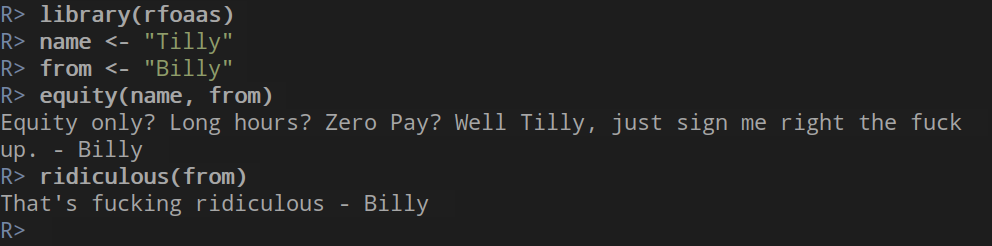
rfoaas greed example The original FOAAS site provided a rather wide variety of REST access points, but it sadky is no more (while the old repo is still there). A newer replacement site FOASS is up and running, but with a somewhat reduced offering. (For example, the two accessors shown in the screenshot are no more. C est la vie.) Recognising that perfect may once again be the enemy of (somewhat) good (enough), we have rejigged the rfoaas package in a new release 2.3.3. (The precding version number 2.3.2 corresponded to the upstream version, indicating which API release we matched. Now we just went + 0.0.1 but there is no longer a correspondence to the service version at FOASS.) Accessor functions for each of the now available access points are provided, ans the random sampling accessor getRandomFO() now picks from that set. My CRANberries service provides a comparison to the previous release. Questions, comments etc should go to the GitHub issue tracker. More background information is on the project page as well as on the github repo

This post by Dirk Eddelbuettel originated on his Thinking inside the box blog. If you like this or other open-source work I do, you can sponsor me at GitHub.

4 February 2026

Dirk Eddelbuettel: littler 0.3.23 on CRAN: More Features (and Fixes)

max-heap image The twentythird release of littler as a CRAN package landed on CRAN just now, following in the now twenty year history (!!) as a (initially non-CRAN) package started by Jeff in 2006, and joined by me a few weeks later. littler is the first command-line interface for R as it predates Rscript. It allows for piping as well for shebang scripting via #!, uses command-line arguments more consistently and still starts faster. It also always loaded the methods package which Rscript only began to do in later years. littler lives on Linux and Unix, has its difficulties on macOS due to some-braindeadedness there (who ever thought case-insensitive filesystems as a default were a good idea?) and simply does not exist on Windows (yet the build system could be extended see RInside for an existence proof, and volunteers are welcome!). See the FAQ vignette on how to add it to your PATH. A few examples are highlighted at the Github repo:, as well as in the examples vignette. This release, the first in about eleven months, once again brings two new helper scripts, and enhances six existing one. The release was triggered because it finally became clear why installGitHub.r ignored r2u when available: we forced the type argument to source (so thanks to I aki for spotting this). One change was once again contributed by Michael which is again greatly appreciated. The full change description follows.

Changes in littler version 0.3.22 (2026-02-03)
  • Changes in examples scripts
    • A new script busybees.r aggregates deadlined packages by maintainer
    • Several small updated have been made to the (mostly internal) 'r2u.r' script
    • The deadliners.r script has refined treatment for screen width
    • The install2.r script has new options --quiet and --verbose as proposed by Zivan Karaman
    • The rcc.r script passes build-args to 'rcmdcheck' to compact vignettes and save data
    • The installRub.r script now defaults to 'noble' and is more tolerant of inputs
    • The installRub.r script deals correctly with empty utils::osVersion thanks to Michael Chirico
    • New script checkPackageUrls.r inspired by how CRAN checks (with thanks to Kurt Hornik for the hint)
    • The installGithub.r script now adjusts to bspm and takes advantage of r2u binaries for its build dependencies
  • Changes in package
    • Environment variables (read at build time) can use double quotes
    • Continuous intgegration scripts received a minor update

My CRANberries service provides a comparison to the previous release. Full details for the littler release are provided as usual at the ChangeLog page, and also on the package docs website. The code is available via the GitHub repo, from tarballs and now of course also from its CRAN page and via install.packages("littler"). Binary packages are available directly in Debian as well as (in a day or two) Ubuntu binaries at CRAN thanks to the tireless Michael Rutter. Comments and suggestions are welcome at the GitHub repo.

This post by Dirk Eddelbuettel originated on his Thinking inside the box blog. If you like this or other open-source work I do, you can sponsor me at GitHub.

Next.

Previous.