David Watson: Project 52 - Week 9
 Something a little political for this week.
I've also taken the low budget studio setup to a new level by adding a black t-shirt for the background. No expense spared.
 Something a little political for this week.
I've also taken the low budget studio setup to a new level by adding a black t-shirt for the background. No expense spared.
$ cupt-experimental -s -R remove kdepimlibs-kio-plugins kdebase-workspace+
Building the package cache...
Initializing package resolver and worker...
Scheduling requested actions...
Resolving possible unmet dependencies...
E: unable to resolve dependencies, because of:
plasma-widgets-workspace 4:4.4.5-8 depends on 'plasma-dataengines-workspace (= 4:4.4.5-8)' -> no solutions
  plasma-dataengines-workspace 4:4.4.4-1 depends on 'kdepim-runtime' -> removed plasma-dataengines-workspace
    kdepim-runtime 4:4.4.3-1 depends on 'kdepimlibs-kio-plugins' -> removed kdepim-runtime
  plasma-desktop 4:4.4.5-8 depends on 'plasma-widgets-workspace (= 4:4.4.5-8)' -> installed plasma-widgets-workspace 4:4.4.5-8
    kdebase-workspace-bin 4:4.4.5-8 depends on 'plasma-desktop (= 4:4.4.5-8)   plasma-netbook (= 4:4.4.5-8)' -> installed plasma-desktop 4:4.4.5-8
      kdebase-workspace 4:4.4.5-8 depends on 'kdebase-workspace-bin (>= 4:4.4.5-8)' -> installed kdebase-workspace-bin 4:4.4.5-8
plasma-dataengines-workspace 4:4.4.5-8 depends on 'kdepim-runtime' -> no solutions
  kdepim-runtime 4:4.4.3-1 depends on 'kdepimlibs-kio-plugins' -> removed kdepim-runtime
  plasma-widgets-workspace 4:4.4.5-8 depends on 'plasma-dataengines-workspace (= 4:4.4.5-8)' -> installed plasma-dataengines-workspace 4:4.4.5-8
    plasma-netbook 4:4.4.5-8 depends on 'plasma-widgets-workspace (= 4:4.4.5-8)' -> installed plasma-widgets-workspace 4:4.4.5-8
      kdebase-workspace-bin 4:4.4.5-8 depends on 'plasma-desktop (= 4:4.4.5-8)   plasma-netbook (= 4:4.4.5-8)' -> installed plasma-netbook 4:4.4.5-8
        kdebase-workspace 4:4.4.5-8 depends on 'kdebase-workspace-bin (>= 4:4.4.5-8)' -> installed kdebase-workspace-bin 4:4.4.5-8
E: error performing command 'remove'
 Spend millions visiting space TWICE, take Amazon referal money from non profit... priceless!

 A few days ago Conrad Sanderson released version 1.1.6 of his Armadillo templated C++ library for
linear algebra. Accordingly, I made a new release 0.2.14 of RcppArmadillo,
our Rcpp-based
integration into R which included a
few local fixes. However, while I updated SVN at the
R-Forge project I
didn't update the final tarball so Armadillo 1.1.6 wasn't in it. That is corrected in
the 0.2.15 upload which is now on CRAN and its mirrors.
The short NEWS file extract for both releases follows, also containing
Conrad's entry for 1.1.6. A few minor tweaks were added but no user-visible
changes:
0.2.15  2011-03-04
    o   Upgraded to Armadillo Version 1.1.6    Baby Carpet Shark
         * fixed size matrices and vectors can use auxiliary (external) memory
         * .in_range() can use span() arguments
         * subfields can use span() arguments
0.2.14  2011-03-02
    o   Support Run-Time Type Information (RTTI) on matrices by setting the
        state variable vec_state in Row and Col instantiation, with thanks to
        Conrad Sanderson for the hint
    o   fastLm code simplified further by instantiating the Armadillo matrix
        and vector directly from the SEXP coming from R
    o   inst/doc/Makefile now respects $R_HOME environment variable
And courtesy of
CRANberries, here are
the diffs
to.2.14
 ChangeLog                                                   14 -
 DESCRIPTION                                                  8
 inst/NEWS                                                   10
 inst/doc/RcppArmadillo-unitTests.pdf                     binary
 inst/doc/unitTests-results/RcppArmadillo-unitTests.html     10
 inst/doc/unitTests-results/RcppArmadillo-unitTests.txt      39 +-
 inst/include/armadillo_bits/Col_meat.hpp                    51 +++
 inst/include/armadillo_bits/Col_proto.hpp                    3
 inst/include/armadillo_bits/Cube_meat.hpp                   52 +++
 inst/include/armadillo_bits/Cube_proto.hpp                   7
 inst/include/armadillo_bits/Mat_meat.hpp                    51 +++
 inst/include/armadillo_bits/Mat_proto.hpp                   12
 inst/include/armadillo_bits/Row_meat.hpp                    51 +++
 inst/include/armadillo_bits/Row_proto.hpp                    3
 inst/include/armadillo_bits/arma_version.hpp                 6
 inst/include/armadillo_bits/config.hpp                       9
 inst/include/armadillo_bits/field_meat.hpp                 220 ++++++++++++++--
 inst/include/armadillo_bits/field_proto.hpp                 20 +
 inst/unitTests/runit.RcppArmadillo.R                        16 +
 19 files changed, 521 insertions(+), 61 deletions(-)
and to the previous release 0.2.13, respectivel
 ChangeLog                                                   14 ++++++
 DESCRIPTION                                                  6 +-
 inst/NEWS                                                   11 +++++
 inst/doc/Makefile                                           15 +++++--
 inst/doc/RcppArmadillo-unitTests.pdf                     binary
 inst/doc/unitTests-results/RcppArmadillo-unitTests.html     18 ++++----
 inst/doc/unitTests-results/RcppArmadillo-unitTests.txt      34 ++++++++--------
 inst/include/RcppArmadillo/Col_meat.h                       24 ++++++-----
 inst/include/RcppArmadillo/Row_meat.h                       19 ++++----
 src/fastLm.cpp                                              15 ++-----
 10 files changed, 94 insertions(+), 62 deletions(-)
More information is on the RcppArmadillo page. Questions, comments etc should go to the rcpp-devel mailing list off the R-Forge page.
 In LaTeX, it seems like you can't define a command with a really optional
argument, using
\newcommand. You can make commands with arguments having
a default value though.
Now, I found myself in need of having such a functionality. I had to google
a while, but finally found it, so I'm posting it here, both to share knowledge
and to remember it in future :)
Suppose you want to do something like \mycmd foo and \mycmd foo bla , doing
different things (in my case, I needed to add the second argument enclosed by
parenthesis in the TOC and other places, but only if it was present)
Here's the code:
\def\mycmd#1 \def\tempa #1 \futurelet\next\mycmd@i % Save first argument
\def\mycmd@i \ifx\next\bgroup\expandafter\mycmd@ii\else\expandafter\mycmd@end\fi %Check brace
\def\mycmd@ii#1 ... %Two args
\def\mycmd@end ... %Single args
In the last two lines of the code, use
\tempa for your first argument, and #1
for your second optional argument. If you need spaces there (maybe as part of some
text), be sure to escape them with a backslash \.
I think it's expandable for additional arguments, but I haven't tried, and I don't
feel like getting my hands dirty with TeX yet 
RedirectPermanent /docs/linuxload.html /2010/07/manually_calculating_process_times/
[Fri Mar 04 14:40:17 2011] [warn] [client 172.16.242.1] incomplete redirection target of '/2010/07/manually_calculating_process_times/' for URI '/docs/linuxload.html' modified to 'http://enc.com.au/2010/07/manually_calculating_process_times/
Also, URL-path must be a fully qualified URL, not a relative path, even when used with .htaccess files or inside of <directory> sections.But I m running Apache 2.2 and the 2.2 mod_alias page says:
The new URL should be an absolute URL beginning with a scheme and hostname, but a URL-path beginning with a slash may also be used, in which case the scheme and hostname of the current server will be added.That s it, you two choices:
RedirectPermanent /docs/linuxload.html http://enc.com.au/2010/07/manually_calculating_process_times/
#!/bin/sh
set -e
WORKDIR=" dirname $ 0  /post"
find $ WORKDIR  -name "*.sh" -exec " " ";"
#!/bin/sh
set -e
OUTPUT_PATH= grep output $ HOME /.chroniclerc   cut -d= -f2   tr -d [:blank:]
sed -ne'/<\?xml version/,/blosxomFirstDayDiv/  /blosxomFirstDayDiv/b;p ' \
        $ OUTPUT_PATH /index.html > $ HOME /tmp/imprint.html
cat  dirname $ 0  /imprint.data >> $ HOME /tmp/imprint.html
echo -e "\n" >> $ HOME /tmp/imprint.html
sed -ne'/imprint_match/,$p' $ OUTPUT_PATH /index.html >> $ HOME /tmp/imprint.html
mv $ HOME /tmp/imprint.html $ OUTPUT_PATH /imprint.html
#!/bin/sh
set -e
OUTPUT_PATH= grep output $ HOME /.chroniclerc   cut -d= -f2   tr -d [:blank:]
sed -nre'/<\?xml version/,/blosxomFirstDayDiv/  /blosxomFirstDayDiv/b;p ' \
        $ OUTPUT_PATH /index.html > $ HOME /tmp/imprint.html
cat  dirname $ 0  /imprint.data >> $ HOME /tmp/imprint.html
echo -e "\n" >> $ HOME /tmp/imprint.html
sed -ne'/imprint_match/,$p' $ OUTPUT_PATH /index.html >> $ HOME /tmp/imprint.html
mv $ HOME /tmp/imprint.html $ OUTPUT_PATH /imprint.html

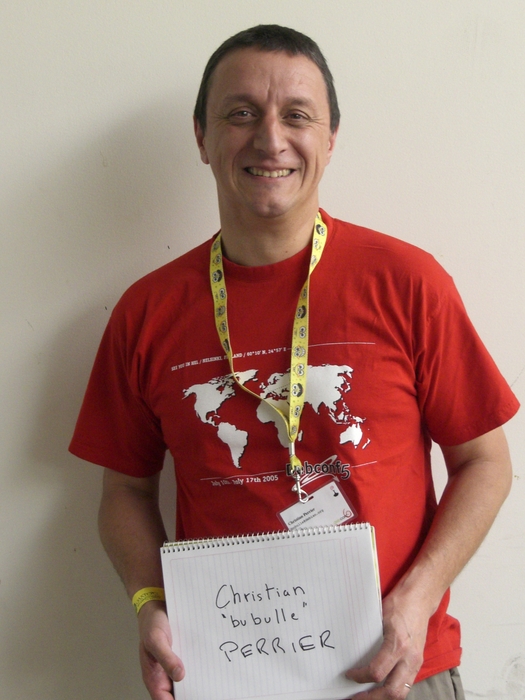 Christian is a figure of Debian, not only because of the tremendous coordination work that he does within the translation project, but also because he s very involved at the social level. He s probably in the top 5 of the persons who attended most often the Debian conference.
Christian is a friend (thanks for hosting me so many times when I come to Paris for Debian related events) and I m glad that he accepted to be interviewed. He likes to speak and that shows in the length of his answers
 but you ll be traveling the world while reading him.
My questions are in bold, the rest is by Christian.
Who are you?
I am a French citizen (which is easy to guess unless you correct my
usual mistakes in what follows). I m immensely proud of being married
for nearly 26 years with Elizabeth (who deserves a statue from Debian
for being so patient with my passion and my dedication to the
project).
I m also the proud father of 3 wonderful kids , aged 19 to
23.
I work as team manager in the Networks and Computers Division of Onera
the French Aerospace lab , a public research institute about
Aeronautics, Space and Defense. My team provides computer management
services for research divisions of Onera, with a specific focus put on
individual computing.
I entered the world of free software as one of the very first users of
Linux in France. Back in the early 1990 s, I happened (though the BBS
users communities) to be a friend of several early adopters of Linux
and/or BSD386/FreeBSD/NetBSD in France. More specifically, I
discovered Linux thanks with my friend Ren Cougnenc (all my free
software talks are dedicated to Ren , who passed away in 1996).
You re not a programmer, not even a packager. How did you come
to Debian?
I m definitely not a programmer and I never studied computing (I
graduated in Materials Science and worked in that area for a few years
after my PhD).
However, my daily work always involved computing (I redesigned the
creep testing laboratory and its acquisition system all by myself
during my thesis research work). An my hobbies often involved
playing with home computers, always trying to learn about something
new.
So, first learning about a new operating system then trying to
figure out how to become involved in its development was quite a
logical choice.
Debian is my distro of choice since it exists. I used Slackware on work
machines for a while, but my home server, kheops,
first ran Debian 1.1 when I stopped running a BBS on an MS-DOS machine
to host a news server. That was back in October 1996.
I then happened to be a user, and more specifically a user of
genealogy software, also participating very actively in Usenet from
this home computer and server, that was running this Debian thing.
So, progressively, I joined mailing lists and, being a passionate
person, I tried to figure out how I could bring my own little
contribution to all this.
This is why I became a packager (yes, I am one!) by taking over the
geneweb package, which I was using to publish my genealogy
research. I applied as DD in January 2001, then got my account in July
2001. My first upload to the Debian archive occurred on August 22nd
2001: that was of course geneweb, which I still maintain.
Quite quickly, I became involved in the work on French localization. I
have always been a strong supporter of localized software (I even
translated a few BBS software back in the early 90 s) as one of the
way to bring the power and richness of free software to more users.
Localization work lead me to work on the early version of Debian
Installer, during those 2003-2005 years where the development of D-I
was an incredibly motivating and challenging task, lead by Joey Hess
and his inspiring ideas.
From user to contributor to leader, I suddenly discovered, around
2004, that I became the coordinator of D-I i18n (internationalization)
without even noticing
You re the main translation coordinator in Debian. What plans
and goals have you set for Debian Wheezy?
As always: paint the world in red.
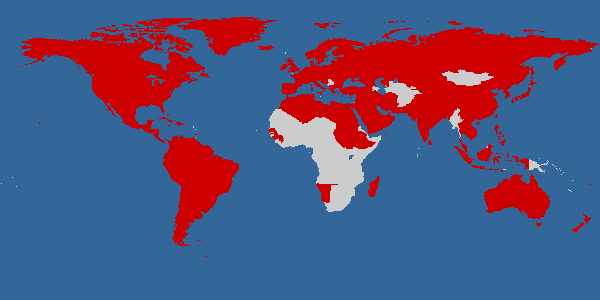 Indeed, this is my goal for years. I would like our favorite distro to
be able to be used by anyone in the world, whether she speaks
English, Northern Sami, Wolof, Uyghur or Secwepemcts n.
As a matter of symbol, I use the installer for this. My stance is that
one should be able to even install Debian in one s own language. So,
for about 7 years, I use D-I as a way to attract new localization
contributors.
This progress is represented on
this
page where the world
is gradually painted in red as long as the installer supports more
languages release after release. The map above tries to illustrate
this by painting in red countries when the most spoken language in the
country is supported in Debian Installer.
However, that map does not give enough reward to many great efforts
made to support very different kind of languages. Not only various
national languages, but also very different ones: all regional
languages of Spain, many of the most spoken languages in India,
minority languages such as Uyghur for which an effort is starting,
Northern Sami because it is taught in a few schools in Norway, etc.,
etc.
Still, the map gives a good idea of what I would like to see better
supported: languages from Africa, several languages in Central
Asia. And, as a very very personal goal, I m eagerly waiting for
support of Tibetan in Debian Installer, the same way we support its
sister language, Dzongkha from Bhutan.
For this to happen, we have to make contribution to localization as
easy as possible. The very distributed nature of Debian development
makes this a challenge, as material to translate (D-I components,
debconf screens, native packages, packages descriptions, website,
documentation) is very widely spread.
A goal, for years, is to set a centralized place where
translators could work easily without even knowing about SVN/GIT/BZR
or having to report bugs to send their work. The point, however, would
be to have this without making compromises on translation quality. So,
with peer review, use of thesaurus and translation memory and all such
techniques.
Tools for this exist: we, for instance, worked with the developers of
Pootle to help making it able to cope with the huge amount of material
in Debian (think about packages descriptions translations). However, as
of now, the glue between such tools and the raw material (that often
lies in packages) didn t come.
So, currently, translation work in Debian requires a great knowledge
of how things are organized, where is the material, how it can be
possible to make contribution reach packages, etc.
And, as I m technically unable to fulfill the goal of building the
infrastructure, I m fulfilling that role of spreading out the
knowledge. This is how I can define my coordinator role.
Ubuntu uses a web-based tool to make it easy to contribute
translations directly in Launchpad. At some point you asked Canonical to
make it free software. Launchpad has been freed in the mean time. Have you
(re)considered using it?
Why not? After all, it more or less fills in the needs I just
described. I still don t really figure out how we could have all
Debian material gathered in Rosetta/Launchpad .and also how Debian
packagers could easily get localized material back from the framework
without changing their development processes.
I have always tried to stay neutral wrt Ubuntu. As many people now in
Debian, I feel like we have reached a good way to achieve our mutual
development. When it comes at localization work, the early days where
the everything in Rosetta and translates who wants stanza did a lot
of harm to several upstream localization projects is, I think, way
over.
Many people who currently contribute to D-I localization were indeed
sent to me by Ubuntu contributors .and by localizing D-I, apt,
debconf, package descriptions, etc., they re doing translation work
for Ubuntu as well as for Debian.
Let s say I m a Debian user and I want to help translate Debian
in my language. I can spend 1 hour per week on this activity. What should
I do to start?
Several language teams use Debian mailing lists to coordinate their
work. If you re lucky enough to be a speaker of one of these
languages, try joining debian-l10n-<yourlanguage>
and follow what s happening there. Don t try to immediately jump in some
translation work. First, participate to peer reviews: comment on
others translations. Learn about the team s processes, jargon and
habits.
Then, progressively, start working on a few translations: you may want
to start with translations of debconf templates: they are short, often
easy to do. That s perfect if you have few time.
If no language team exists for your language, try joining debian-i18n
and ask about existing effort for your language. I may be able to
point you to individuals working on Debian translations (very often
along with other free software translation efforts). If I am not, then
you have just been named coordinator for your language I may
even ask you if you want to work on translating the Debian Installer.
What s the biggest problem of Debian?
We have no problems, we only have solutions
We are maybe facing a growth problem for a few years. Despite the
increased welcoming aspects of our processes (Debian Maintainers),
Debian is having hard times in growing. The overall number of active
contributors is probably stagnating for quite a while. I m still
amazed, however, to see how we can cope with that and still be able to
release over the years. So, after all, this is maybe not a
problem
Many people would point communication problems here. I don t. I
think that communication inside the Debian project is working fairly
well now. Our famous flame wars do of course still happen from time
to time, but what large free software project doesn t have flame wars?
In many areas, we indeed improved communication very significantly. I
want to take as an example the way the release of squeeze has been
managed. I think that the release team did, even more this time, a
very significant and visible effort to communicate with the entire
project. And the release of squeeze has been a great success in that
matter.
So, there s nearly nothing that frustrates me in Debian. Even when a
random developer breaks my beloved 100% completeness of French
translations, I m not frustrated for more than 2 minutes.
You re known in the Debian community as the organizer of the
Cheese & Wine Party during DebConf. Can you tell us what this is
about?
 This is an interesting story about how things build themselves in
Debian.
It all started in July 2005, before DebConf 5 in Helsinki. Denis
Barbier, Nicolas Fran ois and myself agreed to bring at Debconf a few
pieces of French cheese as well as 1 or 2 bottles of French wine and
share them with some friends. Thus, we settled an informal meeting in
the French room where we invited some fellows: from memory, Benjamin
Mako Hill, Hannah Wallach, Matt Zimmermann and Moray Allan. All of
us fond of smelly cheese, great wine plus some extra p t
home-made by Denis in Toulouse.
It finally happened that, by word of mouth, a few dozens of other
people slowly joined in that French room and turned the whole thing
into an improvized party that more or less lasted for the entire
night.
The tradition was later firmly settled in 2006, first in Debconf 6 in
Mexico where I challenged the French DDs to bring as many great cheese
as possible, then during the Debian i18n meeting in Extremadura (Sept
2006) where we reached the highest amount of cheese per participant
ever. I think that the Creofonte building in Casar de C ceres hasn t
fully recovered from it and is still smelling cheese 5 years after.
This party later became a real tradition for DebConf, growing over
and over each year. I see it as a wonderful way to illustrate the
diversity we have in Debian, as well as the mutual enrichment we
always felt during DebConfs.
My only regret about it is that it became so big over the years that
organizing it is always a challenge and I more and more feel pressure
to make it successful. However, over the years, I always found
incredible help by DebConf participants (including my own son, last
year a moment of sharing which we will both remember for years, i think).
And, really, in 2010, standing up on a chair, shouting (because the
microphone wasn t working) to thank everybody, was the most emotional
moment I had at Debconf 10.
Is there someone in Debian that you admire for their
contributions?
So many people. So, just like it happens in many awards ceremonies, I
will be very verbose to thank people, sorry in advance for this.
The name that comes first is Joey Hess. Joey is someone who has a
unique way to perceive what improvements are good for Debian and a
very precise and meticulous way to design these improvements. Think
about debconf. It is designed for so long now and still reaching its
very specific goal. So well designed that it is the entire basis for
Joey s other achievement: designing D-I. Moreover, I not only admire
Joey for his technical work, but also for his interaction with
others. He is not he loudest person around, he doesn t have to .just
giving his point in discussion and, guess what? Most of the time, he s
right.
Someone I would like to name here, also, is Colin Watson. Colin is
also someone I worked with for years (the D-I effect, again ) and,
here again, the very clever way he works on technical improvements as
well as his very friendly way to interact with others just make it.
And, how about you, Rapha l? I m really admirative of the way you
work on promoting technical work on Debian. Your natural ability to
explain things (as good in English as it is in French) and your
motivation to share your knowledge are a great benefit for the
project. Not to mention the technical achievements you made with
Guillem on dpkg of course!
Another person I d like to name here is Steve Langasek. We both
maintain samba packages for years and collaboration with him has
always been a pleasure. Just like Colin, Steve is IMHO a model to
follow when it comes at people who work for Canonical while continuing
their involvment in Debian. And, indeed, Steve is so patient with my
mistakes and stupid questions in samba packaging that he deserves a
statue.
We re now reaching the end of the year where Stefano Zacchiroli was
the Debian Project Leader. And, no offense intended to people who were
DPL before him (all of them being people I consider to be friends of
mine), I think he did the best term ever. Zack is wonderful in sharing
his enthusiasm about Debian and has a unique way to do it. Up to the
very end of his term, he has always been working on various aspects of
the project and my only hope is that he ll run again (however, I would
very well understand that he wants to go back to his hacking
activities!). Hat off, Zack!I again have several other people to name in this Bubulle hall of
Fame : Don Armstrong, for his constant work on improving Debian BTS,
Margarita Manterola as one of the best successes of Debian Women (and
the most geeky honeymoon ever), Denis Barbier and Nicolas Fran ois
because i18n need really skilled people, Cyril Brulebois and Julien
Cristau who kept X.org packaging alive in lenny and squeeze, Otavio
Salvador who never gave up on D-I even when we were so few to care
about it.
I would like to make a special mention for Frans Pop. His loss in 2010
has been a shock for many of us, and particularly me. Frans and I had
a similar history in Debian, both mostly working on so-called non
technical duties. Frans has been the best release manager for D-I (no
offense intended, at all, to Joey or Otavio .I know that both of
them share this feeling with me). His very high involvment in his work
and the very meticulous way he was doing it lead to great achievements
in the installer. The Installation Guide work was also a model and
indeed a great example of non technical work that requires as many
skills as more classical technical work. So, and even though he was
sometimes so picky and, I have to admit, annoying, that explains why
I m still feeling sad and, in some way, guilty about Frans loss.
One of my goals for wheezy is indeed to complete some things Frans
left unachieved. I just found one in bug #564441: I will make this
work reach the archive, benefit our users and I know that Frans would
have liked that.
7 comments Liked this article? Click here. My blog is Flattr-enabled.
 It looks like many peoples decided it is right time to bloat my system with stuff I don't use.
The first think I did not like when squeeze went out was libpcsclite1 pulling pcsd and hal into my system. This is being solved on two fronts - porting pcsd to udev (in #612971) and disabling libpcslite1 support in wpasupplicant. Both of them being good ideas.
What actually drove me to writing this post is today's update, where aptitude suddenly wanted to install whole latex and thus using about 760MiB of extra disk space. I know disk space is supposed to be cheap these days, but it's not that cheap with SSD in notebook. The culprit turned out to be doxygen, which up to now happily lived without single bit of latex, but now needs it (though temporarily according to changelog).
I know it is tempting to enable every possible feature in your package, but in same cases it is really not something what most of people would appreciate.
Filed under: Debian English 4 comments Flattr this!
 Another week is over and it's time to look again at state of translations for phpMyAdmin 3.4. Compared to last week, there one three translations at 100%, so we now have 12 translations at 100%:
Filed under: English Phpmyadmin 0 comments Flattr this!
 Another month and thus another issue of Flattr FOSS. Time flies but Flattr s usage seems to remain relatively strong.
I was fearing that people get bored after some time but that does not seem be to the case, my Flattr income does not really drop (it doesn t take off either
 ). I get a bit less for dpkg than at the start but a bit more for my blog.
Enough babbling, let s go straight to the 5 projects to flattr this month:
This article is part of the Flattr FOSS project.
5 comments Liked this article? Click here. My blog is Flattr-enabled.
The phpMyAdmin survey for new theme is over and it's time to publish results. Today I will show only basic summary, I will dig deeper into the data later.
The first question for default theme has quite clear winner:
 As the results are quite persuating, this gives no space to discuss.
Next question was about inclusion of additional theme in standard download kit:
 While two themes still have big majority, people are not that convinced about it.
The last question of the survey was which theme should be included as additional in the download kit:
 I think this is most interesting result - while in question about default theme Graphite theme was clearly the second one, in this question people have indicated that Original theme should stay in the download kit.
I would like to thank to all 228 people who have participated (the number is low because the survey required email confirmation, but I still think it is better way than thousands of votes which are easily scriptable).
Filed under: English Phpmyadmin 0 comments Flattr this!
February has been again a busy month for me. Here s a quick summary of what I did:
Multi-Arch work
I have spent many days implementing and refining dpkg s Multi-Arch support with Guillem Jover (dpkg co-maintainer) and Steve Langasek (beta-tester of my code ). Early testers can try what s in my latest pu/multiarch/snapshot/* branch in my personal git repository.
A Debian DVD shop
 I m always exploring new options to fund my Debian work (besides direct donations) and this month with the Debian Squeeze release I saw an opportunity in selling Debian DVD. Nobody provides DVD with included firmwares and quite a few people would like to avoid the SpaceFun theme. So I built unofficial Debian DVDs that integrate firmware and that install a system with the old theme (MoreBlue Orbit). Click here to learn more about my unofficial DVDs.
On my blog
In my People behind Debian series, I interviewed Mike Hommey (Iceweasel maintainer) and Maximiliam Attems (member of the kernel team).
I started a Debian Cleanup Tip series and already published 4 installments:
Click here to subscribe to my free newsletter and get my monthly analysis on what s going on in Debian and Ubuntu. Or just follow along via the RSS feed, Identi.ca, Twitter or Facebook.
No comment Liked this article? Click here. My blog is Flattr-enabled.
 I've been slowly moving towards full IPv6 usage on my main machines for the past few months. My main servers all have IPv6 setup and appropriate DNS records in place.
This weekend I configured my mailserver, which is based upon QPSMTPD & exim4, to be available on IPv6 too. Previously it would send mail via IPv6 where appropriate, but only receive mail via IPv4.
QPSMTPD I've written about a lot in the past, and indeed I did commercial things with it for a year or two, but in short it is more of an SMTP framework than an actual mailserver.
These days I use a small collection of plugins which test incoming mail in various ways, and either:
steve@steve:~$ tree -d -L 2 /spam/
/spam/
 -- 23
     -- debian-administration.org
     -- mail-scanning.com
     -- steve.org.uk
 -- 24
     -- debian-administration.org
     -- steve.org.uk
 -- 25
     -- debian-administration.org
     -- mail-scanning.com
     -- steve.org.uk
...
 -- 55
     -- debian-administration.org
     -- mail-scanning.com
     -- steve.org.uk
     -- stolen-souls.com
 -- 56
     -- debian-administration.org
     -- steve.org.uk
     -- stolen-souls.com
 -- today -> /spam/56
 -- yesterday -> /spam/55
(Here "N" is the day of the year - Think of this as "date +%j". I rotate such that I keep 32 days of past SPAM mail, for reference/amusement/mistake-catching.)
ObQuote: "I am already grown up, I just get older. " - Leon
Next.