Search Results: "ina"

21 August 2014

Gunnar Wolf: Walking without crutches

Walking without crutches
I still consider myself a newbie teacher. I'm just starting my fourth semester. And yes, I really enjoy it. Now, how did I come to teaching? Well, my training has been mostly on stages for different conferences. More technical, more social, whatever I have been giving ~10 talks a year for ~15 years, and I must have learnt something from that. Some good things, some bad habits. When giving presentations, a most usual technique is to prepare a set of slides to follow/support the ideas. And yes, that's what I did for my classes: Since my first semester, I prepared a nice set of slides, thematically split in 17 files, with ~30 to ~110 pages each (yes, huge variation). Given the course spans 32 classes (72 hours, 2 hours per class), each slide lasts for about two classes. But, yes, this tends to make the class much less dynamic, much more scripted, rigid, and... Boring. From my feedback, I understand the students don't think I am a bad teacher, but still, I want to improve! So, today I was to give the introduction to memory management. Easy topic, with few diagrams and numbers, mostly talking about the intuitive parts of a set of functions. I started scribbling and shortening the main points on a piece of paper (yes, the one on the picture). I am sure I can get down to more reduction But this does feel like an improvement! The class was quite successful. I didn't present the 100% of the material (which is one of the reasons I cling to my presentations I don't want to skip important material), and at some point I do feel I was a bit going in circles. However, Operating Systems is a very intuitive subject, and getting the students to sketch by themselves the answers that describe the working of real operating systems was a very pleasant experience! Of course, when I use my slides I do try to make it as interactive and collaborative as possible. But it is often unfeasible when I'm following a script. Today I was able to go around with the group's questions, find my way back to the outline I prepared. I don't think I'll completely abandon my slides, specially for some subjects which include many diagrams or pictures. But I'll try to have this alternative closer to my mind.

20 August 2014

Aurelien Jarno: MIPS Creator CI20

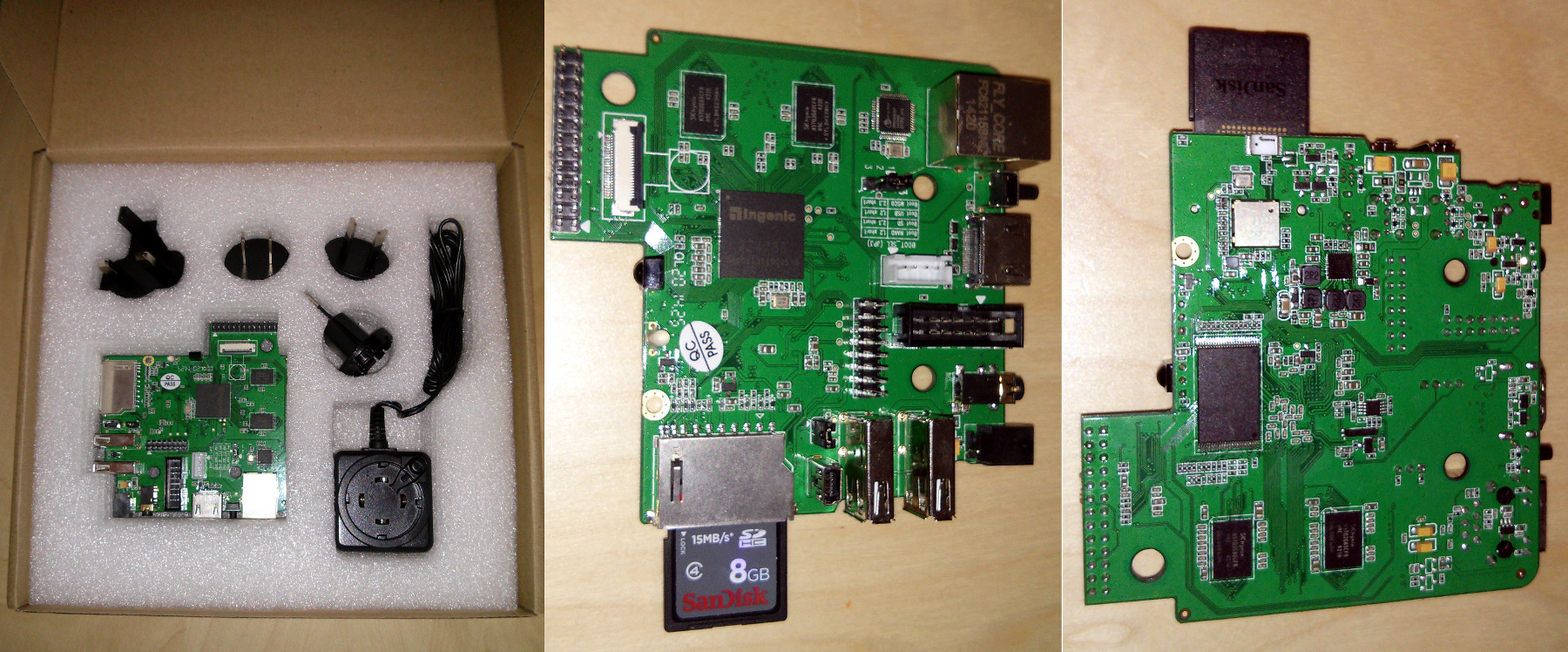
I have received two MIPS Creator CI20 boards, thanks to Imagination Technologies. It s a small MIPS32 development board: mips-ci20 As you can see it comes in a nice packaging with a world-compatible power adapter. It uses a Ingenic JZ4780 SoC with a dual core MIPS32 CPU running at 1.2GHz with a PowerVR SGX540 GPU. The board is fitted with 1GB of RAM, 8GB of NOR flash, HDMI output, USB 2.0 ports, Ethernet + Wi-Fi + BlueTooth, SD card slot, IR receiver, expansion headers and more. The schematics are available. The Linux kernel and the U-Boot bootloader sources are also available. Powering this board with a USB keyboard, a USB mouse and a HDMI display, it boots off the internal flash on a Debian Wheezy up to the XFCE environment. Besides the kernel, the Wi-Fi + Bluetooth firmware, and very few configuration changes, it runs a vanilla Debian. Unfortunately I haven t found time to play more with it yet, but it looks already quite promising. The board has not been formally announced yet, so I do not know when it will become available, nor the price, but if you are interested I ll bring it to DebConf14. Don t hesitate to ask me if you want to look at it or play with it.
Gunnar Wolf: Bigger than the cloud

Summer is cool in Mexico City. It is cool because, unlike Spring, this is our rainy season And rains are very predictable. Almost every day we wake up with a gorgeous, clean, blue sky. Cool, nice temperature, around 15 C. The sun slowly evaporates the rain throughout the morning; when I go out for lunch, the sky is no longer so blue, giving way to a seemingly dirty white/grayish tint. No, it's not our world-famous pollution: It's just yesterday's rain. Rain starts falling usually between 4 and 7 PM. Sometimes it starts as a light rain, sometimes it starts with all of its thunder, all of its might. But anyway, almost every night, there is a moment of awe, of not believing how much rain we are getting today. It slowly fades away during the late night. And when I wake up, early next morning, everything is wet and still smells fresh. Yes, I love our summer, even though it makes shy away from my much enjoyed cycling to work and school. And I love taking some minutes off work, look through the window of my office (located ~70m over the level of our mostly flat city) and watching how different parts of the city have sun or rain; learning to estimate the distance to the clouds, adding it to the direction and guessing which of my friends have which weather. But I didn't realize our city had so clearly defined micro-climates... (would they really be *micro*-climates?) In fact, it even goes against my knowledge of Mexico City's logic I always thought Coyoac n, towards the South of the city, got more rain than the Center and North because we are near the mountains, and the dominant air currents go Southwards, "clumping" the clouds by us. But no, or at least, not this year. Regina (still in the far South Far because she's too far away from me and I'm too egocentric; she returns home after DebConf) often asks me about the weather, as our friends working nearer the center of the city. According to the photos they post on their $social_media_of_the_day accounts, rains are really heavier there. Today I heard on the radio accounts of yesterday's chaos after the rain. This evening, at ESIME-Culhuac n, I saw one of the reported fallen trees (of course, I am not sure if it's from yesterday's rain). And the media pushes galleries of images of a city covered in hail... While in Copilco we only had a regular rain, I'd even say a mild one. This city is bigger than any cloud you can throw at it.
AttachmentSize
IMG_20140819_155052.jpg929.69 KB

Holger Levsen: 20140819-lts-july-2014

Debian LTS - impressions and thoughts from my first month involvement About LTS - we want feedback and more companies supporting it financially Squeeze LTS, and even more Debian LTS, is a pretty young project, started in May 2014, so it's still a bit unclear where exactly we'll be going :) One purpose of this post is to spread some information about the initiative and invite you to tell us what you think about it or what your needs are. LTS stands for "Long Term Support" and the goal of the project is to extend the security support for Squeeze (aka the current oldstable distribution) by two years. If it weren't for Squeeze LTS, the security support for it would have been stopped in May 2014 (=one year after the release of the current stable distribution), which for many is a too short timespan after it's release in February 2011. It's an experiment, we hope that there will be a similar Wheezy LTS initiative in future, but the future is unwritten and things will change based on our experiences and your needs. If you have feedback on the direction LTS should take (or anything else LTS related), please comment on the lts mailing list. For immediate feedback there is also the #debian-lts IRC channel. Another quite pragmatic way to express your needs is to read more about how to financially contribute to LTS and then doing exactly that - and unsurprisingly we are prioritizing the updates based on the needs expressed from our paying customers. My LTS work in July 2014 So, "somehow" I started working for money on Debian LTS in July, which means there were 10h I got paid, and probably another 10h where I did LTS related work unpaid. I used those to release four updates for squeeze-lts (linux-2.6, file, munin and reportbug) fixing 22 CVEs in total. The unpaid work was mostly spent on unsuccessfully working on security updates and on adding support for LTS to the security team tracker, which I improved but couldn't fully address and which I haven't properly shared / committed yet... but at least I have a local instance of the tracker now, which - for LTS - is more useful than the .debian.org one. Hopefully during DebConf14 we'll manage to fix the tracker for good. Without success I've looked at libtasn1-3 (where the first fixes applied easily but then the code had changed too much from what was in squeeze compared to the available patches that I gave up) and libxstream-java (which is at version 1.3, while patches exist for upstream branches 1.4 and 2.x, but those need newer java to build and maybe if I'll spend two more hours I'll can get it build and then I'll have to find a useful test case, which looked quite difficult on a brief look.. so maybe I give up on libxstream-java too.... OTOH, if you use it and can do some testing, please do tell me. Working on all these updates turned out to be more team work than expected and a lot of work involving code (which I did expect), and often code which I'd normally not look at... similarily with tools: one has to deal with tools one doesnt like, eg I had to install cdbs... :-) And as I usually like challenges, this has actually been a lot of fun! Though it's also pretty cool to use common best practices, easy and understandable workflows. I love README.Source (or better yet, when it's not needed). And while git is of course really really great, it's still very desirable if your package builds twice (=many times) in a row, without resetting it via git. Some more observations The first 16 updates (until July 19th) didn't have a DLA ID, until I suggested to introduce them and insisted until we agreed. So now we agreed to put the DLA ID in the subject of the announcement mails and there is also some tool support for generating the templates/mails, but enforcing proper subjects is not done, as silent bounces are useless (and non silent ones can be abused too easily). I'm not really happy about this, but who is happy with the way email works today? And I agree, it's not the end of the world if an LTS announcement is done without a proper ID, but it looks unprofessional and could be avoided, but we have more important work to do. But one day we should automate this better. Another detail I'm not entirely happy is the policy/current decision that "almost everything is fine to upload if deemed sensible by the uploader" (which is everyone in the Debian upload keyring(s)). In discussions before actually having the archive some people suggested the desire to upload new upstream versions too (eg newer kernels, iceweasel or other software to keep running a squeeze desktop in the modern world were discussed). I sincerely hope for most intrusive new upstream versions squeeze-(sloppy-)backports is used instead, and squeeze-lts rather not. Luckily so far all uploads were (IMHO) sensible and so, right now, I will just say that I hope it will stay this way. And it's true, one also has to install these upgrades in the first place. But people do that blindly all the time... So by design/desire currently there is no gatekeeping mechanism whatsover (no NEW, no proposed updates), except that only some selected "few" can upload. What is uploaded (and signed correctly), gets pushed to archive, buildds and the mirrors, and hopefully maybe someone will send an announcement. So far this has worked remarkedly well - and it's also the way the Debian Security team works, as I'm told. Looking at this from a process quality / automatisation perspective, all this manual and errorprone labour seems very strange to me. ;-) And then there is another thing: as already mentioned, the people working paid hours for this, are prioritizing their work based on customer requests. So we did two updates (python-scipy and file), which are not fixed in wheezy yet. I think this is unfortunate and while I could probably prepare the wheezy DSA for file, I don't really want to join the Security Team... or maybe I want/should join the Security Team and be a seldomly active member (eg fixing file in wheezy now....) A note related to this: out of those 37 uploads done until today, 16 were done by those two people being paid, while the other 21 uploads were done by 10 volunteers (or at least not paid by Debian LTS). It will be interesting to see how this statistics evolves over time. Last, but not least, there is also this can of worms (aka: the discussion) about paying people to work on Debian... I do agree it's work we didnt find volunteers for and I also see how the (financial side of the) setup is done outside of Debian (and well too, btw!), but... then we also use Debian ressources like buildds, the archive itself and official mailing lists. Also I'm currently biased in this discussion, as I directly (and happily) profit from it. I'm mentioning this here, because I believe it's important we discuss this and come to both good and practical conclusions. FWIW, we have also discussed this on the list, feel free to search the archives for it. To bring this post to an end: for those attending DebConf14 (directly or thanks to some ninjas), there will be an event about LTS in Portland, though I'm not sure yet what I will have to talk about what hasn't been already covered here :-) But this probably means that will be a good opportunity for you to do lots of talking instead! I'm curious what you will have to say! Thanks for reading this far. I think I can promise that my next LTS report will be shorter :-D

Dirk Eddelbuettel: RcppArmadillo 0.4.400.0

After two pre-releases in the last few days, Conrad finalised a new Armadillo version 4.400 today. I had kept up with the pre-releases, tested twice against all eighty (!!) CRAN dependents of RcppArmadillo and have hence uploaded RcppArmadillo 0.4.400.0 to CRAN and into Debian. This release brings a number of new upstream features which are detailed below. As included is s bugfix for sparse matrix creation at the RcppArmadillo end which was found by the ASAN tests at CRAN --- which are similar to the sanitizers tests I recently blogged. I was able to develop and test the fix in the very docker r-devel-san images I had written about which was nice. Special thanks also to Ryan Curtin for help with the fix.
Changes in RcppArmadillo version 0.4.400.0 (2014-08-19)
  • Upgraded to Armadillo release Version 4.400 (Winter Shark Alley)
    • added gmm_diag class for statistical modelling using Gaussian Mixture Models; includes multi-threaded implementation of k-means and Expectation-Maximisation for parameter estimation
    • added clamp() for clamping values to be between lower and upper limits
    • expanded batch insertion constructors for sparse matrices to add values at repeated locations
    • faster handling of subvectors by dot()
    • faster handling of aliasing by submatrix views
  • Corrected a bug (found by the g++ Address Sanitizer) in sparse matrix initialization where space for a sentinel was allocated, but the sentinel was not set; with extra thanks to Ryan Curtin for help
  • Added a few unit tests for sparse matrices
Courtesy of CRANberries, there is also a diffstat report for the most recent release. As always, more detailed information is on the RcppArmadillo page. Questions, comments etc should go to the rcpp-devel mailing list off the R-Forge page.

This post by Dirk Eddelbuettel originated on his Thinking inside the box blog. Please report excessive re-aggregation in third-party for-profit settings.

19 August 2014

Joey Hess: using a debian package as the remote for a local config repo

Today I did something interesting with the Debian packaging for propellor, which seems like it could be a useful technique for other Debian packages as well. Propellor is configured by a directory, which is maintained as a local git repository. In propellor's case, it's ~/.propellor/. This contains a lot of haskell files, in fact the entire source code of propellor! That's really unusual, but I think this can be generalized to any package whose configuration is maintained in its own git repository on the user's system. For now on, I'll refer to this as the config repo. The config repo is set up the first time a user runs propellor. But, until now, I didn't provide an easy way to update the config repo when the propellor package was updated. Nothing would break, but the old version would be used until the user updated it themselves somehow (probably by pulling from a git repository over the network, bypassing apt's signature validation). So, what I wanted was a way to update the config repo, merging in any changes from the new version of the Debian package, while preserving the user's local modifications. Ideally, the user could just run git merge upstream/master, where the upstream repo was included in the Debian package. But, that can't work! The Debian package can't reasonably include the full git repository of propellor with all its history. So, any git repository included in the Debian binary package would need to be a synthetic one, that only contains probably one commit that is not connected to anything else. Which means that if the config repo was cloned from that repo in version 1.0, then when version 1.1 came around, git would see no common parent when merging 1.1 into the config repo, and the merge would fail horribly. To solve this, let's assume that the config repo's master branch has a parent commit that can be identified, somehow, as coming from a past version of the Debian package. It doesn't matter which version, although the last one merged with will be best. (The easy way to do this is to set refs/heads/upstream/master to point to it when creating the config repo.) Once we have that parent commit, we have three things:
  1. The current content of the config repo.
  2. The content from some old version of the Debian package.
  3. The new content of the Debian package.
Now git can be used to merge #3 onto #2, with -Xtheirs, so the result is a git commit with parents of #3 and #2, and content of #3. (This can be done using a temporary clone of the config repo to avoid touching its contents.) Such a git commit can be merged into the config repo, without any conflicts other than those the user might have caused with their own edits. So, propellor will tell the user when updates are available, and they can simply run git merge upstream/master to get them. The resulting history looks like this:
* Merge remote-tracking branch 'upstream/master'
 \  
  * merging upstream version
   \  
    * upstream version
*   user change
 /  
* upstream version
So, generalizing this, if a package has a lot of config files, and creates a git repository containing them when the user uses it (or automatically when it's installed), this method can be used to provide an easily mergable branch that tracks the files as distributed with the package. It would perhaps not be hard to get from here to a full git-backed version of ucf. Note that the Debian binary package doesn't have to ship a git repisitory, it can just as easily ship the current version of the config files somewhere in /usr, and check them into a new empty repository as part of the generation of the upstream/master branch.

18 August 2014

Jelmer Vernooij: Using Propellor for configuration management

For a while, I've been wanting to set up configuration management for my home network. With half a dozen servers, a VPS and a workstation it is not big, but large enough to make it annoying to manually log into each machine for network-wide changes. Most of the servers I have are low-end ARM machines, each responsible for a couple of tasks. Most of my machines run Debian or something derived from Debian. Oh, and I'm a member of the declarative school of configuration management.
Propellor Propellor caught my eye earlier this year. Unlike some other configuration management tools, it doesn't come with its own custom language but it is written in Haskell, which I am already familiar with. It's also fairly simple, declarative, and seems to do most of the handful of things that I need. Propellor is essentially a Haskell application that you customize for your site. It works very similar to e.g. xmonad, where you write a bit of Haskell code for configuration which uses the upstream library code. When you run the application it takes your code and builds a binary from your code and the upstream libraries. Each host on which Propellor is used keeps a clone of the site-local Propellor git repository in /usr/local/propellor. Every time propellor runs (either because of a manual "spin", or from a cronjob it can set up for you), it fetches updates from the main site-local git repository, compiles the Haskell application and runs it.
Setup Propellor was surprisingly easy to set up. Running propellor creates a clone of the upstream repository under ~/.propellor with a README file and some example configuration. I copied config-simple.hs to config.hs, updated it to reflect one of my hosts and within a few minutes I had a basic working propellor setup. You can use ./propellor <host> to trigger a run on a remote host. At the moment I have propellor working for some basic things - having certain Debian packages installed, a specific network configuration, mail setup, basic Kerberos configuration and certain SSH options set. This took surprisingly little time to set up, and it's been great being able to take full advantage of Haskell. Propellor comes with convenience functions for dealing with some commonly used packages, such as Apt, SSH and Postfix. For a lot of the other packages, you'll have to roll your own for now. I've written some extra code to make Propellor deal with Kerberos keytabs and Dovecot, which I hope to submit upstream. I don't have a lot of experience with other Free Software configuration management tools such as Puppet and Chef, but for my use case Propellor works very well. The main disadvantage of propellor for me so far is that it needs to build itself on each machine it runs on. This is fine for my workstation and high-end servers, but it is somewhat more problematic on e.g. my Raspberry Pi's. Compilation takes a while, and the Haskell compiler and libraries it needs amount to 500Mb worth of disk space on the tiny root partition. In order to work with Propellor, some Haskell knowledge is required. The Haskell in the configuration file is reasonably easy to understand if you keep it simple, but once the compiler spits out error messages then I suspect you'll have a hard time without any Haskell knowledge. Propellor relies on having a central repository with the configuration that it can pull from as root. Unlike Joey, I am wary of publishing the configuration of my home network and I don't have a highly available local git server setup.

Julien Danjou: OpenStack Ceilometer and the Gnocchi experiment

A little more than 2 years ago, the Ceilometer project was launched inside the OpenStack ecosystem. Its main objective was to measure OpenStack cloud platforms in order to provide data and mechanisms for functionalities such as billing, alarming or capacity planning. In this article, I would like to relate what I've been doing with other Ceilometer developers in the last 5 months. I've lowered my involvement in Ceilometer itself directly to concentrate on solving one of its biggest issue at the source, and I think it's largely time to take a break and talk about it. Ceilometer early design For the last years, Ceilometer didn't change in its core architecture. Without diving too much in all its parts, one of the early design decision was to build the metering around a data structure we called samples. A sample is generated each time Ceilometer measures something. It is composed of a few fields, such as the the resource id that is metered, the user and project id owning that resources, the meter name, the measured value, a timestamp and a few free-form metadata. Each time Ceilometer measures something, one of its components (an agent, a pollster ) constructs and emits a sample headed for the storage component that we call the collector. This collector is responsible for storing the samples into a database. The Ceilometer collector uses a pluggable storage system, meaning that you can pick any database system you prefer. Our original implementation has been based on MongoDB from the beginning, but we then added a SQL driver, and people contributed things such as HBase or DB2 support. The REST API exposed by Ceilometer allows to execute various reading requests on this data store. It can returns you the list of resources that have been measured for a particular project, or compute some statistics on metrics. Allowing such a large panel of possibilities and having such a flexible data structure allows to do a lot of different things with Ceilometer, as you can almost query the data in any mean you want. The scalability issue We soon started to encounter scalability issues in many of the read requests made via the REST API. A lot of the requests requires the data storage to do full scans of all the stored samples. Indeed, the fact that the API allows you to filter on any fields and also on the free-form metadata (meaning non indexed key/values tuples) has a terrible cost in terms of performance (as pointed before, the metadata are attached to each sample generated by Ceilometer and is stored as is). That basically means that the sample data structure is stored in most drivers in just one table or collection, in order to be able to scan them at once, and there's no good "perfect" sharding solution, making data storage scalability painful. It turns out that the Ceilometer REST API is unable to handle most of the requests in a timely manner as most operations are O(n) where n is the number of samples recorded (see big O notation if you're unfamiliar with it). That number of samples can grow very rapidly in an environment of thousands of metered nodes and with a data retention of several weeks. There is a few optimizations to make things smoother in general cases fortunately, but as soon as you run specific queries, the API gets barely usable. During this last year, as the Ceilometer PTL, I discovered these issues first hand since a lot of people were feeding me back with this kind of testimony. We engaged several blueprints to improve the situation, but it was soon clear to me that this was not going to be enough anyway.
Thinking outside the box Unfortunately, the PTL job doesn't leave him enough time to work on the actual code nor to play with anything new. I was coping with most of the project bureaucracy and I wasn't able to work on any good solution to tackle the issue at its root. Still, I had a few ideas that I wanted to try and as soon as I stepped down from the PTL role, I stopped working on Ceilometer itself to try something new and to think a bit outside the box. When one takes a look at what have been brought recently in Ceilometer, they can see the idea that Ceilometer actually needs to handle 2 types of data: events and metrics. Events are data generated when something happens: an instance start, a volume is attached, or an HTTP request is sent to an REST API server. These are events that Ceilometer needs to collect and store. Most OpenStack components are able to send such events using the notification system built into oslo.messaging. Metrics is what Ceilometer needs to store but that is not necessarily tied to an event. Think about an instance CPU usage, a router network bandwidth usage, the number of images that Glance is storing for you, etc These are not events, since nothing is happening. These are facts, states we need to meter. Computing statistics for billing or capacity planning requires both of these data sources, but they should be distinct. Based on that assumption, and the fact that Ceilometer was getting support for storing events, I started to focus on getting the metric part right. I had been a system administrator for a decade before jumping into OpenStack development, so I know a thing or two on how monitoring is done in this area, and what kind of technology operators rely on. I also know that there's still no silver bullet this made it a good challenge. The first thing that came to my mind was to use some kind of time-series database, and export its access via a REST API as we do in all OpenStack services. This should cover the metric storage pretty well. Cooking Gnocchi
A cloud of gnocchis!
At the end of April 2014, this led met to start a new project code-named Gnocchi. For the record, the name was picked after confusing so many times the OpenStack Marconi project, reading OpenStack Macaroni instead. At least one OpenStack project should have a "pasta" name, right? The point of having a new project and not send patches on Ceilometer, was that first I had no clue if it was going to make something that would be any better, and second, being able to iterate more rapidly without being strongly coupled with the release process. The first prototype started around the following idea: what you want is to meter things. That means storing a list of tuples of (timestamp, value) for it. I've named these things "entities", as no assumption are made on what they are. An entity can represent the temperature in a room or the CPU usage of an instance. The service shouldn't care and should be agnostic in this regard. One feature that we discussed for several OpenStack summits in the Ceilometer sessions, was the idea of doing aggregation. Meaning, aggregating samples over a period of time to only store a smaller amount of them. These are things that time-series format such as the RRDtool have been doing for a long time on the fly, and I decided it was a good trail to follow. I assumed that this was going to be a requirement when storing metrics into Gnocchi. The user would need to provide what kind of archiving it would need: 1 second precision over a day, 1 hour precision over a year, or even both. The first driver written to achieve that and store those metrics inside Gnocchi was based on whisper. Whisper is the file format used to store metrics for the Graphite project. For the actual storage, the driver uses Swift, which has the advantages to be part of OpenStack and scalable. Storing metrics for each entities in a different whisper file and putting them in Swift turned out to have a fantastic algorithm complexity: it was O(1). Indeed, the complexity needed to store and retrieve metrics doesn't depends on the number of metrics you have nor on the number of things you are metering. Which is already a huge win compared to the current Ceilometer collector design. However, it turned out that whisper has a few limitations that I was unable to circumvent in any manner. I needed to patch it to remove a lot of its assumption about manipulating file, or that everything is relative to now (time.time()). I've started to hack on that in my own fork, but then everything broke. The whisper project code base is, well, not the state of the art, and have 0 unit test. I was starring at a huge effort to transform whisper into the time-series format I wanted, without being sure I wasn't going to break everything (remember, no test coverage). I decided to take a break and look into alternatives, and stumbled upon Pandas, a data manipulation and statistics library for Python. Turns out that Pandas support time-series natively, and that it could do a lot of the smart computation needed in Gnocchi. I built a new file format leveraging Pandas for computing the time-series and named it carbonara (a wink to both the Carbon project and pasta, how clever!). The code is quite small (a third of whisper's, 200 SLOC vs 600 SLOC), does not have many of the whisper limitations and it has test coverage. These Carbonara files are then, in the same fashion, stored into Swift containers. Anyway, Gnocchi storage driver system is designed in the same spirit that the rest of OpenStack and Ceilometer storage driver system. It's a plug-in system with an API, so anyone can write their own driver. Eoghan Glynn has already started to write a InfluxDB driver, working closely with the upstream developer of that database. Dina Belova started to write an OpenTSDB driver. This helps to make sure the API is designed directly in the right way. Handling resources Measuring individual entities is great and needed, but you also need to link them with resources. When measuring the temperature and the number of a people in a room, it is useful to link these 2 separate entities to a resource, in that case the room, and give a name to these relations, so one is able to identify what attribute of the resource is actually measured. It is also important to provide the possibility to store attributes on these resources, such as their owners, the time they started and ended their existence, etc.
Relationship of entities and resources
Once this list of resource is collected, the next step is to list and filter them, based on any criteria. One might want to retrieve the list of resources created last week or the list of instances hosted on a particular node right now. Resources also need to be specialized. Some resources have attributes that must be stored in order for filtering to be useful. Think about an instance name or a router network. All of these requirements led to to the design of what's called the indexer. The indexer is responsible for indexing entities, resources, and link them together. The initial implementation is based on SQLAlchemy and should be pretty efficient. It's easy enough to index the most requested attributes (columns), and they are also correctly typed. We plan to establish a model for all known OpenStack resources (instances, volumes, networks, ) to store and index them into the Gnocchi indexer in order to request them in an efficient way from one place. The generic resource class can be used to handle generic resources that are not tied to OpenStack. It'd be up to the users to store extra attributes. Dropping the free form metadata we used to have in Ceilometer makes sure that querying the indexer is going to be efficient and scalable.
The indexer classes and their relations
REST API All of this is exported via a REST API that was partially designed and documented in the Gnocchi specification in the Ceilometer repository; though the spec is not up-to-date yet. We plan to auto-generate the documentation from the code as we are currently doing in Ceilometer. The REST API is pretty easy to use, and you can use it to manipulate entities and resources, and request the information back.
Macroscopic view of the Gnocchi architecture
Roadmap & Ceilometer integration All of this plan has been exposed and discussed with the Ceilometer team during the last OpenStack summit in Atlanta in May 2014, for the Juno release. I led a session about this entire concept, and convinced the team that using Gnocchi for our metric storage would be a good approach to solve the Ceilometer collector scalability issue. It was decided to conduct this project experiment in parallel of the current Ceilometer collector for the time being, and see where that would lead the project to. Early benchmarks Some engineers from Mirantis did a few benchmarks around Ceilometer and also against an early version of Gnocchi, and Dina Belova presented them to us during the mid-cycle sprint we organized in Paris in early July. The following graph sums up pretty well the current Ceilometer performance issue. The more you feed it with metrics, the more slow it becomes.
For Gnocchi, while the numbers themselves are not fantastic, what is interesting is that all the graphs below show that the performances are stable without correlation with the number of resources, entities or measures. This proves that, indeed, most of the code is built around a complexity of O(1), and not O(n) anymore.
Next steps
Cl ment drawing the logo
While the Juno cycle is being wrapped-up for most projects, including Ceilometer, Gnocchi development is still ongoing. Fortunately, the composite architecture of Ceilometer allows a lot of its features to be replaced by some other code dynamically. That, for example, enables Gnocchi to provides a Ceilometer dispatcher plugin for its collector, without having to ship the actual code in Ceilometer itself. That should help the development of Gnocchi to not be slowed down by the release process for now. The Ceilometer team aims to provide Gnocchi as a sort of technology preview with the Juno release, allowing it to be deployed along and plugged with Ceilometer. We'll discuss how to integrate it in the project in a more permanent and strong manner probably during the OpenStack Summit for Kilo that will take place next November in Paris.

16 August 2014

Ian Donnelly: How-To: Integrate elektra-merge Into a Debian Package

Hi Everybody, So I already explained that we decided to go in a new direction and patch ucf to allow automatic configuration file merging with any custom command. Today I wanted to explain how to use ucf s new three-way-merge-command functionality in
conjunction with Elektra in order to ultilize Elektra s powerful tools in order to allow automatic three-way merges of your package s configuration during upgrades in a way that is more reliable than a diff3 merge. This guide assumes that you are fimilar with ucf already and are just trying to impliment the --three-way-merge-command option using Elektra. The addition of the --three-way-merge-command option was a part of my Google Summer of Code Project. This option takes the form:

--three-way-merge-command command [New File] [Destination]

Where command is the command you would like to use for the merge. New File and Destination are the same as always. We added a new script to Elektra called elektra-merge for use with this new option in ucf. This script acts as a liaison between ucf and Elektra, allowing a regular ucf command to run a kdb merge even though ucf commands only pass New File and Destination whereas kdb merge requires ourpath, theirpath, basepath, and resultpath. Since ucf already performs a three-way merge, it keeps track of all the necessary files to do so, even though it only takes in New File and Destination. In order to use elektra-merge, the current configuration file must be mounted to KDB to serve as ours in the merge. The script automatically mounts theirs, base, and result using the kdb remount command in order to use the same backend as ours (since all versions of the same file should use the same backend anyway) and this way users don t need to worry about specifying the backend for each version of the file. Then the script attempts a merge on the newly mounted KeySets. Once this is finished, either on success or not, the script finishes by unmouting all but our copy of the file to cleanup KDB. Then, if the merge was successful ucf will replace ours with the result providing the package with an automatically merged configuration which will also be updated in KDB itself. Additionally, we added two other scripts, elektra-mount and elektra-umount which act as simple wrappers for kdb mount and kdb umount. That work identically but are more script friendly The full command to use elektra-merge to perform a three-way merge on a file managed by ucf is:

ucf --three-way --threeway-merge-command elektra-merge [New File] [Destination]

Thats it! As described above, elektra-merge is smart enough to run the whole merge off of the information from that command and utilizes the new kdb remount command to do so. Integrating elektra-merge into a package that already uses ucf is very easy! In postinst you should have a line similar to:

ucf [New File] [Destination]

or perhaps:

ucf --three-way [New File] [Destination]
All you must do is in postinst, when run with the configure option you must mount the config file to Elektra:

kdb elektra-mount [New File] [Mounting Destination] [Backend]
Next, you must update the line containing ucf with the options --three-way and --threeway-merge-command like so:

ucf --three-way --threeway-merge-command elektra-merge [New File] [Destination]
Then, in your postrm script, during a purge, you must umount the config file before deleting it:

kdb lektra-umount [Name]
That s it! With those small changes you can use Elektra to perform automatic three-way merges on any files that your package uses ucf to handle! I just wanted to show a quick example, below is a diff representing the changes we made to the samba-common package in order to allow automatic configuration merging for smb.conf using Elektra. We chose this package because it already
uses ucf to handle smb.conf but it frequently requires users to manually merge changes across versions. Here is the patch showing what we changed:

diff samba_orig/samba-3.6.6/debian/samba-common.postinst samba/samba-3.6.6/debian/samba-common.postinst
92c92,93
< ucf --three-way --debconf-ok "$NEWFILE" "$CONFIG"
---
> kdb elektra-mount "$CONFIG" system/samba/smb ini
> ucf --three-way --threeway-merge-command elektra-merge --debconf-ok "$NEWFILE" "$CONFIG"
Only in samba/samba-3.6.6/debian/: samba-common.postinst~
diff samba_orig/samba-3.6.6/debian/samba-common.postrm samba/samba-3.6.6/debian/samba-common.postrm
4a5
> kdb elektra-umount system/samba/smb
As you can see, all we had to do was add the line to mount smb.conf during install, update the ucf command to include the new --threeway-merge-command option, and unmount system/samba/smb during a purge. It really is that easy! Sincerely,
Ian S. Donnelly

Daniel Pocock: WebRTC: what works, what doesn't

With the release of the latest rtc.debian.org portal update, there are numerous improvements but there are still some known problems too. The good news is that if you have a web browser, you can probably make successful WebRTC calls from one developer to another without any need to install or configure anything else. The bad news is that not every permutation of browser and client will work. Here I list some of the limitations so people won't waste time on them. The SIP proxy supports any SIP client Just about any SIP client can connect to the proxy server and register. This does not mean that every client will be able to call each other. Generally speaking, modern WebRTC clients will be able to call each other. Standalone softphones or deskphones will call each other. Calling from a normal softphone or deskphone to a WebRTC browser, or vice-versa, will not work though. Some softphones, like Jitsi, have implemented most of the protocols to communicate with WebRTC but they are yet to put the finishing touches on it. Chat should just work for any combination of clients The new WebRTC frontend supports SIP chat messaging. There is no presence or buddy list support yet. You can even use a tool like sipsak to accept or send SIP chats from a script. Chat works for any client new or old. Although a WebRTC user can't call a softphone user, for example, they can send chats to each other. WebRTC support in Iceweasel 24 on wheezy systems is very limited On a wheezy system, the most recent Iceweasel update is version 24.7. This version supports most of WebRTC but does not support TURN relay servers to help you out of a NAT network. If you call between two wheezy machines on the same NAT network it will work. If the call has to traverse a NAT boundary it will not work. Wheezy users need to either download a newer Firefox version or use Chromium. JsSIP doesn't handle ICE elegantly Internet Connectivity Establishment (ICE, RFC 5245) is meant to prevent calls from being answered with missing audio or video streams. ICE is a mandatory part of WebRTC. When correctly implemented, the JavaScript application will exchange ICE candidates and run the connectivity checks before alerting anybody that a call is ringing. If the checks fail (for example, with Iceweasel 24 and NAT), the caller should be told the call can't be made and the callee shouldn't be disturbed at all. JsSIP is not operating in this manner though. It alerts the callee before telling the browser to start the connectivity checks. Then it even waits for the callee to answer. Only then does it tell the browser to start checking connectivity. This is not a fault with the ICE standard or the browser, it is an implementation problem. Therefore, until this is fully fixed, people may still see some calls that appear to answer but don't have any media stream. After this is fixed, such calls really will be a thing of the past. Debian RTC testing is more than just a pipe dream Although these glitches are not ideal for end users, there is a clear roadmap to resolve them. There are also a growing collection of workarounds to minimize the inconvenience. For example, JSCommunicator has a hack to detect when somebody is using Iceweasel 24 and just refuse to make the call. See the option require_relay_candidate in the config.js settings file. This also ensures that it will refuse to make a call if the TURN server is offline. Better to give the user a clear error than a call without any audio or video stream. require_relay_candidate is enabled on freephonebox.net because it makes life easier for end users. It is not enabled on rtc.debian.org because some DDs may be willing to tolerate this issue when testing on a local LAN. To find out more about practical integration of WebRTC into free software solutions, consider coming to my talk at xTupleCon in October.

Matthias Klumpp: AppStream/DEP-11 Debian progress

There hasn t been a progress-report on DEP-11 for some time, but that doesn t mean there was no work going on on it. DEP-11 is Debian s implementation of AppStream, as well as an effort to enhance the metadata available about software in Debian. While initially, AppStream was only about applications, DEP-11 was designed with a larger scope, to collect data about libraries, binaries and things like Python modules. Now, since AppStream 0.6, DEP-11 and AppStream have essentially the same scope, with the difference of DEP-11 metadata being described in YAML, while official AppStream data is XML. That was due to a request by our ftpmasters team, which doesn t like XML (which is also not used anywhere in Debian, as opposed to YAML). But this doesn t mean that people will have to deal with the YAML file format: The libappstream library will just take DEP-11 data as another data source for it s Xapian database, allowing anything using libappstream to access that data just like the XML stuff. Richards libappstream-glib will also receive support for the DEP-11 format soon, filling it s in-memory data cache and enabling the use of GNOME-Software on Debian. So, what has been done so far? The past months, my Google Summer of Code student. Abhishek Bhattacharjee, was working hard to integrate DEP-11 support into dak, the Debian Archive Kit, which maintains the whole Debian archive. The result will be an additional metadata table in our internal Postgres database, storing detailed information about the software available in a Debian package, as well as Components-<arch>.yml.gz files in the Debian repositories. Dak will also produce an application icon-cache and a screenshots repository. During the time of the SoC, Abhishek focused mainly on the applications part of things, and less on the other components (like extracting data about Python modules or libraries) these things can easily be implemented later. The remaining steps will be to polish the code and make it merge-ready for Debian s dak (as soon as it has received enough testing, we will likely give it a try on the Tanglu Debian derivative). Following that, Apt will be extended to fetch the DEP-11 data on-demand on systems where it is useful (which is currently mostly desktop-systems) if you want to save a little bit of space, you will be able to disable downloading this extra metadata in Apt. From there, libappstream will take the data for it s Xapian db. This will lead to the removal of the much-hated (from ftpmasters and maintainers side) app-install-data package, which has not been updated for two years and only contains a small fraction of the metadata provided by DEP-11. What Debian will ultimately gain from this effort is support for software-centers like GNOME-Software, and improved support for tools like Apper and Muon in displaying applications. Long-term, with more metadata being available, It would be cool to add support for it to specialized package managers , like Python s pip, npm or gem, to make them fetch information about available distribution software and install that instead of their own copies from 3rd-party repositories, if possible. This should ultimatively lead to less code duplication on distributions and will likely result in fewer security issues, since the officially maintained and integrated distribution packages can easily be used, if possible. This is no attempt to make tools like pip obsolete, but an attempt to have the different tools installing software on your machine communicate better, instead of creating parallel worlds in terms of software management. Another nice sideeffect of more metadata will be options to search for tools handling mimetypes in the software repos (in case you can t open a file), smart software centers installing missing firmware, and automatic suggestions for developers which software they need to install in order to build a specific software package. Also, the data allows us to match software across distributions, for that, I will have some news soon (not sure how soon though, as I am currently in thesis-writing-mode, and therefore have not that much spare time). Since the goal is to have these features available on all distributions supporting AppStream, it will take longer to realize but we are on a good way. So, if you want some more information about my student s awesome work, you can read his blogpost about it. He will also be at Debconf 14 (Portland). (I can t make it this time, but I surely won t miss the next Debconf) Sadly, I only see a very small chance to have the basic DEP-11 stuff land in-time for Jessie (lots of review work needs to be done, and some more code needs to be written), but we will definitively have it in Jessie+1. A small example on how this data will look like can be found here a larger, actual file is available here. Any questions and feedback are highly appreciated.

14 August 2014

Juliana Louback: JSCommunicator 2.0 (Beta) is Live!

This is the last week of Google Summer of Code 2014 - all good things must come to an end. To wrap things up, I ve merged all my work on JSCommunicator into a new version with all the added features. You can now demo the new and improved (or at least so I hope) JSCommunicator on rtc.debian.org! JSCommunicator 2.0 has an assortment of new add-ons, the most important new features are the Instant Messaging component and the internationalization support. The UI has been reorganized but we are currently not using a skin for color scheme - will be posting about that in a bit. The idea is to have a more neutral look that can be easily customized and integrated with other web apps. A chat session is automatically opened when you begin a call with someone - unless you already started a chat session with said someone. Sound alerts for new incoming messages are optional in the config file, visual alerts occur when an inactive chat tab receives a new message. Future work includes multiple user chat sessions and adapting the layout to a large amount of chat tabs. Currently it only handles 6. (Should I allow more? Who chats with more than 6 people at once? 14 year old me would, but now I just can t handle that. Anyway, I welcome advice on how to go about this. Should we do infinite tabs or if not, what s the cut-off?) About internationalization, I m uber proud to say we currently run in 6 languages! The 6 are English (default), Spanish, French, Portuguese, Hebrew and German. But one thing I must mention is that since I added new stuff to JSCommunicator, some of the new stuff doesn t have a translation. I took care of the Portuguese translation and Yehuda Korotkin quickly turned in the Hebrew translation, but we are still missing an update for Spanish, French and German. If you can contribute, please do. There are about 10 new labels to translate, you can fix the issue here. Or if you re short on time, shoot me an email with the translation for what s on the right side of the = : welcome = Welcome, call = Call chat = Chat enter_contact = Enter contact type_to_chat = type to chat start_chat = start chat me = me logout = Logout no_contact = Please enter a contact. remember_me = Remember me I ll merge it myself but I ll be sure to add you to the authors list.

Gregor Herrmann: RC bugs 2014/13 - 2014/33

perl 5.20 got uploaded to debian unstable a few minutes ago; be prepared for some glitches when upgrading sid machines/chroots in the next days, while all 557 reverse dependencies are rebuilt via binNMUs. how does this relate to this blog post's title? it does, since during the last weeks I was mostly trying to help with the preparation of this transition. & we managed to fix quite a few bugs while they were not bumped to serious yet, otherwise the list below would be a bit longer :) anyway, here are the the RC bugs I've worked on in the last 20 or so weeks: p.s.: & now, go & enjoy the new perl 5.20 features :)

Daniel Pocock: Bug tracker or trouble ticket system?

One of the issues that comes up from time to time in many organizations and projects (both community and commercial ventures) is the question of how to manage bug reports, feature requests and support requests. There are a number of open source solutions and proprietary solutions too. I've never seen a proprietary solution that offers any significant benefit over the free and open solutions, so this blog only looks at those that are free and open. Support request or bug? One common point of contention is the distinction between support requests and bugs. Users do not always know the difference. Some systems, like the Github issue tracker, gather all the requests together in a single list. Calling them "Issues" invites people to submit just about anything, such as "I forgot my password". At the other extreme, some organisations are so keen to keep support requests away from their developers that they operate two systems and a designated support team copies genuine bugs from the customer-facing trouble-ticket/CRM system to the bug tracker. This reduces the amount of spam that hits the development team but there is overhead in running multiple systems and having staff doing cut and paste. Will people use it? Another common problem is that a full bug report template is overkill for some issues. If a user is asking for help with some trivial task and if the tool asks them to answer twenty questions about their system, application version, submit log files and other requirements then they won't use it at all and may just revert to sending emails or making phone calls. Ideally, it should be possible to demand such details only when necessary. For example, if a support engineer routes a request to a queue for developers, then the system may guide the support engineer to make sure the ticket includes attributes that a ticket in the developers' queue should have. Beyond Perl Some of the most well known systems in this space are Bugzilla, Request Tracker and OTRS. All of these solutions are developed in Perl. These days, Python, JavaScript/Node.JS and Java have taken more market share and Perl is chosen less frequently for new projects. Perl skills are declining and younger developers have usually encountered Python as their main scripting language at university. My personal perspective is that this hinders the ability of Perl projects to attract new blood or leverage the benefits of new Python modules that don't exist in Perl at all. Bugzilla has fallen out of the Debian and Ubuntu distributions after squeeze due to its complexity. In contrast, Fedora carries the Bugzilla packages and also uses it as their main bug tracker. Evaluation I recently started having a look at the range of options in the Wikipedia list of bug tracking systems. Some of the trends that appear:
  • Many appear to be bug tracking systems rather than issue tracking / general-purpose support systems. How well do they accept non-development issues and keep them from spamming the developers while still providing a useful features for the subset of users who are doing development?
  • A number of them try to bundle other technologies, like wiki or FAQ systems: but how well do they work with existing wikis? This trend towards monolithic products is slightly dangerous. In my own view, a wiki embedded in some other product may not be as well supported as one of the leading purpose-built wikis.
  • Some of them also appear to offer various levels of project management. For development tasks, it is just about essential for dependencies and a roadmap to be tightly integrated with the bug/feature tracker but does it make the system more cumbersome for people dealing with support requests? Many support requests, like "I've lost my password", don't really have any relationship with project management or a project roadmap.
  • Not all appear to handle incoming requests by email. Bug tracking systems can be purely web/form-based, but email is useful for helpdesk systems.
Questions This leaves me with some of the following questions:
  • Which of these systems can be used as a general purpose help-desk / CRM / trouble-ticket system while also being a full bug and project management tool for developers?
  • For those systems that don't work well for both use cases, which combinations of trouble-ticket system + bug manager are most effective, preferably with some automated integration?
  • Which are more extendable with modern programming practices, such as Python scripting and using Git?
  • Which are more future proof, with choice of database backend, easy upgrades, packages in official distributions like Debian, Ubuntu and Fedora, scalability, IPv6 support?
  • Which of them are suitable for the public internet and which are only considered suitable for private access?

13 August 2014

Riku Voipio: Booting Linaro ARMv8 OE images with Qemu

A quick update - Linaro ARMv8 OpenEmbbeded images work just fine with qemu 2.1 as well:

$ http://releases.linaro.org/14.07/openembedded/aarch64/Image
$ http://releases.linaro.org/14.07/openembedded/aarch64/vexpress64-openembedded_lamp-armv8-gcc-4.9_20140727-682.img.gz
$ qemu-system-aarch64 -m 1024 -cpu cortex-a57 -nographic -machine virt \
-kernel Image -append 'root=/dev/vda2 rw rootwait mem=1024M console=ttyAMA0,38400n8' \
-drive if=none,id=image,file=vexpress64-openembedded_lamp-armv8-gcc-4.9_20140727-682.img \
-netdev user,id=user0 -device virtio-net-device,netdev=user0 -device virtio-blk-device,drive=image
[ 0.000000] Linux version 3.16.0-1-linaro-vexpress64 (buildslave@x86-64-07) (gcc version 4.8.3 20140401 (prerelease) (crosstool-NG linaro-1.13.1-4.8-2014.04 - Linaro GCC 4.8-2014.04) ) #1ubuntu1~ci+140726114341 SMP PREEMPT Sat Jul 26 11:44:27 UTC 20
[ 0.000000] CPU: AArch64 Processor [411fd070] revision 0
...
root@genericarmv8:~#
Quick benchmarking with age-old ByteMark nbench:
Index Qemu Foundation Host
Memory 4.294 0.712 44.534
Integer 6.270 0.686 41.983
Float 1.463 1.065 59.528
Baseline (LINUX) : AMD K6/233*
Qemu is upto 8x faster than Foundation model on Integers, but only 50% faster on Math. Meanwhile, the Host pc spends 7-40x slower emulating ARMv8 than executing native instructions.

12 August 2014

Ian Donnelly: How-To: kdb import

Hi everybody, Today I wanted to go over what I think is a very useful command in the kdb tool, kdb import. As you know, the kdb tool allows users to interact with the Elektra Key Database (KDB) via the command line. Today I would like to explain the import function of kdb. The command to use kdb import is:

kdb import [options] destination [format]
In this command, destination is where the imported Keys should be stored below. For instance, kdb import system/imported would store all the keys below system/imported. This command takes Keys from stdin to store them into KDB. Typically, this command is used with a pipe to read in the Keys from a file. The format argument you see above can be a very powerful option to use with kdb import. The format argument allows a user to specify which plug-in is used to import the Keys into the Key Database. The user can specify any storage plug-in to serve as the format for the Keys to be imported. For instance, if a user wanted to import a /etc/hosts file into KDB without mounting it, they could use the command cat /etc/hosts kdb import system/hosts hosts. This command would essentially copy the current hosts file into KDB, like mounting it. Unlike mounting it, changes to the Keys would not be reflected in the hosts file and vise versa. If no format is specified, the format dump will be used instead. The dump format is the standard way of expressing Keys and all their relevant information. This format is intended to be used only within Elektra. The dump format is a good means of backing up Keys from the Key Database for use with Elektra later such as reimporting them later. As of this writing, dump is the only way to fully preserve all parts of the KeySet. It is very important to note that the dump does not rename keys by design. If a user exports a KeySet using dump using a command such as kdb export system/backup > backup.ecf, they can only import that keyset back into system/backup using a command like cat backup.ecf kdb import system/backup. The kdb import command only takes one special option:

-s --strategy

which is used to specify a strategy to use if Keys already exist in the specified destination.
The current list of strategies are:

preserve any keys already in the destination will not be overwritten
overwrite any keys already in the destination will be overwritten if a new key has the same name
cut all keys already in the destination will be removed, then new keys will be imported

If no strategy is specified, the command defaults to the preserve strategy as to not be destructive to any previous keys. An example of using the kdb import is as follows:

cat backup.ecf kdb import system/restore

This command would import all keys stored in the file backup.ecf into the Key Database under system/restore. In this example, backup.ecf was exported from the KeySet using the dump format by using the command:
kdb export system/backup > backup.ecf backup.ecf contains all the information about the keys below system/backup:

$cat backup.ecf
kdbOpen 1
ksNew 3
keyNew 19 0
system/backup/key1
keyMeta 7 1
binary
keyEnd
keyNew 19 0
system/backup/key2
keyMeta 7 1
binary
keyEnd
keyNew 19 0
system/backup/key3
keyMeta 7 1
binary
keyEnd
ksEnd
Before the import command, system/backup does not exists and no keys are contained there.
After the import command, running the command kdb ls system/backup prints:

system/backup/key1
system/backup/key2
system/backup/key3
As you can see, the kdb import command is a very useful tool included as part of Elektra. I also wrote a tutorial on the kdb export command. Please go read that as well because those two commands go hand in hand and allow some very powerful usage of Elektra. Sincerely,
Ian S. Donnelly

11 August 2014

Juliana Louback: JSCommunicator - Setup and Architecture

Preface During Google Summer of Code 2014, I got to work on the Debian WebRTC portal under the mentorship of Daniel Pocock. Now I had every intention of meticulously documenting my progress at each step of development in this blog, but I was a bit late in getting the blog up and running. I ll now be publishing a series of posts to recap all I ve done during GSoC. Better late than never. Intro JSCommunicator is a SIP communication tool developed in HTML and JavaScript. The code was designed to make integrating JSCommunicator with a website or web app as simple as possible. It s quite easy, really. However, I do think a more detailed explanation on how to set things up and a guide to the JSCommunicator architecture could be of use, particularly for those wanting to modify the code in any way. Setup To begin, please fork the JSCommunicator repo. If you are new to git, feel free to follow the steps in section Setup and Clone in this post. If you read the README file (which you always should), you ll see that JSCommunicator needs a SIP proxy that supports SIP over Websockets transport. Some options are: I didn t find a tutorial for Kamailio setup, I did find one for repro setup. And bonus, here you have a great tutorial on how to setup and configure your SIP proxy AND your TURN server. In your project s root directory, you ll see a file named config-sample.js. Make a copy of that file named config.js. The config-sample.js file has comments that are very instructive. In sum, the only thing you have to modify is the turn_servers property and the websocket property. In my case, debrtc.org was the domain registered for testing my project, so my config file has:
turn_servers: [
	  server:"turn:debrtc.org"       
],
Note that unlike the sample, I didn t set a username and password so SIP credentials will be used. Now fill in the websocket property here we use sip5060.net.
websocket:  
    servers: 'wss://ws.sip5060.net',
    connection_recovery_min_interval: 2,
    connection_recovery_max_interval: 30,
   ,
I m pretty sure you can set the connection_recovery properties to whatever you like. Everything else is optional. If you set the user property, specifically display_name and uri, that will be used to fill in the Login form and takes preference over any Remember me data. If you also set sip_auth_password, JSCommunicator will automatically log in. All the other properties are for other optional functionalities and are well explained. You ll need some third-party javascript that is not included in the JSCommunicator git repo. Namely jQuery version 1.4 or higher and ArbiterJS version 1.0. Download jQuery here and ArbiterJS here and place the .js files in your project s root directory. Do make sure that you are including the correct filename in your html file. For example, in phone-dev.shtml, a file named jquery.js is included. The file you downloaded will likely have version numbers in it s file name. So rename the downloaded file or change the content of src in your includes. This is uber trivial, but I ve made the mistake several times. You ll also need JsSIP.js which can be downloaded here. Same naming care must be taken as is the case for jQuery and ArbiterJS. The recently added Instant Messaging component and some of the new features need jQuery-UI - so far version 1.11.* is known to work. From the downloaded .zip all you need is the jquery-ui-...js file and the jquery-ui-...css file, also to be placed in the project s root directory. If you ll be using the internationalization support you ll also need jquery.i18n.properties.js. To try out JSCommunicator, deploy the website locally by copying your project directory to the apache document root directory (provided you are using apache, which is a good idea.). You ll likely have to restart your server before this works. Now the demo .shtml pages only have a header with all the necessary includes, then a Server Side Include for the body of the page, with all the JSCommunicator html. The html content is in the file jscommunicator.inc. You can enable SSI on apache, OR you can simply copy and paste the content of jscommunicator.inc into phone-dev.shmtl. Start up apache, open a browser and navigate to localhost/jscommunicator/phone-dev.shmtl and you should see: jscommunicatorRaw Actually, pending updates to JSCommunicator, you should see a brand new UI! But all the core stuff will be the same. Architecture Disclaimer: I m explaining my view of the JSCommunicator architecture, which currently may not be 100% correct. But so far it s been enough for me to make my modifications and additions to the code, so it could be of use. One I get a JSCommunicator Founding Father s stamp of approval, I ll be sure to confirm the accuracy. Now to explain how the JSCommunicator code interacts, the use of each code item is described, ignoring all the html and css which will vary according to how you choose to use JSCommunicator. I m also not going to explain jQuery which is a dependency but not specific to WebRTC. The core JSCommunicator code is the following: Each of these files will be presented in what I hope is an intuitive order. The next three files could be considered utils : These two are where the magic happens: Now for some extras: Third party code: Here s a diagram of sorts to help you visualize how the code interacts: jscommArch In sum, 1 - JSCommUI.js handles what is displayed in the UI and feeds data to JSCommManager.js; 2 - JSCommManager.js actually does stuff, feeding data to be displayed to JSCommUI.js; 3 - JSCommManager.js calls functions from the three utils , parseuri.js, webrtc-check.js and jssip-helpher.js which organizes the data from config.js; 4 - JSCommManager.js initializes a SIP User Agent based on the implementation in Arbiter.js. When making any changes to JSCommunicator, you will likely only be working with JSCommUI.js and JSCommManager.js.

Sylvestre Ledru: clang 3.4, 3.5 and 3.6 are now coinstallable in Debian

Clang is finally co installable on Debian. 3.4, 3.5 and the current trunk (snapshot) can be installed together. So, just like gcc, the different version can be called with clang-3.4, clang-3.5 or clang-3.6. /usr/bin/clang, /usr/bin/clang++, /usr/bin/scan-build and /usr/bin/scan-view are now handled through the llvm-defaults package. llvm-defaults is also now managing clang-check, clang-tblgen, c-index-test, clang-apply-replacements, clang-tidy, pp-trace and clang-query. Changes are also available on llvm.org/apt/.
The next step will be to manage also llvm-defaults on llvm.org/apt to simplify the transition for people using these packages. So, with:
# /etc/apt/sources.list
deb http://llvm.org/apt/unstable/ llvm-toolchain main
deb http://llvm.org/apt/unstable/ llvm-toolchain-3.4 main
deb http://llvm.org/apt/unstable/ llvm-toolchain-3.5 main
$ apt-get install clang-3.4 clang-3.5 clang-3.6
$ clang-3.4 --version
Debian clang version 3.4.2 (branches/release_34) (based on LLVM 3.4.2)
Target: x86_64-pc-linux-gnu
Thread model: posix
$ clang-3.5 --version
Debian clang version 3.5.0-+rc2-1~exp1 (tags/RELEASE_350/rc2) (based on LLVM 3.5.0)
Target: x86_64-pc-linux-gnu
Thread model: posix
$ clang-3.6 --version
Debian clang version 3.6.0-svn214990-1~exp1 (trunk) (based on LLVM 3.6.0)
Target: x86_64-pc-linux-gnu
Thread model: posix

Ian Donnelly: dpkg Woes

Hi Everybody, The original plan for my Google Summer of Code project involved creating a merge tool for Elektra including a kdb merge command, that part is all finished and integrated into the newest release of Elektra, 0.8.7 already. The next step was to patch dpkg to add an option for conffile merging. The basic overview of how this would work is: Obviously, all of these things require patching dpkg, although not in too large away. Luckily, we found a previous attempt to patch dpkg for a three-way merge hook, however it is a few years old and was never included in dpkg. Felix decided to update this patch to work with the new versions of dpkg and cleaned up a bit of redundancy, he then resubmitted it to see if the dpkg maintainers would be interested in such a patch, and to start a dialogue about including all the patches we need. Unfortunately there has been no response from the dpkg team, any many bugs on their tracker have been sitting unanswered for years. Additionally, dpkg s source can be quite complex and it would require a ton of effort for us to make all these patches with no guarantee of integration. As a result, we have decided to go another route (which I will be posting about soon). I just wanted to update anybody interested on the progress of my Google Summer of Code Project by letting them know the experience with dpkg. We have come up with a new solution that is already looking great and you will hear a lot more about it this final week of Google Summer of Code. Stay Tuned!
- Ian S. Donnelly

Next.

Previous.