Petter Reinholdtsen: Legal to share more than 3000 movies listed on IMDB?
A month ago, I blogged about my work to
automatically
check the copyright status of IMDB entries, and try to count the
number of movies listed in IMDB that is legal to distribute on the
Internet. I have continued to look for good data sources, and
identified a few more. The code used to extract information from
various data sources is available in
a
git repository, currently available from github.
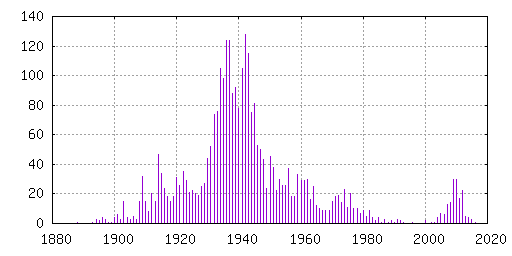
So far I have identified 3186 unique IMDB title IDs. To gain
better understanding of the structure of the data set, I created a
histogram of the year associated with each movie (typically release
year). It is interesting to notice where the peaks and dips in the
graph are located. I wonder why they are placed there. I suspect
World War II caused the dip around 1940, but what caused the peak
around 2010?
 I've so far identified ten sources for IMDB title IDs for movies in
the public domain or with a free license. This is the statistics
reported when running 'make stats' in the git repository:
  249 entries (    6 unique) with and   288 without IMDB title ID in free-movies-archive-org-butter.json
 2301 entries (  540 unique) with and     0 without IMDB title ID in free-movies-archive-org-wikidata.json
  830 entries (   29 unique) with and     0 without IMDB title ID in free-movies-icheckmovies-archive-mochard.json
 2109 entries (  377 unique) with and     0 without IMDB title ID in free-movies-imdb-pd.json
  291 entries (  122 unique) with and     0 without IMDB title ID in free-movies-letterboxd-pd.json
  144 entries (  135 unique) with and     0 without IMDB title ID in free-movies-manual.json
  350 entries (    1 unique) with and   801 without IMDB title ID in free-movies-publicdomainmovies.json
    4 entries (    0 unique) with and   124 without IMDB title ID in free-movies-publicdomainreview.json
  698 entries (  119 unique) with and   118 without IMDB title ID in free-movies-publicdomaintorrents.json
    8 entries (    8 unique) with and   196 without IMDB title ID in free-movies-vodo.json
 3186 unique IMDB title IDs in total
The entries without IMDB title ID are candidates to increase the
data set, but might equally well be duplicates of entries already
listed with IMDB title ID in one of the other sources, or represent
movies that lack a IMDB title ID. I've seen examples of all these
situations when peeking at the entries without IMDB title ID. Based
on these data sources, the lower bound for movies listed in IMDB that
are legal to distribute on the Internet is between 3186 and 4713.
It would be great for improving the accuracy of this measurement,
if the various sources added IMDB title ID to their metadata. I have
tried to reach the people behind the various sources to ask if they
are interested in doing this, without any replies so far. Perhaps you
can help me get in touch with the people behind VODO, Public Domain
Torrents, Public Domain Movies and Public Domain Review to try to
convince them to add more metadata to their movie entries?
Another way you could help is by adding pages to Wikipedia about
movies that are legal to distribute on the Internet. If such page
exist and include a link to both IMDB and The Internet Archive, the
script used to generate free-movies-archive-org-wikidata.json should
pick up the mapping as soon as wikidata is updates.
As usual, if you use Bitcoin and want to show your support of my
activities, please send Bitcoin donations to my address
15oWEoG9dUPovwmUL9KWAnYRtNJEkP1u1b.
 There's an old net story from the 80's, which I can't find right now, but
is about two computers, 10 feet apart, having a ridiculously long network
route between them, packets traveling into other states or countries and
back, when they could have flowed over a short cable.
Ever since I read that, I've been collecting my own ridiculously long
routes. ssh bouncing from country to country, making letters I type travel
all the way around the world until they echo back on my screen. Tasting the
latency that's one of the only ways we can viscerally understand just how
big a tangle of wires humanity has built.
Yesterday, I surpassed all that, and I did it in a way that hearkens right
back to the original story. I had two computers, 20 feet apart, I wanted
one to talk to the other, and the route between the two ended up traveling
not around the Earth, but almost the distance to the Moon.
I was rebuilding my home's access point, and ran into a

 It finally happened
On the 6th of April 2017, I finally took the plunge and




 Like
 I've been tempted to run own
 The server runs Debian sid (probably it would be doable on stretch as well, but I didn't try much) and the setup was pretty simple.
First we need to install some things - Bitcoin daemon and ElectrumX dependencies:
 Doing a lot with all kinds of tables in ScalaFX, I stumbled upon a
 In one of the answers it is stated that:

 About me
Hello, world! For those who are meeting me for the first time, I am a 31 year old History teacher from Porto Alegre, Brazil.
Some people might know me from the Python community, because I have been leading
 I ve been using
 Narabu is a new intraframe video codec. You probably want to read
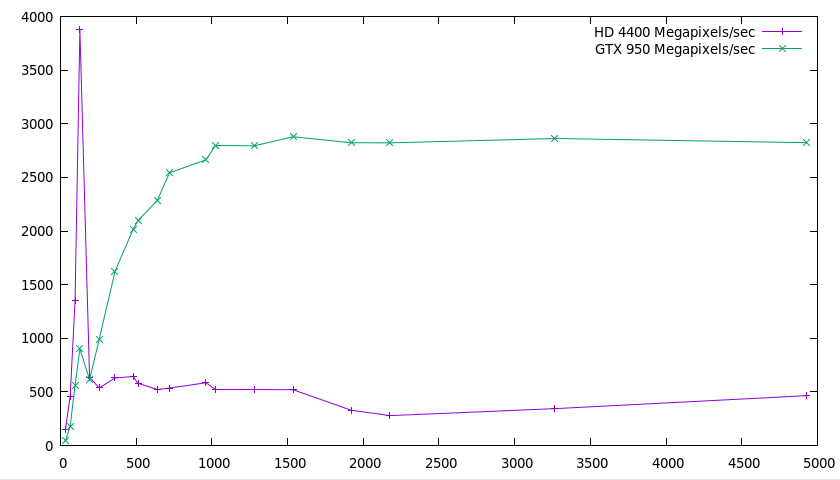 I'm not going to comment much beyond two observations:
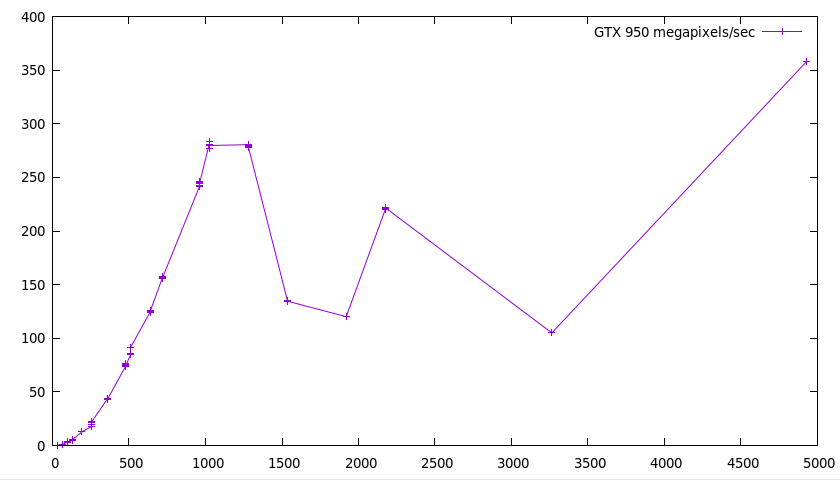 This is interesting. I have few explanations. Probably more benchmarking and
profiling would be needed to make sense of any of it. In fact, it's so
strange that I would suspect a bug, but it does indeed seem to create a
valid bitstream that is decoded by the decoder.
Do note, however, that seemingly even on the smallest resolutions, there's a
1.7 ms base cost (you can't see it on the picture, but you'd see it in an
unnormalized graph). I don't have a very good explanation for this either
(even though there are some costs that are dependent on the alphabet size
instead of the number of pixels), but figuring it out would probably be a
great start for getting the performance up.
So that concludes the series, on a cliffhanger. :-) Even though it's not in a
situation where you can just take it and put it into something useful, I hope
it was an interesting introduction to the GPU! And in the meantime, I've
released version 1.6.3 of
 Previously:


 I'm taking the month of November off work, so that I can exclusively take care of our child. Despite it being a difficult time, with him teething, it has been a great half-month so far.
During the course of the month I've found my interest in a lot of technological things waning, so I've killed my account(s) on a few platforms, and scaled back others - if I could exclusively do child-care for the next 20 years I'd be very happy, but sadly I don't think that is terribly realistic.
My interest in things hasn't entirely vanished though, to the extent that I found the time to replace my use of
 Welcome to gambaru.de. Here is my monthly report that covers what I have been doing for Debian. If you re interested in Java, Games and LTS topics, this might be interesting for you.
Debian Games
 I was assigned 15 hours of work by Freexian's Debian LTS initiative
and carried over 9 hours from September. I worked 20 hours and will
carry over 4 hours to the next month.
I prepared and uploaded an update to dnsmasq to fix some urgent
security issues. I issued
 A unit is a part of your program you can test in isolation. You write
unit tests to test all aspects of it that you care about. If all your
unit tests pass, you should know that your unit works well.
Integration tests are for testing that when your various well-tested,
high quality units are combined, integrated, they work together.
Integration tests test the integration, not the individual units.
You could think of building a car. Your units are the ball bearings,
axles, wheels, brakes, etc. Your unit tests for the ball bearings
might test, for example, that they can handle a billion rotations, at
various temperatures, etc. Your integration test would assume the ball
bearings work, and should instead test that the ball bearings are
installed in the right way so that the car, as whole, can run a
kilometers, and accelerate and brake every kilometer, uses only so
much fuel, produces only so much pollution, and doesn't kill
passengers in case of a crash.