Search Results: "agi"

23 November 2006

Edd Dumbill: Really really getting the testing religion

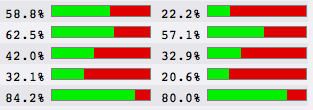
Writing tests is virtuous. It's the wholemeal bread of programming. Do it, and you'll be so much fitter. Except it tastes like cardboard and gets in the way of consuming the yummy treacle sponge of programming. But now I've got the testing religion. I view the lack of tests with the disapprobation of a reformed smoker tutting and huffing at the merest suggestion of a Marlboro Light. How did this happen and how can I be sure I won't backslide? The moment of transition was the first time that a test saved me from releasing software with a bad bug in it. The theoretical knowledge of virtue was translated into the palpitating relief of not disgracing myself in public. After that happened a few more times, I found myself desperately uncomfortable with the idea of releasing anything that didn't have decent test coverage. And so a virtuous habit is formed. It's not just driven by fear. With the right tools to hand, writing tests can be a lot of fun. You don't always need to be "in the zone". If you've got a spare half hour here and there, you can use it to increase the coverage of your tests. Getting better at testing is one of the ways I've become a much more proficient Rails developer over the last year of work on Expectnation. In case it helps anybody else, I thought I'd share some of the tools and techniques that are part of making Rails testing fun and effective. Continuous testing Whenever a checkin is made to our source repository, tests are run and the results emailed to everybody working on the project. As with the "you broke the build" disincentive, you need to be kept honest by frequent running of the tests. There are a variety of tools around to help you do continuous integration with Rails, most of which have some dependence on you using Subversion for source control. In the event, I just created my own script to do what we required. Coverage reports rcov coverage barsOne of the big mental hurdles with testing is knowing how many tests you should aim for.  You can't prove a negative: even if your tests are all passing it still doesn't tell you much about the tests you haven't written that might fail! We use rcov as part of the continuous integration process, and post the results to our project web site. The pretty red and green bars give you some idea of when you're starting to get adequate test coverage, and the line-by-line breakdown is invaluable. Tainting strings One of the easiest errors to make in Rails templates is to miss the call to h(), to escape any HTML in an output string. The only real way to catch these errors is through automation. The wonderful safe_erb plugin helps you do just that. By using Ruby's tainting mechanism for strings, it throws an exception if you render any external data unescaped. One of the beneficial side effects of safe_erb is that you then become very particular about ensuring your functional tests properly cover every action in your application.  Tests such as get 'index', which before seemed mundane and redundant, are now essential, as you want to test for tainted strings. In addition to the above techniques, there are a lot of fun shiny gadgets to help you write tests, such as ZenTest, but the three things above are the ones I've found to be of significant value. I ought to conclude with words of praise for Rails. It goes out of its way to make testing an important part of the development lifecycle, and the availability of the of unit, functional and integration test functionality makes it easy to get started. Every time I teach somebody about Rails' testing features, they end up finding it very enjoyable.
Don't forget, testing can be fun!

22 November 2006

Simon Richter: The next step in packaging: functional units as system components?

I need to set up a spam filter, preferably with instantaneous rejection of emails. The way postfix does this is to immediately attempt to forward the mail to a filter, which is then responsible for feeding it back. This is probably the sanest way to do it, as it allows postfix to handle timeouts in the filter, and it allows the filter to modify the message (e.g. tag it) Now, all I need is a filter that actually works in this place. What would be nice would be a readymade spam filter installation that I could simply boot on a virtual machine and be set.

Gunnar Wolf: O mighty Tezcatlipoca, we bow before you!


Tezcatlipoca, the smoking mirror, was (quoting from Wikipedia) the god of the night, the north, temptation, sorcery, beauty and war. He was known by other descriptive names, such as Titlacauan (We His Slaves), Ipalnemoani (He by whom we live), Necocyaotl (Sower of Discord on Both Sides) and Tloque Nahuaque (Lord of the Near and Nigh) and Yohualli ecatl (Night, Wind). And today, I strongly feel as being born his servant. Why? Because today I took courage and started working on the integration of our ~20 print servers into a single, smarter scheme, with user control and printer assignment done by a central server. I cannot, of course, say that in the course of a day my troubles are over - No, no, quite far from it... But at least, I managed to grasp how to send the CUPS generic Postscript driver as the default driver for W2K/XP clients (no, I haven't worked on older ones yet - and yes, we still have many W98 machines around). I'm quite used to the fact that things in a Unix system are just easy to understand. Yes, sometimes it takes some time, sometimes you have to dig into the manuals, but all in all things can be finally understood. Today, after a couple of hours sticking my nose into the extremely extensive Official Samba HOWTO and Reference guide (chapters 21 and 22) and having my attention drift over the quite interesting Implementing CIFS book in a vain attempt to fully understand what goes on behind the curtains, after trying to debug my Windows-Linux communication issues by grokking what Wireshark finds over the wire... I can only understand that CUPS is pure black magic, although quite well documented. Samba is elegant and feels nice and easy, but really begs to be debugged with the Malleus Maleficarum at hand. CIFS (also here) is the subtle utterance of a dark spell pronounced by a stuttering sorcerer. And the way Windows integrates with it all is... Bah.

Edd Dumbill: Three things I would be doing if we had Thanksgiving in the UK

Working as much with the US as with the UK, Thanksgiving is always a noticeable holiday for me, even if I still have to work. If I had the luxury of the holiday this year, I'd be
  1. Staying up all night to follow The Ashes. Sporting competitions founded in the 1880s don't have much regard for television and radio audience hours, alas.
  2. Going to evensong at York Minster. The intimate and historic choir is an amazing experience at this time of year, as the candles take over from the weak winter sun.
  3. Encouraging people to use the holiday to prepare their submissions for XTech 2007. Springtime in Paris and top technology seems like something to look forward to.
As it happens, I'll do No. 3 anyway and reluctantly miss out on the others. Happy Thanksgiving to my friends and colleagues in the US.

21 November 2006

Benjamin Mako Hill: Writing and Writing Code

Over the years, I've published some of the articles I am most proud of on Advogato. As you can imagine, I was sad to see demise of Advogato announced early September and thrilled to see that by the end of the month, Steve Rainwater had stepped up to save the site. For a belated welcome of Advogato back from the edge of the grave, I've published a short essay about the effectiveness of an analogy of software and writing on the site. In it, I introduce the analogy and argue that it is useful in advocating free software and programming education and in justifying the disproportionately large amount of programming related projects in the free software world. Here's the intro:
Advocates of free and open source software, myself included, like to talk about the "democratizing" effect of free software. Others, especially non-programmers, are quick to point out that the only technical people can take advantage of half of the enumerated freedoms in FOSS. The freedoms to modify and collaborate mean little if you don't know to program. Over time, I have come to the conclusion that the only good solution to this problem -- and one that I was initially quite opposed to -- is to teach everyone to program. In considering this position, the processes of reading and writing provide a useful analogy when considering the processes of using and creating computer software. Additionally, the analogy provides an powerful justification for the fact that FOSS programmers produce a disproportionately large amount of software that is primarily of interest to FOSS programmers.
Please check it out on Advogato and feel free to leave a comment on my blog if you don't have an Advogato account.

Matt Brown: MyVFX first impressions

There has been a lot of interest recently in the VFX VoIP service launched by WorldXchange (WXC), no doubt partly driven by the fact that there is no monthly charge until April 2007. I had a spare Linksys PAP2T so I thought I would try the service out to see how it performed. The signup process didn’t go anywhere near as smoothly as it did when I signed up for my WXC DSL connection. The online signup form tried to force me to select a new WXC DSL Plan (I don’t want to do that, I want to keep my old plan with free National traffic). Despite trying several times and making sure that the only checkbox ticked was VFX each time, it refused to let me go any further. Giving up on the web form, I rang the WXC helpdesk who answered promptly. It is easy to see why WXC won the 2006 award for best call centre. Every time I deal with them over the phone it is a pleasant experience. This time was no exception. The CSR I was talking to explained that the webform was dying because I tried to use a VFX username that differed from my WXC DSL username. There was no mention of this restriction on the website! Anyway, 15 minutes later, with my MAC address taken down and my voice recording completed, I was told we were all done and that I would receive my welcome email and account details with 2 working days! 24 hours later I received the email with the details, followed promptly by a phone call from WXC CSR who was ready to talk me through the process of setting up my PAP2. Configuring the PAP2 was a simple procedure, I had to copy and paste a URL into the Provisioning Rule field of the web interface and reboot the device. It then downloads configuration information directly from WXC (based off the device MAC adddress) and configures itself. I was up and running with dial-tone about 2 minutes after receiving the email. Very smooth. I understand that the process is even easier if you purchase a pre-configured PAP2. The downside to the whole scheme is that in trying to make the process as simple as possible WXC has locked the entire system down very tightly and remove a lot of the flexibility that I would desire. In particular my PAP is now completely locked, I can’t access any of the web interfaces, and even the dial-in prompt on the PAP2 replies with a curt “cancelled” before hanging up. There is no way for me to configure the second line of the device to talk to a second SIP provider. Apparently WXC will create a custom configuration for me so that I can still use the second line, but I imagine this requires giving them all my account details for my second SIP provider, which I’m not sure I’m comfortable doing. It also appears that WXC has an arrangement with Linksys such that every PAP2 now sold in New Zealand comes pre-configured to be used with WXC. I haven’t had a chance to look at one of these PAP2s yet, but if it were to turn out that I had to contact WXC to remove the locking on my PAP2 before I was able to use it with another VoIP provider I would be fairly annoyed. The MyVFX portal is very underwhelming. It insists on opening itself in a new browser window, and isn’t integrated with the rest of the WXC/VFX website. From what I can make out it’s just a branded frontend on to the management system that WXC has purchased. The user interface is reminiscent of the design of the 1990s. I think there is a lot of potential for WXC to improve the experience in this area and I doubt that the average user would be comfortable updating settings via MyVFX in its present state. On the technical side of things the VFX service seems to be fairly well designed and secured. The devices are provisioned and configured using the Linksys/Sipura provisioning tools, which appear to encrypt all conversations with the device. The setup process downloaded two configuration files and a firmware file (v 3.1.10) to my PAP2. Both of the configuration files were binary and appear to be encrypted. Interestingly it appears that WXC downgraded the firmware from 5.1.1 to 3.1.1 during the provisioning process. The MyVFX portal and SIP server appear to be using some sort of BroadWorks device. The device fetches it’s configuration file from the WXC server every time it is powered on, so it will be easy for WXC to push out updates and configuration changes as they desire. The VoIP side of things is performed using SIP, which appears to be using standard HTTP Digest authentication. The username and passsword for this being hidden inside the encrypted configuration files which are downloaded to the device. The voice data uses the G.729 codec inside an RTP stream, and from a few short calls seems to be relatively good quality. Conclusion
Overall, VFX seems like a very easy to use and simple service. Simple being the keyword. By locking down the devices so securely and preventing people from using softphones and devices other than Linksys equipment I imagine many people like myself are excluded from the potential market. I can’t see myself keeping the service after I have to start paying money for it. But I would definitely recommend it to friends and family who are looking for a simple, easy to use VoIP system.

Steve Langasek: midterm report

This is the first of my two formal reports to the Dunc-Tank board on the release management funding experiment. Although submitted to the board some time earlier, I've delayed publishing it to the wider community until a release update could be sent out with more concrete information on timeline adjustments as Debian developers are wont to demand.
I'm supposing that I don't need to give you any more specific details on what I've been working on than what's already been posted in my blog. There has certainly been plenty to keep me busy the past three weeks, including a lot of triage work on the state of bug reports in the BTS, managing the last of the major package transitions into testing for etch, removing packages and NMUing them, and it has indeed kept me busy. Busy enough that I've been lax when it comes to talking about it, either here or in my blog. :) Has the hard work paid off? Well, http://bugs.debian.org/release-critical/ shows a sharp decline in release critical bugs affecting testing over the same time period, following the peak resulting from Dunc Bank's successful campaign of identifying latent release-critical bugs in etch. Unfortunately, we have no statistics that track the number of RC bugs closed or opened over time, which makes it hard to judge how large of a dent my own work has made in the overall bug count. It's also totally guesswork to try to judge whether Dunc-Tank has encouraged others to help with the release overall, or discouraged them from doing so. What I can say is that, even though the past month coincides both with the tail-end of the Dunc Bank mass bug filings and multiple archive-wide rebuild efforts, the bug count is moving in the right direction, and I am seeing many maintainers being responsive to bugs in their packages and a number of active NMUers. If not for the buzz-kill of Lucas Nussbaum's latest round of build failure reports :), we would be down from over 300 RC bugs to less than 200 right now, which probably represents at least twice that many RC bugs closed. In terms of how the time I'm putting into this release compares with the sarge release, I'd say it's pretty comparable. That's actually quite a positive statement about Dunc Tank's role, IMHO; getting a Debian release out is uphill all the way, and whereas the sarge release came at a time when I was in a position to work more or less full time on it without compensation, my availability this time around would have been greatly reduced, and progress would have been much more heavily dependent on individual maintainers and semi-periodic bugsquashing parties, which I'm not sure is any longer enough to offset the rate at which new RC bugs are created in the distribution by uploaders. As it stands, I do find myself trying to consciously avoid a hero complex of needing to fix every bug personally, but there are after all only so many options for getting bugs fixed for release. A lot of maintainers respond positively to gentle nudging about their RC bugs, but there are still bugs that the maintainers can't or don't fix and that no NMUers take on, which does leave it more or less up to the release managers to address -- which is why one of my tasks for this week is to try get the count of RC bugs over 20 days old down from 90 to around 20-30, as these are the bugs that really do need more attention to get them resolved. So yes, Dunc-Tank is making a positive difference. Andi and I have reviewed the status, and while we don't think we'll be able to hit the Dec 4 deadline (even if we get the bug count down immediately we're waiting on the debian-installer to release, which needs at least one more release candidate with the 2.6.18 kernel), we do believe that a release before the end of the year is very possible and I'm looking forward to starting the full freeze in the next few weeks.

20 November 2006

Ben Armstrong: Towards a Debian Jr. Live CD

Debian Jr. development revived Recently there has been some lively discussion on the Debian Jr. list about how to arrange an account for a child of 1 to 3 years of age. Suggestions included using set-top box software like Freevo, tailoring DEs with panels and large buttons, using simpler WMs like fvwm, or using an “activity centre” app like Gcompris. Now, I respect those parents who hold that a child this young should interact more with the “real world”. While I wouldn’t go so far as to outright prohibit my young ones from computer use, I can see the wisdom in keeping it to a minimum. But, for better or worse, our family is one of several who have some experience helping our youngest members use our Debian systems. We would like to share what we’ve learned through the Debian Jr. project. Getting started with live.debian.net To that end, last week I was inspired to follow the Debian Live ISO Howto to produce my first rough draft of a Debian Jr. live CD built from scratch on Etch. For the final product, we’ll want to use a local partial Debian archive mirror, as it not only optimizes fetching packages for several build iterations, but also can be kept stable, which is important as we near release. But for this draft, I ran into trouble building the complete package list to populate the partial mirror, as cdebootstrap, which make-live uses, has no handy --print-debs switch like debootstrap does. So for now, I rely on approx to cache packages for optimization only. A straightforward process to create a working live CD The rest of the process was straightforward: using live-package, I created a package list1 containing Gnome and the Debian Jr. metapackages, I configured /etc/make-live.conf to point at my proxy, and then I ran the make-live script on the package list. The end result was ./debian-live/binary.iso, which successfully booted under qemu. At this stage, there is not much to show. To be truly useful, the live CD needs to be set up so that children and their guides can immediately find and use the material intended for them. We will need not only one live CD user, but four, varying in age range and role. (More about this in a future article.) However, it is an encouraging start, and shows that we may be able to produce something usable by the time Etch releases.

1 For this exercise, I simply combined /usr/share/make-live/lists/gnome with the junior-* metapackages in Etch, and added mozilla-firefox-gnome-support to satisfy Gnome’s web browser dependency and cut down on redundancy, resulting in the following list.

junior-art
junior-doc
junior-games-card
junior-games-gl
junior-games-net
junior-games-sim
junior-games-text
junior-gnome
junior-internet
junior-kde
junior-math
junior-programming
junior-puzzle
junior-sound
junior-system
junior-toys
junior-typing
junior-writing
mozilla-firefox-gnome-support
eject sudo
console-common locales
gdm gdm-themes gnome-desktop-environment gnome-cups-manager gnome-screensaver
gnome-themes-extras
rhythmbox synaptic
x-window-system-core

Julien Danjou: Freevo packaging on its way

So this week-end Cyril Lacoux began to work on packaging freevo, which never got into Debian for a reason I still ignore. All I found is a 4 year old ITP from Matt Zimmerman who closed id some weeks later because he decided to give up and use MythTV instead. ;-) There's now a project on Alioth and we will probably get a working package soon, since we began to commit this morning.

19 November 2006

Jose Carlos Garcia Sogo: Cities with no traffic signals

According to this article, also referred on Slashdot, an European Union project has been developed aimed to check if streets free of any traffic signal or other rules are viable. Seven cities and regions are involved, no one of them in Spain. And I hope things to stay as now. Perhaps this can work in those civilized cultures in which people try to respect others rights. But I am 100% comfident that this won't work in Spain. If people does not respect signal even if they are there and can be fined for not following them, I don't want to imagine what will people make if there are no signals and no rules. The most used motto will be: "And who the ***** are you to tell me that I can not do this?". yay!

Piotr Roszatycki: YADA kills kitten ;-)

There was very funny thread about CDBS and kitten. I think any other solution is better than plain Makefile. Long time ago I adopted the YADA. It's wonderful tool for anybody who hates Makefiles. Yes, the project is still alive. Unfortunately I don't have too much time for promoting this project. Just one month ago some developer did NMU for my package (see Bug#391753). He wrote that YADA is quite unfriendly for NMUers. I really wonder, how it could be unfriendly as far as plain Makefile don't support even separate patch files... I think it would be much better if Debian had only one tool for packaging. The RPM's SPEC file as single source for package is more friendly for maintainer than thousands of separate debhelper's files. So the YADA came. But... I understand it is just an option. It is my choose how to package my packages. My own right to decide. I can live with Debian and CDBS, YADA or other packaging helpers.

18 November 2006

Riku Voipio: cdbs: empathic maybe

I tried to ask our cats if they felt threatened by CDBS. They didn't seem really worried.

I'm not sure if it is entirely fair to blame CDBS for complex packaging issues. If CDBS was not available, more maintainers would just cook up their own spaghetti packaging scripts. The balance needs to be somewhere between "everyone reinventing the wheel" and "frameworks that are harder to use than the raw stuff". Currently I would recommend only using CDBS for simple packages.

17 November 2006

Biella Coleman: The Politics of (lyme) bacteria

Recently I read an amazing review of patient advocacy and health (counter)movements by Steven Epstein from the STS program at UCSD. It is still a draft but bound to be published in the New Handbook of Science and Technology Studies and when it is, anyone who works in this area will gain so much from reading the review. It was stunningly broad yet highly specific. He is able to synthesize an enormous literature on patient advocacy, a field that has seen a blizzard of activity, especially in the last twenty years. Along with providing points of entry and departure into the field, he also examines who the burgeoning interest in the field of STS. What I found interesting is that there is very little work being done on a topic I happen to know a lot about, lyme disease and whose politics I have been following since at least 1999. I am not sure why the lacuna but it is an odd disease dripping and screaming with controversy and seems to stand apart from many illnesses, in part because of its odd dual existence. On the one hand, it is an illness that the medical establishment totally recognize as real (and thus in some respects is unlike the class of syndromes from MCS to chronic fatigue, which another STS researcher, Joe Dumit provocatively describes as illnesses you have to fight to get ). But that is only half the picture because mainstream medicine tends think that lyme is not only easy to diagnose but also to treat, so much so that if a person thinks they have lyme (even after a round of antibiotics or lacking diagnostic markers), the are either seen as suffering from something else (and usually then told they have one of those highly contested syndromes), or more often just crazy. So it exists dually: at once recognized but only narrowly, so that in another form, that of chronicty, lyme cannot exist. It is this dual quality of lyme that defines and shapes its politics and just recently, new developments have fueled the controversy. Namely it follows from the Infectious Diseases Society of America new guidelines for the diagnosis and treatment of lyme, published last month. In a nutshell, they basically re-reduce lyme to a very easily diagnosable and treatable illness, calling for even more strict guidelines for its diagnosis than now exist. They sanction a small range of blood tests and thus totally nullify the role for clinical diagnosis, which even the CDC had acknowledged as vital in times past. Unsurprisingly this has thrown the chronic lyme community in a total tizzy and they have not taken this sitting down. A petition has been launched and protests have been planned. And amid the controversy, politicians have already heard the call to arms. In the state where lyme is a famous entity for it was first discovered there, Connecticut, its Attorney General is calling for an anti-trust investigation into the Infectious Diseases Society of America, in essence for using their clout and prestige to legitimate a gold standard in diagnosis and treatment, when it seems far from obvious that this should be the standard. According to the LDA press release:
The national non-profit Lyme Disease Association (LDA), representing more Lyme disease patients than any organization in the United States, applauds Connecticut State Attorney General Richard Blumenthal for beginning an investigation into the Infectious Diseases Society of America (IDSA) Lyme disease guidelines development process. In an unprecedented move, the Attorney General’s office filed a Civil Investigative Demand (CID) to look into possible anti-trust violations by the IDSA in connection with exclusionary conduct and monopolization in the development of the Lyme guidelines
What I find so interesting is that this latest chapter in the grungy and torrid politics of lyme encapsulates the very nature of the politics of lyme, which really is about the agency of bacteria and in the Latourian sense. If Pasteur had to put a lot of effort into making credible the bacteriological model of disease as Brunto Latour covers in The Pasteurization of France and if there was plenty of future prostelyzing needed to bring credibility to the bacteria to more general publics, as Nancy Tomes illustrates in The Gospel of Germs, well now, I think we are in an era where we think we have such intimacy with the biological ins and outs of bacteria, it is almost impossible for the scientific community to imagine bacteria as such complex organisms that they can be in fact very difficult to diagnose, eradicate and treat. It is just no longer part of the basic conceptual universe of most doctors and medical researchers to think of bacteria in this way. The LDA press release acknowledges this very fact in the following way:
The October 2006 guidelines do not acknowledge that a complex bacterium such as the Lyme disease spirochete could possibly survive in the body and the brain, evading the immune system and short-term courses of antibiotics.
For many lyme researchers and doctors, since lyme is a bacteria and we know how to treat those pesky critters, it is frivolous to even imagine or contemplate otherwise. I would call this a hubris that arises not from the arrogance of doctors and the medical establishment but following the heels of success that medicine has indeed had with conquering the bacteria with antibiotics. Even new forms of poweful and highly resistanant TB are still treatable with a potent cocktail. That is, at a cultural level, I understand the blinders. At a political level, however, because people are suffering and because it is plausible that lyme can exist chronically, it is imperative to unseat this cultural comfort borne from past success to get the ball of research rolling anew. I think bacteria (and parasites for that matter as a recent smattering of articles demonstrate) are a lot more savvy creatures that should be treated as novel, wondorous creatures, once again. I would dare say the medical establishment, by refocusing energies on that which they think they have solved, would find themselves quite surprised. updateHere is an article discussing the issues.

Steve Langasek: On setting and meeting goals, and statistical fun

While NMUing plays an important part in getting us to a release, as shown by the thousand or so fixed-in-NMU RC bugs that we recently cleaned up the BTS state on, it's evident after doing this whole release-managing thing for a while that there is a very high (non-linear) correlation between the age of an open RC bug and the likelihood that a release manager is going to have to touch it at some point in order to get it fixed. By and large, maintainers really do a good job of fixing their own packages, which is probably something we don't say enough - maybe 75% of all RC bugs, I'd guess, will (or would) get fixed by maintainers in the first week without anyone needing to poke them about it, and of the remainder, probably another 80-90% get taken care of by BSPers and serial-NMUers like bug-a-day mascot Steinar Gunderson. That's why I'm not bothered overly much by the idea of full-archive searches for hidden RC bugs, like Lucas's piuparts tests, affecting the release timeline, because I know that 95-98% of those bugs are going to be gone two weeks after they're filed anyway, especially when they're no-brainer fixes to maintainer scripts or dependencies. But then that leaves the other 2-5%, which are the ones nobody else has fixed. And why hasn't anyone fixed them? Because they're the hard ones, of course... So although I follow the debian-bugs-rc list and occasionally swat a few non-bugs closed to save the maintainers time, and also provide some nudges when it looks like a package is causing RC bugs to be filed on other packages, my goal for the last full week of my Dunc-Tank contract was to get the count of etch RC bugs unfixed in unstable that are 20 days old or older down from around 50 to under 30. This seemed a reasonable goal, since it had been at 80 the week before, and it would go a long way towards helping the real blockers on the release. Initially I was aiming to bring down the count of RC bugs unfixed in testing that are 20 days old or older to this number, but quickly realized that this wasn't going to be realistic because it depended too much on the autobuilders all operating optimally and there wasn't time to both help fix 20 of the hardest RC bugs and handhold 60 RC bugfixes into testing in one week. In the end, we did miss this lesser target by a day or two. Still not a bad week's work, given that I'm pretty sure I fixed about 20 of these bugs myself in that time period (through NMUs, removals, and analysis+downgrades) and they seem to average 3 hours of work for a fix. And we've been holding at or below 30 on this list of bugs since then, so we're successfully keeping up with new bugs aging past the 20-day mark, which is also a good sign. Unfortunately, I seem to have left myself to fix the alpha Xorg 7.1 bugs on my own time. :) By now the announcement has made the rounds that the release team doesn't think we can hit the Dec. 4 target date because more time is needed for a final release candidate of the installer. Does that mean that RC bugs were the wrong thing to be focusing on for the past weeks? Well, no; if you want one place in Debian where Brooks' Law holds, I think you'll find that getting a d-i release out is it, and we still have a hard road ahead to make sure we do get our other RC issues sorted out in the same time frame. The installer just happens to put a lower limit on a release date, we still have an opportunity to screw it up from there. ;) At least the statistics suggest that we're going in the right direction. Only 13% of RC bugs fall into the "20 days or older and unfixed" category. Half of all RC bugs over 10 days old have a fix of some kind in unstable, and 64% of all reported RC bugs are less than 10 days old. We'll see whether this graph backs me up on this in a couple more days.

16 November 2006

Stefano Zacchiroli: cdbs relevance

/me on the Relevance of CDBS Whoa, people discussing about CDBS, I can't help joining them. My position: I love CDBS. I started switching my packages to CDBS an year ago or so and nowadays I've almost finished. I understand that people not knowing CDBS might have trouble fixing bugs in my packages, but that's life and it's the same as having to fix a bug in a software written in a programming language you are not fond of. It's just a matter of setting a minimal standard: today people in the NM have to learn debhelper, tomorrow they will have to learn CDBS too. I think it's worth the effort, because CDBS, if used extensively in our archive, has the benefit of providing a single place where to massively make changes to potentially all packages of the archive. That's a huge win for QA in Debian. The same does debhelper, but it only takes care of technical aspects in the packaging process while CDBS also takes care of behavioural aspects. Of course CDBS has drawbacks and nuisances (the available hooks for examples are not properly standardized nor documented IMO), but I think it's a step in the right direction. In Debian we should push more and more toward the possibility of making changes in a centralized/batch manner, so that when maintainers tend to get MIA we have a quick and easy way to take over their unfulfilled duties. Collaborative maintenance is a social step in that direction, CDBS is a technical one.

Benjamin Mako Hill: Dare to DReaM?

I went to a talk today by Sun scientist Susan Landau on Sun's DReaM/Open Media Commons DRM system that I've mentioned in the past. Landau used a variant of these slides to do a rough overview of the Sun system and the problems that it is trying to solve. Halfway through her talk, Landau showed a slide titled, "Users Matter: Creative Commons." Elaborating, Landau mentioned that she had been talking to a number of people -- both at CC and outside -- about the possibility of using DReaM to enforce the terms of CC licenses. I interrupted Landau to point out that CC licenses had an anti-DRM clause that, as far I knew, would make her system unusable on CC content. The CC anti-DRM clause, plus the resistance of the CC and iCommons community to accept parallel distribution language, are why it's impossible to play CC-licensed works on an unmodified PlayStation or XBox (these systems only play signed disks) -- even if you include an unencumbered copy alongside! Landau reassured me that I must be mistaken and that she had talked about DReaM in depth with CC leadership, lawyers, and technical advisory board members and she was sure her system was at least possible. Puzzled, I shut up. For most of the rest of her talk, Landau talked about fair use and how a DRM system might go about respecting it. In his qualified endorsement of the DRM system, Lessig mentioned that DReaM, "would be implemented to allow individuals to assert 'fair use,' and unlock DRM'd content, with a tag to trace misuse." At the time, I had a hard time imagining how fair use could be built into such a system -- separating fair from unfair use is remarkably resistant to technical solutions. Even bright light cases like verbatim copies every page of the Encyclopedia Britannica might be fair use if I were to make them into a paper m ch bust of Johann Gutenburg or use them to wallpaper a gallery wall. Landau's acknowledged the trickiness around fair use and suggested a compromise:
By default, works might be encumbered in the ways and to the degrees that the copyright holder wish. However, users could petition for an unencumbered "fair use copy" by identifying themselves and then checking some boxes and explaining (briefly) why they think their use for the work qualifies as fair. Once they've done this, the system would present the user with an unencumbered, watermarked, and fully traceable piece of media.
Conceivably, requests would be subject to some sort of review (at the very least to prevent automated requests) and non-fair uses of watermarked goods would be strictly tracked. If a "fair use" copy is found in the wild, the watermark would be traced and the originator would be held liable. Of course, anonymous fair use becomes impossible but, as Simson Garfinkel pointed out at Landau's talk, users may have a right to anonymous speech and to fair use but not to anonymous fair use. "Fair" enough. It is perhaps important to point out that DReaM does not currently implement this "fair use" system and that, one can only assume, the vast majority of DReaM users (e.g., Hollywood movie studios and their ilk) would have no little interest in giving their users a blanket ability to make "fair use copies" and would in most cases choose not to enable such an option. But let's return to the issue of DRM enforcement of CC license terms. While I was initially quite confused by the idea of DRM enforcement of CC license terms, it made much more sense when I looked at the CC anti-DRM clause itself:
You may not distribute, publicly display, publicly perform, or publicly digitally perform the Work with any technological measures that control access or use of the Work in a manner inconsistent with the terms of this License Agreement.
The emphasis (mine) points to the crux of the issue. The CC anti-DRM clause only blocks technological measures that overstep the boundaries set in the rest of the licensee. For the free licenses, that's a wide boundary that leaves little room for DRM. But as I've pointed out before, CC is a lot more than just free licenses. Landau mentioned that her group was primarily interested in using the DReaM system to enforce attribution and non-derivative work clauses in CC licenses -- a wise choice as non-commercial use is hard enough for humans to discern. As a result, the DReaM system might be used to make it impossible to remove attribution from CC works or might block modification to works marked as "ND." The catch that led me to believe that CC license blocked all DRM was the fact that I didn't think it would be possible for a DRM system to respect fair use. After all, each CC license includes an explicit affirmation that, "nothing in this license is intended to reduce, limit, or restrict any rights arising from fair use." The question that the possibility of a CC DRM scheme like DReaM hangs on is: to what degree does Landau's suggestion live up to the fair use legal bargain? Landau pointed out that a number of lawyers including Pam Samuelson and CC's technical advisory board and legal staff have been generally positive about her fair use permission-asking compromise. Honestly and on CC's own terms, it's hard to see why they wouldn't be. The loss of anonymous fair use was only ever a right we enjoyed by a fortunate accident. Watermarks are only there to "keep honest people honest." If you are not doing anything wrong, what do you have to hide? But DReaM enforcement of CC licenses is a bad thing and the bad taste that it inevitably leaves in many commoners mouths is not hard to explain:
  • Many commoners are not comfortable with the idea of DRM because it shifts power over users' computing devices away from the users and makes computers obey the will of a copyright holder. That's true of DReaM just as much as as it is of Apple iTunes or Microsoft DRM.
  • Many commoners are not completely comfortable with all CC licenses, so the idea of technical protection measures enforcing these terms, even those allowing for fair use lines and in line with the will of the author, is seen as dangerous.
To solve the first issue, CC needs a more strongly worded anti-DRM clause -- ideally one tied to a parallel distribution clause. To solve the second, we will ultimately need a new banner under which only truly free cultural works will reside. Susan Landau doesn't have it easy but she does seem to have the genuine best interest of consumers and users at heart. That's more than I can say about the vast majority of people in the DRM business. She's trying to walk a fine line and she's almost certainly being abused and heckled by folks in the industry who call her "communist" and by folks like me who feel that she's sacrificing essential principles in an attempt to compromise. The one thing we all agree on is that the ground she's treading is mine field. Yet while I sympathize with her, I must speak out against both her and DReaM. A DRM compromise at this stage would be insanity. This is a fight we have to win.

Benjamin Mako Hill: Ignorance is Bliss

A banker at my hippy bank had never heard of Google. I had to spell the name out and explain it to her! I've never imagined one could feel so happy about their choice of financial institution.

15 November 2006

Russell Coker: economics of a computer store (why they don't stoc...


In some mailing list discussions recently some people demonstrated a lack of knowledge of the economics of a shop. Having run a shop for a few years (an Internet Cafe) I have some practical knowledge of this. I will focus on small businesses in this article, but the same economic principles apply to large corporations too.

When running a shop the main problem you have is in managing stock. There are two ways of getting stock, one is to have wholesalers give it to you for a period in which you can try to sell it and you pay for it when it's sold, this is probably quite rare (I don't know of an example of it being done - and probably no retailer wants to talk about it in case they lose it). Often retailers consider themselves to be privileged if they are permitted to pay for hardware one month after they receive it! The more common way of getting stock is simply to buy it and hope you can sell it in a reasonable period of time (often the wholesaler will offer to buy the stock back at a 10% discount if you can't sell it).

To buy stock you need money, this can come from money that has accrued in the business account (if things are going really well) or from a mortgage taken out by the business owner if things aren't going so well. For small businesses things usually don't go so well so the money used to buy stock is borrowed at an interest rate of about 7% or 8% (I'm using numbers based on the current economic conditions in Australia, different numbers apply to different countries and different times but the same principles apply). The ideal situation is when there is money in the company bank account to cover the purchase of all stock, this means that the cost of owning stock is that you miss out on the 5.5% interest that the money will get in a term deposit.

Almost all stock has a use-by date of some form. Some items have a very short expiry (EG milk used to make hot chocolate in an Internet cafe, some have a moderate expiry date (computer systems become almost unsellable in about 18 months and lose value steadily month after month), but in the computer industry nothing has a long expiry date.

Let's assume for the sake of discussion that you want to run a small computer store that is open to passing trade (this means that you must have stock for an immediate sale). Let's assume that all items of computer hardware lose half their value over the period of 20 months at a steady rate of 2.5% of the original price per month (I think that most computer hardware loses value faster than that, but it's just an assumption to illustrate the point).

The next major issue is the profit margin on each sale. If you can make a 20% profit on a sale then an item that has lost 10% of it's value while gathering dust in your store will still be profitable. However the profit margins on computer sales are very small due to having a small number of major manufacturers (Intel, AMD, nVidia, ATI, Seagate, and WD) that have almost cartel positions in their markets and there being little to differentiate the stores apart from price. I have been told that 3% profit is typical for retail computer hardware sales by the small companies nowadays! Now if the stock will lose 2.5% of it's value per month, you pay 0.5% interest per month and you make a 3% profit then if an item remains in stock for a month then you lose money. So on average (by value) you need to have stock spending significantly less than a month in your store. Cheap items such as low-quality cases and PSUs can stay in stock for a while. More expensive items such as new CPUs and the motherboards to house them must be moved quickly.

What's the first thing that you do to reduce stock? You can keep stocks low, but there is a limit to how low you can go without losing sales. The next thing to do is to not stock items that customers won't often buy or items where there is a similar item that you can stock as a substitute. The classic example of this is hard drives, a customer will want a certain capacity for a certain price - if their preferred brand is not in stock they will almost always take a different brand if it has the same capacity at the same price. Stores often advertise prices on multiple brands of hard drive in each capacity, but often only try to keep one brand in stock.

Of course this is a problem for the more fussy buyer. If you want to buy two identical parts from the same store on different days you might discover that they don't have the stock on the second day and that they instead offer you something equivalent. Not only do retailers have issues with managing their investment in stock but wholesalers have the same problem. So if a retailer runs out of WD drives and discovers that their preferred wholesaler has also run out of WD drives then they just buy a different brand - most customers don't care anyway.

There are some companies I deal with that have a business model based on services. One of them sells hardware to customers at cost, but charges them for the time spend assembling them, transporting them, etc. The potential for a 3% profit on the hardware isn't worth persuing, they prefer to just charge for work and also save themselves the sales effort. Another company I know operates almost exclusively on the basis of ordering parts when customers request them (but still make a small profit margin on the sales), this means that the customer can be invoiced as soon as the hardware arrives. The down-side to this is that wholesalers have the same stock issues and they sometimes have excessive delays before the wholesaler can deliver the hardware.

Dell is the real winner out of this. As they operate by mail-order they don't need to have the stock immediately available, they have a few days to deliver it which gets them time to arrange the supply. They can also have a central warehouse per region which reduces the stock requirements again. A 3% profit on items that rapidly decrease in value makes it almost impossible to sustain a small business. But an organization such as Dell can sustain a successful business at that level.

Of course the down-side for the end-user is that Dell doesn't want to have too many models as that just makes it more complex for the sales channel. Also they have deals with major suppliers which presumably give them deep discounts in exchange for not selling rival products (this is why some brands of parts are conspicuously absent from Dell systems).

10 years ago there used to be a small computer store in every shopping area. Now in Australia there are a few large stores (which often only have a small section devoted to computers) and mail-order. There seems to be much less choice in computer hardware than there was, but it is much cheaper.


PS I've attached a picture of day 39 of the beard.

Steve Kemp: I could kill, but I don t care about it

I’ve significantly updated the code behind the Debian Administration website over the past few days. Now: I still need to decide whether to open up the inter-user messaging system, and implement a few more tweaks and fixups. But these are pretty trivial to do, it is more a matter of deciding whether they are appropriate things than actually writing the code. All of this work combined with travelling a fair amount recently has left me behind on several fronts though. I’m going to dedicate tomorrow to catching up on the biggest outstanding issues, but I’m not sure how far I’ll get. Being behind on things actually makes me feel pretty good, I’m no longer on as many critic paths as I was a few months ago, so whilst getting behind is frustrating and annoying it doesn’t affect quite so many people/projects/packages/things. Either way better to be happy and behind than the reverse .. ObXen: The xen-hosting setup managed to reach an uptime of 100 days. I’m obviously not geeky enough; powers of ten remain much more significant to me than powers of two! Actually I take that back: I can recite powers of two to rediculous degrees and disassemble x86 and z80 hex dumps into opcodes with a fair degree of accuracy .. About time I got more practised at patching binaries; although its hard to find GNU/Linux software which requires serial numbers ;)

Erich Schubert: CDBS is NMU-friendly

Steinar H. Gunderson even threatens kittens because of it, and Steve McIntyre ranted against using CDBS for packaging, claiming that it's much harder to fix bugs in packages that use CDBS. I have to disagree. More than once I've given up on fixing a bug in a package because I couldn't decrypt the huge makefiles used for building the package. For private packages I often switch over packages to CDBS then, so I don't have to fiddle around with a build system noone except the original maintainer understands. And every now and then I fix a bug in Debian, but don't upload it because I replaced the "magic" build system with CDBS magic... While CDBS does a lot of "black magic" to build packages, it usually does quite a good job. If it doesn't, it maybe even is a bug in CDBS, that happens. debian/rules files that use CDBS are usually quite easy to read, even easier than traditional debhelper template-based scripts. And that is why I think that CDBS is a good thing: it does a good job at separating package-specific and package-independendant build scripting. Maybe all we need is more documentation on how to properly fix common issues in CDBS, starting with misplaced or misnamed files etc. CDBS has a lot of hooks, but it's not obvious which hooks to use for which fixes. (Note that sometimes the fix should maybe be done in the upstream makefile instead.) On the long run, Debian could use a more unified way of packaging. Debhelper has already unified package building a lot, and CDBS maybe goes one step too far, but ideally we would all be able to understand each others debian/rules.

Next.

Previous.