Search Results: "reg"

25 March 2010

Neil Williams: lintian, source format 3.0 and blog comments

Regarding my previous post on source format 3.0, I think it came across that I was blaming lintian entirely which would be unfair.

(As a side-note, a bug in serendipity XMLRPC resulting in all entries having comments disabled has led to a welcome effect of spreading the discussion more widely than a series of comments on my own site could have achieved. I'm happy with this state of affairs, so it you want to comment, either contact me by private email or put your comments on your own blog. I won't be enabling comments any time soon.)

The extended information behind the lintian warning is one thing (I've explained my position on that to Russ privately) - my main objection is to how such a warning was pushed into lintian and the entire use 3.0 or be damned approach that seems to be being adopted.

IMHO, source format 3.0 is not good enough to be the standard dpkg source format for a simple reason: It offers nothing to well maintained packages. Not all packages need NMU's - ever. Not all packages have patches - ever. Native packages and packages with the Debian maintainer upstream gain nothing from 3.0, as far as I can see.

I have 67 source packages - after much very careful consideration, I have found that a handful of those (less than 10) actually benefit from 3.0 and the rest are all unaffected. None of the packages that I will keep on 1.0 have ever had an NMU since I've been maintainer, most are either native or entirely under my sole upstream control. I will decide whether Debian gets a .tar.gz or a .tar.bz2 and although I generally offer both for download where I can, I see no reason to adopt .tar.bz2 as my default for Debian packaging.

Adding a redundant directory and file is obnoxious. I fail to see why debian/source-format would not have been perfectly suitable. Nevertheless, I will do what is necessary to avoid 3.0 until there is a compelling technical reason to adopt it.

The imperative for those in favour of 3.0 is to convince me that there is a reason TO change, not to make it difficult for me NOT to change. I do not need any reason to avoid 3.0 other than I do not have a good enough reason to move from 1.0. Making developers feel like luddites or incompetent merely because the proponents of 3.0 have failed to convince others to move to 3.0 is just insulting. You want me to use 3.0? Explain why I should bother - the current "reasons" on the Wiki page are simply not good enough and any rehash of those will be ignored. Come up with something new or respect my decision and let me get on with more important stuff.

John Goerzen: Trip part 2: Flight to Hamburg

Note: This post written March 13, and posted after our return. Yesterday was a day of travel. We said goodbye to Jacob and Oliver in the morning. We had thought a lot about how to tell Jacob what was happening and when to tell him. Ultimately, he doesn t really understand time or distance very well yet, and we know that he worries about the unknown. So although he knew about the visit to Indiana for awhile, he didn t know that Terah and I would be going somewhere until th emorning. He wasn t pleased, but seemed to take it well. We told him that we re going to a hotel in Germany and reminded him of other times we ve gone to a hotel. I also reminded him that sometimes a babysitter comes to our house while Terah and I go somewhere else, but we always come back later. That seemed to help. We got to the Indianapolis International Airport in plenty of time for our flight. They have built a completely new terminal building; the old one we were familiar with is now abandoned. The new building is beautiful, sunny, open, and even inspiring. I was impressed. Newark Liberty International, on the other hand, had all the ambiance of a Greyhound station across from the county jail. It reminded me a lot of Chicago Midway, which I used to go through regularly: dark, a bit run down (water stains on the ceilings), and nowhere near enough seating in the gate areas. We wound up standing for an hour before our flight left (late). The food court in Concourse C was something special. As we were witting there, Terah remarked on the constant stream of passengers that walked up to the food court, glanced around, and made a look of THESE are my choices? Which was our exact reaction a few minutes before. Yep, it s the first food court I ve been in where McDonald s was the upscale choice. The sit-down Mexican Cafe had hamburgers with mexi-fries as its main attractions. Terah tried out the dodgy pizza place while I tried out the even more dodgy Chinese/sushi place (I was not silly enough to try sushi there). Ultimately we decided that perhaps the point of the food court was to make us eager for airplane food. The choices in Indianapolis sure put that to shame: TGI Fridays was a real gourmet option compared to the choices in Newark. I was really a bit embarrassed; Newark is a major international airport, and many visitors to the United States will be greeted by a foul-smelling food court and a dingy airport. Yay for being welcoming? Well, really we had a good day of travel and I shouldn t be ragging on the Newark airport so much, so I ll say something positive: there s a pharmacy right behind the food court, which is probably a very convenient location to meet the needs of many diners. Anyhow, our flight left Newark about an hour late, at about 7PM Eastern. As I write this, it s about 7:30 CET (1AM Eastern) and our plane will be on the ground in about an hour. I m excited for the coming week! I got some sleep on the plane, but not a lot. I m hoping that I will have the energy for a good weekend.

Russell Coker: Bose vs Bauhn/Aldi Noise Canceling Headphones

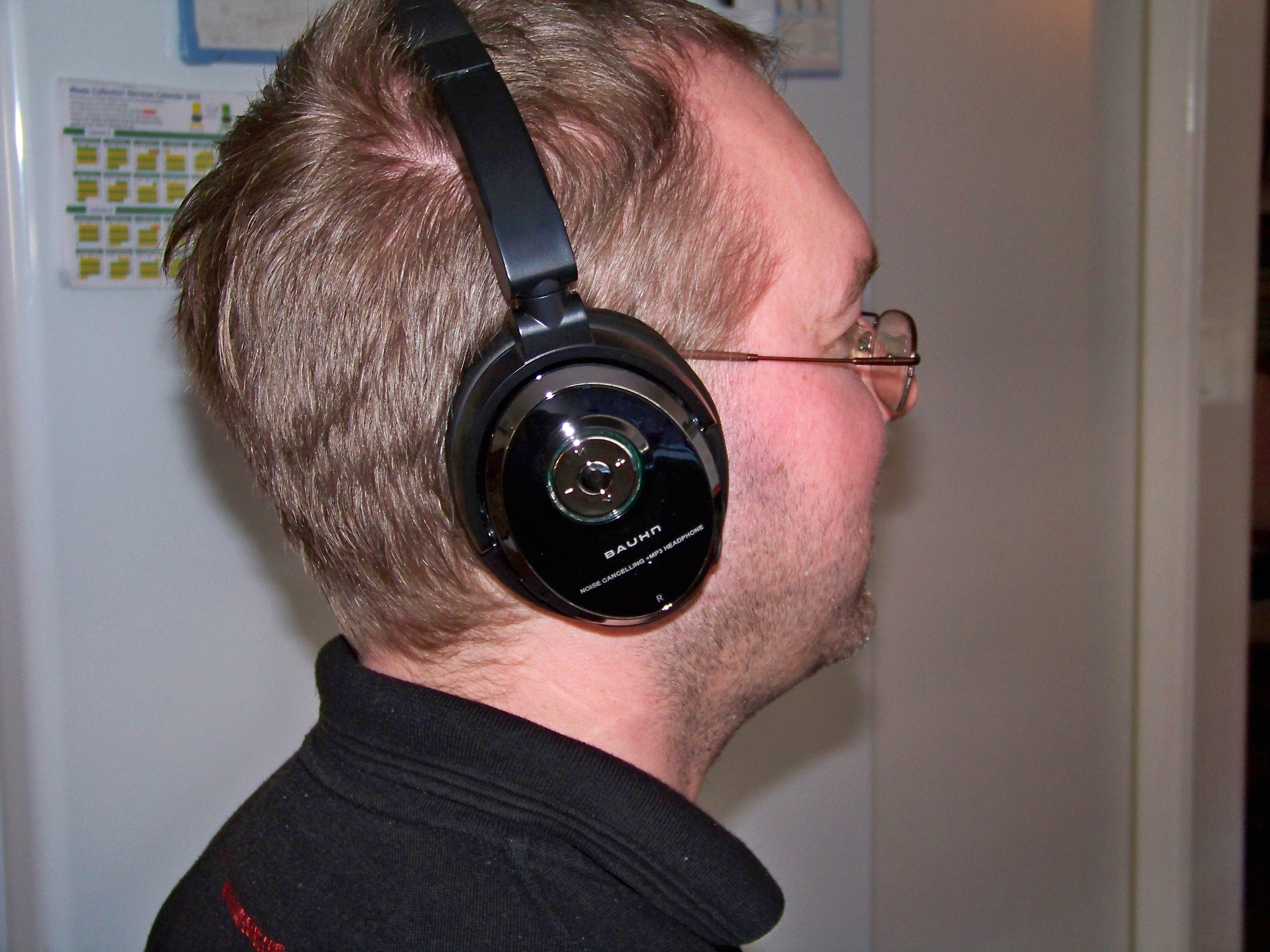
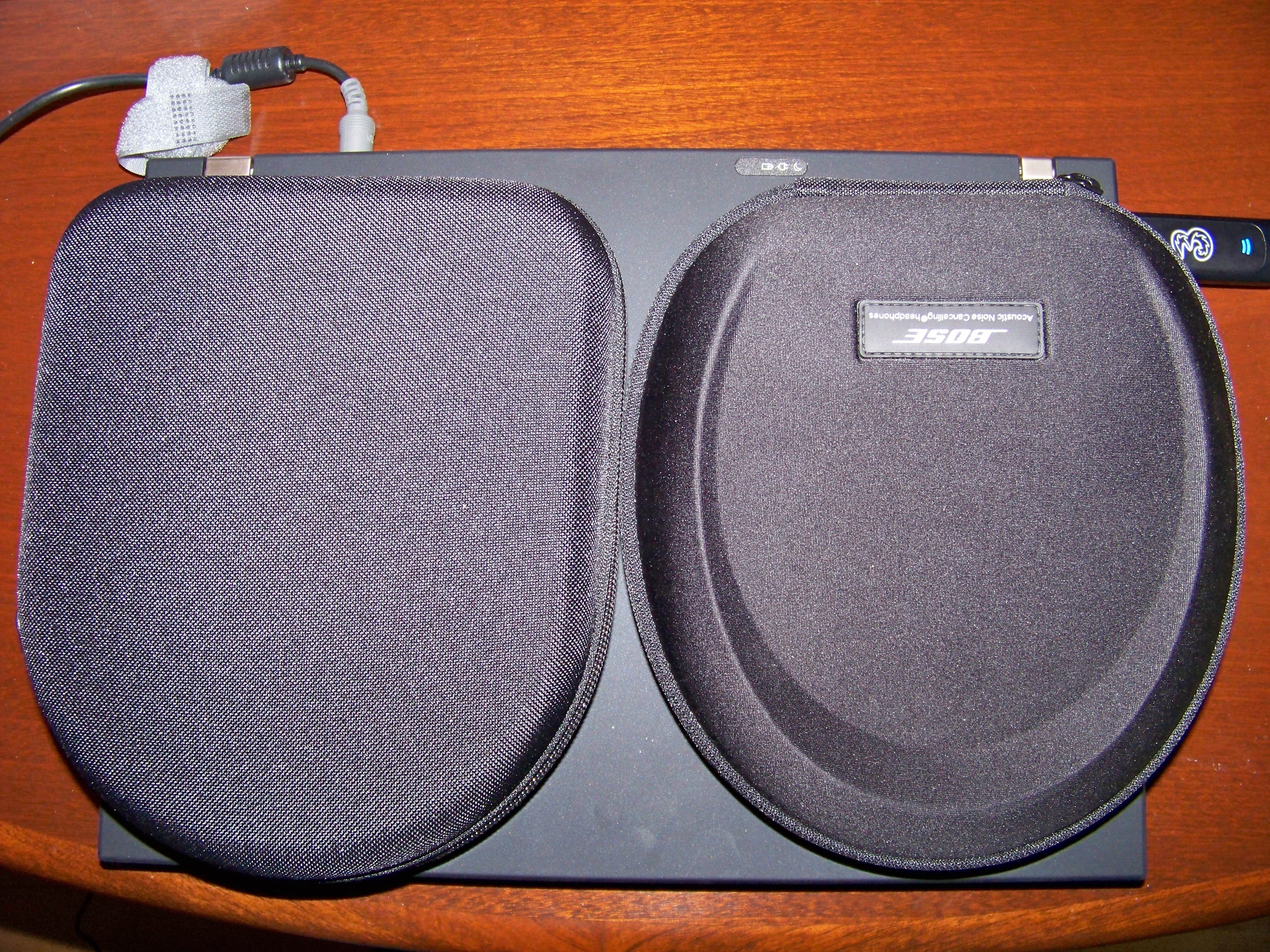
Me wearing Bauhn HeadphonesInside the case of Bauhn Noise Canceling Headphones showing the cable and connectorsOutside of the cases of Bauhn and Bose Headphones Overview The German supermarket chain Aldi has been running in Australia for 8 years now [1]. Their standard practice for a long time has been to offer regular special deals on a few items of consumer electronics every week, my chocolate fridge is one thing I bought from Aldi [2]. Today Aldi have started selling Noise Canceling Headphones [3]. These headphones are badged by Bauhn but that name is apparently applied to random products from cheap manufacturers, it may be an Aldi name that is applied to stuff that they sell. The headphones cost $69AU which is really cheap. But the deal will probably end in less than a week when stock runs out. Noise canceling headphones can be used in server rooms and other noisy environments. Every company that has a server room should buy a few sets. One of the features of noise-canceling is that it works best on low frequencies and on regular sounds it specifically doesn t block human voice well. In some noisy environments it will be easier to hear people talk if you wear such headphones! Noise canceling headphones are also very useful to people who are on the autism spectrum and other people who get more annoyed by noise pollution than average people. I have been wearing my Bose headphones on public transport and when walking around in the city, this not only stops traffic noise but it also helps to avoid people thinking that I want to talk to them. Features The first picture shows me wearing the Bauhn NC headphones, it s from the right to show the controls for the built-in MP3 player. I have not yet tested the MP3 functionality. It appears that as the controls are one power button, buttons for next/previous track, and for controlling the volume. This is fairly poor for MP3 functionality, ideally you would want to have a display to see a list of tracks, maybe have directories to store files, etc. I guess this could be a convenient feature on occasion, but you wouldn t buy the headphones for the MP3 functionality.
The next two pictures show a comparison of the Bauhn headset with the Bose QC-15 headset that I bought last year [4]. The cases of the Bauhn and Bose devices are almost exactly the same size and of a very similar shape, the Bose case is tapered and indented and also has a finer weave on the cloth covering it looks much nicer. Both devices come with an adapter for an airline socket and with a detachable cable. They also both have pouches attached to the inside of the case with velcro. But the Bauhn headphones come with an adapter for the 6.5mm TRS connector which could be convenient if you want to plug them in to a larger amplifier, the basic connector is 3.5mm in both cases. The Bauhn device uses a standard TRS connector at the headphone end while the Bose QC-15 use a special connector that matches the shape of the headset and which has a TRRS plug (to cater for the high/low volume switch), so it seems that a damaged Bauhn cable could be replaced cheaply while a replacement Bose cable would have to be purchased from Bose (presumably at great expense and delay). The Bauhn case also has a velcro attached pocket for storing business cards (or maybe a name tag or something). The supplied cable for the Bauhn is described as being 5 feet long which isn t quite long enough to reach a tower PC that is sitting on the floor. The Bose has a cable that is about a foot longer (maybe 6 feet total), but due to the non-standard connector you can t replace it. I presume that I could easily buy a 4 meter cable for the Bauhn headphones, but I could of course buy an extension cable to use with the Bose. Bose advertise the QC-15 headphones as having 35 hours of battery life from a single AAA battery. Aldi advertise the Bauhn headset as having 5 hours of battery life when NC is turned on and they use two AAA batteries. It s widely regarded that rechargeable batteries don t last as long as the batteries used for estimating the battery life (which presumably are the most expensive long-life batteries available). I ve found a single rechargeable AAA battery to last well over 5 hours in my Bose headphones, so it seems that battery life is considerably worse for the Bauhn device. One feature of the Bauhn device is that it can be used without any batteries for playing external music. The Bose headphones can t be used at all without a battery. So while the Bauhn will use the batteries faster it will at least be usable when the batteries run out. But if you are buying headphones for the purpose of avoiding noise then the Bose headphones are simply better. Comfort The Bose headphones have significantly deeper ear wells than the Bauhn about 23mm vs 18mm. If your ears stick out more than 18mm (as mine apparently do) then this is a good reason for choosing Bose. The Bose headphones are a tighter fit, the spring that pushes the ear-pieces together is stronger. But they have better padding so this doesn t cause me any discomfort. Also the Bose headphones have better passive noise reduction due to having a more snug fit around the ears. I ve worn my Bose headphones on a flight from the US to Australia with hardly a break and they were quite comfortable I would never want to do that with the Bauhn headphones. Noise Reduction I tested the Bose and Bauhn products against three noise scenarios, external music, an air-conditioner, and a car engine. The Bose headphones made good reductions of the noise from the external music (Numb by Linkin Park) and the air-conditioner. The Bauhn headphones did little to stop Linkin Park and was not very effective against the air-conditioner noise. I think that this is largely due to the lack of passive noise reduction, the air-conditioner in question makes little vibration noise and the sound of rushing air is generally immune to active noise cancellation. Both headphones were very effective when in a car with the engine idling. The engine noise of vehicles seems to fall in an ideal frequency range for active cancellation. Music Quality When listening to Youtube music played on my Thinkpad I could not notice any quality difference between the two sets of headphones. I did notice that the Bose headphones seemed to have a greater response in the higher frequency range, but that doesn t necessarily mean that one set is better than the other. Maybe if I was listening to FLAC0 encoded music that I had personally ripped from a CD then I would notice a difference. But for most people the Bauhn music quality should be good enough. Design Quality The Bose product is solidly designed, while the Bauhn product appears cheap in every way. Opening the battery compartment on the Bauhn headphones is difficult and if you do it wrong you could easily break the lid off, I expect that every set of Bauhn headphones that is used by children will be broken in a small amount of time but it should still be fully functional with a broken lid. The matt finish of the Bose headphones should hide minor scratches much better than the shiny Bauhn headphones. The Bauhn headphones also have lower quality plastic parts, it appears that the molds used were designed cheaply and without adequate care to prevent marking the final product. The design flaws that affect usage of the Bauhn product are the shallow ear wells, the poor fit of the cushions around the ears (which is probably mostly due to a weak spring pressing the ear cups to the wearer s head), and the battery compartment lid which is difficult to open and appears prone to breakage. The other flaws are all cosmetic. I wonder whether the Bauhn product was made by one of the big name manufacturers who deliberately reduced the quality to avoid competing with their more expensive products. It seems that the major flaws could have been corrected at design time with almost no increase in manufacturing costs. Recommendations If you can afford the Bose QuietComfort 15 Acoustic Noise Cancelling Headphones then they are really worth the extra expense, I have no regrets at all about spending about $320US (including tax) on my Bose QC-15. The Bauhn product is good for when you want something cheap, for example a set to be used in a server room, or for the use of children. I bought a Bauhn headset for a friend who is a pilot, he spent $1,100 on a noise-canceling headset for his plane but had never got around to buying one for recreational use I expect that he will allow his children to use his new Bauhn headphones, if they get broken it s only a $69 expense. The second cheapest NC headphones I ve seen on offer in Australia is Harvey Norman selling Phillips HN-110 Noise Canceling Headphones for $100AU [5]. Amazon sells Philips HN 110 Folding Noise-Canceling Headphones for $50US but doesn t seem to ship them outside the US (at least not to Australia). JB Hifi also has some NC headphones on sale in Australia [6], but they are more expensive at $219 for AKG and $319 for Sennheiser. Also the models they sell are on-ear which means that they will inherently have very little passive noise reduction and will also annoy anyone who doesn t like having their ears squashed. If I was buying NC headphones for my own use and didn t want to spend $300US then I would either buy the Philips HN 110 Folding Noise-Canceling Headphones from Amazon and get a friend in the US to post them to me or I would buy them from Harvey Norman. But the Bauhn product is good if you want cheap headphones to stop engine noise and give reasonable quality when playing music.

23 March 2010

Mike Hommey: Security update for Iceweasel 3.6 preview

While the package is not ready yet for experimental, mostly because there are pending changes in the 3.5 branch, Mozilla released a security update today. So, here are the packages you need to be safe security-wise with Iceweasel 3.6. Please note only xulrunner packages have been updated, as the security fix lies in the xulrunner code. A known regression of this version is that the icons in the search box on the top right don t show up.
Update: This regression actually doesn t exist.

Russ Allbery: Lintian 2.3.4

It's been nearly two months since the previous release, so lots had accumulated in the bug tracker. This release resolves a bunch of various false positives, fixes a few minor issues with the lintian.debian.org pages, and applies all the patches that were in the BTS that were ready to go in. It doesn't have any of the pending larger changes, since we wanted to get the smaller fixes out quickly. The current tentative plan is that the next release will be 2.4.0 and will include several large structural changes that various people have been working on, including the conversion of the manual to DocBook. All plans are, of course, pending finding enough time. It's amazing how effective Lintian can be given that it uses a bunch of guesswork and loose regexes to parse everything from init scripts to debian/rules files. We do have a bunch of accumulated wishlist bugs that aren't going to be fixed without writing better and more thorough parsing, particularly for shell scripts, but it boggles me just how far you can get with some dead-simple heuristics. Thanks very much to Adam D. Barratt and Raphael Geissert who have kept things going while I've been eaten by work, and particularly to Raphael for doing the last two releases and a ton of work with the security update.

22 March 2010

Russell Coker: Links March 2010

Blaise Aguera y Arcas gave an exciting demonstration of new augmented reality mapping software from Microsoft that combines video (including live video) with static mapping data and pictures [1]. This is a significant advance over current mapping systems such as Google Earth but it s not released yet either. It will be interesting to see whether Google or Microsoft gets this released first. The New York Review of Books has an insightful atricle by Garry Kasparov about human/computer chess [2]. It s surprising the degree to which a combination of human and computer chess playing can give a good result. Amateur human chess players plus regular PCs can beat grandmasters with computers or high-end computers with human help. It s apparently the quality of human-computer interaction that determines the quality of play. But the article contains a lot more, I recommend reading it. Daniel Kahneman gave an interesting TED talk about the difference between experiential and memory happyness [3]. As the concept of the moment is so short (about 3 seconds) apparently most people try to optimise their actions for the best memories of being happy. But to do so requires some different strategies. For example a two week vacation gives a memory that s not much different from a one week vacation. Therefore it seems that you would be better off staying in a five star hotel for a week than a four star hotel for two weeks, and eat dinner at a Michelin Star restaurant at least once per holiday even if it means eating at McDonalds on other occasions due to lack of funds. Temple Grandin gave an interesting TED talk The World Needs all Kinds of Minds [4] which mostly focussed on teaching children who are on the Autism spectrum. She is concerned that autistic children won t end up where they belong in Silicon Valley . Anupam Mishra gave an interesting TED talk about how the people of India s Golden desert built structures to harvest and store water [5]. Some of their ideas should be copied in Australia, due to mismanagement and stupidity Australians are failing to survive in much more hospitable places. Michael Tieman wrote an insightful and well researched article about the OSI s rejection of the IIPA s attacks on Open Source [6]. This is worth reading by anyone who wants to make a business or social case for free software. Mark Shuttleworth wrote an interesting post about the new visual style for Ubuntu and Canonical [7]. Apparently this includes the creation of a new font set which will be available for free use. Divorced Before Puberty an informative New York Times article by Nicholas Kristof about the links between treatment of women and terrorism [8]. The New York Times has an interesting article on Human Flesh Searches on the Internet in China [9]. It s basically crowds targetting people to find private information and harass them (similar to what some griefers are known for doing on the English-language part of the Internet). But they seem more interested in vigilante justice than lulz. The New York Times has an informative article about the Cult of Scientology (Co$) [10]. Among other interesting news it suggests that the number of cult victims in the US has dropped from 55,000 to 25,000 in the 2001-2008 time period. Senator Xenophon has called for an inquiry into the crimes committed by the cult and a review of it s tax-exempt status [11]. As always Xenu.net is the authoritative source for information on the Cult of Scientology AKA the Church of Scientology. The New York Times has an interesting article about formally studying the skills related to school teaching [12]. It largely focuses on Doug Lemov s Taxonomy of Effective Teaching describes 49 techniques that improve school results and some other related research. The article also mentions that increasing teacher salaries is not going to help much due to the large number of teachers, it s only professions that employ small numbers of people that can potentially have their overall skills improved by increasing salaries. Andy Wingo wrote an interesting article about Julius Caesar [13] based on the book The Assassination of Julius Caesar: A People s History of Ancient Rome by Michael Parenti. It seems that Caesar was more of a populist than a despot. Interesting article in The Register about the Large Hadron Collider (LHC) [14]. Apparently one 3.5TeV proton beam has as much energy as a British aircraft carrier running at 8 knots.

Christian Perrier: Amazing week in Khon Kaen for Thailand MiniDebconf

I'm now on my way back from The first miniDebCamp and miniDebconf that happened from March 13th to March 19th in Khon Kaen, Thailand. This even was organized locally by a team of very motivated Thai Debian enthusiasts and contributors, such as Theppitak Karoonboonyanan (*the* Thai DD), Neutron Soutmun, Kitt Tientanopajai, and all those whose name I'm not remembering as of now (I hope they won't mind). The even had kinda the structure of DebConfs, with a few days of "Debcamp" to begin. See the full schedule. We were hosted in Khon Kaen University (KKU), one one the most famous universities in Thailand, a small "town in town" in a city with a few hundred thousand inhabitants (dunno exactly). Lodging was done in a hotel located inside the university. Interestingly, the hotel was also hosting youg students participating to "Summer Camps" (apparently training systems to get good school results) gving to all this a very young atmosphere. The hacking lab and talks location was a 30-seat room in the university library, and meals were brought in there very efficiently, with the very specific way that Thai people have to transport each and every kind of meal (in small plastic bags closed by rubber). I arrived only in the 3rd day because I had commitments at home that made it impossible to me to come for the first day. During these days, people have been very busy hacking and participating to the Bug Squashing Party. During that BSP, about 50 bugs have been touched, without about 15 or so closed. Other non Thai attendees were Andrew Lee from TW, Paul Wise from AU, Daiki Ueno and Yukiharu Yabuki from JP. Organizers were expecting some attendees from neighbouring countries such as Laos, Vietnam or Cambodia. Unfortunately, none of them could come, including Anousak Soupavanh, leader of Lao free software localization efforts, who I was very impatient to meet. Transport difficulties, or visa problems, do not make things easy in that part of the world. On Wednesday we had a "DayTrip" as it is common for such event. We went abotu 50 km away from Khon Kaen, to visit a nice place, close to a dam lake, and climbed a hill surrounded by a big temple and a giant Buddha statue. Then we had a wonderful lunch in a fish restaurant in the very specific Thai way to share stuff: everything is on the table and you pick your food here and there, at you rconvenience. Of course, local advice before trying apparently innocent food is always worth it because the fire might be hidden anywhere (for instance in that soja plate which I tried and that set my mouth as a burning hell for 20 minutes). The journey ended by a visit of a great temple in Khon Kaen and, very noticeably by a dinner in a very popular barbecue restaurant in "all you can eat" style for...100Bath (so, about 2.5 euros). Maybe only vegetarian people had more trouble enjoying the meal as it was mostly made of various meat (and sea food). The talk days were very intense, at least in my opinion. Probably because I ended up giving four talks, some of them completely improvised (about IP-over-DNS, which I was using at the hotel and about which many wanted to learn a little bit more, and GPG keysigning processes). It turned out that the GPG talk was well received and, discussing with Paul later on, we agreed that such a talk, mostly meant to explain the DOs and DON'Ts For good GPG keys signing, could be a good idea even for Debconfs. There were also a few talks about local initiatives and efforts to develop (and not only promote) free software. We have no recordings of these talks as we were infortunately missing some video recording installation (maybe next time, Thep) just like the miniConf that was happening in Panama at about the same time was having. Due to local regulation on the university network, we had some limitations with Internet access (some firewalling that for instance was preventing SIP to work properly, which made a video-conference with a japanese user group fail, unfurtunately). The event ended in a round table discussion about ideas to organize something bigger in the future. The local community in Thailand has apparently the energy, maybe ressources and local support to be able to organize a slightly bigger event as first try (somethign like an Asian DebConf or something similar, targeting mostly Asian contributors and about 50-100 people. Thailand seems to be a good target to host such event, with many things being relatively inexpensive (and not only beer!). And they even think about possibly hosting a Debconf at some time in the future (actually, Martin Krafft should also be credited for bringing this idea). That isn't as crazy as it seems and, provided that potential organizers start involving themselves in the current Debconfs, everything seems to be possible. After all, if we look back to 2005, only one person (hello, Safir) was seriously thinking that Debconf could really happen in Bosnia and Herzegovina, right? After this week (followed by 2.5 days of sightseeing in Bangkok for me, plus a small meeting today with local Thai Linux corporate users and IT company owners), I feel like the mood in Asia about Debian development is high and full of potential. The miniconf last year in Taiwan was already a good success, by establishing a good connection between people.....we need to keep that alive and, hopefully, there will be other miniconfs in this part of the world. And, well, if I can be there, I'll be there.

21 March 2010

Robert Collins: LibrePlanet 2010 day 3

Free network services A discussion session led by Bradley Kuhn, Mako & Matt Lee : Libre.fm encouraged last.fm to write an API so they didn t need to screen scrape; outcome of the network services story still unknown netbooks without local productivity apps might now work, most users of network office apps are using them because of collaboration. We have a replacement for twitter status.net, distributed system, but nothing like facebook [yet?]. Bradley says like the original GNU problem, just start writing secure peer to peer network services to offer the things that are currently proprietary. There is perhaps a lack of an architectural vision for replacing these proprietary things: folk are asking how we will replace the cloud aspects of facebook etc tagging photos and other stuff around the web, while not using hosted-by-other-people-services. I stopped at this point to switch sessions the rooms were not in sync session time wise. Mentoring in free software Leslie Hawthorne: Projector not working, so Leslie carried on a discussion carried on from the previous talk about the use of sexual themes in promoting projects/talk content and the like. This is almost certainly best covered by watching the video. A few themes from it though: We then got Leslies actual talk. Sadly I missed the start of it I was outside organising security guards because we had (and boy it was ironic) a very loud, confrontational guy at the front who was replying to every statement and the tone in the room had gotten to the point that a fight was brewing. From where I got back: Chris Ball, Hanna Wallach, Erinn Clark and Denise Paolucci Recruiting/retaining women in free software projects. Not a unique problem to women things that make it better for women can also increase the recruitment and retention of men. Make a lack of diversity a bug; provide onramps small easy bugs in the bug tracker (tagged as such), have a dedicated womens sub project and permit [well behaved :) ] men in there helps build connections into the rest of the project. Make it clear that mistakes are ok. On retention recognise first patches, first commits in newsletters and the like. Call out big things or long wanted features by the person that helped. Regular discussion of patches and fixes rather than just the changelog. CMU did a study on undergrad women participation in CS : Lack of confidence preceeds lack of interest/partipation . Engagement with what they are doing is a key thing too. Women are consistently undervaluing their worth to the free software community . Its the personal touch that seems to make a huge difference . More projects should do a code of conduct kudos to Ubuntu for doing it Chris Ball. I found the mentoring and women-in-free-software talks to have extremely similar themes which is perhaps confirmation or something but it wasn t surprising to me. They were both really good talks though! And thats my coverage of LibrePlanet I m catching a plane after lunch :( . Its a good low-key conference, and well put together.

C.J. Adams-Collier: More DLR work

Ivan put up a hudson server on our winders box. Ankit helped me figure out the IronRuby xbuild build problems. I should probably try it on IronPython, too. I sent the ironruby-core list a patch to fix some case sensitivity issues. Some time in the near future, I m going to get together a bug report for the compiler and send it off to Marek. But I m tired and Scarlet s got a friend doing the sleep-over thing tonight. So. Later ;) P.S., can you believe that nobody registered a11y.com before now? Crazy talk. P.P.S., does anyone out there in gnome land have a ruby app they want to test for compatibility with IronRuby?

20 March 2010

Maximilian Attems: New klibc release 1.5.17

Not only fixes ipconfig regressions due to fixes in 1.5.16, but ipconfig should no longer discard useful packages. We also fixed a long standing klibc sparc specific socket bug (#444087): sparc lists socket system calls, but does not provide all of them natively. So one is better off on sparc to use sys_socketcall. Thanks to Jan Hauke Rahm the packaging switched to modern Source Format 3.0 (quilt) with debhelper 7 usage reducing cdbs overhead on build. This is a big switch and makes me very happy. New addition include a $(make help) target in Makefile to ease klibc build. A small losetup got added to klibc-utils. i386 and sparc build fine against current linux-libc-dev: klibc-1.5.17 released
P.S.: New outfall seem to include armel and s390 due to libgcc changes.
Update: Seems only a small packaging error due to test target invocation, should be fixed in 1.5.17-3.

19 March 2010

MJ Ray: Co-ops at the North Somerset Initiative

On Wednesday, I went to a meeting of the Business Initiative for North Somerset for Cooperatives-SW (our regional cooperative cooperative). It was the first time anyone from the cooperative and mutual sector was present.
platform
Conference Bank of England The first speaker was Geoff Harding from the Bank of England, who talked through topics in their agents summary and related news. One interesting graph showed a steep rise in the percentage of household income being saved. Answers to questions suggested that more of that goes to mutuals and building societies, but they find it difficult to be competitive while the banks are keen to increase their balances. There was mention of employment hoarding businesses short-time working, redeploying or shutting down temporarily to keep trained workers under contract, rather than make them redundant and rehire later. People from both the Federation of Small Businesses and the Hoteliers Association made strong comments about the banks claiming to government that they are willing to lend, but still offering deeply unattractive depth-of-recession rates and terms. If the regional agents get details of such cases, they pass them to the central bank. South West Regional Development Agency The second main speaker was Ann O Driscoll, who covers business development for the West of England (what many people call CUBA Councils that Used to Be Avon). She introduced their four strategic priorities:-

  1. Low Carbon Economy apparenly our region has good wind, wave and solar experience. However, Vestas were mentioned and I know that when Vestas closed the UK s only wind turbine blade factories in August 2009, the RDAs were criticised for not acting against the subsidy-chasing, socially irresponsible conduct of Vestas and related companies continue to worry workers. If Vestas is one of the praised companies, I wonder whether we re attracting sustainable work to the region. On a related note, North Somerset Council and NS Enterprise Agency are organising a Climate Change forum on 1st April, but it s at Cadbury House Hotel, which is awkward to get to except by car: no footpath to the door, a mile-and-a-half walk along a busy road from a train station, bad roads for biking, wheelbending speedhumps on the drive, I can t remember if there is bicycle parking and its website doesn t say
  2. Successful Businesses SWRDA funds our rather poor Business Link service. Does someone in the South West have some good news about Business Link? If so, please leave a comment on this article.
  3. Prosperous Places intervention in areas like south Bristol or central Weston.
  4. United Approach co-ordinating with other regional groups.
The main activities introduced were: The questions were fascinating, except for mine. The best one was probably about the forthcoming election and the Conservatives pledge to shut down the RDAs and Business Links. The answer was that much of the work will still need to be done somehow, so it s more a question of who will do it, rather than what the name on the door says. So I don t think axing RDAs is going to achieve more than shuffling people between organisations. When allowed to ask a question, I got too excited and ranted a bit about how the Co-operative Group s co-operative enterprise hub is doing work that Business Link should have been funding, but the RDA doesn t understand social enterprise and treats it as a ghetto service. I ll try to take that up in a more coherent form later. Overview I think Cooperatives-SW were invited to the North Somerset Initiative largely because of pressure from software.coop for co-ops to be represented better in the Local Strategic Partnership, which has treated us badly. NSI holds one of the three business places on the partnership board, with the other two being held by NSEA and Bristol International Airport. I think it s a bit off that a private company and an enterprise agency are both represented by other groups and also have their own board seats while co-ops don t even have a collective seat, so that pressure for a representative organisation for co-operatives and mutuals to have a board place (in line with national government guidance) should continue, useful though the NSI meetings seem to be. The other thing which would really help is some funding for co-operative business development specialists to work in North Somerset at strategic tasks like this, instead of it being left to ordinary workers from other sectors. I don t know where that funding will come from and until then, I ll continue to try my best. We need to make sure that local strategy at least does no harm to the sector.

Dirk Eddelbuettel: R Project selected for the Google Summer of Code 2010

Earlier today, Google announced the list of accepted mentor organizations for the Google Summer of Code 2010 (GSoC 2010). And we are happy to report that the R Project is once again a participating organization (and now for the third straight year) joining a rather august group of open source projects from around the globe. An R Wiki page had been created and serves as the central point of reference for the R Project and the GSoC 2010. It contains a list of project ideas, currently counting eleven and spanning everything from research-oriented topics (such as spatial statistics or automatic differentiation) to R community-support (regarding CRAN statistics and the CRANtastic site) to extensions (NoSQL, RPy2 data interfaces, Rserve browser integration) and more. I also just created a mailing list gsoc-r@googlegroups.com where prospective students and mentors can exchange ideas and discuss. As for other details, the Google Summer of Code 2010 site has most of the answers, and we will try to keep R-related information on the aforementioned R Wiki page.

18 March 2010

Clint Adams: BSPs and Triage and squeeze

Some people want Debian 6.0 (codename "squeeze") to be released sometime this year. Personally I think there is some kitsch value in releasing it during DebCamp or DebConf, and there is something to be said for doing it just beforehand so that everyone can break unstable into insanity while rolling around on the quad under the hot August sun. Some people want it to happen sooner, possibly as soon as possible. Irrespective of your preferences, or if you care at all, we will repeat the time-honored mantra: it will be released when it's ready. Readiness is somewhat of a subjective measure, but we typically do not consider a potential release ready when the RC bug count is high. There are a lot of RC bugs right now. Typically these are fixed at some point by their maintainers. There are also some self-motivated individuals who enjoy fixing these bugs themselves, and this practice predates the RCBW initiative, though perhaps not to the same level of combined intensity and endurance. Then there are bug-squashing parties, or BSPs. A BSP can be held virtually which means that a bunch of people get together online and say that they are having a party, or it can be at a designated physical space. I attended one of the latter type not too long ago. This BSP was targeted specifically to newbies or people who might feel that they are unqualified to help squash bugs, but wished to learn how to contribute. Some group and one-on-one mentoring occurred, in areas of how packages are put together, how to patch things, how to submit patches to the BTS, how to reproduce bugs, and other more problem-specific topics. I really don't know how successful this endeavor was since getting metrics on the effectiveness of teaching has been a historically difficult problem. On the other hand, we did spend a fair amount of time actually squashing bugs, which is a bit easier to assess. One problem we had was that some people liked to be loud and distracting and demand unreasonable amounts of attention for topics that had nothing to do with bugs, Debian, or free software, but we made progress regardless. Marc Brockschmidt thinks we need more BSPs and more focus on bug triage. Bug triage can be very demotivating and many people dislike doing it. BSPs seem to have powers of motivation through group camaraderie or friendly competition, so I would agree that it's worth experimenting with.

17 March 2010

Chris Lamb: Per-channel BTS bot filtering

Just a short announcement that my Debian BTS IRC bot which hangs out on #debian-devel-changes can now spam your favourite subproject's channel with specific bug activity and uploads. Filtering is done with a regular expression tested against the package name. /msg me with your (channel, regex) tuples (in Python re format, please).

Gunnar Wolf: Getting away from Panam

Several months ago, around the Central American Free Software Encounter (ECSL) in Estel , Nicaragua, I started stirring the waters The Central American regions have vibrant, beautiful Free Software communities, but have mostly (with some very notable examples, of course) shied away from being active participants in major development projects. What was I to do about it? Of course, try to get them to become Debian contributors! During the following weeks, I talked about it with several friends from the region, and the result was an announcement and lots of arguments that followed it. Panam was decided as the host country, and many people have put a lot of work into making the MiniDebConf happen. Mauro Rosero and Anto Recio came up with what appears to be a wonderful local venue and a set of sponsored amenities, and the Debian project is sponsoring what is needed in terms of transportation for people from the whole region (spanning from Mexico to Ecuador and Venezuela IIRC). I am very sorry, however, that I cannot attend this meeting. This very same weekend, I will fly three hours, but in the opposite direction: I will go to Tijuana, where fate decided I will present my first round of CENEVAL equivalence exams (Acuerdo 286 Licenciatura). I expect that to be the topic of another post, to come soon. So, while my friends will be having a good time and talking about Debian and group work, I will sit through three periods of four hours, answering an exam for the first time in a very long time. Fun, hah? Anyway, I will meet Guillermo Amaral (thanks for hosting me! ;-) ), which ensures I will not miss all of the fun ;-)

Martin Michlmayr: Using the installer to flash the kernel again

Every once in a while someone asks how they can use the Debian installer to access their system on disk to run commands, for example to write the kernel and ramdisk to flash again. This is particularly useful on headless NAS devices. So here's how to do it:
  1. Start the Debian installer.
  2. Remove the SSH key from ~/.known_hosts because the installer will always generate a new key.
  3. Connect to the installer with SSH: ssh installer@...
  4. Follow the installer until you reach the partitioner, then choose "go back".
  5. Open a shell (look for Execute a shell towards the end of the menu).
  6. Run the commands below (the example assumes that /boot is /dev/sda1 and / is /dev/sda2.
mkdir -p /target
mount /dev/sda2 /target
mount /dev/sda1 /target/boot
mount --bind /dev /target/dev
mount -t proc none /target/proc
mount -t sysfs none /target/sys
chroot /target /bin/sh
# the prompt will change
# make modifications to the system and regenerate the initramfs
update-initramfs -u
exit
# the prompt will change again as you're leaving the chroot
umount /target/sys
umount /target/proc
umount /target/dev
umount /target/boot
umount /target
reboot

David Pashley: Letter to my MP regarding the Digital Economy Bill

I have just sent the following email to my MP, David Lepper MP, outlining my concerns about the Digital Economy Bill. I urge you to write to your MP with a similar letter. Open Rights Group's guide to writing to your MP

From: David Pashley <david@davidpashley.com>
To: David Lepper
Cc: 
Bcc: 
Subject: Digital Economy Bill
Reply-To: 
Dear Mr Lepper, 
I'm writing to you so express my concern at the Digital Economy Bill
which is currently working its way through the House of Commons. I
believe that the bill as it stands will have a negative effect on
the digital economy that the UK and in particular Brighton have
worked so hard to foster. 
Section 4-17 deals with disconnecting people reported as infringing
copyright. As it stands, this section will result in the possibility
that my internet connection could be disconnected as a result of the
actions of my flatmate. My freelance web development business is
inherently linked to my access of the Internet. I currently allow my
landlady to share my internet access with her holiday flat above me.
I will have to stop this arrangement for fear of a tourist's actions
jeopardising my business. 
This section will also result in the many pubs and cafes, much
favoured by Brighton's freelancers, from removing their free wifi. I
have often used my local pub's wifi when I needed a change of
scenery. I know a great many freelancers use Cafe Delice in the
North Laine as a place to meet other freelancers and discuss
projects while drinking coffee and working.
Section 18 deals with ISPs being required to prevent access to sites
hosting copyrighted material. The ISPs can insist on a court
injunction forcing them to prevent access. Unfortunately, a great
many ISPs will not want to deal with the costs of any court
proceedings and will just block the site in question. A similar law
in the Unitied States, the Digital Millenium Copyright Act (DMCA)
has been abused time and time again by spurious copyright claims to
silence critics or embarrassments.  A recent case is Microsoft
shutting down the entire Cryptome.org website because they were
embarrassed by a document they had hosted.  There are many more
examples of abuse at http://www.chillingeffects.org/
A concern is that there's no requirement for the accuser to prove
infringement has occured, nor is there a valid defense that a user
has done everything possible to prevent infringement. 
There are several ways to reduce copyright infringement of music and
movies without introducing new legislation. The promotion of legal
services like iTunes and spotify, easier access to legal media, like
Digital Rights Management free music. Many of the record labels and
movie studios are failing to promote competing legal services which
many people would use if they were aware of them. A fairer
alternative to disconnection is a fine through the courts. 
You can find further information on the effects of the Digital
Economy Bill at http://www.openrightsgroup.org/ and
http://news.bbc.co.uk/1/hi/technology/8544935.stm
The bill has currently passed the House of Lords and its first
reading in the Commons. There is a danger that without MPs demanding
to scrutinise this bill, this damaging piece of legislation will be
rushed through Parliament before the general election.
I ask you to demand your right to debate this bill and to amend the
bill to remove sections 4-18. I would also appreciate a response to
this email. If you would like to discuss the issues I've raised
further, I can be contacted on 01273 xxxxxx or 07966 xxx xxx or via
email at this address.
Thank you for your time.
-- 
David Pashley
david@davidpashley.com
Read Comments (0)

16 March 2010

Ben Hutchings: KVM reliability

Russell Coker writes:
I had also hoped that it would be really reliable and work with the latest kernels (unlike Xen) but it is giving me problems with 2.6.32 on Opteron.
This is a regression caused by a recent security fix (CVE-2010-0298, "KVM: x86 emulator: fix memory access during x86 emulation"). It appears to affect only recent Linux kernels running as guests on AMD systems, and it will probably be fixed soon.

Bdale Garbee: TeleMetrum v1.0 Order Placed

I've been too busy (work, family, and fighting a nasty cold!) to write much text lately, other than the comments I put on launch photos uploaded to my Flickr stream, but the remainder of our testing of the prototype TeleMetrum v0.2 boards went really well! The only significant change we decided to make before going to production was to change the 3.3 volt regulator from a 100mA to a 150mA part. This will ensure adequate power for the companion boards we have planned, even when the GPS chip is in maximum power mode searching for satellites during a cold start. So... [drum roll, please] Keith and I just placed the orders for our first production lot of TeleMetrum v1.0 boards! With any luck, in 3-4 weeks we should have a pile of altimeters to sell, along with the associated TeleDongle ground stations already in stock. Stay tuned!
Russell Coker: Thinkpad T61

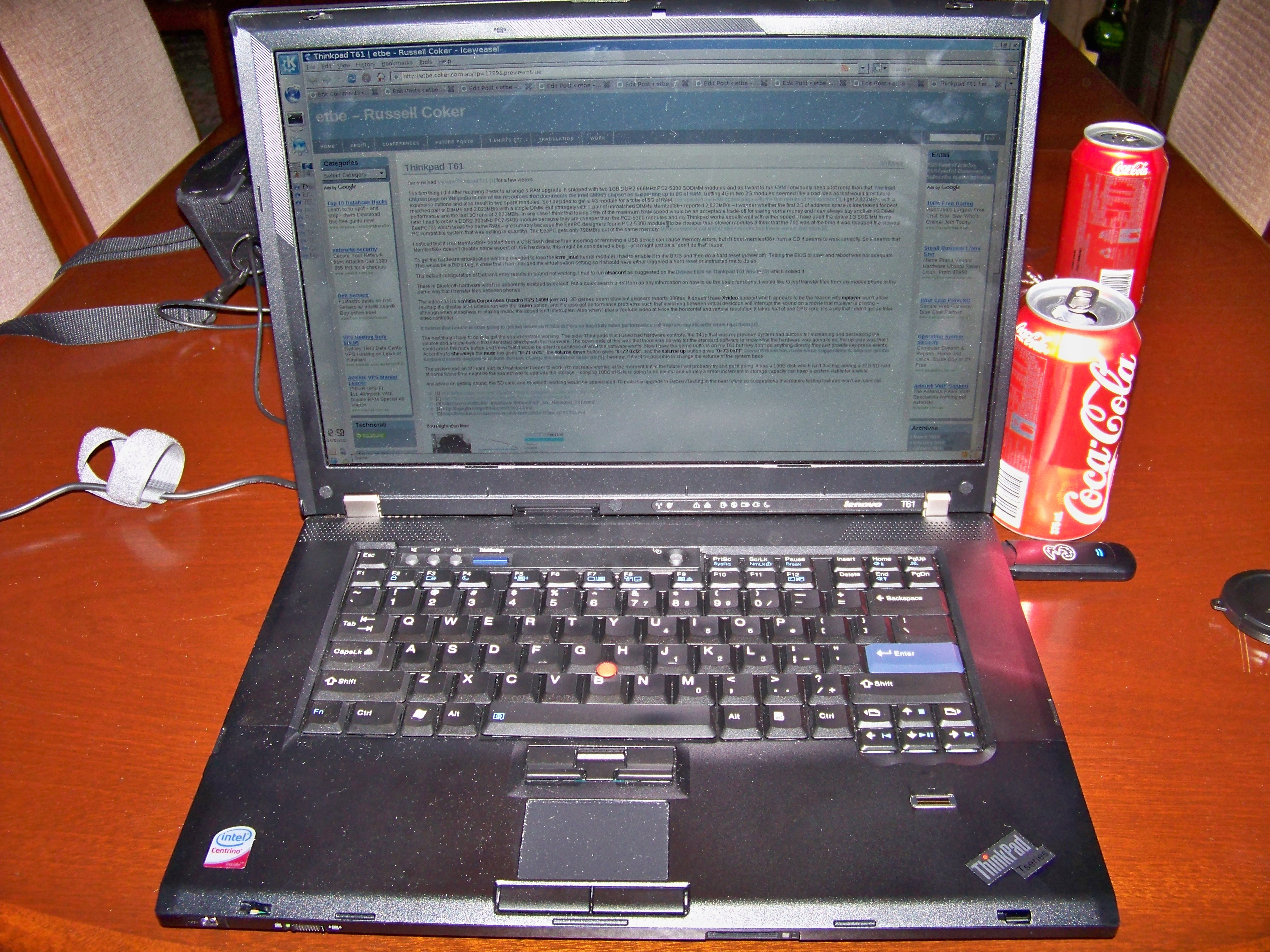
picture of my new Thinkpad T61 I ve now had my new Thinkpad T61 [1] for almost a month. The letters on the keyboard are not even starting to wear off which is unusual, either this Thinkpad is built with harder plastic than the older ones or I m typing more softly. Memory The first thing I did after receiving it was to arrange a RAM upgrade. It shipped with two 1GB DDR2 666MHz PC2-5300 SODIMM modules and as I want to run KVM I obviously need a lot more than that. The Intel Chipset page on Wikipedia is one of the resources that documents the Intel GM965 chipset as supporting up to 8G of RAM. Getting 4G in two 2G modules seemed like a bad idea as that would limit future expansion options and also result in two spare modules. So I decided to get a 4G module for a total of 5G of RAM. I ve updated my RAM speed page with the test results of this system [2], I get 2,823MB/s with a matched pair of DIMMs and 2,023MB/s with a single DIMM. But strangely with a pair of unmatched DIMMs Memtest86+ reported 2,823MB/s I wonder whether the first 2G of address space is interleaved for best performance and the last 3G runs at 2,023MB/s. In any case I think that losing 29% of the maximum RAM speed would be an acceptable trade-off for saving some money and I can always buy another 4G DIMM later. I had to order a DDR2-800MHz PC2-6400 module because they are cheaper than the PC2-5300 modules and my Thinkpad works equally well with either speed. I have used the spare 1G SODIMM in my EeePC701 which takes the same RAM presumably because the EeePC designers found PC2-5300 modules to be cheaper than slower modules (I think that the 701 was at the time it was released the slowest PC compatible system that was selling in quantity). The EeePC gets only 798MB/s out of the same memory. My document about Memtest86+ results has these results and more [2]. I noticed that if I run Memtest86+ booted from a USB flash device then inserting or removing a USB device can cause memory errors, but if I boot memtest86+ from a CD it seems to work correctly. So it seems that Memtest86+ doesn t disable some aspect of USB hardware, this might be considered a bug or it might just be a don t do that issue. Misc To get the hardware virtualisation working (needed to load the kvm_intel kernel module) I had to enable it in the BIOS and then do a hard reset (power off). Telling the BIOS to save and reboot was not adequate. This would be a BIOS bug, it knew that I had changed the virtualisation setting so it should have either triggered a hard reset or instructed me to do so. The default configuration of Debian/Lenny results in sound not working, I had to run alsaconf as suggested on the Debian Etch on Thinkpad T61 howto [3] which solved it. Generally I m happy with this system, the screen resolution is 1680*1050 which has 20% more pixels than the 1400*1050 screen on my Thinkpad T41p, it s a lot faster for CPU operations and should be a lot faster for video when I get the drivers sorted out (currently it s a lot slower), and I have virtualisation working again. But when you buy a system that s much like the last one but 6 years newer you expect it to be better. Generally the amount of effort involved in the process of buying a new system, upgrading the RAM to the desired specs, installing Linux and tweaking all the options is enough to make me want to wait at least another 6 years before buying another. Part of the reason for this difficulty is that I want to get so much functionality from the machine, a machine with more modest goals (such as a Netbook) takes a lot less time to configure. Problems There is Bluetooth hardware which is apparently enabled by default. But a quick search didn t turn up any information on how to do the basic functions, I would like to just transfer files from my mobile phone in the same way that I transfer files between phones. The video card is a nVidia Corporation Quadro NVS 140M (rev a1). 3D games seem slow but glxgears reports 300fps. It doesn t have Xvideo support which appears to be the reason why mplayer won t allow resizing it s display area unless run with the -zoom option, and it s also got performance problems such that switching between virtual desktops will interrupt the sound on a movie that mplayer is playing although when alsaplayer is playing music the sound isn t interrupted. Also when I play a Youtube video at twice the horizontal and vertical resolution it takes half of one CPU core. It s a pity that I didn t get an Intel video controller. It seems that Debian is soon going to get the Nouveau NVidia drivers so hopefully video performance will improve significantly when I get them [4]. The next thing I have to do is to get the sound controls working. The older Thinkpads that I used had hardware controls, the T41p that was my previous system had buttons for increasing and decreasing the volume and a mute button that interacted directly with the hardware. The down-side of this was that there was no way for the standard software to know what the hardware was going to do, the up-side was that I could press the mute button and know that it would be silent regardless of what the software wants. Now I have the same buttons on my T61 but they don t do anything directly, they just provide key-press events. According to showkeys the mute key gives 0 71 0xf1 , the volume down button gives 0 72 0xf2 , and the volume up button gives 0 73 0xf3 . Daniel Pittman has made some suggestions to help me get the keyboard events mapped to actions that can change the sound via software [5] which I haven t yet had time to investigate. I wonder if it will ever be possible to change the volume of the system beep. The system has an SD card slot, but that doesn t seem to work. I m not really worried at the moment but in the future I will probably try and get it going. It has a 100G disk which isn t that big, adding a 32G SD card at some future time might be the easiest way to upgrade the storage copying 100G of data is going to be painful and usually a small increment in storage capacity can keep a system viable for a while. Any advice on getting sound, the SD card, and Bluetooth working would be appreciated. I ll probably upgrade to Debian/Testing in the near future so suggestions that require testing features won t be ruled out.

Next.

Previous.