Some news about Calibre in Debian: I have been added to the list of maintainers, thanks Martin, and the recent release of Calibre 3.4 into Debian/unstable brought some fixes concerning the desktop integration. Now I am working on Calibre 3.5.
Calibre 3.5 separates out one module, html5-parser, into a separate package which needs to be included into Debian first. I have prepared and uploaded a version, but NEW processing will keep this package from entering Debian for a while. Other things I am currently doing is going over the list of bugs and try to fix or close as many as possible.
Finally the endless Rar support story still continues. I still don t have any response from the maintainer of unrar-nonfree in Debian, so I am contemplating to package my own version of libunrar. As I wrote in the previous post, Calibre now checks whether the Python module unrardll is available, and if, uses it to decode rar-packed ebooks. I have a package for unrardll ready to be uploaded, but it needs the shared library version, and thus I am stuck waiting for unrar-nonfree.
Anyway, to help all those wanting to play with the latest Calibre, my archive nowadays contains:
deb http://www.preining.info/debian/ calibre main
deb-src http://www.preining.info/debian/ calibre main
The releases are signed with my Debian key 0x6CACA448860CDC13
Enjoy
apt-get update apt-get upgrade apt-get autoremove apt-get clean dpkg --list > original.dpkg apt-get --download-only install dpkg:amd64 tar:amd64 apt:amd64 bash:amd64 dash:amd64 init:amd64 mawk:amd64 for pack32 in $(grep i386 original.dpkg egrep "^ii " awk ' print $2 ' ) ; do echo $pack32 ; apt-get --download-only install -y --allow-remove-essential $ pack32%:i386 :amd64 ; done cd /var/cache/apt/archives/ dpkg --install libacl1_*amd64.deb libattr1_*_amd64.deb libapt-pkg5.0_*amd64.deb libbz2-1.0_*amd64.deb dpkg_*amd64.deb tar_*amd64.deb apt_*amd64.deb bash_*amd64.deb dash_*amd64.deb dpkg --install --skip-same-version *.deb dpkg --configure --pending dpkg --install --skip-same-version *.deb dpkg --remove libcurl4-openssl-dev:i386 dpkg --configure --pending dpkg --remove libkdesu5 kde-runtime apt-get --fix-broken install apt-get install $(egrep "^ii" ~/original.dpkg grep -v ":i386" grep -v "all" grep -v "aiccu" grep -v "acroread" grep -v "flashplayer-mozilla" grep -v "flash-player-properties" awk ' print $2 ')Reboot. Then the system failed to boot, missing lvm2 package. Boot with a live CD.
sudo -i mount /dev/sdc2 /mnt mount /dev/vg100/usr /mnt/usr mount /dev/vg100/var /mnt/var mount -o bind /proc /mnt/proc mount -o bind /sys /mnt/sys mount -o bind /dev/ /mnt/dev mount -o bind /dev/pts /mnt/dev/pts chroot /mnt /bin/su - apt-get install lvm2 exit rebootStill somethings do not work, like command fakeroot.
for pack32 in $(grep i386 original.dpkg egrep "^ii " awk ' print $2 ' ) ; do
echo $pack32 ;
if dpkg --status $pack32 grep -q "Multi-Arch: same" ; then
apt-get -y install $ pack32%:i386 :amd64 ;
fi ;
done
for pack32 in $(grep i386 original.dpkg egrep "^ii " awk ' print $2 ' ) ; do
echo $pack32 ;
apt-get -y install $ pack32%:i386 :amd64 ;
done
Now is time to find what still does not work and how to solve it.
[...]
override_dh_auto_configure:
dh_auto_configure -B build-deb -- --with-feature1 --with-feature2
dh_auto_configure -B build-udeb -- --without-feature1 --without-feature2
[...]
What is somewhat obvious to a human is that the first configure line is related to the regular debs and the second configure line is for the udebs. However, debhelper does not know how to infer this and this is where buildlabels come in. With buildlabels, you can let debhelper know which packages and builds that belong together.
How to use buildlabels
To use buildlabels, you have to do three things:
[...]
override_dh_auto_configure:
dh_auto_configure -B build-deb -- --with-feature1 --with-feature2
dh_auto_configure --buildlabel=udeb -B build-udeb -- --without-feature1 --without-feature2
[...]
(Remember to update *all* calls to dh_auto_* helpers; the above only lists dh_auto_configure to keep the example short.) And then add X-DH-Buildlabel: udeb in the stanzas for foo-udeb + libfoo1-udeb.
With those two minor changes:
ErrorDocument 400 directive pointing to a cgid script
in worker mode).
Still, it was a serious regression and I found a part of the nasty
long patch we worked on back then that was faulty, and introduced a
small fix to correct that. The proposed package unfortunately
didn't yield any feedback, and I can only assume it will work okay for
people. The result is the DLA-841-2 upload which fixes the
regression. I unfortunately didn't have time to work on the remaining
CVEs affecting apache2 in LTS at the time of writing.
The name comes from what snakes and other animals do to "create a new snake": they shed their skin. This is not so appropriate for snakes, as it's just a way to rejuvenate their skin, but is especially relevant for anthropods since then "ecdysis" may be associated with a metamorphosis:It was an interesting exercise to go back into older projects and factor out interesting code. The process is not complete yet, as there are older projects I'm still curious in reviewing. A bunch of that code could also be factored into upstream project and maybe even the Python standard library. In short, this is stuff I keep on forgetting how to do: a properEcdysis is the moulting of the cuticle in many invertebrates of the clade Ecdysozoa. Since the cuticle of these animals typically forms a largely inelastic exoskeleton, it is shed during growth and a new, larger covering is formed. The remnants of the old, empty exoskeleton are called exuviae. WikipediaSo this project is metamorphosed into others when the documentation templates, code examples and so on are reused elsewhere. For that reason, the license is an unusally liberal (for me) MIT/Expat license. The name also has the nice property of being absolutely unpronounceable, which makes it unlikely to be copied but easy to search online.
setup.py config, some fancy argparse extensions and so on. Instead
of having to remember where I had written that clever piece of code, I
now shove it in the crazy chaotic project where I can find it again in
the future.
set builtin: for small
items, it is basically as fast as a bloom filter. Of course, when
the item size grows larger, its memory usage explodes, but in this
case it turned out to be sufficient and bloom filter completely
overkill and confusing.
Oh, and thanks to those efforts, I got admitted in the beetbox
organization on GitHub! I am not sure what I will do with that
newfound power: I was just scratching an itch, really. But hopefully
I'll be able to help here and there in the future as well.
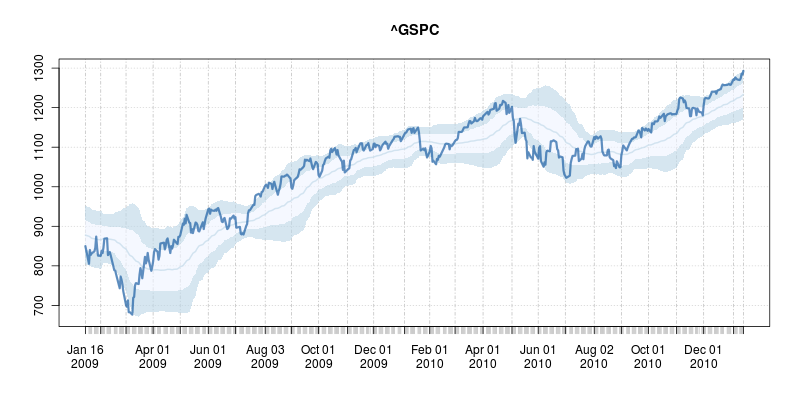
A good six years ago I blogged about plotOBOS() which charts a moving average (from one of several available variants) along with shaded standard deviation bands. That post has a bit more background on the why/how and motivation, but as a teaser here is the resulting chart of the SP500 index (with ticker ^GSCP):
The code uses a few standard finance packages for R (with most of them maintained by Joshua Ulrich given that Jeff Ryan, who co-wrote chunks of these, is effectively retired from public life). Among these, xts had a recent release reflecting changes which occurred during the four (!!) years since the previous release, and covering at least two GSoC projects. With that came subtle API changes: something we all generally try to avoid but which is at times the only way forward. In this case, the shading code I used (via polygon() from base R) no longer cooperated with the beefed-up functionality of plot.xts(). Luckily, Ross Bennett incorporated that same functionality into a new function addPolygon --- which even credits this same post of mine.
With that, the updated code becomes
## plotOBOS -- displaying overbough/oversold as eg in Bespoke's plots
##
## Copyright (C) 2010 - 2017 Dirk Eddelbuettel
##
## This is free software: you can redistribute it and/or modify it
## under the terms of the GNU General Public License as published by
## the Free Software Foundation, either version 2 of the License, or
## (at your option) any later version.
suppressMessages(library(quantmod)) # for getSymbols(), brings in xts too
suppressMessages(library(TTR)) # for various moving averages
plotOBOS <- function(symbol, n=50, type=c("sma", "ema", "zlema"),
years=1, blue=TRUE, current=TRUE, title=symbol,
ticks=TRUE, axes=TRUE)
today <- Sys.Date()
if (class(symbol) == "character")
X <- getSymbols(symbol, from=format(today-365*years-2*n), auto.assign=FALSE)
x <- X[,6] # use Adjusted
else if (inherits(symbol, "zoo"))
x <- X <- as.xts(symbol)
current <- FALSE # don't expand the supplied data
n <- min(nrow(x)/3, 50) # as we may not have 50 days
sub <- ""
if (current)
xx <- getQuote(symbol)
xt <- xts(xx$Last, order.by=as.Date(xx$ Trade Time ))
colnames(xt) <- paste(symbol, "Adjusted", sep=".")
x <- rbind(x, xt)
sub <- paste("Last price: ", xx$Last, " at ",
format(as.POSIXct(xx$ Trade Time ), "%H:%M"), sep="")
type <- match.arg(type)
xd <- switch(type, # compute xd as the central location via selected MA smoother
sma = SMA(x,n),
ema = EMA(x,n),
zlema = ZLEMA(x,n))
xv <- runSD(x, n) # compute xv as the rolling volatility
strt <- paste(format(today-365*years), "::", sep="")
x <- x[strt] # subset plotting range using xts' nice functionality
xd <- xd[strt]
xv <- xv[strt]
xyd <- xy.coords(.index(xd),xd[,1]) # xy coordinates for direct plot commands
xyv <- xy.coords(.index(xv),xv[,1])
n <- length(xyd$x)
xx <- xyd$x[c(1,1:n,n:1)] # for polygon(): from first point to last and back
if (blue)
blues5 <- c("#EFF3FF", "#BDD7E7", "#6BAED6", "#3182BD", "#08519C") # cf brewer.pal(5, "Blues")
fairlylight <<- rgb(189/255, 215/255, 231/255, alpha=0.625) # aka blues5[2]
verylight <<- rgb(239/255, 243/255, 255/255, alpha=0.625) # aka blues5[1]
dark <<- rgb(8/255, 81/255, 156/255, alpha=0.625) # aka blues5[5]
## buglet in xts 0.10-0 requires the <<- here
else
fairlylight <<- rgb(204/255, 204/255, 204/255, alpha=0.5) # two suitable grays, alpha-blending at 50%
verylight <<- rgb(242/255, 242/255, 242/255, alpha=0.5)
dark <<- 'black'
plot(x, ylim=range(range(x, xd+2*xv, xd-2*xv, na.rm=TRUE)), main=title, sub=sub,
major.ticks=ticks, minor.ticks=ticks, axes=axes) # basic xts plot setup
addPolygon(xts(cbind(xyd$y+xyv$y, xyd$y+2*xyv$y), order.by=index(x)), on=1, col=fairlylight) # upper
addPolygon(xts(cbind(xyd$y-xyv$y, xyd$y+1*xyv$y), order.by=index(x)), on=1, col=verylight) # center
addPolygon(xts(cbind(xyd$y-xyv$y, xyd$y-2*xyv$y), order.by=index(x)), on=1, col=fairlylight) # lower
lines(xd, lwd=2, col=fairlylight) # central smooted location
lines(x, lwd=3, col=dark) # actual price, thicker
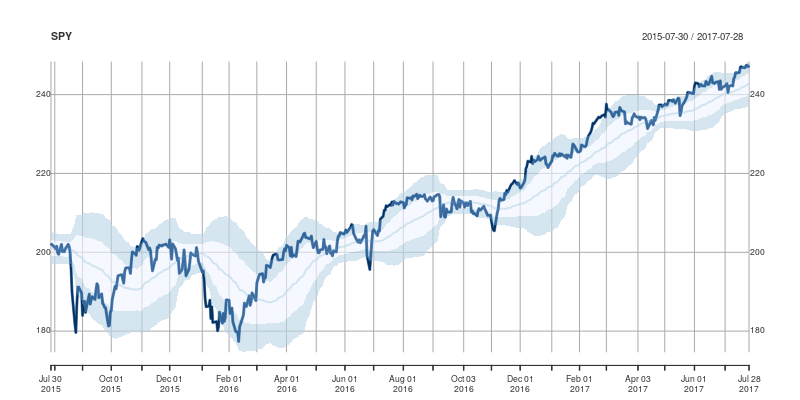
addPolygon. To illustrate, we call plotOBOS("SPY", years=2) with an updated plot of the ETF representing the SP500 over the last two years:
Comments and further enhancements welcome!
This post by Dirk Eddelbuettel originated on his Thinking inside the box blog. Please report excessive re-aggregation in third-party for-profit settings.
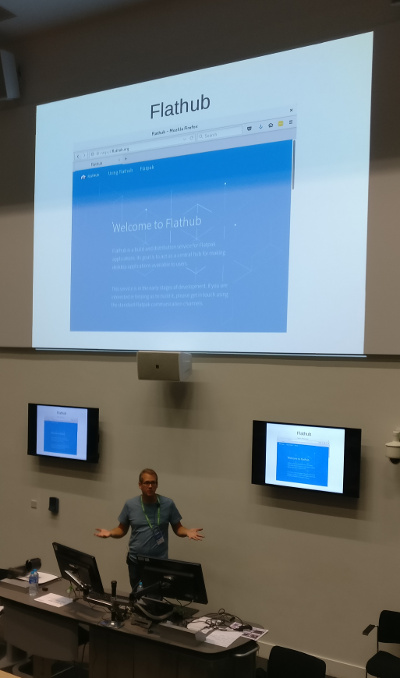
At the Gtk+ hackfest in London earlier this year, we stole an afternoon from the toolkit folks (sorry!) to talk about Flatpak, and how we could establish a critical mass behind the Flatpak format. Bringing Linux container and sandboxing technology together with ostree, we ve got a technology which solves real world distribution, technical and security problems which have arguably held back the Linux desktop space and frustrated ISVs and app developers for nearly 20 years. The problem we need to solve, like any ecosystem, is one of users and developers without stuff you can easily get in Flatpak format, there won t be many users, and without many users, we won t have a strong or compelling incentive for developers to take their precious time to understand a new format and a new technology.
As Alex Larsson said in his GUADEC talk yesterday: Decentralisation is good. Flatpak is a tool that is totally agnostic of who is publishing the software and where it comes from. For software freedom, that s an important thing because we want technology to empower users, rather than tell them what they can or can t do. Unfortunately, decentralisation makes for a terrible user experience. At present, the Flatpak webpage has a manually curated list of links to 10s of places where you can find different Flatpaks and add them to your system. You can t easily search and browse to find apps to try out so it s clear that if the current situation remains we re not going to be able to get a critical mass of users and developers around Flatpak.
Enter Flathub. The idea is that by creating an obvious center of gravity for the Flatpak community to contribute and build their apps, users will have one place to go and find the best that the Linux app ecosystem has to offer. We can take care of the boring stuff like running a build service and empower Linux application developers to choose how and when their app gets out to their users. After the London hackfest we sketched out a minimum viable system Github, Buildbot and a few workers and got it going over the past few months, culminating in a mini-fundraiser to pay for the hosting of a production-ready setup. Thanks to the 20 individuals who supported our fundraiser, to Mythic Beasts who provided a server along with management, monitoring and heaps of bandwidth, and to Codethink and Scaleway who provide our ARM and Intel workers respectively.
We inherit our core principles from the Flatpak project we want the Flatpak technology to succeed at alleviating the issues faced by app developers in targeting a diverse set of Linux platforms. None of this stops you from building and hosting your own Flatpak repos and we look forward to this being a wide and open playing field. We care about the success of the Linux desktop as a platform, so we are open to proprietary applications through Flatpak s extra data feature where the client machine downloads 3rd party binaries. They are correctly labeled as such in the AppStream, so will only be shown if you or your OS has configured GNOME Software to show you apps with proprietary licenses, respecting the user s preference.
The new infrastructure is up and running and I put it into production on Thursday. We rebuilt the whole repository on the new system over the course of the week, signing everything with our new 4096-bit key stored on a Yubikey smartcard USB key. We have 66 apps at the moment, although Alex is working on bringing in the GNOME apps at present we hope those will be joined soon by the KDE apps, and Endless is planning to move over as many of our 3rd party Flatpaks as possible over the coming months.
So, thanks again to Alex and the whole Flatpak community, and the individuals and the companies who supported making this a reality. You can add the repository and get downloading right away. Welcome to Flathub! Go forth and flatten
Like all good blog posts, this one starts with an apology about not blogging for ages in my case it looks like it s been about 7 years which is definitely a new personal best (perhaps the equally or more remarkable thing is that I have diligently kept WordPress running in the meantime). In that time, as you might expect, a few things have happened, like I met a wonderful woman and fell in love and we have two wonderful children. I also decided to part ways with my first baby and leave my role as CTO & co-founder of Collabora. This was obviously a very tough decision it s a fantastic team where I met and made many life-long friends, and they are still going strong and doing awesome things with Open Source. However, shortly after that, in February last year, I was lucky enough to land what is basically a dream job working at Endless Computers as the VP of Deployment.
As I m sure most readers know, Endless is building an OS to bring personal computing to millions of new users across the world. It s based on Free Software like GNOME, Debian, ostree and Flatpak, and the more successful Endless is, the more people who get access to education, technology and opportunity and the more FOSS users and developers there will be in the world. But in my role, I get to help define the product, understand our users and how technology might help them, take Open Source out to new people, solve commercial problems to get Endless OS out into the world, manage a fantastic team and work with bright people, learn from great managers and mentors, and still find time to squash bugs, review and write more code than I used to. Like any startup, we have a lot to do and not enough time to do it, so although there aren t quite enough days in the week, I m really happy!
In any case, the main point of this blog post is that I m at GUADEC in Manchester right now, and I d like to blog about Flathub, but I thought it would be weird to just show up and say that after 7 years of silence without saying hello again.
Lintian is static analysis tool for Debian packages, reporting on various errors, omissions and quality-assurance issues to the maintainer.
I seem to have found myself hacking on it a bit more recently (see my previous installment). In particular, here's the code of mine which made for a total of 20 bugs closed that made it into the recent 2.5.52 release:
I normally don t play survival games or walking simulators, but The Long Dark by Hinterland Games, which I purchased back then when it was still in early access on Steam, took me into new realms. You are tossed out into the Canadian wilderness with hardly anything, and your only aim is to survive, find shelter, food, craft tools, hunt for food, explore. And while everything by now is Sandbox mode, on August 1st the first episode of Story mode is released. Best time to get the game!
You will be greeted with some icy nights, but also with great vistas, relaxed evenings at a fire place, you will try to survive on moldy food and rotten energy bars, but also feast on the fireside while reading a good book. A real treat this game!
Sandbox mode features five different areas to explore. Each one is large enough to spend weeks (in game time) wandering around. The easiest area to start with is Mystery Lake, with plenty of shelter (several huts) and abundance of resources. And just in case you are getting bored, all the areas are connected via tunnels or caves and one can wander of into the neighboring places. My home in Mystery Lake was always the Camp Office, the usual suspect. Nice views, fishing huts nearby to get fresh fish, lots of space.
After managing to get from your starting place (which is arbitrary as far as I see) to one of the shelters, one starts collecting food, wood, savaging every accessible place for tools, weapons, burning material. And soon the backpack becomes to heavy, and one needs to store stuff and decide what to take.
This is a very well done part of the game. The backpack is not limited by number of items, but you are limited in weight you can carry. That includes clothes (which can get quite heavy) and all the items in your backpack. In addition, the longer the day and the more tired you become, the less weight you can carry. And if the backpack starts getting too heavy you crawl to a very slow movement.
There are many influences of the outside world on the player s condition: temperature, the wetness of your clothes, hunger, thirst, exhaustion, but also infections and bruises, all need to be taken care of, otherwise the end is coming faster than one wishes for.
I have only two things to complain: First, if one walks outside, or runs outside, the own body temperature does not rise. This is unrealistically and should have been taken into account. The other thing is the difficulty: I have played weeks in game time in the easiest level, without any problem. But the moment I switched to the second level of difficulty (of 5!), I not even manage it for 2(!) days. Wolves, starvation, thirst, any of those kills me within an instant. I don t want to know how the hardest level feels, but it has a certain steep step here.
The game takes a very realistic view onto the weather: Every day is different, sunny, foggy, blizzard, windy, often changing very quickly. It is wise to plan one s activities according to the weather, as it is very unforgiving.
With beautifully crafted landscapes, loads of areas to explore, your own pride to survive for at least a few weeks, and lots of tools to find and craft and try out, this games, even while it is still in Sandbox mode, is a real feat. My absolute favorite since I have finished the Talos Principle and Portal series, absolutely recommendable!
In the past there used to be a puppet-labs project called puppet-dashboard, which would let you see the state of your managed-nodes. Having even a very basic and simple "report user-interface" is pretty neat when you're pushing out a change, and you want to see it be applied across your fleet of hosts.
There are some other neat features, such as allowing you to identify failures easily, and see nodes that haven't reported-in recently.
This was spun out into a community-supported project which is largely stale:
Having a dashboard is nice, but the current state of the software is less good. It turns out that the implementation is pretty simple though:
root@master /var/lib/puppet/reports # ls tail -n4
smaug.dh.bytemark.co.uk
ssh.steve.org.uk
www.dns-api.com
www.steve.org.uk
Inside each directory is a bunch of YAML files which describe the state of the host, and the recipes that were applied. Parsing those is pretty simple, the hardest part would be making a useful/attractive GUI. But happily we have the existing one to "inspire" us.
I think I just need to write down a list of assumptions and see if they make sense. After all the existing installation(s) won't break, it's just a matter of deciding whether it is useful/worthwhile way to spend some time.
wheezy.4.84.2-2+deb8u4. root@master ~# dump-run www.steve.org.uk
www.steve.org.uk
Puppet Version: 4.8.2
/var/lib/puppet/reports/www.steve.org.uk/201707291813.yaml
Runtime: 2.16
Status:changed
Time:2017-07-29 18:13:04 +0000
Resources
total -> 176
skipped -> 2
failed -> 0
changed -> 3
out_of_sync -> 3
scheduled -> 0
corrective_change -> 3
Changed Resources
Ssh_authorized_key[skx@shelob-s-fi] /etc/puppet/code/environments/production/modules/ssh_keys/manifests/init.pp:17
Ssh_authorized_key[skx@deagol-s-fi] /etc/puppet/code/environments/production/modules/ssh_keys/manifests/init.pp:22
Ssh_authorized_key[steve@ssh.steve.org.uk-s-fi] /etc/puppet/code/environments/production/modules/ssh_keys/manifests/init.pp:27
Skipped Resources
Exec[clone sysadmin utils]
Exec[update sysadmin utils]
Earlier today, I demonstrated how to work with coinduction in the theorem provers Isabelle, Coq and Agda, with a very simple example. This reminded me of a discussion I had in Karlsruhe with my then colleague Denis Lohner: If coinduction is the dual of induction, why do the induction principles look so different? I like what we observed there, so I d like to share this.
The following is mostly based on my naive understanding of coinduction based on what I observe in the implementation in Isabelle. I am sure that a different, more categorial presentation of datatypes (as initial resp. terminal objects in some category of algebras) makes the duality more obvious, but that does not necessarily help the working Isabelle user who wants to make sense of coninduction.
datatype 'a list = nil cons (hd : 'a) (tl : "'a list")
with the well-known induction principle that many of my readers know by heart (syntax slightly un-isabellized):
P nil ( x xs. P xs P (cons x xs)) xs. P xs
codatatype 'a llist = lnil lcons (hd : 'a) (tl : "'a llist")
we get the following coinduction principle:
( xs ys.
R xs ys' (xs = lnil) = (ys = lnil)
(xs lnil ys' lnil
hd xs = hd ys R (tl xs) (tl ys)))
( xs ys. R xs ys xs = ys)
This is less scary that it looks at first. It tell you if you give me a relation R between lists which implies that either both lists are empty or both lists are nonempty, and furthermore if both are non-empty, that they have the same head and tails related by R, then any two lists related by R are actually equal.
If you think of the infinte list as a series of states of a computer program, then this is nothing else than a bisimulation.
So we have two proof principles, both of which make intuitive sense. But how are they related? They look very different! In one, we have a predicate P, in the other a relation R, to point out just one difference.
datatype declaration automatically creates a relator:
rel_list :: ('a 'b bool) 'a list 'b list bool
The definition of rel_list R xs ys is that xs and ys have the same shape (i.e. length), and that the corresponding elements are pairwise related by R. You might have defined this relation yourself at some time, and if so, you probably introduced it as an inductive predicate. So it is not surprising that the following induction principle characterizes this relation:
Q nil nil
( x xs y ys. R x y Q xs ys Q (cons x xs) (cons y ys))
( xs ys rel_list R xs ys Q xs ys)
Note how how similar this lemma is in shape to the normal induction for lists above! And indeed, if we choose Q xs ys (P xs xs = ys) and R x y (x = y), then we obtain exactly that. In that sense, the relation induction is a generalization of the normal induction.
codatatype declaration introduces a function
rel_llist :: ('a 'b bool) 'a llist 'b llist bool
which relates lists of the same shape with related elements only that this one also relates infinite lists, and therefore is a coinductive relation. The corresponding rule for proof by coinduction is not surprising and should remind you of bisimulation, too:
( xs ys.
R xs ys (xs = lnil) = (ys = lnil)
(xs lnil ys lnil
Q (hd xs) (hd ys) R (tl xs) (tl ys)))
( xs ys R xs ys rel_llist Q xs ys)
It is even more obvious that this is a generalization of the standard coinduction principle shown above: Just instantiate Q with equality, which turns rel_llist Q into equality on the lists, and you have the theorem above.
( xs ys.
R xs ys (xs = lnil) = (ys = lnil)
(xs lnil ys lnil
Q (hd xs) (hd ys) R (tl xs) (tl ys)))
= case analysis (the other two cases are vacuously true)
( xs ys.
xs = lnil ys = lnil
R xs ys (xs = lnil) = (ys = lnil)
(xs lnil ys lnil
Q (hd xs) (hd ys) R (tl xs) (tl ys)))
( xs ys.
xs lnil ys lnil
R xs ys (xs = lnil) = (ys = lnil)
(xs lnil ys lnil
Q (hd xs) (hd ys) R (tl xs) (tl ys)))
= simplification
( xs ys. xs = lnil ys = lnil R xs ys
( x xs y ys. R (cons x xs) (cons y ys) (Q x y R xs ys))
= more rewriting
R nil nil
( x xs y ys. Q x y R xs ys R (cons x xs) (cons y ys))
The DeepSpec Summer School is almost over, and I have had a few good discussions. One revolved around coinduction: What is it, how does it differ from induction, and how do you actually prove something. In the course of the discussion, I came up with a very simple coinductive exercise, and solved it both in Coq and Isabelle
CoInductive ENat :=
N : ENat
S : ENat -> ENat.
CoFixpoint min (n : ENat) (m : ENat)
:=match n, m with S n', S m' => S (min n' m')
_, _ => N end.
CoInductive le : ENat -> ENat -> Prop :=
leN : forall m, le N m
leS : forall n m, le n m -> le (S n) (S m).
The lemma is specified as
Lemma min_le: forall n m, le (min n m) n.
and the proof method of choice to show that some coinductive relation holds, is cofix. One would wish that the following proof would work:
Lemma min_le: forall n m, le (min n m) n.
Proof.
cofix.
destruct n, m.
* apply leN.
* apply leN.
* apply leN.
* apply leS.
apply min_le.
Qed.
but we get the error message
Error:
In environment
min_le : forall n m : ENat, le (min n m) n
Unable to unify "le N ?M170" with "le (min N N) N
Effectively, as Coq is trying to figure out whether our proof is correct, i.e. type-checks, it stumbled on the equation min N N = N, and like a kid scared of coinduction, it did not dare to run the min function. The reason it does not just run a CoFixpoint is that doing so too daringly might simply not terminate. So, as Adam explains in a chapter of his book, Coq reduces a cofixpoint only when it is the scrutinee of a match statement.
So we need to get a match statement in place. We can do so with a helper function:
Definition evalN (n : ENat) :=
match n with N => N
S n => S n end.
Lemma evalN_eq : forall n, evalN n = n.
Proof. intros. destruct n; reflexivity. Qed.
This function does not really do anything besides nudging Coq to actually evaluate its argument to a constructor (N or S _). We can use it in the proof to guide Coq, and the following goes through:
Lemma min_le: forall n m, le (min n m) n.
Proof.
cofix.
destruct n, m; rewrite <- evalN_eq with (n := min _ _).
* apply leN.
* apply leN.
* apply leN.
* apply leS.
apply min_le.
Qed.
ENat and le:
theory ENat imports Main begin
codatatype ENat = N S ENat
primcorec min where
"min n m = (case n of
N N
S n' (case m of
N N
S m' S (min n' m')))"
coinductive le where
leN: "le N m"
leS: "le n m le (S n) (S m)"
There are actually many ways of defining min; I chose the one most similar to the one above. For more details, see the corec tutorial.
Now to the proof:
lemma min_le: "le (min n m) n"
proof (coinduction arbitrary: n m)
case le
show ?case
proof(cases n)
case N then show ?thesis by simp
next
case (S n') then show ?thesis
proof(cases m)
case N then show ?thesis by simp
next
case (S m') with n = _ show ?thesis
unfolding min.code[where n = n and m = m]
by auto
qed
qed
qed
The coinduction proof methods produces this goal:
proof (state)
goal (1 subgoal):
1. n m. ( m'. min n m = N n = m')
( n' m'.
min n m = S n'
n = S m'
(( n m. n' = min n m m' = n) le n' m'))
I chose to spell the proof out in the Isar proof language, where the outermost proof structure is done relatively explicity, and I proceed by case analysis mimiking the min function definition.
In the cases where one argument of min is N, Isabelle s simplifier (a term rewriting tactic, so to say), can solve the goal automatically. This is because the primcorec command produces a bunch of lemmas, one of which states n = N m = N min n m = N.
In the other case, we need to help Isabelle a bit to reduce the call to min (S n) (S m) using the unfolding methods, where min.code contains exactly the equation that we used to specify min. Using just unfolding min.code would send this method into a loop, so we restrict it to the concrete arguments n and m. Then auto can solve the remaining goal (despite all the existential quantifiers).
min.code into the simpset, so working with objects that do not evaluate easily or completely is less strange.
module ENat where
open import Coinduction
data ENat : Set where
N : ENat
S : ENat ENat
min : ENat ENat ENat
min (S n') (S m') = S ( (min ( n') ( m')))
min _ _ = N
data le : ENat ENat Set where
leN : m le N m
leS : n m (le ( n) ( m)) le (S n) (S m)
min_le : n m le (min n m) n
min_le S n' S m' = leS ( min_le)
min_le N S m' = leN
min_le S n' N = leN
min_le N N = leN
I will refrain from commenting it, because I do not really know what I have been doing here, but it typechecks, and refer you to the official documentation on coinduction in Agda. But let me note that I wrote this using plain inductive types and recursion, and added , and until it worked.
Weblate 2.16 is almost ready (I expect no further code changes), so it's really great time to contribute to it's translations! Weblate 2.16 will be probably released during my presence at DebConf 17.
As you might expect, Weblate is translated using Weblate, so the contributions should be really easy. In case there is something unclear, you can look into Weblate documentation.
I'd especially like to see improvements in the Italian translation which was one of the first in Weblate beginnings, but hasn't received much love in past years.
Is it possible to do software development, mathematical or not, as mathematician in academics? This is a question I was asking myself recently a lot, seeing my own development from logician at a state university getting rid of foreigners to software developer. And then, a friend pointed me to this very depressing document: The origins of SageMath by William Stein, the main developer of SageMath. And I realized that it seems to be a global phenomenon that mathematicians who are interested in software development have to leave academics. What a sad affair.
SageMath has a clear mission:
Creating a viable free open source alternative to Magma, Maple, Mathematica and Matlab.All the Ma -software packages are commercial, and expensive. On the other hand they often have very good algorithms implemented. The Sage developers invested lots of time, energy, and brain power to develop excellent algorithm in an open source project for the mathematical researcher, but this investment wasn t honored in academic life. To quote from the presentation:
Issues with software dev in academiaI can fully agree to this. Both from my own experience as well as from those around me. The presentation slides are full of other examples, from the developers of NumPy, Jupyter, as well as statements by Stephen Wolfram from Mathematica about this issue. A textbook how to not setup academia. My assumption was that this hits only on non-tenured staff, the academic precariat. It is shocking to see that even William Stein with a tenure position is leaving academics. It seems the times are not readyThe origins of SageMath, p.31
- Hard money for software development is virtually nonexistent: I can t think of anyone I know who got tenured based on his or her software.
- Researchers on soft money are systematically discriminated against in favor of tenure-track and tenured faculty.
- Researchers are increasingly evaluated solely on bibliometric counts rather than an informed assessment of their overall portfolio of papers, code, software, industry engagement, or student supervision.
Every great open source math library is built on the ashes of someone s academic career.
The origins of SageMath, p.32
In this
wiki entry, I describe how to extend a FAI nfsroot, so it can be used
as a file system for a diskless client or a Live CD. A host can mount it
via NFS when booting via PXE. You can create a Live CD easily by using
the command fai-cd.
This works also nicely with a Xfce desktop, and I've prepared a
ISO image for easy testing.
You can log in as user demo, and the password is fai.
The next thing is to check, if we can use FAI's dirinstall or install method
for creating the same environment, so it will be easy to create
customized Live images.
FAI
Yesterday I uploaded the first update of the TeX Live packages in Debian after TeX Live 2017 has entered Debian/unstable. The packages should by now have reached most mirrors. Nothing spectacular here besides a lot of updates and new packages.
If I have to pick one update it would be the one of algorithm2e, a package that has seen lots of use and some bugs due to two years of inactivity. Good to see a new release.
Enjoy.
New packages
algolrevived, invoice2, jfmutil, maker, marginfit, pst-geometrictools, pst-rputover, pxufont, shobhika, tikzcodeblocks, zebra-goodies.
Updated packages
acmart, adobemapping, algorithm2e, arabluatex, archaeologie, babel, babel-french, bangorexam, beamer, beebe, biblatex-gb7714-2015, bibleref, br-lex, bxjscls, combofont, computational-complexity, dozenal, draftfigure, elzcards, embrac, esami, factura, fancyhdr, fei, fithesis, fmtcount, fontspec, fonttable, forest, fvextra, genealogytree, gotoh, GS1, l3build, l3experimental, l3kernel, l3packages, latexindent, limap, luapackageloader, lwarp, mcf2graph, microtype, minted, mptopdf, pdfpages, polynom, powerdot, probsoln, pxbase, pxchfon, pythontex, reledmac, siunitx, struktex, tcolorbox, tetex, texdirflatten, uowthesistitlepage, uptex-fonts, xcharter.
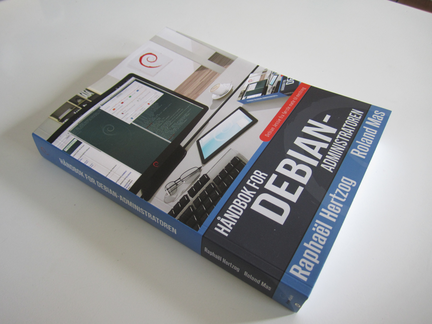
I finally received a copy of the Norwegian Bokm l edition of
"The Debian Administrator's
Handbook". This test copy arrived in the mail a few days ago, and
I am very happy to hold the result in my hand. We spent around one and a half year translating it. This paperbook edition
is available
from lulu.com. If you buy it quickly, you save 25% on the list
price. The book is also available for download in electronic form as
PDF, EPUB and Mobipocket, as can be
read online
as a web page.
This is the second book I publish (the first was the book
"Free Culture" by Lawrence Lessig
in
English,
French
and
Norwegian
Bokm l), and I am very excited to finally wrap up this
project. I hope
"H ndbok
for Debian-administratoren" will be well received.
Next.