Search Results: "ed"

8 March 2020

Enrico Zini: Self perception links

Self-handicapping - Wikipedia
empowerment archive.org
Self-handicapping is a cognitive strategy by which people avoid effort in the hopes of keeping potential failure from hurting self-esteem.[1] It was first theorized by Edward E. Jones and Steven Berglas,[2] according to whom self-handicaps are obstacles created, or claimed, by the individual in anticipation of failing performance.[3]
Learned Helplessness is behaviour exhibited by a subject after enduring repeated aversive stimuli beyond their control. It was initially thought to be caused from the subject's acceptance of their powerlessness: discontinuing attempts to escape or avoid the aversive stimulus, even when such alternatives are unambiguously presented. Upon exhibiting such behavior, the subject was said to have acquired learned helplessness.[1][2] Over the past few decades, neuroscience has provided insight into learned helplessness and shown that the original theory actually had it backwards: the brain's default state is to assume that control is not present, and the presence of "helpfulness" is what is actually learned.[3]
One of the "classics" of Magic literature. Stuck In The Middle With Bruce by John F. Rizzo.

Ulrike Uhlig: Implementing feedback into our work culture

Everywhere I worked in the past, the only feedback that was asked of employees was during a yearly evaluation meeting. These meetings always felt to me like talking to Santa Claus and his Knecht Ruprecht. I was asked: Were you a good employee last year? If yes, we might give you a raise. If no, admit all your mistakes now, even if we already know everything, ho ho ho. And don't you talk about your feelings, or your well-being, or say anything about the organization's (invisible) hierarchies, otherwise we will put you on the "naughty list", and that's it with candy. The yearly evaluation set aside, there was no other place to give feedback (except by escalating a matter by involving the Labour Court, if you happen to work in France, or going on strike, also mostly part of French culture). Feedback allows to reflect on work processes, to situate oneself, and to get closure. How surprised was I when, some years ago, I received an email from a collaborator asking me: kindly for just few paragraphs (doesn t have to be anything long) to hear from you about the process, your work, challenges you had, or anything else you want to mention there.. Wow!
This simple email allowed me to reflect about: How do we get to a feedback culture? How do we get from German Christmas folklore, protestant work ethics, and the deeply rooted principles of disciplining and punishing to a feedback culture on eye level? It sounds a bit like going from the dark ages to a really cool science fiction utopia with universal peace, telepathy, and magic between all sentient beings on all inhabited planets in the cosmos at least that's how I imagined it as a child, just like some of my heroes did: the cosmonaut girl who saves Earth, the boy who talks to space flowers that give him the capacity to fly, and the little onion who fights for justice (the Italian author was so popular on our side of the iron curtain that a soviet astronomer named a minor planet after him. His wife meanwhile immortalized Karl Marx.) and some romantic part of me hangs on to these ideas. Feedback is not always easy to hear and to give. I-Statements Giving and receiving feedback is hard in a culture where people learnt that when they made a mistake they won't get candy. Or that they have to constantly please other people because they are not worthy by themselves. This can lead to people putting mistakes on one another. Every sentence that starts with You are has the potential of creating a lot of hurt, and anger. Have you heard of I-Statements? They have very powerfully changed my world view, as they shift from accusation to ownership of feelings. So instead of telling someone Your writing style is impossible! You really need to change the way you write., with an I-Statement one could say I have a hard time understanding that part of the text. I-Statements make cooperation possible. Listening actively Feedback is not about being right or wrong, it's first of all about being able to see how another person has experienced a situation. Active listening is a tool that helps with understanding. It might seem easy, but needs quite some practice and a safe space. One part of active listening is to restate what you hear the other person say (by mirroring, or paraphrasing), to make sure you understood, and make sure they know you understood what they were trying to say. You can practise this: in a circle of three people, have one person tell how they experienced a (possibly conflictual) situation, have one person do the active listening, and the third person observing in order to give feedback to the active listener about how they did. Then switch roles, for example clockwise, until everyone has had every role. Encouraging continuous feedback A working feedback culture does not take place only once a year. It needs to be a continuous process and therefore implemented in meetings, teams, eventually on the level of a project. Making clear: Who can I talk to if I experience an issue? is not different than telling developers and users where and how they can report a bug, or request a feature. A safe space to express feedback is key. Encouraging multiple feedback channels Some people might feel less empowered or more vulnerable over a channel than others. Make sure to have different channels for receiving feedback such as email, a point on each meeting agenda, a one-to-one meeting, or a poll. Giving and receiving feedback on eye level In a workplace that does not have a working feedback culture, feedback is easily perceived as policing. If your feedback process consists of asking people to upload a form to a cloud server every 3 months, and you notice that some people don't do it, you could ask yourself if there is an issue with how your colleagues perceive giving feedback in your organization. Do you meet your colleagues on eye level when it comes to feedback? Do you take feedback seriously and act on it? How do you deal with unpleasant feedback? How do you react when colleagues don't meet your expectations? Can people participate in the feedback process within their paid work time? Did everybody understand what the feedback process is about? Don't jump to conclusions Humans are problem solving animals. When someone comes to us with a problem, the first thing we want to do is to solve it, to help them. But sometimes this is uncalled for, it can be disempowering, or prevent people from acquiring competences themselves, and it can even break people's boundaries. So instead of asking What can I do for you?, try asking What do you need right now? People will often reply something that you did not expect at all. Acting on feedback Make sure you have a process to collect feedback (possibly anonymized) and to regularly evaluate if the organization needs to implement changes to thrive. Conclusion I stumbled upon Hans-Christian Dany's critique of feedback again recently, therefore I need to make it clear: I'm not interested in improving capitalist work culture by using cybernetic principles of self-regulation through feedback. Instead, I am interested in improving cooperation between people who work either individually or in organizations on eye level. In this framework, I see feedback processes as profoundly anti-capitalist methods to improve cooperation while working towards common good. Implementing these ideas should be doable: there are organizations who provide feedback training for example. This document, initially aiming at people in cooperatives, gives many insights on communication skills and feedback, the agile and UX worlds do feedback "retrospectives". and otherwise I'll have to go and write science fiction stories for children myself.

Lisandro Dami n Nicanor P rez Meyer: Qt 4 removed from Debian Sid (unstable)

The day has finally arrived: Qt 4 is no longer part of Debian unstable. It's gone.

Thanks should go to many people. You know who you are, and I really appreciate the support and time you put into this. **Thanks**

7 March 2020

Julian Andres Klode: APT 2.0 released

After brewing in experimental for a while, and getting a first outing in the Ubuntu 19.10 release; both as 1.9, APT 2.0 is now landing in unstable. 1.10 would be a boring, weird number, eh? Compared to the 1.8 series, the APT 2.0 series features several new features, as well as improvements in performance, hardening. A lot of code has been removed as well, reducing the size of the library.

Highlighted Changes Since 1.8

New Features
  • Commands accepting package names now accept aptitude-style patterns. The syntax of patterns is mostly a subset of aptitude, see apt-patterns(7) for more details.
  • apt(8) now waits for the dpkg locks - indefinitely, when connected to a tty, or for 120s otherwise.
  • When apt cannot acquire the lock, it prints the name and pid of the process that currently holds the lock.
  • A new satisfy command has been added to apt(8) and apt-get(8)
  • Pins can now be specified by source package, by prepending src: to the name of the package, e.g.:
    Package: src:apt
    Pin: version 2.0.0
    Pin-Priority: 990
    
    Will pin all binaries of the native architecture produced by the source package apt to version 2.0.0. To pin packages across all architectures, append :any.

Performance
  • APT now uses libgcrypt for hashing instead of embedded reference implementations of MD5, SHA1, and SHA2 hash families.
  • Distribution of rred and decompression work during update has been improved to take into account the backlog instead of randomly assigning a worker, which should yield higher parallelization.

Incompatibilities
  • The apt(8) command no longer accepts regular expressions or wildcards as package arguments, use patterns (see New Features).

Hardening
  • Credentials specified in auth.conf now only apply to HTTPS sources, preventing malicious actors from reading credentials after they redirected users from a HTTP source to an http url matching the credentials in auth.conf. Another protocol can be specified, see apt_auth.conf(5) for the syntax.

Developer changes
  • A more extensible cache format, allowing us to add new fields without breaking the ABI
  • All code marked as deprecated in 1.8 has been removed
  • Implementations of CRC16, MD5, SHA1, SHA2 have been removed
  • The apt-inst library has been merged into the apt-pkg library.
  • apt-pkg can now be found by pkg-config
  • The apt-pkg library now compiles with hidden visibility by default.
  • Pointers inside the cache are now statically typed. They cannot be compared against integers (except 0 via nullptr) anymore.

python-apt 2.0 python-apt 2.0 is not yet ready, I m hoping to add a new cleaner API for cache access before making the jump from 1.9 to 2.0 versioning.

libept 1.2 I ve moved the maintenance of libept to the APT team. We need to investigate how to EOL this properly and provide facilities inside APT itself to replace it. There are no plans to provide new features, only bugfixes / rebuilds for new apt versions.

Fran ois Marier: Fixing MariaDB InnoDB errors after upgrading to MythTV 30

After upgrading to MythTV 30 and MariaDB 10.3.18 on Debian buster, I noticed the following errors in my logs:
Jan 14 02:00:05 hostname mysqld[846]: 2020-01-14  2:00:05 62 [Warning] InnoDB: Cannot add field  rating  in table  mythconverg . internetcontentarticles  because after adding it, the row size is 8617 which is greater than maximum allowed size (8126) for a record on index leaf page.
Jan 14 02:00:05 hostname mysqld[846]: 2020-01-14  2:00:05 62 [Warning] InnoDB: Cannot add field  playcommand  in table  mythconverg . videometadata  because after adding it, the row size is 8243 which is greater than maximum allowed size (8126) for a record on index leaf page.
The root cause is that the database is using an InnoDB row format that cannot handle the new table sizes. To fix it, I put the following in alter_tables.sql:
ALTER TABLE archiveitems ROW_FORMAT=DYNAMIC;
ALTER TABLE bdbookmark ROW_FORMAT=DYNAMIC;
ALTER TABLE callsignnetworkmap ROW_FORMAT=DYNAMIC;
ALTER TABLE capturecard ROW_FORMAT=DYNAMIC;
ALTER TABLE cardinput ROW_FORMAT=DYNAMIC;
ALTER TABLE channel ROW_FORMAT=DYNAMIC;
ALTER TABLE channelgroup ROW_FORMAT=DYNAMIC;
ALTER TABLE channelgroupnames ROW_FORMAT=DYNAMIC;
ALTER TABLE channelscan ROW_FORMAT=DYNAMIC;
ALTER TABLE channelscan_channel ROW_FORMAT=DYNAMIC;
ALTER TABLE channelscan_dtv_multiplex ROW_FORMAT=DYNAMIC;
ALTER TABLE codecparams ROW_FORMAT=DYNAMIC;
ALTER TABLE credits ROW_FORMAT=DYNAMIC;
ALTER TABLE customexample ROW_FORMAT=DYNAMIC;
ALTER TABLE diseqc_config ROW_FORMAT=DYNAMIC;
ALTER TABLE diseqc_tree ROW_FORMAT=DYNAMIC;
ALTER TABLE displayprofilegroups ROW_FORMAT=DYNAMIC;
ALTER TABLE displayprofiles ROW_FORMAT=DYNAMIC;
ALTER TABLE dtv_multiplex ROW_FORMAT=DYNAMIC;
ALTER TABLE dtv_privatetypes ROW_FORMAT=DYNAMIC;
ALTER TABLE dvdbookmark ROW_FORMAT=DYNAMIC;
ALTER TABLE dvdinput ROW_FORMAT=DYNAMIC;
ALTER TABLE dvdtranscode ROW_FORMAT=DYNAMIC;
ALTER TABLE eit_cache ROW_FORMAT=DYNAMIC;
ALTER TABLE filemarkup ROW_FORMAT=DYNAMIC;
ALTER TABLE gallery_directories ROW_FORMAT=DYNAMIC;
ALTER TABLE gallery_files ROW_FORMAT=DYNAMIC;
ALTER TABLE gallerymetadata ROW_FORMAT=DYNAMIC;
ALTER TABLE housekeeping ROW_FORMAT=DYNAMIC;
ALTER TABLE inputgroup ROW_FORMAT=DYNAMIC;
ALTER TABLE internetcontent ROW_FORMAT=DYNAMIC;
ALTER TABLE internetcontentarticles ROW_FORMAT=DYNAMIC;
ALTER TABLE inuseprograms ROW_FORMAT=DYNAMIC;
ALTER TABLE iptv_channel ROW_FORMAT=DYNAMIC;
ALTER TABLE jobqueue ROW_FORMAT=DYNAMIC;
ALTER TABLE jumppoints ROW_FORMAT=DYNAMIC;
ALTER TABLE keybindings ROW_FORMAT=DYNAMIC;
ALTER TABLE keyword ROW_FORMAT=DYNAMIC;
ALTER TABLE livestream ROW_FORMAT=DYNAMIC;
ALTER TABLE logging ROW_FORMAT=DYNAMIC;
ALTER TABLE music_albumart ROW_FORMAT=DYNAMIC;
ALTER TABLE music_albums ROW_FORMAT=DYNAMIC;
ALTER TABLE music_artists ROW_FORMAT=DYNAMIC;
ALTER TABLE music_directories ROW_FORMAT=DYNAMIC;
ALTER TABLE music_genres ROW_FORMAT=DYNAMIC;
ALTER TABLE music_playlists ROW_FORMAT=DYNAMIC;
ALTER TABLE music_radios ROW_FORMAT=DYNAMIC;
ALTER TABLE music_smartplaylist_categories ROW_FORMAT=DYNAMIC;
ALTER TABLE music_smartplaylist_items ROW_FORMAT=DYNAMIC;
ALTER TABLE music_smartplaylists ROW_FORMAT=DYNAMIC;
ALTER TABLE music_songs ROW_FORMAT=DYNAMIC;
ALTER TABLE music_stats ROW_FORMAT=DYNAMIC;
ALTER TABLE music_streams ROW_FORMAT=DYNAMIC;
ALTER TABLE mythlog ROW_FORMAT=DYNAMIC;
ALTER TABLE mythweb_sessions ROW_FORMAT=DYNAMIC;
ALTER TABLE networkiconmap ROW_FORMAT=DYNAMIC;
ALTER TABLE oldfind ROW_FORMAT=DYNAMIC;
ALTER TABLE oldprogram ROW_FORMAT=DYNAMIC;
ALTER TABLE oldrecorded ROW_FORMAT=DYNAMIC;
ALTER TABLE people ROW_FORMAT=DYNAMIC;
ALTER TABLE phonecallhistory ROW_FORMAT=DYNAMIC;
ALTER TABLE phonedirectory ROW_FORMAT=DYNAMIC;
ALTER TABLE pidcache ROW_FORMAT=DYNAMIC;
ALTER TABLE playgroup ROW_FORMAT=DYNAMIC;
ALTER TABLE powerpriority ROW_FORMAT=DYNAMIC;
ALTER TABLE profilegroups ROW_FORMAT=DYNAMIC;
ALTER TABLE program ROW_FORMAT=DYNAMIC;
ALTER TABLE programgenres ROW_FORMAT=DYNAMIC;
ALTER TABLE programrating ROW_FORMAT=DYNAMIC;
ALTER TABLE recgrouppassword ROW_FORMAT=DYNAMIC;
ALTER TABLE recgroups ROW_FORMAT=DYNAMIC;
ALTER TABLE record ROW_FORMAT=DYNAMIC;
ALTER TABLE record_tmp ROW_FORMAT=DYNAMIC;
ALTER TABLE recorded ROW_FORMAT=DYNAMIC;
ALTER TABLE recordedartwork ROW_FORMAT=DYNAMIC;
ALTER TABLE recordedcredits ROW_FORMAT=DYNAMIC;
ALTER TABLE recordedfile ROW_FORMAT=DYNAMIC;
ALTER TABLE recordedmarkup ROW_FORMAT=DYNAMIC;
ALTER TABLE recordedprogram ROW_FORMAT=DYNAMIC;
ALTER TABLE recordedrating ROW_FORMAT=DYNAMIC;
ALTER TABLE recordedseek ROW_FORMAT=DYNAMIC;
ALTER TABLE recordfilter ROW_FORMAT=DYNAMIC;
ALTER TABLE recordingprofiles ROW_FORMAT=DYNAMIC;
ALTER TABLE recordmatch ROW_FORMAT=DYNAMIC;
ALTER TABLE scannerfile ROW_FORMAT=DYNAMIC;
ALTER TABLE scannerpath ROW_FORMAT=DYNAMIC;
ALTER TABLE schemalock ROW_FORMAT=DYNAMIC;
ALTER TABLE settings ROW_FORMAT=DYNAMIC;
ALTER TABLE storagegroup ROW_FORMAT=DYNAMIC;
ALTER TABLE tvchain ROW_FORMAT=DYNAMIC;
ALTER TABLE tvosdmenu ROW_FORMAT=DYNAMIC;
ALTER TABLE upnpmedia ROW_FORMAT=DYNAMIC;
ALTER TABLE user_permissions ROW_FORMAT=DYNAMIC;
ALTER TABLE user_sessions ROW_FORMAT=DYNAMIC;
ALTER TABLE users ROW_FORMAT=DYNAMIC;
ALTER TABLE videocast ROW_FORMAT=DYNAMIC;
ALTER TABLE videocategory ROW_FORMAT=DYNAMIC;
ALTER TABLE videocollection ROW_FORMAT=DYNAMIC;
ALTER TABLE videocountry ROW_FORMAT=DYNAMIC;
ALTER TABLE videogenre ROW_FORMAT=DYNAMIC;
ALTER TABLE videometadata ROW_FORMAT=DYNAMIC;
ALTER TABLE videometadatacast ROW_FORMAT=DYNAMIC;
ALTER TABLE videometadatacountry ROW_FORMAT=DYNAMIC;
ALTER TABLE videometadatagenre ROW_FORMAT=DYNAMIC;
ALTER TABLE videopart ROW_FORMAT=DYNAMIC;
ALTER TABLE videopathinfo ROW_FORMAT=DYNAMIC;
ALTER TABLE videosource ROW_FORMAT=DYNAMIC;
ALTER TABLE videotypes ROW_FORMAT=DYNAMIC;
ALTER TABLE weatherdatalayout ROW_FORMAT=DYNAMIC;
ALTER TABLE weatherscreens ROW_FORMAT=DYNAMIC;
ALTER TABLE weathersourcesettings ROW_FORMAT=DYNAMIC;
and then ran it like this:
mysql -umythtv -pPassword1 mythconverg < alter_tables.sql

Matthias Klumpp: Introducing the MetaInfo Creator

This year s FOSDEM conference was a lot of fun one of the things I always enjoy most about this particular conference (besides having some of the outstanding food you can get in Brussels and meeting with friends from the free software world) is the ability to meet a large range of new people who I wouldn t usually have interacted with, or getting people from different communities together who otherwise would not meet in person as each bigger project has their own conference (for example, the amount of VideoLAN people is much lower at GUADEC and Akademy compared to FOSDEM). It s also really neat to have GNOME and KDE developers within reach at the same place, as I care about both desktops a lot. An unexpected issue This blog post however is not about that. It s about what I learned when talking to people there about AppStream, and the outcome of that. Especially when talking to application authors but also to people who deal with larger software repositories, it became apparent that many app authors don t really want to deal with the extra effort of writing metadata at all. This was a bit of a surprise to me, as I thought that there would be a strong interest for application authors to make their apps look as good as possible in software catalogs. A bit less surprising was the fact that people apparently don t enjoy reading a large specification, reading a long-ish intro guide with lots of dos and don ts or basically reading any longer text at all before being able to create an AppStream MetaInfo/AppData file describing their software. Another common problem seems to be that people don t immediately know what a reverse-DNS ID is, the format AppStream uses for uniquely identifying each software component. So naturally, people either have to read about it again (bah, reading!  ) or make something up, which occasionally is wrong and not the actual component-ID their software component should have. The MetaInfo Creator It was actually suggested to me twice that what people really would like to have is a simple tool to put together a MetaInfo file for their software. Basically a simple form with a few questions which produces the final file. I always considered this a nice to have, but not essential feature, but now I was convinced that this actually has a priority attached to it. So, instead of jumping into my favourite editor and writing a bunch of C code to create this make MetaInfo file form as part of appstreamcli, this time I decided to try what the cool kids are doing and make a web application that runs in your browser and creates all metadata there. So, behold the MetaInfo Creator! If you click this link, you will end up at an Angular-based web application that will let you generate MetaInfo/AppData files for a few component-types simply by answering a set of questions. The intent was to make this tool as easy to use as possible for someone who basically doesn t know anything about AppStream at all. Therefore, the tool will: For the Meson feature, the tool simply can not generate a use this and be done script, as each Meson snippet needs to be adjusted for the individual project. So this option is disabled by default, but when enabled, a few simple Meson snippets will be produced which can be easily adjusted to the project they should be part of. The tool currently does not generate any release information for a MetaInfo file at all, This may be added in future. The initial goal was to have people create any MetaInfo file in the first place, having projects also ship release details would be the icing on the cake. I hope people find this project useful and use it to create better MetaInfo files, so distribution repositories and Flatpak repos look better in software centers. Also, since MetaInfo files can be used to create an inventory of software and to install missing stuff as-needed, having more of them will help to build smarter software managers, create smaller OS base installations and introspect what software bundles are made of easily. I welcome contributions to the MetaInfo Creator! You can find its source code on GitHub. This is my first web application ever, the first time I wrote TypeScript and the first time I used Angular, so I d bet a veteran developer more familiar with these tools will cringe at what I produced. So, scratch that itch and submit a PR!  Also, if you want to create a form for a new component type, please submit a patch as well. C developer s experience notes for Angular, TypeScript, NodeJS This section is just to ramble a bit about random things I found interesting as a developer who mostly works with C/C++ and Python and stepped into the web-application developer s world for the first time. For a project like this, I would usually have gone with my default way of developing something for the web: Creating a Flask-based application in Python. I really love Python and Flask, but of course using them would have meant that all processing would have had to be done on the server. One the one hand I could have used libappstream that way to create the XML, format it and validate it, but on the other hand I would have had to host the Python app on my own server, find a place at Purism/Debian/GNOME/KDE or get it housed at Freedesktop somehow (which would have taken a while to arrange) and I really wanted to have a permanent location for this application immediately. Additionally, I didn t want people to send the details of new unpublished software to my server. TypeScript I must say that I really like TypeScript as a language compared to JavaScript. It is not really revolutionary (I looked into Dart and other ways to compile $stuff to JavaScript first), but it removes just enough JavaScript weirdness to be pleasant to use. At the same time, since TS is a superset of JS, JavaScript code is valid TypeScript code, so you can integrate with existing JS code easily. Picking TS up took me much less than an hour, and most of its features you learn organically when working on a project. The optional type-safety is a blessing and actually helped me a few times to find an issue. It being so close to JS is both a strength and weakness: On the one hand you have all the JS oddities in the language (implicit type conversion is really weird sometimes) and have to basically refrain from using them or count on the linter to spot them, but on the other hand you can immediately use the massive amount of JavaScript code available on the web. Angular The Angular web framework took a few hours to pick up there are a lot of concepts to understand. But ultimately, it s manageable and pretty nice to use. When working at the system level, a lot of complexity is in understanding how the CPU is processing data, managing memory and using the low-level APIs the operating system provides. With the web application stuff, a lot of the complexity for me was in learning about all the moving parts the system is comprised of, what their names are, what they are, and what works with which. And that is not a flat learning curve at all. As C developer, you need to know how the computer works to be efficient, as web developer you need to know a bunch of different tools really well to be productive. One thing I am still a bit puzzled about is the amount of duplicated HTML templates my project has. I haven t found a way to reuse template blocks in multiple components with Angular, like I would with Jinja2. The documentation suggests this feature does not exist, but maybe I simply can t find it or there is a completely different way to achieve the same result. NPM Ecosystem The MetaInfo Creator application ultimately doesn t do much. But according to GitHub, it has 985 (!!!) dependencies in NPM/NodeJS. And that is the bare minimum! I only added one dependency myself to it. I feel really uneasy about this, as I prefer the Python approach of having a rich standard library instead of billions of small modules scattered across the web. If there is a bug in one of the standard library functions, I can submit a patch to Python where some core developer is there to review it. In NodeJS, I imagine fixing some module is much harder. That being said though, using npm is actually pretty nice there is a module available for most things, and adding a new dependency is easy. NPM will also manage all the details of your dependency chain, GitHub will warn about security issues in modules you depend on, etc. So, from a usability perspective, there isn t much to complain about (unlike with Python, where creating or using a module ends up as a fight the system event way too often and the question which random file do I need to create now to achieve what I want? always exists. Fortunately, Poetry made this a bit more pleasant for me recently). So, tl;dr for this section: The web application development excursion was actually a lot of fun, and I may make more of those in future, now that I learned more about how to write web applications. Ultimately though, I enjoy the lower-level software development and backend development a bit more. Summary Check out the MetaInfo Creator and its source code, if you want to create MetaInfo files for a GUI application, console application, addon or service component quickly.

6 March 2020

Reproducible Builds: Reproducible Builds in February 2020

Welcome to the February 2020 report from the Reproducible Builds project. One of the original promises of open source software is that distributed peer review and transparency of process results in enhanced end-user security. However, whilst anyone may inspect the source code of free and open source software for malicious flaws, almost all software today is distributed as pre-compiled binaries. This allows nefarious third-parties to compromise systems by injecting malicious code into ostensibly secure software during the various compilation and distribution processes. The motivation behind the reproducible builds effort is to provide the ability to demonstrate these binaries originated from a particular, trusted, source release: if identical results are generated from a given source in all circumstances, reproducible builds provides the means for multiple third-parties to reach a consensus on whether a build was compromised via distributed checksum validation or some other scheme. In this month s report, we cover:

If you are interested in contributing to the project, please visit our Contribute page on our website.

Media coverage & upstream news Omar Navarro Leija, a PhD student at the University Of Pennsylvania, published a paper entitled Reproducible Containers that describes in detail the workings of a new user-space container tool called DetTrace:
All computation that occurs inside a DetTrace container is a pure function of the initial filesystem state of the container. Reproducible containers can be used for a variety of purposes, including replication for fault-tolerance, reproducible software builds and reproducible data analytics. We use DetTrace to achieve, in an automatic fashion, reproducibility for 12,130 Debian package builds, containing over 800 million lines of code, as well as bioinformatics and machine learning workflows.
There was also considerable discussion on our mailing list regarding this research and a presentation based on the paper will occur at the ASPLOS 2020 conference between March 16th 20th in Lausanne, Switzerland. The many virtues of Reproducible Builds were touted as benefits for software compliance in a talk at FOSDEM 2020, debating whether the Careful Inventory of Licensing Bill of Materials Have Impact of FOSS License Compliance which pitted Jeff McAffer and Carol Smith against Bradley Kuhn and Max Sills. (~47 minutes in). Nobuyoshi Nakada updated the canonical implementation of the Ruby programming language a change such that filesystem globs (ie. calls to list the contents of filesystem directories) will henceforth be sorted in ascending order. Without this change, the underlying nondeterministic ordering of the filesystem is exposed to the language which often results in an unreproducible build. Vagrant Cascadian reported on our mailing list regarding a quick reproducible test for the GNU Guix distribution, which resulted in 81.9% of packages registering as reproducible in his installation:
$ guix challenge --verbose --diff=diffoscope ...
2,463 store items were analyzed:
  - 2,016 (81.9%) were identical
  - 37 (1.5%) differed
  - 410 (16.6%) were inconclusive
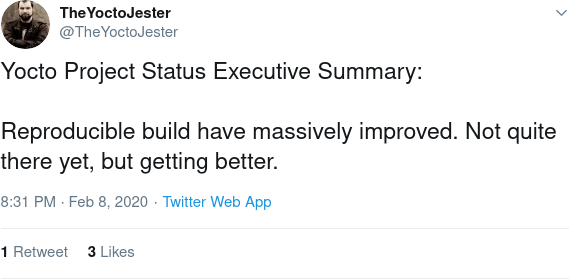
Jeremiah Orians announced on our mailing list the release of a number of tools related to cross-compilation such as M2-Planet and mescc-tools-seed. This project attemps a full bootstrap of a cross-platform compiler for the C programming language (written in C itself) from hex, the ultimate goal being able to demonstrate fully-bootstrapped compiler from hex to the GCC GNU Compiler Collection. This has many implications in and around Ken Thompson s Trusting Trust attack outlined in Thompson s 1983 Turing Award Lecture. Twitter user @TheYoctoJester posted an executive summary of reproducible builds in the Yocto Project: Finally, Reddit user tofflos posted to the /r/Java subreddit asking about how to achieve reproducible builds with Maven and Chris Lamb noticed that the Linux kernel documentation about reproducible builds of it is available on the kernel.org homepages in an attractive HTML format.

Distribution work

Debian Chris Lamb created a merge request for the core debian-installer package to allow all arguments and options from sources.list files (such as [check-valid-until=no] , etc.) in order that we can test the reproducibility of the installer images on the Reproducible Builds own testing infrastructure. (#13) Thorsten Glaser followed-up to a bug filed against the dpkg-source component that was originally filed in late 2015 that claims that the build tool does not respect permissions when unpacking tarballs if the umask is set to 0002. Matthew Garrett posted to the debian-devel mailing list on the topic of Producing verifiable initramfs images as part of a wider conversation on being able to trust the entire software stack on our computers. 59 reviews of Debian packages were added, 30 were updated and 42 were removed this month adding to our knowledge about identified issues. Many issue types were noticed and categorised by Chris Lamb, including:

openSUSE In openSUSE, Bernhard M. Wiedemann published his monthly Reproducible Builds status update as well as provided the following patches:

Software development

diffoscope diffoscope is our in-depth and content-aware diff-like utility that can locate and diagnose reproducibility issues. It is run countless times a day on our testing infrastructure and is essential for identifying fixes and causes of nondeterministic behaviour. Chris Lamb made the following changes this month, including uploading version 137 to Debian:
  • The sng image utility appears to return with an exit code of 1 if there are even minor errors in the file. (#950806)
  • Also extract classes2.dex, classes3.dex from .apk files extracted by apktool. (#88)
  • No need to use str.format if we are just returning the string. [ ]
  • Add generalised support for ignoring returncodes [ ] and move special-casing of returncodes in zip to use Command.VALID_RETURNCODES. [ ]

Other tools disorderfs is our FUSE-based filesystem that deliberately introduces non-determinism into directory system calls in order to flush out reproducibility issues. This month, Vagrant Cascadian updated the Vcs-Git to specify the debian packaging branch. [ ] reprotest is our end-user tool to build same source code twice in widely differing environments and then checks the binaries produced by each build for any differences. This month, versions 0.7.13 and 0.7.14 were uploaded to Debian unstable by Holger Levsen after Vagrant Cascadian added support for GNU Guix [ ].

Project documentation & website There was more work performed on our documentation and website this month. Bernhard M. Wiedemann added a Java Gradle Build Tool snippet to the SOURCE_DATE_EPOCH documentation [ ] and normalised various terms to unreproducible [ ]. Chris Lamb added a Meson.build example [ ] and improved the documentation for the CMake [ ] to the SOURCE_DATE_EPOCH documentation, replaced anyone can with anyone may as, well, not everyone has the resources, skills, time or funding to actually do what it refers to [ ] and improved the pre-processing for our report generation [ ][ ][ ][ ] etc. In addition, Holger Levsen updated our news page to improve the list of reports [ ], added an explicit mention of the weekly news time span [ ] and reverted sorting of news entries to have latest on top [ ] and Mattia Rizzolo added Codethink as a non-fiscal sponsor [ ] and lastly Tianon Gravi added a Docker Images link underneath the Debian project on our Projects page [ ].

Upstream patches The Reproducible Builds project detects, dissects and attempts to fix as many currently-unreproducible packages as possible. We endeavour to send all of our patches upstream where appropriate. This month, we wrote a large number of such patches, including: Vagrant Cascadian submitted patches via the Debian bug tracking system targeting the packages the Civil Infrastructure Platform has identified via the CIP and CIP build depends package sets:

Testing framework We operate a fully-featured and comprehensive Jenkins-based testing framework that powers tests.reproducible-builds.org. This month, the following changes were made by Holger Levsen: In addition, Mattia Rizzolo added an Apache web server redirect for buildinfos.debian.net [ ] and reverted the reshuffling of arm64 architecture builders [ ]. The usual build node maintenance was performed by Holger Levsen, Mattia Rizzolo [ ][ ] and Vagrant Cascadian.

Getting in touch If you are interested in contributing to the Reproducible Builds project, please visit our Contribute page on our website. However, you can get in touch with us via:

This month s report was written by Bernhard M. Wiedemann, Chris Lamb and Holger Levsen. It was subsequently reviewed by a bunch of Reproducible Builds folks on IRC and the mailing list.

Mike Gabriel: My Work on Debian LTS (February 2020)

In February 2020, I have worked on the Debian LTS project only for 5.75 hours (of 20 hours planned). I gave back 12 hours to the pool and reduced my availability to 8 hours per month. Unfortunately, last month I got too distracted by other interesting and challenging projects, and also by some intense personal topics. I herewith send my apology to all LTS team members and all Debian LTS users for not having completed my planned LTS workload. LTS Work light+love
Mike

4 March 2020

Noah Meyerhans: Daily VM image builds are available from the cloud team

Did you know that the cloud team generates daily images for buster, bullseye, and sid? They re available for download from cdimage.debian.org and are published to Amazon EC2 and Microsoft Azure. This is done both to exercise our image generation infrastructure, and also to facilitate testing of the actual images and distribution in general. I ve often found it convenient to have easy access to a clean, up-to-date, disposable virtual machine, and you might too. Please note that these images are intended for testing purposes, and older ones may be removed at any time in order to free up various resources. You should not hardcode references to specific images in any tools or configuration. If you re downloading an image for local use, you ll probably want one of the nocloud images. They have an empty root password (the security ramifications of this should be obvious, so please be careful!), and don t rely on any cloud service for configuration. You can use the qcow2 images with QEMU on any Linux system, or retrieve the raw images for use with another VMM. If you want to use the images on Amazon EC2, you can identify the latest nightly build using the AWS CLI as follows:
# Select the most recent bullseye image for arm64 instance types:
$ aws ec2 describe-images --owner 903794441882 \
--region us-east-1 --output json \
--query "Images[?Architecture=='arm64']   [?starts_with(Name, 'debian-11-')]   max_by([], &Name)"
 
"Architecture": "arm64",
"CreationDate": "2020-03-04T05:31:12.000Z",
"ImageId": "ami-056a2fe946ef98607",
"ImageLocation": "903794441882/debian-11-arm64-daily-20200304-189",
"ImageType": "machine",
"Public": true,
"OwnerId": "903794441882",
"State": "available",
"BlockDeviceMappings": [
 
"DeviceName": "/dev/xvda",
"Ebs":  
"Encrypted": false,
"DeleteOnTermination": true,
"SnapshotId": "snap-0d7a569b159964d87",
"VolumeSize": 8,
"VolumeType": "gp2"
 
 
],
"Description": "Debian 11 (daily build 20200304-189)",
"EnaSupport": true,
"Hypervisor": "xen",
"Name": "debian-11-arm64-daily-20200304-189",
"RootDeviceName": "/dev/xvda",
"RootDeviceType": "ebs",
"SriovNetSupport": "simple",
"VirtualizationType": "hvm"
 
# Similarly, select the most recent sid amd64 AMI:
$ aws ec2 describe-images --owner 903794441882 \
--region us-east-1 --output json \
--query "Images[?Architecture=='x86_64']   [?starts_with(Name, 'debian-sid-')]   max_by([], &Name)"
 
"Architecture": "x86_64",
"CreationDate": "2020-03-04T05:13:58.000Z",
"ImageId": "ami-00ec9272298ca9059",
"ImageLocation": "903794441882/debian-sid-amd64-daily-20200304-189",
"ImageType": "machine",
"Public": true,
"OwnerId": "903794441882",
"State": "available",
"BlockDeviceMappings": [
 
"DeviceName": "/dev/xvda",
"Ebs":  
"Encrypted": false,
"DeleteOnTermination": true,
"SnapshotId": "snap-07c3fad3ff835248a",
"VolumeSize": 8,
"VolumeType": "gp2"
 
 
],
"Description": "Debian sid (daily build 20200304-189)",
"EnaSupport": true,
"Hypervisor": "xen",
"Name": "debian-sid-amd64-daily-20200304-189",
"RootDeviceName": "/dev/xvda",
"RootDeviceType": "ebs",
"SriovNetSupport": "simple",
"VirtualizationType": "hvm"
 
If you re using Microsoft Azure images, you can inspect the images with az vm image list and az vm image show, as follows:
$ az vm image list -o table --publisher debian --offer debian-sid-daily --location westeurope --all   sort -k 5   tail
debian-sid-daily Debian sid-gen2 Debian:debian-sid-daily:sid-gen2:0.20200228.184 0.20200228.184
debian-sid-daily Debian sid Debian:debian-sid-daily:sid:0.20200229.185 0.20200229.185
debian-sid-daily Debian sid-gen2 Debian:debian-sid-daily:sid-gen2:0.20200229.185 0.20200229.185
debian-sid-daily Debian sid Debian:debian-sid-daily:sid:0.20200301.186 0.20200301.186
debian-sid-daily Debian sid-gen2 Debian:debian-sid-daily:sid-gen2:0.20200301.186 0.20200301.186
debian-sid-daily Debian sid Debian:debian-sid-daily:sid:0.20200302.187 0.20200302.187
debian-sid-daily Debian sid-gen2 Debian:debian-sid-daily:sid-gen2:0.20200302.187 0.20200302.187
debian-sid-daily Debian sid Debian:debian-sid-daily:sid:0.20200303.188 0.20200303.188
debian-sid-daily Debian sid-gen2 Debian:debian-sid-daily:sid-gen2:0.20200303.188 0.20200303.188
Offer Publisher Sku Urn Version
$ az vm image show --location westeurope --urn debian:debian-sid-daily:sid:latest
 
"automaticOsUpgradeProperties":  
"automaticOsUpgradeSupported": false
 ,
"dataDiskImages": [],
"hyperVgeneration": "V1",
"id": "/Subscriptions/428325bd-cc87-41f1-b0d8-8caf8bb80b6b/Providers/Microsoft.Compute/Locations/westeurope/Publishers/debian/ArtifactTypes/VMImage/Offers/debian-sid-daily/Skus/sid/Versions/0.20200303.188",
"location": "westeurope",
"name": "0.20200303.188",
"osDiskImage":  
"operatingSystem": "Linux",
"sizeInBytes": 32212255232,
"sizeInGb": 30
 ,
"plan": null,
"tags": null
 
More information about cloud computing with Debian is available on the wiki.

Norbert Preining: Okular and restoration of tabs (plus Debian packages)

I have the need to restore my okular tab setup on restart, since I often have quite a lot of pdfs open to view at the same time. Unfortunately, the current okular doesn t provide this feature. There is a merge request by one of the main authors of okular, but it doesn t work for me in a stand-alone setup, that is not running KDE but only Okular. I developed a much simpler fix for the restoration problem (because most of the code is already there!), see this merge request, which although not perfect for sure does the trick for me. I have recently updated Okular for Debian in my private repository, which maybe has triggered an update of the maintainers of Okular to update the package in the main repository, too. Thanks a lot to the maintainers for their work. But since it does not contain my own tab-restore patches, I still provide NMU versioned Okular packages in my private repo:

deb https://www.preining.info/debian unstable main
deb-src https://www.preining.info/debian unstable main
and the git changes to it in this git repo. Enjoy.

3 March 2020

Ben Hutchings: Debian LTS work, February 2020

I was assigned 20 hours of work by Freexian's Debian LTS initiative and worked 19.25 hours this month, so I will carry over 0.75 hours to March. I prepared and, after review, released Linux 3.16.82. I then rebased the Debian package onto that, but haven't yet sent a request for testing. I have started preparing and testing the next update to Linux 3.16. I backported the Linux 4.9 package that was included in the stretch point release (Debian 9.12) and uploaded it to jessie. I prepared DLA 2114-1 covering this update. I also replied to questions from LTS contributors and users, sent to the lts-security alias or on the public mailing list.

Ian Jackson: Let's Encrypt certificate revocation - panic now!

Let's Encrypt have rather quietly announced (sadly, requires discourse JS!) that they are going to revoke a very large number of certificates. These revocations will start "no earlier than" 00:00 UTC tonight (24:00 on the 3rd of March), a little over 9h from now. Affected websites etc. may stop working. I discovered this at about lunchtime UK time today; two of my certs were affected. xenproject.org and linuxfoundation.org are listed as affected and I am trying to get in touch with the hosting provider to get it fixed. One of the domains we in the Xen Project run ourselves, with the help of the contractors who do much of our sysadmin, is affected - and those contractors (who are very competent) didn't know until I told them. tl;dr: If you are responsible for any Let's Encrypt certificates, check it right away and maybe panic now!
edited 2020-03-03 15:35 to fix arithmetic error

comment count unavailable comments

Elana Hashman: Chili

I really like beans. This is one way for me to power through the copious amounts I receive through the beloved Bean of the Month Club. (It took me many months, but I finally got in!) Beef Chili Serves 5-7. Active time: 20m. Total time: 90m. Ingredients: Recipe:
  1. Heat a dutch oven on high.
  2. Small or medium dice (depending on your preference) the celery, pepper, and onion. You should have about four cups total.
  3. Brown the beef in the dutch oven, using a little bit of cooking oil to avoid sticking if desired.
  4. While the meat is browning, mince the garlic, measure the spices, and combine these all together.
  5. Once the meat is brown, add the diced vegetables and cook until tender and the onion is translucent.
  6. Add the spices and garlic, thoroughly combine, and cook until fragrant, about one minute.
  7. Add the tomatoes. Once the mixture comes to a boil, cover and simmer for about an hour, stirring every ~20 minutes or so.
  8. Add the beans and use bean broth or water to adjust consistency.
  9. This is a good time to taste and add salt. I usually use 1 to 1 teaspoons.
  10. Bring to a boil again, cover and simmer for 10-15 more minutes.
  11. Turn off the heat, taste, and adjust seasoning if necessary. Add a squeeze of lime if it needs a little acidity.
  12. Serve with sour cream, grated cheese, sliced green onions, or any of your other favourite garnishes.
  13. Enjoy!
Frequently Asked Questions Q: Why wait until basically the end to add salt?
A: Because canned ingredients will contain salt, and it's hard to predict how much, so you should always salt to taste. Waiting until the end will always ensure you season accurately. Q: Why are so many of these directions so hand-wavey?
A: Cooking is an adventure. Experiment a little! Q: But I have no idea what "to taste" means.
A: Taste it, add the thing, stir, taste it again. Is it salty enough? Sour enough? Sweet enough? You don't know, you say? Keep going. Add a little too much and then you'll find out for next time. Q: Why do you add so many beans and so little meat?
A: I really like beans.

2 March 2020

Noah Meyerhans: Buster in the AWS Marketplace

When buster was first released back in early July of last year, the cloud team was in the process of setting up some new accounts with AWS to be used for AMI publication. For various reasons, the accounts we used for pre-buster releases were considered unsuitable for use long term, and the buster release was considered to be a good logical point to make the switch. Unfortunately, issues within the bureaucracy of both SPI/Debian and AWS delayed the complete switch to the new accounts. We have been publishing buster AMIs using a new account since September of 2019, but we have not been able to list them with the AWS Marketplace. This has reduced the visibility and discoverability of the AMIs and lead to numerous questions on the mailing lists and other forums. I m happy to announce today that the issues blocking Marketplace publication have finally been resolved, and buster is officially available in the AWS Marketplace. Please use it, please leave us ratings and reviews in the Marketplace, and most importantly, please feel welcome to contribute to the Debian cloud team. As always, if you d rather get the latest details from the Debian wiki, they re available, or you can query the AWS API directly, e.g. using the awscli command as follows:
$ aws ec2 describe-images --owner 136693071363 \
--region us-east-1 --output json \
--query "Images[?Architecture=='arm64']   [?starts_with(Name, 'debian-10-')]   max_by([], &Name)"
 
"Architecture": "arm64",
"CreationDate": "2020-02-10T19:04:55.000Z",
"ImageId": "ami-031d1abcdcbbfbd8f",
"ImageLocation": "136693071363/debian-10-arm64-20200210-166",
"ImageType": "machine",
"Public": true,
"OwnerId": "136693071363",
"State": "available",
"BlockDeviceMappings": [
 
"DeviceName": "/dev/xvda",
"Ebs":  
"Encrypted": false,
"DeleteOnTermination": true,
"SnapshotId": "snap-0d8459c1e3fe12486",
"VolumeSize": 8,
"VolumeType": "gp2"
 
 
],
"Description": "Debian 10 (20200210-166)",
"EnaSupport": true,
"Hypervisor": "xen",
"Name": "debian-10-arm64-20200210-166",
"RootDeviceName": "/dev/xvda",
"RootDeviceType": "ebs",
"SriovNetSupport": "simple",
"VirtualizationType": "hvm"
 
Hopefully this helps reduce some of the confusion around the availability of the buster AMIs. Next up, GovCloud!

Sylvain Beucler: Debian LTS and ELTS - February 2020

Debian LTS Logo Here is my transparent report for my work on the Debian Long Term Support (LTS) and Debian Extended Long Term Support (ELTS), which extend the security support for past Debian releases, as a paid contributor. In February, the monthly sponsored hours were split evenly among contributors depending on their max availability - I was assigned 20h for LTS (out of 30 max; all done) and 8h for ELTS (out of 20 max; I did 7). Security work is never completely isolated, typically my work on nodejs impacted jessie/stretch/buster, and my work on netty affected wheezy/jessie/stretch :) ELTS - Wheezy LTS - Jessie Documentation/Scripts

Petter Reinholdtsen: Nikita version 0.5 released - updated free software archive API server

Today, after many months of development, a new release of Nikita Noark 5 core project was finally announced on the project mailing list. The Nikita free software solution is an implementation of the Norwegian archive standard Noark 5 used by government offices in Norway. These were the changes in version 0.5 since version 0.4, see the email link above for links to a demo site: If free and open standardized archiving API sound interesting to you, please contact us on IRC (#nikita on irc.freenode.net) or email (nikita-noark mailing list). As usual, if you use Bitcoin and want to show your support of my activities, please send Bitcoin donations to my address 15oWEoG9dUPovwmUL9KWAnYRtNJEkP1u1b.

Jonathan Carter: Free Software activities for 2020-02

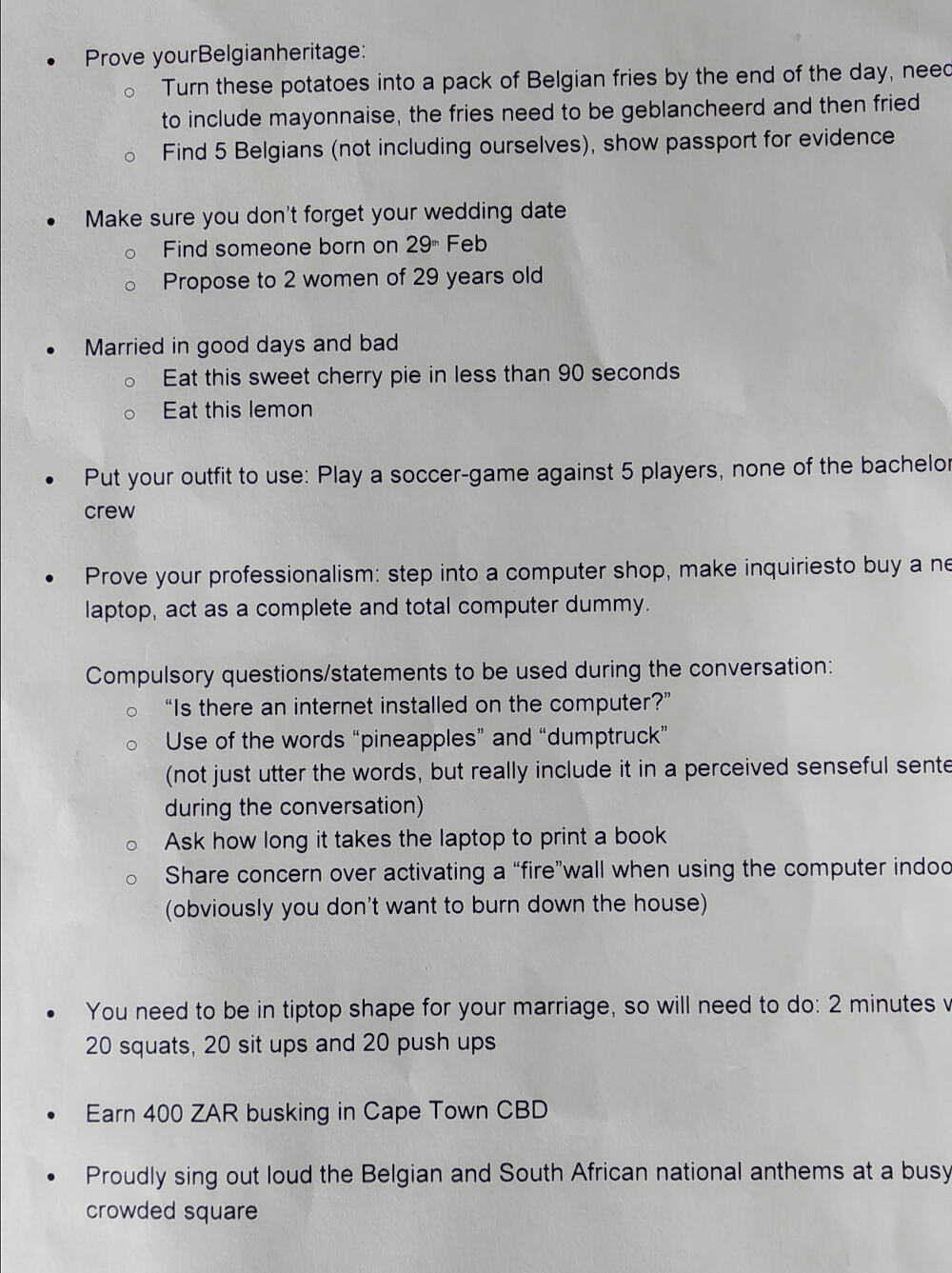
Belgians This month started off in Belgium for FOSDEM on 1-2 February. I attended FOSDEM in Brussels and wrote a separate blog entry for that. The month ended with Belgians at Tammy and Wouter s wedding. On Thursday we had Wouter s bachelors and then over the weekend I stayed over at their wedding venue. I thought that other Debianites might be interested so I m sharing some photos here with permission from Wouter. It was the only wedding I ve been at where nearly everyone had questions about Debian! I first met Wouter on the bus during the daytrip on DebConf12 in Nicaragua, back then I ve eagerly followed the Debianites on Planet Debian for a while so it was like meeting someone famous. Little did I know that 8 years later, I d be at his wedding back in my part of the world. If you went to DebConf16 in South Africa, you might remember Tammy, who have done a lot of work for DC16 including most of the artwork, bunch of website work, design on the badges, bags, etc and also did a lot of organisation for the day trips. Tammy and Wouter met while Tammy was reviewing the artwork in the video loops for the DebConf videos, and then things developed from there. Wouter s Bachelors Wouter was blindfolded and kidnapped and taken to the city center where we prepared to go on a bike tour of Cape Town, stopping for beer at a few places along the way. Wouter was given a list of tasks that he had to complete, or the wedding wouldn t be allowed to continue

Wouter s tasks
Wouter s props, needed to complete his tasks

Bike tour leg at Cape Town Stadium.

Seeking out 29 year olds.

Wouter finishing his lemon and actually seemingly enjoying it.
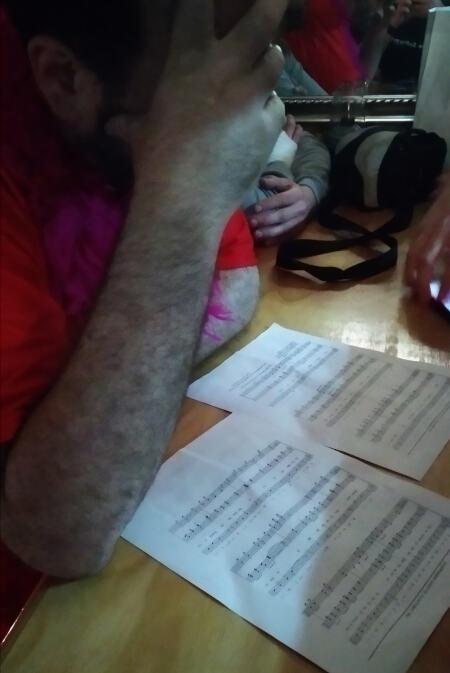
Reciting South African national anthem notes and lyrics.

The national anthem, as performed by Wouter (I was actually impressed by how good his pitch was).
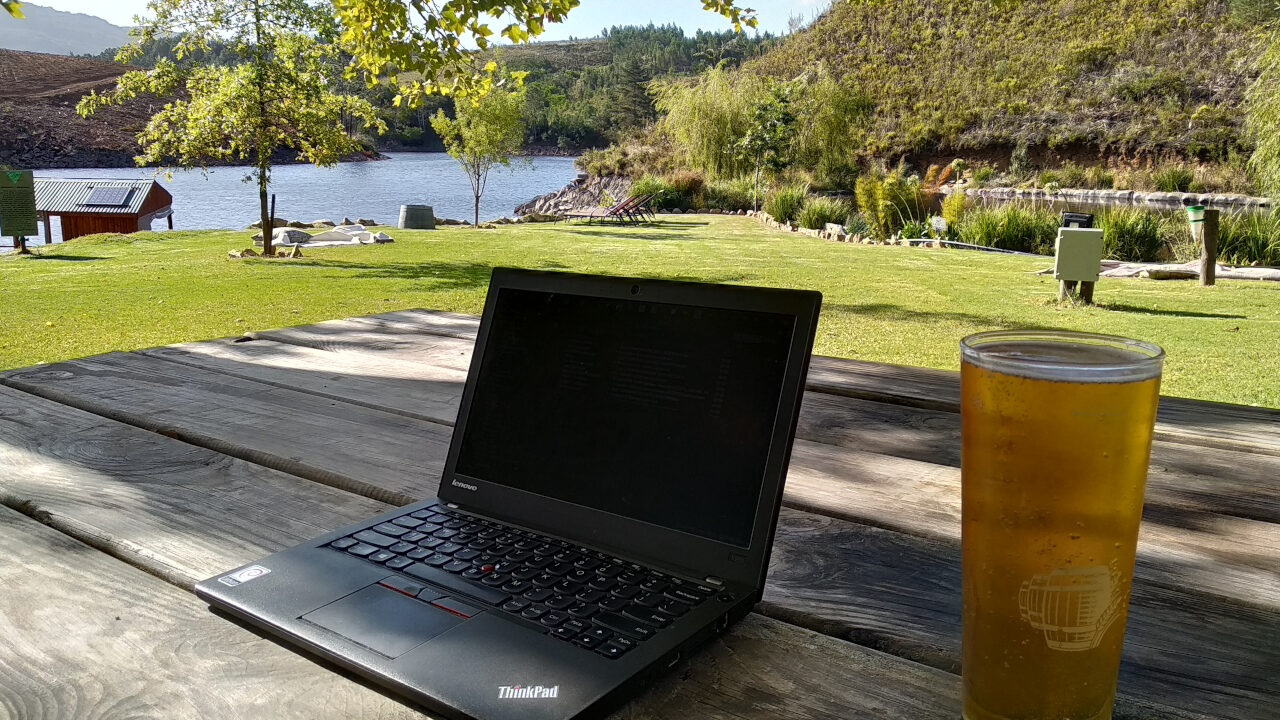
The Wedding Friday afternoon we arrived at the lodge for the weekend. I had some work to finish but at least this was nicer than where I was going to work if it wasn t for the wedding.
Accommodation at the lodge
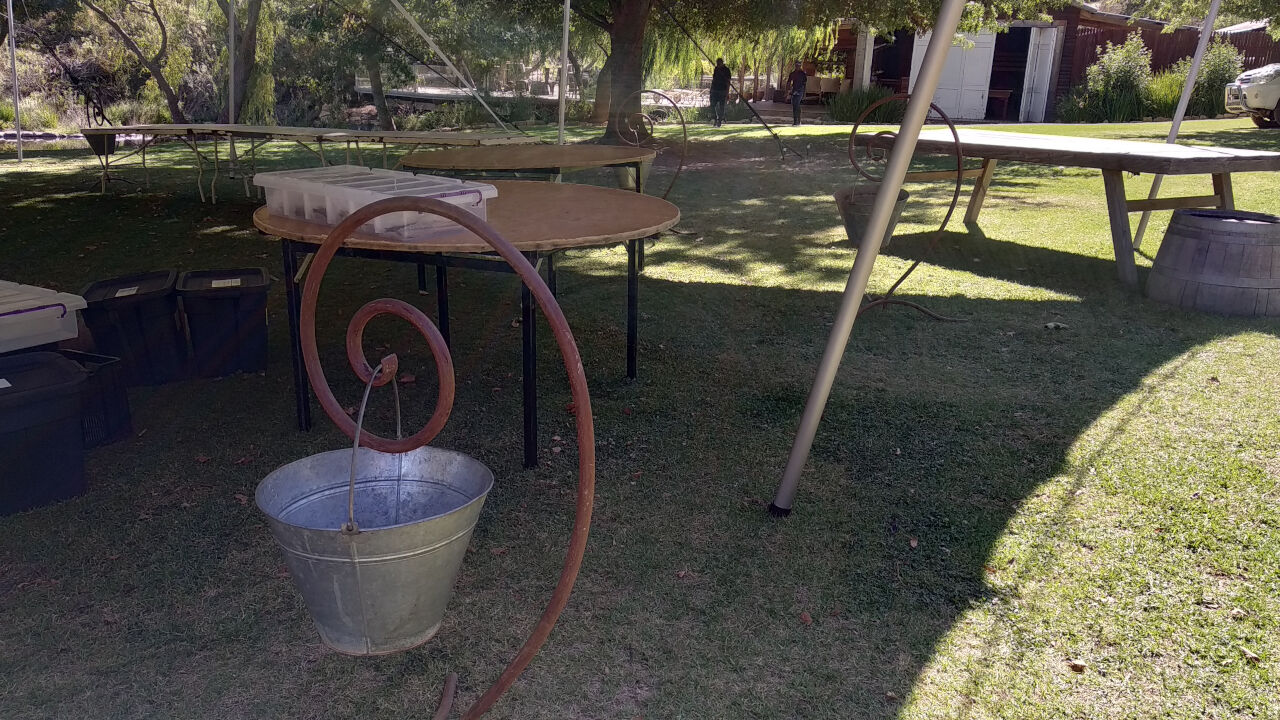
When the wedding co-ordinators started setting up, I noticed that there were all these swirls that almost looked like Debian logos. I asked Wouter if that was on purpose or just a happy accident. He said Hmm! I haven t even noticed that yet! , didn t get a chance to ask Tammy yet, so it could still be her touch.
Debian swirls everywhere
I took a canoe ride on the river and look what I found, a paddatrapper!

Kyle and I weren t the only ones out on the river that day. When the wedding ceremony started, Tammy made a dramatic entrance coming in on a boat, standing at the front with the breeze blowing her dress like a valkyrie.
A bit of digital zoomage of previous image.

Time to say the vows.

Just married. Thanks to Sue Fuller-Good for the photo.

Except for one character being out of place, this was a perfect fairy tale wedding, but I pointed Wouter to https://jonathancarter.org/how-to-spell-jonathan/ for future reference so it s all good.
Congratulations again to both Tammy and Wouter. It was a great experience meeting both their families and friends and all the love that was swirling around all weekend.

Debian Package Uploads 2020-02-07: Upload package calamares (3.2.18-1) to Debian unstable. 2020-02-07: Upload package python-flask-restful (0.3.8-1) to Debian unstable. 2020-02-10: Upload package kpmcore (4.1.0-1) to Debian unstable. 2020-02-16: Upload package fracplanet (0.5.1-5.1) to Debian unstable (Closes: #946028). 2020-02-20: Upload package kpmcore (4.1.0-2) to Debian unstable. 2020-02-20: Upload package bluefish (2.2.11) to Debian unstable. 2020-02-20: Upload package gdisk (1.0.5-1) to Debian unstable. 2020-02-20: Accept MR#6 for gamemode. 2020-02-23: Upload package tanglet (1.5.5-1) to Debian unstable. 2020-02-23: Upload package gamemode (1.5-1) to Debian unstable. 2020-02-24: Upload package calamares (3.2.19-1) to Debian unstable. 2020-02-24: Upload package partitionmanager (4.1.0-1) to Debian unstable. 2020-02-24: Accept MR#7 for gamemode. 2020-02-24: Merge MR#1 for calcoo. 2020-02-24: Upload package calcoo (1.3.18-8) to Debian unstable. 2020-02-24: Merge MR#1 for flask-api. 2020-02-25: Upload package calamares (3.2.19.1-1) to Debian unstable. 2020-02-25: Upload package gnome-shell-extension-impatience (0.4.5-4) to Debian unstable. 2020-02-25: Upload package gnome-shell-extension-harddisk-led (19-2) to Debian unstable. 2020-02-25: Upload package gnome-shell-extension-no-annoyance (0+20170928-f21d09a-2) to Debian unstable. 2020-02-25: Upload package gnome-shell-extension-system-monitor (38-2) to Debian unstable. 2020-02-25: Upload package tuxpaint (0.9.24~git20190922-f7d30d-1~exp3) to Debian experimental.

Debian Mentoring 2020-02-10: Sponsor package python-marshmallow-polyfield (5.8-1) for Debian unstable (Python team request). 2020-02-10: Sponsor package geoalchemy2 (0.6.3-2) for Debian unstable (Python team request). 2020-02-13: Sponsor package python-tempura (2.2.1-1) for Debian unstable (Python team request). 2020-02-13: Sponsor package python-babel (2.8.0+dfsg.1-1) for Debian unstable (Python team request). 2020-02-13: Sponsor package python-pynvim (0.4.1-1) for Debian unstable (Python team request). 2020-02-13: Review package ledmon (0.94-1) (Needs some more work) (mentors.debian.net request). 2020-02-14: Sponsor package citeproc-py (0.3.0-6) for Debian unstable (Python team request). 2020-02-24: Review package python-suntime (1.2.5-1) (Needs some more work) (Python team request). 2020-02-24: Sponsor package python-babel (2.8.0+dfsg.1-2) for Debian unstable (Python team request). 2020-02-24: Sponsor package 2048 (0.0.0-1~exp1) for Debian experimental (mentors.debian.net request). 2020-02-24: Review package notcurses (1.1.8-1) (Needs some more work) (mentors.debian.net request). 2020-02-25: Sponsor package cloudpickle (1.3.0-1) for Debian unstable (Python team request).

Debian Misc 2020-02-12: Apply Planet Debian request and close MR#21. 2020-02-23: Accept MR#6 for ToeTally (DebConf Video team upstream). 2020-02-23: Accept MR#7 for ToeTally (DebConf Video team upstream).

Antoine Beaupr : Moving dconf entries to git

I've been managing my UNIX $HOME repository with version control for almost two decades now (first under CVS, then with git). Once in a while, I find a little hack to make this work better. Today, it's dconf/gsettings, or more specifically, Workrave that I want to put in git. I noticed my laptop was extremely annoying compared with my office workstation and realized I never figured out how to write Workrave's configuration to git. The reason is that its configuration is stored in dconf, a binary database format, but, blissfully, I had forgotten about this and tried to figure out where the heck its config was. I was about to give up when I re-remembered this, when I figured I would just do a quick search ("dconf commit to git") and that brought me to Josh Triplett's Debconf 14 talk about this exact topic. The slides are... a little terse, but I could figure out the gist of it. The key is to change the DCONF_PROFILE environment to point to a new config file (say in your .bashrc):
export DCONF_PROFILE=$HOME/.config/dconf/profile
That file (~/.config/dconf/profile) should be created with the following content:
user-db:user
service-db:keyfile/user
  1. The first line is the default: store everything in this huge binary file.
  2. The second is the magic: it stores configuration in a precious text file, in .config/dconf/user.txt specifically.
Then the last step was to migrate config between the two. For that I need a third config file, a DCONF_PROFILE that has only the text database so settings are forcibly written there, say ~/.config/dconf/profile-edit:
service-db:keyfile/user
And then I can migrate my workrave configuration with:
gsettings list-recursively org.workrave   while read schema key val ; do DCONF_PROFILE=~/.config/dconf/profile-edit gsettings set "$schema" "$key" "$val" ; done
Of course, a bunch of those settings are garbage and do not differ from the default. Unfortuantely, there doesn't seem to be a way to tell gsettings to only list non-default settings, so I had to do things by hand from there, by comparing my generated config with:
DCONF_PROFILE=/dev/null gsettings list-recursively org.workrave
I finally ended up with the following user.txt, which is now my workrave config:
[org/workrave/timers/daily-limit]
snooze=1800
limit=25200
[org/workrave/timers/micro-pause]
auto-reset=10
snooze=150
limit=900
[org/workrave/timers/rest-break]
auto-reset=600
snooze=1800
limit=10800
[org/workrave/breaks/micro-pause]
max-preludes=0
That's a nice setup: "YOLO" settings end up in the binary database that I don't care about tracking in git, and a precious few snowflakes get tracked in a text file. Triplett also made a command to change settings in the text file, but I don't think I need to bother with that. It's more critical to copy settings between the two, in my experience, as I rarely have this moment: "oh I know exactly the key setting I want to change and i'll write it down". What actually happens is that I'm making a change in a GUI and later realize it should be synchronized over. (It looks like Triplett does have a tool to do those diffs and transitions, but unfortunately git://joshtriplett.org/git/home doesn't respond at this time so I can't find that source code.) (Update: that git repository can be downloaded with:
git clone https://joshtriplett.org/git/home
It looks like dconfc is designed to copy settings between the two databases. So my above loop would be more easily written as:
dconf dump /org/workrave/   DCONF_PROFILE=~/.config/dconf/profile-edit dconf load /org/workrave/
Certainly simplifies things. dconfd is also nice although it relies on the above dconfe script which makes it (IMHO) needlessly hard to deploy.) Now if only Firefox bookmarks were reasonable again...

Russell Coker: Amazon Prime and Netflix

I ve been trying both Amazon Prime and Netflix. I signed up for the month free of Amazon Prime to watch Good Omens and Picard . Good Omens is definitely worth the effort of setting up the month free of Amazon Prime and is worth the month s subscription if you have used your free month in the past and Picard is ok. Content Amazon Prime has a medium amount of other content, I m now paying for a month of Amazon Prime mainly because there s enough documentaries to take a month. For reference there are plenty of good ones about war and about space exploration. There are also some really rubbish documentaries, for example a 2 part documentary about the Magna Carta where the second part starts with Grover Norquist claiming that the Magna Carta is justification for not having any taxes (the first part seemed ok). Netflix has a lot of great content. A big problem with Netflix is that there aren t good ways of searching and organising the content you want to watch. It would be really nice if Netflix could use some machine learning for recommendations and recommend shows based on what I ve liked and also what I ve disliked. On both Netflix and Amazon when you view the details of a show it gives a short list of similar shows which is nice. With Amazon I have no complaints about that. But with Netflix the content library is so great that you get lost in a maze of links. On the Android tablet interface for Netflix it shows 12 similar shows in a grid and on the web interface it s a row of 20 shows with looped scrolling. Then as you click a different show you get another list of 12/20 shows which will usually have some overlap with the previous one. It would be nice if you could easily swipe left on shows you don t like to avoid having them repeatedly presented to you. On Netflix I ve really enjoyed the Altered Carbon series (which is significantly more violent than I anticipated), Black Mirror (the episode written by Trent Reznor and starring Miley Cyrus is particularly good), and Love Death and Robots . Overall I currently rate Love Death and Robots as in many ways the best series I ve ever watched because the episodes are all short and get straight to the point. One advantage of online video is that they don t need to pad episodes out or cut them short to fit a TV time slot, they can use as much time as necessary to tell the story. Watch List Having a single row of shows to watch is fine for the amount of content that Amazon has, but for the Netflix content you can easily get 100 shows on your watch list and it would be good to be able to search my watch list by genre (it s a drag to flick through dozens of icons of war documentaries when I m in the mood for an action movie as the icons are somewhat similar). As well as a list of shows you selected to watch Netflix has a list of shows that have been recently watched with no way to edit it which is separate from the list of shows selected to watch. So if you watch 5 minutes of a show and decide that it sucks then it stays on the list until you have partially watched 10 other shows recently. For my usage the recently watched list is the most important thing as I m watching some serial shows and wouldn t want to go through the 100 shows on my watch list to find them. If I ve decided that a movie sucked after watching a bit of it I don t want to be reminded of it by seeing the icon every time I use Netflix for the next month. Amazon has only a single watch next list for shows that you have watched recently and shows that you selected as worth watching. It allows editing the list which is nice, but then Amazon also often keeps shows on the list when you have finished watching them and removed them from the to watch setting. Amazon s watch list is also generally buggy, at one time it decided that a movie was no longer available in my region but didn t let me remove it from the list. Quality Apparently the Netflix web interface on Linux only allows 720p video while the Amazon web interface on all platforms is limited to 720p. In any case my Internet connection is probably only good enough for 1080p at most. I haven t noticed any quality differences between Netflix and Amazon Prime. Multiple Users Netflix allows you to create profiles for multiple users with separate watch lists which is very handy. They also don t have IP address restrictions so it s a common practice for people to share a Netflix account with relatives. If you try to use Netflix when the maximum number of sessions for your account is in use it will show a list of what the other people on your account are watching (so if you share with your parents be careful about that). Amazon doesn t allow creating multiple profiles, but the content isn t that great. The trend in video streaming is for proprietary content to force users to subscribe to a service. So sharing an Amazon Prime account with a few people so you want watch the proprietary content would make sense. Watching Patterns Sometimes when I m particularly distracted I can t focus on one show for any length of time. Both Amazon and Netflix (and probably all other online streaming services) allow me to skip between shows easily. That s always been a feature of YouTube, but with YouTube you get recommended increasingly viral content until you find yourself watching utter rubbish. At least with Amazon and Netflix there is a minimum quality level even if that is reality TV. Conclusion Amazon Prime has a smaller range of content and some really rubbish documentaries. I don t mind the documentaries about UFOs and other fringe stuff as it s obvious what it is and you can avoid it. A documentary that has me watching for an hour before it s revealed to be a promo for Grover Norquist is really bad, did the hour of it that I watched have good content or just rubbish too? Netflix has a huge range of content and the quality level is generally very high. If you are going to watch TV then subscribing to Netflix is probably a good idea. It s reasonably cheap, has a good (not great) interface, and has a lot of content including some great original content. For Amazon maybe subscribe for 1 month every second year to binge watch the Amazon proprietary content that interests you.

1 March 2020

Enrico Zini: Online aggression links

Sealioning - Wikipedia
privilege archive.org
Sealioning (also spelled sea-lioning and sea lioning) is a type of trolling or harassment which consists of pursuing people with persistent requests for evidence or repeated questions, while maintaining a pretense of civility and sincerity.[1][2][3][4] It may take the form of "incessant, bad-faith invitations to engage in debate".[5]
Tone policing (also tone trolling, tone argument, and tone fallacy) is an ad hominem (personal attack) and antidebate tactic based on criticizing a person for expressing emotion. Tone policing detracts from the validity of a statement by attacking the tone in which it was presented rather than the message itself.
"A brawler who tattoos a message onto his knuckles does not throw every punch with the weight of First Amendment protection behind him," the brief stated. "Conduct like this does not constitute speech, nor should it. A deliberate attempt to cause physical injury to someone does not come close to the expression which the First Amendment is designed to protect."
It s no secret that times are changing. It used to be that men were men, jokes were jokes, and all facts came from one white guy in a suit who you trusted because he looked like your dad. Now I know I could get in a lot of trouble for just saying this, but I don t care because someone has to tell the truth: These days, you can t say anything racist at all without being called a racist.
Russia's neighbor has developed a plan for countering misinformation. Can it be exported to the rest of the world?
So, I wrote my BIFF Response but Marvin wrote me another angry email. Actually, he wrote 6 more this week, so what s up with that? Why didn t he stop after my first email?
The BIFF Response Method will teach you how to respond to angry emails, texts, or social media posts while maintaining your dignity and personal power.

Next.

Previous.