Search Results: "ean"

12 July 2011

John Goerzen: First Look at Google Plus

Seems like everybody s writing Google+ reviews these days, but most of the ones I ve found seem to be fluff pieces. I haven t used it long, but have some initial impressions to share. First, an analogy. Facebook reminds me of the sleazy guy selling stuff from his car down the street. They do things like change privacy defaults when they think it s good for Facebook, rather than good for you. Google+ reminds me of an Apple product. It s beautiful, easy to learn, but locks everything down and is lacking some critical features. So here goes with the details. The good I think that this can be best summed up by: it s not Facebook. Facebook has, perhaps, set an incredibly low bar but still, this holds. Facebook is the only website I can ever remember using that changes things so much, so often, and so completely that I keep having this feeling of not knowing how to do things. Try maintaining a Facebook page or two and you ll especially feel my pain then. But even the basics: how many times have I accidentally posted a partial comment because I pressed Enter to start a new paragraph (that has only been the button used for that for, hmm, let s see now, decades), and instead it posted the comment. Principle of least surprise, anyone? Google+ has a simple and, on the surface anyway, intuitive interface. However, it does get muddy; more on that below. I m going to spend a lot more space on the bad below, but don t let that diminish my excitement about having a viable alternative to Facebook. I am keen to get rid of that monster. The Bad I ll start of this section with the fact that Google+ is a tightly-controlled walled garden. There is no way to take a copy of your status updates, comments, etc. and back them up with your own devices. If your Google account goes away, so do all your updates about your kids first words. Facebook does have this feature these days. It has broken half the time, but it exists, works, and I use it. Twitter doesn t have the feature built in, but its API makes it pretty easy; you could easily use my twidge program to do this, for instance. But whatever you put in G+ stays in G+. There is no autoposting it to twitter or Facebook, no backups, nothing. I m disappointed in that, given Google s prior attitude about openness to individual data ownership. (Update 7/12/2011: There is a way to get a backup, which I hadn t noticed; see comments below.) Almost as bad, there s also no way to get data in. So I now have identi.ca, twitter, Facebook, and now also G+ accounts. When I post an item in identi.ca, it autoposts to twitter, and then it autoposts from twitter to Facebook. Handy one place to notify people of my public activities. My uploads to Flickr and blog posts also auto-post to Facebook, so people I m friends with there get a picture of what I m doing outside of Facebook without me manually having to link it in. Not so with G+. There is no way to even add an RSS feed for my blog to auto-post to G+ as there is with Facebook. If you use G+, the only way to get stuff into it is with a keyboard. Poor integration with other Google apps is also an issue. G+ is nowhere near Google s first social app. They also have Blogger, Google Reader, Buzz, Gmail, etc. So here s the rub. These aren t integrated well, and when they have tried to integrate them, they ve done an exceedingly poor job of it. As an example: Buzz is a twitter-like service for posting updates. Very similar to what G+ does, right? Well, the best you can do is link your Buzz account to a separate tab on your profile. You can t even have your Buzz updates flow straight into G+, from what I can see. You have a separate list of followers in Buzz from G+. Reader is even worse; it has a sharing feature, but it s not G+ aware, so it goes to a reader inbox. But what takes the cake is the integration with Gmail Contacts. Sounds easy? Not entirely. When you add someone to G+, apparently it sometimes links the record with their entry in Contacts. And the help gives you the handy warning that when you remove them from G+, you have the option of removing them from Contacts, which could impact what you see on a mobile device. It is unclear what happens when it doesn t link the record, or how it decides which record to link (some people have more than one person in a family sharing phone numbers and email addresses, for instance.) One very nice feature of G+ is you can add email addresses, even if they aren t G+ members. Then when you post updates to the circle you ve added them to, G+ offers to send them an email with an update. Very handy. Except the undocumented part is that if you select Your circles (meaning all your circles), rather than individually ticking the box by each circle, they don t get the email. And they also don t get it if you set it Public. You have to select their specific circle, which is a significant difference from how people with G+ accounts are treated. And that s just an example. There are a ton of things that work one way 95% of the time, but have non-obvious exceptions. Some of these exceptions are documented in the help, and some aren t. I m still confused about the integration with Picasa. G+ help says that you can upload unlimited numbers of photos for free (though they will be downscaled at a certain point). Picasa has definite storage limits. But G+ uploads are showing up in Picasa. Do I really get free storage by uploading to the same place via a different tool? Very odd. And finally, a gripe about web standards. I ve been using Firefox/Iceweasel 3.5, which came out in Debian squeeze and is still supported there. It is also pretty darn new by corporate IT standards. And Google Plus refuses to let me log in with it, saying it s incompatible. Perhaps it can t do some fancy animation, but then again I don t really care. Seems Google has forgotten the old RFC adage: be liberal in what you accept and conservative in what you generate. If you can detect that my browser won t animate something right, then you could give me a stripped-down version of the page rather than an error message.

11 July 2011

Thorsten Glaser: Yugoslawia, I ll be back

So yes, this means I m going to DebConf 11 to what used to be Yugoslawia when I was there the last time, although in the Pore region of Istria, Hrvatska. Thanks to my my boss who s sending me there.

10 July 2011

Christian Perrier: 33094 spam posts removed from Debian mailing lists in two years

Debian mailing lists' standard policy is to allow posts from unsubscribed users. That of course fits our standards for opened development but has the drawback of allowing a lot of spam to reach our mailing lists. This spam also clutters the mailing lists archives. Since 2009, a working system allows removing spam from the mailing list archives. Today, I would like to put some light on the results of this system : Results are impressive for mailing lists where a coordinated effort is done over time: the debian-boot mailing list (first coorindated effort, initiated by regretted Frans Pop), the Italian and French mailing lists. You want to help? You can. Reporting spam is as easy as reading Debian mailing lists. When you see a mail that you consider being a spam mail, just bounce it to report-listspam at lists dot debian dotte org. Don't forward it, you need to bounce it ("b" keyboard shortcut in mutt). Alternatively, you can check for this message on Debian mailing lists archives and hit the "Report as spam" button. If you're a Debian developer, you can help in reviewing nominated spam. It takes me about 20 minutes every week. Go to the spam review home page and register for an account there. Then, you'll be able to process through nominated posts. Once a given post is confirmed as spam by at least 3 reviewers with nobody else reporting it as "ham", it is removed the next week from the archive. Feel free to join the game and be part of the Debian moppers team!

9 July 2011

Stefano Zacchiroli: debconf11 video hardware

And Now For Something Completely Different There are those weird coincidences that flock together and have the power of subverting initial expectations. Something like that has happened to me this week, when I've ended up spending a considerable amount of my IRILL work time (you know, something like 1000% of it) as a Debian Video Team volunteer. Mean as I am, I'm not going to explain the concatenation of coincidences. Suffices to say that most of the video hardware meant to be used at DebConf11 ended up being in my IRILL office. Of course all of it for about 200 kg and 2000 liters was in need of some inventory, packing, and shipment love. Together with Holger, Mehdi, and Etci we have tamed all of it. The following box miscellanea will therefore soon be on its way to Banja Luka:
DebConf11 video hardware
As an undesirable side effect, I had to join Bdale's knows more about ATA than he'd like to -club.
Holger opted not to join the club and I really can't blame him.

Wouter Verhelst: Freedom, continued

Okay, so the story continues: Joe Brockmeier has posted a rebuttal to Nina Paley's post that I commented on earlier today. Basically, Joe says that Culture is not the same things as Software, and gives a lot of arguments as to why this would be true. But I can't agree with him. Let's see why. His first argument is "One of these things is not like the other". As in,
But it's far more reasonable and sensible to discuss Perl scripts and software written in assembler embedded on a chip together, and the rights that they come with, than to try to talk about rights to modify sculpture and essays.
I don't see how one could combine a perl script with an embedded assembler program, except perhaps over a network, or by using exec() two cases in which the FSF would consider that they are not even derivatives anymore, they are "at arm's length", and it would be legal to do something like this if one bit was released under the GPL while the other was not. At the same time, it's possible to engrave (part of) an essay into a statue, for example. Or make a technical apparatus which looks like a statue but which will play music if you come near it. Both would be valid cases of some artist combining two separate and (at first sight) distinct things into one work.
Sure, you could crowdsource sculpture, but I doubt it will have much practical application. (And certainly difficult over the Internet, but I digress...)
It's called RepRap, and it's very much possible over the Internet. Joe moves on, with 'Unintended consequences of forkable prose'.
Take the GNU Manifesto, for example. If you could "fork" the manifesto, I could easily see variant versions modified to justify open source instead of free software.
This argument had been brought forward during the discussions which Debian had on the GFDL vote, and has been seriously debunked there. In short: the ability and right to fork someone's prose does not, in any way, give you the right to misrepresent them. While I believe it should be okay for someone to base a theoretical Open Source Manifesto on the GNU Manifesto, I do not believe it should be okay for them to still keep calling it the GNU Manifesto. It's not the same thing anymore, so that should be clear. This is true within Free Software as well: if you fork, you give it a new name, so it becomes clear that you're not the original anymore. Moreover, I doubt the kind of prose found in the GNU Manifesto is the same kind of prose that Nina would like to see in a free culture movement. Not because the GNU Manifesto is a bad piece of writing it isn't but because Free Culture likely focuses on other things than manifestos. Next, we get "Solving a problem that doesn't exist"
The spark that fired off the GNU revolution was a legitimate problem because of non-free code, a user was unable to make use of hardware they (or their university) legitimately owned.
(...)
While Paley and others may want the same freedoms to go with cultural works, it is not a real problem in the same sense.
Pardon ye me? I am a musician. Not a very brilliant one, mind you, but I play the flute with much enthusiasm, and have done so in a number of places. If you've been to any debconf since 2007, surely you must've heard me play. Also, I've been singing in choirs since I was sixteen which, I just realized, means I've now been singing for more than half my lifetime. Time flies, it must be said. One of the orchestra that I've been playing in was an extended flute choir with a rather unusual instrumentarium: apart from 30-something flautists, the orchestra also had a piano and drummer, a number of guitar players, and a bass guitar. Such an unusual set of music means you have three options: you play original music, written specifically for your group; you play something written for a different set of instruments, without changing anything, and hope nobody notices that it doesn't actually sound very well; or you make modifications. You make a derivative work of the music, so you can actually play it. There, I've said the word. This isn't just true for music; I've yet to see the first theatre performance that is true, word-for-word, to the original script. Also, movies use music all the time. When they do, there are usually two options: either they have original pieces of music written specifically for their movie (as is the case for most Hollywood blockbusters), or they take a piece of existing music, and adapt it so it fits the events in the movie better. By, say, shortening it, so it doesn't run into the next scene. Or by repeating the refrain an extra time, so the words line up nicely with the action. Or by having a group of musicians record a version of that piece specifically for your movie, which is the same thing in everything except the speed so that the feet of the actor walking on the big screen hit the ground in sync with the music. Or... well. You get the idea. By claiming that artists have no need to modify and derive from others, the only thing Joe accomplishes is to show that he really, really, really doesn't know what the fuck he's talking about. Artists have a need to modify other artists' works all the time. The only difference with free software is that they either need to invoke the fair use clause, or need to pay big bucks to the original rightsholder. Sound familiar? Joe finishes up with stating that despite all of that, Free Culture is still possible. And:
That doesn't mean that free culture is impossible. It simply means that different standards apply.
Exactly: different standards apply. And why? There is no good reason for that. Because people make money from cultural works? Well, money is made from software, too, that has never been a good enough reason. Because Culture is not functional? How many in the Free Software movement would even be willing to only be doing software all the time, and not ever do anything remotely related to Culture? None, I would say. Culture is just as functional as Software, it just serves different functions. In the comments, Joe clarifies that he isn't against people preferring not to use the ND clause in the CC licenses they select, he's just against demanding that others do the same. That argument would make sense if not for the fact that the FSF demands, mostly, that Software Should Be Free!!1!. By not complaining about the GNU Manifesto, but complaining about Paley's "Rantifesto", which basically complains about the lack of such an environment in the free culture movement, Joe just makes a fool of himself. Anyway, 'nuff said.

Wouter Verhelst: On Software (and Cultural) Freedom

Nina Paley, author/actor/director/animatrist of the excellent sita sings the blues, blogs about the FSF's double standards when it comes to freedom. To the FSF, Software Should Be Free!!1!, and it is willing to go to great lengths to accomplish that. For example, the FSF will create dracionian requirements on their Hardware endorsement criteria, that will most likely render it unusable, just for the remote possibility that they might convert a single soul to their religion. They will add propaganda to their documentation, and slap on a license that makes it illegal for anyone to modify or remove that propaganda. They will claim to make an update to that license, just to make their friends happy, but then do not make any effort to finish the job. Most of all, the FSF is led by a person who deserves our respect for jumpstarting a movement that has made all this free software even possible, but whose atypical behaviour might be interfering with his message these days. I have stated before that I'm not a member of the FSF, and that 'I have my reasons'. In case you were wondering: the above are my reasons. I can't be a member of, or be supporting of, any organization that uses such double standards in anything. In the case of Debian, it took us a long time to come to the conclusion that the GNU FDL is a non-free license. And though we came to that conclusion through other arguments than "Culture should be free, too" (specifically, the arguments boiled down to "if it's digital, it's software, and software should be free"), I have since come to the conclusion that there is nothing special about 'digital stuff' that should mean it should be more free than 'non-digital stuff'. If I hand you a piece of music on a sheet of paper, why should you not have the right to redistribute and/or modify that, while you should have the exact same right if I were to hand you the exact same paper on a digital medium? That makes no sense. So, in short, I agree with you, Nina: there is no Free Culture movement, and that's a shame; and while it would be nice if the FSF were to take a lead role in guiding such a movement, I find it highly unlikely that they will. The FSF may claim they care about Freedom, that doesn't mean they do; they care about Software Freedom. And while that certainly was an issue thirty years ago, when the FSF was formed, it isn't so much anymore today. There can only be one conclusion: the FSF is obsolete.

7 July 2011

Dirk Eddelbuettel: Rcpp 0.9.5

A maintenance release version 0.9.5 of Rcpp is now on CRAN and in Debian. This release comprises a number of minor fixes, extensions as well as small additions to the documentation and examples which have accumulated since the last release in April. The complete NEWS entry is below; more details are in the ChangeLog file in the package and on the Rcpp Changelog page.
0.9.5   2011-07-05
    o   New Rcpp-FAQ examples on using the plugin maker for inline's
        cxxfunction(), and on setting row and column names for matrices
        
    o   New sugar functions: mean, var, sd
    o   Minor correction and extension to STL documentation in Rcpp-quickref
    o   wrap() is now resilient to NULL pointers passed as in const char *
    
    o   loadRcppModules() gains a "direct" argument to expose the module instead
        of exposing what is inside it
    o   Suppress a spurious warning from R CMD check on packages created with
        Rcpp.package.skeleton(..., module=TRUE)
    o   Some fixes and improvements for Rcpp sugar function 'rlnorm()'
    o   Beginnings of new example using OpenMP and recognising user interrupts
Thanks to CRANberries, there is also a diff to the previous release 0.9.4:
 ChangeLog                                                 74
 DESCRIPTION                                               10
 R/00_classes.R                                             3
 R/Module.R                                                16
 R/loadRcppModules.R                                       10
 R/populate.R                                              10
 R/tools.R                                                 13
 R/zzz.R                                                    3
 cleanup                                                    2
 inst/NEWS                                                 21
 inst/doc/Rcpp-FAQ.pdf                                  binary
 inst/doc/Rcpp-FAQ/Rcpp-FAQ.Rnw                            62
 inst/doc/Rcpp-extending.pdf                            binary
 inst/doc/Rcpp-introduction.pdf                         binary
 inst/doc/Rcpp-modules.pdf                              binary
 inst/doc/Rcpp-modules/Rcpp-modules.Rnw                     7
 inst/doc/Rcpp-package.pdf                              binary
 inst/doc/Rcpp-quickref.pdf                             binary
 inst/doc/Rcpp-quickref/Rcpp-quickref.Rnw                  59
 inst/doc/Rcpp-sugar.pdf                                binary
 inst/doc/Rcpp-unitTests.pdf                            binary
 inst/doc/Rcpp.bib                                          4
 inst/doc/unitTests-results/Rcpp-unitTests.html            18
 inst/doc/unitTests-results/Rcpp-unitTests.txt             49
 inst/examples/OpenMP                                   only
 inst/include/Rcpp/Module.h                                33
 inst/include/Rcpp/config.h                                 2
 inst/include/Rcpp/internal/wrap.h                          5
 inst/include/Rcpp/module/Module_generated_CppMethod.h   2902  +++++++++++++++++-
 inst/include/Rcpp/stats/random/rlnorm.h                   14
 inst/include/Rcpp/stats/random/rnorm.h                     4
 inst/include/Rcpp/sugar/functions/functions.h              3
 inst/include/Rcpp/sugar/functions/mean.h               only
 inst/include/Rcpp/sugar/functions/sd.h                 only
 inst/include/Rcpp/sugar/functions/sum.h                    4
 inst/include/Rcpp/sugar/functions/var.h                only
 inst/include/Rcpp/vector/Vector.h                          4
 inst/skeleton/zzz.R                                        1
 inst/unitTests/runit.wrap.R                               25
 man/CppClass-class.Rd                                      2
 man/loadRcppModules.Rd                                     6
 src/Module.cpp                                             1
 42 files changed, 3252 insertions(+), 115 deletions(-)
As always, even fuller details are on the Rcpp Changelog page and the Rcpp page which also leads to the downloads, the browseable doxygen docs and zip files of doxygen output for the standard formats. A local directory has source and documentation too. Questions, comments etc should go to the rcpp-devel mailing list off the R-Forge page

6 July 2011

John Goerzen: Geeks, Hobbies, and Free/Open Source: Feedback Wanted

I ve been thinking lately about ways to improve ways in which I interact with Free Software projects, and ways in which they interact with me. Before I proceed to take steps or make suggestions, I d like to see if others share my traits and observations. Here are some questions I have been thinking of. If you d like to help give me anecdotal evidence, please post a comment below this post. Identify the question numbers you are answering. It helps me if you can give specific examples, but if you don t have the time or memory for that, no problem. I will post my own answers in a day or two, but the point of this post is listening, not talking, so I ll not post them immediately. Hobbies (General any geeks) Examples: video games might be a challenging hobby (depending on the person) but in most cases aren t educational. A hobby might be video game playing or being a Debian developer. A sub-hobby might be playing GTA IV , playing RPGs , or maintaining mutt . Free/Open Source Hobbies Examples on F9: If, say, you are a long-time Perl user and have gone to Perl conferences, but now you are interested in Ruby, would your involvement with the Perl community cause you to avoid taking up the Ruby programming hobby? Or would it cause you to cut your ties with Perl less quickly than your changing interest might dictate? (This is a completely arbitrary example and isn t meant to start a $LANGUAGE thread.) Changes over time

5 July 2011

Rudy Godoy: Compute Clusters Integration for Debian Development and Testing Report 3

Hello this is the third report regarding my project. As usual, quick
summary first. From my last report I have progressed much little than I
would like but, as stated previously also, I m finishing semester
and between exams and projects it takes almost all my time. However, I m
free of academic duties next week and I ll double the speed on the project. What was done so far

- Started working on the modifications to the Eucalyptus code, as
expected.
I ve almost complete the code for the Libvirt s XML Domain
definition. I ve abstracted the wrapper in order to support a broader
number of arches. Previously it was tailored for supporting x86/amd64
based machines. The idea is to have a list of supported arches and
generate the XML file according that. For ARM some parameters and
elements are different than for the others. This would allow for
people to support another architectures, given they are well supported
by KVM-Qemu.
Started working on changes to util/data.c to make sure the correct
parameters are being passed to the XML generator and to libvirt kvm
calls.
- Define and start to setup the testing / demo environment. Basically
involves having one machine to run KVM as hypervisor so the Eucalyptus
handler uses it to run ARM kvm-qemu images.
- Over this weekend I ll be publising the code changes on my
website. Steffen suggested to create some docs regarding the progress
too. I ll do that once I feel I m on track again for my current
pending work, that s coding. What I ll be working over the next two weeks

- My primary goal is to catch up on the work pace and finish the neccesary
code for Eucalyptus to support ARM images. This means to finish
modifications to:
node/handlers_kvm.c handling nc creation. Little changes are need
here from what I ve indentified already.
util/data. c,h handling instance creation. This is the part where
most of the work shall be done. I ve started to work here already.
- Test the code I ve complete already and send the patches to the teams
involved. To date I m still working on a local environment, because no
usable patches have been generated already, just little pieces here
and there.
- Since this is a sort of gluing project, that is code here and there
and make it work together. I m in the process of finding a machine to
be able to test parts of it once they are complete. I m still
contacting people to get such machine, in anycase I gues I can manage
to get one myself. I can t use my current machine since it involves
reinstalling and working at the OS level.
- For the project s demo I ll use both machines, one as the front-end
and the kvm one for NCs (nodes). That s the goal. What is required after that

- I d like to release a package that includes my changes, so it can be
installed either from official packages or my own packages, this
involves:
Updating the packaging bits to the pkg-Eucalyptus repo.
Talking to upstream about it.
- Write the reference Steffen suggested. I believe that I can finish the first part in one week, because of the
work I ve done in the past weeks to understand the Eucalyptus code. I m
also will be talking more to the Eucalyptus team and also to the
maintainers about such changes. I guess that s all for now.

John Goerzen: The Lives of Others

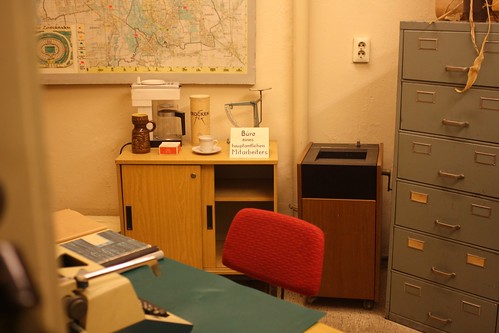
It s not very often that I watch a movie anymore. It s been a few years since I ve actually purchased one (normally I see them from Netflix). But yesterday I saw one that may change that. The Lives of Others is an incredible film set in the former East Germany (GDR/DDR) mostly in 1984. The authenticity of it is incredible and so is the story. It s subtitled, but if you re an American wary of subtitled European films, don t be wary of this one. It is easy to watch and worth every minute. The story revolves around the Stasi, the GDR Ministry for State Security ( secret police ). It is an incredible picture of what living in a police state was like, and how many of the informants were victims of the regime too. My breath caught near the beginning of the film, showing the inside of a Stasi building. A prisoner was being interrogated for helping someone attempt to escape to the west. But the reason my breath caught was this incredible feeling of I was there . Last year, Terah and I were in Leipzig and visited the Stasi museum there, Museum in der Runden Ecke . I always have an incredible sense of history when being in a preserved place, and this building was literally the Stasi headquarters for Leipzig. Much of it was preserved intact, and seeing it in the film brought home even more vividly the terrible things that happened in that building, and others like it, not so very long ago. IMG_2717 We watched the special features on the Blu-Ray disc, and one of them was an interview with director Florian Henckel von Donnersmarck. He described how he spent a lot of time interviewing both victims of the Stasi, as well as ex-Stasi officers. One of the most disturbing things to me was his almost offhand comment that most of the former Stasi officers still had some pride in performing their jobs well. Even now, freed of the state s ideology, they were proud of the work they did which could be put most charitably as ruining people s lives. What leads a person to view life that way? How can we try to make sure it doesn t happen again elsewhere? I am happy to say that most of us have never experienced anything like the Stasi. And yet, small reflections of that mindset can be seen almost everywhere. Societies at wartime or feeling under threat, even Western democracies, can drum up those feelings. In the USA, for instance, the McCarthyism era saw people s careers ruined for alleged anti-state behavior. Contemporary examples include the indefinite detention (I hate that word; shouldn t we say imprisonment ?) of terrorism suspects at Guantanamo Bay, and the terrible treatment of Bradley Manning, who revealed some true but embarrassing things about the US military which really needed to be revealed. Even tobacco farmers and companies are selling a product they know ruins lives, but somehow keep doing it. And there are still members of the public that try to make life difficult for people that don t think like they do. From organizing campaigns of telephone harassment of colleges that don t perform the American national anthem before sporting events, to tossing about the term un-American (a loaded McCarthyist one, which many may not even be aware) at an inflated rate, we are not immune from attempts at forcing conformity or silence in others, and blind loyalty to state. I am never in a particularly celebratory mood on July 4, the biggest day for American boasting, faux patriotism, militarism, and general flag-waving. We do have a lot to be proud of and thankful for, but it seems that we celebrate all the wrong things on July 4, and see it as an occasion to proclaim American exceptionalism rather than as one to see how far we ve come and bolster hope for how far we can, and should, yet go. No, I don t think that the land of the free ought to have operated secret prisons in Europe (nor the Europeans to have been complicit in it), or that the American military was defending our freedom 100% of the time they were deployed, or that it is right for governments to mandate daily recitation of an untrue document (the pledge of allegiance) in schools. And yet, I am mindful that I have a lot to be thankful for stability, lack of much internal violent conflict, etc. And this particular day I am happy that a post like this is not something that gets the attention of some government agency and mostly that I will have a handful of angry emails to delete.

4 July 2011

Nathan Handler: Google Summer of Code Report #3

Since my last report, a lot of visible changes have been made. First, if you edit the value of any of the text inputs on the dashboard table, your changes will be saved when you hit the submit button. This feature still needs a bit of work though. For example, I noticed during testing that if you submit the form multiple times, you will sometimes end up with approximately duplicate entries in the changes file (the file that stores user-submitted changes to the table). I also need to implement some checks to ensure that the values submitted are actually valid (i.e. we probably only want to allow a few possible values for the status column). Another big improvement is the addition of a graph at the bottom of each project s page. This graph tracks the number of open tasks versus time. The graph is re-generated once each day based on a progress file. This file simply lists a date and the number of open tasks on each line. While the graph does correctly show a line tracking the progress, it still has some issues to sort out. For example, the x-axis does not properly display a time increment. Work on the graph was blocked for a while due to not having a fully-functioning dashboard. Now that the dashboard is functioning, I should be able to start working on fixing these graph issues. Several people approached me to request the ability to link directly to a particular project. That way, users do not need to mess around with the select boxes. Above each table is a title. If you click on the title, the URL should update to link directly to the project. This is done with the distro and project query parameters. For example, a link to dex.html?distro=ubuntu&project=ancient-patches will take you directly to Ubuntu s ancient-patches project. Attempting to specify an invalid distro or project will cause the query parameters to be ignored. While looking at the table title, you will also notice a new (Graph) link. This link will take you directly to the bottom of the page so you can view the graph. Currently, it is not possible to link directly to the graph anchor tag of a specific project. Attempting to do so will cause the #graph portion of the URL to be ignored. However, if you click on the actual graph, it will load a full-size graph.png that you can link to. One rather significant issue that has shown up is that the table is very wide. On most monitors, you will have to scroll horizontally to view all of the columns. This is due to the fact that most of the cells are made up of text inputs (they don t have a background or border, but if you click on some text in the table, you should see the box) rather than plain text. The size parameter for a text input was meant to specify how many characters should be visible. However, while I have the size parameter set correctly for each input, it is showing up much wider than the text. I will continue to play around with this, since excluding the size parameter results in some values getting cut-off. As mentioned in my last report, I have continued to work with Allison Randal to make the dashboard more useful. I have received feedback directly from her and indirectly from other people working on the python2.7 project. During my last phone call with my mentor, Stefano Zacchiroli, we agreed that it would be very helpful to spend some time documenting how to go about adding a new project to the dashboard and how to utilize all of the dashboard s features. The goal of this is to not require people to go through me or any other individual to be able to use the dashboard. So while the Summer of Code is meant to focus on programming, I will probably spend some time adding some documentation, as a program is rather useless if nobody knows how to use it. Another bug that I will be working on has to do with sorting the table. I had this feature working early on in the project. However, the sorting broke when I starting using text inputs instead of plain text. I have done some research, and I hope to get the sorting re-implemented in the near future. One other feature that has been requested by several people is the ability to hide completed tasks. This has been on my todo list for a while. Matt Zimmerman wanted to take this a step farther. He felt that the status of the task should be separate from the bug. This means that you can have an open task with a closed bug or a closed task with an open bug. The user could then have some more control over what data they are seeing. I will probably attempt to add some check boxes to control whether certain information is displayed. The user will also be able to specify this directly in the URL. This means that a team could link directly to all open tasks in a project. It is also worth noting that thanks to some help from the fantastic Alioth admins, I now have a live instance of the dashboard running on Alioth. While the URL might change in the future, I hope to keep it running on Alioth. If you are interested in helping out with DEX or dextools, my code is available in a git repository on alioth. You can also join the debian-derivatives mailing list, join #debian-derivatives on OFTC, or contact me directly via email or on IRC (nhandler).

Ross Burton: System Defaults in GSettings

Note: Florian in the comments points me at the documentation (albeit rather concise) for this in the API documentation under Vendor Overrides. GSettings, like GConf before it, allows the administrator of a system to override the default settings or lock down keys to particular settings. This is well documented in the GNOME wiki. However GConf didn't really have the concept of vendor patches. Traditionally if a Vendor wanted to change a default (say, the wallpaper) they'd have to patch the GConf schemas directly. Luckily for people who maintain distributions, GSettings provides a way of installing vendor overrides directly. It's not documented as far as I can tell so consider this a first draft at the manual... First, find the setting you want to override, dconf-editor is useful for this. Say you're making a work-orientated custom distribution so you want the shell's popup calendar to show the week number by default. Some digging in dconf-editor leads us to the org.gnome.shell.calendar folder (the "schema") with a boolean key show-weekdate that defaults to false. By changing the default of this to true, all users will have work week shown unless they explicitly set it to false. Now we've found the information we need we can write the override file. Create a new file with the extension .gschema.override, such as mydistro-tweaks.gschema.override. This file is a .ini-style keyfile, logically mapping schemas to groups and key/value pairs to (predicable) key/value pairs. The value needs to be in the GVariant serialisation format, but for things like booleans, numbers and strings these are fairly obvious. So we'd have a file that looks a little something like this:
[org.gnome.shell.calendar]
  show-weekdate=true
Note that you can set multiple keys in multiple schemas in the same override file, so if we also wanted to show the date in the panel we'd have this:
[org.gnome.shell.calendar]
show-weekdate=true
[org.gnome.shell.clock]
show-date=true
Now the file is ready to be installed. Put it in a package, install to $prefix/share/glib-2.0/schemas and finally run glib-compile-schemas $prefix/share/glib-2.0/schemas in the post-install/post-remove hooks. Done! (many thanks to Ryan Lortie for telling me how vendor patches work)

Raphaël Hertzog: How to prepare patches for Debian packages

You want to start contributing to Debian and/or Ubuntu, you decided to help a package maintainer and you re now looking for how to change a source package and how to submit your changes. 1. Retrieve the source package and install build-dependencies The first step is to retrieve the latest version of the source package and to install the required build-dependencies. I already covered how to do this with apt-get in the article explaining how to rebuild a source package. If you prefer, you can use dget (from the devscripts package) to directly grab the source package. You can find the URL of the .dsc files in the Package Tracking System for example. Sometimes apt-get will warn you that the source package is maintained in a VCS repository, like this:
$ apt-get source wordpress
[...]
NOTICE: 'wordpress' packaging is maintained in the 'Git' version control system at:
git://git.debian.org/git/collab-maint/wordpress.git
[...]
In that case, you can use debcheckout to retrieve the VCS repository instead (provided that you have the corresponding VCS installed):
$ debcheckout wordpress
declared git repository at git://git.debian.org/git/collab-maint/wordpress.git
git clone git://git.debian.org/git/collab-maint/wordpress.git wordpress ...
Cloning into wordpress...
Note however that some maintainers use their VCS in a way that s not really compatible with the explanations that I will give below. It s also a good idea to install the package packaging-dev . It s a meta-package depending on the most common tools that are used for Debian packaging work. 2. Do the changes Execute dch --nmu to record the fact that you re working on an update prepared by someone who is not the maintainer (NMU means Non Maintainer Upload). This also ensures that if we build the package, we won t overwrite the original source package that we downloaded, thus making it possible to generate a diff between both versions. 2.1. Modify Debian packaging files Now fire your text editor and do the required changes in the debian sub-directory. You will probably run dch -a multiple times to document each subsequent change. 2.2. Modify upstream files If you have to modify upstream files, the proper way to do it depends on the source package format ( 1.0 vs 3.0 (quilt) vs 3.0 (native) , see the debian/source/format file) and on the presence or not of a patch system (the what-patch can help you identify it). In this explanation, I ll assume that the package is using the recommended format: 3.0 (quilt) . (It also works for 1.0 if quilt is used and if you configured ~/.quiltrc as recommended by /usr/share/doc/quilt/README.source). First you should ensure that all patches have been applied with quilt push -a. If there s no patch yet, you want to create the debian/patches directory (with mkdir debian/patches). 2.2.1. Import a patch If the upstream changes are already in a patch file (say /tmp/patch that you downloaded from the upstream VCS repository) you can import that patch like this:
$ quilt import -P fix-foobar.patch /tmp/patch
Importing patch /tmp/patch (stored as fix-foobar.patch)
$ quilt push
Applying patch fix-foobar.patch
[...]
Now at patch fix-foobar.patch
The -P option allows to select the name of the patch file created in debian/patches/. As you see, the new patch file is recorded in debian/patches/series but not applied by default, we re thus doing it with quilt push. 2.2.1. Create a new patch If the upstream changes that you want to make are not in a patch yet, you should tell quilt that you re going to create one:
$ quilt new fix-foobar.patch
Patch fix-foobar.patch is now on top
Then you must record every file that you re going to modify with a quilt add invocation. quilt then makes a backup of those files so that it can generate the patch later on. If you re going to modify the files with your text editor you can just do quilt edit file-to-modify, it s the same than quilt add file-to-modify followed by sensible-editor file-to-modify.
$ quilt edit foobar.c
File foobar.c added to patch fix-foobar.patch
The last step is tell quilt to generate the patch:
$ quilt refresh
Refreshed patch fix-foobar.patch
3. Test your changes You should build your modified package with debuild -us -uc . You can easily install the resulting package with debi . Verify that everything works as expected. If not, continue your modifications until you re satisfied with the result. 4. Generate a patch and mail it If you followed the instructions, you should have two .dsc files in the parent directory, like this:
$ cd ..
$ ls wordpress_*.dsc
../wordpress_3.0.5+dfsg-1.1.dsc
../wordpress_3.0.5+dfsg-1.dsc
Generating the patch to send to the maintainer is then just a matter of running debdiff:
$ debdiff wordpress_3.0.5+dfsg-1.dsc wordpress_3.0.5+dfsg-1.1.dsc >/tmp/wp-debdiff
You can send the /tmp/wp-debdiff file to the wordpress maintainer. Usually you send it via the bugreport that your update is fixing and you add the patch tag to the report. This can be automated with the nmudiff utility. By default it assumes that you re using mutt but it can also directly feed the resulting mail to sendmail. The default text that nmudiff proposes assumes that you re actually performing an NMU and that the result has been uploaded. If that s not the case, you should edit the text and make it clear that you re just sending a patch. If you have been working in a VCS repository, instead of using debdiff you can simply use the diff feature integrated in your VCS (git diff, svn diff, etc.). But note that with a distributed VCS (like git/bzr/mercurial, unlike svn) you should probably have committed all individual changes in separate changesets. And instead of sending a single patch, you re probably going to send a series of patches (though it might be easier to just upload your branch in a public repository and give the corresponding URL to the maintainer).
Found it useful? Be sure to not miss other packaging tips (or lessons), click here to subscribe to my free newsletter and get new articles by email.

No comment Liked this article? Click here. My blog is Flattr-enabled.

3 July 2011

Andrea Veri: Automatic Gmail s Trash & Spam folders cleanup

Since some time I ve been thinking about a possible way to delete my Gmail s Trash & Spam folders content automatically without having to bother doing it manually every single time I wanted to check my mail and clean it up. (I love keeping everything in place and having my Trash&Spam folders empty as they should be makes me pretty happy) A few years ago when Mutt was my main mail client I had the need to filter my mail through IMAP and while googling around for that I found out a great piece of software: imapfilter. Today while analyzing the above quoted issue I suddenly told myself: Hey, but why don t you use your dear and old friend imapfilter to fulfil your needs? After a few minutes I came up with a small lua script that was doing exactly what I wanted: my Trash&Spam folders are no longer crowded and I finally don t have to delete mails twice! But here they come a few details about my script:
options.timeout = 120
options.subscribe = true
account = IMAP  
 server = 'imap.gmail.com',
 username = 'example@gmail.com',
 password = 'password',
 ssl = 'ssl3'
  
trash = account['[Gmail]/Trash']:is_undeleted()
account['[Gmail]/Trash']:delete_messages(trash)
spam = account['[Gmail]/Spam']:is_unanswered()
account['[Gmail]/Spam']:delete_messages(spam)
The script does two things:
  1. It checks whether a mail is not marked as deleted (moving an e-mail into the Trash does not mark it as to be deleted automatically) already and removes it.
  2. It checks whether a mail on the Spam folder has been answered (I never had to answer a single e-mail contained into my Spam folder) and if not removes it.
Using the above script is really easy (you should run imapfilter on interactive mode first to generate Gmail s certificates, do that before having cron to run the script for you or otherwise it ll just hang), just make sure to have imapfilter installed on your system and then run it through cron every half an hour or less depending on your needs:
crontab -e
*/30 * * * * imapfilter -c /home/user/imapfilter.lua >> /home/user/imapfilter.log
Please also remember to setup appropriate permissions on the config file since it contains your Gmail s password and most of all make sure that your Spam folder is visible through IMAP (this option can be found on the label menu available under your Gmail s settings) otherwise imapfilter will just report an error. Enjoy!

Mesutcan Kurt: Python Multi-Build for Python Extensions Packaging - Report 3

<meta content="text/html; charset=utf-8" equiv="content-type">
Hello,

This is the third report of my GSoC project for Debian. During last two weeks
I've done most of things about the main tool. Before that weeks I have been
working on project's API. API is almost finished. Still I find missing/wrong
parts during the coding and changing the API design.

Like I said, main tool's coding process is nearly finished. For now It is doing
its job for building Python3.X packages. You can find the source code at [1].

I also coded an example plugin (actually only return values) and plugins/__init__.py
file which contains like Base class, exception classes and plugin listing method.

When I started coding I realized that I need extra parameters. I've added --install-dir
parameter. You can specify the install directory if there is no install directory the tools
pretends that the install directory is "./debian/tmp". After that it checks whether if the
directory exists. If not it creates the directory.

I've changed py3build.py a bit. First, I've thought for every process I invoke py3build's
methods but they are redundant. I've removed them. Now they are called in main
method of py3build.

I use logging module for printing messages, errors etc.

get_build_system() method retieves list from plugins/__init__.py file. In that file there is
scan_for_plugins() method. It finds all plugins in plugins/ directory which files match for
"[a-zA-Z].py". It keeps the list in plugins_list variable and returns that. When I'm writing
scan_for_plugins() method I've read codes (f.e. [2]) about that and decided to name all
plugins' class name as *BuildSystem*. Now, detecting method works with that way.
(all plugins' class' are called BuildSystem) And I've changed base class name to
BuildSystemBase.

get_build_system() method is used by determine_build_system() method. If there is given
build system (by parameter) it tries to use that. If that build system is not usable then give
error and exits. If there is no given build system. It invokes get_build_system() and iterates
that methods return value which is a list. When iterating It create an instance of that build
system class (if can not create then it gives warning and skips that build system plugin)
and invokes detect method and append plugin name and detect method's return value to
the bs_list which contains plugin list which are available. And then sorts it. If there is error
while sorting list or there is no usable plugin then give error and exits. If there is multiple
highest detect values then lists that plugins and exists. (maintainer should select one of
these plugins to build extension.)

In main method, after getting arguments, it checks for verbose mode (or 'DH_VERBOSE'
environment variable) and sets log level (logging.DEBUG or logging.WARN)

If there is no given build_dir then it pretends it is "./".

After that It try to determine build system. If can not then prints error and exits.

And finally it starts to build extension. Firstly it checks if there is given version list. If not,
it uses default values and iterates build loop with that values.

First cleans, configures, builds (if there is no --test-only arg) and tests (if there is --test-only
arg or there is not --no-tests argument)

If there is error (raises plugin.Error) while invoking that method then prints error and exits.

In verbose mode tool prints every process. (like "configuring for PythonX.Y" etc.)

I've started writing a plugin for detecting *distutils*. For now, I only wrote its detect method. It
returns between 0-1.0 floating point value. If everything is OK it returns 1.0. Other methods does
nothing, only returns True but this week I'll finish this plugin and work for others.

For detecting distutils I've used the code at [3]. First I try to import that module if not, I've copied
required methods to plugins/_packaging.py file, I use them.

I don't use is_distutils() method directly. For give probability I invoke what it invokes and give them
a number. (f.e. _has_setup_py has 0.5, _has_pkg_info has 0.25 and _has_distutil_text has 0.25.
But if _has_setup_py returns False then detect method doesn't look other methods since they
require setup.py.)

For now that's all. See you at next time.

[1] git://git.debian.org/~<wbr>mesutcan-guest/py3multibuild.<wbr>git
[2] http://svn.berlios.de/<wbr>viewvc/griffith/trunk/lib/<wbr>plugins/extensions/
[3] http://hg.python.org/<wbr>cpython/file/a7e00934baf1/Lib/<wbr>packaging/util.py

--
Mesutcan Kurt

Vincent Bernat: Dealing with missing locales on remote hosts

On my system, I happen to set LANG to fr_FR.utf8 and LC_MESSAGES to en_US.utf8. This means that applications should follow French cultural conventions for most things except for messages which should be displayed in US English. On my own system, /etc/locale.gen contains those two locales. However, when I connect to some random remote system, they may be unavailable. Most applications will fallback silently to C. However, Perl can be quite noisy:
$ perl -e 'print "Hello\n";'
perl: warning: Setting locale failed.
perl: warning: Please check that your locale settings:
        LANGUAGE = (unset),
        LC_ALL = (unset),
        LC_MESSAGES = "en_US.utf8",
        LANG = "fr_FR.utf8"
    are supported and installed on your system.
perl: warning: Falling back to the standard locale ("C").
Hello
This is an incredibly annoying message. I don t understand why we still need to bear it. Perl documentation explains how to get rid of this message. The simplest way is to set PERL_BADLANG environment variable to 0. Problem solved.
$ PERL_BADLANG=0 perl -e 'print "Hello\n";'
Hello
Well, no. Keep reading. When you connect to a remote host with ssh, all your environment variables are thrown away, except those defined in AcceptEnv directive in /etc/ssh/sshd_config file on the remote host. On Debian, this directive defaults to LANG LC_*. Since I cannot install my favourite locales on all hosts or fiddle environment variables on them, I use something like this in my .zshrc:
ssh()  
  [ -t 1 ] && echo -ne "\033]0;$@\007"
  LANG=C LC_MESSAGES=C =ssh "$@"
 
Unfortunately, on systems where my locales are present, I still fallback to the crappy C locale. I could just unset LANG and LC_MESSAGES to allow fallback to the proper default locale but if the remote system starts to speak Spanish, I will not be pleased. Moreover, the behaviour of C locale (also known as POSIX locale) is undefined with characters not in the portable character set. From IEEE Std 1003.1:
Conforming systems shall provide a POSIX locale, also known as the C locale. The behavior of standard utilities and functions in the POSIX locale shall be as if the locale was defined via the localedef utility with input data from the POSIX locale tables in Locale Definition. The tables in Locale Definition describe the characteristics and behavior of the POSIX locale for data consisting entirely of characters from the portable character set and the control character set. For other characters, the behavior is unspecified. For C-language programs, the POSIX locale shall be the default locale when the setlocale() function is not called. The POSIX locale can be specified by assigning to the appropriate environment variables the values C or POSIX.
There is no way to detect the locales installed on the remote system unless you connect to it. Starting a connection just to check the locale is too expensive. On my own systems, I use another snippet in .zshrc to reconfigure the locales to my favourite ones if they are available:
export LANG=C
export LC_MESSAGES=C
(( $+commands[locale] )) && function  
    local locales
    locales=( "LANG fr_FR.utf8 en_US.utf8 C.UTF-8 C" \
              "LC_MESSAGES en_US.utf8 fr_FR.utf8 C.UTF-8 C" )
    for locale in $locales; do
        for l in $=locale[(w)2,-1]; do
            if locale -a   grep -qx $l; then
                export $locale[(w)1]=$l
                break
            fi
        done
    done
  2> /dev/null
This is an interesting snippet which uses some ZSH features. Feel free to tell me if you have found a better way to handle this problem!

Dominique Dumont: Generate a configuration editor from a config template file with Perl: lcdproc example

Hello Creating a configuration model for Config::Model can be a boring task: When a configuration system has a lot of parameters, a lot of details need to be specified to have a complete configuration validation tool. So, all tricks are permitted to make this task more bearable. Let s see how this can be applied to lcdproc. This project requires a configuration file that supports more than 40 drivers. Each driver has it own set of parameters for a total of about 250 parameters. That s a lot to specify.. Fortunately, LCDd.conf template file is written in a way which makes it relatively easy to parse and get all required information to build a model. All drivers are listed in this template file, most parameters have default values and legal values are written in comments in a uniform way. Hence this file (and comments) can be parsed to retrieve information required for the model. This blog will describe how this task can be implemented in Perl using Config::Model modules. The code will be slightly trimmed down to keep this blog (relatively) short. All initialisation code and error checks are removed. You can get the whole script on sourceforge. The main steps are:
  1. prepare a parser for LCDd.conf template
  2. parse LCDd.conf template
  3. prepare a LCDd model skeleton
  4. translate LCDd.conf template information in a format suitable to create a model.
  5. Write the resulting LCDd model
First, here s the necessary incantation to start properly a Perl program:
use strict;
use warnings;
Then load all required libraries. Their use will be described later:
use Config::Model;
use Config::Model::Itself 1.225;
use Config::Model::Backend::IniFile;
use 5.10.0;
use IO::File;
use IO::String;
Perform some initialisation to avoid upsetting the logging system:
use Log::Log4perl qw(:easy);
Log::Log4perl->easy_init($WARN);
Let s also initialize a model object that will be very useful later:
my $model = Config::Model->new();
Now we can really start the fun part. Step 1: Create a parser for LCDd.conf (INI file)
Problem: LCDd.conf comments must also be analysed to get more semantic information. The comments must be retrieved and associated with the INI classes and parameters found in this file. Fortunately, Config::Model::Backend::IniFile is able to associate comments with the relevant parameters. But Config::Model::Backend::IniFile must store its values in a configuration tree. So let s create a model suitable for LCDd.conf template that accepts any INI class and any INI parameter Dummy::Class is used to store any parameter found in an INI class. The accept keyword with .* regular expression means that any INI parameter will be accepted in each INI class.
$model->create_config_class(
  name   => 'Dummy::Class',
  accept => [
    '.*' =>  
       type => 'leaf',
       value_type => 'uniline'
        ,
    ],
);
Now the Dummy model must provide a configuration class to hold all INI classes:
$model->create_config_class(
    name   => 'Dummy',
    accept => [
       '.*' =>  
           type => 'node',
           config_class_name => 'Dummy::Class'
        ,
    ],
);
Note that an INI backend could be specified directly here. But, some useful parameters are commented out in LCD.conf. Some some processing is required to be able to create a model with these commented parameters. See below for this processing. Step 2: Parse LCDd.conf Now the dummy configuration class is created. Let s create a configuration tree from this dummy class to store the data from LCDd.conf
my $dummy = $model->instance(
    instance_name   => 'dummy',
    root_class_name => 'Dummy',
)-> config_root;
Now, read LCDd.conf:
my $lcd_file
  = IO::File->new('examples/lcdproc/LCDd.conf');
my @lines    = $lcd_file->getlines;
And perform the pre-processing on LCDd.conf mentioned above. Just un-commenting commented parameters is required:
foreach (@lines)   s/^#(\w+=)/$1/  
Store the pre-processed LCDd.conf in a IO::Handle usable by INI backend
my $ioh = IO::String->new( join( '', @lines ) );
Create an INI backend to read the data from pre-processed LCDd.conf and store it in the configuration tree:
my $ini_backend = Config::Model::Backend::IniFile
  ->new( node => $dummy );
$ini_backend->read( io_handle => $ioh );
Step 3: Prepare LCDd configuration model Your attention please. You may remember that we invoked instance on object to create the dummy configuration tree to hold LCDd.conf data. The instance method used the Dummy configuration class. Now, we must invoke instance again on object. But this time, instance will use Config::Model::Itself. This model is Config::Model s way of eating its own dog food. The configuration tree created there will be able to hold LCDd model. Hence the root of this special configuration tree will be called meta_root to avoid confusion with the other configuration root defined above (for the Dummy model). Still with me? Good, let s create this meta tree that will contain LCDd model:
my $meta_root = $model->instance(
    root_class_name => 'Itself::Model',
    instance_name   => 'meta_model',
) -> config_root;
Create the main LCDd configuration class and store the first comment from LCDd.conf as class description:
my $first_comment = $dummy->annotation ;
$meta_root
  ->grab("class:LCDd class_description")
  ->store( $first_comment );
Append my own text in this description:
my $extra_description =
    "Model information extracted from template /etc/LCDd.conf"
  . "\n\n=head1 BUGS\n\nThis model does not support to load "
  . "several drivers. Loading several drivers is probably a "
  . "marginal case. Please complain to the author if this "
  . "assumption is false";
$meta_root->load(
     qq!class:LCDd
        class_description.="\n\n$extra_description"!
);
Add legal stuff in the model:
$meta_root->load( qq!
  class:LCDd
    copyright:0="2011, Dominique Dumont"
    copyright:1="1999-2011, William Ferrell and others"
    license="GPL-2"
!
);
Add INI backend so configuration object created from LCDd model will be able to read user s INI files:
$meta_root->load( qq!
  class:LCDd
    read_config:0
      backend=ini_file
      config_dir="/etc"
      file="LCDd.conf"
!
);
Note that all the load calls above could be done as one call. They were split for better clarity. Step 4:Extracting LCDd.conf information Now that all information from LCDd.conf template file is stored in $dummy configuration tree, it s time to use this information to enhance the skeleton of LCDd model created above. Let s first find all the INI classes defined in LCDd.conf:
my @ini_classes = $dummy->get_element_name;
Now before actually mining LCDd.conf information, we must prepare several subs to handle them. This is done using a dispatch table:
my %dispatch;
First create the default entry which will be used for most parameters. This subs is passed: the INI class name, the INI parameter name, the comment attached to the parameter, the INI value, and an optional value type. It will return a string describing a model for simple elements. For instance: class:"LCDd::MD8800" element:Device type=leaf value_type=uniline default="/dev/ttyS1" description="device to use [default: /dev/ttyS1]" Here s the subroutine invoked by default. Let s create a an anonymous subroutine and store it in the dispatch table:
$dispatch _default_  = sub  
    my ( $ini_class, $ini_param, $ini_note,
         $ini_v, $value_type ) = @_;
    $value_type  = 'uniline';
Now, prepare a string that will be used later to create the ini_class model. This string uses Config::Model s serialisation format described in Config::Model::Loader:
    my $load = qq!class:"$ini_class"
                  element:$ini_param type=leaf !;
Get semantic information from LCDd.conf template comments (written between square brackets):
    my $info = $ini_note =~ /\[(.*)\]/ ? $1 : '';
    $info =~ s/\s+//g;
Use this semantic information to better specify the parameter:
    $load .=
        $info =~ /legal:(\d+)-(\d+)/
           ? " value_type=integer min=$1 max=$2"
      : $info =~ /legal:([\w\,]+)/
           ? " value_type=enum choice=$1"
      :    " value_type=$value_type";
    if ( $info =~ /default:(\w+)/ )  
        # specify upstream default value
        # if it was found in the comment
        $load .= qq! upstream_default="$1"!
           if length($1);
     
    else  
        # or use the value found in INI
        # file as default
        $ini_v =~ s/^"//g;
        $ini_v =~ s/"$//g;
        $load .= qq! default="$ini_v"!
           if length($ini_v);
     
The model (in serialised format) is ready, let s return it and exit the subroutine:
    return $load;
 ;
Now let s take care of the special cases. This one deals with Driver parameter found in INI [server] class. This sub will create a string for an enum element. The possible values of the enum are extracted from the comment found in the LCDd.conf file:
$dispatch "LCDd::server" Driver  = sub  
    my ( $class, $elt, $info, $ini_v ) = @_;
    my $load = qq!class:"$class"
                    element:$elt
                      type=leaf
                      value_type=enum
    !;
    my @drivers = split /\W+/, $info;
    while ( @drivers
            and ( shift @drivers ) !~ /supported/ )  
      # nothing, the work is done by shift operator
      # in loop test to skip all words in $info until
      # 'The following drivers are supported:'.
      # ok, that's a hack
     
    $load .= 'choice='
          . join( ',', @drivers ) . ' ';
    return $load;
 ;
This sub invokes the default sub and add a small feature to the model to ensure that DriverPath ends with / . This is ensured by the match="/$" snippet:
$dispatch "LCDd::server" DriverPath  = sub  
    my ( $class, $elt, $info, $ini_v ) = @_;
    return   $dispatch _default_ ->(@_)
           . q! match="/$" !;
 ;
Likewise, this sub invokes the default sub with the optional 4th parameter that forces the value_type of the element. In this case, we enforce an integer element:
 $dispatch "LCDd::server" WaitTime 
 = $dispatch "LCDd::server" ReportLevel 
 = $dispatch "LCDd::server" Port 
 = sub  
    my ( $class, $elt, $info, $ini_v ) = @_;
    return $dispatch _default_ ->( @_, 'integer' );
   ;
This sub returns a string for a list element with default values:
  $dispatch "LCDd::server" GoodBye 
= $dispatch "LCDd::server" Hello 
= sub  
    my ( $class, $elt, $info, $ini_v ) = @_;
    my $ret = qq( class:"$class"
                    element:$elt
                      type=list
                ) ;
    $ret .= 'cargo type=leaf
             value_type=uniline - ' ;
    $ret .= 'default_with_init:0="\" '.$elt.'\"" ' ;
    $ret .= 'default_with_init:1="\" LCDproc!\""';
    return $ret ;
 ;
Now that the dispatch table is ready, let s really mine LCDd.conf information. First handle all INI classes in the foreach loop:
foreach my $ini_class (@ini_classes)  
Let s retrieve parameters for this INI class from the LCDd.conf template:
  my $ini_obj = $dummy->grab($ini_class);
This will be the name of the lcdproc driver configuration class (e.g. LCDd::imonlcd):
  my $config_class   = "LCDd::$ini_class";
The configuration class will also be created in a serialised format. Let s create config class in case there s no parameter in INI file:
  $meta_root->load(qq!class:"LCDd::$ini_class"!);
Now, loop over all INI parameters and create LCDd::$ini_class elements:
  my @all_ini_params = $ini_obj->get_element_name ;
  foreach my $ini_param ( @all_ini_params )  
Retrieve the value provided in template LCDd.conf:
    my $ini_v = $ini_obj->grab_value($ini_param);
Retrieve the comment attached to the value provided in template LCDd.conf:
    my $ini_comment
      = $ini_obj->grab($ini_param)->annotation;
    # escape embedded quotes
    $ini_comment =~ s/"/\\"/g;
Retrieve the correct sub from dispatch table:
    my $sub = $dispatch $config_class $ini_param 
              $dispatch _default_ ;
Run the sub to get the model string:
    my $model_spec
      = $sub->( $config_class, $ini_param,
                   $ini_comment, $ini_v );
Attach the comment from LCDd.conf as class description:
    $model_spec .= qq! description="$ini_comment"!
      if length($ini_comment);
Then, last but not least, load class specification in the model, and end the loop aroung INI parameters:
    $meta_root->load($model_spec);
   
Now create a an $ini_class element in LCDd class (to link LCDd class and LCDd::$ini_class):
  my $driver_class_spec = qq!
    class:LCDd
      element:$ini_class
  ! ;
Since server and menu are not drivers, they have a special treatment:
  if (   $ini_class eq 'server'
      or $ini_class eq 'menu' )  
    $driver_class_spec .= qq!
      type=node
      config_class_name="LCDd::$ini_class"
    ! ;
   
Here s the treatment for LCDd drivers. Setup the model with a warped node so that a driver configuration class is shown only if the driver was selected in the [server] class:
  else  
    $driver_class_spec .= qq!
      type=warped_node
      config_class_name="LCDd::$ini_class"
      level=hidden
      follow:selected="- server Driver"
      rules:"\$selected eq '$ini_class'"
        level=normal
    !;
   
Now we can load the LCDd driver model in meta root:
  $meta_root->load($driver_class_spec);
 
Step 5: save LCDd model Still with me ? Good. Here s the last part, now that the model was created in memory, let s save it in files. Config::Model::Itself constructor returns an object to read or write the data:
my $rw_obj = Config::Model::Itself
     ->new( model_object => $meta_root );
say "Writing all models in file (please wait)";
$rw_obj->write_all(
    model_dir => 'lib/Config/Model/models/'
);
That s it. Once this script is run, the directory lib/Config/Model/models/ contains a bunch of files: You can see the resulting editor in my first blog on lcdproc. Conclusion and future steps (with you?) As mentioned at the end of this blog, the result of this model generation process is far from perfect, because the information retrieved from LCDd.conf template are not complete for this task (which is normal since these comments were targeted for users). Now, I d really like to discuss with project developers to improve configuration template to generate better models. For project owner, such an improvement would give them: Please leave a comment on this blog (or send a message to config-model-users at lists.sourceforge.net) if you are interested in configuration tool generation for a project you contribute to. All the best

2 July 2011

Joey Hess: databranches: using git as a database

I've just released git-annex version 3, which stops cluttering the filesystem with .git-annex directories. Instead it stores its data in a git-annex branch, which it manages entirely transparently to the user. It is essentially now using git as a distributed NOSQL database. Let's call it a databranch. This is not an unheard of thing to do with git. The git notes built into recent git does something similar, using a dynamically balanced tree in a hidden branch to store notes. My own pristine-tar injects data into a git branch. (Thanks to Alexander Wirt for showing me how to do that when I was a git newbie.) Some distributed bug trackers store their data in git in various ways. What I think takes git-annex beyond these is that it not only injects data into git, but it does it in a way that's efficient for large quantities of changing data, and it automates merging remote changes into its databranch. This is novel enough to write up how I did it, especially the latter which tends to be a weak spot in things that use git this way. Indeed, it's important to approach your design for using git as a database from the perspective of automated merging. Get the merging right and the rest will follow. I've chosen to use the simplest possible merge, the union merge: When merging parent trees A and B, the result will have all files that are in either A or B, and files present in both will have their lines merged (and possibly reordered or uniqed). The main thing git-annex stores in its databranch is a bunch of presence logs. Each log file corresponds to one item, and has lines with this form:
timestamp [0 1] id
This records whether the item was present at the specified id at a given time. It can be easily union merged, since only the newest timestamp for an id is relevant. Older lines can be compacted away whenever the log is updated. Generalizing this technique for other kinds of data is probably an interesting problem. :) While git can union merge changes into the currently checked out branch, when using git as a database, you want to merge into your internal-use databranch instead, and maintaining a checkout of that branch is inefficient. So git-annex includes a general purpose git-union-merge command that can union merge changes into a git branch, efficiently, without needing the branch to be checked out. Another problem is how to trigger the merge when git pulls changes from remotes. There is no suitible git hook (post-merge won't do because the checked out branch may not change at all). git-annex works around this problem by automatically merging */git-annex into git-annex each time it is run. I hope that git might eventually get such capabilities built into it to better support this type of thing. So that's the data. Now, how to efficiently inject it into your databranch? And how to efficiently retrieve it? The second question is easier to answer, although it took me a while to find the right way ... Which is two orders of magnitude faster than the wrong way, and fairly close in speed to reading data files directly from the filesystem. The right choice is to use git-cat-file --batch; starting it up the first time data is requested, and leaving it running for further queries. This would be straightforward, except git-cat-file --batch is a little difficult when a file is requested that does not exist. To detect that, you'll have to examine its stderr for error messages too. Perhaps git-cat-file --batch could be improved to print something machine parseable to stdout when it cannot find a file. Takes some careful parsing, but straightforward. Efficiently injecting changes into the databranch was another place where my first attempt was an order of magnitude slower than my final code. The key trick is to maintain a separate index file for the branch. (Set GIT_INDEX_FILE to make git use it.) Then changes can be fed into git by using git hash-object, and those hashes recorded into the branch's index file with git update-index --index-info. Finally, just commit the separate index file and update the branch's ref. That works ok, but the sad truth is that git's index files don't scale well as the number of files in the tree grows. Once you have a hundred thousand or so files, updating an index file becomes slow, since for every update, git has to rewrite the entire file. I hope that git will be improved to scale better, perhaps by some git wizard who understands index files (does anyone except Junio and Linus?) arranging for them to be modified in-place. In the meantime, I use a workaround: Each change that will be committed to the databranch is first recorded into a journal file, and when git-annex shuts down, it runs git hash-object just once, passing it all the journal files, and feeds the resulting hashes into a single call to git update-index. Of course, my database code has to make sure to check the journal when retrieving data. And of course, it has to deal with possibly being interrupted in the middle of updating the journal, or before it can commit it, and so forth. If gory details interest you, the complete code for using a git branch as a database, with journaling, is here. After all that, git-annex turned out to be nearly as fast as before when it was simply reading files from the filesystem, and actually faster in some cases. And without the clutter of the .git-annex/ directory, git use is overall faster, commits are uncluttered, and there's no difficulty with branching. Using a git branch as a database is not always the right choice, and git's plumbing could be improved to better support it, but it is an interesting technique.

Guillaume Mazoyer: Status report Jigsaw num. 3 for GSoC 2011

code.pngAt beginning of the last two weeks, I was working on the final package of JTReg. I was working on generating man pages and I finally found a solution. I decided to use help2man to generate the man pages but I had to patch the two scripts jtreg.sh and jtdiff.sh . Basically, these two scripts launch main classes of the jtreg.jar JAR file. The problem with them is that they don t know where they can find the JAR file on Debian. So I patched the two scripts shell so they can locate JAR files in /usr/share/java .
To be able to generate man pages with help2man, I needed to be able to use the scripts. But with jtdiff.sh and jtreg.sh using jtreg.jar which is not in /usr/share/java during the build, I had to find a way to make the scripts work. I decided to patch the scripts (again) and make them depend of some environment variables. So in each script, there are 4 used variables: So during the packaging only JTREG_HOME needed to be changed to be able to use the script. Once the scripts patch done, I finally wrote the rules file of the package. Once again, I used javahelper so the rules file contains the following code:

#!/usr/bin/make -f
JAVA_HOME = /usr/lib/jvm/default-java

override_dh_auto_build:
ant -f make/build.xml
dh_auto_build
JTREG_HOME=./dist/jtreg/lib/ help2man \
--name="Regression Test Harness" \
--help-option="-help" \
./dist/jtreg/linux/bin/jtdiff > jtdiff.1
JTREG_HOME=./dist/jtreg/lib/ help2man \
--name="Regression Test Harness" \
--help-option="-help" \
./dist/jtreg/linux/bin/jtreg > jtreg.1

override_dh_auto_clean:
rm -r dist :
rm -r build :
rm jtdiff.1 :
rm jtreg.1 :
dh_auto_clean

%:
dh $@ --with javahelper


As you can see it is not really complicated. The most interesting part is the one when the man pages are generated. The JTREG_HOME variable is set to ./dist/jtreg/lib/ because it is the path where jtreg.jar is once it is built. I also used the help-option option of help2man because the help option of jtreg and jtdiff is -help and not help .
The jtreg package is now on the Debian Java team SVN so anyone can get it using:

svn checkout svn+ssh://$ SVN_USER @svn.debian.org/svn/pkg-java/trunk/jtreg

Thanks to Sylestre Ledru, jtreg is now available in Sid and the ITP is now closed.

The second part of my work consisted in testing Jigsaw and fixed tests if necessary. All the packaging work is now useful since the tests need JTReg to be run. The problem with the current build system of Jigsaw is that it is enough generic to be used on any system. So I had to patch several makefiles. To find them:

cd jigsaw-tests
find . -name 'Makefile' grep '/test/Makefile'

Then, the path to find jtreg has to be modified to match /usr/bin/jtreg . After that it is possible to run the tests with the following command:

make test

Passing all the tests is something which takes a lot of time. After that, I identified 42 (that s a cool number right?) failing tests. Some of them came from the lack of X11 server and other from unreachable network hosts. Some hackers of IcedTea gave me some ideas to fix several tests. They told me to look here and here because I just had the same problems that they had before.
With this, I was able to fix the tests related to unreachable hosts and to the lack of X server. I used Xvfb to fix the X server depending tests.
After running the tests again, only 13 tests were still failing. That is a good result. Tom Marble and me decided to apply the patch of Alan Bateman and re-run the tests to see if it will break something:

cd jigsaw-tests
mkdir patches && cd patches
wget http://cr.openjdk.java.net/~alanb/jigsaw-mp-prototype1/webrev/jdk.patch
cd jdk
patch -p1 < ../patches/jdk.patch
make clean
make sanity
make all
make modules
xvfb-run -e xvfb-errors -a -s -ac make test -k


15 tests failed against 13 before. The 2 new failing tests are: I didn t go further but I ll try to understand why we have 15 failing tests in few days. All the modifications that I have made on the source code of Jigsaw can be found in a patch format here:

This 2 weeks were also dedicated to the understanding of Jigsaw and its modules. Reading the jigsaw-dev mailing list, I have found some interesting conversation about jigsaw and how to write modules. So I decided to write a module to see how it works. I followed the instruction of the quick start guide but when compiling the module didn t work. So I tried to understand why and then to fix it. I eventually compiled and installed my module and here is how I did it:

mkdir -p src/com.greetings/com/greetings/
mkdir -p src/org.astro/org/astro/
mkdir modules
vim src/com.greetings/module-info.java
vim src/com.greetings/com/greetings/Hello.java
vim src/org.astro/module-info.java
vim src/org.astro/org/astro/World.java
./jigsaw/build/linux-amd64/bin/javac -d modules \
-modulepath ./jigsaw/build/linux-amd64/modules/modules \
-sourcepath src find src -name '*.java'
./jigsaw/build/linux-amd64/bin/jmod create -L mlib
./jigsaw/build/linux-amd64/bin/jmod install \
modules org.astro com.greetings -L mlib
./jigsaw/build/linux-amd64/bin/java -L mlib -m com.greetings


And here it is, we have a nice hello world module. The documentation says to put the module-info.java of org.astro in src/org.astro/org/astro/ but it didn t work for me so I tried to put it in src/org.astro/ and it worked. Also the quick start guide says that we have to use the -modulepath option to specify where the modules are. I first tried to use ./jigsaw/build/linux-amd64/modules/ but javac told me he could not find java.lang so I noticed that there is a subdirectory called modules in ./jigsaw/build/linux-amd64/modules/ so I used it as module path and it worked.

Writing a module and seeing how Jigsaw modules are made started to make me think about the packaging of Jigsaw. Dependencies being available, knowing how to build and test Jigsaw and seeing how modules are made, I think that I will soon try to start the packaging of Jigsaw and getting started with the packaging will be my goal for the next two weeks.

1 July 2011

Gunnar Wolf: Yet another flurry of invites

Umh, so Google created yet-another-beta-service with yet-another-invite-only stage. Whee! And this time they choose a name yet more stupid to their previous attempts (Wave, Buzz now it's simply Google+). And yes, some of my friends have mailed me invites (or offered them to me by chat) so I can join the fun and love, and lose the few free time I still have. Guys, I care about you. I even love you all! But no, I don't care the least for so-called-social-network invites. I am quite a mess managing my time as it stands. And I cannot reply this to you in person, as Google+ sends mails with a very helpful sender (noreply-929ac25c@plus.google.com or variations of it), I have just added this to my .procmailrc:
  1. :0
  2. * ^From:.*noreply.*@plus.google.com
  3. /dev/null
What does this mean in human? That instead of manually ignoring your invitations and feeling bad about not answering to you, dear friends, I'll leave that job to my computer. I will not receive any Google+ invites. Just as I don't receive Twitter and Facebook spam, FWIW. Thanks for thinking about me!

Next.

Previous.