Search Results: "nic"

30 January 2012

Pau Garcia i Quiles: HTML5 for everything?

Apparently HTML5 applications are the best thing after sliced bread. HTML5 is the first platform any mobile vendor supports: iPhone, Android, Windows Phone, BlackBerry, Symbian. All of them. Windows 8 is said to promote HTML5 as the preferred application development solution. I used to look kindly at that. But about a month ago I started to get worried: is HTML5 good for everything? Long-lived applications In military, industrial, warehouse management, medical, etc is not rare that bespoke applications are developed and stay in use for many years (and I really mean many: 10, 20 or even more!) with barely an update. It s not rare that those applications only receive very small updates once very 5 years. Those applications, not Angry Birds, are what keeps the world running: troops know what supplies they can count on, iPhones are manufactured, FedEx is able to deliver your package and your doctor is able to check your health. But now that everybody seems to be moving to HTML5 webapps, what happens when my warehouse management application is a webapp and the additions in the newest browsers make the webapp no longer work? Are vain upgrades the future? Say my webapp is released in 2014 and it works fine with Firefox 14.0 and Chrome 26.0, the newest browsers when I release the application in 2014. Fast-forward to 2020 and Firefox 14.0 and Chrome 26.0 do not even install on Windows 10 computer! What s the solution? Should the customer pay for a huge update and redesign to make it work with Firefox 27.1 and Chrome 41.0 in 2020? A virtual machine with Windows 8 and Firefox 14.0? A portable Mozilla Firefox 14.0 on Windows 10 in 2020 to be able to use that line-of-business application that only requires a small update once or twice every 5 years? How are the virtual machine and/or Portable Firefox 14.0 different from or better than a fat client? What s the advantage? I d say none! Native applications usually do not have that kind of problems because APIs are much more stable. You can still run Win16 applications on Windows 7! You don t believe me? We may soon be developing for 76 browsers! While HTML5 may be fine for applications which are updated very often, it makes me feel very uneasy to see it used in environments where applications will be rarely updated, such as SCADAs, warehouse management, control system, medical records, etc. A solution is needed It looks like that choice of technology is going to make those applications much more expensive in the medium and long term, paying for adaptations to new browsers (sorry, I resist to call update or upgrade to something that adds zero value other than being able to run on a newer browser). Or maybe it s about time to define actual HTML5 profiles . ACID3 seems to be too weak of a profile: two very different browsers may pass ACID3 yet a webapp would work with one browser and fail with the other due to bugs, missing features/added features, etc. Something needs to be done.

28 January 2012

Russ Allbery: Review: Effective Java, Second Edition

Review: Effective Java, Second Edition, by Joshua Bloch
Publisher: Addison-Wesley
Copyright: 2008
Printing: October 2009
ISBN: 0-321-35668-3
Format: Trade paperback
Pages: 319
Guy Steele, in the forward to this book, writes:
Programs, unlike spoken sentences and unlike most books and magazines, are likely to be changed over time. It's typically not enough to produce code that operates effectively and is readily understood by other persons; one must also organize the code so that it is easy to modify. There may be ten ways to write code for some task T. Of those ten ways, seven will be awkward, inefficient, or puzzling. Of the other three, which is most likely to be similar to the code needed for the task T in next year's software release?
Teaching this, as well as how to avoid being awkward, inefficient, or puzzling, is the goal of this book. Clearly communicating effective, idiomatic, and maintainable usage to a newcomer to a programming language is one of the hardest types of programming books to write. Books like this are therefore quite scarce. Most introductory texts do try to communicate some degree of basic usage, but they rarely go far beyond the syntax, and when they do that usage is rarely both well-defended and inobvious. Bloch takes the concept quite far indeed, going deep not only into the Java language but also into object-oriented software construction in general. Effective Java is modeled after Effective C++ by Scott Meyers, a book I've not read (due to the lack of need for C++ in my programming life), but which I've heard a great deal about. This means the book is organized into 78 numbered items, each of which provides specific advice and analysis about one area of Java. Examples include item 16, "Favor composition over inheritance," or item 33, "Use EnumMap instead of ordinal indexing." As you can see, they run the gamut from high-level design principles to specific coding techniques. This sort of book demands a lot of the author. Everyone has a coding style, and everyone can make usage recommendations, but the merits or lack thereof of specific recommendations are often only visible with substantial later experience. More than any other type of programming language book, this sort of usage guide must be written by a language expert with years of experience with both good and bad code in the language. This is where Effective Java shines. Joshua Bloch led the design and implementation of significant portions of the Java core libraries at Sun and is currently the chief Java architect at Google, but even without knowing that background, his expertise is obvious. Every item in this book is backed up with specific examples and justification, and Bloch quotes extensively from the Java core library to illustrate both the advantages of the techniques he describes and the problems that result when they're not followed. This is not an introductory book, which is one of the things that makes it so efficient and concise. It's a book aimed at the intermediate or advanced Java programmer and assumes you already know the language and the basic pitfalls. There are only a few items in here that would be obvious to most experienced programmers, and even there Bloch ties them back to specific issues in Java in ways that are illuminating. I would not have expected to learn something new from a chapter on a hoary old problem like avoiding float and double for precise values, but I did: Bloch discusses the available alternatives within Java and their tradeoffs and then makes useful specific recommendations. If, like me, you're an experienced programmer already but relatively new to Java, you still should not read this book first. You need a general introduction to the language and libraries and a few projects under your belt before you can appreciate it. (I personally started with Thinking in Java by Bruce Eckel and it served me well, although on several points of style Bloch disagrees with advice in Eckel's book, and I find Bloch's arguments convincing.) But I think this is one of the best possible choices for your second book on Java, in large part because Bloch will head off bad design and style decisions that you don't realize you're making and catch them before they become entrenched. I'm glad I read it as soon as I knew the language well enough to absorb it, and it's the sort of book that I'm likely to re-read sections of whenever I work on Java code related to those topics. It's not entirely obvious that you should take my advice about this sort of book, since I'm not a Java expert and don't have those years of experience with it. But I've checked the recommendation with other programmers I know who are experts, and I've never heard anything but praise for it. It's also one of the books recommended in Coders at Work, and Bloch is one of the people interviewed there, which carries a lot of weight with me. And, apart from that, any long-time programmer who cares about their craft builds an internal sense of aesthetics around what a well-written program should look like and finds themselves recognizing a similar sense in other people's code, even in languages with which they're not familiar. Bloch's recommendations and analysis feel right; one can immediately see how they improve maintainability and robustness, and some of the techniques he shows are elegant and beautiful. This is not a general programming book. It's specifically focused on the Java language, and much of it deals with specific suggestions on how to use Java's core libraries and language features. If you're not going to be writing code in Java, I can't really recommend it. But one of the things I loved about it is that, while talking about Java, Bloch also talks about object-oriented software construction: techniques for extending foreign libraries one does not control, API design, and the proper use of inheritance, among other topics.. That advice is some of the best object-oriented software design advice I've ever read. There isn't enough of it to recommend the book to people with no interest in Java, but this book has even made my C and Perl code better, and has helped me grasp the tradeoff between inheritance and composition in a deeper way than I ever had before. It's a lovely side bonus. If you're writing Java, read this book. If you're learning Java, don't read it first, but read it second, and more than once, or alongside a project where you can apply the advice. It's dense and efficient in the information that it conveys, which means there's more in a couple pages here than in thirty or forty pages of some of the sprawling introductory programming books. I did read it cover to cover, which is one of the better ways to get a sense of Bloch's more general advice on software construction, but you'll hit information overload and will want to return to it piecemeal to fully absorb it. And do get the second edition. I'm sure the first edition is available cheap used, but the additions of enums and generics to the Java language are hugely important and provide some of the most elegant and graceful techniques in the book. Rating: 9 out of 10

Russ Allbery: Summary of C++ symbols experience

This is a follow-up to my previous post about the way that Debian's library symbols analysis support interacts with C++ libraries, based on further debian-devel discussion. The primary outcome of that discussion was to point me at the pkg-kde-tools utilities for handling maintenance of these files, which solved a bunch of my problems. As before, this was also posted on debian-devel, which is where I expect most of the discussion to be. First of all, for those who haven't explored the pkg-kde-tools infrastructure for this, it looks like the effective process goes something like this:
  1. Do a local build of the package and then generate an initial symbols template for that architecture. So, for example, I did:
        fakeroot debian/rules build install
        pkgkde-gensymbols -plibxml-security-c16 -v1.6.1 -Osymbols.i386 \
            -edebian/libxml-security-c16/usr/lib/*/libxml-security-c.so.*.*
        pkgkde-symbolshelper create -o debian/libxml-security-c16.symbols \
            -v 1.6.1 symbols.i386
    
    This generates an initial symbols file that will work for i386.
  2. Build and upload this version of the package. Now wait for all the buildds to fail (because they will, on probably nearly every other architecture than your local one).
  3. Download all of the build logs and feed them back into pkgkde-symbolshelper so that it can adjust your symbols template for all of the architecture variations. So, for example, I did:
        pkgkde-getbuildlogs
        pkgkde-symbolshelper batchpatch -v 1.6.1 *_unstable_logs/*.build
    
    This will generate rather nice annotated symbols files with appropriate arch lists and using subst tags where appropriately (such as when an argument to a function is a size_t).
  4. Modify your package to use pkg-kde-tools during the build, because subst tags are a really nice way to handle a lot of C++ symbol patterns but #533916 against dpkg-dev is wontfix, so you need the pkg-kde-tools replacement for dpkg-gensymbols. I added a dependency on pkg-kde-tools and then added the (undocumented) pkgkde_symbolshelper add-on to my dh --with flag.
  5. Build and upload the package again. Now it will hopefully build on all architectures.
This is, as you might expect, a fair bit of work, but it does work, and what comes out the other end is a symbols file that works across the current buildd architectures and detects any mistakes by upstream that change the symbols exported. However, it does have some problems, some obvious, and some more subtle. Here's a list of the issues that I see:
  1. It feels like this symbols file is still likely to be fragile. While pkg-kde-tools detects a lot of template instances and marks them optional, I was still seeing a lot of "leaked" symbols from other C++ libraries that my package build-depends on, and which I suspect may also disappear. There's also the problem of optimizers eliminating some things that are inlined; for example, that appears to be the variation that my package sees on arm. And for a substantial C++ library, the symbols file is HUGE. Over 12,000 lines for one of my libraries. It's kind of scary to think of how many fragility landmines are buried under there.
  2. By the nature of this process, it's very sensitive to the current supported architectures. I expect any package with a symbols template built this way stands a good chance of FTBFS on a new architecture. For example, my symbols file has a lot of !armel !armhf patterns, which don't appear to be anything unique to arm except that the C++ compiler behaves slightly differently there due to inlining, and those are the only two architectures in the current set with that pattern.
  3. The lack of dpkg-gensymbols support for subst is very unfortunate, since it's used by the pkg-kde-tools utilities and it's the Right Thing To Do for symbols that take, for example, size_t as an argument. I would strongly encourage the dpkg maintainers to accept the work in #533916 except maybe for the vt work, since the alternative is to generate regexes that are significantly worse at capturing mistakes (since they're going to accept either int or long, rather than only whatever one corresponds to size_t, for example), or to embed a lot of specific architecture restrictions listing, for instance, all 64-bit architectures and guarantee FTBFS for every new architecture.
  4. It's a little hard on the infrastructure, since adding a symbols file requires uploading a package that's guaranteed to fail to build almost everywhere just so that you can get all the build logs to feed into the machinery. I always feel guilty about doing that.
  5. It's still not clear that the benefit is worth the amount of effort, since I expect most C++ libraries to require frequent SONAME changes anyway, which means that the long-term binary compatibility angle of symbols is probably futile. Mostly, all of this is to give you a tool to do ABI checking, which will catch some mistakes but not all of them. And I'm guessing it's going to be substantially more work than maintaining symbols for a C library if one actually does it properly and checks every missing symbol and change in new builds.
I'm going to try this for the Shibboleth packages for a while since I want to see what it's like across a new upstream release, but I'm still very much not convinced that this is a useful use of a packager's time.

27 January 2012

Raphaël Hertzog: People Behind Debian: Josselin Mouette, founder of the Debian GNOME team

Josselin Mouette is one the leaders of the pkg-gnome team, he takes sound technical decisions and doesn t fear writing code to work-around upstream issues. He deserves kudos for the work he has put into packaging GNOME over the years. He can also be very sarcastic (sometimes he even enjoys participating to flamewars on debian lists), and there are quite a few topics where we have long agreed to disagree. But this kind of diversity is also what makes Debian a so interesting place Read on to learn more about the pkg-gnome team, its plans for Wheezy, Josselin s opinion on the GNOME 3 switch, and much more. Raphael: Who are you? Josselin: I am a 31 years old Linux systems engineer. I started in life with physics, which I studied at the ENS Lyon. I started a thesis on experimental and numerical models for optoelectronics, but when it became clear that research was not for me, I abandoned it and accepted a job at the CEA, which holds the largest computing center in Europe. Working on these machines has been the most awesome job ever (except for it being near Paris). After that I worked a bit on system monitoring technologies. I am married, currently living in Lyon, and working for EDF (the French historical electricity company) on scientific workstations using Debian. EDF is using Debian on more than a thousand workstations and holds the fastest Debian supercomputer in the world (200 Tflops), which makes it another obvious place for Debian developers. Raphael: How did you start contributing to Debian? Josselin: I discovered Debian in 1999 while studying at the ENS, which is one of the biggest nests of Debian developers while being a small place, it is producing almost one Debian developer per year on average. After wondering for a while what it could be useful for, hacking on a slink snapshot made me think that it was for, well, everything except for gaming. Later, in 2002, when I was working on optoelectronics computing codes, I started to package them for Debian in order to make them easier to install, for us as well as other labs over the world. I started the NM process, and it was going smoothly but also going to take time. However, at that moment, the frozen-bubble game went out and made quite some buzz. Since I knew a guy who knew the game s developer, he asked me to package it. The package found 3 sponsors in a very short time and was fast-tracked into the archive at a speed that was unseen before. After which the NM process was completed very quickly. At that time, I was a heavy WindowMaker user, but I didn t like the direction the project was taking (actually, I wonder if there was one). GNOME was starting to become attractive, but its packaging in Debian was very ineffective, with many inconsistent packages maintained by people who didn t ever talk to each other some of them didn t speak English, and some of them didn t talk at all. Together with awesome people, among which Jordi Mallach, Gustavo Noronha Silva, JHM Dassen, Ross Burton and S bastien Bacher, we started the GNOME team in 2003, introducing consistent packaging practices, and initiating synchronized uploads. Releasing a completely integrated GNOME 2.8 in sarge was a considerable achievement; proving (together with the Perl team) that a team was the best way to maintain large package sets changed the way people work on Debian.
Proving [ ] that a team was the best way to maintain large package sets changed the way people work on Debian.
Raphael: You re one of the most active contributors of the team which is packaging GNOME for Debian. What would you suggest to a new contributor who would like to help the team? Josselin: There are several ways to contact the team, but the recommended one has always been IRC. We hang on #debian-gnome on the OFTC network, so just come around and ask for us. The real question is what you want to do in the team. Of course, most new volunteers want to help packaging the latest and greatest version of GNOME into unstable as soon as possible, but unless they already have Debian background, this is not the easiest task. Since there are already people working on this, the big packages are usually waiting on dependencies. I used to direct newcomers towards bug triage, but it is a tedious task and I m now convinced that our huge bug backlog will never be dealt with. The most useful thing to do for newcomers now is probably to find a GNOME or GNOME-related package that needs improvement or is lagging behind, and simply try to work on it. You can also come and fix the bugs you find annoying. Find a patch on the GNOME bugzilla, or cook it yourself, propose it, and if it s worthy enough you ll soon get commit access.
Our huge bug backlog will never be dealt with.
At this point I feel worth mentioning that if no one answers in 10 minutes, it doesn t mean that no one will answer in 2 hours, so please stay on the channel after asking. Raphael: There s been some controversy about GNOME 3 and the direction that the project is taking. What s your personal stance on GNOME 3? And what s the position of the pkg-gnome team? Josselin: The controversy is not new to GNOME 3, but the large-scale changes made with it have put it more prominently. The criticism usually boils down to a few categories:
  1. General lack of configurability
  2. Strange design decisions
  3. Red Hat centric development
  4. Hardware requirements
  5. Change resistance
The lack of configuration options has been an ongoing criticism since GNOME 2.0 has decided to rip off most of them. Of course, when the control center was redesigned again for 3.0, there was a surge of horrified exclamations from people who missed their favorite buttons. On this topic, I fully concur with GNOME developers. The configuration option that is useful for you is not necessarily useful for someone else. Of course, sometimes developers go a bit too far, but the general direction is right. At work, we found that only a minority of users actually configure anything on their desktops: they just want something that works to launch their applications. Apple and Google have sold millions of devices by making them the simplest possible and without any configuration. Design decisions are, on the contrary, individual decisions, and each of them, while having reasons behind it, can be questioned. I remember seeing a lot of complaints when the OK and Cancel buttons were reversed in dialog boxes, something that nobody questions anymore. GNOME Shell is full of such changes; some are easy to get accustomed with, some others just make eyebrows raise. The most obvious example is the user menu in GNOME 3.2, which contains an entry to configure your Google account, but no entry to shutdown the computer. Both decisions were taken independently, each of them with (good or bad) reasons, but the result is simply ridiculous. The default configuration in Debian will contain an extension to make it a bit better, but on the whole we don t intend to diverge from the upstream design, on which a lot of good work has been done.
On the whole we don t intend to diverge from the upstream design, on which a lot of good work has been done.
Point 3 is more complex. Red Hat being the company spending the most on GNOME, it is obvious that their employees work on making things work for their distribution. An example is the recurring discussions about relying on system services that are currently only implemented by systemd. Since there is a lot of (mostly unjustified) resistance against systemd in Debian, and since it won t work on kFreeBSD anyway, someone needs to develop an alternative implementation of these services for upstart and sysvinit. Everything is in place for someone else to do the job but it has to be done, and this can be frustrating. Especially since it can also be hard to integrate changes needed for other distributions . Hardware requirements are mostly a consequence of the previous criticism: there s hardware that most distributions just don t want to bother supporting. We ve seen it in squeeze with the introduction of a hard dependency on PulseAudio. The Debian GNOME team (together with the Gentoo maintainers) made this dependency optional, carrying heavy patches, in order to cover the cases where it does not work. Now that it has gained more maturity, making this effort obsolete, the new tendency is to require 3D acceleration. For various reasons, it is not available to everyone . On this matter, the position of the Debian GNOME team has always been to support as much different configurations as possible with reasonable effort. Thanks to efforts from the incredible Vincent Untz, upstream supports a so-called fallback mode , which is the GNOME panel from 2.x with a lot of its bugs fixed. We intend to support this mode for as long as reasonably possible in Debian, possibly even after upstream ends up dropping it. However, other applications are going to require 3D because GStreamer is moving to clutter too, affecting video playback performance on non-accelerated systems . For epiphany this is not a problem; only embedded video will be affected. But for totem, this is a major issue; because of that we will probably keep totem 3.0 in wheezy. Finally, there is a natural human tendency to dislike change (I have it too), and it applies a lot to desktop users habits. Needless to say a change of such a scale as introducing GNOME Shell can trigger reactions. However, I don t think it is reasonable, because of this resistance, to keep gnome-panel 2.x in Debian. This would be a lot of work on obsolete technology, and would prevent the upcoming removal of a lot of deprecated libraries. This time is much better spent improving gnome-panel 3.x in Debian and keeping the fallback mode great. One of the change that was made in Debian was to make it easier to find, being available as GNOME Classic directly from the login manager, instead of having to find it in an obscure configuration panel. In all cases, I would recommend to actually try GNOME Shell for a few hours before ditching it. I had never been accustomed to a new environment as quickly ever before.
In all cases, I would recommend to actually try GNOME Shell for a few hours before ditching it.
Having seen several of my GDM patches reverted without a warning, I know we are not finished with carrying patches in Debian packages.
Scientific workstations are a non-trivial example, since there is a measurable effect of using 3D in the window manager on heavy 3D applications.
On the other hand, on accelerated systems, this feature should end up improving performance a lot. Raphael: What are your plans for Debian Wheezy? Josselin: The first goal of the GNOME team is, of course, to provide again a great desktop environment to work on. For wheezy it will probably be based on GNOME 3.4. There also needs to be some work on package management interfaces. Upstream bases everything on PackageKit, but it is not as featureful as the aptdaemon Ubuntu technology. If I have time, I would also like to improve HTTP proxy support, since currently it is based on a stack of terrible hacks. Raphael: If you could spend all your time on Debian, what would you work on? Josselin: Obviously I would like to make GNOME in Debian even better. That would imply working on underneath dependencies (what we now like to call plumbing) to make sure everything is working great. This would also imply working more as GNOME upstream to make it more suitable for our needs. I would also work on large-scale improvements on the distribution, like conditional recommends which I d love to see implemented , or automatic build-dependency generation. I would also work on the installer to make it better for desktops machines. The idea is to automatically install language packs, or glues between two packages when both packages are installed. Raphael: What s the biggest problem of Debian? Josselin: The obvious answer is the same as the one most people you interviewed before gave: not enough members in core teams. A lot of developers join Debian to work on a small number of pet packages, and don t necessarily want to be involved with existing teams. It is probably still not obvious enough that the primary way to start contributing to Debian is to join an existing team. But if there is one thing that is preventing Debian from gaining more momentum now, it is a completely different one: the too short support timeframe. 3 years is really not enough for corporate users. One year to migrate from one version to another is too short, and it is not possible to skip a release. It is definitely possible to change that with reasonable effort: the long-term support after 3 years doesn t have to cover the same perimeter as the short-term one. For example, we could upgrade the kernel to the version in the current stable release, and stop fixing all non-remote security holes. The important thing is to cover the most basic needs: companies are ready to take the risk of having less support if it allows skipping a version, but not the risk of having no support at all. And even more important is to say that you do something. Red Hat says they support a release for 10 years, but of course after 5 years the supported perimeter is extremely small.
3 years [of support] is really not enough for corporate users.
Long-term support will not magically fix all problems in Debian, but it will bring more corporate users into the picture. And with corporate users come paid Debian developers, who can work on critical pieces of the system. Debian was built on the synergy between individuals and companies, and in recent years perhaps as a reaction against what happened with Ubuntu we ve kind of forgot the latter. A lot of individuals have joined the project, and they are actively working, for example, on shortening the release cycle, which goes against the interest of professionals. We should embrace again such users and developers, and that means adapting to the current needs of larger entities. Raphael: You re the maintainer of python-support, a packaging helper that was competing with python-central. Both helpers are now deprecated in favor of dh_python2. Does this mean that the situation of Python in Debian is now sane? Or are there remaining problems? Josselin: dh_python2 (and the Python3 version, dh_python3) has a sane enough design. It fixes a lot of issues in python-central and also python-support, at the expense of somehow reduced functionality for developers. However, just like the previous tools, it merely works around design mistakes in the Python interpreter. For example it is not possible to split binary modules, pure-Python modules and byte-compiled modules in different directory trees, like Perl does although PEP 3147 introduces a way to do so. There is still no sane and standardized way to deal with module versions. There is no difference made between the module (which is a part of language semantics) and the file containing it (an information which depends on the implementation). Developers heavily rely on introspection features and make assumptions based on the implementation, that make it impossible to work around problems with module files. Such problems are not restricted to Python. Those who fought against Ruby gems could tell even worse stories. While introducing GObject introspection packages in Debian (they can be used in JavaScript and Python to provide modules based on GObject libraries), I was pleased to see a clear distinction between file and module, but I was again struck by the fact you are not forced to declare API versions in your Python/JS code. In all cases, there is no reliable way to detect runtime dependencies in a given Python or JavaScript file, which leaves the maintainer to declare them by hand, and of course, often be wrong about them. Add to that the fact that most errors cannot be detected before runtime. For all these reasons, and while still being fond of Python for scripts and prototyping, I ve become really skeptical of using purely interpreted languages to write real applications. Some GNOME developers are moving away from Python and JavaScript, mostly towards Vala; I can only approve of that move and hope the same happens to other projects. Raphael: Is there someone in Debian that you admire for their contributions? Of course there is the never-sleeping, never-stopping, Michael Biebl who can upload a whole GNOME release in a single week-end. But there are a lot of awesome people who make Debian something that simply works. I could talk about Cyril Brulebois from the X strike force, Julien Cristau from the release team, Sjoerd Simons for his sound advice and work on plumbing, Luca Falavigna who is so fast at processing NEW, to quote only a few of those I work with frequently. And of course, Jordi and Sam for their humor.
Thank you to Josselin for the time spent answering my questions. I hope you enjoyed reading his answers as I did. Note that you can find older interviews on http://wiki.debian.org/PeopleBehindDebian.

Subscribe to my newsletter to get my monthly summary of the Debian/Ubuntu news and to not miss further interviews. You can also follow along on Identi.ca, Google+, Twitter and Facebook .

8 comments Liked this article? Click here. My blog is Flattr-enabled.

Nikita Youshchenko: Cryptkeeper

Situation: a home Debian-based desktop, used by non-technical family members, without any lock-screen passwords or so to maximize convenience. Need: without making much noise, hide private files from too curious relatives. Solution: aptitude install cryptkeeper.

Craig Small: Unlucky sometimes

Sometimes life throws little curves at you to see if you are still awake, today has been one of those days. fglrx is (apparently) fixed I ve had a long-running problem with fglrx on my laptop. The problem stems from ATI closed-source drivers with one of those laptops that has an ATI and Intel driver. It means I am basically using the slow Intel chip only. This morning I had enough and backed up my home and started to rebuild the laptop with debian 6.0.3. So I kicked off the very very slow process of reformatting the crypto drive (it has taken 5 hours and still going) let it gurgle on its merry way and started to read my email. One of the emails was that my bug about fglrx not working is closed, apparently it is fixed. If I had read that 10 minutes earlier, a simple apt-get install fglrx-driver would of perhaps fixed it; oh well. My problem is now is do I move to the latest driver and hope their fix is my fix or leave it with some ancient version? My preference is the former; I only hope it works! psmisc 22.15 and buffer overflows psmisc has a program called pstree which prints the set of processes in a tree fashion. It hasn t changed much for quite a while. I released version 22.15 and the Debian package 22.15-1. 22.15-1 I also adopted the harden CFLAGS as suggested for procps. I was a little surprised that I received an important bug. The report was saying I had a buffer overflow introduced in 22.15-1, but no relevant code had changed. The compiler options had done their job and stopped a buffer being overflowed. But where exactly was the overflow? Running gdb on pstree quickly showed that it was line 267 of pstree.c which uses strcpy(). That function set off warning bells. The relevant code is:
    PROC *new;
 
    if (!(new = malloc(sizeof(PROC))))  
        perror("malloc");
        exit(1);
     
    strcpy(new->comm, comm);
Now comm is the short command name you find in /proc//stat. It is fixed in the kernel at 16 characters. The PROC structure has this field as 17 characters long, one extra for the NUL. I went and checked the Linux source and yes, it is still 16 characters long. The clue was in the name of the program that it died on.
#6  new_proc (comm=0x6111b0 " console-kit-dae ", pid=1571, uid=0)
  at pstree.c:267
That string is 17 characters long. The problem is that 16 characters is for the name only. If the name is in brackets or braces, then that 16 character limit doesn t apply. The buffer overflow bug has been there for a long time, but only with the compiler flags did it become visible. Given you need to read names out of the /proc filesystem and if someone can fiddle with that you have bigger problems it doesn t seem to be too much of an issue. It should be (and is in Debian 22.15-2) fixed but is a nice example of the compiler catching bad things.

26 January 2012

Ondřej Čertík: When double precision is not enough

I was doing some finite element (FE) calculation and I needed the sum of the lowest 7 eigenvalues of a symmetric matrix (that comes from the FE assembly) to converge to at least 1e-8 accuracy (so that I can check calculation done by some other solver of mine, that calculates the same but doesn't use FE). In reality I wanted the rounded value to 8 decimal digits to be correct, so I really needed 1e-9 accuracy (but it's ok if it is let's say 2e-9, but not ok if it is 9e-9). With my FE solver, I couldn't get it to converge more than to roughly 5e-7 no matter how hard I tried. Now what?

When doing the convergence, I take a good mesh and keep increasing "p" (the polynomial order) until it converges. For my particular problem, it is fully converged for about p=25 (the solver supports the order up to 64). Increasing "p" further will not increase the accuracy anymore, and the accuracy stays at the level 5e-7 for the sum of the lowest 7 eigenvalues. For optimal meshes, it converges at p=25, for not optimal meshes, it converges for higher "p", but in all cases, it doesn't get below 5e-7.

I know from experience, that for simpler problems, the FE solver can easily converge to 1e-10 or more using double precision. So I know it is doable, now the question is what the problem is: there
are a few possible reasons:

When using the same solver for simpler potential, it converged nicely to 1e-10. So this suggests there is no bug in the assembly or solver itself. It is possible that the quadrature is not accurate enough, but again, if it converges for simple problem, it's probably not it. So it seems it is the ill conditioned matrix, that causes this. So I printed the residuals (that I simply calculated in Fortran using the matrix and the eigenvectors returned by LAPACK), and it only showed 1e-9. For simpler problems, it can go to 1e-14 easily. So that must be it. How do we fix it?

Obviously by making the matrix less ill conditioned, which is caused by the mesh for the problem (the ratio of the longest/shortest elements is 1e9) but for my problem I really needed such a mesh. So the other option is to increase the real number accuracy.

In Fortran all real variables are defined as real(dp), where dp is an integer defined at a single place in the project. There are several ways to define it, but it's value is 8 for gfortran and it means double precision.So I increased it to 16 (quadruple precision), recompiled. Now the whole program calculates in quadruple precision (more than 30 significant digits). I had to recompile LAPACK using the "-fdefault-real-8" gfortran option, that promotes all double precision numbers to quadruple precision, and I used the "d" versions (double precision, now promoted to quadruple) of LAPACK routines.

I rerun the calculation ---- and suddenly LAPACK residuals are around 1e-13, and the solver converges to 1e-10 easily (for the sum of the lowest 7 eigenvalues). Problem solved.

Turning my Fortran program to quadruple precision is as easy as changing one variable and recompiling. Turning LAPACK to quadruple precision is easy with a single gfortran flag (LAPACK uses the old f77 syntax for double precision, if it used real(dp), then I would simply change it as for my program). The whole calculation got at least 10x slower with quadruple. The reason is that gfortran runtime uses the libquadmath library, that simulates quadruple precision (as current CPUs only support double precision natively).

I actually discovered a few bugs in my program (typically some constants in older code didn't use the "dp" syntax, but had the double precision hardwired). Fortran warns about all such cases, when the real variables have incompatible precision.

It is amazing how easy it is to work with different precision in Fortran (literally just one change and recompile). How could this be done with C++? This wikipedia page suggests, that "long double" is only 80bit in most cases (quadruple is 128bit), but gcc offers __float128, so it seems I would have to manually change all "double" to "__float128" in the whole C++ program (this could be done with a single "sed" command).

Russ Allbery: Do symbols files make sense for C++?

I also posted this to debian-devel, which is where the discussion will be, but I wanted to post it on my journal as well so that others who may be interested will see it on Planet Debian. For those not familiar with Debian, this concerns the implications of a new feature for how Debian tracks shared library dependencies. I'm currently working on the Policy modification to document (and recommend) use of symbols instead of shlibs, but I'd only personally used symbols with C libraries. Today I decided that I should try adding a symbols file to a C++ library, particularly if I'm going to recommend everyone do it. I tried this exercise with xml-security-c, which is, I think, a reasonably typical C++ library. Not the sort of core C++ library that would sit at the center of the distribution, but a random software package that's in Debian because other things use it. The experience was rather interesting, and I ended up uploading the new version without a symbols file and continuing to just use shlibs. That's for the following reasons:
  1. The generated symbols file was HUGE. Hundreds of lines. This is a marked difference from the typical C symbols file, which is of quite manageable size. Some of that is that the library provides a lot of different classes, but some of it is that C++ just generates a lot of exported symbols. There's no way that I could do what I would do with a C library and understand those symbols, why they're there, and whether they are likely to have changed between revisions.
  2. Generating a reasonable symbols file was a pain. Generating an unreasonable symbols file that just contains all of the mangled symbols is largely mechanical and uninteresting, but that symbols file doesn't seem to me to convey useful information. So I did some scripting to translate the symbols back with c++filt, and add (c++) tags, and then try to understand what I was looking at and figure out whether I should sort the symbols list because the default sort is by mangled name, which is meaningless. This is a rather unappealing process. It's not particularly difficult, but it's very awkward and feels like it's missing vital tools.
  3. The resulting symbols file is incomprehensible to someone without strong knowledge of C++. It's full of opaque entries that don't make sense to the non-C++ programmer, which I suspect is a substantial number of people who package C++ libraries for Debian. I know enough C++ from school that I can evaluate security fixes, make simple patches, and review upstream changes, and I think that's all that should be needed to package things for Debian. But I'm deeply uncomfortable producing a symbols file on my own that contains entries for things that I know nothing about and cannot evaluate when they've last changed, like "non-virtual thunk to FooClass::~FooClass@Base".
  4. Once I had a symbols file that resulted in a successful build and that I could have uploaded, I started thinking about how I was going to maintain it. With a C program, I would change the symbols file versions when the underlying function implementation changes in a way that may not offer eqiuvalence, similar to bumping shlibs. I realized that I was going to have no idea when that happened, and the only way that I would maintain the symbols file would be to either trust upstream to maintain ABI equivalence and therefore only change the symbols file when upstream changes the SONAME, or not trust upstream to maintain ABI equivalence and therefore change all the versions with each new upstream release. That gives me exactly the same semantics as a shlibs file, so what's the point in having a symbols file?
  5. The exported symbols of the library contained many symbols that obviously weren't really from that library, but instead were artifacts of the C++ compilation process, things like instantiations of std::vector. Do those go into the symbols file? Do they change from architecture to architecture? If they disappear again, is that actually an ABI break? How do I know? It's all very mysterious, and while shlibs provides the same semantics as just ignoring this, at least I'm not then including in the package data, generated by me, things that I'm just blindly ignoring.
I came away from this experience thinking that I should revise the Policy amendment to say that symbols files are really for C libraries and for C++ libraries with either a tightly maintained symbol export list or maintained by a C++ expert, and that most C++ library maintainers should just not bother with this and use shlibs, bumping the shlibs version or not based on their impression of how good upstream is at maintaining ABI equivalence. But that feels like a result contrary to what I had previously thought was the intended direction, so I wanted to ask the Debian development community as a whole: am I missing something? Are these symbols files actually useful? Am I missing some trick to make them useful?

25 January 2012

Petter Reinholdtsen: Setting up a new school with Debian Edu/Squeeze

The next version of Debian Edu / Skolelinux will include a new tool sitesummary2ldapdhcp, which can be used to quickly set up all the computers in a school without much manual labour. Here is a short summary on how to use it to set up a new school. First, install a combined Main Server and Thin Client Server as the central server in the network. Next, PXE boot all the client machines as thin clients and wait 5 minutes after the last client booted to allow the clients to report their existence to the central server. When this is done, log on to the central server and run sitesummary2ldapdhcp -a in the konsole to use the collected information to generate system objects in LDAP. The output will look similar to this:
% sitesummary2ldapdhcp -a
info: Updating machine tjener.intern [10.0.2.2] id ether-00:01:02:03:04:05.
info: Create GOsa machine for auto-mac-00-01-02-03-04-06 [10.0.16.20] id ether-00:01:02:03:04:06.
Enter password if you want to activate these changes, and ^c to abort.
Connecting to LDAP as cn=admin,ou=ldap-access,dc=skole,dc=skolelinux,dc=no
enter password: *******
% 
After providing the LDAP administrative password (the same as the root password set during installation), the LDAP database will be populated with system objects for each PXE booted machine with automatically generated names. The final step to set up the school is then to log into GOsa, the web based user, group and system administration system to change system names, add systems to the correct host groups and finally enable DHCP and DNS for the systems. All clients that should be used as diskless workstations should be added to the workstation-hosts group. After this is done, all computers can be booted again via PXE and get their assigned names and group based configuration automatically. We plan to release beta3 with the updated version of this feature enabled this weekend. You might want to give it a try. Update 2012-01-28: When calling sitesummary2ldapdhcp to add new hosts, one need to add the option -a. I forgot to mention this in my original text, and have added it to the text now.

Pietro Abate: new thinkpad x220

This summer my beloved thinkpad x301 died in a cloud of smoke. It was exactly 3 years and 20 days old while my warranty was valid only for 3 years. Now, don't tell me this is a coincidence. Anyway. After about 5 months, I finally managed to convince my employer to get me a new thinkpad, the x220. My specs includes a 128G SSD , 4G of RAM, 2.4Gz processor, camera and fingerprint reader. It's a pity that the x300 series is not in production anymore. They were light, with a solid battery and a large screen. The X1 just don't cut it. Even though it can be consider the successor of the x300, its battery life is just not enough for my needs. On the other hand, the x220 is a very nice machine : the screen is a bit smaller then the X300, but it is light, with a very powerful processor, good battery and it feels very solid. In my opinion lenovo should have packed the new hw of the x220 in the chassis of the x300, maybe with small compromise on the battery life (I got the big battery and I can squeeze almost 7 hs with a single charge) but clearly this was not a good business choice... Installing debian on this laptop is not immediate because none of the official debian installers are shipped with a recent kernel (as in 3.x series). Since with the official debian installer I cannot have neither the driver for the Ethernet card or the driver for the wirelles card, I opted to use a custom installer built by kmuto (http://kmuto.jp/debian/d-i/ ) . Using this installer the ethernet card is recognized immediately and it's easy to proceed with the installation as usual. Another option would have been to add the binary blog for the wireless chip, but apparently the deb installer supports only WEP auth, while all my access point are WPA. I didn't spend too much time on the wireless setup, so it might well be that is indeed possible to install using a WPA access point. Last time I installed a laptop, I used the automatic partition option to have lvm on top of a lucks encrypted partition, only to discover later that the default dimensions of the partitions were a bit too small for me. For example, by default the boot partition is only 256Mb. This is plenty if you want to have only one kernel image installed at each given time, but if you want more then one kernel, memtest and for example a grml rescue iso, it's easy to run out of space. So I proceed to manually partition the disc creating a boot partition of 512M, and using the rest as a luks encrypted device with lvm on top and 3 logical volumes : sys (15G), swap (4G) and home (the rest). For my daily use having 15G on my laptop for /usr, /var, etc should more the enough... Next step was to install the system. Since in recent times I got extremely pissed off with gnome 3, I've decided to dump it completely and go back to awesome. But since awesome all by itself is a bit sad, I paired it up with xfce. Everything works, except the automount, and I'm still trying to figure out how to make it work. Apparently is a consolkit problem... I'll write another post about the xfce4 + awsome setup soon... Today I've also started playing with the finger print reader. It seems working, but I haven't managed yet to use it in conjunction with pam for authentication ... more to come. And... On last closing remark : during the last 5 months I've used a dell latitude e6410 ... Gosh. I feel I'm on anther planet. The keyboard of a thinkpad give you pleasure, not pain, from 2 to 4G of RAM is a big jump and from a conventional HD to a SSD ... well... it seems I'm flyinggggg :) I've the impression my productivity just went up 50% !!! If you work with your laptop everyday get a good laptop. It is well worth the investment ...

24 January 2012

Sylvain Beucler: OpenGL ES 2.0 using Android NDK

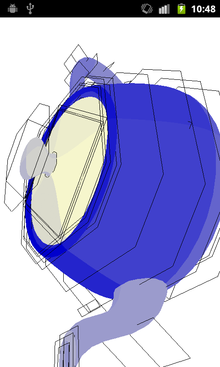
Teapot on Android I got myself a second-hand Samsung Galaxy S at last, and started hacking on it! The very first thing I wanted to try was porting the OpenGL wikibook C++ samples, that we wrote with OpenGL ES 2 in mind. I started writing a minimal GLUT-compatible wrapper to run the samples as-is, using the Android NDK, and I'm making progress :) The Android NDK is getting nicer with Android 2.3, though it still feels less supported than Java apps (e.g. the resize events seem buggy and the keycodes header is incomplete...). Nonetheless, it's nice to be able to write C++ portable apps. You can see how to use the wrapper, and how it works internally, at: http://en.wikibooks.org/wiki/OpenGL_Programming/Installation/Android One of the limitations is that GLES2 is not a true subset of OpenGL 2.1, in particular: I needed to pre-process these differences away, checking on GL_ES_VERSION_2_0 in the C++ source code to define a GLES2 macro in the shaders:
#ifdef GLES2
varying lowp vec4 f_color;
# else
varying vec4 f_color;
#endif
Is there a better way?

Gunnar Wolf: BugCon friends, are you trying to scare away 50%+ of the target audience?

You are scaring away much more than that. I just came across an invitation for BugCon 2012. BugCon is a Mexican conference devoted to computer security I cannot comment on its level or value because, although it's a topic that has long interested me, I must recognize each day I feel less of an expert, nowadays finding myself at the level of a "sysadmin who tries not to be too dumb for his own job security". Oh, and also because it would be completely off-topic for this post. If you look at Vendetta's (the main organizer) blog post, it will probably give you the impression that the conference is just an excuse for the afterparty: Lets go see some b00bs! Do you think your fellow female hackers will have any interest in joining a bunch of sex-starved, hormone-infested teenagers who only want to pwn a website and grab more pr0n? Do you think females will feel welcome (or even mildly safe) between you? I would not think so. And I also think you are alienating any professional who might have any interest in joining your community, be it as a member, as a mentor, or whatnot. I cannot right now do a coherent post on this topic, but I can reference you to what I have seen (and read) over the last almost 10 years, when the issue was first brought up to our attention. I am very glad to see that, at least in the Free Software area, there has been a real change of mindset. I hope you are in time to think about it and rectify. Oh, and not the description of an incident, but a very interesting and thoughtful take on this: [pdf] Interesting analysis by Hannah Wallach on the numbers and motivations of women in Free Software groups. I don't know if Hannah has published this in article form, but many interesting points can be understood by looking at the presentation. My good friend Vendetta: I don't mean this post (longer than what I originally intended) as a way to say you and the conference you are organizing for the third year (IIRC) already is unprofessional or targetted to pimply teenagers. I know the work you have put in it. I hope you see the points I'm trying to drive You are of course free to have whatever afterparty you have. But, if as the main organizer, you are giving the images of nice chicks at Hooters more weight and relevance than to the conference itself... you are doing yourself a disservice. I hope you can rectify it, and make BugCon attractive to hacker women as well.

C.J. Adams-Collier: SOPA response from Representative Rick Larsen, WA 2nd District

Below is an email I received from Representative Rick Larsen s office. I don t recall ever having identifying myself as PVT Adams-Collier in any communications with his office, though I could have done so at some point. Maybe. I also don t recall contacting his office directly concerning SOPA. I blogged a few things and mentioned him on facebook a couple of times, though. It is good to know that I don t always have to go directly to my representative to have my voice heard. For those playing along at home, I think the best course of action would be for producers to perform searches for their work on peer-to-peer file sharing search engines such as http://thepiratebay.org/ and http://scrapetorrent.com/. If producers find that their work is being distributed in a way which is contrary to their wishes, I advise the producer or their agent to contact the individuals operating seeds with high share ratio in order to ensure that they perform AAA before accepting new peers into the swarm. Those seed operators who refuse to negotiate reasonable AAA terms should be issued C&D orders, and legal action should be taken, should they fail to comply with the request. [edit 2012-01-24T05:27:44] It would probably be wise to impose a minimum fee of $5 for seed operators per content package they distribute. This will encourage them to pass this fee on to their subscribers in a legal and responsible manner. I recommend that it be distributed in the same fair and concise way in which the tickets are distributed for toll violations on the Tacoma Narrows Bridge. Ask me how I know. This will provide content producers a valuable distribution channel which is closely in touch with the consumers of the producers media. I believe that if the producer puts forth effort in good faith to develop and maintain relationships with key distribution points, we will see a situation where both content producers and consumers get what they want. The authorization phase of the AAA system could charge a Payment Card Industry or bitcoin account a reasonable fee. My employer produces content delivery appliances which would serve quite well the role of AAA gateway. For an example of this use case in action (sans account billing), I recommend contacting seeding participants of the Debian CD/DVD swarms. I will proxy such requests if there is interest. An alternative might be a tool developed for the online gaming community with a strange name: http://www.evenbalance.com/

Dear Pvt. Adams-Collier: Thank you for contacting me about the Stop Online Piracy Act (SOPA) and the Protect IP Act (PIPA). I wanted to update you on my views on this important issue. I am opposed to SOPA and PIPA in their current forms. I believe that these bills create unacceptable threats to free speech and free access to the internet. I have heard from many of you in Northwest Washington who are deeply concerned about the potential impacts of SOPA and PIPA. Online piracy is a serious problem that costs U.S. businesses billions of dollars. Government agencies must be empowered to stop and prosecute intellectual property thieves. But in doing so we cannot undermine freedom of speech or jeopardize the free flow of information on the internet. I will work with my colleagues to see that any final anti-online piracy legislation protects the internet and does not encroach on free speech rights. Please be assured that I will keep your thoughts in mind should I have the opportunity to vote on any legislation that would impact online piracy and internet freedom on the House floor. Again, thank you for contacting me. I encourage you to contact me in the future about this or any other issue of importance to you. Sincerely, Rick Larsen
United States Representative
Washington State, 2nd District
[edit 2012-01-24T05:28:09] Sincerely, C.J. Adams-Collier
San Juan County Democratic Central Committee (*whew*) PCO
San Juan County, Washington State, Orcas 3 District

22 January 2012

Jon Dowland: The Crying Tree

Somebody bought The Crying Tree by Naseem Rakha for Sarah as a present and she asked me to read it so we could talk about it, so I did. It's a novel about a family tragedy, Southern-state U.S.A. and the death penalty. A little boy is shot dead, a man is arrested for the crime and faces the death penalty. The book chronicles what happens to the family and to the killer during the 19 years or so that passes before the execution takes place. The book could be accused of having an anti-capital punishment agenda, but I have no problem with that. At least until about half-way through the book, the plot and happenings follow the synopsis with little in the way of surprise, but then there's a twist. I felt that the twist diminished the message of the book. Without trying to spoil what happens, I felt that you didn't need the core details of the story to be varied or expanded upon or U-turned to push that agenda. In my opinion, it's perfectly possible for someone to construct a story about a killer who faces death, who was unambiguously guilty of the crime they are charged with, and still leave the reader feeling remorse for the killer, and questioning the justice meted out. In fact I thought Rakha was doing a fine job of just that. However, a twist (or twists) occur, and the facts are called into question, and so you ask even further questions about the practise of killing criminals, in my view redundantly. It's a good book and worth a read, regardless of what your position is on the issue. It does a great job of describing the unbearable pain of losing a child, but also of the power of forgiveness for the victims.

21 January 2012

Steve Kemp: So mega-upload is gone

So the site http://megaupload.com/ has been taken offline, amidst allegations of knowingly conducting in piracy. There are probably a lot of legitimate users who have lost access to their uploaded files, even if they were offsite backups you can imagine a user owning a website which now has a million dead-links. This reminds me of a conversation I overheard on Jon Dowlands blog - the summary is that he'd written a (useful) tool to extract attachments from Maildir folders and was wondering how to store and access those attachments. The upshot seemed to be magical URLs of the form:
  • https://file.example.com/sha1/509c2fe2eba509e93987c3024a74d74583c274bd
The comments covered an alternative which was hash:///sha1/xxxxxxxxxxxxxxxx, which then becomes close to the magnet:// schema. I've not yet thought things through, but I can't help thinking that with the redundency already present in the internet we should be looking at non-server-specific links. Yes there are times right now when you might want to address a specific file on a specific server - but otherwise? Wouldn't it be nice if you could just access a file from "anywhere" which happened to have the right contents? Already my nonporn-but-definitely-adult-site makes its images available as /img/$md5sum.jpg - and similarly the storage at the back-end of my random image upload site uses SHA1 hashes to store the actual files. To make this more complete what we need is something that crawls the internet to find files by hash; then add support in browsers. Obviously this must be async and could introduce timing issues, but fundamentally it seems like a reasonable approach to the problem of a single host going offline. (Consider what happens if imgur.com disappears. All those links would die, yet 99% of the images would still be available somewhere.) I'm tempted to suggest microformat format but I need to consider the matter. Right now I'm going to immediately update my current image hosts to use, at the very least:
 <a href="/foo" rel="sha1:xxxxx md5sum:xxxx">
  <img src="foo.jpg" alt="img name">
 </a>
The unfortunate thing is you cannot have a 'rel="xx"' attribute for an image. So you either have to encode it in the parent link, or add it to the alt attribute which is suboptimal. ObQuote: "Now, they tell me I paid my debt to society." - Oceans Eleven (2001)

19 January 2012

Obey Arthur Liu: Going to London - Cambridge

I'll be in Great Britain next week. I'll come to the Debian Party 2008 in Cambridge on Saturday 23rd August and will be back to London to visit 'till Wednesday 27th August. I'm staying by myself in a nice little hotel in Bloomsbury.

It will be very interesting to meet Debian people and probably do some pitching for my Aptitude GTK project which is making nice progress.


I've never been to London before. In fact, I've been once when very young and all that I can remember is that the hot dogs seemed nice :). I'm currently reading the Lonely Planet book about London and filling my program. Hi, London!

Obey Arthur Liu: Google Summer of Code 2009 at Debian needs you


In case you've been living under a rock these past years, I shouldn't have to tell you what this is about :). Well, just in case.
The Google Summer of Code (GSoC) is an international program that offers student developers stipends to write code for various open source software projects. Debian has participated since 2006, mentoring dozens of students on Debian projects.

The important part of the 2009 edition of the Google Summer of Code is going to start next week with the Organizations application period (March 9th). By that time, we should have listed a reasonable number of ideas on the dedicated wiki page.

We will try this year to improve on the performance of the previous years, starting first with more and more dedicated manpower. If you have some time to spare to help manage our Summer of Code bid this year, we can make it a much better experience for the students and for Debian.

Help is immediately needed in many areas. Some examples:

By mid-March, we will need:

Further in the spring:

In the summer:

As you can see, there is much work ahead. It's time to pitch out your favorite pet project :)
Remember! The Summer of Code has become a prominent outreach forum for open source organizations. It puts a spotlight on each of them to provide a well-rounded and deep experience of open source development.

Right now, you can help with the Wiki, join us on IRC on #debian-soc on OFTC or join the mailing-list at soc-coordination on alioth.

The short "flyers-friendly" URL for the Summer of Code at Debian is : <http://wiki.debian.org/gsoc>. Publicize it!

See you this summer!

Rapha&#235;l Hertzog: Debian related goals for 2012

Like last year, here s a list of Debian related goals that I d like to achieve this year. I might not have the time to implement all the projects, but I like to write them down to keep me motivated. And maybe it can inspire other people to implement some of them (or to help me).
  1. Finish the translation of the Debian Administrator s Handbook The target is to have the book available in April. It would be nice to complete the liberation fund until then so that the book is immediately made available under a DFSG-free license.
  2. Update the Debian Administrator s Handbook for Wheezy
  3. Translating the book in English is only the start of the journey. The real challenge is to keep the book up-to-date with each subsequent release of Debian. And Wheezy should hopefully be released in 2012 since the freeze is in June.
  4. Design and implement the Debian Package Maintenance Hub It s an ambitious project that aims to merge and replace the PTS, the DDPO and their respective mail variants. It should also standardize the flow of information directed towards package maintainers. I m going to use the DEP process to drive this project. This could easily take most of the year, but hopefully I ll motivate other people to chime in and help.
  5. Implement dpkg --check-db and dpkg --repair-db While dpkg is fairly reliable, it s not exempt of bugs and more annoyingly, harddrives/filesystems are not 100% reliable either, thus it happens that some internal database files get corrupted. Given that most files are text based, advanced users can manually fix them but many less skilled users are just left with a broken system that they tend to reinstall. To avoid this, we could provide a command that would try to automatically bring back the internal database to a sane state by looking for a working backup to restore (while at the same time marking some packages as requiring re-installation since we have some indications that they were present).
  6. Implement storage of dpkg s internal files in Git This would be an extension of the former idea. Installing a package dpkg-db-history (any idea for a better name?) would setup dpkg hooks that would record every database change in a git repository. This repository could then be used to restore the last working version of the database.
Besides those concrete projects, I want to do better than last year on the topic of funding my Debian work. I will thus reiterate some objectives:
  1. Write useful articles for Debian users and Debian contributors. They should complete the pages Mastering Debian, Contributing to Debian 101, Debian Packaging Tutorials, and help me increase the audience of this blog.
  2. Write at least one Debian-related ebook (different from the Debian Admin Handbook) and sell it. It could be an ebook targetting testing users since I believe that many more users could benefit from it if they had some better knowledge of the limitations and of the way to mitigate the problems that arise from time to time. Or maybe it could be an ebook for people who want to start contributing to Debian, it could even be bundled with a few hours of mentoring.
  3. By the end of the year, have at least 1/3 of my time funded by donations and/or earnings of my information products. This means doing 3,5 times better than in 2011. It should be doable given that the sales of the Debian Administrator s Handbook will contribute to this goal (once the translation is over).
That makes up lots of challenges for this year. Feel free subscribe to my newsletter to stay up-to-date with my progress and to get my monthly summary of the Debian/Ubuntu news. It s also a good way to help me reach those goals since you will be informed of all my new projects.

11 comments Liked this article? Click here. My blog is Flattr-enabled.

18 January 2012

Kai Wasserb ch: Announcement: new yaWP packages available (0.4.2)

Just a short announcement: yaWP 0.4.2 is available from Debian Sid and should enter Testing (Wheezy) in ten days. One of the main changes (compatibility with KDE SC 4.7+) isn't affecting Debian yet, but the fixes to e.g. the Wunderground ION are nice to have (no matter which wheather frontend you use). Thanks to Ulf, the current main upstream developer, for keeping yaWP the (in my partial opinion) best weather Plasmoid out there! Now a little request to the various users around the world: It'd be nice if some of you would upload a screenshot of your yaWP instance to screenshots.debian.net in order to get a little variety on the package page for plasma-widget-yawp. Other themes or usage in the bar would be most welcome.

Christian Perrier: Zou....Italian (and Danish, and Dutch....) take off!

The increasing storm of localization NMUs and uploads, related to debconf translations, has an interesting effect: some teams are now incredibly active at pushing translations for their language towards the magic 100%. So, after Danish (effort lead by Joe Hansen) and Dutch (effort lead by Jeroen Schot) which I already mentioned, it seems that the Italian localization team started engines and is now taking off. It will be interesting to watch these teams competing (in a friendly way) to climb in statistics over next months..:-) So, if you're Italian (or speak it well) and want to help, please join the Italian l10n mailing list (debian-l10n-italian on lists.debian.org. If you're Danish or Dutch and want to stay ahread the two others, please joind debian-l10n-danish or debian-l10n-dutch. PS: why did I write "Zou" in this post's title? Because this is a common French interjection for "Whoooosh" and because this is part of the nickname of the tireless and incredibly active, in many places, Francesca Ciceri, aka MadameZou, who's is doing so much for Italian localization (and many other areas in Debian such as the publicity and web team). And that really deserves some lights, trumpets, etc.

Next.

Previous.