Search Results: "nate"

23 October 2007

Adeodato Sim : Coming out (the bipolar version)

I’d like to make somewhat more visible what some of you already know, that I have bipolar disorder. I was diagnosed a bit more than a year ago. I’m doing this mainly because I think visibility matters. First and most important, because in my experience it can be helpful and comforting to hear about other people whose names you recognize that can relate to your situation. And second, in case it helps a tiny bit in detabooizing mental ilnesses and their drugs. (But fortunately geek circles seem to need less of that than other, more prejudiced environments.) On a more personal note, I can’t but be grateful after six months of straight euthymia, during which I’ve regained control of my life, written code, attended events, and retaken long term projects. I also feel, after many years, less fearful of the future. And finally, let me add I can’t imagine having made through it without one particular friend, who doesn’t even read this blog. Should everybody be so lucky.

Wouter Verhelst: Printer on fire

Seems this message (which I have seen once or twice on my Linux systems) originated from a real failure mode in which the printer could, indeed, catch fire. Whoa. Mean time, my own old Kyocera FS-1500 is dead; the drum is damaged to a level that confuses the printer somehow, so that it now always thinks there's no toner left. If this were any type of modern printer, I'd just replace the drum. In this particular case, that's not going to happen, though; this printer is from 1992, and neither the toner container nor the drum are replaceable; instead, you have to clean the drum with some device that's part of the toner kit, and you have to refill the toner container using the contents of a box of toner that's inside the kit. Trust me, toner powder is messy.

MJ Ray: the Cooperative Group Half-Yearly Meeting: Q+A

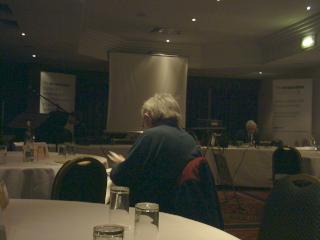
the co-operative half-yearly meeting, Bristol Belatedly, as promised, here are the questions from the floor at last week's half-year meeting of the Co-operative Group Kennet and Avon area. All errors and omissions are mine, of course.
How do we defend against demutualisation and private equity attacks?
Our rules are now written so that demutualisation would require assets to be transferred to other co-operatives. Please comment on other ways to the current constitutional review consultation.
How can ordinary members get informed and involved in running the group?
Get items into network, call the regional office.
The consitutional review should give more power to meetings and make it easier for motions and binding promises.
will forward this to the review.
Why did the group secretary suddenly leave?
The job had changed post-merger, with different responsibilities.
How can we stop the payments to voluntarily-retiring directors?
The area has made its point. The chief executive of CooperativesUK will look into this and there was a congress motion to look into this issue.
There's been no mortgage advisor in one local bank branch for months. Is this indicative of the bank's attitude to mortgages?
No, it's disappointing. Please send details to the area secretary.
Please can we use geographic numbers instead of the expensive 0845 for the membership enquiries?
Will forward and ask for a geographic number.
Is the constitutional review being rushed?
It's streamlined because the merger gives a pressing need, but we want member input.
Can we or do we promote credit unions in-store?
Yes, we can and do promote them to members already. Can set aside some space in-store if needed.
Does the co-operative travel insurance discriminate against over 75s?
will forward the answer when we have it.
The top management post-merger are all from United: is this a take-over?
no, 2 executives had clear intentions to retire already and the lower levels are more mixed.
Which? gave the co-operative food a D for organic produce: why and what will we do about it?
Report from today's Guardian not yet seen. Expect to respond in next few days. The report may have compared convenience stores with larger stores.
Will ex-United travel agents become the co-operative travel stores?
Yes. There's a big big change coming, to be more of a community travel agent, restructured, with more phone and internet options.
Is the energy-saving policy to include refrigeration, lighting and IT?
This is a top goal, to improve refrigeration and lighting control. It saves the earth and saves money. Nearly all electricity is already "greener" electricity.
Do we own the freehold on the land previously occupied by a store at Shirehampton?
Yes. Only a non-food retailer will be allowed in.
Why do elected representatives have to retire at 70 if still capable?
Please submit comments on it to the constitutional review?
Why was there no transport from Weston-super-Mare?
Will check the office records for requests.
Anyone see these themes appear at other meetings? Any comments on these themes?

Isaac Clerencia: Open aLANtejo 2007

Last weekend I had the chance to attend the Open aLANtejo conference, in beautiful vora, Portugal. I went there to give a presentation about Open Source Game Development and had the chance to meet interesting people that I knew through somebody else or just from the community lore :P To be honest I had a really better time than I expected :) Some of the speakers were the Bitrock people, Jono Bacon (Ubuntu Community Manager) and Juanjo from Igalia. I’m really looking forward to meet up again. The organisation team was also really helpful and passionate about the event, so if you get invited, don’t think twice about going :)

22 October 2007

Russell Coker: Wordpress and Thumbnails

I have just had a lot of trouble with Thumbnails on one of my blogs. It turned out that I had to install the package php5-gd and restart Apache before thumbnails would even be generated. The package php5-gd (or php4-gd) is “suggested” by the Debian Wordpress package and it’s not a dependency, so the result of apt-get install wordpress will be that thumbnails won’t work. I’ve filed Debian bug report 447492 [1] requesting that php5-gd be a dependency. Another slightly controversial issue is the fact that the MySQL server is not a dependency. I believe that it’s correct to suggest MySQL as the database server is commonly run on a different host and Wordpress will clearly inform you if it can’t access the database. An alternate way of solving this bug report would be to have Wordpress give a warning such as “Thumbnails disabled due to lack of php-gd support” which would allow users to make requests of their sys-admins that can be easily granted.

21 October 2007

Russell Coker: Open Hardware - What Would Change

I have just read an interesting post speculating about the possibility of open source hardware [1]. To some extent things have been following a trend in that direction. Back in the bad old days every computer manufacturer wanted to totally control their market segment and prevent anyone else from “stealing their business”. Anti-competitive practices were standard in the computer industry, when you bought a mainframe you were effectively making a commitment to buy all peripherals and parts from the same company. The problems were alleviated by government action, but the real change came from the popularity of PC clones. White-box clones where every part came from a different company truly opened up the hardware development, and it wasn’t all good. When running a simple single-tasking OS such as MS-DOS the problems were largely hidden. But when running a reliable multi-tasking OS such as Linux hardware problems became apparent. The PCI bus (which autoconfigured most things) reduced the scope of the problem but there are still ways that white-box machines can fail you. Now when I get a white-box machine I give it away to members of my local LUG. My time is too valuable to waste on debugging white-box hardware, I would rather stick to machines from IBM and HP which tend to just work. Nowadays I buy only name-brand machines, all the parts were designed and tested to work together - this doesn’t guarantee that the machine will be reliable but it does significantly improve the probability. Fortunately modern hardware is much faster than I require for the work I do, so buying second-hand name-brand machines (for less money than a new white-box machine) is a viable option. The PCI bus [2] standard from Intel can be compared to some of the “Open Source” licenses from companies where anyone can use the software but only one company can really be involved in developing it. One significant impediment to open hardware development is the proprietary nature of CPU manufacture. Currently there are only a few companies that have the ability to fabricate high-end CPUs so projects such as OpenRISC [3] which develop free CPU designs will be limited to having their CPUs implemented with older technology (which means lower clock speeds). However this doesn’t mean that they aren’t useful, tailoring factors such as the number of registers, the bus width of the CPU, and the cache size to match the target application has the potential to offset the performance loss from a lower clock speed. But this doesn’t mean that an OpenRISC or similar open core would be ideal for your typical desktop machine. If companies such as Intel and AMD were compelled to fabricate any competing CPU design at a reasonable cost (legislation in this regard is a possibility as the two companies collectively dominate the world computer industry and it would be easy for them to form a cartel) then designs such as OpenRISC could be used to implement new CPUs for general purpose servers. Another issue is the quality of support for some optional extra features which are essential for some operations. For example Linux software RAID is quite good for what it does (basic mirroring, striping, RAID-5 and RAID-6), but it doesn’t compare well with some hardware RAID implementations (which actually are implemented in software with a CPU on the RAID controller). For example with a HP hardware RAID device you can start with two disks in a RAID-1 and then add a third disk to make it a RAID-5 (I’ve done it). Adding further disks to make it a larger RAID-5 is possible too. Linux software RAID does not support such things (and I’m not aware of any free software RAID implementation which does). It would certainly be possible to write such code but no-one has done so - and HP seem happy to make heaps of money selling their servers with the RAID features as a selling point. Finally there’s the issue of demand. When hardware without free software support (such as some video cards which need binary-only drivers for best performance) is discussed there is always a significant group of people who want it. The binary-only drivers in question are of low quality, often don’t support the latest kernels, and have such a history of causing crashes that kernel developers won’t accept bug reports from people who use them, but still people use them. In the short-term at least I expect that an open hardware design would deliver less performance and in spite of the fact that it would have the potential to offer better reliability the majority of the market would not accept it. The production volume of electronics gear is the major factor determining the price so it would cost more. I think that both IBM and HP provide hardware that is open enough for my requirements, they both have engineers working on their Linux support and the interfaces are well enough documented that we generally don’t have any problems with them. Both Intel and AMD and the major system vendors are all working on making things more open, so I expect some small bug significant improvements in the near future.

20 October 2007

Adam Rosi-Kessel: Multitasking and Classical Music

Two recent print-media articles begging to be linked: First, the Autumn of the Multitaskers in this month’s Atlantic. Despite the age-of-Internet theme, the full article is only available to subscribers. The thesis is one I’ve seen before (e.g., in GTD). Namely: although we might feel like we’re accomplishing more when multitasking, we actually end up less productive, and eventually we’ll lose our minds if we continue to overload our sense. The writer takes the idea further than I’ve seen before, incorporating several astonishing indicators from the zeitgeist, including this NSFW quote from Jennifer Connelly that I won’t reprint, and several foreign policy and domestic political examples of how multitasking is failing our culture and our country. There is a generational divide at work here. Most in previous generations (say, people over 40) didn’t come online until the Internet was nearly full-blown with spam, entertainment news, popups, advertising, streaming stock quotes, rich media services, IM, Facebook, Flash, etc.. These people generally deal poorly with information and sensory overflow because they had no incremental introduction. The younger generations (people under 25) don’t remember the world before the Internet and multipurpose portable devices, and thus think it entirely normal to watch TV, surf the web with a few open windows, talk on the phone (perhaps VoIP), and IM at the same time. At least. And they’re bored if they don’t have at least have three or four tasks going simultaneously. This isn’t to say that these gen-Yers are actually doing a good job at it — I find myself often answering computer-related questions from my younger siblings because they can’t actually read a focused page or two of dense text on the computer (e.g., a readme file) in one sitting — but rather that they don’t experience the flow as psychologically overwhelming. That leaves my (in between) generation, generally people born in the 1970’s. Those of us who grew up with early low-bandwidth wide area networks — I started on BITNET, USENET, and BBS’s in the early- to mid-1980’s — have better mechanisms for coping and prioritizing. Perhaps because our multitasking options were relatively limited, we haven’t leaped on the bandwagon to the same extent as others. I personally don’t mind two simultaneous tasks — e.g., perusing RSS headlines and listening to MP3s — but more than that doesn’t interest me. (I don’t count it as “multitasking” in the same sense where one of the tasks is just waiting, e.g., for code to compile or a large upgrade to download). Please feel free to destroy my broad generalizations here in the comments. While we’re on the subject of multitasking, I fall into the “subtle exception” category described in Getting Things Done:
The Multitasking Exception There’s a subtle exception to the one-item-at-a-time rule. Some personality types really need to shift their focus away from some task for at least a minute in order to make a decision about it. When I see this going on with someone, I let him take two or sometimes three things out at once as he’s processing. It’s then easier and faster for him to make a choice about the action required.
I find this trick particularly helpful in getting unstuck. Frequently, when drafting briefs, I’ve rewritten a sentence eight or nine times and it still doesn’t seem to get across the necessary idea efficiently and without making the reader do any hard work. Switching to another (usually simpler) task, if only for one or two minutes, is often enough to come back and do it right in one swoop. In this situation (and probably only in this situation), multitasking actually saves me time. Second, the Well Tempered Web (by Alex Ross, music critic with a blog) in this week’s New Yorker. This one is more naturally available in complete form online. Ross manages to weave together Wagner, Snakes on a Plane, the Long Tail, and Rick Rubin. Worth reading. (And while you’re at it, check out Adam Gopnik’s piece on abridgments, which unfortunately is not available online.) Lest you all think all I read is the New Yorker and the Atlantic: it’s not true. I’m just not at liberty to disclose my other sources at this time.

John Goerzen: Short-Term Thinking

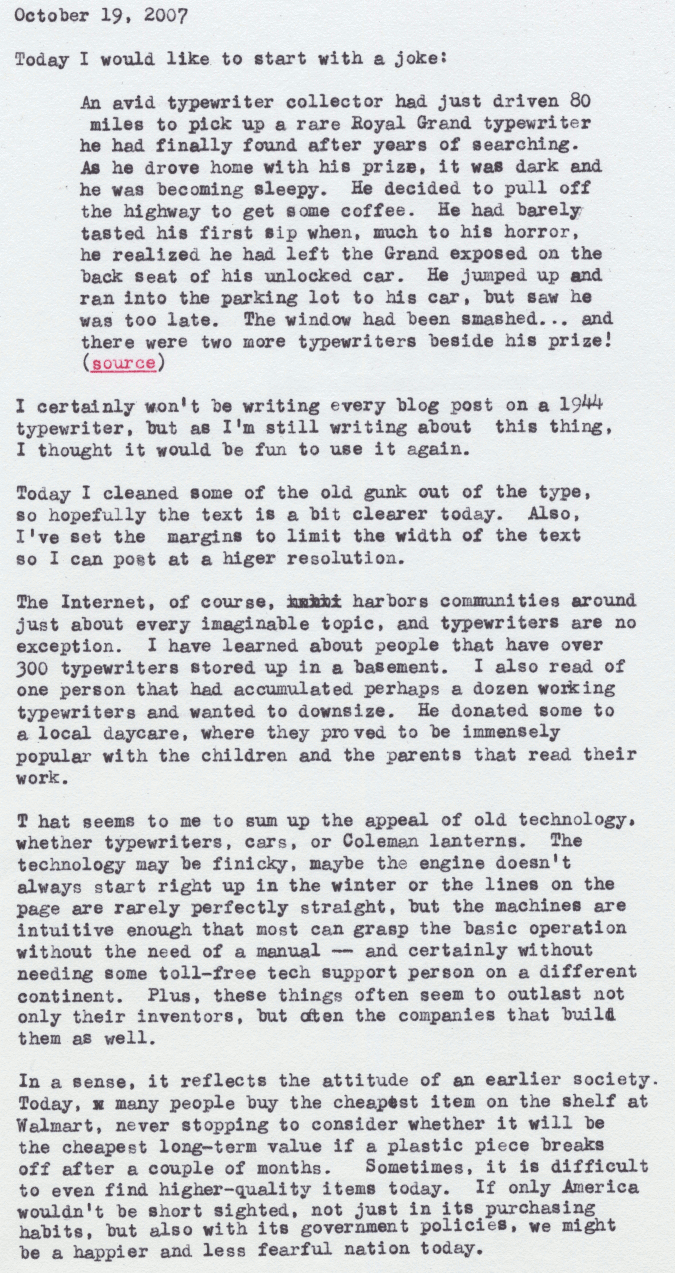
Today I would like to start with a joke:
An avid typewriter collector had just driven 80 miles to pick up a rare Royal
Grand typewriter he had finally found after years of searching.  As he drove
home with his prize, it was dark and he was becoming sleepy.  He decided
to pull off the highway to get some coffee.  He had barely tasted his first
sip when, much to his horror, he realized he had left the Grand exposed on
the back seat of his unlocked car.  He jumped up and ran into the parking
lot to his car, but saw he was too late.  The window had been smashed...
and there were two more typewriters beside his prize!
I certainly won't be writing every blog post on a 1944 typewriter, but I'm
still writing about this thing, I thought it would be fun to use it again.
Today I cleaned some of the old gunk out of the type, so hopefully the
text is a bit clearer today.  Also, I've set the margins to limit the width
of the text so I can post at a higher resolution.
The Internet, of course, harbors communities around just about every
imaginable topic, and typewriters are no exception.  I have learned about people that have over 300 typewriters stored up in a basement.  I also read of one person that had accumulated perhaps a dozen working typewriters and wanted to downsize.  He donated some to a local daycare, where they proved to be immensely popular with the children and the parents that read their work.
That seems to sum up the appeal of old technology, whether typewriters, care, or Coleman lanterns.  The technology may be finicky, maybe the engine doesn't always start right up in the winter or the lines on the page are rarely perfectly straight, but the machines are intuitive enough that most can grasp the basic operation without the need of a manual -- and certainly without needing some toll-free tech support person on a different continent.  Plus, these things often seem to outlast not only their inventors, but often the companies that build them as well.
In a sense, it reflects the attitude of an earlier society.  Today, many people buy the cheapest item on the shelf at Walmart, never stopping to consider whether it will be the cheapest long-term value if a plastic piece breaks off after a couple of months.  Sometimes, it is difficult to even find higher-quality items today.  If only America wouldn't be short sighted, not just in its purchasing habits, but also with its government policies, we might be a happier and less fearful nation today. flickr page

Andrea Veri: BehindMOTU: My interview

Original post can be found here. Interview: Today we are interviewing Andrea Veri, fresh MOTU and eager Ubuntu volunteer. Age: 18
Location: Udine, Italy
IRC Nick: bluekuja How long have you used Linux and what was your first distro?
I started using Linux at the end of 2005 using Red Hat and Fedora distros, contributing on writing several pages for Fedora documentation (mostly server docs) but mainly working on some packaging-related activities (introducing ctorrent, gtorrent-viewer and v2strip packages inside Fedora) for more than 3 months until the beginning of March 2006 when I decided to move definitely to Ubuntu after discovering it at a friend s party. Was love at first sight that made me leaving every Fedora plan and project creating my first personal wiki page on wiki.ubuntu.com some days later. How long have you been using Ubuntu?
In fact, I started using Ubuntu at the beginning of 2006, firstly getting involved inside the Edubuntu family making real the possibility to have an Edubuntu Italian support and website area inside the current Italian LoCo Team. When did you get involved with the MOTU team and how?
Right after joining the Ubuntu brigade I started checking out MOTU documentation, mainly packaging guide plus debian new maintainer s guide, trying to understand every single new word and applying directly to a source package every lesson learned during developer s world travel . After getting introduced and fascinated from an active community, I had to left the project for a while for some small problems, restarting everything on May 2007 with my first sponsored upload inside the archive. My packaging passion increased right after meeting Alexander Sack inside #ubuntu-mozillateam irc channel some days later, deciding to work directly with him as my mentor for both Debian and Ubuntu distributions. What helped you learning packaging and learning how the Ubuntu teams work?
I started with Debian New Maintainer s guide and Ubuntu s packaging guide moving then to package my first applications learning from already-packaged software and asking if needed to Alexander improving and learning every time from him or from other developers a new Ubuntu Team lesson. Favorite part of working with MOTU?
Introducing a fix making tons of users happy is one of the best things I appreciate of being a MOTU. Mentoring, sponsoring, helping out new contributors or students is something special as well. Any advice for people wanting to help with MOTU?
I always suggest to start with a package a new contributor cares about personally, that s useful to improve/fix the package itself during its maintenance.
Reading MOTU and Debian documentation is a great starting point as well to avoid any strange question on our MOTU irc channel. What packages/areas of Universe are you most interested in?
I m currently working on a vast area of packages, but I ll try to focus on p2p (Peer-2-Peer) applications both for Universe and Main. I planned to create a MOTU-p2p team really soon including it inside the existing motu-torrent team, but it will take some months to organize everything up; contributors (testers/packagers) are currently missing. Any Plans for Hardy Heron?
I ll keep working on a large number of packages but as I said before I would like to focus on having an updated situation of p2p applications, introducing libtorrent-rasterbar and its related clients like btg or linkage. Creating a working team with interested contributors and developers will be the first step to work on. Favorite quote?
As for me, all I know is that I know nothing. Socrates
What do you do in your other spare time?
I love going around with my motorbike, listening good music, playing basketball and meeting up with friends around the city centre. Pic of you, your work area, and/or your screen?

19 October 2007

Ian Haken: Long Time, No Update

So I've clearly neglected giving frequent updates, so I'll try to summarize everything that's been going on and maybe try to post more frequently in the future (I feel like I've said that many times before).

The summer ended very well, I think. My GSoC project vlosuts concluded with a fully working version, and so hopefully some guys over at Quality Assurance can be goaded into giving it a try. Once Lars and I find some time (it seems like both our lives have been quite hectic) we'll be submitting it to the unstable branch. I intend to continue supporting and developing it; in fact last night I just checked in the first update for VirtualBox support, as recommended by Jon in my comments. It does seem to work faster than QEMU and Innotek did a quality job (in my opinion at least) of packaging it. The biggest kink is that it does not support raw disk images, and so vlosuts gets slowed down by having to convert to VMDK and back, for which I am using qemu-img (and does anyone know why VBoxManage unregisterimage doesn't seem to be working for VMDKs?). If it's possible to do a loopback mount of VMDK (without VMware's utility) it would probably make more sense to use VMDK instead of a raw image to begin with, but I'm not familiar with any way to do this. At any rate, first version of VirtualBox is there for anyone who'd like to give it a shot.

Anyone not concerned with the personal going-ons of my life should stop reading right about now. Since my semester started up again at the end of August, I've pretty much hit the ground running. I'm taking 20 units (I think the average is around 15), one of which is a mathematics graduate course. I'm also doing a research project in computer science, working a part time job (which I try to do for about 10 hours a week), and getting my graduate school applications taken care of. For anyone who is curious, the GRE is a terrible thing. Graduate school and fellowship applications have been a particular headache, but fortunately I'm just about finished up with the essays. For the curious I'll be applying to mathematics departments with an emphasis in logic and foundations at the following universities (list subject to change frequently): MIT, Berkeley, Stanford, Carnegie Mellon, Urbana-Champaign, UMich.

Christian Perrier: RWC: France punished by Argentina

France sank against Argentina tonight. Last time France played in Parc des Princes, they were crushed by South-Africa, 10 years ago. The same happened tonight with an impressive victory by Argentina against France. France dominated the first 20 minutes but Argentina's defense was heroic and strong. Certainly the best defense play of this entire world cup, in this match, with a great organization around mauls, an impressive scrum and explosive tackles. After being dominated 26 minutes long and anyway scoring a try an, Argentina had to resist 10 minutes before half time when France unsuccessfully attempted to score a try (which would probably have changed the match). I think I will have to review these 10 minutes again as this was a demonstration of defensive play. It is indeed not a surprise that Ibanez lost his nerves and got expelled at the very end of 1st half time. Sad end of career...very similar to Zidane's one, indeed. In second half time, seeing France being crushed so hard was sometimes saddening but Argentina played so wonderfully that we could just be admirative of that play. Again, their solidarity and defensive play made the difference and, 5 tries later, they finally logically beat France. The Argentinian team is really a great satisfaction of the world cup. Playing only with 18 players, they only half-missed one match: their semi-final against South-Africa. I think they now really deserve to play in the Tri-Nations tournament along with New Zealand, Australia and South-Africa: if that doesn't happen, I will really think that other southern hemisphere nations are just cowards..:-) What about France? Well, this is a really sad ending for that world cup. Finishing with two very bad matches is really worrying for the future of that team. There are many promising players in that team (such as Dusautoir, Szarzewski...) and they can probably rebuild something and we still be enthusiast about that sport in this country.

18 October 2007

Romain Francoise: Shared links for 2007-10-18

17 October 2007

Adeodato Sim : The joy of libraries, and more

I’m reading Lo raro es vivir by Carmen Mart n Gaite, borrowed from the Library of my University. Somebody decided to amend this copy of the book with sundry fixes to the author’s grammar and spelling. Except that, of course, none are needed, and whoever made these changes can’t actually read (confusing unusual but valid constructs with not valid grammar), and doesn’t seem to have a clue of what an alternate spelling is, either. Joy. But maybe this post is only an excuse to recommend The Orphanage, this year’s Spain’s submission to the Best Foreign Language Film Category (which I really enjoyed!), and to point to Urban Dictionary re today’s xkcd.

Martin F. Krafft: Mexican salsa on Pizza?

I am a purist when it comes to food. A huge purist. And yesterday I ended up at Miller's Pizza on Upper Baggot Street, Ballsbridge, Dublin, Ireland, and I enjoyed a Thai Prawn Green Curry Pizza, while colleagues of mine were devouring Mexican Salsa on Pizza Dough and similarly "perverse-sounding" foods. Unfortunately, their menu behind the above link is out of date (someone should let them know ), but that should not stop anyone with an appreciation for eclectic food and an adventurous vein from stopping to eat at this place the next time you're in Dublin. NP: Devin Townsend: Ziltoid the Omniscient

Martin F. Krafft: Asymmetry of eShops

Why do we shop over the Internet? Why do we let ourselves be treated like cattle in ways? The other day, I won an eBay auction and was notified shortly afterwards by the seller ("smile_plus168") that the item was not in stock anymore. So why did you list it, you muppet? If I retract my bid on eBay, I get punished for it, but sellers can do what they like? It was the icing on the cake to then receive the following note from the seller:
Would you pls still give me a positive feedback to me .pls don't worry about yours ,once you given it to me ,my ebay system will give you the same by AUTO.
Are you out of your mind? Then I got a note from an Amazon seller ("e-bug.de"), filled with spelling and grammar errors and letting me know that
unfortunately, the number of articles in stock was not enough to ship one out to you.
I got refunded in both cases, but still feel let down. I find it unacceptable that such asymmetry exists. After all, clicking that "Yes, I agree" button is making a binding contract, just like putting an item up for sale. If you don't have the item, you can't sell it. Seems like standard merchandising 101. NP: Oceansize: Frames

John Goerzen: Unexpected Interest

A few days ago, I wrote about my recent purchase of an old Smith-Corona manual typewriter built in 1944. Terah and I were at an antique store, and it was $25 and sorta an impulse buy.

Since then, something unexpected has happened: I'm getting interested in using manual typewriters.

I've been busily tracking down ribbons (Nukote BW277 doesn't work on it, even though their website says it does), typing paper (business-supplies.com has it at a decent price with free overnight shipping on most orders over $50), and various tidbits of knowledge (such as: what does the lever numbered 0 to 6 beneath the right ribbon spool do?)

Today I went to a local office supply store. Not OfficeMax or OfficeDepot -- they do carry ribbons for typewriters of this era, but not the right ones for my particular machine. But the store that has been owned by the same family since it opened in 1899 on Main Street, where it remains.

And, surprise, they had the ribbon I need!

It seems that typewriters are experiencing a certain resurgence in popularity. People that have computers -- and perhaps never knew a world without them -- are buying typewriters. Because of interest, novelty, or even usefulness. There are quite a few typewriter repair shops that still exist, most of them happy to work on typewriters up to a century old.

So why am I excited about it?

Part of it is the fun of making a really old piece of technology work.

Perhaps part of it is knowing that I'll be typing at a machine that was built the same year as D-Day, the year when the first German city fell in World War II. Part of it is knowing that this 40-pound machine was built to last, in an era before planned obsolescence. And, to a certain extent, it has outlasted its manufacturer.

Part of it is curiosity: will I write differently on a typewriter than a computer? It seems that most people that have tried both say that their writing is different on a typewriter, and often better. Perhaps it is the difficulty of editing that forces more rigorous thought up front.

Christopher Watkins wrote:

[Manual typewriters] just plain shame me into working. As with any fine instrument, they're made to be used, their very design bespeaks this, and there's been many a night I've caught one of my typewriters glaring sternly at me from the shadows, implicating me in a grand failure to honor their structural destinies. Chagrined and challenged, I dutifully sit down to see what I can do to contribute to the machine-age legacy I've been called on to uphold. . .

When you sit down to write a song at the piano, you're going to write differently than if you have a banjo in your lap. And if one instrument isn't bringing the magic and the muse, maybe another will. Typewriters are the same; they make me write in a different fashion, and also provide an alternate trigger for inspiration. And as an electric guitar is different from an acoustic steel-string guitar is different from a nylon-string classical guitar is different from a national steel resonator guitar; so does each individual typewriter differ. My Underwood is different from my Royal is different from my Remington is different from my Corona is different from my Hermes. And if one isn't giving me the juice, another might.


Brian Drake added (emphasis mine):

Or you print out the document again because someone misplaced it. Misplaced it! When we were on typewriters, let me tell you, no one misplaced a hundred-page contract! That meant another two days of typing, and tying up at least two secretaries to get it done then. . .

Gore Vidal said he could tell when a book had been written on a word processor. I can, too. Sometimes I can see the cut-and-paste.

I've worked as a professional proofreader and copyeditor, and I can attest that the computer has not led to better writing. What it has led to is more writing, acres and acres of it. Books have grown fatter and fatter while their content grows slimmer and slimmer.


These seem to resonate well. More typewriter essays here.

And perhaps a typewritten blog post or two, once I try out my new ribbon.

16 October 2007

Marc 'Zugschlus' Haber: A thousand things I never wanted to know about X

In the last few days, I have replaced the two 20 inch CRT monitors that I have hardly used the last years with two 20 inch TFT displays, and my company (finally) gave me a 19 inch TFT display to accompany my notebook display at work. Maybe I should take that as a hint that they want to see me in the office more frequently rather than in my home office which I generously use these days. At home, I built a “new” computer from mainly used parts to drive the two 20 inchers. I have learned a lot about X in the last days, but spent too much time with it. I have been running my Desktop with older X and two CRTs for quite some time, but I hardly ever used it due to the setup of my now ex-flat. Back then, I learned that the “two monitors, one display, one screen, one desktop” option of X was called Xinerama and statically configured: You write down your display layout in xorg.conf and it uses it. Configuration changes mean restarting the X server. KDE notices Xinerama automatically, designates one monitor the “main monitor” and displays its panel there. You can move windows from one monitor to the other one, but changing virtual desktops always changes what both monitors display. This is not really what I want, since I often have “static” contents (news reader, mail reader, chat windows, help screens etc) on one monitor while I do my normal work on the other monitor, which involves changing virtual desktops. So I was rather happy when I learned upon the arrival of the external TFT display for the notebook that you can work without Xinerama. In that case, the X server comes up with one display and two screens, which KDE uses to display two independent desktops which can be independently configured, but can both be accessed with one mouse and one keyboard. For me, this means that I finally can independently change virtual desktops on both monitors, but pay the price that I cannot display a certain virtual desktop on monitor 1 now, and on monitor 2 in five minutes, and that a window opened on monitor 1 is never going to be shown on monitor 2 without serious interference. This looked ok for me. Additionally, you can use different font sizes on the different monitors as defaults, which comes in handy if both monitors are blatantly different in size (which is the case with the notebook and its external monitor). However, with that setup, KDE seems to be challenged when it comes to saving the configuration. Some things (such as desktop background and panel config) seem to save fine, desktop independent, other things (such as open windows and their position) are lost when the session exitst. My daily visit to Kevin&Kell (which used to be in a browser window that was saved with my session) has badly suffered since then. Then, a few weeks ago, somebody talked me into trying the X server from experimental. Which is when my dual-desktop setup ceased working. The nice people on #debian-x told me that Xinerama is a thing of the past, and is currently in the process of being replaced by Xrandr 1.2. The removal of “my” two monitor, two screens, two desktop setup is collateral damage, and if I still want that behavior, the X.org upstream considers this an issue to be handled by the Window Manager / Desktop Environment now. Gee, thanks. That’s what I call a regression. After spending half a day cursing and ranting, and even considering to go back to lenny’s (or even etch’s) X.org, I finally settled on going with the “new” way as I was going to lose my independent desktops sooner or later anyway. Again, with the friendly help of the people on #debian-x, I found out about a lot of advantages of the latest X servers. In most basic cases, the latest X server does not need a configuration file any more. It autodetects your hardware and chooses whatever modes it finds optimal. It does a pretty decent job in doing so. If one wants to influence how the X system comes up, once can always write an Xorg.conf file - the configfileless server even writes the “virtual config file” it uses to the log as a starting point. Additionally, almost everything regarding screen layout can be reconfigured at run time using the xrandr binary from a command line. Even a hardware change (such a new monitor plugged into the powered on notebook) is correctly detected. Cute. This allows me to reconfigure my notebook depending on where it currently is and which external monitor (or projector) is connected. This can be perfected if I find out whether X offers a hook to plug a reconfiguration script into that is called when the X server starts or when the system is waking up from standby or hibernation with the X server running. A lot to do, and great potential for elegant stuff. However, while I am talking about hibernation, this is a downside of the new driver: When the system wakes up from hibernation, the X server sometimes confuses itself enough to become nearly unuseable: I had it become psychotic when plugging in the external monitor (which can do 1600x1200 points) after waking it up from hibernation at the office. The internal display can only do 1400x1050, and the box thought that the external monitor only had 1050 y axis pixels, displaying bit garbage in the lower part of the big monitor, and showing a useable, but unintelligible panel. When opening any browser or any other application with considerable text amounts in the window, all fonts become unreadable once one scrolls down. Restarting the X server helps and everyting is fine. But I do not use hibernation to force myself to log out of X after waking up. After going back to the “one monitor mode”, the X server now thinks that my virtual desktop is 1600x1200 and only shows 1400x1050, with dead space at the right and lower side of the virtual desktop. xrandr does not allow me to reisize the FB below 1600x1200. No idea what’s going on here. In most of the cases, calling xrandr --auto for each output will fix the issues at run time, but sometimes a session restart is needed. Code needs to stabilize quite a bit before becoming useable in production. There are a few disadvantages that will remain: Both monitors will change their contents when the virtual desktop is changed, and both displays will use the same default font size (which might be inappropriate if both displays are of different size). But I think, when the issues are cleared up, that I can live with these disadvantages. The “new” desktop system that I built has a Matrox G450 dual head graphics card, and unfortunately, the Xrandr 1.2 enabled X server from experiemental has shown to be unuseable: Upon some mode changes, the X server goes into an endless loop and proves itself to be unkillable short of SIGKILL. And if it dies, it sometimes pulls the entire system with it. There is a corresponding bug in the upstream BTS, but it hasn’t received any noticeable attention by the upstream developers. So I might find myself configuring one last Xinerama config before I can finally completly migrate to Xrandr 1.2 on the desktop as well. Then I’ll probably need to bug the KDE upstream people to implement a two-desktops-on-a-single-screen feature in one of their future versions so that I can get my independent-desktop-things back. But that’s a far far away future.

Russell Coker: Introverts

I am amazed that I had never read the article Caring for Your Introvert [1] before. One of the interesting points concerned acting like an extrovert (I can do it for the duration of a typical job interview). Another was the issue of recovery time after having to deal with people. When living in hotels (which I did for about 18 months straight in 1999 and 2000) I found that some days I would reach my quota for dealing with people before I had dinner, going to bed hungry seemed like a better option than going to a restaurant. One thing that occurred to me is the lack of apparent introversion among most delegates at computer conferences. It seems that the majority of people who are any good at coding are introverts and you might expect an environment with a majority of introverts to be somewhat quiet. An interview with the author of the article [2] published 3 years later explains this (among other things). Here is a quote:
But once an introvert gets on a subject that they know about or care about or that intrigues them intellectually, the opposite often takes hold. They get passionately engaged and turned on by the conversation. But it’s not socializing that’s going on there. It’s learning or teaching or analyzing, which involves, I’m convinced, a whole different part of the brain from the socializing part. Which describes a lot of the activity at conferences. It’s standard practice for people to walk up and join a conversation that covers an area of technology that interests them and then just walk away when the topic changes. I wonder if any of the social networking and dating sites have a section for Myers-Briggs [3] test results. Via Tim Connors blog [4].

15 October 2007

Christian Perrier: RWC: That will be South Africa-England

...and, really, we nearly never thought that Argentina could win tonight. South Africa was really too strong for them. The only domain where Argentinians dominated were scrums but this was much compensated by their great weakness on line-outs, losing something like 5 or 6 of them. South Africa thus logical won very easily...and Bryan Habana is now the best try scorer all along RWCs, along with Jonah Lomu. He is a really great player, indeed. Much much impressive South Africa: they'll be by far the favourites of the final against England, which they beated already during that World Cup. I said several times that I'm not a deep fan of RSA's play, but I could become one. Their game improved all along the World Cup and today, they probably played their best match. Two remakes next week-end: France-Argentina for the 3rd place and South Africa-England as final. That will be good matches, no doubt...and I hope that Bernard Laporte will change the French team to play against Argentina.

14 October 2007

Christian Perrier: RWC: That will be South Africa-England

...and, really, we nearly never though that Argentina could win tonight. South Africa was really too strong for them. The only domain were Argentinians dominated were scrums but this was much compensated by their great weakness on line-outs, losing something like 5 or 6 of them. South Africa thus logical won very easily...and Bryan Habana is now the best try scorer all along RWCs, along with Jonah Lomu. He is a really great player, indeed. Much much impressive South Africa: they'll be by far the favourites of the final against England, which they beated already during that World Cup. I said several times that I'm not a deep fan of RSA's play, but I could become one. Their game improved all along the World Cup and today, they probably played their best match. Two remakes next week-end: France-Argentina for the 3rd place and South Africa-England as final. That will be good matches, no doubt...and I hope that Bernard Laporte will change the French team to play against Argentina.

Next.

Previous.