Junichi Uekawa: Already May.
 Already May. Time flies during the Shelter in Place.

$home.
--gem-install layout and fixing autopkgtest.Conflicts field.ARM $arch.Breaks+Replaces for ruby-sass-rails (#952682 and #954544).cut -d'-' -f1 to just show upstream version.
encryptor for Ruby2.7 test failures.image_science for removing relative paths.ffi-yajl for Ruby2.7 test failures.aggregate for simply using require.aggregate for modernizing CI and adding Ruby 2.5 and 2.7 support.espeak-ruby for Ruby2.7 test failures.tty-which for test failures in general.packable for Ruby2.7 test failures. PR #12 has been proposed.growl for test failures and proposed an initial patch.

hugo-coder, asking to enable RSS feed for blogs.hugo-coder for fixing the above issue myself.arbre for requesting a release.combustion, asking to relax dependency on rubocop. Fixed in this commit.ffi-compiler for requesting to fix homepage and license.gographviz for requesting a release.crb-blast, suggesting compatability with bio 2.0.x.uniform_notifier for asking to drop the use of ruby-growl.polybar, adding installation instructions on Debian systems.:wq for today.

 Here is my monthly update covering what I have been doing in the free software world during April 2020 (previous month's report). Looking it over prior to publishing, I am surprised how much I got done this month I felt that I was not only failing to do all the extra things I had planned, but I was doing far less than normal. But let us go easy on ourselves; nobody is nailing this.
send-later command's message limit. [...]


debian/rules files that specify -Wl,--as-needed as this is now the default from bullseye onwards. (#956146).debug. (#958945)--with=systemd with a Debhelper compatibility level of 10 or higher. (#949844)$* as using the Debhelper sequencer. (#930679)override dh_install (ie. with a space) in debian/rules; in 99% of cases this will be an omission of the underscore. [...]python3-all-dev and python3-all-dbg to satisfy the check for packages that use py3versions with the -s argument. (#955799, #956134)Build-Depends-Arch and Build-Depends-Indep do not imply each other, so don't warn about "duplicate" dependencies in this case. (#956368)py3versions -s without the corresponding Build-Depends. (#958794)pre-depends-directly-on-multiarch-support tag; any package pre-depending on the multiarch-support will not be installable in the bullseye distribution. (#798762)mailing-list-obsolete-in-debian-infrastructure as being experimental. (#958182, #958666)dh_dwz-generated "multi-files". (#955752)package-relation-with-self if we have specified a required architecture. (#956227)package-uses-old-debhelper-compat-version when run against itself. [...].travis.yml file as we are using Salsa now. [...] One of the original promises of open source software is that distributed peer review and transparency of process results in enhanced end-user security. However, whilst anyone may inspect the source code of free and open source software for malicious flaws, almost all software today is distributed as pre-compiled binaries. This allows nefarious third-parties to compromise systems by injecting malicious code into ostensibly secure software during the various compilation and distribution processes.
The motivation behind the Reproducible Builds effort is to ensure no flaws have been introduced during this compilation process by promising identical results are always generated from a given source, thus allowing multiple third-parties to come to a consensus on whether a build was compromised.
 The initiative is proud to be a member project of the Software Freedom Conservancy, a not-for-profit 501(c)(3) charity focused on ethical technology and user freedom.
Conservancy acts as a corporate umbrella allowing projects to operate as non-profit initiatives without managing their own corporate structure. If you like the work of the Conservancy or the Reproducible Builds project, please consider becoming an official supporter.
otf-active mailing list this final report described in detail the status of each objective, our overall lessons and our future plans.
disorderfs-debug prefix in log output when we change non-disorderfs things in the file and, as it happens, do not run disorderfs at all. [...]a HTML elements under li ones, which was causing a comma/bullet spacing issue. [...]*.sym files as Java archives. (#15).zip filename filtering and exclude two patterns of files generated by Maven projects in "fork" mode. (#13) Elsewhere in our tooling, I made the following changes to diffoscope, our in-depth and content-aware diff utility that can locate and diagnose reproducibility issues, including preparing and uploading versions
139, 140, 141 and 142 to Debian:
.dex files can also serve as APK containers so restrict the narrower identification of .dex files to files ending with this extension and widen the identification of APK files to when file(1) discovers a Dalvik file. (#28).p7c and .p7b certificates. (#94)zipinfo(1) warnings. (#97)pdftotext as a requirement to run the PDF test_metadata text. (#99)python3-h5py in debian/tests/control.in to ensure that we have this module installed during a test run to generate the fixtures in these tests. [...]./setup.py test --pytest-args arguments. [...]rb-general mailing list is probably a first step for contributors to take. [...]/docs/buildinfo/ to /docs/recording/. (#23)/news/ namespace [...] and improve formatting of archived news links [...].ntp Network Time Protocol server to prevent a denial of service vulnerability (CVE-2020-11868).
ntp in ELA-224-2 to add further protection that was not present in the previous update.

Content-Type HTTP header is missing when downloading .deb files (#956471) and to report build failures in the macs & ruby-enumerable-statistics packages:
6.0~rc3-1 New upstream beta release.6.0~rc4-1 New upstream beta release and use the newly-packaged liblzf-dev package over the local version. (#958321)5.0.7-3 Fix build failures with GCC 10. (#957751)5.0.7-4 Use the newly-packaged liblzf-dev package over the bundled version. (#958321)5.0.7-5 Ensure that the daemon is running prior to running the autopkgtests.5.0.7-6 Perform a "no change" sourceful upload to permit migration to the testing distribution.5.0.7-7 Add a sleep to ensure that the server has started before running the tests.2.2.12-1 New upstream release.3.0.5-1 New upstream release.1.6.3-1 New upstream release.1.6.5-1 New upstream release.1.6.5-2 Fix a failing autopkgtest that assumes a particular string is in the first kilobyte of the response which was no longer the case due to the addition of new configuration options.1.2.2-1 New upstream release.1.2.2-2 Ensure that the server is started before running autopkgtests.1.2.2-3 Sleep to ensure the server has really started before running the autopkgtests.2.2-2) Replace python-nautilus in the build-dependencies with python3-nautilus. (#943137)
15) Correct the (confusing) internal logic of --force from being visible to users. (#895686)
20.0.0-1) New upstream release and refresh packaging.
1.0.1-1) New upstream release and refresh packaging.
0.6-3) Mark a non-deterministic autopkgtest as "flaky" for now to ease migration (#930448) and use DEB_VERSION_UPSTREAM_REVISION over manually parsing dpkg-parsechangelog in debian/rules.
 A SYNCNI article passed by on my Twitter feed this morning, talking about balancing work life balance while working from home in these times of COVID-19 inspired lock down. The associated Twitter thread expressed an interest in some words of advice from men to other men (because of course the original article has the woman having to do all the balancing).
This post does not contain the words of advice searched for, but it hopefully at least offers some reassurance that if you re finding all of this difficult you re not alone. From talking to others I don t think there s anything particularly special we re doing in this house; a colleague is taking roughly the same approach, and some of the other folk I ve spoken to in the local tech scene seem to be doing likewise.
First, the situation. Like many households both my wife and I work full time. We have a small child (not even a year and a half old yet). I work for a software startup, my wife is an HR business partner for a large multinational, dealing with employees all over the UK and Ireland. We re both luckily able to work from home easily - our day to day work machines are laptops, our employers were already setup with the appropriate VPN / video conferencing etc facilities. Neither of us has seen any decrease in workload since lock down; there are always more features and/or bugs to work on when it comes to a software product, and, as I m sure you can imagine, there has been a lot more activity in the HR sphere over the past 6 weeks as companies try to work out what to do.
On top of this our childcare arrangements, like everyone else s, are completely gone. Nursery understandably shut down around the same time as the schools (slightly later, but not by much) and contact with grandparents is obviously out (which they re finding hard). So we re left with trying to fit 2 full time jobs in with full time childcare, of a child who up until recently tried to go down stairs by continuing to crawl forward.
Make no mistake, this is hard. I know we are exceptionally lucky in our situation, but that doesn t mean we re finding it easy. We ve adopted an approach of splitting the day up. I take the morning slot (previously I would have got up with our son anyway), getting him up and fed while my wife showers. She takes over for a bit while I shower and dress, then I take over again in time for her to take her daily 8am conference call.
My morning is mostly taken up with childcare until nap time; I try to check in first thing to make sure there s nothing urgent, and get a handle on what I might have to work on later in the day. My local team mates know they re more likely to get me late morning and it s better to arrange meetings in the afternoon. Equally I work with a lot of folk on the US West coast, so shifting my hours to be a bit later is not a problem there.
After nap time (which, if we re lucky, takes us to lunch) my wife takes over. As she deals with UK/Ireland folk she often ends up having to take calls even while looking after our son; generally important meetings can be moved to the morning and meetings with folk who understand there might be a lot of pot banging going on in the background can happen in the afternoon.
Having started late I generally work late - past the point where I d normally get home; if I m lucky I pop my head in for bath time, but sometimes it s only for a couple of minutes. We alternate cooking; usually based on work load + meetings. For example tonight I m cooking while my wife catches up on some work after having put our son to bed. Last night I had a few meetings so my wife cooked.
So what s worked for us? Splitting the day means we can plan with our co-workers. We always make sure we eat together in the evening, and that generally is the cut-off point for either of us doing any work. I m less likely to be online in the evening because my study has become the place I work. That means I m not really doing any of my personal projects - this definitely isn t a case of being at home during lock down and having lots of time to achieve new things. It s much more of case of trying to find a sustainable way to get through the current situation, however long it might last.
 Due to sickness I was not able to complete my 8 hours of work on Debian LTS as planned. I only worked 1.5 hours this month, moving the remaining 6.5 hours over to May.
LTS
# include <signal.h>
# include <stdlib.h>
# include <stdio.h>
# include <time.h>
int main(int argc, char **argv)
union sigval sigval;
pid_t pid;
if (argc < 2 (pid = atoi(argv[1])) < 0)
return EXIT_FAILURE;
sigval.sival_int = time(NULL) & 0xff;
printf("sender: sending %d to PID %d\n",
sigval.sival_int, pid);
sigqueue(pid, SIGUSR1, sigval);
return EXIT_SUCCESS;
The key lines are 13 and 16 where the random (ish) integer is stored in the sigval union and then sent to the other process with the sigqueue.
The receiver
The receiver just sets up the signal handler, sends its PID (so I know what to tell the sender) and sits in a sleeping loop.
# include <stdio.h>
# include <stdlib.h>
# include <sys/types.h>
# include <unistd.h>
# include <signal.h>
void signal_handler(int signum, siginfo_t *siginfo, void *ucontext)
if (signum != SIGUSR1) return;
if (siginfo->si_code != SI_QUEUE) return;
printf("receiver: Got value %d\n",
siginfo->si_int);
int main(int argc, char **argv)
pid_t pid = getpid();
struct sigaction signal_action;
printf("receiver: PID is %d\n", pid);
signal_action.sa_sigaction = signal_handler;
sigemptyset (&signal_action.sa_mask);
signal_action.sa_flags = SA_SIGINFO;
sigaction(SIGUSR1, &signal_action, NULL);
while(1) sleep(100);
return EXIT_SUCCESS;
Lines 16-26 setup the signal handler. The main difference here is SA_SIGINFO used for the signal flags and sigaction references a sa_sigaction function rather than sa_handler.
We need to use a different function because the sigaction only is passed the signal number but we need more information, including the integer that the sender process stored in sigval.
Lines 7-14 are the signal handler function itself. It first checks that the receiver process got the correct signal (SIGUSR1 in this case) and that we got this signal from sigqueue because the type is SI_QUEUE. Checking the type of signal is important because different signals give you different data. For example, if you signalled this process with kill then si_int is undefined.
The result
As a proof of concept, the results are not terribly exciting. We see the sender say what it will be sending and the receiver saying it got it. It was useful to get some results, especially when things went wrong.
$ ./receiver &
[1] 370216
receiver: PID is 370216
$ ./sender 370216
sender: sending 133 to (gdPID 370216
receiver: Got value 133
Gotchas While testing the two process there was two gotchas I encountered. GDB and the siginfo structure The sigaction manual page shows a simple siginfo_t structure, however when looking at what is passed to the signal handler, it s much more complicated.
(gdb) p *siginfo
$2 =  si_signo = 10, si_errno = 0, si_code = -1, __pad0 = 0, _sifields =  _pad =  371539, 1000, 11, 32766, 0 <repeats 24 times> , _kill =  si_pid = 371539, si_uid = 1000 , _timer =  si_tid = 371539,
      si_overrun = 1000, si_sigval =  sival_int = 11, sival_ptr = 0x7ffe0000000b , _rt =  si_pid = 371539, si_uid = 1000, si_sigval =  sival_int = 11, sival_ptr = 0x7ffe0000000b , _sigchld =
      si_pid = 371539, si_uid = 1000, si_status = 11, si_utime = 0, si_stime = 0 , _sigfault =  si_addr = 0x3e80005ab53, si_addr_lsb = 11, _bounds =  _addr_bnd =  _lower = 0x0, _upper = 0x0 , _pkey = 0 ,
    _sigpoll =  si_band = 4294967667539, si_fd = 11 , _sigsys =  _call_addr = 0x3e80005ab53, _syscall = 11, _arch = 32766
(gdb) p siginfo->_sifields._rt.si_sigval.sival_int
$3 = 11
So the integer is stored in a union in a structure in a structure. Much harder to find than just simply sival_int.
The pointer is just a pointer
So perhaps sending an integer is not enough. The sigval is a union with an integer and a pointer. Could a string be sent instead? I changed line 13 of the sender so it used a string instead of an integer.
sigval.sival_ptr = "Hello, World!"The receiver needed a minor adjustment to print out the string. I tried this and the receiver segmentation faulted. What was going on? The issue is the set of system calls does a simple passing of the values. So if the sender sends a pointer to a string located at 0x1234567 then the receiver will have a pointer to the same location. When the receiver tries to dereference the sival_ptr, it is pointing to memory that is not owned by it but by another process (the sender) so it segmentation faults. The solution would be to use shared memory between the processes. The signal queue would then use the pointer to the shared memory and, in theory, all would be well.
 For the foreseeable future I'm working for myself, as a contractor, here in sunny Helsinki, Finland.
My existing contract only requires me to work 1.5-2.0 days a week, meaning my week looks something like this:
 The new FAI version 5.9.4 adds support for the new Ubuntu LTS version 20.04 (focal).
New FAI installation images (including a Ubuntu only ISO) are available from
https://fai-project.org/fai-cd
I've added support for the Debian testing release (currently bullseye) to the
FAIme service for building customized installation and cloud
images. This service still supports the oldstable and stable release
including variants with a backports kernel.
The FAI.me build service is also using the newest FAI version and the
customized ISO images can be booted in an UEFI or legacy BIOS
environment.
https://fai-project.org/FAIme
 ...even the SD cards were wet!
 The last photo my camera took before it died
 Tada! Turns out you can dehydrate hardware too!

 Armadillo is a powerful and expressive C++ template library for linear algebra aiming towards a good balance between speed and ease of use with a syntax deliberately close to a Matlab. RcppArmadillo integrates this library with the R environment and language and is widely used by (currently) 705 other packages on CRAN.
A new upstream release 9.870.2 of Armadillo was released a few days ago. We had tested two release candidates, and this caught one bug. The release was held up at CRAN for a few days as one package had an overly sensitive test depending on random input data; eventually we all convinced ourselves that there was no (Rcpp)Armadillo issue here. So morale: friends don t let friends have tests depend on random behavior.
Changes in the new release are noted below.
Courtesy of CRANberries, there is a diffstat report relative to previous release. More detailed information is on the RcppArmadillo page. Questions, comments etc should go to the rcpp-devel mailing list off the R-Forge page. If you like this or other open-source work I do, you can now sponsor me at GitHub. For the first year, GitHub will match your contributions.Changes in RcppArmadillo version 0.9.870.2.0 (2020-04-24)
- Upgraded to Armadillo release 9.870.2 (Roasted Mocha Retox)
- faster handling of matrix multiplication expressions by
diagvec()anddiagmat()- added
trimatu_ind()andtrimatl_ind()- more consistent detection of sparse vector expressions
This post by Dirk Eddelbuettel originated on his Thinking inside the box blog. Please report excessive re-aggregation in third-party for-profit settings.
 A few days ago KDE Apps 20.04 were released, and I am happy that thanks to the openSUSE Build Service (and a lot of scripting and some hand-work), packages for Debian Unstable and Testing are available in by repositories!
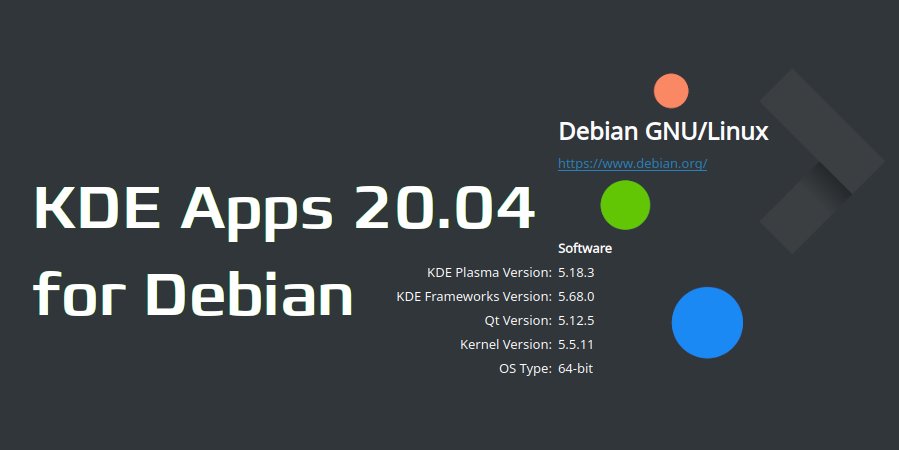 The previous location (debian-plasma at OBS) should be replaced by the following entries in
/etc/apt/sources.list.d/obs-npreining-kde.list:
For Unstable:
other-deps mostly backports from experimental that are necessary for building KDE Apps 20.04frameworks the KDE frameworks, currently version 5.69plasma the Plasma packages, currently 5.18.4.1apps the KDE Apps, currently 20.04other other apps that need rebuild, currently only digikam (but that in the latest beta3 released a few days ago)
/etc/apt/trusted.gpg.d/obs-npreining.asc.
I don t provide an apt-gettable source archive anymore, in particular since one of the Debian KDE maintainers has rejected my help and told me Go away . So it seems that this convenience is not appreciated, and necessary. The source packages are available from the OBS web sites of the respective repositories. Well, if they are not doing the work, I cannot more than offer my help. Thanks Debian!
Currently there are two packages missing: kio-extras and kdeconnect, both of which need new (hitherto unavailable) packages which I will hopefully package in the next days. Two other, juk and okular, are already at version 20.04 in Debian and co-installable.
Enjoy!
Welcome to the 26th post in the rationally regularized R revelations series, or R4 for short.
R 4.0.0 was released two days ago, and a casual glance at some social media conversations appears to suggest quite some confusion, almost certainly some misunderstandings, and possibly also a fair amount of fear, uncertainty, and doubt about the process. So I thought I could show how I upgrade my own main workstation, live and in colour without a safety net. (Almost: I did upgrade my laptop yesterday which went swimmingly, if more slowly.) So here is a fresh video about upgrading to R 4.0.0, with some support slides as usual:
The slides used in the video are at this link.
A few quick follow-ups to the live nature of this. The pbdZMQ package did in fact install smoothly once the (Ubuntu) -dev packages for Zero MQ were (re-)installed; then IRkernel also followed. BioConductor completed once I realized that GOSemSim needed the annotation package GO.db to be updated, that allowed MNF to install. So the only bug, really, was the circular depdency between pkgload and testthat. Overall, not bad at all for a quick afternoon session!
And as mentioned, if you are interested and have questions concerning use of R on a .deb based system like Debain or Ubuntu (or Mint or ), the r-sig-debian list is a very good and friendly place to ask them.
If you like this or other open-source work I do, you can now sponsor me at GitHub. For the first year, GitHub will match your contributions.
This post by Dirk Eddelbuettel originated on his Thinking inside the box blog. Please report excessive re-aggregation in third-party for-profit settings.
Artemisia Lomi or Artemisia Gentileschi (US: / d nt l ski, -ti -/, Italian: [arte mi zja d enti leski]; July 8, 1593 c. 1656) was an Italian Baroque painter, now considered one of the most accomplished seventeenth-century artists working in the dramatic style of Caravaggio. In an era when women had few opportunities to pursue artistic training or work as professional artists, Artemisia was the first woman to become a member of the Accademia di Arte del Disegno in Florence and had an international clientele.
Maria Pellegrina Amoretti (1756 1787), was an Italian lawyer. She is referred to as the first woman to graduate in law in Italy, and the third woman to earn a degree.
Laura Maria Caterina Bassi (October 1711 20 February 1778) was an Italian physicist and academic. She received a doctoral degree in Philosophy from the University of Bologna in May 1732. She was the first woman to earn a professorship in physics at a university. She is recognized as the first woman in the world to be appointed a university chair in a scientific field of studies. Bassi contributed immensely to the field of science while also helping to spread the study of Newtonian mechanics through Italy.
Maria Gaetana Agnesi (UK: / n je zi/ an-YAY-zee,[1] US: / n -/ ahn-,[2][3] Italian: [ma ri a ae ta na a zi, - e z-];[4] 16 May 1718 9 January 1799) was an Italian mathematician, philosopher, theologian, and humanitarian. She was the first woman to write a mathematics handbook and the first woman appointed as a mathematics professor at a university.[5]
Elena Lucrezia Cornaro Piscopia (US: /k r n ro p sko pi /,[4] Italian: [ lena lu kr ttsja kor na ro pi sk pja]) or Elena Lucrezia Corner (Italian: [kor n r]; 5 June 1646 26 July 1684), also known in English as Helen Cornaro, was a Venetian philosopher of noble descent who in 1678 became one of the first women to receive an academic degree from a university, and the first to receive a Doctor of Philosophy degree.
Maria Tecla Artemisia Montessori (/ m nt s ri/ MON-tiss-OR-ee, Italian: [ma ri a montes s ri]; August 31, 1870 May 6, 1952) was an Italian physician and educator best known for the philosophy of education that bears her name, and her writing on scientific pedagogy. At an early age, Montessori broke gender barriers and expectations when she enrolled in classes at an all-boys technical school, with hopes of becoming an engineer. She soon had a change of heart and began medical school at the Sapienza University of Rome, where she graduated with honors in 1896. Her educational method is still in use today in many public and private schools throughout the world.
Rita Levi-Montalcini OMRI OMCA (US: / le vi mo nt l t i ni, l v-, li vi m nt l -/, Italian: [ ri ta l vi montal t i ni]; 22 April 1909 30 December 2012) was an Italian Nobel laureate, honored for her work in neurobiology. She was awarded the 1986 Nobel Prize in Physiology or Medicine jointly with colleague Stanley Cohen for the discovery of nerve growth factor (NGF). From 2001 until her death, she also served in the Italian Senate as a Senator for Life. This honor was given due to her significant scientific contributions. On 22 April 2009, she became the first Nobel laureate ever to reach the age of 100, and the event was feted with a party at Rome's City Hall. At the time of her death, she was the oldest living Nobel laureate.
Margherita Hack Knight Grand Cross OMRI (Italian: [mar e ri ta (h)ak]; 12 June 1922 29 June 2013) was an Italian astrophysicist and scientific disseminator. The asteroid 8558 Hack, discovered in 1995, was named in her honour.
Samantha Cristoforetti (Italian pronunciation: [sa manta kristofo retti]; born 26 April 1977, in Milan) is an Italian European Space Agency astronaut, former Italian Air Force pilot and engineer. She holds the record for the longest uninterrupted spaceflight by a European astronaut (199 days, 16 hours), and until June 2017 held the record for the longest single space flight by a woman until this was broken by Peggy Whitson and later by Christina Koch. She is also the first Italian woman in space. Samantha Cristoforetti is also known as the first person who brewed an espresso in space.
| Publisher: | Silvertail |
| Copyright: | 2014-2016 |
| Printing: | 2016 |
| ISBN: | 1-909269-42-5 |
| Format: | Kindle |
| Pages: | 308 |
Every damaging resignation letter, every cornered truth attack, every out-of-control speech by a former friend, is more than just an inconvenience, to be countered with positive spin and internal memos: it's an open challenge to the official version of the story, the perfectly controlled brand. They are breaks in an otherwise perfectly planned, smoothly executed narrative of the powerful. Holes in the program code. A rare, irresistible chance to hack into history's shiny, unstoppable operation.The Last Goodbye: A History of the World in Resignation Letters is not, in truth, a history of the world. It is, first and foremost, a taxonomy, because there are types of resignation letters. The opening chapter, the truth bomb, is the type that one would expect upon discovering that someone wrote a book on the topic (that wasn't advice on how to write a good one). But there are other types, less heavy on the fireworks but just as fascinating. The unquotable expert construction. The knife in the back. The incoherent scream of rage. But also the surprisingly gentle and graceful conclusion.
It is the question that the letters themselves try in vain to answer, over and over again even as they explain, analyse, protest and bear witness to a million other details. The question is: Why? All the forces in the universe stack up against unburdening ourselves in a resignation letter. Professionally, it can be suicide. In practical terms, it is often self-defeating. Self-help books coach against unleashing its force; colleagues and confidantes urge caution, self-restraint. And yet we do it, and damn the consequences. We have no choice but to speak in sorrow, love, grief, cold anger, thirst for revenge, wounded pride, the pain of injustice, loyalty, pangs of regret, throes of vengeful madness, deluded righteousness, panic, black distress, isolation, ecstasies of martyrdom, and a million other shades of human extremity we need to say our piece even as we leave the stage.The risk of the enthusiast's book is that the lack of structural grounding can leave the conclusions unsupported. A fair critique of this book is that it contains a lot of amateur sociology. Potter has a journalist's eye for motive and narrative, but some of his conclusions may not be warranted. But he compensates for the lack of rigor with, well, enthusiasm. Potter is fascinated by resignation letters and the insight they offer, and that fascination is irresistibly contagious. It's probably obvious that the chapters on truth bombs, fuck yous, and knives in the back have visceral appeal. The resignation letter as a force of truth-telling, as the revenge of a disregarded peon, as a crack in the alliance between the powerful that may let some truth shine through, is what got me to buy this book. And Potter doesn't disappoint; he quotes from both famous and nearly unknown examples, dissects the writing and the intent, and gives us a ringside seat to a few effective acts of revenge. That's not the best part of this book, though. The chapter that I will remember the longest is Potter's dissection of the constructed resignation letter. The carefully drafted public relations statement, the bland formality, the attempt to make a news story disappear. The conversation-ender. It's a truism that any area of human endeavor involves more expertise than those who have only observed it from the outside will realize, but I had never thought to apply that principle to the ghost-written resignation letter. The careful non-apology, the declaration that one has "become a distraction," the tell-tale phrasing of "spending more time with my family" is offensive in its bland dishonesty. But Potter shows that the blandness is expertly constructed to destroy quotability. Those statements are nearly impossible to remember or report on because they have been built that way: nouns carefully separated from verbs, all force dissipated by circuities and modifiers, and subtle grammatical errors introduced to discourage written news from including direct quotes. Potter's journalism background shines here because he can describe the effect on news reporting. He walks the reader through the construction to reveal that the writing is not incompetent but instead is skillfully bad in a way that causes one's attention to skitter off of it. The letter vanishes into its own vagueness. The goal is to smother the story in such mediocrity that it becomes forgettable. And it works. I've written several resignation letters of my own. Somewhat unusually, I've even sent several of them, although (as Potter says is typical) fewer than I've written. I've even written (and sent) the sort of resignation letter that every career advisor will say to never send. Potter's discussion of the motives and thought process behind those letters rang true for me. It's a raw and very human moment, one is never in as much control of it as one wishes, the cracks and emotions break through in the writing, and often those letters are trying to do far too many things at the same time. But it's also a moment in which one can say something important and have others listen, which can be weirdly challenging to do in the normal course of a job. Potter ends this book beautifully by looking at resignation letters that break or transcend the mold of most of the others he's examined: letters where the author seems to have found some peace and internal understanding and expresses that simply and straightforwardly. I found this surprisingly touching after the emotional roller-coaster of the rest of the book, and a lovely note on which to end. This is a great book. Potter has a good eye for language and the emotion encoded in it, a bracing preference for the common worker or employee over the manager or politician, and the skill to produce some memorable turns of phrase. Most importantly, he has the enthusiast's love of the topic. Even if you don't care about resignation letters going in, it will be hard to avoid some fascination with them by the end of this book. Recommended. This book was originally published as F*ck You and Goodbye in the UK. Rating: 8 out of 10
DPkg::Options "--force-confnew"; ;" in apt.conf),
and then after the upgrade, ran ansible to redeploy the changes (after checking
what changes it would do and adjusting a few things).
There are two remaining flaws:
Size fields -
but status does not. Hence, it merges the installed version with the
first repository it sees.
What happens is that it installs from weechat.org, but then it believes the installed version
is from archive.ubuntu.com and replaces it each dist-upgrade.
I worked around it by moving the weechat.org repo to the front of sources.list,
so that the it gets merged with that instead of the archive.ubuntu.com one, as
it should be, but that s a bit ugly.
dpkg-dev package provides all the basic tools needed. Assuming that you already succeeded with creating the necessary packaging metadata (i.e., debian/changelog, debian/control, debian/copyright, etc., and there are great helper tools for this such ash dh-make, dh-make-golang, etc.,) it should be as simple as invoking the dpkg-buildpackage tool. So what's the big deal here?dpkg-buildpackage expects to be called with an appropriately setup build context, that is, it needs to be called in an environment that satisfies all build dependencies on the system. Let's say you are building a package for Debian unstable on your Debian stable system (this is the common scenario for the official Debian build machines), you would need your build to link against libraries in unstable, not stable. So how to tell the package build process where to find its dependencies?/usr/lib, etc.chroot(2) system call, which is a privileged operation. Also creating these system installations is a somewhat finicky process. In Debian, we have tools that make this process easier, the most popular ones are probably pbuilder(1)2 and sbuild(1)3. Still, they are somewhat clumsy to use, add significant levels of abstraction in the sense that they do quite a bit of magic behind the scenes to work hide the fact that privileged operations (need root to run chroot(2), etc.) are required. They are also somewhat brittle, for instance, if a build process is aborted (SIGKILL, or system crash), you may end up with temporary directories and files under userids other than your own that again may require root-privileges to cleanup.unshare(2) system call). This means that a regular user may run a process (and its child processes) in an "environment" where system calls behave differently and provide a configurable amount of isolation levels. This article demonstrates a novel build tool buildah, which is:buildah is written in golang and compiled as a (mostly) statically linked executable. It builds on top a number of libraries written in golang, including github.com/containers/storage and github.com/containers/image. The overlay functionality is provided by the fuse-overlayfs(1) utility.echo kernel.unprivileged_userns_clone = 1 sudo tee -a /etc/sysctl.d/containers.confI have to admit that I'm not entirely sure why the Debian kernels don't enable usernamespaces by default. I've found a reference on stackexchange4 that claims this disables some "hardening" features in the Debian kernel. I also understand this step is not necessary if you chose to compile and run a vanilla upstream kernel. I'd appreciate a better reference and am happy to update this text.
systemctl -p /etc/sysctl.d/containers.conf
$ c=$(buildah from docker.io/debian:sid)This command downloads the image from docker.io and stores it locally in your home directory. Let's install essential utilities for building Debian packages:
Getting image source signatures
Copying blob 2bbc6b8c460d done
Copying config 9b90abe801 done
Writing manifest to image destination
Storing signatures
1: buildah run $c apt-get update -qq
2: buildah run $c apt-get install dpkg-dev -y
3: buildah config  --workingdir /src $c
4: buildah commit $c dpkg-dev
dpkg-buildpackage, etc. The buildah config command in line 4 arranges that whenever you start a shell in the container, the current working directory in the container is in /src. Don't worry about this location not existing yet, we will make sources from your host system available there. The last command creates an OCI image with the name dpkg-dev. BTW, the name you use for the image in the commit command can be used in podman (but not the "containers"). See 5 and 6 for a comparison between podman and buildah.buildah images -a
  REPOSITORY                 TAG      IMAGE          ID   CREATED   SIZE
  localhost/dpkg-dev         latest   b85c34f95d3e   16   seconds   ago    406   MB
  docker.io/library/debian   sid      9b90abe801db   11   hours     ago    124   MB
$c. To use it conveniently with source packages that I have stored in /srv/scratch/packages/containers, let's introduce a shell alias r like this:alias r='buildah run --tty -v /srv/scratch/packages/containers:/src $c 'This allows you to easily execute commands in that container:
r pwdThe last command will give you an interactive shell that we'll be using for building packages!
r bash
siretart@x1:~/scratch/packages/containers/libpod$ r bashNow we have a environment that has all build-dependencies available and we are ready to build the package:
root@x1:/src# cd golang-github-openshift-imagebuilder
root@x1:/src/golang-github-openshift-imagebuilder# dpkg-checkbuilddeps
dpkg-checkbuilddeps: error: Unmet build dependencies: debhelper (>= 11) dh-golang golang-any golang-github-containers-storage-dev (>= 1.11) golang-github-docker-docker-dev (>= 18.09.3+dfsg1) golang-github-fsouza-go-dockerclient-dev golang-glog-dev
root@x1:/src/golang-github-openshift-imagebuilder# apt-get build-dep -y .
Note, using directory '.' to get the build dependencies
Reading package lists... Done
Building dependency tree
Reading state information... Done
The following NEW packages will be installed:
[...]
root@x1:/src/golang-github-openshift-imagebuilder# dpkg-checkbuilddeps
root@x1:/src/golang-github-openshift-imagebuilder#
root@x1:/src/golang-github-openshift-imagebuilder# dpkg-buildpackage -us -uc -bAssuming the package builds, the package build results are placed in
/src inside the container, and are visible at ~/scratch/packages/containers on the host. There you can inspect, extract or even install them. The latter part allows you to interactively rebuild packages against updated dependencies, without the need of setting up an apt archive or similar.buildah(1) tool is available in debian/bullseye since 2019-12-17. Since is a golang binary, it only links dynamically against system libraries such as libselinux and libseccomp, which are all available in buster-backports. I'd expect buildah to just work on a debian/buster system as well provided you install those system libraries and possibly the backported Linux kernel.docker command to an extend that a user familiar with docker might want to place this in their ~/.bashrc file:alias docker='podman'Unfortunately, at the time of writing podman is still being processed by the ftp-masters since 01-03-2020. At this point, I recommend building the package from our salsa repository at https://salsa.debian.org/debian/libpod
-I rules and -L flags) to tell the compiler and linker where to look. Troubleshooting mdns issuses. I've noticed that mdns wasn't working on crostini.
It seems like avahi-browse -a returns empty results.
Chrome browser also doesn't seem to resolve .local host names, so that might be related.
Next.