#!/usr/bin/env ruby lines = [] while line = gets() do lines << line end while ! lines.empty? do idx = rand(lines.length) puts lines[idx] lines.delete_at(idx) end(Any Ruby afficionados out there, feel free to e-mail me and tell me what egregious sins I've committed). I think it looks reasonably neat and clean, it's certainly simple, and the use of real Object Orientation makes for a certain readability (I think the method call lines.empty? is particularly cute, although I did initially consider the use of a question mark in a method name to be a crime against humanity). So, will I be using Ruby more in the future? I think so. There are some features in Ruby which I'm hoping to get a lot more cosy with -- the idea of "blocks" looks particularly interesting, and I don't think the utility of languages that have been designed, top-to-bottom, to really live the OO ideal has been explored enough (you SmallTalk bigots can stop glaring at me now -- really, I mean it -- stop it!). It's far too early to tell whether Ruby will become my "go to" language for random development tasks, but anything that stops the nightmares (where I start thinking about using PHP as a general scripting language) cannot be all bad. And, if I continue to make new webapps, Rails will probably come in handy. Update: HTML <pre> tags don't like having < inside them unescaped. Also, Philipp Kern pointed out that the Ruby documentation browser is called ri (not ir as I originally wrote). Philipp was also kind enough to provide a much shorter version of my original script, which shows the power of Ruby so much better:
lines = [] STDIN.each_line line lines << line lines.sort_by rand .each line puts lineNow tell me that isn't a language worth using!
Earlier I dismissed the
quod libet music player
since it needed 20% of my laptop's cpu to play music. The new
version has been improved, it only needs a still exorbitant 13%, but at
home I use my shuttle PC for music now, so CPU usage doesn't matter. And I
think quod libet is worth the slightly lowered battery life on the road
too.
There's no end to the features -- and plugins full in all kinds of
interesting edges (onscreen display, audioscrobbler, alarm clock) -- and
while it's still under development with a rough spot here and there, mostly
around the plugins, it mostly just works.
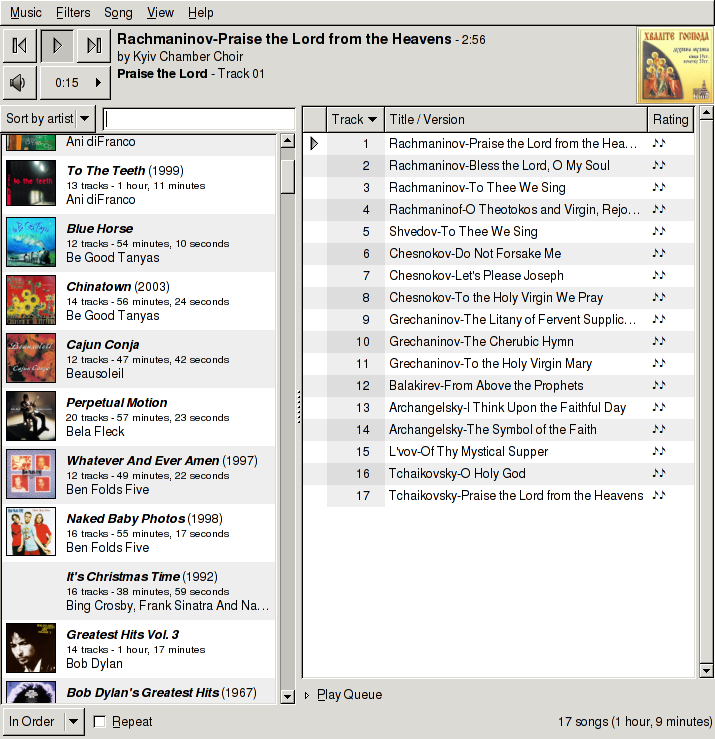
I'm especially impressed at how powerful the tag editing is in quod libet.
It makes it so easy to clean up the missing and broken metadata in even a
large sound library like mine, and the effects are so immediate and nice as
things get sorted into the right place, albums ordered as missing track
info is added, album covers displayed, that it's addictive just to putter
around in there.
Some other features that IMHO make it worth using include the ramdom album
plugin, which lets it pick a new album at random when it finishes playing
the current one (my collection is too varied and big for random track play
to work, but this, mostly, does), the gorgeous album list, and the queue,
an odd little feature that lets you insert any songs you like into a play
queue, to play after the currently playing song. Which solves a lot
situations I've been in before.
And the little details are all there too, little things like right-clicking
on the play button to turn off the music player after the current song
finishes; and automatically and quickly finding new music on startup; and
properly supporting multiple artist albums.
And that just scratches the surface of things I've found to like over a
day.. there's a whole regexp/tag based search engine in there, a music
prefernces learning system with weighted playback, internet radio,
playlists and more. And it's actively developed, and kinda oddly marketed
squarely at Debian users.
Buh-bye rhythmbox..
A statement of verifiable fact is a statement that conveys a provably false factual assertion, such as someone has committed murder or has cheated on his spouse. To illustrate this point, consider the following excerpt from a court (Vogel v. Felice) considering the alleged defamatory statement that plaintiffs were the top-ranking 'Dumb Asses' on defendant's list of "Top Ten Dumb Asses":A statement that the plaintiff is a "Dumb Ass," even first among "Dumb Asses," communicates no factual proposition susceptible of proof or refutation. It is true that "dumb" by itself can convey the relatively concrete meaning "lacking in intelligence." Even so, depending on context, it may convey a lack less of objectively assayable mental function than of such imponderable and debatable virtues as judgment or wisdom. Here defendant did not use "dumb" in isolation, but as part of the idiomatic phrase, "dumb ass." When applied to a whole human being, the term "ass" is a general expression of contempt essentially devoid of factual content. Adding the word "dumb" merely converts "contemptible person" to "contemptible fool." Plaintiffs were justifiably insulted by this epithet, but they failed entirely to show how it could be found to convey a provable factual proposition. ... If the meaning conveyed cannot by its nature be proved false, it cannot support a libel claim.
<aj> so, the other thing i wonder is what you think of the testing-security-support split?Assuming those really are the key factors (which might or might not turn out true, but they seem likely) then that’s something that can be worked on. The first point is completely out of my domain – I’ve never been on vendor-sec, and it’s not likely something that ought to be tweaked much anyway; vendor-sec’s a very closed list by design, and for most security work it’s probably a distraction (testing security as is currently operates without concerning itself with vendor-sec, AIUI); the second points purely technical; and the third point is a combination of technical issues and an issue of training, both of which will be hopefully helped a lot by integrating testing-security and security.debian.org. So the easiest point of attack is obviously the second one, since it’s “just” a matter of expanding dak’s featureset. The problem here is embargoed fixes – the security team needs to be able to prepare fixes for vulnerabilities revealed on vendor-sec, but then keep them secret from everyone not on vendor-sec until the publication date. Which is fine, except that dak takes an all or nothing approach to that sort of secrecy: secuirty uploads go into accepted, get built, and then the security team run “amber” to publish the update. But what that means is the accepted directory and its contents can only be visible to people with vendor-sec access, which means only people with vendor-sec access can do security updates. But we do actually have a different queuing mechanism that allows us to keep some things secret, while not hiding everything: thanks to the crypto-in-main transition, the NEW queue acts like that, more or less, only allowing ftpmaster to see the contents of NEW packages until they’ve passed license inspections and the appropriate export notifications have taken place. And actually, we’d already considered extending that sort of behaviour to add an “unapproved” queue that would prevent uploads from entering proposed-updates without the stable release manager’s prior approval. The idea then, would be to have a couple of queues for the security team: an embargoed queue, accessible only to those with vendor-sec access that would store embargoed fixed ‘til they’re ready to be released, and an unembargoed queue for preparation accessible by a wider group, for preparation of fixes that don’t need to be secret. Both queues would need to be autobuilt (and the build logs for embargoed uploads would need to stay restricted, while the build logs for unembargoed uploads would not), which is an added difficulty, since only accepted can be autobuilt presently. But otherwise, it seems basically plausible, both to myself and Joey. Conveniently, Andrew Pollock’s been interested in throwing some money through the AJ Market to see what happens, and since the initial idea we were tossing around fell through due to his move to the US, he’s put up the dosh to make the above happen. Well, strictly the dosh to make me make the above happen, or something. Anyway, I’m already running behind both in implementation and blogging about it, so back to the grindstone… (Okay, perhaps it’s not quite the feature Mark Twain would most like added to dak, but it’s still nifty.)
<Joey> need more input
<aj> as in separate host, funny domain name, not available on security.debian.org/, extra effort to mirror, etc
<aj> i think it sucks :)
<Joey> there are a lot of sucking things…
<aj> it’s true
<aj> so, i figure the reasons for the split are (a) you don’t want to add a bunch of people to team@ and hence vendor-sec, and (b) there’s no way to make it so they can use dak-security without being full team/vendor-sec members; and maybe (c) you don’t want them officially associated with debian security coz they’re newbies
<Joey> a) and b) are true
<Joey> However, with security.debian.org being a push mirror, it would be possible to let it be pushed from a second source into a different directory, such as /testing-security/
<aj> hrm
<Joey> However, that would require all architectures to be supported and not just some.
<Joey> all as in “all that are in testing”
<aj> ah, that’s (c) then – they don’t do enough for the official debian stamp
<Joey> ah ok
[T]echnology across software domains should be consistent. There should be a standard, however de facto, that works everywhere. Skills should be portable across those markets, so that someone with experience in desktop software development has a decent chance of developing for handhelds. Everything should just work together, and development across all devices should be relatively straightforward to someone with experience in any one of them. Microsoft has been very good at this. […] I wonder whether the open source world can match that consistency. Granted, there are movements to make things consistent, such as the LAMP set of technologies for Linux, or the Linux Standard Base project. However, the structure of development for open source products militates against the establishment of any consistent standard. Open source development relies mostly on voluntary contributions. People don’t tend to contribute to ALL open source products (that would be impossible). Rather, they concentrate mostly on the products that interest them. This results in a developer version of tunnel vision. Since all that matters is the creation of the handful of products to which the volunteer contributes, what matters is the interests of contributors to a single project, not the interests of technology which should span ALL products.Great points, though I clearly disagree that the open source community is fundamentally unable to match Microsoft on providing a consistent environment. It’s going to take some work on our part though. One of the reasons Microsoft has historically been so successful is its unique ability to integrate disparate technologies into cohesive wholes, as well as to leave the mechanisms they use to do this just open enough that others can integrate with them to a degree but never so open that they can do so better than Microsoft can. Of course, Microsoft can do this because they develop, own, and control each of the pieces and the interfaces between them. Other platforms (Linux, Java, UNIX, even the Web to a certain extent) are comparative mishmashes for the exact reasons John describes, namely that every project is developed independently, and that there’s comparatively little thought put into how the pieces interact. The only parties that do think about these issues, the Linux distributors, tend to do so after the fact, and, of course, they have no direct control over the projects that produce the pieces to push any integration improvements they might make upstream (in the general case anyway). Furthermore, once multiple solutions in a given problem domain emerge, it’s not always possible to generalize the interfaces when the projects behind them don’t agree with each other on the “right solution”. In other words, because it’s an after-the-fact thing, “not invented here” and general inertia come into play. So, while the technical aspect of the problem is important, namely the interfaces between components (APIs at the source level and ABIs at the binary level), there’s a social aspect here too. We need to encourage the kind of competition at the implementation level that results in technical excellence while fostering a sense of cooperation at the interface level to ensure that, collectively, the various implementations fit seamlessly into a larger, consistent environment. In other words, we don’t want to get in the way of open source project and Linux distro innovation, but we do want to encourage open source projects and Linux distros to innovate in a collaborative fashion so the technology that ultimately wins in the marketplace can be standardized with as few legacy issues as possible (or, in the case where multiple best practices emerge, for legacy reasons or otherwise, we want to collaboratively define a uniform interface, i.e., cooperate on interface, compete on implementation, etc.). That’s the only way we’re going to get there.
Randomly clicking around Advogato today I accidently tried to login. Rather than seeing “Person not Found” which is all I’ve seen since my account(s) were removed I now get “incorrect password”. It looks like my primary, and replacement accounts at Advogato are back. At the time those accounts were removed I setup this blog so that I could still remain syndicated upon Planet Debian. It would be nice to have the Advogato account(s) back, but I could live without them. (Indeed mailing Raph at his acm.org address bounced so I may will have to)Syndication
For my own notes. This blog appears at:Stalker-tastic. Of course my daily life goes entirely elsewhere - but that contains rudeness, angst, & etc. As you would expect from LiveJournal
- Planet Debian.
- Planet Hants Lug
- The Hampshire Linux User Group - ironically i live in Edinburgh and should be more affiliated with Edlug…
- Planet Former Advogato
- A planet syndicating people who “moved on” from Advogato.
![]()

A last view over Manhattan
Mako was developing a plan in secret, though, which involved micah and his
car. Micah found out soon after. We went back to Clint's, expecting to find
sladen somewhere, but we didn't. I packed my things, and when we really needed
to go, we resolved to put his things in the entrance so he could find then and
do whatever he wanted on his return.
We went on the Metro to Union Square, where, hear this helix, I saw TONS of
raperos doing their break-dance thing (ok, maybe not tons, but I did see them).
And two blocks away, we arrived to the most incredible book store.
Mako has blogged many times about buying very rare books at the Strand for
ridiculous prices, but this was totally unexpected. The Strand is
huge. On the outside, there's carts with hundreds of second-hand
books, all for one dollar. Mako used to go there and browse the books to find
interesting stuff. The Acetarium is full of them! Most of the dollar books are
total crap though. A very high percent talk about god, religion, "our troops"
and stuff like that. Mentally filtering what might be good and what is not is
not easy when you haven't done it before.
Mako started scanning the shelves as soon as we arrived, and every now and
them he'd pick some totally stupid title. I was on my own shelf, missing many
good stuff, while mika, Clint and mako did their own. Clint found quite a few
titles, but mako didn't find anything good. I got lucky though, and found the
precious book of the day: The Spanish Anarchists. The heroic years
1868-1936, by Murray Bookchin. Although old, it was in very good condition,
and mako immediately asked if I was taking it. :) I won!
The inside of the Strand was incredible too. Three very big floors packed
with books, plus the half-priced "reviewer's copies" at the basement. I was
totally overwhelmed by the amount of books I'd be interested in buying, and the
limited weigh I should be carrying back, so I did my best not to look too
carefully.
For a few hours, I didn't have a too clear idea of what mako's plans were.
At some point, micah phoned him and we rushed to the PATH, the train that goes
to New Jersey. Apparently we were meeting micah at Newark, but I still didn't
know why we had to go there. During our ride, I could see how pleasant New
Jersey is to the human eye. Miles and miles of heavy industries. I'm pretty
sure it's the ugliest place I've ever seen. What I couldn't see, and I'm still
disappointed, is any of the viciously arrogant rats of the New York metro
system. Mako had told me about how they look at you, like saying "if you come
down here, you'll be left with 9 fingers", and the incredible number of them on
the tracks. Unfortunately I couldn't see any. I blame Michael Bloomberg.
At Newark, micah appeared in his car, and we all hopped into it. We
apparently were going by car to Boston... including Clint. I was puzzled, as he
had to work on Monday, but he'd said that he'd simply "come back". There was a
problem though, mako had dilinger's keys, and he was going back to NYC from
Boston, and we didn't have time to get to Boston before he left, so we had to
find a way of leaving the keys in NYC so he could get into his appartment.
Finally, mako resolved that Clint would be left in a cold street, in a rough
area of NYC, and he would handle the keys problem. I still didn't understand
what was going on.
We headed North, and I quickly fell asleep on mika's nap. I'm getting old.
When the car stopped again and I suddenly woke up, I looked ahead and...
HORROR! We were at the door of a McDonads. WTF WAS GOING ON? So it seems that
when you're on the road, there's no much other choice than shit food. After a
quick discussion with mako about how badly those burgers taste, I quickly went
back to sleep, until we were in Boston. It took a while to find a parking spot,
because all of them "permit only". It's impossible to park if you come from
somewhere else.
I was finally at the Acetarium, a
very cool flat in Cambridge, 15 minutes away from the MIT. It was 3:30 in the morning.
The day after, we woke up pretty late, and as I opened my laptop and found a
privmsg from sladen, he was was knocking at the door. This man has an
incredible ability to disappear and reappear when he's most unexpected.
Apparently he managed to grab his stuff in NYC, fetch the bus and arrive at 2
in Boston, meeting dilinger at the station, and mako as he went out to MIT.
micah and I went to explore Boston, but never managed. We consumed a few
hours when trying to ship some equipment to micah's colo, and then trying to
find food. When we were ready to go, micah got a very badly timed call, which
made him go back to the Acetarium: a server at work was dying or dead. At one
point, it was late enough that going to Boston wasn't worth it, so we went to
visit the Media Lab instead.
On our way there, micah and I kept chatting about this and that, and found
out how small the internet is. We both know a bunch of common people from
uncommon places like Per , from our involvement in social projects in the net
like Indymedia and Sindominio.net.
The MIT is incredible, specially the Stata Center by Frank Gehry. We
wandered around as we only got voice mail from mako, until an hour later we
found we was like 20 metres away from us. He gave us a tour through the Media
lab, and it was incredible. I had never seen something like that. Every lab was
colourful and fun, and very cool developments were going on everywhere. I also
saw the coolest mame box ever, with an arcade case and everything.

The Stata Center, right next to the Media Lab
After the tour, micah and I headed back, while sladen stayed to have a look
at one of mako's projects. When we got back to the flat, there were a few
people already there for mika's sushi party, and I rolled my first sushi rolls,
which was fun. A bunch of Debian people joined us, including zufus and gravity,
and had a great chat with them. The party ended way too late and after too many
beers.
sladen used his secret disappearing abilities, and a few colleagues from
mako crashed, so there was a bit of overbooking. Mako's solution was simple.
mika, him and I could share their bed.
I can't say I have slept too much, because mako would keep pulling the
blanket and leave me out in the cold, and I was trying not to squish mika. But
it went ok, although we discovered too late that mika was hot while I was cold,
and we swapped our places too late.
Today, we'll go find the Freedom Trail and walk a bit around it, meet
gravity and zufus for lunch, and I will sadly have to go back to Cambridge,
quickly pack and head to the airport to catch my plane. My hours in North
America are expiring.
make oldconfig from 2.4 I finally tried to boot with it. The most deep changes I did was:
Next.