Search Results: "spa"

6 May 2011

Matt Zimmerman: Moving on from Canonical (but not from Ubuntu)

This June, soon after my seventh anniversary with Canonical, I will finish my job as Ubuntu CTO at Canonical. You can read my official announcement on the Canonical blog. It s sometimes hard to believe that it s been that long since we first envisioned a Linux desktop for human beings . When I look at how far we ve come, at the difference we ve made to so many people, it s easy to see how the time passed so quickly. It s been an incredible experience for me to play a part in building Ubuntu and Canonical. Whether building a decentralized company of hundreds of people, to a global community project of tens of thousands of members, I m grateful for all of the learning opportunities along the way. It has been a privilege to work with so many brilliant, passionate and thoughtful people under such auspicious circumstances. There is much I will miss, and I have many memories to enjoy, from all-night global hacking sessions driving toward a ship date, to casual singing and playing music at our many face-to-face events Nonetheless, it is time for me to seek out new challenges and stretch myself in new ways. I ll be moving back to the US, closer to old friends and family, and starting a new job with a different type of company. I am leaving behind a capable and dedicated team at Canonical, who I am confident will achieve even greater things in the years to come. I will remain active in the free software community as a volunteer. I intend to continue to participate in Ubuntu, and to serve on the Technical Board. I will also be continuing my work with Debian and the DEX project. This year, I ve accepted advisory positions with the Ada Initiative and the Freedom Box Foundation, and will continue to support those organizations and their missions. I ll be in Budapest at the Ubuntu Developer Summit for the next week, and look forward to seeing my friends in Canonical and the Ubuntu community. I ll have more to say soon about what I ll be doing next professionally. Watch this space for updates!

5 May 2011

Alexander Reichle-Schmehl: Getting to DebConf11 via night train from Germany

By the way: For DebConf attendees from Germany (or passing through Germany) might be interesting, that you can currently book the night train from Munich to Zagreb with a special price (called Spar Night or something like that); quite cheap: It's cheaper for Meike and me in a double cabin of that train, than to fly for one of us. As far as I know it is a limited offer, to book fast while you can! Apparently you can't book that train via the web interface, but you can buy it in their offices and via phone. Oh, an it seems that the train on the 22nd of July there and on the 31st back might become a Debian train. Seems there are already five of us taking that one ;) Update: Fixed a typo: DebConf is taking place in July, not in June.

Erich Schubert: Upcoming publications in data mining

Upcoming 2011 publications of my research:
Just presented at the SDM11 last weekend:
H.-P. Kriegel, P. Kr ger, E. Schubert, A. Zimek
Interpreting and Unifying Outlier Scores
In Proceedings of the 11th SIAM International Conference on Data Mining (SDM), Mesa, AZ, 2011.
To be presented and published end of August:
T. Bernecker, M. E. Houle, H.-P. Kriegel, P. Kr ger, M. Renz, E. Schubert, A. Zimek
Quality of Similarity Rankings in Time Series
In Proceedings of the 12th International Symposium on Spatial and Temporal Databases (SSTD), Minneapolis, MN, 2011.
E. Achtert, A. Hettab, H.-P. Kriegel, E. Schubert, A. Zimek
Spatial Outlier Detection: Data, Algorithms, Visualizations
In Proceedings of the 12th International Symposium on Spatial and Temporal Databases (SSTD), Minneapolis, MN, 2011.
The latter will also accompany the release of version 0.4 of our data mining research software ELKI.

Jeff Licquia: FHS Refresh

I ve been busy tonight spamming mailing lists and otherwise getting the word out: the LSB workgroup is preparing to update the FHS. This update has been a long time in coming; FHS 2.3 (the current version) was released back in 2004. Since then, a lot has happened, and it s starting to look like the FHS is holding things back due to the lack of updates. For the longest time, the FHS was cared for by its original editors: Dan Quinlan, Rusty Russell, and Chris Yeoh. We should all be grateful that they created a useful and well-written standard one that has been resilient enough to remain useful for six years without changes. Even though it s time to move on, we should not forget that we are building on a strong foundation they laid for us. So, you may be asking: how can I help? Glad you asked! We re tentatively shooting for a goal of releasing FHS 3.0 before July, though that s not written in stone. But we don t want to wait much longer than we ve already had to.

Anand Kumria: Django and Whiskey.

No, not programming whilst inebriated. Although the effects of the Ballmer Peak are well known. I mean using wsgi and Apache together with Django. But, perhaps, I should explain my (current) layout of projects. I now use:
 /path/to/project/
                 .git
                 .gitignore
                 project_name/
                             urls.py
                             settings.py
                             production_settings.py
                             [...]
                 apache/
                       project_name.conf
                       django.wsgi
                 env/
                    [...]
                 sitestatic/
                 requirements.txt
                 fabfile.py
This allows me to have revision control of things meta to the project and of the project itself. This setup is relatively new, I've only been using it in about 4 projects now. Which meant that my wsgi file had to be slightly modified. This took me a lot longer than I expected to get going. But if you decide to use a layout similar to mine, this might help.
import os
import sys
import site
## Assumptions:
# Assume that the Django project and the environment are at the same level.
# i.e.
# /home/
#      /<project root>/                                     <- *
#                     /<project name>/                      <- *
#                                    /apache/
#                                           django.wsgi
#                                    production_settings
#                     /env/
#                         /lib/
#                             /pythonX.Y/
#                                       /site-packages/     <- *
#                     /sitestatic
#
# Directories marked with '<- *' need to be imported for everything to work
PROJECT_NAME = "control"
PYVER = "%d.%d" % (sys.version_info[0], sys.version_info[1])
APACHE_DIR = os.path.abspath(os.path.dirname(__file__))
PROJECT_ROOT = os.path.abspath(os.path.join(APACHE_DIR, ".."))
site_packages = os.path.join(PROJECT_ROOT, 'env/lib/python%s/site-packages' % PYVER)
site.addsitedir(os.path.abspath(site_packages))
sys.path.insert(0, os.path.join(PROJECT_ROOT, PROJECT_NAME))
sys.path.insert(0, PROJECT_ROOT)
# import from down here to pull in possible virtualenv django install
os.environ['DJANGO_SETTINGS_MODULE'] = 'production_settings'
import django.core.handlers.wsgi
application = django.core.handlers.wsgi.WSGIHandler()
One slight tweak I have also done is to rename the django.wsgi file, to be the environment file. e.g. devel.wsgi. That means the only hardcoded thing in the wsgi file is the PROJECT_NAME. Apply this patch on top of the file above:
--- apache/django.wsgi  2011-05-06 00:38:57.266316530 +0100
+++ apache/devel.wsgi   2011-05-05 14:23:33.708685680 +0100
@@ -24,14 +24,15 @@
 PYVER = "%d.%d" % (sys.version_info[0], sys.version_info[1])
 APACHE_DIR = os.path.abspath(os.path.dirname(__file__))
 PROJECT_ROOT = os.path.abspath(os.path.join(APACHE_DIR, ".."))
+ENVIRON_TYPE = os.path.basename(__file__).rstrip('.wsgi')
-site_packages = os.path.join(os.path.dirname(PROJECT_ROOT), 'env/lib/python%s/site-packages' % PYVER)
+site_packages = os.path.join(PROJECT_ROOT, 'env/lib/python%s/site-packages' % PYVER)
 site.addsitedir(os.path.abspath(site_packages))
 sys.path.insert(0, os.path.join(PROJECT_ROOT, PROJECT_NAME))
 sys.path.insert(0, PROJECT_ROOT)
 # import from down here to pull in possible virtualenv django install
-os.environ['DJANGO_SETTINGS_MODULE'] = 'production_settings'
+os.environ['DJANGO_SETTINGS_MODULE'] = '%s_settings' % ENVIRON_TYPE
 import django.core.handlers.wsgi
 application = django.core.handlers.wsgi.WSGIHandler()
If you have any suggestions for improvements, or thoughts on how to remove the PROJECT_NAME, let me know!

4 May 2011

Craig Small: JFFNMS 3rd RC lucky?

I ve just uploaded to sourceforge the third and hopefully last RC for jffnms network management system version 0.9.0 The reason for the delay was easter as well as I wanted to test the engines for a long while to make sure I was not getting any orphan children or items. Previous versions had processes that never died or if they died the parent didn t realise and didn t handle the item, permanently making the item out for work . PHP5 has much better job and process handling and the new version takes advantage of this handling. It s run well on my on test setup for a week or two. You can find the RC code or just the older releases at https://sourceforge.net/projects/jffnms/files/

3 May 2011

Pietro Abate: On the apt-get installation plan

One important aspect of the mancoosi project is to build a model of the installation process in order to simulate packages upgrades before committing the changes on the machine. This work described here and here (and in upcoming publications) relays on the availability installation plan of the meta-installer (the exact order in which packages will be installed, configured and removed ) to run a simulation of maintainers scripts and check for potential problems accordingly to the model. Thanks to the help of Julian Andres Klode upstream and maintainer of the python-apt bindings it is now possible to extract the installation plan from apt-get without resorting to debug printout or other hacks. A forthcoming integration with mpm (Mancoosi-Package-Manager, our testbed meta-installer) will give us the possibility to hook the model checker to the meta-installer and to run it before every upgrade. The two important changes in the python-apt bindings that will make this possible are the new bindings to the class OrderList and the sub-classing of the class package manager. PackageManager . Regarding the latter, this is a small example (thanks again Julien !) that you can use to get the installation plan as computed by apt-get. In theory, this will also allow to experiment with different back-ends (like rpm - blah ! :) ) easily without the need to hack the c++ code.
import apt_pkg, sys
import apt

class PkgManager(apt_pkg.PackageManager):

parent = apt_pkg.PackageManager
depcache = apt_pkg.DepCache(apt_pkg.Cache())
installionplan = []

def install(self, pkg, file):
#print "Installing", pkg.get_fullname(True)
self.installionplan.append((pkg,"Inst"))
return True

def configure(self, pkg):
#print "Configuring", pkg.get_fullname(True)
self.installionplan.append((pkg,"Conf"))
return True

def remove(self, pkg, purge):
#print "Removing", pkg.get_fullname(True)
self.installionplan.append((pkg,"Rem"))
return True

def go(self, fd):
for (p,a) in self.installionplan :
if a == "Inst" or a == "Conf" :
ver = self.depcache.get_candidate_ver(p)
else :
ver = p.current_ver
print a, p.name, ver.ver_str, ver.arch

return True

apt_pkg.PackageManager = PkgManager


cache = apt.Cache()
pkg = cache["python"]
if pkg.is_installed:
pkg.mark_delete()
else:
pkg.mark_install()

apt_pkg.config.set("APT::Get::Simulate","true")
apt_pkg.config.set("dir::cache","/tmp")

print "COMMIT"
cache.commit(install_progress=apt.progress.base.InstallProgress())
And this is the result on my machine :
abate@zed.fr:~$python pkgmanager-test.py
Reading package lists... Done
Building dependency tree
Reading state information... Done
COMMIT
Rem alacarte 0.13.2-1 all
Rem apt-listchanges 2.85.7 all
Rem apt-xapian-index 0.41 all
Rem gnome-accessibility 1:2.30+7 all
Rem gok 2.30.0-1 amd64
Rem dasher 4.11-1 amd64
Rem gnome-orca 2.30.2-2 all
Rem python-pyatspi 1.30.1-3 all
Rem at-spi 1.30.1-3 amd64
Rem bluetooth 4.91-1 all
Rem gnome-bluetooth 2.30.0-2 amd64
Rem bluez 4.91-1 amd64
Rem brasero 2.30.3-2 amd64
Rem gthumb 3:2.13.1-1 amd64
Rem libbrasero-media0 2.30.3-2 amd64
Rem brasero-common 2.30.3-2 all
Rem bzr 2.3.1-2 all
Rem gnome-core 1:2.30+7 amd64
Rem gnome-control-center 1:2.30.1-3 amd64
Rem capplets-data 1:2.30.1-3 all
Rem cheese 2.30.1-2 amd64
Rem cheese-common 2.30.1-2 all
Rem cython 0.14.1-5 amd64
Rem dasher-data 4.11-1 all
Rem deluge 1.3.1-1 all
Rem deluge-gtk 1.3.1-1 all
Rem deluge-common 1.3.1-1 all
Rem deskbar-applet 2.32.0-1+b1 amd64
Rem dia 0.97.1-8 amd64
Rem dia-common 0.97.1-8 all
Rem doxygen 1.7.4-1 amd64
Rem doxygen-latex 1.7.4-1 all
Rem dput 0.9.6.2 all
Rem duply 1.5.4.2-1 all
Rem duplicity 0.6.13-1 amd64
Rem edos-debcheck 1.0-9 all
Rem edos-distcheck 1.4.2-12 amd64
Rem eog 2.30.2-1 amd64
Inst libxp6 1:1.0.1-1 amd64
Inst lesstif2 1:0.95.2-1 amd64
Inst xpdf 3.02-12 amd64
Conf libxp6 1:1.0.1-1 amd64
Conf lesstif2 1:0.95.2-1 amd64
Conf xpdf 3.02-12 amd64
[ ... ]

Michal &#268;iha&#345;: phpMyAdmin translation status

It's time to report again progress on phpMyAdmin translations. I will make it shorter this time :-). There has been great progress in translation progress. Japanese translation is near completing (only 55 messages are missing right now) thanks to Yuichiro who did tremendous work there. There is also ongoing effort for Sinhala translation lead by Madhura Jayaratne. Nevertheless the number of complete translations is still 14 (see my previous post for complete list). Besides translating phpMyAdmin itself, there was lot of work on translating documentation, so we now have complete documentation translated to Spanish and very good progress on Chinese one. As the final release of 3.4.0 is really close, anybody is welcome to translate missing bits. Any Norwegian, Polish or Finnish readers of this blog? I'm sure you can still make your translation complete! (Others are welcome as well of course.)

Filed under: English Phpmyadmin 0 comments Flattr this!

Rapha&#235;l Hertzog: My Debian activities in April 2011

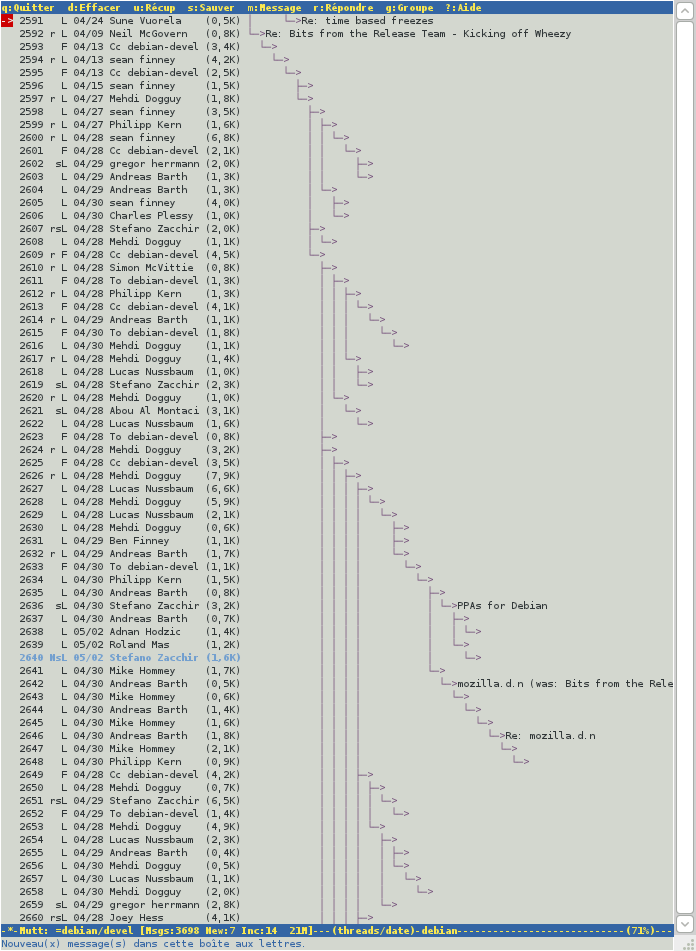
This is my monthly summary of my Debian related activities. If you re among the people who support my work, then you can learn how I spent your money. Otherwise it s just an interesting status update on my various projects. GNOME 3 packaging Right after the GNOME 3 release, I was eager to try it out so I helped the pkg-gnome team to update some of the packages. I did some uploads of totem, totem-pl-parser, gvfs, mutter, gnome-shell, gnome-screensaver. I also kept people informed via my blog and prepared a pinning file for adventurous users who wanted to try it out from experimental (like me). One month later, I m still using GNOME 3. There are rough edges still, but not so many. And I m starting to get used to it. Debian Rolling planning Debian Rolling is a project on my TODO list for quite some time. I decided it was time to do something about it and started a series of articles to help clarify my ideas while getting some early feedback. My goal was to prepare a somewhat polished proposal before posting it to a Debian mailing list. But as usual with Murphy s law, my plan did not work out as expected. Almost immediately after my first post the discussion started on debian-devel:
At this point it s a discussion thread of several hundreds of messages (there are several screens of messages like the one above). Many of the sub-threads have been interesting, but the general discussions mixed too many different things so that there s no clear outcome yet. Lucas Nussbaum tried to make a summary. Obviously I must adjust my plan, there s lots of feedback to process. I accepted to drive a DEP together with Sean Finney to help structure the part of the discussion that focuses on allowing development to continue during freezes. But I m also eager to fix the marketing problem of testing and have the project recognize that testing is a product in itself and that end-users should be encouraged to use it. Package Tracking System maintenance The Package Tracking System is an important tool for Debian developers, and it has been broken by some change on the Bug Tracking System. I worked around it quite quickly so that few people noticed the problem but Cron kept reminding me that I had to properly fix it. I ended up doing it last week-end. While working on the PTS, I took the opportunity to merge a patch from Jan Dittberner to enhance the news RSS feed that the PTS provides. And I also integrated information from backports.debian.org (thanks to Mehdi Dogguy for reminding me #549115). Multiarch update Not much new this month. I fixed two bugs in the multiarch dpkg branch thanks to bug reports from Ubuntu users (LP 767634, LP 756381). I m still waiting on Guillem Jover finishing his review of the multiarch branch. I m pinging him from time to time but it looks like multi-arch is no longer in his short term priority list. :-( I ve been running this code for more than 2 months and it works fine. I want to see it merged. I m ready to update my code should anything need to be changed to please Guillem. But without any feedback we re in a deadlock. Misc dpkg work While fixing a bug in update-alternatives (found in one of the valid reports on launchpad), I noticed that there was room for improvements in the error messages output by update-alternatives. I changed them to reuse the same strings that were already used in other parts of dpkg. The result is that there are a few strings less to translate (always a nice thing for the poor translators who have to deal with the thousands of strings that dpkg contains). I also tried to fix some of the most cryptic error messages in dpkg (see #621763) but that work is stalled at the request of Guillem. Book update We (me and Roland Mas) are almost done with the update of our French book for Debian Squeeze. It will hit the shelves in July or September. I m starting to prepare the fundraising campaign to make an English translation of it. We ll use ulule.com for this. On my blog I have been pleased to interview Meike Reichle, it s the first women that I have interviewed in the series but it s certainly not the last one. I also interviewed Adam D. Barratt, one of our tireless release managers. Thanks Many thanks to the people who gave me 180.35 in March and 235.37 in April. That represents 1.5 and 2 days of work for those months. See you next month for a new summary of my activities.

8 comments Liked this article? Click here. My blog is Flattr-enabled.

30 April 2011

Thomas Girard: ACE+TAO Debian packaging moved to git

We recently converted Debian ACE+TAO package repository from Subversion to git. This was a long and interesting process; I learned a lot on git in the course. I had been using git for a while for other packages: BOUML, dwarves and GNU Smalltalk. But I did not really get it. A preliminary study led by Pau[1] showed that out of the following three tools: the last one was giving results that look better.
The conversion svn-all-fast-export requires physical access to the repo, so the Alioth SVN repo was copied on my machine svn-pkg-ace/ before running the tool:
svn-all-fast-export --identity-map authors.txt --rules pkg-ace.rules svn-pkg-ace
Here's the content of the pkg-ace.rules configuration file that was used:
create repository pkg-ace
end repository
match /trunk/
  repository pkg-ace
  branch master
end match
match /(branches tags)/([^/]+)/
  repository pkg-ace
  branch \2
end match
The author mapping file authors.txt being:
markos = Konstantinos Margaritis <email-hidden>
mbrudka-guest = Marek Brudka <email-hidden>
pgquiles-guest = Pau Garcia i Quiles <email-hidden>
tgg = Thomas Girard <email-hidden>
tgg-guest = Thomas Girard <email-hidden>
The tool sample configuration file merged-branches-tags.rules recommends to post-process tags, which are just a branch in SVN. That's why the configuration file above treats branches as tags. The conversion was indeed fast: less than 1 minute.
Post-conversion observations Invoking gitk --all in the converted repo revealed different kind of issues:
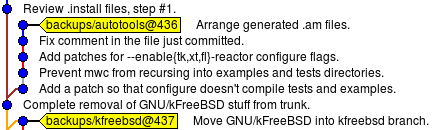
  • svn tags as branches: http://thomas.g.girard.free.fr/ACE/tags-as-branches.png Branches are marked with green rectangles, and tags with yellow arrows. What we have here (expected given our configuration of the tool) are branches (e.g. 5.4.7-5) corresponding to tags, and tags matching the SVN tagging commit (e.g. backups/5.4.7-5@224). We'll review and fix this.

  • merged code that did not appear as such: http://thomas.g.girard.free.fr/ACE/missing-merge-metadata.png Branches that were not merged using svn merge look like they were not merged at all.

  • commits with wrong author: http://thomas.g.girard.free.fr/ACE/wrong-author.png Before being in SVN, the repository was stored in CVS. When it was imported into SVN, no special attention was given to the commit author. Hence I got credited for changes I did not write.

  • obsolete branches: http://thomas.g.girard.free.fr/ACE/obsolete-branches.png The tool leaves all branches, including removed ones (with tag on their end) so that you can decide what to do with them.

  • missing merges: http://thomas.g.girard.free.fr/ACE/missing-merge.png The branch 5.4.7-12 was never merged into the trunk!

Learning git Based on observations above, I realized my limited knowledge won't do to complete the conversion and clean the repository. There are tons of documentation on git out there, and you can find a lot of links from the git documentation page. Here's the one I've used:
The Git Object Model It's described with pictures here. You really need to understand this if you haven't already. Once you do, you understand that git is built bottom-up: the plumbing then the porcelain. If you can't find the tool you need, it's easy to write it.
git fast-import The Migrating to Git chapter explains how you can use the git fast-import tool to manually import anything into git. I've used it to create tags with dates in the past, slightly changing the Custom Importer example in the book:
#!/usr/bin/env ruby
#
# retag.rb
#
# Small script to create an annotated tag, specifying commiter as well as
# date, and tag comment.
#
# Based on Scott Chacon "Custom Importer" example.
#
# Arguments:
#  $1 -- tag name
#  $2 -- sha-1 revision to tag
#  $3 -- committer in the form First Last <email>
#  $4 -- date to use in the form YYYY/MM/DD_HH:MM:SS

def help
  puts "Usage: retag <tag> <sha1sum> <committer> <date> <comment>"
  puts "Creates a annotated tag with name <tag> for commit <sha1sum>, using "
  puts "given <committer>, <date> and <comment>"
  puts "The output should be piped to git fast-import"
end
def to_date(datetime)
  (date, time) = datetime.split('_')
  (year, month, day) = date.split('/')
  (hour, minute, second) = time.split(':')
  return Time.local(year, month, day, hour, minute, second).to_i
end
def generate_tag(tag, sha1hash, committer, date, message)
  puts "tag # tag "
  puts "from # sha1hash "
  puts "tagger # committer  # date  +0000"
  print "data # message.size \n# message "
end
if ARGV.length != 5
  help
  exit 1
else
  (tag, sha1sum, committer, date, message) = ARGV
  generate_tag(tag, sha1sum, committer, to_date(date), message)
end
graft points (graft means greffe in French) Because of missing svn:mergeinfo some changes appear unmerged. To fix this there are graft points: they override git idea of parents of a commit. To create a graft point, assuming 6a6d48814d0746fa4c9f6869bd8d5c3bc3af8242 is the commit you want to change, currently with a single parent 898ad49b61d4d8d5dc4072351037e2c8ade1ab68, but containing changes from commit 11cf74d4aa996ffed7c07157fe0780ec2224c73e:
me@mymachine$ echo 6a6d48814d0746fa4c9f6869bd8d5c3bc3af8242 11cf74d4aa996ffed7c07157fe0780ec2224c73e 898ad49b61d4d8d5dc4072351037e2c8ade1ab68 >> .git/info/grafts
git filter-branch git filter-branch allows you to completely rewrite history of a git branch, changing or dropping commits while traversing the branch. As an additional benefit, this tool use graft points and make them permanent. In other words: after running git filter-branch you can remove .git/info/grafts file. I've used it to rewrite author of a given set of commits, using a hack on top of Chris Johnsen script:
#!/bin/sh

br="HEAD"
TARG_NAME="Raphael Bossek"
TARG_EMAIL="hidden"
export TARG_NAME TARG_EMAIL
filt='
    if test "$GIT_COMMIT" = 546db1966133737930350a098057c4d563b1acdf -o \
            "$GIT_COMMIT" = 23419dde50662852cfbd2edde9468beb29a9ddcc; then
        if test -n "$TARG_EMAIL"; then
            GIT_AUTHOR_EMAIL="$TARG_EMAIL"
            export GIT_AUTHOR_EMAIL
        else
            unset GIT_AUTHOR_EMAIL
        fi
        if test -n "$TARG_NAME"; then
            GIT_AUTHOR_NAME="$TARG_NAME"
            export GIT_AUTHOR_NAME
        else
            unset GIT_AUTHOR_NAME
        fi
    fi
'
git filter-branch $force --tag-name-filter cat --env-filter "$filt" -- $br
(Script edited here; there were much more commits written by Raphael.)

Important

It's important to realize that the whole selected branch history is rewritten, so all objects id will change. You should not do this if you already published your repository.

The --tag-name-filter cat argument ensures our tags are copied during the traversal; otherwise they would be untouched, and hence not available in the new history.

Hint

Once git filter-branch completes you get a new history, as well as a new original ref to ease comparison. It is highly recommended to check the result of the rewrite before removing original. To shrink the repo after this, git clone the rewritten repo with file:// syntax -- git-filter-branch says it all.

Cleaning up the repo To recap, here's how the ACE+TAO git repo was changed after conversion:
  1. Add graft points where needed.

  2. Clean tags and branches. Using git tag -d, git branch -d and the Ruby script above it was possible to recreate tags. During this I was also able to add missing tags, and remove some SVN errors I did -- like committing in a branch created under tags/.

  3. Remove obsolete branches.

  4. Merge missing pieces. There were just two missing debian/changelog entries. I did this before git filter-branch because I did not find a way to use the tool correctly with multiple heads.

  5. Fix commit author where needed. Using the shell script above Raphael is now correctly credited for his work.

That's it. The ACE+TAO git repository for Debian packages is alive at http://git.debian.org/?p=pkg-ace/pkg-ace.git;a=summary.
[1]http://lists.alioth.debian.org/pipermail/pkg-ace-devel/2011-March/002421.html
[2]available in Debian as svn-all-fast-export

29 April 2011

Ian Wienand: Toolchains, libc and interesting interactions

When building a user space binary, the -lc that gcc inserts into the final link seems pretty straight forward link the C library. As with all things system-library related there is more to investigate. If you look at /usr/lib/libc.so; the "library" that gets linked when you specify -lc, it is not a library as such, but a link script which specifies the libraries to link, which also includes the dynamic linker itself:
$ cat /usr/lib/libc.so
/* GNU ld script
   Use the shared library, but some functions are only in
   the static library, so try that secondarily.  */
OUTPUT_FORMAT(elf64-x86-64)
GROUP ( /lib/libc.so.6 /usr/lib/libc_nonshared.a  AS_NEEDED ( /lib/ld-linux-x86-64.so.2 ) )
On very old glibc's the AS_NEEDED didn't appear; so every binary really did have a DT_NEEDED entry for the dynamic linker itself. This can be somewhat confusing if you're ever doing forensics on an old binary which seems to have these entries for not apparent reason. However, we can see that that /lib/libc.so itself does actually require symbols from the dynamic linker:
$ readelf --dynamic /lib/libc.so.6   grep NEEDED
 0x0000000000000001 (NEEDED)             Shared library: [ld-linux-x86-64.so.2]
Although you're unlikely to encounter it, a broken toolchain can cause havoc if it gets the link order wrong here, because the glibc dynamic linker defines minimal versions of malloc and friends -- you've got a chicken-and-egg problem using libc's malloc before you've loaded it! You can simulate this havoc with something like:
$ cat foo.c
#include <stdio.h>
#include <syslog.h>
int main(void)
 
   syslog(LOG_DEBUG, "hello, world!");
   return 0;
 
$ cat libbroken.so
GROUP ( /lib/ld-linux-x86-64.so.2 )
$ gcc -o -Wall -Wl,-rpath=. -L. -lbroken -g -o foo foo.c
$ ./foo
Inconsistency detected by ld.so: dl-minimal.c: 138: realloc: Assertion  ptr == alloc_last_block' failed!
Depending on various versions of things, you might see that assert or possibly just strange, corrupt output in your logs as syslog calls the wrong malloc. You could debug something like this by asking the dynamic linker to show you its bindings as it resolves them:
$ LD_DEBUG_OUTPUT=foo.txt LD_DEBUG=bindings ./foo
Inconsistency detected by ld.so: dl-minimal.c: 138: realloc: Assertion  ptr == alloc_last_block' failed!
$ cat foo.txt.11360   grep "\ malloc'"
     11360:	binding file /lib/libc.so.6 [0] to /lib64/ld-linux-x86-64.so.2 [0]: normal symbol  malloc' [GLIBC_2.2.5]
     11360:	binding file /lib64/ld-linux-x86-64.so.2 [0] to /lib64/ld-linux-x86-64.so.2 [0]: normal symbol  malloc' [GLIBC_2.2.5]
     11360:	binding file /lib/libc.so.6 [0] to /lib64/ld-linux-x86-64.so.2 [0]: normal symbol  malloc' [GLIBC_2.2.5]
Above, because the dynamic loader comes first in the link order, libc.so.6's malloc has bound to the minimal implementation it provides, rather the full-featured one it provides internally. As an aside, AFAICT, there is really only one reason why a normal library will link against the dynamic loader -- for the thread-local storage support function __tls_get_addr. You can try this yourself:
$ cat tls.c
char __thread *foo;
char* moo(void)  
	return foo;
 
$ gcc -fPIC -o libtls.so -shared tls.c
$ readelf -d ./libtls.so    grep NEED
 0x00000001 (NEEDED)                     Shared library: [libc.so.6]
 0x00000001 (NEEDED)                     Shared library: [ld-linux.so.2]
 0x6ffffffe (VERNEED)                    0x314
 0x6fffffff (VERNEEDNUM)                 2
Thread-local storage is worthy of a book of its own, but the gist is that this support function says "hey, give me an address of foo in libtls.so", the magic being that if the current thread has never accessed foo then it may not actually have any storage for foo yet, so the dynamic linker can allocate some memory for it lazily and then return the right thing. Otherwise, every thread that started would need to reserve room for foo "just in case", even if it never cares about moo. But looking a little closer at the symbols of libc.so is also interesting. libc.so doesn't actually have many functions you can override. You can see what it is possible to override by checking the relocations against the procdure-lookup table (PLT).
Relocation section '.rela.plt' at offset 0x1e770 contains 8 entries:
  Offset          Info           Type           Sym. Value    Sym. Name + Addend
00000035b000  084600000007 R_X86_64_JUMP_SLO 00000000000a2100 sysconf + 0
00000035b008  02e000000007 R_X86_64_JUMP_SLO 0000000000075e50 calloc + 0
00000035b010  01dd00000007 R_X86_64_JUMP_SLO 0000000000077910 realloc + 0
00000035b018  029300000007 R_X86_64_JUMP_SLO 00000000000661c0 feof + 0
00000035b020  046f00000007 R_X86_64_JUMP_SLO 00000000000768c0 malloc + 0
00000035b028  000400000007 R_X86_64_JUMP_SLO 0000000000000000 __tls_get_addr + 0
00000035b030  01b400000007 R_X86_64_JUMP_SLO 0000000000076dd0 memalign + 0
00000035b038  086000000007 R_X86_64_JUMP_SLO 00000000000767e0 free + 0
i.e. instead of jumping directly to the malloc defined in the libc code section, any internal calls will jump to this stub which, the first time, asks the dynamic linker to go out and find the address of malloc (it then saves it, so the second time the stub just jumps to the saved location). This is an interesting list, seemingly without much order. feof, for example, stands out as worth checking out a bit closer why would that be there when fopen isn't, say? We can track down where it comes from with a bit of detective work; knowing that the value of the symbol feof will be placed into 0x35b018 we can disassemble libc.so to see that this address is used by the feof PLT stub at 0x1e870 (luckily, objdump has done the math to offest from the rip for us; i.e. 0x1e876 + 0x33c7a2 = 0x35b018)
000000000001e870 <feof@plt>:
   1e870:       ff 25 a2 c7 33 00       jmpq   *0x33c7a2(%rip)        # 35b018 <_IO_file_jumps+0xb18>
   1e876:       68 03 00 00 00          pushq  $0x3
   1e87b:       e9 b0 ff ff ff          jmpq   1e830 <h_errno+0x1e7dc>
From there we can search for anyone jumping to that address, and find out the caller:
$ objdump --disassemble-all /lib/libc.so.6   grep 1e870
000000000001e870 <feof@plt>:
   1e870:	ff 25 a2 c7 33 00    	jmpq   *0x33c7a2(%rip)        # 35b018 <_IO_file_jumps+0xb18>
   f19f7:	e8 74 ce f2 ff       	callq  1e870 <feof@plt>
$ addr2line -e /lib/libc.so.6 f19f7
/home/aurel32/eglibc/eglibc-2.11.2/sunrpc/bindrsvprt.c:70
Which turns out to be part of a local patch which probably gets things a little wrong, as described below. The sysconf relocation is from a similar add-on patch (being used to find the page size, it seems). libc, like all sensible libraries, uses the hidden attribute on symbols to restrict what is exported by the library. The benefit of this is that when the linker knows you are referencing a hidden symbol it knows that the value can never be overridden, and thus does not need to emit extra code to do indirection just in case you ever wish to redirect the symbols. In the above, it appears that feof has never been marked as hidden, probably because no internal glibc functions used it until that add-on patch, and since it is not considered an internal function the linker must allow for the possibility that it will be overridden at run time and provide a PLT slot for it. There are consequences; if this was on a fast-path then the extra jumps required to go via the PLT may matter for performance and it may also cause strange behaviour if somebody had preloaded something that took over feof. Note, this is different from saying that your library can override symbols provided by libc.so; such as when you LD_PRELOAD a library to wrap an open call. What you can not override is the open call that say, the internal libc.so function getusershell does to read /etc/shells. Having the malloc related calls as preemptable seems intentional and sane; although I can not find a comment to the effect of "we deliberately leave these like this so that users may use alternative malloc implementations", it makes sense so that libc.so is internally using the same malloc as everything else if you choose to use something such as tc-malloc. tl;dr? Digging into your system libraries is always interesting. Be careful with your link order when creating toolchains, and be careful about symbol visibility when you're working with libraries.

Steve Kemp: Goodbye, world.

Today I resigned from the Debian project. The following packages are up for adoption: I'll remove myself from Planet Debian tomorrow, assuming the keyring revokation isn't swift and merciless. ObQuote: This space is intentionally blank.

28 April 2011

Patrick Schoenfeld: Directory-dependent shell configuration with zsh (Update)

For a while I've been struggling with a little itch. I'm using my company notebook for company work and for Debian related stuff. Now, whenever I switch between those two contexts, I had to manually fix the environment configuration. This is mostly related to environment variables, because tools like dch et cetera rely on some, which need to be different for the different contexts, like DEBEMAIL.
A while ago I had the idea to use directory dependent configuration for that purpose, but I never found the time and mood to actually fix my itch.
Somewhere in the meanwhile I applied a quick hack ("case $PWD in ...; do export...; esac") to my zsh configuration to ease the pain, but it still did not feel right.


For the impatient: Below you find a way to just use whats described here. The rest of the article just contains detailed information on how to implement something like this.


The other day I were cleaning up and extending my zsh configuration and it came to my mind again. I then thought about what my requirements are and how I could solve it. First I thought about using a ready solution, like the one in the Grml Zsh configuration, but at that point I did not remember it (it needed a hint by a co-worker *after* I finished the first version of my solution). Then I came up with my requirements:

It lead to a configuration approach as a first start. When thinking about how to represent the configuration I looked into the supported data types in zsh. zsh supports arrays, which is perfect for my need. I came up with something like that:
typeset -A EMAILS ENV_DEBIAN ENV_COMPANY
EMAILS=(
"private" "foo@bar.org"
"company" "baz@foo.org"
"debian" "schoenfeld@debian.org"
)
ENV_DEBIAN=(
"DEBEMAIL" "$EMAILS[debian]"
"EMAIL" "$EMAILS[debian]"
)
ENV_COMPANY=(
"DEBEMAIL" "$EMAILS[company]"
)
The next part was selecting the right profile. In the first version I used the old case logic, but it was breaking my separate logic and configuration paradigm. Approximate at this point the co-worker lead me to the grml approach, which I borrowed an idea from:


# Configure profile mappings
zstyle ':chpwd:profiles:*company*' profile company
zstyle ':chpwd:profiles:*debian*' profile debian

and the following code to lookup profile based on $PWD:

1 function detect_env_profile
2 local profile
3 zstyle -s ":chpwd:profiles:$ PWD " profile profile profile='default'
4 profile=$ (U)profile
5 if [ "$profile" != "$ENV_PROFILE" ]; then
6 print "Switching to profile: $profile"
7 fi
8 ENV_PROFILE="$profile"
9

For an explanation: zstyle is a zsh-builtin which is used to "define and lookup styles", as the manpage says, or put different: Another way to store and lookup configuration values.
Its nice for my purpose, because it allows storing patterns instead of plain configuration values which can be compared against $PWD easily with all of the zsh globbing magic. This is basically whats done in line 3. zstyle then sets $profile to the matching zstyle configuration in the :chpwd:profiles: context or to 'default' if no matching zstyle is found.

The (almost) last part is putting it together with code to switch the profile:

1 function switch_environment_profiles
2 detect_env_profile
3 config_key="ENV_$ENV_PROFILE"
4 for key value in $ (kvP)config_key ; do
5 export $key=$value
6 done
7
The only non-obvious part in this are lines 3 and 4. Remember, the profiles were defined as ENV_PROFILE, where PROFILE is the name of the profile. We cannot know that key in advance, therefore we have to construct the right environment variable from the result of detect_env_profile. We do that in line 3 and lookup this environment variable in line 4.
The deciding aspect for that is the P-flag in the parameter expansion. It tells zsh that we do not want the value of $config_key, but instead the value of $WHATEVER_CONFIG_KEY_EXPANDS_TO.
The other flags k and v tell zsh that, from the array, we want both: keys and values. If we'd omitted those flags it would have given us the values only.
We then loop over that to configure the environment. Easy, hu?

We would be finished, if this would do anything. The code above needs to be called. Lucky for us thats pretty easy to achieve, as zsh has a hook for when a directory is changed. Making all this work is simply a matter of adding something like this:

function chpwd()
switch_environment_profiles

Now, one could say, that the solution in the grml configuration has an advantage. It allows calling arbitrary commands on profile changing, which might be useful to *unset* variables in a given profile or whatever you could think of.
Well, its a matter of three lines to extend the above code for that feature:


# Taken from grml zshrc, allow chpwd_profile_functions()
if (( $ +functions[chpwd_profile_$ENV_PROFILE] )) ; then
chpwd_profile_$ ENV_PROFILE
fi

to the end of switch_environment_profiles and now its possible to additionally add a function chpwd_profile_PROFILE which is called whenever the profile is changed to that profile.


USAGE: I have put the functions into a file which can be included into your zsh configuration, which can be found on github.
Please see this README and the comments in the file itself on further usage instructions.

Russell Coker: Australia Needs it s own Monarch

Tomorrow Prince William will marry Kate Middleton. If we don t change anything he will probably become the King of Australia at some future time, so I think that now is the time to start discussing the options. Walter Block makes some interesting points in favor of longer terms for politicians and for having a monarch to get a long-term view of the national interest [1], he s not the only person to make such points, but he makes them in a better way than most. Of course the problem with this is the long history of kings not doing what s best for their country part of the ownership rights to property is the right to destroy it, so a monarch who owns a country therefore can be considered to have the right to cause the wholesale death of their subjects. There are some examples of President for Life political leaders demonstrating this at the moment. Even with a monarch who is generally a nice person and who has controls to prevent the worst abuses there is the possibility of Control Fraud. In the Constitutional Monarchy system that doesn t happen because a constitutional monarch has little power (no official position of power). But there is still the issue of whether the monarchy is any good. Charles Stross wrote an interesting post about the apparent human need to have a leadership figure [2]. So getting rid of a monarch tends to result in a president getting the trappings of a king, and if things go wrong (as they often do) then they get absolute power until the next revolution. It seems that having one person who is the head of government and the head of state (as done in the US for example) is a bad idea, they can start to think that it s all about them. I don t think that the US is at risk of getting a president for life in the near future and I don t think that Australia will do so if we become a republic, but that doesn t mean that the republican system works well. I think that the Australian system is working better than the US system and I will generally vote against any changes that make Australia more like the US. As long as the House of Windsor provides monarchs who are as sensible as Queen Elizabeth 2 I will vote in favor of the continued rule of the House of Windsor in preference to an Australian republic (if Prince Charles ever becomes king I may support a republic). A Way of Improving Things I want to have an Australian monarch. Someone who will live in Australia for most of the time (as opposed to a distant monarch who visits once a decade if we are lucky). Protocol should dictate that the Prime Minister and cabinet ministers are forced to show ritual respect to the monarch, bowing etc, and no touching. A separation between the person who performs most of the ceremonial functions and the person who actually makes the political decisions should help constrain political egos. When a Prime Minister feels the need to suck up to someone more powerful it would be better to have that person be an Australian monarch than the US president. Tradition has it that monarchs have to be descended from other monarchs (although there are cases of elected monarchs as happened in Danish history). An election for a monarch probably wouldn t work well in a modern political environment, so we need someone with royal ancestry. One possibility is to have a spare descendant of our current Queen become the monarch of Australia, I think it s quite likely that given a choice between remaining a UK prince or princess for the rest of their life and becoming the monarch of Australia there would be someone who would take the latter option and I expect that the Queen would consent to that arrangement if asked (she would have to prefer it to a Republic). Another possibility is the fact that Mary the Crown Princess of Denmark has more children than the Danish monarchy requires [3]. As she was born in Australia it seems likely that her children will have more interest in Australia than most royals and a skim read of some tabloid magazines indicates that her family is quite popular. I expect that if a Danish prince or princess was invited to become the monarch of Australia then this would be acceptable to the Queen of Denmark. In an ideal world there would not be such a thing as a monarchy. But as we don t get to have ideal voters and therefore our politicians are far from ideal it seems to me that the constitutional monarchy is the least bad system of government. Don t think that I am in favor of a monarchy, I just dislike it less than the other options. Finally the Queen is the Supreme Governor of the Church of England. I think that it would be good to have a separation between church and state and therefore anyone who is in a leadership position of any religious organisation should be considered unsuitable to be the monarch.

Jaldhar Vyas: Now Make Him Dance

Donald Trump you magnificent bastard, you did it. You actually did it. What you did is irrelevant and counterproductive but still gold star and a tick for perseverence. In possibly related news, SETI is closing down their radio telescope array. I don't think I'd want to show this planet off to the neighbors either.

26 April 2011

Julien Danjou: Why not Lua

Since my latest announcement of the Lua workshop, I received a couple of emails asking why I discourage the use of Lua. Actually, I already wrote out many of the things I dislike about Lua. I won't come back on this technical issues here, but since Lua 5.2 is not yet released (it's still at alpha stage), they are still relevant nowadays. Stack based API is harder

The ease of integration of Lua into a C program is one of the point of Lua. They claim it's very easy to integrate Lua into your C application, because it does not use pointer, nor reference counting, nor anything that requires a minimum amount of skills to be used. It uses a virtual stack based approach. You push or pop things on a stack, and refers to them using a relative or absolute index. In order to people who never wrote Lua code to understand, here's a quick example on how this work. The L pointer is a Lua environment.

/* Create a table on the stack: index 1 */
lua_newtable(L);
/* Push a string on the stack: index 2 */
lua_pushstring(L, "hello");
/* Push a number on the stack: index 3 */
lua_pushnumber(L, 123);
/* Set newtable["hello"] = 123 */
lua_settable(L, -3);
You first push a table (in Lua, a table is almost equivalent to what you'd call a hash table in other language), then push the key, the value, and do the assignment operation. In the settable, we use -3 as index, meaning the "3rd item on the stack counting from top". We could also have written lua_settable(L, 1), since the table is also the first item on the stack from the bottom. So far, so good. Problems arise when you do more complicated stuff. My previous example is what you would typically find in a tutorial, but of course, real life is different, and usually more complex. If you cut the things in different parts, it can start to be more complicated. Let's take a look at the following:
/* Create a table on the stack: index 1 */
lua_newtable(L);
/* Push a string on the stack: index 2 */
lua_pushstring(L, "hello");
/* Push a number on the stack: index 3 */
lua_pushnumbe(L, mycomputingfunction());
/* Set newtable["hello"] = 123 */
lua_settable(L, -3);
Here, we do exactly the same thing, but we do not push 123 directly: we compute it. And here's the trick: if your computing function is also using the Lua stack, things can become very messy. As long as your computing function use the stack cleanly by pushing and poping all its item, and returning the stack in the same state it was before, you're safe. The problem is that in a complex program, you also write bugs. You do not chose to, but you do. And sometimes, you forget to pop one of the item you fetched from a table. Imagine that mycomputingfunction is:
int
mycomputingfunctiong(void)
 
  /* Just push the table we want to fetch
     the number from on the stack */
  pushatableonstack(L);
  lua_pushstring(L, "mykey");
  lua_gettable(L, -2);
  return lua_tonumber(L, -1);
 
This function works perfectly. It pushes a table, then a key ("mykey"), then fetches mytable["mykey"] and pops the key (lua_gettable does push value/pop key itself), and then returns the numeric value of the last item (the fetched one) of the stack. However, this function has a bug: it does not pop the table! This does not prevent the function to work. It does not raise a segmentation fault. It does not show any problem under gdb. It does not show any leak under Valgrind. It does now show any problem under any standard C debugging tool. But when you'll start using it, your program will start to do weird things, and you'll have to spend a huge amount of time debugging it manually, dumping the stack content at each step of your program to watch out what's wrong. Another bad thing, that can happen, is some code poping accidentally an item from the stack, or worst, from an empty stack. This does not raise any error on the Lua side, but will break your program in very unfunny way. Even if I've been very meticulous writing awesome, but we hit that problem regularly. The easiest workaround is to use lua_settop(L, 0) to reset the stack to 0 element. Doing this regularly (like after each program event or treatment) can remove left-over items and avoid the never ending stack grow you may experience if your left-over items continue to pile up. Did I tell you I dislike work-around? You could also use lua_call(), which would avoid such an error, but this would require a huge amount of indirection, and would make write more (useless) code. This kind of problem does not exists with pointer based API. If you screw things up, the problem will cause a segmentation fault or leak memory, or cause things you can (easily) debug with standard tools like gdb or Valgrind. No reference counting is a pain in the ass

Userdata objects are variable Lua size objects embedding a C struct you define. It's the equivalent of an object in object oriented language. Lua does not provide any reference counting for the userdata objects. That means you can push this objects on the stack, use them, but they cannot directly reference each others. If you have a "car" userdata and a "wheel" one, the car cannot hold directly a reference to the wheel. This is not possible because userdata are allocated and garbage collected by Lua, and there's no way to increase the reference counting yourself. So the common hack is to store the wheel into a table as a value, and store the table index as an integer into the car data structure. This obviously makes memory leaks tracking harder, add huge level of reference indirection in usage (still more code), and does not make the whole process less error prone (at least in my opinion). No paradigm makes you lose time

Lua is proud to come with no paradigm and to provide metatables. I already showed 3 years ago that it has big flaws. To me, this ain't no good. Lua is not functional, nor it is object oriented. Most people, including me, want one of this paradigm, or any else. Plain old imperative is not enough. So you'll start to build more, or to use something like LOOP, which implements an object model. You'll implement your paradigm. I say life is too short to (re)write a paradigm. In awesome we wanted to have an object oriented approach (this is kind of typical in such a graphical application context), so we tried to build one. To me, this started to be a show stopper when I realized that I've ended writing Python object model into Lua while developing awesome (which aims to be a window manager, not a language). This is one of the reason I stopped hacking on Lua things. I liked Python object model and wanted to have it in Lua, and spending time rewriting Python is just not worth it. I probably should have chose Python, not Lua. YMMV. Embedding may not be a good choice

This is not Lua related, but I want to mention it. Googling for "embedding vs extending" will probably tell you more about why you should double check that you really need to embed Lua rather than to extend it. Being small is not an excuse

One common argument to choose Lua is that it has a small footprint. Yeah, that's true, but that's useless. Bummer! When I program, I don't have any resource usage pressure. People who have such pressure are either paranoids or playing in the world of embedded computers. This is also a no more existing conception since quad core processors equiped phones are coming into the market. I'm rather confident that what we used to call embedded devices are just dead and are now plain computers. But as usual, YMMV. So start to forget about it, run in your underpants and yelling "yay we killed that shit!", and then use real computers stuff. :-) Even if benchmarks show how Lua is damn fast, remember what a benchmark proves: that you can do useless things very fast. Too few extension modules

This is not directly Lua's fault, but there's too few extension modules for Lua. The community is quite small compared to other big languages' ones. So think twice

before you choose Lua (or any other language). My recommendations these days would be not to embed, but to extend. If you really have no choice and need to embed a language into your application, GNU Guile is probably worth considering, because it's a Scheme and therefore a functional language :-), and because it can provides also different languages. Including Lua. Flattr this

24 April 2011

John Goerzen: Adventure: 1 dad, 2 boys, and lots of trains

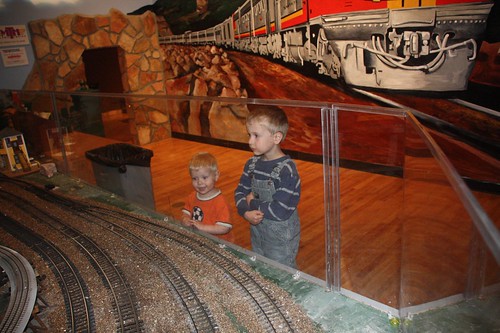
Terah and I recently decided that each of us could use a day off of not having to do work or supervise boys. Yesterday I had the day off work so that was mine. I took my Kindle, along with its Gutenberg copy of War and Peace, which yes, I m reading for fun. I slept in a bit, then got breakfast and sat down at Botanica, the Wichita Gardens with the Kindle for awhile. That was a nice way to spend the morning. Today was Terah s day off. Initially I thought of taking the boys to The Cosmosphere, one of the world s premier space museums, or to the Kansas Aviation Museum. But then I realized that the Midland Railway, a historic excursion line in Baldwin City, KS, was having their first train trip of the year. And it s the Easter special: you take the train a few miles out of town, get off, the kids do an Easter egg hunt, then also get to get their picture taken with the Easter bunny. Kid paradise, right? What could be better? So this is how my alarm came to be set for 5:15 on a Saturday morning. Oliver woke up early, but I had to get Jacob up. He was groggy, trying to cover his face and ears, and annoyed at me for trying to wake him up. Until I said, Jacob, it s time to get ready for the car trip to the train ride. Can you go get dressed for the day? Silence. Then about 5 seconds later, he jumped up, said, OK dad, I will do it, and he did. We drove our 2.5 hours. I had set out a non-dirty breakfast in the car for them the night before, so they munched while we drove. Then had to wait in a huge line for our tickets. An hour later we had them got the last 3 tickets for the first departure of the day, 10AM and ran to get on the train before it left. Jacob and Oliver both got very quiet. Sometimes Jacob especially does that when he s very excited about things. He doesn t always look it right then, but I knew I d be hearing about it later. He had his face almost pressed to the window the whole way. IMG_5685.JPG Oh, and yes, he dressed himself and I didn t check to make sure he had the correct shirt, or that it wasn t on inside-out, until it was too late. Oops. We rode in an ex-CP car built in 1936. One of the cars on the train was built in the 1890s quite some neat equipment. Anyhow, next came the hunt. There were two large lawns covered in eggs, separated by age group. Jacob and Oliver were in the younger group, but still only got a few eggs (there were lots of other parents, uhm, helping their kids by picking up eggs the kids were too slow to get and putting them in baskets ) But they were thrilled with the experience so that s what counts. They moved the locomotive to the other end of the train for the trip back using an adjacent track. Lots of the kids watched them couple it back on. Jacob and Oliver were particularly interested nothing could have distracted them from watching that train though they didn t particularly like the noise of the horn. IMG_5655.JPG On the way back, someone in an Easter bunny suit was on the train for pictures. I took the boys there. They usually refuse to sit on laps of Santa and such, so I didn t figure much success. They actually agreed to do it. And despite their expressions in this photo, Jacob later told me over and over how much fun it was to be with the Easter bunny. IMG_5671.JPG After we got back, we headed for the car. Jacob insisted on carrying his own Easter bag, and predictably wound up carrying it upside down for awhile. So his bag had some grass in it from picking the candy back up. Oliver discovered some rocks by a ditch and had fun throwing them in to make a splash, so we paused for that for awhile. By this point it was about noon. So at this point, what does a dad who has managed to keep two active boys in line for an hour, help them with an egg hunt and giant rabbit, and keep them from falling into the ditch they re throwing rocks into, do? Say that it s time to eat lunch and then head for home so we can be there in time for supper? Or go for MORE ADVENTURE? I said, Jacob, how would you like to eat lunch inside a big train station in Kansas City? Pause for a couple of seconds to think. YEAH! I have never had lunch in a train station before! Let s go! Shall we go NOW? So I gave them the leftover breakfast to eat during the hour drive on towards the beautiful Kansas City Union Station. It s one of the few grand American train stations that survives intact, and is just stunning. Jacob and Oliver both fell asleep on the way there. We parked, walked inside, and Jacob just froze. Dad WOW! That ceiling is SO HIGH! I can t even reach it! He then raised his hand as high as it would go and said, See dad, it is so high I can t touch it! (Most ceilings are, but this one is indeed much, much taller than most.) We ate lunch in the second level of a restaurant right in the Grand Hall, which Jacob really enjoyed. Here s Jacob, annoyed that I pulled out the camera again: IMG_5693.JPG Then we went exploring for an hour. Jacob talked about his adventure . We went up the elevators and checked out the balconies. Then we found the Model Railroad Experience. And oh my. The boys were visibly the most excited they had been all day. Oliver just froze at the spot he walked through the door, not caring to move and see the rest of the exhibit because he was so fascinated by what he already saw. There was a huge layout in the middle of the room, and smaller ones in adjacent rooms. We finally made our way there, and Oliver just ran round and round one of them, following a train, excitedly yelling There it is! There it is! There it is! Here s a photo from the big layout: IMG_5706.JPG Jacob cried when it was time to go, but I had promised them some dessert before we left, so after a bite of ice cream we were on our way. On the way home, every 15 minutes or so, Jacob would make a remark like this: Dad, the train ride was SO fun! or Dad, I really liked Kansas City Union Station! and so forth, naming every highlight of the day for him several times over: the Easter bunny, the egg hunt, train ride, and everything about Union Station. On the way home, we stopped at our favorite restaurant in Emporia: BobbyD s Merchant St. BBQ. This is always a hit for everyone in the family. A down-home place that has excellent food, is not far off our path, and never seems to have a wait. Yum.

Ben Hutchings: Upcoming changes in Debian Linux packages for i386

The major upcoming configuration change in Linux 2.6.39 is to get rid of the '686' flavour. This may be surprising, because it's the most widely used flavour of the 4 we have a present:
Name Minimum CPU features Maximum total CPU threads Physical address space
486 486-class 1 4 GiB
686 686-class; CMOV instruction 32 4 GiB
686-bigmem 686-class; PAE 32 64 GiB
amd64 x86-64 512 64 TiB
However, the physical address limitation means that an increasing proportion of new PCs and the majority of PC servers need the '686-bigmem' flavour. Even those that have less than 4 GiB RAM do support PAE and can run the '686-bigmem' flavour. There is a small cost (up to about 0.1% of RAM) in the use of larger hardware page tables. There is also an important benefit on recent processors: the larger page table entries include an NX bit (also known as XD) which provides protection against some buffer overflow attacks, both in the kernel and in user-space.. Q: What about 686 processors without PAE? There are only a few 686-class processors that support CMOV but not PAE: most Intel Pentium M models, the VIA C3 'Nehemiah' and the AMD Geode LX. These also all lack SMP support, which means the '486' flavour is suitable for them. Some benchmarking on two of those - a Pentium M model 745 and a C3 'Nehemiah' - indicated that they run the '486' flavour slightly faster than the '686' flavour. It appears that the performance gain from using plain uniprocessor code (rather than SMP-alternatives, which are patched with NOPs on uniprocessor systems) outweighs the performance loss from avoiding use of some newer instructions. Q: Why get rid of '686' but keep the 'amd64' flavour? We intend to get rid of 'amd64' too, but we need to ensure that upgrades from linux-image-2.6-amd64:i386 to linux-image-2.6-amd64:amd64 work properly. Q: If '686-bigmem' will be the default, isn't 'bigmem' redundant? Yes, it is. Therefore '686-bigmem' will be renamed to '686-pae'.

23 April 2011

Iustin Pop: Second system effect

A recent email from a user of one of my small software tools prompted me to write this entry If you read Wikipedia's page on Second system effect, it doesn't say much and it's hard to internalise what it means. Some other resources describe it better, but actually learning it first-hand is, shall we say, enlightening. Fortunately, I learned this in my spare time, and not at work. Back in 2002, I started working on a small tool (bakonf) to basically backup /etc and generate a tar archive out of it. It had some other features of course that made it a bit more useful than tar c /etc, but not many. It worked well and I was using it to make incremental dumps of server configuration ready to write to a CD on a few servers. A while later (around a year or so), I came to the conclusion that just having a tar archive is not enough, and rather one would want to be able to check differences between the filesystem and the archive, and ideally between multiple servers configurations (note, this was before DVCSs) online. I started working on cfvers in my free time and initially made reasonable progress. However, I didn't know to hold back from changing the scope and features, so actual progress in the form of a beta release was always postponed. Then came changes to the transport protocol, to the structure of the app, etc., all the fun. Note that this was in my free time, done in bursts of work in a month, then a few months with no work at all, so not too much work overall. Still, I slowly realised that this will go nowhere, so at the end of 2006 I finally gave up on developing it and marked the project as obsolete. However, bakonf is still doing its job, and I've done a few small commits to it in order to add compatibility with Python 3.x as recent as last year. I got an email about it from a user at the start of this year, so it definitely outlived its supposed replacement. Hah! Overall, it was a great lesson. Maybe it wasn't just second system effect, but also not enough effort invested by me, or bad planning, so on. But for me it drove the point home that writing the second version of something is filled with dangerous decisions

Ben Hutchings: Recent changes in Debian Linux packages

Linux 2.6.38 and 2.6.39 As you've probably seen, the testing suite finally got a new upstream kernel version (Linux 2.6.38) and is currently synchronised with unstable. I'm just about to upload a new version of linux-2.6 based on upstream stable update 2.6.38.4. Linux 2.6.39 is well on its way to release, so 2.6.39-rc4 should soon be in experimental. The Debian source package will add support for the new armhf (ARM with hardware floating-point) architecture. Splitting linux-2.6 The linux-base package, introduced to handle transitions and other support functions for 'image' packages, is now built from a separate source package. It won't be changed very often, so you will no longer need to upgrade linux-base every time you upgrade an 'image' package. (This doesn't apply within 'squeeze', but I may have a way to work around that.) The firmware-linux-free package, containing a few firmware and configuration blobs from Linux that are DFSG-compliant, is also now built from a separate source package. These blobs have not changed for a very long time, so again you will no longer be recommended to upgrade this package every time you upgrade an 'image' package. Secondly, this allows us to remove the entire 'firmware' directory from the upstream source rather than carefully removing and patching to leave just the DFSG-compliant bits. Wireless regulations The '2.4 GHz' and '5 GHz' ISM bands used for wifi are not defined identically around the world. The exact frequency ranges and maximum permitted power levels vary between countries. Radio equipment manufacturers have a legal responsibility to ensure their equipment operates within these regulations. Since it is expensive to implement such regulations in hardware (including many different variants for different regions), these restrictions are usually implemented in the driver using a country code retrieved from the hardware's EEPROM or flash. So this is now our responsibility. We need to be able to look up regulations by country codes, and we also need to support the case where a device sold in one country is used in another country with tighter regulations. For some time, the wifi configuration library (cfg80211) included regulatory information for a small number of countries and regions. However, the default since Linux 2.6.34 has been to build-in only the 'world' domain (intersection of all the restrictions) and to request information from user-space. In Debian, we didn't have anything to provide this information, so for example channels 12-13 became unavailable for users in Europe. The regulatory information should be provided by the Central Regulatory Domain Agent (CRDA) from a current database. These are now packaged as crda and wireless-regdb respectively. Drivers that do not use cfg80211 (mostly those from the 'staging' area) will not be affected, and may or may not implement correct regulations. When you travel to another country or use an imported wifi device with an incorrect country code (I hear 'CN' is common), you can use iw reg set to ensure that your wifi devices operate within the regulations of the country you are in. Set the REGDOMAIN variable in /etc/default/crda to make this persistent. These will be intersected with the regulations specified by the hardware.

Next.

Previous.