Search Results: "ema"

25 February 2010

Ian Wienand: Building a quiet, cool media/house server

After getting sick of having to underclock my existing home server to get it to remain up for any period of time, along with the horrendous noise, I finally found the time and budget to rebuild. My goals were: In the end I went with The case is really awesome. Very easy to access, and the fan is extremley quiet. It very cleverly holds 3 full-size hard-disks; two mounted vertically on either side, and one horizontally in the middle. The final space is for a DVD -- after that it's pretty cramped inside! It makes claims it is a very efficient power supply. It has a very bright blue LED on the front, and the face-plate over the DVD looks nice but the button doesn't quite reach the eject button on my drive, so it's software eject only. All over, definitely recommend. The motherboard is fairly good. One annoying thing is that it only has 3 SATA ports -- I think it's reasonable to want to have a primary drive, two mirrored large disks plus a DVD for a nice little media server. It also has no parallel-IDE, which is reasonable these days. However, if you wanted to install a wireless card you'd be out of luck if you also wanted to put in another SATA card, as it only has one PCI slot. There are plenty of USB ports for a USB wireless card, however. It also comes with two SATA cables, which isn't mentioned anywhere I could see (hopefully this saves you a trip back to Fry's to return your extra cables :). The CPU fan is a little on the loud side, as mentioned in some other forums. It is also located right where the power supply cables come down in this case, making for a fairly tight fit. Here's a lspci for those interested in such things
00:00.0 Host bridge: nVidia Corporation MCP79 Host Bridge (rev b1)
00:00.1 RAM memory: nVidia Corporation MCP79 Memory Controller (rev b1)
00:03.0 ISA bridge: nVidia Corporation MCP79 LPC Bridge (rev b2)
00:03.1 RAM memory: nVidia Corporation MCP79 Memory Controller (rev b1)
00:03.2 SMBus: nVidia Corporation MCP79 SMBus (rev b1)
00:03.3 RAM memory: nVidia Corporation MCP79 Memory Controller (rev b1)
00:03.5 Co-processor: nVidia Corporation MCP79 Co-processor (rev b1)
00:04.0 USB Controller: nVidia Corporation MCP79 OHCI USB 1.1 Controller (rev b1)
00:04.1 USB Controller: nVidia Corporation MCP79 EHCI USB 2.0 Controller (rev b1)
00:06.0 USB Controller: nVidia Corporation MCP79 OHCI USB 1.1 Controller (rev b1)
00:06.1 USB Controller: nVidia Corporation MCP79 EHCI USB 2.0 Controller (rev b1)
00:08.0 Audio device: nVidia Corporation MCP79 High Definition Audio (rev b1)
00:09.0 PCI bridge: nVidia Corporation MCP79 PCI Bridge (rev b1)
00:0b.0 IDE interface: nVidia Corporation MCP79 SATA Controller (rev b1)
00:10.0 PCI bridge: nVidia Corporation MCP79 PCI Express Bridge (rev b1)
00:15.0 PCI bridge: nVidia Corporation MCP79 PCI Express Bridge (rev b1)
01:05.0 RAID bus controller: Silicon Image, Inc. PCI0680 Ultra ATA-133 Host Controller (rev 02)
02:00.0 VGA compatible controller: nVidia Corporation ION VGA (rev b1)
03:00.0 Ethernet controller: Realtek Semiconductor Co., Ltd. RTL8111/8168B PCI Express Gigabit Ethernet controller (rev 03)
I know there are issues with the controller of the Patriot SSD, which would probably worry me for a general purpose machine. However for the primary disk of a server machine I'm not too fussed. The silence is golden and cool-running and low power consumption really helps too. I wouldn't really say it seems that blazing fast. It comes with a handy mount so it fits in a full-size hard-disk slot. Hard to beat for the price. One concession I made to avoid excessive writes was mounting /tmp on tmpfs; this is where it's nice to have 4GB of RAM. Handbrake seems to do a lot of work in /tmp for example. The two green hard-disks (software mirrored) are also inaudible. I'm hoping different brands should at least not fail at the same time. I'm not sure if they're auto-spinning down, but you can't really tell if they're on or not, even under load. Even when running flat-out re-encoding a DVD in the enclosed cabinet with minimal airflow the CPU temperature hasn't gone above 60C; normal CPU temp is around 40C. Performance is adequate -- running PlayOn in a VMware workstation XP VM almost works. It's kind of hard to take photos inside a case, but here's an attempt: <object height="300" width="400"> <param name="flashvars" value="offsite=true&amp;lang=en-us&amp;page_show_url=%2Fphotos%2Fiwienand%2Fsets%2F72157623509152266%2Fshow%2F&amp;page_show_back_url=%2Fphotos%2Fiwienand%2Fsets%2F72157623509152266%2F&amp;set_id=72157623509152266&amp;jump_to="> <param name="movie" value="http://www.flickr.com/apps/slideshow/show.swf?v=71649"> <param name="allowFullScreen" value="true"><embed allowfullscreen="true" flashvars="offsite=true&amp;lang=en-us&amp;page_show_url=%2Fphotos%2Fiwienand%2Fsets%2F72157623509152266%2Fshow%2F&amp;page_show_back_url=%2Fphotos%2Fiwienand%2Fsets%2F72157623509152266%2F&amp;set_id=72157623509152266&amp;jump_to=" height="300" src="http://www.flickr.com/apps/slideshow/show.swf?v=71649" type="application/x-shockwave-flash" width="400"></embed></object> Debian unstable installed without issues (except for some weird bug with the boot hanging for 60 seconds due to the RTL driver). It is also very strange installing from USB to an SSD no noise!

23 February 2010

Mike Hommey: Mind blowing news

The Firefox logo, the very reason why Iceweasel exists, is now free as in speech. Its use is still limited by trademarks, but it is free. The news is not entirely official, but apparently the change has occurred a year ago, and the license text for the branding hasn t been changed accordingly. Waw.

Thorsten Glaser: Rant about PGP keysigning problems

Update: This wlog entry uses aggressive tone because I somehow needed to vent frustration from using some of the tools. I should probably provide some constructive critics, too... but this is a rant. Be warned. Keysigning is useless. I boot up a suitable live GNU/Linux system, install signing-party, take the trouble that is to set up caff, transfer my secret key from the secure box, sign. I think caff providing the keys in a different order than they're given on the command line sucks and just run caff once per key. I did even start Postwreck. But no, people just don't accept any mail from "EHLO grml" systems, and I still cannot control my reverse DNS despite having a static IPv4 address (and IPv6, which looks to be unused). People also pretend I'm on dial-up. Great! I will no longer participate in any (mass) PGP keysigning but will continue to do so on a per-person basis. Probably sign but one uid, either apply common sense and upload it to t h e keyserver, or mail the entire signed key to one address. By the way, how crazy is it that I need to use the deprecated $CONFIG 'mailer-send' to pass an envelope-from to the mailer? It also suffers from the same delusion as e.g. nmudiff, namely that my Debian box is a fully set up workstation able to send out eMail and configured correctly. At least, it, unlike a number of others, does not assume I use mud (Mutt). grml Oh, and caff does a protocol violation (by always sending out GnuPG/MIME and not offering the standardised Inline OpenPGP), I think people just don't care about such. (There is a notation people can use to signal they want PGP/MIME, Inline PGP which is called "partitioned" or both (and which order of priority) but, alas, despite Inline PGP being the only one useful for the MUAs without integratin, and being more widely spread than that PGP/MIME crap, the followers of the latter do some (FSF-style?) kind of vendor lockin by not speaking anything else. Anyway. I'm all for X.509 except there seems to be no sane CA (Startcom is... trouble, even with Opera; CAcert.org is dying). I'll just buy a certificate (not from Verisign though) for www, and roll my own again (I can do it, I have experience with that actually). On an unrelated side note, still waiting for an OpenSSL patch for that recent TLS extension... ObRant: password policies, be they required characters or any kind of length restrictions, suck. People I will eventually end up with less secure passwords on such systems, because even if some of mine may appear to be derived from some kind of dictionary (what language that is I'd be interested in, though...) they aren't, and I have my schemes. You got to have them with a gazillion of passwords used. And I probably will forget them more often (and sending them via eMail is also not a solution). Unrelated notice: mksh R39c with bug fixes coming RSN. (Updated 24.02. because I was, rightfully, told the language, and the title, were too strong. I also would like to excuse for going so low as to write an ad-hominem attack, which I've since redacted.

Russell Coker: Divisive Behavior

Past Sins Sam Varghese wrote an article about Matthew Garrett s LCA talk The Linux community: what is it and how to be a part of it [1]. In page 2 Sam quotes Martin Krafft as asking about how Matthew s behavior had changed between 2004 and the present, Sam cites some references for Matthew s actions in 2005 to demonstrate. I think that this raises the issue of how far back it is reasonable to go in search of evidence of past behavior, something that I think is far more important than the specific details of what Matthew said on mailing lists many years ago and whether he now regrets such email. If someone did something that you consider to be wrong yesterday and did the same thing five years ago you might consider it to be evidence of a pattern of behavior. If someone s statements today don t match their actions yesterday then you should consider it to be evidence of hypocrisy. But if someone did something five years ago which doesn t match their current statements then in many situations it seems more reasonable to consider it as evidence that they have changed their mind. Then of course there is the significance of what was done. Flaming some people excessively on some mailing lists is something that can be easily forgiven and forgotten if Google doesn t keep bringing it up. But as a counter-example I don t think that Hans Reiser will be welcome in any part of the Linux community when he gets out of jail. For the development of the Linux community (and society in general) I think it s best to not tie people to their past minor mistakes. While it is nice when someone apologises for their past actions, the practical benefits of someone just quietly improving their behavior are almost identical. A particular corner case in this regard is the actions of young people, anyone who was born after about 1980 will have had great access to electronic media for their entire life and will have left a trail. Most people do a variety of silly things when they were young, the older members of the Linux community were fortunate enough not to have electronic records remaining where Google could find them. Back to Matthew, I think that if he is to be criticised about such things then evidence that is much more recent than 2005 needs to be used. Cultural Differences Sam quotes Matthew as claiming that the Linux community was largely a Western, English-speaking one, those who participated in it necessarily had to adapt to the norms of this group . I don t believe that there is a single Linux community. There are a number of different communities that are formed around free software, which have significant amounts of overlap. I don t believe that there s any reason why a Chinese or Indian Linux mailing list should conform to the same standards as those of an American list. But there will be a trend towards meme propagation through people who are associated with the Linux communities in multiple countries every time you meet Linux people in another country you are helping to reduce the cultural differences in the Linux community. Someone from China or India who joins a LUG in Australia will have to adapt to some of the norms of Australian behavior in the same way as an Australian who migrates to China or India would have to adapt to some local norms. On page 4 of the discussion Matthew disagrees with Sam s interpretation [2], maybe Matthew s opinions on this matter are closer to mine than the way Sam describes them. Is Division Inherently Bad? I believe that the word divisive is overused. The only way to avoid division is to have everyone agree with the majority, but sometimes the minority will be right. Note that I am using the word minority to refer to any group of people who happen to disagree with the majority, among other things that includes people who vote for a political party that isn t one of the two biggest ones. An entirely separate issue is that of the treatment of minority groups , one of the most divisive events in history was the US civil war it s good that slavery is outlawed but unfortunate that a war was required to gain that result. On page 4 of the discussion Matthew says to Sam Your writing is influenced by members of the Linux community, and in turn it influences the Linux community. The tone of it is entirely relevant to the behavioural standards of the community [2]. If a community can be easily divided then the real problem probably isn t the person who triggered a particular division. Also there is the issue that even if you could get a general agreement that certain issues shouldn t be discussed in certain ways then with the wide range of cultural attitudes and ages of participants you have to expect someone to raise the issue you don t want raised. Of course it s impossible to objectively determine whether a division is productive or not, so it doesn t seem at all viable to have any expectations regarding outsiders not being divisive. Sometimes you just have to deal with the fact that the Internet contains people who disagree with you. It seems to me that the most divisive issues we face involve people who mostly agree on contentious issues. If someone entirely disagrees with you then it s easy to ignore them (if you even have a conversation with them), but if they are someone that you communicate with and they are almost right in your opinion then there s the potential for a big argument. Probably the best way to minimise division in the community is to have the first people who get involved in a dispute take a Rogerian approach [3]. Failing that a good approach is to respond by writing an essay. When an issue is made popular by services such as Twitter that give little explanation then everyone rushes to the barricades. It seems to me that the unreliability of some blogging platforms is part of the cause of the problem in this regard. I ve just given up on writing comments on Blogger, I m not going to write a good comment only to have it eaten by blogger. There are lots of blogs that have problems which discourage the population from writing anything other than a one-sentence response. The Good that can come from Disputes On page 5 of the discussion there is a comment from Anirudh the Indian student who was criticised by Sam (which ended up inspiring part of Matthew s talk and leading to more disputes) [4]. Here is the start: I am the person who wrote the ill thought-out post that drew criticism eight months ago. There has been some discussion about that, so I wish to say something.

I am very grateful to Sam Varghese. I say this with utmost sincerity. Read the rest, it s educational. I m sure that there are others who have had similar learning experiences but who don t want to write about them. I m sure that there have been many disputes which would appear to the casual observer to have resulted in no good at all, but which would actually have resulted in people learning things and amending their behavior. The issue of Age Car rental companies generally don t do business with men who are less than 25 years old. Life insurance policies don t offer reasonable rates to males between the ages of about 16 and 25. This is because the insurance companies have good statistical data on the results of the typical actions of people at various ages and know that young men tend to be at a high risk of earning a Darwin Award. The same combination of hormones and life experience that makes a young man a danger on the road will also tend to make him get involved in flame-wars on the net. If we could figure out how to influence teenagers into being less anti-social then it would be a great achievement. The current young people will become older and more sensible soon enough but will be replaced by a larger number of young people who will do the same things. As things stand I don t expect the next cohort of young people to learn from Anirudh.

21 February 2010

Michael Banck: 21 Feb 2010

Application Indicators: A Case of Canonical Upstream Involvement and its Problems I always thought Canonical could do a bit more to contribute to the GNOME project, so I was happy to see the work on application indicators proposed to GNOME. Application indicators are based on the (originally KDE-driven, I believe) proposed cross-desktop status notifier spec. The idea (as I understand it) is to have a consistent way of interacting with status notifiers and stop the confusing mix of panel applets and systray indicators. This is a very laudable goal as mentioned by Colin Walters:
"First, +5000 that this change is being driven by designers, and +1000 that new useful code is being written. There are definite problems being solved here."
The discussion that followed was very useful, including the comments by Canonical's usability expert Matthew Paul Thomas. Most of the discussion was about the question how this proposal and spec could be best integrated into GTK, the place where most people seemed to agree this belongs (rather than changing all apps to provide this, this should be a service provided by the platform) However, on the same day, Canonical employee Ted Gould proposed libappindicator as an external dependency. The following thread showed a couple of problems, both technical and otherwise: What I personally disliked is the way the Cody Russel and Ted Gould are papering over the above issues in the thread that followed. For examples, about point one, Ted Gould writes in the proposal:
Q: Shouldn't this be in GTK+?
A: Apparently not.
while he himself said on the same day, on the same mailing list: "Yes, I think GTK/glib is a good place" and nobody was against it (and in fact most people seemed to favor including this in GTK). To the question about why libappindicator is not licensed as usual under the LGPL, version 2.1 or later, Canonical employee Cody Russell even replied:
"Because seriously, everything should be this way. None of us should be saying "LGPL 2.1 or later". Ask a lawyer, even one from the FSF, how much sense it makes to license your software that way."
Not everybody has to love the FSF, but proposing code under mandated copyright assignments which a lot of people have opposed and at the same time insinuating that the FSF was not to be trusted on their next revision of the LGPL license seems rather bold to me. Finally, on the topic of copyright assignments, Ted said:
"Like Clutter for example ;) Seriously though, GNOME already is dependent on projects that require contributor agreements."
It is true that there are (or at least were) GNOME applications which require copyright assignments for contributions (evolution used to be an example, but the requirement was lifted), however, none of the platform modules require this to my knowledge (clutter is an external dependency as well). It seems most people in the GNOME community have the opinion that application indicators should be in GTK at least eventually, so having libappindicator as an external dependency with copyright assignments might work for now but will not be future proof. In summary, Most of the issues could be dealt with by reimplementing it for GTK when the time comes for this spec to be included, but this would mean (i) duplication of effort, (ii) possibly porting all applications twice and (iii) probably no upstream contribution by Canonical. Furthermore, I am amazed at how the Canonical people approach the community for something this delicate (their first major code drop, as far as I am aware). To be fair, neither Ted nor Cody posted the above using their company email addresses, but nevertheless the work is sponsored by Canonical, so their posts to desktop-devel-list could be seen as writing with their Canonical hat on. Canonical does not have an outstanding track record on contributing code to GNOME, and at least to me it seems this case is not doing much to improve things, either.

Biella Coleman: Logos of our Lives

Two of the more influential books that have taken swipe at our contemporary intellectual property landscape concerned themselves with trademark, logos, and capitalism. Here i am thinking of Rosemary Coombe s seminal The Cultural Life of Intellectual Property Law and Naomi Klein s more activist take on the subject, No Logo. What would happen if you condensed the arguments in these two books into a 15 minute video? Well, this morning I found out what this might look like. Someone pointed me to a mind blowing video that might be called All Logo, All the Time: an amazing visual and dystopian rendition of the alphabet soup of logos, trademark acronyms, corporate mascots that pervade our landscape, one might even say consciousness. I would take a whirl and watch before the IP police take it down.

20 February 2010

Martin F. Krafft: Charge advertisers for the last mile

ISPs fight a raging war over net neutrality because their infrastructure cannot keep up with the increasing demand (or rather supply) of content. Therefore, ISPs want to charge the users premiums if they wish to use certain services on the Net. For instance, since videos are usually large in size, one would have to purchase e.g. the platinum package to be able to access video hosting sites. It would be a serious loss of freedom if they won, and the Internet would never be the same. Let s turn that idea around: since sites that use advertising make money off every visitor, they are really the ones that should pay the ISPs so that they can improve their infrastructure. The same applies to sites that make money off visitors in other ways. At the moment, users pay to access the network (which is like paying a taxi to get to the market), so that they can visit sites where advertisers make money showing ads to the visitor, which might actually let them to pay a manufacturer for a product the end user pays twice, and the advertisers take in money, leeching off the ISPs investing into their infrastructure. I think that the advertiser and not the consumer should pay the ISP to keep the infrastructure afloat improve it even. The manufacturer should then pay the advertisers for displaying the ad, and the user consumes if s/he chooses to and everyone only pays once, for services they want. This will help improve competition among providers, which should always be the goal. If my ISP would start to record the volume of HTTP traffic I produce for each target site, charge the targets appropriately (they could start with a couple at first), and I d get free connectivity in turn, I d be quite happy. The ISP wouldn t have to look at the contents at all for that. I don t yet know what to do if the target sites choose not to pay up. ISPs could block them, or throttle or deprioritise traffic, but either of those might simply lead to an exodus of users, just like premiums would. As usual, this just needs to be done by many ISPs in concert. Are you listening?

19 February 2010

Matthew Garrett: Pittsburgh

As I mentioned, I headed to Pittsburgh last week to give some talks at CMU and find out something about what they're doing there. Despite the dire weather that had closed the airport the day before, I had no trouble getting into town and was soon safely in a hotel room with a heater that seemed oddly enthusiastic about blasting cold air at me for ten seconds every fifteen minutes. Unfortunately, it seems that life wasn't as easy for everyone - ten minutes after I arrived, I got a phone call telling me that the city had asked CMU to cancel classes the next day.

This turned out to be much less of a problem than I'd expected - whether because of their enthusiasm to learn about ACPI or because they simply hadn't noticed the alert telling them about the cancellation, a decent body of students turned up the next morning. After a brief chat with Mark Stehlik, the assistant dean for undergraduate education, I headed off to the lecture hall. The fact that I can now just plug my laptop into a VGA cable and have my desktop automatically extend itself continues to amaze me, as does OpenOffice's seemingly unerring ability to get confused about which screen should have my content and which should be showing me the next slide. Nevertheless, facts were imparted and knowledge dropped on those assembled. I'm even reasonably sure that the contents were factually accurate, which is a shame because the most attractive part of teaching always struck me as being able to lie to students who will then happily regurgitate whatever you tell them because in case it turns up on the exam. Perhaps this is why I'm safer out of academia.

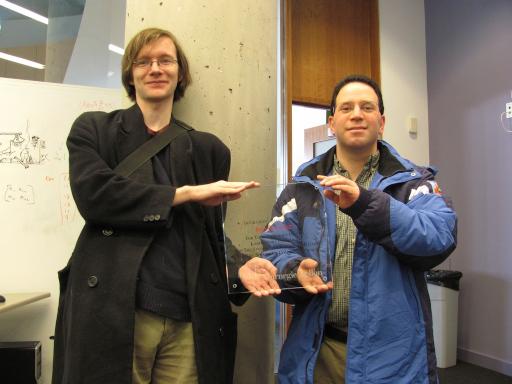
Lunch offered an opportunity to visit the Red Hat sponsored lab, which was pleasingly located somewhere other than a basement. The guy on the right of the picture is Greg Kesden, the director of undergraduate laboratories in CS there - it was wonderful to get an opportunity to see the machines getting used, and students seemed genuinely appreciative of the facility.

After lunch I spent a while talking to Satya about the Internet Suspend and Resume project. This is an impressive combination of virtualisation and migration, using a Fedora-based live image to bring up an OS on arbitrary hardware before downloading a machine image and launching it. The majority of the data is pulled in on demand, meaning that initial performance can be slow but ensuring that data is only downloaded if it's needed. When the user is finished, the delta between the original image and the new one can be pushed back to the server while remaining cached on the local machine in case the image is used again.

It's an interesting approach, combining the flexibility of thin clients with the advantages of having actually useful computing power at the local end. There's a few functional awkwardnesses, such as some VMs being unhappy if images are migrated between machines with different CPU features, and it obviously benefits from having significant bandwidth. But the idea of being able to combine the convenience of a floating session with the knowledge that you can still keep copies of your data on you is an attractive one, and I'd love a future where I can move my session between my laptop and a desktop.

After that there was some time to talk to Bill Scherlis and Philip Lehman about the software engineering courses that CMU run. Part of the minor in software engineering includes a course requirement to make a meaningful contribution to an existing software project, from design through to submission and upstream acceptance. I had the opportunity to talk to a couple of the students about this and the differences they found between working with the Mozilla and Chrome communities, which I'll try to write up at some point.

Finally I gave a presentation on Fedora and some of the issues that we face in providing a useful OS when patents and recalcitrant hardware vendors do their best to thwart us. Despite the ice outside and the significantly-below-freezing temperatures, enough people turned up that sorties had to be sent out to find extra chairs. It was great to see how interested people were in learning about what we do, although it's probably the case that the free pizza did help encourage people.

After that it was an early trip back to the airport, where I found that my plane was delayed and the only "restaurant" still open was McDonalds. Even so, I left with the feeling that it had been an interesting and educational visit. Many thanks to David Eckhardt, who runs the OS course I presented to and who looked after me all day - thanks too to Joshua Wise who picked me up when David was running late due to the ground being covered with blocks of ice.

Bernhard R. Link: reprepro 4.1.0 and new Packages.diff generation

I've just released reprepro 4.1.0 and uploaded it to unstable. The most noteworthy change and the one where I need your help is that the included rredtool program can now generate Packages.diff/Index files when used as export-hook by reprepro. (Until now you had to use the included tiffany.py script, which is a fork of the script the official Debian archives use. That script is still included in case you prefer the old method). So instead
DscIndices: Sources Release . .gz tiffany.py
DebIndices: Packages Release . .gz tiffany.py
you can now use
DscIndices: Sources Release . .gz /usr/bin/rredtool
DebIndices: Packages Release . .gz /usr/bin/rredtool
to get the new diff generator. The new diff generator has am import difference to the old one: It merges patches so every client should only need to download and apply a single patch, and not multiple after each other, thus reducing the disadvantages of Packages.diff files a bit (and sometimes even reducing the amount of data to download considerably). While reprepro and apt-get (due to carefully working around bugs/shortcomings of older versions of apt) seem to work, I don't know if there are other users of those files that could be suprised by that. If you know any I'd be glad if you could test them or tell me about them.

Gunnar Wolf: Computer education parallelisms

I opened Slashdot's Looking back from the 1980s at computers in education article because I am quite convinced of the point some of the commenters argued before me, (and it's good to know others think as you do ;-) ) When I got close to computers, learning computing for children basically meant learning programming in a fun way. For years, my hobbies included Logo and BASIC. At age 7 (by 1983), typing TeX and using Emacs at the computer of the institute where my father worked, I started walking the path I took for my professional life. When I taught computing to high school students as my first paid job (which didn't last long, only a semester, as for an untrained 20 year old it is very hard to control a group of kids nearly his age), I tried to teach some basic BASIC programming (which was the best I knew then)... But no, both students and the school wanted me to focus on teaching MS Office applications. It seemed stupid for me 14 years ago, and it still seems stupid for me today. Anyway, on Slashdot, I came across this beautiful way to explain what computer education should mean:
"computing is no longer taught in schools (parents look quizzical), they are simply 'trained' (parents look like they vaguely get it). if this was sex instead of computing that was taught in schools, would you prefer that your kids have sex _education_ or sex _training_? (parents finally get it)".
By the way, if you are interested in reading a bit of paleofuturism, to feel the joy and excitement with which computer-aided education was seen 30 years ago, be sure to get the Classroom Computer News issue for September-October 1980, linked from the Slashdot article (and copied over here for your convenience, of course!)
AttachmentSize
Classroom Computer News vol. 1 no. 1, sep-oct 19803.54 MB

18 February 2010

Alexander Reichle-Schmehl: RC-Bug statistics for Squeeze, calendar week 7:

Note: Please see RC-Bug statistics for Squeeze, calendar week 7 for an explanation of the numbers.
Total:699+49
Affecting Squeeze:559+41
Squeeze-only:117+23
Unfixed bugs remaining in Squeeze:442+18
Of these 442 bugs...
... are pending36+4
... are patched:65+1
... are duplicates:47+-0
... are in Non-free or contrib:10+10
... are claimed by someone:14-3
... are fixed in the delayed queue:5-1
... are somehow marked as fixed:53+14
Or in other words:
Release critical bugs left in squeeze, when ignoring all these:
262 (+2 compared to previous week). With this release managers views, 472 (+48 compared to previous week) bugs remain to be fixed somehow before we can release. Some notes: So much for this week. Let's see, how the numbers evolve in the coming seven days...

17 February 2010

Bastian Venthur: Links not opening in Thunderbird 3?

If you re using KDE and upgraded to Thunderbird 3 lately you might have the problem that links in emails don t open in a browser anymore. For my case that happened even without a user visible error message. If that sounds familiar for you, check the error console (Tools/Error-Console). If there is an error like:

Error: uncaught exception: [Exception... "Component returned failure
code: 0x80004005 (NS_ERROR_FAILURE)
[nsIExternalProtocolService.loadUrl]   nsresult:  0 80004005
(NS_ERROR_FAILURE)   location:  JS frame ::
chrome://communicator/content/contentAreaClick.js :: openLinkExternally
:: line 188   data: no]
Then Thunderbird just (silently) fails to launch the browser. Guido pointed me to gconftool. gconftool -R / grep url-handlers told me that some components of gnome still had Firefox configured as http-handler (which is strange since it was rebranded to iceweasel ages ago). Resetting them solved the problem for me. The sad part of the story: x-www-browser, sensible-browser and KDE s http handler where all correctly configured and pointed to iceweasel. All applications behaved correctly only Icedove used a (for me) hidden setting pointing to firefox.

16 February 2010

Russell Coker: Would you Short-Change a Pedophile?

For some time the film industry has been running an anti-piracy campaign with slogans such as you wouldn t steal a car [1] in an attempt to draw a false analogy between downloading a movie and stealing a significant and valuable object the modern equivalent to being a horse thief . One of the many ways that such poor analogies break down is the fact that downloading a movie is not a crime, it s copyright infringement. The best analogy that I can think of for non-commercial copyright infringement is the practice of short-changing. I expect that almost everyone has at some time received less change than they deserved when buying something at a shop, the cashier aims to collect $1 or $2 from each customer and can easily double the amount of money that they take home at the end of the day. When a customer complains they just pretend to have made a mistake and although short-changing is a crime (unlike copyright infringement) it almost never results in police action. The practice is tolerated to such a degree that some people know the shops where they are likely to be short-changed, they count their change more carefully and demand the full amount but don t bother complaining to the manager! The film industry also tries to portray itself as representing struggling artists who deserve the money, it s described as a moral issue good people pay for movies while bad people download movies and steal cars. But then there s the case of Roman Polanski who is a well known movie director and child rapist [2]. I expect that most store employees would gladly palm some of the change if Roman Polanski was a customer that is of course if they weren t too busy arranging a lynch mob. So instead of you wouldn t steal a car a more reasonable statement would be you would short-change a pedophile if you weren t organising a lynch mob . Please note that murdering a criminal as part of a lynch mob is a crime (unlike making an unauthorised copy of a DVD), so I encourage people not to perform lynchings. Many important people in the movie industry have different ideas, the Wall Street Journal has an article about the petition to free Roman Polanski which demonstrates the difference between Hollywood attitudes and those of the rest of the world [3]. For them, violent crime is no big deal if the criminal is famous and the victim isn t but anything which affects their own wealth is regarded as a serious issue. Indiewire has a copy of the petition to free Roman and a list of the names of 100 people who signed it [4] (I heard that the latest count was nearer 150 but couldn t find a reference). I believe that the matter of morals is not whether someone who rapes children deserves jail time (that issue is really clear) but whether it is morally acceptable to give money to such a criminal or their supporters. I suggest that the list of signatories to the pro-rape petition be black-listed, any movie that involves any of them should not be paid for either don t see the movie or download it without paying at your own whim. If anyone knows of a web site that is being regularly updated with a list of all past and current projects involving people who signed the petition for Roman then please let me know it would be good to have a list of movies that I will never pay for. Anyone who feels morally obliged to pay something for a movie and who has a great desire to watch a movie made by Roman Polanski or his supporters could download it and then make a donation to a charity equivalent to the purchase price rumor has it that women s refuges are always short of funds. As an aside I find Wikipedia a good reference for movies that I don t plan to see, I read the plot summary on the wiki page and then have no curiosity about what happens in the movie if that isn t adequate I ask friends for spoilers or do a Google search on the movie name and spoilers .

Steve Kemp: I am lightened, can we drop this?

As part of some house-keeping I've been checking over my systems and ensuring they're all tickity-boo for the past couple of days. One thing that I'm getting increasingly tempted by is converting my kvm guest to a 64-bit system. I've not quite sold myself on the prospect of what will be a fair amount of downtime, but I'm 90% there. I do think that a lot of my setup needs an overhaul, for example: One possible plan is to wipe my system, and then restore data from backups. A perhaps saner approach is divide my guest into two smaller ones, and migrate services over one by one (e.g. website1, website2, .. websiteN, email, etc). For the moment I've taken a complete dump of my existing guest, and I'm running it with an IP in the 10.0.0.0/24 range on my desktop. That's at least given me a clear idea of the amount of work involved. I'm still a little unclear on how best to manage running N websites with the intention they'll each run under their own UID. I guess it comes down to having a few instances of nginx/lighttpd/apache and then proxy from *:80 to the actual back-end. Precisely which mixture of services to use is a little overwhelming. Though at some point soon I need to start enabling IPv6 support, and that changes things a little. (Not least because nginx has no IPv6 support present in the Lenny release - I've got a backported package which I run on the Debian Administration website.) It's possible I could hack mod_vhost_alias to redirect/proxy to a local port based upon the virtual hostname present in the request - that's pretty trivial and I've already done something similar for work purposes. Though something like that should presumably already exist? I would expect a map of some form:

example.org: 127.0.0.1:8080
example.net: 127.0.0.1:9090
That has to be about the minimum necessary information to make the decision; a pair of vhost name & local destination. /me googles some.. Update
OK quick update I've added local users for some of my sites, and now have them running under thttpd.
skx:/etc/thttpd# ls -ltr /home/www/   tail -n 4
drwxr-sr-x  4 s-static   s-static   4096 Jan 15 01:41 static.steve.org.uk
drwxr-sr-x  5 s-openid   s-openid   4096 Feb 16 21:31 openid.steve.org.uk
drwxr-sr-x  6 s-images   s-images   4096 Feb 16 21:52 images.steve.org.uk
drwxr-sr-x  5 s-packages s-packages 4096 Feb 16 22:03 packages.steve.org.uk
That seems to work well, with a small wrapper script to start N instances of thttpd instead of a single one. Minor issues are that I'm using mod_proxy to forward requests to the thtpd instances running upon the loopback - and it was initially logging 127.0.0.1 as the source IP. A quick patch later all is well. I'll leave it running a couple of the simple sites for the next few days and see if it kills children. If it does I'll convert the rest. Probably will aim to have nginx in front of thttpd, instead of Apache, but this way I don't have to worry about mod_rewrite rules just yet.
ObFilm: Cruel Intentions

15 February 2010

Biella Coleman: Timing Life

The Chronicle recently published a piece that drew a lot of attention on the difficulties that female academics with kids face during the first 4-7 seven years of their job when academics are expected to do nothing but produce, produce, and produce and yet because they have produced children, they can t produce all that much writing. I don t share the author s predicament in that I don t have kids. But I have had to be an (often long-distance) caretaker for the last 8 years, 4 of which I spent considerable time in PR taking over my mom s caretaker s duties. Although when it comes to female academics and kids there is a lot that can (really must) be done to facilitate a career and motherhood, when it comes to taking care of my mom, being an academic has been an odd and mixed blessing, although it did require me to play with the system self-consciously or else it would have been an early academic death. When my mom was first falling pretty ill, I was wrapping up my dissertation. Though I was ready (on paper at least) to go on the market, I did not step foot in it. I knew that if I landed a job it would be the end of seeing my mom and since she only had a few years of capacity left, I decided to 1) apply only for one postdoctoral position (that had no teaching and was in NJ making it very easy to fly home frequently) 2) if I did not land it, I would return home to spend time with her, keep on writing but not graduate. If I had started a job right after my dissertation, I would have killed my chances of churning out articles, and worse, not have seen much of my mom. I was lucky enough to land this postdoctoral fellowship, which was a life savior. I was able to get a heck of a lot of work done that I would never ever would have been able to do my first two years of teaching (kids or no kids) and I spent many months in PR as well. I always encourage graduate students to apply for these positions because the payback is enormous (with the exception of fellowships that require a ton of teaching), even if the applications are really time consuming, more so than applying for jobs. Though rarely stated in such terms, the first few years of an academic position is not unlike medical residency. It takes a brutal amount of time, not only because of the sheer time you have to work but also because there is so much new to learn and so many different responsibilities to juggle. It is exhiliarting but draining, even disorienting. But there is one important difference from our medical school counterparts (aside from the blood and guts and gore :-)): their hell continues throughout the year, while our hell diminishes during the summer when classes end and writing is supposed to dominate your attention. Also since I am not required to be here once classes ended, I am able to leave NYC and spend it back home. I would simply not be able to do this with most any other full time job (unless it involved telecommunting) and for that I am grateful I landed the job I did. Academia, despite its rat race quality, has allowed me to visit my mom throughout the year and summer. Given the importance of summers for writing it seem that departments/universities can do a lot for female faculty simply by sponsoring or helping to pay for summer day care for two years, thus offsetting some of the costs and then providing them with the space needed to write/produce.This can accompany the policy that some, though not enough schools have, which is turning off your tenure clock for the year you are pregnant, and in some cases, even giving you leave. Thankfully at NYU you can stop your clock not just for pregnancy (which they now automatically do because when it was optional some female professors were not taking it!) but also for circumstances like mine. I was given a short tenure extension, which was not easy to ask for but it is important to do so. I am extremely grateful they have this policy. Something else partially unique about caring for a parent is the perspective it affords. Although it would be a lie to say I suffer no anxieties about my job, I find it hard to get embroiled in a lot of the petty politics of academia, a perspective that clings to me, especially after having to take care of someone with Alzheimers, and especially my mom who we nicknamed the Russian Terror for her turbulent (but really fun) personality. Sitting in front of your computer to write and think about some obscure academic topic feels not only easy after those experiences but a scamish sort of privilege. My mom is now in a nursing home and I no longer have to spend time taking care of her. Instead I visit and see her and get overwhelmingly sad when I do. In one month, it will be her 2 year anniversary in a nursing home and I still have not come to grips with the situation. It strikes me as obscene and unreasonably cruel that this illness can afflict a person for years, even a decade or more. Perhaps more than anything it is the sheer massive length and persistence of this illness that makes it so hard to bear. And I am sure my work for better or for worse has acted as an emotional refuge, where I drown myself in work that I love instead of drowning in the sorrow that I often feel, making what is a difficult job far easier.

Debian News: Brief updates: Lenny 5.0.4, updates from the Release Team, Debian Edu release and DebConf registration

Russell Coker: Links February 2010

Popular Mechanics has a good article about 911 [1]. Experts in all the relevant fields were consulted to debunk popular myths. It s an old article but I hadn t read it before and learned a lot. Former CIA analyst Raw McGovern and former FBI attorney/special agent Coleen Rowley, a colleague in Veteran Intelligence Professionals for Sanity wrote an interesting article titled Why Counter-Terrorism Is in Shambles [2]. Such sanity from people who are associated with the intelligence industry is unusual. Gizmodo has an amusing and informative poster about the true risks of airline travel post 911 [3]. Reuters has an interesting article about drug smugglers using Gulfstream and 727 aircraft to smuggle cocaine from South America to Africa [4]. They claim a link to al Quaeda, but such a link seems tenuous from the evidence provided, it does seem reasonable to claim that groups who claim affiliation to al Quaeda are involved in smuggling anyone can claim anything really. An 8yo boy is on the TSA terrorism watch list , he regularly gets frisked when traveling by air [5]. His mother had a security clearance to fly on Air Force 2 when Al Gore was the Vice President, any sane security system would look at the parents rather than an 8yo child children of that age aren t going to independently become terrorists. The Dallas Observer has an interesting article by Kimberly Thorpe about how to beat debt collectors [6]. Apparently most debt collectors break the law in some way and can be sued for damages with a typical settlement of $3,500. Some debtors are suing multiple debt collectors, after one debt collector is successfully sued the debt is passed to another collector who also breaks the law. What I really like about this is that the community of people who sue debt collectors keep the industry honest and protect the majority of the population who don t have the time or interest for engaging in law suits. Read Write Web has an informative article about SourceForge being forced to deny access to people in Cuba, Iran, North Korea, Sudan and Syria [7]. A problem for free software developers is that we often don t know the location of the people we collaborate with so it s best to be as open as possible. This means that the US is not a good place to host servers, probably some part of the EU would be better. Also this sort of thing makes the field of free software development less welcoming to US citizens. Did the congress people learn nothing in high-school? They should know that someone who starts a campaign of ostracism may end up being in the small group. Google is developing a new Native Client (NaCl) system that seems to be like Microsoft ActiveX [8]. I can t imagine this doing anything that couldn t be done with Java, it seems most likely to just marginalise the less popular platforms which isn t in the best interests of Google. Kevin Kelly of the Technium wrote an interesting post about 1000 true fans [9]. The concept is that if you are doing creative work you only need 1000 dedicated fans who buy everything you sell to make a living. If you make $20 per year from each of the 1000 fans and you will earn enough to live. Make $100 per year from each of the 1000 fans and you will be earning more money than most people. The updates show that artists who try this aren t having much success yet, but the Internet population is still increasing dramatically PaxStreamline offers an innovation in commercial air-conditioning, apparently a significant amount of electricity is wasted on heating the air after chilling it excessively to remove moisture [10]. So instead of cooling it they use a liquid dessicant to extract the moisture. Ben Schwartz explains why you should never create files in H.264 or MPEG formats, unless you have a special commercial license then you (and your viewers) will all be liable for patent infringement for any type of commercial use [11]. Note that storing the data on a web site with Google adverts counts as commercial use. I wonder if all those digital cameras and mobile phones that create MPEG videos have appropriate licenses, maybe uploading a file created on your phone breaches the patent. J. K. Rowling (author of Harry Potter) gave an inspiring speech for Harvard graduates [12]. I particularly liked the following reference to her work for Amnesty International Choosing to live in narrow spaces leads to a form of mental agoraphobia, and that brings its own terrors. I think the willfully unimaginative see more monsters. They are often more afraid . Peter Eigen gave an interesting TED talk about the formation of Transparency International and the economic problems that are caused by corruption [13]. The Monthly Review has an interesting article about the failure of the US justice system [14]. The prison industrial complex has captured part of the US government, neo-liberalism is to blame. 59% of Americans agree that homosexuals ought to be able to serve in the U.S. military. But 70 percent believe that gays and lesbians ought to be able to serve in the military [15]. Apparently 11% of Americans think that gays and lesbians are better than homosexuals .

William Pitcock: How to Fight Lazy For Sports

OLAHRAGA(getactivechallenge)-DALAM Everyone knows that exercise can heal the body. But why only a few people who routinely perform the activity? Ask yourself. The answer is, maybe you less motivated to do so. A survey ever conducted to find out why people rarely do sports. The survey involving 15,000 women from 25 countries showed that although nearly half of them know that exercise is very important for health, but less than 25 percent of it done. Why? More than two-thirds of respondents said that they would exercise more often if the gym was fun. So far, they consider it as a routine or demand to stay healthy so feel burdened. Although the facts say so, but it is unfortunate if people take sport as a less desirable activity. If you are not motivated to do the morning run, bike or fitness, try these few tips that may improve your mood for a workout without having to feel it as a demand or load. 1. Participate In A Club
Come in a club full of adventure and can arrange your sporting activity each week. Find information from friends or open the website that provides these facilities. 2. Involve Friends
If you are interested in joining a club, you can do sports with your friends or beloved. Sport activities together can evoke passion and spirit to not realize that you are really doing is exercise, not just recreation. 3. Try New Types
Trying something new will make you feel to have new experiences and unexpected. Make your muscles work with the new type of sport and do not usually very good for your body. 4. Make A Game
You would be very interested in an adventure or a game. Making sport like games is a good idea. Make activities as the game ran find treasure limited time, and you will feel more happy and challenged. 5. Back to Boyhood
Do you remember when as a child running around all day without feeling tired and bored? It feels good right? That s what you should do now. Create a day where you can be reunited with friends and do sports or play activities you usually do in childhood. Rollerblading in the park to play or jump rope can be very enjoyable. 6. Give Credits For Yourself
If you ve managed to do sports, try giving a gift to yourself. Watching the film series, enjoying a plate of spaghetti or relax at the spa can be temoat rewards you deserve for successfully achieving exercise goals. Most people who do not enjoy the sport has a very dense activity and also because they are not used to doing. But if once you find that it is a routine exercise that is enjoyable, you will begin to enjoy it. Without realizing it, you also have to do two things at once is fun, physical exercise and psychological. Good luck.

Next.

Previous.