Molly de Blanc: Computing Under Quarantine
Under the current climate of lock-ins, self-isolation, shelter-in-place policies, and quarantine, it is becoming evident to more people the integral role computers play in our lives. Students are learning entirely online, those who can are working from home, and our personal relationships are being carried largely by technology like video chats, online games, and group messages. When these things have become our only means of socializing with those outside our homes, we begin to realize how important they are and the inequity inherent to many technologies.
Someone was telling me how a neighbor doesn t have a printer, so they are printing off school assignments for their neighbor. People I know are sharing internet connections with people in their buildings, when possible, to help save on costs with people losing jobs. I worry now even more about people who have limited access to home devices or poor internet connections.
As we are forced into our homes and are increasingly limited in the resources we have available, we find ourselves potentially unable to easily fill material needs and desires. In my neighborhood, it s hard to find flour. A friend cannot find yeast. A coworker couldn t find eggs. Someone else is without dish soap. Supply chains are not designed to meet with the demand currently being exerted on the system.
This problem is mimicked in technology. If your computer breaks, it is much harder to fix it, and you lose a lot more than just a machine you lose your source of connection with the world. If you run out of toner cartridges for your printer and only one particular brand works the risk of losing your printer, and your access to school work, becomes a bigger deal. As an increasing number of things in our homes are wired, networked, and only able to function with a prescribed set of proprietary parts, gaps in supply chains become an even bigger issue. When you cannot use whatever is available, and instead need to wait for the particular thing, you find yourself either hoarding or going without. What happens when you can t get the toothbrush heads for your smart toothbrush due to prioritization and scarcity with online ordering when it s not so easy to just go to the pharmacy and get a regular toothbrush?
In response to COVID-19 Adobe is offering no-cost access to some of their services. If people allow themselves to rely on these free services, they end up in a bad situation when a cost is re-attached.
Lock-in is always a risk, but when people are desperate, unemployed, and lacking the resources they need to survive, the implications of being trapped in these proprietary systems are much more painful.
What worries me even more than this is the reliance on insecure communication apps. Zoom, which is becoming the default service in many fields right now, offers anti-features like attendee attention tracking and user reporting.
We are now being required to use technologies designed to maximize opportunities for surveillance to learn, work, and socialize. This is worrisome to me for two main reasons: the violation of privacy and the normalization of a surveillance state. It is a violation of privacy, to have our actions tracked. It also gets us used to being watched, which is dangerous as we look towards the future.
 The Network Communication
To my own surprise, the communication is straight forward. A single UDP paket is sent to the
broadcast address (255.255.255.255) on port 8765.
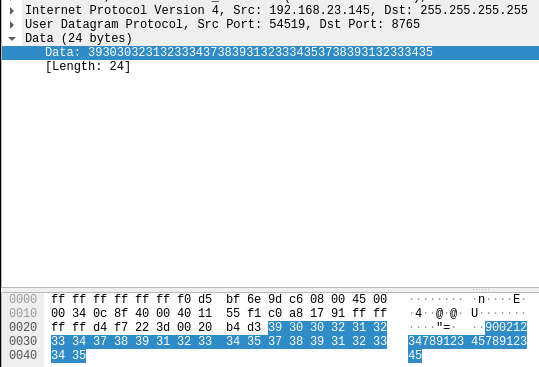 I expected some strange binary protocol, but the payload is just simple numbers. They're a
combination of the serial numbers of the inverter and the ID of the Enverbridge device.
One thing I'm not 100% sure about are the inverter serial numbers, there are two of them, but
on the inverter I've seen the serial numbers are always the same. So the payload is assembled
like this:

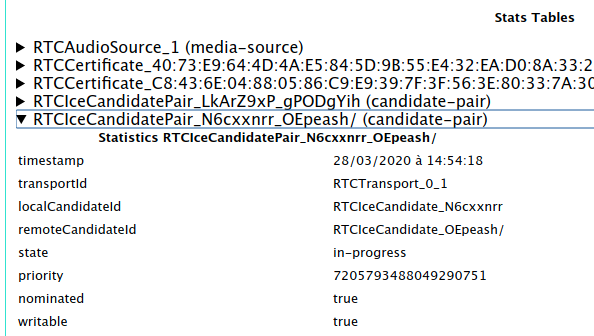 Then from the name of that pair (
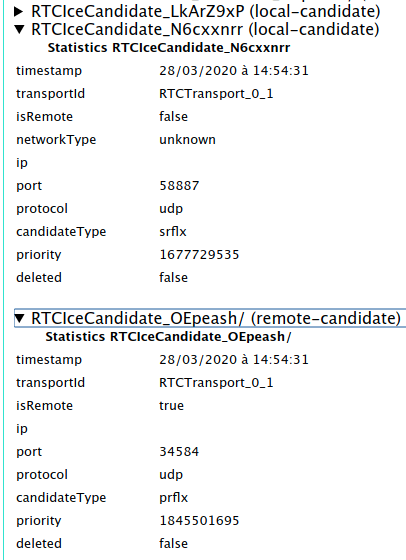 In the case of a direct connection, I saw the following on the
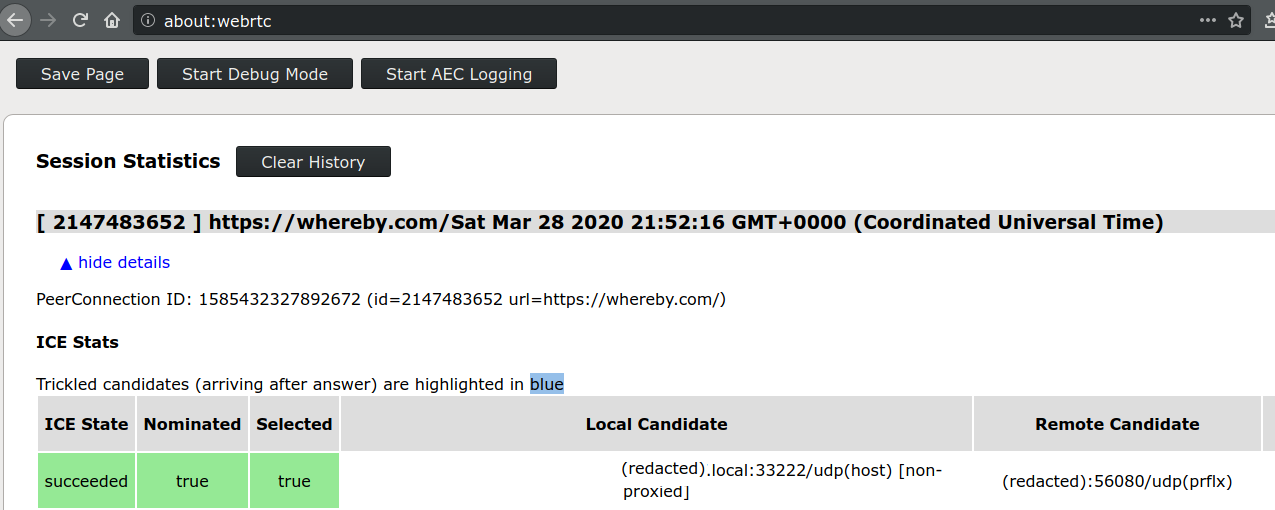


 A new release 0.4.17 of
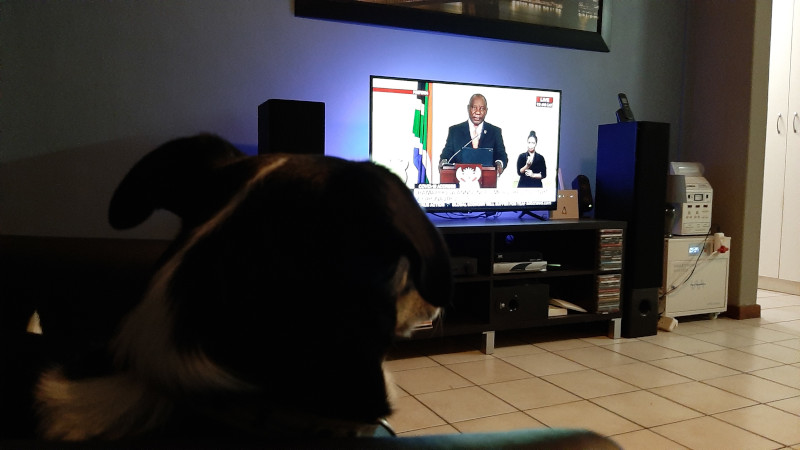
 I just took my dog for a nice long walk. It s the last walk we ll be taking for the next 3 weeks, he already starts moping around if we just skip one day of walking, so I m going to have to get creative keeping him entertained. My


 I recently stumbled upon


 Like
 Update 2020-04-03: Please see
 If there are a few things I would change, then mostly the chaos about kwallet and Gnome keyring. I would love to have one secret storage, and it seems that Gnome Keyring is preferrable, but this is in flux at the moment. Also, it is not that pressing, because I have moved all my passwords into
 Users had often asked where they could find older versions of packages from
 This is my last Outreachy blogpost, as my internship unfortunately has come to an end. It was a blast!
Through the
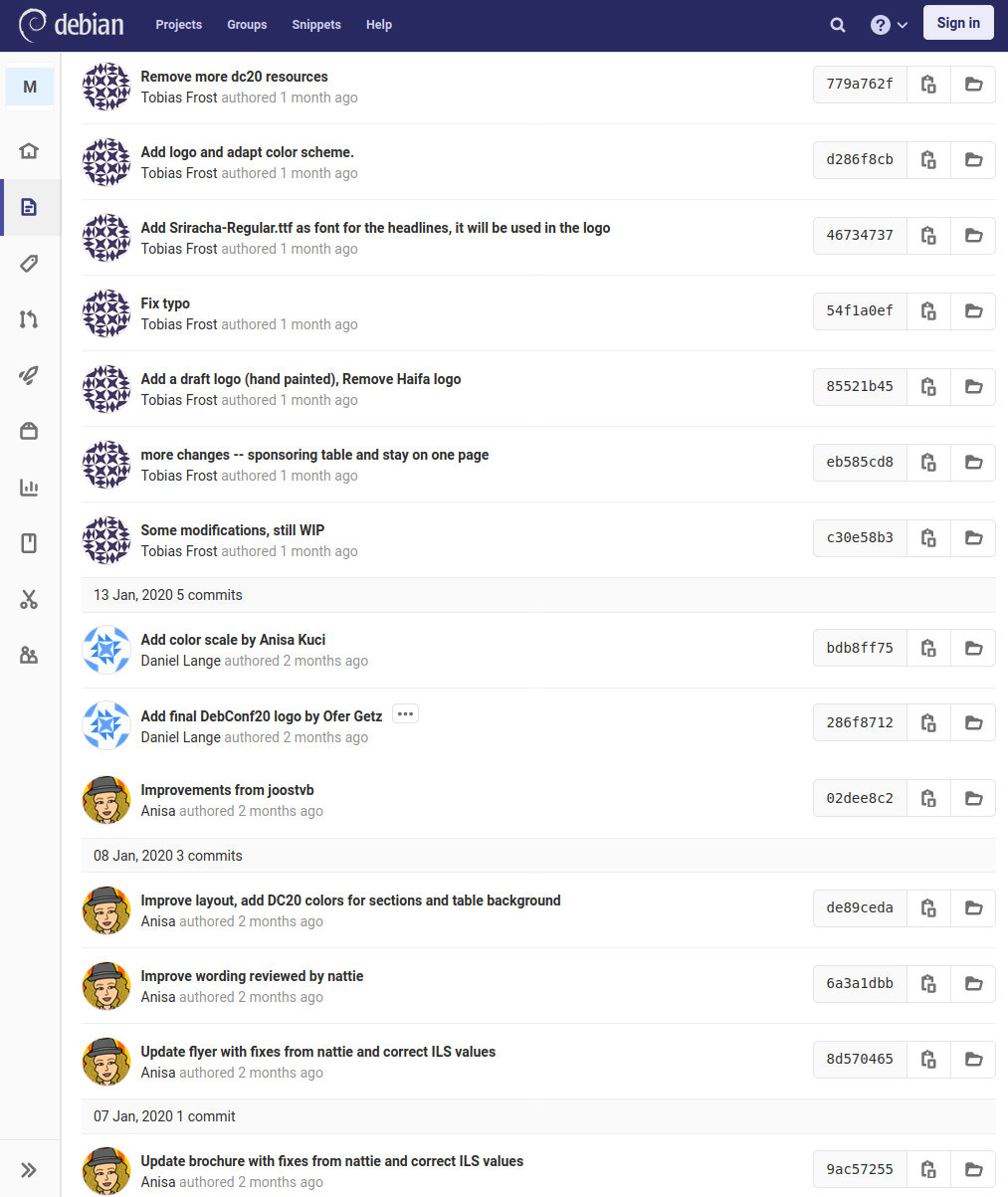 I have profited so much from other people s work, so I am very happy if community members can build on mine. Afterall sharing is caring!
Through the Outreachy travel stipend I was able to
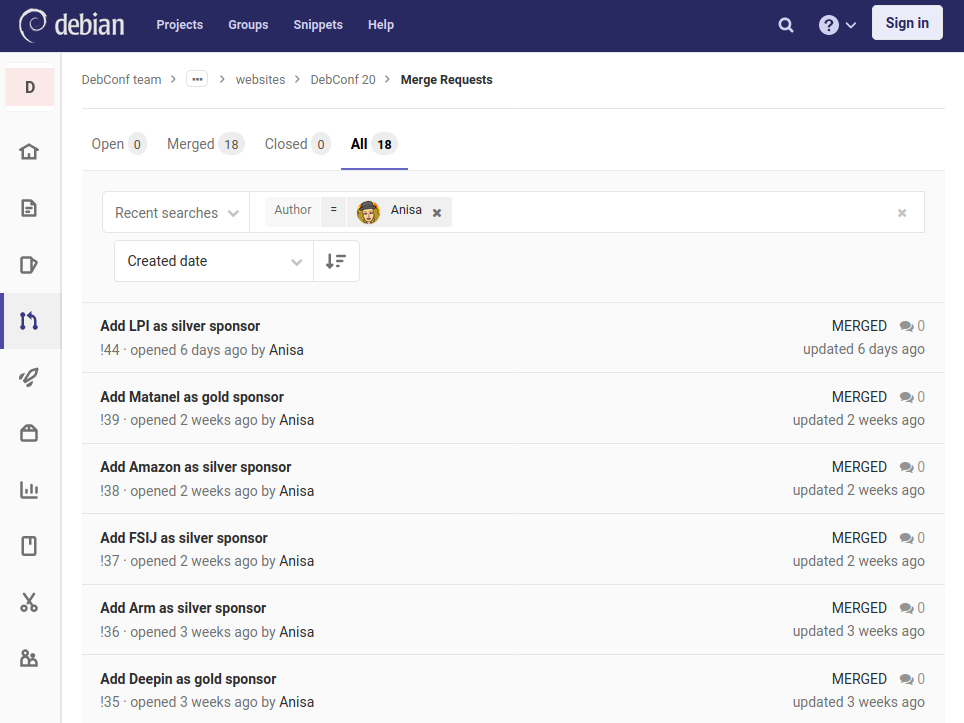 I completed six email templates for the DebConf sponsor communication campaigns. While two of them have already been very useful, I hope my
other proposals will be the ones used for the next waves of sponsors contacting.
I committed them to the sponsors git repo so they can be easily accessible and well documented for other DebConf teams or can be recycled for
smaller Debian events.
Unfortunately, due to the insecurity about travel around the Corona virus pandemic, the third wave of communication, originally scheduled for
the end of my internship in March, has been held. I have committed to the team to do this once the travel restrictions have been lifted and we
know that DebConf20 can proceed as planned for August 2020.
So yeah, I am definitely going to stay around and continue to help with DebConf fundraising!
DebConf has been held for two decades and it also has a generic website, so I also updated the
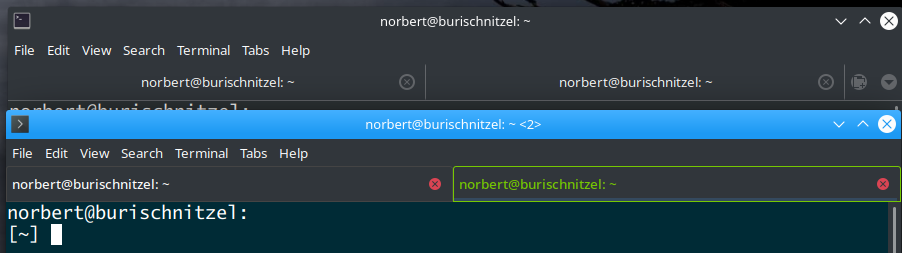 In the above screen shot you see the tabs in the upper part are hardly distinguishable, and in the lower part the active tab is clearly indicated with different colors. Searching for relevant search terms brings up a variety of suggestions, most of them not working. I finally found
 I am trying to avoid bringing coronovirus into my house on anything,
and I also don't want to sterilize a lot of stuff. (Tedious and easy to
make a mistake.) Currently it seems that the best approach is to leave
stuff to sit undisturbed someplace safe for long enough for the virus to
degrade away.
Following that policy, I've quickly ended up with a porch full of stuff
in different stages of quarantine, and I am quickly losing track of how
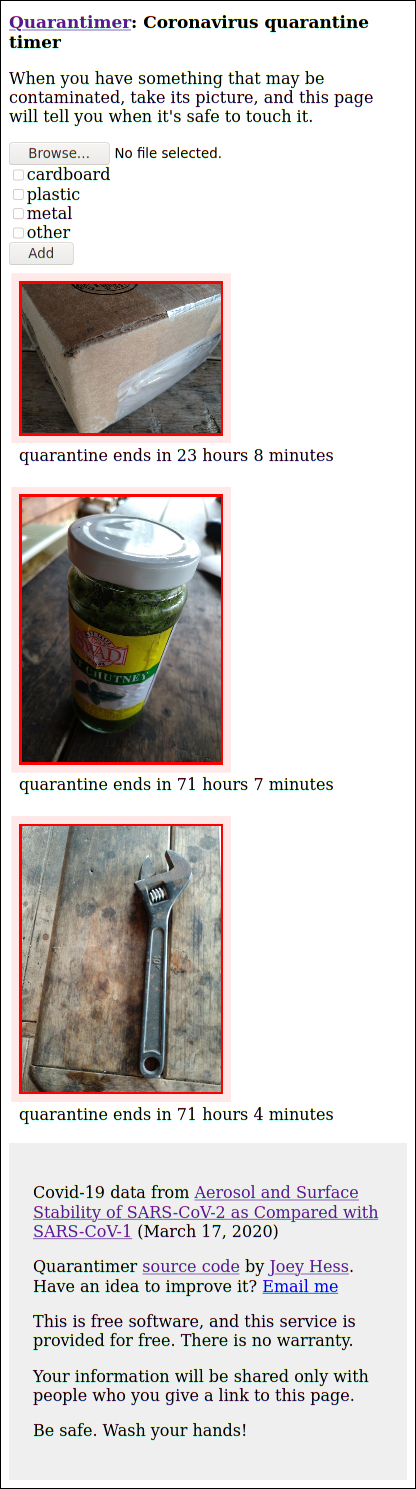
long things have been in quarantine. If you have the same problem,
here is a solution:
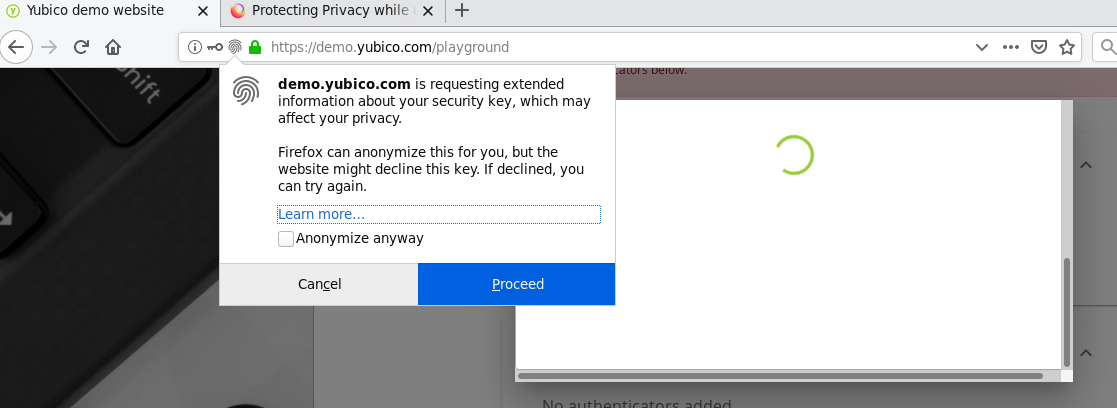
 I wanted to have a working Two Factor Authentification (2FA) setup to login on salsa.debian.org, Debians s gitlab instance.
 The following contributors got their Debian Developer accounts in the last two months:
 Say What?

