Daniel Pocock: DebConf13: breakthroughs in OTP and WebRTC

Saturday, 17 August was a day that saw groundbreaking new work revealed at DebConf13 and may have been a watershed moment in the emergence of WebRTC for the free software community.
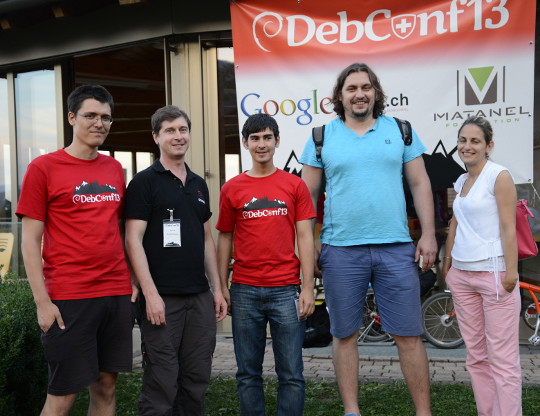
Fabian Gr nbichler, Daniel Pocock, Catalin Constantin Usurelu, Emil Ivov, Yana Stamcheva Advancing the use of One Time Passwords with free software Google Summer of Code (GSoC) student Fabian Gr nbichler has spent the summer enhancing oath-toolkit and dynalogin to support a more diverse range of One Time Password schemes. dynalogin's original 1.0 release supports vanilla HOTP and TOTP authentication schemes. Fabian's work has extended the framework to support the more generic and powerful OCRA approach. To find out about all the benefits this brings, I would strongly encourage you to review his slides and video presentation, with a demo where it is explained thoroughly. While there are existing hardware tokens that support HOTP and TOTP using this open algorithm (Gooze has been kind enough to donate some which were on display), the mutual challenge-response schemes are yet to be widely supported in hardware and this means that Fabian's work is now at the cutting edge of development in this area.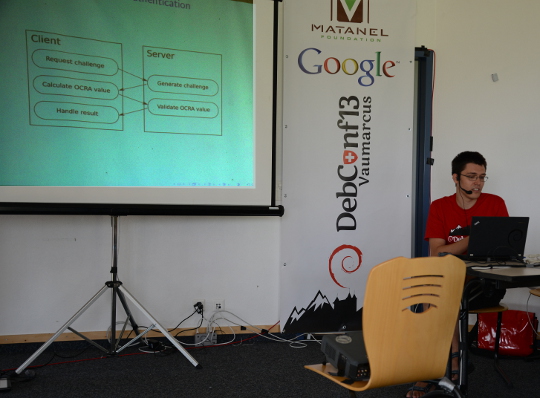 WebRTC: premium voice/video chat in modern browsers, no plugin required
 Another member of Debian's GSoC program, Catalin Constantin Usurelu helped organise and run one of the must-see sessions of DebConf13 (video available). In a demonstration that had all the hallmarks of a magic show, Catalin and I took random members of the audience and invited them to wave a magic wand over their web browsers and effortlessly turn them into Skype-busting softphones.
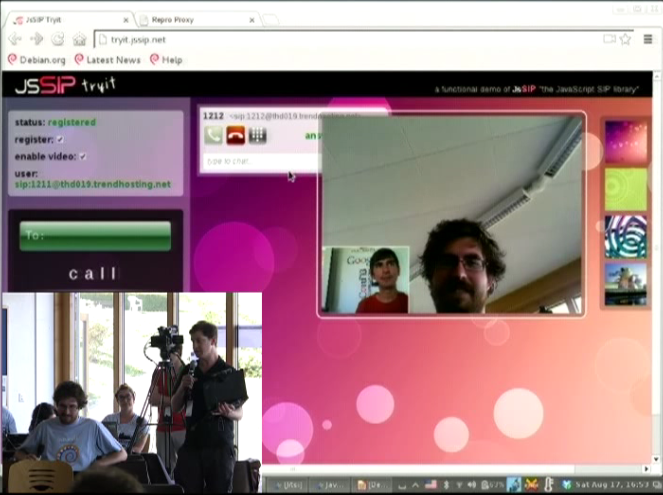 As the grand finale, we took Wookey's blog and showed him how to add a WebRTC "call-me" page in less than 20 seconds, less time than it takes to hand over all your private data to the registration process of those rather uncomfortable alternatives. Anybody else seeking to duplicate this effort is encourage to review options like Drucall for Drupal or just directly use JsSIP
Jitsi and the Jitsi Video-bridge
 The grand-finale of the DebConf13 real-time communications track was our guest speaker, Emil Ivov, founder of the Jitsi softphone project.
Jitsi itself has recently been accepted into Debian and is easier than ever before to install and use.
Emil's talk (video and slides available) went into some detail about the cutting edge development activities of his team, particularly the new Jitsi Video bridge
Subsequent to the talk, we had some out-of-bands discussion about ways to potentially integrate Jitsi Video bridge with the open source dvswitch system used to produce streams and recordings from free software events such as DebConf and FOSDEM. It is hoped that this will provide an additional option for remote participation at free software events of all sizes.
Upcoming events
Emil and I have been invited to participate in the WebRTC Conference Paris 2013 in December. This will be an excellent opportunity to have further discussion about progress with WebRTC and do more to raise the compelling case for premium quality free software to meet the demanding needs of modern business communications. There are a series of talks for both technical and business-oriented audiences.

Fabian Gr nbichler, Daniel Pocock, Catalin Constantin Usurelu, Emil Ivov, Yana Stamcheva Advancing the use of One Time Passwords with free software Google Summer of Code (GSoC) student Fabian Gr nbichler has spent the summer enhancing oath-toolkit and dynalogin to support a more diverse range of One Time Password schemes. dynalogin's original 1.0 release supports vanilla HOTP and TOTP authentication schemes. Fabian's work has extended the framework to support the more generic and powerful OCRA approach. To find out about all the benefits this brings, I would strongly encourage you to review his slides and video presentation, with a demo where it is explained thoroughly. While there are existing hardware tokens that support HOTP and TOTP using this open algorithm (Gooze has been kind enough to donate some which were on display), the mutual challenge-response schemes are yet to be widely supported in hardware and this means that Fabian's work is now at the cutting edge of development in this area.
WebRTC: premium voice/video chat in modern browsers, no plugin required
Another member of Debian's GSoC program, Catalin Constantin Usurelu helped organise and run one of the must-see sessions of DebConf13 (video available). In a demonstration that had all the hallmarks of a magic show, Catalin and I took random members of the audience and invited them to wave a magic wand over their web browsers and effortlessly turn them into Skype-busting softphones.
As the grand finale, we took Wookey's blog and showed him how to add a WebRTC "call-me" page in less than 20 seconds, less time than it takes to hand over all your private data to the registration process of those rather uncomfortable alternatives. Anybody else seeking to duplicate this effort is encourage to review options like Drucall for Drupal or just directly use JsSIP
Jitsi and the Jitsi Video-bridge
The grand-finale of the DebConf13 real-time communications track was our guest speaker, Emil Ivov, founder of the Jitsi softphone project.
Jitsi itself has recently been accepted into Debian and is easier than ever before to install and use.
Emil's talk (video and slides available) went into some detail about the cutting edge development activities of his team, particularly the new Jitsi Video bridge
Subsequent to the talk, we had some out-of-bands discussion about ways to potentially integrate Jitsi Video bridge with the open source dvswitch system used to produce streams and recordings from free software events such as DebConf and FOSDEM. It is hoped that this will provide an additional option for remote participation at free software events of all sizes.
Upcoming events
Emil and I have been invited to participate in the WebRTC Conference Paris 2013 in December. This will be an excellent opportunity to have further discussion about progress with WebRTC and do more to raise the compelling case for premium quality free software to meet the demanding needs of modern business communications. There are a series of talks for both technical and business-oriented audiences.
 I write a fair number of Unix command line programs, and I want to
have test suites for them. A year and a half ago I wrote a tool to
make that easier:

 The
 RichiH used flint and steel to light the bonfire. We carefully fed it up
from those sparks to a blaze. Put on the biggest logs we could find
to make it last. Now I'm sitting on the hill above it watching folks
gathered around. A poem is being read, in Hindi, then
translated for us to English. Others have shared songs and poems in a dozen
languages, both classics and their own. Out below the darkness of
the lake. This is Debian at 20.
At the start of this DebConf, I gave a talk on
"


 Do you feel like an impostor? Do you fear other people realising that you are not as good as your peers?
You are not alone, many people feel the same, and it goes away eventually. I know because I've been there, it is a really awful feeling that got me depressed and unhappy for months. But you can try to fight it!
This is an excellent document from the Geek Feminism Wiki, that I found thanks to pabs@, make yourself a favour and read it:



 OpenMAMA was developed by
 Commercial background
Reuters and Bloomberg are well known as two of the main vendors in the market data industry. Both of them (and other competitors) provide a range of data services and related software. Buying a data feed doesn't automatically give access to the software from the same franchise: the software and APIs are promoted as a valuable product in their own right. It is actually quite possible (and not unheard of) for an institution to run a


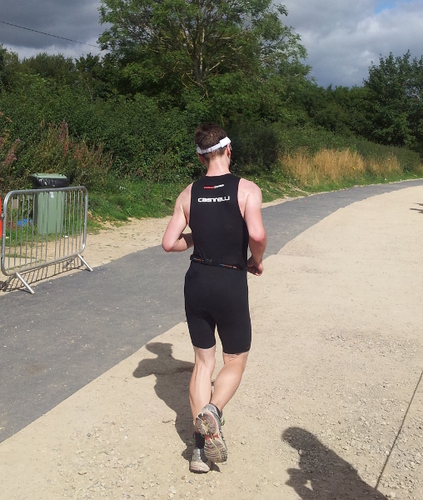
 Since becoming interested in triathlon in October of last year, my goal in 2013 was not to just finish a "70.3" (or "Half-Ironman"), but to complete one in under 5 hours.
At the time, each discipline was woefully inadequate; I had not swum in over a decade, my cycling was average and I had only begun running again after years away from exercise.
The somewhat arbitrary target time would dictate my training. For example, the high proportion of time spent on the bike combined with the injury-sensitive nature of running meant that cycling would have a highest return on investment of the three disciplines. Despite that, I would need to take the run seriously but carefully - I decided to enter a series of monthly 10K races where I could steadily reduce my times over the year.
Races themselves formed a crucial part of my preparation and a carefully balanced race calendar was surprisingly important, balancing upcoming milestones that would provide an achievable goal as well as uncovering weaknesses in enough time so they could be worked on.
Whilst I did post about

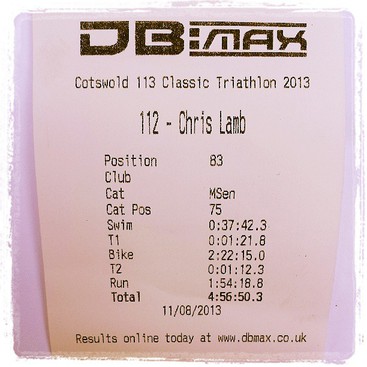 (



 Cloud is passing the hype curve and we are seeing more stable developments and offerings on the market. Lately I ve been playing with RedHat s Openshift. Openshift is a PaaS (Platform as a Service) offering that intends to be an alternative for vendors such as Heroku. The focus for such offerings is to give developers enough flexibility and tools that handle the application deployment and maintenance process in a way that is integrated with their existing development workflow and tools.
I ve been using Heroku for a while to deploy small to medium size projects. I liked the tools and developer-centered experience they offer. Openshift is quite new on the market and it comes in two flavors:
 The ascent
Delegates get a feel for the Swiss landscape.
 Main talk room
Rooms are prepared and ready for speakers
 Ambience
There are many relaxing places for people to catch up and have a discussion
 Leadership
One of the DebConf chairs enjoys a quiet moment of reflection
 Drinks
 The bar is open
DebConf13 begins

