Search Results: "spa"

15 May 2011

Kai Wasserb ch: Chronicle 4.6-2 fixes another UTF-8 encoding issue

Today I was playing with some RDF information, initially triggered by my entry about Josephine. While at it I decided to add some information explicitly to the head tag, including
<meta property="cc:attributionName" content="Kai Wasserb ch" />
<meta property="dc:creator" content="Kai Wasserb ch" />
Obviously I wanted to add those two tags to my templates, so Chronicle adds that to all files. Unfortunately this resulted in an encoding error of the " ". Some digging in the source of chronicle showed, that HTML::Template-new() was called without ensuring, that the tempalte files were parsed as UTF-8 encoded. The solution was to add a filter. The just uploaded version 4.6-2 contains the required patch and if you don't use the Debian packages you won't be left out for long, as Steve already applied the fix upstream.

John Goerzen: Napoleon, Winter in May, and Silly String

This is just a diary of a random day sort of post. Nothing all that particularly unusual, but then perhaps if I only blog about the unusual, the typical gets lost. This week started out with temperatures as high at 99F. Today we didn t even reach 60, and tonight will be cold almost to freezing. It s Kansas, so while we remark on the strange weather, we re not particularly surprised by it. This morning, Jacob and Oliver went over to play across the street. Jacob then went with Terah to a birthday party for one of his classmates, while Oliver helped plant some trees with his grandparents. I was at home this morning, which gave me a small but welcome break from the past week: we had something going on 6 out of the last 7 evenings, and little time to do anything else. So I got out the Kindle and read from War and Peace. I started at the kitchen table while eating some granola, and then sat on the couch. The day was cold, windy, and overcast, and I like to use natural light, so there were only a few places to sit with enough light. I sat there reading the account of Napoleon s capture of Moscow in 1812, the characters lives uprooted by those events, and stories of violent mobs forming. And, of course, Tolstoy s essays on the mistake of overstating the importance of famous figures in history were common. I am now about 3/4 through War and Peace, which means I ve read 1,044 pages and have (only) 348 to go. As I got up to try to find slippers or a blanket for my cold feet at one point, I remembered a conversation I had while eating lunch this week. I was reading on the Kindle while reading, and a person I knew happened to walk past. She asked what I was reading. I said simply, War and Peace. There was this stunned silence, so I added, for fun. It s great! Which is true. She said, Oooookay, John, you just enjoy that then and went on her way. This isn t the first time I ve had a conversation like that about this book. It seems to be held up as some example of long, dry, literature that people are made to read but don t want to. I think that only long is accurate here. Anyhow, pretty soon Oliver arrived and, much to my surprise, said Doh! (meaning no ) when I asked him if he was ready for lunch. Instead he stood there looking at me sweetly. Taking a guess, I said, Oliver, would you like to watch train videos? Yeah yeah yeah yeah! So we did. He particularly enjoyed the steam engines today, and eventually was ready for lunch at 12:30. Jacob and Terah got home just as he was finishing. Oliver got his nap, and I played with Jacob for a bit. Ever since he had heard of the British wedding in preschool, he s been interested in weddings, so I showed him pictures from Terah and me at our wedding. This was a big hit. Then he went with Terah to decorate a Sunday School room at church, so I read a bit more Tolstoy. Tolstoy s characters sometimes are prone to not just changes in mood but changes in outlook and worldview changing from cold, logical, and uncaring to warm and loving, or from despair at the vanity and shallowness of humanity to elation at the simple honesty of a peasant and renewed trust in the human spirit. At first I marveled at this tendency in certain characters, but on reflection, and in consideration of the timeline of the novel, which spans several years, it didn t seem quite so strange. Things can happen to change the mood of individuals, or even a country; I can remember the national mood changing after 9/11, and again after Obama s election, for instance. I also felt a contrast with some of the characters who, due to their decisions or circumstances, lost things that mattered while chasing things that weren t as important. I felt fortunate to be at this place, with Jacob, Oliver, and Terah, and decided that we all ought to do something fun in the evening, but hadn t quite figured out what. And about that, the clouds started to break and Oliver woke up from his nap. I went up to his room, and much to his delight, played peekaboo with him for quite awhile. Eventually he was done with that game, but spotted my phone, so I helped guide his finger to launch Youtube and watch a train video over the wifi. This was certainly a Big Deal to him. After Terah and Jacob got back, I figured it was time figure out something fun to do. And what could be more fun, I decided on the spur of the moment, than a drive into town to pick up some cans of Silly String for the boys, neither of which had ever used it before. So we went to a restaurant, then bought the surprise toy (I hadn t told them what it would be beforehand), then went to an ice cream place, and finally back home. Oliver loved it. He needed my help to press the nozzle to make it come out, but still had a great time and shrieked with delight. Jacob then tried out his can, and stood in one place spraying his bright green strings all over the place. Then he took to running around the yard spraying string randomly in every direction until he finally completely emptied out the can. And after that, he gathered up some of the different colors of string and rolled them up into a ball which he was very proud of. A nice day.

14 May 2011

Vincent Bernat: FVWM configuration

There is actually some buzz around Gnome 3 and the new release of Ubuntu switching to Unity. I thought this was a good occasion to make this small post to tell that I still uses FVWM whose latest version was released a month ago. FVWM is a very old window manager. So old that nobody really knows what the F stands for. It comes with a ugly configuration by default and can be configured to look even uglier. However, FVWM is powerful and highly configurable. Moreover, it is pretty lightweight.

My FVWM configuration My configuration of FVWM is available on GitHub. It requires the use of fvwm-crystal. If you are running Debian or Ubuntu, there is a package for this. This is a set of powerful configuration files for FVWM which add a lot of goodies and themes. Unfortunately, the project site seems to have disappared. You can still grab the sources from your nearest Debian mirror. While those configuration files were great, I did not like to have such a complex desktop with all those icons and menus. However, what is great with fvwm-crystal is you can overlay your own configuration. If a file is present in your home directory, it will take precedence over the one installed on the system. So, I just wrote a new recipe. What you may want to steal from my configuration is the ability to alter the configuration depending on the fact that you are using one or two screens. With one screen, you get:
  • an application panel (a launcher bar) on the upper left corner,
  • an icon manager (which will contained iconified windows) on the upper right corner,
  • a systray on the left of the icon manager
  • a pager (which shows various desktops) just below it,
  • two icon managers (which act as a taskbar) on the bottom, one for regular applications and the other one for terminal windows.
One screen setup of FVWM With two screens, the organization is different. The two icon managers at the bottom are on their own screens. The pager is between the two screens and the other elements are on the upper left of the right screen. Dual screen setup of FVWM If I am using a single screen and I plug another one, I do something like this to get my setup updated:
1
2
$ xrandr --output  VGA-1 --auto --output DVI-I-1 --auto --right-of VGA-1
$ killall trayer ; FvwmCommand Restart
I also uses conky, a light-weight system monitor. It is started in my .xsession, not through FVWM.

Building wallpapers for dual-screen One difficulty with a multi-head setup is how to get the background set properly? . I have made a small script for generating one. Use it like this:
1
$ ./build-wallpaper.py -d ~/.fvwm/wallpapers -c -t ~/tmp/mywallpaper.png
It will randomly select two wallpapers and put them together to look nice on your dual-screen setup. It will also correct the aspect ratio, either by cropping the image or centering the image. You need the following dependencies to make script work: python-xpyb and python-imaging. UPDATE: Thomas Adam pointed to Nitrogen, a graphical wallpaper utility supporting multi-head setups. It is a great tool if you want to set manually your wallpaper but it does not allow to select a random one. Nowadays, I grab most of my wallpapers from InterfaceLIFT.

13 May 2011

Gustavo Noronha Silva: My experience with GNOME 3 so far

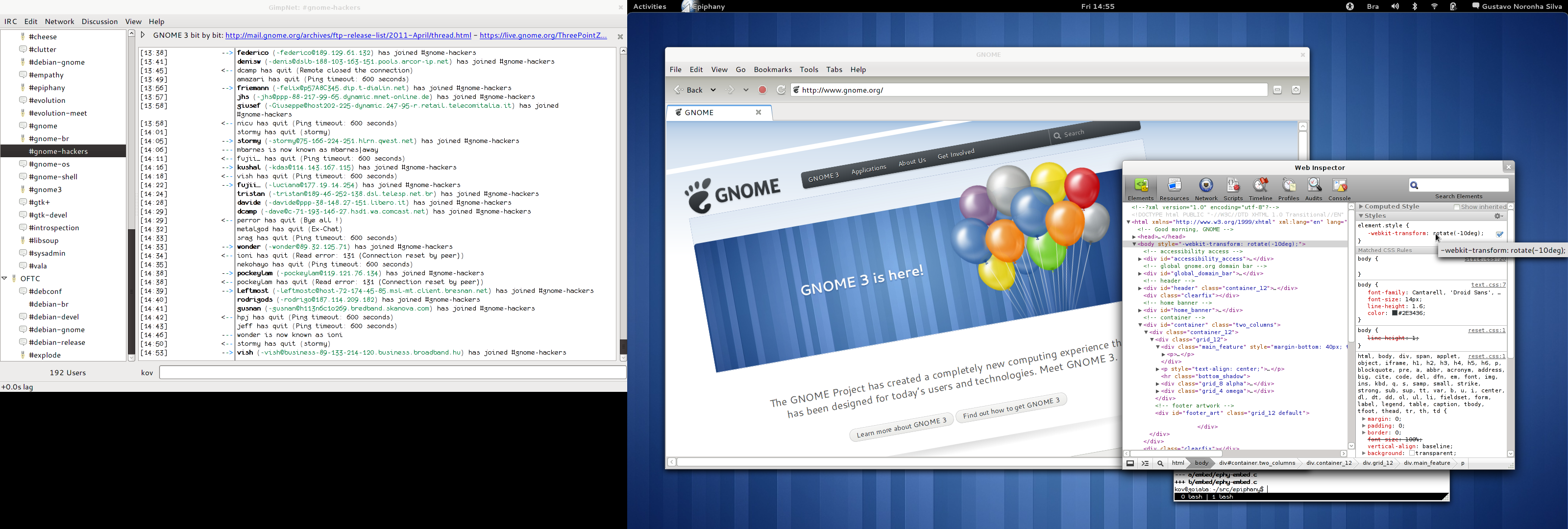
You know, GNOME Shell and I are not really strangers to each other for a long time now. I have been using it almost daily as my main desktop since late 2009, when I started shipping it to Debian experimental. That means that I had ample opportunity to both get used to it and witness the huge improvements it had with every new release. My general feeling towards GNOME 3 is this: . Yes, I love it! I love the new themes, I love the window borders, I love the top panel, the overview, the dynamic workspaces, I love the Me menu, I love the clock and the calendar, the system indicators with the beautiful symbolic icons, being able to search for applications in such a nice way, the window animations, the multi-screen support, the new nautilus, the dash, looking glass. It s hard for me to even express how thankful I am and how much admiration I have for the awesome folks who helped bring this to life. Thanks so much!
My GNOME3 desktop

My GNOME 3 desktop

After all this time, there are only two things I can say I dislike about GNOME3, apart from some minor wishlists: the alt-tab behaviour and the message tray. Let me expand on those. Message Tray Of the very few things I dislike, there is only 1 I hate and cannot see myself living with: the accordion animation in the message tray. No, really, it s such a terrible, terrible idea. Every single time I try to use that thing I overshoot while moving the mouse to the left, then overshoot again moving the mouse to the right because the frigging icon has moved. It s no good knowing that I can click in the text or in the empty area to its right, it feels wrong. It s terrible that my actual target is moving at all. Every single time I use it is a small frustration for me it s as if the message tray was playing games with me, laughing at me for not having good enough mouse pointer driving skills even more than the infamous sub-menus used to. And I had to go through that penance whenever I wanted to find the person I was chating with to resume the conversation. I wrote an extension that disables the accordion animation by simply not showing the title at all when you hover the icon, and I patched GNOME Shell s CSS to make the icons a bit bigger, so that it s easier for me to hit them with the mouse. It s clearly not ideal, and you still have to click the various people icons to figure out which of your friends who were lazy enough to not add a picture to their IM profiles is that one, but it s still much better than chasing the (smaller) ones around to figure that out. Perhaps we should have the icons be bigger and always have the title bellow them? I don t know, I trust the awesome designers who designed the awesomess that s everywhere else will come up with a great idea.
My Message Tray

My message tray with bigger icons and no accordion animation.

Alt Tab The number 1 feature of workspaces for me has always been locality being able to not see all of the other applications and windows that are open elsewhere. This lowers the amount of noise when I m trying to find something. The overview is very nice in this matter only windows in the current workspace are shown, and even when you have an extra screen, the windows in there appear in that screen. The alt-tab behaviour, on the other hand, of showing all windows and apps, even with the separator, bothers me. It s really useful to have when you want to go to a specific window no matter where it is (I usually use the dash for that, though), but it adds noise when you want to go to a specific window _in this_ workspace, which is the most common use case for my usage. So I copied the alt-tab code over to an extension and modified it so that only windows in the current workspace would be considered. In addition to that, with the windows in the extra screen always being there no matter what workspace you re in (which I think is an awesome idea), they are effectively in all workspaces, so they add constant noise even with my extension. It s also weird to have to look at the main screen to switch to a window in the extra screen. There s a huge discontinuity. What I would prefer is having alt-tab to follow the mouse regarding screens only show windows in the extra screen if you hit alt-tab in there, making sure the selector thing appears in there as well.

Pietro Abate: Eating you own dog food - mpm

After a bit of work, today I decided to start using mpm, the mancoosi package manager, to upgrade my laptop. My first use of it on a production system - until now I run all my experiments in throw-away virtual machines - and it works ! Not rocket science here. During the last month David Kalnischkies (of APT fame) visited our offices in Paris and together with zack worked out a communication protocol between apt-get and the mancoosi cudf solvers (EDSP). I guess somebody is going to announce all details about this endeavor soon. This cooperation enabled us to advance in the integration of apt-get and the mancoosi technology. Reusing the same protocol and backend I developed to translate the apt problem to cudf (and to call a suitable solver), I've re-wrote large part of mpm and added the possibility to generate the installation plan before calling dpkg and really installing the selected packages. Below notice the intermediate calls as Inject Model , Simulate, Compare Models . These are at the moment stubs that are going to call the simulation framework developed at mancoosi. The food :
abate@zed.fr:~/Projects/git-svn-repos/mpm$sudo ./mpm.py -c mpm.conf update
Reading package lists... Done
Building dependency tree
Reading state information... Done
Inject Model ...


abate@zed.fr:~/Projects/git-svn-repos/mpm$sudo ./mpm.py -c mpm.conf upgrade
Reading package lists... Done
Building dependency tree
Reading state information... Done
The following new packages will be installed:
libtracker-client-0.8-0 libnet-ip-perl libio-socket-ssl-perl libasyncns0 libapr1
5 to install
Simulate
Proceed ? yes/[no]
yes
Reading package fields... Done
Reading package status... Done
Retrieving bug reports... Done
Parsing Found/Fixed information... Done
Reading changelogs... Done
apt-listchanges: Mailing root: apt-listchanges: changelogs for zed
Reading package fields... Done
Reading package status... Done
Retrieving bug reports... Done
Parsing Found/Fixed information... Done
Reading changelogs... Done
apt-listchanges: Mailing root: apt-listchanges: changelogs for zed
(Reading database ... 179534 files and directories currently installed.)
Preparing to replace libapr1 1.4.2-8 (using .../libapr1_1.4.4-1_amd64.deb) ...
Unpacking replacement libapr1 ...
Preparing to replace libasyncns0 0.8-1 (using .../libasyncns0_0.8-2_amd64.deb) ...
Unpacking replacement libasyncns0 ...
Preparing to replace libio-socket-ssl-perl 1.40-1 (using .../libio-socket-ssl-perl_1.43-1_all.deb) ...
Unpacking replacement libio-socket-ssl-perl ...
Preparing to replace libnet-ip-perl 1.25-2 (using .../libnet-ip-perl_1.25-3_all.deb) ...
Unpacking replacement libnet-ip-perl ...
Preparing to replace libtracker-client-0.8-0 0.8.17-2 (using .../libtracker-client-0.8-0_0.8.18-1_amd64.deb) ...
Unpacking replacement libtracker-client-0.8-0 ...
Processing triggers for man-db ...
Setting up libapr1 (1.4.4-1) ...
Setting up libasyncns0 (0.8-2) ...
Setting up libio-socket-ssl-perl (1.43-1) ...
Setting up libnet-ip-perl (1.25-3) ...
Setting up libtracker-client-0.8-0 (0.8.18-1) ...
localepurge: Disk space freed in /usr/share/locale: 0 KiB
localepurge: Disk space freed in /usr/share/man: 0 KiB
localepurge: Disk space freed in /usr/share/gnome/help: 0 KiB
localepurge: Disk space freed in /usr/share/omf: 0 KiB

Total disk space freed by localepurge: 0 KiB

localepurge: Disk space freed in /usr/share/locale: 0 KiB
localepurge: Disk space freed in /usr/share/man: 0 KiB
localepurge: Disk space freed in /usr/share/gnome/help: 0 KiB
localepurge: Disk space freed in /usr/share/omf: 0 KiB

Total disk space freed by localepurge: 0 KiB

Inject Model ...
Compare Models ...
abate@zed.fr:~/Projects/git-svn-repos/mpm$
Reg the installation plan, this is an xml file that will be passed to a simulator developed by the university of L'Aquila to make sure that the installation script (well, a model of them), will not cause any problem during the installation. The format is a very simple xml file as follows :
<selectionStates>
<selectionState type="Install">
<param name="package" value="libapr1" />
<param name="version" value="1.4.4-1" />
<param name="architecture" value="amd64" />
</selectionState>
<selectionState type="Install">
<param name="package" value="libasyncns0" />
<param name="version" value="0.8-2" />
<param name="architecture" value="amd64" />
</selectionState>
<selectionState type="Install">
<param name="package" value="libio-socket-ssl-perl" />
<param name="version" value="1.43-1" />
<param name="architecture" value="all" />
</selectionState>
[...]
Soon APT will ship a patch to use the very same infrastructure of mpm (yeii !!!). This will on one hand make mpm useless as package manager on its own. It is a simple hack in python and I never tough to compete with its big brothers. On the other hand I think it will stand as a nice workbench to experiment with new ideas, to prototype new features and to make it easier for poeple that are not c++ experts to play with the APT library (thanks to python-apt) in a semi structured environment. The code is in the mancoosi svn if you want to have a look.

Pietro Abate: Eating my own dog food - mpm

After a bit of work, today I decided to start using mpm, the mancoosi package manager, to upgrade my laptop. My first use of it on a production system - until now I run all my experiments in throw-away virtual machines - and it works ! Not rocket science here. During the last month David Kalnischkies (of APT fame) visited our offices in Paris and together with zack worked out a communication protocol between apt-get and the mancoosi cudf solvers (EDSP). I guess somebody is going to announce all details about this endeavor soon. This cooperation enabled us to advance in the integration of apt-get and the mancoosi technology. Reusing the same protocol, and backend I developed to translate the apt problem to cudf (and to call a suitable solver), I've re-wrote large part of mpm and added the possibility to generate the installation plan before calling dpkg and really installing the selected packages. Below notice the intermediate calls as Inject Model , Simulate, Compare Models . These are at the moment stubs that are going to call the simulation framework developed at mancoosi. The food :
abate@zed.fr:~/Projects/git-svn-repos/mpm$sudo ./mpm.py -c mpm.conf update
Reading package lists... Done
Building dependency tree
Reading state information... Done
Inject Model ...


abate@zed.fr:~/Projects/git-svn-repos/mpm$sudo ./mpm.py -c mpm.conf upgrade
Reading package lists... Done
Building dependency tree
Reading state information... Done
The following new packages will be installed:
libtracker-client-0.8-0 libnet-ip-perl libio-socket-ssl-perl libasyncns0 libapr1
5 to install
Simulate
Proceed ? yes/[no]
yes
Reading package fields... Done
Reading package status... Done
Retrieving bug reports... Done
Parsing Found/Fixed information... Done
Reading changelogs... Done
apt-listchanges: Mailing root: apt-listchanges: changelogs for zed
Reading package fields... Done
Reading package status... Done
Retrieving bug reports... Done
Parsing Found/Fixed information... Done
Reading changelogs... Done
apt-listchanges: Mailing root: apt-listchanges: changelogs for zed
(Reading database ... 179534 files and directories currently installed.)
Preparing to replace libapr1 1.4.2-8 (using .../libapr1_1.4.4-1_amd64.deb) ...
Unpacking replacement libapr1 ...
Preparing to replace libasyncns0 0.8-1 (using .../libasyncns0_0.8-2_amd64.deb) ...
Unpacking replacement libasyncns0 ...
Preparing to replace libio-socket-ssl-perl 1.40-1 (using .../libio-socket-ssl-perl_1.43-1_all.deb) ...
Unpacking replacement libio-socket-ssl-perl ...
Preparing to replace libnet-ip-perl 1.25-2 (using .../libnet-ip-perl_1.25-3_all.deb) ...
Unpacking replacement libnet-ip-perl ...
Preparing to replace libtracker-client-0.8-0 0.8.17-2 (using .../libtracker-client-0.8-0_0.8.18-1_amd64.deb) ...
Unpacking replacement libtracker-client-0.8-0 ...
Processing triggers for man-db ...
Setting up libapr1 (1.4.4-1) ...
Setting up libasyncns0 (0.8-2) ...
Setting up libio-socket-ssl-perl (1.43-1) ...
Setting up libnet-ip-perl (1.25-3) ...
Setting up libtracker-client-0.8-0 (0.8.18-1) ...
localepurge: Disk space freed in /usr/share/locale: 0 KiB
localepurge: Disk space freed in /usr/share/man: 0 KiB
localepurge: Disk space freed in /usr/share/gnome/help: 0 KiB
localepurge: Disk space freed in /usr/share/omf: 0 KiB

Total disk space freed by localepurge: 0 KiB

localepurge: Disk space freed in /usr/share/locale: 0 KiB
localepurge: Disk space freed in /usr/share/man: 0 KiB
localepurge: Disk space freed in /usr/share/gnome/help: 0 KiB
localepurge: Disk space freed in /usr/share/omf: 0 KiB

Total disk space freed by localepurge: 0 KiB

Inject Model ...
Compare Models ...
abate@zed.fr:~/Projects/git-svn-repos/mpm$
Reg the installation plan, this is an xml file that will be passed to a simulator developed by the university of L'Aquila to make sure that the installation script (well, a model of them), will not cause any problem during the installation. The format is a very simple xml file as follows :
<selectionStates>
<selectionState type="Install">
<param name="package" value="libapr1" />
<param name="version" value="1.4.4-1" />
<param name="architecture" value="amd64" />
</selectionState>
<selectionState type="Install">
<param name="package" value="libasyncns0" />
<param name="version" value="0.8-2" />
<param name="architecture" value="amd64" />
</selectionState>
<selectionState type="Install">
<param name="package" value="libio-socket-ssl-perl" />
<param name="version" value="1.43-1" />
<param name="architecture" value="all" />
</selectionState>
[...]
Soon APT will ship a patch to use the very same infrastructure of mpm (yeii !!!). This will on one hand make mpm useless as package manager on its own. It is a simple hack in python and I never tough to compete with its big brothers. On the other hand I think it will stand as a nice workbench to experiment with new ideas, to prototype new features and to make it easier for poeple that are not c++ experts to play with the APT library (thanks to python-apt) in a semi structured environment. The code is in the mancoosi svn if you want to have a look.

Mike Hommey: Debian Squeeze + btrfs = FAIL

Executive summary: Don t use btrfs on Debian Squeeze.
Longer summary: Don t use btrfs RAID with the kernel Debian Squeeze comes with. About six months ago, I set up a new server to handle this web site, mail, and various other things. The system and most services (including web and mail) was set to use an MD RAID 1 array across two small partitions on two separate disks, and the remaining space was setup in three different btrfs file systems: Three days ago, this happened:
May 10 10:18:04 goemon kernel: [3545898.548311] ata4: hard resetting link
May 10 10:18:04 goemon kernel: [3545898.867556] ata4: SATA link up 1.5 Gbps (SStatus 113 SControl 310)
May 10 10:18:04 goemon kernel: [3545898.874973] ata4.00: configured for UDMA/33
followed by other ATA related messages, then, garbage such as:
May 10 10:18:07 goemon kernel: [3545901.28123] sd3000 d]SneKy:AotdCmad[urn][ecitr
May 10 10:18:07 goemon kernel: 4[550.821 ecio es aawt es ecitr i e)
May 10 10:18:07 goemon kernel: 6[550.824     20 00 00 00 00 00 00 00 <>3491225     16 44 <>3491216]s ::::[d]Ad es:N diinlsneifrain<>3491216]s ::::[d]C:Ra(0:2 00 03 80 06 0
3491217]edrqet / ro,dvsb etr2272
May 10 10:18:07 goemon kernel: 3[550.837 ad:sb:rshdln etr2252
May 10 10:18:07 goemon kernel: 6[551214]s ::::[d]Rsl:hsbt=I_Kdiebt=RVRSNE<>3491215]s ::::[d]SneKy:AotdCmad[urn][ecitr
May 10 10:18:07 goemon kernel: 4[550.833 ecitrsnedt ihsnedsrpos(nhx:<>3491216]    7 b0 00 00 c0 a8 00 00 0
Then later on:
May 10 12:01:18 goemon kernel: [3552089.226147] lost page write due to I/O error on sdb4
May 10 12:01:18 goemon kernel: [3552089.226312] lost page write due to I/O error on sdb4
May 10 12:10:14 goemon kernel: [3552624.625669] btrfs no csum found for inode 23642 start 0
May 10 12:10:14 goemon kernel: [3552624.625783] btrfs no csum found for inode 23642 start 4096
May 10 12:10:14 goemon kernel: [3552624.625884] btrfs no csum found for inode 23642 start 8192
etc. and more garbage. At that point, I wanted to shutdown the server, check the hardware, and reboot. Shutdown didn t want to proceed completely. Btrfs just froze on the sync happening during the shutdown phase, so I had to power off violently. Nothing seemed really problematic on the hardware end, and after a reboot, both disks were properly working. The MD RAID would resynchronize, and the btrfs filesystems would be automatically mounted. It would work for a while, until such things could be seen in the logs, with more garbage as above in between:
May 10 14:41:18 goemon kernel: [ 1253.455545] __ratelimit: 35363 callbacks suppressed
May 10 14:45:04 goemon kernel: [ 1478.717749] parent transid verify failed on 358190825472 wanted 42547 found 42525
May 10 14:45:04 goemon kernel: [ 1478.717936] parent transid verify failed on 358316642304 wanted 42547 found 42515
May 10 14:45:04 goemon kernel: [ 1478.717939] parent transid verify failed on 358190825472 wanted 42547 found 42525
May 10 14:45:04 goemon kernel: [ 1478.718128] parent transid verify failed on 358316642304 wanted 42547 found 42515
May 10 14:45:04 goemon kernel: [ 1478.718131] parent transid verify failed on 358190825472 wanted 42547 found 42525
Then there would be kernel btrfs processes going on and on sucking CPU and I/O, doing whatever it was doing. At such moment, most file reading off one of the btrfs volumes would either take very long or freeze, and un-mounting would only freeze. At that point, considering the advantages of btrfs (in my case, mostly, snapshots) were outweighed by such issues (this wasn t my first btrfs fuck up, but by large, the most dreadful) and the fact that btrfs is just so slow compared to other filesystems, I decided I didn t want to care trying to save these filesystems from their agonizing death, and that I d just go with ext4 on MD RAID instead. Also, I didn t want to just try (with the possibility of going through similar pain) again with a more recent kernel. Fortunately, I had backups of most of the data (only problem being the time required to restore that amount of data), but for the few remaining things which, by force of bad timing, I didn t have a backup of, I needed to somehow get them back from these btrfs volumes. So I created new file systems to replace the btrfs volumes I could directly throw away and started recovering data from backups. I also, at the same time, tried to copy a big disk image from the remaining btrfs volume. Somehow, this worked, with the system load varying between 20 and 60 (with a lot of garbage in the logs and other services deeply impacted as well) But when trying to copy the remaining files I wanted to recover, things got worse, so I had to initiate a shutdown, and power cycle again. Since apparently the kernel wasn t going to be very helpful, the next step was to just get other things working, and get the data back some other way. What I did was to use a virtual machine to get the data off the remaining btrfs volume. The kernel could become unusable all it wanted to, I could just hard reboot without impacting the other services. In the virtual machine, things got interesting . I did try various things I ve seen on the linux-btrfs list, but nothing really did anything at all except spew some more parent transid messages. I should mention that the remaining btrfs volume was a RAID 0. To mount those, you d mount one of the constituting disks like this:
$ mount /dev/sdb /mnt
Except that it would complain that it can t find a valid whatever (I don t remember the exact term, and I threw the VM away already) so it wouldn t mount the volume. But when mounting the other constituting disk, it would just work. Well, that s kind of understandable, but what is not is that on the next boot (I had to reboot a lot, see below), it would error out on the disk that worked previously, and work on the disk that was failing before. So, here is how things went: Ain t that fun? The good thing is that in the end, despite the pain, I recovered all that needed to be recovered. I m in the process of recreating my build chroots from scratch, but that s not exactly difficult. It would just have taken a lot more time to recover them the same way, 50 files at a time. Side note: yes, I did try newer versions of btrfsck ; yes I did try newer kernels. No, nothing worked to make these btrfs volumes viable. No, I don t have an image of these completely fucked up volumes.

12 May 2011

Peter Van Eynde: Debian on kfreebsd weirdness

I've installed Debian sid in a FreeBSD 8.2 jail and I'm seeing this weird effect:
root@debian:~# aptitude upgrade
No packages will be installed, upgraded, or removed.
0 packages upgraded, 0 newly installed, 0 to remove and 1 not upgraded.
Need to get 0 B of archives. After unpacking 0 B will be used.
                                         
User defined signal 1
root@debian:~#

This will randomly kill the normal aptitude gui, while other things like vim or dpkg-reconfigure using the 'dialog' gui will work normally.

Google is useless. strace doesn't work. ktrace gives
21131 100410 aptitude-curses CALL stat(0x9ef968,0x7fffffffe810)
21131 100410 aptitude-curses NAMI "/tmp/aptitude-root.21131:mvkyG0"
21131 100410 aptitude-curses STRU invalid record
21131 100410 aptitude-curses RET stat 0
21131 100410 aptitude-curses CALL open(0x9ef968,O_NONBLOCK,<unused>0)
21131 100410 aptitude-curses NAMI "/tmp/aptitude-root.21131:mvkyG0"
21131 100410 aptitude-curses RET open 3
21131 100410 aptitude-curses CALL fstat(0x3,0x7fffffffe810)
21131 100410 aptitude-curses STRU invalid record
21131 100410 aptitude-curses RET fstat 0
21131 100410 aptitude-curses CALL fcntl(0x3,<invalid=2>,FD_CLOEXEC)
21131 100410 aptitude-curses RET fcntl 0
21131 100410 aptitude-curses CALL getdents(0x3,0x1b9e630,0x20000)
21131 100410 aptitude-curses RET getdents 24/0x18
21131 100410 aptitude-curses CALL getdents(0x3,0x1b9e630,0x20000)
21131 100410 aptitude-curses RET getdents 0
21131 100410 aptitude-curses CALL close(0x3)
21131 100410 aptitude-curses RET close 0
21131 100410 aptitude-curses CALL rmdir(0x9ef968)
21131 100410 aptitude-curses NAMI "/tmp/aptitude-root.21131:mvkyG0"
21131 100410 aptitude-curses RET rmdir 0
21131 100410 aptitude-curses CALL write(0x28,0x7fffffffeb20,0x38)
21131 100410 aptitude-curses GIO fd 40 wrote 56 bytes
0x0000 4026 a000 0800 0000 0200 0000 0800 0000 0000 0000 0800 0000 0000 0000 0000 0000 2818 0803 0800 0000 a0f9 9d00 0000 0000 0100 0000 @&..............................(...................
0x0034 0000 0000 ....

21131 100410 aptitude-curses RET write 56/0x38
21131 100410 aptitude-curses CALL sigprocmask(SIG_SETMASK,0,0x7fffffffeaf0)
21131 100410 aptitude-curses RET sigprocmask 0
21131 100410 aptitude-curses PSIG SIGUSR1 SIG_DFL


Anybody has an idea?

root@debian:~# uname -a
GNU/kFreeBSD debian.home 8.2-RELEASE FreeBSD 8.2-RELEASE #1: Wed Apr 6 09:52:09 CEST 2011 root@frost.local:/usr/obj/usr/src/sys/PEVANEYN x86_64 amd64 Intel(R) Core(TM)2 Quad CPU Q6600 @ 2.40GHz GNU/kFreeBSD


This entry was originally posted at http://pvaneynd.dreamwidth.org/140395.html. Please comment there using OpenID.

11 May 2011

Julian Andres Klode: Project APT2: new cache format and small things

I did not write much code or merge much of my prototype code, but some things happened since the last blog post about APT2 specific things in August and I forgot to write about them. First of all, I dropped the GVariant-based cache. The format strings were simply getting ugly long and were not very understandable, performance was just much too slow (needing more than a few nanoseconds for a package lookup is obviously too slow for solving dependency problems); furthermore, building the cache was also slow and complicated because we needed all attributes of an object at once to pass them to GVariant, leading to ugly API. I replaced the GVariant cache with one that can be easily mmap()ed and is described completely in C. It s derived from APT s cache design (but more robust, as it includes the size of the cache and we can thus detect to small files, although that s scheduled for the next ABI break in APT as well), but has fewer duplicate data, and uses arrays where APT uses linked lists. The reason for arrays is simple: They take up less space and can be represented naturally in Python and other languages using array-based lists. The cache also contains a coalesced hash table which does use a linked list, but that one is a bit different, as it is for searching only and not exposed. Everything non-stringy is 64-bit aligned in order to keep things as simple as possible. All integers are fixed size, thus the format is architecture-independent if you fix byte orders. The format is described at http://people.debian.org/~jak/apt2-doc/apt-Cache-Format.html. I stole one more idea from cupt and changed the configuration system to verify types of variables. APT2 s configuration system knows more types than cupt s, though, including regular expressions, directory and filenames (i.e. it does not let you store a value /d/ in a file variable), strings (which store everything), unsigned and signed integers, and boolean options; all of which are checked when parsing files (producing warnings) or command-line options (producing errors). I have also simplified the type world by removing all iterator types except for one, replacing them with get_thing() and n_things() functions in the objects holding the arrays. Makes cool bindings slightly harder, but makes the C API much easier to use from C. Most things expected from a package manager are still missing, but what is there looks good in most cases (especially AptConfiguration has a nice API, and no complaints from valgrind anywhere). Currently I am working on Python bindings so I can interact with the functions easily and check things in an interactive fashion; and I am also writing a document explaining the concepts behind APT2, drafts at http://people.debian.org/~jak/midlevel.pdf. I also have some more code pending further thoughts (including complete index parsing), but it might still take some time before I have something usable in the wild. On other package managers: From time to time I also use Cupt, look at Cupt code, hack Cupt code, and report bugs against Cupt. I still do not really understand the (extreme) nesting of directory structures in the source code, why there are so (extremely) many source files split all over them, or the general concepts of Cupt, but I can hack together what I need for my personal testing. I also play with yum whenever I end up on a Fedora system (which happens from time to time).
Filed under: APT2

Julian Andres Klode: underscores and undefined behavior

As everyone should know, underscores in C are not cool, as they cause undefined behavior per 7.1.3:
All identifiers that begin with an underscore and either an uppercase letter or another underscore are always reserved for any use.
[...]
If the program declares or defines an identifier in a context in which it is reserved (other than as allowed by 7.1.4), or defines a reserved identifier as a macro name, the behavior is undefined.
Yet, they are widely used everywhere. Here are some examples: All of this triggers undefined behavior and is thus uncool. Of course in APT, it s most stupid, as we do not have any namespace and could thus
end up redefining things we should not much more likely then the other two. But why were those solutions chosen in the first place, and what is the alternative? I cannot answer the first question, but for the second one, the obvious alternative is to use trailing underscores: Then there is another class of reserved identifiers with underscores:
All identifiers that begin with an underscore are always reserved for use as identifiers
with file scope in both the ordinary and tag name spaces.
Meaning that everything except for parameters, local variables and members of structs/unions that starts with an underscore is reserved. So, if you happen to create a variable _mylibrary_debug_flag, you trigger undefined behavior as well. And while we re at it, do not think you can create a type ending in _t: POSIX reserves all identifiers ending in _t for its own use. In summary, whenever you write C and want to be 100% safe of undefined-behavior-because-of-naming, do not start any identifier with an underscore and do not end any identifier with _t.
Filed under: General

Vincent Bernat: New website with Hyde

My previous website was generated (dynamically) with mod_autoindex, a module from Apache targeted at rendering an index page for the files contained in a directory. Pretty basic (but themable). Here is a new revamped web site using Hyde, a static web generator written in Python.

Static or dynamic ? It has been a long time since almost everybody is creating dynamic websites. Most often, they are powered by some blog engine written in PHP like DotClear or WordPress. Infrequently, they are crafted with bare hands using one s preferred language. Nowadays, hosting a dynamic website is pretty easy. There are a lot of cheap virtual servers solution that allow you to get a root access. However, dynamic websites have some drawbacks:
  • Security need to be monitored tightly, especially security upgrades; some platforms are more often vulnerable than others.
  • Dynamic websites may have some problem to handle increased load.
With a static website, security problems are easier: there are far less components to monitor and most of them (for example, the web server) are pretty solid and well audited. A site powered by nginx can handle several thousands of new connections per second without any special tuning. Getting this kind of performance with a dynamic website is far more difficult. Scaling is also easier. Just add more webservers and copy the content. No database, no synchronisation mechanism needed. Hosting can even be done on simple platforms like Amazon S3, even if there is now more appropriate platforms for this like Amazon CloudFront. Moreover, even a static website can receive comments using a system like Disqus which leverages the use of Javascript to add comment system to any static page.

Hyde Hyde is a static website generator written in Python. There exists a lot of those beasts. On StackOverflow, a question about this got some interesting answers. You will also find a fairly complete list on this blog. If you like Ruby, I assume that nanoc and Webgen are good candidates. Let s go back to Hyde. It was rewritten recently and the documentation is a bit incomplete. You will need to read the source code or look at examples (like the shipped one or this site) to understand how things are handled. Everything is handled by a plugin system. I hope it will not become a mess in one year (I play a large part in this). Hyde takes your files, apply a lot of filters on them and generate the final website. It uses Jinja as a template system, Markdown for markup syntax, Less to write CSS in a more efficient way (and to minify them), UglifyJS to minify Javascript, etc. It is also possible to add metadata to files (title, author, creation date, etc.). But since everything comes as a plugin, you can use any technology you like. In the end, you can tune all knobs but you need to do most of the work (HTML, CSS, Javascript), as well. Conveniently, there is a small web server that rebuild modified files on the fly. This comes handy but this is a common feature with this kind of generator.

New website Here is a new website crafted with Hyde. It is translated both in French and in English. This is done with the help of a small plugin plugin. I am quite happy about the result. Technically, there is one minified CSS file, one minified Javascript file and the dependencies (like jQuery) are loaded with the help of yepnope.js which will become part of Modernizr. I don t want to support Internet Explorer 6, but I plan to support Firefox 3, Internet Explorer 7 and recent versions of Chrome and Safari. For the design, I have always been undecided. I am pretty impressed by some raw website but also by some others more elaborate. Since I am not a talented graphic designer, I have tried to keep things plain and simple. If you are interested, sources are available on GitHub !

10 May 2011

David Welton: Welton's Law of Trite Business Advice

For each and every bit of trite business advice, there is an equal and opposite bit of trite business advice "Fail fast" vs "be persistent" "The first person to mention a number in a negotiation loses" vs "by saying a number, you frame the negotiations" "Ideas don't matter" vs "the Number One startup killer ... making a product for which there is no interesting market" "Do something you're passionate about" vs "where there's muck, there's brass" "Business plans are a waste of time" vs "failure to plan is planning to fail" There's some valuable lesson behind all of these; I'm not saying these are bad advice. What I'm saying is that if it were so easy, more people would be doing it successfully. In reality, it's very difficult. What are some of your favorite equal and opposite bits of business advice?

Ian Wienand: PLT and GOT - the key to code sharing and dynamic libraries

(this post was going to be about something else, but after getting this far, I think it stands on its own as an introduction to dynamic linking) The shared library is an integral part of a modern system, but often the mechanisms behind the implementation are less well understood. There are, of course, many guides to this sort of thing. Hopefully this adds another perspective that resonates with someone. Let's start at the beginning - relocations are entries in binaries that are left to be filled in later -- at link time by the toolchain linker or at runtime by the dynamic linker. A relocation in a binary is a descriptor which essentially says "determine the value of X, and put that value into the binary at offset Y" each relocation has a specific type, defined in the ABI documentation, which describes exactly how "determine the value of" is actually determined. Here's the simplest example:
$ cat a.c
extern int foo;
int function(void)  
    return foo;
 
$ gcc -c a.c 
$ readelf --relocs ./a.o  
Relocation section '.rel.text' at offset 0x2dc contains 1 entries:
 Offset     Info    Type            Sym.Value  Sym. Name
00000004  00000801 R_386_32          00000000   foo
The value of foo is not known at the time you make a.o, so the compiler leaves behind a relocation (of type R_386_32) which is saying "in the final binary, patch the value at offset 0x4 in this object file with the address of symbol foo". If you take a look at the output, you can see at offset 0x4 there are 4-bytes of zeros just waiting for a real address:
$ objdump --disassemble ./a.o
./a.o:     file format elf32-i386
Disassembly of section .text:
00000000 <function>:
   0:	 55			push   %ebp
   1:	 89 e5                	mov    %esp,%ebp
   3:	 a1 00 00 00 00       	mov    0x0,%eax
   8:	 5d                   	pop    %ebp
   9:	 c3                   	ret    
That's link time; if you build another object file with a value of foo and build that into a final executable, the relocation can go away. But there is a whole bunch of stuff for a fully linked executable or shared-library that just can't be resolved until runtime. The major reason, as I shall try to explain, is position-independent code (PIC). When you look at an executable file, you'll notice it has a fixed load address
$ readelf --headers /bin/ls
[...]
ELF Header:
[...]
  Entry point address:               0x8049bb0
Program Headers:
  Type           Offset   VirtAddr   PhysAddr   FileSiz MemSiz  Flg Align
[...]
  LOAD           0x000000 0x08048000 0x08048000 0x16f88 0x16f88 R E 0x1000
  LOAD           0x016f88 0x0805ff88 0x0805ff88 0x01543 0x01543 RW  0x1000
This is not position-independent. The code section (with permissions R E; i.e. read and execute) must be loaded at virtual address 0x08048000, and the data section (RW) must be loaded above that at exactly 0x0805ff88. This is fine for an executable, because each time you start a new process (fork and exec) you have your own fresh address space. Thus it is a considerable time saving to pre-calculate addresses from and have them fixed in the final output (you can make position-independent executables, but that's another story). This is not fine for a shared library (.so). The whole point of a shared library is that applications pick-and-choose random permutations of libraries to achieve what they want. If your shared library is built to only work when loaded at one particular address everything may be fine until another library comes along that was built also using that address. The problem is actually somewhat tractable you can just enumerate every single shared library on the system and assign them all unique address ranges, ensuring that whatever combinations of library are loaded they never overlap. This is essentially what prelinking does (although that is a hint, rather than a fixed, required address base). Apart from being a maintenance nightmare, with 32-bit systems you rapidly start to run out of address-space if you try to give every possible library a unique location. Thus when you examine a shared library, they do not specify a particular base address to be loaded at:
$ readelf --headers /lib/libc.so.6
Program Headers:
  Type           Offset   VirtAddr   PhysAddr   FileSiz MemSiz  Flg Align
[...]
  LOAD           0x000000 0x00000000 0x00000000 0x236ac 0x236ac R E 0x1000
  LOAD           0x023edc 0x00024edc 0x00024edc 0x0015c 0x001a4 RW  0x1000
Shared libraries also have a second goal code sharing. If a hundred processes use a shared library, it makes no sense to have 100 copies of the code in memory taking up space. If the code is completely read-only, and hence never, ever, modified, then every process can share the same code. However, we have the constraint that the shared library must still have a unqiue data instance in each process. While it would be possible to put the library data anywhere we want at runtime, this would require leaving behind relocations to patch the code and inform it where to actually find the data destroying the always read-only property of the code and thus sharability. As you can see from the above headers, the solution is that the read-write data section is always put at a known offset from the code section of the library. This way, via the magic of virtual-memory, every process sees its own data section but can share the unmodified code. All that is needed to access data is some simple maths; address of thing I want = my current address + known fixed offset. Well, simple maths is all relative! "My current address" may or may not be easy to find. Consider the following:
$ cat test.c
static int foo = 100;
int function(void)  
    return foo;
 
$ gcc -fPIC -shared -o libtest.so test.c
So foo will be in data, at a fixed offset from the code in function, and all we need to do is find it! On amd64, this is quite easy, check the disassembly:
000000000000056c <function>:
 56c:		 55			push   %rbp
 56d:		 48 89 e5             	mov    %rsp,%rbp
 570:		 8b 05 b2 02 20 00    	mov    0x2002b2(%rip),%eax        # 200828 <foo>
 576:		 5d                   	pop    %rbp
This says "put the value at offset 0x2002b2 from the current instruction pointer (%rip) into %eax. That's it we know the data is at that fixed offset so we're done. i386, on the other hand, doesn't have the ability to offset from the current instruction pointer. Some trickery is required there:
0000040c <function>:
 40c:	 55			push   %ebp
 40d:	 89 e5                	mov    %esp,%ebp
 40f:	 e8 0e 00 00 00       	call   422 <__i686.get_pc_thunk.cx>
 414:	 81 c1 5c 11 00 00    	add    $0x115c,%ecx
 41a:	 8b 81 18 00 00 00    	mov    0x18(%ecx),%eax
 420:	 5d                   	pop    %ebp
 421:	 c3                   	ret    
00000422 <__i686.get_pc_thunk.cx>:
 422:	 8b 0c 24		mov    (%esp),%ecx
 425:	 c3                   	ret    
The magic here is __i686.get_pc_thunk.cx. The architecture does not let us get the current instruction address, but we can get a known fixed address the value __i686.get_pc_thunk.cx pushes into cx is the return value from the call, i.e in this case 0x414. Then we can do the maths for the add instruction; 0x115c + 0x414 = 0x1570, the final move goes 0x18 bytes past that to 0x1588 ... checking the disassembly
00001588 <global>:
    1588:       64 00 00                add    %al,%fs:(%eax)
i.e., the value 100 in decimal, stored in the data section. We are getting closer, but there are still some issues to deal with. If a shared library can be loaded at any address, then how does an executable, or other shared library, know how to access data or call functions in it? We could, theoretically, load the library and patch up any data references or calls into that library; however as just described this would destroy code-sharability. As we know, all problems can be solved with a layer of indirection, in this case called global offset table or GOT. Consider the following library:
$ cat test.c
extern int foo;
int function(void)  
    return foo;
 
$ gcc -shared -fPIC -o libtest.so test.c
Note this looks exactly like before, but in this case the foo is extern; presumably provided by some other library. Let's take a closer look at how this works, on amd64:
$ objdump --disassemble libtest.so
[...]
00000000000005ac <function>:
 5ac:		 55			push   %rbp
 5ad:		 48 89 e5             	mov    %rsp,%rbp
 5b0:		 48 8b 05 71 02 20 00 	mov    0x200271(%rip),%rax        # 200828 <_DYNAMIC+0x1a0>
 5b7:		 8b 00                	mov    (%rax),%eax
 5b9:		 5d                   	pop    %rbp
 5ba:		 c3                   	retq   
$ readelf --sections libtest.so
Section Headers:
  [Nr] Name              Type             Address           Offset
       Size              EntSize          Flags  Link  Info  Align
[...]
  [20] .got              PROGBITS         0000000000200818  00000818
       0000000000000020  0000000000000008  WA       0     0     8
$ readelf --relocs libtest.so
Relocation section '.rela.dyn' at offset 0x418 contains 5 entries:
  Offset          Info           Type           Sym. Value    Sym. Name + Addend
[...]
000000200828  000400000006 R_X86_64_GLOB_DAT 0000000000000000 foo + 0
The disassembly shows that the value to be returned is loaded from an offset of 0x200271 from the current %rip; i.e. 0x0200828. Looking at the section headers, we see that this is part of the .got section. When we examine the relocations, we see a R_X86_64_GLOB_DAT relocation that says "find the value of symbol foo and put it into address 0x200828. So, when this library is loaded, the dynamic loader will examine the relocation, go and find the value of foo and patch the .got entry as required. When it comes time for the code loads to load that value, it will point to the right place and everything just works; without having to modify any code values and thus destroy code sharability. This handles data, but what about function calls? The indirection used here is called a procedure linkage table or PLT. Code does not call an external function directly, but only via a PLT stub. Let's examine this:
$ cat test.c
int foo(void);
int function(void)  
    return foo();
 
$ gcc -shared -fPIC -o libtest.so test.c
$ objdump --disassemble libtest.so
[...]
00000000000005bc <function>:
 5bc:		 55			push   %rbp
 5bd:		 48 89 e5             	mov    %rsp,%rbp
 5c0:		 e8 0b ff ff ff       	callq  4d0 <foo@plt>
 5c5:		 5d                   	pop    %rbp
$ objdump --disassemble-all libtest.so
00000000000004d0 <foo@plt>:
 4d0:   ff 25 82 03 20 00       jmpq   *0x200382(%rip)        # 200858 <_GLOBAL_OFFSET_TABLE_+0x18>
 4d6:   68 00 00 00 00          pushq  $0x0
 4db:   e9 e0 ff ff ff          jmpq   4c0 <_init+0x18>
$ readelf --relocs libtest.so
Relocation section '.rela.plt' at offset 0x478 contains 2 entries:
  Offset          Info           Type           Sym. Value    Sym. Name + Addend
000000200858  000400000007 R_X86_64_JUMP_SLO 0000000000000000 foo + 0
So, we see that function makes a call to code at 0x4d0. Disassembling this, we see an interesting call, we jump to the value stored in 0x200382 past the current %rip (i.e. 0x200858), which we can then see the relocation for the symbol foo. It is interesting to keep following this through; let's look at the initial value that is jumped to:
$ objdump --disassemble-all libtest.so
Disassembly of section .got.plt:
0000000000200840 <.got.plt>:
  200840:       98                      cwtl   
  200841:       06                      (bad)  
  200842:       20 00                   and    %al,(%rax)
        ...
  200858:       d6                      (bad)  
  200859:       04 00                   add    $0x0,%al
  20085b:       00 00                   add    %al,(%rax)
  20085d:       00 00                   add    %al,(%rax)
  20085f:       00 e6                   add    %ah,%dh
  200861:       04 00                   add    $0x0,%al
  200863:       00 00                   add    %al,(%rax)
  200865:       00 00                   add    %al,(%rax)
        ...
Unscrambling 0x200858 we see its initial value is 0x4d6 i.e. the next instruction! Which then pushes the value 0 and jumps to 0x4c0. Looking at that code we can see it pushes a value from the GOT, and then jumps to a second value in the GOT:
00000000000004c0 <foo@plt-0x10>:
 4c0:   ff 35 82 03 20 00       pushq  0x200382(%rip)        # 200848 <_GLOBAL_OFFSET_TABLE_+0x8>
 4c6:   ff 25 84 03 20 00       jmpq   *0x200384(%rip)        # 200850 <_GLOBAL_OFFSET_TABLE_+0x10>
 4cc:   0f 1f 40 00             nopl   0x0(%rax)
What's going on here? What's actually happening is lazy binding by convention when the dynamic linker loads a library, it will put an identifier and resolution function into known places in the GOT. Therefore, what happens is roughly this: on the first call of a function, it falls through to call the default stub, which loads the identifier and calls into the dynamic linker, which at that point has enough information to figure out "hey, this libtest.so is trying to find the function foo". It will go ahead and find it, and then patch the address into the GOT such that the next time the original PLT entry is called, it will load the actual address of the function, rather than the lookup stub. Ingenious! Out of this indirection falls another handy thing the ability to modify the symbol binding order. LD_PRELOAD, for example, simply tells the dynamic loader it should insert a library as first to be looked-up for symbols; therefore when the above binding happens if the preloaded library declares a foo, it will be chosen over any other one provided. In summary code should be read-only always, and to make it so that you can still access data from other libraries and call external functions these accesses are indirected through a GOT and PLT which live at compile-time known offsets. In a future post I'll discuss some of the security issues around this implementation, but that post won't make sense unless I can refer back to this one :)

9 May 2011

Wouter Verhelst: Moved house

I was amazed this morning that it's only been a month since I moved house. So much has happened since. For reasons that I won't go into, I've had to move house. Since I like living in Mechelen, not too far from work, however, I decided to search for something close by. And I did find something close by; I moved to "just around the corner". Which is a bit silly, but then blame the bureaucrats. At any rate, I'm starting to feel at home in the new spot. It's a bit smaller and a bit more expensive than the old place, but it looks a lot better, and that more than makes up for it. And it's not like I needed the extra space in the old place -- I kept having this big empty spot in the middle of my living room, anyway. To make matters more interesting, I've been on stage three times and out of the country once in this past month: One wedding, two concerts, and a work trip to Cork. I guess that's why it seemed like so much more time. But that's over now, and recently I finally managed to make some time working on other projects. Today it was incorporating some patches (which turned out not to work entirely) and doing a release for nbd. That release was overdue by quite a bit; there were a few fairly serious bugs outstanding that I had commits for in the git repository already, I just had to get them out there. Oh well. A few weeks back I've also managed to work a bit on ipcfg some more. The reason it has been so long since the last time I worked on it was that I had started to realize there were several things wrong with it, and I wasn't sure how to best move forward. But then not so long ago I had an epiphany, and I've now started to reimplement the broken bits which is, well, most of it. But hey. Moving isn't fun. Glad it's over. Almost.

Christian Perrier: 2011 week 18 Debian work

As usual at the beginning of a month, I gave spam reviewers a GO to review spam on debian-boot as well as french-speaking mailing lists. I triaged bugs in the pytrainer package and forwarded some more with patches (thanks to Matt Kraai and Jukub Wilk). Some have already been fixed upstream. Apparently, pytrainer's upstream is very reactive and opened to such bug reports. I fixed several forgotten commits in D-I packages after the previous week's mass upload. Thanks to Coling Watson for prodding me about this. I launched a debconf templates review for a recently appeared package: slapos.tool.format. I indeed even filed a bug report for debconf abuse for it..:-) However, I dropped the templates review for apparmor as the package maintainer launched a translation update round on his own. I completed the review and translation update round for bastet. I sponsored fonts-hosny-amiri and added Ahmed El-Mahmoudy to DMUA for it. This was, Ahmed should be able to upload the package by himself in a near future. He's doing clean work with that package, so adding him to DMUA was not a big deal.

8 May 2011

Christian Perrier: 2011 week 18 Debian work

As usual at the beginning of a month, I gave spam reviewers a GO to review spam on debian-boot as well as french-speaking mailing lists. I triaged bugs in the pytrainer package and forwarded some more with patches (thanks to Matt Kraai and Jukub Wilk). Some have already been fixed upstream. Apparently, pytrainer's upstream is very reactive and opened to such bug reports. I fixed several forgotten commits in D-I packages after the previous week's mass upload. Thanks to Coling Watson for prodding me about this. I launched a debconf templates review for a recently appeared package: slapos.tool.format. I indeed even filed a bug report for debconf abuse for it..:-) However, I dropped the templates review for apparmor as the package maintainer launched a translation update round on his own. I completed the review and translation update round for bastet. I sponsored fonts-hosny-amiri and added Ahmed El-Mahmoudy to DMUA for it. This was, Ahmed should be able to upload the package by himself in a near future. He's doing clean work with that package, so adding him to DMUA was not a big deal.

7 May 2011

Amaya Rodrigo: Saturday Cat Blogging


Clara
Originally uploaded by Amayita.

Kai Wasserb ch: KVIrc 4.1 snapshot and the stable update

I've just uploaded a new KVIrc SVN snapshot (r5829) to Unstable. This one took a little longer than the "normal" ten days because the transition of the previous version waited for some other packages to migrate first. This transition might also take longer than we hope for, due to #625607 in EGLIBC, which leads to a segfault in CMake on SPARC. The stable update to (more or less) upstream's 4.0.4 is also almost ready. We hope for an upload soon.

Ritesh Raj Sarraf: Mukthi 11.04 - Free Software/Debian - Philosophy, Design, Merits

I was invited to talk at the Mukthi 11.04 event hosted at the M. S. Ramaiah Institute of Technology. I talked about Free Software/Debian - Philosophy, Design, Merits. The focus was more on the philosophical aspects of why Free Software/Debian. The slides are available here.

6 May 2011

Rapha&#235;l Hertzog: People behind Debian: Steve Langasek, release wizard

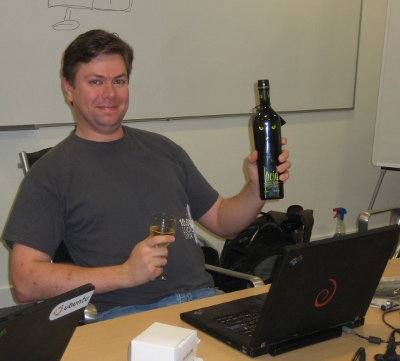
Steve Langasek has been contributing to Debian for more than a decade. He was a release manager for sarge and etch, and like many former release managers, he s still involved in the Debian release team although as a release wizard (i.e. more of an advisory role than a day-to-day contributor). Oh, and he did the same with Ubuntu: on the picture on the left, he just announced the release of Ubuntu 10.04 from his Debian-branded laptop. ;-) He has also been maintaining PAM in Debian for as long as can I remember and does a great job at that. He s very knowledgeable and fully deserves his place within the Debian Technical Committee. I m glad he still has the time to participate on several important Debian mailing lists because his contributions are always very useful. I m sure you ll notice this just by reading his answers below. My questions are in bold, the rest is by Steve. Who are you? I m 32 years old, have been running Linux since my first year in college back in 96, and have been a Debian developer now for ten years. Along the way I ve been involved in maintaining a variety of server packages, worked on the Alpha port for a while, did a stint as a release manager for a couple of years, and serve on the technical committee. This year I m also celebrating my ten year anniversary with my lovely wife Patty, who many know as an erstwhile front-desk volunteer at DebConf. God only knows why she puts up with my late-night hacking! These days in my day job I m a manager on the Ubuntu Platform team at Canonical, working to help make Ubuntu a daughter distribution that the Debian community can be proud of. What s your biggest achievement within Debian or Ubuntu? There s no doubt that my biggest achievement in Debian has been overseeing the release of two Debian releases as release manager. On the other hand, the scope of a release is so huge, and it represents the output of so many developers working together, that it would be arrogant to claim the release itself as an achievement of my own. Also, sarge and etch have long since been rotated off of the mirrors so no one cares about them anymore. ;) For a more personal and lasting contribution in the distro itself, I m very proud of writing pam-auth-update. It s a small piece of code, but one that Debian was missing for a long time it s made a big difference to PAM module integration in packages! What are your plans for Debian Wheezy? My top priority for this cycle is to see multiarch through. We re still not far enough along in Debian for most developers to see any difference and once we are, the first thing people are going to see is a fair bit of breakage when we start breaking a lot of assumptions about paths that have been hard-coded upstream. But I m still excited by the progress that is being made here. We should be able to ship wheezy without any ia32-libs package. We might even be able to get rid of all the biarch library packages, including those used by the toolchain itself. 54 packages in testing build-depend on gcc-multilib right now, in order to build 32-bit code to ship in the amd64 package; a bunch of those should go away with absolutely no reduction in functionality, saving us a bit of space in the archive and saving the maintainers a lot of complexity in their packages, while at the same time giving us much better support for cross-compilation than we ve ever had before. It s a tall order, certainly, but the pieces are falling into place one by one. My second priority is to get a policy in Debian around packages integrating upstart jobs. It would of course benefit Ubuntu to have many packages back in sync with Debian, but if all we wanted was to sync with Debian, we could mostly just make debhelper ignore upstart jobs in Debian, prefer them in Ubuntu, and call it good. I m interested in making sure Debian also gets the benefits of being able to use upstart, because as Linux has become increasingly asynchronous (doing more in parallel at start up), the traditional sysvinit has not been able to keep up. There are all kinds of bugs now related to network startup, for instance, that we don t have a good answer for in a sysvinit model but that we can fix with an event-based system. Upstart has been around for a while now, but we ve been slow to integrate it into Debian because it only works on Linux. It would be a shame if right after the first Debian GNU/kFreeBSD technology preview, packages all stopped working on kFreeBSD because they started to assume the availability of upstart! Unfortunately, having been so cautious we now have systemd on the scene, which not only doesn t support non-Linux but seems to be in the process of trying to gobble up other, non-Linux-specific components of the desktop stack. So I have to wonder what the future holds for the free desktop on non-Linux kernels. If you could spend all your time on Debian, what would you work on? Well, based on my previous experiences when I did spend all my time on Debian, I think the answer here is QA / release work. :) Otherwise, I don t know. My hands are full enough now with multiarch that it s hard for me to see what the Next Thing would be. You re a member of the technical committee. In the interview of Bdale Garbee, I have argued that it s not working well. What s your point of view on this topic? Well, I feel a constant low level guilt about my own poor level of activity in the TC; but that doesn t translate into a belief that the system is broken. This is, after all, the decision making body of last resort for technical disputes in Debian, and as such it should really be used sparingly. And if a reputation for glacial deliberation means more developers work out their disputes on their own rather than asking the TC to step in, I think that s actually a healthy thing! I do still wish we were more effective at resolving those issues that do come our way, but there s no silver bullet for this. Though the funny thing is, I ve noticed that the majority of issues that get referred to the TC nowadays never even need us to make a decision; a short conversation with the disputants is often enough to get them to come to an agreement. What s the biggest problem of Debian? By and large, I think Debian is still doing a great job at what it s best at delivering a rock-solid distribution that users can rely on. If I would highlight one problem in Debian, though, it would be that I think we re becoming less innovative as time goes on. Part of that comes from being such a large project that we re bound to be more conservative as an institution; but even though the three pet Debian projects of mine that I mentioned above are fairly innovative (multiarch, pam-auth-update, upstart), each of these has landed first in Ubuntu rather than in Debian. Always with a clear intent of pushing back up into Debian, of course, but it just wasn t possible to do this work within Debian for the first cut without much longer delays. I worry that if Debian is no longer the place to try new things, that we re going to miss out on attracting contributions from the folks who are inspired to make Free Software better and not simply to make it stable. I m not sure how to address this, though. Maybe improved conversations with derivatives such as (but not limited to) Ubuntu, about what crack of the day is being tried where and how that can be integrated into Debian once it s proven to work? I don t think that team-based maintenance or low-threshold NMUs do anything to address this, though, as the kinds of innovation that matter most are ones that require discussion and consensus-finding not just routing around inactive maintainers. Do you have wishes for Debian Wheezy? Well, I d like to see the armhf port get on its feet and become an official port. Over the lifetime of the arm and armel ports, the state of the art on ARM has changed quite a bit; it would be great to see Debian taking advantage of this richer platform, to let people make better use of their hardware via Debian. As a former release manager, you re now a release wizard . I guess you have seen it on debian-devel, there are proposals to not freeze testing and to use another distribution starting as a snapshot of testing to finalize the new stable release. According to your experience, what needs to happen to make this possible? Frankly, I ve stayed out of that discussion because I don t think what s being asked for is possible. I think proponents of a freezeless release have seriously underestimated the amount of work required on the part of the release team to wrangle testing into a releasable product, and that anything that makes propagation of fixes into the pending release more time consuming will make Debian worse on the whole, not better. If people really want to avoid long freezes for the Debian release, the best way they can help this happen is by making Debian more releasable on an ongoing basis, by helping to hold our packages to our shared standards for quality (i.e., by fixing RC bugs!). The biggest factor in long freezes for Debian is the slow rate at which we bring the RC bug count down during the freeze. Back in the sarge, etch days we used to have really great bug squashing parties that would get people together on weekends to hack through RC bugs by the dozens. I don t see that happening as much anymore. I d really like us to get back to that, but my few attempts at this so far since retiring as release manager have led me to think I m really terrible at organizing parties of any kind. :) On the other side, as seen at http://bugs.debian.org/release-critical/, the RC bug count for testing at the beginning of the release cycle keeps getting higher and higher. I d love to know why that is so we can address it. I know we ve gotten better at detecting some classes of RC bugs; that s part of it, but I don t think it explains the whole trend. Is there someone in Debian that you admire for their contributions? Wow, what kind of arrogant jerk would I be if I didn t admire anyone in Debian for their contributions? Debian is and always has been an amazing community of top-notch developers; there are certainly too many I admire to list them all here. Joey Hess certainly makes the list, for his longstanding example of code speaking louder than words and for his ability to get to the heart of common problems and come up with elegant solutions. So does Russ Allbery, who by all accounts had his ability to feel anger in response to email burned out of him at a young age in a flame-related accident on Usenet. ;-) The list goes on, but here I think I have to follow Joey s example and cut the words short.
Thank you to Steve for the time spent answering my questions. I hope you enjoyed reading his answers as I did. Subscribe to my newsletter to get my monthly summary of the Debian/Ubuntu news and to not miss further interviews. You can also follow along on Identi.ca, Twitter and Facebook.

3 comments Liked this article? Click here. My blog is Flattr-enabled.

Next.

Previous.