Search Results: "ana"

4 May 2011

Craig Small: JFFNMS 3rd RC lucky?

I ve just uploaded to sourceforge the third and hopefully last RC for jffnms network management system version 0.9.0 The reason for the delay was easter as well as I wanted to test the engines for a long while to make sure I was not getting any orphan children or items. Previous versions had processes that never died or if they died the parent didn t realise and didn t handle the item, permanently making the item out for work . PHP5 has much better job and process handling and the new version takes advantage of this handling. It s run well on my on test setup for a week or two. You can find the RC code or just the older releases at https://sourceforge.net/projects/jffnms/files/

Gerfried Fuchs: Different Interpretations

Mostly everything in life boils down to the same troublesome issue: people are reading different things into what they read, and interpret them regularly in a way it wasn't meant to. It seems that in certain areas a culture of interpreting things in a bad way instead of good or asking how they were actually meant has established the rules of (not) working together but rather against each other and around each other. At times I would like to account it to language barriers, or cultural differences, but it happens with people from all areas so that reasoning would be too easy. Even artists manage to do that, and in that certain area it creates something extremely creative and thoughtful. This blog entry thus contains three songs and six videos: Two different interpretations of the same lyrics. Maybe this is able to stir some thinking process whether the interpretation that one found for a given situation might be biased or even just looking from the wrong angle. Enjoy! One thing I'd like to mention, and that is two cross references to former blog entries. For the first song, James Iha played as guitarist in The Smashing Pumpkins before he joined A Perfect Circle. The second cross reference is with respect to my former blog entry about the Wise Guys: They did also cover Mad World, in the Gary Jules' interpretation but of course in a capella.

/music permanent link Comments: 6 Flattr this

3 May 2011

Pietro Abate: On the apt-get installation plan

One important aspect of the mancoosi project is to build a model of the installation process in order to simulate packages upgrades before committing the changes on the machine. This work described here and here (and in upcoming publications) relays on the availability installation plan of the meta-installer (the exact order in which packages will be installed, configured and removed ) to run a simulation of maintainers scripts and check for potential problems accordingly to the model. Thanks to the help of Julian Andres Klode upstream and maintainer of the python-apt bindings it is now possible to extract the installation plan from apt-get without resorting to debug printout or other hacks. A forthcoming integration with mpm (Mancoosi-Package-Manager, our testbed meta-installer) will give us the possibility to hook the model checker to the meta-installer and to run it before every upgrade. The two important changes in the python-apt bindings that will make this possible are the new bindings to the class OrderList and the sub-classing of the class package manager. PackageManager . Regarding the latter, this is a small example (thanks again Julien !) that you can use to get the installation plan as computed by apt-get. In theory, this will also allow to experiment with different back-ends (like rpm - blah ! :) ) easily without the need to hack the c++ code.
import apt_pkg, sys
import apt

class PkgManager(apt_pkg.PackageManager):

parent = apt_pkg.PackageManager
depcache = apt_pkg.DepCache(apt_pkg.Cache())
installionplan = []

def install(self, pkg, file):
#print "Installing", pkg.get_fullname(True)
self.installionplan.append((pkg,"Inst"))
return True

def configure(self, pkg):
#print "Configuring", pkg.get_fullname(True)
self.installionplan.append((pkg,"Conf"))
return True

def remove(self, pkg, purge):
#print "Removing", pkg.get_fullname(True)
self.installionplan.append((pkg,"Rem"))
return True

def go(self, fd):
for (p,a) in self.installionplan :
if a == "Inst" or a == "Conf" :
ver = self.depcache.get_candidate_ver(p)
else :
ver = p.current_ver
print a, p.name, ver.ver_str, ver.arch

return True

apt_pkg.PackageManager = PkgManager


cache = apt.Cache()
pkg = cache["python"]
if pkg.is_installed:
pkg.mark_delete()
else:
pkg.mark_install()

apt_pkg.config.set("APT::Get::Simulate","true")
apt_pkg.config.set("dir::cache","/tmp")

print "COMMIT"
cache.commit(install_progress=apt.progress.base.InstallProgress())
And this is the result on my machine :
abate@zed.fr:~$python pkgmanager-test.py
Reading package lists... Done
Building dependency tree
Reading state information... Done
COMMIT
Rem alacarte 0.13.2-1 all
Rem apt-listchanges 2.85.7 all
Rem apt-xapian-index 0.41 all
Rem gnome-accessibility 1:2.30+7 all
Rem gok 2.30.0-1 amd64
Rem dasher 4.11-1 amd64
Rem gnome-orca 2.30.2-2 all
Rem python-pyatspi 1.30.1-3 all
Rem at-spi 1.30.1-3 amd64
Rem bluetooth 4.91-1 all
Rem gnome-bluetooth 2.30.0-2 amd64
Rem bluez 4.91-1 amd64
Rem brasero 2.30.3-2 amd64
Rem gthumb 3:2.13.1-1 amd64
Rem libbrasero-media0 2.30.3-2 amd64
Rem brasero-common 2.30.3-2 all
Rem bzr 2.3.1-2 all
Rem gnome-core 1:2.30+7 amd64
Rem gnome-control-center 1:2.30.1-3 amd64
Rem capplets-data 1:2.30.1-3 all
Rem cheese 2.30.1-2 amd64
Rem cheese-common 2.30.1-2 all
Rem cython 0.14.1-5 amd64
Rem dasher-data 4.11-1 all
Rem deluge 1.3.1-1 all
Rem deluge-gtk 1.3.1-1 all
Rem deluge-common 1.3.1-1 all
Rem deskbar-applet 2.32.0-1+b1 amd64
Rem dia 0.97.1-8 amd64
Rem dia-common 0.97.1-8 all
Rem doxygen 1.7.4-1 amd64
Rem doxygen-latex 1.7.4-1 all
Rem dput 0.9.6.2 all
Rem duply 1.5.4.2-1 all
Rem duplicity 0.6.13-1 amd64
Rem edos-debcheck 1.0-9 all
Rem edos-distcheck 1.4.2-12 amd64
Rem eog 2.30.2-1 amd64
Inst libxp6 1:1.0.1-1 amd64
Inst lesstif2 1:0.95.2-1 amd64
Inst xpdf 3.02-12 amd64
Conf libxp6 1:1.0.1-1 amd64
Conf lesstif2 1:0.95.2-1 amd64
Conf xpdf 3.02-12 amd64
[ ... ]

Kai Wasserb ch: gitosis moved its post-update hook (upgrade from Lenny to Squeeze)

I'm using gitosis to manage my Git repositories on the public server. That server was recently upgraded to Squeeze and I didn't create a new repository on that server so far but today I wanted to and got:
ERROR:gitosis.serve.main:Repository read access denied
fatal: The remote end hung up unexpectedly
A search yielded some results with people messing up their keys or forgetting to create the configuration file entry or something similar. None of this was my problem. As it turned out, the post-update hook for the admin repository has been moved from /usr/share/python-support/gitosis/gitosis-0.2-py2.5.egg/gitosis/templates/admin/hooks/post-update to /usr/share/pyshared/gitosis/templates/admin/hooks/post-update, but the symlink hasn't been updated on upgrade. After running a simple
ln -sf /usr/share/pyshared/gitosis/templates/admin/hooks/post-update post-update
in the hook directory of the admin repository everything worked again.

Josselin Mouette: Rolling release

Since this has been a major request from users for a long time, I can only cool with the idea of seeing the Debian project support a rolling release. However I m not pleased with the proposed ideas, since they don t actually include any serious plan to make this happen. Sorry guys, but a big GR that says We want a pony rolling release to happen doesn t achieve anything. Let me elaborate. First of all, discussions have focused a lot on what to do when we re in a freeze phase. Numerous cool ideas have been proposed, including PPAs (which again, won t happen until someone implements them). This is all good, but this is only the tip of the iceberg. Above all, before wondering what can happen in a freeze that lasts 20% of the time, let s wonder what can happen for the 80% remaining time. Once you have something that works in the regular development phase, you can tune it to make it happen, even if in a less optimal way, when the distribution is frozen. So let s not put the cart before the horse. There are three options if you want to make a rolling release happen.
  1. Make unstable usable. to make it happen, you have to prevent the disasters that rarely but unavoidably happen here. You don t want to make all rolling systems unusable because someone broke grub or uploaded a new version of udev that doesn t work with the kernel.
  2. Make testing usable. This sounds easy since RC-buggy packages are already prevented from migrating, but actually it is not. A large number of RC bugs are discovered at the time of testing migration, when some packages migrate and others don t. Worst of all, they require several days to be fixed, and it is very often that they require several months, when one of the packages gets entangled in a transition.
  3. Create a new suite for rolling usage.
The proponents of the CUT project obviously believe in option 2. Unfortunately, I haven t seen many things that could make it happen. A possible way to fix the situation would be to run large-scale regression testing on several upgrade paths. I don t know if there are volunteers for this, but that won t be me. That would also imply to make a lot of important bugs RC, since they could have a major effect on usability, but the release team will not be keen to make it happen. Because of the testing situation, when someone asks me for a rolling release, I point her to unstable with apt-listbugs. As of today, this is the closest thing we have to a rolling release, so we should probably examine more deeply option 1. Is it that complicated to write a tool to prevent upgrades to broken packages? A 2-day delay in mirror propagation and a simple list of broken packages/versions (like the #debian-devel topic, would be enough. Add an overlay archive, that works like experimental, and you can now handle freezes smoothly. Wait isn t that aptosid? We would probably gain a lot of insight from the people who invented this, instead of trying to reinvent the wheel. Finally, option 3 could open new horizons. There s a risk that it might drive users away from the testing and unstable suites, and this makes us wonder how we could have proper testing for our packages. Still, build a process that would (and that s really only an example) freeze unstable every month, give people 10 days to fix the most blatant issues, add a way to make security updates flow in from unstable, and you have a really nice rolling distribution. So overall, it only requires people to make things happen. You want option 2 to happen? Instead of working on GR drafts, start working with maintainers and release managers on ways to avoid breakage in testing. You want option 3 to happen? Start it as a new .debian.net service and see how it works. Personally, I d be in favor of offering aptosid developers to become DDs and offer their solution as a Debian service. It would bring in new people rather than driving away existing developers from working on our releases.

Raphaël Hertzog: My Debian activities in April 2011

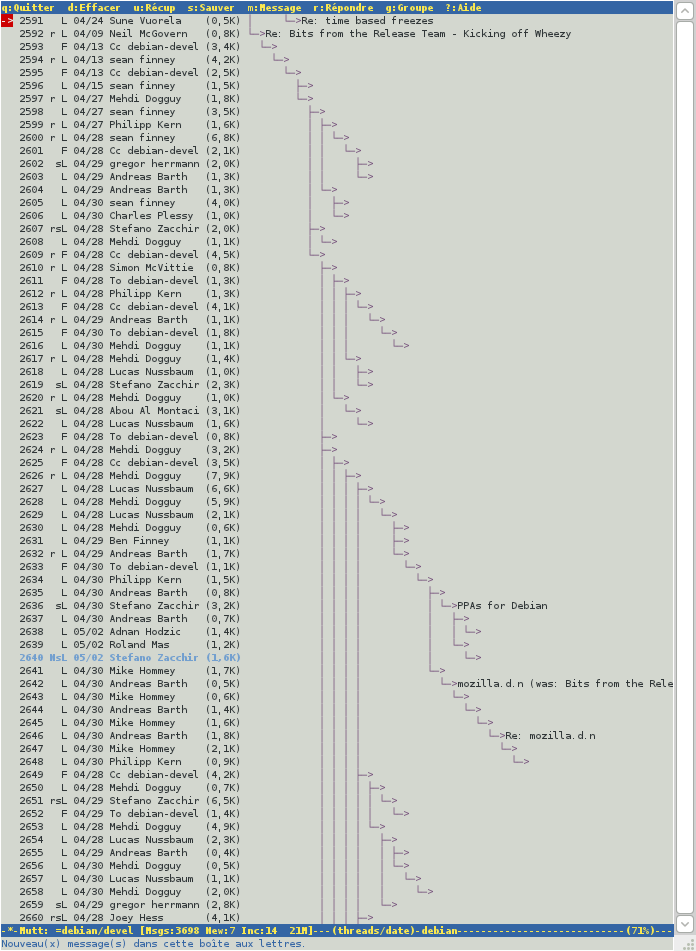
This is my monthly summary of my Debian related activities. If you re among the people who support my work, then you can learn how I spent your money. Otherwise it s just an interesting status update on my various projects. GNOME 3 packaging Right after the GNOME 3 release, I was eager to try it out so I helped the pkg-gnome team to update some of the packages. I did some uploads of totem, totem-pl-parser, gvfs, mutter, gnome-shell, gnome-screensaver. I also kept people informed via my blog and prepared a pinning file for adventurous users who wanted to try it out from experimental (like me). One month later, I m still using GNOME 3. There are rough edges still, but not so many. And I m starting to get used to it. Debian Rolling planning Debian Rolling is a project on my TODO list for quite some time. I decided it was time to do something about it and started a series of articles to help clarify my ideas while getting some early feedback. My goal was to prepare a somewhat polished proposal before posting it to a Debian mailing list. But as usual with Murphy s law, my plan did not work out as expected. Almost immediately after my first post the discussion started on debian-devel:
At this point it s a discussion thread of several hundreds of messages (there are several screens of messages like the one above). Many of the sub-threads have been interesting, but the general discussions mixed too many different things so that there s no clear outcome yet. Lucas Nussbaum tried to make a summary. Obviously I must adjust my plan, there s lots of feedback to process. I accepted to drive a DEP together with Sean Finney to help structure the part of the discussion that focuses on allowing development to continue during freezes. But I m also eager to fix the marketing problem of testing and have the project recognize that testing is a product in itself and that end-users should be encouraged to use it. Package Tracking System maintenance The Package Tracking System is an important tool for Debian developers, and it has been broken by some change on the Bug Tracking System. I worked around it quite quickly so that few people noticed the problem but Cron kept reminding me that I had to properly fix it. I ended up doing it last week-end. While working on the PTS, I took the opportunity to merge a patch from Jan Dittberner to enhance the news RSS feed that the PTS provides. And I also integrated information from backports.debian.org (thanks to Mehdi Dogguy for reminding me #549115). Multiarch update Not much new this month. I fixed two bugs in the multiarch dpkg branch thanks to bug reports from Ubuntu users (LP 767634, LP 756381). I m still waiting on Guillem Jover finishing his review of the multiarch branch. I m pinging him from time to time but it looks like multi-arch is no longer in his short term priority list. :-( I ve been running this code for more than 2 months and it works fine. I want to see it merged. I m ready to update my code should anything need to be changed to please Guillem. But without any feedback we re in a deadlock. Misc dpkg work While fixing a bug in update-alternatives (found in one of the valid reports on launchpad), I noticed that there was room for improvements in the error messages output by update-alternatives. I changed them to reuse the same strings that were already used in other parts of dpkg. The result is that there are a few strings less to translate (always a nice thing for the poor translators who have to deal with the thousands of strings that dpkg contains). I also tried to fix some of the most cryptic error messages in dpkg (see #621763) but that work is stalled at the request of Guillem. Book update We (me and Roland Mas) are almost done with the update of our French book for Debian Squeeze. It will hit the shelves in July or September. I m starting to prepare the fundraising campaign to make an English translation of it. We ll use ulule.com for this. On my blog I have been pleased to interview Meike Reichle, it s the first women that I have interviewed in the series but it s certainly not the last one. I also interviewed Adam D. Barratt, one of our tireless release managers. Thanks Many thanks to the people who gave me 180.35 in March and 235.37 in April. That represents 1.5 and 2 days of work for those months. See you next month for a new summary of my activities.

8 comments Liked this article? Click here. My blog is Flattr-enabled.

2 May 2011

Kai Wasserb ch: Flattr option added to traffic-intensive package downloads

Due to popular demand ("I would give you something, if you'd offer Flattr."), which really just came up after WineHQ started linking to the download page, I've added a Flattr link to the wine-unstable download page. I still wanted to keep it as unobtrusive as possible and just use a text link. In other news I've uploaded 1.3.19 today, sorry that I didn't manage to do so before the weekend was over, but the upstream release happend after I went on a short trip to Bremen. And since some people didn't seem to read the notes on the download page, I'll try it through this channel: the package download page is NOT an APT repository. I want people to carefully consider the pros and cons before installing software from a third party. So please don't point your sources.list to the download page. Thanks!

Lucas Nussbaum: Debian rolling discussion on -devel@

Here is my attempt at a summary of the rolling discussion currently happening on debian-devel@. It might not be complete, it s probably a bit biased, but I hope that it s still better than nothing. It was also posted on debian-devel@. If you are involved in Debian development, please discuss it on debian-devel@, rather than in the comments of this blog. If you want to provide feedback about the Debian rolling idea, use this Doodle poll and/or the comments of this blog.
Update : Someone had the good idea to vandalize the poll, and remove all the votes from people in favor of rolling. Before the vadalism (log), the results were:
37 votes: I am a Debian user, I use testing or unstable, and I would like rolling to happen.
6 votes: I am a Debian user, I use testing or unstable, and I DON T want rolling to happen.
17 votes: I am a Debian user, I use stable, and I would like rolling to happen.
3 votes: I am a Debian user, I use stable, and I DON T want rolling to happen.
7 votes: I am NOT a Debian user, but I would probably use it if rolling happened.
1 vote: I am NOT a Debian user, and I don t care about rolling. Motivations There s some user demand for rolling releases. For evidence, one can look at the usage of Debian testing or unstable which clearly goes further than the Debian development community. Or at the quickly growing market share of ArchLinux. Or at the interest in LinuxMint and Aptosid. Or at the DPL s report of his interactions with the press. Debian s only official product is its stable releases. While it s a clearly great and useful product, many users and developers don t recognize themselves in it: it contains software that is too old for their needs. The success of Ubuntu is related to this problem: Ubuntu proposes a different compromise between stability and up-to-date-ness. While concurrencing Ubuntu with more frequent stable releases (released every 6-months, for example) doesn t look like the right thing to do, Debian is in a perfect position to provide a rolling release with marginal additional work, since Debian already has testing (and unstable) to build on. The rolling discussion investigates how we could endorse the concept of a rolling release, provided as a product in addition to stable releases. This rolling release would be based on the current testing branch. Benefits for Debian: Current proposed plan for rolling (Disclaimer: this is mostly my view. It is shared by others, but some details might not be) rolling is mostly about (external) communication. It is not expected to change our development processes fundamentally.
It would be a statement by the project (through a GR, for example). A very preliminary draft was proposed by Raphael Hertzog:
Title: Debian endorses usage of testing by end-users, and renames it to rolling The Debian project recognizes that the Debian testing distribution initially created to make it easier to prepare and test the next stable release has become a useful product of its own. It satisfies the needs of users who are looking for the latest stable versions of software and who can cope (or even appreciate) a system that s constantly evolving. The Debian project decides to endorse this usage and will strive to provide a good experience to users of testing . To better communicate this policy change to our users, testing will be renamed rolling .
Yes, it s mostly PR bullshit , and I don t expect it to significantly change Debian development processes. However, communication is necessary if we want to attract new users. What would change is more attention from developers to what happens in testing/rolling, which is a good thing since a better testing/rolling makes it easier to create stable releases from it. Open questions Most of the discussion is about the influence of the introduction of rolling on Debian development processes, and in particular, on the painful process resulting in stable releases. Many fear that, with rolling , it will be harder to get stable releases out. The root question is: if we do rolling, what do we do during freezes? Several options have been mentioned in the thread:
  1. We could decide not to do anything special: just freeze rolling for ~6 months, as we used to freeze testing. That might bore people who like the constant flux of new upstream releases, but if we decide that it s the only way to ensure high-quality stable releases, so be it.
  2. We could decide to fork a frozen branch when we freeze, and continue to manage rolling using migrations from unstable.
  3. We could mix both solutions: freeze rolling for 3 months, so that most of the stabilization work occurs with a single active branch, and then, for the final release preparation, fork frozen off rolling, and unfreeze rolling.
Two kinds of objections have been raised: Other things that were discussed: Tentative personal conclusion I have the impression that advertising testing as a rolling release usable by end-users is generally considered a good thing.
The renaming of testing to rolling is not as consensual, but most opponents have a whatever ; if you want position. How we deal with freezes is the hard point in this discussion. I m personnally in favor of the freeze rolling for 3 months, then fork frozen and unfreeze rolling plan, though it has some problems too (it is not clear whether the required manpower really decreases at the end of freezes). Where do we go from there? After another round of discussion, we might postpone the how to deal with freezes question to later, and proceed with a GR to measure the support for the testing for end-users + s/testing/rolling/ proposal.

Christian Perrier: 2011 week 17 Debian work

Will I succeed maintaining a weekly log of what I'm doing in Debian? We'll see. At least, let's try. D-I work: After spending most of the end of week 16 uploading D-I components, I completed this during this week. I hunted down the remaining arch:all, arch:i386 and arch:amd64 packages that need an upload because of l10n changes. The main point was bringing published D-I work inline with the work of translators. That was mostly meant to publicly have an image with Uyghur activated (which I blogged about separately). Finally, I ended up doing some changes to the fonts-ukij-uyghur package in order to use the right font to display the language in D-I, as well as improving the readability by increasing the font size just as we're already doing for Arabic and Persian. Samba packaging: I got release managers approval to upload a new release to stable-proposed-updates. It fixes several important bugs in samba 3.5.6, often affecting Win7 clients. I'm always happy to see that we can do that even when issues are ot security or "release critical" issues. I also integrated the newly-published samba 3.6.0-pre3 in the package maintenance SVN. However, we're still having problems with symbols disappearing from libwbclient, that prevent me to upload 3.6.0pre3 in experimental. Steve Langasek's help here will be welcome. Pytrainer and "gant" packaging: I setup a mailing list for the pkg-running maintenance team so that we can move the few packages some of us maintain (pytrainer and garmin-forerunner-tools as of now, and soon "garmin-ant-downloader", the helper tool for 405 watches). I also began looking at pytrainer bugs and forwarding some of them upstream. I also began packaging "gant" (had to rename it as we already have a gant package, totally unrelated). I just got a notice from Klaus Ethgen about improvements he did to the software. We'll try to figure out what to do as this software doesn't really have a clear upstream and published versions. l10n work: a few packages introduced debconf templates and I launched reviews of English for them (while mumbling about uncoordinated work, of course..;-)). I also reviewed about one hundred package description translations in French DDTP (something I recently began to commit to do even though it means onlinen work for me, which I'm not used to). No l10n NMUs this week but a few maintainer uploads after I (gently) kicked their ass..:-)

1 May 2011

Ana Beatriz Guerrero Lopez: Qt 3 looking for adopters

With KDE 3 almost gone in unstable, the KDE team is not longer interested in Qt 3 and we are looking for new maintainer(s). If you want to have Qt 3 in wheezy, now is the time to step up! Please, read this email and reply in list.

30 April 2011

Russell Coker: Autism Awareness and the Free Software Community

It s Autism Awareness Month April is Autism Awareness month, there are lots of articles about Autism, most of them are at best misleading if not wrong. The most common error seems to be describing non-verbal Autistic children and then claiming that Autistic people comprise about 1% of the population. The number of non-verbal Autistic children is a lot less than 1% of the population, and at least 1/3 of the people on the Autism Spectrum have good verbal skills and often talk more than average. To be precise, they are describing the symptoms of people who would be diagnosed with Severity 3 according to the American Psychiatric Association s Diagnostic and Statistical Manual (the DSM) as applying to all people who are on the Autism Spectrum even though of the currently diagnosed people probably about 1/3 might be classified as Severity 2 and 1/3 as Severity 1. It seems that severity 1 Autism is going to be the replacement for Asperger Syndrome in the new DSM-5. The problem with misleading information in regard to what comprises Autism is that parents really don t want to have a child who s abnormal and search for evidence to make their wishes come true. At the extreme there are parents who can convince themselves that a 4yo non-verbal child isn t on the Autism Spectrum. When people are given the impression that Autism is only about non-verbal children then they will probably think that a 6yo who can give a half-hour lecture on a topic of interest (regardless of whether the audience is interested) isn t on the Autism Spectrum. There is also a similar issue with undiagnosed adults, I would have probably got assessed at least a decade earlier if I had learned more about Autism instead of believing some of the stories. In a quick Google search for Autism Awareness Month I haven t found any clear and accurate information on what Autism is or what should be done about it, so it seems to me that the awareness project has largely been a failure. The Autism page on Wikipedia [1] and the page for Asperger Syndrome [2] are good places to start reading. By merely pointing to those two Wikipedia pages I ve made this post a lot more useful than every article I ve seen in the mainstream media. To find some useful and insightful posts about Autism awareness you have to add some search terms such as neurodiversity, which turns up posts such as a post by Leah Jane about Autism Acceptance [3]. It seems that the Autism Awareness articles that are most useful at informing people will only be found by people who are already aware of some of the issues. Most People Who Read this are Geeks The majority of the readers for my blog come from aggregators that cater to fairly geeky people. Geek culture is largely Aspie culture. So I think that most people who read my blog have a good general knowledge of what people who might be diagnosed with Asperger Syndrome or High Functioning Autism are like they just think that such people are merely a bit more geeky than is typical for the Free Software community. So it s not as if all Autistic people are hidden away somewhere because they can t live independently. Many of us work in the computer industry and in academia. Probably the majority of people who have a university degree related to science or engineering have had a professor who was on the Autism Spectrum, probably most people who have any significant experience in the computer industry have had colleagues who are on the Spectrum. After having become used to the geek culture I initially found it difficult to believe that I could be on the Autism Spectrum because I knew heaps of people in the Free Software community who are at least as geeky as me but apparently weren t on the Autism Spectrum. I now think that the majority of people who are as geeky as me would get diagnosed with Asperger Syndrome (or High Functioning Autism under DSM-5) if they were assessed. Adult Diagnosis If you are wondering whether you might be on the Autism Spectrum then it s worth reading the pages linked from the DSM 5 draft process have the full diagnostic criteria (both for DSM-4 and DSM-5) [4]. Also Glenn Rowe has a web page with tests designed by Professor Simon Baron-Cohen [5] and Leif Ekblad has a project to do long-term analysis of changes to personality test scores which starts with a quick Aspie quiz [6] (and also has lots of links to other relevant sites). If you think that you might be on the Autism Spectrum (which means Asperger Syndrome in the case of most people who read my blog) then I recommend that you get assessed if possible. As assessment by a psychologist isn t cheap there is the option of self-diagnosis in which case Chaotic Idealism s post about self-diagnosis is worth reading [7].

Christian Perrier: Pytrainer: finally

This week, I finally switched to use pytrainer to track my running data. Up to now, I was still using Garmin proprietary software on Elizabeth's Windows copmuter for this. Mostly because my GPW watch is a Forerunner 405, that uses a bloody crappy stupid USB stick with proprietary communication protocol (ANT+). So, the use of proprietary crappy software was kinda mandatory. There is however some code floating around to handle this device in Linux, named "Gant". This is far from being very polished, but I finally managed to make it work more or less reliably to get the GPS traces from my watch to my Debian laptop. So, during the week , I brought all my old running data back from "Garmin Training Center" (the Windows software provided by Garmin) back to my laptop and imported it in pytrainer. And I imported new data from my daily runs with help of that "gant" software. So, this is now time to really jump into maintenance of pytrainer and help my friend No l (that will be easy as pytrainer is kinda well maintained), then package "gant" for Debian, as part of the work in the "pkg-running" maintenance team (Ralf Treinen, No le K the and /me). New challenge for me: learn how to create a git public repo and maintain a package in it (I already participate to maintenance work with git for several things, but I never initiated any). Other plans: some bug triage on pytrainer (if some is needed, I indeed don't know yet) and eventually deal with things that have to be reported upstream. Looking at Launchpad might also be a good idea as I suspect that many are using pytrainer with Ubuntu.

28 April 2011

Russell Coker: What is Valid SE Linux Policy?

Guido Trentalancia started an interesting discussion on the SE Linux policy development list about how to manage the evolution of the policy [1]. The Problem The SE Linux policy is the set of rules that determine what access is granted. It assigns types to files and domains to processes and has a set of rules that specify all the permitted interactions between processes and files (among many other things). The policy evolves over time to match the requirements of programs (applications and daemons). As a program evolves the things that it does will change and the SE Linux policy will tend to evolve to permit the set of all operations that were requested by all versions because people only complain when things stop working not when excessive privilege is granted. So we need to periodically remove old allow rules from the policy. One difficulty in this regard is the fact that multiple versions of programs are often available for use at the same time. Debian in particular has a good history of providing separate packages for the old and new versions of programs such as Apache to meet the needs of users who want the tried and tested version and of users who want the newer version with better performance, more features, better documentation, or something else good. There is also a demand to have the same policy work with multiple versions of a distribution without excessive effort. Finally all the distributions that have SE Linux support have different people deciding when the new version of a daemon is ready for inclusion and therefore there is a need to support multiple versions for multiple distributions. So support for older versions of daemons can t be removed easily. One of the things I do to make these things a little easier to manage is to put ifdef( distro_debian', before any Debian specific bits of policy. When policy is conditional and only used in Debian I can freely remove it at any future time if Debian works well without it. Also it doesn t matter if such Debian specific policy allows access that is not needed or desired in other distributions, the only down-side to this is that sometimes other distributions need to repeat work that I did, they determine what access is needed for their configuration and discover that it was already enabled for Debian. What is Valid Policy? We went to only have Valid Policy (as described by Christopher J. PeBenito), so the challenge is determining what is Valid Policy. It seems to me that there are three type of access granted by valid policy (it is debatable whether type #3 is valid):
  1. Access that is needed for an application to perform it s minimal designed task.
  2. Access that is needed for the application to perform all the optional configurations, EG an ftpd running from inetd or as a daemon, and daemons like http server being granted access to ssl keys or not.
  3. Access that is needed to perform all the operations the application requests, but which the application doesn t require or shouldn t require if it worked correctly.
Some common operations that aren t required include opening utmp for write, searching /root, and many other relatively innocuous access attempts which don t affect the program operation if they are denied. There are also many things such as writing temporary files to /root that don t seem unusual if the application developer is not considering SE Linux (but which are often considered bad practice anyway). Some of these things (like using /root for stuff that belongs in /var/lib) have the potential to break things (for the daemon or for other system processes) even if you don t consider SE Linux. How to deal with those types:
  1. In most cases this can be determined without too much effort. For example a web server needs to listen on port 80 and read files and directories that relate to data. When writing policy I can write a lot of the allow rules without even testing the application because I know from the design what it will do. A large part of the other access is obvious in a I can t believe I didn t realise it would need this sense.
  2. The main question here is whether we have booleans (settings which can be tuned at run-time by the sysadmin which determine how the policy works) to specify which optional tasks or whether we allow all access for optional configurations by default. The secondary question is when certain unusual corner cases should be not supported at all such that the people who do such unusual corner cases need to use audit2allow to generate local policy to allow their operations.
  3. Sometimes we have to allow things that we really don t like. Even when we write policy to allow a daemon to do unusual things (such as using /root instead of /var/lib) it s still a lot better than running without SE Linux. Also SE Linux policy to allow such obviously broken things stands out and is a constant reminder that the daemon needs fixing, this is better than allowing symptoms of broken design to be forgotten.
How to Improve the Situation We could have comments in the policy source for everything that is in category 3. If the comments had a fixed format so that a recursive grep could find them all then it would allow us to more easily remove the gross things from the policy at a later date. But it seems to me that the main problem is a lack of people working on this. I am not aware of any people actively testing Debian policy for excessive privilege in regard to such issues.

Raphaël Hertzog: No freeze of Debian s development, what does it entail?

The main feature of rolling is that it would never freeze. This is not without consequences. Possible consequences It can divert developers from working on the release No freeze means developers are free to continue their work as usual in unstable. Will it be more difficult to release because some people will spend their time working on a new upstream version instead of fixing RC bugs in the version that is frozen? Would we lose the work of the people who do lots of NMU to help with the release? It makes it more difficult to cherry-pick updates from unstable No freeze also means that unstable is going to diverge sooner from testing and it will be more difficult to cherry-pick updates from unstable into testing. And the release team likes to cherry-pick updates that have been tested in unstable because updates that comes through testing-proposed-updates have often not been tested and need thus a more careful review. Frozen earth My responses to the objections Those are the two major objections that we ll have to respond to. Let s try to analyze them a bit more. It s not testing vs rolling On the first objection I would like to respond that we must not put testing and rolling/unstable in opposition. The fact that a contributor can t do its work as usual in unstable does not mean that he will instead choose to work on fixing RC bugs in testing. Probably that some do, but in my experience we simply spend our time differently, either working more on non-Debian stuff or doing mostly hidden work that is then released in big batches at the start of the next cycle (which tends to create problems of its own). I would also like to argue that by giving more exposure to rolling and encouraging developers to properly support their packages in rolling, it probably means that the overall state of rolling should become gradually better compared to what we re currently used to with testing. The objection that rolling would divert resources from getting testing in a releasable shape is difficult to prove and/or disprove. The best way to have some objective data would be to setup a questionnaire and to ask all maintainers. Any volunteer for that? Unstable as a test-bed for RC bugfixes? It s true that unstable will quickly diverge from testing and that it will be more difficult to cherry-pick updates from unstable into testing. This cannot be refuted, it s a downside given the current workflow of the release team. But I wonder if the importance of this workflow is not overdone. The reason why they like to cherry-pick from unstable is because it gives them some confidence that the update has not caused other regressions and ensures that testing is improving. But if they re considering to cherry-pick an update, it s because the current package in testing is plagued by an RC bug. Supposing that the updated package has introduced a regression, is it really better to keep the current RC bug compared to trading it for a new regression? It sure depends on the precise bugs involved so that s why they prefer to know up-front about the regression instead of making a blind bet. Given this, I think we should use testing-proposed-updates (tpu) as a test-bed for RC bug fixes. We should ask beta-testers to activate this repository and to file RC bugs for any regression. And instead of requiring a full review by a release manager for all uploads to testing-proposed-updates, uploads should be auto-accepted provided that they do not change the upstream version and that they do not add/remove binary packages. Other uploads would still need manual approval by the release managers. On top of this, we can also add an infrastructure to encourage peer-reviews of t-p-u uploads so that reviews become more opportunistic instead of systematic. Positive reviews would help reduce the aging required in t-p-u before being accepted into testing. This changes the balance by giving a bit more freedom to maintainers but still keeps the safety net that release managers need to have. It should also reduce the overall amount of work that the release team has to do. Comments welcome Do you see other important objections beside the two that I mentioned? Do you have other ideas to overcome those objections? What do you think of my responses? Does your experience infirm or confirm my point of view?

18 comments Liked this article? Click here. My blog is Flattr-enabled.

Patrick Schoenfeld: On Debian discussions

In my article "Last time I've used network-manager" I made a claim for which I've been criticized by some people, including Stefano, our current (and just re-elected) DPL. I said that a certain pattern, which showed up in a certain thread, were a prototype for discussions in the Debian surroundings.

Actually I have to commit, that this was a very generalizing statement, making my own point against the discussion point back directly at myself.
Because as Stefano said correctly there has been some progress in the Debian discussion cult.
Indeed, there are examples of threads, were discussions followed another scheme.
But to my own advocacy I have to say that such changes are like little plants (in the botanical sense). They take their time to grow and as long as they are so very new, they are very vulnerable to all small interruptions. Regardless of how tiny those interruptions may seem.

I've been following Debian discussions for 6 or 7 years. That scheme I was describing was that which had the most visibility of all Debian discussions. Almost every discussion which were important for a broader audience followed that scheme. It has a reason that Debian is famous for flamewars.
In a way its quiet similar to the network-manager perception, some people have. Negative impressions manifest themselves. Especially if they have years of time.
Positive impressions does not have a chance to manifest themselves as long as the progress is not visible enough to survive small interruptions.

I hope that I didn't cause to much damage with my comment, which got cited (context-less) on other sites. Hopefully the Debian discussion cult will improve further to a point where there is no difference between the examples of very good, constructive discussions we already have in some parts of the project and the project-wide decision-making-discussions which affect a broad audience and often led to flamewars.

Patrick Schoenfeld: Directory-dependent shell configuration with zsh (Update)

For a while I've been struggling with a little itch. I'm using my company notebook for company work and for Debian related stuff. Now, whenever I switch between those two contexts, I had to manually fix the environment configuration. This is mostly related to environment variables, because tools like dch et cetera rely on some, which need to be different for the different contexts, like DEBEMAIL.
A while ago I had the idea to use directory dependent configuration for that purpose, but I never found the time and mood to actually fix my itch.
Somewhere in the meanwhile I applied a quick hack ("case $PWD in ...; do export...; esac") to my zsh configuration to ease the pain, but it still did not feel right.


For the impatient: Below you find a way to just use whats described here. The rest of the article just contains detailed information on how to implement something like this.


The other day I were cleaning up and extending my zsh configuration and it came to my mind again. I then thought about what my requirements are and how I could solve it. First I thought about using a ready solution, like the one in the Grml Zsh configuration, but at that point I did not remember it (it needed a hint by a co-worker *after* I finished the first version of my solution). Then I came up with my requirements:

It lead to a configuration approach as a first start. When thinking about how to represent the configuration I looked into the supported data types in zsh. zsh supports arrays, which is perfect for my need. I came up with something like that:
typeset -A EMAILS ENV_DEBIAN ENV_COMPANY
EMAILS=(
"private" "foo@bar.org"
"company" "baz@foo.org"
"debian" "schoenfeld@debian.org"
)
ENV_DEBIAN=(
"DEBEMAIL" "$EMAILS[debian]"
"EMAIL" "$EMAILS[debian]"
)
ENV_COMPANY=(
"DEBEMAIL" "$EMAILS[company]"
)
The next part was selecting the right profile. In the first version I used the old case logic, but it was breaking my separate logic and configuration paradigm. Approximate at this point the co-worker lead me to the grml approach, which I borrowed an idea from:


# Configure profile mappings
zstyle ':chpwd:profiles:*company*' profile company
zstyle ':chpwd:profiles:*debian*' profile debian

and the following code to lookup profile based on $PWD:

1 function detect_env_profile
2 local profile
3 zstyle -s ":chpwd:profiles:$ PWD " profile profile profile='default'
4 profile=$ (U)profile
5 if [ "$profile" != "$ENV_PROFILE" ]; then
6 print "Switching to profile: $profile"
7 fi
8 ENV_PROFILE="$profile"
9

For an explanation: zstyle is a zsh-builtin which is used to "define and lookup styles", as the manpage says, or put different: Another way to store and lookup configuration values.
Its nice for my purpose, because it allows storing patterns instead of plain configuration values which can be compared against $PWD easily with all of the zsh globbing magic. This is basically whats done in line 3. zstyle then sets $profile to the matching zstyle configuration in the :chpwd:profiles: context or to 'default' if no matching zstyle is found.

The (almost) last part is putting it together with code to switch the profile:

1 function switch_environment_profiles
2 detect_env_profile
3 config_key="ENV_$ENV_PROFILE"
4 for key value in $ (kvP)config_key ; do
5 export $key=$value
6 done
7
The only non-obvious part in this are lines 3 and 4. Remember, the profiles were defined as ENV_PROFILE, where PROFILE is the name of the profile. We cannot know that key in advance, therefore we have to construct the right environment variable from the result of detect_env_profile. We do that in line 3 and lookup this environment variable in line 4.
The deciding aspect for that is the P-flag in the parameter expansion. It tells zsh that we do not want the value of $config_key, but instead the value of $WHATEVER_CONFIG_KEY_EXPANDS_TO.
The other flags k and v tell zsh that, from the array, we want both: keys and values. If we'd omitted those flags it would have given us the values only.
We then loop over that to configure the environment. Easy, hu?

We would be finished, if this would do anything. The code above needs to be called. Lucky for us thats pretty easy to achieve, as zsh has a hook for when a directory is changed. Making all this work is simply a matter of adding something like this:

function chpwd()
switch_environment_profiles

Now, one could say, that the solution in the grml configuration has an advantage. It allows calling arbitrary commands on profile changing, which might be useful to *unset* variables in a given profile or whatever you could think of.
Well, its a matter of three lines to extend the above code for that feature:


# Taken from grml zshrc, allow chpwd_profile_functions()
if (( $ +functions[chpwd_profile_$ENV_PROFILE] )) ; then
chpwd_profile_$ ENV_PROFILE
fi

to the end of switch_environment_profiles and now its possible to additionally add a function chpwd_profile_PROFILE which is called whenever the profile is changed to that profile.


USAGE: I have put the functions into a file which can be included into your zsh configuration, which can be found on github.
Please see this README and the comments in the file itself on further usage instructions.

27 April 2011

Matthew Garrett: On platforms

At some stage the seminal KDE vs Gnome paper vanished from its original home, and while it's still available in a few places (such as here) it set me thinking. What are the fundamental differences between Gnome and KDE development? There's lots of little differences (2006: Gnome parties on a beach. Akademy has melted ice cream in the rain) but they're both basically communities made up of people who are interested in developing a functional and interesting desktop experience. So why do the end results have so little in common?

Then I read this and something that had been floating around in my mind began to solidify. KDE assumes a platform and attempts to work around its shortcomings. Gnome helps define the platform and works on fixing its shortcomings.

It's pretty easy to see this across the platform. The developer of the Gnome Bluetooth support has multiple commits to the underlying Bluetooth stack, while nobody who's committed to bluedevil appears to. The main developer of the Gnome Networkmanager support is Networkmanager upstream, with the same applying to the Gnome power management infrastructure. And when Gnome developers find limitations in graphics drivers, those tend to be fixed in the graphics drivers rather than worked around in the UI code. KDE builds on top of what's already there, while Gnome is happy to flatten some mountains first.

I should emphasise that I'm not criticising KDE here[1]. These are both rational development models. One optimises for making things work and will compromise on functionality in order to be more portable to different underlying operating systems. The other optimises for additional functionality at the cost of being tied to a much smaller number of underlying operating systems that have to be completely up to date. But understanding that this distinction exists is key to understanding fundamental differences between the projects, and any argument about which is better or about how there should be more collaboration has to take these fundamentally different approaches into consideration. My personal belief is that a tightly integrated platform is going to produce a more compelling product in the long run than one built on top a series of abstraction layers, but we'll see what happens in the long run.

And then, of course, there's Unity and Canonical's gradual effort to turn Ubuntu into a platform distinct from either Gnome or KDE. But that's a separate post.

[1] Well, except for the melted ice cream at Akademy 2006. But I think that's fair.

(comment count unavailable Comments Comment on this)

Daniel Kahn Gillmor: The bleeding edge: systemd

Curious about these shiny new things i keep hearing about, i set up a test desktop system using using systemd as the init system (yes, that means using systemd-sysv in place of sysvinit -- so i had to remove an essential package for this to work). A system-crippling bug was naturally the result of living on the bleeding edge, but fortunately it was resolved with a trivial patch. In all, i'm pretty happy with some of the things that systemd seems to get right. For example, native supervision of daemon processes, clean process states, elimination of initscript copy-paste-isms, and socket-based service initiation are all obvious, marked improvements over the existing sysvinit legacy cruft. But i'm a bit concerned about other parts. For example, all the above-mentioned features fit really well within a tightly-tuned, well-managed server. But systemd also appears to rely heavily on complex userland systems like dbus and policykit that would be much more at home on a typical desktop machine. I've never seen a well-managed server installation that warranted either policykit or dbus. Also, given the bug i ran into -- when PID 1 aborts due to a silly assertion, your system is well-and-truly horked. Shouldn't a lot more attention to detail be happening? I'd think that a "recover gracefully from failed assertions" approach would be the first thing to target for a would-be PID 1. I'm also concerned about the Linux-centricism of systemd. I understand that features like cgroups and reliance on the spiffiness of inotify are part of the appeal, but i also really don't want to see us stuck with only One Single Kernel as an option. The kFreeBSD folks (and the HURD folks) have done a lot of work to get us close to having some level of choice at this critical layer of infrastructure. It'd be good to see that possibility realized, to help us avoid the creeping monoculture. I worry that systemd's over-reliance on Linux-specific features is heading in the wrong direction. So my question is: why is this all being presented as a package deal? I'd be pretty happy if i could get just the "server-side" features without incurring the dbus/policykit/etc bloat. I already run servers with runit as pid 1 -- they're lean and quite nice, but runit doesn't have systemd's socket-based initiation (or the level of heavyweight backing that systemd seems to have picked up, for that matter). I understand that Lennart is resistant to UNIX's traditional "do one thing; do it well" philosophy. I can understand some of his reasoning, but i think he might be doing his work and his tools a disservice by taking it this far. Wouldn't systemd be better if it was clearer how to take advantage of parts of it without having to subscribe to the entire thing? Of course, i might be missing some nice ways that systemd can be effectively tuned and pared down. But i've read his blog posts about systemd and i haven't seen how to get some of the nice features without the parts i don't want. I'd love to be pointed to some explanations that show me how i'm wrong :)Tags: systemd

26 April 2011

Julien Danjou: Why not Lua

Since my latest announcement of the Lua workshop, I received a couple of emails asking why I discourage the use of Lua. Actually, I already wrote out many of the things I dislike about Lua. I won't come back on this technical issues here, but since Lua 5.2 is not yet released (it's still at alpha stage), they are still relevant nowadays. Stack based API is harder

The ease of integration of Lua into a C program is one of the point of Lua. They claim it's very easy to integrate Lua into your C application, because it does not use pointer, nor reference counting, nor anything that requires a minimum amount of skills to be used. It uses a virtual stack based approach. You push or pop things on a stack, and refers to them using a relative or absolute index. In order to people who never wrote Lua code to understand, here's a quick example on how this work. The L pointer is a Lua environment.

/* Create a table on the stack: index 1 */
lua_newtable(L);
/* Push a string on the stack: index 2 */
lua_pushstring(L, "hello");
/* Push a number on the stack: index 3 */
lua_pushnumber(L, 123);
/* Set newtable["hello"] = 123 */
lua_settable(L, -3);
You first push a table (in Lua, a table is almost equivalent to what you'd call a hash table in other language), then push the key, the value, and do the assignment operation. In the settable, we use -3 as index, meaning the "3rd item on the stack counting from top". We could also have written lua_settable(L, 1), since the table is also the first item on the stack from the bottom. So far, so good. Problems arise when you do more complicated stuff. My previous example is what you would typically find in a tutorial, but of course, real life is different, and usually more complex. If you cut the things in different parts, it can start to be more complicated. Let's take a look at the following:
/* Create a table on the stack: index 1 */
lua_newtable(L);
/* Push a string on the stack: index 2 */
lua_pushstring(L, "hello");
/* Push a number on the stack: index 3 */
lua_pushnumbe(L, mycomputingfunction());
/* Set newtable["hello"] = 123 */
lua_settable(L, -3);
Here, we do exactly the same thing, but we do not push 123 directly: we compute it. And here's the trick: if your computing function is also using the Lua stack, things can become very messy. As long as your computing function use the stack cleanly by pushing and poping all its item, and returning the stack in the same state it was before, you're safe. The problem is that in a complex program, you also write bugs. You do not chose to, but you do. And sometimes, you forget to pop one of the item you fetched from a table. Imagine that mycomputingfunction is:
int
mycomputingfunctiong(void)
 
  /* Just push the table we want to fetch
     the number from on the stack */
  pushatableonstack(L);
  lua_pushstring(L, "mykey");
  lua_gettable(L, -2);
  return lua_tonumber(L, -1);
 
This function works perfectly. It pushes a table, then a key ("mykey"), then fetches mytable["mykey"] and pops the key (lua_gettable does push value/pop key itself), and then returns the numeric value of the last item (the fetched one) of the stack. However, this function has a bug: it does not pop the table! This does not prevent the function to work. It does not raise a segmentation fault. It does not show any problem under gdb. It does not show any leak under Valgrind. It does now show any problem under any standard C debugging tool. But when you'll start using it, your program will start to do weird things, and you'll have to spend a huge amount of time debugging it manually, dumping the stack content at each step of your program to watch out what's wrong. Another bad thing, that can happen, is some code poping accidentally an item from the stack, or worst, from an empty stack. This does not raise any error on the Lua side, but will break your program in very unfunny way. Even if I've been very meticulous writing awesome, but we hit that problem regularly. The easiest workaround is to use lua_settop(L, 0) to reset the stack to 0 element. Doing this regularly (like after each program event or treatment) can remove left-over items and avoid the never ending stack grow you may experience if your left-over items continue to pile up. Did I tell you I dislike work-around? You could also use lua_call(), which would avoid such an error, but this would require a huge amount of indirection, and would make write more (useless) code. This kind of problem does not exists with pointer based API. If you screw things up, the problem will cause a segmentation fault or leak memory, or cause things you can (easily) debug with standard tools like gdb or Valgrind. No reference counting is a pain in the ass

Userdata objects are variable Lua size objects embedding a C struct you define. It's the equivalent of an object in object oriented language. Lua does not provide any reference counting for the userdata objects. That means you can push this objects on the stack, use them, but they cannot directly reference each others. If you have a "car" userdata and a "wheel" one, the car cannot hold directly a reference to the wheel. This is not possible because userdata are allocated and garbage collected by Lua, and there's no way to increase the reference counting yourself. So the common hack is to store the wheel into a table as a value, and store the table index as an integer into the car data structure. This obviously makes memory leaks tracking harder, add huge level of reference indirection in usage (still more code), and does not make the whole process less error prone (at least in my opinion). No paradigm makes you lose time

Lua is proud to come with no paradigm and to provide metatables. I already showed 3 years ago that it has big flaws. To me, this ain't no good. Lua is not functional, nor it is object oriented. Most people, including me, want one of this paradigm, or any else. Plain old imperative is not enough. So you'll start to build more, or to use something like LOOP, which implements an object model. You'll implement your paradigm. I say life is too short to (re)write a paradigm. In awesome we wanted to have an object oriented approach (this is kind of typical in such a graphical application context), so we tried to build one. To me, this started to be a show stopper when I realized that I've ended writing Python object model into Lua while developing awesome (which aims to be a window manager, not a language). This is one of the reason I stopped hacking on Lua things. I liked Python object model and wanted to have it in Lua, and spending time rewriting Python is just not worth it. I probably should have chose Python, not Lua. YMMV. Embedding may not be a good choice

This is not Lua related, but I want to mention it. Googling for "embedding vs extending" will probably tell you more about why you should double check that you really need to embed Lua rather than to extend it. Being small is not an excuse

One common argument to choose Lua is that it has a small footprint. Yeah, that's true, but that's useless. Bummer! When I program, I don't have any resource usage pressure. People who have such pressure are either paranoids or playing in the world of embedded computers. This is also a no more existing conception since quad core processors equiped phones are coming into the market. I'm rather confident that what we used to call embedded devices are just dead and are now plain computers. But as usual, YMMV. So start to forget about it, run in your underpants and yelling "yay we killed that shit!", and then use real computers stuff. :-) Even if benchmarks show how Lua is damn fast, remember what a benchmark proves: that you can do useless things very fast. Too few extension modules

This is not directly Lua's fault, but there's too few extension modules for Lua. The community is quite small compared to other big languages' ones. So think twice

before you choose Lua (or any other language). My recommendations these days would be not to embed, but to extend. If you really have no choice and need to embed a language into your application, GNU Guile is probably worth considering, because it's a Scheme and therefore a functional language :-), and because it can provides also different languages. Including Lua. Flattr this

Anand Kumria: The SciFiRomCom.

In the last few weeks I've seen both The Adjustment Bureau and Limitless. And I've realised they are really both in a new (new to me, that is) category. If you have the chance, they are both worth seeing. They are not particular spectacular and neither will really make you think. But what is this new category about? Basically you have a Romantic Comedy but the trigger is Science Fiction. For example; in the Adjustment Bureau, a man loses an election. He meets an amazing girl who lifts his spirits and inspires him. To not only give a great consilation speech but to not give up. However, he never meets her again. Or he does but "outside forces" (the titular Adjustment Bureau) conspire to keep them apart. The remainder of the story is about him trying to overcome those obsticles. In Limitless, a man reaches rock bottom when his girlfriend leaves him. Whilst bumbling around he gets a 'magic' pill that helps him get into a state of flow and solve problems. Along the way, he arranges to do things that enhance his social proof; like learning (multiple) languages, earning lots of money, etc. Whilst the remainder of the story is about him trying to overcome the obsticles that life with the pill throws up, a significant sub-plot is the relationship with the ex.; and how he tries to win her back. Thus the SciFiRomCom, there are, no doubt many examples of this genre. But the earliest that I can recall seeing is Groundhog Day (which is a classic and MUST be seen). What other classic SciFiRomCom's are out there?

Next.

Previous.