Search Results: "agi"

15 February 2007

Jordi Mallach: Tunisia

Last month, Bel n and I managed to secure our trip to Tunisia on the very last moment. So, planning trips on the very last moment isn't nothing new around this place, but we made a big effort to take things to the limit. I can't remember why exactly, but on January 31 we were *so* close to fucking everything up before it started, when we packed our stuff just a pair of hours before having to leave to the train station. My luggage was prepared in a rush, so while I think I took everything I thought I'd need, I didn't really select my clothes too much. The idea was to have our suitcases mostly empty to bring back stuff from the markets: smoking cachimbas, lamps, leather stuff, etc. At that time I didn't know that would end up being a great strategy. Anyway, like 9 minutes before the train's departure we were stuck in Nuevo Centro without a taxi and at that point I really had lost hope about being on time. For some reason, there were no taxis in the area, when it's normally a place where there's tons of them. Suddenly one appeared, we rushed in and I asked the taxi driver to please fly to the station. Happily, we got an incredible green wave around the avenues, he drove us at like 80 Km/h and we even had to wait for a few minutes at the station. In Barcelona, we prepared our small New Year's Eve dinner with my cousin Laia and Marc, and while the plan was to go to sleep pretty early to be in good shape to go to the airport next morning, the bottles of wine and cava emptied quite fast, and around 4:30 we were quite drunk when we decided it was enough. When some annoying sound woke us up next morning, it was really late, so we again rushed out to the empty streets of Barcelona, sneaked into a regional train, without knowing it was the only way to get in time in El Prat airport, and after some initial confusion trying to find the travel's agency desk in the wrong terminal, we managed to check into our flight, being the very last to do so. With all the rush, I couldn't get some clothes from my suitcase transfered into my hand luggage, which I really wanted to do after my nice lost luggage experience during Debconf 5 in Helsinki. Anyway, chances are small that your luggage gets lost, right? But of course, Murphy is always vigilant, and this was a great opportunity to fuck me up. After a short but horrible (due to our really bad hangover) to Tunis/Carthage airport, we were in the long security/passport check. When Bel n picked up her bag and mine didn't appear, I tried to tell myself hey, it'll appear, no worries! . After 15 minutes, the stupid suitcase was nowhere to be found. Apparently, another two pieces of luggage had the same luck, which made us contact a group of four Uruguayans who were missing one of them. Nothing too terrible; it'll surely come on tomorrow's flight. After reclaiming our lost luggage, we went out to the parking where a bus was waiting for us, and on the way there, the six of us nearly fell into the first Tunisian scam, involving a dude selling jasmine flowers at 2 each. The bus took us down to Jasmine Hammamet, the most touristic place in Tunisia. Valencians might have an easy imagining the atrocity of the area by picturing what twice Marina d'Or plus Benidorm including Terra M tica would look like. Kilometres and kilometres of a disgusting Who can build the most horrible giant hotel right next to the beach contest. So it was pretty clear we had to spend as little time as possible in the area. We soon learned about how transport works in Tunisia. The cheapest is to use the public busses and the luagge collective taxis, we soon found out. Our first morning there, our guide Rejeb, working for Iberojet and Solplan touroperators, gave a talk where he advised us against travelling alone, specially around the South, while he offered organised trips around the country for every day of the week. Although we expected this danger! speech, we decided to book the two day trip to the South and Great South of the country, basically because it was the best way to see many places in a short time, even if it meant having limited time in each destination. We wandered around Jasmine Hammamet and discovered Carthage Land, sort of a Disneyland set in the age of Anibal and Carthage's empire, which was inside a newly built medina complex. This was a really bad place to practice the art of haggling, as the place was so desert, merchants really tried hard to get you buy something. Again, we were close to fucking up after our first negotiation, but we finally decided we weren't so interested. Lucky, we later found out the price was outrageous. Sadly, we spent way too much time in that tourist trap, and we found it was too late to go to the real Hammamet town to see a real medina and real stuff, so we had a long walk around the immense beach until sunset. On Wednesday, we did organise a bit with the Uruguayans and some others we had met: Mar a and Santi Kuchi Kuchy , Cristina and Pedro and an Argentinian family, and managed to hire a van driver to drive us all over the North. For quite a good price, we were taken to a few ruin sites in Carthago, now mostly a residential area, and it was really impressive. While the condition of many of the remainings is not optimal, it was exciting to see things which had been built by Phoenicians and Romans 2,000 years ago. I really enjoyed the remainings of the Antonine thermal baths of the city. It had been a huge building right next to the sea; one of the standing columns helps figuring out how big it had been. Right next to this site, the Presidential Palace dominated the whole gulf. Military places are treated zealously in Tunisia, and it is against the law to take pictures of any bit of it, not even a barbwire of the fence. The Palace had a great Tunisian flag waving over it, and many signs advised you against taking pictures in that direction. I couldn't resist.


The ruins of the Roman Antonine Baths After Carthage, we went to Sidi Bou Said, a small touristic town, which had the peculiarity and beauty of having all windows and doors painted in a beautiful light blue colour. Our last stop for the day was in Tunis, where we visited the most amazing medina of the whole week. Unlike the new medina in Jasmine Hammamet, this one was literally packed with people going up and down the maze of very narrow streets. Every few metres you'd come across a new, attractive smell coming from the few salons de th or spice, leather or perfume shops. Here we finally started developing our haggling skills, and managed to get a few items for reasonable amounts.


Streets of Sidi Bou Said Back at our hotel, everyone tried to get a quick dinner and go early to bed, as next morning we were taking a bus for our trip around the South. There was time to call yet another time to the Airport, to find out that one of the luggage pieces had been found. While there was no news about my suitcase, we shared a taxi to the airport to pick the found suitcase, and see if mine was actually there by any chance. Unluckily, it wasn't, so I wouldn't have any clothes for the desert visit. Some people in the group were kind enough to lend me some t-shirts and pants. For my underwear, I actually resorted to using some of Bel n's (no kidding, it was way too sexy :P), while mine dried up after some manual washing. The alarm clock went off at 5:15 or so, and soon after we were ready in the hall with our small bags. When the bus was ready to pick us up, the guide said we weren't allowed in, as we weren't on the list. WTF? We were nearly the first ones to book and pay for it! So he finally let us in, for a short while, until he realised there was no space for everyone, so he demanded that we got off. Of course, we didn't, and a long and very disgusting argument started between the guide, us and a few people who had seen us pay for our trip, and were trying to support us. To make a long story short, we ended up stepping down when I noticed the bus driver calling the police, and after Rejeb, our guide, told us the other bus would be waiting for us at the travel agency if we quickly took a taxi there. We of course knew that was a fantasy to get the bus moving, but dealing with the police at 6:30AM wasn't on my list of activities for the day, so we finally gave up to let the rest of the people get in time to their visits, as they were very tightly scheduled to make everything fit in two days. Nobody was waiting for us at the travel agency, but we were promised our money back, which did happen in the evening; our plans for Thursday and Friday were a bit broken though, and the rest of the morning was spent looking for alternatives. When we had managed to book a new trip in a different agency for Saturday, we took the bus to Nabeul, the capital of the province, well known for their medina specialised in pottery. In Nabeul, we lived a tourist trap which I found to be quite original. Not having walked 3 metres into the city walls, some young dude stops us and tells us that he knows us, as he works in the restaurant of our hotel . I totally didn't remember his face at all, but why not? So he quickly tells us Nabeul has good carpet workshops, and her sister is working in one which is regulated by the Government, and you can only visit two days a week. Coincidentally, Thursday is one of them! So he literally grabs us by the arm and takes us to one of the streets perpendicular to the main market street, and we enter a carpet shop. To the right, his sister probably being like 45 years older, is knitting a nice carpet on the loom. And a few seconds after, we're taken upstairs, where a Teletienda show starts before us. Without being asked if we want to buy a carpet, some other dude starts to unroll carpets and more carpets before us, talking in some very basic Spanish. While we're offered jasmine tea, which is really nice, Ali the brother quickly excuses himself and vanishes, leaving us with the salesman, which continues unrolling more and more before us, now helped by someone else. When 10 minutes later we convince them that we won't buy any carpet, he asks a donative for his young employee, who has unrolled and will now roll back a zillion carpets. Back in the hotel, we have dinner with a pair of Catalans from our flight, and when we tell us about the carpet place, they tell us they went over the same story like one hour before us! On Friday, we got some advice on other places to visit, and decided to go up to Cape Bon and visit Kerkuan, the only important remainings of a Punic city which, when conquered by the Romans, was destroyed to the grounds, but not rebuilt on top (they were busy with Carthage). Romans did an excellent job when destroying cities, and the result is a site which still lets you see perfectly how a small town (around 1,500) looked like 2,000 years ago.


Ruins of a Kerkuan neighbourhood, with their red bathrooms nearly intact To reach Kerkuan we had taken the bus up to Nabeul and then our first luagge to Kelibia, where we took a taxi (after no less than half an hour arguing in French with the taxi driver to settle on a rate for a ride to Kerkuan and then to the tip of the Cape in El Haouaria. Luagges are undoubtedly the best way to travel medium distances for very little money, while getting mixed with locals. During our ride up North, we chatted with a nursing student from Kelibia who was going back to her town for the weekend. She was really open, like most of the people we found in Tunisia, and we ended up exchanging our post addresses; we still need to send her a postcard from Val ncia soonish. This area wasn't so touristic, so the roads, while totally acceptable, weren't as good as the highway from Tunis to Sfax we were used to. We had seen some bits of the local driving skills , but the luagge driver performed some of the most extreme overtakings I've ever seen. These happened every three of four minutes, so after a while I was actually amused about what was going on. We would overtake two lorries on one go when there was absolutely no visibility; if things went too far, people would just slow down to let the overtaker get back into his lane on time, and those coming ahead would just use their headlamps to make them know it was just a bit too close. The taxi driver, annoyed at us, took us to Kerkuan but didn't wait for us; he immediately left, leaving us without any transportation in the middle of nowhere. After a visit at the site, we walked around 2.5 kilometres back to the main road, where we decided it was too late and risky to continue the journey up to El Haouaria, so we waited on the road gutter for a taxi. The first one which stopped was, to our surprise, the same bastard who left us one hour before, who stopped, laughing at us a little. Luckily some other taxi came by in the correct direction, and soon forgot about that man. After a taxi, luagge and bus ride, we were back in Hammamet, and the desert group had already got back from the two day trip. We were asked over and over what happened, what did we do, etc. People who hadn't talked to us before would come over and see; we were really surprised about the warm welcome we had. After dinner, we improvised a customes party, and many people managed to dress up in Tunisian/arabic fashions using bed sheets and so on. We had to wake up at 5AM next morning, but didn't go to bed until 2AM. Nothing could go wrong this time. We had our tickets, we had confirmed we would be going on Sunday the night before, so at 6:15, our new guide came in, and came straight towards me. He said something in German, and after I told him I spoke absolutely no German, he said huh, well you know the bus is full of Germans, and my indications will be in German? . Pretty incredible, but again a fuckup by the agency. My ticket said, clearly: Sahara safari. Bus + 4x4. (ALL). Turns out ALL meant Allemand, not everything included , although we had requested English pretty clearly. This was quite a minor problem though, after having no clothes for a whole week and having been left behind two days before. I think we were really lucky getting that German group, though. We were only 16 people on the minibus, making the stops a lot faster than the normal ones, where 55 persons need to get out and in of the bus. We had our own Routard guide for Tunisia, so we could read about the places we were about to visit before getting ther. Also, I surprisingly knew much of what our guide was talking about, just missing the details he talked about oil production in Tunisia compared to Spain's, among other topics . When the landscape was becoming drier and drier, Bel n and I spotted something dark far away ahead in the completely straight road. As it became bigger, I started thinking it might be the #1 place to visit for me in Tunisia: El Djem's impressive Roman amphitheatre. When we got off the bus, I was totally excited. Before me, the walls of an incredibly well preserved, huge Roman building; in fact, the best Roman ruins in the whole continent. El Djem's amphitheatre was the third biggest of the Roman empire with 35,000 seats, only surpased by Rome's and Capua's. It remained mostly intact until the 17th century, when some of its stones were used to build the city and some of the treasures taken to the Great Mosque of Kairouan, but when it took more damage was during two consequent wars, when the Turks didn't have many problems to blow part of the wall away using cannons to end up a siege of the city.


The Roman amphitheatre of El Djem The underground tunnels are intact, and it's difficult to not have flashes of Gladiator while walking under the arena's trapdoors. Sadly, there was little time to spend there, and we had to continue the journey after just 45 minutes. I would have spent half of the day there. From here, the landscape truly started to get drier and more desertic. The south of Tunisia is a giant olive field, until you reach the Great South, where it's dry enough that the only thing that grows in the land are rocks. Hours later we arrived in Matm ta, the very famous troglodyte village of small holes in the ground. Although I was curious about being there, watching how organised and massive tourism has destroyed these Berber's ways of life dissapointed me greatly. Our guide stopped the bus in one of the pits, which was decorated with white and light blue. In the first room, an old woman was grinding something in a small, stone mill. The dwellers of the few pits still used by their original inhabitants now make a living by letting people into their homes and getting dinar as a payment for taking photographs. What the woman was doing was just a bit of theatre, part of the show. After this first room, we got into the middle of the pit, which had a series of other passages to some rooms, some of which were simply open so we could get in and have a look. I felt a little bit like violating someone's privacy, and wondered how much the house had changed in the last years.


Inside a troglodyte underground house in Matm ta After our visit, we continued up the mountains of Matm ta, and after going by a giant "WELCOME TO MATMATA" sign drawn in white in the middle of a mountain, Hollywood style (!), we stopped for a brief photo-stop (sic). Indeed, the view was quite impressive, and is universally famous as one of the filming spots of Tatoonie scenes in Star Wars: A New Hope. Speaking of famous places, a few minutes later we stopped at the top of one of the hills, were we'd have lunch in the Hotel Sidi Driss, a place of pilgrimage for Star Wars fans, as it was the troglodyte pit which served as the Skywalker's home. The place is full of references to the film saga, and one of the open pits is full of set pieces stuck into the walls. We were served couscous, which wasn't bad, but was cooked and served in the most genuine fast-food fashion. Everyone there gets couscous to eat, apparently, and it's the same in many other touristic places in the area.


Matm ta's lunar landscape From here, our journey headed straight West, in the middle of the rocky desert, until after some time, you could start to see lines of palm tree branches planted here and there, a sign that rocks would soon disappear, being replaced by sand and dunes. As when we were approaching El Djem, at some point a huge, dark spot appeared on the horizon. Douz, probably named after some 12th French batallion which stayed there, is a small town in the very limit of the Sahara desert, built right next to a huge oasis, exclusively dedicated to palm tree plantations, making dates production a big source of income, along with, of course tourism. The travel agencies use Douz as the starting point for several-day trips into the desert, camel rides and stuff like this. Our guide offered us getting a camel and carriage ride in Tozeus for 20 dinar, but Bel n and I declined. He didn't seem to be too happy about it, and had no problem commenting this in German and Arab with the driver (Spanisch and Spanien were clear to me). We learned that the agency (or the guide) makes around 3 Dinar for everyone who contracts the camel rides, after speaking to one native young kid who worked in the camel place. While our German trip mates got dressed in berber fashion, we opted to walk into the desert and play around in the sand on our own. I discovered a few desert insects which were unlike anything I've seen anywhere, and their diminute trails were all over the dunes. Looking West, the view was astonishing, with only thousands of kilometres of yellow dunes ahead us.


The evening sun over the dunes After they came back, we were taken to our hotel, which was really impressive. After leaving our stuff in our room, we headed back to the desert, which was like 300 metres away, to see the sunset over the Great Dune . There's a street which literally serves as the frontier between the rocky ground and the sand desert. From there, you could see many lines of palm tree branches, which are planted by locals in a futile attempt to stop the inexorable advance of the desert. Women in Douz and other towns in the desert limit spend their days sweeping the entrances to their homes, as sand gets in really fast. A small village next to Douz even had to be abandoned and rebuilt in some other place, with the old one being finally devoured by the dunes. When it got dark, we still had some time to kill before dinner, and we discovered a hammam in our hotel. I got in, and saw there was a bored young man inside. He informed us about the prices, and after some short deliberation, we realised we'd spent half of the camel money in some Arab relaxation; while I got a really cool massage, Bel n enjoyed a Turkish bath. I spoke to the guy for a while, and he said not that many people used that hammam. He actually handed the list of services since 2002, which easily fitted in one piece of paper. People don't know what they are missing; he explained that most of the hotel's clients just showed no interest in the baths. I wonder how Fins or Norwegians would react, given their sauna culture. The dinner and breakfast in that hotel was absolutely awesome, and I actually ate too much to have an easy sleep. Next morning we had to be ready at 5:30. That's pushing my limits. The bus started crossing the Chott Jerid when it was still quite dark. The chotts are dry, salt lakes in the middle of the desert, which during some seasons do get some water, sometimes from the underground. The Chott Jerid is the biggest of the three chotts in the area, and the views are fantastic. It's like a giant, totally flat muddy sea which reflects light creating dangerous mirages of oasis-like dark patterns. Before the construction of the recent road that links Douz and Tozeur, crossing the chott was so risky that many people died in the attempt. We had the unique opportunity to see the sun rise over the salty horizon.


Sunrise at the Chott Jerid Again, on our way to Tozeur, we were offered a carriage ride for ten dinar, and again we declined. The guide then asked us if we had no money or what. So in Tozeur we basically wanted to walk around the oasis fields, and ended up talking most of the time with some old man who sold drums and desert roses. On a 4x4, we went up North to Chebika, a really cool town with a small oasis of thermal water, which I guess was around 40 C. The short walk to the wall where the oasis surfaced was packed with children who insistently begged for money or offered necklaces and other items. It was difficult to make them understand you didn't want anything. We then went up the mountain behind Chebika through a road which had its own piece of history. It seems that during WWII, Rommel suffered an Allied siege in Chebika, with a range of mountains behind their backs. The Allies gave him one month to surrender, and he took his time to answer. During that time, he ordered his engineers to design and build a road which would let them escape Chebika through the steep mountains, and they managed. When the ultimatum expired, the Allies apparently found out Chebika had been abandoned by the Germans, including tanks and most of their equipment. So, on the way up, a few kilometres away from the Algerian border, there was another typical visit to the biggest oasis waterfall in Tunisia, which was several metres high.


The oasis at Chebika Our Sahara trip would soon end, and after lunch we headed Northeast on our way to Hammamet. On our way back, we stopped in Kairouan, one of the key Islam pilgrimace spots, with the Great Mosque as the biggest attraction. Unluckily, as we arrived after lunch, we didn't had a chance to see it. Apparently it is really impressive. We haggled a bit for a pair of babouches and a small leather couch in the medina. We came back to our hotel around 7, and found most of the people around the hall. After the obligatory update on how it went, we went to bed as we were exhausted, and of course we had to get up really early to head to the airport. The airport was at that early time of the morning a total chaos, and while people stood in the checkin lines, I tried to find out what was going on with my still lost luggage. I went back to the lost luggage window, which would be closed for 5 more minutes. When they finally opened, they told me once again they had no clue about what was going on with my luggage. I finally understood they had no clue: my tracking number wasn't in their database. I asked them if I could have a look at the unreclaimed luggage storage room. They kindly opened a small door for me, and invited me to go inside and have a look. The view was gross: hundreds of lost bags all over the place. As I was in a bit of a hurry (I actually had to get back to Barcelona), I asked him where to find the bags of one week ago, and he nearly bursted into laugher. Okay, I had to look all over the place, scanning every piece of luggage in an attempt to spot mine. There were bags of absolutely every type in there. In one of the corridors, I sensed a disgusting smell, and figured out some poor guy may have food or something in one of their lost bags, which was rotting in that horrible room. So wrong: soon after I found myself nearly stepping on a puddle of shit, as if someone had literally dumped it right there. Oh my... luckily my search was nearly over and unsuccessful, and I got back to Barcelona with the hope of finding my bag in El Prat. After looking in their two storage rooms I realised I'd probably not see the luggage again, which is a real pain in the ass. A few hours of train later we were back in Val ncia, with a feeling of having spent 3 or 4 weeks in Tunisia, not just 8 days. Really a great place to visit, not only for their cultural treasures, both current and ancient, but for the openness of their people. I hope I'll be back at some point!
14 February 2007

Matt Brown: Dell - Carbon Neutrality

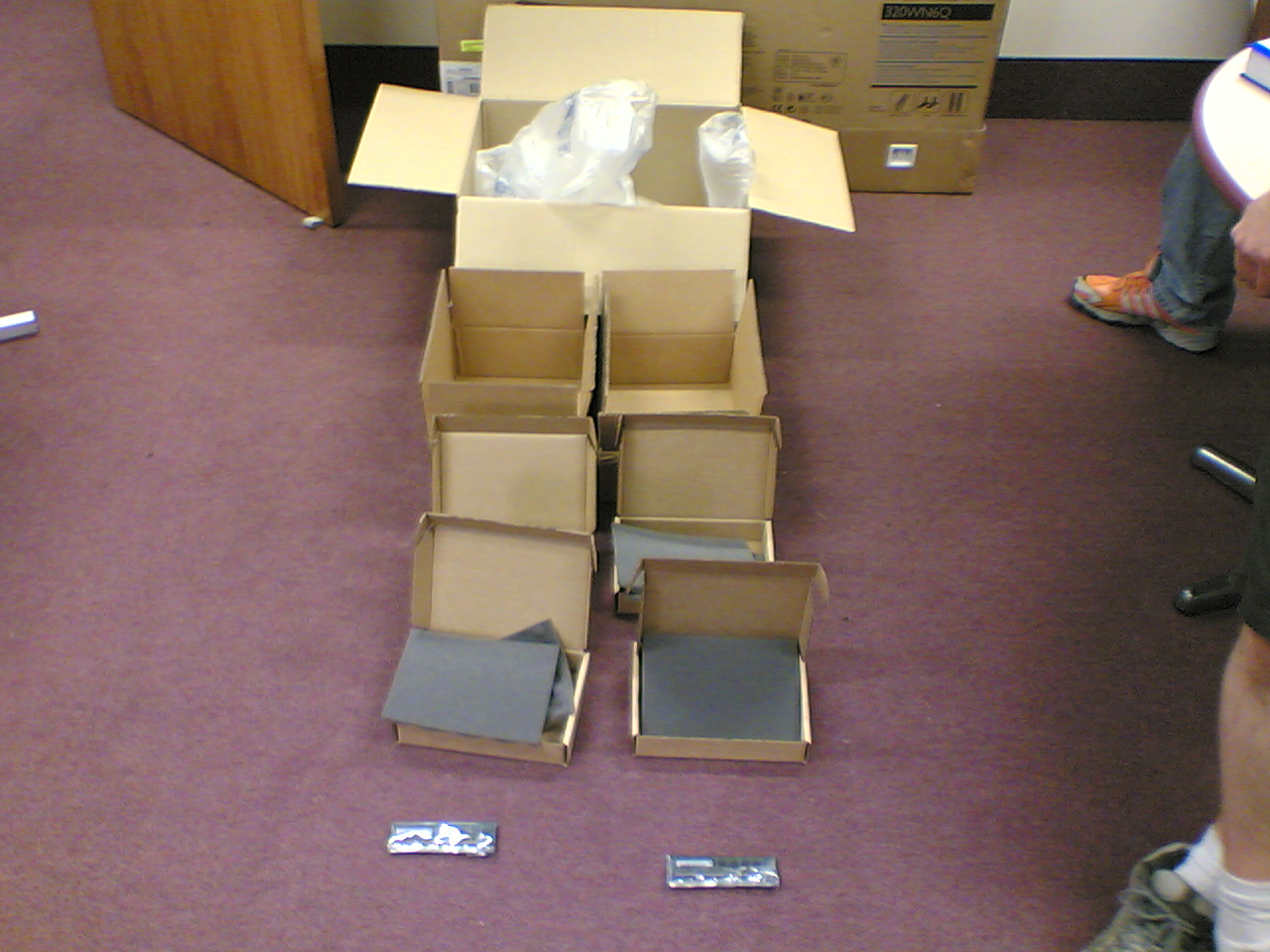
About a month ago Dell announced with great fan-fare that they were the first computer company that offered their customers the chance to be carbon neutral, by planting trees to offset the carbon dioxide generated in producing a years worth of electricity for the computer. Nice idea. They’re lucky that they specifically didn’t mention packaging, and saving the forests. I was down in Hamilton today for work, and a box from Dell arrived with two sticks of RAM for a new Dell server. We’re talking standard 1GB ECC sticks of ram. The packaging for these two unremarkable sticks of memory amounted to no less than seven boxes of increasing size (think japanese dolls), 8 peices of packaging foam, and one long strip of “air bubbles”. Two of the boxes contained absolutely nothing except for packaging foam, and were just used to pad out the medium size boxes, so that the boxes containing the actual ram didn’t bounce around. The two sticks could easily have fit in just one of the smaller boxes! The waste is unbelievable, see the picture below with your own eyes.

dell carbon neutral?
click for fullsize image
With the number of trees that died to support this packaging effort, I sure hope that the $6 I pay to make my desktop carbon neutral plants a lot more trees than is strictly necessary!

13 February 2007

Wouter Verhelst: Eww

For a project at work, I needed to write some application that would talk to sockets and store some state. So, I was facing a dilemma here: either use the cumbersome C API to libdb, or try to figure out a way to be able to talk to many sockets all at once from perl while still being able to use buffered PerlIO. I chickened out.
wouter@country:~$ perldoc perlembed
Fast forward half a day, and I now have an application that will use perl to talk to libdb, and that will use C to talk to a number of sockets. I feel dirty now. But it seems to work...

12 February 2007

Christine Spang: Armagetron Advanced and Debian

News flash: gamers and Tron fans everywhere can rejoice; Armagetron Advanced will soon be up-to-date once more in Debian! The last time a new upstream version (0.2.7.0) was uploaded was almost two years ago now, and while the Debian package has languished in neglect, upstream has chugged on, fixing bugs and adding new awesomeness to the game. Just recently, the old maintainer orphaned the package, and since I use it anyway I’ve adopted it and given it some much-needed love. The new version is 0.2.8.2.1, what an, er, long version number. The new packages have been renamed from armagetron[-foo] to armagetronad[-foo] to reflect upstream’s name change. They include upstream improvements such as the addition of maps and improved graphics code, as well as packaging improvements like a new initscript for the server and rewritten, up-to-date manpages. While the new packages have been uploaded to experimental, they’re stuck in NEW due to the binary name changes. So, grab the x86 or x86-kfreebsd packages from here and test, test, test! (Yes, I run a kfreebsd machine. I wanted something eclectic for a non-essential, moderately old dual-core x86 box. Also, I’ll probably compile amd64 packages soon, but the amd64-machine I can use to build them on is currently in a half-installed state, which I need to fix before that. You can always build from source.) I’ve cleared with the security team that it won’t get in the way of anything and will probably be uploading to unstable as soon as there’s been some more testing to look for major problems. And since the newest version contains fixes for the security bugs affecting the old version, I’m going to snoop around and judge the [in]sanity level of porting back the security fixes for etch, since the new version will at most be unofficially backported to etch. Go, er, take a break in between fixing RC bugs. And test, test, test!

11 February 2007

Andreas Metzler: gotcha in library packaging - gettext translations

I have realized today that we do not ship upstream's gettext translations in the Debian packages. Fixing this required a tiny little bit of thought. Upstream installs the catalogues as e.g. /usr/share/locale/pl/LC_MESSAGES/gnutls.mo. Shipping these files in libgnutls* would have broken co-installability of multiple versions of the library (libgnutls11 and libgnutls13). Since the translations are tiny currently (about 80KB) I did not go for a libgnutls-data package but instead simply versioned the filename.
--- gnutls13-1.6.1/po/Makevars.orig     2006-03-03 16:16:16.000000000 +0000
+++ gnutls13-1.6.1/po/Makevars  2007-02-11 10:22:01.000000000 +0000
[...]
 # Usually the message domain is the same as the package name.
-DOMAIN = $(PACKAGE)
+DOMAIN = $(PACKAGE)13

8 February 2007

Miriam Ruiz: Problems when packaging games

I’ll try to summarize the problems I usually encounter when packaging a game for Debian: I’m sure I’m leaving lots of points out of this list, it doesn’t mean to be exhaustive in any way. Maybe I’ll remember more things later.

7 February 2007

Biella Coleman: Visualize the web

Wathching this video I was reminded that the image can quite often trump the power of the written word. Made by anthropologist Michael Wesh, I could not help but smile at his visual essay on the web, even though I am not all that rah-rah over Web 2.0 and the unbelievable proliferation of …. everything …. . But I immediately identified with most of the images and so there was something quite comforting in seeing a set of images that if nothing else, captures the everyday experiences of many folks hunched over their computers for hours everyday. I think it would have been good, however, to include at least a small splash of the dysptopic in this representation, because even for its biggest enthusiasts, I imagine there is always a set of frustrations and downsides, like for example, taking over 3 weeks to catch up with your blogroll (and mine is pretty modest) because of this extreme explosion of well … everything… and all the organzing tools like tagging and citation software while are really “cool” in that gadget-gizmo sense are just not enough to soften the downsides of a really heavy (information-over) load.

6 February 2007

Ross Burton: Xrandr 1.2

Since I got my 20" widescreen monitor in the summer, I discovered how bad X's support for resizing displays is. I wanted to have the ability to plug my laptop into the 20" display in the office and expand the desktop to 1680x1050, or remove the 20" display and shrink the desktop back down to the native resolution of 1024x768. It turns out that a number of factors were stopping this, and the only way to do it would have been to restart X. Because of this I ended up using the display at 1024x768 when I did use it, but mostly I stayed on the sofa. Then I heard about xrandr 1.2, the all-singing all-dancing revision of the X Resize and Rotate extension. Basically, it would solve my problem, and as luck would have it my laptop has an Intel chipset and the people hacking on it work at Intel. Yesterday after lots of poking I finally made it all work for this. This involved a lot of poking and a little black magic. The first step is getting an X server new enough. First, you'll need to update some X protocol headers. We'll start with the easy ones that have had releases (grab the latest release you can find): Then you'll need to update various other bits of X: Once this is done and X still works, it's time to brave the perilous world of git. If you've never used git before, it's quite simple for this. Go to the git browser and find the module you want to check out. Click on it, and you'll see two URLs: you want the anongit one. Do git clone [url], and then if I've specified a branch other than master, cd into the directory and do git checkout [branch]. For example:
git clone git://anongit.freedesktop.org/git/xorg/driver/xf86-video-intel
cd xf86-video-intel
git checkout modesetting
You'll need to grab: Build it all in that order. The order is important as if you build the Intel driver against randr 1.0 instead of 1.2, it won't do what you want. By now you should have an X that looks no different. But...
$ xrandr
Screen 0: minimum 320 x 240, current 1024 x 768, maximum 1680 x 1050
VGA disconnected 0mm x 0mm
LVDS connected 1024x768+0+0 246mm x 185mm
   1024x768       50.0 +   60.0*    40.0  
   800x600        60.3  
   640x480        60.0     59.9  
TV disconnected 0mm x 0mm
Now that is clever. Here you can see that I don't have anything connected via VGA, my LVDS (no idea what this stands for, but it means the laptop's panel) has a preferred mode of 1024x768 (thats what the * means), and I have nothing connected to the TV output (because Lenovo didn't wire it up). Now if I plug something into the VGA and run xrandr -s 0 (select default screen size), the external display should power on. Xrandr doesn't try to be too clever, it will leave that to desktop daemons, but by default it will try and make something appear on all of the connected displays. In this case, my 20" TFT gets a clone of my laptop panel, at 1024x768. That is no good though, I want to turn off the laptop panel (as I'll be shutting the laptop) and switch the external display to 1680x1050. This is where the black magic starts... Currently the Intel driver cannot resize the physical framebuffer in memory after X has started, so it defaults to a framebuffer of 1200x1024 (IIRC). That isn't big enough to hold 1680x1050. Also the Intel driver doesn't detect any modes from the TFT. This may be Dell being stupid, or the EDID parser in the driver being too restrictive, I don't know. Luckily we can still use modelines in xorg.conf so I added this:
Section "Monitor"
        Identifier "Dell TFT"
        # This is a standard modeline for 1680x1050 at 60Hz
        Modeline "1680x1050" 149.00  1680 1760 1944 2280  1050 1050 1052 1089
EndSection
        
Section "Screen"
        Identifier      "Screen"
        Device          "Intel"
        Monitor         "Monitor"
        # This says that when using a monitor on the output called VGA, use the
        # settings in the monitor "Dell TFT"
        Option "monitor-VGA" "Dell TFT"
        DefaultDepth    24
        SubSection "Display"
                Depth 24
                # This tells the screen to allocate a frame buffer up to
                # 1680x1050.
                Virtual 1680 1050
        EndSubSection
EndSection
With this, everything just works. If I xrandr with various displays plugged in I can see what they support and can switch modes. To make everything nice and easy I wrote a small script that I bound to an unused function key:
if xrandr -q   grep -q  "VGA connected"; then
  xrandr --output LVDS --off --output VGA --mode 1680x1050
else
  xrandr --output VGA --off --output LVDS --mode 1024x768
fi
(thanks to Eric for pointing out that I don't need to use the hex values). Simple! As you can see the new xrandr is very powerful. If you want to do Xinerama-style dual screen you can do that too: xrandr 1.2 encompasses that behaviour. The final thing to point out is how glad I am that GNOME seems to handle the screen resizing like this so nicely already. When the desktop shrinks Metacity moves windows so they are visible, and when the desktop expands the panel applets on the right stay on the right instead of sitting in the middle. The script I run when I change screens does more than I pasted here: it changes the wallpaper to match the aspect ratio, and also changes the fonts. I hope this has made sense, I know there are a few people out there who were waiting for me to test this before they gave it a go. If anything is too vague, leave a comment and I'll expand it. I should also mention that I've got Ubuntu Edgy packages for everything here in my repository. NP: Animal Magic, Bonobo

5 February 2007

Christian Perrier: fr: 99.817%, cs: 92.647%

These are the current translation ratios for French and Czech in unstable, after 18 days of "blitz l10n NMU". The sing package modifications lower French stats, as expected. However, the package has already been fixed by its maintainer (kudos!). viewvc has got an RC bug today so that gives me a very good excuse to push for an urgent update...including of course our beloved l10n bugs. That leaves us with dpkg-cross again, for which I have no answer yet. Small pause today in uploads as the Samba packaging team had to take care of a security update, which has been uploaded, for unstable, 3 hours after the official annoucement by the Samba Team. We are very grateful to these wonderful people, and more particularly to Gerald "Jerry" Carter who is not only a nice guy but also a very efficient developer. Thanks also to Steve Langasek for his commitment to this issue, to No l K the for being ready to upload in case I fail, to Eloy Paris for keeping the contact and to Moritz Muehlenhoff who prepared/is preparing the update for sarge.

3 February 2007

Paul Wise: 3 Feb 2007

So, back to geekery after too many months away. While we were in Thailand, I met Theppitak Karoonboonyanan and his friend Neutron Soutmun and a couple of others from the Thai Linux community. Thep is in the NM process for Debian, he maintains Thai support packages in Debian and Neutron is a Debian user. Neutron writes firmware for GPS receivers (IIRC) and other GIS stuff, I'm hoping he will get involved in the debian-gis subproject. I think I convinced Neutron to at least think about applying to NM :D. We talked about a lot of things, mainly about Thai localisation and the challenges involved. He mentioned that the language barrier is a big problem for Thai people, so their main focus has been firstly infrastructure (text rendering, layout and wrapping, fonts, input methods, locale, etc) and now translation (and the associated, laborious localisation efforts). He told me a bit about the writing system and how it is related to other systems in the area. Thep also mentioned the possibility of debconf9 being in Thailand, I recon it would be bloody awesome to have debconf in Asia. At least one other Debian Developer is interested in this, madduck is the initial instigator. I hope we both make it to debconf in the UK this year. I also visited the open source lab at NECTEC (the Thai National Electronics and Computer Technology Center), which is government funded. There, they develop LinuxTLE (an Ubuntu based desktop distro), LinuxSIS (a simple internet server for schools and businesses) and do lots of translation and advocacy work within NECTEC and with businesses and other organisations within Thailand. One thing about LinuxPLE which I noted was that during the post-install GUI configuration step, there is an option to setup the system to use fonts from a mounted Windows partition. IIRC, they explained that they found this was important because of a reliance on Microsoft fonts in Thailand. While I was there, I went to a couple of other labs and saw a demo of a cool Thai OCR and car registration plate recognition system, English to Thai machine translation (text) and direct English speech to Thai speech conversion. They were also working on some medical imaging and speech recognition stuff that I didn't get to see. I also met the founder of linux.thai.net, whose company develops this online map for Bangkok.. Also posted some photos from our trip through Thailand.

2 February 2007

Enrico Zini: pmdraft

Second generation package manager I have created many prototypes for advanced package manager features. Erich Schubert also made a tag cloud prototype. Recently, I wrote:
We have lots of interesting, usable metadata; we have algorithms; we have prototypes; we have ideas for lots of cool, implementable features. The question is, are we able to write applications that just combines what is needed from all this treasure to provide the right interface(s) for our base(s) of users?
Most of the back-end code is already implemented in Python, and I'm thinking of putting it together into a working prototype for a new concept of a file manager. This could be even implemented quickly, if someone joins me who is good at: What follows is a sketch description of what I have in mind. The user
Debora is 34, working as a web designer in a small enterprise. She has a laptop running Debian which she uses both for work and at home. She likes Debian for the wide range of software, that allows her to be always able to access the best tools for the job, even in a highly changing environment like the one of web design. At home she enjoys the various tools for photo editing and management, and of course, having a husband and a 6 years old son, the selection of games.
The tasks Looking for new software Use the smart tag search for searching: it allows a Google-like search interface, which afterwards allows categories to be used to semantically refine the results. This last step is conceptually very simple, as it maps to a sequence of "more like this" and "less like this". The search results can be sorted using popcon suggestions, that are very effective at showing software not in the system that many other people use. Looking at what is installed Let's see if this package does what I need Given an installed pacakge, show the contents of its bin/ directories and showing manpages as the details for the bin/ file: thanks to the Debian Policy, executables are all in /(usr/)?s?bin/ and they must have manpages. For packages that are tagged as interface::3d, interface::text-mode or interface::x11, allow to run them directly from the interface. Also show the contents of /usr/share/doc/pkgname and /usr/share/doc/suggested-and-recommended-pkgnames and allow to open documentation with the appropriate software. If there is an html directory which contains an index.html, only show that and not all the other HTML files. Find info documentation and allow to open it into a proper info browser. If there are manpages that don't have a corresponding executable, show them as extra documentation. What was that nice package I installed yesterday? List installed packages sorted by when was the last time they have been installed. Let's get rid of the cruft There are also some "unusefulness" scores one can compute, but I haven't yet been playing with them yet: Task filter Have a look at the popcon suggestion page: there is a "Suggestion type" box. Of course the same idea can be used in a package manager to restrict it to a significant subset of the packages. More filters, as you can imagine, can be easily created. This is how it is implemented:
case "any": $filter = "'!role::shared-lib'"; break;
case "gui": $filter = "'!role::shared-lib && role::program && (interface::x11   interface::3d)'"; break;
case "devel": $filter = "'!role::shared-lib && devel::*'"; break;
case "game": $filter = "'!role::shared-lib && role::program && game::*'"; break;
default: $filter = ""; break;
The same filter can be gived to Debtags:
debtags search '!role::shared-lib'
debtags search '!role::shared-lib && role::program && (interface::x11   interface::3d)'
debtags search '!role::shared-lib && devel::*'
debtags search '!role::shared-lib && role::program && game::*'
Conclusion As I said:
There is so much really cool stuff to be written, just within reach.
So?

1 February 2007

Pierre Habouzit: Solutions Linux

Solutions Linux was great. At least I had a great time, seeing a lot of people that I meet too seldom. A short making up is: There was not as many visitors I would have hoped, but that was still a nice time. edit: it seems only the video card was broken after all, because I carried the computer forgetting to remove the DVI to VGA adapter. So that's a 50 loss, not a 350 + one. I'm relieved

Brett Parker: Command line lucene index inspection!

Woo! I've been looking for a lucene index inspection tool for the command line for about 6 months or so, ever since first trying to use luke over a forwarded X11 over ssh connection to a machine in the colo with a large(ish) (300,000 document) index... a couple of months ago I stumbled upon PyLucene - a python library that can play with lucene indexes, of course the first thing I did with it was package it (can't have random unpackaged software laying around the system after all, can you!), and then played for a bit, and joined the pylucene-dev mailing list. So, imagine my glee today when on that mailing list there's a post about plush - a Python LUcene SHell - fantasticness! Quickly threw that in to a package and tested it out against a lucene index laying around on my workstation, it worked nicely (couple of small bugs, but they've now been fixed in the trunk version), so, now that I had it packaged, straight off I went to the main indexing server and threw it at a large lucene index, it just worked. Fantastic. I'll add some links to my repository for pylucene and plush later, when I'm feeling slightly better, feel a little under the weather at the moment.

Biella Coleman: 2 articles on the problematic effects of scientific endeavors

Technology and science are, at times, part of some solution. But once unleashed in the world, they can also perpetuate problems and act as barriers. I just finished two articles that have addressed this conundrum in provocative ways and I recommend both to read just for the sake of reading as they are written stunningly well and if you teach a course related to science, technology, medicine and society, these two would make excellent introductions to the importance of critically dissecting science, technology, and medicine (and I think you could unpack them for hours and hours, which is very helpful if you are looking to fill up some time). One, Happy Meal is by the author of the immensely popular Omnivore’s Dilemma, Michael Pollan. In the article he starts with the simple suggestion of trashing most fast/junk/processed food in favor of whole foods, notably plants. But then he delves into the much more complicated topic of the science of nutrition, making a pretty sharp critique of the field, especially for 1) its reductionism 2) and the ways in which the food industry mobilizes nutrition data it is favor and often to the detriment of furthering the goals of real nutrition. After I posted the link on an IRC Debian channel, I had a pretty heated conversation with a number of Debian developers about the nature of science and how one goes about critique it (and mobilizing data to make counter-claims). As often is the case, we ended up arguing over the merit of his attack (though everyone agreed that his food suggestions were quite sound, and I find this disjuncture pretty interesting), as some felt like his attack on the science of nutrition went too far. I did not feel like his article was anti-science or alarmist but saw it as attacking a particular configuration of nutrition science (the reductionism, the inability to admit more complexity, and the turning away from common sense principles), which carry with it serious consequences in the so-called real world. He offers a critical edge that I think does not attack the principle of science generally (after all, he is using the techniques of skepticism and he marshals plenty of scientific data, like studies on omega 3s and 6 to make his point, though he does not only employ the rhetoric of science, which I think is key to understand his critique too) but just what is sees as a particularly problematic rendition of it that is especially problematic for nutrition (though I am sure many of his critiques are easily transfered to other domains). Here, for example, is an attack on reductionism:
If nutritional scientists know this, why do they do it anyway? Because a nutrient bias is built into the way science is done: scientists need individual variables they can isolate. Yet even the simplest food is a hopelessly complex thing to study, a virtual wilderness of chemical compounds, many of which exist in complex and dynamic relation to one another, and all of which together are in the process of changing from one state to another. So if you re a nutritional scientist, you do the only thing you can do, given the tools at your disposal: break the thing down into its component parts and study those one by one, even if that means ignoring complex interactions and contexts, as well as the fact that the whole may be more than, or just different from, the sum of its parts. This is what we mean by reductionist science.
And muses on the effects of this narrow path:
No one likes to admit that his or her best efforts at understanding and solving a problem have actually made the problem worse, but that s exactly what has happened in the case of nutritionism. Scientists operating with the best of intentions, using the best tools at their disposal, have taught us to look at food in a way that has diminished our pleasure in eating it while doing little or nothing to improve our health. Perhaps what we need now is a broader, less reductive view of what food is, one that is at once more ecological and cultural. What would happen, for example, if we were to start thinking about food as less of a thing and more of a relationship?
.
But you will see here that he reaches into scientific facts so that he is not throwing out the bathwater with the baby:
Eat less is the most unwelcome advice of all, but in fact the scientific case for eating a lot less than we currently do is compelling. Calorie restriction has repeatedly been shown to slow aging in animals, and many researchers (including Walter Willett, the Harvard epidemiologist) believe it offers the single strongest link between diet and cancer prevention. Food abundance is a problem, but culture has helped here, too, by promoting the idea of moderation. Once one of the longest-lived people on earth, the Okinawans practiced a principle they called Hara Hachi Bu : eat until you are 80 percent full. To make the eat less message a bit more palatable, consider that quality may have a bearing on quantity: I don t know about you, but the better the quality of the food I eat, the less of it I need to feel satisfied. All tomatoes are not created equal.
There is no doubt that the article is advocating, very strongly, a point and he is not being all impassioned and neutral as may happen with a purely scientific rendition of the the topic. This will no doubt cause debate and reaction, which I am sure is what he was aiming for. And whether you end up agreeing or not with his critique, it makes for one fascinating read. Along with this piece is another engrossing, somewhat older one piece by Carl Elliot: A New Way to be Mad that examines the ethical complexities of what seems to be a relatively new phenomenon: Body Integration Identity Disorder (which he may have helped fuel a little via his very article and it is this issue of looping, first discussed by the philosopher of science, Ian Hacking that Carl Elliot nicely captures). Since the article is not available for free, here is another one, also by Carl Elliot, that addresses the same topic Unlike Pollan, Elliot does not have any clear cut answers or a really trenchant critique. More than anything he serves up a tasty meal that will in all likelihood be new to many readers, and the flavors he adds are those that make us confront the many interesting moral quandaries that this case presents.

David Nusinow: Bits From The XSF

This has been a little overdue, but here it is. Lots of less than glamorous stuff has been going on in the XSF, and a few more exciting things are in the pipeline.

Among the less glamorous stuff, our resident release junkie/alpha porter, Steve Langasek, fixed #392500 which was our major RC bug on the alpha arch. Aside from that bug, there's been a whole host of bug triage by our newest team member, Brice Goglin. Brice has taken on the unenviable task of going through the massive list of bugs owned by the XSF. I've been traditionally less than responsible about handling bug reports like I should, and Brice is dealing with the mess I've left behind. Before he started, we were at over 2000 outstanding bugs, and as of this writing we're down to 1646 bugs, which is a huge amount of work. Hopefully this will go a long way towards making our little corner of the BTS usable for mere mortals. Aside from that, there's been an enormous amount of small cleanups and bug fixes by the whole team, most notably Julien Cristau (who's been doing more actual release management than yours truly), Thierry Redding, and Drew Parsons. Perhaps most important among these are miscellaneous last minute driver fixes that will enable a fair number of people to actually run Etch without backports. Michel D nzer has continued to be his usual awesome self, responding to the tough DRI bugs that the rest of us are terrified to approach.

Some of the more exciting stuff from a user perspective has been the various updates and new packaging going on. Thierry has taken on mesa, which is an incredibly daunting task, and he's done and incredible job of it so far. He and Julien cooperated on getting the newest mesa release, 6.5.2, in to experimental. That's a huge step on the way to getting the 7.2 release in to the archive. Thierry has also packaged up the newest compiz and some additional plugins ported from beryl, both of which are waiting in NEW right now for our overworked ftp masters to find time to have a look at them. Speaking of beryl, we also have that more or less complete and packaged. Our second-newest XSF member, Shawn Starr, has taken on beryl, and done a great job of getting the packages ready for experimental. They came back from review with a few minor comments, so he's busy getting those last issues resolved, so beryl should be winging its way over to NEW again for re-review soon. Finally, Josh Triplett and Jamie Sharp, who are both Debian and XCB developers, have put XCB in to experimental for you to test and play with. Expect to hear more about this when the Lenny development cycle starts.

The other huge thing that's been going on, and what I've been devoting most of my time to (aside from reading all the mail from Brice's bug triage), is transitioning the XSF over to git. Thierry has written major chunk of infrastructure to help move us over. I've done most of the conversion locally, and have been putting things up on git.debian.org as I go. As of now, we've got a very large chunk of X in git now, and using svn for those bits is officially closed. I'm hoping to complete the move in the next two weeks or so. If you want the above software that's not yet in the archive (beryl, compiz, compiz-extra, etc) you can clone it from the git repositories and build away. The other major thing that I've been doing is writing up a XSF git policy. This required a lot of input from the team, and we had to come up with a reasonable way of working the archive so that we could easily work with an upstream that was also using git, which as far as I know is a unique situation right now. It's in pretty good shape right now and we're just starting to put it in to real use. I've proposed a talk for Debconf on the XSF roadmap for Lenny, and I'll be sure to talk about our experiences using git if it gets accepted. In addition, we've all been learning the ins and outs of git, which is a whole other post in itself. I think that the XSF will end up being a really good resource for people in Debian who are looking to use git, as we'll have a lot of real world experience with a tool that relatively few people actually seem to know. Since I think git usage will only grow in the future, hopefully this will end up being valuable for Debian as a whole.

31 January 2007

Evan Prodromou: 11 Pluvi se CCXV

The growth of new Open Content projects continues to amaze me. I really admire how the wiki technique makes it possible to combine the microcontributions of thousands or millions of people across the Internet and make high-quality, usable reference works for everyone to share and enjoy equally. What we'd normally think of as staggeringly audacious becomes manageable and realizable using wikis. I'm mostly waxing poetic here about a new project for creating a Free event calendar for the entire planet. Wikevent is built using the ubiquitous and reliable MediaWiki software, but with a ton of add-ons and features to make organizing an events calendar reasonable. There's a good mix of calendar-oriented interface, geographical interface, and a nice dose of Microformats thrown in for good measure. Wikevent is still in its early stages, but it doesn't take much imagining to envision a great future for it. Managing event calendars -- everything from the Beck concert in your city to the meeting of the local Interlingua club -- is a daunting task for local media. As its API and data feeds mature, it's reasonable -- nay, probable -- that Wikevent feeds could power the events calendars for local weekly newspapers, radio stations, TV, and community Web sites. I think it will make a good data source for community-oriented sites like Upcoming.org or Eventful. Wikevent plans to use a lot of metadata to allow slicing its database in different ways for different kinds of people. The entire database is available under the extremely liberal BSD-like Creative Commons Attribution license. Because it's such a nice complement to a travel guide, we've started adding Wikevent links to Wikitravel guide articles on our English version (and, soon, other versions too). There's more crossover, of course: the site's founder, Mark Jaroski, and community powerhouse Andrew Haggard, are both longtime Wikitravellers. I'm looking forward to seeing how this new Open Content project continues to develop. tags:

Jyte Speaking of cool new sites, I was glad to see in Scott Kveton's blog news of the new Jyte project. Jyte is a fascinating social network that uses the OpenID authentication system for the identity infrastructure. I think this is really interesting -- using OpenID for social networks is really a good idea, and opens up the process a lot. Another interesting point is that Jyte lets you make arbitrary assertions about yourself or, really, anything that has an URI. Other users can approve or disapprove the assertion, giving it more validity. For example, I've made an assertion that I'm the founder of Wikitravel: http://jyte.com/cl/evan.prodromou.name-is-the-founder-of-wikitravel That assertion has been backed up by 3 other people (so far), giving it a little bit more authority. Or, as Chris Dawson put it, http://jyte.com/cl/jyte-is-hot-or-not-for-nerds I think that the claims system is pretty intelligent -- a great way to make statements about yourself or others. It works like ClaimID, but with more latitude in what you can make claims about. tags:

30 January 2007

MJ Ray: Debconf7 loves climate change?

I've just noticed that some debconf7 registrations close this week. Yes, this week - a full two months before national rail advance tickets go on sale. What's that about? Meanwhile, the debconf7 travel page (SSL) seems to have far more airline details than railway ones. I'm almost wondering if someone involved owns an airport up there or something... Please, for the sake of our British Isles, don't fly to debconf from Europe and especially not the UK! For example, flying from London dumps 193kg of carbon into the upper atmosphere (where it's over twice as damaging), but a train only 24kg near the ground (source).

29 January 2007

Erich Schubert: On 3D Desktops

So Mandriva apparently is including a new 3D desktop named "Metisse" in their next release. It seems to be a real 3D thing, not like Compiz and Beryl which are just about some fancy effects for your 2D desktop. However, I'm not convinced that this is a good idea. First of all, many people have problems with thinking in 3D. "Engineers" like us are used to thinking in 3D, but many people are not. They might be better off with a 2D thing. Also supposedly 2D perception is easier for the mind, and should better allow us to focus on other things. Secondly, optimizing display for 2D is much better. Many people won't want to miss the crisp and sharp fonts we have today. Subpixel Antialiasing together with hinting does a good job at optimizing fonts for readability. Don't exepct a 3D desktop to be able to offer this, as soon as you turn perspective you'll end up with blurred fonts. Instead I'd consider doing mostly away with the concept of resizable and moveable windows. Most of my applications (except my terminal windows) are running full-screen. If I'd be working a next generation Desktop thing, I'd be investigating application switching (Expose for example seems to be good), some intuitive way of automatically tiling windows (ion sucks, sorry) and making the concept of multiple desktops easier for users. IMHO that is one of the most powerful (and yet often unused) functions on our systems. Note that metisse does seem to enable people to use multiple desktop a bit easier; I like their overview screen. I also like the "folding away" concept when temporarily marking text in a different window, but how is it supposed to know I'm going back to the previous window again afterwards? Most of what they show off is totally useless and has bad usability. Where is the actual use of being able to 3D-turn two windows? I can barely read the location bar of the browser afterwards! Just like Compiz and Beryl, they're just showing off fancy effects, but I don't see the usability benefit. (I havn't tried metisse, this opinion is solely from watching their demo videos.) For example, I never need to move my windows around on a pixel-level. If I ever resize my windows away from their default size, it's about having two windows visible at the same time. I could imagine having a window chooser such as Expose, and by selecting multiple windows with the right mouse button I can get a tiled view of them, as opposed to selecting a single window with the left mouse button.

28 January 2007

Erich Schubert: How Microsoft might already have lost the desktop wars

I was recently asked to help someone understand the OpenSource movement, and the effects it might have on companies such as Oracle or SAP. I talked a bit that these companies can benefit from being independant of big vendors like Microsoft, while still not having to do everything themselves. But also on how opensource alternatives to their products will threaten their business in the long run and force them to be more innovative and constantly improve their product. I then talked about the 'viral' aspects in OpenSource; not about that GPL licensing bullshit (just read the licenses of stuff you want to use, and don't use them if you don't like the license...; this virality is highly overrated due to Microsofts FUD), but a very different kind of virality: Let's say you are supposed to evaluate different CMS solutions. So you install one or another that sounds promising. Most likely you'll install an opensource database like MySQL or Postgresql. And when you've decided upon a solution, you are quite likely to go with this database, and say to yourself: "if MySQL doesn't scale up well enough for our needs, we can still but an Oracle license". This would be probably different if you had had installed Oracle in the first place. Say a demo or so. But the demo versions of the CMS you tried already made you comfortable in using MySQL; it's easy to install (most likely included with your system anyway), and it just works. But would you have tried a CMS in first place that actuall required you to setup Oracle? Anyway, this "social" virality brought me to another point: developers and administrators. When you see numbers on the market share of Microsoft, they're still huge. Some 95% of users are using Microsoft as their primary operation system (I'm discounting the fact that a huge share of DSL modems here is running Linux, so actually many people are Linux users, and I'm also discounting the use of www.google.com, which would make 99.9% of people Linux users...). But these are the average users. But they aren't on their own. The software choice of the "average user" is influenced by a couple of factors, including: But if you look at the computer geeks around you, what are they using? A huge share of the people I know are using Linux. Not everyone is using Linux as their main desktop system, but many are. Others are using Linux just for their development stuff, some only on servers. It doesn't really matter, Linux is huge with the geeks. When I look at the sofware my mom has installed on her Windows system (which also dual-boots Linux, and interestingly is the primary choice for watching a movie - Windows doesn't playback sound with some videos...): half of it is opensource. There is OpenOffice.org, Gimp, Gaim, Firefox, Thunderbird, Inkscape, LyX, Mplayer and a couple others. He favourite game? PySol. My dad already has switched to Linux as his main operating system. So why did they switch to so much opensource software? Because it's what I recommended them, and where I can help them. My mom needed a software to record something for her blog (yes, she's "podcasting" now) - of course I recommended her an opensource application, audacity. My mom is giving private lessons in math and physics; she's very successful at that. When one of her students got herself a laptop, she of course was given all kinds of (opensource!) software. For her highschool thesis she needed a vector graphics program - she ended up with inkscape. Now if my parents have some problem with Windows, who are they going to ask? I didn't manage to solve the video playback issues, my mom by herself switched to Linux for watching movies. It didn't work with Windows, I couldn't help her - she switched to something where she knews she'd get more support (and where the problem by chance didn't occur). Now let's have a look at the university. Our computer pool for the students is all Linux. There are a few windows systems for legacy purposes, I never found out if they are accessible to regular students; I only know they're supposed to exist. When doing some assignment, you're very often required to use some opensource software. For a thesis, you'll very likely be building upon some opensource system. The mathematics institute is still on solaris, but recently Gnome was installed there. Physics and electrical engineering also have mostly Linux systems, I've heard. For software development, it's pretty much a "develop on Linux, run anywhere", whereas Windows-only developers usually need to port their applications (or trust on Wine being able to run them good enough on Linux). So more and more people start developing on Linux, and get to love it's great development environment (after all, Linux was pretty much completely done by software developers...). And that is how Microsoft might already have lost the desktop war: developers, technical students and administrators (who usually also love their Linux boxes). They're only a small share of the userbase, but they're influential. In fact, other users rely on them being able to eventually fix their systems for them. But since these are using Windows much less already, they will be less capable of assisting others with Windows. They'll be putting Linux systems everywhere, and keep on encouraging them to make the switch. Of course it will still take some years, but you can expect more and more companies (and cities) to switch over, like the city of Munich. Windows support staff on the other hand might even become more expensive. I don't know of any numbers on the MCSE programme (Minesweeper Consultant, Solitaire Expert) - does anyone have numbers on "graduates" for that?

Adam Rosi-Kessel: Blosxom to Wordpress

I finally completed a longstanding project converting this blog from Blosxom to Wordpress. Five years ago when I transitioned from a self-coded blog to blosxom, I loved the low tech “hackable” nature of Blosxom. Unfortunately, it hasn’t scaled well. I can imagine using Wordpress five years from now, but the Blosxom filesystem-only style organization just won’t hold up. At some point soon while it’s still fresh in my memory I will document the transition. Since nearly every Blosxom user has a unique set of quirks, each transition will have its own special problems. I’ve made every effort to preserve permalinks from the old blog, but I’m not sure they all made it over. If you are looking for something and can’t find it, please drop me a line. I also suspect that my most recent entries will repeat themselves for everyone who subscribes to this RSS feed. I apologize for any inconvenience.

Next.

Previous.