Search Results: "sf"

2 December 2005

MJ Ray: French law banning Source Code

I've posted a translation of an easier to read article about the proposed DADVSI law (source: ffii.fr) which might help more people understand what the complaint is. Here's how I read it but I am not a lawyer, much less French. (Vive la Wallonie...)

Simon Law: WvDial

I've been struggling to get WvDial out the door for about two days now. This is why I'm still in the office at five in the morning. I thought I was just about done when I discovered the plethora of Debian bugs filed against it. WvDial is a magical piece of software that figures out how to talk to your modem to get you connected to your ISP. It used to be very popular back when everyone in North America used dial-up access to get on the newfangled Internet. Nowadays, many people have broadband service, so it's popularity has waned. However, people are starting to use bluetooth mobile phone modems now, so we're seeing a resurgence in popularity. Which is why, of course, I'm hoping to get another release out the door. I have the impression that I can't fix all of the bugs this time around, mostly because I don't have the hardware. But the easy ones should be solved so that we can concentrate on the tough problems.

Ross Burton: Poetic

There is something quite satisfying about Mail Watch auctioning a Daily Mail Christmas Carols album on eBay, with the proceeds going to Asylum Welcome, an asylum-seeker support charity based in Oxford. Let the bidding commence!

Martin 'Joey' Schulze: Volunteer LinuxTag Work

Without the vast number of voluntary supporters past LinuxTag events wouldn't have been possible at all. On the financial side LinuxTag has always made only little profit after the event. Without these nearly 100 volunteers who have supported us directly during the event and during its preparation the show wouldn't have been possible. Without the help of so many supporters during the event, the entire show isn't possible. Hence, it is important to either generate more income and be able to pay for hostesses and callboys or manage a proper environment in which many supporters want to help. For this, accepting the importance of the supporters, acknowledging their work and supporting them with food, fluids, fun and other advantages is very important. To my regret, I have to admit that this has not always been the case inside the core team. I have argued in favour of the supporters several times, so hopefully not much of it has been noticed by them. Supporters have worked in several different areas. I'll try to list them below but I'm sure I already forgot half of them even though I have coached most supporters directly or indirectly. We have maintained the parking ground so we were able to ensure that the Festplatz in the middle of LinuxTag is not abused as a parking place during the event. This required us to maintain a gate with at least one gatekeeper from 6 a.m. to 10 p.m. This was a lot of work, and it wasn't that interesting, but good for people who want to read or hack in the gatekeeper pavilion. We have manually built the projects network in the exhibition halls. In the conference building it was built by the KaLUG. All information signs and plans had to be drawn, printed, magnified and fixed at their respective locations. There are a lot of additional signs that we have maintained to help visitors find their way. I'm sure still a lot of signs were missing. I have used the opportunity to prepare most of them after the last event, so that we have less work for the new one. Our own office had to be set up, since we've used naked rooms with only some cupboards, tables and chairs inside. More furniture had to be arranged, the network had to be built up, the server had to be installed or configured, the printer had to be attached, the network configuration needed testing, the desks had to be set up. For some years now one to three volunteers have helped us in the office in order to support the core team and so that we are able to present visitors, exhibitors, the press etc. We've had an an additional human firewall who worked for two or three days usually and was able to support most people already without clogging the office room. The firewall (Arne) himself had the idea to become a firewall several years ago and I have to agree that it was a very good idea. However, with the exhibitor support maintained at a special booth at the entrance less work had to be done for the firewall this year. Several large and self-standing signs had to be prepared or repaired after the had been broken at the last event or their content has been obsoleted. Signs for the gate from above had to be printed and fixed at proper locations so that exhibitors find their way. We have built up the entire audio and video equipment on our own with a service provider from Bremen. Since this affected up to six rooms a lot of equipment and cables had to be moved, installed and dismantled after the show. For this we've helped J rg and Sven with several volunteers. The business congress had to be prepared as well. Stuff for the attendees had to be created and taken to the conference building. The entrance counter for it had to be maintained and staffed. Doors had to be secured. Deliveries had to be maintained in a storage area, since before LinuxTag a lot of stuff is delivered to LinuxTag without the target booth built up already. During setting up the booth, the booth builders also had to be supported and problems detected, discussed and corrected. During the entire time of our siege of the fairground we've had to maintain our own storage of fluids and food. Due to the high temperatures having around enough fluids was very important. In addition to this demands for several goods also required us to send somebody out for shopping each day. In order not to die of starvation during the event we have also organised a delicious lunch for all supporters and core team members. Kudos to Thomas we were able to order large pots of salad and cooked food for two years so that we didn't have to eat unhealthy food (such as fat pizza for six days) and everybody could decide on their own how much they want to eat. In the years before we've had rented a cook and even ordered Pizza. The food had to be fetched from the restaurant, arranged, together with table clothes, cutlery and stuff, and finally taken back at the evening. Cutlery had to be cleaned regularly as well. For the social event the location had to be cleaned and prepared. This year we've had the great opportunity to use the Nancy Caf which was unused for about 10 years, and hence required a lot of cleaning. As it turned out just before the show began, it required a lot more cleaning than expected. However, thanks to the competent and highly motivated supporters the location was cleaned in time. Kudos to Claudia, this year's social event was also one of the most successful. For the legendary KaLUG party the location had to be prepared as well and the food cooked. Looking at the pictures, the pavilions had to be built, tables and chairs arranged, cutlery and fluids organised. In the evening all the stuff had to be cleaned as well. This year KaLUG had organised a so called "Sp lmobil" that helped with doing the washing-up, but somebody had to work in it as well. The KaLUG has maintained the Internet caf in the conference building and has set up the network for the exhibiting projects in the conference building. For this they have acquired a lot of computers and network equipment that had to be built up and dismantled after the show. They have also acquired a number of movable walls for separating booths and providing poster space. During the show we have distributed fluids for the conference rooms and exchanged information posters and flyers with the daily schedules. When you're giving a talk, your throat often gets quite dry, hence, a cup of fresh water is a good cure, but requires the organisator to maintain water and cups. Since the conference program changed daily posters and handouts had to be exchanged during the evening. Project exhibitors were supported directly by us while company exhibitors were supported by a service provider. Additionally all speakers had to be supported as well. The conference rooms were also maintained by a moderator who supported the speaker, announced the talks and speakers, ran (!) around with a microphone, helped in case of technical problems and maintained the schedule. Even though it may look strange for an outsider there are a lot of costs that emerge when such an event is organised at a commercial fairground. LinuxTag has always had the problem of only little yield after all bills have been paid after the show but had to start preparing the event for the upcoming year. In the past years it was always a struggle to continue with only little financial substance trying to get the next event set up properly. LinuxTag has been unique in its configuration, looking at its history, its organisation structure, its size and its components. There are basically only three ways of creating income: commercial exhibition, business congress and sponsoring. All three have obviously been on the descending path for several years now, reducing a lot of flexibility for the organisation. This income has had to be used for all expenses. On the other side there are a lot of areas that just cost money, such as the conference building, exhibition hall, hotel, travel reimbursements, projects booths, advertising. In addition to that we've had two service providers that have taken over some tasks and needed to be paid as well. A very rough overview is in my Howto LinuxTag talk from this summer.

1 December 2005

MJ Ray: Translation of article about VU/SACEM/BSA amendment

I was too tired to do this really, but I wrote a translation of an article about the French anti-free software law which I mentioned earlier. So, remember: E&OE, no refunds, no warranty.

Uwe Hermann: French Government Lobbied to Ban Free Software

From FSF France:
Friday November 18th, 2005, French Department of Culture. SNEP and SCPP have told Free Software authors: "You will be required to change your licenses." SACEM add: "You shall stop publishing free software," and warn they are ready "to sue free software authors who will keep on publishing source code" should the "VU/SACEM/BSA/FA Contents Department"[1] bill proposal pass in the Parliament.
WTF? This has got to be a joke... Please tell me this is a sick joke. (via MJ Ray)

Uwe Hermann: Drupal 4.6.4 / 4.5.6 fixes three security issues

You might have already noticed, but I'll re-iterate nevertheless: the Drupal project has released Drupal 4.6.4 and 4.5.6 which fix three security vulnerabilities. Everyone running a Drupal site is advised to upgrade, as always. Multiple people were mighty busy yesterday preparing, finalizing and testing the patches and advisories. I was one of them, although I was more like lurking around trying to look busy ;-) Anyways, I have sent the respective advisories (DRUPAL-SA-2005-007, DRUPAL-SA-2005-008, DRUPAL-SA-2005-009) to the "usual suspects" today: Bugtraq, Full Disclosure, and the php-sec mailing list. The advisories have already been picked up by Secunia and a bunch of other security sites... Btw: I finally received news that my domain was transferred to my new web hoster today, which led to a short downtime. Everything should be fine now. If you notice any problems, please drop me a note.

Martin 'Joey' Schulze: Voluntary Work vs. Paid Work

In several semi- or non-commercial associations work is done by volunteers who spend a lot of their spare time and energy for the goals of the association. This works fine as long as all people who are spending a lot of time on the goals are treated the same and work voluntarily. When some people decide that some people should get paid for their work, while others, who don't work significantly less, don't get paid for their work an uneasy situation is created. Why are some people treated better and get paid for their work while others don't get paid, but still work a lot on the same or similar issues? Why should those, who have to make money in other areas in order to live at all, continue to work voluntarily? I have always argued that in such constellations one must not have volunteers and paid workers do the same work. The only exceptions are volunteers who have stated that they want to do the same work, even though they don't get paid for it. Otherwise you'll create dissatisfaction of the volunteers, which in turn will most probably result in less volunteers, at least in the long term. Also volunteer work should be more interesting and relaxed than paid work, so that the volunteers have more freedoms and develop more fun doing the volunteer work they were asked to do. Paid work is fine for boring tasks that not enough volunteers are comfortable with, such as standing around asking visitors at an exhibition for their tickets, keeping people out of areas where they don't belong, working at a counter, folding and packing stuff etc. Looking at LinuxTag, we had such situations twice. First of all, two members of the board of directors have been on the payroll of the LinuxTag association for three or four months, while the others of the team have worked voluntarily. The same or at least a lot of similar work has been done by the same people before voluntarily. This has caused resentment by those who have worked for LinuxTag in their spare time, or even full-time for several months without getting a Penny for it. In addition to that there were two external service providers that have worked on some tasks (such as press coordination, social event and business acquisition) which didn't interfere with volunteer work. We've had those for years and especially for business acquisition it is important since they can maintain regular 9-to-5 business hours. These companies have worked very well, and we've had a great social event this year, after several years with extremely problematic social events. A second situation arose after it was clear that not enough hostesses were available and volunteers should work side by side with them. There is no problem as long as the volunteers want this. However, normally they don't. Many of them enjoy their freedom, not having to work for the entire time but having enough time to walk around and talk to people etc. Most volunteers feel very strange when they are asked to do the same job voluntarily while their neighbour is paid for it. In the Debian project I have always objected to paying some developers while not paying others. In my opinion, the best situation would be a company that employs a developer for regular company work but lets them work on Debian and Free Software issues for 30-60 % of their time. However, I have to admit that those, who work on Debian more or less for the entire day, and, hence, don't have enough time for their studies, jobs or work, will have to get some revenue or they will starve to death sooner or later. On the other hand, if they get paid for the work, they can't easily take a day off and enjoy their non-computer life. Err... I've heard that some people do...

MJ Ray: PR, GR, Law

On the first day of Christmas month, GPLv3 sent to me: three corporate counsels two FSF spokesmen, a research corporation director and a lawyer in a pear tree. No community projects support GPLv3? Were they excluded or did they refuse? If GPLv3 is a similar corporation-placater to the FDL, sacrificing freedom for sponsorship, I predict a riot. A bit of discussion about this problem here. The proposed resolution on publishing debian-private emails both contradicts itself and may have copyright problems. At best, reject. At least, amend. Also troubling, a claim from FSF France that new laws threaten free software developers or at least public distribution of source code. What madness is that?

30 November 2005

Baruch Even: The GPLv3 process is warming engines

The GPLv3 process to discuss and decide on the final GPLv3 license is warming engines with today's launch of http://gplv3.fsf.org/. Currently the website is only featuring a Process Definition document, but it does contain the schedule to work on the license. The plan is for the license draft to be released on the 16-17 of January 2006. With the final license agreed upon no later than March 2007. It will be interesting how the FSF and the Free-Software community will come to an agreement on something so fundamental with so many conflicting requirements.

28 November 2005

Joachim Breitner: Extended-range telepresence

Today, I took part in a tour to the Intelligent Sensor-Acuator-Systems (ISAS) department here at the University of Karlsruhe. They work on a project for extended-range telepresence. At first it is like a regular Virtual Realtiy device: Head-mounted display for the 3D view of the world and an acoustic tracking system to record the user’s curret position and orientation. While this is a nice toy by itself, the guys from ISAS have developed a system where you can walk through inifinitely large virtual places, including a virtual museum, a pacman game and our cafeteria, rendered by quake, and still stay in the 5x5m room at the university.This works by bending the space, at least the space you percieve: The computer calculates a path that resembles the path you want to go with regard to length and turns, but bends it a barely noticeable bit, thus guiding you in circles around in that room. This guiding is done by shifting the view on the display, making you counter-act that shift and thus turning. A bit like dizziness, when you think you tip over and you move the other way.This works pretty well, at least for movement at regular speed and not too many unpredictable turns - the less predictable the path you take in the virtual world, the less optimal is the path you will take in the real room, thus having stronger and more noticable bends.To me, this seems to be the first step to a world like the one Tad Williams describes in his “Otherland”-Series. Together with what promising but also threatening advances are made on the neurological front, e.g. retina prothesises, “real” virtual reality for mass comsumption is not so far away. And even more improvements in the human-device-interface field have been made: Remote control of human movement by stimulation of the equilibrium sense was sucessfully tried in Japan (German link).I have more pictures of today’s presentation and check out the video on the Karlsruhe telepresence installation.

27 November 2005

Antti-Juhani Kaijanaho: John Ringo: Ghost

John Ringo is known for writing military science fiction. I therefore was a little surprised to find out about Ghost, which, according to what I knew at the time, is a James Bond story, set roughly in the real world. Well, I’ve always liked “special agent” stories, so I read this book. First impressions: Interesting stories; it was more a collection of connected novellas than a novel. Certainly not for everyone: there is a lot of explicit BDSM (read: very rough but consensual sex) and even an explicit aggravated rape scene. Single agent overpowering multiple terrorists. Nuclear explosions (I’ve said it before, a book which depicts a nuclear explosion, cannot be all bad). More than one miracle recovery. A protagonist who certainly is not a good person. An overall first impression was of a former military guy writing out a fantasy, sort of literary self-satisfaction. I didn’t think much good of this book at that time. I later found out that this book was intended to start a new series. Now, I had actually heard of a follow-up book, but I had figured it was more of the same, and I wasn’t interested. Instead, the tone shifts a lot. The Ghost becomes a significant part of the main character’s backstory, but that’s all that it is: backstory. I have now read a part of the sequel, and it has changed my prespective on Ghost. As a standalone book, Ghost is a horrible book, and I would not recommend it, because the brutality in it has no meaning. But as the prequel to a different series, it gets meaning; it becomes a sort of character study of a man who has vicious demons inside him and is barely able to control them, and channel them for doing good (and once loses control of them). So, Mike Harmon is an ex-SEAL, discharged on medical grounds, who is a conservative jerk according to his fellow history undergrads. He likes to stalk young coeds, and one day, as he is doing so, he accidentally witnesses a kidnapping. He follows, and discovers a terrorist plot. He kills the bad guys (most of them, anyway), and follows up on the trail of other, already kidnapped women. He hitches a ride on a plane and ends up … well, I don’t want to spoil it for you. I’ll rate this book 8/10, with the warning that the book contains explicit descriptions of extreme sex and even rape, in addition to the usual jamesbondesque explosions and stuff.

26 November 2005

Anthony Towns: The NIv2 Plot

So having found time to catch up satisfactorily on the implementation, time to get back into the blogging. After working out what you actually want to do, the next step in implementing stuff, in my book, is to make sure you fully understand the context of the stuff you’re trying to change. In this case, the “unapproved” queue concept comes from some thoughts from quite a while ago that come under the heading “NIv2” for “new incoming v2”. For reference, the original “new incoming” was the switch to separate queues for new, byhand, and accepted packages, which was followed by a notable update shortly after to make accepted autobuilding possible. That setup works, but has a few problems. One is that packages sit in accepted for quite a while (up to a full 24h), and occassionally in that time it can become inappropriate to actually add the package to the archive – for instance if it’s a build of a package that’s then removed from the archive. This results in an UNACCEPT, and requires manual intervention, since potentially it can result in weird inconsistencies, such as bug closures. Another is that files in the various queues aren’t tracked in the database, which can result in files (particularly upstream tarballs) being lost or left behind, and also requires some unpleasant special casing in the code. A final concern is that one of the bigger time sinks in the daily pulse is the apt-ftparchive scan, which is actually just doing work that’s already been done in order to allow packages in accepted to be autobuilt. Put all those concerns together with the ones mentioned last week, and you get the impetus for NIv2. The principle of that is to put stuff in the queue into the database properly, simplify it, extend the queuing support to deal with different queues, and move stuff from accepted directly into the pool every quarter hour, though only pushing to buildds that frequently, leaving updates of Packages files and mirror pushes to still be daily, or every few hours or whatever. This is what that bit looked like in the dak TODO:
[hard, long term] unchecked -> accepted should go into the db, not a suite, but similar. this would allow katie to get even faster, make madison more useful, decomplexify specialacceptedautobuild and generally be more sane. may even be helpful to have e.g. new in the DB, so that we avoid corner cases like the .orig.tar.gz disappearing ‘cos the package has been entirely removed but was still on stayofexecution when it entered new.
Obviously, it needed to get defined a little more clearly than that to work out how much the changes for the security queues I’m interested in depend on the other changes, and what they actually mean in detail. After some IRC discussion we came up with more or less the following summary of what NIv2 actually means:
How NIv2 should work. q/accepted goes away; once packages are accepted, they get added straight into the pool and the database. At this point they’re added to a micro-suite for the buildds, and so apt-ftparchive can cache the package contents; and a symlink tree is made up so incoming.d.o works. The micro-suite might or mightn’t be a fully fledged suite in the database. Presumably it wouldn’t be visible in dists/ though. The micro-suite probably should contain packages uploaded to unstable for X hours, where X is 48 or 2x pulse-interval or similar. This means UNACCEPT is impossible and apt-ftparchive takes less time in cron.daily. q/byhand and q/new get new friends: q/sec-embargoed, q/sec-unembargoed, q/stable-updates. Rather than checking for “byhand” entries, or a lack of overrides; uploads get diverted to those queues if they’re uploaded to security or stable, and get moved out of there when a security team member or stable RM (ie, Joey) runs an amber/lisa-esque command. This means sec-embargoed and sec-unembargoed need to be autobuilt. This also means that proposed-updates can be a full suite, and point releases can be a matter of (a) adding proposed-updates to stable; (b) removing old versions from stable; (c) removing packages that have to be dropped; and users can put “stable + proposed-updates” in their sources.list reasonably sanely. This also means that REJECTs from accepted (security) or the archive (p-u) aren’t needed. It means the queue ends up looking like:
    unchecked      [uploads go here, insecure]
    holding        [secured]
    new            [waiting NEW processing]
    byhand         [waiting byhand processing]
    stable-updates [waiting stable RM approval]
    done           [.changes files for accepted packages]
    reject         [.changes, .reason and rejected stuff]
    bts_version_track [data for BTS]
with q/accepted disappearing and q/proposed-updates and q/old-proposed-updates being replaced by the stable-updates / oldstable-updates queues.
One of the nice parts about this is that it breaks down fairly neatly into three sets of changes: supporting additional queues, removing the accepted queue, and tracking queue stuff in the database. It does make those changes more or less dependent though – the new queues need to be autobuilt in the way accepted is at present; so it makes sense to add the queues before removing accepted so as not to lose the queue autobuild support. The above actually can be simplified a little further – instead of managing a microsuite for changes since the last update, it’s possible to add accepted packages directly to the real suite; and generate the Packages files needed for autobuilding by querying packages accepted to unstable in the last 24 or 48 hours, simply by adding a field to track upload time for binaries as well as sources. In any event, this thus makes generalising the queue autobuild support the next challenge.

25 November 2005

Simon Law: Montr al geeks


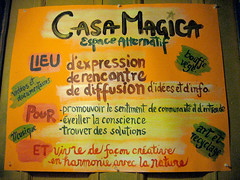
Casa Magica
Originally uploaded by sfllaw.
There's this artists collective on St-Laurent, across from La Sala Rossa. They call their place Casa Magica, and it's really quite groovy. They've got this cozy living area with an open plan. The kitchen is separated from the living room with a tiled countertop someone built themselves. It's decorated in that way with splashes of paint, splashes of light, and furnishings that look like they grew there. I showed up at this place to meet some people in the Free Software world. I've been in Montr al for about a year and I still don't know very many hackers in the city. So when I got invited to Les 24h SQIL, I decided to show up and meet some people. I went up St-Laurent to a non-descript red door with a poster about SQIL on it. "This must be the place," I thought as I tried the door. Upstairs, I was greeted by a living room full of random people: some sitting in front of computers, some chatting away, and one guy fiddling with a projector. I wandered around in a state of confusion until I was introduced to Robin. Robin Millette seems to do a lot of work for FACIL, which is an organisation for promoting free content in Quebec. He introduced me to a bunch of people, like Simon Raven whom I helped with finger-ldap. I met Fran ois from Quebec City, who was interested in Nitix. There was Nicolas who is a Java developer that writes web-based applications. And other people like Alex, Yan, Marco and Matthieu who seemed nice but I can no longer remember what they do. I returned later in the week to Robin's birthday party where I happened to meet Fabien, who is a consultant that does work on Firefox and Yannick who's a Ph.D. student at McGill. We had a good time talking about quantum computing and how to design a programming language for quantum computers. Good geeky times were had.

24 November 2005

Andrew Pollock: [life] My E-3 visa experiences

I've already fielded enquiries from two people who have found my blog via Google, and given the 10,500 visas a year being issued, there's only going to be more, so in the interests of not spending too much time answering questions individually, I'm going to write a detailed account of things. Disclaimer: This article is not a replacement for doing your own homework. I expressly disclaim any responsibility for you getting your visa application denied, being cavity searched when you attempt to enter the US, or being sent to Guantanamo Bay. In particular, this information is subject to change, and as I'm not applying for a new visa every day, I'm not going to know about the changes. If you find something here that is blatantly wrong, or out of date, please let me know, but at the moment, I'm writing about my experiences. I'm undecided about maintaining a website devoted to capturing the state of the art in E-3 visa applications. If in doubt, spend the money (and I do mean spend, it's not a cheap phone call) and call the information line - 1902 941 641 - to speak to a human being, and ask all the questions. Resources What's the process? Your potential employer (sponsor) needs to file a Labor Condition Application (see the form here). At present, this form hasn't been brought up to date with respect to E-3 visas, it's the same form used for H1-B visas. Your employer needs to have written at the top of each page "E-3 - Australia - to be processed". This bit of handwriting is apparently key. You need to have the signed LCA in your hot little hand before you roll up at the US Consulate to apply for your visa. As for how long these take to be processed by the Department of Labor, the FAQ says a week for postal applications. From my experience, and the experience of a couple of other people I've spoken to, it takes anything up to about four weeks. Generally speaking, you do not have to concern yourself with the LCA process, unless for some reason, you're sweating on the LCA so you can apply for your visa. My personal opinion is that the whole process is so long, bureaucratic and unpredictable, that you really don't want to be making any firm plans based on any assumptions on when you think anything is going to happen. Start your planning from when you have been issued your visa, not when you expect you will be issued your visa. Once the LCA has been issued, your sponsor will send it to you along with a wad of paperwork, most of which you just take with you to the consulate. You can make an appointment online. Paperwork-wise, you need to take a completed DS-156 and a DS-157 if you are male between 16 and 45. These forms are available here. You can make an appointment online, the links to make an appointment at each of the US Consulates are also here. I found that the lead time to an appointment was around a month, so if you know the LCA application has been made, you can probably make the booking at the Consulate, so as to try and parallelise things a little bit. What do you need to take to the interview? You need to take your completed DS-156 and DS-157 forms. You need one for each person. So if you are the principal (i.e. the person being hired), you need a DS-156 for yourself, and your spouse, and whichever of you is male needs a DS-157. Bring the sponsor's offer letter too. You need a receipt for a non-refundable visa application fee. You need one receipt per person applying for a visa. You get these receipts by paying $130 per person at any Australia Post outlet. As the visa is non-immigrant, you need to be able show some sort of ongoing connection with Australia. If you own property here, and are planning to continue owning it while in the US, bring a rates notice. I don't know what else is useful to demonstrate an ongoing connection. Also bring a bank statement, as you need to demonstrate an ability to support yourself while in the US. Bring birth certificates and marriage certificates. Also bring a copy of your University transcript, and any assessments that your employer may have had done that state that you hold the equivalent of a US degree. I'm not sure how hard and fast the whole degree thing is. I have an incomplete degree and about 10 years of work experience. This was sufficient. I don't know how you'd go with absolutely no degree and lots of work experience. Finally, you need to bring two US-sized passport photos. These are 5cm x 5cm, which are not what your average passport photo is like if you go somewhere and ask for a passport photo. Processing takes about 3 days, although you get an indication on the day as to whether you are successful or not. If you don't want to come back to collect your passport with the visa in it, you need to leave sufficient stamped, self-addressed envelopes so that the Consulate can mail the passports back to you. It's a bit hazy as to what constitutes 3 days, but assume 3 full working days, plus whatever time it takes for the postage, so up to 5 working days. Good luck with your visa application. Let me know how it goes, and if this has been of assistance.

Clint Adams: Musical Personality Disorder

Decklin, MPD looks pretty interesting. I have filed a wishlist bug on vux on the presumption that integrating it with mpd would be peachy keen. Still, mpdscribble is conspiring against me. That it can't get MusicBrainz IDs is a minor irritation. The more significant problem is that it doesn't work at all. For every song, it whines about skipping, like this:
new song detected (Leonard Cohen - Hey, That's No Way to Say Goodbye)
skipping detected, not submitting.
I'm not doing any skipping, and crossfade is set to '0'. I continue to use my happy NIH pseudosolution.

Erich Schubert: Wikipedia wasn't really new - so what is the difference?

Wikipedia wasn't really "new". Wikis have been around before. There were a dozen of encyclopedia attempts around (although maybe not using a wiki, and usually more focussed around a specific field of knowledge), there were huge collaboration applications. I think that Wikipedia just offered the right options for the users at the very right moment, when this "revolution" - people not using the web as a way to 'download' content as much, but to actually publish their very own stuff, taking over content production - was just kicking off, without being too fragmented yet. Today, you'll find dozen of "encyclopedias" for specific parts, who somewhat try to copy the success of Wikipedia, but which maybe was so successful because it didn't put up much restrictions on what it was to be used for... As for the "not new" part - take for example a look at DMOZ.org, which is for example used by Google as datasource for Directory.google.com. This has been around for years (since 1995?), 5 Million verified Links in there, 70k editors just to verify and organize the links (many just taking care of a small part like the links for their home town), and everybody can submit new links. I started being an editor when it had around 2 Million links, and "timed out" due to inactivity when it reached 3 Million. I have the impression (partially of course to the success of search robots like google, who have also "ruined" the directory business for e.g. Yahoo) that growth slowed down horribly the last years a lot. Although the level you could contribute wasn't that different from what e.g. Wikipedia offers. On the one hand it's a shame that great projects like DMOZ get so little attention, but on the other hand e.g. Wikipedia is fantastic, and I'm happy that many people have realized that they can be an active part of the web, not just a content consumer. That there is more to the web than to share music and access pr0n^Wcommercial websites.

Benjamin Drieu: Pick of the day, ccache

I recently tried and adopted ccache, which (quoting its webpage) acts as a caching pre-processor to C/C++ compilers, using the -E compiler switch and a hash to detect when a compilation can be satisfied from cache. This often results in a 5 to 10 times speedup in common compilations. I must say I was sceptical, but ccache really works great, specially when you have to compile again and again the same code, like a Debian package which you have to clean but which source code remained the same. The only glitch is installation. If you wish to use it by default for all your compilers, there is still some manual configuration. I'd really like it to provide an alternative to, say, cc.

23 November 2005

David Welton: Reading material

Via Ugo Cei I found this reading list: http://www.joelonsoftware.com/articles/FogCreekMBACurriculum.html, some of which looks to be interesting, but I'm not convinced that it's a selection where each book is a 9 or a 10. Books like the Mythical Man Month stand the test of time, and some of the books there are good ones by that measure, others look less convincing, at least judging by their contents (too focused on the 90ies, the bubble, a particular company), or some of the reviews on Amazon. Perhaps those aren't always worthwhile, but the real winners don't seem to have much flack thrown at them. I'd enjoy hearing why Joel et al. recommend them. I've read these: in addition to Microeconomics (6th Edition) as a textbook on Economics. What are your recommendations? All things considered, though, I have a hunch that it would be better to be out trying to *do* rather than reading books about doing...

Antti-Juhani Kaijanaho: I have a request for Planet Debian bloggers

If you have a firm opinion about the latest general resolution vote, please publish your ballot, and an explanation of your reasoning, in your blog (and hence in Planet Debian). Note that the ballots will all be published after the vote, so there is no voter confidentiality protecting your ballot in any case, and hearing your arguments will help people like me, who are undecided, to decide. I'm not looking to imitate anyone in my voting behaviour, but after the previous vote, I don't trust my personal reading of the proposals to be accurate or at least to reflect the reading that matters. Julien Danjou already explained his position:
Since I think we have to release Sarge as soon as possible in order to satisfay our users, I have just voted for postponing changes until Sarge is released.
Julien, I would like to ask you to publish and explain your full ballot. There are a lot of options in there, and it is not at all clear, at least to me, how one would order them to bring about a release of Sarge as soon as possible (note that I am as of yet undecided on even whether I want that or not:).

Next.

Previous.