Search Results: "ema"

19 March 2010

Alexander Reichle-Schmehl: RC-Bug statistics for Squeeze, calendar week 11:

Note: Please see RC-Bug statistics for Squeeze, calendar week 6 for an explanation of the numbers.
Total:615-84
Affecting Squeeze:481-78
Squeeze-only:105-12
Unfixed bugs remaining in Squeeze:376-66
Of these 376 bugs...
... are pending20-16
... are patched:50-15
... are duplicates:49+2
... are in Non-free or contrib:7-3
... are claimed by someone:12-2
... are fixed in the delayed queue:1-4
... are somehow marked as fixed:42-11
Or in other words:
Release critical bugs left in squeeze, when ignoring all these:
228 (-34 compared to previous statistics). With this release managers views, 402 (-70 compared to previous statistics) bugs remain to be fixed somehow before we can release.

Jon Dowland: The Dice Man and Generation X

The movie ' Fight Club' had a profound effect on me when I first saw it in 1999. I wasn't as fond of the originating novel, although there was something about the prose that Palahniuk used which I did enjoy. Since then I've read more of Palahniuk's work. My favourite of his books is actually Non-Fiction (a.k.a. Stranger than Fiction ): a collection of essays and interviews. Reading some of the stories in that collection, it becomes very clear where some of the concepts in his fiction originate. There are also a number of pieces on the craft of writing. He writes some really gushing praise about Amy Hempel:
When you study Minimalism in the novelist Tom Spanbauer's workshop, the first story you read is Amy Hempel's The Harvest. After that, you're ruined every other book you ever read will suck.
I recently read a couple of novels, both of which reminded me a lot of Fight Club. 'Generation X: Tales for an Accelerated Culture' by Douglas Coupland is an interesting tale of three or more societal drop-outs. Fight Club was written five years after Generation X and owes it a lot. 'Generation X' has curt, clipped passages and many dictionary-definition-esque side notes decoding hipster-slang, which add a lot of colour to the non-events of the story. These remind me both of the copous asides in Pratchett novels, or the chapter introductions in Philip K Dick's excellent 'Ubik'.
Historical Overdosing: To live in a period of time when too much seems to happen. Major symptoms include addiction to newspapers, magazines, and TV news broadcasts.
The novel goes absolutely nowhere, but that's actually one of the appealing things about it. When I mentioned this to my partner (who, as far as I know, has not read the book), she said that it sounded like the perfect tonic to a stressful life: imagine lying on a sunbed, doing nothing, reading about people lying on sunbeds, doing nothing. This is the first of Coupland's novels that I have read, but I managed to pick up a copy of 'Generation A' (so far as a I can tell, not a sequel, as such) 70% off as part of the closing-down sale at my local Borders store, so I will probably read that too. I also recently finished The Dice Man , by Luke Reinhart. It's a tongue-in-cheek pseudo-autobiography written under a pen-name about a psychiatrist who opts to delegate all life decisions to the throw of dice. Once again, Fight Club owes a lot to this book. The unhinged situations that occur are used to shine a satirical light on modern society. 'modern society' in the book is the 1970s. The distance between society then and now adds something to the novel's value now. Having said that, the narrator is not a particularly likeable character and it's hard to relate to him. Coincidentally my dad recently read this book and described it as 'misogynistic', which might be an understatement. Mind you, most of the characters, female or otherwise, are fairly 2D: perhaps intentionally the only fleshed out human is the narrator. In my favourite scene of the book, the narrator is in a situation under the influence of more than one drug. A TV set is on in the background. As the scene progresses, the events taking place on the TV are written about with increasing prominence compared to the main events of the scene. This escalates to a point where they are of equal importance and you can no longer easily distinguish the events taking place in the real world from those taking place on the television. This is the only part of the book that I can recall that employed any narrative tricks. The rest is by-the-numbers, and mostly internal monologue. The book is also at least 50% too long: the concept just doesn't stretch as far as it's forced to.

18 March 2010

Clint Adams: BSPs and Triage and squeeze

Some people want Debian 6.0 (codename "squeeze") to be released sometime this year. Personally I think there is some kitsch value in releasing it during DebCamp or DebConf, and there is something to be said for doing it just beforehand so that everyone can break unstable into insanity while rolling around on the quad under the hot August sun. Some people want it to happen sooner, possibly as soon as possible. Irrespective of your preferences, or if you care at all, we will repeat the time-honored mantra: it will be released when it's ready. Readiness is somewhat of a subjective measure, but we typically do not consider a potential release ready when the RC bug count is high. There are a lot of RC bugs right now. Typically these are fixed at some point by their maintainers. There are also some self-motivated individuals who enjoy fixing these bugs themselves, and this practice predates the RCBW initiative, though perhaps not to the same level of combined intensity and endurance. Then there are bug-squashing parties, or BSPs. A BSP can be held virtually which means that a bunch of people get together online and say that they are having a party, or it can be at a designated physical space. I attended one of the latter type not too long ago. This BSP was targeted specifically to newbies or people who might feel that they are unqualified to help squash bugs, but wished to learn how to contribute. Some group and one-on-one mentoring occurred, in areas of how packages are put together, how to patch things, how to submit patches to the BTS, how to reproduce bugs, and other more problem-specific topics. I really don't know how successful this endeavor was since getting metrics on the effectiveness of teaching has been a historically difficult problem. On the other hand, we did spend a fair amount of time actually squashing bugs, which is a bit easier to assess. One problem we had was that some people liked to be loud and distracting and demand unreasonable amounts of attention for topics that had nothing to do with bugs, Debian, or free software, but we made progress regardless. Marc Brockschmidt thinks we need more BSPs and more focus on bug triage. Bug triage can be very demotivating and many people dislike doing it. BSPs seem to have powers of motivation through group camaraderie or friendly competition, so I would agree that it's worth experimenting with.

17 March 2010

David Pashley: Letter to my MP regarding the Digital Economy Bill

I have just sent the following email to my MP, David Lepper MP, outlining my concerns about the Digital Economy Bill. I urge you to write to your MP with a similar letter. Open Rights Group's guide to writing to your MP
From: David Pashley <david@davidpashley.com>
To: David Lepper
Cc: 
Bcc: 
Subject: Digital Economy Bill
Reply-To: 
Dear Mr Lepper, 
I'm writing to you so express my concern at the Digital Economy Bill
which is currently working its way through the House of Commons. I
believe that the bill as it stands will have a negative effect on
the digital economy that the UK and in particular Brighton have
worked so hard to foster. 
Section 4-17 deals with disconnecting people reported as infringing
copyright. As it stands, this section will result in the possibility
that my internet connection could be disconnected as a result of the
actions of my flatmate. My freelance web development business is
inherently linked to my access of the Internet. I currently allow my
landlady to share my internet access with her holiday flat above me.
I will have to stop this arrangement for fear of a tourist's actions
jeopardising my business. 
This section will also result in the many pubs and cafes, much
favoured by Brighton's freelancers, from removing their free wifi. I
have often used my local pub's wifi when I needed a change of
scenery. I know a great many freelancers use Cafe Delice in the
North Laine as a place to meet other freelancers and discuss
projects while drinking coffee and working.
Section 18 deals with ISPs being required to prevent access to sites
hosting copyrighted material. The ISPs can insist on a court
injunction forcing them to prevent access. Unfortunately, a great
many ISPs will not want to deal with the costs of any court
proceedings and will just block the site in question. A similar law
in the Unitied States, the Digital Millenium Copyright Act (DMCA)
has been abused time and time again by spurious copyright claims to
silence critics or embarrassments.  A recent case is Microsoft
shutting down the entire Cryptome.org website because they were
embarrassed by a document they had hosted.  There are many more
examples of abuse at http://www.chillingeffects.org/
A concern is that there's no requirement for the accuser to prove
infringement has occured, nor is there a valid defense that a user
has done everything possible to prevent infringement. 
There are several ways to reduce copyright infringement of music and
movies without introducing new legislation. The promotion of legal
services like iTunes and spotify, easier access to legal media, like
Digital Rights Management free music. Many of the record labels and
movie studios are failing to promote competing legal services which
many people would use if they were aware of them. A fairer
alternative to disconnection is a fine through the courts. 
You can find further information on the effects of the Digital
Economy Bill at http://www.openrightsgroup.org/ and
http://news.bbc.co.uk/1/hi/technology/8544935.stm
The bill has currently passed the House of Lords and its first
reading in the Commons. There is a danger that without MPs demanding
to scrutinise this bill, this damaging piece of legislation will be
rushed through Parliament before the general election.
I ask you to demand your right to debate this bill and to amend the
bill to remove sections 4-18. I would also appreciate a response to
this email. If you would like to discuss the issues I've raised
further, I can be contacted on 01273 xxxxxx or 07966 xxx xxx or via
email at this address.
Thank you for your time.
-- 
David Pashley
david@davidpashley.com
Read Comments (0)

16 March 2010

Bdale Garbee: TeleMetrum v1.0 Order Placed

I've been too busy (work, family, and fighting a nasty cold!) to write much text lately, other than the comments I put on launch photos uploaded to my Flickr stream, but the remainder of our testing of the prototype TeleMetrum v0.2 boards went really well! The only significant change we decided to make before going to production was to change the 3.3 volt regulator from a 100mA to a 150mA part. This will ensure adequate power for the companion boards we have planned, even when the GPS chip is in maximum power mode searching for satellites during a cold start. So... [drum roll, please] Keith and I just placed the orders for our first production lot of TeleMetrum v1.0 boards! With any luck, in 3-4 weeks we should have a pile of altimeters to sell, along with the associated TeleDongle ground stations already in stock. Stay tuned!

Wouter Verhelst: Stuff

I'm running again. No, not running in a bubulle style; I'm running for DPL. It started as a fairly last-minute decision because I would hate to see an election with only one candidate, but then two other people submitted their candidacy right after me. As I stated in my candidacy email, I had "a concert" this weekend. Actually, there were three two-hour performances; two on saturday, one on sunday. Early on, I also suggested videotaping the performance (using the excellent dvswitch, for which I added a patch to support crossfading transitions) to the organising group within the choir, and they liked that. Apart from dvswitch, we used the theatre's own audio mixing setup (so I wouldn't have to worry about that too much) and the theatre's intercom system. I'd made some tally lights, but in the end we were not entirely able to use them, because there were some issues to be dealt with that meant I couldn't quite get them working properly. So on saturday, I was in the theatre pretty early to get everything set up, did some explanations to the volunteers who would do the actual recording, drove my dad (who'd done the direction for the video parts) home, went home, and found my bed at around midnight. On sunday, I got up fairly early, booted my laptop to update the live images with some fixes for some issues we'd encountered on saturday, left for the theatre fairly early again, set up the extra camera position, found out that one of the laptops was actually running at 100Mbit rather than a gigabit and that therefore the extra camera wasn't going to work, learned that one of the volunteers for sunday had done some other camera work for another performance right before that, for which he'd rented some high-end DV-capable cameras. So we broke down the two low-end set-ups, set up the high-end cameras, connected them to the laptops, recalibrated the whitebalance and the diaphragm setting, and restarted the streams. Then one laptop started failing. Since we had had to remove one camera anyway, I just replaced it. By that time, I had about 15 minutes left before sunday's performance would start, so I went to prepare for that. After the performance had finished, I found out that something had gone wrong with the sound of sunday's performance; rather than music, we only heard crackling all the time. Luckily, the sound had also been separately recorded to a different medium, and that recording is fine, so we only need to resync the audio to the video, which should not be a problem. All in all, I had an extremely busy weekend. The alert reader will note that I didn't mention 'food' anywhere in the above paragraphs, mostly because I hardly ever found the time to eat. But it was also extremely satisfying. We still have some postprocessing to do, but I expect I'll put some videos online once we've done that. They're truly stunning, at times. And then yesterday I still had to spend some time writing my DPL platform, and doing some campaigning work. All in all, I didn't find my bed until approximately 4 AM... oh well. I look forward to the election time, and hope that I will do well. I don't need to win, but I'd hope my result will be at least as good as the last time... Update: we used the theatre's audio setup, not video setup -- oops :-)

15 March 2010

Joey Hess: pre to droid

in which the Pre unsuprisingly continues to suck My Palm Pre was killed by a forced over the air WebOS upgrade. You can't avoid those upgrades, even if you are sure they'll be bad news. The previous WebOS upgrade spared my Debian partition, but lost all other customizations (including Palm Pre privacy fixes), and wasted hours. When I went to use my phone and it didn't even boot, and displayed only "http://palm.com/rom", I knew that was the last straw. (Shouldn't forcing an upgrade that breaks a working phone to the point that it can't even call 911 be well, illegal?) switching cell providers in the US: suprisingly doable I thought about ditching the smart phone and using VOIP, but I seem to have gotten addicted. So I got a Droid. That meant switching cell phone companies. I've heard a lot about how horrible the US cell phone company contracts are. My experience has me wondering if all that is well... not overblown, but oversimplified. I was half a year into a two year contract. Today I got my closing statement, and I really got out of it with no early termination fee. The trick seems to be, switch to a different cell phone company. They'll be happy to get you out of your old contract, salivating at the chance of locking you in to a new one. They probably have a script to use when calling to cancel. Or "know a guy". Or claim to know a guy, then just use a script, and get lucky. Given the hard sells and vague promises they tried on me, I assume that these places are where all the car salesmen ended up. Trust == 0. But it worked. If you're good on the phone, and are looking for a new business idea: Start a business of getting people out of their cell phone contracts, for a reasonable fee and no other obligation. Use loopholes like rate changes. As long as the cell phone companies can raise their monthly rate 2 cents, and 99.9999% of their users accept it, and they make untold millions of dollars, for free, they seem to not care if the remaining fraction use a loophole to get out. Especially if they're able to take advantage of other comanies loopholes to switch over users. So there seems to be a niche there in which one could prosper. droid first impressions So now I have a slightly larger lump in my pocket and the Pre is on a shelf, and will either be used for future development and testing of Debian piggyback ideas, or donated to someone like Lennart who can make good use of it. Compared with the Pre, the droid's hardware is all superior. The keyboard, especially, is great, with arrow keys, and all the symbols I need. At the same time, the phone is bigger, and oddly clunky. But in an endearing way. Only thing I really dislike about the hardware is the "back" button is easy to accidentially swipe while typing on the keyboard. Compared with WebOS, the Android UI has some clunkiness and non-obvious things. Like the status bar at the top not doing anything when you click on it. And there being no way to close an app. Especially annoying is that this means opening the web browser returns to whatever page I was on last, which is never what I want. The UI is however much, much snappier. I don't use the Google email, etc services so can't comment on them; I assume the amount of info Google is gathering about me went up by a few percentage points; I've blocked their analytics on my network to knock it back down. (PS: DuckDuckGo now avoids logging IP addresses at all.) The best thing is the ConnectBot application, which is a very usable shell and ssh client. It's a terminal, in my pocket, which I can easily use for an hour without feeling like my interactions are feeding through a stifling soda straw. Between the keyboard and the app, the Pre has nothing at all that compares. Under the hood, Android annoys me terribly, with its lack of busybox, its kernel that does not even have the ext* filesystem, its hard-partitioned storage, and its general lack of every single thing I like in a Linux system. Compare this with the Pre, which has a package manager, a userspace based on busybox with a full standard Linux stack (all the way up to PulseAudio) and a kernel with lots of standard filesystems, and even LVM. Sigh. It's amazing that WebOS and Android have found such broadly different ways to suck. There is significant interest and activity around running a Debian chroot on the Droid. The best tries so far put it on a loop mounted ext2 filesystem (which means you need to get ahold of a matching ext2.ko somehow), living on the FAT formatted SSD. And there are apparently some bad problems with IO to that starving/locking the system, so I have not tried it.

Russell Coker: The Yubikey

Picture of Yubikey Some time ago Yubico were kind enough to send me an evaluation copy of their Yubikey device. I ve finally got around to reviewing it and making deployment plans for buying some more. Above is a picture of my Yubikey on the keyboard of my Thinkpad T61 for scale. The newer keys apparently have a different color in the center of the circular press area and also can be purchased in white plastic. The Yubikey is a USB security token from Yubico [1]. It is a use-based token that connects via the USB keyboard interface (see my previous post for a description of the various types of token [2]). The Yubikey is the only device I know of which uses the USB keyboard interface, it seems that this is an innovation that they invented. You can see in the above picture that the Yubikey skips the metal that is used to surround most USB devices, this probably fails to meet some part of the USB specification but does allow them to make the key less than half as thick as it might otherwise be. Mechanically it seems quite solid. The Yubikey is affordable, unlike some token vendors who don t even advertise prices (if you need to ask then you can t afford it) and they have an online sales site. $US25 for a single key and discounts start when you buy 10. As it seems quite likely that someone who wants such a token will want at least two of them for different authentication domains, different users in one home, or as a backup in case one is lost or broken (although my experiments have shown that Yubikeys are very hardy and will not break easily). The discount rate of $20 will apply if you can find four friends who want to use them (assuming two each), or if you support several relatives (as I do). The next discount rate of $15 applies when you order 100 units, and they advise that customers contact their sales department directly if purchasing more than 500 units so it seems likely that a further discount could be arranged when buying more than 500 units. They accept payment via Paypal as well as credit cards. It seems to me that any Linux Users Group could easily arrange an order for 100 units (that would be 10 people with similar needs to me) and a larger LUG could possibly arrange an order of more than 500 units for a better discount. If an order of 500 can t be arranged then an order of 200 would be a good thing to get half black keys and half white ones you can only buy a pack of 100 in a single color. There is a Wordpress plugin to use Yubikey authentication [3]. It works, but I would be happier if it had an option to accept a Yubikey OR a password (currently it demands both a Yubikey AND a password). I know that this is less secure, but I believe that it s adequate for an account that doesn t have administrative rights. To operate the Yubikey you just insert it into a USB slot and press the button to have it enter the pass code via the USB keyboard interface. The pass code has a prefix that can be used to identify the user so it can replace both the user-name and password fields of course it is technically possible to use one Yubikey for authentication with multiple accounts in which case a user-name would be required. Pressing the Yubikey button causes the pass code to be inserted along with the ENTER key, this can take a little getting used to as a slow web site combined with a habit of pressing ENTER can result in a failed login (at least this has happened to me with Konqueror). As the Yubikey is use-based, it needs a server to track the usage count of each key. Yubico provides source to the server software as well as having their own server available on the net obviously it might be a bad idea to use the Yubico server for remote root access to a server, but for blog posting that is a viable option and saves some effort. If you have multiple sites that may be disconnected then you will either need multiple Yubikeys (at a cost of $20 or $15 each) or you will need to have one Yubikey work with multiple servers. Supporting a single key with multiple authentication servers means that MITM attacks become possible. The full source to the Yubikey utilities is available under the new BSD license. In Debian the base functionality of talking to the Yubikey is packaged as libyubikey0 and libyubikey-dev, the server (for validating Yubi requests via HTTP) is packaged as yubikey-server-c, and the utility for changing the AES key to use your own authentication server is packaged as yubikey-personalization thanks Tollef Fog Heen for packaging all this! The YubiPAM project (a PAM module for Yubikey) is licensed under the GPL [4]. It would be good if this could be packaged for Debian (unfortunately I don t have time to adopt more packages at the moment). There is a new model of Yubikey that has RFID support. They suggest using it for public transport systems where RFID could be used for boarding and the core Yubikey OTP functionality could be used for purchasing tickets. I don t think it s very interesting for typical hobbyist and sysadmin work, but RFID experts such as Jonathan Oxer might disagree with me on this issue.

Gregor Herrmann: RC bugs 2010/09, 2010/10

not many closed bugs in the last two weeks, & not even one RC bug per day worked on. anyway, here's my recent list:

14 March 2010

DebConf team: DebConf10 call for contributions (Posted by DebConf10 Talks Team)

The Debconf team is excited to announce that we are now accepting proposals for contributions to this year s Debian conference! We invite you to submit proposals for how you would contribute until the deadline: May 1st, 2010, 23h59 UTC. There are many ways you can contribute, you could present a technical paper, host a panel discussion, put on a tutorial, do a performance, an art installation, a debate, host a meeting (BoFs, or Birds of a Feather Session), or other possibilities that you devise. This year we are also accepting proposals for tracks a thematic grouping around a particular subject, and people to coordinate those tracks. If you are looking for ideas of things that you could contribute, or have ideas for things that you would like to see happen at Debconf, have a look at the Contribution Brainstorm page. DebConf talks will be broadcast live on the Internet where possible, unless otherwise requested. Videos of the talks will be published on the web along with the presentation slides and papers. Step 1. Submit Proposal Proposals should provide an overview of your proposed contribution, similar to an abstract, and be no more than 600 words. Since contributions can cover a range of issues, please describe what your proposal covers, be it political (Free Software, law, advocacy, access, etc.), technical (d-i, OpenPGP, etc.), social (Debian structures and groups). It s okay to hit all three of these. Your proposal should also include some information on why you re qualified to present, or coordinate this topic. For example, you can include links to posts you have made to Debian mailing lists or other material that indicates your qualifications. Proposals and their abstracts will be accepted until May 1st, 2010, 23h59 UTC. To submit your proposal, go to http://debconf10.debconf.org/register.xhtml and register as an attendee. Once you are registered, there is a Submit a proposal link. You will see your proposal on the site. You can choose between different presentation types. If you are unsure what type you should use, please read our definitions first. If it s not there for some reason, or you have questions, please contact us immediately. Step 2. Committee Review The review committee for this year will make its decision by May 1st, 2010. All correspondence will be done by email. Step 3. Paper Submission Like last year, we are asking for papers to be submitted along with the presentations. A full paper is optional, however we strongly encourage you to submit one if possible as we intend to provide written information along with transcripts of the sessions for later viewing. Having written papers in advance will allow us to get translations done to help non-native-English speakers feel more comfortable with the topics presented. Papers are due by July 1st, 2010, and should cover the topic in reasonable depth (3 pages A4 text, plus pictures and diagrams). We will use LaTeX to typeset the proceedings. Please submit your paper formatted in LaTeX. Should you be unfamiliar with LaTeX earlier submission in plain text is also fine. Step 4. Live Presentation Longer presentations may have a break in the middle and should include workshop items that directly involve the participants. If using slides or any other presentation, please consider that your audience will consist of people who use free software, and your choice of application to prepare and display the slides should reflect this if at all possible. Fine Print Publication Rights Debconf requires non-exclusive publication rights to papers, presentations, and any additional handouts or audio/visual materials used in conjunction with the presentation. The authors have the freedom to pick a DFSG-free license for the papers themselves and retain all copyrights. The presentations will be recorded, and may be broadcast over the Internet. Any copies of the presentation will be made available under a license like the MIT/X11 license. Failure to Submit In the event that a deadline is missed we reserve the right to revoke any offer to present.

Biella Coleman: Call for Contributions

It is a little later than we wanted but here it finally is: Debconf10 call for contributions. Do read as it has some new ideas, categories, and prospects. Also make sure to share with us on the brainstorming page.

Biella Coleman: Call for Contributions

It is a little later than we wanted but here it finally is: Debconf10 call for contributions. Do read as it has some new ideas, categories, and prospects. Also make sure to share with us on the brainstorming page.

Biella Coleman: Training it up to Debconf

im_going_to_debconf10 That s right: I am taking the train uptown to my old romping ground, Columbia University, for Debconf10. I am supremely and superbly excited as I tend to really like these events, so much so, that I am also pretty involved with the organizing team. For those on the edge of a decision, here are a few thoughts that might push you toward the edge of f*ck yea, I am gonna go! So one important, one of the MOST important parts of the conf is the venue and Columbia University is a fantabulous venue. In fact, it is the only great venue, imho, in all of Manhattan so I was pretty thrilled (and relieved) to hear that it was secured. It is an oasis in an otherwise bustling city. And better, a compact oasis where everything is nestled and close to each other, within like 3 minutes walking distance of each other. Even better is that the grounds and architecture are quite beautiful and charming. There are these majestic stairs, the steps where you can soak in the sun, great lawns for tossing a Frisbee, wonderful and smaller patches of lawn behind old school red brick buildings, and statutes, one of which is great for climbing on to sit and contemplate the day or night or just life, as I used to love to do. It is a great campus for staying up late and watching the sun rise. My fondest times was when the campus was blanketed under a mountain of snow, but it is pretty nice over the summer as well. We have also secured an all night hack lab, which is a pretty essential touch. We are also thinking beyond the venue, concocting and expanding ideas for contributions, a great day trip (that will likely not entail a bus but a beach, lots of Russians, roller coasters, and even baseball, oh and lots of NY Kitsch), and there are many other ideas swirling around. We are about to release the call for contributions so you will learn more, including some information on how to brainstorm with us, so be on the look out and remember to register if you ve made your decision!

13 March 2010

Lucas Nussbaum: RC bugs of the week

I just couldn t resist I joined the game, but did it the other way around. I could only file 51 new FTBFS (Fail To Build From Source) bugs this time. Looks like Squeeze is getting closer! I ve also been doing rebuilds of Ubuntu lucid. There are currently 561 packages that fail to build from source in lucid/amd64, versus 430 in sid/amd64 (I will start rebuilding squeeze instead of sid after the freeze). Surprisingly, only 131 packages fail in both. I would have expected that number to be much higher. The 51 new FTBFS bugs:
#573648: gnome-chemistry-utils: FTBFS: Nonexistent build-dependency: libgoffice-0-8-dev
#573649: /api/package-list is no longer compressed
#573650: /api/package-list is no longer compressed
#573651: virt-top: FTBFS: configure: error: Cannot find required OCaml package extlib
#573652: heartbeat: FTBFS: Nonexistent build-dependency: libcluster-glue-dev
#573653: abiword: FTBFS: Nonexistent build-dependency: libgoffice-0-8-dev
#573654: helium: FTBFS: Makefile: hGetLine: invalid argument (Invalid or incomplete multibyte or wide character)
#573655: mlton-cross: FTBFS: /bin/sh: wget: not found
#573656: pytest-xdist: FTBFS: ImportError: No module named setuptools
#573657: libfile-fu-perl: FTBFS: tests failed
#573658: libphysfs: FTBFS: docs/man/man3/PHYSFS_addToSearchPath.3: No such file or directory at /usr/bin/dh_installman line 127.
#573659: ecl: FTBFS: rm: cannot remove /build/user-ecl_10.2.1-1-amd64-S2bazb/ecl-10.2.1/debian/ecl/usr/share/info/dir : No such file or directory
#573660: /api/package-list is no longer compressed
#573661: libdbix-class-schema-loader-perl: FTBFS: tests failed
#573662: /api/package-list is no longer compressed
#573663: libthai: FTBFS: /usr/bin/install: cannot stat ./../doc/man/man3/th_render_text_tis.3 : No such file or directory
#573664: /api/package-list is no longer compressed
#573665: hunspell-dict-ko: FTBFS: build hangs
#573666: plexus-active-collections: FTBFS: missing junit:junit:jar:debian
#573667: nuapplet: FTBFS: Can t find gnutls library developpement files!
#573668: binutils-z80: FTBFS: /bin/sh: cannot open /build/user-binutils-z80_2.20-3-amd64-MwJBIl/binutils-z80-2.20/binutils-2.20.tar.bz2: No such file
#573669: keynav: FTBFS: keynav.c:799: error: too few arguments to function xdo_mousemove
#573670: moblin-panel-applications: FTBFS: moblin-netbook-launcher.c:1640: undefined reference to mx_scroll_view_get_vscroll_bar
#573671: tetradraw: FTBFS: /bin/bash: line 1: automake-1.7: command not found
#573672: beid: FTBFS: rm: cannot remove _src/eidmw/bin/eidmw_*.qm : No such file or directory
#573673: swfdec-gnome: FTBFS: Nonexistent build-dependency: libswfdec-0.8-dev
#573674: swfdec-mozilla: FTBFS: Nonexistent build-dependency: libswfdec-0.8-dev
#573675: jasmin-sable: FTBFS: Error: JAVA_HOME is not defined correctly.
#573676: corosync: FTBFS: Depends field, reference to libcorosync4 : error in version: version string is empty
#573677: banshee-extension-mirage: FTBFS: ./PlaylistGeneratorSource.cs(469,39): error CS0539: Banshee.PlaybackController.IBasicPlaybackController.Next in explicit interface declaration is not a member of interface
#573678: gnucash: FTBFS: Nonexistent build-dependency: libgoffice-0-8-dev
#573679: libwx-perl: FTBFS: xvfb-run: error: Xvfb failed to start
#573680: /api/package-list is no longer compressed
#573681: fso-usaged: FTBFS: fsobasics-2.0.vapi:110.2-110.84: error: FsoFramework already contains a definition for AsyncWorkerQueue
#573682: libiscwt-java: FTBFS: Nonexistent build-dependency: libswt-gtk-3.4-java
#573683: nordugrid-arc-nox: FTBFS: ld: cannot find -larccrypto
#573684: cssc: FTBFS: rm: cannot remove /build/user-cssc_1.2.0-1-amd64-XCK7aQ/cssc-1.2.0/debian/cssc/usr/share/info/dir* : No such file or directory
#573685: django-threaded-multihost: FTBFS: distutils.errors.DistutilsError: Could not find suitable distribution for Requirement.parse( setuptools-hg )
#573686: /api/package-list is no longer compressed
#573687: davical: FTBFS: /bin/sh: phpdoc: not found
#573688: gauche-gtk: FTBFS: gauche-gtk.c:450: error: too few arguments to function Scm_Apply
#573689: quilt: FTBFS: tests failed
#573690: pyabiword: FTBFS: Nonexistent build-dependency: libgoffice-0-8-dev
#573691: flumotion: FTBFS: configure: error: You need at least version 2.0.1 of Twisted
#573692: libnet-dns-zone-parser-perl: FTBFS: tests failed
#573693: nip2: FTBFS: Nonexistent build-dependency: libgoffice-0-8-dev
#573694: hedgewars: FTBFS: Error: Illegal parameter: -Nu
#573695: epsilon: FTBFS: FAILED (skips=5, expectedFailures=1, errors=7, successes=229)
#573696: python-glpk: FTBFS: Unsatisfiable build-dependency: libglpk-dev(inst 4.43-1 ! <= wanted 4.38.999)
#573697: libnanoxml2-java: FTBFS: cp: cannot stat /usr/share/doc/default-jdk-doc/api/package-list.gz : No such file or directory
#573698: doxia-maven-plugin: FTBFS: Reason: Cannot find parent: org.apache.maven.doxia:doxia

Biella Coleman: Stuff I have been enjoying (a freaken lot)

So in the last week I have read some stuff, seen some presentations, and visited some sites that I have really loved, so here they are to share: Trollcats (this will take my power point slides to a whole NEW level) and here is one for all the free software geeks, in particular. I finally read Manuela Carneiro da Cunha fantastic Prickly Paradigm press book Culture and Culture: Traditional Knowledge and Intellectual Rights. If you don t know jack about the thorny issues around indigenous knowledge an IPR, the first 2/3 provides a pretty darn good introduction rooted not only in an explanation of trade treaties, the limited repertoire available for indigenous groups to politically respond, but a great story about a specific frog that secretes a sticky film that basically F s you up (if you let it seep in your open wounds). It is entertaining. The last 1/3 takes a far more theoretical turn and will be harder to understand for novices (it helps if you have like at least a BA, possibly MA in anthro, best if you have a PhD from her academic home, U of Chicago). It is there where she discusses the relationship between culture as reflexive (hey, peoples of the world, we have x, y, c culture) as lived unreflexively (the unconscious plane of norms that helps guide perception and action). I loved her theoretical somersaults whereby she explained how contradictions between the two are experienced as anything but a contradiction. Ok so today I went to this conference Radars and Fences III (where I presented my anon/scientology talk for the first time 3 years ago!). I was not able to stay the whole day but I saw Ricardo Dominguez & Amy Sara Carroll from the Electronic Disturbance Theater present on the Transborder Immigrant Tool, which I knew about but did not know how infused it was in poetry, poetry that is, in fact, an integral part of its arsenal. Their presentation was fantastic and it reminds me the great political work being done at the interface of art and technology (and believe me, these 2 are rabble rousers. UCSD, who helped fund the project, are not all that happy they did and they also get not hate mail they get but the HATE mail). Then I saw Laila El Haddad & Mushon Zer-Aviv present on an amazing project You are Not Here which is a bit hard to explain briefly but I will try (and their site introduces it as an urban tourism mash-up. It takes place in the streets of one city and invites participants to become meta-tourists of another city. So basically there are two interlinked sites (NYC and Baghdad and Tel Aviv and Gaza) where you can be a tourist (though the physical place to follow the symbols are only in NYC and Tel Aviv). You need a map. You get a map. The map, once put up to the light shows two cities/places with symbols that indicate a special spot on the map. You find the physical spot, there is sticker or other sign with a phone number, you call, and you hear a story not about NYC or Tel Aviv (where you would physically go) but about Baghdad or Gaza and a story that pertains to the area of the map that overlaps where you are in NYC or Tel Aviv. We saw a bunch of examples and they were riveting and powerful.

12 March 2010

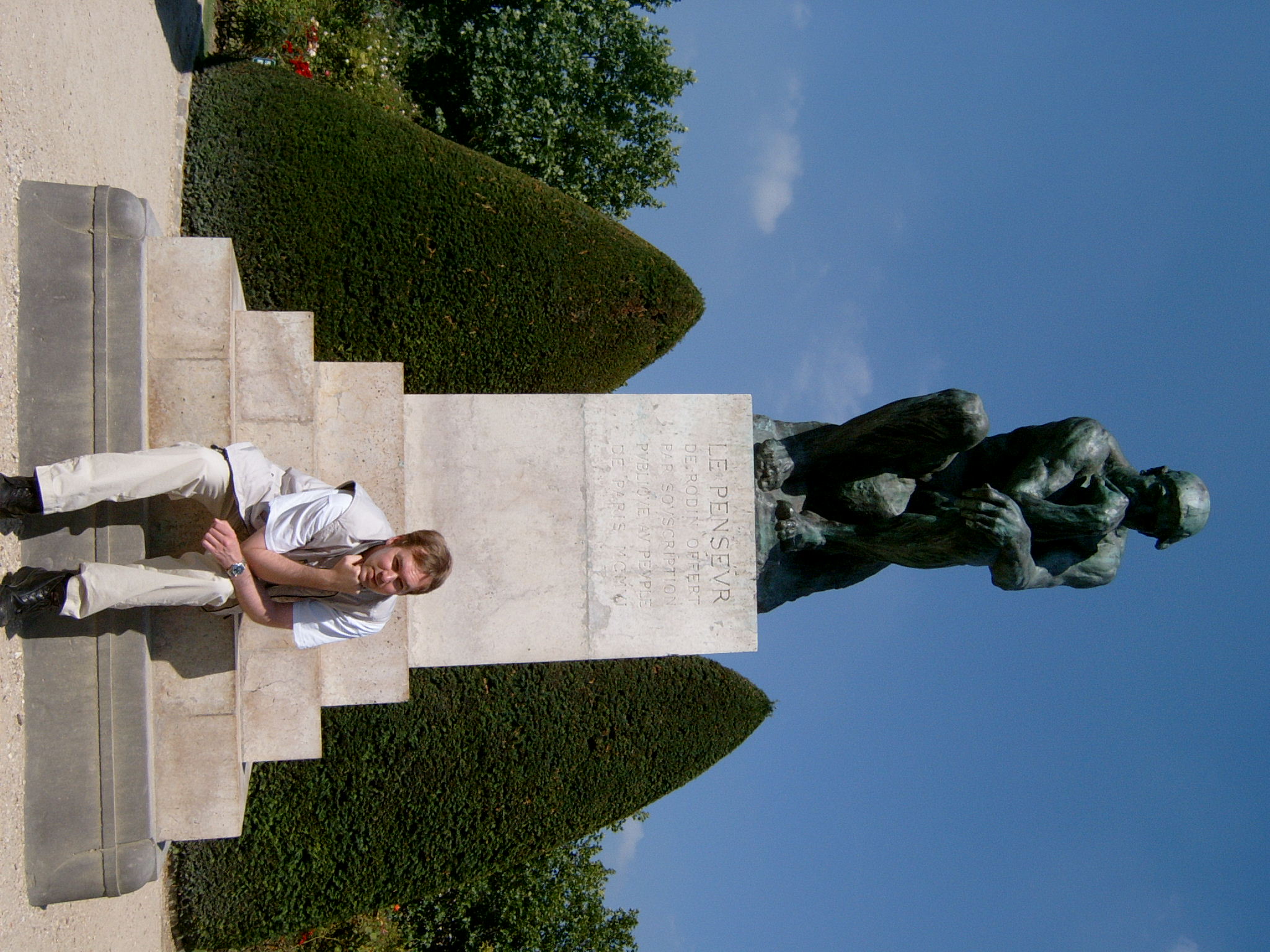
Russell Coker: CAL Self-Serving and Useless

Me Thinking about Copyright in front of Le Pensevr Brendan Scott linked to a couple of articles about CAL (the Copyright Agency Limited) [1]. I have previously written about CAL and the way that they charge organisations for the work of others without their consent [2]. My personal dispute with CAL is that they may be charging people to use my work, I have not given them permission to act on my behalf and will never do so. If they ever bill anyone for my work then it will be an act of piracy. The fact that the government through some bad legislation permitted them to do such things doesn t prevent it from being piracy you can t disagree with this claim without supporting the past actions of China and other countries that have refrained from preventing factories from mass-producing unauthorised copies of software. The first article concerns the fact that last year CAL paid more than $9,400,000 in salary to it s employees (including $350,000 to it s CEO) while it only paid $9,100,000 directly to the authors [3]. It also spent another $300,000 to send it s executives to a junket in Barbados. It did give $76,000,000 to publishers on the assumption that a proportion of this money will be returned to authors of course said publishers could have used the money to have holidays in Barbados. CAL doesn t bother to check who ends up with shares of the $76,000,000 so it s anyone s guess where it ends up. The second article is by James Bradley who is an author and director of CAL [4]. He claims that much of the $76,000,000 was distributed to authors, although I m not sure how he would have any idea of how much it was which is presumably why he used the word much instead of some other word with a clearer meaning such as most . He also notes that CAL invested $1,000,000 in projects specifically designed to promote the development and dissemination of Australian writing , which sounds nice until you consider the fact that none of the authors (apart from presumably the few who sit on the CAL board) had any say in the matter. Can I take a chunk of the $9,400,000 that is paid to CAL employees and invest it in something? If not then why not? If they can invest money that was owed to other people then why can t I invest their salaries? James also says The issue of how well CAL serves rights-holders and authors and artists in particular is a vital one which is remarkably silly. He is entirely ignoring the fact that some rights holders don t want to be served by CAL at all. The fact that CAL can arbitrarily take money for other people s work is an infringement on their rights. He further demonstrates his ignorance by saying Without CAL and the licences we administer, users educational institutions, government agencies and corporate organisations, to name just a few would be required to seek permission every time they reproduced copyright material or run the risk of legal action for copyright infringement of course any educational institution can use Creative Commons licensed work [5]. I ve previously written about the CK12 project to develop CC licensed text books for free use [6]. There s no reason why the same thing can t be done for university text books. In the discussion following Claudine Chionh s LUV talk titled Humanities computing, Drupal and What I did on my holidays [7] it was suggested that it should be possible to gain credit towards a post-graduate degree based on work done to share information this could mean setting up a Drupal site and populating the database or it could mean contributing to CC licensed text books. Let s face it, a good CC text book will be read by many more people than the typical conference proceedings! James says that CAL is used Instead of having to track down individual rights-holders every time they want to reproduce copyright material . The correct solution to this problem would be to change the copyright law such that if a reasonable attempt to discover the rights-holder fails then work is deemed to be in the public domain. The solution to the problem of tracking down rights-holders is not to deny them their rights entirely and grant CAL the right to sub-license their work! He also makes the ridiculous claim Whereas in the age of the physical book schools and universities could have bought fewer books and made up the difference by using photocopies, it is now possible for an organisation to buy a single set of digital materials and reproduce them ad infinitum which implies that CAL is the only thing saving the profits of authors from unrestricted digital copying. Of course as CAL seems to have no active enforcement mechanisms and they apparently charge a per-student fee they really have no impact on the issue of a single licensed copy being potentially used a million times extra use apparently won t provide benefits to the author and use in excess of the licensing scheme won t be penalised. He asks the rhetorical question After all, why go to the expense of creating a textbook (or some form of digital course materials) if you are going to sell only a half-dozen copies to state education departments . The answer is obvious to anyone who has real-world experience with multiple licensing schemes you can sell one single copy and make a profit if the price is high enough. The smart thing for the education departments to do would be to pool their resources and pay text book companies for writing CC licensed texts (or releasing previously published texts under the CC). The average author of a text book would probably be very happy to earn $100,000 for their work, the editorial process probably involves a similar amount of work. So if the government was to offer $300,000 for the entire rights to a text book then I m sure that there would be more than a few publishers tendering for the contract. According to the CIA World Fact Book there are 2,871,482 people in Australia aged 0-14 [8], that means about 205,000 per year level. CAL charges $16 for each primary and secondary student so the government is paying about $3,280,000 every year per year level. Even in year 12 the number of text books used is probably not more than 10, so it seems to me that if all the money paid to CAL by schools in a single year was instead used to fund Creative Commons licensed text books then the majority of the school system would be covered! The universities have a much wider range of text books but they also have higher CAL fees of $40 per student. After cutting off the waste of taxpayer money on CAL fees for schools that money could be invested in the production of CC licensed university text books.

Matt Brubeck: Discovering Urbit: Functional programming from scratch

C. Guy Yarvin is a good friend of Mencius Moldbug, a pseudonymous blogger known for iconoclastic novella-length essays on politics and history (and occasionally computer science). Guy recently published under his own name a novel project in language and systems design. His own writing about his work is entertaining but verbose (as Moldbug's readers might expect), so I will attempt to summarize it here. Nock, Urbit, Watt First there is Nock, a tool for defining higher-level languages comparable to the lambda calculus, but meant as foundational system software rather than foundational meta mathe matics. Its primitives include positive integers with equality and increment operators, cons cells with car/cdr/cadr/etc., and a macro for convenient branching. Nock uses trees of integers to represent both code and data. Next, Guy provides the rationale for Nock. In short, he asks how a planet-wide computing infrastructure (OS, networking, and languages) would look if designed from first priniciples for robustness and interoperability. The answer he proposes is Urbit: a URI-like name space distributed globally via content-centric networking, with a feudal structure for top-level names and cryptographic identities. Urbit is a static functional name space: it is both referentially transparent and monotonic (a name, once bound to a value, cannot be un- or re-bound). Why does this require a new formal logic and a new programming language? In Urbit, all data and code are distributed via the global namespace. For interoperability, the code must have a standard format. Nock's minimal spec is meant to be an un ambiguous, unchanging, totally standardized basis for computation in Urbit. Above it will be Watt, a self-hosting language that compiles to Nock. Urbit itself will be implemented in Watt, so Nock and Watt are designed to treat data as code using metacircular evaluation. The code A prototype implementation of Watt is on GitHub. It is not yet self-hosting; the current compiler is written in C. Watt is a functional language with static types called molds and a mechanism for explicit lazy evaluation. (I was suprised to find I had accidentally created an in com patible lazy dialect of Nock despite its goal of unambiguous semantics just by implementing it in Haskell.) The code is not fully documented, but the repository contains draft specs for both Watt and Urbit. Beware: the syntax and terminology are a bit unconventional. Guy has offered a few exercises to help get started with Nock and Watt:
The Nock challenge:
Write a decrement operator in Nock, and an interpreter that can evaluate it.
Basic Watt:
Write an integer square root function in Watt.
Advanced Watt:
How would you write a function that tests whether molds A and B are orthogonal (no noun is in both A and B)? Or compatible (any noun in A is also in B)? Are these functions NP-complete? If so, how might one work around this in practice?
If you want to learn more, start with these problems. You can email your solutions to Guy. Will it work? I find Urbit intellectually appealing; it is a simple and clean architecture that could potentially replace a lot of complex system software. But can we get there from here? Guy imagines Urbit as the product of an ages-old Martian civilization:
Since Earth code is fifty years old, and Martian code is fifty million years old, Martian code has been evolving into a big ball of mud for a million times longer than Earth software. (And two million times longer than Windows.) Therefore, at some point in Martian history, some abject fsck of a Martian code-monkey must have said: fsck this entire fscking ball of mud. For lo, its defects cannot be summarized; for they exceed the global supply of bullet points; for numerous as the fishes in the sea, like the fishes in the sea they fsck, making more little fscking fishes. For lo, it is fscked, and a big ball of mud. And there is only one thing to do with it: obliterate the trunk, fire the developers, and hire a whole new fscking army of Martian code-monkeys to rewrite the entire fscking thing. This is the crucial inference we can draw about Mars: since the Martians had 50 million years to try, in the end they must have succeeded. The result: Martian code, as we know it today. Not enormous and horrible tiny and diamond-perfect. Moreover, because it is tiny and diamond-perfect, it is perfectly stable and never changes or decays. It neither is a big ball of mud, nor tends to become one. It has achieved its final, permanent and excellent state.
Do Earthlings have the will to throw out the whole ball of mud and start from scratch? I doubt it. We can build Urbit but no one will come, unless it solves some problem radically better than current software. Moldbug thinks feudalism will produce better online reputation, but feudal reputation does not require feudal identity; it is not that much harder to build Moldbug's reputation system on Earth than on Mars. I still have not figured out the killer app that will get early adopters to switch to Urbit.

Stefano Zacchiroli: RC bugs of the week - issue 24

RCBW - #24 Some pause, and here we go with another RCBW issue. The pause has involved various Debian-related work, such as preparing OCaml batteries included for Squeeze and of course preparing my DPL platform. Without any further ado, here are this week's squashes: Random points:

Next.

Previous.