Search Results: "don"

15 March 2014

Lars Wirzenius: Obnam 1.7 (backup software)

I have just released version 1.7 of Obnam, my backup program. Version 1.7, released 2014-03-15 WARNING: This release has had fairly large parts of the internals re-written. There shouldn't be any externally visible changes due to that, but there is a chance of bugs. Be careful. Make a copy of your backup repository before upgrading, if you can. Bug fixes: Internal changes:

14 March 2014

Richard Hartmann: Git prize: Outstanding Contribution to Open Source/Linux/Free Software

In February, Linux Magazine contacted me, asking if I would be willing to accept the Linux New Media Award 2014 in the main category "Outstanding Contribution to Open Source/Linux/Free Software" on behalf of the Git community due to my involvement with evangelizing and vcsh. Needless to say, I was thrilled. I managed to poke Junio via someone at Google and he agreed. We also reached out within the German Git community and two maintainers of git submodule, Jens Lehmann and Heiko Voigt, joined in as well. While we didn't manage to hammer out interoperability issues of vcsh and git submodule due to time constraints and too much beer, we are planning to follow up on that. Git beat OpenStack, Python, and Ubuntu by a huge margin; sadly I don't have exact numbers (yet). More details and a rather crummy photo can be found in Linux Magazine's article. A video of the whole thing will uploaded to this page soonish. If it appears that we kept our "speech" very short, that was deliberate after the somewhat prolonged speeches beforehand ;) The aftershow event was nice even though the DJ refused to turn down the music down to tolerable levels; his reaction to people moving father away, and asking him to turn down the volume a bit, was to turn it up... Anyway, given the mix of people present during the award ceremony, very interesting discussions ensued. While I failed to convert Klaus Knopper to zsh and git, at least there's a chance that Cornelius Schuhmacher will start using vcsh and maybe even push for a separation of configuration and state in KDE. The most interesting tidbits of the evening were shared by Abhisek Devkota of cyanogenmod fame. Without spilling any secrets it's safe to say that the future of cyanogenmod is looking extremely bright and that there are surprises in the works which will have quite the impact. Last but not least, here's the physical prize: Glass trophy held by your's truly

Neil Williams: LAVA server on an arndale

(ARMv7 A15 dual core) I ve covered how I set up my home LAVA lab and how I got two iMX.53 boards running, the next step was to sort out the LAVA server. My initial setup relied on using my Thinkpad as the server. This was somewhat convenient as that s how I develop the code, but didn t help me run jobs like health checks because the laptop was usually somewhere other than on the home LAN. There had been a long-standing problem with using LAVA on ARM the uwsgi support didn t compile but the code being used was old. As the same code has been in Debian for a long time, I suspected that this was fixed with a newer version. So as part of migrating LAVA to django1.6, apache2.4, postgres9.3, django-tables2 0.13 and a few other updated dependencies, I have been using the version of uwsgi from Debian unstable for quite a while without problems on x86. A simple tweak to the LAVA setup scripts and a newer version of uwsgi became available and it builds just fine on armhf. (I haven t tried armel because Linaro is ARMv7 or newer and we don t test with ARMv5/ARMv6 boards, so there s no point in trying armel it s not likely to be an issue for this fix though.) (Only the current lava-deployment-tool methods need to actually compile uwsgi directly from upstream without any patches the packaging which will replace l-d-t uses precompiled binaries, just as any admin would expect.) That initial install was on one of the iMX.53 boards, which ran as slowly as anyone who has used an iMX.53 would expect. I haven t run test jobs on that install, it had a hard enough time serving the frontend. Clearly some more cores would be a good step and when an arndale became available for the home lab, the next step was to get a SATA drive onto the arndale, put Debian unstable on that and then deploy LAVA to the arndale using the Debian packages. As a bonus, these packages are built for django1.6 (using an unreleased branch). Sounds simple enough. It works on iMX.53, it should work on an arndale. Well, it does but only after some unexpected faff. arndale, u-boot and SATA I hate u-boot every single time I ever touch it, the little I know about any other u-boot device is completely useless. Uniformity is a good thing infinite permutations are just rope to hang ourselves with cute embedded nonsense hacks and I m bored of that whole scene. So, boot the arndale, interrupt the bootloader to get to the prompt. What s the first thing most people would want? help. Denied this particular u-boot has been compiled without the ability to display any help messages. u-boot has just sunk further into the depths of please can we have something else which is uniform across devices . OK, well maybe I can get by without help. sata init unknown command sata . (Go away, do something else for a bit.) The arndale isn t one of the newest boards in the ARMv7 world, LAVA has been using them for a while, so someone has probably done some work to fix this . nope. There s a workaround a nice detailed guide by Phil Endecott which details that the kernel needs to continue to be loaded from SD and then the SATA can be used for just the rootfs. Mildly annoyed (I was hoping to be able to update the arndale kernel without the hassle of mounting the SD card at all), the rest was straight-forward. Preparing the SATA and installing Debian Due to the complexity of some of the transitions currently ongoing in Debian ahead of the Jessie release freeze, uwsgi is not in Debian testing right now so this install has to be Debian unstable. That s OK, I ve been running Debian unstable on all my machines for several years now usually updating ~5 times a week.

# parted /dev/sda -s unit mb mktable msdos
# parted /dev/sda -s unit mb mkpart primary 1 -- "-0"
# mkfs.ext4 /dev/sda1
# mount /dev/sda1 /mnt/root/
(note the in the mkpart command, that catches me out most times I try this. Without it, the special -0 gets interpreted as an option to parted but parted doesn t then tell you how to fix it, it just complains about an unknown option.) The SD image I am using is a LAVA master image, based on Ubuntu, so it was easy to put debootstrap onto it.

# apt-get install debootstrap
# debootstrap --arch=armhf sid /mnt/root/ http://ftp.uk.debian.org/debian
# chroot /mnt/root/
Inside the chroot, it s Debian as usual:

apt-get update
apt-get install emdebian-archive-keyring
passwd
emdebian-archive-keyring is a package I (ab)use to sign my LAVA packaging as it has the advantage of being in Debian and Ubuntu going back to the time of Lenny, so it is always available from a repository which has already been authenticated to apt and doesn t involve downloading some random key from a website. I use passwd manually because this rootfs won t be using auto-login, it will have regular users. root passwords can be automated, if necessary. Thinking about login, remember to give the rootfs a usable tty. (The LAVA master image has a nasty habit of mangling editors like nano and vi when used over serial, so I m using echo.) For the arndale you need:

# echo T0:23:respawn:/sbin/getty -L ttySAC2 115200 vt102 >> ./etc/inittab
# echo >> ./etc/securetty
# echo ttySAC2 >> ./etc/securetty
Then to make the hostname useful, adapt this to your needs:

echo 127.0.0.1 arndale.codehelp arndale >> ./etc/hosts
Finally, get the network running at boot and add the LAVA repository:

# echo auto lo eth0 > ./etc/network/interfaces.d/arndale
# echo iface lo inet loopback >> ./etc/network/interfaces.d/arndale
# echo iface eth0 inet dhcp >> ./etc/network/interfaces.d/arndale
# echo deb http://people.linaro.org/~neil.williams/lava sid main >> ./etc/apt/sources.list.d/lava.list
# apt-get update
# exit
Once the LAVA packaging is finalised, the packages will be uploaded to a normal Linaro PPA, I ll update the packages to use an official download location and we ll move to using sane version string handling. For now, the packages are still in development. Code for the packaging is in Alioth but there are issues with anonymous access to the pkg-linaro-lava repositories currently, so I ve also pushed to http://github.com/Linaro if you are interested in building the packages yourself. See also my packaging guide which is also linked from the Links page on my own site. With that done, time to reboot, set the SATA drive as the rootfs using the horrid u-boot and install LAVA.

# reboot
> setenv bootargs console=tty0 console=ttySAC2,115200n8 drm_kms_helper.edid_firmware=edid-1920x1080.fw root=/dev/sda1
> boot
login
# apt-get install postgresql
After this operation, 63.0 MB of additional disk space will be used.

# apt-get install lava-server
After this operation, 231 MB of additional disk space will be used.

# a2dissite 000-default
# a2ensite lava-server
# apache2ctl restart
# service lava-server restart
Take note of the IP address of your new ARM LAVA server and sign in with your regular details, e.g. using OpenID before creating a temporary superuser:

# lava-server manage createsuperuser --username default --email=user@example.com
Choose a temporary password, log out, log in as the temporary superuser, promote your regular user to superuser and default owner of unrestricted devices in the django admin interface. Finally, log out and login as regular user to delete the temporary user. (Yes, that probably could do with some improvement remind me later and I ll see if a known user can be promoted from the command line.) See also Senthil s recent post on LAVA unit tests. Getting those to run without so many steps is also on the TODO list. Results
IP Address: 127.0.0.1
Is Master? : True
Uptime: 6:02:23.700000
Architecture: armv7l
Platform: Linux-3.10.1.0-1-linaro-arndale-armv7l-with-debian-jessie-sid
Insignal Arndale evaluation board based on EXYNOS5250
System memory: 1998MiB
Next! I m working on some code upstream to make it easier to add devices from the command line. The aim is that a set of simple commands will set up an initial device, run a job on that device and submit a result bundle to the LAVA server as job #1. This gives some assurance that everything has gone well. Now I can finally add health checks for the iMX.53 boards and start regular tests on those boards. The cubie boards will wait for a later blog post, there are interesting problems with the bootloader and serial connections. That s a whole different rant.

12 March 2014

Matthew Garrett: Dealing with Apple ACPI issues

I wrote about Thunderbolt on Apple hardware a while ago. Since then Andreas Noever has somehow managed to write a working Thunderbolt stack, which awesome! But there was still the problem I mentioned of the device not appearing unless you passed acpi_osi="Darwin" on the kernel command line, and a further problem that if you suspended and then resumed it vanished again.

The ACPI _OSI interface is a mechanism for the firmware to determine the OS that the system is running. It turns out that this works fine for operating systems that export fairly static interfaces (Windows, which adds a new _OSI per release) and poorly for operating systems that don't even guarantee any kind of interface stability in security releases (Linux, which claimed to be "Linux" regardless of version until we turned that off). OS X claims to be Darwin and nothing else. As I mentioned before, claiming to be Darwin in addition to Windows was enough to get the Thunderbolt hardware to stay alive after boot, but it wasn't enough to get it powered up again after suspend.

It turns out that there's two sections of ACPI code where this Mac checks _OSI. The first is something like:

if (_OSI("Darwin")) Store 0x2710 OSYS; else if(_OSI("Windows 2009") Store 0x7D9 OSYS; else

ie, if the OS claims to be Darwin, all other strings are ignored. This is called from \_SB._INI(), which is the first ACPI method the kernel executes. The check for whether to power down the Thunderbolt controller occurs after this and then works correctly.

The second version is less helpful. It's more like:

if (_OSI("Darwin")) Store 0x2710 OSYS; if (_OSI("Windows 2009")) Store 0x7D9 OSYS; if

ie, if the OS claims to be both Darwin and Windows 2009 (which Linux will if you pass acpi_osi="Darwin"), the OSYS variable gets set to the Windows 2009 value. This version gets called during PCI initialisation, and once it's run all the other Thunderbolt ACPI calls stop doing anything and the controller gets powered down after suspend/resume. That can be fixed easily enough by special casing Darwin. If the platform requests Darwin before anything else, we'll just stop claiming to be Windows.

Phew. Working Thunderbolt! (Well, almost - _OSC fails and so we disable PCIe hotplug, but that's easy to work around). But boo, no working battery. Apple do something very strange with their ACPI battery interface. If you're running anything that doesn't claim to be Darwin, Apple expose an ACPI Control Method battery. Control Method interfaces abstract the complexity away into either ACPI bytecode or system management traps - the OS simply calls an ACPI method, magic happens and it gets an answer back. If you claim to be Darwin, Apple remove that interface and instead expose the raw ACPI Smart Battery System interface. This provides an i2c bus over which the OS must then speak the Smart Battery System protocol, allowing it to directly communicate with the battery.

Linux has support for this, but it seems that this wasn't working so well and hadn't been for years. Loading the driver resulted in modprobe hanging until a timeout occurred, and most accesses to the battery would (a) take forever and (b) probably fail. It also had the nasty habit of breaking suspend and resume, which was unfortunate since getting Thunderbolt working over suspend and resume was the whole point of this exercise.

So. I modified the sbs driver to dump every command it sent over the i2c bus and every response it got. Pretty quickly I found that the failing operation was a write - specifically, a write used to select which battery should be connected to the bus. Interestingly, Apple implemented their Control Method interface by just using ACPI bytecode to speak the SBS protocol. Looking at the code in question showed that they never issued any writes, and the battery worked fine anyway. So why were we writing? SBS provides a command to tell you the current state of the battery subsystem, including which battery (out of a maximum of 4) is currently selected. Unsurprisingly, calling this showed that the battery we wanted to talk to was already selected. We then asked the SBS manager to select it anyway, and the manager promptly fell off the bus and stopped talking to us. In keeping with the maxim of "If hardware complains when we do something, and if we don't really need to do that, don't do that", this makes it work.

Working Thunderbolt and working battery. We're even getting close to getting switchable GPU support working reasonably, which is probably just going to involve rewriting the entirety of fbcon or something similarly amusing.

comment count unavailable comments

Vasudev Kamath: Working around type system of Go with unsafe

Go language has a strong type system unlike C, and some times this will be head ache when we want to interact with C data types with Cgo or just to convert a Go type to lets say byte slice. I recently faced the same problem and after poking around things, I learned the Go provides unsafe package which can be used to work around the Go's type system.
Problem Recently I started using Cgo to use some C library I had to write some tools for development and testing. The reason I chose Go for this was prototyping and writing some quick tools is much easier in Go than done in C. The C library had some function which takes pointer to array types and fills it with some values. The problem I was facing here was how to create a C array in Go. Go does have array but its largely used as internal representation for much efficient type called slice and I can't directly cast a byte slice into an C array. Second problem I had was I had to store arbitrary Go types like float (float32,float64) and int (int32, int64) etc. into C array. So in brief, the problems that needed to solve are
  1. Find a way to convert byte slice from Go into C array and vice versa.
  2. Find a way to convert and store Go types into a C array.
Solution Basically C array are sequence of memory location which can be statically or dynamically allocated. In Cgo its possible to access C standard library functions for memory allocation, so why not use it. The memory allocation function then returns the pointer to starting of allocated memory, we can use this pointer to write Go's bytes into the memory location and bytes from memory location into Go's slice. The pointer returned by C allocation functions are not directly usable for memory dereferencing in Go, here is where unsafe package kicks in. We will cast the return of C allocation function as unsafe.Pointer type and from the documentation of unsafe package,
  1. A pointer value of any type can be converted to a Pointer.
  2. A Pointer can be converted to a pointer value of any type.
  3. A uintptr can be converted to a Pointer.
  4. A Pointer can be converted to a uintptr.
So we can then cast unsafe.Pointer to uintptr which is the Go type which is large enough to hold any memory address in Go and can be used for pointer arithmetic just like we do in C (of course with some more castings). Below I'm pasting a simplified code in C which I wrote for this post.
#ifndef __BYTETEST_H__
#define __BYTETEST_H__
typedef unsigned char UBYTE;
extern void ArrayReadFunc(UBYTE *arrayout);
extern void ArrayWriteFunc(UBYTE *arrayin);
#endif
#include "bytetest.h"
#include <stdio.h>
#include <string.h>
void ArrayReadFunc(UBYTE *arrayout)
 
     UBYTE array[20] =  1, 2, 3, 4,5, 6, 7, 8, 9, 10,
                        11, 12, 13, 14, 15, 16, 17,
                        18, 19, 20 ;
     memcpy(arrayout, array, 20);
 
void ArrayWriteFunc(UBYTE *arrayin)
 
     UBYTE array[20];
     memcpy(array, arrayin, 20);
     printf("Byte slice array received from Go:\n");
     for(int i = 0; i < 20; i ++) 
             printf("%d ", array[i]);
      
     printf("\n");
 
Functions are written just for this post and they don't really do anything. As you can see ArrayReadFunc takes a pointer to array and fills it with content of another array using memcpy. Function ArrayWriteFunc on other hand takes pointer to array and copies its content to internal array. I've added print logic to ArrayWriteFunc just to show that values passed from Go are making it here. Below is the Go code which uses the above C files passes byte slice to get value out of C code and array made of byte slice to C function to send values in.
package main
/*
#cgo CFLAGS: -std=c99
#include "bytetest.h"
#include <stdlib.h>
*/
import "C"
import (
     "fmt"
     "unsafe"
)
func ReadArray() unsafe.Pointer  
       var outArray = unsafe.Pointer (C.calloc(20,1))
       C.ArrayReadFunc((*C.UBYTE)(outArray))
       return outArray
 
func WriteArray(inArray unsafe.Pointer)  
       C.ArrayWriteFunc((*C.UBYTE)(inArray))
 
func CArrayToByteSlice(array unsafe.Pointer, size int) []byte  
       var arrayptr = uintptr(array)
       var byteSlice = make([]byte, size)
       for i := 0; i < len(byteSlice); i ++  
               byteSlice[i] = byte(*(*C.UBYTE)(unsafe.Pointer(arrayptr)))
               arrayptr ++
        
       return byteSlice
 
func ByteSliceToCArray (byteSlice []byte) unsafe.Pointer  
       var array = unsafe.Pointer(C.calloc(C.size_t(len(byteSlice)), 1))
       var arrayptr = uintptr(array)
       for i := 0; i < len(byteSlice); i ++  
              *(*C.UBYTE)(unsafe.Pointer(arrayptr)) = C.UBYTE(byteSlice[i])
              arrayptr ++
        
       return array
 
func main() 
        carray := ReadArray()
        defer C.free(carray)
        carraybytes := CArrayToByteSlice(carray, 20)
        fmt.Println("C array converted to byte slice:")
        for i := 0; i < len(carraybytes); i ++  
                fmt.Printf("%d ", carraybytes[i])
         
        fmt.Println()
        gobytes := []byte 21, 22, 23, 24, 25, 26, 27, 28, 29, 30,
                31, 32, 33, 34, 35, 36, 37, 38, 39, 40 
        gobytesarray := ByteSliceToCArray(gobytes)
        defer C.free(gobytesarray)
        WriteArray(gobytesarray)
 
Functions ReadArray and WriteArray are just wrapper to the calls to C counter parts ArrayReadFunc and ArrayWriteFunc. ReadArray returns unsafe.Pointer which is allocated C array and should be freed by caller. WriteArray takes unsafe.Pointer which is pointing to memory location containing C array. Now the functions of interest are CArrayToByteSlice and ByteSliceToCArray. It should be pretty clear from the above code to understand what is happening in these functions. Still I will just put explain them briefly. ByteSliceToCArray allocates a C array using calloc from C standard library. It then creates a uintptr, a pointer type in Go which is used to dereference the each memory location and store bytes from the input byte slice in them. CArrayToByteSlice on other hands creates a uintptr type by casting input unsafe.Pointer type and then uses this pointer type to dereference values from memoy and store it in byte slice with suitable casting. So lets build the code and run it and see the output:
C array converted to byte slice:
1 2 3 4 5 6 7 8 9 10 11 12 13 14 15 16 17 18 19 20
Byte slice array received from Go:
21 22 23 24 25 26 27 28 29 30 31 32 33 34 35 36 37 38 39 40
So yes it actually works and values are moving across C and Go. This solves first problem in hand next is converting arbitrary Go types into byte slices. There are many cases where we would like to convert an arbitrary Go types like (int, float) into bytes. One such use case I found was when writing a TCP client for communicating with a Server written using C speaking custom protocol. Here I'm just going to show how to convert types like float, int to byte slice, I've not tried converting structures but it is certainly possible. Below is the function which can convert int32,float32 into byte slice it can also be extended for other types.
func CopyValueToByte(value interface ) []byte  
     var valptr uintptr
     var slice []byte
     switch t := value.(type)  
     case int32:
             i := value.(int32)
             valptr = uintptr(unsafe.Pointer(&i))
             slice = make([]byte, unsafe.Sizeof(i))
     case float32:
             f := value.(float32)
             valptr = uintptr(unsafe.Pointer(&f))
             slice = make([]byte, unsafe.Sizeof(f))
     default:
             fmt.Fprintf(os.Stderr,"Unsupported type: %T\n", t)
             os.Exit(1)
      
     for i := 0; i < len(slice); i++  
             slice[i] = byte(*(*byte)(unsafe.Pointer(valptr)))
             valptr++
      
     return slice
 
This function is generic which can take various types of value. First we will use Go's type assertion to determine the type and creates a uintptr pointer for the value and allocates byte slice depending on the size of the value as calculated using unsafe.Sizeof. Later it uses the pointer to dereference value from memory location and copies each byte into byte slice. The idea used here is every type is represented as certain number of bytes in the memory. Below is the entire program.
package main
import (
     "fmt"
     "unsafe"
     "os"
)
func CopyValueToByte(value interface ) []byte  
     var valptr uintptr
     var slice []byte
     switch t := value.(type)  
     case int32:
             i := value.(int32)
             valptr = uintptr(unsafe.Pointer(&i))
             slice = make([]byte, unsafe.Sizeof(i))
     case float32:
             f := value.(float32)
             valptr = uintptr(unsafe.Pointer(&f))
             slice = make([]byte, unsafe.Sizeof(f))
     default:
             fmt.Fprintf(os.Stderr,"Unsupported type: %T\n", t)
             os.Exit(1)
      
     for i := 0; i < len(slice); i++  
             slice[i] = byte(*(*byte)(unsafe.Pointer(valptr)))
             valptr++
      
     return slice
 
func main()  
     a := float32(-10.3)
     floatbytes := CopyValueToByte(a)
     fmt.Println("Float value as byte slice:")
     for i := 0; i < len(floatbytes); i++  
             fmt.Printf("%x ", floatbytes[i])
      
     fmt.Println()
     b := new(float32)
     bptr := uintptr(unsafe.Pointer(b))
     for i := 0; i < len(floatbytes); i++  
             *(*byte)(unsafe.Pointer(bptr)) = floatbytes[i]
             bptr++
      
     fmt.Printf("Byte value copied to float var: %f\n", *b)
 
The above conversion can also be achieved using encoding/binary package provided by Go. But its been told to me that it makes things pretty slow.
Conclusion So goes unsafe.Pointer is really powerful thing which allows us to work around the Go's type system but as package documentation says it should be used with care
PS: I'm not really sure if its recommended to use allocation functions from C standard library, I will wait for expert gophers to comment on that.

Petter Reinholdtsen: How to add extra storage servers in Debian Edu / Skolelinux

On larger sites, it is useful to use a dedicated storage server for storing user home directories and data. The design for handling this in Debian Edu / Skolelinux, is to update the automount rules in LDAP and let the automount daemon on the clients take care of the rest. I was reminded about the need to document this better when one of the customers of Skolelinux Drift AS, where I am on the board of directors, asked about how to do this. The steps to get this working are the following:
  1. Add new storage server in DNS. I use nas-server.intern as the example host here.
  2. Add automoun LDAP information about this server in LDAP, to allow all clients to automatically mount it on reqeust.
  3. Add the relevant entries in tjener.intern:/etc/fstab, because tjener.intern do not use automount to avoid mounting loops.
DNS entries are added in GOsa , and not described here. Follow the instructions in the manual (Machine Management with GOsa in section Getting started). Ensure that the NFS export points on the server are exported to the relevant subnets or machines:
root@tjener:~# showmount -e nas-server
Export list for nas-server:
/storage         10.0.0.0/8
root@tjener:~#
Here everything on the backbone network is granted access to the /storage export. With NFSv3 it is slightly better to limit it to netgroup membership or single IP addresses to have some limits on the NFS access. The next step is to update LDAP. This can not be done using GOsa , because it lack a module for automount. Instead, use ldapvi and add the required LDAP objects using an editor.
ldapvi --ldap-conf -ZD '(cn=admin)' -b ou=automount,dc=skole,dc=skolelinux,dc=no
When the editor show up, add the following LDAP objects at the bottom of the document. The "/&" part in the last LDAP object is a wild card matching everything the nas-server exports, removing the need to list individual mount points in LDAP.
add cn=nas-server,ou=auto.skole,ou=automount,dc=skole,dc=skolelinux,dc=no
objectClass: automount
cn: nas-server
automountInformation: -fstype=autofs --timeout=60 ldap:ou=auto.nas-server,ou=automount,dc=skole,dc=skolelinux,dc=no
add ou=auto.nas-server,ou=automount,dc=skole,dc=skolelinux,dc=no
objectClass: top
objectClass: automountMap
ou: auto.nas-server
add cn=/,ou=auto.nas-server,ou=automount,dc=skole,dc=skolelinux,dc=no
objectClass: automount
cn: /
automountInformation: -fstype=nfs,tcp,rsize=32768,wsize=32768,rw,intr,hard,nodev,nosuid,noatime nas-server.intern:/&
The last step to remember is to mount the relevant mount points in tjener.intern by adding them to /etc/fstab, creating the mount directories using mkdir and running "mount -a" to mount them. When this is done, your users should be able to access the files on the storage server directly by just visiting the /tjener/nas-server/storage/ directory using any application on any workstation, LTSP client or LTSP server.

11 March 2014

Steve Langasek: My CuBox-i has arrived

A couple of weeks ago, Gunnar Wolf mentioned on IRC that his CuBox-i4 had arrived. This resulted in various jealous noises from me; having heard about this device making the rounds at the Kernel Summit, I ordered one for myself back in December, as part of the long-delayed HDification of our home entertainment system and coinciding with the purchase of a new Samsung SmartTV. We've been running an Intel Coppermine Celeron for a decade as a MythTV frontend and encoder (hardware-assisted with a PVR-250), which is fine for SD video, but really doesn't cut it for anything HD. So after finally getting a TV that would showcase HD in all its glory, I figured it was time to upgrade from an S-Video-out, barely-limping-along tower machine to something more modern with HDMI out, eSATA, hardware video decoding, and whose biggest problem is it's so small that it threatens to get lost in the wiring! Since placing the order, I've been bemused to find that the SmartTV is so smart that it has had a dramatic impact on how we consume media; between that and our decision to not be a boiled frog in the face of DISH Network's annual price increase, the MythTV frontend has become a much less important part of our entertainment center, well before I ever got a chance to lay hands on the intended replacement hardware. But that's a topic for another day. Anyway, the CuBox-i4 finally arrived in the mail on Friday, so of course I immediately needed to start hacking on it! Like Gunnar, who wrote last week about his own experience getting a "proper" Debian install on the box, I'm not content with running a binary distribution image prepared by some third party; I expect my hardware toys to run official distro packages assembled using official distro tools and, if at all possible, distributed on official distro images for a minimum of hassle. Whereas Gunnar was willing to settle for using third-party binaries for the bootloader and kernel, however, I'm not inclined to do any such thing. And between my stint at Linaro a few years ago and the recent work on Ubuntu for phones, I do have a little knowledge of Linux on ARM (probably just enough to be dangerous), so I set to work trying to get the CuBox-i4 bootable with stock Debian unstable. Being such a cutting-edge piece of hardware, that does pose some challenges. Support for the i.MX6 chip is in the process of being upstreamed to U-Boot, but the support for the CuBox-i devices isn't there yet, nor is the support for SPL on i.MX6 (which allows booting the variants of the CuBox-i with a single U-Boot build, instead of requiring a different bootloader build for each flavor). The CuBox-i U-Boot that SolidRun makes available (with source at github) is based on U-Boot 2013.10-rc4, so more than a full release behind Debian unstable, and the patches there don't apply to U-Boot 2014.01 without a bit of effort. But if it's worth doing, it's worth doing right, so I've taken the time to rebase the CuBox-i patches on top of 2014.01, publishing the results of the rebase to my own github repository and submitting a bug to the Debian U-Boot maintainers requesting its inclusion. The next step is to get a Debian kernel that not only works, but fully supports the hardware out of the box (a 3.13 generic arm kernel will boot on the machine, but little things like ethernet and hdmi don't work yet). I've created a page in the Debian wiki for tracking the status of this work.

Ian Wienand: Tenvis IP391W meta-page

Recently I purchased a Tenvis IP391W-HD camera. I would be unlikely to recommend it. The price is certainly right and the picture quality is quite good. The Android and iPhone apps do work to watch the stream live. However, the interface is terrible and almost useless without Internet Explorer. There is a RTSP stream (rtsp://admin:password@ip) which VLC can seem to handle, but not mplayer. The recording format (.h264) is not viewable by VLC or mplayer and all I could find is a Windows .exe to convert them to an .avi. The motion detection gets troubled by the dark. It would really only be useful for something permanently well-lit. It did send me emails via gmail. I have got it recording to a NFS server, but I don't have a lot of confidence in the reliability of it. I think I have it configured to record in 3600-second blocks (given the interface, it's hard to tell if I've set it up to the network, or to the internal flash, etc), but it seems to intersperse 60 minute recordings with random small recordings. Given the whole idea of a security camera is to record the unexpected, you want a lot of confidence you're actually recording, which you don't get with this. You can see below it recorded 3 hour blocks, then started going a little crazy...
-rw-r--r-- 1 nobody nogroup  69M Mar 11 01:25 0-003035.v264
-rw-r--r-- 1 nobody nogroup  69M Mar 11 02:25 0-013049.v264
-rw-r--r-- 1 nobody nogroup  69M Mar 11 03:26 0-023103.v264
-rw-r--r-- 1 nobody nogroup 5.9M Mar 11 03:31 0-033117.v264
-rw-r--r-- 1 nobody nogroup 1.5M Mar 11 03:40 0-034350.v264
-rw-r--r-- 1 nobody nogroup  17M Mar 11 04:02 0-035259.v264
-rw-r--r-- 1 nobody nogroup 306K Mar 11 04:10 0-041548.v264
-rw-r--r-- 1 nobody nogroup 4.9M Mar 11 04:23 0-042457.v264
There is a support forum, where I found the following files scattered in various posts. From what I can tell, they are the latest as of this writing. I can confirm they work with my IP391W-HD, which the system tells me is GM8126 hardware and came with firmware 1.2.8.3.
  • 1.3.3.3.pk2 - firmware (b56f211a569fb03a37d13b706c660dcb)
  • web.pk2 - a UI update that includes dropbox support. This is really for the model that has pan and tilt, so those buttons don't work. (0e42e42bd6f8034e87dcd443dcc3594d)
  • V264ToAVIen.exe - converts the output to an AVI file that mplayer will play (with some complaints) (9c5a858aa454fed4a0186cf244c0d234)
www.modern.ie offers free limited-time Windows VM's which will work to upload this firmware. Just make sure you use a bridged network in the VM; I'm guessing the firmware ActiveX control tells the camera to TFTP the data from it, which doesn't work via NAT. Somewhat worryingly, you can telnet to it and get a login prompt (TASTECH login). So it has a built-in backdoor you can't disable. There have been some efforts to hack the device. leecher@dose.0wnz.at did an excellent job reverse engineering the .pk2 format and writing tenvis_pack.c (no license, I'm generously assuming public domain). I used this to recreate the firmware above with a telnet daemon listening with a shell on port 2525 (no password, just telnet to it)
It's interesting to poke around, but it seems like the whole thing is really driven by a binary called ipc8126
/ # ipc8126 --help
*** TAS-Tech IPCAM/DVS
*** Version: 1.3.3.3
*** Release date: 2013-08-05 15:48:32
In general, I'd say hackability is quite low. Warning : any of the above might turn your camera into a paperweight. It worked for me, but that's all I can say...

10 March 2014

Jaldhar Vyas: 7DRL 2014/Procedural Death Jam

Each year the 7DRL competion gives me an opportunity to abandon developing a roguelike game part way through. This year I am going to strive mightily to actually complete a playable game though owing to family commitments I have already gotten off to a rocky start which does not bode well. But enough negativity... So this year 7DRL coincides with the first ever Procedural Death Jam. This is a similar type of thing except the genre is Procedural Death Labyrinth. Procedural Death Labyrinths are a subset of Roguelikes (or is it the other way round?) If you have taken advantage of the wonderful offer Valve has given to Debian developers, you can find a number of examples of Procedural Death Labyrinths on Steam. The most important part of any software development project is of course choosing a cool name. My game is called "The Girl Who Played With The Dragons Nest" (Can you guess what I've been reading?) It is written in C++ with the Curses toolkit. It will of course be open source. I intend to blog my progress here if you care to follow along.

Andrew Pollock: [life] Day 41, Running, Kindergarten, baking

I got up not as early as I'd have liked, and did the first 10km run I've done for a while, with my new shoes and the orthotics in them. It was a bit cooler, and despite not being particularly well hydrated, I lasted the distance, and managed to complete it in under an hour. I'm a long way off my best time at the moment, but I'm hoping as it cools down my running fitness will improve. I ended up doing a bunch of startup-related stuff today, instead of Debian stuff. It felt good to make some vaguely forward progress, even if it was just business operations planning stuff. I picked up Zoe from Kindergarten by bike. We'd both confirmed with her several times since Friday as to which mode of transport she wanted to use to come home, and she'd indicated the bike. Zoe was asleep as usual, but woke up pretty easily. The Kindergarten has indicated that they want everyone out of the centre by 2:30pm, which makes it a bit of a challenge to rouse a deeply sleeping child and exit the centre in 10 minutes. I managed to sunscreen her while she was still horizontal, so that sped things up, and it helped greatly that she didn't have a post-nap meltdown. One of her class mates and her mother were hanging around waiting for her big brother to finish school, and the bike trailer tends to be a good conversation starter, so we chatted for a little bit before leaving. It was nice to properly meet another parent, and I'm glad to see Zoe's started learning some of her class mates names. I had a kale, carrot and apple juice for lunch today, and as I hate wasting the pulp out of the juicer, I'd previously found a nice muffin recipe that I could use the kale and carrot pulp in. I'd previously baked a batch of mini muffins for Zoe's lunches, and was pleased that she liked them. We were getting a bit low, so I thought we'd bake another batch this afternoon, so that's what we did after we got home. Once they were in the oven, Zoe went off to watch TV and I made a start on dinner. Bedtime went nice and smoothly tonight.

Matthew Garrett: The simple things in life

I've spent a while trying to make GPU switching work more reliably on Apple hardware, and got to the point where my Retina MBP now comes up with X running on Intel regardless of what the firmware wanted to do (test patches here. But in the process I'd introduced an additional GPU switch which added another layer of flicker to the boot process. I spent some time staring at driver code and poking registers trying to figure out how I could let i915 probe EDID from the panel without switching the display over and made no progress at all.

And then I realised that nouveau already has all the information that i915 wants, and maybe we could just have the Switcheroo code hand that over instead of forcing i915 to probe again. Sigh.

comment count unavailable comments

8 March 2014

Lisandro Dami&aacute;n Nicanor P&eacute;rez Meyer: Does your app use Qt4? You better start porting it to Qt5

As you might know, Qt 4 is now in bug-fixes-only maintenance mode. This means that only bug fixes are allowed to be pushed to Qt 4's repository, but no new features.

On the other hand, Qt 5 is already here. Porting existing apps from Qt 4 to Qt 5 is actually easier than it was to port Qt 3 stuff to Qt 4. Take a look at this Qt project's wiki page for more info. Also pay attention at the links at the bottom of it under "Recommended Reading".

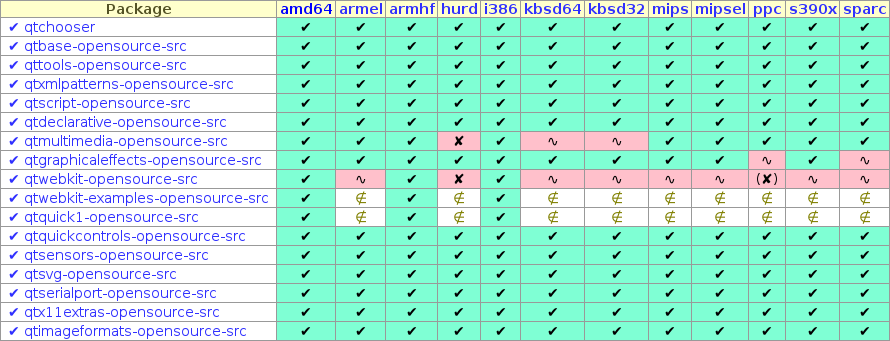
Some time ago I blogged about the 5.2.0 status in Debian experimental. We currently have it in testing with a much better status:


And we also have 5.2.1 in experimental with an even better status:

Note: qttools is FTBFS in armhf just because of some symbols changes, it will be fixed on the next upload.
Don't be afraid of getting it from experimental! Take a look at this blog post to know how to compile with Qt 5 in Debian.

BonusI have also uploaded Qt Creator built against Qt 5 to experimental. I plan to push it to unstable with Qt 5.2.1.

Paul Tagliamonte: Donate to MediaGoblin!

If you re the sort that cares about federation, the MediaGoblin project is for you!

MediaGoblin is a media hosting platform, where you can post all sorts of things, like video, images or even 3d models. It s a nice replacement for things like Flickr, and YouTube, and super easy to set up.

If I wasn t such a lazy person, I d have uploaded it to Debian, but alas. Soon. Soon!

It s an official GNU project, and it s maintainer, Chris is a totally awesome guy, and MediaGoblin is really important work.


If you feel the urge to support federation on the web, Support MediaGoblin! Help us take back the net!

Andrew Shadura: Process isolation support in start-stop-daemon

Yesterday I played with LXC a bit, and I liked it, as LXC provides a very lightweight isolation of processes, much like enchanced chroot. However, I realised, I don t always need the chroot-like part of LXC, sometimes what I need is just to make sure the process is unable to see the other processes and talk to them in any other way except the filesystem, but I don t want a whole separate root file system for that. LXC provides a simple utility, lxc-unshare, which uses Linux-specific clone(2) call to run a process with new PID, IPC and other namespaces. However, this utility can t be used for running forking daemons, as the container is destroyed when its PID 1 exits. That s why I decided to add the support for process isolation to start-stop-daemon. I was careful enough to introduce minimal changes to it to make sure they can be merged back to the version as shipped with dpkg, and at the same time be buildable separately from the rest of it. Speaking of building, by the way, this version of start-stop-daemon uses mk-configure, a light-weight autotools replacement, as its build system. What I added, from a user s perspective, is a single --isolate option. When run with this option, start-stop-daemon calls clone(2) just before configuring the environment of a process it s going to run. The cloned process runs in a new namespace, and immediately remounts /proc, /dev/shm and /dev/mqueue. Then it forks, and a forked process executes the daemon. The parent process, which is PID 1 in the new PID namespace, uses waitpid(2) to monitor its child processes. As soon as its very first child exits, it talks via a pipe to the process outside of the container, so that it knows the container has a forked daemon and it needs to detach. In any case, the container s PID 1 does waitpid(2) in a loop, checking the process list every time a child terminates. As soon as it s left alone or a SIGTERM is received, it exits. The code is published at Bitbucket.

Mart&iacute;n Ferrari: Fun with the Linux desktop

Or, "Why 2014 will NOT be the year of Linux in the desktop". So, it happens that my mum (66 yo) has been a Debian user for over a year now. With highs and lows, she manages to do what she needs; sometimes I need to intervene. Today I thought I could send her a quick email explaining how to download using BitTorrent, because of reasons. So, as I was writing, I realised that in many torrent sites, you only get a magnet link these days. No problem! Click on the magnet link, at it should work automagically. Then I remembered: it works on my computer, because I've spent a couple of hours some time ago researching how to make FireFox work with magnet links, creating a custom script, etc. I hoped that by now this must have been solved, at least in Debian unstable. Wrong again. I created a new user in my computer, launched IceWeasel/FireFox and boom: I get a dialog asking me to select a program, not from a list of desktop applications, taken from one of the gazillion sources where applications are defined, but just from any place on the file system! (At least, now you don't need to go tweaking with the hidden FireFox configuration editor). I was very angry at the brainiac at Mozilla who thought it was a great idea to ignore the host system and do their own MIMEtype handling. And then, tried Chromium to see what would happen... And I get first a scary message telling me that it is going to use the super-obscure xdg-open program to open my link, and that it could harm my computer! It was followed by another very helpful dialog telling me something like:
Unable to detect the URI-scheme of "magnet:?xt=urn:btih:diePh6iengei4quaep4shai8ahshahnae9 oolahtetheir2bohmu1eelaChui1ohdahruegh4wief6PusahDae4ho oshahjoogai7bae9shuvei9shufeX4boog8neichi3OoDee5ei9Uori c6aingairepon9gok8Mee7uRahphah4EucoopheiYin4xe4lahn0goh"
Then the real fun started... I starting looking around to understand how this is supposed to work, I wanted to provide a patch! So, it turns out that if you add some values to GConf this should work. So, try to find where would that be. Read about GConf schemas, default and mandatory values, and their 10 possible locations. Find that Azureus provides an schema, use that to create one for Transmission. Then find that in fact, Transmission was providing defaults, which are not the same but work the same, and that they had an error there: yes, problem found! (#741069) No! It turns out that the Gnome desktop does not use that any more, and now they scan the .desktop (who knows in which of the 100 directory tress where .destop files are present) files for MIME handlers, and the transmission-gtk.desktop file had that correctly. So why does it not work? Well, it turns out that if I used gvfs-open instead of xdg-open, it did work! The thing is, I am running XFCE here, which is GTK based, but it is not Gnome: instead of gvfs-open, I was getting exo-open, which is it's brain-dead cousin, and can't do anything but files, email and web. It is fecking 2014, and we still don't have a sensible, unified way to select preferred applications. We still have incompatible, duplicated, incomplete, competing implementations. We have FreeDesktop doing one thing to try and unify criteria, which is then ignored or mis-implemented up and down by some desktops and applications. Some days I get really angry at the Free Software world. PS: I guess I will tell mum to copy&paste the links from the browser to the torrent client, but not today. I have already lost 4 hours of sleep on this.

Russell Coker: Less Work

I previously wrote about the idea of a Basic Income for Australia [1], that post was mainly to show how it could be introduced with little real change. That is not because I don t think that we need real changes, but because we should consider the various changes separately as much as possible. In terms of how society works I think that we need to move from the current model where most people are expected to work most of the time and the people who don t work are treated badly to encourage them to work for low wages. I think that we should aim as a society to have less time spent doing paid work which means more people working part time (maybe 6 months a year, 3 or 4 days a week, or other ways of doing less than 40 hours a week * ~45 weeks) and more people who aren t doing paid work. The idea of 100% employment is the cause of many jokes about the Soviet Union. I don t know how much truth is behind the jokes about needless work being done to fulfill Soviet plans, but regardless of the accuracy I think we should take such things as an idea of what not to do in our society. The Broken Window Fallacy is an example of the Soviet production problem in supposedly capitalist societies. Here are some of my ideas for decreasing the amount of needless work without decreasing anyone s quality of life in fact most of these make things better for most people. The War on Drugs The easiest way to reduce needless employees is to end the war on drugs . During the course of the war the drug use has steadily increased and the amount of law enforcement energy devoted to it has also increased. Some estimates claim that 50% of law enforcement is devoted to it. Also some of the hospital budget is related to drug use. I think that we should allow adults to consume any drug that they wish (not just tobacco, alcohol, caffeine, and other popular drugs) and apply the same laws regarding product quality to all of them. That will reduce the violence related to drugs, reduce the health impact (it s usually poor quality control that causes medical problems), and allow law enforcement to concentrate on crimes that hurt other people. Treating drug addiction as a medical problem has been shown to be the most effective way of reducing drug use, reducing violent crime, and reducing the health impact of drug use. Other Crime Issues Gary Slutkin s TED talk about treating violence as a contagious disease has some interesting ideas for reducing violence in the community [2]. Implementing those ideas on a wide scale seems to have the potential for reducing law enforcement and medical work. Generally I think we should aim to have as few laws as possible. Whenever adults want to do things that don t hurt other people they should be permitted to do so. There should also be an aim for laws to be consistent and easy to understand. Ideally there would be a single database with all laws in some form of hypertext (maybe some type of Wiki) so that any citizen can discover all implications of the laws that affect them. Health More money should be spent on preventing people getting sick. One problem we have in recent times is silly people refusing to get their children vaccinated because they take medical advice from a playboy model instead of doctors. I think that as a society we need to do more to protect children from stupid things that their parents do and that reducing the amount of medical work is the least of the reasons for doing so. Another problem is the quality of food. The big supermarket chains are pushing prices down which reduces food quality. The excessive use of anti-biotics is a serious threat to world health that is driven by the low price of meat. Robots Rodney Brooks gave an interesting TED talk about robotics [2]. He showed how robots can be programmed/trained and talked about the factory workers who want their children to do anything other than factory work. Work that can be done by robots should be done by robots so that people can do better things. Travel One problem that we have in Australia is rent-seeking companies being permitted to establish toll roads. To make such toll roads profitable (which is guaranteed by corrupt politicians) they close roads that might be used to bypass the toll roads. This creates needless traffic congestion (wasted work time driving). Also running toll roads involves employing people to collect the tolls and take legal action against people who don t pay. I believe that toll roads shouldn t exist, this will reduce the number of needless workers and make everything more efficient. Also as a matter of principle I believe that the government should own and control every monopoly in the country. Currently in Australia most adults own cars, this involves a lot of work in car maintenance. Even when not being used a car needs to be maintained for safety. When people drive to work instead of using public transport their travel time counts as work. While time spent on a train, tram, or bus isn t leisure time it s a lesser degree of work than driving a car. You can read a book, play phone games, or do other recreational activities when on public transport. Car sharing companies are taking off in urban areas, this allows some people to avoid owning a car and some families to own fewer cars. We also need more government investment in public transport including more routes, greater passenger capacity, and more service late at night. We also need to encourage companies not to have employees working from 9 to 5 to reduce the peak demand for public transport. A short term tax incentive would do some good in this regard, if companies were to encourage their employees to work different hours for a year then it might change the norms for work enough to permanently break the 9-5 concept. I believe that all land-based mass public transport (buses, trams, and trains) should be free. That would remove the need to pay people to collect fares and fine people who don t have tickets, and also remove the work time involved in buying tickets. Not requiring tickets would also decrease the time needed to get on and off public transport which would improve the speed of public transport and reduce disruption to traffic. One simulation of traffic in New York City showed that collecting fares on buses slowed down traffic enough to impose costs on all workers that were greater than the fares collected so it would be cheaper overall for people in NYC to have free buses paid by the government. I don t think that Melbourne has congestion similar to NYC and even Sydney might not have the same economic issues. But I still think that we should have free transport for the convenience of everyone. Google has been doing some interesting research into cars that are driven by computer, their prototypes have been shown to work well in practice but have not been approved for real use. Trains and trams are easier to drive because there is no steering so it seems that they would be good options for the first implementation of computer driven public transport. Robot trams would allow more regular service late at night and thus make the network more useful. Stop Buying Rubbish A significant waste of resources is the commercial events of Christmas, Valentine s day, and Easter. A lot of marketing money is spent to encourage people to buy rubbish for other people in celebration of such events. I think that Christmas presents for children are a good thing and that even the trivial things (crackers and party hats) are OK, but adults don t need it. Valentine s day is OK for people who are in relationships, but coercing single people to rush to find someone so that they aren t single on that day is bad for everyone. Most Easter and Valentine s chocolate is rubbish, cheap and nasty chocolate in fancy wrappings. Buy a small quantity of good chocolate instead of a large quantity of rubbish. There s a big market for knick-nacks for adults outside of those holidays too. Stands at trade shows usually give away junk to delegates, some of it has enough value to be taken home but really it s mostly rubbish. If you can t sell your stuff without giving away freebies then giving away plastic toys or cheap chocolate isn t going to make it sell. Any Other Ideas? Does anyone have other ideas about how to reduce the amount of work required to sustain our society? Suggestions for improvements that suit other countries are welcome too, while I m mostly thinking about Australia while writing this I m interested in ways of making things better all around the world.

7 March 2014

Keith Packard: glamor-hacking

Brief Glamor Hacks Eric Anholt started writing Glamor a few years ago. The goal was to provide credible 2D acceleration based solely on the OpenGL API, in particular, to implement the X drawing primitives, both core and Render extension, without any GPU-specific code. When he started, the thinking was that fixed-function devices were still relevant, so that original code didn t insist upon modern OpenGL features like GLSL shaders. That made the code less efficient and hard to write. Glamor used to be a side-project within the X world; seen as something that really wasn t very useful; something that any credible 2D driver would replace with custom highly-optimized GPU-specific code. Eric and I both hoped that Glamor would turn into something credible and that we d be able to eliminate all of the horror-show GPU-specific code in every driver for drawing X text, rectangles and composited images. That hadn t happened though, until now. Fast forward to the last six months. Eric has spent a bunch of time cleaning up Glamor internals, and in fact he s had it merged into the core X server for version 1.16 which will be coming up this July. Within the Glamor code base, he s been cleaning some internal structures up and making life more tolerable for Glamor developers. Using libepoxy A big part of the cleanup was a transition all of the extension function calls to use his other new project, libepoxy, which provides a sane, consistent and performant API to OpenGL extensions for Linux, Mac OS and Windows. That library is awesome, and you should use it for everything you do with OpenGL because not using it is like pounding nails into your head. Or eating non-tasty pie. Using VBOs in Glamor One thing he recently cleaned up was how to deal with VBOs during X operations. VBOs are absolutely essential to modern OpenGL applications; they re really the only way to efficiently pass vertex data from application to the GPU. And, every other mechanism is deprecated by the ARB as not a part of the blessed core context . Glamor provides a simple way of getting some VBO space, dumping data into it, and then using it through two wrapping calls which you use along with glVertexAttribPointer as follows:
pointer = glamor_get_vbo_space(screen, size, &offset);
glVertexAttribPointer(attribute_location, count, type,
              GL_FALSE, stride, offset);
memcpy(pointer, data, size);
glamor_put_vbo_space(screen);
glamor_get_vbo_space allocates the specified amount of VBO space and returns a pointer to that along with an offset , which is suitable to pass to glVertexAttribPointer. You dump your data into the returned pointer, call glamor_put_vbo_space and you re all done. Actually Drawing Stuff At the same time, Eric has been optimizing some of the existing rendering code. But, all of it is still frankly terrible. Our dream of credible 2D graphics through OpenGL just wasn t being realized at all. On Monday, I decided that I should go play in Glamor for a few days, both to hack up some simple rendering paths and to familiarize myself with the insides of Glamor as I m getting asked to review piles of patches for it, and not understanding a code base is a great way to help introduce serious bugs during review. I started with the core text operations. Not because they re particularly relevant these days as most applications draw text with the Render extension to provide better looking results, but instead because they re often one of the hardest things to do efficiently with a heavy weight GPU interface, and OpenGL can be amazingly heavy weight if you let it. Eric spent a bunch of time optimizing the existing text code to try and make it faster, but at the bottom, it actually draws each lit pixel as a tiny GL_POINT object by sending a separate x/y vertex value to the GPU (using the above VBO interface). This code walks the array of bits in the font and checking each one to see if it is lit, then checking if the lit pixel is within the clip region and only then adding the coordinates of the lit pixel to the VBO. The amazing thing is that even with all of this CPU and GPU work, the venerable 6x13 font is drawn at an astonishing 3.2 million glyphs per second. Of course, pure software draws text at 9.3 million glyphs per second. I suspected that a more efficient implementation might be able to draw text a bit faster, so I decided to just start from scratch with a new GL-based core X text drawing function. The plan was pretty simple:
  1. Dump all glyphs in the font into a texture. Store them in 1bpp format to minimize memory consumption.
  2. Place raw (integer) glyph coordinates into the VBO. Place four coordinates for each and draw a GL_QUAD for each glyph.
  3. Transform the glyph coordinates into the usual GL range (-1..1) in the vertex shader.
  4. Fetch a suitable byte from the glyph texture, extract a single bit and then either draw a solid color or discard the fragment.
This makes the X server code surprisingly simple; it computes integer coordinates for the glyph destination and glyph image source and writes those to the VBO. When all of the glyphs are in the VBO, it just calls glDrawArrays(GL_QUADS, 0, 4 * count). The results were encouraging :
1: fb-text.perf
2: glamor-text.perf
3: keith-text.perf
       1                 2                           3                 Operation
------------   -------------------------   -------------------------   -------------------------
   9300000.0      3160000.0 (     0.340)     18000000.0 (     1.935)   Char in 80-char line (6x13) 
   8700000.0      2850000.0 (     0.328)     16500000.0 (     1.897)   Char in 70-char line (8x13) 
   6560000.0      2380000.0 (     0.363)     11900000.0 (     1.814)   Char in 60-char line (9x15) 
   2150000.0       700000.0 (     0.326)      7710000.0 (     3.586)   Char16 in 40-char line (k14) 
    894000.0       283000.0 (     0.317)      4500000.0 (     5.034)   Char16 in 23-char line (k24) 
   9170000.0      4400000.0 (     0.480)     17300000.0 (     1.887)   Char in 80-char line (TR 10) 
   3080000.0      1090000.0 (     0.354)      7810000.0 (     2.536)   Char in 30-char line (TR 24) 
   6690000.0      2640000.0 (     0.395)      5180000.0 (     0.774)   Char in 20/40/20 line (6x13, TR 10) 
   1160000.0       351000.0 (     0.303)      2080000.0 (     1.793)   Char16 in 7/14/7 line (k14, k24) 
   8310000.0      2880000.0 (     0.347)     15600000.0 (     1.877)   Char in 80-char image line (6x13) 
   7510000.0      2550000.0 (     0.340)     12900000.0 (     1.718)   Char in 70-char image line (8x13) 
   5650000.0      2090000.0 (     0.370)     11400000.0 (     2.018)   Char in 60-char image line (9x15) 
   2000000.0       670000.0 (     0.335)      7780000.0 (     3.890)   Char16 in 40-char image line (k14) 
    823000.0       270000.0 (     0.328)      4470000.0 (     5.431)   Char16 in 23-char image line (k24) 
   8500000.0      3710000.0 (     0.436)      8250000.0 (     0.971)   Char in 80-char image line (TR 10) 
   2620000.0       983000.0 (     0.375)      3650000.0 (     1.393)   Char in 30-char image line (TR 24)
This is our old friend x11perfcomp, but slightly adjusted for a modern reality where you really do end up drawing billions of objects (hence the wider columns). This table lists the performance for drawing a range of different fonts in both poly text and image text variants. The first column is for Xephyr using software (fb) rendering, the second is for the existing Glamor GL_POINT based code and the third is the latest GL_QUAD based code. As you can see, drawing points for every lit pixel in a glyph is surprisingly fast, but only about 1/3 the speed of software for essentially any size glyph. By minimizing the use of the CPU and pushing piles of work into the GPU, we manage to increase the speed of most of the operations, with larger glyphs improving significantly more than smaller glyphs. Now, you ask how much code this involved. And, I can truthfully say that it was a very small amount to write:
 Makefile.am             2 
 glamor.c                5 
 glamor_core.c           8 
 glamor_font.c         181 ++++++++++++++++++++
 glamor_font.h          50 +++++
 glamor_priv.h          26 ++
 glamor_text.c         472 +++++++++++++++++++++++++++++++++++++++++++++++++++++
 glamor_transform.c      2 
 8 files changed, 741 insertions(+), 5 deletions(-)
Let s Start At The Very Beginning The results of optimizing text encouraged me to start at the top of x11perf and see what progress I could make. In particular, looking at the current Glamor code, I noticed that it did all of the vertex transformation with the CPU. That makes no sense at all for any GPU built in the last decade; they ve got massive numbers of transistors dedicated to performing precisely this kind of operation. So, I decided to see what I could do with PolyPoint. PolyPoint is absolutely brutal on any GPU; you have to pass it two coordinates for each pixel, and so the very best you can do is send it 32 bits, or precisely the same amount of data needed to actually draw a pixel on the frame buffer. With this in mind, one expects that about the best you can do compared with software is tie. Of course, the CPU version is actually computing an address and clipping, but those are all easily buried in the cost of actually storing a pixel. In any case, the results of this little exercise are pretty close to a tie the CPU draws 190,000,000 dots per second and the GPU draws 189,000,000 dots per second. Looking at the vertex and fragment shaders generated by the compiler, it s clear that there s room for improvement. The fragment shader is simply pulling the constant pixel color from a uniform and assigning it to the fragment color in this the simplest of all possible shaders:
uniform vec4 color;
void main()
 
       gl_FragColor = color;
 ;
This generates five instructions:
Native code for point fragment shader 7 (SIMD8 dispatch):
   START B0
   FB write target 0
0x00000000: mov(8)          g113<1>F        g2<0,1,0>F                        align1 WE_normal 1Q  ;
0x00000010: mov(8)          g114<1>F        g2.1<0,1,0>F                      align1 WE_normal 1Q  ;
0x00000020: mov(8)          g115<1>F        g2.2<0,1,0>F                      align1 WE_normal 1Q  ;
0x00000030: mov(8)          g116<1>F        g2.3<0,1,0>F                      align1 WE_normal 1Q  ;
0x00000040: sendc(8)        null            g113<8,8,1>F
                render ( RT write, 0, 4, 12) mlen 4 rlen 0        align1 WE_normal 1Q EOT  ;
   END B0
As this pattern is actually pretty common, it turns out there s a single instruction that can replace all four of the moves. That should actually make a significant difference in the run time of this shader, and this shader runs once for every single pixel. The vertex shader has some similar optimization opportunities, but it only runs once for every 8 pixels with the SIMD format flipped around, the vertex shader can compute 8 vertices in parallel, so it ends up executing 8 times less often. It s got some redundant moves, which could be optimized by improving the copy propagation analysis code in the compiler. Of course, improving the compiler to make these cases run faster will probably make a lot of other applications run faster too, so it s probably worth doing at some point. Again, the amount of code necessary to add this path was tiny:
 Makefile.am             1 
 glamor.c                2 
 glamor_polyops.c      116 ++++++++++++++++++++++++++++++++++++++++++++++++++--
 glamor_priv.h           8 +++
 glamor_transform.c    118 +++++++++++++++++++++++++++++++++++++++++++++++++++++
 glamor_transform.h     51 ++++++++++++++++++++++
 6 files changed, 292 insertions(+), 4 deletions(-)
Discussion of Results These two cases, text and points, are probably the hardest operations to accelerate with a GPU and yet a small amount of OpenGL code was able to meet or beat software easily. The advantage of this work over traditional GPU 2D acceleration implementations should be pretty clear this same code should work well on any GPU which offers a reasonable OpenGL implementation. That means everyone shares the benefits of this code, and everyone can contribute to making 2D operations faster. All of these measurements were actually done using Xephyr, which offers a testing environment unlike any I ve ever had build and test hardware acceleration code within a nested X server, debugging it in a windowed environment on a single machine. Here s how I m running it:
$ ./Xephyr  -glamor :1 -schedMax 2000 -screen 1024x768 -retro
The one bit of magic here is the -schedMax 2000 flag, which causes Xephyr to update the screen less often when applications are very busy and serves to reduce the overhead of screen updates while running x11perf. Future Work Having managed to accelerate 17 of the 392 operations in x11perf, it s pretty clear that I could spend a bunch of time just stepping through each of the remaining ones and working on them. Before doing that, we want to try and work out some general principles about how to handle core X fill styles. Moving all of the stipple and tile computation to the GPU will help reduce the amount of code necessary to fill rectangles and spans, along with improving performance, assuming the above exercise generalizes to other primitives. Getting and Testing the Code Most of the changes here are from Eric s glamor-server branch:
git://people.freedesktop.org/~anholt/xserver glamor-server
The two patches shown above, along with a pair of simple clean up patches that I ve written this week are available here:
git://people.freedesktop.org/~keithp/xserver glamor-server
Of course, as this now uses libepoxy, you ll need to fetch, build and install that before trying to compile this X server. Because you can try all of this out in Xephyr, it s easy to download and build this X server and then run it right on top of your current driver stack inside of X. I d really like to hear from people with Radeon or nVidia hardware to know whether the code works, and how it compares with fb on the same machine, which you get when you elide the -glamor argument from the example Xephyr command line above.

Russell Coker: Depression

Andrew Solomon gave an interesting TED talk about depression [1]. I ve had problems with depression at various times through my life, about 18 months ago I recognised it as depression after reading a list of depression symptoms on the Beyond Blue site. I think that they have changed their site recently they now have an interactive checklist for depression on their web site [2] (or maybe I just missed the interactive part last time). There is a strong correlation between Autism and depression, this is noted both in research and described on the web, Elspeth s article on Bluehackers is a good description of this [3]. Her experiences differ from mine in some ways, but it s within the common range of experiences you see described on Autism forums etc. Depression is getting more widely known, organisations such as Beyond Blue and Bluehackers are doing good work in spreading information to people who might be depressed and people who know them. The general advice is to see a psychologist, which is good advice for average people. Alexithymia and Choice of Psychologists One problem with such advice is that it doesn t apply so well to people with alexithymia (read the Wikipedia page) [4], that means most people on the Autism Spectrum. The Wikipedia page says psychosomatic illness or substance abuse is frequently exacerbated should these individuals enter psychotherapy . Based on people I know and accounts I ve read on the Internet I expect that anyone on the Autism Spectrum who sees a psychologist that doesn t specialise in Autism (which means most psychologists) will get a result that s about the opposite of what one might desire. In theory a psychologist could recognise someone as being possibly on the Autism Spectrum and refer them to an expert for assessment, but I haven t heard of that happening to an adult. I think that most people who have some degree of alexithymia will avoid psychologists, without ever seeing one you can just know that it s going to be unpleasant. So while you wouldn t want someone who has alexithymia to visit a random psychologist in practice that shouldn t happen too often as such people will be more likely to reject any advice about seeing a psychologist. My page of Autism self-diagnosis tests has a link to an Alexithymia test [5]. If you get a high score on that test (or if taking the test seems too unpleasant) then it s best to see a psychologist who specialises in Autism. Such psychologists are usually happy to work for people who don t quite meet the Autism diagnostic criteria, but they may strongly recommend an Autism assessment so that they can determine the best strategies for treatment. In terms of addressing such problems it seems that the best thing we can do is try and reduce the stigma associated with Autism. The vast majority of people on the Autism Spectrum have little in common with Rain Man. Many of the so-called Autism advocacy organisations make things worse by implying that everyone who is Autistic is unable to live an independent life which helps them in fundraising but doesn t help us.

Vincent Fourmond: Removing the background of an image

While in the process of polishing up a paper, I had to draw figures using a well-known proprietary program for drawing chemical formula whose name I will not write down, out of decency (but you know which one it is anyway). I'm using the mac version (yes, no version for Linux) which has a neat glitch in that the "Save As" button does not work at all: no way to export your chemical formula as a SVG/PDF/PNG picture or whatever ! So I resorted to the neat Print as PDF feature of macintosh. I had to edit the resulting PDF files by hand as some of the colors were wrong (great !), and when I tried to include the PDF, I realized they had a white background... No way !So I dug in ImageMagick's convert documentation, and came up with the following code that converts the PDF file into a PNG with a transparent background:
convert -density 600 figure.pdf -channel alpha \
  -fx '((r == 1 && g == 1 && b == 1) ? 0 : 1)' figure.png
There are still some few points that look white but are probably not that white (due to antialiased rendering of the PDF file ?). There are many more things that can be done using the -fx operator, this page was helpful to me !Edit: while the alpha channel seems to be on by default for PDF files, it is not necessarily the case for all images. If the above doesn't work, try adding -alpha Set before the -fx bit.

6 March 2014

Steve Kemp: So I bought some new hardware, for audio purposes.

This week I received a logitech squeezebox radio, which is basically an expensive toy that allows you to listen to either "internet radio", or music streamed from your own PC via a portable device that accesses the network wirelessly. The main goal of this purchase was to allow us to listen to media stored on a local computer in the bedroom, or living-room. The hardware scans your network looking for a media server, so the first step is to install that: The media-server has a couple of open ports; one for streaming the media, and one for a user-browsable HTML interface. Interestingly the radio-device shows up in the web-interface, so you can mess around with the currently loaded playlist from your office, while your wife is casually listening to music in the bedroom. (I'm not sure if that's a feature or not yet ;) Although I didn't find any alternative server-implementations I did find a software-client which you can use to play music from the central server - slimp3slave - and again you can push playlists, media, etc, to this. My impressions are pretty positive; the device was too expensive, certainly I wouldn't buy two, but it is functional. The user-interface is decent, and the software being available and open is a big win. Downsides? No remote-control for the player, because paying an additional 70 is never going to happen, but otherwise I can't think of anything. (Shame the squeezebox product line seems to have been cancelled (?)) Procmail Alternatives?
Although I did start hacking a C & Lua alternative, it looks like there are enough implementations out there that I don't feel so strongly any more. I'm working in a different way to most people, rather than sort mails at delivery time I'm going to write a trivial daemon that will just watch ~/Maildir/.Incoming, and move mails out of there. That means that no errors will cause mail to be lost at SMTP/delivery time. I'm going to base my work on Email::Filter since it offers 90% of the primitives I want. The only missing thing is the ability to filter mails via external commands which has now been reported as a bug/omission.

Next.

Previous.