Search Results: "spa"

13 June 2011

Craig Small: Debian Linux on HP DV6-6023TX

It was time to update my creaking old laptop. I ordered HP6-6023TX online and after a few days it arrived just before a long weekend. I first backed up Windows 7 onto a set of DVDs and found that either my blank DVDs are old or this new DVD drive is far more fussy. There were quite a few coasters made until I gave up and bought some new ones. DVDs seemed to be trouble for me that day. I downloaded the Debian 6.0.4 DVD image but couldn t burn it. Brasero would just keep saying calculating checksum and go no further. So after waiting too long, the CD iso was downloaded and installed. Installation of debian onto the laptop was straightforward. That is if you used a wired connection. Wireless needs the non-free firmware and I gave up trying to work out how to install it at debian-installer time as it didn t see the tar.gz full of firmware on the USB stick. Wireless worked perfectly once I loaded everything on. So at this point with not much trouble I had an almost fully working setup. Even the webcam and sound was working. Video Fun The laptop is one of these strange modern ones that has two video cards. The low-spec one is an Intel Sandybridge while the higher one is an AMD/ATI Radeon HD 6700M. The idea being you use the ATI when plugged in and the Intel on batteries. Xorg worked first go, but only on the Intel chip. Trying to force X to use the ATI driver with an Xorg configuration resulted in the Xserver crashing. Next attempt was the fglrx packages within Debian. aticonfig said it didn t know about the card. The reason for this is that the Debian packages use fglrx version11.4 and I needed for my card 11.5 So close but so far away. OK, so building the ATI software can t be that hard can it? A nice set of instructions on the Debian wiki and we had errors. The first problem is that the packaging used is ancient. The second problem is much more serious; it won t compile. I was stuck about here until I hopped onto the Debian irc channel and asked about it and someone found a very useful webpage about compiling the ATI drivers on Debian which importantly had information about the patches you need, especially the blk patch. Success! the program compiled and installed. A small xorg.conf specifying the fglrx driver and the BusID and we were up and running. I now have accelerated graphics on the laptop. Ouch, my eyes! I do actually get outside (one of my hobbies is gardening and that is an outdoor activity) so I don t need a monitor screen trying to give me a suntan. The default screen brightness on the laptop could be described as sub-nova . I m sure there is some alien astronomers several light-years away who will in many years time wonder what that flash from the unimpressive end of the milky-way was about. To protect your eyes and keep the neighborhood complaints down you can reduce the brightness to something sane. You do this in the power management settings which for me is System -> Preferences -> Power Management. I can see again!

Joachim Breitner: 401 page family book published

Over the course of the last five years, some relatives of me and I have been working on a family book which lists all descendants of my grandgrandgrandgrandfather Isaak Riehm, born 1799, and his wife Charlotte. My task was everything related to maintaining the data, running the infrastructure and generating the final book. In the end, we have collected biographical details, often with the person s live story, of 703 descendants, 285 partners and 416 parents-in-law. Together with an extensive preface the book now has a respectable size of 401 pages, includes 144 pictures and maps and over 200 copies have been printed and sold through the family.
The book cover
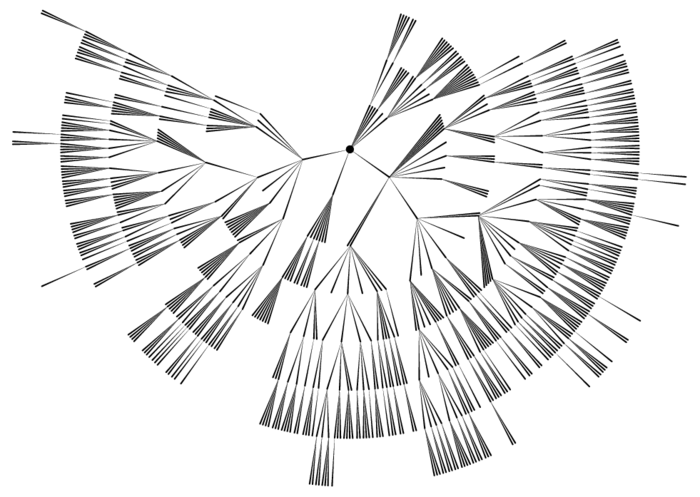
Although I do not think that the details of the lives of my family is very interesting for the general public, or even suitable for general release, I do want to show the fruit of our work. Therefore, I have created a stripped-down on-line version that only covers the first four generations. I bundled the book body with the cover and the end sheets into one complete PDF file (caution, large: 54MB, and of course in German). Some nifty embellishments of the book that I especially like are the abstract looking descendant fan in the front-end and back-end sheets, the separating bars between the persons which indicate the livespan of that person between 1799 and 2011 and the maps of the birth places and Isaak s travel destinations in the preface. Now to the technical details: Naturally, I used only Free Software in the genesis of the work (The cover is an exception, as it was not created by me). The most important is definitely gramps, a free genealogy system that held all our data. It is written in python and extensible with plug-ins, so I was able to create a custom report that takes the data relevant for us, filters for people who have agreed to appear in the book, and then generate LaTeX code that typesets the book, ready to be printed. I learned a great deal of LaTeX for this project, which uses over 30 different packages and required me to create a font of my own (which, as a side product, lead to a publication in the Linux-Magazin). For the maps I found the Generic Mapping Tools (GMT) and the freely available data for that of great use. I still had to manually collect the coordinates for all the places I wanted to show up in the map. Here, I relied mostly on Wikipedia. The fan which appears in the end sheets is laid out using a Haskell program (naturally, I have to use Haskell somewhere).
The front-end sheet
Of course, generating the book is only one side of the story; first, the data has to be collected and edited. For that, I wrote a plug-in to gramps that creates forms for each person. These forms contain the current known data and are used to correct and extend our knowledge. One variant of the form, created using LaTeX, was printed and mailed by snail-mail around the country and beyond, for those who are not reachable by mail. The other variant is an HTML form, hosted on a password-protected web site. Changes to that form cause the server to send an e-mail with a description of the changes (and only the changes, not the fields that are left untouched) to the mailing list of our team. There, the changes can be reviewed, e.g. for spelling and stylistic issues, and finally I copy n pasted them into gramps. These parts are implemented in python as well. Since genealogical data is never complete or up-to-date, I have set up a password-protected mediawiki based web site for the book where we collect corrections and additions to the data in the book. We have never anticipated that it would be so much work and that it would take us so long to finish this project, but we pulled it through and we are very happy with the result. Also, the reception has been very good and it was definitely a success. At this point I d like to express my gratitude to the hundreds of Free Software developers out there whose code we used and without whom it would not have been possible publish the book in the current form at all! Update: Due to some requests, I am making the code that I wrote available. You can download the tarball. Note that the code is a big mess and will not be usable right away. I guess if you can get the code to run and actually adjust to your needs, then you can as well write it yourself. Nevertheless it might be useful as inspiration or reference.

12 June 2011

Clint Adams: Debian on the DreamPlug, Part II

If you have debootstrapped the internal microSD card, the vendor-supplied U-Boot config should serve you adequately. To boot off of a USB stick, however, interrupt the boot sequence (if you don't have a JTAG/serial board at this point, go buy one immediately), and enter the following commands:
setenv x_bootcmd_kernel fatload usb 1:1 0x6400000 uImage
setenv x_bootargs_root root=/dev/sdc2 rootdelay=10
saveenv
reset
If you just want to testboot once, and don't want to make it permanent, omit the saveenv. If you do want to make it permanent, consider removing the superfluous pings from the bootcmd, but be careful to escape semicolons and dollar signs instead of zealously copying and pasting. If you haven't bothered putting a FAT partition with uImage on the USB stick, omit the setenv x_bootcmd_kernel line. Once you've booted Debian, you may wish to natively-debootstrap or copy your new partition to /dev/sda2 (which is what Linux will call the ext3 partition of your microSD card). To then return to fully booting off of microSD so you can repurpose the USB stick,
setenv x_bootcmd_kernel fatload usb 0:1 0x6400000 uImage
setenv x_bootargs_root root=/dev/sda2 rootdelay=10
saveenv
reset
Enjoy.

Christian Perrier: Developers per country (June 2011) - 3rd take

See comments at the end about this 3rd version This is time again for yet another bubulle game: counting the number of developers per country. I already published such analysis in 2010 and 2009. So, here we are with the June 2011 version, sorted by the ratio of *active* developers per million population for each country.
Act: number of active developers
Dev: total number of developers
A/M: number of active devels per million pop.
D/M: number of devels per million pop.
2009: rank in 2009
2010: rank in 2010
June 2011: rank now
Code Name Population Act Dev Dev Act/Million Dev/Million 2009 2010 June 2011
fi Finland 5374781 21 31 3,91 5,77 1 1 1
ch Switzerland 7866500 21 26 2,67 3,31 2 2 2
mq Martinique 397730 1 1 2,51 2,51

3
no Norway 4964500 12 15 2,42 3,02 5 4 4
nz New Zealand 4393500 10 15 2,28 3,41 4 3 5
ie Ireland 4470700 10 13 2,24 2,91 13 9 6
se Sweden 9354462 19 35 2,03 3,74 3 6 7
lu Luxemburg 511840 1 1 1,95 1,95 8 5 8
de Germany 81802000 155 221 1,89 2,7 7 7 9
at Austria 8404252 15 25 1,78 2,97 6 8 10
fr France 63136180 91 119 1,44 1,88 12 12 11
au Australia 22632213 31 57 1,37 2,52 9 10 12
be Belgium 11007020 15 17 1,36 1,54 10 11 13
uk United-Kingdom 62008048 67 106 1,08 1,71 14 14 14
nl Netherlands 16674600 18 37 1,08 2,22 11 13 15
dk Denmark 5564219 6 10 1,08 1,8 17 17 16
ca Canada 34480000 27 57 0,78 1,65 15 15 17
hr Croatia 4429078 3 3 0,68 0,68 20 18 18
es Spain 46030109 31 51 0,67 1,11 16 16 19
lt Lithuania 3225346 2 2 0,62 0,62 28 19 20
cz Czech Rep 10540748 6 6 0,57 0,57 21 20 21
it Italy 60605053 33 47 0,54 0,78 23 22 22
bg Bulgaria 7351254 4 4 0,54 0,54 25 23 23
il Israel 7602400 4 6 0,53 0,79 24 24 24
us USA 308745538 162 364 0,52 1,18 19 21 25
hu Hungary 9979000 5 11 0,5 1,1 18 25 26
lv Latvia 2245357 1 1 0,45 0,45 26 26 27
uy Uruguay 3494382 1 2 0,29 0,57 22 27 28
jp Japan 127960000 33 46 0,26 0,36 30 28 29
pl Poland 38186860 9 13 0,24 0,34 29 29 30
cr Costa Rica 4253897 1 1 0,24 0,24 31 30 31
pt Portugal 10647763 2 4 0,19 0,38 27 32 32
sk Slovakia 5429763 1 1 0,18 0,18 32 31 33
gr Greece 11305118 2 3 0,18 0,27 33 38 34
ar Argentina 40091359 7 9 0,17 0,22 34 33 35
sv El Salvador 6134000 1 1 0,16 0,16

36
tw Taiwan 23061689 3 3 0,13 0,13 37 34 37
br Brazil 190732694 20 21 0,1 0,11 36 35 38
by Belarus 9648533 1 1 0,1 0,1 35 36 39
mg Madagascar 20653556 2 2 0,1 0,1 44 37 40
cu Cuba 11239363 1 1 0,09 0,09
38 41
kr South Korea 48758000 4 6 0,08 0,12 39 39 42
ec Ecuador 14790608 1 1 0,07 0,07
40 43
cl Chile 17224200 1 2 0,06 0,12 42 41 44
ro Romania 21466174 1 2 0,05 0,09 45 43 45
co Colombia 45925397 2 3 0,04 0,07 41 44 46
ru Russia 142905200 6 7 0,04 0,05 43 42 47
za South Africa 49991300 2 9 0,04 0,18 38 48 48
my Malaysia 27565821 1 1 0,04 0,04

49
ve Venezuela 29105632 1 1 0,03 0,03 40 45 50
pe Peru 29496000 1 1 0,03 0,03 46 46 51
tr Turkey 73722988 2 2 0,03 0,03 47 47 52
mx Mexico 112322757 2 2 0,02 0,02 49 49 53
th Thailand 63878267 1 2 0,02 0,03 50 50 54
eg Egypt 80085862 1 3 0,01 0,04 51 51 55
in India 1210193422 8 8 0,01 0,01 52 52 56
cn China 1339724852 7 11 0,01 0,01 53 53 57
ua Ukraine 45888000 0 0 0 0 48 53 58


896 1450 61,79%


A few interesting facts: v2 comment: This is the second version of this blog post. I have been pointed that the population I was using for "Ireland" is indeed the population of the entire island, so Republic of Ireland (Eire) plus Northern Ireland (Ulster). We may guess that people listing "IE" as their country are citizens of the Republic of Ireland, so the population to use is that of this part of the island. As a consequence, Ireland is bumped up to 6th rank instead of 9th. v3 comment: Doh. Since I'm doing this survey, I was always adding people using "sv" as country to Sweden. This is a quite common mistake and it was happening in the past. But now, there is only ONE developer who uses "sv" as country, this is Rene Mayorga and he definitely lives in El Salvador, not Sweden. As a consequence, Sweden lost one developer (but keeps its rank) and El Salvador now appears at rank 36. It is not a "new" country as Rene is DD for quite some time.

11 June 2011

Dirk Eddelbuettel: United Sounds of America: New York

Last night was the kick-off concert in a series the Chicago Symphony has been preparing (and pushing) for the last little while: United Sounds of America: A Journey through Musical Roots. Five concerts featuring New York (last night), Chicago/Route 66 (tonight), New Orleans (tomorrow), Detroit (next Friday) and Austin (next Saturday). The New York evening was organized by pianist Bill Charlap (wikipedia) who also headlined and MC-ed the first set. Covering the birth of Jazz until early post-war bebop in chronological fashion, it was a pretty decent jazz set with a very nice band featuring Kenny Washington (dr), Peter Washington (b), Jeremy Pelt (tp), Jimmy Greene (ts) and Ken Peplowski (cl) --- and local favourite Kurt Elling (wikipedia) who was simply outstanding with the classic songbook material. Having seen him live once before a few years ago, I happened to listen a lot to Elling of late, following the random find of this stream from a live concert in February as well as his two most recent records, the Grammy-winning Dedicated to You (which retakes the wonderful Coltrane/Hartman album from 1963) and the simply amazing very recent The Gate (which you should go and buy right now). And I was not disappointed. He has a great four-octave-spanning baritone voice and great stage presence. The second set was dedicated to post-war folk and singer/songwriter material and organized by Suzanne Vega. That was neat too, if somewhat different in format and more like your standard (rock-ish) concert. Vega brought her own band featuring Gerry Leonard (g), Mike Visceglia (b), Graham Hawthorne (dr) along with guest appearances by Tom Paxton (g, vocals) and Richard Julian (g, vocals). Somehow Vega seems a little trapped in her own success in the 1980s and rehashed a lot of old hits. Nothing wrong that per se as it is good material (more on that below). Only during three encores did she provide new material which was ... excellent. So maybe some rebalancing towards new stuff was neat. Also nice was the additiona of four string players from the Chicago Symphony which had joined the band for a Simon and Garfunkel's song The Boxer. Oh, and of course seeing Vega perform Tom's Diner was nice, especially in such a fast and rocking version, even enhanced by the those strings. Just a few months ago I had gone over the passage from the original a-capella version of Tom's Diner to the various beat-box remixes which were then remixed by Vega in various live performances (e.g. videos of a capella, rockish, another rockish and beatboxish versions). Good fun, and it is nice to see she is playing along and enjoying it as well. All told, a really nice iniative by the CSO. If you're in Chicagoland, go and see some of the remaining shows.

Christian Perrier: Developers per country (June 2011) - 2nd take

See comment at the end about this 2nd version This is time again for yet another bubulle game: counting the number of developers per country. I already published such analysis in 2010 and 2009. So, here we are with the June 2011 version, sorted by the ratio of *active* developers per million population for each country.
Act: number of active developers
Dev: total number of developers
A/M: number of active devels per million pop.
D/M: number of devels per million pop.
2009: rank in 2009
2010: rank in 2010
June 2011: rank now
Code Name Population Act Dev Dev Act/Million Dev/Million 2009 2010 June 2011
fi Finland 5374781 21 31 3,91 5,77 1 1 1 1
ch Switzerland 7866500 21 26 2,67 3,31 2 2 2 2
mq Martinique 397730 1 1 2,51 2,51

3 3
no Norway 4964500 12 15 2,42 3,02 5 4 4 4
nz New Zealand 4393500 10 15 2,28 3,41 4 3 5 5
ie Ireland 4470700 10 13 2,24 2,91 13 9 6 6
se Sweden 9354462 20 36 2,14 3,85 3 6 7 7
lu Luxemburg 511840 1 1 1,95 1,95 8 5 8 8
de Germany 81802000 155 221 1,89 2,7 7 7 9 9
at Austria 8404252 15 25 1,78 2,97 6 8 10 10
fr France 63136180 91 119 1,44 1,88 12 12 11 11
au Australia 22632213 31 57 1,37 2,52 9 10 12 12
be Belgium 11007020 15 17 1,36 1,54 10 11 13 13
uk United-Kingdom 62008048 67 106 1,08 1,71 14 14 14 14
nl Netherlands 16674600 18 37 1,08 2,22 11 13 15 15
dk Denmark 5564219 6 10 1,08 1,8 17 17 16 16
ca Canada 34480000 27 57 0,78 1,65 15 15 17 17
hr Croatia 4429078 3 3 0,68 0,68 20 18 18 18
es Spain 46030109 31 51 0,67 1,11 16 16 19 19
lt Lithuania 3225346 2 2 0,62 0,62 28 19 20 20
cz Czech Rep 10540748 6 6 0,57 0,57 21 20 21 21
it Italy 60605053 33 47 0,54 0,78 23 22 22 22
bg Bulgaria 7351254 4 4 0,54 0,54 25 23 23 23
il Israel 7602400 4 6 0,53 0,79 24 24 24 24
us USA 308745538 162 364 0,52 1,18 19 21 25 25
hu Hungary 9979000 5 11 0,5 1,1 18 25 26 26
lv Latvia 2245357 1 1 0,45 0,45 26 26 27 27
uy Uruguay 3494382 1 2 0,29 0,57 22 27 28 28
jp Japan 127960000 33 46 0,26 0,36 30 28 29 29
pl Poland 38186860 9 13 0,24 0,34 29 29 30 30
cr Costa Rica 4253897 1 1 0,24 0,24 31 30 31 31
pt Portugal 10647763 2 4 0,19 0,38 27 32 32 32
sk Slovakia 5429763 1 1 0,18 0,18 32 31 33 33
gr Greece 11305118 2 3 0,18 0,27 33 38 34 34
ar Argentina 40091359 7 9 0,17 0,22 34 33 35 35
tw Taiwan 23061689 3 3 0,13 0,13 37 34 36 36
br Brazil 190732694 20 21 0,1 0,11 36 35 37 37
by Belarus 9648533 1 1 0,1 0,1 35 36 38 38
mg Madagascar 20653556 2 2 0,1 0,1 44 37 39 39
cu Cuba 11239363 1 1 0,09 0,09
38 40 40
kr South Korea 48758000 4 6 0,08 0,12 39 39 41 41
ec Ecuador 14790608 1 1 0,07 0,07
40 42 42
cl Chile 17224200 1 2 0,06 0,12 42 41 43 43
ro Romania 21466174 1 2 0,05 0,09 45 43 44 44
co Colombia 45925397 2 3 0,04 0,07 41 44 45 45
ru Russia 142905200 6 7 0,04 0,05 43 42 46 46
za South Africa 49991300 2 9 0,04 0,18 38 48 47 47
my Malaysia 27565821 1 1 0,04 0,04

48 48
ve Venezuela 29105632 1 1 0,03 0,03 40 45 49 49
pe Peru 29496000 1 1 0,03 0,03 46 46 50 50
tr Turkey 73722988 2 2 0,03 0,03 47 47 51 51
mx Mexico 112322757 2 2 0,02 0,02 49 49 52 52
th Thailand 63878267 1 2 0,02 0,03 50 50 53 53
eg Egypt 80085862 1 3 0,01 0,04 51 51 54 54
in India 1210193422 8 8 0,01 0,01 52 52 55 55
cn China 1339724852 7 11 0,01 0,01 53 53 56 56
ua Ukraine 45888000 0 0 0 0 48 53 57 57


896 1450 61,79%


A few interesting facts: This is the second version of this blog post. I have been pointed that the population I was using for "Ireland" is indeed the population of the entire island, so Republic of Ireland (Eire) plus Northern Ireland (Ulster). We may guess that people listing "IE" as their country are citizens of the Republic of Ireland, so the population to use is that of this part of the island. As a consequence, Ireland is bumped up to 6th rank instead of 9th.

Christian Perrier: Developers per country (June 2011)

This is time again for yet another bubulle game: counting the number of developers per country. I already published such analysis in 2010 and 2009. So, here we are with the June 2011 version, sorted by the ratio of *active* developers per million population for each country.
Act: number of active developers
Dev: total number of developers
A/M: number of active devels per million pop.
D/M: number of devels per million pop.
2009: rank in 2009
2010: rank in 2010
June 2011: rank now
Code Name Population Act Dev Dev Act/Million Dev/Million 2009 2010 June 2011
fi Finland 5374781 21 31 3,91 5,77 1 1 1
ch Switzerland 7866500 21 26 2,67 3,31 2 2 2
mq Martinique 397730 1 1 2,51 2,51

3
no Norway 4964500 12 15 2,42 3,02 5 4 4
nz New Zealand 4393500 10 15 2,28 3,41 4 3 5
se Sweden 9354462 20 36 2,14 3,85 3 6 6
lu Luxemburg 511840 1 1 1,95 1,95 8 5 7
de Germany 81802000 155 221 1,89 2,7 7 7 8
at Austria 8404252 15 25 1,78 2,97 6 8 9
ie Ireland 6197100 10 13 1,61 2,1 13 9 10
fr France 63136180 91 119 1,44 1,88 12 12 11
au Australia 22632213 31 57 1,37 2,52 9 10 12
be Belgium 11007020 15 17 1,36 1,54 10 11 13
uk United-Kingdom 62008048 67 106 1,08 1,71 14 14 14
nl Netherlands 16674600 18 37 1,08 2,22 11 13 15
dk Denmark 5564219 6 10 1,08 1,8 17 17 16
ca Canada 34480000 27 57 0,78 1,65 15 15 17
hr Croatia 4429078 3 3 0,68 0,68 20 18 18
es Spain 46030109 31 51 0,67 1,11 16 16 19
lt Lithuania 3225346 2 2 0,62 0,62 28 19 20
cz Czech Rep 10540748 6 6 0,57 0,57 21 20 21
it Italy 60605053 33 47 0,54 0,78 23 22 22
bg Bulgaria 7351254 4 4 0,54 0,54 25 23 23
il Israel 7602400 4 6 0,53 0,79 24 24 24
us USA 308745538 162 364 0,52 1,18 19 21 25
hu Hungary 9979000 5 11 0,5 1,1 18 25 26
lv Latvia 2245357 1 1 0,45 0,45 26 26 27
uy Uruguay 3494382 1 2 0,29 0,57 22 27 28
jp Japan 127960000 33 46 0,26 0,36 30 28 29
pl Poland 38186860 9 13 0,24 0,34 29 29 30
cr Costa Rica 4253897 1 1 0,24 0,24 31 30 31
pt Portugal 10647763 2 4 0,19 0,38 27 32 32
sk Slovakia 5429763 1 1 0,18 0,18 32 31 33
gr Greece 11305118 2 3 0,18 0,27 33 38 34
ar Argentina 40091359 7 9 0,17 0,22 34 33 35
tw Taiwan 23061689 3 3 0,13 0,13 37 34 36
br Brazil 190732694 20 21 0,1 0,11 36 35 37
by Belarus 9648533 1 1 0,1 0,1 35 36 38
mg Madagascar 20653556 2 2 0,1 0,1 44 37 39
cu Cuba 11239363 1 1 0,09 0,09
38 40
kr South Korea 48758000 4 6 0,08 0,12 39 39 41
ec Ecuador 14790608 1 1 0,07 0,07
40 42
cl Chile 17224200 1 2 0,06 0,12 42 41 43
ro Romania 21466174 1 2 0,05 0,09 45 43 44
co Colombia 45925397 2 3 0,04 0,07 41 44 45
ru Russia 142905200 6 7 0,04 0,05 43 42 46
za South Africa 49991300 2 9 0,04 0,18 38 48 47
my Malaysia 27565821 1 1 0,04 0,04

48
ve Venezuela 29105632 1 1 0,03 0,03 40 45 49
pe Peru 29496000 1 1 0,03 0,03 46 46 50
tr Turkey 73722988 2 2 0,03 0,03 47 47 51
mx Mexico 112322757 2 2 0,02 0,02 49 49 52
th Thailand 63878267 1 2 0,02 0,03 50 50 53
eg Egypt 80085862 1 3 0,01 0,04 51 51 54
in India 1210193422 8 8 0,01 0,01 52 52 55
cn China 1339724852 7 11 0,01 0,01 53 53 56
ua Ukraine 45888000 0 0 0 0 48 53 57


896 1450 61,79%


A few interesting facts:

10 June 2011

Gunnar Wolf: Reading revolutions: Online digital text and implications for reading in academe A (very informal) review

It's been a long time since I last took some time to read First Monday A great online publication, if you are not familiar with it, that I would categorize (and no, I'm not probably well-informed in it to be authoritative) as dealing with social, psychological aspects of the cultural shifts the online world has brought upon us (often dealing with topics related to Free Software communities, the reason I first met the publication). Firstmonday is an Open Access champion from early on. It follows an approachable but academic format (this means, it is peer-reviewed, its articles give extensive lists of references, and the articles are not the short reads we have got used to finding on the net, but, quoting from their audience profile, English is not the first language of many First Monday readers; A large percentage of First Monday readers are not a part of academia; Cultures, educational backgrounds, and fields of study vary greatly among First Monday readers.) This means, it's at least a great publication for me to follow :) Anyway After a long time not following it, I have just read Reading revolutions: Online digital text and implications for reading in academe, by Barry W. Cull; First Monday, Volume 16, Number 6 - 6 June 2011 Nice, interesting read. As I was planning on telling about the article to a couple of friends more into the subjects than myself, I'll comment+quote some bits on it. Before going any further: The article makes several references to Maryanne Wolf. No relation to her I'm not lulling my (two? are you both still reading?) readers towards her work ;-) The article talks about the differences social, even dips into some physiological aspects that the activity of reading is sustaining due to the shift from an activity done mainly from books (or other similar printed material) to the computer screen. Of course, we all know from our own experience many of the basic traits Shorter attention spans, a different reading pattern (skimming instead of reading; browsing through several related items instead of in-depth reading a single text as a knowledge unit). The article begins with an overview of reading and humankind. Cull quotes Maryanne Wolf's phrase, despite the fact that it took our ancestors about 2,000 years to develop an alphabetic code, children are regularly expected to crack this code in about 2,000 days . An interesting point I never thaught of is the start of reading as a purely mental activity, detaching reason from verbalization, ~1200 years ago:
Interestingly, these early scribes first did their work by reading out loud to themselves. Not until the ninth century did monastic regulations begin requiring silent reading. By the thirteenth century the practice of men reading silently and alone became commonplace. This shift to silent reading was a profound change, one that Darnton suggested involved a greater mental adjustment than the shift to printed text
. One last important point in this older history, that I'm quoting because I know I'll need the reference later on for one of my texts is about reading as a social activity Yes, also related to the quietness I just mentioned:
Interestingly, with the democratization of the printed text, there was a return to reading aloud. Reading was a solitary silent process only for the educated elite who could afford to buy books. For the rest of the population, as Darnton pointed out, reading was a social activity which took place in workshops, barns, and taverns [and] while children played, women sewed, and men repaired tools.
After this introduction (obviously one of the most interesting parts to me), Cull gives numbers showing how reading is evolving (in the USA and Canada), and quotes some prediction on how the future will end up adapting. Of course, I live in a place with a very different society, so I cannot comment much. Then he confronts some studies regarding specifically leisure reading, as it is a much more trustable factor than just literacy (in a world as highly literate as ours is, many people only read when they have to and have never or very seldom experienced the pleasure of reading just for the sake of it), bringing into the discussion the Internet (and computers in general) usage patterns. I found also very interesting the next section, regarding the pattern changes many libraries are facing now, specially academic/research-oriented libraries:
For several millennia, right up until just two decades ago, the central role of a library was to collect and house physical texts: from clay tablets, to scrolls, to printed books (Battles, 2003; Manguel, 2006). While printed text remains essential to most academic libraries, today s libraries have also become a core conduit via which researchers access scholarly texts online. Just within the last few years, Canadian academic libraries, in a situation similar to libraries throughout the Western world, have reached an interesting tipping point librarians now spend the majority of their collections budgets on electronic instead of printed texts.
( )
Libraries are convinced that digital text, now in its infancy, is likely to have a long future. Not only do they purchase electronic texts, but most academic libraries have also become publishers of electronic texts, whether they are digitizing large portions of their book holdings, or focusing on scanning a relatively small number of archival documents from their unique special collections.
And yes, doing some work with our Institute's library, I can confirm this trend. About e-books: I have got quite into that topic since the Kindle won my heart (and my money!) half a year ago. The little device completly changed my reading habits, I have read lots more since I carry it. And yes, I have never considered a full tablet-like device The article talks long about the difference, about the disadvantage that multitasking means to the human brain (oh, do I suffer from it!) I liked this snippet, quoting Steve Jobs a couple of years ago, regarding an Apple e-book reader question:
When Apple was rumoured to be working on an e book reader a few years ago, CEO Steve Jobs expressed his lack of interest: It doesn t matter how good or bad the product is, the fact is that people don t read anymore, he reportedly said, continuing by stating that 40 percent of the people in the U.S. read one book or less last year. The whole conception is flawed at the top because people don t read anymore (Markoff, 2008). Nicholas Carr (2010) has summed up Apple s involvement in the tablet phenomenon this way: Jobs is no dummy. As a text delivery system, the iPad is perfectly suited to readers who don t read anymore .
The issue for me is, I do enjoy reading, but I am an information addict. I know that if I have parallel information flows, my attention will surely dilute between them. Of course, as I read this article on-screen, it was hard for me to take the needed discipline not to be distracted by IMs or IRC highlights during the whole reading (which was also as an excercise for myself ;-) ). I am surprised to see this on student preferences (and even more surprised to see this data comes from my university):
In a study of students at the Universidad Nacional Aut noma de M xico (UNAM), the majority of students preferred print, and 63 percent reported that they could bear reading a document on a computer screen for no more than one hour (Ram rez Leyva, 2003). When it comes to course textbooks, a marked student preference for paper over e books has recently been found (Woody, 2010).
As we approach the end, it talks about another important topics I have often tried (and often failed) to communicate to my users: That of paratext, the meaning of the different texts, covers, items, layouts, etc. that are not part of the text itself but do shape the way we face it. To some of us, this seems obvious. To others, it is so hard to understand It closes with two more topics I will refer to. One is the permanent connectivity. All the time, more people are connected virtually all of their waking time. This affects not only learning habits but priorities. Will this near constant access to information interfere with students desire to comprehend and remember information, necessary to the educational process of turning it into knowledge? Author and university business school lecturer Don Tapscott recently suggested that students might not have to stress about the details those you can check Finally, regarding the continuity and ellaboration found in texts that are each time more common He quotes Maryanne Wolf:
I am worried about kids who are immersed in digital culture. They will get to college and they will have been Twittering so much that they won t have the patience to read those really long cognitively convoluted and complex sentences. They may not have developed those rich networks which are required in order to read at a high level of sophistication. The effort is what we are going to lose. They are becoming not so much a lazy reader, but an atrophied reader
As you can see, not only this post is meant to tell my couple-of-interested-friends to read the article, but it's mainly meant as a mental placeholder for myself. I will be surely refering to some of these items.

Axel Beckert: How to move a git submodule

If you try to move a git submodule with git mv, you ll get the following error message:
$ git mv old/submodule new/submodule
fatal: source directory is empty, source=old/submodule, destination=new/submodule
There s a patch against git to supoort submodule moving, but it doesn t seem to be applied yet, at least not in the version which is currently in Debian Sid. What worked for me to solve this issue was the following (as posted on StackOverflow):
  1. Edit .gitmodules and change the path of the submodule appropriately, and put it in the index with git add .gitmodules.
  2. If needed, create the parent directory of the new location of the submodule: mkdir new.
  3. Move all content from the old to the new directory: mv -vi old/submodule new/submodule.
  4. Remove the old directory with git rm --cached old/submodule.
Looked like this for me afterwards:
 # On branch master
 # Changes to be committed:
 #   (use "git reset HEAD <file>..." to unstage)
 #
 #       modified:   .gitmodules
 #       renamed:    var/lib/dokuwiki/tpl -> var/lib/dokuwiki/lib/tpl
 #
Finally commit the changes. HTH.

Rapha&#235;l Hertzog: People behind Debian: Philipp Kern, Stable Release Manager

Philipp is a Debian developer since 2005 and a member of the release team since 2008. Since he took the responsibility of Stable Release Manager, the process has evolved for the best. I asked him to explain how the release team decides what s fit for stable or not. His work on the buildd infrastructure is also admirable but I ll let him describe that. My questions are in bold, the rest is by Philipp. Who are you? I m a 24 year old Computer Science student, living in Karlsruhe, Germany. As a student assistant I m currently in two jobs: one is taking care of getting our university IPv6 network in shape, or rather generally getting fringe technologies into the network. The second is taking care of a s390x machine in the basement which my faculty got sponsored recently. In my spare time I tend my Debian duties and I m active in the student council (Fachschaft) as a sys-admin, software developer and until recently as treasurer. I got accepted as a Debian Developer in 2005. I m only really active since I was invited to join the Release Team in early 2008 after I contributed rewrites of some scripts that got lost in a disk crash of ftp-master. In late 2008 I also took on wanna-build/buildd duties. What s your notable achievement within Debian? For one I worked on the deployment of a single buildd/sbuild combination over all of our buildds and I rebased it on the sbuild in the archive several times already. All buildds basically look the same on all architectures, with only few variations. The chroots are now also created in a mostly predictable manner. Then we finally got build autosigning after years of constant poking. However the policy decision to allow it was made by the ftp-masters anyway, for which I m grateful, as it eases the workload of the buildd maintainers, the Security Team and the Release Team quite a bit. On the release side there s the integration of volatile into the proper structures of Debian. But there I m guilty for choosing the bad name squeeze-updates is, in comparision with security s squeeze/updates. Let s see if we can improve that for wheezy. The policy for stable updates have changed over time. Can you summarize what kind of updates are allowed nowadays? All the changes that were made to the policy were driven by the aim to keep stable (and to some lesser degree oldstable) usable throughout its lifetime. I have to admit that we got slightly more liberal in what we accept since I took over. The previous stable update policy included the fixes of critical bugs that break the system in interesting ways and security fixes. We also opened up the possibility of including important fixes for annoying bugs on a case-by-case basis. The whole don t update that much part of the stable release management is rooted in let s don t change the behaviour of a running system and let s have as few regressions as possible . We currently try to counter that with a review process that only allows self-contained fixes that were tested in unstable first, if applicable. In the future I d also like to have a feedback process that includes the users of the packages to report problems more early. In fact that s also why we now send calls for testing to debian-stable-announce one week in advance (see this mail as an example). So stable is updated through point releases that happen roughly every two months for stable and roughly every four for oldstable. They are accompanied by announcements and new CD/DVD sets. To be able to push some updates with less delay to our users and to avoid that they have to pick them from proposed-updates, there is stable-updates. The current policy for this suite is available in this post on debian-devel-announce. It boils down to everything urgent like tzdata, regression fixes and volatile packages. We noticed that some packages in stable just weren t useful anymore when they got updated through volatile. Hence those are folded into stable, too. We also relaxed the rules a bit so that leaf packages like clive, that rely on external websites not to change their URLs, can be updated too. If somebody wonders what happened to the and a half releases Those were intended to mark the inclusion of new hardware support (mostly by including a co-installable new kernel version). This kind of flag point release is thankfully no longer needed because our marvellous kernel team now backports certain hardware drivers to the kernel version in stable. They have some trouble soliciting test feedback for them, though. It would be cool if more people using stable could respond to their calls for testing. What are your plans for Debian Wheezy? Luckily the wanna-build/buildd side isn t much dependent on release cycles. The stable release management also just takes care of what gets dumped on them by the testing RMs. ;-) The near-term goals are certainly: Apart from that my work is mainly squashing the bugs on buildd.debian.org for the wanna-build part, so if you want something fixed, you need to report it, I m afraid. You have several roles within Debian, in particular stable release manager and member of the wanna-build team. Which role do you enjoy more and why? So the regular duties of the SRM, apart from setting up policies, are reviewing requests for uploads to proposed-updates, accepting them, chasing builds and scheduling point releases. It s mainly steady work. As for the Release Team it s working in a fabulous team where everyone s doing an awesome job. For me the wanna-build role is holding the things together and fixing up stuff that breaks while the world continues to evolve. And occassionally taking a stab at the ftp-masters. So rather different. My heart is probably siding with the buildd side because it s infrastructure but release work is fun, too. What s the biggest problem of Debian? Mainly that we re not quick in picking up new technologies and that we got slow on innovation. Distro-wide changes are usually a very big effort to coordinate and to finally complete. I guess people should be able to push fixes for release goals more eagerly into the archive. Also it seems to me that many DDs are actually disengaging from the release process, especially during the freeze but also before, which makes me a bit sad. However I m still not sure how we could counter that. As we re all volunteers you can t suddenly make others love the idea of releasing something together, I guess. Do you have wishes for Debian Wheezy? It s getting old, but there s certainly multiarch. Also a usable Python 3 is something I d really appreciate. Is there someone in Debian that you admire for their contributions? Peter Palfrader did an awesome job of getting a nicely working team together for DSA and got many tasks as automated as they are now. It s a pleasure to work with them and setting up a new buildd is, for example, a real breeze. He also developed a sane archive snapshot service, kudos for that.
Thank you to Philipp for the time spent answering my questions. I hope you enjoyed reading his answers as I did. Subscribe to my newsletter to get my monthly summary of the Debian/Ubuntu news and to not miss further interviews. You can also follow along on Identi.ca, Twitter and Facebook.

3 comments Liked this article? Click here. My blog is Flattr-enabled.

8 June 2011

Francois Marier: Sample Python application using Libgearman

Gearman is a distributed queue with several language bindings.

While Gearman has a nice Python implementation (python-gearman) of the client and worker, I chose to use the libgearman bindings (python-libgearman) directly since they are already packaged for Debian (as python-gearman.libgearman).

Unfortunately, these bindings are not very well documented, so here's the sample application I wished I had seen before I started.

Using the command-line toolsBefore diving into the Python bindings, you should make sure that you can get a quick application working on the command line (using the gearman-tools package).

Here's a very simple worker which returns verbatim the input it receives:
gearman -w -f myfunction cat
and here is the matching client:
gearman -f myfunction 'test'
You can have have a look at the status of the queues in the server by connecting to gearmand via telnet (port 4730) and issuing the status command.

Using the Python libgearman bindingsOnce your gearman setup is working (debugging is easier with the command-line tools), you can roll the gearman connection code into your application.

Here's a simple Python worker which returns what it receives:
#!/usr/bin/python

from gearman import libgearman

def work(job):
workload = job.get_workload()
return workload

gm_worker = libgearman.Worker()
gm_worker.add_server('localhost')
gm_worker.add_function('myfunction', work)

while True:
gm_worker.work()
and a matching client:
#!/usr/bin/python

from gearman import libgearman

gm_client = libgearman.Client()
gm_client.add_server('localhost')

result = gm_client.do('myfunction', 'test')
print result
This should behave in exactly the same way as the command-line examples above.

Returning job errorsIf you want to expose to the client errors in the processing done by the worker, modify the worker like this:
#!/usr/bin/python

from gearman import libgearman

def work(job):
workload = job.get_workload()
if workload == 'fail':
job.send_fail()
return workload

gm_worker = libgearman.Worker()
gm_worker.add_server('localhost')
gm_worker.add_function('myfunction', work)

while True:
gm_worker.work()
and the client this way:
#!/usr/bin/python

from gearman import libgearman

gm_client = libgearman.Client()
gm_client.add_server('localhost')

result = gm_client.do('myfunction', 'fail')
print result
LicenseThe above source code is released under the following terms:
CC0
To the extent possible under law, Francois Marier has waived all copyright and related or neighboring rights to this sample libgearman Python application. This work is published from: New Zealand.

Cosimo Alfarano: OpenNI in Debian

The world of augmented reality is quite fashinating.

I recently got interested into Natural Interaction due to the popularity of Microsoft's Kinect and decided to package OpenNI for Debian.

OpenNI is a framework aiming to making natural interaction transparent to the user/developer, publishing a unified API and abstracting the access to different sensors and modules. Currently it supports some Asus sensors and there is a branch on github supporting also Kinect (which is the one we're packaging).

Some cool projects are already using OpenNI: ROS, PointClouds and OpenCV come to my mind immediately.

We'are working on OpenNI package in the Multimedia Maintainers group on Alioth, the package is still not ready to be uploaded to unstable and upstream has some major problems like the lack of SONAME in its produced library, so some communication with upstream is needed but for preliminary use the packages are in a decent state: OpenNI, PrimeSense Sensor, NITE (non-free).

NITE is a closed source module set for advanced body and scene recognition, unfortunately PrimeSense didn't opensource them, thus I decided to use the same approach of flashplugin-nonfree and write a downloader.

For the sake of completeness, unstable already has libfreenect which purpose is similar but specifically oriented to Kinect.

I am studying both and really hope that in the next future some open source project will make (at least) skeleton and hand recognition available under an open license. People are already working on it, according to Google.

7 June 2011

Vincent Bernat: Mobile browsing & content optimization

Since my laptop features WWAN connectivity, I purchased a 3G mobile broadband plan from SFR, a French mobile phone company. I took the cheapest one available: 250 MB per month for 10 .

Optimizing transparent proxy by SFR While browsing, I was curious about the fact that there were multiple accesses to non-public IP, like 10.141.0.4. I was browsing the mobile version of Le Monde, a French daily newspaper. I enabled Chromium developer tools and watched what happened in the Network tab. All images were served from IP like 10.141.0.4. Looking at the HTML source code, I discovered that <img> tags were rewritten to point to those images. The smaller one were identical to the original one but the larger ones (more than 50 KB) were of reduced quality (and therefore reduced size). <img> tags were not the only one to be rewritten. <style> and <script> tags that were pointing to external resources (with a src attribute) were also rewritten to include the CSS or the javascript inline. Before:
<script src="http://s1.lemde.fr/js/lib/jquery/1.5.1/jquery.js"></script>
After:
<script oldSrc="http://s1.lemde.fr/js/lib/jquery/1.5.1/jquery.js" NG="replaced">
/*!
 * jQuery JavaScript Library v1.5.1
 *
 * Copyright 2011, John Resig
 * Dual licensed under the MIT or GPL Version 2 licenses.
 * http://jquery.org/license
 * [...] */
</script>
This means that each page that includes jQuery, a popular javascript library, as an external resource, will be turned into a page that includes the whole jQuery code which is about 85 KB. Each page will weight more than 85 KB instead of relying on an external and cacheable resource. Nowadays, most browsers support HTTP keep-alive which allows to serve multiple resources into a single request. There are two cases:
  1. If the resource is served from the same server as the HTML page, keep-alive would enable to get almost the same result without hindering the cache: the browser would first request the HTML page, then the javascript resource into the same TCP connection. There is a small penalty of about 100 ms to let the browser request the second resource. The browser may decide to open another connection because the initial document is not loaded yet. Some browsers may even negotiate this additional connection before needing it. In this case, it can use this idle connection at no cost. Otherwise, we may fall in the second case.
  2. If the resource is served from another server (like in the example above) or if the browser does not have an idle connection ready for reuse, it would download the resource in parallel with the help of another connection. It will only costs about 300 ms of additional time due to the establishment of a new TCP connection with the server. Those 300 ms are a very small price to pay compared to the 2 seconds needed to download 85 KB for each page. Moreover, other static resources will likely be downloaded from the same server and therefore, this is 300 ms the first time and about 100 ms for additional resources (round-trip time for a new HTTP request into the same TCP connection).
UPDATED: In a previous version of this article, I confused pipelining and keep-alive mechanisms. While keep-alive allows to reuse an existing connection to download a new resource, only one request at a time by connection could be issued. Pipelining allows to push additional requests in the same TCP connection without waiting for answers. As noted by ric Daspet in a comment, pipelining is disabled for most browsers. However, keep-alive is well supported. Searching on the web for oldSrc and NG="replaced", I find very little information about what is used. It seems that such a feature may also break some scripts, like TinyMCE, trying to get additional resources relative to the path where the script is installed. It appears that SFR is using a product from Flash Networks called Harmony Gateway. I have asked SFR more info about this and if it was possible to disable the use of this feature but got no answer so far. I have retried a bit later and there was no rewriting for Javascript and CSS. Images were still degraded and served by a special server. The next day, my requests did not travel through a transparent proxy anymore (no more Via header in answers). Each try was done at a different location. The proxies may be installed at some locations only and configured differently. Another explanation is that SFR silently disabled this functionality for my account. If it was done correctly, such an accelerator service could be be proposed as an opt-out option since most users would appreciate faster page downloads. If you care about network neutrality, you can disable this option. Of course, it needs to be properly advertised, for example as a free option in your mobile plan.

Setting up our own optimizing proxy Google provides mod_pagespeed as a solution to optimize a website on the fly. This is an Apache module. It is targeted at optimizing your own website but since Apache can act as a regular proxy, it seems possible to enable mod_pagespeed for any website. That s pretty easy to setup if you don t mind using a precompiled version of mod_pagespeed. Download mod_pagespeed. I have downloaded the 64bit version for Debian.
# touch /etc/default/mod-pagespeed
# dpkg -i ~/download/mod-pagespeed-beta_current_amd64.deb
Selecting previously deselected package mod-pagespeed-beta.
(Reading database ... 277699 files and directories currently installed.)
Unpacking mod-pagespeed-beta (from .../mod-pagespeed-beta_current_amd64.deb) ...
dpkg: dependency problems prevent configuration of mod-pagespeed-beta:
 mod-pagespeed-beta depends on apache2.2-common; however:
  Package apache2.2-common is not installed.
dpkg: error processing mod-pagespeed-beta (--install):
 dependency problems - leaving unconfigured
Errors were encountered while processing:
 mod-pagespeed-beta
# apt-get install -f
[...]
Unpacking apache2.2-common (from .../apache2.2-common_2.2.19-1_amd64.deb) ...
Processing triggers for man-db ...
Setting up apache2.2-common (2.2.19-1) ...
[...]
# apt-get install apache2-mpm-worker
[...]
Unpacking apache2-mpm-worker (from .../apache2-mpm-worker_2.2.19-1_amd64.deb) ...
Setting up apache2-mpm-worker (2.2.19-1) ...
Starting web server: apache2.
# a2enmod proxy_http
Considering dependency proxy for proxy_http:
Enabling module proxy.
Enabling module proxy_http.
To to activate the new configuration, you need to run:
  /etc/init.d/apache2 restart
Then, we modify /etc/apache2/mods-enabled/proxy.conf:
ProxyRequests On
<Proxy *>
    AddDefaultCharset off
    Order deny,allow
    Deny from all
    Allow from 127.0.0.1
</Proxy>
Of course, this makes little sense to run the proxy on your laptop since you don t want to download the non-optimized content over your WWAN link. You need to run it on another server and therefore allow your laptop to access it. Also, we need to modify /etc/apache2/mods-enabled/pagespeed.conf to add the directive ModPagespeedDomain * to let mod_pagespeed rewrite any page. You should restart Apache after that. Now, check if the proxy is working:
$ curl -six http://localhost:80 http://www.lemonde.fr/   grep ^X-Mod-Pagespeed
X-Mod-Pagespeed: 0.9.17.7-716
All is working! Let s try a very simple site, like Debian Backports. It features one HTML file and two CSS files: Debian Backports website without pagespeed We downloaded a total of 8 KB (compression included). Let s use our proxy and try again: Debian Backports website with pagespeed mod_pagespeed succeeds in reducing the size of the HTML file and combined the CSS files. Moreover, it minified the resulting CSS file. There seems to be a bug in Chromium that display incorrect transfert sizes (including in the timeline representation) when using a proxy. I have checked with Wireshark that the overall quantity transferred was about 8 KB. The gain is very thin here but you can imagine that you will get better results on larger sites. mod_pagespeed seems to handle well most sites. However, it only optimizes pages that already are in its cache. The first time you grab a page, you will get the unoptimized version. I don t know if it is the expected behaviour.

John Goerzen: Back from Joplin

I m just back from spending a few days volunteering with the tornado recovery effort in Joplin, MO. The biggest image that remains in my mind is of the first time I saw a person picking through a large pile of rubble. The person was standing on top of what used to be a house. Now it was a pile of wood, glass, carpet, siding, and roofing material. I m sure there was hope for finding some treasure or other maybe a photo album or videos of children. In any case, it made me feel so lucky, even unfairly lucky, to have not had to go through that. This scene was repeated several times, but mostly the houses that devastated appeared abandoned by the time we were there, now two weeks after the event. But I heard stories, and lots of them. The victims of the storm, who were perhaps trying to rebuild that part of their house that got smashed by a tree or a pickup, or trying to get their intact belongings out before abandoning the house, or whatever, were mostly surprisingly upbeat. They were working out in 95-degree heat, many without electricity, running water, or sewer service. Almost every person I met that suffered a loss from the tornado wanted to tell their story. Many also told of their plans for the future, which were full of hope and even upbeat. These were people doing a hard job in terrible conditions and still showing hope. Another testament to the disaster was the most unusual set of vehicles you ve ever seen parked at any hotel you can care to think of, for at least an hour-and-a-half radius in the direction I came from. Besides the usual cars and minivans, there might be FEMA vehicles, electric company trucks, Red Cross vans, construction trucks of every kind, police and law enforcement from all over, etc. There was quite obviously an influx of people helping out in Joplin. My primary task there was to provide communications support for the effort as an amateur radio operator. Amateurs (or hams ) are something of a volunteer first responder of sorts during times of crisis; most of us own and are very familiar with operating equipment that can communicate over very long distances without the need for any on-site infrastructure. Amateur radio was the only method of communication for some Joplin hospitals in the immediate aftermath. The communications emergency is over, but the response isn t. I was assigned to work with the Salvation Army. They were doing a lot of things in Joplin, and had hundreds of volunteers working with them. I don t think I even know what many of them were doing I do know they had set up several warehouses across the city working with donating clothing, food, etc. The part I was involved with was primarily the canteen operation. The SA sent in food service trucks from several parts of the country. These trucks would roam up and down the streets in the damaged area, trying to get past every single street several times a day. Anybody that we could see would be offered food and water. No strings attached, no questions asked. This included homeowners, electric line workers, construction crews, sanitation workers, and quite a few nonprofit groups that sent well-meaning and useful volunteers into the area but didn t think to provide them with a large supply of water due to sending them into an area without any. Oops. In any case, with extreme heat and no running water, conditions were dangerous. The canteens also knew of certain at-risk families that were living in homes that were mostly intact in the disaster areas, and made a special point to check in on them. They also generally looked to make sure that people looked like they were healthy. Each canteen also had a counselor on board that would visit with people while we quickly prepared their meal they all seemed to welcome that. Amateur Radio s Role The operation of this size had quite a logistics challenge. I d hear of things like an unexpected need of 70 lunches, or a semi showing up with donations before there was space, or an unexpected but very welcome donation of a large quantity of ice cream without a place to store it (so the canteen trucks, which have freezers, needed to pick it up quickly). That s where us hams came in. Each canteen had an amateur radio operator on board. Each major location also had a ham stationed there, and the head of operations also often had a shadow a ham that would follow him around wherever he went to relay messages back and forth. We also had hams with pickups (with radios in them, of course) that could transport things around the city to places that needed them, hams at headquarters managing all the communication and generally investigating questions that didn t have immediately obvious answers, etc. Radios were used instead of cellphones for a few reasons. One big one is that everybody on the operation can hear what everyone else s needs are, since it s a group communications situation rather than one-to-one. It s easy to give a general alert to everyone ( come get your ice cream now please! ) and people that have suggestions can chime in. This came in extremely handy more than once. Also, it frees the people doing other jobs from having to spend time chasing someone s voicemail, finding phone numbers, etc; that gets delegated to us in some cases. I heard from the head of canteen operations, for whom this was the first disaster he d worked that had amateur radio support, how wonderful it was to have this going on. I also heard a secondhand report that some police officers that were also amateurs had listened to our operation and reported that we sound more professional than 911 dispatch and do a better job. On Sunday I was assigned to a canteen. This meant I didn t have a lot of radio traffic to pass, so although I had it in my ear all day, I wasn t actively talking on the radio very much. So I rode in back, helping hand out water, carry meals to people, and so forth. On Saturday, I was the shadow for the head of operations. That was a difficult task, because he barely ever moved at a pace slower than a run, sometimes would abruptly zip out somewhere, etc. But it was also enlightening and vital. He was a real get it done sort of guy, and was the key to quite a few things. Having someone available to relay questions to and from him was a good thing. And today I worked as a transport person and at headquarters. Due to not having a pickup there, I didn t actually get called on much to transport things, but in general between jobs the whole time I d act as a runner if needed, or simply try to figure out the details of how things were run for next time. I wound up taking net control (being the control operator at headquarters, and generally managing communications so that people don t talk over each other and such) for about an hour. So I got to do a little of just about every amateur radio task. Thoughts I am thankful for the opportunity to go, and the good feeling of helping people in need the first I ve ever had the chance to do that in a disaster. It s a good feeling to have a skill that is useful and appreciated. Sometimes it felt like handing out food and water is something pretty small in the scheme of things. But on the other hand, it gives people a chance to have contact with someone that cares, an opportunity to have people that can notice problems drive by a few times a day, and an opportunity to help meet people s basic needs. And sometimes in a fluid situation, there might be more volunteers than are needed, so I did spend some time sitting waiting for the next task. But overall, I m convinced that the work I helped facilitate was a good thing and provided a good and needed service in Joplin. This has been quite the experience and I m sure it s changed me too, though I don t yet know how.

6 June 2011

Sam Dunne: Declarative Diversions - Design Spec 2

DECLARATIVE DIVERSIONS ====================== Introduction A diversion is when it is possible to have dpkg not overwrite a file when it reinstalls the package it belongs to, and to have it put the file from the package somewhere else instead. Declarative diversions involves a new control file with a declarative syntax which dpkg will parse and process directly as part of the package unpack and removal phases, eliminating the problems resulting from non-atomic handling of diversions. Topics There are a number of topics involved in implementing this kind of project * What syntax do we use for the new control file? * What dpkg does with the control file * How do we handle diversions to a non-existant directory? * How do we order unpacking a new package which adds a diversion? * How do we order unpacking a new package that removes a diversion? * How do we order removing a package which had a diversion? * How do we handle errors? * What happens to dpkg-divert? Details - Control File Syntax - It will conform to RFC2822 style with the following format: * Divert-From: * Divert-To: * Blank lines and lines beginning with # will be comments Divert-To will be optional and if it is ommitted then files being diverted will have their filename changed to file.distrib The above style has it s advantages, one of the main ones being that there is no need to escape whitespace within filenames. It also allows for more commands to be added at a later date. Details - Control File Handling - Within control.tar.gz the file should be named diversions This file is then copied to /var/lib/info/$package.diversions We need to store the control file for the currently-installed package so that we can detect declarative diversions that have been removed from the control file between versions (On-disk version and the to-be-unpacked version). If there is no previous version of a control file then all current diversions within the package are left in place and any new ones declared within the control file are added. If there is a previous version of the control file then the diversions listed within the file are compared with the diversions currently in place. If a diversion exists that is no longer listed in the control file then it is removed. If there is a diversion listed in the control file that doesn t currently exist then it is added. Details - Handling Diversions to non-existant directories - Diverting files to directories that don t exist can cause a number of problems. If the package does not own the directory it may be left orphaned on removal of the package The package is responsible for ensuring the availability of the target directory in the unpack phase. If a declarative diversion attempts to divert a file to a folder that neither exists already on the filesystem at unpack time, nor is shipped within the package, dpkg will return an error at unpack time. Details - Ordering Requirements - =>Unpacking a new package that adds a diversion *1. Check if package has a previous diversion control file *2. Copy control file to tmp directory *3. Calculate diversions to be added *4. Unpack folders *5. Add diversions *6. Unpack files *7. Copy control file to /var/lib/dpkg/info/$package.diversion *Performing diversions this way avoids trouble with creating folders and accidentally overwriting the wrong version of files. *Another major problem would be extracting a new version of the file and overwriting the old one. *This might cause the wrong version of the file to be diverted and the package to break. =>Unpacking a new package that removes a diversion *1. Check if package has a previous diversion control file *2. Copy control file to tmp directory *3. Calculate diversions to be removed *4. Check if dropped diversion results in a file conflict and abort the unpack if it does. *5. Unpack folders *6. Unpack files *7. Remove old files no longer needed in the package *8. Remove diversions *9. Copy control file to /var/lib/dpkg/info/$package.diversion *If a package has no previous diversion control file then no diversions will be removed and existing diversions can only be removed using dpkg-divert. *If removing a diversion results in a file conflict then dpkg will return an error at unpack time before anything is unpacked and the unpack is aborted. =>Removing a package which had a diversion *1. Remove files *2. Remove diversions *3. Remove folders *4. Remove control file at /var/lib/dpkg/info/$package.diversion *This ensures that all files, diversions and folders are removed correctly Details - Error handling Errors in diversions will have to handled with a great deal of care due to the fact that if they are not the package could be broken. This means that a great deal of checks must be done to ensure that all the files can be diverted properly before any actual diverting takes place. If they can t the package installation/update must be stopped and rolled back to avoid the package being installed incorrectly or broken. Details - dpkg-divert - When we impliment the new diversion method we should keep the current dpkg-divert. This allows maintainers to catch up with the new method without breaking their packages. It also allows maintainers to perform some operations that aren t support by the new method. All current functionality of dpkg-divert will be left intact for use by sysadmins and for maintainers to catch up with the new system. The two systems will work together without directly conflicting with each other. Example Usage #1 The file to be diverted is /usr/share/foo It needs to be moved to /usr/share/bar The syntax of the control file would be: #Start File Divert-From: /usr/share/foo Divert-To: /usr/share/bar #End File Example Usage #2 In this example the maintainer doesn t want to move the file to any specific folder The syntax of the control file would be: #Start File Divert-From: /usr/share/foo #End File This would divert the file to /usr/share/foo.distrib Footnotes - RFC2822 Guide: * http://www.faqs.org/rfcs/rfc2822.html First Email Thread on Declarative Diversions (First Message in Thread): * http://lists.debian.org/debian-dpkg/2011/05/msg00102.html Email thread on first design draft (First message in Thread): * http://lists.debian.org/debian-dpkg/2011/06/msg00019.html Declarative Diversions Wiki: * http://wiki.debian.org/SummerOfCode2011/DeclarativeDiversions My Blog for this Project: * http://blog.sam-dunne.com

Thorsten Glaser: synchronise environment between two shells

(First posting to Pl net Commandline! Tag: pcli) Vutral asked in IRC how to synchronise two shells environment while they re running. As you may know, POSIX systems cannot change a process environment vector after it has been started, only the process itself can. Well, the shell can, and we ll use a variety of things for this. This trick assumes you have $HISTFILE set to the same pathname in both shells (obviously, they run under the same user). It uses export -p to render the current list of exported variables, then transforms the list from newline-separated to a single big one-line export statement.

Then it transforms all remaining newlines (which will be part of a single-quoted string, since that s mksh(1) s export format) into the sequence '$'\n'' which means: terminate current single-quoted string, append $'\n' and open up a new single-quoted string immediately; concatenate these three.
Now, $'\n' is just a fancy way of saying newline, and part of mksh because David Korn (yes, the Korn in Korn Shell) strongly suggested to me that this functionality be included but, as we can see here, it pays off.
Finally, the so transformed string is prepended by unset \$(export); which, when executed, will cause the shell to unset (and unexport) all currently exported variables. The shell parameters that are not exported, i.e. not in the environment, are not affected by this code (except for $x and $nl, but whatever).
This string is then passed to read -s (plus -r and clearing IFS to enable raw mode), which means, read into the parameter $REPLY (which we conveniently don t use but it s trashed too, thus) but store into history at the same time. Ah hah! Now, the persistent history feature comes into effect! After running the below statement in the source shell, switch into the terminal running the destination shell, press Enter once on the empty line (Ctrl-U to empty it if it wasn t), then Cursor-Up ( ) to recall voil , an insanely large line with the previously created string sorta expanded and press Enter again to run it. Now your set of exported parameters is the exact same (minus if you exported IFS, nl, x or REPLY) as in the source shell.

I ve added extra spaces and a linewrap below, this is really just one big line:

nl=$'\n'; x=$(export -p); x=$ x//$ nl export/ ; IFS= read -rs <<<"unset \\\$(export);$ x//$nl/\'\$\'\\\\n\'\' "

Of course, this makes a nice function, for your ~/.mkshrc or somesuch.

Steve Kemp: So I chose fabric and reported a bug..

When soliciting for opinions, recently, I discovered that the python-based fabric tool was not dead, and was in fact perfect for my needs. During the process of getting acquainted with it I looked over the source code, it was mostly neat but there was a trivial (low-risk) symlink attack present. I reported that as #629003 & it is now identified more globally as CVE-2011-2185. I guess this goes to show that getting into the habit of looking over source code when you install a new package is a worthwhile thing to do; and probably easier than organising a distribution-wide security audit </irony>. In other news I'm struggling to diagnose a perl segfault, when running a search using the swish-a perl modules. Could it be security worthy? Possibly. Right now I just don't want my scripts to die when I attempt to search 20Gb of syslog data. Meh. ObQuote: "You're scared of mice and spiders, but oh-so-much greater is your fear that one day the two species will cross-breed to form an all-powerful race of mice-spiders who will immobilize human beings in giant webs in order to steal cheese. " - Spaced.

Sune Vuorela: Daemon slaying

I ve gotten a couple of complaints on the amount of daemons that is launched by default by any app built upon the KDE Frameworks, so I investigated one of them a bit. The knotify daemon currently seems to do two things:
  1. Keeping some dependencies out of KDE Framework libraries
  2. Recieve messages from dbus, parse them, encode differently and send them on to other places over dbus
In the past, the knotify daemon was also responsible of showing popup-messages. So, I did a quick experiment here in Switzerland to try kill off that daemon and merged the code from the daemon into the KNotification part of kdeui. As a proof of concept it works, and if I can cut out some of the newly introduced dependencies it can end up being really nice. There is much less need for a separate daemon these days where knotify doesn t actually paint the popups itself, but rather passes them on to a galago-spec implementing part of the workspace (on linux) or to growl for various non-free platforms.

Vincent Bernat: Ready for World IPv6 day?

On June 8, 2011, will be World IPv6 Day. Major web companies like Google, Yahoo! and Facebook will serve their content through IPv6. While some of them already provide IPv6 content, you either need to use a special URL or get your connection from some selected providers, known to provide working IPv6 connection (the selection is done through DNS).

What s World IPv6 Day about? World IPv6 Day is mostly about major content providers and network operators. End users are not expected to take any special actions. The content will be provided for one day on IPv6 and IPv4 without any special trick to circumvent broken IPv6 setup. If you have an IPv4 only connectivity, all will continue to work (this day is not about switching Internet to IPv6 only). If you have a working IPv6 connectivity of any kind, you will use it to access content. However, if you have a broken IPv6 connectivity, you will find yourself isolated during one day until you solve the problem. You can check your connectivity and determine if you will run into trouble on World IPv6 Day. The main point of this day is to check if IPv6 native content can be provided to anybody without leaving out a large part of the users (the ones with a broken connectivity) which is reason why we don t already have IPv6 native content everywhere. Google explains it this way:
We continuously conduct detailed measurements on the quality of IPv6 connectivity, and our latest results show that making Google services generally available over IPv6 at this time would lead to connection problems and increased latency for a small number of users. User experience is very important to us, and we do not want to impact users on networks that do not yet fully support IPv6. We will continue to re-evaluate the situation as the IPv6 Internet evolves.
While content provider are invited to provide IPv6 content, network operator are expected to troubleshoot their customers problem (and they cannot withdraw themselves from this operation since the main change is done by content providers). If they can enable IPv6 connectivity, that would be great too but this is not mandatory. UPDATED: It s a shame but Microsoft s participation to World IPv6 day is a fix to prefer IPv4 over IPv6. Moreover, this fix will be reverted a few days later. Let s hope that network operators don t follow the lead by not setting up DNS hijacking to remove AAAA record.

What can I do? Even if you are neither a network operator nor a major player in web content publishing, it is expected that World IPv6 Day will also be the playground for most IPv6 related things.

As a user Check if your ISP provides native IPv6 connectivity. This can be an opt-in option. For example, in France, Free allows its users to enable native IPv6 connectivity if they choose the appropriate option. That s easy to do and you get IPv6 in a matter of minutes. If your ISP does not provide native IPv6 connectivity, you can try to bug them about this. This is unlikely to work. You can also get IPv6 through a tunnel broker like SixXS (create an account and apt-get install aiccu) or Hurricane Electric. Wikipedia has a list of IPv6 tunnel brokers. Don t rely on any other transition mechanism, they are unreliable.

As a service provider If you host yourself some services, like your web page or your own mail server, you can enable IPv6 connectivity for those as well. Get an IPv6 connectivity for your services, either native or through a tunnel broker. Then, enable IPv6 on each service you provide. Check that they are listening on IPv6 with ss -6l. All the tips below are meant for very simple setup. Ensure that net.ipv6.bindv6only is set to 0. Here is what I have done:
  • Enable SSH access through IPv6. With the default configuration of OpenSSH, this is already done. Check your ListenAddress directive if you have one.
  • Serve Web content through IPv6. I am using Nginx as a web server and you can mix IPv4 and IPv6 in the same virtual host. Setting up IPv6 is easy. Ensure that IPv6 support is compiled in (nginx -V) use listen [::]:80 instead of listen 80. Apache is equally easy to configure and should even work out of the box since the Listen 80 directive will listen to both IPv4 and IPv6 by default. lighttpd also supports IPv6. An easy way to get started is to use server.use-ipv6 = "enable".
  • Enable IPv6 in Postfix, Dovecot, BIND. For all of those, this works out of the box. Nowadays, most daemons will work fine with IPv6 without any special configuration since they will listen to :: by default which means any IPv4 or IPv6 address as long as net.ipv6.bindv6only is set to 0. Unfortunately, there is still some daemons that do not support IPv6.
  • Add appropriate AAAA record to your DNS because providing IPv6 services is of little use if your users (including you) cannot access them without typing the appropriate IP address. You may also want to provide a NS record reachable through IPv6.
  • Update your monitoring to use IPv6 as well. If you advertise IPv6 service and only IPv4 is working, most IPv6 client will be unable to access them.
  • Adapt your firewall. In Linux, Netfilter handles IPv4 and IPv6 separately. You need to ensure you setup a correct firewall for IPv6 as you have done with IPv4.
Here is a minimal firewall that you can adapt:
 1
 2
 3
 4
 5
 6
 7
 8
 9
10
11
12
13
14
15
16
17
18
19
20
21
22
23
24
ip6tables -A INPUT -m state --state ESTABLISHED,RELATED -j ACCEPT
ip6tables -A OUTPUT -m state --state ESTABLISHED,RELATED -j ACCEPT
for chain in INPUT OUTPUT; do
  ip6tables -A $chain -m rt --rt-type 0 -j DROP
  ip6tables -A $chain -p icmpv6 --icmpv6-type neighbor-solicitation \
     -m hl --hl-eq 255 -j ACCEPT
  ip6tables -A $chain -p icmpv6 --icmpv6-type neighbor-advertisement \
     -m hl --hl-eq 255 -j ACCEPT
  ip6tables -A $chain -m state --state NEW \
     -p icmpv6 --icmpv6-type echo-request -j ACCEPT
done
ip6tables -A INPUT -i lo -j ACCEPT
ip6tables -A OUTPUT -o lo -j ACCEPT
# Put your rules here!
ip6tables -N REJECT_ALL
ip6tables -A REJECT_ALL -p tcp -j REJECT --reject-with tcp-reset
ip6tables -A REJECT_ALL -p udp -j REJECT --reject-with icmp6-adm-prohibited
ip6tables -A REJECT_ALL -j DROP
for chain in INPUT OUTPUT FORWARD; do
    ip6tables -A $chain -j LOG --log-prefix "$chain-reject: "
    ip6tables -A $chain -j REJECT_ALL
done

Debian status There is still a long way for full IPv6 support of all applications in Debian but it is a release goal since Etch. This is not an easy task since adding IPv6 support on some software can be really difficult. DSA also enabled IPv6 support on many servers used by the Debian project including the main web server, the main mirror, the security mirror and the name servers. You should be able to use Debian with an IPv6 only access.

Enrico Zini: Python list gotcha

Python list gotcha Suppose in python you're building a list of buckets:
>>> a = [[]] * 10
>>> print a
[[], [], [], [], [], [], [], [], [], []]
Looks good. However:
>>> a[5].append(1)
>>> print a
[[1], [1], [1], [1], [1], [1], [1], [1], [1], [1]]
Surprising? What happens here is that multiplying the list replicates the reference to the same empty list. You have the exact same mutable list replicated 10 times: instead of 10 buckets, you have 10 references to 1 bucket: therefore if appending to one it looks like one appends to all. What you need here is a way to invoke the list constructor [] multiple times:
>>> a = [[] for i in range(10)]
>>> print a
[[], [], [], [], [], [], [], [], [], []]
>>> a[5].append(1)
>>> print a
[[], [], [], [], [], [1], [], [], [], []]
a mistake like this can take quite a bit of time to track down.

Next.

Previous.