Search Results: "reg"

14 June 2010

Biella Coleman: Baby Panda wants YOU to submit to DEBCONF


bad mood destroyer, originally uploaded by the biella.
People s the deadline is fast approaching. Don t worry though, the best ideas come under deadlines and your proposal need not be lengthy. So get those typing hands out and submit a proposal (a few sentences suffices) for a presentation!
The annual Debian conference is being held in NYC this year. First time
setting foot in the imperial empire. Are you doing something related to
free software that might be interesting to share, show off or talk about
at Debconf? I bet you are! We are looking for art installations,
performances, movie screenings, maybe you are wanting to host a
roundtable/panel discussion, coordinate a workshop (you dont have to
know the subject deeply to do this!). I know the deadline is soon, but don t let that scare you. The
submission requirement bar is very low, and we are flexible! here is the submission information: [1] ********************* Calling all potential contributors to DebConf10! One more week until
the final submission deadline! The DebConf team is excited to announce that we are now accepting
proposals for contributions to this year s Debian conference! We
invite you to submit proposals for how you would contribute until the
deadline: soon There are many ways you can contribute, you could present a technical
paper, host a panel discussion, put on a tutorial, do a performance,
an art installation, a debate, host a meeting (BoFS, or Birds of a
Feather Session), or other possibilities that you devise. This year we
are also accepting proposals for tracks=E2=80=94a thematic grouping around a
particular subject, and people to coordinate those tracks. If you are
looking for ideas of things that you could contribute, or have ideas
for things that you would like to see happen at DebConf, have a look
at the Contribution Brainstorm[0] page. DebConf talks will be broadcast live on the Internet where possible,
unless otherwise requested. Videos of the talks will be published on
the web along with the presentation slides and papers. =3D=3D Step 1. Submit Proposal =3D=3D Proposals should provide an overview of your proposed contribution,
similar to an abstract, and be no more than 600 words. Since
contributions can cover a range of issues, please describe what your
proposal covers, be it political (Free Software, law, advocacy,
access, etc.), technical (d-i, OpenPGP, etc.), social (Debian
structures and groups). It s okay to hit all three of these. Your
proposal should also include some information on why you re qualified
to present, or coordinate this topic. For example, you can include
links to posts you have made to Debian mailing lists or other material
that indicates your qualifications. Proposals and their abstracts will
be accepted until May 1st, 2010, 23h59 UTC. To submit your proposal, go to Penta[1] and register as an
attendee. Once you are registered, there is a Submit a proposal
link. You will see your proposal on the site. You can choose between
different presentation types. If you are unsure what type you should
use, please read our glossary of definitions[2]. If it s not there for
some reason, or you have questions, please contact us immediately at
mailto:talks@debconf.org. =3D=3D Step 2. Committee Review =3D=3D The review committee for this year will make its decision by May 1st,
2010. All correspondence will be done by email. =3D=3D Step 3. Paper Submission =3D=3D Like last year, we are asking for papers to be submitted along with
the presentations. A full paper is optional, however we strongly
encourage you to submit one if possible as we intend to provide
written information along with transcripts of the sessions for later
viewing. Having written papers in advance will allow us to get
translations done to help non-native-English speakers feel more
comfortable with the topics presented. Papers are due by July 1st,
2010, and should cover the topic in reasonable depth (3 pages A4 text,
plus pictures and diagrams). We will use LaTeX to typeset the
proceedings. Please submit your paper formatted in LaTeX. Should you
be unfamiliar with LaTeX earlier submission in plain text is also
fine. =3D=3D Step 4. Live Presentation =3D=3D Longer presentations may have a break in the middle and should include
workshop items that directly involve the participants. If using slides
or any other presentation, please consider that your audience will
consist of people who use free software, and your choice of
application to prepare and display the slides should reflect this if
at all possible. =3D=3D Fine Print Publication Rights =3D=3D DebConf requires non-exclusive publication rights to papers,
presentations, and any additional handouts or audio/visual materials
used in conjunction with the presentation. The authors have the
freedom to pick a DFSG-free license for the papers themselves and
retain all copyrights. The presentations will be recorded, and may be
broadcast over the Internet. Any copies of the presentation will be
made available =3D=3D Failure to Submit =3D=3D In the event that a deadline is missed we reserve the right to revoke
any offer to present. =3D=3D About DebConf =3D=3D The annual DebConf conference is a technical and social forum for
Debian developers, sponsors, affiliates, and friends. It allows
various groups within Debian a chance to come together, network, and
share their work. Until we see you in the big city,
DebConf Talks Team [1] introduction written by Micah Anderson

Gunnar Wolf: Planned obsolescence and propietary gear - Dear lazyweb, a sports tracking app for a N95 phone?

Grah. I got my current phone (a Nokia N95) back in January 2008. It was the first phone I ever paid for, and I don't expect that to change - The feature set I need from a phone is extremely basic, but I wanted to have a GPS unit on me, without needing to plan for it beforehand. As I recently blogged, I just got over the 5000Km mark (5269 as of last Friday), with almost daily usage since I registered. A couple of days ago (although please note I don't log in often to the web page, I just upload my , I was greeted by this gem:

IMPORTANT NEWS Thank you Nokia Sports Tracker beta users! After two and a half years of operation, the Nokia Sports Tracker beta service will close as of June 30, 2010. Thanks to all of you exercise enthusiasts who used the service and contributed valuable feedback to its improvement. We want you to stay active. You can keep tracking workouts through a new, non-Nokia service provided by Sports Tracking Technologies available for free in the Ovi Store. The new service is open for registrations at sports-tracker.com, and you'll even be able import your workout history from Nokia Sports Tracker until August 31, 2010.
In my case, instead of Thank you they could have just said Fuck off. They are directing me to a new application available in Nokia's Ovi store. Of course, this application is linked to a new 100% Flash-powered website. That would be a big turnoff for me, yes, although there are many ways around it (after all, I don't need the website functionality every day). However, I find the list of supported phones does not include the N95 (any version). This means, my two year old phone (which I bought as soon as the model arrived in Mexico) is obsolete now and they want me to (spend more money and) switch to a new one. Am I going to do that? Hell no! The N95 phone is quite good. The only gripes I have is with the (slow, buggy and memory leak and phone crash prone) Symbian S60 operating system. I will probably keep using the SportsTracker application, although I won't be able to link my tracks as easily as I do today. So... Dear lazyweb, do you know of any similar program? The feature set I use in Sports Tracker is:
  1. Have different activity profiles. I use Running and Cycling, and very ocassionaly Walking.
  2. Of course, GPS tracking, getting average and top speeds, altitude profile, etc.
  3. Aggregation into something website-friendly
  4. The ability to do my uploads post-factum (i.e. do not rely on a data plan, allow me to upload my excercising when I get home)
There are probably more things I'd want. But I am a geek, and I basically enjoy tracking myself, and sharing my tracks with $world. Thanks, dear lazyweb. I am confident you won't let me down.

John Goerzen: Camping with 2 Boys

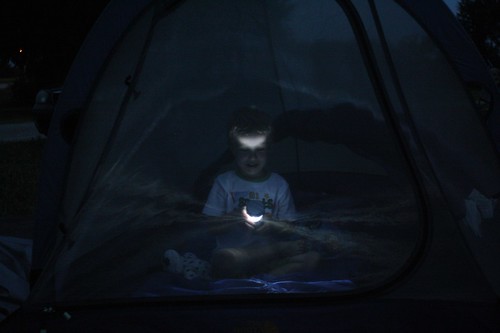
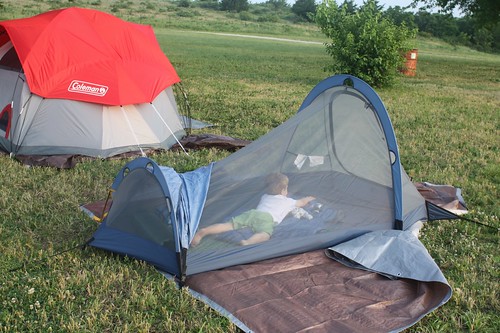
Friday I took the day off for us to go camping. Due to the birth of Oliver, our last time camping was in 2008. Back then, Terah had asked me what I wanted for father s day, and I suggested camping. Except when she was pregnant last year (and then Oliver was little), we have sort of had a standing plan to go camping twice a year: around father s day and my birthday. She says that s way more camping in a year than anyone needs. Anyhow, Jacob doesn t remember the last time we went camping; he was not quite 2 at the time. I explained that we would sleep in tents, and he d get one just his size. He laughed at that. Then I explained that he would get a bag to sleep in, and he thought that was hilarious. He kept talking about tents and even more so about sleeping bags until he actually got to be in one. It seems like each time we go camping, we wind up somewhere else. We ve camped at Kanoplis Lake and Marion Park and Lake in the past few years. But this time we went to Cedar Valley Reservoir near Garnett, KS. It was a nice place to be, with some wilderness camping areas far from any RV hookups (though right next to a gravel driveway where we could park). Almost as soon as we got out of the car, Jacob found a partially-burned stick left in a fire ring. So of course his hands were black pretty quick. He kept track of that stick the whole time we were there, and used it for everything he could think of. His favorite use, though, was at the lake to splash water: 2010-06-11 15.20.21.jpg The lake really was his favorite feature. He loved to throw rocks and sticks in it with me, to splash himself, and to stick his feet in. Oh, and to splash me. IMG_4057.JPG The pier was also a great thing for him he at first thought it was a boat, then really wanted to go. I made him hold my hand the whole time, and he liked walking on it. But he was frustrated that he couldn t reach the water. Somehow, Jacob acted as if he could sit in the hot sun for hours, just making small splashes with a stick. I, on the other hand, felt the 90-degree heat strongly, and eventually we found a shady spot to play in the lake. Oliver enjoyed crawling around on a blanket or on the grass. Though Terah put a stop to that after she noticed that he came across a pile of fish heads and was about to reach for one and put it in his mouth. We cooked over a campfire Friday night and Saturday morning. It took me a lot longer to start a fire than normal. Part of the problem was that there had been a lot of rain in the area, and it was humid, so there was little kindling to be found. Plenty of larger pieces of wood, so once the fire got going, it burned nicely. We cooked brats, brought along some homemade bread, had grilled foil-wrapped potatoes, and had stir-fry vegetables. Oliver got to eat with us too, of course: IMG_4022.JPG Terah is a big believer in smores, so after supper we made some smores Jacob predictably got sticky from the marshmallows and chocolate. Jacob started asking when I d set up the tent almost as soon as he found his stick. All afternoon he kept asking. Finally we got it set up, and of course he was so excited that he played inside it for an hour before he fell asleep. Terah had bought a $4 lantern at Walmart to give to him to use in his tent. I told him that there would be a surprise lantern in his tent for him to use. And he loved his lantern. It could turn on, off, and flash red. At one point he asked me, Dad, do you have a surprise lantern too? No, I will just use my flashlight. He looked a bit sad about that. For about 5 seconds. Then he turned on his lantern again. Here he is with it, still playing happily about 2 hours after his bedtime: IMG_4100.JPG And in the morning, of course he was still wanting that, but also wanted to play with his digital camera (a kid s version that also has a simple game or two on it). Without leaving the tent, of course. IMG_4105.JPG Oliver was getting hungry while we worked on breakfast, so I gave him some bread to munch on. IMG_4119.JPG We used our cast iron skillet to fry some bacon for breakfast. Then Terah made some pancakes in the skillet (with the bacon grease). Greasiest and best pancakes ever. After that, we had some fried and scrambled eggs. After that, we had more smores (I wasn t kidding about Terah being a big believer in them.) Jacob decided that he wanted to play in the other tent. He enjoyed playing with Terah, Oliver, and the air mattress (that Terah appreciated as much as I thought it took up too much space in the car). There s a little window on the back that can open to a screen or open completely. Jacob and Oliver enjoyed looking out of it while open. Or rather, Jacob enjoyed that, while Oliver enjoyed licking it. IMG_4161.JPG I had my Droid with me to keep an eye on the weather. The forecast for several days had called for a 20% chance of storms on Saturday. I checked Saturday morning at 7, and it still called for 20% chance of storms after 1PM. We decided we d pack up our tents after breakfast so we could stay as long as we liked or leave on short notice if we preferred. Clouds seemed to be building, though, so I checked the forecast again at maybe 9. Now it called for 60% chance of thunderstorms and heavy rain before 1PM. Guess I shouldn t have been surprised; it is Kansas after all. As I had the first tent about 90% put away, it started to rain. We rushed to get the rest of the stuff in the car, and by the time we did, it was raining heavily. We had planned to spend at least part of the afternoon there, but decided we d look for another place to stop on the way home. We stopped first at Garnett s North Lake, as the rain had let up for awhile. We spotted a fishing pier that Jacob wanted to walk on, but the bridge out to it was underwater, so we passed on that. While Terah fed Oliver in a shelter, Jacob and I played on some swings. Then we walked down to that lake. Jacob carefully came to an abrupt stop and looked both ways at each disused road between us and the lake, saying OK when it was clear to go. The rain picked up again, so we started heading towards home. It got quite heavy, with thunder and everything, which Jacob didn t care for at all. Both boys went to sleep, though. We stopped at Marion Reservoir on the way home. Jacob hadn t been able to play in the lake at Garnett (the place we stopped had a bank that was too steep) and so we played there. He waded into the water at the swimming area, and predictably enjoyed yes throwing rocks into the lake. When we got home, I set out the wet tent and tarps (it s not good to store that stuff wet) to dry there hadn t been rain at home yet. Camping s a lot of work, but it was a good family activity. I m looking forward to our next time, and hope we can choose a weekend a little less hot and damp.

Christine Spang: Christine Spang: the end of an era

The world around me seems to whirl these days. One week ago, I graduated from MIT. People I've known during the last four years have been dispelling to various parts of the globe one by one, day by day. California, Canada, Indonesia, Seattle. Some will be back again. Some will not, or if so only to visit. pika is a continuous bustle of activity as the summer has commenced and it has filled with creative and adventurous MIT students who've suddenly found themselves having free time. A hammock being built on the roofdeck. Thrice-weekly icecream forays. Common areas overflowing with people playing musical instruments, chatting, and messing around on laptops. Summer's warmth has arrived, bringing with it farmer's markets, strawberry picking, and swimming expeditions. While it's wonderful to get to meet so many new people living in a college environment, I can't help but feel sadness thinking about everyone who's left. There are always more friends to be made as new people arrive, but old ones moving away leave bittersweet memories, and the new relationships are always a bit different as the age discrepancy between me and others changes. Or the me-the-ephemeral-collection-of-thoughts-which-when-regarding-other-people-sometimes-involve-the-mentor/mentee-distinctions-caused-by-one-party-being-older-or-more-knowledgeable-than-the-other-at-least-in-certain-areas changes. The end of a semester always feels like this, but this year even more so as the people I started university with start down new paths. For me, that was going to involve staying on at MIT to complete a one-year master's program, the "M.Eng." in electrical engineering and computer science. That plan, too, has changed. I've deferred the degree and accepted a full-time engineering position at Ksplice, an exciting early-stage Linux startup here in Cambridge. I'd been working at Ksplice part-time since January before joining full-time immediately following graduation. Ksplice is the realization of ideas I saw being born on the whiteboard at SIPB when I was a freshman, and it's fun to see that play out in a small, ever-changing, low-bullshit company. All in all, there are many more exciting things down the road, and, working at an MIT startup, I haven't even escaped the MIT/Cambridge reality-distortion bubble yet. Still, it's tempting to resist change and let myself romanticize the good old days, hoping to catch every person I've ever enjoyed spending time with and hold them down here forever. That's not the way life works, though. Change happens.

13 June 2010

Martin Michlmayr: Debian support for eSATA SheevaPlug available

The eSATA SheevaPlug is supported by the Debian installer and by Debian now. I've updated the install guide accordingly. If you're already running Debian on your eSATA SheevaPlug but you installed as a regular SheevaPlug to USB or SD and you'd like to use the eSATA, then make sure you're the latest kernel from Debian squeeze:
apt-get update
apt-get dist-upgrade
flash-kernel
Reboot and type this in u-boot:
setenv arcNumber 2678
saveenv
reset
Your machine will then be recognized as an eSATA SheevaPlug and eSATA will work. Thanks to John Holland for working on SheevaPlug eSATA support.

Petter Reinholdtsen: Lenny->Squeeze upgrades, removals by apt and aptitude

My testing of Debian upgrades from Lenny to Squeeze continues, and I've finally made the upgrade logs available from http://people.skolelinux.org/pere/debian-upgrade-testing/. I am now testing dist-upgrade of Gnome and KDE in a chroot using both apt and aptitude, and found their differences interesting. This time I will only focus on their removal plans. After installing a Gnome desktop and the laptop task, apt-get wants to remove 72 packages when dist-upgrading from Lenny to Squeeze. The surprising part is that it want to remove xorg and all xserver-xorg-video* drivers. Clearly not a good choice, but I am not sure why. When asking aptitude to do the same, it want to remove 129 packages, but most of them are library packages I suspect are no longer needed. Both of them want to remove bluetooth packages, which I do not know. Perhaps these bluetooth packages are obsolete? For KDE, apt-get want to remove 82 packages, among them kdebase which seem like a bad idea and xorg the same way as with Gnome. Asking aptitude for the same, it wants to remove 192 packages, none which are too surprising. I guess the removal of xorg during upgrades should be investigated and avoided, and perhaps others as well. Here are the complete list of planned removals. The complete logs is available from the URL above. Note if you want to repeat these tests, that the upgrade test for kde+apt-get hung in the tasksel setup because of dpkg asking conffile questions. No idea why. I worked around it by using 'echo >> /proc/pidofdpkg/fd/0' to tell dpkg to continue. apt-get gnome 72
bluez-gnome cupsddk-drivers deskbar-applet gnome gnome-desktop-environment gnome-network-admin gtkhtml3.14 iceweasel-gnome-support libavcodec51 libdatrie0 libgdl-1-0 libgnomekbd2 libgnomekbdui2 libmetacity0 libslab0 libxcb-xlib0 nautilus-cd-burner python-gnome2-desktop python-gnome2-extras serpentine swfdec-mozilla update-manager xorg xserver-xorg xserver-xorg-core xserver-xorg-input-all xserver-xorg-input-evdev xserver-xorg-input-kbd xserver-xorg-input-mouse xserver-xorg-input-synaptics xserver-xorg-input-wacom xserver-xorg-video-all xserver-xorg-video-apm xserver-xorg-video-ark xserver-xorg-video-ati xserver-xorg-video-chips xserver-xorg-video-cirrus xserver-xorg-video-cyrix xserver-xorg-video-dummy xserver-xorg-video-fbdev xserver-xorg-video-glint xserver-xorg-video-i128 xserver-xorg-video-i740 xserver-xorg-video-imstt xserver-xorg-video-intel xserver-xorg-video-mach64 xserver-xorg-video-mga xserver-xorg-video-neomagic xserver-xorg-video-nsc xserver-xorg-video-nv xserver-xorg-video-openchrome xserver-xorg-video-r128 xserver-xorg-video-radeon xserver-xorg-video-radeonhd xserver-xorg-video-rendition xserver-xorg-video-s3 xserver-xorg-video-s3virge xserver-xorg-video-savage xserver-xorg-video-siliconmotion xserver-xorg-video-sis xserver-xorg-video-sisusb xserver-xorg-video-tdfx xserver-xorg-video-tga xserver-xorg-video-trident xserver-xorg-video-tseng xserver-xorg-video-v4l xserver-xorg-video-vesa xserver-xorg-video-vga xserver-xorg-video-vmware xserver-xorg-video-voodoo xulrunner-1.9 xulrunner-1.9-gnome-support aptitude gnome 129
bluez-gnome bluez-utils cpp-4.3 cupsddk-drivers dhcdbd djvulibre-desktop finger gnome-app-install gnome-mount gnome-network-admin gnome-spell gnome-vfs-obexftp gnome-volume-manager gstreamer0.10-gnomevfs gtkhtml3.14 libao2 libavahi-compat-libdnssd1 libavahi-core5 libavcodec51 libbluetooth2 libcamel1.2-11 libcdio7 libcucul0 libcupsys2 libcurl3 libdatrie0 libdirectfb-1.0-0 libdvdread3 libedataserver1.2-9 libeel2-2.20 libeel2-data libepc-1.0-1 libepc-ui-1.0-1 libfaad0 libgail-common libgd2-noxpm libgda3-3 libgda3-common libgdl-1-0 libgdl-1-common libggz2 libggzcore9 libggzmod4 libgksu1.2-0 libgksuui1.0-1 libgmyth0 libgnomecups1.0-1 libgnomekbd2 libgnomekbdui2 libgnomeprint2.2-0 libgnomeprint2.2-data libgnomeprintui2.2-0 libgnomeprintui2.2-common libgnomevfs2-bin libgpod3 libgraphviz4 libgtkhtml2-0 libgtksourceview-common libgtksourceview1.0-0 libgucharmap6 libhesiod0 libicu38 libiw29 libkpathsea4 libltdl3 libmagick++10 libmagick10 libmalaga7 libmetacity0 libmtp7 libmysqlclient15off libnautilus-burn4 libneon27 libnm-glib0 libnm-util0 libopal-2.2 libosp5 libparted1.8-10 libpoppler-glib3 libpoppler3 libpt-1.10.10 libpt-1.10.10-plugins-alsa libpt-1.10.10-plugins-v4l libraw1394-8 libsensors3 libslab0 libsmbios2 libsoup2.2-8 libssh2-1 libsuitesparse-3.1.0 libswfdec-0.6-90 libtalloc1 libtotem-plparser10 libtrackerclient0 libxalan2-java libxalan2-java-gcj libxcb-xlib0 libxerces2-java libxerces2-java-gcj libxklavier12 libxtrap6 libxxf86misc1 libzephyr3 mysql-common nautilus-cd-burner openoffice.org-writer2latex openssl-blacklist p7zip python-4suite-xml python-eggtrayicon python-gnome2-desktop python-gnome2-extras python-gtkhtml2 python-gtkmozembed python-numeric python-sexy serpentine svgalibg1 swfdec-gnome swfdec-mozilla totem-gstreamer update-manager wodim xserver-xorg-video-cyrix xserver-xorg-video-imstt xserver-xorg-video-nsc xserver-xorg-video-v4l xserver-xorg-video-vga zip apt-get kde 82
cupsddk-drivers karm kaudiocreator kcoloredit kcontrol kde kde-core kdeaddons kdeartwork kdebase kdebase-bin kdebase-bin-kde3 kdebase-kio-plugins kdesktop kdeutils khelpcenter kicker kicker-applets knewsticker kolourpaint konq-plugins konqueror korn kpersonalizer kscreensaver ksplash libavcodec51 libdatrie0 libkiten1 libxcb-xlib0 quanta superkaramba texlive-base-bin xorg xserver-xorg xserver-xorg-core xserver-xorg-input-all xserver-xorg-input-evdev xserver-xorg-input-kbd xserver-xorg-input-mouse xserver-xorg-input-synaptics xserver-xorg-input-wacom xserver-xorg-video-all xserver-xorg-video-apm xserver-xorg-video-ark xserver-xorg-video-ati xserver-xorg-video-chips xserver-xorg-video-cirrus xserver-xorg-video-cyrix xserver-xorg-video-dummy xserver-xorg-video-fbdev xserver-xorg-video-glint xserver-xorg-video-i128 xserver-xorg-video-i740 xserver-xorg-video-imstt xserver-xorg-video-intel xserver-xorg-video-mach64 xserver-xorg-video-mga xserver-xorg-video-neomagic xserver-xorg-video-nsc xserver-xorg-video-nv xserver-xorg-video-openchrome xserver-xorg-video-r128 xserver-xorg-video-radeon xserver-xorg-video-radeonhd xserver-xorg-video-rendition xserver-xorg-video-s3 xserver-xorg-video-s3virge xserver-xorg-video-savage xserver-xorg-video-siliconmotion xserver-xorg-video-sis xserver-xorg-video-sisusb xserver-xorg-video-tdfx xserver-xorg-video-tga xserver-xorg-video-trident xserver-xorg-video-tseng xserver-xorg-video-v4l xserver-xorg-video-vesa xserver-xorg-video-vga xserver-xorg-video-vmware xserver-xorg-video-voodoo xulrunner-1.9 aptitude kde 192
bluez-utils cpp-4.3 cupsddk-drivers cvs dcoprss dhcdbd djvulibre-desktop dosfstools eyesapplet fifteenapplet finger gettext ghostscript-x imlib-base imlib11 indi kandy karm kasteroids kaudiocreator kbackgammon kbstate kcoloredit kcontrol kcron kdat kdeadmin-kfile-plugins kdeartwork-misc kdeartwork-theme-window kdebase-bin-kde3 kdebase-kio-plugins kdeedu-data kdegraphics-kfile-plugins kdelirc kdemultimedia-kappfinder-data kdemultimedia-kfile-plugins kdenetwork-kfile-plugins kdepim-kfile-plugins kdepim-kio-plugins kdeprint kdesktop kdessh kdict kdnssd kdvi kedit keduca kenolaba kfax kfaxview kfouleggs kghostview khelpcenter khexedit kiconedit kitchensync klatin klickety kmailcvt kmenuedit kmid kmilo kmoon kmrml kodo kolourpaint kooka korn kpager kpdf kpercentage kpf kpilot kpoker kpovmodeler krec kregexpeditor ksayit ksim ksirc ksirtet ksmiletris ksmserver ksnake ksokoban ksplash ksvg ksysv ktip ktnef kuickshow kverbos kview kviewshell kvoctrain kwifimanager kwin kwin4 kworldclock kxsldbg libakode2 libao2 libarts1-akode libarts1-audiofile libarts1-mpeglib libarts1-xine libavahi-compat-libdnssd1 libavahi-core5 libavc1394-0 libavcodec51 libbluetooth2 libboost-python1.34.1 libcucul0 libcurl3 libcvsservice0 libdatrie0 libdirectfb-1.0-0 libdjvulibre21 libdvdread3 libfaad0 libfreebob0 libgail-common libgd2-noxpm libgraphviz4 libgsmme1c2a libgtkhtml2-0 libicu38 libiec61883-0 libindex0 libiw29 libk3b3 libkcal2b libkcddb1 libkdeedu3 libkdepim1a libkgantt0 libkiten1 libkleopatra1 libkmime2 libkpathsea4 libkpimexchange1 libkpimidentities1 libkscan1 libksieve0 libktnef1 liblockdev1 libltdl3 libmagick10 libmimelib1c2a libmozjs1d libmpcdec3 libneon27 libnm-util0 libopensync0 libpisock9 libpoppler-glib3 libpoppler-qt2 libpoppler3 libraw1394-8 libsmbios2 libssh2-1 libsuitesparse-3.1.0 libtalloc1 libtiff-tools libxalan2-java libxalan2-java-gcj libxcb-xlib0 libxerces2-java libxerces2-java-gcj libxtrap6 mpeglib networkstatus openoffice.org-writer2latex pmount poster psutils quanta quanta-data superkaramba svgalibg1 tex-common texlive-base texlive-base-bin texlive-common texlive-doc-base texlive-fonts-recommended xserver-xorg-video-cyrix xserver-xorg-video-imstt xserver-xorg-video-nsc xserver-xorg-video-v4l xserver-xorg-video-vga xulrunner-1.9

12 June 2010

Matt Zimmerman: How to decide what to read (and what not to read)?

Like you, dear Internet readers, I have no shortage of reading material. I have ready access to more engaging, high quality, informative and relevant information than I can possibly digest. Every day, I have to choose what to read, and what to pass by. This seems like an important thing to do well, and I wonder if I do a good enough job of it. This is just one example of a larger breadth/depth problem, but I m finding the general problem difficult to stomach, so I m focusing on reading for the moment. These are my primary sources of reading material on a day-to-day basis: How do you decide what to read, and what not to read? How does your experience differ between your primary information sources? How have you tried to improve?

Russell Coker: Links June 2010

Seth Berkley gave an interesting TED talk about developing vaccines against the HIV and Influenza viruses [1]. The part I found most interesting was the description of how vaccines against viruses are currently developed using eggs and how they plan to use bacteria instead for faster and cheaper production. One of the problems with using eggs is that if the chickens catch the disease and die then you can t make a vaccine. Aigars Mahinovs wrote a really good review of Microsoft Azure and compared it to Amazon EC2 [2]. It didn t surprise me that Azure compared poorly to the competition. Johanna Blakley gave an insightful TED talk about IP lessons from the fashion industry [3]. She explained how an entire lack of IP protection other than trademark law was an essential part of the success of the fashion industry. She also compared the profits in various industries and showed that industries with little or no IP protection involve vastly larger amounts of money than industries with strong IP protection. Lisa D wrote an insightful post about whether Autism Spectrum Disorders (such as Asperger Syndrome) should be considered to be disabilities [4]. I don t entirely agree with her, but she makes some really good points. Sharmeen Obaid-Chinoy gave an interesting TED talk about the way the Taliban train young children to become suicide bombers [5]. Apparently the Taliban prey on large poor families, sometimes paying the parents for taking children away to school . At the Taliban schools the children are beaten, treated poorly, and taught theology by liars who will say whatever it takes to get a result. Then after being brain-washed they are sent out to die. Wired has an interesting article about Charles Komanoff s research into New York traffic problems [6]. He aims to track all the economic externalities of traffic patterns and determine incentives to encourage people to do things that impose less costs on the general economy. His suggestions include making all bus travel free as the externality of the time spent collecting fares is greater than the fare revenue. It s a really interesting article, his research methods should be implemented when analysing traffic in all large cities, and many of his solutions can be implemented right now without further analysis such as free buses and variable ticket pricing according to the time of day. William Li gave an interesting TED talk about starving cancer by preventing new blood vessels from growing to feed it [7]. Drugs to do this have been shown to increase the life expectancy of cancer patients by more than 100% on average. Also autopsies of people who died in car accidents show that half the women in their 40 s had breast cancer and half the men in their 50 s prostate cancer but those cancers didn t grow due to a natural lack of blood supply, so the aim here is to merely promote what naturally happens in terms of regulating cancers and preventing them from growing larger than 0.5mm^3. There are a number of foods that prevent blood vessels growing to cancers which includes dark chocolate! ;) Also drugs which prevent blood vessel growth also prevent obesity, I always thought that eating chocolate all the time prevented me from getting fat due to the central nervous system stimulants that kept me active Graham Hill gave an inspiring TED talk about becoming a weekday vegetarian [8]. Instead of making a commitment to being always vegetarian he s just mostly vegetarian (only eating meat on Sundays). He saves most of the environmental cost and doesn t feel guilty if he ever misses a day. It s an interesting concept. Cory Doctorow wrote an insightful article for the Guardian about the phrase Information Wants To Be Free [9]. He points out that really it s people who want to be free from the tyranny that is being imposed on us in the name of anti-piracy measures. He also points out that it s a useful straw-man for the MAFIAA to use when claiming that we are all pirates. The Atlantic has an interesting article about the way that Google is working to save journalistic news [10]. Adam Sadowsky gave an interesting TED talk about creating a Rube Goldberg machine for the OK Go video This Too Shall Pass [11]. At the end of the talk they include a 640*480 resolution copy of the music video. Brian Cox gave an interesting TED talk advocating increased government spending on scientific research [12]. Among other things he pointed out that the best research indicates that the amount of money the US government invested in the Apollo program was returned 14* to the US economy due to exports of new American products that were based on that research. It s surprising that any justification other than the return on investment for the Apollo program is needed! Moot gave an interesting TED talk about Anonymity [13]. I don t think that he made a good case for anonymity, he cited one person being identified and arrested for animal cruelty due to the efforts of 4chan people and also the campaign against the Cult of Scientology (which has not been very successful so far). Rory Sutherland gave an intriguing TED talk titled Sweat the Small Stuff [14]. He describes how small cheap changes can often provide greater benefits than huge expensive changes and advocates corporations having a Chief Detail Officer to take charge of identifying and implementing such changes. TED Hosted an interesting debate between pro and anti nuclear campaigners [15]. They agreed that global warming is a significant imminent problem but disagree on what methods should be implemented to solve it.

11 June 2010

Petter Reinholdtsen: Automatic upgrade testing from Lenny to Squeeze

The last few days I have done some upgrade testing in Debian, to see if the upgrade from Lenny to Squeeze will go smoothly. A few bugs have been discovered and reported in the process (#585410 in nagios3-cgi, #584879 already fixed in enscript and #584861 in kdebase-workspace-data), and to get a more regular testing going on, I am working on a script to automate the test. The idea is to create a Lenny chroot and use tasksel to install a Gnome or KDE desktop installation inside the chroot before upgrading it. To ensure no services are started in the chroot, a policy-rc.d script is inserted. To make sure tasksel believe it is to install a desktop on a laptop, the tasksel tests are replaced in the chroot (only acceptable because this is a throw-away chroot). A naive upgrade from Lenny to Squeeze using aptitude dist-upgrade currently always fail because udev refuses to upgrade with the kernel in Lenny, so to avoid that problem the file /etc/udev/kernel-upgrade is created. The bug report #566000 make me suspect this problem do not trigger in a chroot, but I touch the file anyway to make sure the upgrade go well. Testing on virtual and real hardware have failed me because of udev so far, and creating this file do the trick in such settings anyway. This is a known issue and the current udev behaviour is intended by the udev maintainer because he lack the resources to rewrite udev to keep working with old kernels or something like that. I really wish the udev upstream would keep udev backwards compatible, to avoid such upgrade problem, but given that they fail to do so, I guess documenting the way out of this mess is the best option we got for Debian Squeeze. Anyway, back to the task at hand, testing upgrades. This test script, which I call upgrade-test for now, is doing the trick:
#!/bin/sh
set -ex
if [ "$1" ] ; then
    desktop=$1
else
    desktop=gnome
fi
from=lenny
to=squeeze
exec < /dev/null
unset LANG
mirror=http://ftp.skolelinux.org/debian
tmpdir=chroot-$from-upgrade-$to-$desktop
fuser -mv .
debootstrap $from $tmpdir $mirror
chroot $tmpdir aptitude update
cat > $tmpdir/usr/sbin/policy-rc.d <<EOF
#!/bin/sh
exit 101
EOF
chmod a+rx $tmpdir/usr/sbin/policy-rc.d
exit_cleanup()  
    umount $tmpdir/proc
 
mount -t proc proc $tmpdir/proc
# Make sure proc is unmounted also on failure
trap exit_cleanup EXIT INT
chroot $tmpdir aptitude -y install debconf-utils
# Make sure tasksel autoselection trigger.  It need the test scripts
# to return the correct answers.
echo tasksel tasksel/desktop multiselect $desktop   \
    chroot $tmpdir debconf-set-selections
# Include the desktop and laptop task
for test in desktop laptop ; do
    echo > $tmpdir/usr/lib/tasksel/tests/$test <<EOF
#!/bin/sh
exit 2
EOF
    chmod a+rx $tmpdir/usr/lib/tasksel/tests/$test
done
DEBIAN_FRONTEND=noninteractive
DEBIAN_PRIORITY=critical
export DEBIAN_FRONTEND DEBIAN_PRIORITY
chroot $tmpdir tasksel --new-install
echo deb $mirror $to main > $tmpdir/etc/apt/sources.list
chroot $tmpdir aptitude update
touch $tmpdir/etc/udev/kernel-upgrade
chroot $tmpdir aptitude -y dist-upgrade
fuser -mv
I suspect it would be useful to test upgrades with both apt-get and with aptitude, but I have not had time to look at how they behave differently so far. I hope to get a cron job running to do the test regularly and post the result on the web. The Gnome upgrade currently work, while the KDE upgrade fail because of the bug in kdebase-workspace-data I am not quite sure what kind of extract from the huge upgrade logs (KDE 167 KiB, Gnome 516 KiB) it make sense to include in this blog post, so I will refrain from trying. I can report that for Gnome, aptitude report 760 packages upgraded, 448 newly installed, 129 to remove and 1 not upgraded and 1024MB need to be downloaded while for KDE the same numbers are 702 packages upgraded, 507 newly installed, 193 to remove and 0 not upgraded and 1117MB need to be downloaded I am very happy to notice that the Gnome desktop + laptop upgrade is able to migrate to dependency based boot sequencing and parallel booting without a hitch. Was unsure if there were still bugs with packages failing to clean up their obsolete init.d script during upgrades, and no such problem seem to affect the Gnome desktop+laptop packages.

10 June 2010

Rog rio Brito: A version of xpdf with the poppler backend available

Well, it s been some time since I last wrote here and things are quite hectic, due to some real-life happenings. Announcement For those people that are insterested in a small PDF viewer, based on an actively maintained backend, and that doesn t bring your computer to a halt when you try to zoom your documents when you need to see some details, then you might want to give this version of xpdf a try. I already received some reports for some bugs and fixed them, with one of them being a problem related by a kind user of Gentoo. Motivation Some people have asked me why this even needs to exist in the first place and I agree that it would be better if it didn t: I would love to spend my time actually using my computers rather than fixing my computers for better tasks (read: studying Mathematics, etc). The upstream maintainer of xpdf uses it as one source of income and keeps it running across many system (even legacy ones). I imagine that this one of the reasons why he tries to keep xpdf almost self contained, with many parts that could be delegated to other libraries, and with some abstraction code that makes the code compile even in the presence of very broken compilers. Of course, this means, in part, that as long as you take more duties, maintaing the code becomes more and more complex. He told me that he doesn t offer an open development tree because he wants to give his customers some advantages over the public version and his reasons are perfectly justifiable, of course. He also manifested the interest of possibly basing xpdf on a more modern toolkit and, when I asked him what that would be, he mentioned that, perhaps, it would be Qt. The development of xpdf will, quite probably, take newer directions. Unfortunately, xpdf has not seen a new upstream release since 2007-02-27. It did, though, have some patchlevel updates released. Taking care of the maintainance of the code is a high concern for distributions. Some people, though, would like to keep it simple (me included). Unfortunately, some efforts to maintain it had not had the necessary coordination and duplication of effort has occured. Proposal I am willing to become a patch aggregator for the code in xpdf with a poppler backend. I would love to give it some refactoring too, drop some of the legacy code that is not used (and only serves to make the code hard to read), and adopt some good coding style standard (I particularly like the one from the Linux Kernel with the proper adaptations for C++). I have already contacted the people at Gentoo, and I would love to get people from Fedora, Ubuntu, and Suse involved also. Alas, the last time I tried to mail their mailing lists, I got messages telling me that my messages were rejected or waiting for moderation, because I was not a subscriber. I never heard back, since. I appreciate it if you could help spread the word. Thanks.

Russell Coker: Logging Shell Commands

In response to my previous post about logging in directly as root [1] it was suggested that using sudo is the only way to log the commands that are entered as root. One reason for doing this is if you don t trust the people who are granted root access and you want to log all commands to a remote server that is run by different people. I wonder whether it is really possible to run systems with untrusted sysadmins, if someone can apply patches etc then they can surely install a trojan and then wait a while before activating it to make things more difficult for anyone who is analysing the logs. One of the many issues is that even the restricted version of vim permits the :r and :w commands, so one could start vim from sudo with an innocuous file as the target of the edit operation and then read and write some critical file such as /etc/shadow. I expect that someone has written an editor which has a restricted mode that doesn t allow reading/writing files other than the one specified on the command-line, and if not it surely wouldn t be difficult to patch vim (or your favorite editor) to have such a mode of operation. But there are always other programs that can access files other than the ones specified on their command-line. It seems that using the auditctl interface to log access to certain critical files (EG read access to /etc/shadow and write access to everything under /etc, /bin, /sbin, and /usr) would be a necessary part of an effective auditing strategy and that sudo would only comprise a small part of a useful configuration. There are other viable ways of logging everything that is done as root which offer benefits over sudo. Ways of Logging Shell Commands The Korn shell supports doing all the logging you might desire as part of a shell function [2]. Bash can have a similar shell function to do the logging, but when a command is entered the previous command is logged [3], this means that any single bash command that unsets this will never be logged. It might be possible to solve this if you know more about Bash than I do. I wonder if the Korn shell function has the same issue. This is still probably useful for some situations when you want to track what honorable sysadmins do, but of little benefit for tracking hostile sysadmins (tracking hostile sysadmins is actually possible). You can put code in a file such as /etc/bash.bash_logout to log the commands elsewhere, but even trivial things such as kill -9 $$ can defeat that so it s only useful when the sysadmin is trusted. The Sudoshell project exists to log all data that is entered in a shell [3]. One deficiency of this for the people who don t trust the root user is that it logs the data to files on disk, but it shouldn t be difficult to rewrite sudoscriptd to write directly to another machine over the network. Also one benefit of this for auditing is that it captures all the output of the commands as well (which can be a little inconvenient to decipher when curses programs are run. The web site also describes some of the problems with trying to use sudo directly for everything (such as pipelines). If you compile Bash version 4.1 with the SYSLOG_HISTORY macro enabled (which can be done by editing the file config-top.h) then it will log all commands to syslog. RootShell.be has a short post about this which mentions the security issues, some commands take passwords as parameters and these passwords could be exposed to the network [5]. Of course the best option is to just avoid such commands. Thanks to Chris Samuel for pointing out the Bash logging feature. Conclusion If you use sudo for auditing root access then you lose some shell functionality. Sudo also only logs the commands that are executed you don t get logging of output. It seems that depending on the exact needs either a modified version of Sudoshell or the logging that can be compiled in to Bash would be the way to go depending on the exact requirements. The main benefit of using sudo for logging would be that some distributions of Linux are configured that way by default but it seems unlikely that someone would go to the effort of running a separate logging server that the regular sysadmin team can t touch and then configure their servers in a default manner.

Dirk Eddelbuettel: RcppArmadillo 0.2.2

Following the Rcpp 0.8.1 release we made yesterday, we released RcppArmadillo release 0.2.2 this morning. RcppArmadillo uses Rcpp (and some 'glue' code) to provide a transparent interface from R to Conrad Sanderson's impressive Armadillo library for linear algebra. This release works well with the most recent inline release 0.3.5. One can now employ inlined R code as we generalized how/which headers are included and how library / linking information is added thanks a plugin mechanism. This is the first RcppArmadillo version to provide such a plugin, We also updated the included Armadillo headers to its most recent release 0.9.10, added some more operators and provide a utility function RcppArmadillo:::CxxFlags() to provide include directory information on the fly. An example of the direct inline approach for the fastLm function:
library(inline)
library(RcppArmadillo)
src <- '
	Rcpp::NumericVector yr(ys);			// creates Rcpp vector from SEXP
	Rcpp::NumericMatrix Xr(Xs);			// creates Rcpp matrix from SEXP
	int n = Xr.nrow(), k = Xr.ncol();

	arma::mat X(Xr.begin(), n, k, false);   	// reuses memory and avoids extra copy
	arma::colvec y(yr.begin(), yr.size(), false);

	arma::colvec coef = arma::solve(X, y);      	// fit model y ~ X
	arma::colvec res = y - X*coef;			// residuals

	double s2 = std::inner_product(res.begin(), res.end(), res.begin(), double())/(n - k);
							// std.errors of coefficients
	arma::colvec std_err = arma::sqrt(s2 * arma::diagvec( arma::inv(arma::trans(X)*X) ));

	return Rcpp::List::create(Rcpp::Named("coefficients") = coef,
				  Rcpp::Named("stderr")       = std_err,
				  Rcpp::Named("df")           = n - k
				  );
'
fun <- cxxfunction(signature(ys="numeric", Xs="numeric"), src, plugin="RcppArmadillo")
This creates a compiled function fun which, by using Armadillo, regresses a vector ys on a matrix Xs (just how the fastLmPure() function in the package does) --- yet is constructed on the fly using cxxfunction from inline. More information is on the RcppArmadillo page. Questions, comments etc should go to the rcpp-devel mailing list off the R-Forge page.

9 June 2010

Sylvain Le Gall: Waiting for her in ~1month

My wife is pregnant and we are expecting our second baby's arrival in about a month. Last time, she came back from her preparation lessons with a adverstisement "baby shower" gift pack. One of them catch my attention: English translation: be prepared to offer him the best... English translation: because Debian guarantee the quality and offering the quality is a proof of love OK, the swirl is the other way and I made a 5 minutes GIMP modification to cut-and-paste the Debian logo. But the message is here! Remember me: For those interested, the real thing is a soap by NUK(R).



Russell Coker: Mailing List Meta-Discussions

It seems that most mailing lists occasionally have meta-discussions about what is on-topic, the few that don t are the ones that have very strong moderation authoritarian moderators who jump on the first infraction and clearly specify the rules. I don t recall the list of acceptable topics for any mailing list including also discussions about what is on-topic . As this is the Internet I m sure that someone will immediately point out an example of such a list, but apart from the counter-example that someone will provide it seems obvious that for the majority of mailing lists a meta-discussion is not strictly on topic. Regardless of a meta-discussion not being on-topic I don t think there s anything wrong with such a discussion on occasion. But if a meta-discussion is to be based on the volume of off-topic messages it would be nice if the people who advocate such a position could try and encourage the discussion in a way that reduced the number of messages. Replying to lots of messages is not a good strategy if your position is that there are too many messages. If a meta-discussion is going to be about moving off-topic discussions to other forums that are more appropriate then it would be nice to have the meta-discussion move to another forum if possible. My previous post which advocates creating a separate mailing list for chatty messages was an attempt to move a discussion to a different forum [1]. Anyone who believes that such discussions don t belong on a list such as debian-private is free to commit their thoughts to some place that they consider more appropriate and provide the URL to any interested parties. I think that it s worth noting that the only comment on my previous post is one that describes how to filter mail to split the traffic from the debian-private list into different mailboxes. I had hoped that other people would write blog posts advocating their positions which would allow us to consider the merits of various ideas without the he-said-she-said element of mailing list discussions. Most mailing lists have a policy against profanity and some go further and ban personal abuse. Therefore it seems hypocritical to advocate a strict interpretation of the rules in regard to what is on-topic while also breaking the rules regarding profanity or personal abuse. I don t think it s asking a lot to suggest that the small minority of messages that someone writes on the topic of a list meta-discussion should obey the set of rules that they advocate I m not suggesting that someone should obey all the rules all the time, just when they are trying to enforce them. Also you can argue that a list policy against profanity doesn t preclude sending profane messages off-list, but if the off-list messages are for the purpose of promoting the list rules it still seems hypocritical to use profanity. It is a fair point that off-topic discussions and jokes can distract people from important issues and derail important discussions. It would be good if people who take such positions would implement them in terms of meta-discussions. If the purpose of a meta-discussion is to avoid distraction from important issues then it seems like a really good idea to try and avoid distraction in the meta-discussion thread. I wonder whether a meta-discussion can provide anything other than a source of lulz for all the people who don t care about the issue in question. The meta-discussions in the Debian project seem to always result in nothing changing, not even when the majority of people who comment agree that the current situation is not ideal. When an almost identical meta-discussion happens regularly it seems particularly pointless to start such a discussion for the purpose of reducing off-topic content. Revisiting an old discussion can do some good when circumstances change or when someone has some new insight. I know that it s difficult to avoid being sucked into such discussions, when I was diagnosed with AS [2] I decided to try and minimise my involvement in such discussions but I haven t been as successful at doing so as I had hoped.

8 June 2010

Adrian von Bidder: Blue Velvet

A somewhat na ve young man, a kidnapping, a policeman's daughter, a night club singer, said policeman's partner being involved, a love triangle, a pervert and (probably because it's Lynch) a cut off ear. What more do you need ... ? Or, in other words, I absolutely regret not having seen Blue Velvet before. In contrast, Pink Flamingos takes its fight over the title of the filthiest woman alive (which sets the whole plot in motion) a bit too literal for my taste. I like movies that leave more things up to the imagination of the spectator. Or perhaps it's just that my sense of aesthetics doesn't agree with John Water's. (And to the person who knew nothing bettter to say than You idiot to my negative critique about Tarantino's Inglourious Basterds: I don't delete comments on my blog that don't agree with me. But I do not tolerate personal attacks. Post it to your own blog. You're as entitled to your opinion as I am.)

7 June 2010

Matthew Garrett: Lie Bot, what is the saddest thing?

The saddest thing is a laptop firmware that provides a valid embedded controller operation region but which then proceeds to read and write embedded controller registers by banging on ioports itself rather than listening to the operating system.

6 June 2010

Petter Reinholdtsen: Upstart or sysvinit - as init.d scripts see it

If Debian is to migrate to upstart on Linux, I expect some init.d scripts to migrate (some of) their operations to upstart job while keeping the init.d for hurd and kfreebsd. The packages with such needs will need a way to get their init.d scripts to behave differently when used with sysvinit and with upstart. Because of this, I had a look at the environment variables set when a init.d script is running under upstart, and when it is not. With upstart, I notice these environment variables are set when a script is started from rcS.d/ (ignoring some irrelevant ones like COLUMNS):
DEFAULT_RUNLEVEL=2
previous=N
PREVLEVEL=
RUNLEVEL=
runlevel=S
UPSTART_EVENTS=startup
UPSTART_INSTANCE=
UPSTART_JOB=rc-sysinit
With sysvinit, these environment variables are set for the same script.
INIT_VERSION=sysvinit-2.88
previous=N
PREVLEVEL=N
RUNLEVEL=S
runlevel=S
The RUNLEVEL and PREVLEVEL environment variables passed on from sysvinit are not set by upstart. Not sure if it is intentional or not to not be compatible with sysvinit in this regard. For scripts needing to behave differently when upstart is used, looking for the UPSTART_JOB environment variable seem to be a good choice.

Gunnar Wolf: Spot the differences?

Spot the differences?
Left: British Petroleum's logo. British Petroleum gained international notoriety last April because of the catastrophic oil spill it is still unable to contain in the North of the Gulf of Mexico; so far, the oil has reached the coasts of Louisiana and Mississippi, and keeps growing and spreading, as probably the worst-ever oil spill. So far, the sea surface covered by oil is larger than several countries in the world. Some sites have very interesting maps that might help understand the importance and size of the spill: BP Gulf Oil Spill Maps in The Daily Green, Deepwater Horizon Incident, Office of Response and Restoration, USA National Ocean Service, Article on Slashdot about quantifying and dealing with the deepwater spill. Right: Mexico's de facto government's logo. One of the most pushed projects of Felipe Calder n's government (that was fortunately canceled) was to pursue the tesorito de las aguas profundas (little treasure that lies deep in the water); they strongly pushed for a reform in the oil legislation, which is 100% government-funded since 1938, to allow for private investment in orded to build platforms reaching oil deposits 3000m below the Gulf's surface. Yup, precisely like the one that produced this massive spill, although most would probably be bound to much less strict regulation and controls to what they have in the US. Is the similarity between the two logos just a strange coincidence?

Mart&iacute;n Ferrari: Loi 1901

After one year in France, there's still something I cannot completely understand; I don't know if it is something common in Europe, or a artifact of the French law, or if it is just that French people like to do things so formally all the time... I was taking a look at the website of the local LUG, and was amazed that they have association loi de 1901 status, an administration council with 11 members, statute, and written bylaws. Also, to be a part of the association, you need to send a paper form and at least 10. According to the Wikipedia page , an association loi de 1901 is just a non-profit organisation, and it has that status even if it is not registered. But it seems that is not mandatory to have any of the hierarchical structure, written rules and the such! So it seems that any group of more than 10 that gets together to do something go through all this trouble when it is not needed, there should be some explanation for all this... Tags: Planet Debian, Planet Lugfi, Francia

5 June 2010

Jos? Parrella: Ditching PCI cards in Asterisk for fun and profit

In the past, I ve used PCI cards providing telephony TDM for my Asterisk-based projects. I ve only worked with Digium s FXO/FXS and T1/E1 cards, both in PCI and PCI-x formats, until a client asked for a gateway solution with FXO, FXS and E1, where using the PCI cards in a 1U IPBX was simply out of the question. Using Ethernet gateways has always been a problem in those cases, since entry-to-medium level solutions lack the processing power for massive call handling, and signalling is poor, making the architecture unfit for reporting purposes and specialized apps such as call centers. But hey, that s my experience with gateways. Therefore, I looked into Xorcom s Astribank. They pack FXO, FXS and PRI/BRI ports inside a convenient 19 1U case, which can connect to an Asterisk-based IPBX server via USB and gets recognized as an integral DAHDI device in modern setups. So I ordered a composite 8xFXO, 8xFXS and 1xE1 PRI from Astribank, labelled XR0072. Getting the equipment from Arizona to Florida was easy, and since I worked with DHL, getting it to Guayaquil in Ecuador was a breeze (next-day delivery) but passing customs is, as always in Latin America, a time-consuming operation. After paying 12.5% taxes and then some for DHL operations, and 15 days waiting, I got the equipment in Quito. To my surprise, the Astribank was extremely light and small, slightly near 3 Kg in 1U form factor and under 1/4 depth in the rack. While it had a rack-mounting kit, which I used, it could also rest securely over my IPBX without rack screws. My Astribank uses a single USB cable to connect to the master PBX it could also be connected to a secondary PBX and provide a fault tolerant setup. It also depends on a DC supply, which they included. Since I was using a modern Debian, with a modern Asterisk with already-compiled modern DAHDI (formerly called Zapata/Zaptel) drivers, I just connected the equipment via USB to the IPBX, issued an invoke-rc.d dahdi restart and we were good to go. Note: you do need the fxload package in Debian for firmware loading to the Astribank. And for good to go I mean you can check the registered spans with dahdi_registration and, as soon as you connect the E1 cable that comes from the CPE to the CPE port (which in my XR0072 is the first on the lower row for PRI) you get an OK status with dahdi_tool. Also note that I use an E1/CPE port, which is the default for the Astribank, otherwise I d have to set the XPP_PRI_SETUP variable as indicated on the User Manual. DAHDI insists on configuring a crc4 parameter for the detected spans, which I needed to remove and restart DAHDI so the equipment could sync with the CPE (that is, the box that the telco provided, with the balun and the crossover RJ45 cable) and avoid some nasty noise issues on the line, that also occur with Digium s Wildcard for PRI.
usb:008/005          xpp_usb+     e4e4:1162 Astribank-modular FPGA-firmware
 LABEL=[usb:...]       CONNECTOR=@usb-0000:00:1d.7-1
	XBUS-00/XPD-00: E1       (31)  Span 1  DAHDI-SYNC
	XBUS-00/XPD-10: FXS      (8)   Span 2
	XBUS-00/XPD-20: FXO      (8)   Span 3
Using DAHDI s dahdi_genconf command writes an /etc/asterisk/dahdi-channels.conf file with the group and channel configuration as detected by DAHDI. It should be included by the chan_dahdi.conf file, which, in my case, is not necessary since I only wanted to enable one DAHDI group (DAHDI/g0) with my 31 E1 channels (1-15,17-31)
group=0
context=from-pstn
channel => 1-15,17-31
That means that when I want to use the FXO/FXS ports, it d probably be easier to include the dahdi-channels.conf (FXS ports, for example, belong to a different context, from-internal) so I don t have to type more than my laziness permits. I also found that, in my setup, some Asterisk parameters were superfluous, such as the switchtype (either national or euroisdn work, and the former is the default) or the echo-cancelling stuff, so I assume Astribank s doing a great job in negotiating that with the CPE. Do take note, however, that in my case the CPE needed to be cold-restarted so I could get an Up status in Asterisk (pri show spans) and that my only non-default, channel related configuration in chan_dahdi.conf is signalling=pri_cpe. So far, so good. I m really happy with the Astribank and I can fully understand how useful it is in terms of price (quite competitive in comparison with traditional cards, specially when bought from resellers -like me-), size/weight and functionality/ease of setup and administration. Kudos!

Next.

Previous.