Search Results: "ema"

28 March 2010

Biella Coleman: The year of the conference

For me, this is the year of the conference, mostly because I am helping to organize Debconf10, which so far has been quite fun, though I know that as we approach August, the planning will become more all encompassing. It is also the case that my piece on the hacker conference has finally been published by Anthropological Quarterly (and thanks to those who help be hunt some of the mistakes and typos). If you have university access you can get it via the traditional (and closed) routes but you can find a copy via my department web page or here. For those that did not catch my last post about this piece, it is a rare specimen for academia: a feel good piece or so I think and so I have been told. If you have been to Debconf before and liked it, it is a good piece for reminiscing. If you have not been and are thinking of going, I would also recommend it (and btw the deadline for the end of registration is fast approaching. Now that I am organizing the event, I know the experience of the conference will feel, look, and be quite different from what I have portrayed in the article. So maybe at the end of August, when I am worn, torn, and deflated from months of hard work, I will write a piece poking fun at my feel-good description, a nice counter-weight to what is admittedly a bit of a romantic piece.

Stefano Zacchiroli: RC bugs of the week - issue 25

RCBW - #25 Last (long) week has finally passed: first in Geneve visiting Gismo, then in Sierre/Crans-Montana to present a paper at SAC 2010, then back in Paris for half a day before a day in Bruxelles for the 2nd year Mancoosi project review. (And of course campaigning has always been going on ...) All went fine and I can finally relax a bit for a week-end back "home" (i.e. Paris). Regarding RCBW, it looks like that in the past 2 months I've stabilized around 3 issues per month, which makes me happy nevertheless. Without any further ado, here are this weekissue's squashes: Random points:

Clint Adams: DPL Campaign Questions 007

Bernd Zeimetz:
From the other candidates I'd like to know their opinion and plans (if there are any) about license/copyright requirements in Debian.
I believe that intellectual property laws are wrong and should be abolished, so I am not particularly in favor of giving copyrights any more respect than necessary. However, I do not think that Debian is the place to undermine copyright, and that we should attempt to maintain standards which not only protect people from legal liability, but are also in the best interests of our developers and users. I do not know what level of nitpicking best serves our developers and users. A GR seems like an interesting way of determining at part of that. Anthony Towns:
What's your estimate of the current number of Debian users?
I do not have one. While I do acknowledge that the number of users does affect us in terms of potential contributor base, and scaling issues (including bug reporting), I do not think that the exact number is important at all to what we do. Also I would hope that whichever DPL is elected chooses to focus on practical matters rather than academic exercises. Kurt Roeckx:
I think that one of issues we have is that there is alot of work to be done by some teams, some of them even regularaly mail that they need more members, but they seem to have a hard time keeping the numbers up, burning the other team members out. What are your ideas to make sure those teams keep running?
Note that I do not think it appropriate either for core teams to choose their own members or to reserve the privilege of demanding that a new person be able to work with them in a certain way. An ideal team member should be able to work with anyone. If the existing delegates are unable to work with new people, perhaps they are not ideal team members. Charles Plessy:
During the discussions that started after the GR, I suggested that the GR proposer should have more control about the options put to the vote. In particular, it would be useful if he can refuse an option that would disequilibrate the voting system. That would make him responsible for the success of the GR: discarding a popular option is taking the risk that the whole GR is refused and the option is accepted as a separate GR, which is the kind of public failure that I expect that people will avoid.
I do not think GR proposers should have any special control over general resolutions beyond what is Constitutionally granted at present. In fact, I would prefer if people did not try to propose multiple options or strategically craft ballots for any purpose. To me, the only honest method is to propose the outcome one genuinely wants to win, and let our strange and special brand of parliamentary procedure take care of the rest. As for the supermajority issue, I am not a huge fan of political word games. Debian distributes non-free software. We have a non-free section within our normal infrastructure, and while it is segregated and does not receive quite the same love that main does, it is still very much part of what we work on and distribute from our official infrastructure. So there is no amount of word lawyering, cognitive dissonance, or NM indoctrination that can make me believe that it is an honest statement to say that non-free is not part of Debian. Likewise I do not believe in redefining success or the meanings of Foundation Documents. I do not think that we should allow ourselves to pass any kind of magical resolution that contravenes the DFSG or Social Contract without actually modifying them. That seems utterly absurd to me, and I have seen what has become of the United States government.

27 March 2010

Clint Adams: DPL Campaign Questions 006

Gerfried Fuchs:
I have a question to the candidates: History has shown that DPLs more or less disappear not too long after their period or at least reduce their visible efforts immensly. I wonder where you see the reasons for this trend, what your impression is about it and wether you try to follow that trend or what you will try to do to not have this happen to you, too.
I think that some DPLs are overwhelmed by the amount of requests they receive, and more importantly, are overwhelmed by the feeling of futility from perceiving that it is impossible to fix the things that they had intended to fix. So, unless there are other factors I would need to adapt to, I would try to discourage the number of private requests, and to not lose hope and faith in Debian. I imagine that delegation could be very useful in both these areas. Gunnar Wolf:
What would be different if there was no leader? Where would the project lose more? Would it gain in some aspect?
The DPL is theoretically one of the most important checks against the power of delegates. The absence of a DPL would thus increase any power imbalance in the the project, and likely to make the fighting between core teams even more political and harmful. Communities and teams are destabilized by egos because people stop paying attention to their healthy shared goals and the people around them and instead focus on their own individual success. So if the project were to achieve some kind of anarchic utopia where this is not an issue, I could imagine that the DPL would be the last remaining ego threat, and removing that role would make things better. However, we are nowhere near that now, and I think the DPL can do more good on this front. Yavor Doganov:
What do you think the project should do (with or without or regardless of your help as potential DPL) to preserve this goodness (maximum supported architectures) for as long as possible? Do you think it is "goodness" or you're in the "good riddance" camp?
I definitely think that one of our strengths is being available on a large number of architectures, and beyond that, providing nearly identical experiences on each of those platforms. I am saddened when porters or package maintainers make decisions to stray from the norm on a particular architecture, because I truly enjoy the consistency. I have run Debian on i386, sparc, hppa, powerpc, amd64, and in the few cases where something was different, I found it irksome. However, there is definitely a point where the cost in maintaining a release architecture far exceeds the benefit, and at that time I think we must regretfully bid it farewell. So you are right that porters are a precious resource, and as DPL I would try to reduce their attrition. Speaking as a former porter, I found the unresponsiveness and uncooperativeness of certain buildd maintainers (especially when not porters themselves) to be extremely demotivating. I would try to find a way mitigate porters being demotivated in such a way.

Clint Adams: DPL Campaign Questions 002

Raphael Hertzog:
Imagine a DD contacts you, she wants to setup an infrastructure to finance Debian related projects (i.e. paying people to enable them to work on the projects that they'd like to do for Debian) but she wants to avoid the main mistakes made during Dunc-Tank; in her project: - everybody can propose projects to be financed - the projects to be financed are selected by the Debian developers and by the donors - eligible projects can only concern new developements and not recurring tasks
I am imagining that this contact took place in public. I see very few legitimate and good reasons to approach the DPL privately, and as DPL I would encourage people to to work toward transparency unless there were very good reasons to do otherwise. I would begin by telling her about the beauty of Debian as a gift economy community, and point out how great it is that I do not need to pay people to respond to my bug reports, apply my patches, release new versions, or develop any code not funded by corporate sponsors. I would recount my recent experience with a different free software community, where there was much talk of the motivational power of money, and how best to link PayPal to bug tracking systems and write a boilerplate email response template suggesting a donation of $5,000 to help facilitate the development of any feature requests. I would confess my suspicion that if this trend continues, any goodness in that community will be driven elsewhere, and the gift economy, which I believe to be a very important basis for free software, will be severely undermined. When I have completed my feeble attempt at political persuasion, if she is still firm and stubborn in her desire to proceed (and when monetary greed is involved, I expect this kind of stubbornness), I would suggest the following points: Then I would ask her once again not to do anything like this. Dmitrijs Ledkovs:
Please finish "In ten years I'd like Debian...."
In ten years I'd like Debian to still be my favorite operating system. In ten years I'd like Debian to be egalitarian and cooperative. In ten years I'd like Debian to be completely free software, without a non-free section.

Wouter Verhelst: Annoyed by Marc Wickmayer

In just under a month, Belgium will face Estonia in a Fed Cup World Group Playoff tie. The winning team will participate in the world group next year, which, in theory, opens the possibility of winning. So this is an important encounter. When team captain Sabine Appelmans announced the Belgian selection, it was described by the Belgian press as the 'dream team' Clijsters, Henin, Wickmayer and Flipkens, aka the four best Belgian female Tennis professionals. That, combined with the possibility of a World Group promotion, seems to excite much of the country, to the extent that 10000 tickets have been sold in no time. Yes, I'll be there too. But one man seems unhappy. Marc Wickmayer, father of Yanina, will say to everyone who wants to hear it, that 'Appelmans needs to choose'; that he's 'tired of the hypocrisy', and so on. His arguments: Clijsters and Henin have not been part of the Fed Cup selection in two years, and his daughter should not be the fourth wheel on the wagon after having been much of the reason why Belgium is playing these playoffs. Sigh. Let's check some facts, shall we? Curiously, Yanina herself does not share her father's opinion. She's been quoted several times as being excited to have Clijstes and Henin on the team, since 'the team is much better with them'. Indeed. Her relationship with her father, is often described as being 'very close'; apparently that doesn't mean they are of the same opinion on everything. Maybe it is time for the two of them to have a little chat on the whole Fed Cup thing, before this gets out of hand. I'd hate for Appelmans to have to make the wrong choices to appease people...

26 March 2010

Jan Hauke Rahm: I got to get a life, I guess

I just had a nice talk with dpkg, yeah right, the bot The cracy thing is, that conversation made the most sense of my day. So, here it goes: 23:50 <jhr> hi!
23:50 <dpkg> hi
23:50 <jhr> how are you?
23:50 <dpkg> pretty good. how about you?
23:50 <jhr> I suppose it s going well
23:51 <dpkg> i haven t a clue
23:51 <jhr> how would you? it s my life!
23:51 <dpkg> I give up, what is it?
23:51 <jhr> oh, busy? I m sorry, didn t wanna annoy you
23:51 <dpkg> I don t know, could you explain it?
23:52 <jhr> uhh annoyance well, that s like when you have a girl friend that always just talks about makeup, you know?
23:52 <dpkg> You are person #2 to send an unparseable request
23:52 <jhr> oh, you already know my girl friend?
23:52 <dpkg> I resemble that remark!
23:52 <jhr> fuck yeah
23:52 <dpkg> wish i knew
23:52 <jhr> oh well, let s cut to the chase
23:53 <dpkg> no idea
23:53 <jhr> but I do
23:53 <dpkg> no idea
23:53 <jhr> why aptitude?
23:53 <dpkg> aptitude has more advanced conflict/dependency resolution and will often find a solution where apt-get gives up. It can be used from the command line like apt-get plus an interactive resolver makes it much easier to recover from broken dependencies. It has advanced search capabilities (see <aptitude search>).
23:53 <jhr> I see
23:53 <dpkg> I see, said the blind man.
23:53 <jhr> haha
23:53 * dpkg laughs!! that s funny jhr!
23:53 <jhr> you re weird
23:53 <dpkg> wish i knew
23:54 <jhr> thanks a lot!
23:54 <dpkg> my pleasure

Martin Michlmayr: Fixing your Debian NAS from within initramfs-tools

The following article was contributed by John Cass. Note that John's instructions will also work on other NAS machines running Debian, such as QNAP devices. I had a problem upgrading my Debian kernel to 2.6.32 on the D-Link DNS-323. The upgrade looked like it worked but on reboot I had a hung machine. I tried taking the disk out, putting it in my main machine and remaking the links in /boot to the previous kernel and initrd.img but it turns out that on the DNS-323 both kernel and initrd are actually stored in flash memory (the /boot disk files are where they are built and a useful archive but are not used during the boot process). So I was stuck, and had to make a serial cable in order to find out what was going on. The instructions here and here were very useful and the CA-42 clone cost me 4 GBP on eBay and arrived within a couple of days. A delicate bit of soldering (and installing ckermit on my main machine) and I had a serial connection - I could finally see what was was happening. The upshot was, during the boot process the DNS-323 failed to mount my root partition. This was because the partition was formatted ext3 and the initrd.img had not included the ext3 module. It probably did this because I had deliberately forced mounting it as ext2 in the /etc/fstab (in an attempt to limit the write access to the disk, I want it to stay in standby for a long time but that's another post). (Remark by Martin: this is a known issue with initramfs-tools.) Anyway, having seen this, Martin was able to guide me to getting it fixed: And it should all be working!

John Goerzen: Trip part 3: L beck

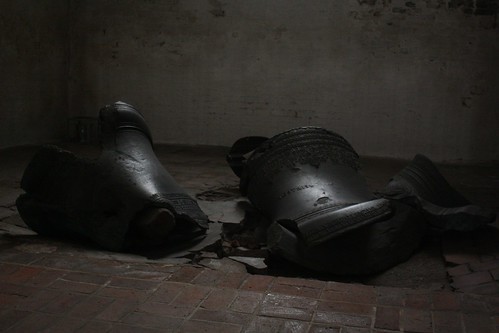
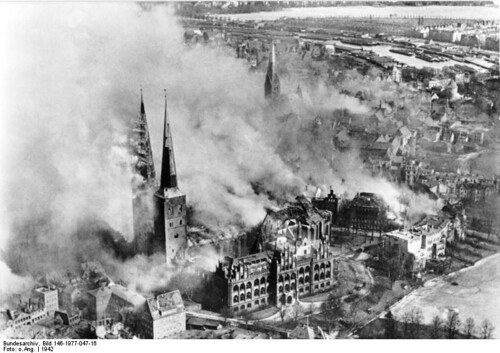
Note: This post was written in March 14-15 and posted after our return. When I think about L beck, the first thing that strikes me is the feeling of history underfoot. It struck me most when we set foot inside the Marienkirche. I had never quite felt a wave of a feeling of stepping back in time like that before. The stones on the floor were uneven and imperfect. L beck has had a wet and snowy winter, so the city had spread sand everywhere: sidewalks and roads. Walking into any grand church, I could hear the sound of sand under the shoes of everyone nearby, and feel it under my own shoes. I think I will long associate with L beck the feeling of walking into a grand old church, looking up at the top of the old building at seemingly impossible heights, while feeling the grit of sand and uneven stone beneath my feet. IMG_2643 Marienkirche isn t perfect, like some American churches I ve been in, such as the Basilica of Notre Dame. It doesn t have a lot of gold, either, and both of these attributes are wonderful. Look at a column of bricks, and you can see that each brick isn t exactly like its neighbor, and the entire column isn t perfectly straight. Lots of things in L beck are so old that they aren t perfectly straight, and it made me think that our American notion of always having to fix such things might be somewhat off sometimes. IMG_2629 Look up, and you see the frescos from the 1300s, revealed after many years after the building was struck by an allied bombing raid in 1942. This heavily damaged the building and knocked down plaster from the walls and ceiling, revealing the old artwork. Many parts of Marienkirche were lost as a result of the bombing, which perhaps adds to its slightly sparse and ancient feel. The church bells were sadly melted and crashed to the ground due to the bombing, and have been left exactly where they fell as a memorial. IMG_2641 Look down, and you see the uneven floor, and the concrete slabs above where important people were buried under the floor an attribute common to many of the churches we visited. It was common to see dates of graves from the 1600s and 1700s, though in some places it would go as far back as the 900s. The main part of the church has no heating or cooling, and visiting it on a day just a bit above freezing adds to the feeling of, well, old. Marienkirche has to be my favorite sight in L beck. Walking around the city, I get a similar feel. Many streets and sidewalks are made of stone. The streets that weren t damaged in the war have rows of beautiful old facades. Walk down many streets, and every so often I d see a little tunnel ( just wide enough for a coffin ) that goes under the street-facing houses to a nice little inner courtyard. These are open to the public, but tend to be very quiet and somewhat private. In the courtyard are smaller houses, which would have originally been used by the less wealthy. We also saw the L beck Dom (cathedral), which had a small museum about the destruction due to the Royal Air Force bombing in 1942. It was very sad to see the photo of the Dom in ruins, still smoking, even now. Burning L beck Cathedral after an air raid in 1942 I can only imagine what it must have felt like to residents of L beck to wake up to see many of their priceless centuries-old landmarks and places of worship so horribly destroyed and all of this for little strategic purpose really focused on the morale of the enemy civil population . It s sad that the allies would do such a short-sighted and terrible thing. Europeans have long had to live with the legacy of war upon war, while we Americans have rarely had to see the consequences of war up close. I think it would be good for more of us to visit these sites and come up face to face with what a bomb can do, and then perhaps we will be more judicious with them in the future. Shifting gears now to where we stayed: Andreas & Sigrid, with whom we stayed, have a beautiful 500-year-old house, with lots of original wood beams exposed, and some very old paintings on the walls and ceilings. Nearby were excellent bakeries and a chocolate shop. Terah and I visited it today and bought some very good chocolate. And this brings me to the second thing I ll remember: Andreas & Sigrid s children, Lukas and Rahel. Now, Terah knows no German, I know only a little bit, and the children know no English. So it was a bit slow getting to know each other to start out, but we managed to work around the communication barrier and had a great time. Terah played board games with Rahel, while with me, she kept inventing games to play: hiding somewhere, saying Hallo! , and laughing at how many unsuccessful attempts I might make to find her. I showed Lukas the camera on my Droid, which he used a lot, though a racing game on Terah s iPod Touch was more exciting. They both enjoyed looking at videos of American trains a bit, but especially pictures of our house and yard with Jacob and Oliver. They tried to teach me the German words for things, and also made futile attempts to correct my pronunciation! When we were leaving today, Rahel came over and gave me a kiss on the hand, then the same to Terah s hand, then a little kiss on one of our suitcases. It was touching and sweet. This was one of those experiences no guidebook prepared me for, and no tour bus would have provided. It is something neat to make friends with children despite the large language barrier. On to the rest of the visit We had arrived a little late into Hamburg. After getting our bags and some Euros at an ATM, the next step was to find the bus to L beck. No signs for it were evident, so I found an information desk. The person at the desk was carrying on a conversation in German with the person ahead of me in line. I figured an information desk person in a busy airport would speak English, and was all ready to ask Sprechen Sie Englisch? , but when I walked up, he got a polite smile, and said, Good morning! How can I help? Guess I m obvious. He directed me to the bus, gave me a brochure about it, and told me what time it would leave. Terah and I found the spot to wait, and for a moment I stepped inside the airport terminal. Terah won t let me forget that someone came up to her and asked a question in German, whereas I was spoken to in English. Anyhow, we found the bus, managed to communicate with the driver that doesn t speak English, and sat next to the friendly person that was talking to Terah. He turned out to be a violin player from Munich, and we had a great conversation for the next hour he asking questions about the USA, us asking questions about Germany and Munich. At one point, he commented, You two are so open minded and you re also Americans! He sounded surprised. We exchanged email addresses at the train station. Andreas found us there, and we walked through the city to his house, with him pointing out the sights along the way. L beck is a beautiful city, and though it was damaged in World War II, much of the really old parts still remain. The famous Holstentor Gate has a museum inside, which was fascinating to visit. On Sunday, we went to church with the family we were staying with, Andreas helpfully translating for us. There I met a British Python programmer, which was fun. His wife is a social worker, which was fun for Terah. Monday it was time to get on the train to Berlin. We again walked through a cold and rainy city to the Hauptbahnhof, ready to head to Berlin. There we got on a train to Hamburg, then an ICE train to Berlin. Despite having just a few minutes for a connection in Hamburg, it all went perfectly smoothly. The train left Leipzig about 10 seconds late the clock inside turned over to the minute, then the doors closed and we were off. Impressive. Note: the rest of my photos from L beck are available on Flickr.
Colin Watson: Thoughts on 3.0 (quilt) format

Note: I wrote most of this before Neil Williams' recent comments on the 3.0 family of formats, so despite the timing this isn't really a reaction to that although I do have a couple of responses. On the whole I think I agree that the Lintian message is a bit heavy-handed and I'm not sure I'm thrilled about the idea of the default source format being changed (though I can see why the dpkg maintainers are interested in that). That said, as far as I personally am concerned, there is a vast cognitive benefit to me in having as much as possible be common to all my packages. Once I have more than a couple of packages that require patching and benefit from the 3.0 (quilt) format as a result, I find it in my interest to use it for all my non-native packages even if they're patchless right now, so that for instance if they need patches in the future I can handle them the same way. It's not unheard of for me to apply temporary patches even to packages I actively maintain upstream, so I don't discount those either. I haven't decided what to do with my native packages yet; unless they're big enough for bzip2 compression to be worthwhile, there doesn't seem to be much immediate advantage to 3.0 (native). Anyway, on to the main body of this post: I've been one of the holdouts resisting use of patch systems for a long time, on the basis that I felt strongly that dpkg-source -x ought to give you the source that's actually built, rather than having to mess around with debian/rules targets in order to see it. Now that the 3.0 (quilt) format is available to fix this bug, I felt that I ought to revisit my resistance and start trying to use it. Migrating to it from monolithic diffs is of course a bit more work than migrating to it from other patch systems, so it's taken me a little while to get round to it. I'd been thinking about holding off until there was better integration with revision control (e.g. bzr looms), as I feel that patch files really ought to be an export format, but I eventually decided that I shouldn't let the perfect be the enemy of the good. I have enough experience with co-maintaining packages that use build-time patch systems to be able to compare my reactions. After experimenting with a couple of small packages, I moved over to the deep end and converted openssh a few weekends ago, since quite a few people have requested over the years that the Debian changes to openssh be easier to audit. This was a substantial job - over 6000 lines of upstream patches - but not actually as much work as I expected. I took a fairly simplistic approach: first, I unapplied all the upstream patches from my tree; then I ran bzr di interdiff -q /dev/stdin /dev/null >x, reduced it to a single logically-discrete patch, applied it to a new quilt patch using quilt fold, and repeated until x was empty. This was maybe an hour or two of work, and then I went through and tagged all the patches according to DEP-3, which took another few hours. After the first pass, I ended up with 38 patches and a much clearer idea of what has been forwarded upstream and what hasn't; I currently have 5 patches to forward or eliminate, down from 18. Good things: Bad things: On the whole I'm satisfied with this, and the benefits definitely outweigh the costs. Thanks to the dpkg team for all their work on this!

25 March 2010

Colin Watson: Thoughts on 3.0 (quilt) format

Note: I wrote most of this before Neil Williams' recent comments on the 3.0 family of formats, so despite the timing this isn't really a reaction to that although I do have a couple of responses. On the whole I think I agree that the Lintian message is a bit heavy-handed and I'm not sure I'm thrilled about the idea of the default source format being changed (though I can see why the dpkg maintainers are interested in that). That said, as far as I personally am concerned, there is a vast cognitive benefit to me in having as much as possible be common to all my packages. Once I have more than a couple of packages that require patching and benefit from the 3.0 (quilt) format as a result, I find it in my interest to use it for all my non-native packages even if they're patchless right now, so that for instance if they need patches in the future I can handle them the same way. It's not unheard of for me to apply temporary patches even to packages I actively maintain upstream, so I don't discount those either. I haven't decided what to do with my native packages yet; unless they're big enough for bzip2 compression to be worthwhile, there doesn't seem to be much immediate advantage to 3.0 (native). Anyway, on to the main body of this post: I've been one of the holdouts resisting use of patch systems for a long time, on the basis that I felt strongly that dpkg-source -x ought to give you the source that's actually built, rather than having to mess around with debian/rules targets in order to see it. Now that the 3.0 (quilt) format is available to fix this bug, I felt that I ought to revisit my resistance and start trying to use it. Migrating to it from monolithic diffs is of course a bit more work than migrating to it from other patch systems, so it's taken me a little while to get round to it. I'd been thinking about holding off until there was better integration with revision control (e.g. bzr looms), as I feel that patch files really ought to be an export format, but I eventually decided that I shouldn't let the perfect be the enemy of the good. I have enough experience with co-maintaining packages that use build-time patch systems to be able to compare my reactions. After experimenting with a couple of small packages, I moved over to the deep end and converted openssh a few weekends ago, since quite a few people have requested over the years that the Debian changes to openssh be easier to audit. This was a substantial job - over 6000 lines of upstream patches - but not actually as much work as I expected. I took a fairly simplistic approach: first, I unapplied all the upstream patches from my tree; then I ran bzr di interdiff -q /dev/stdin /dev/null >x, reduced it to a single logically-discrete patch, applied it to a new quilt patch using quilt fold, and repeated until x was empty. This was maybe an hour or two of work, and then I went through and tagged all the patches according to DEP-3, which took another few hours. After the first pass, I ended up with 38 patches and a much clearer idea of what has been forwarded upstream and what hasn't; I currently have 5 patches to forward or eliminate, down from 18. Good things: Bad things: On the whole I'm satisfied with this, and the benefits definitely outweigh the costs. Thanks to the dpkg team for all their work on this!

Neil Williams: lintian, source format 3.0 and blog comments

Regarding my previous post on source format 3.0, I think it came across that I was blaming lintian entirely which would be unfair.

(As a side-note, a bug in serendipity XMLRPC resulting in all entries having comments disabled has led to a welcome effect of spreading the discussion more widely than a series of comments on my own site could have achieved. I'm happy with this state of affairs, so it you want to comment, either contact me by private email or put your comments on your own blog. I won't be enabling comments any time soon.)

The extended information behind the lintian warning is one thing (I've explained my position on that to Russ privately) - my main objection is to how such a warning was pushed into lintian and the entire use 3.0 or be damned approach that seems to be being adopted.

IMHO, source format 3.0 is not good enough to be the standard dpkg source format for a simple reason: It offers nothing to well maintained packages. Not all packages need NMU's - ever. Not all packages have patches - ever. Native packages and packages with the Debian maintainer upstream gain nothing from 3.0, as far as I can see.

I have 67 source packages - after much very careful consideration, I have found that a handful of those (less than 10) actually benefit from 3.0 and the rest are all unaffected. None of the packages that I will keep on 1.0 have ever had an NMU since I've been maintainer, most are either native or entirely under my sole upstream control. I will decide whether Debian gets a .tar.gz or a .tar.bz2 and although I generally offer both for download where I can, I see no reason to adopt .tar.bz2 as my default for Debian packaging.

Adding a redundant directory and file is obnoxious. I fail to see why debian/source-format would not have been perfectly suitable. Nevertheless, I will do what is necessary to avoid 3.0 until there is a compelling technical reason to adopt it.

The imperative for those in favour of 3.0 is to convince me that there is a reason TO change, not to make it difficult for me NOT to change. I do not need any reason to avoid 3.0 other than I do not have a good enough reason to move from 1.0. Making developers feel like luddites or incompetent merely because the proponents of 3.0 have failed to convince others to move to 3.0 is just insulting. You want me to use 3.0? Explain why I should bother - the current "reasons" on the Wiki page are simply not good enough and any rehash of those will be ignored. Come up with something new or respect my decision and let me get on with more important stuff.

John Goerzen: Trip part 2: Flight to Hamburg

Note: This post written March 13, and posted after our return. Yesterday was a day of travel. We said goodbye to Jacob and Oliver in the morning. We had thought a lot about how to tell Jacob what was happening and when to tell him. Ultimately, he doesn t really understand time or distance very well yet, and we know that he worries about the unknown. So although he knew about the visit to Indiana for awhile, he didn t know that Terah and I would be going somewhere until th emorning. He wasn t pleased, but seemed to take it well. We told him that we re going to a hotel in Germany and reminded him of other times we ve gone to a hotel. I also reminded him that sometimes a babysitter comes to our house while Terah and I go somewhere else, but we always come back later. That seemed to help. We got to the Indianapolis International Airport in plenty of time for our flight. They have built a completely new terminal building; the old one we were familiar with is now abandoned. The new building is beautiful, sunny, open, and even inspiring. I was impressed. Newark Liberty International, on the other hand, had all the ambiance of a Greyhound station across from the county jail. It reminded me a lot of Chicago Midway, which I used to go through regularly: dark, a bit run down (water stains on the ceilings), and nowhere near enough seating in the gate areas. We wound up standing for an hour before our flight left (late). The food court in Concourse C was something special. As we were witting there, Terah remarked on the constant stream of passengers that walked up to the food court, glanced around, and made a look of THESE are my choices? Which was our exact reaction a few minutes before. Yep, it s the first food court I ve been in where McDonald s was the upscale choice. The sit-down Mexican Cafe had hamburgers with mexi-fries as its main attractions. Terah tried out the dodgy pizza place while I tried out the even more dodgy Chinese/sushi place (I was not silly enough to try sushi there). Ultimately we decided that perhaps the point of the food court was to make us eager for airplane food. The choices in Indianapolis sure put that to shame: TGI Fridays was a real gourmet option compared to the choices in Newark. I was really a bit embarrassed; Newark is a major international airport, and many visitors to the United States will be greeted by a foul-smelling food court and a dingy airport. Yay for being welcoming? Well, really we had a good day of travel and I shouldn t be ragging on the Newark airport so much, so I ll say something positive: there s a pharmacy right behind the food court, which is probably a very convenient location to meet the needs of many diners. Anyhow, our flight left Newark about an hour late, at about 7PM Eastern. As I write this, it s about 7:30 CET (1AM Eastern) and our plane will be on the ground in about an hour. I m excited for the coming week! I got some sleep on the plane, but not a lot. I m hoping that I will have the energy for a good weekend.

Adrian von Bidder: Community Distributrion?

As a complete outsider and with my obvious bias as a Debian Developer: how can anybody call Ubuntu a community distribution when it's obvious that Canonical and Mark Shuttleworth can, and will, take decisions for reasons that are not made clear, and with only little or no community involvment? This rethorical question refers, of course, to the current debate about purple vs. brown and the best position of the window close button (Bug report and LWN coverage.) Conclusion? Let's be fair and call it a community support commercial distribution. Perhaps we should found a non-profit to award a (trademarked) True Community Effort label to operating system distributions where no commercial body has the final say?

23 March 2010

Miriam Ruiz: Ada Lovelace Day 2010

Today is March 24th, that means Ada Lovelace Day, and it is being pushed as an international day of blogging to celebrate the achievements of women in technology and science. The aim of Ada Lovelace Day is to focus on building female role models not just for girls and young women but also for those of us in tech who would like to feel that we are not alone in our endeavours. There are some very good examples of women that have been important in the development of science and technology, starting with Ada Lovelace herself (the first developer of an algorithm intended to be processed by a machine), Rear Admiral Grace Murray Hopper (developer of the first compiler for a computer programming language), Adele Goldstine (who wrote the complete technical description for the first digital computer, ENIAC), as well as the six women who did most of the programming of if (Kay McNulty, Betty Jennings, Betty Snyder, Marlyn Wescoff, Fran Bilas and Ruth Lichterman), or women scientists, or women inventors, etc. Well, I m not going to write about any of those, even when any of them would surely deserve that and more for sure. I m going to write about a woman who has definitely been very inspiring and supportive for me when I was starting to get in touch with Free Software and Debian, and who is probably the most important single reason I decided to go for it. It is definitely hard to write about someone you admire when she happens to be one of your best friends, and in fact I m pretty sure that most of the people reading this article already know her, so there s no great mistery. I m talking about Amaya Rodrigo, the first european female Debian Developer (AFAIK) and co-founder of the Debian Women project, and also member of Hispalinux Board in the golden days. The first time I met her she was giving a talk in Madrid about a project that was starting then, Debian Women, and it was very inspiring for me. Inspiring enough for me to join the project. Afterwards I ve learnt more about her, how she overcame many dificulties, like starting to work with computers quite late, among others. The real merit of a pioneer is not really to be the best techie out there, but to overcome the difficulties and doing it the best you can, when no one else has done it before. I m not going to write her biography here, it s not really the purpose of this blog entry, and you probably can ask herself directly. This blog entry is, as I said at the beginning, to highlight women in technology that I consider inspiring and relevant. You know, I admire you, Amaya :)

22 March 2010

Russell Coker: Links March 2010

Blaise Aguera y Arcas gave an exciting demonstration of new augmented reality mapping software from Microsoft that combines video (including live video) with static mapping data and pictures [1]. This is a significant advance over current mapping systems such as Google Earth but it s not released yet either. It will be interesting to see whether Google or Microsoft gets this released first. The New York Review of Books has an insightful atricle by Garry Kasparov about human/computer chess [2]. It s surprising the degree to which a combination of human and computer chess playing can give a good result. Amateur human chess players plus regular PCs can beat grandmasters with computers or high-end computers with human help. It s apparently the quality of human-computer interaction that determines the quality of play. But the article contains a lot more, I recommend reading it. Daniel Kahneman gave an interesting TED talk about the difference between experiential and memory happyness [3]. As the concept of the moment is so short (about 3 seconds) apparently most people try to optimise their actions for the best memories of being happy. But to do so requires some different strategies. For example a two week vacation gives a memory that s not much different from a one week vacation. Therefore it seems that you would be better off staying in a five star hotel for a week than a four star hotel for two weeks, and eat dinner at a Michelin Star restaurant at least once per holiday even if it means eating at McDonalds on other occasions due to lack of funds. Temple Grandin gave an interesting TED talk The World Needs all Kinds of Minds [4] which mostly focussed on teaching children who are on the Autism spectrum. She is concerned that autistic children won t end up where they belong in Silicon Valley . Anupam Mishra gave an interesting TED talk about how the people of India s Golden desert built structures to harvest and store water [5]. Some of their ideas should be copied in Australia, due to mismanagement and stupidity Australians are failing to survive in much more hospitable places. Michael Tieman wrote an insightful and well researched article about the OSI s rejection of the IIPA s attacks on Open Source [6]. This is worth reading by anyone who wants to make a business or social case for free software. Mark Shuttleworth wrote an interesting post about the new visual style for Ubuntu and Canonical [7]. Apparently this includes the creation of a new font set which will be available for free use. Divorced Before Puberty an informative New York Times article by Nicholas Kristof about the links between treatment of women and terrorism [8]. The New York Times has an interesting article on Human Flesh Searches on the Internet in China [9]. It s basically crowds targetting people to find private information and harass them (similar to what some griefers are known for doing on the English-language part of the Internet). But they seem more interested in vigilante justice than lulz. The New York Times has an informative article about the Cult of Scientology (Co$) [10]. Among other interesting news it suggests that the number of cult victims in the US has dropped from 55,000 to 25,000 in the 2001-2008 time period. Senator Xenophon has called for an inquiry into the crimes committed by the cult and a review of it s tax-exempt status [11]. As always Xenu.net is the authoritative source for information on the Cult of Scientology AKA the Church of Scientology. The New York Times has an interesting article about formally studying the skills related to school teaching [12]. It largely focuses on Doug Lemov s Taxonomy of Effective Teaching describes 49 techniques that improve school results and some other related research. The article also mentions that increasing teacher salaries is not going to help much due to the large number of teachers, it s only professions that employ small numbers of people that can potentially have their overall skills improved by increasing salaries. Andy Wingo wrote an interesting article about Julius Caesar [13] based on the book The Assassination of Julius Caesar: A People s History of Ancient Rome by Michael Parenti. It seems that Caesar was more of a populist than a despot. Interesting article in The Register about the Large Hadron Collider (LHC) [14]. Apparently one 3.5TeV proton beam has as much energy as a British aircraft carrier running at 8 knots.

Wouter Verhelst: N900 back!

So, a short while ago, the battery of my N900 had run flat. As in, completely, utterly flat. In itself, that's no big deal -- you connect it to a power outlet, wait until it's gone past the low-battery charging bits, then boot and use as usual. Except that it wouldn't. I'd recently installed a firmware update from Nokia (which contained some bug fix that I really was waiting for), and now the bloody thing wouldn't boot. Rather than do the low-battery charging dance, it thought the battery had enough power that it could just go ahead and boot. Of course it was wrong, so whenever I powered it on, it would sit there fore 30 seconds, try to boot, fail, power off for about a second, and start over. I left it like that for a night, but it didn't recharge. Needless to say, that was quite annoying. So I sent it in for repair, and today there was a package in the mail, containing my (repaired) N900. They'd reflashed it. A reasonable course of action, I guess, but of course that meant all data was gone. Good thing it has a backup application, and good thing I stored those backups on an external micro-SD card. Restoring those back-ups was a breeze; they'd also stored the contents of sources.list and have done something akin to "dpkg --get-selections", since now the application manager kindly asks me whether I wish to reinstall the applications that I had installed. Cute. At any rate, I'm very happy I finally got rid of this awful Samsung "cellphone". It's a SGH-C140 that I had as a replacement until my N900 got back, but there was something very very wrong with it; I don't know whether it's a design flaw or just a wear-and-tear issue (these replacement phones aren't usually handled in the best possible way), but it managed to lose connection to the network every once in a while. So people who would call me would immediately get my voicemail, and then they'd be angry with me later because I was unavailable. Well, duh. Anyway, that's over now. Whee.

Andrew McMillan: The cost of crap

For several years now we've been buying our groceries online. It's worked well, and for the last couple of christmases I remember Heather adding a six-pack into the pre-christmas order so she could pull it out and hand it off to the delivery guy. Fair enough too, because he was their front-line man. He was the guy who had to actually meet the customer, and even if only for two minutes face time, the impression he gave with his cheery "seeya mate" on the way out, and his always-happy smile, was that getting the groceries delivered was fun. Well that ongoing encouragement has gone now. His surly replacement who moans about having to carry the boxes up a flight of stairs does nothing to promote a repeat experience, and he brings into sharp focus the disadvantages of online grocery ordering: sometimes the wrong thing is substituted, or sent. Or the fruit doesn't travel quite so well as it does with the personal loving kindness we supply in our own padded wagon. Two visits from the new guy, and we're back to driving to the supermarket ourselves, patrolling the aisles once more in a cereal haze of consumer demand. Distress-purchasing done, and back to the car A.S.A.P. Carrying our own boxes up the stairs. I hate it, which is why I promoted the idea that we try this online grocery thing a few years ago, and it's worked just fine until this sullen bastard came along and destroyed the fun. I wonder how the company feels? Do they realise what this person is doing to their customers? Will they notice, and if they do, will they even be able to tell where the source of the problem is? In these days of increasing online experience, customer service is still important, if not more important than ever before.

20 March 2010

Robert Collins: LibrePlanet 2010 Day 2

John Gilmore keynote What do we do next, having produced a free software system for our computers? Perhaps we should aim at Windows? Wine + an extended ndiswrapper to run other hardware drivers + a better system administration interface/resources/manuals. However that means knowing a lot about windows internals something that open source developers don t seem to want to do. We shouldn t just carry on tweaking its not inspiring; whats our stretch goal? Discussion followed reactos, continue integrating software and people with a goal of achieving really close integration: software as human rights issue! Desktop paradigm needs to be replaced : need to move away from a document based desktop to a device based desktop. Concern about the goal of running binary drivers for hardware: encourages manufacturers to sell hardware w/out specs; we shouldn t encourage the idea that that is ok. Lots of concern about cloning, lots of concern about what will bring more freedom to users, and what it will take to have a compelling vision to inspire 50000 free software hackers. Free software in cars lots of safety issues in .e.g brake controllers, accelerators. Eben Moglen We re at the inflection point of free software because any large scale global projects these days are not feasible without free software. Claims that doing something that scales from tiny to huge environment requires us A claim I would (sadly) dispute. Lots of incoming and remaining challenges. Entirely clear that the patent systems relationship to technology is pathological and dangerous that I agree with! Patent muggings are a problem patent holders are unhappy with patents granted to other people :) . Patent pools are helping slowly as they grow. Companies which don t care about the freedom aspect of GPLv3 are adopting it because of the patent protection aspects. Patent system is at the head of the list of causes-of-bad-things affecting free software. SFLC is building coalitions outside the core community to protect the interests of the free software community. We are starting to be taken for granted at the high end of mgmt in companies that build on free software. We face a problem in the erosion of privacy. We need to build a stack, running on commodity hardware that runs federated services rather than folk needing centralised services. Marina Zhurakhinskaya on GNOME Shell: Integrates old and new ideas in an overall comprehensive design. Marina ran through the various goals of the shell growing with users, being delightful, starting simply so new users are not overwhelmed. The activities screen looks pretty nice ;) The workspace rearrangement UI is really good. The notifications thing is interesting; you can respond to a chat message in-line in the notification. Richard Stallman on Software as a Service he presented verbally the case made in the paper. Some key quotes All your data on a server is equivalent to total spyware I think this is a worst-case analogy; it suggests that you can never trust another party: kindof a sad state of paranoia to assume that all network servers are always out to get you all the time. And I have to ask should we get rid of Savannah then (because all the data is stored there) the argument for why Savannah is not SaaS is not convincing: its just file storage, so what makes it different to e.g. Ubuntu One? If there is a server and only a little bit of it is SaaS, perhaps just say don t worry about it because that little bit is often the hardest bit to replace. Lets write systems for collaborative word process that don t involve a central server abiword w/the sharing plugin ? :) RMS seems to be claiming that someone else sysadmining a server for you is better than someone else sysadmining a time-shared server for you: I don t actually see the difference, unless you re also asserting that you ll always have root over your own machine . The argument seems very fuzzy and unclear to me as to why there is really a greater risk in particular when there is a commercial relationship with the operator (as opposed to, say, an advertising supported relationship).

Alejandro Rios P.: MiniDebconf at Panama (day Two)

Yesterday began the central america and caribbean MiniDebconf at Panama. Over 50 people from Mexico, Belice, Nicaragua, Guatemala, Costa Rica, Salvador, Colombia and Venezuela, among others, are here to share experiences around Free Software and Debian contributions. All this is possible to several sponsors from Panama and SPI, and the hard work from many people, specially Anto Recio, Mauro Rosero, Carolina Flores, Gunnar Wolf and the local team.

More info(in spanish), including live streaming url can be found on: http://softwarelibre.ca/wiki/MiniDebconf2010

update: Also, on a personal note, I'll take the chance of this event to start my transition to a stronger gpg key, so If you have signed my old one, please take a look at: http://people.debian.org/~alerios/key-transition-2010-03-20.txt

Next.

Previous.