Rigved Rakshit: Intermediate Statistics
These are some of my notes on intermediate statistics from the Udemy Data Science Bootcamp. The Python code associated with this section is available here.

 Like each month, here comes a report about the work of paid contributors to Debian LTS.
Individual reports
In March, 252 work hours have been dispatched among 14 paid contributors. Their reports are available:
No comment Liked this article? Click here. My blog is Flattr-enabled.
/etc/opendkim/signing.table:
*@debian.org marcos-debian.anarcat.user
/etc/opendkim/key.table:
marcos-debian.anarcat.user debian.org:marcos-debian.anarcat.user:/etc/opendkim/keys/marcos-debian.anarcat.user.private
.anarcat.user suffix) for Debian to be happy. The -debian
string is to tell me where the key is published. The marcos
prefix is to remind me where the private is used.opendkim-genkey --directory=/etc/opendkim/keys/ --selector=marcos-debian.anarcat.user --domain=debian.org --verbose
/etc/opendkim/keys/marcos-debian.anarcat.user.txt (alongside the
private key in .key).service opendkim restart
marcos-debian.anarcat.user._domainkey   IN  TXT ( "v=DKIM1; h=sha256; k=rsa; "
"p=MIIBIjANBgkqhkiG9w0BAQEFAAOCAQ8AMIIBCgKCAQEAtKzBK2f8vg5yV307WAOatOhypQt3ANQ95iDaewkVehmx42lZ6b4PzA1k5DkIarxjkk+7m6oSpx5H3egrUSLMirUiMGsIb5XVGBPFmKZhDVmC7F5G1SV7SRqqKZYrXTufRRSne1eEtA31xpMP0B32f6v6lkoIZwS07yQ7DDbwA9MHfyb6MkgAvDwNJ45H4cOcdlCt0AnTSVndcl"
"pci5/2o/oKD05J9hxFTtlEblrhDXWRQR7pmthN8qg4WaNI4WszbB3Or4eBCxhUdvAt2NF9c9eYLQGf0jfRsbOcjSfeus0e2fpsKW7JMvFzX8+O5pWfSpRpdPatOt80yy0eqpm1uQIDAQAB" )  ; ----- DKIM key marcos-debian.anarcat.user for debian.org
"p=MIIB..." string needs to be joined together, without the
quotes and the p=, and sent in a signed email to
changes@db.debian.org:
-----BEGIN PGP SIGNED MESSAGE-----
dkimPubKey: marcos.anarcat.user MIIB[...]
-----BEGIN PGP SIGNATURE-----
[...]
host -t TXT marcos-debian.anarcat.user._domainkey.debian.org nsp.dnsnode.net
nsp.dnsnode.net being one of the NS records of the
debian.org zone.)anarcat@debian.org.
check-auth@verifier.port25.com. Those tools will run Spamassassin
on the received emails and report the results. What you are looking
for is:
-0.1 DKIM_VALID: Message has at least one valid DKIM or DK
signature-0.1 DKIM_VALID_AU: Message has a valid DKIM or DK signature from
author's domain-0.1 DKIM_VALID_EF: Message has a valid DKIM or DK signature from
envelope-from domainMAIL FROM: header
as sent by the originating MTA, which you see as from=<> in the
postfix lost.
The following will happen anyways, as soon as you have a signature,
that's normal:
0.1 DKIM_SIGNED: Message has a DKIM or DK signature, not necessarily valid1.1 DKIM_ADSP_ALL No valid author signature, domain signs all mail--- a/opendkim/key.table
+++ b/opendkim/key.table
@@ -1 +1 @@
-marcos anarc.at:marcos:/etc/opendkim/keys/marcos.private
+marcos %:marcos:/etc/opendkim/keys/marcos.private
 Welcome to gambaru.de. Here is my monthly report (+ the first week in April) that covers what I have been doing for Debian. If you re interested in Java, Games and LTS topics, this might be interesting for you.
I am sure I am not the only one who will remember March 2020 in the future as a month nobody was really fond of. I was mostly occupied with non-Debian work and managed to get ill in the same week I wanted to celebrate my birthday but it didn t matter anyway because of ehm quarantine and social distancing. Maybe next year March will be great again.
 TLDR:
setxkbmap -layout us -variant altgr-intl and become a happier programmer./etc/default/keyboardXKBLAYOUT="us"
XKBVARIANT="altgr-intl"
setxkbmap -print -verbose 10dconf write /org/gnome/desktop/input-sources/sources "[('xkb', 'us+altgr-intl')]"

 Armadillo is a powerful and expressive C++ template library for linear algebra aiming towards a good balance between speed and ease of use with a syntax deliberately close to a Matlab. RcppArmadillo integrates this library with the R environment and language and is widely used by (currently) 706 other packages on CRAN.
A new upstream release 9.860.2 of Armadillo was just released. The theme of convergence continues; the previous release increased the minor from 800 to 850, now we are at 860. We first wrapped this up as version 0.9.859.1.0, but it turned out to have been held back by a buglet between R 4.0.0 and Rcpp which the recent patch release fixed (along with other woes on old R or non-CRAN-alike macOS). It then turns out that the new (upstream) version 9.860.1 had a minor bug which I missed as I reverse-depends checked the prior version. Doh. My thanks, as always, to CRAN for spotting this. The fix was added upstream and we have 9.860.2 as RcppArmadillo 0.9.860.2.0.
Changes in the new release are noted below.
Courtesy of CRANberries, there is a diffstat report relative to previous release. More detailed information is on the RcppArmadillo page. Questions, comments etc should go to the rcpp-devel mailing list off the R-Forge page. If you like this or other open-source work I do, you can now sponsor me at GitHub. For the first year, GitHub will match your contributions.Changes in RcppArmadillo version 0.9.860.2.0 (2020-04-13)
- Upgraded to Armadillo release 9.860.2 (Roasted Mocha Fix)
- Added
powmat()- Faster access to columns in sparse submatrix views
- Faster handling of relational expressions by
accu()- Faster handling of sympd matrices by
expmat(),logmat(),sqrtmat()- Workaround for save/load issues with HDF5 v1.12
- Vignettes are now pre-made and include (#285)
- Two test files are now skipped on 32-bit Windows
This post by Dirk Eddelbuettel originated on his Thinking inside the box blog. Please report excessive re-aggregation in third-party for-profit settings.
A minor routine update 0.0.4 of gettz arrived on CRAN overnight.
gettz provides a possible fallback in situations where Sys.timezone() fails to determine the system timezone. That happened when e.g. the file /etc/localtime somehow is not a link into the corresponding file with zoneinfo data in, say, /usr/share/zoneinfo. Since the package was written (in the fall of 2016), R added a similar extended heuristic approach itself.
This release adds registration of the compiled routine via R_registerRoutines() and R_useDynamicSymbols(), adds .registration=TRUE to useDynLib() in NAMESPACE, and uses an unquoted symbol in .Call(). Two new badges were added to the README.md as well. And as in the previous release in 2016: No new code, or new features.
Courtesy of CRANberries, there is a comparison to the previous release.
More information is on the gettz page. For questions or comments use the issue tracker off the GitHub repo.
If you like this or other open-source work I do, you can now sponsor me at GitHub. For the first year, GitHub will match your contributions.
This post by Dirk Eddelbuettel originated on his Thinking inside the box blog. Please report excessive re-aggregation in third-party for-profit settings.
 In a previous job I wrote some simple utilities which were helpful for continuous-integration pipelines. Most of these were very very simple, for example:
*.json files, and validate them.*.yaml files, and validate them.run-parts does this on Debian GNU/Linux systems, but on CentOS there is no -exit-on-error flag.sysbox validate-yaml [path/to/find/files/beneath]
validate-yaml to sysbox you don't need to prefix with the name - so this is just like busybox in this regard.
Might be interesting to some.
 " 'Boa constrictors swallow their prey whole, without chewing it. After that they are not able to move, and they sleep through the six months that they need for digestion.'
I pondered deeply, then, over the adventures of the jungle. And after some work with a colored pencil I succeeded in making my first drawing.
My Drawing Number One.
It looked something like this:
 I showed my masterpiece to the grown-ups, and asked them whether the drawing frightened them.
But they answered: 'Frighten? Why should any one be frightened by a hat?'
My drawing was not a picture of a hat. It was a picture of a boa constrictor digesting an elephant. But since the grown-ups were not able to understand it, I made another drawing: I drew the inside of a boa constrictor, so that the grown-ups could see it clearly. They always need to have things explained.
My Drawing Number Two looked like this:
 The grown-ups' response, this time, was to advise me to lay aside my drawings of boa constrictors, whether from the inside or the outside, and devote myself instead to geography, history, arithmetic, and grammar.
That is why, at the age of six, I gave up what might have been a magnificent career as a painter. I had been disheartened by the failure of my Drawing Number One and my Drawing Number Two.
Grown-ups never understand anything by themselves, and it is tiresome for children to be always and forever explaining things to them."
from The Little Prince by Antoine de Saint Exup ry
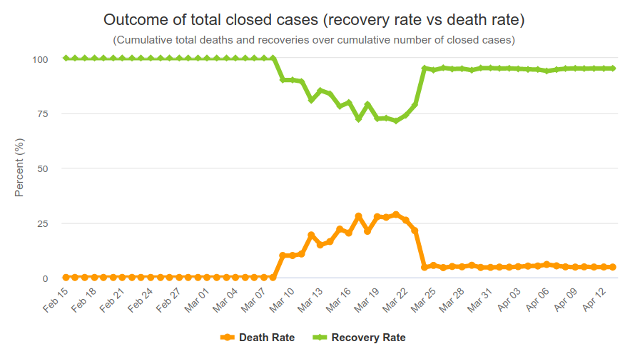 from the Corona Fun with Statistics department at Worldometers
(source, archive.org link)
@debian.org are very nice and well-behaving, any random spammer can
easily send emails from whatever@debian.org, and even if you trust
people from @debian.org you cannot easily configure your antispam
filter to just accept all emails from @debian.org, because spammers
would get in too.
Since nearly ten years DKIM is there to help you. If you send an email
from @debian.org with DKIM, it will have a header like this:
DKIM-Signature: v=1; a=rsa-sha256; c=simple/simple; d=debian.org;
    s=vps.gio.user; t=1586779391;
    bh=B6tckJy2cynGjNRdm3lhFDrp0tD7fF8hS4x0FCfLADo=;
    h=From:Subject:To:Date:From;
    b=H4EDlATxVm7XNqPy2x7IqCchBUz1SxFtUSstB23BAsdyTKJIohM0O4RRWhrQX+pqE
     prPVhzcfNALMwlfExNE69940Q6pMCuYsoxNQjU7Jl/UX1q6PGqdVSO+mKv/aEI+N49
     vvYNgPJNLaAFnYqbWCPI8mNskLHLe2VFYjSjE4GJFOxl9o2Gpe9f5035FYPJ/hnqBF
     XPnZq7Osd9UtBrBq8agEooTCZHbNFSyiXdS0qp1ts7HAo/rfrBfbQSk39fOOQ5GbjV
     6FehkN4GAXFNoFnjfmjrVDJC6hvA8m0tJHbmZrNQS0ljG/SyffW4OTlzFzu4jOmDNi
     UHLnEgT07eucw==
d=debian.org is the domain this email claims to be from
and the fields bh= and b= are a cryptographic public key signature
certifying this fact. How do I check that the email is actually from
@debian.org? I use the selector s=vps.gio.user to fetch the public
key via DNS, and then use the public key to verify the signature.
$ host -t TXT vps.gio.user._domainkey.debian.org
vps.gio.user._domainkey.debian.org descriptive text "v=DKIM1; k=rsa; s=email; h=sha256; p=" "MIIBIjANBgkqhkiG9w0BAQEFAAOCAQ8AMIIBCgKCAQEAsM/W/kxtKWT58Eak0cfm/ntvurfbkkvugrG2jfvSMnHHkFyfJ34Xvn/HhQPLwX1QsjhuLV+tW+BQtxY7jxSABCee6nHQRBrpDej1t86ubw3CSrxcg1mzJI5BbL8un0cwYoBtUvhCYAZKarv1W2otCGs43L0s" "GtEqqtmYN/hIVVm4FcqeYS1cYrZxDsjPzCEocpYBhqHh1MTeUEddVmPHKZswzvllaWF0mgIXrfDNAE0LiX39aFKWtgvflrYFKiL4hCDnBcP2Mr71TVblfDY0wEdAEbGEJqHR1SxvWyn0UU1ZL4vTcylB/KJuV2gMhznOjbnQ6cjAhr2JYpweTYzz3wIDAQAB"
@debian.org. The spammer
hopefully does not have access to Debian's DKIM keys, and they cannot
sign emails.
Many large and small email services have already deployed DKIM since
years, while most @debian.org emails still do not use it. Why not?
Because people send @debian.org emails from many different
servers. Basically, every DD used their @debian.org address sends
email from their own mail server, and those mail servers (fortunately)
do not have access to Debian's DNS record to install their DKIM
keys. Well, that was true until yesterday! :-)
A few weeks ago I poked DSA asking to allow any Debian Developer to
install their DKIM keys, so that DDs could use DKIM to sign their
emails and hopefully reduce the amount of spam sent from
@debian.org. They have done it (thank you DSA very much, especially
adsb), and now it is possible to use it!
How do I configure it?
I will not write here a full DKIM tutorial, there are
many
around. You
have to use opendkim-genkey to generate a key and then configure
your mail server to use opendkim to digitally sign outbound email.
There are a few Debian-specific things you have to care about, though.
First the have to choose a selector, which is a string used to
distinguish many DKIM keys belonging to the same domain. Debian allows
you to installa a key whose selector is <something>.<uid>.user,
where <uid> is your Debian uid (this is done both for namespacing
reasons and for exposing who might be abusing the system). So check
carefully that your selector has this form.
Then you cannot edit directly Debian's DNS record. But you can use the
email-LDAP gateway on db.debian.org to
install your key in a way similar to how entries in debian.net are
handled (see the updated
documentation). Specifically,
suppose that opendkim-genkey generated the following thing for
selector vps.gio.user and domain debian.org:
vps.gio.user._domainkey IN  TXT ( "v=DKIM1; h=sha256; k=rsa; "
      "p=MIIBIjANBgkqhkiG9w0BAQEFAAOCAQ8AMIIBCgKCAQEAsM/W/kxtKWT58Eak0cfm/ntvurfbkkvugrG2jfvSMnHHkFyfJ34Xvn/HhQPLwX1QsjhuLV+tW+BQtxY7jxSABCee6nHQRBrpDej1t86ubw3CSrxcg1mzJI5BbL8un0cwYoBtUvhCYAZKarv1W2otCGs43L0sGtEqqtmYN/hIVVm4FcqeYS1cYrZxDsjPzCEocpYBhqHh1MTeUE"
      "ddVmPHKZswzvllaWF0mgIXrfDNAE0LiX39aFKWtgvflrYFKiL4hCDnBcP2Mr71TVblfDY0wEdAEbGEJqHR1SxvWyn0UU1ZL4vTcylB/KJuV2gMhznOjbnQ6cjAhr2JYpweTYzz3wIDAQAB" )  ; ----- DKIM key vps.gio.user for debian.org
p= field (without
being fooled by it being split between different strings) and
construct a request of the form:
dkimPubKey: vps.gio.user MIIBIjANBgkqhkiG9w0BAQEFAAOCAQ8AMIIBCgKCAQEAsM/W/kxtKWT58Eak0cfm/ntvurfbkkvugrG2jfvSMnHHkFyfJ34Xvn/HhQPLwX1QsjhuLV+tW+BQtxY7jxSABCee6nHQRBrpDej1t86ubw3CSrxcg1mzJI5BbL8un0cwYoBtUvhCYAZKarv1W2otCGs43L0sGtEqqtmYN/hIVVm4FcqeYS1cYrZxDsjPzCEocpYBhqHh1MTeUEddVmPHKZswzvllaWF0mgIXrfDNAE0LiX39aFKWtgvflrYFKiL4hCDnBcP2Mr71TVblfDY0wEdAEbGEJqHR1SxvWyn0UU1ZL4vTcylB/KJuV2gMhznOjbnQ6cjAhr2JYpweTYzz3wIDAQAB
changes@db.debian.org:
echo 'dkimPubKey: vps.gio.user blahblahblah' gpg --clearsign mail changes@db.debian.org
host -t TXT vps.gio.user._domainkey.debian.org to chech the
key gets published (it will probably take some minutes/hours, I don't
know). Once it is published, you can enable DKIM in you mail server
and your email will be signed. Congratulations, you will not look like
a spammer any more!
You can send an email to check-auth@verifier.port25.com to check
that your setup is correct. They will reply with a report, including
the success of DKIM test.
Notice that currently Debian's setup only allows you to use RSA DKIM
keys and doesn't allow you to set other DKIM fields (but you probably
won't need to set them).
EDIT DSA made an official announcement about DKIM
support,
which you might want to check out as well, together with its links.
EDIT 2 Now ed25519 keys are supported, the syntax for specifying
keys on LDAP is a little bit more flexible and you can also insert
CNAME records. See the official
documentation for the updated
details.
So we have solved our problems with spam?
Ha, no! DKIM is only a small step. Useful, also because it enable
other steps to be taken in the future, but small.
In particular, DKIM enables you to say: "This particular email
actually comes from @debian.org", but doesn't tell anybody what to
do with emails that are not signed. A third-party mail server might
wonder whether @debian.org emails are actually supposed to be signed
or not.
There is another standard for dealing with that, which is called
DMARD, and I believe that Debian should eventually use it, but not
now: the problem is that currently virtually no email from
@debian.org is signed with DKIM, so if DMARC was enabled other mail
servers would start to nuke all @debian.org emails, except those
which are already signed, a minority. If people and services sending
emails from @debian.org will start configuring DKIM on their
servers, which is now possible, it will eventually come a time when
DMARC can be enabled, and spammers will find themselves unable to send
forged @debian.org emails. We are not there yet, but todays we are a
little step closer than yesterday.
Also, notice that having DKIM on @debian.org only counters spam
pretending to be from @debian.org, but there is much more. The
policy on what to accept is mostly independent on that on what you
send. However, knowing that @debian.org emails have DKIM and DMARC
would mean that we can set our spam filters to be more aggressive in
general, but whitelist official Debian Developers and services. And
the same can be done for other domains using DKIM and DMARC.
Finally, notice that some incompatibilities between DKIM and mailing
lists are known, and do not have a definitive answer yet. Basically,
most mailing list engines modify either the body of the headers in
forwarded emails, which means that DKIM does not validate any
more. There are many proposed solutions, possibly none completely
satisfying, but since spam is not very satisfying as well, something
will have to be worked out. I wrote a lot already, though, so I wont't
discuss this here.
 A few days ago we have released upstream TeX Live 2020, and Debian packages are already available in the sid/unstable suite, and will (hopefully) migrate to testing rather soon.
 All the changes listed in the upstream release blog apply also to the Debian packages:
The currently available versions in unstable are
 I was gonna use this blog post to share about the migrant worker woes as there has been multiple stories doing the rounds. For e.g. a story which caught the idea of few people but most of us, i.e. middle-class people are so much into our own thing that we care a fig leaf about what happens to migrants. This should not be a story coming from a humane society but it seems India is no different than any other country of the world and in not a good way. Allow me to share
Or for those who don t like youtube, here s an alternative link
https://www.invidio.us/watch?v=JGEgZq_1jmc
Now the above two editorial shares two stories, one of Trump retaliatory threat to India in the Q&A of the journalist. In fact, Trump has upped the ante on visa sanctions as India buckled so easily under pressure.
There have been other stories doing the rounds how people who have illnesses who need HCQ in India are either dying or are close to death because of unavailability of HCQ in the medicine shop. There have been reports in Pune as well as South Mumbai (one of the poshest localities in Mumbai/Bombay) that medicine shops are running empty or emptier. There have been so many stories on that, with reporters going to shops and asking owners of the medicine shops and shop-owners being clueless.
I think the best article which vividly describes the Government of India (GOI) response to the pandemic is the free-to-read article shared by Arundhati Roy in Financial Times. It has reduced so much of my work or sharing that it s unbelievable. And she has shared it with pictures and all so I can share other aspects of how the pandemic has been affecting India and bringing the worst out in the Government in its our of need. In fact, not surprisingly though, apparently there was also a pro-Israel similar thing which happened in Africa too . As India has too few friends now globally, hence it decided to give a free pass to them.
 News Broadcasters Association reply to Mrs. Gandhi
 Aryan Plastic bottle
 Dhauladhar range Northern Punjab Copyright CNN.Com
 Intel's Dynamic Platform and Thermal Framework (DPTF) is a feature that's becoming increasingly common on highly portable Intel-based devices. The adaptive policy it implements is based around the idea that thermal management of a system is becoming increasingly complicated - the appropriate set of cooling constraints to place on a system may differ based on a whole bunch of criteria (eg, if a tablet is being held vertically rather than lying on a table, it's probably going to be able to dissipate heat more effectively, so you should impose different constraints). One way of providing these criteria to the OS is to embed them in the system firmware, allowing an OS-level agent to read that and then incorporate OS-level knowledge into a final policy decision.
Cleopatra the Alchemist who likely lived during the 3rd century AD, was a Greek alchemist, author, and philosopher. She experimented with practical alchemy but is also credited as one of the four female alchemists that could produce the Philosopher's stone. Some writers consider her to be the inventor of the alembic, a distillation apparatus.
Hedy Lamarr (/ he di/), born Hedwig Eva Maria Kiesler (November 9, 1914[a] January 19, 2000), was an Austrian-born American film actress and inventor who was posthumously inducted into the National Inventors Hall of Fame.[1]
Radia Joy Perlman (born December 18, 1951) is an American computer programmer and network engineer. She is most famous for her invention of the spanning-tree protocol (STP), which is fundamental to the operation of network bridges, while working for Digital Equipment Corporation. She also made large contributions to many other areas of network design and standardization, such as link-state routing protocols.
Stephanie Louise Kwolek (July 31, 1923 June 18, 2014) was an American chemist who is known for inventing Kevlar. She was of Polish heritage and her career at the DuPont company spanned more than 40 years.[1] She discovered the first of a family of synthetic fibres of exceptional strength and stiffness: poly-paraphenylene terephthalamide.
This page aims to list inventions and discoveries in which women played a major role.
Welcome to the 25nd post in the randomly recurring R recitations series, or R4 for short.
Just yesterday, we posted a short post along with a video and supporting slides. It covered how to test the soon-to-be-released R 4.0.0 on a custom Ubuntu 18.04 Rocker container.
A container for Ubuntu 20.04, which is itself in final beta stages, was being built while the video was made. As it is available now, we created a quick follow-up video showing the use under Ubuntu 20.04:
The updated supporting slides from the video are still at this link. What we showed in both videos does of course also work directly on Ubuntu (or Debian, using those source repos) installations; the commands shown in the Rocker use case generally apply equally to a normal installation. If you like this or other open-source work I do, you can now sponsor me at GitHub. For the first year, GitHub will match your contributions.
This post by Dirk Eddelbuettel originated on his Thinking inside the box blog. Please report excessive re-aggregation in third-party for-profit settings.
I am switching jobs, and after a two year stint as a full stack developer at BPMasters, I am joining Red Hat as a Technical Account Manager (Platform and Openshift). A good friend of a good friend already worked at Red Hat, and advised me to apply, which I did, and I am starting in May in Vienna, the place where I live. Welcome to the 24nd post in the relentlessly regular R ravings series, or R4 for short.
R 4.0.0 will be released in less than two weeks, and testing is very important. I had uploaded two alpha release builds (at the end of March and a good week ago) as well as a first beta release yesterday, all to the Debian experimental distribution (as you can see here) tracking the release schedule set by Peter Dalgaard. Because R 4.0.0 will require reinstallation of all packages, it makes some sense to use a spare machine. Or a Docker container. So to support that latter mode, I have now complemented the binaries created from the r-base source package with all base and recommended packages, providing a starting point for actually running simple tests. Which is what we do in the video, using again the R on Ubuntu (18.04) Rocker container:
Slides from the video are at this link. This container based on 18.04 is described here on the Docker Hub; a new 20.04 container with the pre-release of the next Ubuntu LTS should be there shortly once it leaves the build queue. What we showed does of course also work on direct Ubuntu (or Debian, using those source repos) installations; the commands shown in the Rocker use case generally apply equally to a normal installation. If you like this or other open-source work I do, you can now sponsor me at GitHub. For the first year, GitHub will match your contributions.
This post by Dirk Eddelbuettel originated on his Thinking inside the box blog. Please report excessive re-aggregation in third-party for-profit settings.
Next.