Search Results: "ana"

30 May 2011

Raphaël Hertzog: Trying to make dpkg triggers more useful and less painful

Lately I have been working on the triggers feature of dpkg. I would like to share my plan and what I have done so far. I ll first explain what triggers are, the current problems, and the work I did to try to improve the situation. Introduction Dpkg triggers are a neat feature of dpkg that package can use to send/receive notifications to/from other installed packages. Those notifications take the form a simple string. This feature is heavily used to track changes of packaged files in a list of predefined directories, and to update other files based on this. For instance, man-db is watching the directories containing manual pages so that it can update its cache (in /var/cache/man/). install-info is updating the index of info pages when there have been changes in /usr/share/info. gnome-menus is updating its own copy of the menu hierarchy (with entries from /etc/gnome/menus.blacklist blacklisted) every time that a .desktop file is installed/updated/removed. From a user s perspective You see triggers in action very often during upgrades (in fact too often as we ll see it later):
Preparing to replace zim 0.52-1 (using .../archives/zim_0.52-1_all.deb) ...
Unpacking replacement zim ...
Processing triggers for shared-mime-info ...
Processing triggers for menu ...
Processing triggers for desktop-file-utils ...
Processing triggers for man-db ...
Processing triggers for hicolor-icon-theme ...
Processing triggers for python-support ...
Processing triggers for gnome-menus ...
Setting up zim (0.52-1) ...
Processing triggers for python-support ...
Processing triggers for menu ...
As you guessed it, those Processing triggers lines correspond to the packages which received (one or more) trigger notifications and which are doing the corresponding task. By default the triggers are processed at the end of the dpkg --unpack invocation which is often too soon because APT will often call dpkg --unpack repeatedly during important upgrades. There are some options to ask APT to use dpkg s --no-triggers option in order to defer the trigger processing at the end of the APT run. You can put this in /etc/apt/apt.conf.d/triggers:
// Trigger deferred
DPkg::NoTriggers "true";
PackageManager::Configure "smart";
DPkg::ConfigurePending "true";
DPkg::TriggersPending "true";
I have now asked APT maintainers to use those options by default, I filed bug #626599 to track this. At the same time I fixed bug #526774 reported by APT maintainers. This bug forced them to put a work-around in APT which resulted in running triggers sooner than expected. (And while writing this article I filed bug #628564 and #628574 because it was clearly not normal that the menu triggers was executed twice for the installation of a single package) From a packager s perspective The implementation of triggers has several consequences on the status that packages can have. Let s assume that the package A installs a file in a directory that is watched by package B (and that B is currently in the installed state). When A is unpacked, dpkg adds B to its Triggers-Awaited field and lists the activated trigger in B s Triggers-Pending field. Package A is in unpacked state, but B has been changed to triggers-pending . When A is configured, instead of going to the installed state, it will go to the triggers-awaited state. In that state the package is assumed to NOT fulfill dependencies. However, B which is still in triggers-pending state does fulfill dependencies. A and B will switch to installed at the same time when the trigger has been processed. The fact that the triggers-awaited status does not fulfill dependencies means that some common triggers like man-db have to be processed regularly just to be able to ensure dependencies are satisfied before running the postinst of other installed packages. But a package which ships a manual page can certainly be considered as configured when its postinst has been run even if man-db has not yet updated its cache to know about the new/updated manual page. When you activate a trigger with the dpkg-trigger command you have an option --no-await to avoid awaiting the trigger processing (and thus to go directly to installed state after the postinst has been run). But with file triggers or activate trigger directives, you do not have this option. My proposal to improve the situation This is the problem that I tried to solve during my last vacation. But before changing the inner working of triggers, I wrote a non-regression test suite for that feature (commit here) so I could hack with some confidence that I did not break everything. The result has been presented on the debian-dpkg mailling list: see the discussion here. I added new directives that can be used in triggers files that work exactly like the current triggers except that they do not put triggering packages in trigger-awaited status. I believe the code to be mostly ready, but in its current form the patch brings zero benefits until all packages have been converted to use the trigger variants that do not require awaiting trigger processing (and the change requires a pre-dependency on dpkg to ensure we have the required dpkg that understands the new kind of trigger directives). Remaining question Thus I wonder if I should not change the default semantic of triggers. The packages which really provide crucial functionality to awaiting packages through triggers would then have to be updated to switch to the new directives. If you re a packager using triggers, you can thus help me by answering this question: do you know some triggers where it s important that the awaiting packages are not considered as configured before the trigger processing? In most of the cases I checked, it s important for the triggered package rather than for the triggering package. In truth, a package in triggers-awaited status is usually in a good enough shape to be able to satisfy dependencies (i.e. requirements that other packages can have), but it would still be worth to record the fact that it s not entirely configured yet because it might be true from the user s point of view: for example if the menu trigger has not yet been processed, the software might not yet be visible in the application menu.

If you appreciate this kind of groundwork that benefits to the whole Debian ecosystem, please consider supporting my work. Click here and give it a look, there are many ways to contribute and to make a difference for me.

3 comments Liked this article? Click here. My blog is Flattr-enabled.

Michael Prokop: Grml 2011.05 Codename Just Mari

I m proud to be able to announce a new stable release of Grml, the Debian based Live system for system administrators. This release is a very special one for me. On the one hand of course because of the special release name Just Mari , being dedicated to my lovely wife. But it s also special because of the way the release management worked out. I ve been the release manager for Grml since the very beginning, which turned out to be more than 6 years since the first stable release already. I developed grml-live as build framework based on FAI for generating a Grml and Debian based Linux Live system to streamline the build process. Anyway it was mainly me who managed the release chroots, doing the update management during release freeze, editing main web page etc. As I want to make the project as independent from myself as much as possible and to keep the Bus factor in balance we started to improve our project infrastructure so it s not just me who can do this kind of release management. As a result Grml core developer Christian Hofstaedtler became the release sergeant of this release. The release candidate version was even released without myself being available (the release happened behind my back during our marriage). Major work on the final stable release was also done by Grml core developers Ulrich Dangel, Christian Hofstaedtler, Frank Terbeck and Alexander Wirt and I m very happy about that. Kudos guys for all your work and all the hidden efforts going on behind my back. :) The details regarding the new Grml release are available in the official release announcement, get the ISOs from grml.org/download. I hope you enjoy the release as much as I do. Happy hacking!

29 May 2011

Evgeni Golov: I m going to DebConf11 and Wacken2011

I'm going to DebConf11Yes, you will see me in Banja Luka. This will be my first DebConf, but I have a strong feeling it won t be the last one. I hope to see some productive sessions in pkg-games and pkg-ayatana, nice people and a lot of fun in a nice country.I will travel with ICE 729 from Duesseldorf to Munich and EN 499 from Munich to Zagreb on the 22.07.2011 and return with EN 498 and ICE 728 on 31.07.2011.To make things louder, I will go to Wacken from 02.08.2011 until 07.08.2011, wonder to see some Debian people there :)

Thomas Koch: Is it really that hard?

It's 2011. Computers are here for a couple of decades now, but they still don't help me with the most simple problems. I've been asked once again about a recommendation for a GroupWare and still don't know what to say. This are the simple requirements:

Manage my Mails, Calendar, Contacts, Files, Knowledge (Wiki) and ToDos (including IssueTracker). Let me synchronize these informations with mobile devices and for offline work. Allow collaboration and sharing.

I started professional programming in 2006 with the eGroupWare project, which provides the above functionality more or less, but I still can't recommend it. Neither could I recommend any other system I know of (Tine 2.0, OpenGroupWare, OpenExchange, Horde, Kolab, ...?) since they violate one or more of my secondary requirements:


This kind of software is on the top position on my Things-To-Do-When-I-Have-Time. But on the other hand I know that many have already started such projects and either they did not deliver sufficient functionality or there code base is a PITA.

Yes, I'm ranting once again. But please show me a decent GroupWare and I'll praise you on any occassion!

Or should I make this my project for my bachelor thesis: A Contacts+Mail server/web frontend in Scala using CouchDB, Dovecot? What do you think?

Thomas Koch: Keysigning @ Berlin Buzzwords

Whenever you download some software from the Apache Software Foundation, there is a small .asc file besides every software release. This tiny file is a cryptographic signature to protect you from accidentally downloading and running malware.
Put your key signing fingerprints in your badge!

However this signature is only as good as the web-of-trust between you and the Release Manager of the Software project.
At BerlinBuzzWords many developers and users will gather at one place. This is a unique occasion to strengthen the web-of-trust. Therefor we want to encourage and remind you to use the occassion for keysigning! For lack of time there won't be an official keysigning party, but you have occassion during lunch, coffee break or the barbecue to do quick one-to-one keysignings.
You should bring print-outs of your key fingerprints and identification documents. If you put the fingerprints in your batch (see picture) everyone can easily see
them and ask you for a quick trust exchange. We may also mark a "keysigning corner" somewhere where people can go and meet others for key signing.

Hints:

28 May 2011

Vincent Bernat: SNMP support for keepalived

keepalived keepalived is an high-availability and load-balacing solution. Using VRRP, it allows you to share IP addresses between several servers or routers. At a given moment, only one of them (the master) will be handed the IP address. VRRP is usually setup for redundant routers, but you can also setup redundant services. If the master becomes unavailable or fails, one of the backups will take over the IP address. VRRP is not a cluster resource manager. It is targeted at sharing one (or several) IP between a set of hosts. If you want to share other resources with complex conditions like at least two web servers should run and the database should not run on the same node as a web server , you should look at heartbeat instead. For load-balancing, keepalived relies on IPVS, a Linux subsystem featuring layer-4 switching. keepalived will check if your servers are alive and tell it to IPVS. IPVS will handle incoming connections and send them on the appropriate alive server depending on the policy you can configure. For example, one policy is round-robin: servers are handled new connections in circular order.

keepalived & SNMP keepalived did not feature a native SNMP support. I have added complete SNMP support and I hope those patches will be accepted into mainstream. Meanwhile, you can grab keepalived with SNMP support source code from GitHub. Currently, it is based on the latest version of keepalived. Here is what you can do :
  • query the configuration of the running keepalived without parsing configuration files;
  • query runtime status (like VRRP status, priority or current state of a virtual server) without looking in the logs;
  • query runtime statistics about virtual servers (how many connections were handled by this real server, for example) without parsing the output of ipvsadm;
  • get noticed with the help of SNMP traps when something changed (VRRP transition or a real server that became unavailable);
  • changing the priority of a VRRP instance (to force a transition as master);
  • changing the weight of a real server (to remove it from a pool of servers).

Compilation To use it:
1
2
3
4
5
$ git clone https://github.com/vincentbernat/keepalived.git
$ cd keepalived
$ git checkout snmp-1.2.0
$ ./configure --enable-snmp
$ make
You get bin/keepalived which is the SNMP enabled keepalived daemon. You can use it directly or install it with make install as root. On RHEL, SNMP is not properly packaged. Try the following command instead of make:
1
$ make LDFLAGS="$(net-snmp-config --agent-libs) -lpopt -lssl -lcrypto"

Use To use it, you need to ensure that your main snmpd daemon can become a master agent. Check for the presence of master agentx line in snmpd.conf. The next step is to start keepalived with the -x switch. keepalived will connect to your main snmpd daemon. You can check the logs for a ligne like this:
May 28 17:21:19 L1 Keepalived_vrrp: NET-SNMP version 5.4.3 AgentX subagent connected

Lab To test it, we can setup a little lab with UML. You can find additional details about this kind of lab in my post about network lab with UML. Grab the complete lab from GitHub. Ensure that you correct the path to keepalived sources at the top of the setup script. keepalived & SNMP lab The lab features four web servers that will be merged into a single web service with the help of keepalived. Since, keepalived now supports full IPv6 support, we will also use IPv6 in our lab. Here is the VRRP configuration of the first keepalived :
vrrp_instance VI_1  
   state MASTER
   interface eth2
   dont_track_primary
   track_interface  
      eth0
      eth1
    
   virtual_router_id 1
   priority 150
   advert_int 2
   authentication  
      auth_type PASS
      auth_pass blibli
    
   virtual_ipaddress  
      1.1.1.15/24 dev eth0
      2001:db8::15/64 dev eth0
      192.168.1.1/24 dev eth1
      fd00::1/64 dev eth1
   
 
We define two virtual servers, one for IPv4, one for IPv6. Here is an excerpt of the configuration :
virtual_server_group VS_GROUP_IPv4  
   1.1.1.15 80
 
virtual_server group VS_GROUP_IPv4  
   delay_loop 10
   lb_algo rr
   lb_kind NAT
   protocol TCP
   real_server 192.168.1.10 80  
      weight 1
      HTTP_GET  
        url  
          path /
          status_code 200
         
        connect_timeout 10
       
    
   [...]
 
When running the lab (with ./setup), we can check that everything works as expected. From the client node, we can make several requests, both with IPv4 and IPv6:
1
2
3
4
5
6
7
8
C1# curl  http://1.1.1.15 
W3
C1# curl  http://1.1.1.15
W2
C1# wget -o /dev/null -O - 'http://[2001:db8::15]'
W3
C1# wget -o /dev/null -O - 'http://[2001:db8::15]'
W2
If we put down eth1 on L1, L2 becomes master and everything works as expected. Our client node can still do the requests.

SNMP We can query the configuration of our running keepalived from L1. The appropriate MIB is KEEPALIVED-MIB. The base OID for this MIB is .1.3.6.1.4.1.9586.100.5. It is hosted in the OID space allocated by IANA to the Debian project. For example, to get the configuration of our VRRP instance:
 1
 2
 3
 4
 5
 6
 7
 8
 9
10
11
12
13
14
15
16
17
18
19
# snmpwalk -v2c -cpublic localhost KEEPALIVED-MIB::vrrpInstanceTable
KEEPALIVED-MIB::vrrpInstanceName.1 = STRING: VI_1
KEEPALIVED-MIB::vrrpInstanceVirtualRouterId.1 = Gauge32: 1
KEEPALIVED-MIB::vrrpInstanceState.1 = INTEGER: master(2)
KEEPALIVED-MIB::vrrpInstanceInitialState.1 = INTEGER: master(2)
KEEPALIVED-MIB::vrrpInstanceWantedState.1 = INTEGER: master(2)
KEEPALIVED-MIB::vrrpInstanceBasePriority.1 = INTEGER: 150
KEEPALIVED-MIB::vrrpInstanceEffectivePriority.1 = INTEGER: 150
KEEPALIVED-MIB::vrrpInstanceVipsStatus.1 = INTEGER: allSet(1)
KEEPALIVED-MIB::vrrpInstancePrimaryInterface.1 = STRING: eth2
KEEPALIVED-MIB::vrrpInstanceTrackPrimaryIf.1 = INTEGER: tracked(1)
KEEPALIVED-MIB::vrrpInstanceAdvertisementsInt.1 = Gauge32: 2 seconds
KEEPALIVED-MIB::vrrpInstancePreempt.1 = INTEGER: preempt(1)
KEEPALIVED-MIB::vrrpInstancePreemptDelay.1 = Gauge32: 0 seconds
KEEPALIVED-MIB::vrrpInstanceAuthType.1 = INTEGER: password(1)
KEEPALIVED-MIB::vrrpInstanceLvsSyncDaemon.1 = INTEGER: disabled(2)
KEEPALIVED-MIB::vrrpInstanceGarpDelay.1 = Gauge32: 0 seconds
KEEPALIVED-MIB::vrrpInstanceSmtpAlert.1 = INTEGER: disabled(2)
KEEPALIVED-MIB::vrrpInstanceNotifyExec.1 = INTEGER: disabled(2)
We can get statistics from IPVS subsystem:
 1
 2
 3
 4
 5
 6
 7
 8
 9
10
11
# snmpwalk -v 2c -c public localhost KEEPALIVED-MIB::virtualServerTable   grep Stats
KEEPALIVED-MIB::virtualServerStatsConns.1 = Gauge32: 6 connections
KEEPALIVED-MIB::virtualServerStatsConns.2 = Gauge32: 6 connections
KEEPALIVED-MIB::virtualServerStatsInPkts.1 = Counter32: 36 packets
KEEPALIVED-MIB::virtualServerStatsInPkts.2 = Counter32: 36 packets
KEEPALIVED-MIB::virtualServerStatsOutPkts.1 = Counter32: 24 packets
KEEPALIVED-MIB::virtualServerStatsOutPkts.2 = Counter32: 24 packets
KEEPALIVED-MIB::virtualServerStatsInBytes.1 = Counter64: 2970 bytes
KEEPALIVED-MIB::virtualServerStatsInBytes.2 = Counter64: 3312 bytes
KEEPALIVED-MIB::virtualServerStatsOutBytes.1 = Counter64: 2592 bytes
KEEPALIVED-MIB::virtualServerStatsOutBytes.2 = Counter64: 3072 bytes
We can also disable a real server, for example W1:
 1
 2
 3
 4
 5
 6
 7
 8
 9
10
11
12
# snmpget -v2c -cpublic localhost KEEPALIVED-MIB::realServerAddrType.1.1 \
                                KEEPALIVED-MIB::realServerAddress.1.1
KEEPALIVED-MIB::realServerAddrType.1.1 = INTEGER: ipv4(1)
KEEPALIVED-MIB::realServerAddress.1.1 = Hex-STRING: C0 A8 01 0A 
# snmpget -v2c -cpublic localhost KEEPALIVED-MIB::realServerAddress.2.1 \
                                KEEPALIVED-MIB::realServerAddress.2.1
KEEPALIVED-MIB::realServerAddress.2.1 = Hex-STRING: FD 00 00 00 00 00 00 00 00 00 00 00 00 00 00 10 
# snmpset -v2c -cprivate localhost KEEPALIVED-MIB::realServerWeight.1.1 = 0
KEEPALIVED-MIB::realServerWeight.1.1 = INTEGER: 0
# snmpset -v2c -cprivate localhost KEEPALIVED-MIB::realServerWeight.2.1 = 0
KEEPALIVED-MIB::realServerWeight.2.1 = INTEGER: 0
From C1, you can now check that W1 is not queried anymore. Let s graph the number of connections per second each real server gets. With a simple script using rrdtool, we can get the following graph: rrdtool graph built from stats returned by keepalived SNMP agent

27 May 2011

Matt Zimmerman: Why I m excited about joining Singly

This summer, I ll be taking a bit of time off, moving back to San Francisco and starting a new job. I can t wait to get back to work. Here s why. Me and my data
I have a singular relationship with my data. I have a copy of every email I ve sent since I first got an Internet email address in 1994 (82,000 messages and counting). I have even older files downloaded from BBSes, and passed between friends on floppy disks. Chat logs, text messages, voicemail I hold onto them all. Anything which is relevant to me personally, I tend to save. This must seem banal to people who are first getting online today. In the age of Gmail and Flickr, it s easy to assume that all of your data will be preserved indefinitely, with little or no effort on your part. But for me, it has been hard work over the years, because I ve done it myself. I ve carried my data with me to countless new computers, operating systems, storage technologies, file formats and cities over the years. Everywhere I ve lived, I ve brought it with me. Physically. Really? Why do I do this? Why have I gone to such trouble for a collection of bits? Especially now, why is most of my data still at home?
One pragmatic answer is that I can simply do more with my data when I have a copy. I can work with it using any software I want, including software that I write myself. I don t have to worry about whether I can transfer it from one web service to another. I m never stuck using yesterday s services because my data is never trapped in them. My personal data is always available to me me, always raw, ready and waiting for the next wave of software to come along. When it does, I can load my data into it and keep going. The fact that Facebook and Google disagree over sharing their users data doesn t bother me in the least. Another reason is that I want to be in control of it. I decide who to share my data with, and when. Some of it, I prefer not to share at all, with any person or company, and I have that choice. Even if a powerful government wants to access my data, I am afforded certain protection under the law, at least in the countries where I ve lived. If I turned over my data to service providers, my choices and protection would likely be much more limited. I have a deeper emotional attachment to my data as well. Enfolded within that vast pattern of bits is some part of my self. By sharing my personal data with other people, I show them something of who I am. Increasingly, my personal data is part of my identity. This is more than just a state of mind: it s been shown that even our non-identifying personal data can reveal who we are. In other words, it s not just my data it s me data . Singly I m joining Singly because I want to take this concept much further, and combine people, data and software into a different shape with people at the center. Today, we are creating vastly greater amounts of personal data, and it s stored in many more places. We leave our trail on the Internet in the form of activity streams, messages and content, spread across different web sites, each with their own inscrutable terms of service and (if we re lucky) their own API. These disconnected silos prevent us from using all of this information effectively. Meanwhile, we want and need to connect with each other in more ways than ever before. We need applications which can connect us, through our personal data, to the services we need. Singly is building the technology to make this possible. It will be designed with the deepest respect for the relationship that we have with our personal data, and with a vision for truly personal computing. Singly is This opportunity is a great fit for my interests and experience. Singly aims to be the commercial part of a vibrant open source community, and I m looking forward to building on what I ve learned in Debian, Canonical and Ubuntu to help make it a success. I ll have lots more to say about it as time goes on. Meanwhile, if you re interested in following what we re doing, here s where:

Lucas Nussbaum: Changes to Ruby in Debian (and Ubuntu)

(this is a copy of an mail sent to ruby-core@ and ruby-talk@) Since the beginning of 2011, the Debian Ruby team has been working on several big changes. Those changes all are available in Debian unstable, some of them are also available in Debian testing, and they should all be available in the next Debian and Ubuntu releases. I think that it addresses most of the reasonable concerns about Ruby in Debian. Using alternatives to switch between Ruby implementations The alternatives system is now used to manage the ruby symlink and the other related symlinks, making it easy to switch between Ruby implementations (only Ruby 1.8 and 1.9.X at the moment) (see this mail for details). The default choice for Ruby is still 1.8, but this change will make it easy for us to make a switch to 1.9.X by default (likely by the release of Debian wheezy). Installing gems executables to /usr/local/bin Rubygems (both as a standalone package, and as shipped with Ruby 1.9.X) now install executables to /usr/local/bin. (The other files still get installed under /var, see this mail) Enabling gem update system gem update system has been re-enabled. Since upgrading rubygems to a version that may not have been properly tested with the rest of the Debian system may cause issues in the user s system, there s a big warning about that. The user can confirm and upgrade rubygems anyway by defining an environment variable. New gem2deb packaging helper There s a new packaging helper, named gem2deb, that makes it very easy to generate Debian source packages from Rubygems. We are in the process of migrating all ruby libraries packaged in Debian to that new helper. It will take some time, though (help is welcomed). Transition status: http://pkg-ruby-extras.alioth.debian.org/wheezy/ One big benefit of the switch to gem2deb for the Ruby community is that, in the process, we are enabling test suites at build time for each package and each Ruby implementation. This should make it easy to detect regressions in new interpreter versions. Ruby 1.9.3 We will switch to Ruby 1.9.3 ASAP (probably when it is branched off trunk, with a package first in Debian experimental). Since the Ruby compatibility version issue is likely to stay around, we will re-evaluate how we are dealing with it (to avoid the ruby1.9.1 package <=> ruby -v = 1.9.2 problem that confuses many users). This is likely by switching the package name to ruby1.9.3 (keep a ruby1.9.1 package for compatibility). The package containing the shared library will stay libruby1.9.1. Links

26 May 2011

Dirk Eddelbuettel: R / Finance 2011 presentations

I just sent the text below to the r-sig-finance list:
The organizing committee for the R/Finance 2011 conference is pleased to announce the availability of presentation slides from the 3rd annual R/Finance conference. This year's two-day conference once again attracted over 200 participants from across the globe. Academics, students and industry professionals enjoyed almost 30 talks covering trading, optimization, risk management and more --- all using R! The majority of these presentations are now available for download at:
http://www.RinFinance.com/agenda/
This year we began offering prizes for the best paper submissions. The 2011 recipients are Robert Gramacy (University of Chicago) and David Matteson (Cornell University) who each won USD 1000. Also new was a graduate student travel award: Mikko Niemenmaa (Aalto University) and Cl ment Dunand-Ch tellet ( cole Polytechnique) each received USD 500. With this, the organizing committee would like to thank our lead conference sponsors, the International Center for Futures and Derivatives at UIC and Revolution Analytics, as well as our conference sponsors OneMarketData, RStudio and Lemnica for their continued support. The organising committee would also like to thank all of the presenters and participants for making R/Finance 2011 so successful. We look forward to seeing you in 2012, with the prospective dates of May 17 - 19 to be confirmed. For the organizing committee,
Gib Bassett, Peter Carl, Dirk Eddelbuettel, Brian Peterson,
Dale Rosenthal, Jeffrey Ryan, Joshua Ulrich
Enjoy!

25 May 2011

Iain Lane: Greetings, Planet Debian!

Well hello there. A couple of days ago my debian.org account was created, meaning that I'm one1 of the crop of current new Debian Developers. Actually the news was broken to me by Rhonda when I attached to irssi after arriving at work, a nice surprise :-)
<Rhonda> All congratulate Laney on becoming a Debian Developer.  ;)
* Rhonda . o O ( http://db.debian.org/search.cgi?dosearch=1&uid=laney )
<Laney> Rhonda: I did?!?!?!
I'll quickly introduce myself by paraphrasing from the background section of the AM report before letting you go about your business. I apparently submitted my first thrilling patch to the alsa-tools package in Ubuntu on February 2nd, 2008. This was sponsored into Hardy by Daniel Chen. Thereafter followed a myriad of exciting patches to various packages that somehow managed to convince a bunch of people that I had enough skill to become an Ubuntu developer. Fast forward a while and I get sucked into the world of Debian packaging by the CLI/Mono strike force of Mirco Bauer and Jo Shields by way of the Mono 2.0 transition. This was where I got my first Debian upload, and it was in this team that I fully realised both the excellence and importance of Debian in the FOSS world2. At some point the Debian Haskell Group formed and I've been involved to some extent there all along too. What I've mainly learned from these two groups is that team maintenance is a really great way to look after a bunch of related packages. When I see people touting new packages about, I often recommend that they look at the list of teams to find a nice home. Perhaps one or two actually did. Thanks to everyone who's supported me so far. I hope to be able to do the same for others in the future.

  1. Along with obergix, lopippo, oliva, aron, madamezou, taffit. Congrats to the rest of you, too :-)
  2. I now consider it one of my primary duties as an Ubuntu developer to reduce the number of fixes that are uploaded to Ubuntu, and take every opportunity that is given to me to promote Debian as the natural home for technically excellent work. Not least because I fully expect DDs to not shy away from calling out poor work presented to them.

Guillaume Mazoyer: Here is a new GSoC student

java.pngHello Planet Debian reader.

And now you re thinking, who is this crazy guy who does not even know how to write English (is my sentence wrong?). My name is Guillaume Mazoyer and I am the Google Summer of Code student working on Jigsaw with Tom Marble and Sylvestre Ledru. I blog from France and I plan to write my GSoC reports right here.

Maybe you don t know what is Jigsaw yet. If so, go read this wiki page, you should be able to understand the goal of my project. Here is the description:

Since the beginning of Java, the JVM is a big virtual machine will all the features incorporated in it. This JVM provides many features which are useful in only limited areas (Corba) or which are not used at all in some contexts (AWT/Swing are useless for a web server).

The goal of the jigsaw project is to provide a modular JVM.

This will provide many improvements in the performance area (startup, solving of the dependencies, etc) but also the size of the dependencies.

There are already some works done by upstream (Oracle) but it does not complain to the Debian standards. The target is Java 8.

The goal is this Google Summer of Code project is to package the current development version of Jigsaw into Debian.

Please note that this project is not only about packaging. This will probably implies some developments and contributions to upstream (upstream is aware of this effort). Updating javahelper to manage specifities of Jigsaw could be considered.

I m pretty excited to work on this project and the work has already started. Can t wait to go deeper and enjoy working on two things that I love: Debian and Java.

24 May 2011

Russell Coker: Are Assholes Essential to a Free Software Project?

What do Assholes do? Rusty just wrote a post titled If you didn t run code written by assholes, your machine wouldn t boot [1] about some of the anti-social tendencies demonstrated by programmers, including some that are implied to be fairly important. His post seems to imply that there are really great programmers who are anti-social and that we should just put up with it because of their great code. One of the problems with his post is that he doesn t define asshole . Holocaust deniers and all other Nazi supporters seem to clearly by assholes by any definition. People who have silly ideas about medicine and tell others seem to be merely misguided (although my dictionary gives stupid or irritating or ridiculous in the definition of asshole so technically they can meet the criteria). In the comments Rusty states that nuttiness is relative . While that is correct it doesn t seem to have much bearing on whether someone is an asshole. For example I know some very nice people who are utterly convinced by creationism. Is Anyone Essential to Free Software? Most projects have one person or several people in leadership positions, usually there seems to be a combination of project management and lead-programmer positions. Such people are obviously quite important to a project. But we have seen examples of people dying, being employed by Microsoft, retiring, relicensing the source in a bad way, and just losing interest without the project ceasing. It seems clear that in most cases when a project which has a significant amount of use has significant bugs and no maintainer then someone will step in. The cases where no-one takes over the project are often resolved by someone creating a competing project. If no-one takes over an abandoned Free Software project then it s a strong indication that the project wasn t particularly important anyway. I have no doubt that if any bug or missing feature made Linux systems stop booting then someone would fix it quite quickly. In a more general sense it seems that every time someone takes a position in a project that is of wide interest they are displacing someone else who might have done the job. When you volunteer to do significant work for a project you may be displacing someone who is more skillful than you this isn t necessarily a bad thing as there are plenty of other projects to work on, some of which require more skill. Growing More Programmers It seems to me that a large part of becoming a great programmer is facing great challenges. People who could be described as optimistic or arrogant will tend to take on more challenging tasks and therefore learn more. I m sure that there are a lot of people out there who have the potential to be great programmers apart from not taking on the challenging work, this seems to be an unfortunate waste of talent. Given a large enough population if someone leaves a senior position there should be someone else who can obtain the skills needed to take over. One advantage of this for Free Software development is that even if the best person to take on the challenge isn t living in the most convenient continent that won t be an obstacle, while with proprietary software development projects the teams are small and it s common that no-one else is capable of stepping up to a lead position. Another advantage is that when the lead developer leaves there are generally many candidates to replace them, all of whom can start work and be judged on the work that they do. I think that the best claims that can be made regarding essential people are not in regard to technical skill alone but to a combination of technical and people skills. Getting a group of programmers to work together is really hard but it s something that needs to be done for any significant project. Also the larger projects tend not to stand alone, being able to get changes included in other projects requires some skill. Ben Collins-Sussman and Brian Fitzpatrick gave an insightful talk at Google IO 2008 titled How to Protect Your Open Source Project From Poisonous People [2]. The first half of their talk is mostly about people who are misguided or difficult rather than what most people would consider poisonous and the second half is more about people who are actively poisonous and need to be removed. They advocate a community based on Politeness, Respect, Trust, and Humility. They describe in detail how the methods they advocate result in the members of their community being more productive, it seems obvious that those principles will lead to better career growth for people within the community and more friendly people wanting to join. When is being an Asshole OK? I once worked for a company that apparently had a team consisting solely of assholes. Apparently one asshole got promoted to management and after some internal transfers they ended up with all the assholes in the company on one team. I guess that when someone has negative interactions with everyone they won t notice the difference if they are put in a team where everyone is difficult. For a corporate environment that lacks a no jerks hiring policy this is probably a good way of improving productivity overall. I am not aware of any significant Free Software project that was comprised of mostly jerks although I have seen a few with dysfunctional environments that encourage the worst behavior from their members. The smaller Free Software projects have less need for people who can relate to other people. There are many useful Free Software projects which have only one developer, in most cases anyone can take the source code and use it without dealing with the author. But even for a single-developer project an asshole can cause some serious problems. One example I know of concerns a developer who had unclear licenses and started making legal threats in response to a request for a clear license. Another example is of a developer who released code that was designed to not work when one particular user compiled it and redistributed the binaries. Both of them caused some significant amounts of time to be wasted by people who were unfortunate enough to develop systems that interacted with the code in question, and even more time was wasted when some misguided people defended them in the inevitable flame-wars. Even for a project with only one developer it s still better for everyone if that developer isn t an asshole. One comment I ve seen related to this issue suggesting that some types of asshole behavior shouldn t be a problem an example that was cited is a colleague who cheats on a romantic partner. Jeremy Clyman (who is currently doing a Ph.D in Psychology) has written an interesting article about this for Psychology Today [3]. He reviews the movie The Dilemma which deals with someone catching their colleague s wife cheating. Jeremy analyses the psychological issues involved and how they can (among other things) impact the ability for such people to work. I once worked in an office where two married employees were very open about having an affair and we were all apparently expected to lie on their behalf if necessary, it really affected the quality of the working environment. Extreme Assholes There are lots of people involved in Free Software development who are difficult and many who are to some extent assholes. But some of them take being an asshole to the extreme, such as Holocaust deniers (an example which Rusty used). In the comments on his post the Westboro Baptist Church is also mentioned. It is possible to entirely disagree with someone on a contentious issue such as abortion but still be able to get along with them. But when someone supports a hate-based organisation such as the WBC or supports Nazis in any way then there will be many people who just can t tolerate them and no-one should be expected to tolerate such people. I have seen two instances where Free Software developers advocated pro-Nazi positions (one had an archive of neo-Nazi propaganda and the other claimed that Nazis were not responsible for the Holocaust). Neither of the pro-Nazi programmers was evicted for defending Nazis, but both of them ended up leaving the community in adverse ways after causing other damage in the mean time. I don t think it takes any great ability to predict the future to determine that someone who defends Nazis will eventually end up doing something that requires expulsion and drive away users and developers in the mean-time. There is no possibility that someone can support the Nazi or WBC ideology only when not associated with your project, it will affect all aspects of their life. When a Holocaust denier is allowed to be a member of a community it also sends out a message that members of the groups which were persecuted by Nazis aren t particularly welcome in the community. Helping Minor Assholes There are a lot of people who don t have malevolent aims but who unintentionally cause some difficulty (it seems that the truly malicious are a tiny minority). I don t think that excusing the bad things that they do on the basis of writing good code helps them in the long term. Many of the suggestions that Ben Collins-Sussman and Brian Fitzpatrick make seem likely to help people who don t want to be assholes and direct them towards positive involvement in the community. One trend that seems apparent is the non-linear response to certain types of bad behavior. There is often little difference in severity between something that gets almost no attention and something that results in a large and extremely hostile reaction. If someone persists in acting like an asshole for long enough it seems to be inevitable that they will eventually exceed some threshold for what is tolerated and get a very significant negative response. It would be good if things didn t need to get to that stage. I think that the most unfortunate aspect of Rusty s blog post is that most people will probably interpret it as encouragement to write better code as a way of getting a free pass for being an asshole. I know that this isn t what Rusty intended, but most people on the Internet don t know Rusty as well as I do. Conclusion Ben Collins-Sussman and Brian Fitzpatrick seem to have some of the best ideas for how to deal with these issues when you control a project, but most of us aren t in that position. Everyone can advocate better behavior. Extreme assholes need to be removed quickly and without a great debate about their contributions, freedom of speech, or other issues. Since considering this issue I ve been wondering about when one should avoid the lesser assholes and asshole-positive environments. People tend to adapt to their environment, so if you associate with assholes a lot then there s a good chance you will start to become like them. Is

Russell Coker: Book Company Bankruptcy

In February Borders went bankrupt [1], since then they have been in the slow process of closing down. Now Borders is trying to clear the last of their stock and offering 80% discounts off the marked price. I bought a book by Stephen Baxter and one by Peter F. Hamilton and those appeared to be the last two books worth buying (IMHO) on the almost empty sci-fi shelves, the books were a little tattered but at 80% discount I m not complaining. It s been almost four years since I last bought books, and I still haven t read all the free sci-fi stories and watched all the free sci-fi movies from the net which interest me [2]. So I m not planning to buy many more books unless I see something better than a 50% discount. Paul Wayper writes about the difficulty of buying ebooks [3]. It s ironic that some people have claimed that ebooks were part of the cause of Borders financial troubles given that they really aren t working well, not even for the most dedicated buyers. In related news Kobo (the company that runs the Borders ebook store) has assured customers that they won t lose the books that they own [4]. There are very few situations in which a company needs to assure customers that they won t lose property that they have paid for and received due to a corporate bankruptcy. As further evidence that Digital Restrictions Management (DRM) is a bad thing, Apple have shut down the iFlow Reader [5] so that they can monopolise ebook sales on the iPhone and iPad. This is a good reason to avoid restricted platforms (such as anything from Apple) and encrypted content. It seems to me that Cory Doctorow s scheme for giving copies of his books to libraries is a more effective way of donating in return for a free ebook [6] (which is rather similar to the buy one get one scheme that they used to run for OLPC). Hopefully Charles Stross will end up doing something similar to make Paul Wayper happy.

23 May 2011

Tanguy Ortolo: Uninstalling a single component of a meta-package

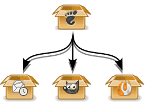
Or how to get rid of Evolution without removing your whole system Tree from a GNOME package to Evolution, GIMP and Brasero packages There is a complain I have heard several times from people after they installed Debian: I use Icedove/Thunderbird so I do not need Evolution: I tried to remove it but this would remove my whole system, that sucks! Explanation The reason behind this situation is that GNOME is installed by a meta-package, which is a dummy package that depends on each component of the official GNOME desktop, including Evolution. So it got installed as a dependency of that dummy package. This means that you, or rather, the Debian installer, never asked explicitly to install either Evolution or any other specific software: it came automatically. Now, you want to remove Evolution: very well, but this implies removing the meta-package, as you are removing one of its dependencies. But if you are removing this meta-package, there is no reason to keep all this software you did not asked for, so, as they got installed automatically, they are now removed automatically as well The solution So, do you still want to remove Evolution but keep the remaining of your GNOME desktop? Of course you will not keep GNOME , because GNOME includes Evolution, so strictly speaking GNOME without Evolution is not GNOME any more. Well, there is a solution: marking all the dependencies of the meta-package as manually installed, that is, faking that you installed them explicitly Aptitude is able to do that with its powerful search functions:
# aptitude unmarkauto '?reverse-depends(gnome)   ?reverse-recommends(gnome)'
# aptitude unmarkauto '?reverse-depends(gnome-core)   ?reverse-recommends(gnome-core)'
# aptitude unmarkauto '?reverse-depends(gnome-desktop-environment)'\
'   ?reverse-recommends(gnome-desktop-environment)'
What did we do? Well, exactly what is written: unmarking as automatically installed the packages that reverse-depend or reverse-recommend gnome or gnome-desktop-environment. In other words, those that are dependencies or recommendations of gnome, gnome-core or gnome-desktop-environment. Why these three packages? Because the GNOME environment that Debian provides by default is composed of several meta-packages: I shall let you refer to their respective descriptions for further information. Now, you can safely remove Evolution without pulling out your whole desktop system:
# aptitude remove evolution

David Welton: Summary: Built To Sell - Creating A Business That Can Thrive Without You

<iframe frameborder="0" marginheight="0" marginwidth="0" scrolling="no" src="http://rcm.amazon.com/e/cm?lt1=_blank&amp;bc1=000000&amp;IS2=1&amp;bg1=FFFFFF&amp;fc1=000000&amp;lc1=0000FF&amp;t=dedasys-20&amp;o=1&amp;p=8&amp;l=as4&amp;m=amazon&amp;f=ifr&amp;ref=ss_til&amp;asins=B004IYISQW" style="width: 120px; height: 240px; float: left; margin-right: 20px; margin-bottom: 8px;"></iframe> Many small business owners start a business with the idea of greater freedom in mind, yet end up chaining themselves to something that takes even more dedication than a regular job. This book discusses the dos and don'ts that business owners need to be conscious of in order to create a business that is independent of its owner(s) in order to be able to sell it. It does so in an easy to read format that's a bit of a gimmick - a fictional story illustrating the authors points. Like most business books, the core idea isn't that hard to explain. the book even includes a handy summary of the main points, which I'll paraphrase here:
  1. Focus on one thing you can do really well; even a service business can be 'productized' by creating a standard service that is the focus of the business.
  2. If your business revolves around one or two key clients, the risk inherent in that approach will lower the value or scare of potential buyers completely.
  3. Put a process in place, from sales through production.
  4. Don't "be" your company. If the company is all about you, what's a potential buyer really getting if you sell it and leave?
  5. By focusing on products, you can charge up front rather than having poor cash flow. If you pay people to work on a project for 3 months, and don't get paid for another month, you are, by the end, out 4 months salary while waiting for the payment.
  6. Say no to projects outside the scope of your business. Only by focusing narrowly can you really excel at what you do.
  7. Spend time doing some research and calculations to estimate your potential market size; buyers will want to know this.
  8. If you have a business that has sales people, hire at least two so that they'll compete with one another.
  9. You want people who are good at selling products, not services; the latter will want to tweak your offering for each and every client, rather than selling it as-is and trying to find how it can meet the customer's needs that way, which is the best strategy for a product.
  10. If you were previously running a more 'generic' services company, and you switch to a more productized approach, be prepared to take a hit the year when you switch.
  11. Potential acquirers will want to see at least a couple of years of steady growth with the new model after making the switch.
  12. If you grow, you'll need a management team that can work without you. Put an incentive system into place to reward their loyalty and results.
  13. When looking for an adviser to sell your company, aim for one where you will not be the largest or smallest client.
  14. If your adviser really only has one company in mind to sell yours to, they may be trying to sell you off cheap as a favor.
  15. Consider how much you could grow with the resources of a buyer. Think big, and show them what kind of growth could happen with the right backing.
  16. Think and speak like a product business with 'customers' rather than 'clients'.
  17. Stock options are more complex than simpler options like bonuses that are paid out over a period of time, in terms of ways to give people an incentive to stay.
All in all, it was an enjoyable read, with solid points. Even if you have no intention of selling your business, thinking of the business itself as a sort of "product" that is not dependent on you to work correctly is a sensible way to go about creating and growing a business. He's certainly not, nor claims to be the first one to discuss this idea, and indeed references the well known E-Myth Revisited which focuses less on selling a business, and more on how to go about extricating you and your skills from the business.

Gregor Herrmann: RC bugs 2011/11 - 2011/20

long time no post about my RC bug fixing activities. & indeed, I haven't been very active during the last weeks. here's a quick update; it includes two NMUs done for the perl 5.12 transition, the rest is just "normal" maintainance work (interesting to see how much stuff can break behind our backs ...). I still hope to find some more time in the future to look at other RC bugs; after all we want to have a not-too-long freeze for wheezy, don't we?

22 May 2011

Thomas Girard: Introducing CORBA

What is CORBA? The wikipedia page says it all:
The Common Object Request Broker Architecture (CORBA) is a standard
defined by the Object Management Group (OMG) that enables software
components written in mutiple computer languages and running on
multiple computers to work together (i.e., it supports mutiple
platforms).
The standard was created twenty years ago, in 1991. The technology can be used in many programming languages: Python, Java, C++, C, etc. Hence you can write a software in your favorite programming language, exposing services that others will be able to call using a different language. (Nowadays you can do the same with WebServices. This article is about CORBA.) All CORBA specifications are available on [OMGSPEC]; latest version is [CORBA3.1]. [MCHALE] book is a very good way to learn CORBA.
How does it work? CORBA is language agnostic because it relies on its own language: the Interface Definition Language (IDL for short). The IDL defines the contract between the client (software calling the service) and the server (software implementing the service). The service is exposed through a remote object. IDL is used to define:
  • modules, which are called namespaces in C++ (or packages in Java)
  • structs, which are like C structs: they can contain data only (the data part of the contract)
  • interfaces, which contain methods specification (the service part of the contract)
  • exceptions that can be raised by a method
  • typedefs which are type aliases
  • unions, la C
  • enums, enumerations
  • constants
IDL comes with existing types:
  • char, octet
  • string, wstring
  • short, long, long long (signed if unspecified, unsigned if prefixed with unsigned)
  • float, double, long double
  • arrays
  • sequences
  • any which can be any existing or user-defined type
From this contract, the following code will be generated using a dedicated tool:
  • client-side code, called stubs
  • server-side code, called skeletons
So to call a CORBA remote service in a given programming language, we will generate stubs from the IDL, then write code relying on these stubs. To provide a CORBA service in a given progamming language, we will generate skeletons from the IDL, then extend them with our implementation. The dispatching and networking machinery is handled by the Object Request Broker (ORB for short). That's the most important part of the CORBA system: it's the component that hides away remoting aspects to make distant objects appear as if they were embedded within the local, client-side code.
Telecom Log Service example The Telecom Log Service [TLOG] is an OMG specified service that defines two interfaces:
  • Log, to add, search and delete records
  • LogMgr, a Log container to lookup a given log, or list all contained logs
The specification details five sub-interfaces of the log service, grouped into three different approaches:
  • basic implementation. This is the service depicted below.
  • event-based implementation. The Event Service [EVENT] is another CORBA service specification. Combining both services means that software emitting events can be plugged to an Event Log without modification.
  • notify-based implementation. The Notification Service [NOTIF] is another CORBA service specification, built on top of the Event Service, with added filtering facility. Again, combining these two services provide easier integration with existing software.
Here is the UML representation of key base interfaces (in yellow), basic implementation (in blue) and important date structures (in green): http://thomas.g.girard.free.fr/CORBA/tls.png Here is the simplified IDL for these parts:
#include <TimeBase.idl>  // IDL can include each other
#pragma prefix "omg.org" // extra prefix to use in front of type names

// DsLogAdmin definition
// Because of the #pragma prefix above, the complete name of this module
// is omg.org/DsLogAdmin
module DsLogAdmin
 
        // E X C E P T I O N --------------------------------------------------
        exception InvalidGrammar  ;                    // empty exception
        exception InvalidConstraint  ;                 // empty exception
        exception LogFull   short n_records_written;  ; // one attribute
        exception LogOffDuty  ;                        // empty exception
        exception LogLocked  ;                         // empty exception
        exception LogDisabled  ;                       // empty exception

        // T Y P E   A L I A S ------------------------------------------------
        typedef unsigned long LogId;
        typedef sequence<LogId> LogIdList; // LogIdList is a sequence of LogId
        typedef unsigned long long RecordId;
        typedef string Constraint;
        typedef TimeBase::TimeT TimeT; // TimeT type defined in TimeBase module
        typedef sequence<any> Anys;    // Anys is the name of a sequence of any

        // S T R U C T U R E S ------------------------------------------------
        struct NVPair  
                string name;
                any    value;
         ; // <-- Mandatory semi-colon
        typedef sequence<NVPair> NVList; // Give a name to a sequence of NVPair

        struct LogRecord  
                RecordId id;
                TimeT    time;
                NVList   attr_list;
                any      info;
         ;
        typedef sequence<LogRecord> RecordList;
        // I N T E R F A C E S ------------------------------------------------
        // Iterator interface specification
        interface Iterator  
                // get() method:
                // - two input parameters
                // - returning a list of LogRecord
                // - possibly raising InvalidParam exception
                RecordList get(in  unsigned long position,
                               in  unsigned long how_many)
                        raises (InvalidParam);
                void destroy();
         ;  // <-- Mandatory semi-colon

        // Forward declaration
        interface LogMgr;
        interface Log
         
                LogMgr my_factory();
                LogId id();
                // retrieve() method:
                // - two input parameters
                // - one output parameter
                // - returning a list of LogRecord
                // This method will actually return two objects: the
                // RecordList and the Iterator
                RecordList retrieve(in  TimeT from_time,
                                    in  long how_many,
                                    out Iterator i);
                RecordList query(in  string grammar,
                                 in  Constraint c,
                                 out Iterator i)
                        raises (InvalidGrammar, InvalidConstraint);
                unsigned long delete_records(in  string grammar,
                                             in  Constraint c)
                        raises (InvalidGrammar, InvalidConstraint);
                void write_records(in  Anys records) 
                        raises (LogFull, LogOffDuty, LogLocked, LogDisabled);
         ;
        typedef sequence<Log> LogList; // Give name LogList to sequence of Log

        // inteface BasicLog derives from interface Log
        interface BasicLog : Log  
                void destroy();
         ;
        interface LogMgr
         
                LogList list_logs();
                Log find_log(in LogId id);
                LogIdList list_logs_by_id();
         ;
        // inteface BasicLogFactory derives from interface LogMgr
        interface BasicLogFactory : LogMgr
         
                BasicLog create(
                        in  LogFullActionType full_action,
                        in  unsigned long long max_size,
                        out LogId id)
                        raises (InvalidLogFullAction);
                BasicLog create_with_id(
                        in  LogId id,
                        in  LogFullActionType full_action,
                        in  unsigned long long max_size)
                        raises (LogIdAlreadyExists, InvalidLogFullAction);
         ;
 ; // <-- Mandatory semi-colon
The complete IDL file for the Basic Telecom Log Service is available here.
[CORBA3.1] http://www.omg.org/spec/CORBA/3.1/
[MCHALE] http://www.ciaranmchale.com/corba-explained-simply/
[OMGSPEC] http://www.omg.org/technology/documents/spec_catalog.htm#Middleware
[TLOG] http://www.omg.org/spec/TLOG/
[EVENT] http://www.omg.org/spec/EVNT/
[NOTIF] http://www.omg.org/spec/NOT/

21 May 2011

Craig Small: JFFNMS 0.9.0 Released

After 3 release candidates jffnms is now at version 0.9.0. Both the web frontend and backend (engines) have had extensive re-work done to them to cleanup and tighten up the code. There should be a lot less warnings and errors from PHP when you set to a higher error level.

19 May 2011

MJ Ray: Top 10 Benefits of Mailing List Software

Particularly around local government, but also some not-for-profits and universities, I m trying to persuade people to stop using huge Blind Carbon Copy (BCC) lists that they keep in their address book and switch over to using mailing list manager software. Our co-op even gives some simple mailing list hosting away with web hosting. I think good mailing list software is better because:

  1. List members can help themselves they can subscribe, unsubscribe and set options by sending email to the software or visiting its website, which reduces the worker time required to manage the list. But you can still manage it directly if you prefer.
  2. Your address book is smaller because you don t need every address on the mailing list cluttering up your email software s address book any more
  3. Errors are handled automatically if an address doesn t work any more, the software will unsubscribe it, usually with some safeguards against one-off problems
  4. Privacy is safeguarded dedicated email list software will not put all the mailing list addresses in the To-line by mistake (as often happens with Address Book announcement lists)
  5. Spam is filtered rules can be set centrally and they can be different to the rest of your organisation
  6. Messages can be moderated if needed, the list managers can be asked to pre-approve the messages, or you can set rules to allow some automatically.
  7. Emails can be archived most list software can save copies of messages for you, or put them on the web
  8. You can offer digests offer members the choice between getting every message or daily or weekly batches
  9. Multiple versions can be sent some list software can send different versions of the same email (like rich and plain text, or different languages) as chosen by the user
  10. You can syndicate news some list software can also put your announcements on content management systems or social media
  11. (OK, I ve done 10 there are two more which matter to a tech worker like me which I m going to mention as free extras.) It s more efficient most list software is designed to handle hundreds or thousands of recipients and sends email with more robust settings than a typical desktop email client. It is less likely to fail after recipient 373 and ask you to resend them all.
  12. Comply with standards good list software either follows standards for things like self-service and digests automatically or can be told to do it. Some desktop email software (Outlook?) usually can t.
Do you think these are good reasons? Are there other reasons you would include above some of these? Would they persuade you to stop using your computer s address book?

18 May 2011

Aigars Mahinovs: Travelling to Debconf11

This year Debconf is a bit off the beaten track, so there is a bit of anxiety in the participants flights to Banja Luka are quite expensive (I d guess we have packed the relevant dates pretty full already) and other options are going via Zagreb or Ljubljana, but there people do not yet have all the info on how they will be able to get from, for example, Zagreb airport to the Debconf venue in Banja Luka, if their plane lands at 22:30 and get back if the departure time is 06:30. There is hope that the organising team will provide the info on how to use the local buses and arrange a Debconf bus for people arriving late and departing early, but that has not been 100% confirmed yet. In light of all this, I really dug deep into all possible options and found an option that is far more fun and relaxing for me and almost the same price. So I will be travelling to Paris on the morning of July 16th, then staying overnight there (never been in Paris before!), then take a late morning flight to Zagreb where I ll be around noon (plenty of time to get to Banja Luka) and then on the final day of the conference I can got to Zagreb at any time, stay there overnight (never been to Zagreb too!) and around noon next day fly back home via Budapest (just a 2 hour break there). This way I will get to see two more cities, save me a lot of stress and also not bother the organizers too much. :) P.S. I must say thank you Accenture for paying for my plane tickets.

Next.

Previous.