Search Results: "tach"

15 December 2014

Gustavo Noronha Silva: Web Engines Hackfest 2014

For the 6th year in a row, Igalia has organized a hackfest focused on web engines. The 5 years before this one were actually focused on the GTK+ port of WebKit, but the number of web engines that matter to us as Free Software developers and consultancies has grown, and so has the scope of the hackfest. It was a very productive and exciting event. It has already been covered by Manuel Rego, Philippe Normand, Sebastian Dr ge and Andy Wingo! I am sure more blog posts will pop up. We had Martin Robinson telling us about the new Servo engine that Mozilla has been developing as a proof of concept for both Rust as a language for building big, complex products and for doing layout in parallel. Andy gave us a very good summary of where JS engines are in terms of performance and features. We had talks about CSS grid layouts, TyGL a GL-powered implementation of the 2D painting backend in WebKit, the new Wayland port, announced by Zan Dobersek, and a lot more. With help from my colleague ChangSeok OH, I presented a description of how a team at Collabora led by Marco Barisione made the combination of WebKitGTK+ and GNOME s web browser a pretty good experience for the Raspberry Pi. It took a not so small amount of both pragmatic limitations and hacks to get to a multi-tab browser that can play youtube videos and be quite responsive, but we were very happy with how well WebKitGTK+ worked as a base for that. One of my main goals for the hackfest was to help drive features that were lingering in the bug tracker for WebKitGTK+. I picked up a patch that had gone through a number of iterations and rewrites: the HTML5 notifications support, and with help from Carlos Garcia, managed to finish it and land it at the last day of the hackfest! It provides new signals that can be used to authorize notifications, show and close them. To make notifications work in the best case scenario, the only thing that the API user needs to do is handle the permission request, since we provide a default implementation for the show and close signals that uses libnotify if it is available when building WebKitGTK+. Originally our intention was to use GNotification for the default implementation of those signals in WebKitGTK+, but it turned out to be a pain to use for our purposes. GNotification is tied to GApplication. This allows for some interesting features, like notifications being persistent and able to reactivate the application, but those make no sense in our current use case, although that may change once service workers become a thing. It can also be a bit problematic given we are a library and thus have no GApplication of our own. That was easily overcome by using the default GApplication of the process for notifications, though. The show stopper for us using GNotification was the way GNOME Shell currently deals with notifications sent using this mechanism. It will look for a .desktop file named after the application ID used to initialize the GApplication instance and reject the notification if it cannot find that. Besides making this a pain to test our test browser would need a .desktop file to be installed, that would not work for our main API user! The application ID used for all Web instances is org.gnome.Epiphany at the moment, and that is not the same as any of the desktop files used either by the main browser or by the web apps created with it. For the future we will probably move Epiphany towards this new era, and all users of the WebKitGTK+ API as well, but the strictness of GNOME Shell would hurt the usefulness of our default implementation right now, so we decided to stick to libnotify for the time being. Other than that, I managed to review a bunch of patches during the hackfest, and took part in many interesting discussions regarding the next steps for GNOME Web and the GTK+ and Wayland ports of WebKit, such as the potential introduction of a threaded compositor, which is pretty exciting. We also tried to have Bastien Nocera as a guest participant for one of our sessions, but it turns out that requires more than a notebook on top of a bench hooked up to a TV to work well. We could think of something next time ;D. I d like to thank Igalia for organizing and sponsoring the event, Collabora for sponsoring and sending ChangSeok and myself over to Spain from far away Brazil and South Korea, and Adobe for also sponsoring the event! Hope to see you all next year!
Web Engines Hackfest 2014 sponsors: Adobe, Collabora and Igalia

Web Engines Hackfest 2014 sponsors: Adobe, Collabora and Igalia

Thomas Goirand: Supporting 3 init systems in OpenStack packages

tl;dr: Providing support for all 3 init systems (sysv-rc, Upstart and systemd) isn t hard, and generating the init scripts / Upstart job / systemd using a template system is a lot easier than I previously thought. As always, when writing this kind of blog post, I do expect that others will not like what I did. But that s the point: give me your opinion in a constructive way (please be polite even if you don t like what you see I had too many times had to read harsh comments), and I ll implement your ideas if I find it nice. History of the implementation: how we came to the idea I had no plan to do this. I don t believe what I wrote can be generalized to all of the Debian archive. It s just that I started doing things, and it made sense when I did it. Let me explain how it happened. Since it s clear that many, and especially the most advanced one, may have an opinion about which init system they prefer, and because I also support Ubuntu (at least Trusty), I though it was a good idea to support all the main init system: sysv-rc, Upstart and systemd. Though I have counted (for the sake of being exact in this blog) : OpenStack in Debian contains currently 64 init scripts to run daemons in total. That s quite a lot. A way too much to just write them, all by hand. Though that s what I was doing for the last years until this the end of this last summer! So, doing all by hand, I first started implementing Upstart. Its support was there only when building in Ubuntu (which isn t the correct thing to do, this is now fixed, read further ). Then we thought about adding support for systemd. Gustavo Panizzo, one of the contributors in the OpenStack packages, started implementing it in Keystone (the auth server for OpenStack) for the Juno release which was released this October. He did that last summer, early enough so we didn t expect anyone to use the Juno branch Keystone. After some experiments, we had kind of working. What he did was invoking /etc/init.d/keystone start-systemd , which was still using start-stop-daemon. Yes, that s not perfect, and it s better to use systemd foreground process handling, but at least, we had a unique place where to write the startup scripts, where we check the /etc/default for the logging configuration, configure the log file, and so on. Then around in october, I took a step backward to see the whole picture with sysv-rc scripts, and saw the mess, with all the tiny, small difference between them. It became clear that I had to do something to make sure they were all the same, with the support for the same things (like which log system to use, where to store the PID, create /var/lib/project, /var/run/project and so on ). Last, on this month of December, I was able to fix the remaining issues for systemd support, thanks to the awesome contribution of Mikael Cluseau on the Alioth OpenStack packaging list. Now, the systemd unit file is still invoking the init script, but it s not using start-stop-daemon anymore, no PID file involved, and daemons are used as systemd foreground processes. Finally, daemons service files are also activated on installation (they were not previously). Implementation So I took the simplistic approach to use always the same template for the sysv-rc switch/case, and the start and stop functions, happening it at the end of all debian/*.init.in scripts. I started to try to reduce the number of variables, and I was surprised of the result: only a very small part of the init scripts need to change from daemon to daemon. For example, for nova-api, here s the init script (LSB header stripped-out):
DESC="OpenStack Compute API"
PROJECT_NAME=nova
NAME=$ PROJECT_NAME -api
That is it: only 3 lines, defining only the name of the daemon, the name of the project it attaches (eg: nova, cinder, etc.), and a long description. There s of course much more complicated init scripts (see the one for neutron-server in the Debian archive for example), but the vast majority only needs the above. Here s the sysv-rc init script template that I currently use:
#!/bin/sh
# The content after this line comes from openstack-pkg-tools
# and has been automatically added to a .init.in script, which
# contains only the descriptive part for the daemon. Everything
# else is standardized as a single unique script.
# Author: Thomas Goirand <zigo@debian.org>
# PATH should only include /usr/* if it runs after the mountnfs.sh script
PATH=/sbin:/usr/sbin:/bin:/usr/bin
if [ -z "$ DAEMON " ] ; then
	DAEMON=/usr/bin/$ NAME 
fi
PIDFILE=/var/run/$ PROJECT_NAME /$ NAME .pid
if [ -z "$ SCRIPTNAME " ] ; then
	SCRIPTNAME=/etc/init.d/$ NAME 
fi
if [ -z "$ SYSTEM_USER " ] ; then
	SYSTEM_USER=$ PROJECT_NAME 
fi
if [ -z "$ SYSTEM_USER " ] ; then
	SYSTEM_GROUP=$ PROJECT_NAME 
fi
if [ "$ SYSTEM_USER " != "root" ] ; then
	STARTDAEMON_CHUID="--chuid $ SYSTEM_USER :$ SYSTEM_GROUP "
fi
if [ -z "$ CONFIG_FILE " ] ; then
	CONFIG_FILE=/etc/$ PROJECT_NAME /$ PROJECT_NAME .conf
fi
LOGFILE=/var/log/$ PROJECT_NAME /$ NAME .log
if [ -z "$ NO_OPENSTACK_CONFIG_FILE_DAEMON_ARG " ] ; then
	DAEMON_ARGS="$ DAEMON_ARGS  --config-file=$ CONFIG_FILE "
fi
# Exit if the package is not installed
[ -x $DAEMON ]   exit 0
# If ran as root, create /var/lock/X, /var/run/X, /var/lib/X and /var/log/X as needed
if [ "x$USER" = "xroot" ] ; then
	for i in lock run log lib ; do
		mkdir -p /var/$i/$ PROJECT_NAME 
		chown $ SYSTEM_USER  /var/$i/$ PROJECT_NAME 
	done
fi
# This defines init_is_upstart which we use later on (+ more...)
. /lib/lsb/init-functions
# Manage log options: logfile and/or syslog, depending on user's choosing
[ -r /etc/default/openstack ] && . /etc/default/openstack
[ -r /etc/default/$NAME ] && . /etc/default/$NAME
[ "x$USE_SYSLOG" = "xyes" ] && DAEMON_ARGS="$DAEMON_ARGS --use-syslog"
[ "x$USE_LOGFILE" != "xno" ] && DAEMON_ARGS="$DAEMON_ARGS --log-file=$LOGFILE"
do_start()  
	start-stop-daemon --start --quiet --background $ STARTDAEMON_CHUID  --make-pidfile --pidfile $ PIDFILE  --chdir /var/lib/$ PROJECT_NAME  --startas $DAEMON \
			--test > /dev/null   return 1
	start-stop-daemon --start --quiet --background $ STARTDAEMON_CHUID  --make-pidfile --pidfile $ PIDFILE  --chdir /var/lib/$ PROJECT_NAME  --startas $DAEMON \
			-- $DAEMON_ARGS   return 2
 
do_stop()  
	start-stop-daemon --stop --quiet --retry=TERM/30/KILL/5 --pidfile $PIDFILE
	RETVAL=$?
	rm -f $PIDFILE
	return "$RETVAL"
 
do_systemd_start()  
	exec $DAEMON $DAEMON_ARGS
 
case "$1" in
start)
	init_is_upstart > /dev/null 2>&1 && exit 1
	log_daemon_msg "Starting $DESC" "$NAME"
	do_start
	case $? in
		0 1) log_end_msg 0 ;;
		2) log_end_msg 1 ;;
	esac
;;
stop)
	init_is_upstart > /dev/null 2>&1 && exit 0
	log_daemon_msg "Stopping $DESC" "$NAME"
	do_stop
	case $? in
		0 1) log_end_msg 0 ;;
		2) log_end_msg 1 ;;
	esac
;;
status)
	status_of_proc "$DAEMON" "$NAME" && exit 0   exit $?
;;
systemd-start)
	do_systemd_start
;;  
restart force-reload)
	init_is_upstart > /dev/null 2>&1 && exit 1
	log_daemon_msg "Restarting $DESC" "$NAME"
	do_stop
	case $? in
	0 1)
		do_start
		case $? in
			0) log_end_msg 0 ;;
			1) log_end_msg 1 ;; # Old process is still running
			*) log_end_msg 1 ;; # Failed to start
		esac
	;;
	*) log_end_msg 1 ;; # Failed to stop
	esac
;;
*)
	echo "Usage: $SCRIPTNAME  start stop status restart force-reload systemd-start " >&2
	exit 3
;;
esac
exit 0
Nothing particularly fancy here You ll noticed that it s really OpenStack centric (see the LOGFILE and CONFIGFILE things ). You may have also noticed the call to init_is_upstart which is needed for upstart support. I m not sure if it s at the correct place in the init script. Should I put that on top of the script? Was I right with the exit values for it? Please send me your comments Then I thought about generalizing all of this. Because not only the sysv-rc scripts needed to be squared-up, but also Upstart. The approach here was to source the sysv-rc script in debian/*.init.in, and then generate the Upstart job accordingly, using the above 3 variables (or more as needed). Here, the fun is that, instead of taking the approach of calculating everything at runtime with the sysv-rc, for Upstart jobs, many things are calculated at build time. For each debian/*.init.in script that the debian/rules finds, pkgos-gen-upstart-job is called. Here s pkgos-gen-upstart-job:
#!/bin/sh
INIT_TEMPLATE=$ 1 
UPSTART_FILE= echo $ INIT_TEMPLATE    sed 's/.init.in/.upstart/' 
# Get the variables defined in the init template
. $ INIT_TEMPLATE 
## Find out what should go in After=
#SHOULD_START= cat $ INIT_TEMPLATE    grep "# Should-Start:"   sed 's/# Should-Start://' 
#
#if [ -n "$ SHOULD_START " ] ; then
#	AFTER="After="
#	for i in $ SHOULD_START  ; do
#		AFTER="$ AFTER $ i .service "
#	done
#fi
if [ -z "$ DAEMON " ] ; then
        DAEMON=/usr/bin/$ NAME 
fi
PIDFILE=/var/run/$ PROJECT_NAME /$ NAME .pid
if [ -z "$ SCRIPTNAME " ] ; then
	SCRIPTNAME=/etc/init.d/$ NAME 
fi
if [ -z "$ SYSTEM_USER " ] ; then
	SYSTEM_USER=$ PROJECT_NAME 
fi
if [ -z "$ SYSTEM_GROUP " ] ; then
	SYSTEM_GROUP=$ PROJECT_NAME 
fi
if [ "$ SYSTEM_USER " != "root" ] ; then
	STARTDAEMON_CHUID="--chuid $ SYSTEM_USER :$ SYSTEM_GROUP "
fi
if [ -z "$ CONFIG_FILE " ] ; then
	CONFIG_FILE=/etc/$ PROJECT_NAME /$ PROJECT_NAME .conf
fi
LOGFILE=/var/log/$ PROJECT_NAME /$ NAME .log
DAEMON_ARGS="$ DAEMON_ARGS  --config-file=$ CONFIG_FILE "
echo "description \"$ DESC \"
author \"Thomas Goirand <zigo@debian.org>\"
start on runlevel [2345]
stop on runlevel [!2345]
chdir /var/run
pre-start script
	for i in lock run log lib ; do
		mkdir -p /var/\$i/$ PROJECT_NAME 
		chown $ SYSTEM_USER  /var/\$i/$ PROJECT_NAME 
	done
end script
script
	[ -x \"$ DAEMON \" ]   exit 0
	DAEMON_ARGS=\"$ DAEMON_ARGS \"
	[ -r /etc/default/openstack ] && . /etc/default/openstack
	[ -r /etc/default/\$UPSTART_JOB ] && . /etc/default/\$UPSTART_JOB
	[ \"x\$USE_SYSLOG\" = \"xyes\" ] && DAEMON_ARGS=\"\$DAEMON_ARGS --use-syslog\"
	[ \"x\$USE_LOGFILE\" != \"xno\" ] && DAEMON_ARGS=\"\$DAEMON_ARGS --log-file=$ LOGFILE \"
	exec start-stop-daemon --start --chdir /var/lib/$ PROJECT_NAME  \\
		$ STARTDAEMON_CHUID  --make-pidfile --pidfile $ PIDFILE  \\
		--exec $ DAEMON  -- --config-file=$ CONFIG_FILE  \$ DAEMON_ARGS 
end script
" >$ UPSTART_FILE 
The only thing which I don t know how to do, is how to implement the Should-Start / Should-Stop in an Upstart job. Can anyone shoot me a mail and tell me the solution? Then, I wanted to add support for systemd. Here, we cheated, since we only just called the sysv-rc script from the systemd unit, however, the systemd-start target uses exec, so the process stays in the foreground. It s also much smaller than the Upstart thing. However, here, I could implement the After thing, corresponding to the Should-Start:
#!/bin/sh
INIT_TEMPLATE=$ 1 
SERVICE_FILE= echo $ INIT_TEMPLATE    sed 's/.init.in/.service/' 
# Get the variables defined in the init template
. $ INIT_TEMPLATE 
if [ -z "$ SCRIPTNAME " ] ; then
	SCRIPTNAME=/etc/init.d/$ NAME 
fi
if [ -z "$ SYSTEM_USER " ] ; then
	SYSTEM_USER=$ PROJECT_NAME 
fi
if [ -z "$ SYSTEM_GROUP " ] ; then
	SYSTEM_GROUP=$ PROJECT_NAME 
fi
# Find out what should go in After=
SHOULD_START= cat $ INIT_TEMPLATE    grep "# Should-Start:"   sed 's/# Should-Start://' 
if [ -n "$ SHOULD_START " ] ; then
	AFTER="After="
	for i in $ SHOULD_START  ; do
		AFTER="$ AFTER $ i .service "
	done
fi
echo "[Unit]
Description=$ DESC 
$AFTER
[Service]
User=$ SYSTEM_USER 
Group=$ SYSTEM_GROUP 
WorkingDirectory=/var/lib/$ PROJECT_NAME 
PermissionsStartOnly=true
ExecStartPre=/bin/mkdir -p /var/lock/$ PROJECT_NAME  /var/log/$ PROJECT_NAME  /var/lib/$ PROJECT_NAME 
ExecStartPre=/bin/chown $ SYSTEM_USER :$ SYSTEM_GROUP  /var/lock/$ PROJECT_NAME  /var/log/$ PROJECT_NAME  /var/lib/$ PROJECT_NAME 
ExecStart=$ SCRIPTNAME  systemd-start
Restart=on-failure
[Install]
WantedBy=multi-user.target
" >$ SERVICE_FILE 
As you can see, it s calling /etc/init.d/$ SCRIPTNAME sytemd-start, which isn t great. I d be happy to have comments from systemd user / maintainers on how to fix it to make it better. Integrating in debian/rules To integrate with the Debian package build system, we only need had to write this:
override_dh_installinit:
	# Create the init scripts from the template
	for i in  ls -1 debian/*.init.in  ; do \
		MYINIT= echo $$i   sed s/.init.in//  ; \
		cp $$i $$MYINIT.init ; \
		cat /usr/share/openstack-pkg-tools/init-script-template >>$$MYINIT.init ; \
		pkgos-gen-systemd-unit $$i ; \
	done
	# If there's an upstart.in file, use that one instead of the generated one
	for i in  ls -1 debian/*.upstart.in  ; do \
		MYPKG= echo $$i   sed s/.upstart.in//  ; \
		cp $$MYPKG.upstart.in $$MYPKG.upstart ; \
	done
	# Generate the upstart job if there's no already existing .upstart.in
	for i in  ls debian/*.init.in  ; do \
		MYINIT= echo $$i   sed s/.init.in/.upstart.in/  ; \
		if ! [ -e $$MYINIT ] ; then \
			pkgos-gen-upstart-job $$i ; \
		fi \
	done
	dh_installinit --error-handler=true
	# Generate the systemd unit file
	# Note: because dh_systemd_enable is called by the
	# dh sequencer *before* dh_installinit, we have
	# to process it manually.
	for i in  ls debian/*.init.in  ; do \
		pkgos-gen-systemd-unit $$i ; \
		MYSERVICE= echo $$i   sed 's/debian\///'  ; \
		MYSERVICE= echo $$MYSERVICE   sed 's/.init.in/.service/'  ; \
		dh_systemd_enable $$MYSERVICE ; \
	done
As you can see, it s possible to use a debian/*.upstart.in and not use the templating system, in the more complicated case (I needed it mostly for neutron-server and neutron-plugin-openvswitch-agent). Conclusion I do not pretend that what I wrote in the openstack-pkg-tools is the ultimate solution. But I m convince that it answers our own need as the OpenStack maintainers in Debian. There s a lot of room for improvements (like implementing the Should-Start in Upstart jobs, or stop calling the sysv-rc script in the systemd units), but that this is a very good move that we did to use templates and generated scripts, as the init scripts are a way more easy to maintain now, in a much more unified way. As I m not completely satisfied for the systemd and Upstart implementation, I m sure that there s already a huge improvements on the sysv-rc script maintainability. Last and again: please send your comments and help improving the above! :)

7 December 2014

Sven Hoexter: Failing with F5: Implementing HTTP session persistence

In the old days people deployed the Apache HTTPD together with mod_jk and mod_balancer in front of Apache Tomcat instances to achieve scalability and resilience. That sooner or later turns out to not provide features you nowadays would like to have to run a service 24/7. So it happened that I had to jump into the sometimes cold sea of managing services fronted by F5 BigIP devices, a somewhat common load balancing solution. Soon after you start to introduce loadbalancing, because you grow beyond the "one fat webserver" state, you'll have the requirement to implement some way of session persistence. In the old days you might have added a unique jvmRoute value to your mod_balancer pool and to your tomcat configuration to match the connection to the right pool member. If you're clever you've set it on the Tomcat as a variable that automatically builds up the jvmRoute based on the hostname, so you can add new instances without having to touch the Tomcat configuration. In case you were not that clever (like we were when we started) you might have added placeholders in the server.xml to set the jvmRoute value in your deployment script. I think in a somewhat better world your first step usually is to introduce a shared session store, be it the php session handler backed by a memcached or Hazelcast for the Java afficionados, to avoid the persistence requirement on your balancer. But if you grow even bigger the requirement will soon reappear because you might have to add some form of sharding and now have to sent users to the same cluster serving a specific shard. In the end all of that is not cool and your developers have to be aware of those issues. For all cases where fault tolerance within the session is not a priority we aimed for something that we can enable or disable on the balancer without application code changes. The "let the box do its job" solution The nicest solution from our point of view is letting the F5 inject a cookie that points the device on subsequent requests to the right pool node. If you like you can define the cookie name, a timeout, force the injection on replies and some other tunables. Take a look at the help for ltm persistence cookie if you'd like to have a look at the details. The "let's do it by hand but on the box" solution Most Java frameworks provide a session cookie called JSESSIONID. Why not use that one and add a persistence table entry on the BigIP with the cookie as the lookup key? As always if there's no solution provided out of the box you can implement an iRule for it. Kind of an F5 mantra. There are many examples out there, here is what we ended up with:
when HTTP_REQUEST  
    if   [HTTP::cookie "JSESSIONID"] ne ""  
        persist uie [string tolower [HTTP::cookie "JSESSIONID"]] 1800 
     
 
when HTTP_RESPONSE  
    if   [HTTP::cookie "JSESSIONID"] ne ""  
        persist add uie [string tolower [HTTP::cookie "JSESSIONID"]] 1800
     
 
And here is where I failed Now imagine you're running an application that so far handles only machine to machine traffic without session persistence. A few month later you're approached to enable session persistence, because someone introduced a management console for the application as a web user interface. Without further ado you jump on board and provide - showcasing the flexibility of the new balancer - session persistence based on cookies injected by the BigIP. You've done it before, you enable it for the test environment, everything looks fine, you enable it for the production setup. Everything is fine (at least for now ...), the WUI workes fine, sessions are persistent to the node the user hit first. A month or two later someone from the development team approaches you again, this time asking if the balancing setup has some issues because over 90% of the live traffic hit one of the two machines in the pool until it wents down due to a crash or a deployment. Then about 90% hit the other node, even after the crashed one is resurrected. But every time the developer tests the balancing with a "while true" loop sending several hundred requests via curl the balancing is perfectly equal. After beeing puzzled by the behaviour myself we started to look at the live traffic with tcpdump and suddenly it was all clear when I saw the BigIP cookie beeing passed around. Actually everything behaved as we configured it. The application used a proper HTTP library and that one implemented cookies: If you receive one you're polite and pass it back to the sender. The original sender of course also implements HTTP with cookie support and now, due to the natur of the traffic, we have long living connections between two applications passing around the same cookie. On every single HTTP request sent through this connection. And every time the balancer will look at the cookie and happily base the routing decision on the pool member noted in this cookie. When we tested with curl we did not have the usage of cookies on our mind. Because our false assumption was that the applications do not create cookies for machine to machine traffic. Nobody, including myself, actively remembered the decision to base the session persistence on cookies injected by the balancer. We went on and switched to the iRule mentioned above. Luckily we already had that one implemented and tested for a different use case with the requirement to not inject additional cookies.
  1. Can we maybe improve the change process for the balancer to handle a mixed traffic scenario?
  2. Do we need monitoring to monitor the balancing of requests?
  3. Is it a wise idea to mix machine2machine and user2machine traffic on the same port?
  4. Should we maybe, if we seperate properly, place management applications on a different system?
  5. Is our documentation sufficient?
Combine 3. and 4. and ask yourself how resilient you are if someone tries to exhaust the memory of the balancer with a lot of connection attempts that have random JSESSIONID cookies? Or is it even possible to exhaust ressource with faked BigIP cookies you inject? Maybe it's even a vector for something like http://events.ccc.de/congress/2011/Fahrplan/attachments/2007_28C3_Effective_DoS_on_web_application_platforms.pdf? Quite some questions left to think about and draft answers for.

5 December 2014

Stefano Zacchiroli: Shuttleworth Foundation Flash Grant

Shuttleworth Foundation Flash Grant I'm glad to announce that I've been awarded a 5,000 USD "Flash Grant" by the Shuttleworth Foundation. Flash grants are an interesting funding model, which I've just learned about. You don't need to apply for them. Rather, you get nominated by current fellows, and then selected and approached by the foundation for funding. The grant amount is smaller than actual fellowships, but it comes with very few strings attached: furthering open knowledge (which is the foundation's core mission) and being transparent about how you use the money. I'm lucky enough to already have a full-time job to pay my bills, and I do my Free Software activism mostly in my spare time. So I plan to use the money not to pay my bills, but rather to boost the parts of my Free Software activities that could benefit from some funding. I don't have a fully detailed budget yet but, tentatively: some money will go to fund Debsources development (by others), some into promoting my thoughts on the dark ages of Free Software, and maybe some into helping the upcoming release of Debian. I'll provide a public report at the end of the funding period (~6 months from now). I'd like to thank the Shuttleworth Foundation for the grant and foundation's fellow Jonas berg for making this possible.

3 December 2014

Michael Stapelberg: Announcing the new Debian Code Search Instant

For the last few months, I have been working on a new version of Debian Code Search, and today it s going live! I call it Debian Code Search Instant, for multiple reasons, see below. A lot faster The new Debian Code Search is still hosted by Rackspace (thank you!), but our new architecture finally allows us to use their Performance Cloud Servers hardware generation. The old code search architecture was split across 5 different servers, however the search itself was only performed on a single machine with a network attached block volume backed by SSD. The new Code Search spreads out both the trigram index and the source code onto 6 different servers, and thanks to the new hardware generation, we have a locally connected SSD drive in each of them. So, we now get more than 6 times the IOPS we ve had before, at much lower latency :). Grouping by Debian source package The first feature request we ever got for Code Search was to group results by Debian source package. I ve tried tackling that before, but it s a pretty hard problem. With the new architecture and capacity, this finally becomes feasible. After your query completes, there is a checkbox called Group search results by Debian source package . Enable it, and you ll get neatly grouped results. For each package, there is a link at the bottom to refine the search to only consider that package. In case you are more interested in the full list of packages, for example because you are doing large-scale changes across Debian, that s also possible: Click on the symbol right next to the Filter by package list, and a curl command will be revealed with which you can download the full list of packages. Expensive queries (with lots of results) now possible Previously, we had a 60 second timeout during which queries must complete. This timeout has been completely lifted, and long-running queries with tons and tons of results are now possible. We kindly ask you to not abuse this feature it s not very exciting to play with complexity explosion in regular expression engines by preventing others from doing their work. If you re interested in that sort of analysis, go grab the source code and play with it on your own machine :). Instant results While your query is running, you will almost immediately see the top 10 results, even though the search may still take a while. This is useful to figure out if your regular expression matches what you thought it would, before having to wait until your 5 minute query is finished. Also, the new progress bar tells you how far the system is with your search. Instant indexing Previously, Code Search was deployed to a new set of machines from scratch every week in order to update the index. This was necessary because the performance would severely degrade while building the index, so we were temporarily running with twice the amount of machines until the new version was up. In the new architecture, we store an index for each source package and then merge these into one big index shard. This currently takes about 4 minutes with the code I wrote, but I m sure this can be made even faster if necessary. So, whenever new packages are uploaded to the Debian archive, we can just index the new version and trigger a merge. We get notifications about new package uploads from FedMsg. Packages that are not seen on FedMsg for some reason are backfilled every hour. The time between uploading a package and being able to find it in Debian Code Search therefore now ranges from a couple of minutes to about an hour, instead of about a week! New, beautiful User Interface Since we needed to rewrite the User Interface anyway thanks to the new architecture, we also spent some effort on making it modern, polished and beautiful. Smooth CSS animations make you aware of what s going on, and the search results look cleaner than ever. Conclusion At least to me, the new Debian Code Search seems like a significant improvement over the old one. I hope you enjoy the new features into which I put a lot of work. In case you have any feedback, I m happy to hear it (see the contact link at the bottom of every Code Search site).

1 December 2014

Olivier Berger: Offline backup/mirror of a Moodle course, using httrack

I havent found much details online on how to perform a Moodle course mirror that could be browsed offline using httrack. This could be useful both for backup purposes, or for distant learners with connectivity issues. In my case, there s a login/password dialog that grants access to the moodle platform, which can be processed by httrack by capturing the POST form results using the catchurl option. The strategy I ve used is to add filters so that everything is excluded and only explicitely mentioned filters are then allowed to be mirrored. This allows to perform the backup connected with a user that may have high privileges, while avoiding to disappear in loops or complex links following for UI rendering variants of Moodle s interface.
Here s an example command line :
httrack -v -z -%F "Mirrored [from host %s [file %s [at %s]]]" -N "%h%p/%n%[id].%t" "http://mymoodle.example.com/login/index.php?>postfile:/home/myself/websites/mycourse/hts-post0" "http://mymoodle.example.com/course/view.php?id=42" -O "/home/myself/websites/mycourse" "-*/*" "+/login/index.php*" "+*/course/view.php*" "+*/mod/resource/view.php*" "+*/mod/page/view.php*" "+*/mod/forum/view.php*" "+*/mod/forum/discuss.php?d=*[0-9]" "+*/mod/url/view.php*" "+*/pluginfile.php/*" "+*/mod/feedback/view.php*" "+*/mod/feedback/analysis.php*" "+*/theme/*" "-*/course/view.php?id=43"
Let s comment on these different parameters : I hope this will be useful.

30 November 2014

Enrico Zini: cxx11-talk-notes

C++11 talk notes On 2014-11-27 I gave a talk about C++ and new features introduced with C++11: these are the talk notes. See cxx11-talk-examples for the examples. (note: I had to add U+2063 INVISIBLE SEPARATOR to prevent noreturn statements to be misinterpreted by the blog formatter. If you copypaste the code and encounter issues, you may want to delete the noreturn statements and retype them) Overview of programming languages
It has to be as fast as possible, so interpreted languages are out. You don't want to micro manage memory, so C is out. You don't want to require programmers to have a degree, so C++ is out. You want fast startup and not depend on a big runtime, so Java is out. [...] (Bram Moolenaar)
C++ secret cultist protip
Do not call up what you cannot put down.
C++ is a compiled language It is now possible to use the keyword constexpr to mark functions and objects that can be used at compile time:
/*
 * constexpr tells the compiler that a variable or function can be evaluated at
 * compile time.
 *
 * constexpr functions can also be run at run time, if they are called with
 * values not known at compile time.
 *
 * See http://en.cppreference.com/w/cpp/language/constexpr for more nice examples
 *
 * It can be used to avoid using constants in code, and using instead functions
 * for computing hardware bitfields or physical values, without losing in
 * efficiency.
 */
#include <iostream>
using namespace std;
constexpr int factorial(int n)
 
    return n <= 1 ? 1 : (n * factorial(n-1));
 
int main()
 
    cout << "Compile time factorial of 6: " << factorial(6) << endl;
    cout << "Enter a number: ";
    int a;
    cin >> a;
    cout << "Run time factorial of " << a << ": " << factorial(a) << endl;
 
See also this for more nice examples. See this and this for further discussion. Multiline strings
        const char* code = R"--(
          printf("foo\tbar\n");
          return 0;
        )--";
See this. C++ memory management protip RAII: Resource Acquisition Is Instantiation This is not new in C++11, but in my experience I have rarely seen it mentioned in C++ learning material, and it does make a huge difference in my code. See this and this for details. Constructors and member initializer lists Initializers in curly braces now have their own type: std::initializer_list:
#include <string>
#include <iostream>
#include <unordered_set>
using namespace std;
// std::initializer_list< >
//   will have as its value all the elements inside the curly braces
string join(initializer_list<string> strings)
 
    string res;
    for (auto str: strings)
     
        if (!res.empty())
            res += ", ";
        res += str;
     
    return res;
 
int main()
 
    unordered_set<string> blacklist  ".", "..", ".git", ".gitignore"  ;
    cout << join(  "antani", "blinda"  ) << endl;
 
See this for details, including the new uniform initialization trick of omitting parentesis in constructors so that you can call normal constructors and initializer_list constructors with the same syntax, which looks like an interesting thing when writing generic code in templates. Type inference I can now use auto instead of a type to let the compiler automatically compute the value of something I assign to:
        auto i = 3 + 2;
        // See also https://github.com/esseks/monicelli
        vector<string> names  "antani", "blinda", "supercazzola"  ;
        for (auto i = names.cbegin(); i != names.cend(); ++i)
            cout << i;
        template<typename T>
        T frobble(const T& stuff)
         
             // This will work whatever type is returned by stuff.read()
             auto i = stuff.read();
             //  
         
See this for more details. Range-based for loop C++ now has an equivalent of the various foreach constructs found in several interpreted languages!
        for (auto i: list_of_stuff)
                cout << i << endl;
        for (auto n:  0,1,2,3,4,5 )
                cout << n << endl;
        // This construct:
        for (auto i: stuff)
        // If stuff is an array, it becomes:
        for (i = stuff, i < stuff + sizeof(stuff) / sizeof(stuff[0]); ++i)
        // If stuff has .begin() and .end() methods it becomes:
        for (i = stuff.begin(); i != stuff.end(); ++i)
        // Otherwise it becomes:
        for (i = begin(stuff); i != end(stuff); ++i)
        // And you can define begin() and end() functions for any type you
        // want, at any time
See this and this for details. Lambda functions and expressions Lambdas! Closures! Something like this:
// JavaScript
var add = function(a, b)   return a + b;  
# Python
add = lambda a, b: a + b
Becomes this:
auto add = [](int a, int b)   return a + b;  
And something like this:
// JavaScript
var a = 0;
$.each([1, 2, 3, 4], function(idx, el)   a += el  );
Becomes this:
unsigned a = 0;
std::for_each(  1, 2, 3, 4  , [&a](int el)   return a += el;  );
See this, this and this. Tuple types C++ now has a std::tuple type, that like in Python can be used to implement functions that return multiple values:
        tuple<int, string, vector<string>> parse_stuff()
         
                return make_tuple(id, name, values);
         
        string name; vector<string> values;
        // std::ignore can be used to throw away a result
        tie(ignore, name, values) = parse_stuff();
        // std::tie can also be used to do other kind of
        // multi-operations besides assignment:
        return tie(a, b, c) < tie(a1, b1, c1);
        // Is the same as:
        if (a != a1) return a < a1;
        if (b != b1) return b < b1;
        return c < c1;
See here, here and here. Regular expressions We now have regular expressions!
        std::regex re(R"((\w+)\s+(\w+))");
        string s("antani blinda");
        smatch res;
        if (regex_match(s, res, re))
            cout << "OK " << res[1] << " -- " << res[2] << endl;
The syntax is ECMAScript by default and can be optionally changed to basic, extended, awk, grep, or egrep. See here and here. General-purpose smart pointers There is std::unique_ptr to code memory ownership explicitly, and std::shared_ptr as a reference counted pointer, and smart pointers can have custom destructors:
    unique_ptr<dirent, std::function<void(void*)>> dirbuf((dirent*)malloc(len), free);
See here and here. Miscellaneous other cool things Standard attribute specifiers
string errno_str(int error)
 
    char buf[256];
#if (_POSIX_C_SOURCE >= 200112L   _XOPEN_SOURCE >= 600) && ! _GNU_SOURCE
    strerror_r(errno, buf, 256);
    string res(buf);
#else
    string res(strerror_r(errno, buf, 256));
#endif
    return res;
 
[ [noreturn]] void throw_libc_error(int error)
 
    throw runtime_error(errno_str(error));
 
See here. Hash tables See here and look at the new containers unordered_set, unordered_map, unordered_multiset, and unordered_multimap. Multithreading There is a standard threading model, with quite a bit of library support: see here, here, here, and here for atomic data structures. Variadic templates Templates can now take variable number of arguments, and that opens possibilities for interesting code generation, like implementing a generic, type-safe printf statement, or something like this:
db.query(R"(
   INSERT INTO table NAMES (id, name, description)
     VALUES (?, ?, ?)
)", 4, "genio", "fantasia, intuizione, decisione, e velocit  di esecuzione");
See here and here. Essential tools You need at least g++ 4.8 or clang 3.3 to have full C++11 support. They will be both available in jessie, and for wheezy you can use the nightly clang packages repository. I cannot think of a good excuse not to use -Wall on new code. scan-build from clang is another nice resource for catching even more potential problems at compile time. valgrind is a great tool for runtime code analysis: valgrind --tool=memcheck (the default) will check your program for wrong memory accesses and memory leaks. valgrind --tool=callgrind will trace function calls for profiling, to be analyzed with kcachegrind. valgrind --tool=helgrind can check multi-threaded programs for suspicious concurrent memory accesse patterns. And of course gdb: a nice trick with C++ is to issue catch throw to get a breakpoint at the point where an exception is being thrown. help catch provides a list of other interesting catch examples. Coredump tips: ulimit -c to enable core dumps, triggering a core dump with ^\, opening a core with gdb program core, and more details on man 5 core. An extra gdb tip, which is not related to C++ but helped me considerably recently, is that it can be attached to running python programs to get a live Python traceback.

28 November 2014

Daniel Pocock: XCP / XenServer and Debian Jessie

In 2013, Debian wheezy was released with a number of great virtualization options include the Xen Cloud Platform (XCP / Xen-API) toolstack packaged by Thomas Goirand to run in a native Debian host environment. Unfortunately, XCP is not available as a host (dom0) solution for the upcoming Debian 8 (jessie) release. However, it is possible to continue running a Debian wheezy system as the dom0 host and run virtualized (domU) jessie systems inside it. It may also be possible to use the packages from wheezy on a jessie system, but I haven't looked into that myself so far. Newer kernel boot failures in Xen After successfully upgrading a VM (domU in Xen terminology) from wheezy to jessie, I tried to reboot the VM and found that it wouldn't start. People have reported similar problems booting newer versions of Ubuntu and Fedora in XCP and XenServer environments. PyGrub displayed an error on the dom0 console:
# xe vm-start name-label=server05
Error code: Using  to parse /grub/grub.cfg
Error parameters: Traceback (most recent call last):,
   File "/usr/lib/xcp/lib/pygrub.xcp", line 853, in ,
     raise RuntimeError, "Unable to find partition containing kernel"
There is a quick and easy workaround. Hard-code the kernel and initrd filenames into config values that will be used to boot. A more thorough solution will probably involve using a newer version of PyGrub in wheezy. If the /boot tree is a separate filesystem inside the VM, use commands like the following (substitute the correct UUID for the VM and the exact names/versions of the vmlinuz and initrd.img files):
xe vm-param-set uuid=da654fd0-74db-11e4-82f8-0800200c9a66 \
   PV-bootloader-args="--kernel=/vmlinuz-3.16-3-amd64
   --ramdisk=/initrd.img-3.16-3-amd64"
xe vm-param-set uuid=da654fd0-74db-11e4-82f8-0800200c9a66 \
   PV-args="root=/dev/mapper/vg00-root ro quiet"
and if /boot is on the root filesystem of the VM, this will do the trick:
xe vm-param-set uuid=da654fd0-74db-11e4-82f8-0800200c9a66 \
   PV-bootloader-args="--kernel=/boot/vmlinuz-3.16-3-amd64
   --ramdisk=/boot/initrd.img-3.16-3-amd64"
xe vm-param-set uuid=da654fd0-74db-11e4-82f8-0800200c9a66 \
   PV-args="root=/dev/mapper/vg00-root ro quiet"
Future strategy Once a comprehensive XCP solution appears in Debian again, hopefully it will be possible to migrate running VMs into the new platform without any downtime and retire the wheezy dom0. Other upgrade/migration options exist and the choice will depend on various factors, such as whether or not you have built your own tools around the XCP API and whether you use a solution like OpenStack that depends on it. Debian's pkg-xen-devel mailing list may be a good place to discuss these options further.

20 November 2014

Matthew Palmer: Multi-level prefix delegation is not a myth! I've seen it!

Unless you ve been living under a firewalled rock, you know that IPv6 is coming. There s also a good chance that you ve heard that IPv6 doesn t have NAT. Or, if you pay close attention to the minutiae of IPv6 development, you ve heard that IPv6 does have NAT, but you don t have to (and shouldn t) use it. So let s say we ll skip NAT for IPv6. Fair enough. However, let s say you have this use case:
  1. A bunch of containers that need Internet access
  2. That are running in a VM
  3. On your laptop
  4. Behind your home router!
For IPv4, you d just layer on the NAT, right? While SIP and IPsec might have kittens trying to work through three layers of NAT, for most things it ll Just Work. In the Grand Future of IPv6, without NAT, how the hell do you make that happen? The answer is Prefix Delegation , which allows routers to delegate management of a chunk of address space to downstream routers, and allow those downstream routers to, in turn, delegate pieces of that chunk to downstream routers. In the case of our not-so-hypothetical containers-in-VM-on-laptop-at-home scenario, it would look like this:
  1. My border router (a DNS-323 running Debian) asks my ISP for a delegated prefix, using DHCPv6. The ISP delegates a /561. One /64 out of that is allocated to the network directly attached to the internal interface, and the rest goes into the pool , as /60 blocks (so I ve got 15 of them to delegate, if required).
  2. My laptop gets an address on the LAN between itself and the DNS-323 via stateless auto-addressing ( SLAAC ). It also uses DHCPv6 to request one of the /60 blocks from the DNS-323. The laptop puts one /64 from that block as the address space for the virtual LAN (actually a Linux bridge) that connects the laptop to all my VMs, and puts the other 15 /64 blocks into a pool for delegation.
  3. The VM that will be running the set of containers under test gets an address on the all VMs virtual LAN via SLAAC, and then requests a delegated /64 to use for the all containers virtual LAN (another bridge, this one running on the VM itself) that the containers will each connect to themselves.
Now, almost all of this Just Works. The current releases of ISC DHCP support prefix delegation just fine, and a bit of shell script plumbing between the client and server seals the deal the client needs to rewrite the server s config file to tell it the netblock from which it can delegate. Except for one teensy, tiny problem routing. When the DHCP server delegates a netblock to a particular machine, the routing table needs to get updated so that packets going to that netblock actually get sent to the machine the netblock was delegated to. Without that, traffic destined for the containers (or the VM) won t actually make it to its destination, and a one-way Internet connection isn t a whole lot of use. I cannot understand why this problem hasn t been tripped over before. It s absolutely fundamental to the correct operation of the delegation system. Some people advocate running a dynamic routing protocol, but that s a sledgehammer to crack a nut if ever I saw one. Actually, I know this problem has been tripped over before, by OpenWrt. Their solution, however, was to use a PHP script to scan logfiles and add routes. Suffice it to say, that wasn t an option I was keen on exploring. Instead, I decided to patch ISC DHCP so that the server can run an external script to add the necessary routes, and perhaps modify firewall rules and also to reverse the process when the delegation is released (or expired). If anyone else wants to play around with it, I ve put it up on Github. I don t make any promises that it s the right way to do it, necessarily, but it works, and the script I ve added in contrib/prefix-delegation-routing.rb shows how it can be used to good effect. By the way, if anyone knows how pull requests work over at ISC, drop me a line. From the look of their website, they don t appear to accept (or at least encourage) external contributions. So, that s one small patch for DHCP, one giant leap for my home network.
  1. The standard recommendation is for ISPs to delegate each end-user customer a /48 (giving 65,536 /64 networks); my ISP is being a little conservative in only giving me 256 /64s. It works fine for my purposes, but if you re an ISP getting set for deploying IPv6, make life easy on your customers and give them a /48.

15 November 2014

Jo Shields: mono-project.com Linux packages an update

It s been pointed out to me that many people aren t aware of the current status of Linux packages on mono-project.com, so I m here s a summary: Stable packages Mono 3.10.0, MonoDevelop 5.5.0.227, NuGet 2.8.1 and F# 3.1.1.26 packages are available. Plus related bits. MonoDevelop on Linux does not currently include the F# addin (there are a lot of pieces to get in place for this to work). These are built for x86-64 CentOS 7, and should be compatible with RHEL 7, openSUSE 12.3, and derivatives. I haven t set up a SUSE 1-click install file yet, but I ll do it next week if someone reminds me. They are also built for Debian 7 on i386, x86-64, and IBM zSeries processors. The same packages ought to work on Ubuntu 12.04 and above, and any derivatives of Debian or Ubuntu. Due to ABI changes, you need to add a second compatibility extension repository for Ubuntu 12.04 or 12.10 to get anything to work, and a different compatibility extension repository for Debian derivatives with Apache 2.4 if you want the mod-mono ASP.NET Apache module (Debian 8+, Ubuntu 13.10+, and derivatives, will need this).
MonoDevelop 5.5 on Ubuntu 14.04

MonoDevelop 5.5 on Ubuntu 14.04

In general, see the install guide to get these going. Docker You may have seen Microsoft recently posting a guide to using ASP.NET 5 on Docker. Close inspection would show that this Docker image is based on our shiny new Xamarin Mono docker image, which is based on Debian 7.The full details are on Docker Hub, but the short version is docker pull mono:latest gets you an image with the very latest Mono.
directhex@desire:~$ docker pull mono:latest
Pulling repository mono
9da8fc8d2ff5: Download complete 
511136ea3c5a: Download complete 
f10807909bc5: Download complete 
f6fab3b798be: Download complete 
3c43ebb7883b: Download complete 
7a1f8e485667: Download complete 
a342319da8ea: Download complete 
3774d7ea06a6: Download complete 
directhex@desire:~$ docker run -i -t mono:latest mono --version 
Mono JIT compiler version 3.10.0 (tarball Wed Nov  5 12:50:04 UTC 2014)
Copyright (C) 2002-2014 Novell, Inc, Xamarin Inc and Contributors. www.mono-project.com
	TLS:           __thread
	SIGSEGV:       altstack
	Notifications: epoll
	Architecture:  amd64
	Disabled:      none
	Misc:          softdebug 
	LLVM:          supported, not enabled.
	GC:            sgen
The Dockerfiles are on GitHub.

10 November 2014

Gustavo Noronha Silva: Yay, the left won! Or did it?

Originally published on politi.kov I have been asked by a bunch of friends from outside of Brazil for my opinion regarding the recent elections we had in Brazil, and it is a bit complicated to explain it without some background, so I decided to write this piece providing a bit of history so that people can understand my opinion. The elections this year were a rematch of our traditional polarization between the workers party (PT) and the social democracy party (PSDB), which has been going on since 1994. PT and PSDB used to be allies. In the 80s, when the dictatorship dropped the law that forbade more than 2 parties, the opposition party, MDB, began breaking up in several smaller ones. PSDB was founded by politicians and intelectuals who were inspired by Europe s social democracy and political systems. Parliamentarism, for instance, is one of the historical causes of the party. The workers party had a more grassroots origin, with union leaders, marxist intelectuals and marxist-inspired catholic priests being the main founders. They drew their inspiration from the USSR and Cuba, and were very close to social movements.

Lula and FHC campaigning together in 1981, by Cl vis Cranchi Sobrinho

Lula (PT) and FHC (PSDB) campaigning together in 1981, by Cl vis Cranchi Sobrinho

Some people have celebrated the reelection of Dilma Roussef as a victory of the left against the right. In my opinion that view is wrong for several reasons. First, because I disagree that PSDB and A cio Neves in particular are right-wing, both in terms of economics and social/moral issues. Second, because I believe Dilma s first government has taken a quite severe turn to the right in several topics that matter a lot to me. Since comparisons with PSDB s government during the 90s has been one of the main strategies of the campaign this year, I ll argue why I think it was actually a pretty good government with a lot of left in it. Unlike what happens in most other places, Brazil does not really have an actual right-wing party, economics-wise. Although we might see the birth of a couple in the near future, no current party is really against public health, education and social security being provided by the state as rights, or wants to decrease state size and lower taxes significantly. It should come as no surprise that even though it has undergone a lot of liberal reforms over the last 20 years, Brazil is still a very closed country, with very high import tariffs and a huge presence of the state in the economy. There is a certain consensus about all of that, with disagreements being essentially on implementation details, not goals. On the other hand, and contrary to popular belief, when it comes to social and moral issues we are a very conservative people. Ironically, the two parties which have been in power over the last 20 years are quite progressive, being historically proponents of diversity, minorities rights, reproductive rights. They have had to compromise on those causes to become viable alternatives, given the conservative nature of the majority of the voters. Despite their different origins and beliefs, both parties share socialist inclinations and were allies from the onset. That changed in 1992, when president Collor, who had been elected on a runoff against Lula (who PSDB supported), was impeached by Congress for corruption. With no formal political support and a chaotic situation in his hands, Itamar Franco, the vice president, called for a national union government to go through the last two years of his term. PSDB answered the call, but the workers party decided against being part of the government. Fernando Henrique Cardoso, a sociologist who was one of the leaders of PSDB was chosen to lead the Foreign Relations Ministry, but a few months later got nominated to the Economy. At the time, Brazil lived under hyperinflation of close to 1000% a year, and several stabilization plans had been attempted. Economy Ministers did not last very much in office at the time. FHC gathered a team of economists and sponsored their stabilization plan, which turned out to be highly successful: the Plano Real ( Real Plan ). In addition to introducing a new currency, something that was becoming pretty common to Brazilians by then, it also attacked the structural causes of inflation. Lula was counting on the failure of the Plano Real when he ran against FHC in 1994, but the plan succeeded, giving FHC two terms as president. During those two terms, FHC introduced several institutional changes that made Brazil a saner country. In addition to the hyperinflation, Brazil had lived a debt crises for decades and was still in default. FHC s team renegotiated the debts, reopened lines of credit, but most importantly, introduced reforms that made the Brazilian finances and financial system credible. The problem was not even that Brazil had a fiscal d ficit, it just did not have any control whatsoever of money supply and budget. Banks, regardless of whether they were private or public, had very little regulation and took advantage of the hyperinflation to hide monstrous holes in their balances. When inflation was gone and regulation became more strict, those became apparent, and it was pretty clear that the system would collapse if nothing was done. Some people like to say that FHC was a president who ruled for the rich and didn t care about the poor. I think the way the potential collapse of the banking system was handled is a great counter-example of that. The government passed laws that made the owners of the banks responsible for the financial problems, regardless of whether caused by mismanagement or fraud. If a bank went under, the central bank intervened and added enough money to protect the deposits, but that money was a loan that had to be repaid by the owners of the bank, and the owners properties were added as collateral to the loan. As a brazilian journalist once said, the people did not risk losing their deposits, the bankers did risk losing the banks, though. Today, we have a separate fund, filled with money from the banks, that does what the central bank did back then when required. Compare that to countries where the banking system was saved with tax payer money and executives kept getting huge bonuses regardless, while owners kept their profits. It is hard to find an initiative that is more focused on the public interest against the interest of the rich people who caused the problem. This legislation, called PROER, is still in place today, and it came along with solid regulation of the banking system. It should come as no surprise that Brazil went through the financial crisis of 2008 with not a single hiccup of the banking system and no fear of bank runs. Despite having been against PROER back in the day, Lula celebrated its existence in 2008, when it was clear it was one of the reasons we would not suffer much. He even advertised it as something that should be adopted by the US and Europe. It is also pretty common to hear that under FHC social questions were not a priority. I believe it is pretty simple to see that that was not the case both by inspecting the growth of social spending and the improvement of social indicators for the period, such as UN s human development index. One area in which people are particularly critical of the FHC government is the investment on higher education, and they are actually quite right. Brazil has free Federal universities and those did not get a lot of priority in the 90s. However, I would argue that while it is a matter of priorities, it is not one of education versus something else, but rather of what to invest on inside education. The reality is basic education was the priority. When FHC came to power, Brazil had a significant number of children who were not going to school at all. The goal was to make access to schools universal for young children, and that goal was reached. Every child has been going to school since the early 2000s, and that is a significant achievement which reaches the poorest. While the federal universities are attended essentially by the Brazilian elite, given the difficulty of passing the exams and the relative lack of quality of free public schools compared to private ones, which is still a reality to this day, investment on getting children to even go to school for the early years has a significant impact on the lives of the poorest. It is important to remember that getting every child to go to school is also what gave birth to one of the most celebrated programs from the Lula era: Bolsa Fam lia ( Family Allowance ) is a direct money transfer to poor families, particularly those who have children and has been an important contribution to lowering inequality and getting people out of extreme poverty. To get the money, the families need to ensure their children are 1) attending school and 2) getting vaccinated. That program comes from the FHC government, in which it was created with the name Bolsa Escola ( School Allowance ), in its turn inspired by a program of the same name by governor Cristovam Buarque, from PT. What Lula did, and he deserves a lot of credit for this, was to merge a series of smaller programs with Bolsa Escola, and then expand the program to ensure it got to more and more people. Interestingly, during the announcement of the program he credited the idea of doing that to a state governor from PSDB. You can see why I think these two should be allies again. When faced with all these arguments, people will eventually say that FHC was bad because he privatized companies and used orthodox economic policies. Well, if that is what it takes, then we ll have to take Lula down with him, because his first term was essentially a continuation of FHC s second term: orthodox economic policies to keep inflation down, along with privatization of several state-owned companies and banks. But Lula, whom I voted for and whose government I believe was a good one, is not my subject: Dilma is. On Lula s second term, Dilma gained a lot of power when other major leaders of PT went down for corruption. She became second in command and started leading several programs. A big believer in developmentalism, she started pushing for a bigger role of the state in the coordination of the productive sector, with a clear focus on growing the industrial base. One of the initiatives she sponsored was a sizable increase on the number and size of subsidized loans given out by the national development bank (BNDES). Brazil started an unnofficial national champions program, where the government elected a few big companies to get a huge amount of subsidized credit. The goal was for these selected firms to get big enough to be competitive on the global market. The criteria for the choices is completely opaque, if it even exists, and includes handing out milions in subsidized credit for Eike Batista, who became Brazil s richest enterpreneur for a while, and lost pretty much everything when it became clear the oil would not be pumping out of his camps after all, sinking with them a huge amount of public funds invested by BNDES. The way this policy was enacted, it is unclear how much it really costs in terms of public funds: the Brazilian treasury emits debt to capitalize, lends that money to BNDES with higher than market interest, and BNDES then lends it out to the big companies with a lower than market interest rate. Although it is obviously unsustainable, the problem does not yet show in the balance because the grace period for BNDES debt with the treasury is 2040. The fact that this has a cost and, perhaps more importantly, a huge opportunity cost is not clear because it is not part of the government budget. Why are we putting money in this rather than quadrupling Bolsa Fam lia, which studies show generates 1,78 reais in GDP for every 1 real invested? Worse, why are we not even updating Bolsa Fam lia enough to cover inflation? When Dilma got elected in 2010, the first signs were pretty bad. She was already seen as someone who did not care much for the environment, and on her first month in power she made good on that promise by pushing to get the Belo Monte Dam building started as soon as possible regardless of conditionalities being satisfied. To this day there are several issues with how the building of the dam is going: the handling of the indigenous people and the small city nearby are lacking, conditionalities are not met. Beyond Belo Monte, indigenous leaders are being assassinated, deforestation in the Amazon forest has increased by 122% in 2014 alone. Dilma s answer to people who question her on these kinds of issues is essentially: would you rather not have electric power? Her populist authoritarian nature and obsession with industry are also pretty evident when it comes to her policies in the energy area as a whole. She showed up in national tv on the eve of our independence day celebration to announce a reduction in electric tariffs, mainly for industry, but also for homes. Nobody really knew how. The following week she sent a fast-track project to Congress to automatically renew concessions of power grid operators, requiring those who accepted it to lower tariffs, instead of doing an auction, which was already necessary anyway because the concessions were up on 2015. There was no discussion with stakeholders, there was just a populist announcement and a great deal of rhethoric to paint anyone who opposed as being against the people. And now, everything went into the crapper because that represented a breach of contract that required indemnification, and we had a pretty bad drought that made power more expensive given the need to turn on the thermal generators. Combining the costs of the thermal generation, indemnity, and financial fallout that the grid operators suffered, we are already at 105 billion reais and counting, nobody knows how high the cost will reach. Any reduction in tariffs has long been invalidated. And the fact that industry has lowered production significantly ends up being good news, we would probably be under rationing already if that was not the case. You would expect someone who fought a dictatorship to be pretty good in terms of human and civil rights. What we see in reality is a lack of respect for those things. During the world cup, Dilma has put the army on the streets and has supported arbitrary behaviour from state polices throughout the country. They jailed a bunch of demonstrators preemptively. No shit. The would be demonstrators were kept in jail throghout the tournament under false accusations. Dilma s Minister of Justice said several times that the case against them was solid and that the arrests were legal, but it turned out the case simply did not exist. Just this week we had a number of executions orchestrated by policemen in the state of Par and there is zero reaction from the federal government. In the oil industry, Dilma has enacted a policy of subsidizing gas prices by using a fixed price that used to be lower than the international prices (it is no longer the case with the fall in international prices). That would not be a problem if Brazil was selfsufficient in oild and gas, which we are not: we had to import a significant amount of both. The implicit subsidy cost Petrobr s a huge amount of cash the more gas it sold, the bigger the losses. This lead not only to decreasing the company s market value (it is a state-controlled, but open company), but to reducing its capacity of investment as well. That is more problematic than it sounds because, with our current concession model, every single oil camp needs to have Petrobr s as a member of the consortium. Limiting the company s investment capacity limits the rate at which our pre-salt oil camps can be explored and thus the speed at which we can become selfsufficient. Chicken and egg anyone? To make things worse, Dilma has made policies that lowered taxes on car production, used to foster economic activity during the crisis in 2008-2010, essentially permanent. This lead to a significant increase in traffic and polution on Brazilian cities, while at the same time increasing the pressure on Petrobr s, which had to import more and more gas. Meanwhile, Brazilian cities suffer from a severe lack of mobility infrastructure. A recent study has shown that Brazil has spend almost twice as much subsidized money on pro-car policies than on pro-mass transit projects. Talk about good usage of public funds. One of the only remaining good news the government was still able to mention was the constant reduction in extreme poverty. Dilma was actually ellected promising to erradicate extreme poverty and changed the government s slogan to A rich country is a country with no poverty (Pa s rico pa s sem pobreza). Well, it turns out all of these policies caused inequality and extreme poverty both to stop falling as of 2013. And given the policies were actually deepened in 2014, I believe it is very likely we ll see an increase in both when we get the data for 2014, next year. Other than that, her policies ended up being a complete failure. Despite giving tax benefits to several sectors, investment has fallen, growth has fallen and inflation is quite high at 6,6% for the last 12 months. In terms of minorities, her government has been a severe set back, with the government going back on educational material against homophoby saying it would not do advertisement of sexual choice , and going back on a decree that allowed the public health system to perform abortions on the cases allowed by the law (essentially if the woman has been raped). Looking at Dilma s policies, I really can t see that much of the left, honestly. So why, you might ask, has this victory been deemed a victory of the left over the right? My explanation is the aura the workers party still manages to keep over itself. There s a notion that whatever PT does, it will still be more to the left than PSDB, which I think is just crazy. There is also a fair amount of idealizing Dilma just because she is Lula s proteg . People will forgive anything, provided it is the workers party doing it. Thankfully, the number of people aligned on the left that supported the candidate from PSDB this election tells me this is changing quite rapidly. Hopefully that leads to PT having to reinvent itself, and get in touch with the left again.

8 November 2014

Ingo Juergensmann: Bind9 vs. PowerDNS - part 2

AttachmentSize
dnssec.sh.txt3.55 KB
Two weeks ago I wrote about implementing DNSSEC with Bind9 or PowerDNS and asked for opinions, because Bind9 appeared to me to be too complex to set it up with regular key signing and such and PowerDNS seemed to me to be nice and easy, but some kind of black box where I don't now what's happening. I think I've now found the best and most suitable way for me to deal with DNSSEC. Or in short words: Bind9 won! It won because of its inline-signing config option that you can use in bind9.9, which happens to be in backports. Another tip I can give due to my findings on the web: if you plan to implement DNSSEC with Bind9, do NOT! search for "bind dnssec" on the web. This will only bring up old HowTos and manuals which leaves you with the burden of manually update your keys. Just add the magic word "inline-signing" to your search phrase and you'll find proper results like the one from Michael McNally on a subpage of ISC.org: In-line Signing With NSEC3 in BIND 9.9+ -- A Walk-through. It's a fairly good starting point, but still left me with several manual steps to do to get a DNSSEC-signed zone. I'm quite a lazy guy when it comes down to manual steps that needs to get executed repeatedly, as many others in IT as well, I think. So I wrote some sort of small wrapper script to do the necessary steps of creating the keys, adding the necessary config options to your named.conf.local, enabling nsec3params, add the DS records to your zone file and displaying the DNSKEY to you, so that you just need to upload it to your registrar. One problem was still open: when doing auto-signing/inline-signing with bind9, you are left with your plain text zone file whereas your signed zone file will keep to increase the serial with each key rollover. When changing your plain text zone file by adding, changing or removing RRs of that domain, you'll be left with the manual task of finding out was your actual serial is that is currently used, because it's not your serial +1 from your plain text zone file anymore. This is of course an awkward part I wanted to get rid off. And therefor my script includes an option to edit zone files with your favorite editor, increase the serial automatically by determing the currently highest number, either on disk or in DNS and raising this serial by 1. Finally the zone is automatically reloaded by rndc. That way I now have the same comfort as in PowerDNS with Bind9, but also know what's going on, because it's not a black box anymore. Me happy. :-) P.S.: I don't know whether this script is of interest to other users, because it relies heavily on my own setting, e.g. paths and such. But if there's interest, just ask... P.P.S.: Well, I think it's better when you can decide yourself if my script is of interest to you... please find it attached...
Kategorie:

5 November 2014

Carl Chenet: Send the same short message on Twitter, Pump.io, Diaspora* and a lot more

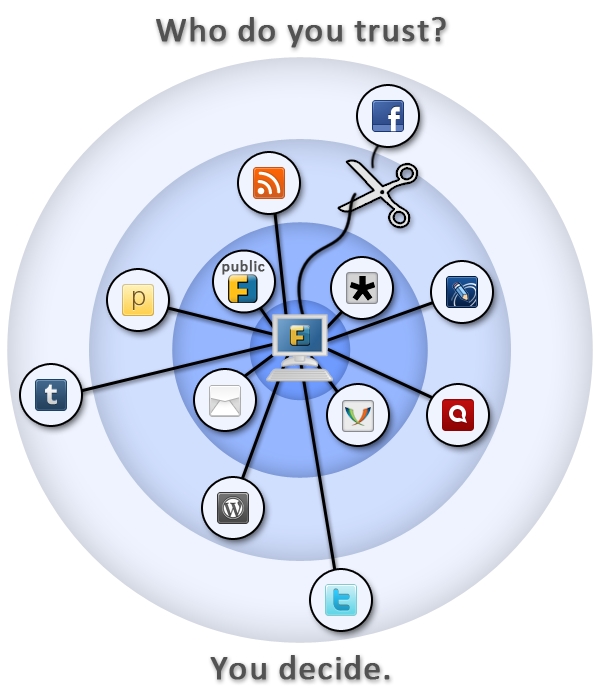
Follow me on Identi.ca or Twitter or Diaspora*diaspora-banner This is a feedback about installing a self hosted instance of Friendica on a Debian server (Jessie). If you re not interested in why I use Friendica, just go to Prerequisite for Friendica section below. Frustration about social networks Being a huge user of short messages, I was quite frustated to spend so much time on my Twitter account. To be quite honest, there is no much I like about this social network, except the huge population of people being potentially interested in what I write. twitter-logo I also have been using Identi.ca (now powered by Pump.io) for a while. But I tried for a while to manage both networks Pump.io and Twitter by hand and it was quite painful. And something was telling me another social network was going to appear from nowhere one of these days and I ll be just horrible to try to keep it up this way. identica-logo So I was looking for a scalable solution not asking too much personal investment. Subscribing to Diaspora* some days ago on the Framasphere pod, tintouli told me to try Friendica. Hmmm, what s Friendica ? f-intro Friendica is a content manager you can plug on almost anything: social networks (Facebook, Twitter, Pump.io, Diaspora*, ), but also WordPress, XMPP, emails I m in fact just discovering the power of this tool but to plug it on my different social network accounts was quite a good use case for me. And I guess if you re still reading, for you too. I tried to use some shared public servers but I was not quite happy with the result, one connector was still missing or public servers were really unstable. So I m at last self hosting my Friendica. Here is how. Prerequisite for Friendica You need to install the following packages: # apt-get install apache2 libapache2-mod-php5 php5 php5-curl php5-gd php5-mysql mysql-server git Having a already self-modified /etc/php5/apache2/php.ini, I encountered a small issue with libCurl and had to manually add the following line in the php.ini: extension=curl.so Setting up MySQL Connect to MySQL and create an empty database with a dedicated user: # mysql -u root -pV3rYS3cr3t -e create database friendica; GRANT ALL PRIVILEGES ON friendica.* TO friendica@localhost IDENTIFIED BY R3AlLyH4rdT0Gu3ss mysql Setting up Apache My server hosts several services, so I use a subdomain friendica.mydomain.com. If you use a subdomain, of course check you do have declared this subdomain in your DNS zone. apache-logo I use SSL encryption with a wildcard certificate for all my subdomains. My Friendica data are stored in /var/www/friendica. Here is my virtual host configuration for Friendica stored in the file /etc/apache2/sites-available/friendicassl.conf : <VirtualHost *:443>
ServerName friendica.mydomain.com
DocumentRoot /var/www/friendica/
DirectoryIndex index.php index.html
ErrorLog /var/log/apache2/friendica-error-ssl.log
TransferLog /var/log/apache2/friendica-access-ssl.log SSLEngine on
SSLCertificateFile /etc/ssl/certs/mydomain/mydomain.com.crt
SSLCertificateKeyFile /etc/ssl/private/mydomain.com.key
SSLVerifyClient None <Directory /var/www/friendica/>
AllowOverride All
Options FollowSymLinks
Order allow,deny
Allow from all
</Directory>
</VirtualHost> After writing the configuration file, just launch the following commands and it should be good for the Apache configuration: # a2ensite friendicassl && /etc/init.d/apache2 reload friendica-trust Setting up Friendica Get the master zip file of Friendica, copy it on your server and decompress it. Something like : # cd /var/www/ && wget https://github.com/friendica/friendica/archive/master.zip && unzip master.zip && mv friendica-master friendica You need to give www-data (Apache user) the rights to write in /var/www/friendica/view/smarty3/ : # chown -R www-data:www-data /var/www/friendica/view/smarty3 && chmod -R ug+w var/www/friendica/view/smarty3 Ok, I guess we re all set, lets launch the installation process! Using your web browser, connect to friendica.mydomain.com. First step you ll see the installation window which checks the prerequisite before installing. Complete if something is missing.
friendica-installation

First window of the Friendica installation process

Second step asks the host/user/password of the database, complete and the installation process starts. Hopefully all goes just fine. Next you ll have to create a /var/www/friendica/.htconfig.php with the content that the last page of the installation process provides. Just copy/paste, check the rights of this file and now you can connect again to see the register page of friendica at the url https://friendlica.mydomain.com/register . Pretty cool! Register a user That s a fairly easy step. You just need to check before that your server is able to send emails, because the password is going to be sent to you by email. If it is ok, you should now identify on the welcome page of friendica and access your account. That s a huge step to broadcast your short messages everywhere, but we have some last steps before being able to send your short messages on all the social networks we need. A small break, create an app for twitter on apps.twitter.com To send your short messages to Twitter, you need to create an app on apps.twitter.com. Just check you re logged in Twitter and connect to apps.twitter.com. Create an app called with a unique name (apparently), then go to the Keys and Access tokens page, note the consumer key and the consumer secret. You ll later need the name of the app, the consumer key and the consumer secret. friendica-decentralized-network Install and configure the addons Friendica uses an addon system in order to plug on the different third-parties it needs. We are going to configure Twitter, Pump.io and the Diaspora* plug. Let s go back to our server and launches some commands: # cd /tmp && git clone https://github.com/friendica/friendica-addons.git && cd friendica-addons # tar xvf twitter.tgz -C /var/www/friendica/addon # tar xvf pumpio.tgz -C /var/www/friendica/addon # cp -a diaspora /var/www/friendica/addon You need to modify your /var/www/friendica/.htconfig.php file and add the following content at the end: // names of your addons, separated by a comma $a->config['system']['addon'] = pumpio, twitter, diaspora ; // your Twitter consumer key
$a->config['twitter']['consumerkey'] = P4Jl2Pe4j7Lj91eIn0AR8vIl2 ; // your Twitter consumer secret
$a->config['twitter']['consumersecret'] = 1DnVkllPik9Ua8jW4fncxwtXZJbs9iFfI5epFzmeI8VxM9pqP1 ; // you Twitter app name $a->config['twitter']['application_name'] = whatever-twitter ; banner_friendica Connect again to Friendica. Go to settings => social networks, you will see the options for Twitter, Pump.io and Diaspora*. Complete the requested information for each of them. Important options you should not forget to check are: Pump.io Twitter Diaspora* Done? Now it s time to send your first broadcasted short message. Yay! Send a short message to your different social networks Connect to Friendica, click on the network page, write your short message in the Share box. Click on the lock lock, you ll see the following setup: friendica-post-default It means your short messages will be broadcasted to the three networks. Or more, it s up to you! That s my setup, feel free to modify. Now close the lock window and send your message. For me it takes some time to appear on Twitter and Diaspora* and it immediatly appears on Identi.ca. Last words friendica-stand Friendica offers to take back the control of your data, by broadcasting content on different media from a single source. While self hosting, you keep your data whatever happends and are not subject to companies losing your data like recently Twitpic. Moreover the philosophy behind Friendica pushed me to dig and test the solution What about you? How do you proceed to broadcast your short messages? Does Friendica offer a good solution in your opinion? Are you interested in the philosophy behind this project? Feel free to share your thoughs in the comments. LAST MINUTE: hey, this article is on Hacker News, don t hesitate to vote for it if you liked it!

1 November 2014

Riku Voipio: Using networkd for kvm tap networking

Setting up basic systemd-network was recently described by Joachim, and the post inspired me to try it as well. The twist is that in my case I need a bridge for my KVM with Lava server and arm/aarch64 qemu system emulators...For background, qemu/kvm support a few ways to provide network to guests. The default is user networking, which requires no privileges, but is slow and based on ancient SLIRP code. The other common option is tap networking, which is fast, but complicated to set up. Turns out, with networkd and qemu bridge helper, tap is easy to set up.

$ for file in /etc/systemd/network/*; do echo $file; cat $file; done
/etc/systemd/network/eth.network
[Match]
Name=eth1
[Network]
Bridge=br0

/etc/systemd/network/kvm.netdev
[NetDev]
Name=br0
Kind=bridge

/etc/systemd/network/kvm.network
[Match]
Name=br0
[Network]
DHCP=yes

Diverging from Joachims simple example, we replaced "DHCP=yes" with "Bridge=br0". Then we proceed to define the bridge (in the kvm.netdev) and give it an ip via dhcp in kvm.network. From the kvm side, if you haven't used the bridge helper before, you need to give the helper permissions (setuid root or cap_net_admin) to create a tap device to attach on the bridge. The helper needs an configuration file to tell what bridge it may meddle with.

# cat > /etc/qemu/bridge.conf <<__END__
allow br0
__END__
# setcap cap_net_admin=ep /usr/lib/qemu/qemu-bridge-helper
Now we can start kvm with bridge networking as easily as with user networking:

$ kvm -m 2048 -drive file=jessie.img,if=virtio -net bridge -net nic,model=virtio -serial stdio
The manpages systemd.network(5) and systemd.netdev(5) do a great job explaining the files. Qemu/kvm networking docs are unfortunately not as detailed.

19 October 2014

Benjamin Mako Hill: Another Round of Community Data Science Workshops in Seattle

Pictures from the CDSW sessions in Spring 2014Pictures from the CDSW sessions in Spring 2014
I am helping coordinate three and a half day-long workshops in November for anyone interested in learning how to use programming and data science tools to ask and answer questions about online communities like Wikipedia, free and open source software, Twitter, civic media, etc. This will be a new and improved version of the workshops run successfully earlier this year. The workshops are for people with no previous programming experience and will be free of charge and open to anyone. Our goal is that, after the three workshops, participants will be able to use data to produce numbers, hypothesis tests, tables, and graphical visualizations to answer questions like: If you are interested in participating, fill out our registration form here before October 30th. We were heavily oversubscribed last time so registering may help. If you already know how to program in Python, it would be really awesome if you would volunteer as a mentor! Being a mentor will involve working with participants and talking them through the challenges they encounter in programming. No special preparation is required. If you re interested, send me an email.

5 October 2014

Stefano Zacchiroli: je code

je.code(); promoting programming (in French) jecode.org is a nice initiative by, among others, my fellow Debian developer and university professor Martin Quinson. The goal of jecode.org is to raise awareness about the importance of learning the basics of programming, for everyone in modern societies. jecode.org targets specifically francophone children (hence the name, for "I code"). I've been happy to contribute to the initiative with my thoughts on why learning to program is so important today, joining the happy bunch of "codeurs" on the web site. If you read French, you can find them reposted below. If you also write French, you might want to contribute your thoughts on the matter. How? By forking the project of course!
Pourquoi codes-tu ? Tout d'abord, je code parce que c'est une activit passionnante, dr le, et qui permet de prouver le plaisir de cr er. Deuxi mement, je code pour automatiser les taches r p titives qui peuvent rendre p nibles nos vies num riques. Un ordinateur est con u exactement pour cela: lib rer les tres humains des taches stupides, pour leur permettre de se concentrer sur les taches qui ont besoin de l'intelligence humaine pour tre r solues. Mais je code aussi pour le pur plaisir du hacking, i.e., trouver des utilisations originelles et inattendues pour des logiciels existants. Comment as-tu appris ? Compl tement au hasard, quand j' tais gamin. 7 ou 8 ans, je suis tomb dans la biblioth que municipale de mon petit village, sur un livre qui enseignait programmer en BASIC travers la m taphore du jeu de l'oie. partir de ce jour j'ai utilis le Commodore 64 de mon p re beaucoup plus pour programmer que pour les jeux vid o: coder est tellement plus dr le! Plus tard, au lyc e, j'ai pu appr cier la programmation structur e et les avantages normes qu'elle apporte par rapport aux GO TO du BASIC et je suis devenu un accro du Pascal. Le reste est venu avec l'universit et la d couverte du Logiciel Libre: la caverne d'Ali Baba du codeur curieux. Quel est ton langage pr f r ? J'ai plusieurs langages pr f r s. J'aime Python pour son minimalisme syntactique, sa communaut vaste et bien organis e, et pour l'abondance des outils et ressources dont il dispose. J'utilise Python pour le d veloppement d'infrastructures (souvent quip es d'interfaces Web) de taille moyenne/grande, surtout si j'ai envie des cr er une communaut de contributeurs autour du logiciel. J'aime OCaml pour son syst me de types et sa capacit de capturer les bonnes propri t s des applications complexes. Cela permet au compilateur d'aider norm ment les d veloppeur viter des erreurs de codage comme de conception. J'utilise aussi beaucoup Perl et le shell script (principalement Bash) pour l'automatisation des taches: la capacit de ces langages de connecter d'autres applications est encore in gal e. Pourquoi chacun devrait-il apprendre programmer ou tre initi ? On est de plus en plus d pendants des logiciels. Quand on utilise une lave-vaisselle, on conduit une voiture, on est soign dans un h pital, quand on communique sur un r seau social, ou on surfe le Web, nos activit s sont constamment ex cut es par des logiciels. Celui qui contr le ces logiciels contr le nos vies. Comme citoyens d'un monde qui est de plus en plus num rique, pour ne pas devenir des esclaves 2.0, nous devons pr tendre le contr le sur le logiciel qui nous entoure. Pour y parvenir, le Logiciel Libre---qui nous permet d'utiliser, tudier, modifier, reproduire le logiciel sans restrictions---est un ingr dient indispensable. Aussi bien qu'une vaste diffusion des comp tences en programmation: chaque bit de connaissance dans ce domaine nous rende tous plus libres.

4 October 2014

Jo Shields: The unstoppable march of mobile technology

It s been more than 2 years since my last post about my smartphone. In the time after that post I upgraded my much loved Windows Phone 7 device to Windows Phone 8 (which I got rid of within months, for sucking), briefly used Firefox OS, then eventually used a Nexus 4 for at least a year. After years of terrible service provision and pricing, I decided I would not stay with my network Orange a moment longer and in getting a new contract, I would get a new phone too. So on Friday, I signed up to a new 15 per month contract with Three, including 200 minutes, unlimited data, and 25GB of data roaming in the USA and other countries (a saving of 200,000 per month versus Orange). Giffgaff is similarly competitive for data, but not roaming. No other network in the UK is competitive. For the phone, I had a shortlist of three: Apple iPhone 6, Sony Xperia Z3 Compact, and Samsung Galaxy Alpha. These are all small phones by 2014 standards, with a screen about the same size as the Nexus 4. I didn t consider any Windows Phone devices because they still haven t shipped a functional music player app on Windows Phone 8. Other more fringe OSes weren t considered, as I insist on trying out a real device in person before purchase, and no other comparable devices are testable on the high street. iPhone 6 This was the weakest offering, for me. 120 more than the Samsung, and almost 200 more than the Sony, a much lower hardware specification, physically larger, less attractive, and worst of all mandatory use of iTunes for Windows for music syncing.
iPhone6_PF_SpGry_iPhone6_PB_SpGry_iPhone6_PSL_SpGry_Homescreen-PRINT

Apple iPhone 6, press shot from apple.com, all rights reserved

The only real selling point for me would be for access to iPhone apps. And, I guess, decreased chance of mockery by co-workers. Galaxy Alpha Now on to the real choices. I ve long felt that Samsung s phones are ugly plasticy tat the Galaxy S5 is popular, well-marketed, but looks and feels cheap compared to HTC s unibody aluminium One. They ve also committed the cardinal sin of gimping the specifications of their mini (normal-sized) phones, compared to the normal (gargantuan) versions. The newly released S5 Mini is about the same spec as early 2012 s S3, the S4 Mini was mostly an S2 internally, and so on. However, whilst HTC have continued along these lines, Samsung have finally released a proper phone under 5 , in the Alpha.
Samsung Galaxy Alpha press shot from samsungmobile.com, all rights reserved

Samsung Galaxy Alpha press shot from samsungmobile.com, all rights reserved

The Alpha combines a 4.7 AMOLED screen, a plastic back, metal edges, 8-core big.LITTLE processor, and 2GB RAM. It is a PRETTY device the screen really dazzles (as is the nature of OLED). It feels like a mix of design cues from an iPhone and Samsung s own, keeping the angular feel of iPhone 4->5S rather than the curved edges on the iPhone 6. The Galaxy Alpha was one of the two devices I seriously considered. Xperia Z3 Compact The other Android device I considered was the Compact version of Sony s new Xperia Z3. Unlike other Android vendors, Sony decided that mini shouldn t mean low end when they released the Z1 compact earlier this year. The Z3 follows suit, where the same CPU and storage are found on both the big and little versions.
Sony Xperia Z3 Compact press shot from Sony Xperia Picasa album. CC BY-NC-SA 3.0

Sony Xperia Z3 Compact press shot from Sony Xperia Picasa album. CC BY-NC-SA 3.0

The Z3C has a similar construction to the Nexus 4, with glass front and back, and plastic rim. The specification is similar to the Galaxy Alpha (with a quadcore 2.5GHz Qualcomm processor about 15% faster than the big.LITTLE Exynos in the Galaxy Alpha). It differs in a few places LCD rather than AMOLED (bad); a non-removable (bad) 2600 mAh battery (good) compared to the removable 1860 mAh in the Samsung; waterproofing (good); A less hateful Android shell (Xperia on Android vs Samsung Touchwiz). For those considering a Nexus-4-replacement class device (yes, rjek, that means you), both the Samsung and the Sony are worth a look. They both have good points and bad points. In the end, both need to be tested to form a proper opinion. But for me, the chunky battery and tasteful green were enough to swing it for the Sony. So let s see where I stand in a few months time. Every phone I ve owned, I ve ended up hating it for one reason or another. My usual measure for whether a phone is good or not is how long it takes me to hit the I can t use this limit. The Nokia N900 took me about 30 minutes, the Lumia 800 lasted months. How will the Z3 Compact do? Time will tell.

3 October 2014

Gunnar Wolf: Obsoletion notice on githubredir

Back in 2009, I set up githubredir.debian.net, a service that allowed following using uscan the tags of a GitHub-based project. Maybe a year or two later, GitHub added the needed bits in their interface, so it was no longer necessary to provide this service. Still, I kept it alive in order not to break things. But as it is just a silly web scraper, every time something changes in GitHub, the redirector breaks. I decided today that, as it is no longer a very useful project, it should be retired. So, in the not too distant future (I guess, next time anything breaks), I will remove it. Meanwhile, every page generated will display this: (of course, with the corresponding project/author names in) Consider yourselves informed.
AttachmentSize
githubredir.png37.68 KB

1 October 2014

Keith Packard: chromium-dri3

Chromium (the browser) and DRI3 I got a note on IRC a week ago that Chromium was crashing with DRI3. The Google team working on Chromium eventually sent me a link to the bug report. That's secret Google stuff, so you won't be able to follow the link, even though it's a bug in a free software application when running on free software drivers. There's a bug report in the freedesktop bugzilla which looks the same to me. In both cases, the recommended fix was to switch from DRI3 back to DRI2. That's not exactly a great plan, given that DRI3 offers better security between GPU-using applications, which seems like a pretty nice thing to have when you're running random GL applications from the web. Chromium Sandboxing I'm not entirely sure how it works, but Chromium creates a process separate from the main browser engine to talk to the GPU. That process has very limited access to the operating system via some fancy library adventures. Presumably, the hope is that security bugs in the GL driver would be harder to leverage into a remote system exploit. Debugging in this environment is a bit tricky as you can't simply run chromium under gdb and expect to be able to set breakpoints in the GL driver. Instead, you have to run chromium with a magic flag which causes the GPU process to pause before loading the driver so you can connect to it with gdb and debug from there, along with a flag that lets you see crashes within the gpu process and the usual flag that causes chromium to ignore the GPU black list which seems to always include the Intel driver for one reason or another:
$ chromium --gpu-startup-dialog --disable-gpu-watchdog --ignore-gpu-blacklist
Once Chromium starts up, it will print out a message telling you to attach gdb to the GPU process and send that process a SIGUSR1 to continue it. Now you can happily debug and get a stack trace when the crash occurs. Locating the Bug The bug manifested with a segfault at the first access to a DRI3-allocated buffer within the application. We've seen this problem in the past; whenever buffer allocation fails for some reason, the driver ignores the problem and attempts to de-reference through the (NULL) buffer pointer, causing a segfault. In this case, Chromium called glClear, which tried (and failed) to allocate a back buffer causing the i965 driver to subsequently segfault. We should probably go fix the i965 driver to not segfault when buffer allocation fails, but that wouldn't provide a lot of additional information. What I have done is add some error messages in the DRI3 buffer allocation path which at least tell you why the buffer allocation failed. That patch has been merged to Mesa master, and should also get merged to the Mesa stable branch for the next stable release. Once I had added the error messages, it was pretty easy to see what happened:
$ chromium --ignore-gpu-blacklist
[10618:10643:0930/200525:ERROR:nss_util.cc(856)] After loading Root Certs, loaded==false: NSS error code: -8018
libGL: pci id for fd 12: 8086:0a16, driver i965
libGL: OpenDriver: trying /local-miki/src/mesa/mesa/lib/i965_dri.so
libGL: Can't open configuration file /home/keithp/.drirc: Operation not permitted.
libGL error: DRI3 Fence object allocation failure Operation not permitted
The first two errors were just the sandbox preventing Mesa from using my GL configuration file. I'm not sure how that's a security problem, but it shouldn't harm the driver much. The last error is where the problem lies. In Mesa, the DRI3 implementation uses a chunk of shared memory to hold a fence object that lets Mesa know when buffers are idle without using the X connection. That shared memory segment is allocated by creating a temporary file using the O_TMPFILE flag:
fd = open("/dev/shm", O_TMPFILE O_RDWR O_CLOEXEC O_EXCL, 0666);
This call cannot fail as /dev/shm is used by glibc for shared memory objects, and must therefore be world writable on any glibc system. However, with the Chromium sandbox enabled, it returns EPERM. Running Without a Sandbox Now that the bug appears to be in the sandboxing code, we can re-test with the GPU sandbox disabled:
$ chromium --ignore-gpu-blacklist --disable-gpu-sandbox
And, indeed, without the sandbox getting in the way of allocating a shared memory segment, Chromium appears happy to use the Intel driver with DRI3. Final Thoughts I looked briefly at the Chromium sandbox code. It looks like it needs to know intimate details of the OpenGL implementation for every possible driver it runs on; it seems to contain a fixed list of all possible files and modes that the driver will pass to open(2). That seems incredibly fragile to me, especially when used in a general Linux desktop environment. Minor changes in how the GL driver operates can easily cause the browser to stop working.

Vincent Sanders: It is a bad plan that admits of no modification

I find it somewhat interesting that thousands of years later that our society still uses Publilius Syrus sententiae though I imagine the tendency to leave well enough alone means such phrases stay in usage.

Marvell ARM system - Photo from Steve McIntyre
One weekend Steve McIntyre asked me if I could find a source of some of some 40mm fans for some systems with some pretty strict requirements. They needed to be long life and shift a lot of air to combat a persistent overheating issue.

I sat with him and went through the Farnell utterly hateful parametric web interface and eventually came up with a couple of options which were very expensive. Only then did I stop and ask what the actual problem was.

Marvell ARM system Original internal cooling arrangement - Photo from Steve McIntyre
Steve showed me one of the Debian ARM buildd boxes which are Marvell development machines. These systems are powerful quad core machines housed in compact steel enclosures.

There is a single 40mm fan trying to provide cooling for the entire enclosure. When the units are placed horizontally and used intermittently this proves adequate. Unfortunately when the system are arranged vertically in a rack and run at full load continuously they often overheat and have to be restarted. In addition the small high speed fans need replacing frequently as their bearings wore out quickly.

Debian ARM buildd systems - Photo from Steve McIntyreThis was obviously causing some issues for the ARM Debian ports which Steve wanted to rectify. After talking the problem through for a while we came to the conclusion we could use much larger 60mm fans to blow air directly through the top of the case onto the cpu heatsink.

Larger fans can be run much more slowly to move a similar volume of air to the smaller 40mm fans which gives a much longer service life.

Hole punch and Drilling template
Steve proceeded to order enough parts to allow us to modify all the Debian systems, this worked out cheaper than a single "special" 40mm high volume fan.

I acquired a rather large steel hole punch, I chose this tool because it produces a much superior finish to a hole cutter and this project demanded a high level of finish (not to mention I loved having a valid excuse to own and use a huge allen key!)

If we had simply been modifying a single case I would have measured and marked up by hand. With the prospect of altering at least eight I laser cut a template from plywood which Andy Simpkins took great glee in excessively annotating.

We also used the opportunity to add bolt holes to securely attach the 2.5 inch SATA drives instead of using sticky pads.

Steve and I modified a single system to begin with both to check our alignment and the efficacy of the change. We were pleasantly surprised to discover that hoiby could now repeatedly do kernel compiles with all four cores flat out which was not possible before. The measured CPU temperature, which had previously been around 90 C, did not rise above 40 C

Steve and Andy on the assembly line
Steve, Andy and I then arranged a day where we took all the remaining units out of the rack at ARM, modified and returned them. We used the facilities at the Cambridge Makespace where I am a member to do the modifications.

I broke two 3mm drill bits and dulled a 4mm bit drilling all the holes, Roger Smith was good enough to loan us the use of his "Christmas tree bit" to ream the fan hole out to 16mm so we could thread the hole punch and cut the 60mm fan aperture out.

six modified systems ready to be re-racked.
We managed to get quite an assembly line going and, in my opinion, the results look pretty professional.

It has been several months since we did this work and these systems continue to run without issue. To complete the story we can see some graphs courtesy of the DSA munin instance.

CPU load on arnold.debian.org
You can clearly see the huge drop in temperature at the end of Week 25 despite the continuously high CPU load. Also there is only a single gap in the data after the changes (these indicate crashes where data was not recorded) where before there were frequent and extensive times where the systems were simply unusable.

CPU Temperature of arnold.debian.org
One reason I continue to enjoy Debian so much is the wide variety of ways in which I can contribute not only by maintaining my packages. Sometimes this kind of work does not receive the credit it deserves and hopefully highlights a small part of the frantic paddling that goes on under the serene surface of the Debian project to keep things "just working".

Next.

Previous.