There is significant effort involved to get your apt or dnf commands always have a consistent set of servers to talk to.
That's why running separate "software stores" is a bad idea:
That way more admins need to learn how to run high availability services for dubious business opportunities to "later" monetize services. Services that nobody cares to pay for and thus opportunities that never materialize. But every company wants to find that out again. Because if Apple could do it, why shouldn't Canonical be able to do it? $$$!1!!
So, can't update Firefox on Ubuntu 22.04 right now.
At least there is https://status.snapcraft.io/:
So I can check back tomorrow if I can update my web browser ...
Update
09.11.2022 12:15 CET
The Snapcraft distribution system seems quite flaky, this is the downtime log:
Bonus points for the bad client side implementation:
dl@laptop:~$ sudo snap refresh All snaps up to date.
# ^this is a lie, just close Firefox and ...
dl@laptop:~$ sudo snap refresh firefox 106.0.5-1 from Mozilla** refreshed
Computer terminals have traditionally had an actual bell
that would ring when a certain control character (the bell
character, typically control-g or \a in an C escape
sequence) would come in the input stream.
That feature actually predates computers altogether, and was present
in Baudot code, "an early character encoding for telegraphy
invented by mile Baudot in the 1870s", itself superseding Morse
code.
Modern terminal emulators have, of course, kept that feature: if
you run this command in a terminal right now:
printf '\a'
... you may hear some annoying beep. Or not. It actually depends on
a lot of factors, including which terminal emulator you're using, how
it's configured, whether you have headphones on, or speakers
connected, or, if you're really old school, a PC speaker, even.
Typically, I have this theory that it does the exact opposite of what
you want, regardless of whether you have configured it or not. That
is, if you want it to make noises, it won't, and if you want it to
stay silent, it will make brutal, annoying noises in moments you would
the least expect. I suspect this is a law in computer science, but I'm
too lazy to come up with a formal definition.
Yet something can be done with this.
Making the bell useful and silent
Many terminal emulators have this feature where they can silence the
bell somehow. It can be turned into a "visual bell" which basically
flashes the screen when a bell arrives. Or that can also be disabled
and the bell is just completely ignored.
What I did instead is turn the bell into a "urgency hint" (part
of the ICCCM standard. In xterm, this is done with this X
resource entry (typically in ~/.Xresources):
XTerm*bellIsUrgent:  true
XTerm*visualBell: false
Interestingly, this doesn't clearly say "bell is muted", but it's
effectively what it does. Or maybe it works because I have muted
"System Sounds" in Pulseaudio. Who knows. I do have this in my startup
scripts though:
If the dash or 'off' are given, the bell will be turned off.
Interestingly, you have the option of setting the bell "volume",
"pitch, in hertz, and [...] duration in milliseconds. Note that not
all hardware can vary the bell characteristics." In any case, I think
that's the magic trick to turn the darn thing off.
Now this should send urgency hints to your window manager:
sleep 3 ; printf '\a'
Try it: run the command, switch to another desktop, then wait 3
seconds. You should see the previous desktop show up in red or
something.
In the i3 window manager I am currently using, this is
the default, although I did set the colors (client.urgent and
urgent_workspace in bar.colors).
Other window managers or desktop environments may require different
configurations.
Sending a bell...
Now that, on itself, will only be useful when something sets a
bell. One place I had found a trick like this, long ago, is this
post (dead link, archived) which has various instructions for
different tools. I'll recopy some of them here since the original site
is dead, but credit goes to the Netbuz blog.
(Note that the blog post also features an Awesome WM configuration for
urgency hints.)
Mutt
set beep=yes
set beep_new=yes
Irssi
/set beep_when_window_active ON
/set beep_when_away ON
/set beep_msg_level MSGS DCC DCCMSGS HILIGHT
It was also recommending this setting, but it appears to be deprecated
and gives a warning in modern irssi versions:
/set bell_beeps ON
GNU Screen
This is an important piece of the puzzle, because by default, terminal
multiplexers have their own opinion of what to do with the bell as
well:
# disabled: we want to propagate bell to clients, which should handle
# it in their own terminal settings. this  vbell off  is also the
# upstream and tmux's default
#
# see also: http://netbuz.org/blog/2011/11/x-bells-and-urgency-hints/
vbell off
# propagate bell from other windows up to the terminal emulator as well
bell_msg 'Bell in window %n^G'
The bell_msg bit is an extra from me: it uses the bell message that
pops up when screen detects a bell in another window to resend the
bell control character up to the running terminal.
This makes it so a bell in any multiplexed window will also
propagate to the parent terminal, which is not the default.
Tmux
Untested, but that is apparently how you do it:
# listen to alerts from all windows
set -g bell-action any
# notice bell in windows
set -g monitor-bell on
# only propagate bell, don't warn user, as it hangs tmux for a second
set -g visual-bell off
# send bell *and* notify when activity (if monitor-activity)
set -g visual-activity both
Note that this config goes beyond what we have in GNU screen in that
inactivity or activity will trigger a bell as well. This might be
useful for cases where you don't have the prompt hack (below) but it
could also very well be very noisy. It will only generate noise when
monitor-activity is enabled though.
bash and shell prompts
Now the icing on cake is to actually send the bell when a command
completes. This is what I use this for the most, actually.
I was previously using undistract-me for this, actually. That was
nice: it would send me a nice desktop notification when a command was
running more than a certain amount of time, and if the window was
unfocused. But configuring this was a nightmare: because it uses a
complex PROMPT_COMMAND in bash, it would conflict with my (already
existing and way too) complex bash prompt, and lead to odd
behaviors. It would also not work for remote commands, of course, as
it wouldn't have access to my local D-BUS to send notifications
(thankfully!).
So instead, what I do now is systematically print a bell whenever a
command terminates, in all my shells. I have this in my
/root/.bashrc on all my servers, deployed in Puppet:
PROMPT_COMMAND='printf "\a"'
Or you can just put it directly in the shell prompt, with something
like:
PS1='\[\a\]'"$PS1"
(I have the equivalent in my own .bashrc, although that thing is
much more complex, featuring multi-command pipeline exit status,
colors, terminal title setting, and more, which should probably
warrant its own blog post.)
This sounds a little bonkers and really noisy, but remember that I
turned off the audible bell. And urgency hints are going to show up
only if the window is unfocused. So it's actually really nice and not
really distracting.
Or, to reuse the undistract-me concept: it allows me to not lose focus
too much when I'm waiting for a long process to complete.
That idea actually came from ahf, so kudos to him on that nice
hack.
Caveats
That is not setup on all the machines I administer for work, that
said. I'm afraid that would be too disruptive for people who do not
have that configuration. This implies that I don't get notifications
for commands that run for a long time on remote servers, most of the
time. That said, I could simply run a command with a trailing printf
'\a' to get a notification.
This might not work in Wayland, your window manager, your desktop
environment, your Linux console, or your telegraphy session.
If you ve done anything in the Kubernetes space in recent years, you ve most likely come across the words Service Mesh . It s backed by a set of mature technologies that provides cross-cutting networking, security, infrastructure capabilities to be used by workloads running in Kubernetes in a manner that is transparent to the actual workload. This abstraction enables application developers to not worry about building in otherwise sophisticated capabilities for networking, routing, circuit-breaking and security, and simply rely on the services offered by the service mesh.In this post, I ll be covering Linkerd, which is an alternative to Istio. It has gone through a significant re-write when it transitioned from the JVM to a Go-based Control Plane and a Rust-based Data Plane a few years back and is now a part of the CNCF and is backed by Buoyant. It has proven itself widely for use in production workloads and has a healthy community and release cadence.It achieves this with a side-car container that communicates with a Linkerd control plane that allows central management of policy, telemetry, mutual TLS, traffic routing, shaping, retries, load balancing, circuit-breaking and other cross-cutting concerns before the traffic hits the container. This has made the task of implementing the application services much simpler as it is managed by container orchestrator and service mesh. I covered Istio in a prior post a few years back, and much of the content is still applicable for this post, if you d like to have a look.Here are the broad architectural components of Linkerd:The components are separated into the control plane and the data plane.The control plane components live in its own namespace and consists of a controller that the Linkerd CLI interacts with via the Kubernetes API. The destination service is used for service discovery, TLS identity, policy on access control for inter-service communication and service profile information on routing, retries, timeouts. The identity service acts as the Certificate Authority which responds to Certificate Signing Requests (CSRs) from proxies for initialization and for service-to-service encrypted traffic. The proxy injector is an admission webhook that injects the Linkerd proxy side car and the init container automatically into a pod when the linkerd.io/inject: enabled is available on the namespace or workload.On the data plane side are two components. First, the init container, which is responsible for automatically forwarding incoming and outgoing traffic through the Linkerd proxy via iptables rules. Second, the Linkerd proxy, which is a lightweight micro-proxy written in Rust, is the data plane itself.I will be walking you through the setup of Linkerd (2.12.2 at the time of writing) on a Kubernetes cluster.Let s see what s running on the cluster currently. This assumes you have a cluster running and kubectl is installed and available on the PATH.
On most systems, this should be sufficient to setup the CLI. You may need to restart your terminal to load the updated paths. If you have a non-standard configuration and linkerd is not found after the installation, add the following to your PATH to be able to find the cli:
export PATH=$PATH:~/.linkerd2/bin/
At this point, checking the version would give you the following:
$ linkerd version
Client version: stable-2.12.2
Server version: unavailable
Setting up Linkerd Control PlaneBefore installing Linkerd on the cluster, run the following step to check the cluster for pre-requisites:
kubernetes-api
--------------
  can initialize the client
  can query the Kubernetes API
kubernetes-version
------------------
  is running the minimum Kubernetes API version
  is running the minimum kubectl version
pre-kubernetes-setup
--------------------
  control plane namespace does not already exist
  can create non-namespaced resources
  can create ServiceAccounts
  can create Services
  can create Deployments
  can create CronJobs
  can create ConfigMaps
  can create Secrets
  can read Secrets
  can read extension-apiserver-authentication configmap
  no clock skew detected
linkerd-version
---------------
  can determine the latest version
  cli is up-to-date
Status check results are
All the pre-requisites appear to be good right now, and so installation can proceed.The first step of the installation is to setup the Custom Resource Definitions (CRDs) that Linkerd requires. The linkerd cli only prints the resource YAMLs to standard output and does not create them directly in Kubernetes, so you would need to pipe the output to kubectl apply to create the resources in the cluster that you re working with.
$ linkerd install --crds   kubectl apply -f -
Rendering Linkerd CRDs...
Next, run  linkerd install   kubectl apply -f -  to install the control plane.
customresourcedefinition.apiextensions.k8s.io/authorizationpolicies.policy.linkerd.io created
customresourcedefinition.apiextensions.k8s.io/httproutes.policy.linkerd.io created
customresourcedefinition.apiextensions.k8s.io/meshtlsauthentications.policy.linkerd.io created
customresourcedefinition.apiextensions.k8s.io/networkauthentications.policy.linkerd.io created
customresourcedefinition.apiextensions.k8s.io/serverauthorizations.policy.linkerd.io created
customresourcedefinition.apiextensions.k8s.io/servers.policy.linkerd.io created
customresourcedefinition.apiextensions.k8s.io/serviceprofiles.linkerd.io created
Next, install the Linkerd control plane components in the same manner, this time without the crds switch:
$ linkerd install   kubectl apply -f -
namespace/linkerd created
clusterrole.rbac.authorization.k8s.io/linkerd-linkerd-identity created
clusterrolebinding.rbac.authorization.k8s.io/linkerd-linkerd-identity created
serviceaccount/linkerd-identity created
clusterrole.rbac.authorization.k8s.io/linkerd-linkerd-destination created
clusterrolebinding.rbac.authorization.k8s.io/linkerd-linkerd-destination created
serviceaccount/linkerd-destination created
secret/linkerd-sp-validator-k8s-tls created
validatingwebhookconfiguration.admissionregistration.k8s.io/linkerd-sp-validator-webhook-config created
secret/linkerd-policy-validator-k8s-tls created
validatingwebhookconfiguration.admissionregistration.k8s.io/linkerd-policy-validator-webhook-config created
clusterrole.rbac.authorization.k8s.io/linkerd-policy created
clusterrolebinding.rbac.authorization.k8s.io/linkerd-destination-policy created
role.rbac.authorization.k8s.io/linkerd-heartbeat created
rolebinding.rbac.authorization.k8s.io/linkerd-heartbeat created
clusterrole.rbac.authorization.k8s.io/linkerd-heartbeat created
clusterrolebinding.rbac.authorization.k8s.io/linkerd-heartbeat created
serviceaccount/linkerd-heartbeat created
clusterrole.rbac.authorization.k8s.io/linkerd-linkerd-proxy-injector created
clusterrolebinding.rbac.authorization.k8s.io/linkerd-linkerd-proxy-injector created
serviceaccount/linkerd-proxy-injector created
secret/linkerd-proxy-injector-k8s-tls created
mutatingwebhookconfiguration.admissionregistration.k8s.io/linkerd-proxy-injector-webhook-config created
configmap/linkerd-config created
secret/linkerd-identity-issuer created
configmap/linkerd-identity-trust-roots created
service/linkerd-identity created
service/linkerd-identity-headless created
deployment.apps/linkerd-identity created
service/linkerd-dst created
service/linkerd-dst-headless created
service/linkerd-sp-validator created
service/linkerd-policy created
service/linkerd-policy-validator created
deployment.apps/linkerd-destination created
cronjob.batch/linkerd-heartbeat created
deployment.apps/linkerd-proxy-injector created
service/linkerd-proxy-injector created
secret/linkerd-config-overrides created
Kubernetes will start spinning up the data plane components and you should see the following when you list the pods:
kubernetes-api
--------------
  can initialize the client
  can query the Kubernetes API
kubernetes-version
------------------
  is running the minimum Kubernetes API version
  is running the minimum kubectl version
linkerd-existence
-----------------
  'linkerd-config' config map exists
  heartbeat ServiceAccount exist
  control plane replica sets are ready
  no unschedulable pods
  control plane pods are ready
  cluster networks contains all pods
  cluster networks contains all services
linkerd-config
--------------
  control plane Namespace exists
  control plane ClusterRoles exist
  control plane ClusterRoleBindings exist
  control plane ServiceAccounts exist
  control plane CustomResourceDefinitions exist
  control plane MutatingWebhookConfigurations exist
  control plane ValidatingWebhookConfigurations exist
  proxy-init container runs as root user if docker container runtime is used
linkerd-identity
----------------
  certificate config is valid
  trust anchors are using supported crypto algorithm
  trust anchors are within their validity period
  trust anchors are valid for at least 60 days
  issuer cert is using supported crypto algorithm
  issuer cert is within its validity period
  issuer cert is valid for at least 60 days
  issuer cert is issued by the trust anchor
linkerd-webhooks-and-apisvc-tls
-------------------------------
  proxy-injector webhook has valid cert
  proxy-injector cert is valid for at least 60 days
  sp-validator webhook has valid cert
  sp-validator cert is valid for at least 60 days
  policy-validator webhook has valid cert
  policy-validator cert is valid for at least 60 days
linkerd-version
---------------
  can determine the latest version
  cli is up-to-date
control-plane-version
---------------------
  can retrieve the control plane version
  control plane is up-to-date
  control plane and cli versions match
linkerd-control-plane-proxy
---------------------------
  control plane proxies are healthy
  control plane proxies are up-to-date
  control plane proxies and cli versions match
Status check results are
Everything looks good.Setting up the Viz ExtensionAt this point, the required components for the service mesh are setup, but let s also install the viz extension, which provides a good visualization capabilities that will come in handy subsequently. Once again, linkerd uses the same pattern for installing the extension.
$ linkerd viz install   kubectl apply -f -
namespace/linkerd-viz created
clusterrole.rbac.authorization.k8s.io/linkerd-linkerd-viz-metrics-api created
clusterrolebinding.rbac.authorization.k8s.io/linkerd-linkerd-viz-metrics-api created
serviceaccount/metrics-api created
clusterrole.rbac.authorization.k8s.io/linkerd-linkerd-viz-prometheus created
clusterrolebinding.rbac.authorization.k8s.io/linkerd-linkerd-viz-prometheus created
serviceaccount/prometheus created
clusterrole.rbac.authorization.k8s.io/linkerd-linkerd-viz-tap created
clusterrole.rbac.authorization.k8s.io/linkerd-linkerd-viz-tap-admin created
clusterrolebinding.rbac.authorization.k8s.io/linkerd-linkerd-viz-tap created
clusterrolebinding.rbac.authorization.k8s.io/linkerd-linkerd-viz-tap-auth-delegator created
serviceaccount/tap created
rolebinding.rbac.authorization.k8s.io/linkerd-linkerd-viz-tap-auth-reader created
secret/tap-k8s-tls created
apiservice.apiregistration.k8s.io/v1alpha1.tap.linkerd.io created
role.rbac.authorization.k8s.io/web created
rolebinding.rbac.authorization.k8s.io/web created
clusterrole.rbac.authorization.k8s.io/linkerd-linkerd-viz-web-check created
clusterrolebinding.rbac.authorization.k8s.io/linkerd-linkerd-viz-web-check created
clusterrolebinding.rbac.authorization.k8s.io/linkerd-linkerd-viz-web-admin created
clusterrole.rbac.authorization.k8s.io/linkerd-linkerd-viz-web-api created
clusterrolebinding.rbac.authorization.k8s.io/linkerd-linkerd-viz-web-api created
serviceaccount/web created
server.policy.linkerd.io/admin created
authorizationpolicy.policy.linkerd.io/admin created
networkauthentication.policy.linkerd.io/kubelet created
server.policy.linkerd.io/proxy-admin created
authorizationpolicy.policy.linkerd.io/proxy-admin created
service/metrics-api created
deployment.apps/metrics-api created
server.policy.linkerd.io/metrics-api created
authorizationpolicy.policy.linkerd.io/metrics-api created
meshtlsauthentication.policy.linkerd.io/metrics-api-web created
configmap/prometheus-config created
service/prometheus created
deployment.apps/prometheus created
service/tap created
deployment.apps/tap created
server.policy.linkerd.io/tap-api created
authorizationpolicy.policy.linkerd.io/tap created
clusterrole.rbac.authorization.k8s.io/linkerd-tap-injector created
clusterrolebinding.rbac.authorization.k8s.io/linkerd-tap-injector created
serviceaccount/tap-injector created
secret/tap-injector-k8s-tls created
mutatingwebhookconfiguration.admissionregistration.k8s.io/linkerd-tap-injector-webhook-config created
service/tap-injector created
deployment.apps/tap-injector created
server.policy.linkerd.io/tap-injector-webhook created
authorizationpolicy.policy.linkerd.io/tap-injector created
networkauthentication.policy.linkerd.io/kube-api-server created
service/web created
deployment.apps/web created
serviceprofile.linkerd.io/metrics-api.linkerd-viz.svc.cluster.local created
serviceprofile.linkerd.io/prometheus.linkerd-viz.svc.cluster.local created
A few seconds later, you should see the following in your pod list:
The viz components live in the linkerd-viz namespace.You can now checkout the viz dashboard:
$ linkerd viz dashboard
Linkerd dashboard available at:
http://localhost:50750
Grafana dashboard available at:
http://localhost:50750/grafana
Opening Linkerd dashboard in the default browser
Opening in existing browser session.
The Meshed column indicates the workload that is currently integrated with the Linkerd control plane. As you can see, there are no application deployments right now that are running.Injecting the Linkerd Data Plane componentsThere are two ways to integrate Linkerd to the application containers:1 by manually injecting the Linkerd data plane components 2 by instructing Kubernetes to automatically inject the data plane componentsInject Linkerd data plane manuallyLet s try the first option. Below is a simple nginx-app that I will deploy into the cluster:
Back in the viz dashboard, I do see the workload deployed, but it isn t currently communicating with the Linkerd control plane, and so doesn t show any metrics, and the Meshed count is 0:Looking at the Pod s deployment YAML, I can see that it only includes the nginx container:
Let s directly inject the linkerd data plane into this running container. We do this by retrieving the YAML of the deployment, piping it to linkerd cli to inject the necessary components and then piping to kubectl apply the changed resources.
Back in the viz dashboard, the workload now is integrated into Linkerd control plane.Looking at the updated Pod definition, we see a number of changes that the linkerd has injected that allows it to integrate with the control plane. Let s have a look:
At this point, the necessary components are setup for you to explore Linkerd further. You can also try out the jaeger and multicluster extensions, similar to the process of installing and using the viz extension and try out their capabilities.Inject Linkerd data plane automaticallyIn this approach, we shall we how to instruct Kubernetes to automatically inject the Linkerd data plane to workloads at deployment time.We can achieve this by adding the linkerd.io/inject annotation to the deployment descriptor which causes the proxy injector admission hook to execute and inject linkerd data plane components automatically at the time of deployment.
This annotation can also be specified at the namespace level to affect all the workloads within the namespace. Note that any resources created before the annotation was added to the namespace will require a rollout restart to trigger the injection of the Linkerd components.Uninstalling LinkerdNow that we have walked through the installation and setup process of Linkerd, let s also cover how to remove it from the infrastructure and go back to the state prior to its installation.The first step would be to remove extensions, such as viz.
FTP master
This month I accepted 484 and rejected 55 packages. The overall number of packages that got accepted was 492.
Debian LTS
This was my hundredth month that I did some work for the Debian LTS initiative, started by Raphael Hertzog at Freexian. Woohoo, There is a party. (yes I am old). Unfortunately there are already 101 completed month listed in the debian-lts-announce archive, so I seem to have counted wrong once. *sigh*, yes I am old.
This month my all in all workload has been 14h.
During that time I uploaded:
[DLA 3168-1] openvswitch security update for one CVE
[graphicsmagick] debdiff for Bullseye sent to security team (update as DLA or via PU?)
[graphicsmagick] prepared upload for Buster
[libvncserver] debdiff for Buster and Bullseye sent to maintainer (no upload yet :-()
I also started to work on virglrenderer.
Last but not least I took care of NEW packages on security-master.
Debian ELTS
This month was the fifty first ELTS month.
During my allocated time I uploaded:
[ELA-719-1] graphicsmagick security update of Jessie and Stretch for one CVE
[ELA-720-1] bluez security update of Jessie and Stretch for three CVEs
marked two CVEs of curl as not-affected for Jessie and Stretch
checked that all patches for dpdk need to be backported, unfortunately that was beyond my capabilities
I also started to work on snapd.
Last but not least I finally managed to become familiar with the git workflow and imported several packages to the salsa repository.
Debian Astro
This month I uploaded new upstream versions or improved packaging of:
I also uploaded a new package pysqm. This software supports the Sky Quality Meters made by Unihedron. I was kindly given an SQM-LU for USB and SQM-LE with network adapter. I plan to put a working Python3 version of the old PySQM software into Debian, package the UDM (Unihedron Device Manager) and finally check the support within Indi.
Debian IoT
This month I uploaded new upstream versions or improved packaging of:
Debian Mobcom
This month I finished the transition of the Osmocom packages, except osmo-mgw and osmo-msc seem to have problems. I have no idea how I can solve this, so help is appreciated.
Other stuff
This month I uploaded new packages:
Before you go on: I've been
warned off
implementing this in practice on a few counts; namely, the space tradeoff isn't
worth it, and it's unlikely to correct meaningful errors. I'm going to leave
this post up, but please do take the content with a very large grain of salt!
My initial efforts to build a PHY
and Data Link layer from
scratch using my own code have been progressing nicely since the initial
BPSK based protocol I ve documented under the PACKRAT series. As part of that,
I ve been diving deep into FEC,
and in particular, LDPC.
I won t be able to do an overview of LDPC justice in this post with any
luck that ll come in a later post to come as part of the RATPACK series,
so some knowledge is assumed. As such this post is less useful for those
looking to learn about LDPC, and a bit more targeted to those who enjoy
talking and thinking about FEC.
Hey, heads up! - This post contains extremely unvalidated and back of
the napkin quality work without any effort to prove this out generally.
Hopefully this work can be of help to others, but please double check anything
below if you need it for your own work!
While implementing LDPC, I ve gotten an encoder and checker working, enough
to use LDPC like a checksum. The next big step is to write a Decoder, which
can do error correction. The two popular approaches for the actual correction
that I ve seen while reading about LDPC are
Belief Propagation,
and some class of linear programming that I haven t dug into yet.
I m not thrilled at how expensive this all is in software, so while implementing
the stack I ve been exploring every shady side ally to try and learn more about
how encoders and decoders work, both in theory - and in practice.
Processing an LDPC Message
Checking if a message is correct is fairly straightforward with LDPC (as with
encoding, I ll note). As a quick refresher given the LDPC H (check) matrix
of width N, you can check your message vector (msg) of length N by
multipling H and msg, and checking if the output vector is all zero.
// scheme contains our G (generator) and
// H (check) matrices.
scheme:=G: Matrix... , H: Matrix...// msg contains our LDPC message (data and
// check bits).
msg:=Vector...// N is also the length of the encoded
// msg vector after check bits have been
// added.
N:=scheme.G.Width// Now, let's generate our 'check' vector.
ch:=Multiply(scheme.H, msg)
We can now see if the message is correct or not:
// if the ch vector is all zeros, we know
// that the message is valid, and we don't
// need to do anything.
ifch.IsZero()
// handle the case where the message
// is fine as-is.
return...// Expensive decode here
This is great for getting a thumbs up / thumbs down on the message being
correct, but correcting errors still requires pulling the LDPC matrix values
from the g (generator) matrix out, building a bipartite graph, and
iteratively reprocessing the bit values, until constraints are satisfied and
the message has been corrected.
This got me thinking - what is the output vector when it s not all zeros?
Since 1 values in the output vector indicates consistency problems in the
message bits as they relate to the check bits, I wondered if this could be used
to speed up my LDPC decoder. It appears to work, so this post is half an attempt
to document this technique before I put it in my hot path, and half a plea for
those who do like to talk about FEC to tell me what name this technique
actually is.
k-Bit Brute Forcing
Given that the output Vector s non-zero bit pattern is set due to the position
of errors in the message vector, let s use that fact to build up a table
of k-Bit errors that we can index into.
// for clarity's sake, the Vector
// type is being used as the lookup
// key here, even though it may
// need to be a hash or string in
// some cases.
idx:=map[Vector]intfori:=0; i < N; i++// Create a vector of length N
v:=Vectorv.FlipBit(i)
// Now, let's use the generator matrix to encode
// the data with checksums, and then use the
// check matrix on the message to figure out what
// bit pattern results
ev:=Multiply(scheme.H, Multiply(v, scheme.G))
idx[ev] = i
This can be extended to multiple bits (hence: k-Bits), but I ve only done
one here for illustration. Now that we have our idx mapping, we can now
go back to the hot path on Checking the incoming message data:
// if the ch vector is all zeros, we know
// that the message is valid, and we don't
// need to do anything.
ifch.IsZero()
// handle the case where the message
// is fine as-is.
return...errIdx, ok:=idx[ch]
ifokmsg.FlipBit(errIdx)
// Verify the LDPC message using
// H again here.
return...// Expensive decode here
Since map lookups wind up a heck of a lot faster than message-passing
bit state, the hope here is this will short-circuit easy to solve errors
for k-Bits, for some value of k that the system memory can tolerate.
Does this work?
Frankly I have no idea. I ve written a small program and brute forced
single-bit errors in all bit positions using random data to start with, and
I ve not been able to find any collisions in the 1-bit error set, using the
LDPC matrix from 802.3an-2006. Even if I was to find a collision for a
higher-order k-Bit value, I m tempted to continue with this approach, and treat
each set of bits in the Vector s bin (like a hash-table), checking the LDPC
validity after each bit set in the bin. As long as the collision rate is small
enough, it should be possible to correct k-Bits of error faster than the more
expensive Belief Propagation approach. That being said, I m not entirely
convinced collisions will be very common, but it ll take a bit more time
working through the math to say that with any confidence.
Have you seen this approach called something official in publications? See
an obvious flaw in the system? Send me a tip, please!
I hope you had a nice Halloween!
I've collected together some songs that I've enjoyed over the last couple of
years that loosely fit a theme: ambient, instrumental, experimental, industrial,
dark, disconcerting, etc. I've prepared a Spotify playlist of most of
them, but not all. The list is inline below as well, with many (but not all)
tracks linking to Bandcamp, if I could find them there.
This is a bit late, sorry. If anyone listens to something here and has any
feedback I'd love to hear it.
(If you are reading this on an aggregation site, it's possible the embeds won't
work. If so, click through to my main site)
Spotify playlist: https://open.spotify.com/playlist/3bEvEguRnf9U1RFrNbv5fk?si=9084cbf78c364ac8;
The list, with Bandcamp embeds where possible:
Review: What Makes This Book So Great, by Jo Walton
Publisher:
Tor
Copyright:
January 2014
ISBN:
0-7653-3193-4
Format:
Hardcover
Pages:
447
Jo Walton, in addition to being an excellent science fiction and fantasy
writer, is a prodigious reader and frequent participant in on-line SFF
book discussion going back to the Usenet days. This book is a collection
of short essays previously published on Tor.com between July 2008 and February 2011. The unifying theme is that
Walton regularly re-reads her favorite books, and each essay (apart from
some general essays on related topics) is about why this specific book is
one that she re-reads, and (as the title says) what makes it so great.
Searching for the title of one of the essays turns it up on Tor.com still,
so this is one of those collections that you don't have to buy since you
can read its contents on-line for free. That said, it looks like these
essays were from before Tor.com started classifying posts into series, so
it's going to be challenging to track them down in the huge number of
other articles Walton has written for the site. (That said, you can't go
far wrong by reading any of her essays at random.)
I read these essays as they were originally published, so this was also a
re-read for me, but it had been a while. I'm happy to report that they
were just as much fun the second time.
In the introduction and in the final essay of this collection, Walton
draws a distinction between what she's doing, criticism, and reviewing.
As someone else who writes about books (in a far more amateur fashion), I
liked this distinction.
The way I'd characterize it is that criticism is primarily about the work:
taking it apart to see what makes it tick, looking for symbolism and
hidden meanings, and comparing and contrasting other works that are
tackling similar themes. I've often finished a work of criticism and
still had no idea if the author enjoyed reading the work being criticized
or not, since that isn't the point.
Reviewing is assistance to consumers and focuses more on the reader: would
you enjoy this book? Is it enjoyable to read? Does it say something new?
What genre and style is it in, so that you can match that to your tastes?
Talking about books is neither of those things, although it's a bit closer
to reviewing. But the emphasis is on one's personal enjoyment instead of
attempting to review a product for others. When I talk about books with
friends, I talk primarily about what bits I liked, what bits I didn't
like, where the emotional beats were for me, and what interesting things
the book did that surprised me or caught my attention. One can find a
review in there, and sometimes even criticism, but the focus and the
formality is different. (And, to be honest, my reviews are more on the
"talking about the book" side than fully proper reviews.)
These essays are indeed talking about books. They're all re-reads; in
some cases the first re-read, but more frequently the latest of many
re-reads. There are lots of spoilers, which makes for bad reviews (the
target audience of a review hasn't read the book yet) but good fodder for
conversations about books. (The spoilers are mostly marked, but if you're
particularly averse to spoilers, you'll need to read carefully.) Most of
the essays are about a single book, but there are a few on more general
topics, such as Walton's bafflement that anyone would skim a novel.
Since these are re-reads, and the essays collected here are more than a
decade old, the focus is on older books. Some of them are famous: Vinge's
A Fire Upon the Deep and
A Deepness in the Sky, early Le Guin,
Samuel Delaney's SF novels, Salmon Rushdie's Midnight's Children.
Some of them are more obscure. C.J. Cherryh, for example, is a writer who
never seems to get much on-line attention, but who is one of Walton's
favorites.
Most of the essays stand alone or come in small clusters about a writer,
often sprinkled through the book instead of clumped together. (The book
publishes the essays in the same order they originally appeared on
Tor.com.) The two largest groups of essays are re-readings of every book
in Steven Brust's Vlad Taltos universe (including
Brokedown Palace and the
Paarfi books) up to Jhegaala, and every book in Lois McMaster Bujold's Miles
Vorkosigan series up to Diplomatic
Immunity. This is fitting: those are two of the great series of science
fiction, but don't seem to be written about nearly as much as I would
expect.
There are over 130 essays in a 447 page book, so there's a lot of material
here and none of them outlive their welcome. Walton has a comfortable,
approachable style that bubbles with delight and appreciation for books.
I think it's impossible to read this collection without wanting to read
more, and without adding several more books to the ever-teetering to-read
pile.
This is perhaps not the best source of reading recommendations if you
dislike spoilers, although it can be used for that if you read carefully.
But if you love listening to conversations about the genre and talking
about how books bounce off each other, and particularly if you have read
most of these books already or don't mind spoilers, this collection is a
delight. If you're the type of SFF reader who likes reading the reviews
in Locus or is already reading Tor.com, highly recommended.
Rating: 8 out of 10
The eighteenth release of littler as a CRAN package just landed, following in the now sixteen year history (!!) as a package started by Jeff in 2006, and joined by me a few weeks later.
littler is the first command-line interface for R as it predates Rscript. It allows for piping as well for shebang scripting via #!, uses command-line arguments more consistently and still starts faster. It also always loaded the methods package which Rscript only started to do in recent years.
littler lives on Linux and Unix, has its difficulties on macOS due to yet-another-braindeadedness there (who ever thought case-insensitive filesystems as a default were a good idea?) and simply does not exist on Windows (yet the build system could be extended see RInside for an existence proof, and volunteers are welcome!). See the FAQ vignette on how to add it to your PATH. A few examples are highlighted at the Github repo, as well as in the examples vignette.
This release, coming just a few weeks since the last release in August, heeds to clang-15 a updates one signature to a proper interface. It also contains one kindly contributed patch updating install2.r (and installBioc.r) to cope with a change in R-devel.
The full change description follows.
Changes in littler version 0.3.17 (2022-10-29)
Changes in package
An internal function prototype was updated for clang-15.
Changes in examples
The install2.r and installBioc. were updated for an update in R-devel (Tatsuya Shima and Dirk in #104).
My CRANberries service provides a comparison to the previous release. Full details for the littler release are provided as usual at the ChangeLog page, and also on the package docs website. The code is available via the GitHub repo, from tarballs and now of course also from its CRAN page and via install.packages("littler"). Binary packages are available directly in Debian as well as soon via Ubuntu binaries at CRAN thanks to the tireless Michael Rutter.
Comments and suggestions are welcome at the GitHub repo.
If you like this or other open-source work I do, you can now sponsor me at GitHub.
As usual with these every-two-year posts, probably of direct interest only
to California residents. Maybe the more obscure things we're voting on
will be a minor curiosity to people elsewhere.
Apologies to Planet Debian readers for the explicitly political post
because I'm too lazy to change my blog software to do more fine-grained
post classification. For what it's worth, most of the discussion here
will be about the more fiddly and nuanced things we vote on, not on the
major hot-button proposition.
As in 2020, I'm only going to cover the ballot propositions, as all of the
state-wide and most of the district races are both obvious to me and
boring to talk about. The hyperlocal races are more interesting this
year, but the number of people who would care and who are also reading
this blog is essentially nonexistent, so I won't bother writing them up.
This year, everything except Proposition 1 is an initiative (not put on
the ballot by the legislature), which means I default to voting against
them because they're usually poorly-written.
Proposition 1: YES. Adds reproductive rights to the California
state constitution. I'm fairly sure everyone reading this has already
made up their mind on this topic and certainly nothing will ever change my
mind, so I'll leave it at that.
Proposition 26: YES. This mushes two different things together
in an unhelpful way: allowing sports betting at some racetracks, and
allowing a wider variety of gambling on tribal lands.
I have no strong opinion about the former (I'll get into that more with
the next proposition). For the latter, my starting point is that Native
American tribes are and should be treated like independent governments
with their own laws (which is what we promised them by treaty and then
have systematically and maliciously betrayed ever since). I am not a
citizen of any of the tribes and therefore fundamentally I should not get
a say on this. I'm not a big fan of gambling or of the companies they're
likely to hire to run casinos, but it should be their land and their
decision.
Proposition 27: NO. This, on the other hand, is about on-line
sports betting outside of tribal lands, and looks to be a lot more about
corruption and corporate greed.
I am fairly dubious that outlawing gambling in general is that good of an
idea. I think the harms are overstated given the existence of even wilder
forms of gambling (crypto and financial derivatives) that are perfectly
legal, and I'm always suspicious of attempting to solve social problems
with police and prohibition systems. If there were a ballot proposition
to simply legalize gambling in California, I'd have to think hard about
that.
But this is not that. This requires companies that want to offer on-line
gambling to pay substantial up-front costs (which will restrict this to
only huge gambling companies). In return, they are allowed entry into
what is essentially a state-constructed partial monopoly. As usual,
there's a typical vice tax deal attached where those companies are taxed
to fund some program (in this case, homeless services and mental health
treatment), but these sorts of taxes tend to be regressive in effect. We
could just tax richer people like me to pay for those services instead.
I'm also dubious that the money for homelessness will be used to build
housing, which is what we need to do to address the problem.
Proposition 28: YES. Sets aside money for art and music funding
in public and charter schools. This is a reluctant yes because this sort
of law should not be done via proposition; it should be done through a
normal legislative process that balances all of the priorities for school
funding. But despite the broken process by which this was put forward, it
seems like a reasonable law and no one is opposing it, so okay, fine.
Proposition 29: NO. The attempt to force all dialysis clinics to
have licensed doctors on site is back again.
Everything about the way dialysis health care is provided in California
makes me angry. We should have a state health care system similar to the
NHS. We should open dialysis clinics based on the number of people
requiring dialysis in that area. Every one of them should be unionized.
We absolutely should not allow for-profit companies to have primary
responsibility for basic life-saving medical care like dialysis.
But this proposition does not solve any of those problems, and what it
claims to do is false. It claims that by setting credential requirements
on who has to be on-site at a dialysis clinic, the clinics will become
safer. This is simply not true, for all of the reasons discussed in
Still Not Safe.
This is not how safety works.
The safest person to do dialysis is someone with extensive experience in
performing dialysis, who has seen all the problems and has an intuition
for what to watch out for. That has less to do with credentials than with
good training specifically in dialysis, apprenticeship, and
practice, not to mention reasonable hours and good pay so that the workers
are not stressed. Do I think the private dialysis clinics are likely
doing a good job with this? Hah. (Do I think dialysis clinics run by
large medical non-profits would do a good job with this? Also hah.) But
this would enshrine into law a fundamentally incorrect solution to the
problem that makes dialysis more expensive without addressing any of the
other problems with the system.
It's the same tactic that was used on abortion clinics, with the same
bogus argument that having people with specific credentials on-site would
make them safer. It was false then and it's still false now. I would
agree with better regulation of dialysis clinics, but this specific
regulation is entirely wrong-headed.
Also, while this isn't an overriding factor, I get annoyed when the same
proposition shows up again without substantial changes. For matters of
fundamental rights, okay, sure. But for technical regulation fixes like
this one, the proponents should consider taking no for an answer and
trying a different approach. Like going to the legislature, which is
where this kind of regulation should be designed anyway.
Proposition 30: YES. Raises taxes on the personal income of
extremely rich Californians (over $2 million in income in one year) to
fund various climate change mitigation programs. This is another
reluctant yes vote, because once again this shouldn't be done by
initiative and should be written properly by the legislature. I also
don't like restricting tax revenue to particular programs, which reduce
budget flexibilty to no real purpose. It's not important to me that these
revenues go to these specific programs, although the programs seem like
good ones to fund.
But the reality remains that wealthy Silicon Valley executives are
undertaxed and the only way we can ever manage to raise taxes is through
voting for things like this, so fine.
Proposition 31: NO. The Calfornia legislature banned the sale of
flavored vape products. If NO beats YES on this proposition, that ban
will be overturned.
Drug prohibition has never, ever worked, and yet we keep trying it over
and over again in the hope that this time we'll get a different outcome.
As usual, the pitch in favor of this is all about the children,
specifically the claim that flavored tobacco products are only about
increasing their appeal to kids because... kids like candy? Or something?
I am extremely dubious of this argument; it's obvious to me from walking
around city streets that adults prefer the flavored products as well and
sale to kids is already prohibited and unchanged by this proposition.
I don't like vaping. I wish people would stop, at least around me,
because the scent is obnoxious and the flavored stuff is even more
obnoxious, even apart from whatever health problems it causes. But I'm
never going to vote for drug prohibition because drug prohibition doesn't
work. It just creates a black market and organized crime and makes
society overall worse. Yes, the tobacco companies are some of the worst
corporations on the planet, and I hope they get sued into oblivion (and
ideally prosecuted) for all the lying they do, but I'm still not going to
vote for prohibition. Even the best kind of prohibition that only outlaws
sale and not possession.
Also, secondarily but still significant, bans like this just frustrate a
bunch of people and burn good will and political capital, which we should
be trying to preserve to tackle far more important problems. The politics
of outlawing people's pleasures for their own good are not great. We have
a lot of serious problems to deal with; maybe let's not pick fights we
don't have to.
In my home lab(s), I have a handful of machines spread around a few
points of presence, with mostly residential/commercial cable/DSL
uplinks, which means, generally, NAT. This makes monitoring those
devices kind of impossible. While I do punch holes for SSH, using jump
hosts gets old quick, so I'm considering adding a virtual private
network (a "VPN", not a VPN service) so that all machines can
be reachable from everywhere.
I see three ways this can work:
a home-made Wireguard VPN, deployed with Puppet
a Wireguard VPN overlay, with Tailscale or equivalent
IPv6, native or with tunnels
So which one will it be?
Wireguard Puppet modules
As is (unfortunately) typical with Puppet, I found multiple different
modules to talk with Wireguard.
The voxpupuli module seems to be the most promising. The
abaranov module is more popular and has more contributors, but
it has more open issues and PRs.
More critically, the voxpupuli module was written after the abaranov
author didn't respond to a PR from the voxpupuli author trying to
add more automation (namely private key management).
It looks like setting up a wireguard network would be as simple as
this on node A:
This configuration come from this pull request I sent to the
module to document how to use that fact.
Note that the addresses used here are examples that shouldn't be
reused and do not confirm to RFC5737 ("IPv4 Address Blocks
Reserved for Documentation", 192.0.2.0/24 (TEST-NET-1),
198.51.100.0/24 (TEST-NET-2), and 203.0.113.0/24 (TEST-NET-3)) or
RFC3849 ("IPv6 Address Prefix Reserved for Documentation",
2001:DB8::/32), but that's another story.
(To avoid boostrapping problems, the resubmit-facts configuration
could be used so that other nodes facts are more immediately
available.)
One problem with the above approach is that you explicitly need to
take care of routing, network topology, and addressing. This can get
complicated quickly, especially if you have lots of devices, behind
NAT, in multiple locations (which is basically my life at home,
unfortunately).
Concretely, basic Wireguard only support one peer behind
NAT. There are some workarounds for this, but they generally imply
a relay server of some sort, or some custom registry, it's
kind of a mess. And this is where overlay networks like Tailscale come
in.
Tailscale
Tailscale is basically designed to deal with this problem. It's
not fully opensource, but pretty close, and they have an interesting
philosophy behind that. The client is opensource, and there
is an opensource version of the server side, called
headscale. They have recently (late 2022) hired the main headscale
developer while promising to keep supporting it, which is pretty
amazing.
Tailscale provides an overlay network based on Wireguard, where each
peer basically has a peer-to-peer encrypted connexion, with automatic
key rotation. They also ship a multitude of applications and features
on top of that like file sharing, keyless SSH access, and so on. The
authentication layer is based on an existing SSO provider, you
don't just register with Tailscale with new account, you login with
Google, Microsoft, or GitHub (which, really, is still Microsoft).
The Headscale server ships with many features out of that:
Neither project (client or server) is in Debian (RFP 972439 for
the client, none filed yet for the server), which makes deploying this
for my use case rather problematic. Their install instructions
are basically a curl bash but they also provide packages for
various platforms. Their Debian install instructions are
surprisingly good, and check most of the third party checklist
we're trying to establish. (It's missing a pin.)
There's also a Puppet module for tailscale, naturally.
What I find a little disturbing with Tailscale is that you not only
need to trust Tailscale with authorizing your devices, you also
basically delegate that trust also to the SSO provider. So, in my
case, GitHub (or anyone who compromises my account there) can
penetrate the VPN. A little scary.
Tailscale is also kind of an "all or nothing" thing. They have
MagicDNS, file transfers, all sorts of things, but those things
require you to hook up your resolver with Tailscale. In fact,
Tailscale kind of assumes you will use their nameservers, and have
suffered great lengths to figure out how to do that. And
naturally, here, it doesn't seem to work reliably; my resolv.conf
somehow gets replaced and the magic resolution of the ts.net domain
fails.
(I wonder why we can't opt in to just publicly resolve the ts.net
domain. I don't care if someone can enumerate the private IP addreses
or machines in use in my VPN, at least I don't care as much as
fighting with resolv.conf everywhere.)
Because I mostly have access to the routers on the networks I'm on, I
don't think I'll be using tailscale in the long term. But it's pretty
impressive stuff: in the time it took me to even review the Puppet
modules to configure Wireguard (which is what I'll probably end up
doing), I was up and running with Tailscale (but with a broken DNS,
naturally).
(And yes, basic Wireguard won't bring me DNS either, but at least I
won't have to trust Tailscale's Debian packages, and Tailscale, and
Microsoft, and GitHub with this thing.)
IPv6
IPv6 is actually what is supposed to solve this. Not NAT port
forwarding crap, just real IPs everywhere.
The problem is: even though IPv6 adoption is still growing, it's
kind of reaching a plateau at around 40% world-wide, with Canada
lagging behind at 34%. It doesn't help that major ISPs in Canada
(e.g. Bell Canada, Videotron) don't care at all about IPv6
(e.g. Videotron in betasince 2011). So we can't rely on
those companies to do the right thing here.
The typical solution here is often to use a tunnel like HE's
tunnelbroker.net. It's kind of tricky to configure, but once
it's done, it works. You get end-to-end connectivity as long as
everyone on the network is on IPv6.
And that's really where the problem lies here; the second one of
your nodes can't setup such a tunnel, you're kind of stuck and that
tool completely breaks down. IPv6 tunnels also don't give you the kind
of security a VPN provides as well, naturally.
The other downside of a tunnel is you don't really get peer-to-peer
connectivity: you go through the tunnel. So you can expect higher
latencies and possibly lower bandwidth as well. Also, HE.net doesn't
currently charge for this service (and they've been doing this for a
long time), but this could change in the future (just like
Tailscale, that said).
Concretely, the latency difference is rather minimal, Google:
--- ipv6.l.google.com ping statistics ---
10 packets transmitted, 10 received, 0,00% packet loss, time 136,8ms
RTT[ms]: min = 13, median = 14, p(90) = 14, max = 15
--- google.com ping statistics ---
10 packets transmitted, 10 received, 0,00% packet loss, time 136,0ms
RTT[ms]: min = 13, median = 13, p(90) = 14, max = 14
In the case of GitHub, latency is actually lower, interestingly:
--- ipv6.github.com ping statistics ---
10 packets transmitted, 10 received, 0,00% packet loss, time 134,6ms
RTT[ms]: min = 13, median = 13, p(90) = 14, max = 14
--- github.com ping statistics ---
10 packets transmitted, 10 received, 0,00% packet loss, time 293,1ms
RTT[ms]: min = 29, median = 29, p(90) = 29, max = 30
That is because HE.net peers directly with my ISP and Fastly (which
is behind GitHub.com's IPv6, apparently?), so it's only 6 hops
away. While over IPv4, the ping goes over New York, before landing
AWS's Ashburn, Virginia datacenters, for a whopping 13 hops...
I managed setup a HE.net tunnel at home, because I also need IPv6
for other reasons (namely debugging at work). My first attempt at
setting this up in the office failed, but now that I found the
openwrt.org guide, it worked... for a while, and I was able to
produce the above, encouraging, mini benchmarks.
Unfortunately, a few minutes later, IPv6 just went down again. And the
problem with that is that many programs (and especially
OpenSSH) do not respect the Happy Eyeballs protocol (RFC
8305), which means various mysterious "hangs" at random times on
random applications. It's kind of a terrible user experience, on top
of breaking the one thing it's supposed to do, of course, which is to
give me transparent access to all the nodes I maintain.
Even worse, it would still be a problem for other remote nodes I might
setup where I might not have acess to the router to setup the
tunnel. It's also not absolutely clear what happens if you setup the
same tunnel in two places... Presumably, something is smart enough to
distribute only a part of the /48 block selectively, but I don't
really feel like going that far, considering how flaky the setup is
already.
Other options
If this post sounds a little biased towards IPv6 and Wireguard, it's
because it is. I would like everyone to migrate to IPv6 already, and
Wireguard seems like a simple and sound system.
I'm aware of many other options to make VPNs. So before anyone jumps
in and says "but what about...", do know that I have personnally
experimented with:
ipsec, specifically strongswan: hard to configure
(especially configure correctly!), harder even to debug, otherwise
really nice because transparent (e.g. no need for special subnets),
used at work, but also considering a replacement there because it's
a major barrier to entry to train new staff
OpenVPN: mostly used as a client for [VPN service][]s like
Riseup VPN or Mullvad, mostly relevant for client-server
configurations, not really peer-to-peer, shared secrets or TLS,
kind of an hassle to maintain, see also SoftEther for an
alternative implementation
All of those solutions have significant problems and I do not wish to
use any of those for this project.
Also note that Tailscale is only one of many projects laid over
Wireguard to do that kind of thing, see this LWN review for
others (basically NetbBird, Firezone, and Netmaker).
Future work
Those are options that came up after writing this post, and might
warrant further examination in the future.
Meshbird, a "distributed private networking" with little
information about how it actually works other than "encrypted with
strong AES-256"
Nebula, "A scalable overlay networking tool with a focus on
performance, simplicity and security", written by Slack people to
replace IPsec, docs, runs as an overlay for Slack's 50k
node network, only packaged in Debian experimental, lagging behind
upstream (1.4.0, from May 2021 vs upstream's 1.6.1 from September
2022), requires a central CA, Golang, I'm in "wait and see" mode
for now
ouroboros: "peer-to-peer packet network prototype", sounds and
seems complicated
QuickTUN is interesting because it's just a small wrapper
around NaCL, and it's in Debian... but maybe too obscure for my own
good
unetd: Wireguard-based full mesh networking from OpenWRT, not
in Debian
vpncloud: "high performance peer-to-peer mesh VPN over UDP
supporting strong encryption, NAT traversal and a simple
configuration", sounds interesting, not in Debian
Conclusion
Right now, I'm going to deploy Wireguard tunnels with Puppet. It seems
like kind of a pain in the back, but it's something I will be able to
reuse for work, possibly completely replacing strongswan.
I have another Puppet module for IPsec which I was planning to
publish, but now I'm thinking I should just abort that and replace
everything with Wireguard, assuming we still need VPNs at work in the
future. (I have a number of reasons to believe we might not need any
in the near future anyways...)
The diffoscope maintainers are pleased to announce the release of diffoscope
version 225. This version includes the following changes:
[ Chris Lamb ]
* Add support for detecting ordering-only differences in XML files.
  (Closes: #1022146)
* Fix an issue with detecting ordering differences. (Closes: #1022145)
* Add support for ttx(1) from fonttools.
  (Re: reproducible-builds/diffoscope#315)
* Test improvements:
  - Tidy up the JSON tests and use assert_diff over get_data and manual
    assert in XML tests.
  - Rename order1.diff to json_expected_ordering_diff for consistency.
  - Temporarily allow the stable-po pipeline to fail in the CI.
* Use consistently capitalised "Ordering" everywhere we use the word in
  diffoscope's output.
This is my report from the Netfilter Workshop 2022. The event was held on 2022-10-20/2022-10-21 in Seville, and the venue
was the offices of Zevenet. We started on Thursday with Pablo Neira (head of the project) giving a short
welcome / opening speech. The previous iteration of this event was in virtual fashion in 2020, two years ago.
In the year 2021 we were unable to meet either in person or online.
This year, the number of participants was just eight people, and this allowed the setup to be a bit more informal.
We had kind of an un-conference style meeting, in which whoever had something prepared just went ahead and opened
a topic for debate.
In the opening speech, Pablo did a quick recap on the legal problems the Netfilter project had a few years ago, a
topic that was settled for good some months ago, in January 2022. There were no news in this front,
which was definitely a good thing.
Moving into the technical topics, the workshop proper, Pablo started to comment on the recent developments to
instrument a way to perform inner matching for tunnel protocols. The current implementation supports VXLAN, IPIP,
GRE and GENEVE. Using nftables you can match packet headers that are encapsulated inside these protocols.
He mentioned the design and the goals, that was to have a kernel space setup that allows adding more protocols by just
patching userspace. In that sense, more tunnel protocols will be supported soon, such as IP6IP, UDP, and ESP.
Pablo requested our opinion on whether if nftables should generate the matching dependencies. For example,
if a given tunnel is UDP-based, a dependency match should be there otherwise the rule won t work as expected. The
agreement was to assist the user in the setup when possible and if not, print clear error messages.
By the way, this inner thing is pure stateless packet filtering. Doing inner-conntracking is an open topic
that will be worked on in the future.
Pablo continued with the next topic: nftables automatic ruleset optimizations. The times of linear ruleset evaluation
are over, but some people have a hard time understanding / creating rulesets that leverage maps, sets, and
concatenations. This is where the ruleset optimizations kick in: it can transform a given ruleset to be more optimal
by using such advanced data structures. This is purely about optimizing the ruleset, not about validating
the usefulness of it, which could be another interesting project.
There were a couple of problems mentioned, however. The ruleset optimizer can be slow, O(n!) in worst case. And the
user needs to use nested syntax. More improvements to come in the future.
Next was Stefano Brivio s turn (Red Hat engineer). He had been involved lately in a couple of migrations to
nftables, in particular libvirt and KubeVirt. We were pointed to https://libvirt.org/firewall.html, and Stefano walked us
through the 3 or 4 different virtual networks that libvirt can create. He evaluated some options to generate efficient
rulesets in nftables to instrument such networks, and commented on a couple of ideas: having a null
matcher in nftables set expression. Or perhaps having kind of subsets, something similar to a view in a SQL
database. The room spent quite a bit of time debating how the nft_lookup API could be extended to support such new
search operations.
We also discussed if having intermediate facilities such as firewalld could provide the abstraction levels that
could make developers more comfortable. Using firewalld also may have the advantage that coordination between different
system components writing ruleset to nftables is handled by firewalld itself and developers are freed of the
responsibility of doing it right.
Next was Fernando F. Mancera (Red Hat engineer). He wanted to improve error reporting when deleting table/chain/rules
with nftables. In general, there are some inconsistencies on how tables can be deleted (or flushed). And there seems
to be no correct way to make a single table go away with all its content in a single command.
The room agreed in that the commands destroy table and delete table should be defined consistently, with
the following meanings:
destroy: nuke the table, don t fail if it doesn t exist
delete: delete the table, but the command will fail if it doesn t exist
This topic diverted into another: how to reload/replace a ruleset but keep stateful information (such as counters).
Next was Phil Sutter (Netfilter coreteam member and Red Hat engineer). He was interested in discussing options to
make iptables-nft backward compatible. The use case he brought was simple: What happens if a container running
iptables 1.8.7 creates a ruleset with features not supported by 1.8.6. A later container running 1.8.6 may fail to
operate.
Phil s first approach was to attach additional metadata into rules to assist older iptables-nft in decoding and
printing the ruleset. But in general, there are no obvious or easy solutions to this problem. Some people are
mixing different tooling version, and there is no way all cases can be predicted/covered. iptables-nft already
refuses to work in some of the most basic failure scenarios.
An other way to approach the issue could be to introduce some kind of support to print raw expressions in
iptables-nft, like -m nft xyz. Which feels ugly, but may work. We also explored playing with the semantics of
release version numbers. And another idea: store strings in the nft rule userdata area with the equivalent
matching information for older iptables-nft.
In fact, what Phil may have been looking for is not backwards but forward compatibility. Phil was undecided which path
to follow, but perhaps the most common-sense approach is to fall back to a major release version bump (2.x.y)
and declaring compatibility breakage with older iptables 1.x.y.
That was pretty much it for the first day. We had dinner together and went to sleep for the next day.
The second day was opened by Florian Westphal (Netfilter coreteam member and Red Hat engineer). Florian has been
trying to improve nftables performance in kernels with RETPOLINE mitigations enabled. He commented that several
workarounds have been collected over the years to avoid the performance penalty of such mitigations.
The basic strategy is to avoid function indirect calls in the kernel.
Florian also described how BPF programs work around this more effectively. And actually, Florian tried translating
nf_hook_slow() to BPF. Some preliminary benchmarks results were showed, with about 2% performance improvement in
MB/s and PPS. The flowtable infrastructure is specially benefited from this approach. The software
flowtable infrastructure already offers a 5x performance improvement with regards the classic forwarding path, and the
change being researched by Florian would be an addition on top of that.
We then moved into discussing the meeting Florian had with Alexei in Zurich. My personal opinion was that
Netfilter offers interesting user-facing interfaces and semantics that BPF does not. Whereas BPF may be more performant
in certain scenarios. The idea of both things going hand in hand may feel natural for some people. Others also
shared my view, but no particular agreement was reached in this topic. Florian will probably continue exploring options
on that front.
The next topic was opened by Fernando. He wanted to discuss Netfilter involvement in Google Summer of Code and Outreachy.
Pablo had some personal stuff going on last year that prevented him from engaging in such projects. After all, GSoC is
not fundamental or a priority for Netfilter. Also, Pablo mentioned the lack of support from others in the project for
mentoring activities. There was no particular decision made here. Netfilter may be present again in such initiatives
in the future, perhaps under the umbrella of other organizations.
Again, Fernando proposed the next topic: nftables JSON support. Fernando shared his plan of going over all features
and introduce programmatic tests from them. He also mentioned that the nftables wiki was incomplete and couldn t be
used as a reference for missing tests. Phil suggested running the nftables python test-suite in JSON mode, which
should complain about missing features. The py test suite should cover pretty much all statements and variations on
how the nftables expression are invoked.
Next, Phil commented on nftables xtables support. This is, supporting legacy xtables extensions in nftables.
The most prominent problem was that some translations had some corner cases that resulted in a listed ruleset that
couldn t be fed back into the kernel. Also, iptables-to-nftables translations can be sloppy, and the resulting
rule won t work in some cases. In general, nft list ruleset nft -f may fail in rulesets created by iptables-nft
and there is no trivial way to solve it.
Phil also commented on potential iptables-tests.py speed-ups. Running the test suite may take very long time
depending on the hardware. Phil will try to re-architect it, so it runs faster. Some alternatives had been
explored, including collecting all rules into a single iptables-restore run, instead of hundreds of individual
iptables calls.
Next topic was about documentation on the nftables wiki. Phil is interested in having all nftables
code-flows documented, and presented some improvements in that front. We are trying to organize all
developer-oriented docs on a mediawiki portal, but the extension was not active yet. Since I worked at the
Wikimedia Foundation, all the room stared at me, so at the end I kind of committed to exploring and enabling the
mediawiki portal extension. Note to self: is this perhaps https://www.mediawiki.org/wiki/Portals ?
Next presentation was by Pablo. He had a list of assorted topics for quick review and comment.
We discussed nftables accept/drop semantics. People that gets two or more rulesets from different software are
requesting additional semantics here. A typical case is fail2ban integration. One option is quick accept (no further
evaluation if accepted) and the other is lazy drop (don t actually drop the packet, but delay decision until the
whole ruleset has been evaluated). There was no clear way to move forward with this.
A debate on nft userspace memory usage followed. Some people are running nftables on low end devices with very
little memory (such as 128 MB). Pablo was exploring a potential solution: introducing struct constant_expr, which
can reduce 12.5% mem usage.
Next we talked about repository licensing (or better, relicensing to GPLv2+). Pablo went over a list of files in the
nftables tree which had diverging licenses. All people in the room agreed on this relicensing effort. A mention to
the libreadline situation was made.
Another quick topic: a bogus EEXIST in nft_rbtree. Pablo & Stefano to work in a patch.
Next one was conntrack early drop in flowtable. Pablo is studying use cases for some legitimate UDP unidirectional
flows (like RTP traffic).
Pablo and Stefano discussed pipapo not being atomic on updates. Stefano already looked into it, and one of the ideas
was to introduce a new commit API for sets.
The last of the quick topics was an idea to have a global table in nftables. Or some global items, like sets. Folk
in the community keep asking for this. Some ideas were discussed, like perhaps adding a family agnostic family. But
then there would be a challenge: nftables would need to generate byte code that works in any of the hooks.
There was no immediate way of addressing this. The idea of having templated tables/sets circulated again as a way
of reusing data across namespaces/families.
Following this, a new topic was introduced by Stefano. He wanted to talk about nft_set_pipapo, documentation, what
to do next, etc. He did a nice explanation of how the pipapo algorithm works for element inserts, lookups, and
deletion. The source code is pretty well documented, by the way. He showed performance measurements of
different data types being stored in the structure. After some lengthly debate on how to introduce changes without
breaking usage for users, he declared some action items: writing more docs, addressing problems with non-atomic
set reloads and a potential rework of nft_rbtree.
After that, the next topic was kubernetes & netfilter , also by Stefano. Actually, this topic was very similar
to what we already discussed regarding libvirt. Developers want to reduce packet matching effort, but also often
don t leverage nftables most performant features, like sets, maps or concatenations.
Some Red Hat developers are already working on replacing everything with native nftables & firewalld integrations.
But some rules generators are very bad. Kubernetes (kube-proxy) is a known case. Developers simply won t learn how
to code better ruleset generators. There was a good question floating around: What are people missing on first
encounter with nftables?
The Netfilter project doesn t have a training or marketing department or something like that. We cannot
force-educate developers on how to use nftables in the right way. Perhaps we need to create a set of dedicated
guidelines, or best practices, in the wiki for app developers that rely on nftables. Jozsef Kadlecsik
(Netfilter coreteam) supported this idea, and suggested going beyond: such documents should be written exclusively
from the nftables point of view: stop approaching the docs as a comparison to the old iptables semantics.
Related to that last topic, next was Laura Garc a (Zevenet engineer, and venue host). She shared the same information
as she presented in the Kubernetes network SIG in August 2020. She walked us through nftlb and
kube-nftlb, a proof-of-concept replacement for kube-proxy based on nftlb that can outperform it.
For whatever reason, kube-nftlb wasn t adopted by the upstream kubernetes community.
She also covered latest changes to nftlb and some missing features, such as integration with nftables egress.
nftlb is being extended to be a full proxy service and a more robust overall solution for service abstractions.
In a nutshell, nftlb uses a templated ruleset and only adds elements to sets, which is exactly the right usage
of the nftables framework. Some other projects should follow its example. The performance numbers are impressive,
and from the early days it was clear that it was outperforming classical LVS-DSR by 10x.
I used this opportunity to bring a topic that I wanted to discuss. I ve seen some SRE coworkers talking about
katran as a replacement for traditional LVS setups. This software is a XDP/BPF based solution for load
balancing. I was puzzled about what this software had to offer versus, for example, nftlb or any other
nftables-based solutions. I commented on the highlighs of katran, and we discussed the nftables equivalents.
nftlb is a simple daemon which does everything using a JSON-enabled REST API. It is already
packaged into Debian, ready to use, whereas katran feels more like a collection of steps that you
need to run in a certain order to get it working. All the hashing, caching, HA without state sharing, and backend
weight selection features of katran are already present in nftlb.
To work on a pure L3/ToR datacenter network setting, katran uses IPIP encapsulation. They can t just mangle the
MAC address as in traditional DSR because the backend server is on a different L3 domain. It turns out nftables
has a nft_tunnel expression that can do this encapsulation for complete feature parity. It is only available in
the kernel, but it can be made available easily on the userspace utility too.
Also, we discussed some limitations of katran, for example, inability to handle IP fragmentation, IP options, and
potentially others not documented anywhere. This seems to be common with XDP/BPF programs, because handling all
possible network scenarios would over-complicate the BPF programs, and at that point you are probably better off by
using the normal Linux network stack and nftables.
In summary, we agreed that nftlb can pretty much offer the same as katran, in a more flexible way.
Finally, after many interesting debates over two days, the workshop ended. We all agreed on the need for extending
it to 3 days next time, since 2 days feel too intense and too short for all the topics worth discussing.
That s all on my side! I really enjoyed this Netfilter workshop round.
Pune Rains
Lemme start with a slightly funny picture that tells as much about Pune, my city as anything else does.
Pune- Leave your attitude behind, we have our own
This and similar tags, puns and whatnot you will find if you are entering Pune from the road highway. You can also find similar similar symbols and Puns all over the city and they are partly sarcasm and ironic and partly the truth. Puneities work from the attitude that they know everything rather than nothing, including yours truly . What is the basis of that or why is there such kind of confidence I have no clue or idea, it is what it is. Approximately 24 hrs. ago, apparently we had a cloudburst. What I came to know later is that we got 100 mm of rain. Sharing from local news site. Much more interesting was a thread made on Reddit where many people half-seriously asked where they can buy a boat. One of the reasons being even if it s October, in fact, we passed middle of October and it s still raining. Even today in the evening, it rained for quite a while. As I had shared in a few blog posts before, June where rains should have started, it didn t, it actually started late July or even August, so something has shifted. The current leadership does not believe in Anthropogenic Climate Change or human activity induced climate change even though that is a reality. I could share many links and even using the term above should give links to various studies. Most of the people who are opposed to it are either misinformed or influenced from the fossil fuel industry. Again, could share many links, but will share just one atm. I have talked to quite a few people about it but nobody has ever been able to give a convincing answer as to why GM had to crush the cars. Let s even take the argument that it was the worst manufactured car in history and there have been quite a few, have the others been crushed? If not, then the reason shared or given by most people sounds hollow. And if you look into it, they had an opportunity that they let go, and now most of them are scrambling and yet most of the legacy auto manufacturers will be out of existence if they don t get back into the game in the next 2-3 years. There have been a bunch of announcements but we are yet to see. The Chinese though have moved far ahead, although one has to remark that they have been doing that for the last decade, so they have a 10-year head start, hardly surprising then.
But I need to get back to the subject, another gentleman on Reddit remarked that if you start to use boat, and others start to use boat, then the Govt. will tax it. In fact, somebody had shared the below the other day
Different types of taxes collected by GOI
Many of the taxes that I have shared above are by the Modi Govt. who came on the platform, manifesto that once they come to power they will reduce taxes for the common man, they have reduced taxes but only for the Corporates. For the common man, the taxes have only gone up, both direct tax and indirect tax. Any reference to the Tory party who have also done similar things and have also shared that it is labor who had done large expenditures even though they have been 8 years in power, I am sure for most is purely coincidental. Incidentally, that is the same tack that was taken even by the Republican party. They all like to give tax benefits to the 1% while for the rest is austerity claiming some reason, even if it has been proven to be false.
Corporate Tax Rate, Revenue Loss to Govt.
The figures mentioned above are findings of parliamentary panel so nobody can accuse of anybody having a bias. Also, I probably had shared this but still feel the need to re-share it as people still believe that 2G scam happened even though there are plenty of arguments I can share to prove how it was all a fabricated lie.
Vinod Rai Mafinama in Uttarakhand High Court.Part 2 of the same Mafinama.
How pathetic Mr. Rai s understanding of economics is can be gauged from the fact that he was made Chairman of IDFC and subsequently had to be thrown out. That whole lie was engineered to throw UPA out and it worked. There are and have been many such coincidences happening over the last 8 years, parallel stories happening in India and UK.
This was just yesterday, about a year back Air India was given back to the Tatas, There was controversy about the supposed auctions as only Indigo was the only other party allowed to be at auction but not allowed to buy but more as a spectator as they already have 60% of the Indian civil aviation market. And there was lot of cheering from the Govt. side that finally Air India has been bought home to its true owners, the Tatas. The Tatas too started cheering and sharing how they will take down all the workers, worker unions and everything will be happy glory within a year. In fact, just couple of days back they shared new plans. Btw for the takeover of Air India, they had bought loans from the Banks and they are in the category of too big to fail. As I have shared couple of times before, RBI has not shared any inspection reports of nationalized or private banks after 2013/14. While by law, RBI is supposed to do inspection reports every 3 months and share them in the Public domain. And if you ask any of their supporter, for everything they will say UPA did x or y, which only goes to show morally bankrupt the present Govt. is. Coming back to the topic, before I forget, the idea of sharing their plans is so that they can again borrow money from the banks.
But that is not the only story. Just one day back, Smita Prakash, one of the biggest cheerleaders of the present Govt. (she is the boss at Asia News International (ANI)) posted how Air India had treated her sister and other 21 passengers. Basically, they had bought business tickets but the whole cabin was dirty, they complained and they were forced to sit in economy class, not just her cousin sister but the other 21 odd passengers too. Of course Ms Smita became calm as her sister was given free air tickets on Vistara and other goodies. Of course, after that she didn t post anything about the other 21 odd passengers after that. And yes, I understand she is supposed to be a reporter but as can be seen from the twitter thread, there is or was no follow up. Incidentally, she is one of many who has calling others about Revdi culture (freebies to the masses.) but guess that only applies to other people not her or her sister. Again, if there are any coincidences of similar nature in the UK or when Trump was P.M. of the U.S. they are just coincidental .
The Uncosted budget
India and the UK have many parallels, it s mind boggling. Before we get into the nitty-gritties, saw something that would be of some interest to the people here.
For those who might not be able to see above, apparently there is place in UK called Tufton Street where there are quite a few organizations that are shadowy and whose finances are not known as to how they are financed. Ms. Truss and quite a few of the people in the cabinet are from the same shadowy organizations. Mr. Kwasi Kwarteng, the just-departed chancellor is and was part of the same group.
Now even for me it was a new term to learn and understand what is an uncosted budget is. To make it much more easier I share the example using a common person who goes to the bank for a loan
Now M/S X wants a loan of say Rs. 1000/- for whatever reason. He/she/they go to the bank and asks give me a loan of say INR 1000/- The banks asks them to produce a statement of accounts to show what their financial position is. They produce a somewhat half-filled statement of accounts In which all liabilities are shown, but incomes are not. The bank says you already have so much liabilities, how are you gonna pay those, accounts have to be matched otherwise you are not solvent. M/s X adamantly refuses to do any changes citing that they don t need to.
At this point, M/s X credit rating goes down and nobody in the market will give them a loan. At the same time, the assets they had held, their value also depreciates because it became known that they can t act responsibly. So whose to say whether or not M/s X has those number of assets and priced them accurately. But the drama doesn t end there, M/s X says this is the responsibility of actually Mr. Z ( cue The Bank of England) as they are my accountant/lawyer etc. M/s Z says as any lawyer/accountant should. This is not under my remit. If the clients either gives incomplete information or false information or whatever then it is their responsibility not mine. And in fact, the Chancellor is supposed to be the one who is given the responsibility of making the budget.
The Chancellor is very similar to our Finance Minister. Because the UK has constitutional monarchy, I am guessing the terms are slightly different, otherwise the functionality seems to be the same. For two weeks, there was lot of chaos, lot of pension funds lost quite a bit in the market and in the end Mr. Kwasi Kwarteng was ousted out of the job. Incredibly, the same media and newspapers who had praised Mr. Kwarteng just few weeks back as the best Tory budget, they couldn t wait to bury him. And while I have attempted to simplify what happened, the best explanation of what has happened can be found in an article from the guardian. Speculation is rife in the UK as to who s ruling atm as the new Chancellor has reversed almost all the policies that Ms. Truss had bought and she is now more or less a figurehead. Mr. Hunt, the new chancellor doesn t have anybody behind him. Apparently, the gentleman wanted to throw his hat the ring in the Tory leadership contest that was held about a month back and he couldn t get 20 MP s to support him. Another thing that is different between UK and India is that in UK by law the PM has to answer questions put up to him or her by the opposition leaders. That is the way accountability is measured there. This is known as PMQ s or Prime Minister Questions and Answers. One can just go to YouTube or any streaming service and give Liz Truss and PMQ s and if they are interested of a certain date, give a date and they can see how she answered the questions thrown at her. Unfortunately, all she could do in both times were non-answers. In fact, the Tories seem to be using some of Labor s policies after they had bad-mouthed the same policies. Politics of right-wing both in the UK and the US seems so out of touch with the people whom they are supposed to protect and administer. An article about cyclists which is sort of half-truth, half irony shows how screwed up the policies are of the RW (right-wing). Now they are questions about the pensions triple-lock. Sadly, it is the working class who would suffer the most, most of the rich have already moved their money abroad several years ago. The Financial Times, did share a video about how things have been unfolding
Seems Ms. Truss forgot to add Financial Times in the list of anti-growth coalition she is so fond of. Also, the Tory party seems to want to create more tax havens in the UK and calling them investment zones. Of course, most of the top tax havens are situated around the UK itself. I wouldn t go more into as that would probably require its own article, although most of that information is all in public domain.
Fracking
I don t really want to take much time as the blog post has become long. There have been many articles written why Fracking is bad and that is why even the Tories had put in their Manifesto that they won t allow Fracking but apparently, today they are trying to reopen Fracking. And again how bad it is and can be found out by the article in Guardian.
I ve released man-db 2.11.0
(announcement,
NEWS), and
uploaded it to Debian unstable.
The biggest chunk of work here was fixing some extremely long-standing
issues with how the database is built. Despite being in the package name,
man-db s database is much less important than it used to be: most uses of
man(1) haven t required it in a long time, and both hardware and
softwareimprovements
mean that even some searches can be done by brute force without needing
prior indexing. However, the database is still needed for the whatis(1)
and apropos(1) commands.
The database has a simple format - no relational structure here, it s just a
simple key-value database using old-fashioned DBM-like interfaces and
composing a few fields to form values - but there are a number of subtleties
involved. The issues tend to amount to this: what does a manual page name
mean? At first glance it might seem simple, because you have file names
that look something like /usr/share/man/man1/ls.1.gz and that s obviously
ls(1). Some pages are symlinks to other pages (which we track separately
because it makes it easier to figure out which entries to update when the
contents of the file system change), and sometimes multiple pages are even
hard links to the same file.
The real complications come with whatis references . Pages can list a
bunch of names in their NAME section, and the historical expectation is
that it should be possible to use those names as arguments to man(1) even
if they don t also appear in the file system (although Debian policy has
deprecated relying on
this
for some time). Not only does that mean that man(1) sometimes needs to
consult the database, but it also means that the database is inherently more
complicated, since a page might list something in its NAME section that
conflicts with an actual file name in the file system, and now you need a
priority system to resolve ambiguities. There are some other possible
causes of ambiguity as well.
The people working on reproducible
builds in Debian branched out to the
related challenge of reproducible installations some time ago: can you take
a collection of packages, bootstrap a file system image from them, and
reproduce that exact same image somewhere else? This is useful for the same
sorts of reasons that reproducible builds are useful: it lets you verify
that an image is built from the components it s supposed to be built from,
and doesn t contain any other skulduggery by accident or design. One of the
people working on this noticed that
man-db s database files were an obstacle to that: in particular, the exact
contents of the database seemed to depend on the order in which files were
scanned when building it. The reporter proposed solving this by processing
files in sorted order, but I wasn t keen on that approach: firstly because
it would mean we could no longer process files in an order that makes it
more efficient to read them all from disk (still valuable on rotational
disks), but mostly because the differences seemed to point to other bugs.
Having understood this, there then followed several late nights of very
fiddly work on the details of how the database is maintained. None of this
was conceptually difficult: it mainly amounted to ensuring that we maintain
a consistent well-order for
different entries that we might want to insert for a given database key, and
that we consider the same names for insertion regardless of the order in
which we encounter files. As usual, the tricky bit is making sure that we
have the right data structures to support this. man-db is written in C
which is not very well-supplied with built-in data structures, and
originally much of the code was written in a style that tried to minimize
memory allocations; this came at the cost of ownership and lifetime often
being rather unclear, and it was often difficult to make changes without
causing leaks or double-frees. Over the years I ve been gradually
introducing better encapsulation to make things easier to follow, and I had
to do another round of that here. There were also some problems with
caching being done at slightly the wrong layer: we need to make use of a
trace of the chain of links followed to resolve a page to its ultimate
source file, but we were incorrectly caching that trace and reusing it for
any link to the same file, with incorrect results in many cases.
Oh, and after doing all that I found that the on-disk representation of a
GDBM database is insertion-order-dependent, so I ended up having to manually
reorganize the database at the end by reading it all in and writing it all
back out in sorted order, which feels really weird to me coming from
spending most of my time with PostgreSQL these days. Fortunately the
database is small so this takes negligible time.
None of this is particularly glamorous work, but it paid off:
I've been working with and on container technology for seven years, but I still
learn new things every day. Recently I read the excellent LWN article Docker
and the OCI container ecosystem and this was
news to me:
Running the docker CLI under a process supervisor only results in supervising
the CLI process. This has a variety of consequences for users of these tools.
For example, any attempt to limit a container's memory usage by running the
CLI as a systemd service will fail; the limits will only apply to the CLI and
its non-existent children. In addition, attempts to terminate a client
process may not result in terminating all of the processes in the container.
Huh of course! I hadn't really thought about that. I run a small number of
containers on my home system via docker (since I was using it at work) and
systemd, and sometimes I have weird consistency issues. This explains them.
Later:
As a result, Podman plays nicely with tools like systemd; using podman run
with a process supervisor works as expected, because the processes inside the
container are children of podman run. The developers of Podman encourage
people to use it in this way by a command to generate systemd units for
Podman containers.
Given the above, it seemed like a good idea to migrate my few local containers
over to Podman. This was easy. The first part is copying the images from
Docker's storage to Podman's. To do this, I used the skopeo tool:
(I want to launch these as a superuser, rather than use root-less containers,
to isolate the containers from each other: rootless ones are forced to share
a common namespace.)
Once the images were copied over, I needed to start up a container instance
via Podman. For most of them, running under Docker, I had volume-mounted the
important bits for persistent data. I can do the same with Podman:
For some of the containers I was running, there are a few more steps required:
migrating docker volumes and configuring equivalents for private docker networks.
But Podman's versions of those concepts are largely identical. Running a mixture
of Podman and Docker containers side-by-side also meant renumbering some private
addresses for migrated hosts whilst the original network was still up.
Debian does not officially support upgrading from earlier than the previous stable release: you re not supposed to skip releases. Instead, you re supposed to upgrade to each intervening major release in turn.
However, skipping intervening releases does, in fact, often work quite well. Apparently, this is surprising to many people, even Debian insiders. I was encouraged to write about it some more.
My personal experience
I have three conventionally-managed personal server systems (by which I mean systems which aren t reprovisioned by some kind of automation). Of these at least two have been skip upgraded at least once:
The one I don t think I ve skip-upgraded (at least, not recently) is my house network manager (and now VM host) which I try to keep to a minimum in terms of functionality and which I keep quite up to date. It was crossgraded from i386 (32-bit) to amd64 (64-bit) fairly recently, which is a thing that Debian isn t sure it supports. The crossgrade was done a hurry and without any planning, prompted by Spectre et al suddenly requiring big changes to Xen. But it went well enough.
My home does random stuff server (media server, web cache, printing, DNS, backups etc.), has etckeeper records starting in 2015. I upgraded directly from jessie (Debian 8) to buster (Debian 10). I think it has probably had earlier skip upgrade(s): the oldest file in /etc is from December 1996 and I have been doing occasional skip upgrades as long as I can remember.
And of course there s chiark, which is one of the oldest Debian installs in existence. I wrote about the most recent upgrade, where I went directly from jessie i386 ELTS (32-bit Debian 8) to bulleye amd64 (64-bit Debian 11). That was a very extreme case which required significant planning and pre-testing, since the package dependencies were in no way sufficient for the proper ordering. But, I don t normally go to such lengths. Normally, even on chiark, I just edit the sources.list and see what apt proposes to do.
I often skip upgrade chiark because I tend to defer risky-looking upgrades partly in the hope of others fixing the bugs while I wait :-), and partly just because change is disruptive and amortising it is very helpful both to me and my users. I have some records of chiark s upgrades from my announcements to users. As well as the recent skip skip up cross grade, direct , I definitely did a skip upgrade of chiark from squeeze (Debian 6) to jessie (Debian 8). It appears that the previous skip upgrade on chiark was rex (Debian 1.2) to hamm (Debian 2.0).
I don t think it s usual for me to choose to do a multi-release upgrade the officially supported way, in two (or more) stages, on a server. I have done that on systems with a GUI desktop setup, but even then I usually skip the intermediate reboot(s).
When to skip upgrade (and what precautions to take)
I m certainly not saying that everyone ought to be doing this routinely. Most users with a Debian install that is older than oldstable probably ought to reinstall it, or do the two-stage upgrade.
Skip upgrading almost always runs into some kind of trouble (albeit, usually trouble that isn t particularly hard to fix if you know what you re doing).
However, officially supported non-skip upgrades go wrong too. Doing a two-or-more-releases upgrade via the intermediate releases can expose you to significant bugs in the intermediate releases, which were later fixed. Because Debian s users and downstreams are cautious, and Debian itself can be slow, it is common for bugs to appear for one release and then be fixed only in the next. Paradoxically, this seems to be especially true with the kind of big and scary changes where you d naively think the upgrade mechanisms would break if you skipped the release where the change first came in.
I would not recommend a skip upgrade to someone who is not a competent Debian administrator, with good familiarity with Debian package management, including use of dpkg directly to fix things up. You should have a mental toolkit of manual bug workaround techniques. I always should make sure that I have rescue media (and in the case of a remote system, full remote access including ability to boot a different image), although I don t often need it.
And, when considering a skip upgrade, you should be aware of the major changes that have occurred in Debian.
Skip upgrading is more likely to be a good idea with a complex and highly customised system: a fairly vanilla install is not likely to encounter problems during a two-stage update. (And, a vanilla system can be upgraded by reinstalling.)
I haven t recently skip upgraded a laptop or workstation. I doubt I would attempt it; modern desktop software seems to take a much harder line about breaking things that are officially unsupported, and generally trying to force everyone into the preferred mold.
A request to Debian maintainers
I would like to encourage Debian maintainers to defer removing upgrade compatibility machinery until it is actually getting in the way, or has become hazardous, or many years obsolete.
Examples of the kinds of things which it would be nice to keep, and which do not usually cause much inconvenience to retain, are dependency declarations (particularly, alternatives), and (many) transitional fragments in maintainer scripts.
If you find yourself needing to either delete some compatibility feature, or refactor/reorganise it, I think it is probably best to delete it. If you modify it significantly, the resulting thing (which won t be tested until someone uses it in anger) is quite likely to have bugs which make it go wrong more badly (or, more confusingly) than the breakage that would happen without it.
Obviously this is all a judgement call.
I m not saying Debian should formally support skip upgrades, to the extent of (further) slowing down important improvements. Nor am I asking for any change to the routine approach to (for example) transitional packages (i.e. the technique for ensuring continuity of installation when a package name changes).
We try to make release upgrades work perfectly; but skip upgrades don t have to work perfectly to be valuable. Retaining compatibility code can also make it easier to provide official backports, and it probably helps downstreams with different release schedules.
The fact that maintainers do in practice often defer removing compatibility code provides useful flexibility and options to at least some people. So it would be nice if you d at least not go out of your way to break it.
Building on older releases
I would also like to encourage maintainers to provide source packages in Debian unstable that will still build on older releases, where this isn t too hard and the resulting binaries might be basically functional.
Speaking personally, it s not uncommon for me to rebuild packages from unstable and install them on much older releases. This is another thing that is not officially supported, but which often works well.
I m not saying to contort your build system, or delay progress. You ll definitely want to depend on a recentish debhelper. But, for example, retaining old build-dependency alternatives is nice. Retaining them doesn t constitute a promise that it works - it just makes life slightly easier for someone who is going off piste.
If you know you have users on multiple distros or multiple releases, and wish to fully support them, you can go further, of course. Many of my own packages are directly buildable, or even directly installable, on older releases.
This entry explains how I have configured a linux bridge, dnsmasq and
iptables to be able to run and communicate different virtualization systems
and containers on laptops running Debian GNU/Linux.
I ve used different variations of this setup for a long time with
VirtualBox and KVM for
the Virtual Machines and Linux-VServer,
OpenVZ, LXC and lately
Docker or Podman for the
Containers.
Required packagesI m running Debian Sid with systemd and network-manager to configure the
WiFi and Ethernet interfaces, but for the bridge I use bridge-utils with
ifupdown (as I said this setup is old, I guess ifupdow2 and ifupdown-ng
will work too).
To start and stop the DNS and DHCP services and add NAT rules when the
bridge is brought up or down I execute a script that uses:
ip from iproute2 to get the network information,
dnsmasq to provide the DNS and DHCP services (currently only the
dnsmasq-base package is needed and it is recommended by network-manager,
so it is probably installed),
iptables to configure NAT (for now docker kind of forces me to keep using
iptables, but at some point I d like to move to nftables).
To make sure you have everything installed you can run the following command:
Warning: To use a separate file with ifupdown make sure that /etc/network/interfaces
contains the line:
source /etc/network/interfaces.d/*
or add its contents to /etc/network/interfaces directly, if you prefer.
This configuration creates a bridge with the address 10.0.4.1 and
assumes that the machines connected to it will use the 10.0.4.0/24 network;
you can change the network address if you want, as long as you use a private
range and it does not collide with networks used in your Virtual Machines all
should be OK.
The vmbridge script is used to start the dnsmasq server and setup the NAT
rules when the interface is brought up and remove the firewall rules and stop
the dnsmasq server when it is brought down.
The vmbridge scriptThe vmbridge script launches an instance of dnsmasq that binds to the
bridge interface (vmbr0 in our case) that is used as DNS and DHCP server.
The DNS server reads the /etc/hosts file to publish local DNS names and
forwards all the other requests to the the dnsmasq server launched by
NetworkManager that is listening on the loopback interface.
As this server already does catching we disable it for our server, with the
added advantage that, if we change networks, new requests go to the new
resolvers because the DNS server handled by NetworkManager gets restarted and
flushes its cache (this is useful if we connect to a new network that has
internal DNS servers that are configured to do split DNS for internal services;
if we use this model all requests get the internal address as soon as the DNS
server is queried again).
The DHCP server is configured to provide IPs to unknown hosts for a sub range
of the addresses on the bridge network and use fixed IPs if the /etc/ethers
file has a MAC with a matching hostname on the /etc/hosts file.
To make things work with old DHCP clients the script also adds checksums to
the DHCP packets using iptables (when the interface is not linked to a
physical device the kernel does not add checksums, but we can fix it adding a
rule on the mangle table).
If we want external connectivity we can pass the nat argument and then the
script creates a MASQUERADE rule for the bridge network and enables IP
forwarding.
The script source code is the following:
/usr/local/sbin/vmbridge
Which means that it will leave interfaces managed by ifupdown alone and, by
default, will send the connection DNS configuration to systemd-resolved if it
is installed.
As we want to use dnsmasq for DNS resolution, but we don t want
NetworkManager to modify our /etc/resolv.conf we are going to add the
following file (/etc/NetworkManager/conf.d/dnsmasq.conf) to our system:
/etc/NetworkManager/conf.d/dnsmasq.conf
[main]dns=dnsmasqrc-manager=unmanaged
and restart the NetworkManager service:
$sudo systemctl restart NetworkManager.service
From now on the NetworkManager will start a dnsmasq service that queries
the servers provided by the DHCP servers we connect to on 127.0.0.1:53 but
will not touch our /etc/resolv.conf file.
Configuring systemd-resolvedIf we start using our own name server but our system has systemd-resolved
installed we will no longer need or use the DNS stub; programs using it will
use our dnsmasq server directly now, but we keep running systemd-resolved
for the host programs that use its native api or access it through
/etc/nsswitch.conf (when libnss-resolve is installed).
To disable the stub we add a /etc/systemd/resolved.conf.d/disable-stub.conf
file to our machine with the following content:
# Disable the DNS Stub Listener, we use our own dnsmasq
[Resolve]DNSStubListener=no
and restart the systemd-resolved to make sure that the stub is stopped:
$sudo systemctl restart systemd-resolved.service
Adjusting /etc/resolv.confFirst we remove the existing /etc/resolv.conf file (it does not matter if it
is a link or a regular file) and then create a new one that contains at least
the following line (we can add a search line if is useful for us):
nameserver 10.0.4.1
From now on we will be using the dnsmasq server launched when we bring up the
vmbr0 for multiple systems:
as our main DNS server from the host (if we use the standard
/etc/nsswitch.conf and libnss-resolve is installed it is queried first,
but the systemd-resolved uses it as forwarder by default if needed),
as the DNS server of the Virtual Machines or containers that use DHCP for
network configuration and attach their virtual interfaces to our bridge,
as the DNS server of docker containers that get the DNS information from
/etc/resolv.conf (if we have entries that use loopback addresses the
containers that don t use the host network tend to fail, as those addresses
inside the running containers are not linked to the loopback device of the
host).
TestingAfter all the configuration files and scripts are in place we just need to
bring up the bridge interface and check that everything works:
$# Bring interface up$sudo ifup vmbr0
$# Check that it is available$ip a ls dev vmbr0
4: vmbr0: <NO-CARRIER,BROADCAST,MULTICAST,UP>mtu 1500 qdisc noqueue state DOWN
group default qlen 1000
link/ether 0a:b8:ef:b8:07:6c brd ff:ff:ff:ff:ff:ff
inet 10.0.4.1/24 brd 10.0.4.255 scope global vmbr0
valid_lft forever preferred_lft forever
$# View the listening ports used by our dnsmasq servers$sudo ss -tulpangrep dnsmasq
udp UNCONN 0 0 127.0.0.1:53 0.0.0.0:* users:(("dnsmasq",pid=1733930,fd=4))
udp UNCONN 0 0 10.0.4.1:53 0.0.0.0:* users:(("dnsmasq",pid=1705267,fd=6))
udp UNCONN 0 0 0.0.0.0%vmbr0:67 0.0.0.0:* users:(("dnsmasq",pid=1705267,fd=4))
tcp LISTEN 0 32 10.0.4.1:53 0.0.0.0:* users:(("dnsmasq",pid=1705267,fd=7))
tcp LISTEN 0 32 127.0.0.1:53 0.0.0.0:* users:(("dnsmasq",pid=1733930,fd=5))
$# Verify that the DNS server works on the vmbr0 address$host www.debian.org 10.0.4.1
Name: 10.0.4.1
Address: 10.0.4.1#53
Aliases:
www.debian.org has address 130.89.148.77
www.debian.org has IPv6 address 2001:67c:2564:a119::77
Managing running systemsIf we want to update DNS entries and/or MAC addresses we can edit the
/etc/hosts and /etc/ethers files and reload the dnsmasq configuration
using the vmbridge script:
$sudo /usr/local/sbin/vmbridge vmbr0 reload
That call sends a signal to the running dnsmasq server and it reloads the
files; after that we can refresh the DHCP addresses from the client machines or
start using the new DNS names immediately.
Welcome to the September 2022 report from the Reproducible Builds project! In our reports we try to outline the most important things that we have been up to over the past month. As a quick recap, whilst anyone may inspect the source code of free software for malicious flaws, almost all software is distributed to end users as pre-compiled binaries. If you are interested in contributing to the project, please visit our Contribute page on our website.
David A. Wheeler reported to us that the US National Security Agency (NSA), Cybersecurity and Infrastructure Security Agency (CISA) and the Office of the Director of National Intelligence (ODNI) have released a document called Securing the Software Supply Chain: Recommended Practices Guide for Developers (PDF).
As David remarked in his post to our mailing list, it expressly recommends having reproducible builds as part of advanced recommended mitigations . The publication of this document has been accompanied by a press release.
Holger Levsen was made aware of a small Microsoft project called oss-reproducible. Part of, OSSGadget, a larger collection of tools for analyzing open source packages , the purpose of oss-reproducible is to:
analyze open source packages for reproducibility. We start with an existing package (for example, the NPM left-pad package, version 1.3.0), and we try to answer the question, Do the package contents authentically reflect the purported source code?
More details can be found in the README.md file within the code repository.
David A. Wheeler also pointed out that there are some potential upcoming changes to the OpenSSF Best Practices badge for open source software in relation to reproducibility. Whilst the badge programme has three certification levels ( passing , silver and gold ), the gold level includes the criterion that The project MUST have a reproducible build .
David reported that some projects have argued that this reproducibility criterion should be slightly relaxed as outlined in an issue on the best-practices-badge GitHub project. Essentially, though, the claim is that the reproducibility requirement doesn t make sense for projects that do not release built software, and that timestamp differences by themselves don t necessarily indicate malicious changes. Numerous pragmatic problems around excluding timestamps were raised in the discussion of the issue.
Sonatype, a pioneer of software supply chain management , issued a press release month to report that they had found:
[ ] a massive year-over-year increase in cyberattacks aimed at open source project ecosystems. According to early data from Sonatype s 8th annual State of the Software Supply Chain Report, which will be released in full this October, Sonatype has recorded an average 700% jump in repository attacks over the last three years.
More information is available in the press release.
A number of changes were made to the Reproducible Builds website and documentation this month, including Chris Lamb adding a redirect from /projects/ to /who/ in order to keep old or archived links working [], Jelle van der Waa added a Rust programming language example for SOURCE_DATE_EPOCH [][] and Mattia Rizzolo included Protocol Labs amongst our project-level sponsors [].
Debian
There was a large amount of reproducibility work taking place within Debian this month:
The nfft source package was removed from the archive, and now all packages in Debian bookworm now have a corresponding .buildinfo file. This can be confirmed and tracked on the associated page on thetests.reproducible-builds.org site.
Vagrant Cascadian announced on our mailing list an informal online sprint to help clear the huge backlog of reproducible builds patches submitted by performing NMU (Non-Maintainer Uploads). The first such sprint took place on September 22nd with the following results:
Holger Levsen:
Mailed #1010957 in man-db asking for an update and whether to remove the patch tag for now. This was subsequently removed and the maintainer started to address the issue.
Emailed #1017372 in plymouth and asked for the maintainer s opinion on the patch. This resulted in the maintainer improving Vagrant s original patch (and uploading it) as well as filing an issue upstream.
The plan is to repeat these sprints every two weeks, with the next taking place on Thursday October 6th at 16:00 UTC on the #debian-reproducible IRC channel.
Roland Clobus posted his 13th update of the status of reproducible Debian ISO images on our mailing list. During the last month, Roland ensured that the live images are now automatically fed to openQA for automated testing after they have been shown to be reproducible. Additionally Roland asked on the debian-devel mailing list about a way to determine the canonical timestamp of the Debian archive. []
Lastly, 44 reviews of Debian packages were added, 91 were updated and 17 were removed this month adding to our knowledge about identified issues. A number of issue types have been updated too, including the descriptions of cmake_rpath_contains_build_path [], nondeterministic_version_generated_by_python_param [] and timestamps_in_documentation_generated_by_org_mode []. Furthermore, two new issue types were created: build_path_used_to_determine_version_or_package_name [] and captures_build_path_via_cmake_variables [].
Other distributions
In openSUSE, Bernhard M. Wiedemann published his usual openSUSE monthly report.
diffoscopediffoscope is our in-depth and content-aware diff utility. Not only can it locate and diagnose reproducibility issues, it can provide human-readable diffs from many kinds of binary formats. This month, Chris Lamb prepared and uploaded versions 222 and 223 to Debian, as well as made the following changes:
The cbfstools utility is now provided in Debian via the coreboot-utils package so we can enable that functionality within Debian. []
Fixed the try.diffoscope.org service by addressing a compatibility issue between glibc/seccomp that was preventing the Docker-contained diffoscope instance from spawning any external processes whatsoever []. I also updated the requirements.txt file, as some of the specified packages were no longer available [][].
In addition Jelle van der Waa added support for file version 5.43 [] and Mattia Rizzolo updated the packaging:
Also include coreboot-utils in the Build-Depends and Test-Depends fields so that it is available for tests. []
Use pep517 and pip to load the requirements. []
Remove packages in Breaks/Replaces that have been obsoleted since the release of Debian bullseye. []
Reprotestreprotest is our end-user tool to build the same source code twice in widely and deliberate different environments, and checking whether the binaries produced by the builds have any differences. This month, reprotest version 0.7.22 was uploaded to Debian unstable by Holger Levsen, which included the following changes by Philip Hands:
Actually ensure that the setarch(8) utility can actually execute before including an architecture to test. []
Include all files matching *.*deb in the default artifact_pattern in order to archive all results of the build. []
Emit an error when building the Debian package if the Debian packaging version does not patch the Python version of reprotest. []
Remove an unneeded invocation of the head(1) utility. []
Upstream patches
The Reproducible Builds project detects, dissects and attempts to fix as many currently-unreproducible packages as possible. We endeavour to send all of our patches upstream where appropriate. This month, we wrote a large number of such patches, including:
Testing framework
The Reproducible Builds project runs a significant testing framework at tests.reproducible-builds.org in order to check packages and other artifacts for reproducibility. This month, however, the following changes were made:
Holger Levsen:
Add a job to build reprotest from Git [] and use the correct Git branch when building it [].
Mattia Rizzolo:
Enable syncing of results from building live Debian ISO images. []
Use scp -p in order to preserve modification times when syncing live ISO images. []
Apply the shellcheck shell script analysis tool. []
In a build node wrapper script, remove some debugging code which was messing up calling scp(1) correctly [] and consquently add support to use both scp -p and regular scp [].
Roland Clobus:
Track and handle the case where the Debian archive gets updated between two live image builds. []
Remove a call to sudo(1) as it is not (or no longer) required to delete old live-build results. []
Contact
As ever, if you are interested in contributing to the Reproducible Builds project, please visit our Contribute page on our website. However, you can get in touch with us via:
Fast laptops are expensive, cheap laptops are slow. But even a fast laptop is slower than a decent workstation, and if your developers want a local build environment they're probably going to want a decent workstation. They'll want a fast (and expensive) laptop as well, though, because they're not going to carry their workstation home with them and obviously you expect them to be able to work from home. And in two or three years they'll probably want a new laptop and a new workstation, and that's even more money. Not to mention the risks associated with them doing development work on their laptop and then drunkenly leaving it in a bar or having it stolen or the contents being copied off it while they're passing through immigration at an airport. Surely there's a better way?
This is the thinking that leads to "Let's give developers a Chromebook and a VM running in the cloud". And it's an appealing option! You spend far less on the laptop, and the VM is probably cheaper than the workstation - you can shut it down when it's idle, you can upgrade it to have more CPUs and RAM as necessary, and you get to impose all sorts of additional neat security policies because you have full control over the network. You can run a full desktop environment on the VM, stream it to a cheap laptop, and get the fast workstation experience on something that weighs about a kilogram. Your developers get the benefit of a fast machine wherever they are, and everyone's happy.
But having worked at more than one company that's tried this approach, my experience is that very few people end up happy. I'm going to give a few reasons here, but I can't guarantee that they cover everything - and, to be clear, many (possibly most) of the reasons I'm going to describe aren't impossible to fix, they're simply not priorities. I'm also going to restrict this discussion to the case of "We run a full graphical environment on the VM, and stream that to the laptop" - an approach that only offers SSH access is much more manageable, but also significantly more restricted in certain ways. With those details mentioned, let's begin.
The first thing to note is that the overall experience is heavily tied to the protocol you use for the remote display. Chrome Remote Desktop is extremely appealing from a simplicity perspective, but is also lacking some extremely key features (eg, letting you use multiple displays on the local system), so from a developer perspective it's suboptimal. If you read the rest of this post and want to try this anyway, spend some time working with your users to find out what their requirements are and figure out which technology best suits them.
Second, let's talk about GPUs. Trying to run a modern desktop environment without any GPU acceleration is going to be a miserable experience. Sure, throwing enough CPU at the problem will get you past the worst of this, but you're still going to end up with users who need to do 3D visualisation, or who are doing VR development, or who expect WebGL to work without burning up every single one of the CPU cores you so graciously allocated to their VM. Cloud providers will happily give you GPU instances, but that's going to cost more and you're going to need to re-run your numbers to verify that this is still a financial win. "But most of my users don't need that!" you might say, and we'll get to that later on.
Next! Video quality! This seems like a trivial point, but if you're giving your users a VM as their primary interface, then they're going to do things like try to use Youtube inside it because there's a conference presentation that's relevant to their interests. The obvious solution here is "Do your video streaming in a browser on the local system, not on the VM" but from personal experience that's a super awkward pain point! If I click on a link inside the VM it's going to open a browser there, and now I have a browser in the VM and a local browser and which of them contains the tab I'm looking for WHO CAN SAY. So your users are going to watch stuff inside their VM, and re-compressing decompressed video is going to look like shit unless you're throwing a huge amount of bandwidth at the problem. And this is ignoring the additional irritation of your browser being unreadable while you're rapidly scrolling through pages, or terminal output from build processes being a muddy blur of artifacts, or the corner case of "I work for Youtube and I need to be able to examine 4K streams to determine whether changes have resulted in a degraded experience" which is a very real job and one that becomes impossible when you pass their lovingly crafted optimisations through whatever codec your remote desktop protocol has decided to pick based on some random guesses about the local network, and look everyone is going to have a bad time.
The browser experience. As mentioned before, you'll have local browsers and remote browsers. Do they have the same security policy? Who knows! Are all the third party services you depend on going to be ok with the same user being logged in from two different IPs simultaneously because they lost track of which browser they had an open session in? Who knows! Are your users going to become frustrated? Who knows oh wait no I know the answer to this one, it's "yes".
Accessibility! More of your users than you expect rely on various accessibility interfaces, be those mechanisms for increasing contrast, screen magnifiers, text-to-speech, speech-to-text, alternative input mechanisms and so on. And you probably don't know this, but most of these mechanisms involve having accessibility software be able to introspect the UI of applications in order to provide appropriate input or expose available options and the like. So, I'm running a local text-to-speech agent. How does it know what's happening in the remote VM? It doesn't because it's just getting an a/v stream, so you need to run another accessibility stack inside the remote VM and the two of them are unaware of each others existence and this works just as badly as you'd think. Alternative input mechanism? Good fucking luck with that, you're at best going to fall back to "Send synthesized keyboard inputs" and that is nowhere near as good as "Set the contents of this text box to this unicode string" and yeah I used to work on accessibility software maybe you can tell. And how is the VM going to send data to a braille output device? Anyway, good luck with the lawsuits over arbitrarily making life harder for a bunch of members of a protected class.
One of the benefits here is supposed to be a security improvement, so let's talk about WebAuthn. I'm a big fan of WebAuthn, given that it's a multi-factor authentication mechanism that actually does a good job of protecting against phishing, but if my users are running stuff inside a VM, how do I use it? If you work at Google there's a solution, but that does mean limiting yourself to Chrome Remote Desktop (there are extremely good reasons why this isn't generally available). Microsoft have apparently just specced a mechanism for doing this over RDP, but otherwise you're left doing stuff like forwarding USB over IP, and that means that your USB WebAuthn no longer works locally. It also doesn't work for any other type of WebAuthn token, such as a bluetooth device, or an Apple TouchID sensor, or any of the Windows Hello support. If you're planning on moving to WebAuthn and also planning on moving to remote VM desktops, you're going to have a bad time.
That's the stuff that comes to mind immediately. And sure, maybe each of these issues is irrelevant to most of your users. But the actual question you need to ask is what percentage of your users will hit one or more of these, because if that's more than an insignificant percentage you'll still be staffing all the teams that dealt with hardware, handling local OS installs, worrying about lost or stolen devices, and the glorious future of just being able to stop worrying about this is going to be gone and the financial benefits you promised would appear are probably not going to work out in the same way.
A lot of this falls back to the usual story of corporate IT - understand the needs of your users and whether what you're proposing actually meets them. Almost everything I've described here is a corner case, but if your company is larger than about 20 people there's a high probability that at least one person is going to fall into at least one of these corner cases. You're going to need to spend a lot of time understanding your user population to have a real understanding of what the actual costs are here, and I haven't seen anyone do that work before trying to launch this and (inevitably) going back to just giving people actual computers.
There are alternatives! Modern IDEs tend to support SSHing out to remote hosts to perform builds there, so as long as you're ok with source code being visible on laptops you can at least shift the "I need a workstation with a bunch of CPU" problem out to the cloud. The laptops are going to need to be more expensive because they're also going to need to run more software locally, but it wouldn't surprise me if this ends up being cheaper than the full-on cloud desktop experience in most cases.
Overall, the most important thing to take into account here is that your users almost certainly have more use cases than you expect, and this sort of change is going to have direct impact on the workflow of every single one of your users. Make sure you know how much that's going to be, and take that into consideration when suggesting it'll save you money.
Canon Space is run, in a way, by the noble mercantile houses, who spread
their cities, colonies, and mines through the mysterious Web that allows
faster-than-light interstellar travel. The true rulers of Canon Space,
though, are the Guardships: enormous, undefeatable starships run by crews
who have become effectively immortal by repeated uploading and
reincarnation. Or, in the case of the Deified, without reincarnation,
observing, ordering, advising, and meddling from an entirely virtual
existence. The Guardships have enforced the status quo for four thousand
years.
House Tregesser thinks they have the means to break the stranglehold of
the Guardships. They have contact with Outsiders from beyond Canon Space
who can provide advanced technology. They have their own cloning
technology, which they use to create backup copies of their elites. And
they have Lupo Provik, a quietly brilliant schemer who has devoted his
life to destroying Guardships.
This book was so bad. A more sensible person than I would have given up
after the first hundred pages, but I was too stubborn. The stubbornness
did not pay off.
Sometimes I pick up an older SFF novel and I'm reminded of how much the
quality bar in the field has been raised over the past twenty years. It's
not entirely fair to treat The Dragon Never Sleeps as typical of
1980s science fiction: Cook is far better known for his Black
Company military fantasy series, this is one of his minor novels, and
it's only been intermittently in print. But I'm dubious this would have
been published at all today.
First, the writing is awful. It's choppy, cliched, awkward, and has no
rhythm or sense of beauty. Here's a nearly random paragraph near the
beginning of the book as a sample:
He hurled thunders and lightnings with renewed fury. The whole damned
universe was out to frustrate him. XII Fulminata! What the
hell? Was some malign force ranged against him?
That was his most secret fear. That somehow someone or something was
using him the way he used so many others.
(Yes, this is one of the main characters throwing a temper tantrum with a
special effects machine.)
In a book of 450 pages, there are 151 chapters, and most chapters switch
viewpoint characters. Most of them also end with a question or some
vaguely foreboding sentence to try to build tension, and while I'm willing
to admit that sometimes works when used sparingly, every three pages is
not sparingly.
This book is also weirdly empty of description for its size. We get a few
set pieces, a few battles, and a sentence or two of physical description
of most characters when they're first introduced, but it's astonishing how
little of a mental image I had of this universe after reading the whole
book. Cook probably describes a Guardship at some point in this book, but
if he does, it completely failed to stick in my memory. There are aliens
that everyone recognizes as aliens, so presumably they look different than
humans, but for most of them I have no idea how. Very belatedly we're
told one important species (which never gets a name) has a distinctive
smell. That's about it.
Instead, nearly the whole book is dialogue and scheming. It's clear that
Cook is intending to write a story of schemes and counter-schemes and
jousting between brilliant characters. This can work if the dialogue is
sufficiently sharp and snappy to carry the story. It is not.
"What mischief have you been up to, Kez Maefele?"
"Staying alive in a hostile universe."
"You've had more than your share of luck."
"Perhaps luck had nothing to do with it, WarAvocat. Till now."
"Luck has run out. The Ku Question has run its course. The symbol is
about to receive its final blow."
There are hundreds of pages of this sort of thing.
The setting is at least intriguing, if not stunningly original. There are
immortal warships oppressing human space, mysterious Outsiders, great
house politics, and an essentially immortal alien warrior who ends up
carrying most of the story. That's material for a good space opera if the
reader slowly learns the shape of the universe, its history, and its
landmarks and political factions. Or the author can decline to explain
any of that. I suppose that's also a choice.
Here are some things that you may have been curious about after reading
my summary, and which I'm still curious about after having finished the
book: What laws do the Guardships impose and what's the philosophy
behind those laws? How does the economic system work? Who built the
Guardships originally, and how? How do the humans outside of Canon Space
live? Who are the Ku? Why did they start fighting the humans? How
many other aliens are there? What do they think of this? How does the
Canon government work? How have the Guardships remained technologically
superior for four thousand years?
Even where the reader gets a partial explanation, such as what Web is and
how it was built, it's an unimportant aside that's largely devoid of a
sense of wonder. The one piece of world-building that this book is
interested in is the individual Guardships and the different ways in which
they've handled millennia of self-contained patrol, and even there we only
get to see a few of them.
There is a plot with appropriately epic scope, but even that is undermined
by the odd pacing. Five, ten, or fifty years sometimes goes by in a
sentence. A war starts, with apparently enormous implications for Canon
Space, and then we learn that it continues for years without warranting
narrative comment. This is done without transitions and without signposts
for the reader; it's just another sentence in the narration, mixed in with
the rhetorical questions and clumsy foreshadowing.
I would like to tell you that at least the book has a satisfying ending
that resolves the plot conflict that it finally reveals to the reader, but
I had a hard time understanding why the ending even mattered. The plot
was so difficult to follow that I'm sure I missed something, but it's not
difficult to follow in the fun way that would make me want to re-read it.
It's difficult to follow because Cook doesn't seem able to explain the
plot in his head to the reader in any coherent form. I think the status
quo was slightly disrupted? Maybe? Also, I no longer care.
Oh, and there's a gene-engineered sex slave in this book, who various
male characters are very protective and possessive of, who never develops
much of a personality, and who has no noticeable impact on the plot despite
being a major character. Yay.
This was one of the worst books I've read in a long time. In retrospect,
it was an awful place to start with Glen Cook. Hopefully his better-known
works are also better-written, but I can't say I feel that inspired to
find out.
Rating: 2 out of 10
 There is significant effort involved to get your
 That way more admins need to learn how to run high availability services for dubious business opportunities to "later" monetize services. Services that nobody cares to pay for and thus opportunities that never materialize. But every company wants to find that out again. Because if Apple could do it, why shouldn't Canonical be able to do it? $$$!1!!
So, can't update Firefox on Ubuntu 22.04 right now.
At least there is https://status.snapcraft.io/:
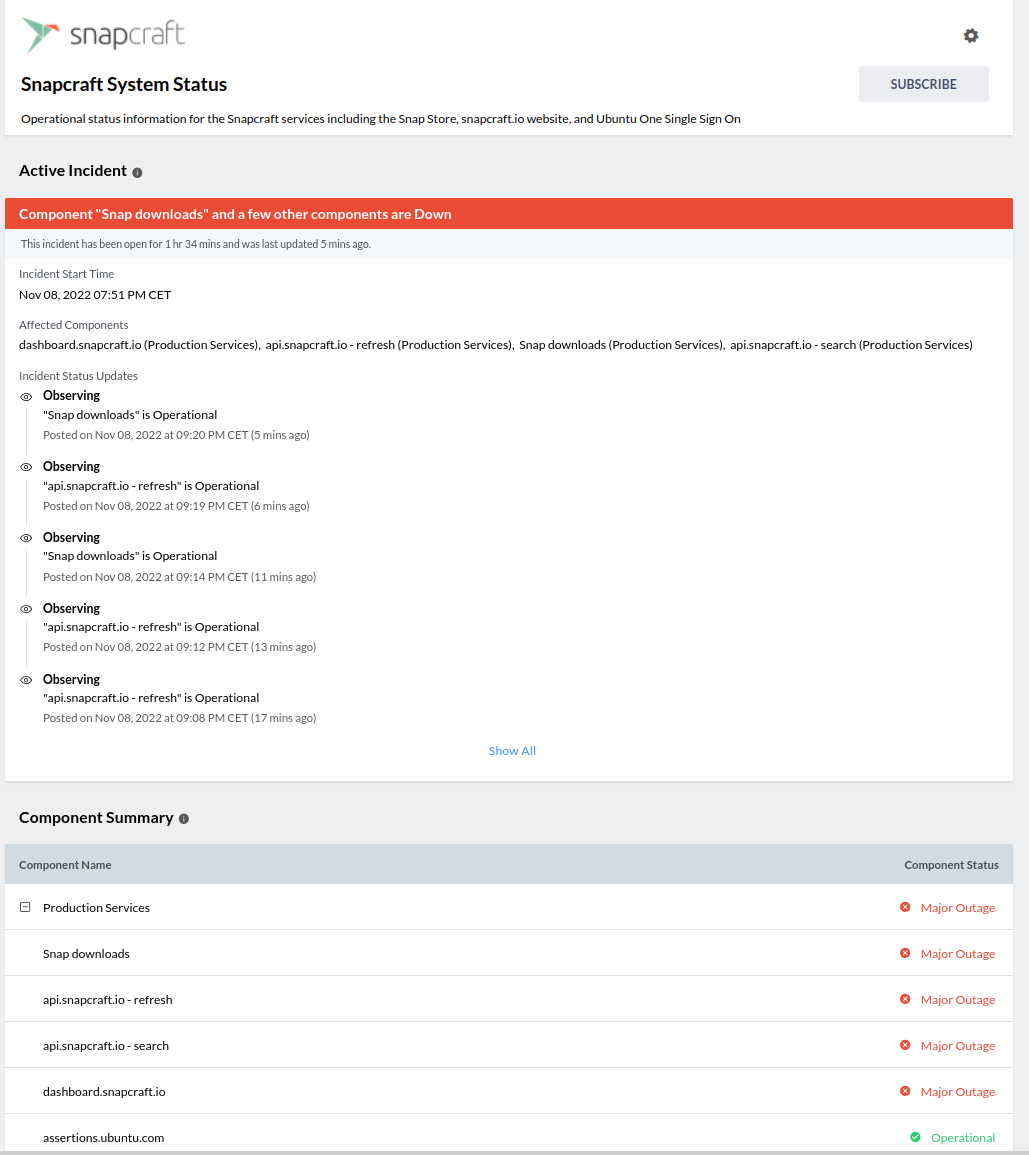 So I can check back tomorrow if I can update my web browser ...
Update
09.11.2022 12:15 CET
The Snapcraft distribution system seems quite flaky, this is the downtime log:
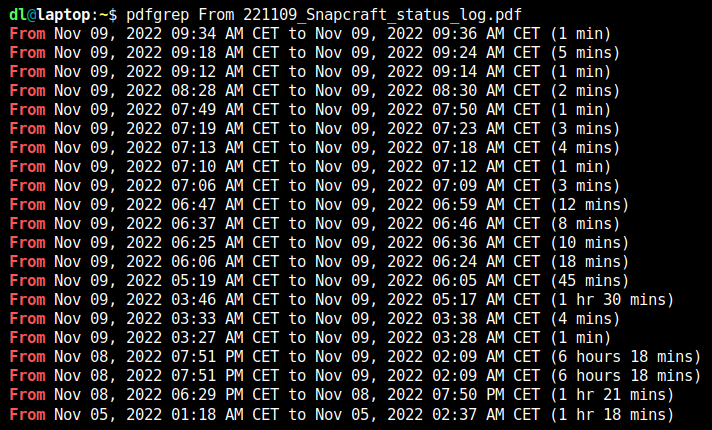 Bonus points for the bad client side implementation:
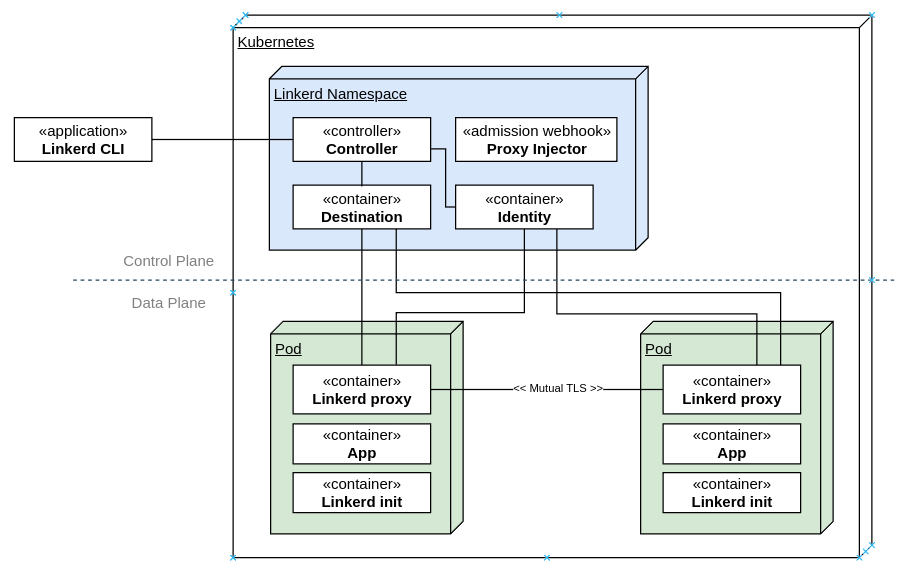
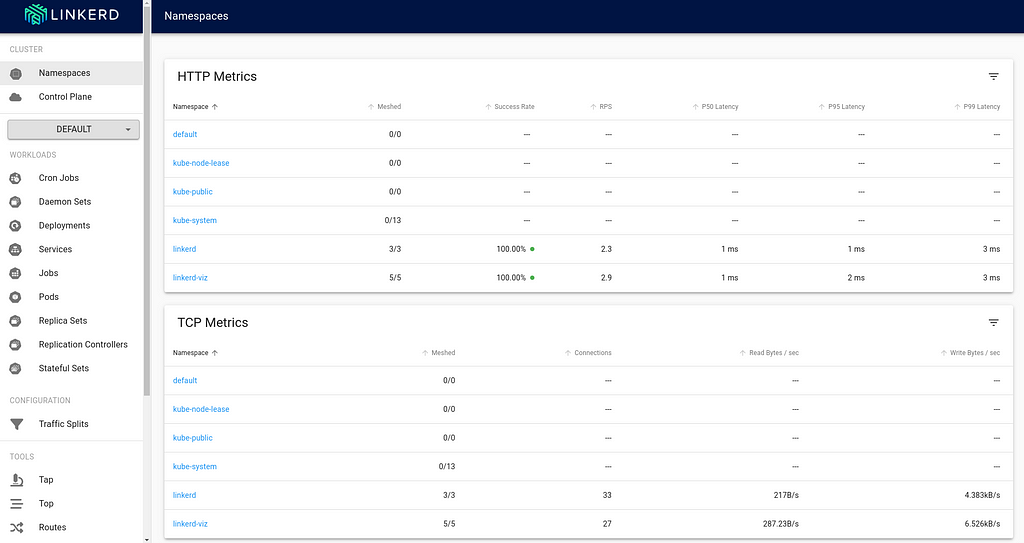
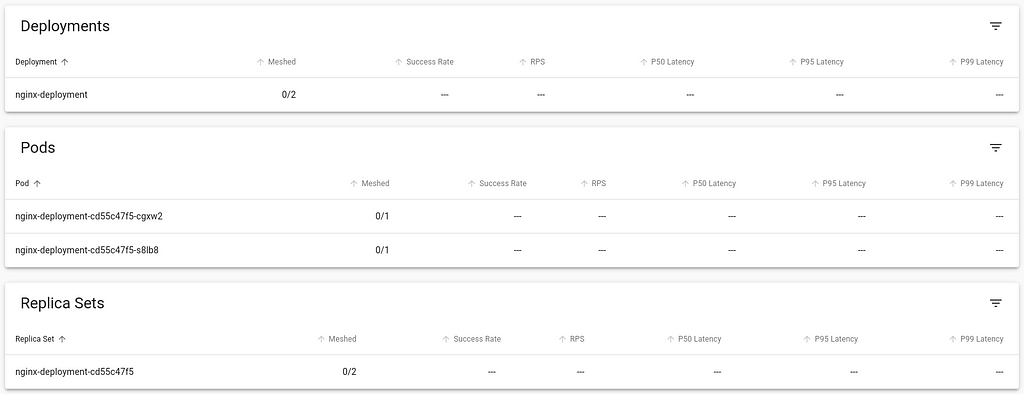
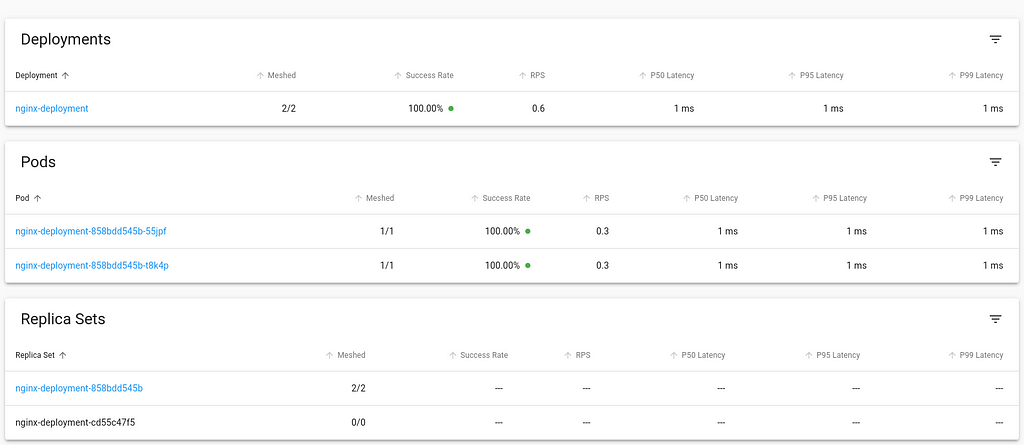

 I hope you had a nice Halloween!
I've collected together some songs that I've enjoyed over the last couple of
years that loosely fit a theme: ambient, instrumental, experimental, industrial,
dark, disconcerting, etc. I've prepared a Spotify playlist of most of
them, but not all. The list is inline below as well, with many (but not all)
tracks linking to Bandcamp, if I could find them there.
This is a bit late, sorry. If anyone listens to something here and has any
feedback I'd love to hear it.
(If you are reading this on an aggregation site, it's possible the embeds won't
work. If so, click through to my main site)
Spotify playlist:

 The eighteenth release of
 This is my report from the Netfilter Workshop 2022. The event was held on 2022-10-20/2022-10-21 in Seville, and the venue
was the offices of
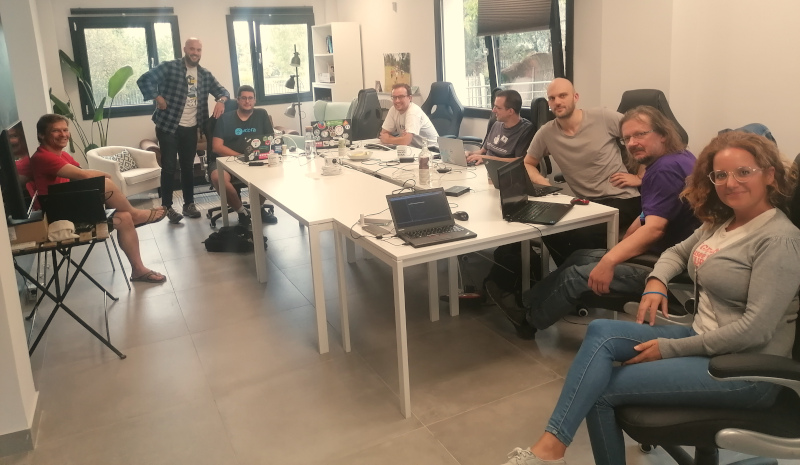 The second day was opened by Florian Westphal (Netfilter coreteam member and Red Hat engineer). Florian has been
trying to improve nftables performance in kernels with RETPOLINE mitigations enabled. He commented that several
workarounds have been collected over the years to avoid the performance penalty of such mitigations.
The basic strategy is to avoid function indirect calls in the kernel.
Florian also described how BPF programs work around this more effectively. And actually, Florian tried translating
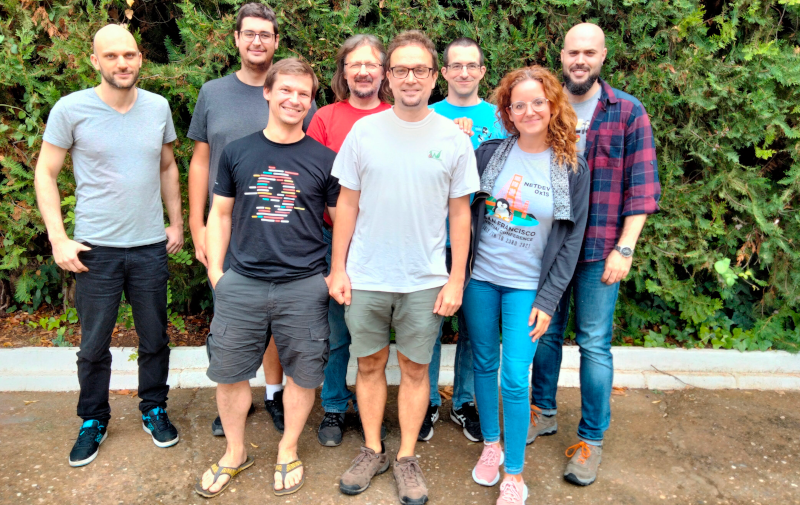 Finally, after many interesting debates over two days, the workshop ended. We all agreed on the need for extending
it to 3 days next time, since 2 days feel too intense and too short for all the topics worth discussing.
That s all on my side! I really enjoyed this Netfilter workshop round.


 . What is the basis of that or why is there such kind of confidence I have no clue or idea, it is what it is. Approximately 24 hrs. ago, apparently we had a cloudburst. What I came to know later is that we got 100 mm of rain. Sharing from local




 I ve released man-db 2.11.0
(
 This entry explains how I have configured a linux bridge,







 Fast laptops are expensive, cheap laptops are slow. But even a fast laptop is slower than a decent workstation, and if your developers want a local build environment they're probably going to want a decent workstation. They'll want a fast (and expensive) laptop as well, though, because they're not going to carry their workstation home with them and obviously you expect them to be able to work from home. And in two or three years they'll probably want a new laptop and a new workstation, and that's even more money. Not to mention the risks associated with them doing development work on their laptop and then drunkenly leaving it in a bar or having it stolen or the contents being copied off it while they're passing through immigration at an airport. Surely there's a better way?