Search Results: "rui"

19 January 2009

Gunnar Wolf: About the recent events and possible outcomes in Israel and Palestine

Several friends, from different groups and backgrounds and with different points of view regarding the current war in Israel (and regarding the Arab-Israeli conflict in general) have asked me for an explanation on what is happening there, what is (my view of) the real conflict, its causes... and any possible answers. And yet I am quite far from being an authority, I do want to write something about it. Be prepared, as this post is quite long.
And yet, after writing frankly a lot more than what I expected... It is by far not enough. I have still much more to add, but I have to say "stop" at some point. So, here you have it: My points of view, as well as some explanation on why are we standing where we currently are.
I am writing this based just on my personal experiencie and, of course, my personal point of view. Furthermore, I wrote a good part of this text while riding a bus, with no network access, so I am offering very few references - In any case, it will allow me to make much more progress. References always take as much time as the text itself! About me Why am I writing this? Why do people ask for my opinion? I must start by explaining who I am, so the rest of this makes sense. I am a Mexican Jew. That means, I was born in a Jewish (albeit secular) family, and grew up in an environment with general Jewish culture. My direct family (say, my parents and brother, and to a lesser degree my closest cousins) are not at all religious, I'd even venture to say most of us are complete atheists. Yet, besides the cultural belonging (which is a mixture of a Eastern European culture with lots of Idish words and dishes and general humor), my family has a strong national identification - In other words, I grew up in a fully Zionist environment, which traces back to Poland.
My grandmother was member of Hashomer Hatzair in Poland, since the early years of its existence, late 1910s and early 1920s. What is it? To make it short, a Zionist Socialist, Kibbutzian youth movement. It has many similarities (and somewhat stems indirectly from) the Scouts many of you will be familiar with, but -obviously- has a way lengthier agenda. And, yes, nowadays I feel it is somewhat out of reach with the current state of the world - It was founded in 1913, and only slightly adjusted its principles since then.
I will talk more about Hashomer later on.
My grandmother arrived in the late 1920s to Mexico, for familiar and economic reasons, but still dreamt about living in Israel for a long time. As they grew up, first my uncle joined Hashomer in Mexico in the late 1940s, when it still pursued a very much Soviet-style ideals for Israel (one of the core points that changed during the 1950s); both my father and my mother joined in the late 1950s (in fact, that's where they met). My cousins and myself were very active in the 1980s and 1990s.
The Iszaevich family has something very unusual, I'd say, engraved in our genes. We live very deeply our ideologies. That's the only explanation I can find to the way we all have led our lives. I won't go into the other family members' details, but just into mine: I was fully convinced of all we taught to our younger members and what we discussed among ourselves. I am among the very few people who really learnt Hebrew at my school, and that was only because I really cared - I know some people that just after 12 years of pseudo-learning could maybe utter a few phrases.
After finishing high school I went with my Hashomer group, together with people my age from other similar-minded Mexican Zionist youth groups, to live and learn for a year in Israel, on what is usually known as shnat hajshar - A year to get ready. To get ready to what? But of course, to come and give back go the younger groups of the movement, and finally go back to Israel and settle there definitively. I came back to Mexico, and after one year I did the only thing that was logical: I became an Israeli and went to live to a kibutz - Zikim, a beautiful place just between Ashkelon and Gaza, very near the sea shore. It was a beautiful period in my life, and I really enjoyed it - But it didn't last for very long - I quickly grew to hate the Israeli society at large. A society full of rage, of hatred. Not just between Arabs and Israelis, as many would think from the outside, but between religious and seculars. And between immigrants and locals. And between leftists and rightists (in several dimensions, as it is one of the countries where you can most easily be a economic leftist while being a political rightist - a complex society it is). A society full of disrespect and intolerance. A very hypocritical society. And one of the things that most shocked me: I wanted to live in a society of proud of its existence, that's what I had learnt Israel was - But Israelis aspire and dream of being anything else (and mostly US-Americans) in a way that made me sick, more than anything I had previously seen in Mexico.
I loved the life at the Kibutz, and I loved being an agricultor, doing hard work every day and literally getting the fruit of it. However, I cannot live isolated to a 300-people universe - At least once a week you have to go to the city if you don't want to become insane. And I could not stand the sick Israeli society.
Anyway, to make things short: After six months as an Israeli, I came back to Mexico. I went through a long period of finding myself, as I could not uphold anymore my Hashomer ideology (if I am not going to live by it, how can I continue teaching it?). Many people do anyway, but for the first months, where my Hashomer work was basically all of my life, I felt really uncomfortable. So, in short, I severed all of my relations to the Jewish community, and even denied for a long time my Jewishness until I found a (I think) better balance.
Today I am at peace. But anyway, I wanted to talk about myself in the critical period that marked me in this regard: The 1990s. Enough, lets get down to business. Zionism 1870-1920 Many people argue that the Jews invaded the Palestinians homeland - And yes, nowadays I cannot counter this. But we cannot judge what happened then based on what we see now.
Modern Zionism started around the 1870s. The Jewish history is full of pogroms and persecution, in different countries all over Europe - And a group of young people decided the only solution was to build a place to call their own. And yes, this was full of idealism and in no small part the foolishness of youth. For several centuries and up to 1920, all of current Middle East were provinces of the Ottoman Empire. Before Zionism began, the population of today-Israel was very sparse, not more than 400,000 people - up to 5% of them Jewish, around 10% Christian Arabs, and the remainder, Muslim Arabs. Of course, the low population was mostly because the country was mostly hostile - A desert in the South, mostly swamps in the North, and some minor towns mostly in the hills. It was a mostly forgotten province, away from the central Turkish rule, and there had been no frictions with the local population. It was a nice place to go, thinking -again- as a fool youngster, or as an idealist. They said, lets take a folk without a land to a land without a folk.
The number of accomplishing Zionists (this is, people who actually went to Israel instead of just talking about doing so) was not high during the first decades. But towards the 1890s, it gained critical mass. The political Zionist movement was born, with Theodor Herzl as a leader, and they started pushing -politically- for different governments to concede a territory to Jews. They went to the Turks, and didn't really get much echo. Went to other colonial powers of the time, and got unfeasible promises with no real backing (i.e. Birobidjan in Eastern Russia, Uganda in Africa)... And, as it happens in strongly ideologized movements, the movement started splitting into different groups with slightly different positions.
And no, I am not talking about the People Front for the Liberation of Judea and the People Judean Liberation Front, but I very well could. Sometimes the differences are as ridiculous as that. But hey, I take that most of my readers are acquinted with the Free Software issues, right? Think BSD vs. GPL vs. OpenSource. To give a broad idea - Only in Mexico City, with a very small Jewish community (~30,000 people), in the mid-1990s we had over 10 such movements, with 50-150 youngsters attending each. And even though some were local, and even though some very important ideologies are not represented in this country, they are all different enough to exist as separate entities. British Mandate The Ottoman empire was divided after the first World War. Its possesions in Europe became independent states, while in Asia (and Africa, if you take the semi-independent Egypt and part of Sudan into account) they were taken over as colonies or protectorates by France and the UK - Evidently, attempting to secure a long-term dominion over the area. In some aspects, they failed. In some aspects, they were (and still are) tremendously successful. The division of people by setting arbitrary boundaries has led to countries sustainable only by force and a harsh rule (such as Iraq, Lebanon and Syria), or doomed to poverty (and thus submission) due to lack of natural resources (as Jordan). Focusing on Israel/Palestine, the UK entered the area by making mutually incompatible promises to arabs and Jews - i.e. the Hussein-McMahon letters and the Balfour declaration, both ambiguous enough to lead to... Well, today. The UK rule was disastrous to the region, both in giving (and taking away) power from all sorts of puppet regimes, and swiftly going away as soon as things started looking too complicated. Yes, typical colonialism.
So, while up to the 1920s there was no real animosity between Arabs and Jews (as i.e. the Faisal-Weizmann agreement shows), during the next decades the seeds of hatred started growing, from both sides.
Many people still quote the 1947 partition plan as the direct antecedent towards Israel's real existence - That was not the first partition plan that existed. Ten years earlier, the Peel commision suggested a similar partition involving forceful population transfer. And many people see the separation of Transjordan (now Jordan) from Palestine in 1922 as a first partition. It is understandable that both partition plans (much more the 1947 than the 1937 one) were accepted by Zionists: Going from having nothing to having something (and against all odds in the environment they lived) is acceptable.
From the Zionist side, two main groups rejected the partitions: The right-wing and religious groups, insisting that the whole of the Mandate should become Israel, and the left-wing groups, which advocated for a single, bi-national state, with equal rights for all of its population. Go over and read this last link, as it was quite interesting (to me at least) to see how this solution has kept existing and regarded by (relatively) many people, and has many interesting links. 1948 onwards: Where did the refugees come from? The November 1947 partition didn't exactly translate to a planned, smooth Israeli independence - It led to six months of revolts (basically, a civil war). By mid May, the UK government and troops abandoned the territory, and one day later, Israel declared its independence. And, of course, all neighbouring countries (and Iraq) sent their troops to invade Israel. The war lasted for over six months (cease-fire was signed in January 1949). There was an intense Arab campaign indicating the armies would enter Israel and devastate it, leaving no stone in place, indicating Arab population to temporarily leave the Jewish-destined areas. The war, they said, would not take more than a couple of months, and they would be able to go back home.
Only that... When the war ended, the results were far from what the Arab governments expected. Not only Israel continued to exist, but it conquered important territories.
Of course, the Israelis were not innocent from said exodus: During the 1947-1948 civil war, and the independence war, some of the existing so-called self-defense forces (some of them were really defensive, while some were quite aggressive, even terrorist) attacked Arab villages in strategic or predominantly Jewish areas to prompt them to leave - yes, what we today call ethnic cleansing.
I had (in my head) the number of 650,000 Arabs (from a total of slightly over a million) fleeing to neighbouring countries. Wikipedia states that it is somewhere between 367,000 and 950,000. A similar number of Jews were expelled from Arab countries, many of which arrived to settle at Israel (and many others went elsewhere - For instance, a good part of the Mexican Jewish community is from Syrian origins - Many of them fleed in those years). Israel didn't accept back the (relatively few) Arabs that requested to resettle, as they were seen as hostile population - but neither did the countries that "temporarily" accepted the Palestinians accepted them as citizens. The Palestinian refugee camps today, mainly in in Lebanon, Syria, and the occupied territories held by Israel have terrible living conditions, and its population -despite living there for over 60 years- have no civil rights at all. Note that I'm omitting Jordan here, although it has several camps as well, as their situation is way better.
The Arab population that didn't leave did receive full Israeli citizenship. No, their living standards are not up to level with the average Israeli. The country and the society do have a sensible degree of racism and segregation. But the situation is nowhere as terrible as it is in the camps.
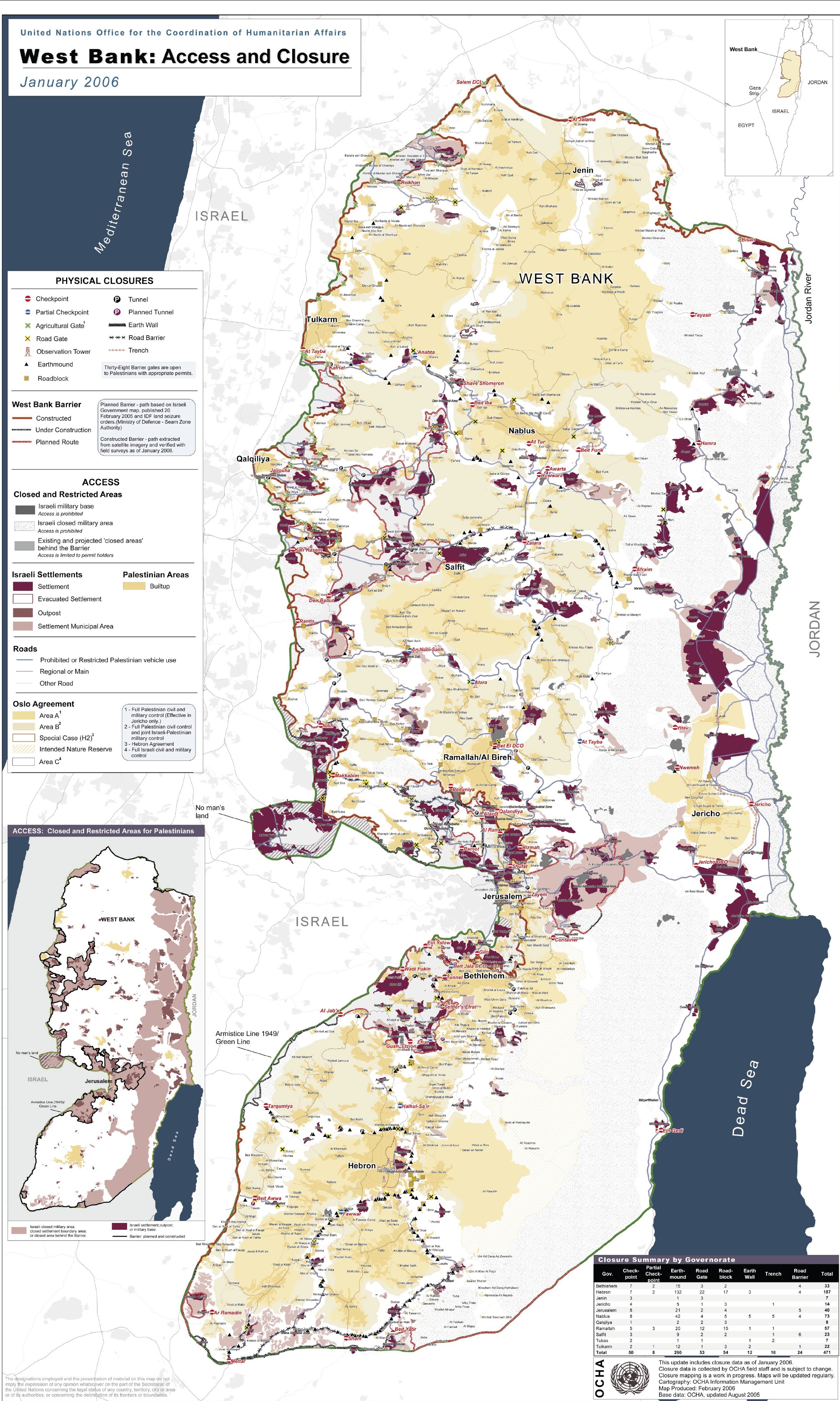
The areas which were originally to become Palestinian and were not conquered by Israel -this is, current-day West Bank and Gaza- bacame respectively Jordan and Egyptian territory. While Jordan did fully extend its soverignty covering the West Bank, Egypt didn't - Gaza is, since 1949, occupied military territory. Gaza, among the most densely populated areas in the world, has had their inhabitants under military rule ever since. When Israel returned the Sinai after signing the peace treaty with President Sadat, Egypt didn't accept Gaza back - And that's where today's greatest problem is born.
Now, Israel conquered those territories in 1967, along with the very sparsely populated Sinai and Golan. For the first ten years, the territories were basically only administered (yes, under a military rule). In 1977, with the first right-wing Israeli government, an extensive settlement policy began (and led partly to today's seemingly unsolvable situation). In 1980-1982, Israel withdrew from the Sinai. In 1981, Israel claimed full soverignty over the whole of Jerusalem and the Golan. In 1993, the "Oslo Agreement" was signed between Israel and the PLO, and it seemed we were heading towards a bright future. I lived in Israel between 1994 and 1996 - Yes, the most hope-filled period in the country's life.
Since 1996, I have tried to keep up to date with the country's evolution. All in all, even if I won't live there again, it is a country I learnt to love, a society I have long studied (even if in the end I did include many references, I wrote most of this text just off the top of my head, with the data I remember - so it might have several big errata). And yes, I keep the political stand I had 12 years ago: The only solution is to dialogue, to treat the current enemies -and not only their governments- with respect, recognizing their dignity and right to life, to self-determination. Only then we will change the status quo. How not to fight hatred Since 1993, the dream of peaceful coexistence seems to have faded. What we saw during the past three weeks, along to what we saw in Lebanon in 2006, is plainly a gross mistake if the goal is to achieve good, lasting peace.
Try to imagine how could life in Gaza be, even in the total absence of Israeli attacks. Just to set some numbers first: The Gaza strip hosts almost 1.5 million people on 360 km . When I lived in Israel, I was constantly surprised at how small a country it is - Israel tops at 550Km North to South, 150Km east to West (it is amazing, almost wherever you stand, except in the middle of the Negev, you can see the country's borders. Yes, I recognize as the border the so-called Green Line); over half of the territory is a desert, and it hosts seven million inhabitants. And it is hard to imagine how that country can be economically viable.
I do not find it feasible to imagine Gaza and the West Bank integrating a single country, and not only because they are separated by ~40Km, but because they are so sociologically different. People in the West Bank, yes, live opressed under military rule and subject to a much more constant, more visible apartheid-like state (as the territory is truly sprinkled with Jewish outposts which many Israelis refuse to recognize as their own, but still, which have incredibly higher living standards). The best land has been taken away from them, yes, but they have some space between cities to have some farming, to communicate, to... Breathe. Besides, West Bank inhabitants -even those in refugee camps- have much better living standards than anybody in Gaza. It is still an overpopulated area, but not nearly as much as Gaza.
Gazan population have been driven towards extremism. And yes, there was a civil war between Palestinian factions, as the world views between both populations are completely different - However hostile a Jenin inhabitant can be towards Israel, he does not lead the life -if it can so be called- you see at Khan Yunis.
But back to Gaza... What Israel is doing (and not only during this military operation terror campaign is wrong, from any rational point of view. Israel wants Hamas to become weaker? Then don't drive the population into supporting them!
Palestinians started giving over 50% of their support to Fatah (ex-PLO), and under 20% to Hamas. That was less than 15 years ago. However, Fatah has shown to be corrupt and inefficient at building infrastructure and improving life conditions, ineffective at negotiating a permanent agreement which secures dignity and sustainability to their people. Hamas stands as a religious, righteous organization. There are no serious corruption charges against any Hamas leaders. Hamas is clearly still at war - They didn't subscribe any peace agreement so far, and their stated #1 goal is to build a Muslim State in the whole of Israel. And the Hamas movement -like Hizbollah in Lebanon- has built quite a bit of infrastructure in the areas they control - Mainly housing. Yes, housing where they mix their own offices, many will accuse, getting human shields for free. But still, they are benefactors to a dehumanized, pauperized population.
I find it obvious that, if living conditions were at a basic level in the region, support of Hamas would decrease. Even more, of course, if they improved due to Israeli support. Israel controls this territory, so it is responsible for the well-being of its population, like it or not. And Gaza is simply too small and low on resources to survive by itself.
I was a bit surprised to find mention -although very brief- of a three state solution - And yes, this is close to what I would expect as a viable outcome. It is clear that Israel will not ever grant full citizenship to the Palestinians, as they would -euphemistically speaking- challenge the Jewish character of the State. Dropping the euphemism, Israel relies on apartheid in order not to become an Arab majority country. I might have some numbers wrong, but AFAIK, there are ~7 million Israelis, 20% of which are Arab citizens (which means, 1.4 million Arabs and probably 5 million Jews, with many other minor denominations for the difference), and ~4 million Palestinians live in the territories. Today, the country is already predominantly Arab, or at least is close to being so. So, Israel should permanently, formally disengage from all of the occupied territories. And in order to ensure violence stops, start a comprehensive, unconditional, long-term aid program. Start with giving them autonomy to regain their sea, as the Gaza port has long been closed. Allow the airport to operate again. Instead of bombing tunnels in the Egypt-Gaza borders, allow Gaza to trade with Egypt - Perhaps even to integrate territorialy, if the conditions are met. Treat their people with respect, and help them ease the terrible situation they have lived for so many decades - and then, undoubtely, terror will stop.
The West Bank? Possibly it could become a Palestinian state by itself. Possibly, it could integrate back to Jordan. That would be up to Jordans and Palestinians to decide. Of course, Jordan has already a large segment of its population defining itself as Palestinians, which counts both for and against. So, I won't venture into this supposition.
But anyway - Back to what prompted me to write this text -yes, a very or maybe even too long text - I hope somebody even takes the time to read it!- is to explain what is my point of view on the current situation, and why.
Today, a cease-fire was announced, after 23 days of murder and destruction. I sadly do not hold very high hopes for it to be lasting, much the less to be enough, to lead to what they call a de-escalation of the conflict. The most I can currently do is to voice my opinion, and hope that mine is just one more voice pointing to a sane solution, to a permanent, dignifying way out, for all people involved. Every people has the right for survival and for safety. We cannot deny this to any others. And certainly, we cannot expect anybody not to fight for their right to live.

Joost Yervante Damad: a month

Last year I even did it for longer then a month, but this year I want at least to redo a minimal effort, thus I'm going for a month of sobriety, as a kind of cleansing :) (and no, I'm not religious).

These are my 5 daily checkpoints:

  1. smoothie for breakfast

    This is something which we (me and my wife) do already anyway, have a fresh fruit smoothie for breakfast. Currently our favorite mix is 4 blood oranges, freshly pealed and parted, a seep of Sea-buckthorn elixir, and a couple of frozen strawberries (or cranberries). Mix all in the blender, long enough to don't have any parts left. It is extremely tasty, and gives a serious vitamin boost for the winter. The idea is to have it for breakfast and then don't drink or eat anything else for at least 1.5 hours, to make sure it's (almost) fully digested.

  2. < 4 coffee

    This is a hard one; people who know me will know I'm a serious coffee lover. I have a special espresso machine, and typically serve single origin or special blend coffees. It's hard to resist :)

  3. exercise

    Just a walk with the dogs already counts.

  4. no sugar

    This is usually not so hard for me, as I'm not into sweets anyway.

  5. no alcohol

    This is tougher. I'll have to stick to coffee, tea and fruit juices.
This is all as much a physical as a mental exercice :)


18 January 2009

Miriam Ruiz: I m going to FOSDEM too

I'm going to FOSDEM, the Free and Open Source Software Developers' European Meeting

15 January 2009

Miriam Ruiz: Chatting in Facebook via Pidgin

Instant messaging through web interfaces is not really the most comfortable thing to use. While their ubiquity is nice, and they can be used from whatever computer you want without having to install anything, for my own computer I prefer a real desktop application. Pidgin (formerly called gaim) is a multi-platform instant messaging client that supports many commonly used instant messaging protocols, so different services can be used from the same application. Being a user of many different messaging systems, I kinda use Pidgin as an abstraction layer from the services I use. Yesterday I discovered pidgin-facebookchat, a Facebook chat plugin for Pidgin and libpurple messengers, that is able to connects to the new Facebook Chat IM service without the need for an API key. It works quite well, all things considered.

13 January 2009

Christoph Haas: NFS: sec=sys or ruin your day

And once again I was bitten by problems on my Debian laptop mounting directories from the file server via NFS. After a Debian dist-upgrade I couldn t login to KDE any more. Shell login worked somehow but I quickly found out I could neither read nor write any files there. Apparently an ls -al showed me the right permissions (not just unmappable numeric UIDs or something of that kind) and an id -a confirmed that my LDAP PAM configuration still worked. But reading or writing any file just lead to Permission denied . I m not sure if it was an update in the nfs-common package in Sid. But I had the same problem before and it took me hours until I finally figured out that Debian s NFS seems to use non-standard defaults. Namely the sec parameter when mounting the NFS share. According to the Solaris documentation the default is sec=sys which means that NFS uses the locally acquired UIDs and GIDs. Like /etc/passwd, NIS or LDAP/PAM. But on Debian it seems to default to sec=krb5 or something. As I have close to no idea how to set up Kerberos and don t want to (and talking to other people hardly anyone has used Kerberos either) I figured that it s not really a sane default. I didn t even ask for NFSv4 - just NFSv3. Perhaps I undeliberately set some /etc/default/nfs-common configuration setting wrong or whatever. It was just strange. So I set sec=sys in the options of the NFS share of my /etc/fstab and the problem was fixed. Actually I wonder what network file systems other people use in a Debian environment. NFS somehow feels antiquated to me anyway.

8 January 2009

Miriam Ruiz: Debian and Ubuntu packages for Calibre, an e-book converter and library management

Some weeks ago I bought myself an e-book reader, Sony Reader PRS 505. It is a really cool gadget, and as I usually read a lot of stuff in my computer, it is somehow an investment in my eyes. I decided on this one because the support for Linux is quite well, through the unofficial Free Software project Calibre. Calibre is primarily an e-book cataloging program: it manages your e-book collection for you, and it is designed around the concept of the logical book (i.e. a single entry in the database that may correspond to ebooks in several formats). It also upports conversion from a dozen different ebook formats to LRF and EPUB. A graphical interface to the conversion software can be accessed easily by just clicking the Convert E-books button. A lot of input formats are supported: MOBI, LIT, PRC, EPUB, ODT, HTML, CBR, CBZ, RTF, TXT, PDF and LRS. After some weeks of work, Martin Pitt and I have finished the packages for Debian and Ubuntu, which are right now waiting in the Debian NEW Queue. You can temporarily get them from here, compiled for Debian SID AMD64, but of course you can build them for your platform, or wait until they enter Debian.

6 January 2009

Gunnar Wolf: Historias de la Historia del c mputo en m xico


Some months ago, I got a phone call from Rafael Fern ndez Flores. He wanted to interview me for a book he was working on regarding the history of computers in Mexico. The first computer in Latin America was installed in 1958 at my University (UNAM), and last year there were several activities conmemorating it. One of said activities is the publication of the book Historias de la Historia del c mputo en m xico, by Rafael Fern ndez and Margarita Ontiveros.
The book was printed in November, and Rafael gave me my copy in early December. It is quite an entertaining read - I mostly enjoyed the archaeological parts of it, referring to the 1950s and 1960s, and with many people that I know first hand (as my father is one of the founding researchers of the Centro de Investigaci n en Matem ticas Aplicadas, Sistemas y Servicios, CIMASS, now IIMAS).
I do believe, anyway, the book is focused too heavily on what happened in the large-scale computer world during a fundamental point in time for me (late 1970s, early 1980s) - It shows that the authors were very involved in the important projects the University set foot on, but they overlook fundamental pieces of the history. Very important developments were made in smaller venues (it was shocking for me to find only one mention, and just as a reference, to Fundaci n Arturo Rosenblueth and its great Centros Galileo, where many hundreds of kids (me included) learned to love computers, to program, and had a thriving socialization place. I also missed mentions of the BBS scene in Mexico, for which there are various exponents. And, just to single out one person, I found it absurd to have me interviewed and not to include La Mancha de la Calabaza que Ladra.
One of the last chapters -there are over 40 chapters, stemming from over 30 individual interviews- publishes the talk I had with Rafael. I must say there are small errata in its transcription (the first example that comes to my mind: I told him that one of the fruits of the OLPC project was the appearance of the now-popular netbooks, partly due to the appearance of lower cost parts, but I must reiterate I didn't say the Asus EEE is a part of said project). You can I am attaching my interview (as scanned, low-res images) to this post, in case you are interested.
Anyway - If the topic interests you, you will find many interesting passages, many passages you will surely laugh with and probably remember. The book is very well laid out. And it is a great joy to be part of it!

Benjamin Mako Hill: Debian Bug Squashing at MIT

I was thrilled to be part of a successful Debian bug squashing party organized by MIT's Student Information Processing Board on December 13th. Greg Price, who helped organize the event, did a wonderful write up which he sent to the debian-devel email list. I though it was worth mentioning the BSP now because I think it's a wonderful model that I'd love to see replicated in Debian and beyond. The event was initiated, organized, run, and executed by people with little or no direct experience with the project. While the organizers went out of their way to recruit several Debian developers and other experts to the party, these experts' role was more in answering questions and helping others. The the majority of the participants -- around 30 of them in total -- had no previous experience doing Debian development. While the 11 bugs closed or dealt with are the most visible outcome, I'm not sure that it is the most important. The event acted as an important learning experience for everyone involved and, perhaps most centrally, an important first step for most participants from using free software to giving back and participating in the community. You don't need experience, connections, or a @project.org email address to organize a party like this for Debian or your own free software project. All you really need is a few people, some technical knowledge, an Internet connection, and the desire to make it happen. Other things can help, of course. In particular, the SIPB folks have packaged up some scripts they used to select bugs to work on and put them online.

20 December 2008

Miriam Ruiz: Interesting proposals on how to make Debian a better world

I have been positively surprised to find out that some people are taking seriously the fact that some people are being put off from actively participating in Debian s discussions because doing so would lead to offensive behaviour and personal attacks, and to try to find a solution to the fact that a very vocal minority is dominating the silent majority. Of course, some people are happy with the statu quo and strongly opposes to changing anything in that direction, not very surprisingly. The part about I m really starting to think that this Project could do a lot better without some people is crystal clear and needs no comments. I m not really sure that the current social environment can be fixed just with technical measures. Another proposal talks about some mailing lists extracted from the official ones but with the offending comments filtered out. I must confess that I find this idea very interesting and that I might think about rejoining such a list. Of course, technical details on how to properly and effectively implement any of this methods, or even a mixed one, can be very tricky.

18 December 2008

Miriam Ruiz: In support of Manoj

Well, everybody has been very vocal about it, so I will be too: I don t like current voting ballot, I won t defend that, but I do like Manoj as Debian s secretary and I don t think he deserves all the attacks he has been subject to. Short and clear.

15 December 2008

Miriam Ruiz: How to win online debates

From How to win online debates, by Adam Graham: You won t really influence the direction of what people think on a given issue. The prize is the satisfaction that you won the debate. You beat that guy. You showed him who was right! Congratz! As the author of the article says, quoting the film War Games: A strange game. The only winning move is not to play.

12 December 2008

Romain Francoise: Pimp your git meme

Zack's post on git colors is a perfect opportunity to recycle this old post of mine on how to make git diff look more like quilt diff and vim.

For good mesure I'll also throw in this snippet (stolen here) which adds a git rlog alias, very handy when you just want to grab the short hash of a recent commit:
[alias]
rlog = log --pretty=format:\"%h %Cblue%cr%Creset %cn %Cgreen%s%Creset\"
It looks like this:

7 December 2008

Neil Williams: langupdate for Emdebian Grip - borne from edos-debcheck

Whilst building more and more packages into Emdebian Grip, I came across gettext
which depends on libglib2.0-0
which surprised me somewhat. However, this is extremely useful because langupdate - the Emdebian-only utility that I wrote to correlate Emdebian TDebs with installed packages and supported locales - also uses libglib2.0-0 as it is one of my favourite libraries for all my C code. So now there is no need to rewrite langupdate to not use libglib2.0-0 (I wasn't looking forward to that particular task so it's even better).
Secondly, I thought about using reportbug --kudos edos-debcheck but AFAICT that merely sends an email to Stefano Zacchiroli so I thought I'd put the "kudos" into a blog post for more people to read:
If you haven't used edos-debcheck before you probably haven't done any work at all with repositories - edos-debcheck is becoming fundamental to everything I do. Emdebian simply could not function without these checks - it would take hours to identify the missing dependencies. (I know because before edos-debcheck was released, I did spend (s/spend/waste/) hours upon hours on a fruitless chase through the dependency trees in Debian.)
Consider my current task - adding packages to Emdebian Grip in such a way as to retain the smallest possible package set in which all dependencies are met (excluding Recommends that do not apply in Emdebian). edos-debcheck makes it almost trivial:

codehelp@ant:/org/emdebian$ ./scripts/grip-binary.sh libxml2
....
codehelp@ant:/org/emdebian$ edos-debcheck -explain -failures < grip/dists/unstable/main/binary-amd64/Packages
Parsing package file... 0.0 seconds 135 packages
Generating constraints... 0.0 seconds
gettext (= 0.17-6em1): FAILED
The following constraints cannot be satisfied:
gettext (= 0.17-6em1) depends on gettext-base NOT AVAILABLE
Checking packages... 0.0 seconds
codehelp@ant:/org/emdebian$ ./scripts/grip-binary.sh gettext-base

Simple. A second script then goes around behind and ensures that each binary added to the repo has the corresponding source package also added. The key is that Emdebian Grip does not have to have all binaries from that source - we only use the binaries that are needed, either directly or as direct dependencies of others.
Zack - and all the people who worked on edos-debcheck - your code is just indispensable to me.

2 December 2008

Miriam Ruiz: Collaborative maintenance of games between developers of different Linux and BSD systems

Games are probably the kind of software that needs more patching and maintenance. In some cases we even have to effectively act as upstreams ourselves. Currently every distro is doing that on their own, and we end up making n times similar patches to provide the same functionality (put files in the proper places, endianess and word size stuff, building with newer versions of gcc or free toolchains, etc). It makes a lot of sense to share among us all that stuff. Some of us, developers of different Linux distributions and BSD operative systems have started working together to reduce duplicated work, creating a distribution-agnostic mailing list in freedesktop servers as a first step. Debian Project News talks about this too. You can read more about our goals here. Wish us luck in this new quest, and join us if you’re interested too :)

1 December 2008

Jordi Mallach: Iru a

This weekend I had the pleasure of visiting my friend Kike in Iru a, a city I really like but had not been able to visit in five years. I spent three days with him, after a really awful Bilman trip during Friday night. The first thing that happened on Friday morning was quite unexpected. I went out, crossed a pair of streets to get to Carlos III, and going past the corner I found myself surrounded by all kinds of policemen: red, blue, green and yellow. There were press reporters all over the place, with TV and photo cameras ready to record something big. What the hell? I looked around, and there it was: a huge blue sign read Populares de Navarra, and Mariano Rajoy was seconds away from getting out of the new PP headquarters in Nafarroa. With a few dozen policemen looking at me in suspicion, and realising my current hair dress wasn't the most appropriate for that scenario, I decided to disappear as quickly as possible. Populares aside, the weekend was really productive. I had a great time trying to find the places I visited 9 and 5 years ago. It was sad to see the fantastic Iru ako Gaztetxea turned into an iron building surrounded by old, traditional houses in the centre of the city. With Kike, I had enough time to learn more about the origins of Iru a and the three cities from which it originated, and visit the Ciudadela. On Saturday, Kike, Ana and I went to have some fun on a snowy day around Orreaga and had dinner in a small town around the area, maybe Lintzoain? I'm afraid I forgot due to the mix of basque names in my head. We had dinner in lo viejo, where I spotted a poster of Solidari@s con Itoiz for the Itoitz hustu arte campaign, a copy of which I unsuccessfully tried to get in several places in the city. On Sunday, Kike and I took a bus to Donosti, and I travelled across the most beautiful highway I've seen. But of course, that was from my perspective seated in a bus. I can imagine the Leitzaran highway project must have been greatly contested by the people of the tiny towns nearby. The spoiled valleys and views must have been really impressive in the past and seem now irreversibly ruined by a scar and holes through the mountains. This was my first visit to Donosti, which held its annual Marathon, and were lucky to meet our friend Rub n when he was around kilometre 25 of his race. He managed to finish under 2:50, which was a bit better than what he aimed for in his first Marathon. Well done! The weather was horrible, and our visit to La Concha, the old harbour and the Casco Viejo was short, we were freezing and getting our feet wet. While I visited Donosti for the first time, Mikel Laboa, one of the most respected singers in the basque culture, was ebbing away. Laboa's songs always give me goosebumps, even if I need to read a translation for the basque lyrics. Many will remember his music from Julio Medem's documentary, La pelota vasca, featuring Txoria txori, which has become a symbol of basque culture over the years. Youtube has quite a few videos, and I'd recommend watching Txoria txori, Gure bazterrak, Lili bat or Baga biga higa performed by the Orfe n Donostiarra to name a few. Mikel Laboa, goian bego.

27 November 2008

Eric Warmenhoven: cado, cadere, cecidi, ?

The other day I was looking at the statistics collected from my web server logs, and saw that easily more than 80% of people who find my website are looking for my Latin vocab learning tools. They’re pretty basic, but I found them to be somewhat helpful when I was learning Latin. I’m seriously considering expanding it a bit, adding conjugation/declension drills, making it a little prettier, etc. Anyway, tonight, I got a nice email from a woman who uses the vocab tools, and noticed that there was a problem with fourth principal part of the Latin verb ‘cado’, and it sent me on a somewhat fruitless search for what the right word is. (A quick primer for those not familiar with Latin verbs: most verbs have four principal parts, which can be used for conjugation. The fourth principal part is the perfect passive participle, e.g. “to have been heard”.) So then, what is the perfect passive participle of ‘cado’, which means “to fall”? Before I get into that, consider for a moment what the translation to English would be. “To fall” is usually used as an intransitive verb (the transitive form is mostly obsolete), so “to have been fallen” doesn’t really sound natural. But the translation can be approximated to something like “to have been dropped” or “to have been struck down”. But what is the actual word that is used? On this there appears to be some disagreement. Wheelock’s Latin says that it’s ‘casurum‘, as does Wiktionary. However, Tyro’s Dictionary says that it’s ‘casum‘, as does All Verbs. Meanwhile, Whitaker’s Words says that ‘casurum‘ is “very rare”, from “later” Latin, and used in the Vulgate Bible, and says it should actually be ‘casusus‘. I still don’t know which one is correct, and suspect that all three are correct depending on the text that’s used. I can somewhat see how ‘casum‘ might have been correct at some point, but changed as it overlaps with the noun ‘casus‘, which is the noun “fall”, as in “that was a nasty fall”. Or vice versa. I tried to go searching through prose to see which was most commonly used, but most of what I found was from the Vulgate Bible and used ‘casurum‘. So, I’m still not sure which is actually the “best” word. I’ve changed the site so that it uses ‘casurum‘ to be consistent with Wheelock’s. So, does anyone definitively know, which is actually best, and what the etymology is?

22 November 2008

Miriam Ruiz: Gnash 0.8.4 in Lenny

Gnash 0.8.4 will be finally included in Lenny. There have been many improvements since 0.8.4, and it looks as though even more will be included in next release. Gnash current release cycle is 3 months, so next upstream release is planned for January 2009.

18 November 2008

Russell Coker: Keating College

Some time ago I spoke to Craig Keating about his plans for a new secondary school in the center of Melbourne. His plan was to focus on the core academic areas and cater to academically gifted students. He had some interesting ideas for his business, one of which was to pay teachers rates that are typical for private schools (higher rates than government schools) but not have any sport programs in the evenings or weekends (private schools typically require teachers to work every Saturday and one evening every week in coaching a sport). This would therefore give an hourly pay rate that was significantly higher than most private schools offered and would thus allow recruiting some of the most skilled teachers. One of his ideas was to intentionally keep the school small so that every teacher could know every student. One of the problems with most schools is that they take no feedback from the students. It seems that this serious deficiency would be largely addressed if the teachers knew the students and talked to them. He pointed out that in the history of our school system (which largely derived from the UK system) the private schools had a lot of sporting activities as a way of filling time for boarding students, given that few schools accept boarders (and those that do have only a small portion of the students boarding) the sports are just a distraction from study. This is not to say that sports are inherently bad or should be avoided. He encouraged parents to take their children to sporting activities that suit the interests of the child and the beliefs of the parents instead of having the child be drafted into a school sport and the parents being forced to take an unwilling child to sporting activities that they detest (which I believe is a common school experience). My own observation of school sport is that it is the epicentre of school bullying. There is an inherent risk of getting hurt when engaging in a sport. Some children get hurt every lesson, an intelligent person who ran a school with an intensive sports program might statistically analyse the injuries incurred and look for patterns. Children who are not good at sport are targeted for attack, for example when I was in year 7 (the first year of high school) one of my friends was assigned to the “cork bobbing” team in the swimming contest - this involved a contest to collect corks floating in the toddler pool for the students who were really bad at swimming. At that moment I knew that my friend would leave the school as the teachers had set him up for more intensive bullying than he could handle. Yet somehow the government still seems to believe that school sports are good! This is not to say that physical activity is bad, the PE 4 Life program [1] (which is given a positive review in the movie Supersize Me [2]) seems useful. It has a focus on fitness for everyone rather than pointless competition for the most skilled. I have just seen a sad announcement on the Keating College web site [3] that they will not be opening next year (and probably not opening at all). The Victorian Registration and Qualifications Authority (VCRA) announced in November that the application to be registered as a school (which was submitted in March) was rejected. The first reason for the rejection was the lack of facilities for teaching woodwork and metalwork. As the VCRA apparently has no problems registering girls’ schools that don’t teach hard maths (a teacher at one such school told me that not enough girls wanted to study maths) it seems unreasonable to deny registration to a school that doesn’t teach some crafts subjects and caters to students who aren’t interested in those areas. The second reason was the lack of facilities for sport and PE. Given the number of gyms in the city area it seems most likely that if specific objections were provided eight months earlier then something could have been easily arranged to cover the health and fitness issues. When I spoke to Craig he had specific plans for using the city baths, gyms, and parks for sporting activities, I expect that most parents who aren’t sports fanatics would find that his plans for PE were quite acceptable. The third reason is the claim that 600 square meters of office space is only enough to teach one class of 24 students. That would mean that 25 square meters is needed for each student! I wonder if students are expected to bring their own binoculars to see the teacher or whether the school is expected to provide them. :-# The government has a list of schools that work with the Australian Institute of Sport [4]. These schools provide additional flexibility in studies for athletes and probably some other benefits that aren’t mentioned in the brief web page. I don’t object to such special facilities being made available for the small number of students who might end up representing Australia in the Olympics at some future time. But I think that a greater benefit could be provided to a greater number of students if there were a number of schools opened to focus on the needs of students who are academically gifted. This doesn’t require that the government spend any money (they spend hundreds of millions of dollars on the AIS), merely that they not oppose schools that want to focus on teaching. Currently the government is trying to force Internet censorship upon us with the claim that it will “protect children” [5]. It seems obvious to me that encouraging the establishment of schools such as Keating College will protect children from bullying (which is a very real threat and is the direct cause of some suicides). While so far no-one has shown any evidence that censoring the net will protect any child.

15 November 2008

Clint Adams: I know that time is a single picture

Amanda and Sarah and Anna and I were in the back room, with the nice guy who can't sing. At least I'm told that he was nice and can't sing. Things were said that did not come to fruition. It's like that girl in the movie where everyone is skating on the edge, and though she keeps running, the weave and the weft get in the way, and the needle which was threaded at the Delly Place threatens to puncture someone's eye in the shadow of the factory where the angels watch poor souls trying to express themselves in coffee shops. A long time ago, Whatsherface explained to me the purpose of going to church: not the one where you meet business contacts, or cruise for ass, or get credit in some moral superiority program, or get harassed by some jackhole named even though he's not Russian, or to serve a higher power, or any of that, but the one where you become part of a greater whole. On the other side of the swimming pool, someone is dipping vis toe into the water. The conventional wisdom is that ve should plunge right in, withstand the shock of the temperature change, and be clearly better off for it. There is no doubt in the mind of conventional wisdom that this is the best outcome for ver. All factors are deemed irrelevant at this point. The same cannot be said for someone about to eat a poison ivy sandwich. I'm gonna need an Almdudler, gespritzt.

14 November 2008

Miriam Ruiz: AGPL (Affero General Public License) in Debian

AGPLv3 LogoI hadn’t noticed until today when Jordi Guti rrez Hermoso pointed it out to me: We already have AGPL’ed stuff in Debian, and not only in sid but it will also be shipped in Lenny. We have discussed that license in debian-legal during August and September this year, and in November its usage in client code has also being clarified when the FSF updated their FAQ to address that question, but we never reached a definitive conclussion. I also filed a bug against FTP Master asking them to clarify the situation of AGPL licensed stuff in Debian, which still remains unanswered. In any case, debian-legal is just a mailing list for discussion, and does not have the capacity to take any final decisions (that’s FTP Master’s task) but it would have been nice if someone had pointed it out there.

Next.

Previous.