Search Results: "otto"

2 July 2012

Raphaël Hertzog: My Debian Activities in June 2012

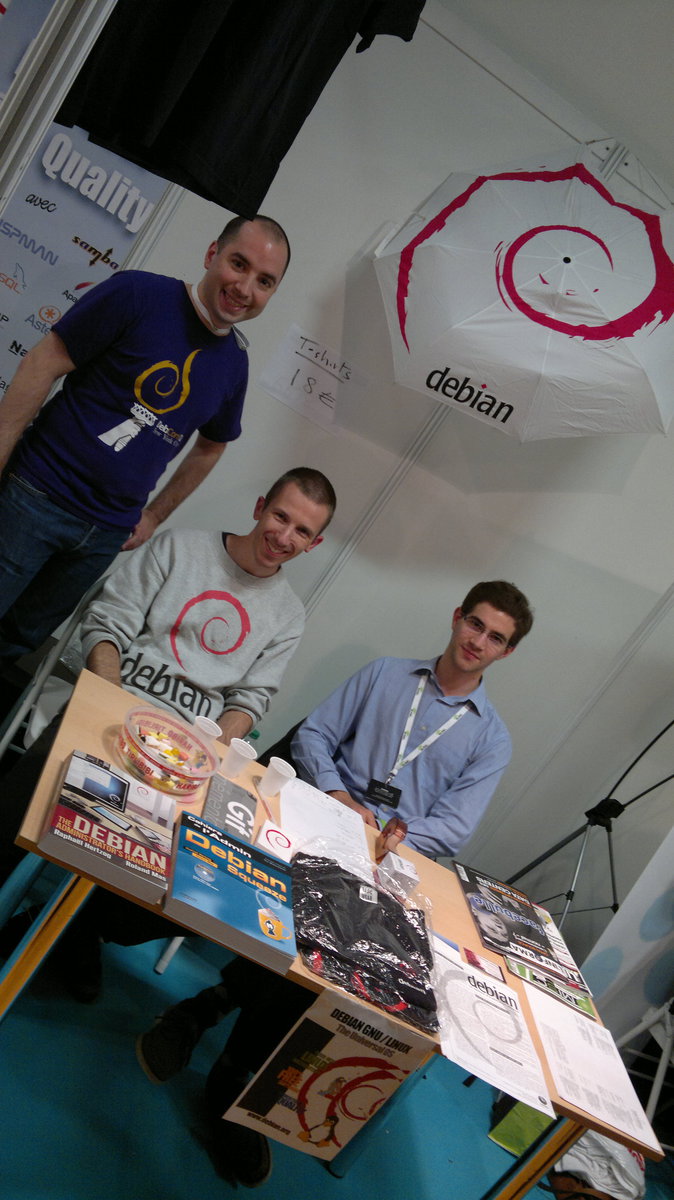
This is my monthly summary of my Debian related activities. If you re among the people who made a donation to support my work (168.12 , thanks everybody!), then you can learn how I spent your money. Otherwise it s just an interesting status update on my various projects. Dpkg This month, I resumed my work on dpkg. I concentrated my efforts on some polishing of the 3.0 (quilt) format. With the latest version (1.16.6 which was uploaded to unstable shortly before the freeze), dpkg-source restores the source tree in a clean state after a failed patch application (#652970), doesn t overwrite the patch header from the pre-existing automatic patch, updates automatically debian/source/include-binaries during dpkg-source commit, and supports a new no-unapply-patches option for those who dislike the auto-unapplication at the end of the process when the patches were not applied at the start. I wanted to go further and offer a new feature that could insert the automatic patch at the bottom of the quilt series but I have been short on time to complete this feature. I just managed to factorize all the quilt handling in a dedicated Perl module (Dpkg::Source::Quilt) to have cleaner code in the module handling the source format (Dpkg::Source::Package::V3::quilt). For those who wonder, this feature is meant primarily for the X Strike Force team which maintains packages in Git and are doings lots of upstream cherry-picks (to fix regressions, etc.). But they also use quilt on top of that tree to keep some lasting Debian specific changes. With the 1.0 format, the automatic diff is a bit messy but at least it gets smaller automatically when a new upstream release gets out, there s nothing to clean out. I d like them to be able to use 3.0 (quilt) while keeping their workflow. I m leaning towards allowing --auto-commit=first:cherry-picks that would name the automatic patch cherry-picks and put it in the first position in the quilt series. (Opinions welcome on that feature, BTW) Packaging There s been quite some packaging in this last month before the freeze: While doing all this packaging work, I found 2 possible improvements that I filed as bug reports: Debian France Booth at Solutions Linux From June 19th to June 21th, I manned the Debian France booth at Solutions Linux together with Carl Chenet, Tanguy Ortolo and other members of the association. We answered lots of questions, sold all t-shirts and umbrellas that Carl imported from Germany and Switzerland (we really need to get our own merchandising stuff produced in France!), got people to join the association. We also presented a printed copy of the Debian Administrator s Handbook and of the corresponding French book. You can see Carl, me and Tanguy on this picture (click on it to see a bigger picture, thanks to S bastien Dubois of Evolix for this one!):
I know lots of people are preparing for Debconf but I decided to not attend this year, the price of the air plane ticket was a bit too hefty for me and it was also in partial conflict with our family vacations. I thought about attending the Libre Software Meeting instead but alas I won t go there either (but Roland Mas will be there!), I have too much work to complete before my own vacation in 2 weeks. Thanks See you next month for a new summary of my activities.

2 comments Liked this article? Click here. My blog is Flattr-enabled.

9 June 2012

Neil McGovern: Anti-ACTA Demo my speech

I'm on my way back from the Anti ACTA demo in London, at which I was asked to speak. I was good to see a number of people attend. I bumped into the wonderful Bridget Fox too! Here's my speech:
As I was travelling here on the train, I found myself thinking: why am I here?
What has gone so wrong with the political system that politicians pass laws - the DMCA, the DEA, SOPA, PIPA, ACTA. Laws that look attractive on the surface, but are so deeply flawed. Why have they stopped listening?
But, they haven't stopped listening. They're falling in to a trap set by big businesses with vested interests. The ones with money to influence policy, the lobbying firms, the corporate hospitality arrangements. They hear that the economy is bumbling along the bottom. That many businesses are struggling, and these are hard problems to solve. And suddenly a shining beacon is held out - support our creative industries and all will be well. No one is interested in this new fangled Internet thing anyway. Well, apart from the people stood here today! People like you, and me. People like Julian Huppert - we helped take a motion to the Liberal Democrat Conference to repeal the damaging parts of the Digital Economy Act. The Alliance of Liberals and Democrats in Europe will vote against ACTA, and in three major committees it has already been rejected it. Something has changed. The people who represent us are starting to hear our stories. How we will not put up with censorship, interference and snooping. And let me tell you this. The big industries are scared. Shady back room negotiations so that they may be able to slip it past the public. Thanks to you, this won't work anymore. We have a voice, and it's here today. It's not too late to stop damaging our freedoms. Go visit your elected representatives. Tell them why we need to stop these bad laws. Help them understand that it's not ok to pass these. Write about it, tell people, shout in the streets! We know ACTA is bad. Let's tell the world.

8 June 2012

Dmitrijs Ledkovs: Hello Debian, Planet and Debconf12

I am going to Debconf12
I'm going to Debconf12
Hello Debian Planet!

I have recently became a Debian Developer. One of the first things I did, was fix some RC bugs in my packages due to an ABI break from upstream in a point release. Then I fixed some bugs in offlineimap... Little did I know, that I broke it for many Debian developers including my ex boss and the Debian Project Leader all at the same time.

Speaking of which, any help will be appreciated in hunting down a memory leak in offlineimap.

I am going to Debconf12, thanks to my employer. I am interested in Python/dh_python[2-3], dh, 3.0 (quilt) with a DVCS, lvm2, mdadm, btrfs-tools, autofs, e2fsprogs, dm-crypt, debian-installer, init-systems & friends, OpenERP, offlineimap... if you are as well, find me and talk to me =)))

Regards,
xnox

3 June 2012

Sandro Tosi: How to migrate your entire Google account to a new one

I've been using a Google account since years, but having a "more serious" one along. The time has come to make the switch and elect the other as main one.

Google has a lot of services, and I'm using several of them, so changing the main account requires to migrate data of those services to the new account, given it's not possible to merge two accounts. To know the full list of services your account is signed in, go to your Account Product page. Some migrations are easy, others hell no: so I'm writing this post to keep track of the migration as it's going on.

First of all, there's a really good post about this migration at LifeHacker: it contains a lot of info I'm using here, but not all the services I need. Additionally, Google has a list of services and methods to migrate from one account to another.

Just to be generic, I'll call AccountSRC the original account and AccountDST the one I want to migrate to.

Migrate GMail

GMail is probably the most important service I have, and also the most difficult one to migrate. I have a lot of filters, so the first step is to migrate them:
  1. Login into GMail for AccountSRC
  2. Gear icon > Settings > Labs
  3. Enable the "Filter import/export" plugin
  4. Reload GMail to enable the plugin (if not done automatically)
  5. Gear icon > Settings > Filters
  6. At the bottom of the page, Select all
  7. Export: this will download an XML file with the filters in it
  8. Login into GMail for AccountDST
  9. Enable "Filter import/export" plugin
  10. Load the file containing the saved filters
  11. Import all (or select which one) filters; this will also create automatically the labels defined in the filters.
I currently have a forward rule from AccountDST to AccountSRC: so let's revert the forward direction: from AccountSRC to AccountDST. This will allow the new account to receive the mails sent to the old one.
  1. Login into GMail for AccountDST
  2. Gear icon > Forwarding and POP/IMAP > Disable forwarding: this will stop redirecting mails from AccountDST to AccountSRC
  3. Login into GMail for AccountSRC
  4. Gear icon > Forwarding and POP/IMAP > add a forwarding address
  5. Enter AccountDST as the address to forward mails to
  6. A verification code is sent to AccountDST and you'll need to enter that code in AccountSRC to verify you have access to both mailboxes
  7. Once verified, select "Forward a copy of incoming mail to" to AccountDST and to delete the GMail copy on AccountSRC
There's no automatic way to migrate all your settings from the old GMail account to the new one, so you'll have to comparing settings pages to set what you had before to AccountDST. I suggest to first enable the labs you have on AccountSRC, and then go thru every page and report the configurations.

Did I forget something? yes, the hardest part: migrate mails! There are a lot of guides about migrating mails, the way I prefer is thru IMAP and Thunderbird (as described here): you'll move IMAP folders, and since they are equivalent to GMail labels, you'll automatically get your email with the correct labels (yes, the same mail appears in several folders, one for each label, and moving an email from one folder will not remove it from all the others).
  1. Enable IMAP access on both AccountSRC and AccountDST
  2. Open Thunderbird (or Icedove if you're on Debian like me) and register both accounts
  3. You can now start moving folders/emails from AccountSRC to AccountDST
    1. Copying a (missing) folder, will automatically create a label with the same name
    2. Moving a mail from the same folders on the two accounts will add the label called with the name of the folder to that email
  4. Be ready, it's a LOOOOONG process, but it's safe and it guarantees a perfect result
With the method above you have all the labels you had before, but not the label colors (and I have a lot :( ).

Another tool that's would be interesting to evaluate for this task is Gmvault.


Migrate Contacts

Contacts are available inside GMail:
  1. Login into GMail for AccountSRC
  2. On the combobox on top-left, select Contacts
  3. More > Export
  4. Export all the contacts in Google CSV, since it's specific to be re-imported
  5. Login into GMail for AccountDST
  6. Contacts > More > Import
  7. Select the previously saved file and import it

Migrate Reader

Migrating Reader subscriptions is easy:
  1. Login into Reader for AccountSRC
  2. Reader Settings -> Import/export
  3. Export your subscriptions in OPML format
  4. Now login into Reader for AccountDST
  5. Reader Settings -> Import/export
  6. And import the saved OPML file
Sadly, that doesn't migrate your starred items, but there's a (long & manual) solution here.


Migrate Blogger

Login to Blogger for AccountSRC; then, for each blog you have there do this dance:
  1. Select the blog
  2. Go into Settings > Permissions
  3. Add AccountDST as a new author: this will send an email to AccountDST GMail account
  4. Accept the invitation (this will ask you to create a new Blogger account for AccountDST if you don't already have one)
  5. Go back to to Blogger with AccountSRC
  6. Blog > Settings > Permissions
  7. Grand admin rights to AccountDST
At this point, both AccountSRC and AccountDST have admin rights; you can leave it as it is, or remove AccountSRC and so only AccountDST will be the admin (other shares should be kept unchanged). The same procedure is described in this Google support answer.

What can't be migrated as easily are all the profile settings you've done on AccountSRC. So profile information, blogs followed and so on have to be migrated by hand: boring but they are just few things, doable in a bunch of minutes.


Migrate Android phone

Android phones require a primary Google account to work, and of course my phone uses AccountSRC. Several sources say the only way to change primary account is to factory reset the phone. But since new market app supports multiple accounts and Android 4.0 (Ice Cream Sandwich) not longer needs a primary account, I just waited for the update to ICS to come.

What you really need to do is to add a new account, AccountDST, to Settings > Account & Sync, and all the Google apps on the phone will be able to use the new account (you might need to select what to sync, and the new account from inside each app).


Migrate Calendar

Even with Calendar the settings will have to be migrated by hand: they are just in one page, so just keep two windows opened and keep switching to sync them. The calendars are easy to move over: for the main calendar:
  1. Login into Calendars for AccountSRC
  2. Go into Settings > Calendars tab
  3. Select export calendars: this will download an archive of your calendars in a zip file; you will need to extract all the ics files from that zip archive so you'll have the main calendar readily available
  4. Login into Calendars for AccountDST
  5. Settings > Calendars tab
  6. Import the main calendar
for the other calendars you can do this way:
  1. Login into Calendars for AccountSRC
  2. Settings > Calendars tab
  3. Share the calendar with AccountDST and give it "Make changes AND manage sharing" right - the new account will have full control over that calendar

Migrate Docs

The procedure to migrate documents in Google Docs (now Google Drive) is described here, and it boils down to:
  1. Login into Docs for AccountSRC
  2. Select all the documents
  3. Share them with AccountDST
  4. In the same window select AccountDST as "is owner"
and you've got all the docs as owned by the new account.


Migrate Groups

There's no way to migrate all your Groups subscriptions from one account to another (if not playing with alternate email address, but it was too risky to try it), so you'll have to migrate all of them by hand.

On the other hand, if you've created some groups, that's possible to move them to the new account:
  1. Login into Groups for AccountSRC
  2. Enter in the "manage" area for the groups you've created
  3. Manage members > Invite members
  4. Invite AccountDST
  5. Accept the invitation, clicking on the email sent to AccountDST account
  6. Go back into AccountSRC manage area
  7. Select the AccountDST account
  8. Edit the subscription and set "Membership type" to "owner": now AccountDST is the owner of the list

Migrate Analytics

The process to migrate the account on Google Analytics is similar to Groups:
  1. Login into Analytics for AccountSRC
  2. Select Admin on top-right, then for each account you have
  3. Select the account, select "Users" tab, click on "+ New User"
  4. Enter AccountDST into the "Email Address" field and give that account the "Administrator" role
  5. Save
  6. Now AccountDST is able to access the same data on Analytics as AccountSRC

Migrate Picasa

To transfer your whole Picasa account follow these steps (as also described in this support post):
  1. Login into Picasa for AccountSRC
  2. Click on the gear on top-right > Photo Settings > Privacy and permissions
  3. On the "Migrate account" line click on "Migrate my photos"
  4. Insert AccountDST into the box for destination address
  5. In case you're using picasa to store blogger photos, also select the tick below
  6. At this point, AccountSRC will receive an email: copy the link in a session where you've logged in as AccountDST and then visit the page: that will start the process
  7. Wait until the transfer is completed: you'll receive an email to AccountDST when it's done

Migrate Google+

I'm not exactly a heavy user of G+ but I have some circles I'd like to move over (also because Reader sharing now works with G+ and it's a feature I user a lot), this is a process to move circles and contacts; as stated there, there's no way to move shared items and stuff (sad!).


Migrate AdSense

It's not possible to migrate the current AdSense account: you have to register a new one. When you do, it's possible that Google notice the new account is for the same person of the first one, and will ask to close the old account on AdSense in favor of the new one.


Migrate Alert

Alerts allows to export the list of alerts you've created but it's not possible to import that list in another Google account, so you'll have to recreate them from scratch (I had just a few so it was a matter of 1 minute or so).


Migrate Zoho Notebook

If you still miss Google Notebook (why big-G you let it die? couldn't you open-sourced it? it was so awesome! anyway...), you probably know that there are two main alternatives to it: Evernote and Zoho Notebook. I decided to go with Zoho (I'm not entirely happy with it, but it's running for now), and given it allows to login with Google account, it was currently using AccountSRC, so I need to migrate that too:
  1. Login into Zoho Notebook for AccountSRC
  2. My Account > Profile > Email address
  3. "Add new email" and add AccountDST, it will send a confirmation email
  4. Then "Make Primary" on AccountDST, so now the new account can login into Zoho notebook with the Google info and have all the notes there.

Migrate Bookmarks

Google provides a guide to migrate Bookmarks from one account to another that basically is:
  1. Login into Bookmarks for AccountSRC
  2. Click on Export bookmarks and it will save an HTML file with the bookmarks in it
  3. Import the file in a browser
  4. Use the Google toolbar to import in into AccountDST
That's kinda ugly way, but it seems to work.


Re-enable Web History

If you used History, then you need to re-enable it on the new account:
  1. Login into History for AccountDST
  2. Click on "Turn Web History on" to enable Web History on the new account
but it seems to be impossible to export/import or migrate the history from one account to another, that's a shame: years and years of stats lost.


Migrate Books

Books doesn't allow to migrate the contents between accounts, so you'll have to do it by hand:
  1. Select one book from AccountSRC, copying its link
  2. Go to AccountDST and navigate to the copied link
  3. Add the book to the right category, as it was before.

Migrate Webmaster Tools

Google released a document that describes how to migrate to another account; it's similar to Analytics and Groups migration.

In addition to that, you might also want to become an owner, that will give full control on the sites.


Did I forget some services? Let me know!

Everyone has a different experience with Google products, so in case you want me to let know how you migrated from one account to another for a product I didn't mentioned, just leave a comment and I'll edit the post (to be as complete as possible).

30 May 2012

Michal Čihař: Four counferences in Prague this October

I'm participating on organizing this year's openSUSE conference and as we've finally finalized place and time and CFP is open, it's time to share some information. This will be special - there is not a single conference, but four of them are sharing same space and the motto - Bootstrapping awesome!!!. The 4th openSUSE conference will be held together with LinuxDays, Czech conference following tradition of canceled LinuxExpo, what should be the biggest free software event in Czech republic. In addition there will be also 12th SUSE Labs conference (so you can meet quite a lot of kernel hackers and other strange guys) and first Gentoo mini summit (the website is empty so far). All that will happen on weekend from 20th October to 21st October, the SUSE conferences will then continue for 22nd and 23rd October. I believe it will be great mixture of conferences and I hope to meet lot of people there.

Filed under: English Gentoo Suse 0 comments Flattr this!

26 May 2012

Vincent Sanders: Each morning sees some task begun, each evening sees it close; Something attempted, something done, has earned a night's repose.

Thursday saw all the Collabora employees at Cambridge office go out and socialise at the beer festival. They seemed to have selected a wonderful day for it, the sun was shining and it was warm and blue sky day.

Alas, I had to attend some customer conference calls and work on some time sensitive research so I could not go to the ball as it were. At about eight my brain had run out of steam so I decided to call it a day and go and meetup with people at the festival for an hour or two.

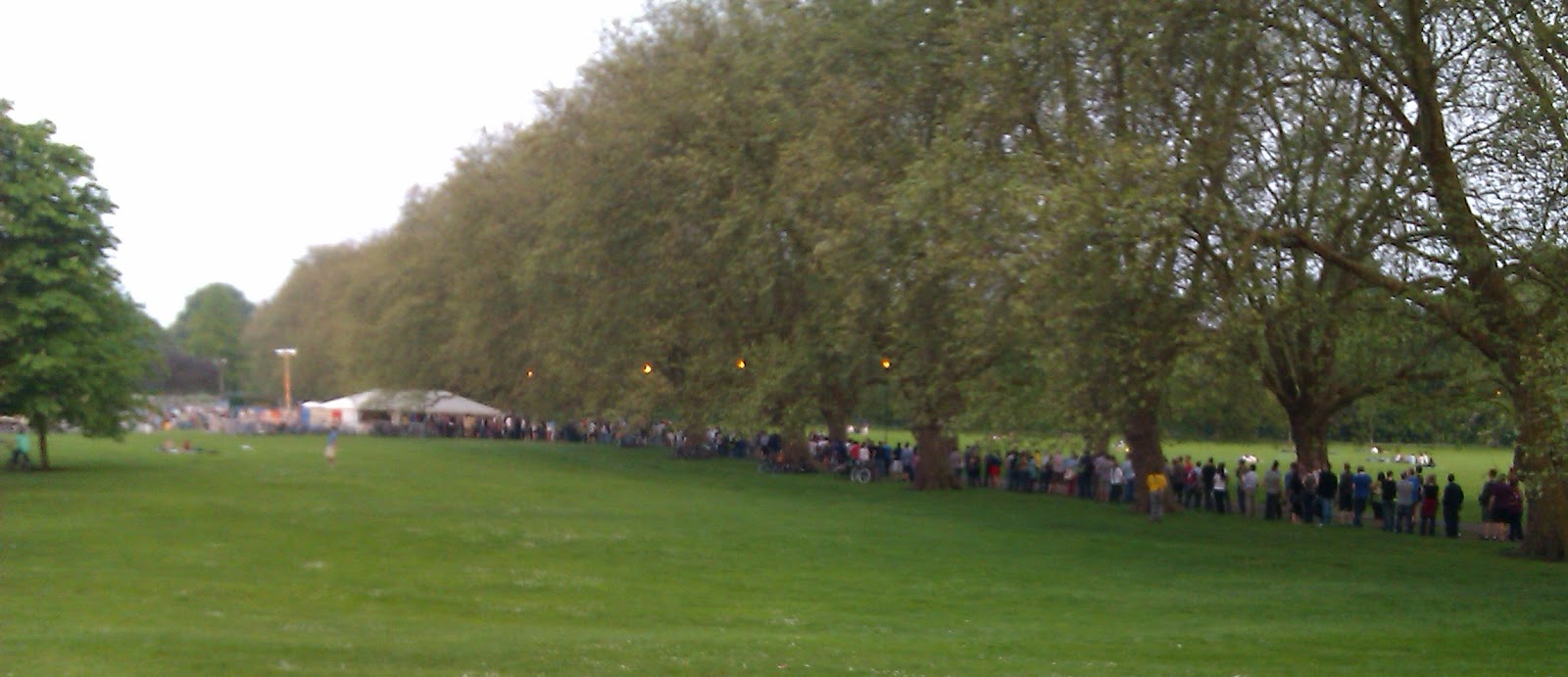
The queue when I arrived dissuaded me from that notion. I asked one of the stewards and they indicated it would take at least an hour from where the queue finished.

So I decided to wend my way home along the bank of the Cam. I proceeded slowly along and to my utter surprise bumped into Ben Hutchings and his Solarflare work colleagues having their own soiree. I was immediately invited to sit and converse. Pretty quickly I was inveigled into accepting a glass of wine by John Aspden from his floating bar (AKA houseboat).

From here on my evening was a pleasant one of amusing new people, easy conversation and a definite pondering if the host would be discovering the delights of Cam swimming as he became progressively inebriated!

So although I missed the festival I did manage to have an enjoyable time. A big thanks to the solarflare guys and especially John who was the consummate host and provided me with far too much alcohol.

24 May 2012

Vincent Sanders: Interrupt Service Routines

Something a little low level for this post. I have been asked recently how to "test" for the maximum duration of an Interrupt Service Routine (ISR) in Linux

To do this I probably ought to explain what the heck an ISR is!

A CPU executes one instruction after another and runs your programs. However early in the history of the electronic computer it soon became apparent that sometimes there were events happening, generally caused by a hardware peripheral, that required some other code to be executed without having to wait for the running program to check for the event.

This could have been solved by having a second processor to look after those exceptional events but that would have been expensive, difficult to synchronize and the designers took the view that there was a perfectly good processor already sat there just running some users program. This Interruption in the code flow became known as, well, an Interrupt (and the other approach as polling).

The hardware for supporting interrupts started out very simply, the processor would complete execution of the current instruction and when the Program Counter (PC) was about to be incremented if an Interrupt ReQest (IRQ) was pending the PC would be stored somewhere (often a "special" IRQ stack or register) and then execution started at some fixed address.

The interrupting event would be dealt with by some code and execution returned to the original program without it ever knowing the CPU just wandered off to do something else. The code that deals with the interrupt is known as the Interrupt Service Routine (ISR).

Now I have glossed over a lot of issues here (sufficient to say there are a huge number of details in which to hide the devil) but the model is good enough for my purpose. A modern CPU has a extraordinarily complex system of IRQ controllers to deal with numerous peripherals requesting the CPU stop what its doing and look after something else.

This system of controllers will ultimately cause program execution to be delivered to an ISR for that device. If we were living in the old single thread of execution world we could measure how long execution remains within an ISR, perhaps by using a physical I/O line as a semaphore and an external oscilloscope to monitor the line.

You may well ask "Why measure this?" well historically while the ISR was running nothing else could interrupt it executing which meant even if there was an event that was more important it would not get the CPU until the first ISR was complete. This was known as IRQ latency which was undesirable if you were doing something that required an IRQ to be serviced in a timely manner (like playing audio)

This is no longer how things are done while the top half runs with IRQ disabled many are threaded interrupt handlers and are preemptable (I.e. can be interrupted themselves) which leads to the first issue with measuring ISR time in that the ISR may be executed in multiple chunks if something more important interrupts. Indeed it may appear an ISR has taken many times longer one time than another because the CPU has been off servicing multiple other IRQ.

Then we have the issue that Linux kernel drivers often do as little as possible within their ISR, often only as much as is required to clear the physical interrupt line. Processing is then continued in a "bottom half" handler this leads to ISR which take practically no time to execute but processing is still being caused elsewhere in the system.

The next issue is the world is not uniprocessor any more, how many processors does a machine have these days? even a small ARM SoC can often have two or even four cores. This makes our timing harder because it is now possible to be servicing multiple interrupts from a single peripheral on separate cores at the same time!

In summary measuring ISR execution time is not terribly enlightening and almost certainly not what you are interested in. The actual question is much more likely that you really want to be examining something that the ISR time was an historical proxy for like IRQ latency or system overheads in locking.

21 May 2012

Johannes Schauer: sisyphus wins ICRA 2012 VMAC

Sisyphus is a piece of software that I wrote as a member of a team from Jacobs University led by Prof. Dr. Andreas N chter. It managed to place our team first in this year's IEEE ICRA 2012 Virtual Manufacturing Automation Competition in all three rounds. The goal was, to stack a given set of boxes of different length, height and width on a pallet in a way that achieved optimal volume utilization, center of mass and interlock of the boxes. Besides the cartesian placement of a box on the pallet, the only other degree of freedom was a 90 rotation of the box around a vertical axis. Since the arrangement of boxes into a three dimensional container is NP hard (three dimensional orthogonal knapsack), I decided for a heuristic for an approximate solution. The premise is, that there are many boxes of equal height which was the case in the test cases that were available from the 2011 VMAC. Given this premise, my heuristic was, to arrange the boxes into layers of equal height and then stack these layers on top of each other. A set of boxes that would be left over or too little from the start to form its own full layer, would then be stacked on the top of the completed layers. There is a video of how this looked like. My code is now online on github and it even documented for everybody who is not me (or a potential future me of course). This blog post is about the "interesting" parts of sisyphus. You can read about the overall workings of it in the project's README. Python dict to XML and XML to Python dict The evaluation program for the challenge is reading XML files and the pallet size and the list of articles with their sizes are also given in XML format. So I had to have a way to easily read article information from XML and to easily dump my data into XML format. Luckily, all the XML involved was not making use of XML attributes at all, so the only children a node had, where other nodes. Thus, the whole XML file could be represented as an XML dictionary with keys being tagnames and the values being other dictionaries or lists or strings or integers. The code doing that uses xml.etree.ElementTree and turns out to be very simple:
from xml.etree import ElementTree

def xmltodict(element):
def xmltodict_handler(parent_element):
result = dict()
for element in parent_element:
if len(element):
obj = xmltodict_handler(element)
else:
obj = element.text
if result.get(element.tag):
if hasattr(result[element.tag], "append"):
result[element.tag].append(obj)
else:
result[element.tag] = [result[element.tag], obj]
else:
result[element.tag] = obj
return result
return element.tag: xmltodict_handler(element)

def dicttoxml(element):
def dicttoxml_handler(result, key, value):
if isinstance(value, list):
for e in value:
dicttoxml_handler(result, key, e)
elif isinstance(value, basestring):
elem = ElementTree.Element(key)
elem.text = value
result.append(elem)
elif isinstance(value, int) or isinstance(value, float):
elem = ElementTree.Element(key)
elem.text = str(value)
result.append(elem)
elif value is None:
result.append(ElementTree.Element(key))
else:
res = ElementTree.Element(key)
for k, v in value.items():
dicttoxml_handler(res, k, v)
result.append(res)
result = ElementTree.Element(element.keys()[0])
for key, value in element[element.keys()[0]].items():
dicttoxml_handler(result, key, value)
return result

def xmlfiletodict(filename):
return xmltodict(ElementTree.parse(filename).getroot())

def dicttoxmlfile(element, filename):
ElementTree.ElementTree(dicttoxml(element)).write(filename)

def xmlstringtodict(xmlstring):
return xmltodict(ElementTree.fromstring(xmlstring))

def dicttoxmlstring(element):
return ElementTree.tostring(dicttoxml(element))
Lets try this out:
>>> from util import xmlstringtodict, dicttoxmlstring
>>> xmlstring = "<foo><bar>foobar</bar><baz><a>1</a><a>2</a></baz></foo>"
>>> xmldict = xmlstringtodict(xmlstring)
>>> print xmldict
 'foo':  'baz':  'a': ['1', '2'] , 'bar': 'foobar' 
>>> dicttoxmlstring(xmldict)
'<foo><baz><a>1</a><a>2</a></baz><bar>foobar</bar></foo>'
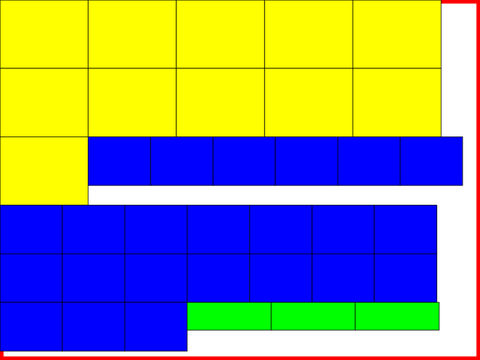
The dict container doesnt preserve order, but as XML doesnt require that, this is also not an issue. Arranging items in layers When it was decided, that I wanted to take the layered approach, it boiled down the 3D knapsack problem to a 2D knapsack problem. The problem statement now was: how to best fit small rectangles into a big rectangle? I decided for a simple and fast approach as it is explained in Jake Gordon's blog article. There is a demo of his code and should the site vanish from the net, the code is on github. This solution seemed to generate results that were "good enough" while simple to implement and fast to execute. If you look very hard, you can still see some design similarities between my arrange_spread.py and his packer.js code. Jake Gordon got his idea from Jim Scott who wrote an article of arranging randomly sized lightmaps into a bigger texture. There is also an ActiveState Code recipe from 2005 which looks very similar to the code by Jake Gordon. The posts of Jake Gordon and Jim Scott explain the solution well, so that I dont have to repeat it. Should the above resources go offline, I made backups of them here and here. There is also a backup of the ActiveState piece here. Spreading items out The algorithm above would cram all rectangles into a top-left position. As a result, there would mostly be space at the bottom and left edge of the available pallet surface. This is bad for two reasons:
  1. the mass is distributed unequally
  2. articles on the layer above at the bottom or left edge, are prone to overhang too much so that they tumble down
Instead all articles should be spread over the available pallet area, creating small gaps between them instead big spaces at the pallet borders. Since articles were of different size, it was not clear to me from the start what "equal distribution" would even mean because it was obvious that it was not as simple as making the space between all rectangles equal. The spacing had to be different between them to accommodate for differently sized boxes. The solution I came up with, made use of the tree structure, that was built by the algorithm that arranged the rectangles in the first place. The idea is, to spread articles vertically first, recursively starting with the deepest nodes and spreading them out in their parent rectangle. And then spreading them horizontally, spreading the upper nodes first, recursively resizing and spreading child nodes. The whole recursion idea created problems of its own. One of the nicest recursive beauty is the following function:
def get_max_horiz_nodes(node):
if node is None or not node['article']:
return [], []
elif node['down'] and node['down']['article']:
rightbranch, sr = get_max_horiz_nodes(node['right'])
rightbranch = [node] + rightbranch
downbranch, sd = get_max_horiz_nodes(node['down'])
ar = rightbranch[len(rightbranch)-1]['article']
ad = downbranch[len(downbranch)-1]['article']
if ar['x']+ar['width'] > ad['x']+ad['width']:
return rightbranch, sr+[downbranch[0]]
else:
return downbranch, sd+[rightbranch[0]]
else:
rightbranch, short = get_max_horiz_nodes(node['right'])
return [node] + rightbranch, short
get_max_horiz_nodes() traverses all branches of the tree that node has below itself and returns a tuple containing the list of nodes that form the branch that stretches out widest plus the list of nodes that are in the other branches (which are shorter than the widest). Another interesting problem was, how to decide on the gap between articles. This was interesting because the number resulting of the subtraction of the available length (or width) and the sum of the articles lengths (or widths), was mostly not divisible by the amount of gaps without leaving a rest. So there had to be an algorithm that gives me a list of integers, neither of them differing by more than one to any other, that when summed up, would give me the total amount of empty space. Or in other words: how to divide a number m into n integer pieces such that each of those integers doesnt differ more than 1 from any other. Surprisingly, generating this list doesnt contain any complex loop constructs:
>>> m = 108 # total amount
>>> n = 7 # number of pieces
>>> d,e = divmod(m, n)
>>> pieces = (e)*[(d+1)]+(n-e)*[d]
>>> print pieces
[16, 16, 16, 15, 15, 15, 15]
>>> sum(pieces) == m
True
>>> len(pieces) == n
True
You can test out the algorithms that arrange rectangles and spread them out by cloning the git and then running:
PYTHONPATH=. python legacy/arrange_spread.py
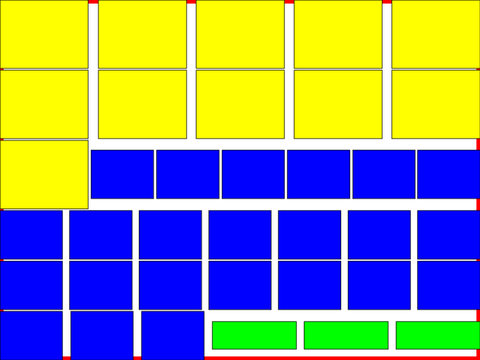
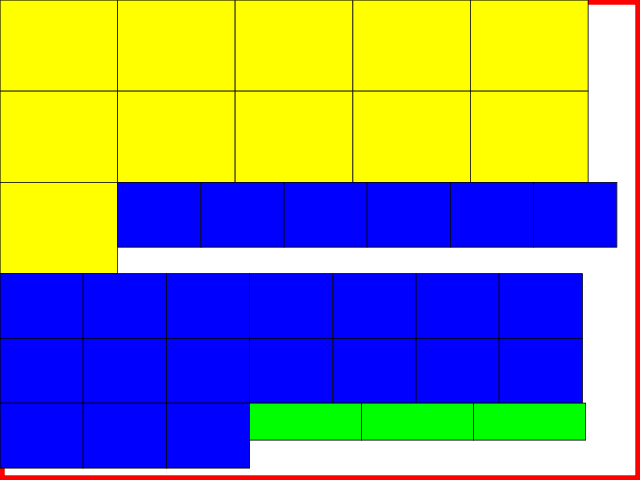
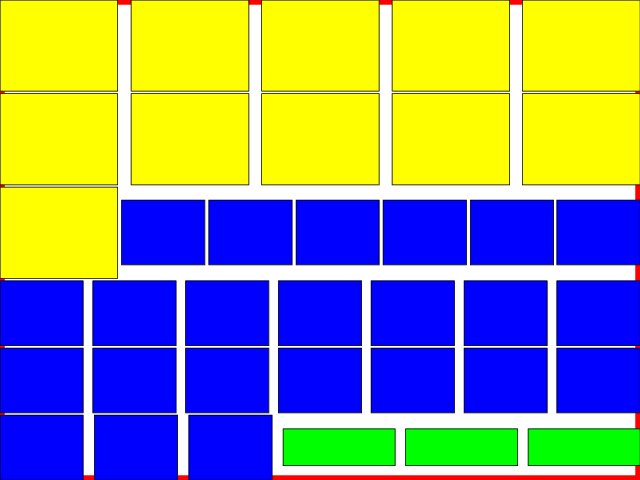
The results will be svg files test1.svg and test2.svg, the latter showing the spread-out result. Here is an example how the output looks like (without the red border which is drawn to mark the pallet border): arrange_spread2.py contains an adaption of arrange_spread.py for the actual problem. Permutations without known length When creating a layer out of articles of same height, then there are four strategies that I can choose from. It is four because there are two methods that I can either use or not. I can rotate the article by 90 per default or not and I can rotate the pallet or not. So every time that I build a new layer, there are those four options. Depending on which strategy I choose, there is a different amount of possible leftover articles that did not fit into any layer. The amount is different because each strategy is more or less efficient. To try out all combinations of possible layer arrangements, I have to walk through a tree where at each node I branch four times for each individual strategy. Individual neighboring nodes might be the same but this outcome is unlikely due to the path leading to those neighboring nodes being different. To simplify, lets name the four possible strategies for each layers 0, 1, 2 and 3. I now want an algorithm that enumerates through all possible permutations of those four numbers for "some" length. This is similar to counting. And the itertools module comes with the product() method that nearly does what I want. For example, should I know that my tree does not become deeper than 8 (read: no more than eight layers will be built), then I can just run:
>>> for i in itertools.product([0,1,2,3], repeat=8):
...     print i
...
(0,0,0,0,0,0,0,0)
(0,0,0,0,0,0,0,1)
(0,0,0,0,0,0,0,2)
(0,0,0,0,0,0,0,3)
(0,0,0,0,0,0,1,0)
(0,0,0,0,0,0,1,1)
(0,0,0,0,0,0,1,2)
(0,0,0,0,0,0,1,3)
This would work if the number of layers created with each strategy was the same. But as each strategy behaves differently depending on the input, it cannot be known before actually trying out a sequence of strategies, how many layers it will yield. The strategy (0,0,0,0,0,0,0,0) might create 7 layers, resulting in (0,0,0,0,0,0,0,1), (0,0,0,0,0,0,0,2) and (0,0,0,0,0,0,0,3) yielding the same output as only the first 7 strategies count. This would create duplicates which I should not waste cpu cycles on later. It might also be that (0,0,0,0,0,0,1,0) turns out to be a combination of strategies that creates more than 8 layers in which case the whole thing fails. So what I need is a generator, that gives me a new strategy depending on how often it is asked for one. It should dynamically extend the tree of possible permutations to accommodate for any size. Since the tree will become humongous (4^11 = 4194304), already traversed nodes should automatically be cleaned so that only the nodes that make the current list of strategies stays in memory at any point in time. This sounded all complicated which made me even more surprised by how simple the solution was in the end. Here a version of the algorithm that could easily be ported to C:
class Tree:
def __init__(self, branch_factor):
self.branch_factor = branch_factor
self.root = "value": None, "parent": None, "children": []
self.current = self.root

def next(self):
if not self.current["children"]:
self.current["children"] = [ "value":val, "parent":self.current, "children":[] for val in range(self.branch_factor)]
self.current = self.current["children"][0]
return self.current["value"]

def reset(self):
if self.current["parent"]:
self.current["parent"]["children"].pop(0)
else:
return False
if self.current["parent"]["children"]:
self.current = self.root
return True
else:
self.current = self.current["parent"]
return self.reset()

def __str__(self):
return str(self.root)
It would be used like this:
>>> tree = Tree(4)
>>> print tree.next(), tree.next(), tree.next()
>>> while tree.reset():
...     print tree.next(), tree.next(), tree.next()
Which would be equivalent to calling itertools.product([1,2,3,4], 3). The special part is, that in each iteration of the loop I can call tree.next() an arbitrary amount of times, just how much it is needed. Whenever I cannot generate an additional layer anymore, I can call tree.reset() to start a new permutation. For my code I used a python specific version which is a generator:
def product_varlength(branch_factor):
root = "value": None, "parent": None, "children": []
current = root
while True:
if not current["children"]:
current["children"] = [ "value":val, "parent":current, "children":[] for val in range(branch_factor)]
current = current["children"][0]
if (yield current["value"]):
while True:
if current["parent"]:
current["parent"]["children"].pop(0)
else:
return
if current["parent"]["children"]:
current = root
break
else:
current = current["parent"]
It is used like this:
it = product_varlength(4)
print it.next(), it.send(False), it.send(False)
while True:
    print it.send(True), it.send(False), it.send(False)
Again, the expression in the loop can have any number of it.send(False). The first it.send(True) tells the generator to do a reset.

8 May 2012

Vincent Sanders: NetSurf at a show

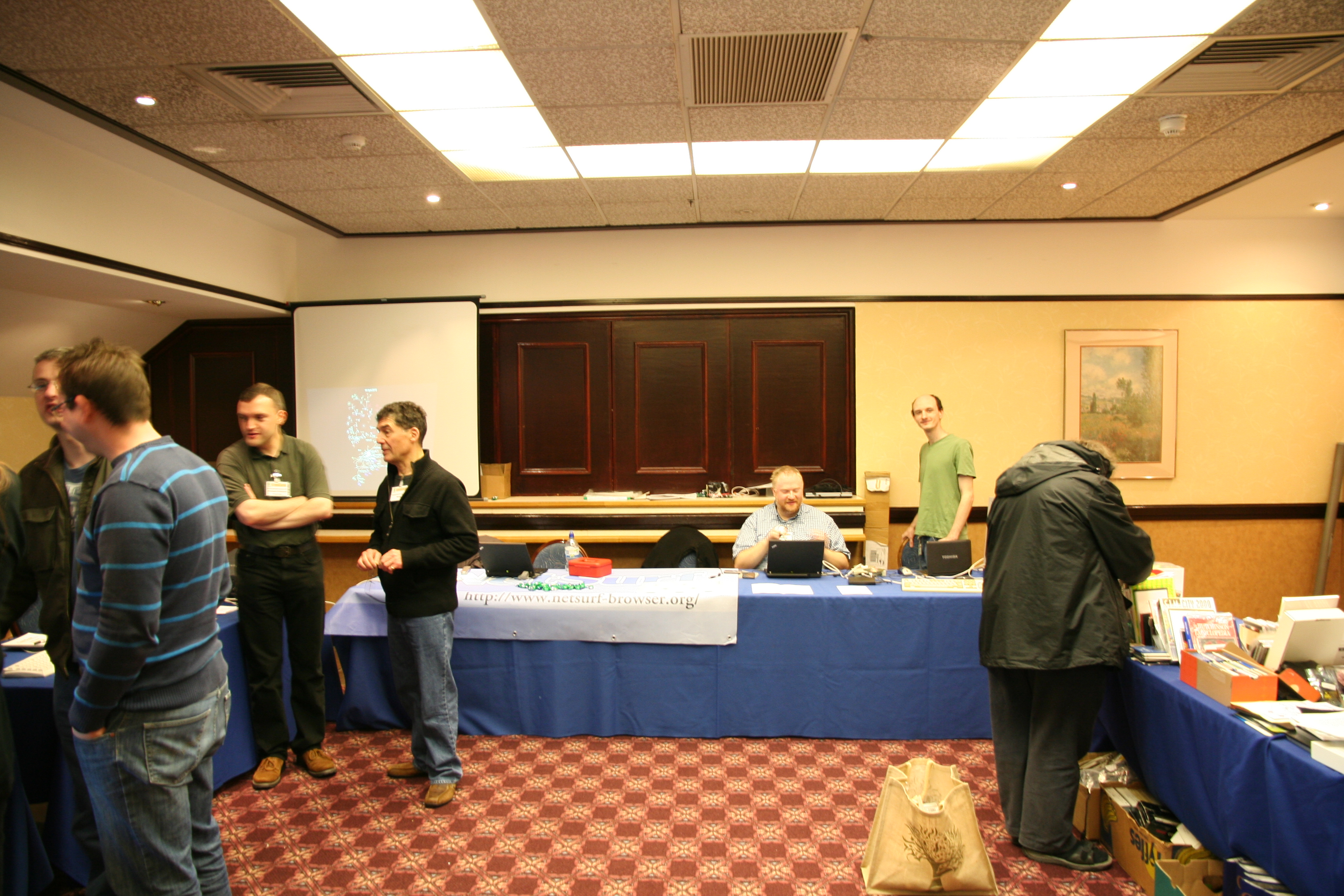
The wakefield RISC OS show is an event the NetSurf project has attended for a long time. in fact since 2005 when the "stand" was a name on an A4 sheet through 2006, 2007, 2008, 2009, 2010 to 2011 we have always been present.

The event has changed in that time from a large affair with many exhibitors to a small specialist interest event with a handful of stands. I took some pictures this year which give a fair impression of the event.

We were seriously considering not attending this year as 2011 had seen us barely break even on donations versus expenses to attend. However we decided that the projects annual Grey Ox Inn post event dinner was probably worth making the effort.

So we all met up in a hotel just off the M1 near Wakefield and set up our table. And although NetSurf as a project now has much more usage on other platforms we still represent the principle browser for the RISC OS platform!

We had a pleasant time, talked to a lot of users and made our expenses back in donations. Overall an amusing Saturday. Based on the size of the event and number and age of the attendees, I fear the RISC OS may be destined for the history books.

Vincent Sanders: Repaying a debt

Some debts are merely financial and some easily repaid but some require repayment in kind . Few debts are more important to me personally than a favour earned by a good friend.

Several years ago, before I started this blog, I replaced the kitchen in my house. Finances were tight at the time and I had to do the entire refit with only limited professional help. Because of this I imposed upon Mark Hymers and Steve Gran to come and assist me. They worked tirelessly for three days over a bank holiday for no immediate reward.

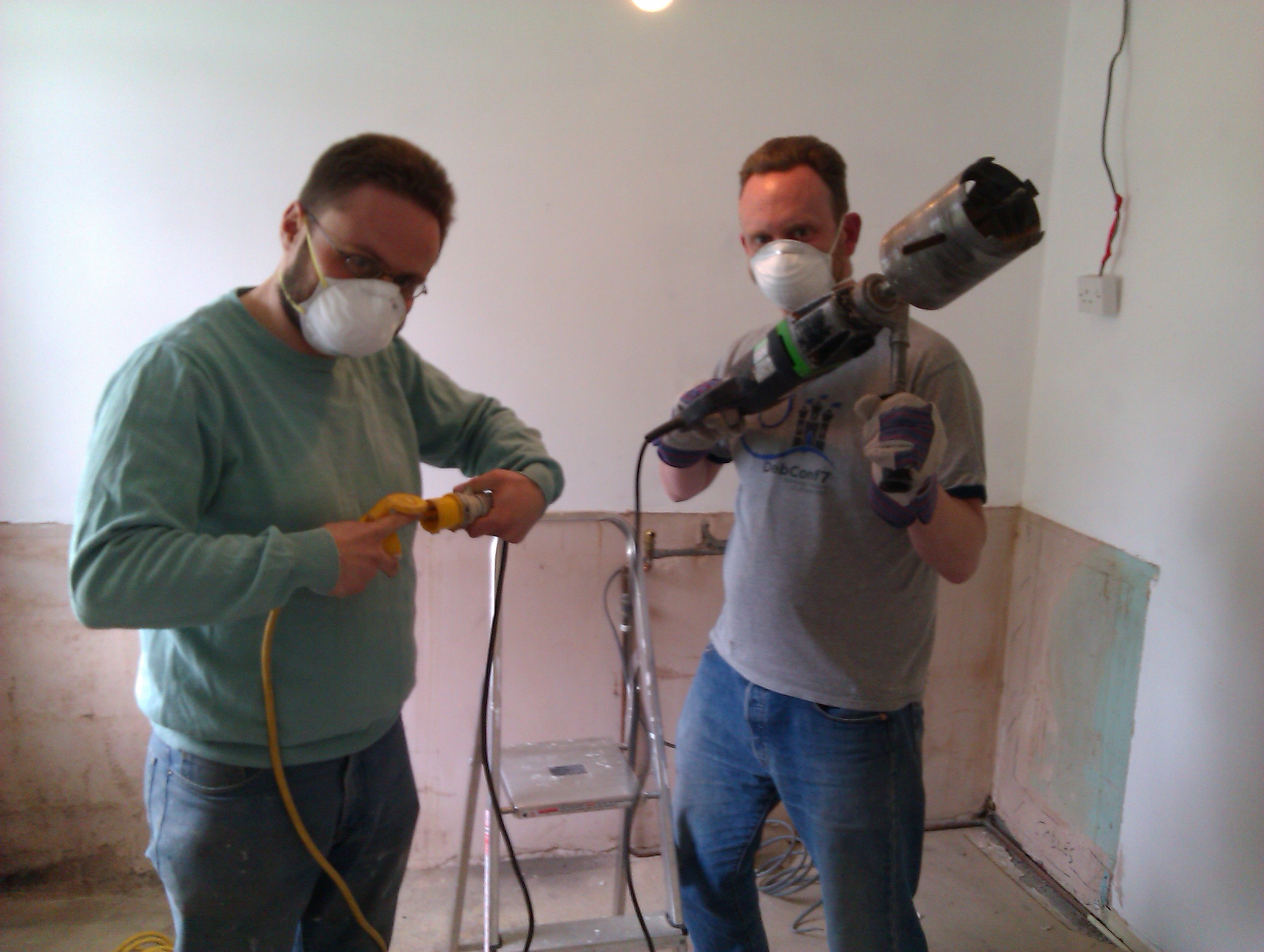
Mark and Steve with a drill
This weekend I had the opportunity to assist Mark with his own kitchen refit and reply my debt.

Although the challenges have been different on this build they were, nonetheless present, including walls which were most definitely not square and affixing cabinets 10mm too high so the doors could not close.

We also got to make a hole for a 125mm extractor which was physically demanding and not a little tiring (Steve actually wielding the drill had a fabulous aim)

I took some photos to document the process which has resulted in an image which is positively threatening, though the two of them are nice people really!

All in all a pleasant weekend with friends, the whole favour thing was really moot, I would have done it for a friend anyway.

6 May 2012

Russell Coker: A Quick Review of the Mac Mini with OS/X Lion compared to Linux

A client just lent me a new Mac Mini with OS/X Lion to play with. I think it s interesting to compare it with regular PCs running Linux. Hardware The Mac Mini is tiny. It s volume can be compared to that of a laptop. The entire outside apart from the base is made from aluminium which helps dissipate heat, it s not as effective as copper but a lot better than plastic. The ports on the system are sound input/output, 4*USB, Ethernet, Firewire, Thunderbolt (replacement for Firewire), SDXC, and HDMI. It ships with a HDMI to DVI-D adapter which is convenient if you have an older monitor (or if you have a recent monitor but no HDMI cable as I do). To open the case you unscrew the bottom, this is much like opening a watch. Also like opening a watch it s not particularly easy to screw it back on tightly, I will probably return the Mac Mini without managing to completely screw the base in. The hardware is very stylish and intricately designed, what we expect from Apple. It s also quiet. In every way it s a much better system than the workstation I m using to write this blog post. The difference of course is that this workstation was free and the Mac Mini cost just over $1000 including the RAM upgrade. A Mac Mini could be a decent Linux workstation and if I see one about to be recycled I ll be sure to grab it! Installation The Mac OS comes pre-installed so I didn t get to do a full installation. When I first booted it up it asked me if I wanted to migrate the configuration from an existing server, I don t know how well this works as I don t have a second Mac system but the concept is a good one. Maybe having full support for such a migration process would be a good release goal for a Linux distribution. After determining that the installation is a fresh one I was asked for a mac.com email address or other form of registration. I skipped this step as I don t have such an email address, but it could be useful. Red Hat has Kickstart to allow configuration of an OS install based on a file from a server (via NFS or HTTP). Debian supports preseeding to take OS configuration options from a file at install time [1] and the same option can be used for later stages of OS autoconfiguration. One thing that would be really useful is to allow the user to enter a URL for configuration data for an individual account or for all accounts, so someone with an account on one workstation could upload the configuration (which would be either encrypted or sanitised to not have secret data) and then download it when first logging in to a new system. I can easily take a tar archive of my home directory to a new system, but people like my parents don t have the skill to do that. One of the final stages of system configuration was to identify the keyboard. The system asked me to press the key to the right of the left shift key and then the key to the left of the right shift key and then offered me three choices of keyboard. That was an interesting way of reducing the list of possible keyboards offered to the user and thus preventing the user from selecting one that is grossly incorrect. Cloud Storage When first logging in I was asked for an iCloud [2] login. iCloud doesn t seem like a service that should be trusted, it s based in the US and has been designed to facilitate access by government agencies. Ubuntu One [3] is a similar service that is run by a more reputable organisation, but the data is still stored by Amazon (a US corporation) which seems like a security risk. Ubuntu One isn t in Debian (which is strange as Ubuntu is based on Debian) so it was too much effort for me to determine whether it encrypts data in a way that protects the users against US surveillance. The cost of Ubuntu One storage is $4 per month with music streaming. A better option is to use a self-hosted OwnCloud installation for a private or semi-private cloud [4]. A cheap server from someone like Hetzner (E49 per month for 3TB of RAID-1 storage) [5] is a good option for OwnCloud hosting. A cheap Hetzner server is about $US64 per month (at current conversion rates) which is equivalent to about 16 users of Ubuntu One for music streaming. So if 20 people shared a Hetzner server they could save money when compared to Ubuntu One while also getting a lot more storage. I ve got about 300G of unused disk space on the Hetzner server that hosts my blog and when the system is migrated to a newer Hetzner server with 3TB disks it will have 2.5TB of unused space, I could store a lot of cloud data in that! The main features of iCloud and Ubuntu One seem to be distribution of random data files (anything you wish), streaming music to various playing systems, and copying pictures from phones as soon as they are taken. These are all great features but it s a pity that they don t appear to support distributed document storage. Apple Pages apparently allows documents to be immediately saved to the cloud. I d like to be able to save a file with Libre Office at home and then access it from my netbook using the cloud, of course that would require encryption for secret files but that s not so hard to do. One advantage with such distributed storage is that when combined with offline-IMAP for email it would almost entirely remove the need for backups of the desktop systems I maintain for my relatives. I could have all their pictures and documents go to the cloud and all their email stay on the server so if their desktop PC dies I could just give them a new PC and get it all back from the cloud! OwnCloud supports replication, so if I got two servers I would be covered against a server failure. But I think that for a small server with less than a dozen users it s probably better to just take some down-time when things go wrong and do regular backups to an array of cheap SATA disks. App Store Apple has an App Store in the OS. The use of such a store on a desktop OS is a new thing for me. It s basically the same as the Android Market (Google Play) but on the desktop. I think that there is a real scope for an organisation such as Canonical to provide such a market service for Linux. I think that there is a lot of potential for apps to be sold for less than $10 to a reasonable number of Linux users. A small payment would be inconvenient for the seller if they have to interact with the customer in any way and also inconvenient for the buyer if they are entering all their credit card details into a web site for the sale. But for repeat sales with one company being an intermediary it would be convenient for everyone. A market program for a desktop Linux system could provide a friendly interface to selecting free apps from repositories (for Debian, Ubuntu, Fedora, or other distributions) and also have the same interface used for selecting paid applications. Conclusion This isn t much of a review of Apple OS/X or the Mac Mini. Thinking about ways of implementing the best features of Lion on Linux is a lot more interesting. I admire Apple in the same way that I admire sharks, they are really good at what they do but they don t care about my best interests any more than a hungry shark cares about me. Update I got the currency conversion wrong in the first version of this article. It seems that to save money via a shared Hetzner server instead of Ubuntu One about 20 users would be needed instead of 10. But that s still not too many and would still give a lot more storage. It would be a little more difficult to arrange though, probably anyone who is seriously into computers knows 10 people who would want to share such a service (including people like their parents who want things to just work and don t understand what s happening). But getting 20 people would be more difficult. Related posts:
  1. Xen and SE Linux EWeek review of RHEL5 The online magazine EWeek has done a review of RHEL5....
  2. Servers vs Phones Hetzner have recently updated their offerings to include servers with...
  3. Modern Laptops Suck One of the reasons why I m moving from a laptop...

5 May 2012

Ritesh Raj Sarraf: Cancer cure drugs now more affordable

Now these are the kind of moves that needs to happen more often. Whether this will cause a negative impact on the overall market, and the further invention of drugs (including patent control), but the affordability of the medicatoin to an average citizen is a great move.The typical Chemotherapy can be on an average of 22 times. When summed up with the dosage (somewhere around 250 mg IIRC), the cost comes to approx: (22/4) * 15000 = 82k, which now, will be affordable at 27k.I guess the price slash is only for India and am not sure what the impact to the global market will look like.Quoting the article: http://www.moneycontrol.com/news/business/cipla-drug-price-cut-not-to-hurt-revenue-much-say-analysts_700380.html

Cipla cut price of its kidney cancer drug Sorafenib, which is sold under brand name Nexavar by multi-national Bayer to Rs 6,840 for a month's supply, from around Rs 28,000 earlier. Its lung cancer drug Gestinib, which is sold under brand name Iressa by AstraZeneca will cost Rs 4,250, versus Rs 10,200 earlier, and price of Temozolamide used to treat brain tumour, has been reduced by Rs 15,000 to Rs 5,000.

India's Patent Office recently issued a compulsory licence allowing Natco to make a generic copy of Sorafenib, on the payment of a royalty to Bayer, which sells the drug at around Rs 2 lakh.

Domestic sales account for 46-47% of Cipla's total sales and of that the cancer drugs portfolio is a very small portion, so these price cuts are unlikely to have any major impact on its revenue, Hitesh Mahida of Fortune Equity Brokers told moneycontrol.com

"Cipla's idea seems to be to create disruption in the market, increase its market share..." the analyst says.

Swiss pharma major Roche had earlier this year signed a manufacturing deal with India's Emcure Pharma so that its anti-cancer drugs Herceptin and MabThera could be made in India at affordable prices. Analysts say Cipla's move to slash prices could in future deter some MNCs from launching their drugs in India at all, but some may also look at doing deals like the one struck by Roche.

Meanwhile, shares of pharma major Cipla surged over 3% on Friday after brokerage CLSA upgraded the stock to "outperform" from "underperform," saying, Cipla would be strongest beneficiaries of a weakening rupee.

The rupee has been sliding sharply against the US dollar in recent days and hit over four month low of around Rs 53.78 earlier in trade.

"We expect improving margins over the coming quarters on back of a weak rupee and a low base. We expect strong operating profit growth over coming quarters led by margin expansion and high margin product supplies," CLSA's Hemant Bakhru said.

The US Food and Drugs Administration has approved Meda's drug Dymista for allergic rhinitis and the product is widely expected to reach USD 300-500 million in annual sales over the coming years. The analyst says Cipla being a partner, will benefit through product supplies over a longer term.

"Apart from approval (outside North America) related milestone payment (US$5m), we expect gradual increase in Cipla s sales from product related supplies to Meda. Assuming Cipla supplies product at 10-15% of sales, it could earn US$50-75m at peak sales," Bakhru said.

Additionally, a low base in domestic formulations could result in reasonable India growth, he adds.

Cipla shares were up 2.8% at Rs 326.60 on NSE in noon trade.

Keywords:

21 April 2012

Andreas Metzler: balance sheet snowboarding season 2011/12

Finally a year with real snow again. Winter started rather late this year, I was still hiking at above 2000m end of November with zero snow there. First day of snowboarding was December 21st. Starting from there we never had too little snow. At home we topped out at 175cm, and had more than 125cm for a long time. Start of February was very cold, I had to skip a good day of good weather as I got a tiny bit of frostburn on my nose. (1200m of descent was a little to much at below -20 C.) A very warm end of March/start of April neverless quickly killed the snow here down at the bottom of the valley. There is still lots of snow in the mountains, although the ski-lifts have closed April 15th. Judging from the number of snowboarding days the season was a bad one. It started late and ended early (31st of March). In spring I simply need good weather to have fun. - Cloudy nights are too warm, the slope does not freeze properly, which is perfect only for breaking one's leg. Nevertheless if I could choose between a repetition of 2010/11 or 2011/2012, I would always go for the latter. :-) On a sidenote, my local hill has switched from www.hoehenmeter.com to www.skiline.cc to provide statistical information. Here is the balance sheet:
2005/06 2006/07 2007/08 2008/09 2009/10 2010/11 2011/12
number of (partial) days25172937303025
Dam ls1010510162310
Diedamskopf154242313414
Warth/Schr cken0304131
total meters of altitude12463474096219936226774202089203918228588
highscore10247m8321m12108m11272m11888m10976m13076m
# of runs309189503551462449516

15 April 2012

Richard Hartmann: Choo choo two

Now that our departure is looming ahead of us, it's time to give a short update. (Turns out it's not so short, after all...) Preparation Visa Mongolian and Russian visas are done; we will apply for the Chinese ones next Monday. Travel All train tickets, hotels, hostels, and tents have been booked and both a horse-back tour through Mongolia and scuba diving in Lake Baikal have been pre-arranged. The Russian railway seems to do maintenance and development on the live website all the time which meant we were forced to book through a local travel agent. We paid a hefty extra charge for that privilege but still, that was less than half of what we would have paid if we had booked through a German agent. With the help of #china-lug on irc.freenode.net, we found accommodation in a traditional Siheyuan in an old Hutong. Hopefully, this will be a interesting as it sounds. Locals By the power of attending conferences and this blog, I now have local contacts in Moscow, Beijing, and Shanghai. Everyone who contacted me was extremely nice and helpful. I have been getting hints and tips galore; I doubt our preparations would be as neat as they are without this invaluable help. Thanks; you know who you are :) Packing list Apparently there's an interest in what we will be bringing; also, this will be a nice reminder for the future. Information and note-keeping Luggage Clothing Personal and computer security Fastening, storage, and tools Health Photography Minimal scuba gear Food Convenience Leisure That's it. Re-reading this list, I wonder how we managed to fit all of this into an 80-liter travel bag and a 15-liter backpack, but we did and with room to spare.

Petter Reinholdtsen: Debian Edu interview: Andreas Mundt

Behind Debian Edu and Skolelinux there are a lot of people doing the hard work of setting together all the pieces. This time I present to you Andreas Mundt, who have been part of the technical development team several years. He was also a key contributor in getting GOsa and Kerberos set up in the recently released Debian Edu Squeeze version. Who are you, and how do you spend your days? My name is Andreas Mundt, I grew up in south Germany. After studying Physics I spent several years at university doing research in Quantum Optics. After that I worked some years in an optics company. Finally I decided to turn over a new leaf in my life and started teaching 10 to 19 years old kids at school. I teach math, physics, information technology and science/technology. How did you get in contact with the Skolelinux/Debian Edu project? Already before I switched to teaching, I followed the Debian Edu project because of my interest in education and Debian. Within the qualification/training period for the teaching, I started contributing. What do you see as the advantages of Skolelinux/Debian Edu? The advantages of Debian Edu are the well known name, the out-of-the-box philosophy and of course the great free software of the Debian Project! What do you see as the disadvantages of Skolelinux/Debian Edu? As every coin has two sides, the out-of-the-box philosophy has its downside, too. In my opinion, it is hard to modify and tweak the setup, if you need or want that. Further more, it is not easily possible to upgrade the system to a new release. It takes much too long after a Debian release to prepare the -Edu release, perhaps because the number of developers working on the core of the code is rather small and often busy elsewhere. The Debian LAN project might fill the use case of a more flexible system. Which free software do you use daily? I am only using non-free software if I am forced to and run Debian on all my machines. For documents I prefer LaTeX and PGF/TikZ, then mutt and iceweasel for email respectively web browsing. At school I have Arduino and Fritzing in use for a micro controller project. Which strategy do you believe is the right one to use to get schools to use free software? One of the major problems is the vendor lock-in from top to bottom: Especially in combination with ignorant government employees and politicians, this works out great for the "market-leader". The school administration here in Baden-Wuerttemberg is occupied by that vendor. Documents have to be prepared in non-free, proprietary formats. Even free browsers do not work for the school administration. Publishers of school books provide software only for proprietary platforms. To change this, political work is very important. Parts of the political spectrum have become aware of the problem in the last years. However it takes quite some time and courageous politicians to 'free' the system. There is currently some discussion about "Open Data" and "Free/Open Standards". I am not sure if all the involved parties have a clue about the potential of these ideas, and probably only a fraction takes them seriously. However it might slowly make free software and the philosophy behind it more known and popular.

14 April 2012

Wouter Verhelst: LOAD: tutorial on Debian Packaging

Two weeks ago, I was at LOAD, where I did a tutorial on Debian Packaging. Unfortunately, I wasn't doing very well physically, and as a result my preparation wasn't what I had hoped for. It ended up being not so much a tutorial as a walking the audience through packaging a piece of software in casu NBD with debhelper in dh mode. Not very difficult, but since there's nothing for people to fall back on afterwards, it may help if they have a writedown of what I said during the session; and I promised to put it on my blog. So, here goes. However, note that the canonical written tutorial on Debian Packaging is here. With apologies to readers of Planet Debian, most of whom for which all this is probably old hat. Unlike RPM packaging, in Debian, the data that tells the debian packaging system how to package a piece of software is functionally split among a number of files. All these files go in a toplevel directory in the source package, (unsurprisingly) called 'debian'. There are four files that are required for every Debian package: the control, changelog, copyright, and rules files. Without these files, dpkg-dev will fail to produce a package any package. The first, the control file, contains metadata on packages: the name of the package, its description, the dependencies, etc. Basically, almost all the information you see when you run 'apt-cache show <package>' (with one exception) is in the control file. If you have a source package that builds multiple binary packages, then you should have multiple 'Package' stanzas in the control file. In my opinion, creating a control file is easiest done by copying a control file from another (similar?) package, and modifying it to suit the software you're dealing with. The one exception, the one bit of metadata that is not found in the control file is the version number: this data is contained in the changelog file. This file looks like a free-form file for the most part, but it really is a machine-parsable format; as such, it's best to edit it with specialized tools, such as the debian-changelog-mode in the emacs editor, or the debchange script, also available as dch, from the devscripts package. In the changelog, you should document any changes you make to the package, making sure the version number (top line), distribution (unstable, experimental, stable, ...; top line), urgency (top line; used mainly when testing needs to be updated urgently for things like security updates), author (bottom line) and date and time (also bottom line) are correct. The copyright file, unsurprisingly, should contain the copyrights statements of the original software, and the license (or a reference to a copy of the same license text under /usr/share/common-licenses). This file is still free-format in most packages today, although a machine-readable format for this file has recently been defined. Of the four required files, this is probably the most boring one, but hey, we can't like everything we do. The last file, the rules file, is where all the action happens. This file is defined as a Makefile, of which the targets are called for various parts of the build system. The rules file has a number of required targets (such as build, clean, and others), but if you're using debhelper in dh mode, you don't need to worry about those; instead, you can use the following simple rules file:
#!/usr/bin/make -f
%:
	dh $@
With the first line, the shebang, we make clear that this is a makefile, and that it should be called by make. The next is a generic target (the % is a wildcard for make), with just one command: 'call dh with the name of the target being called'. Since dh implements all required rules targets, that immediately gets you a working package. Go ahead, try! Run 'dpkg-buildpackage -rfakeroot', and see what happens. Did that work? Maybe, maybe not. First, you'll have seen loads of warnings about something involving a "compatibility level". This is from debhelper; this compatibility level, or 'API level' if you wish, allows debhelper to move forward and make incompatible changes without breaking all the existing packages out there; whenever the compat level is bumped, some new functionality will only be made available if you also raise the compat level in your source package (and then you'll know you may have some changes to do in your package). Since the original debhelper, over a decade ago, did not have a compat level, the absense of a compat level signals compat level 1, which is far outdated now, and about to be unsupported. Hence the warning. The fix is simple: create a file debian/compat containing a single number: the compatibility level you're working with. It's best to use the most recent level which debhelper supports when you create your package, which as of this writing is level 9. Ignoring the compatibility level, if you're building a software package which uses a well-established build system, and you only build one binary package out of that, chances are pretty high that everything worked as expected. If not, you'll have more work. Building multiple packages requires that you tell debhelper somehow which file goes in which package. You can do this with a file debian/package.install, where package is the name of the binary package you're building. The install file is read by dh_install, one of many tools in the debhelper suite. You see, in the old days (before debhelper 7), debhelper was just a suite of tools, which required that you wrote a debian/rules file containing all the individual tools to be called in the correct order. This mode is still supported; in fact, even if you do use dh, you do, since all that tool really does is call the right tools in the right order; the real work is done by the invidual tools. They all have their own man page; to understand how dh_install chooses which file to put in which package, go read man dh_install. Go ahead, do it now; I'll wait. Back? Good. You've now learned that dh_install can install files either from the source directory (useful for packages containing only scripts or so), or from a directory debian/tmp. If you use an autotools-based software package, this is what dh will do for you. When you called dpkg-builpackage above, you may also have noticed that the output contained many lines starting with dh_, one of which said dh_install. As you may have guessed, dh echoes every debhelper command just before it will execute them. This allows you to look at the output, and see what's happening. For more detail, set the environment variable DH_VERBOSE to a non-zero value. I'm sure you'll have seen one or two debhelper tools that could make your package better. Go ahead, go and read their man pages to see what they do, and how they do it. Most of these will require you to create a file debian/package.toolname to specify details. In some cases, you may need to specify command-line arguments to the tool to get it to do what you want. In yet other cases, the tool won't support what you need it to do, and you'll have to do something manual. What to do now? The dh command line doesn't support adding extra commands easily. Does this mean you'd have to revert to old-style long, non-dh debian/rules files? Luckily, no. You can create an override target. If dh detects that you have such a target for a particular tool, it will call that target instead of the tool. This target's rules can then call the tool in question (or not), and add any command line arguments, or extra commands, as needed. An override target is a normal Makefile target with a name of the form override_dh_something, where dh_something is the name of the tool you wish to override. At this point, I'd reached almost the end of my two allotted hours, and a member of the audience asked how to make dpkg deal with configuration files. The answer is, you don't need to do anything! Not if you use debhelper, anyway; all you need to do is install the file in /etc. Since debian policy specifies that all files in /etc need to be configuration files and that no conffiles may be placed anywhere but in /etc, debhelper will automatically mark any file installed in /etc as a conffile, which will cause dpkg to ask the user what to do with changes to such files. Note that in Debian parlance, a conffile is not the same thing as a configuration file: a conffile is a configuration file that is part of the binary package (i.e., if you call 'dpkg --contents' on the .deb file, you'll see it in the output), whereas a configuration file is a file (any file, including files generated during or after installation of the .deb file on a system). Occasionally, this is also why some differences to configuration files are managed through debconf, while others aren't: the ones managed through debconf are non-conffile configuration files managed through ucf, whereas the others are conffiles. So in the simplest of cases, if you want to install a configuration file and you want to make sure it's protected against accidental overwrites by package upgrades, all you need to do is make sure it's installed to /etc; debhelper will do the rest. And that concludes this introduction. Please note it's only an introduction, not a full-blown tutorial; while this will allow you to get started, you may have to learn a bit more if you wish to eventually upload a package to Debian.

8 April 2012

John Goerzen: 26 Hours At The Creek

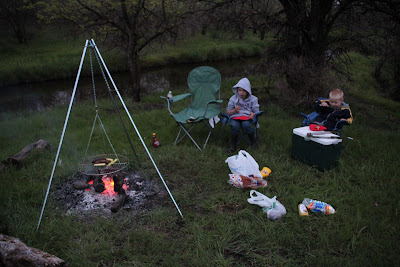
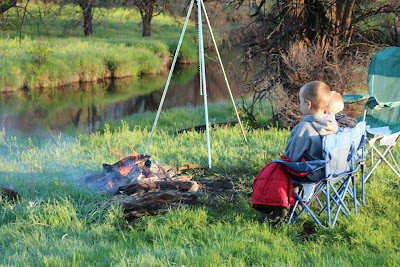
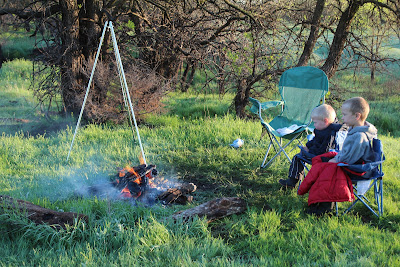
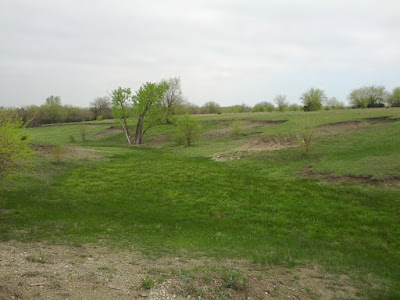
I m back from one of the best experiences a father can have a whole day with two happy boys. I took Jacob (5) and Oliver (2) camping with me out by our creek. This was the first time we d camped there, and also the first time I d taken the boys camping without Terah along. So there were some unknowns, but it worked out great. When we got out there, I started to get the tents set up. The boys were interested, but pretty soon invented some games. A large nearby tree with plenty of low branches on its trunk became their locomotive, and certain sticks made the train go forward or backward, whistle, or ding its bell. This was good for quite some entertainment. Another nearby tree, near the bank of the creek, had some erosion near it. Combined with its roots, this made some natural steps. Jacob named some the enter steps and others the exit steps , and I sure heard about it if I walked the wrong way on the exit steps. We then gathered up sticks and the things we needed to build a campfire. We cooked up brats and zucchini. Although it was later than usual for supper, they loved it just the same. After that, we made smores for dessert another thing they loved. Then, one of the big highlights: sleeping in tents and sleeping bags. I had showed them the sleeping bags earlier, and they were excited to try them out. Morning was beautiful when the sun came out, it was shining right on the heavy dew on the ground, making the grass shine brightly. It s not every day that they get to start their morning slowly waking up by a warm fire. They were content to sit for quite awhile while I got things going for breakfast. It was chilly outside, so I helped them change clothes by the fire where. I then cooked them some scrambled eggs which, despite the lack of salt and pepper, seemed so much better than normal to the boys and then we went exploring. I took them to some areas with erosion, which Jacob called the big holes in the ground. It s really quite beautiful in spring, which this cellphone photo completely fails to capture. The boys loved climbing up and down these areas, some of which were quite tall. They discovered different kinds of rock on the way up and down, and with my help avoided discovering too much of the mud at the bottom. We hiked back to our camping spot through grass almost as tall as Oliver much to his delight and then after warming up by the fire for a bit, went off in the other direction. There is a grove of trees by the creek over there, which surprise became another train. Here are the boys explaining how it works. <iframe allowfullscreen="allowfullscreen" frameborder="0" height="315" src="https://www.youtube.com/embed/43EcEK8F_ic?rel=0" width="560"></iframe> They helped pack things back up, too. Actually, it took some convincing to get Jacob to not pull up all the stakes for the tent before I was ready for them. Things didn t go perfectly, but then, they never do, and that was OK with everyone. Camping is an adventure, and it wouldn t be an adventure if you knew every detail beforehand. It is rare in life to be able to think that I have enough time to do anything the boys might want to do. Spend half an hour pretending a tree is a train sure, no problem. Today Oliver asked to go camping again, and was a bit disappointed when I didn t agree to go camping again right this minute, today. Jacob said, we had an EXCELLENT time and gave me hugs thinking about it. I have a lot of happy memories about the creek. We camped at the same spot where I went fishing or camped as a child. There have been family gatherings and even a birthday party out there. The boys and I have enjoyed a hike or a wagon ride to the area, but as I learned, nothing could possibly match the excitement of camping there. It is wonderful to add another happy memory of a time at the creek. And it s even better to see another generation of Goerzens discover that there s a lot of fun to be had down by the creek.

7 April 2012

Ritesh Raj Sarraf: Apport for Debian

apport just cleared the new queue and is now available in experimental. For those who do not know what apport is:

Debugging program crashes without any automated tools has been pretty time consuming and hard for both developers and users. Many program crashes remain unreported or unfixed because:

  • Many crashes are not easily reproducible.
  • End users do not know how to prepare a report that is really useful for developers, like building a package with debug symbols, operating gdb, etc.

  • A considerable part of bug triage is spent with collecting relevant information about the crash itself, package versions, hardware architecture, operating system version, etc.
  • There is no easy frontend which allow users to submit detailed problem reports.
  • Existing solutions like bug-buddy or krash are specific to a particular desktop environment, are nontrivial to adapt to the needs of a distribution developer, do not work for crashes of background servers (like a database or an email server), and do not integrate well with existing debug packages that a distribution might provide.

Apport is a system which

  • intercepts crashes right when they happen the first time,
  • gathers potentially useful information about the crash and the OS environment,
  • can be automatically invoked for unhandled exceptions in other programming languages (e. g. in Ubuntu this is done for Python),
  • can be automatically invoked for other problems that can be automatically detected (e. g. Ubuntu automatically detects and reports package installation/upgrade failures from update-manager),
  • presents a UI that informs the user about the crash and instructs them on how to proceed,
  • and is able to file non-crash bug reports about software, so that developers still get information about package versions, OS version etc.
At this moment, it is quite broken. The crashes are not intercepted by update-notifier on my box. With it now in experimental, my intent is to slowly integrate it well with all dependent tools for Debian. It won't be ready for the Wheezy release, but hopefully for the one after that.On the Ubuntu side, Canonical hosts a retracing service that takes user reported core dumps and generates a usable backtrace. For Debian, my plan is to have a chroot kind interface, where in the user could opt-in to download all debug packages to generate a valid backtrace. This could go as the debian backend for apport in the future. On the bug reporting side, afaik, we do not have a web interface to lodge bugs. To report bugs (minus the core dumps), we will want a backend to submit it over email. The current apport report gathering tool is pretty good (if compared to other tools like reportbug), so here the low hanging fruit would be to just take the report and feed in email to our BTS server. For the eyes:Apport on Debian

22 March 2012

Russell Coker: Links March 2012

Washington s Blog has an informative summary of recent articles about corporate psychopaths [1]. Including the fact that some banks deliberately hire psychopaths. Anu Partanen wrote an insightful article for The Atlantic about the difference between Finnish and American education systems [2]. It seems that Finland has achieved great educational success by aiming for equality with no private schools and giving the teachers and principals enough responsibility to do the job properly. Ramona Pierson gave an interesting TED talk about how she recovered from being run over by a drunk driver with the help of the residents of a senior citizens home [3]. Quyen Nguyen gave a very interesting TED talk about the use of fluorescent dyes in cancer surgery [4]. They can make cancer glow one color and nerves glow with a different color which makes it a much easier task to remove ALL the cancer without cutting the smaller nerves. James Fallows wrote an interesting article for The Atlantic about the experience of having his wife s Gmail account cracked [5]. She stored EVERYTHING in her Gmail account so this was a lot worse for her than for the typical Geek who doesn t use such accounts for storing much. James describes what the attacker did, how they did it, and what needed to be done to recover. When running a mail server it s worth considering what you would do to help a user who was attacked in that way. Charles Stross has written an interesting blog post trying to predict some future psychological and social changes [6]. Matthew Wright of Beyond Zero Emissions has written an informative article about how solar panels on home roofs save everyone money [7]. Mikko Hypponen gave an interesting TED talk about different types of online attack and how they can affect us [8]. Among other things he describes how online attacks can result in people dying. Scott Rickard gave an interesting TED talk about using maths to create SONAR pings without repitition and also the worst music ever created [9]. I found it entertaining to watch Michael Lindel (the director of chamber music for the New York Symphony) play the music, he obviously didn t enjoy that performance. Sheena Iyengar gave an interesting TED talk about the way people make choices [10]. It s useful for anyone who is going to prepare a set of options for someone else to choose from. ASD Aid is a project that uses Lego to encourage kids on the Autism Spectrum to socialise [11]. They have training manuals for using Lego in therapy. Unfortunately they have not been supported by the Lego corporation. Bilal Bomani gave an interesting and informative TED talk about NASA research into renewable aviation fuel [12]. The most interesting thing to me was the way that they were aiming for a sustainable lifecycle that didn t use resources that coule be used for food and which required minimal input once it was started. Alain de Botton gave an interesting TED talk about Atheism 2.0 [13]. He suggests that we adopt some ideas from religious organisations including lectures (sermons), celebrations, and rituals. It s interesting to think of a technology conference as a pilgrimage. Homaro Cantu and Ben Roche from Moto restaurant in Chicago gave an interesting talk about some of the unusual foods that they have produced [14]. If I visit the US again I will try and go to Chicago to eat there! Related posts:
  1. Links March 2009 Cory Doctorow has written a column for The Guardian titled...
  2. Links February 2012 Sociological Images has an interesting article about the attempts to...
  3. Links January 2012 Cops in Tennessee routinely steal cash from citizens [1]. They...

15 March 2012

Debian Med: Bits from Debian Med team (Posted by Andreas Tille)

Hi,

in this bits:
  1. Debian Med Bug Squashing Advent Calendar 2011
  2. Anniversary of Debian Med
  3. Second Debian Med sprint (Southport, 27th-29th January 2012)
  4. Mentoring of Month (MoM)
  5. DDs who came to Debian because of Debian Med
  6. Future plans
  7. General lessons learned

Debian Med Bug Squashing Advent Calendar 2011In December last year Thorsten Alteholz has started a nice QA initiative which might be interesting for other teams next Advent. The Debian Med team was able to fix about 70 bugs in this time. Thanks to Thorsten for this nice piece of motivation and thanks to everybody who took part in the bug squashing.

Anniversary of Debian MedOn Mon, 7 Jan 2002 the Debian Med project was first officially announced. I submitted a short blog posting about this and perhaps you might like to see a long sequence of talks about this topic.

Second Debian Med sprint (Southport, 27th-29th January 2012)In end of January 2012 the Debian Med team has met to the second sprint. As last year I would call this a very successfull event and I would recommend other teams to instanciate such meetings as well. Feel free to read my more verbose report.

Mentoring of Month (MoM)I have started this project for the following reasons:
I made a short summary how the first MoM project worked (see at bottom).

DDs who came to Debian because of Debian MedAfter realising that several members of the Debian Med team finally became DDs I made a little survey to find out about their reasons to become DD / DM. I came to the conclusion that a Blend could be a nice entry point for people to join Debian because newcomers can identify themselves with a known topic (the scope of the Blend - in this case medicine and bioinformatics) first and learn Debian rules in a team with common interest. This perfectly fits my expectation which I had from the beginning 10 years ago and I would be very happy if other Blends would follow this example to be nice, inviting and try to *actively* ask people for cooperation (see some simple rules which I learned in this process below). In the teammetrics GSOC project some graphs were created where you can see the level of contribution of these people (and other team members).

Future plansCurrently some heavy work regarding bringing bibliographic references about packages straight into package information is going on. This topic is specifically interesting in Biology because programs are frequently connected to some publication about the methods used inside the code. This topic is as well relevant to Debian Science and DebiChem. Thanks to the patient work done by Charles Plessy we now have about 70 packages featuring debian/upstream files featuring bibliographic references and there is ongoing work to move these data to UDD to enable further usage. We are in the process of final polishing the format and finishing scripts for the import. If people are interested to join this effort this would be the right moment to raise their hand.

General lessons learned
  1. Do not let wait anybody who wants to do work.
  2. Newcomers are frequently shy - try to invite them kindly and patiently.
  3. Tell people verbosely about your project - it is astonishing how less people know and what wrong assumptions they make about your project.

Kind regards
Andreas.

Next.

Previous.