Search Results: "nion"

8 October 2015

Gunnar Wolf: On evolving communities and changing social practices

I will join Lars and Tincho in stating this, and presenting a version contrary to what Norbert portraits. I am very glad and very proud that the community I am most involved in, the Debian project, has kept its core identity over the years, at least for the slightly-over-a-decade I have been involved in it. And I am very glad and very proud that being less aggressive, more welcoming and in general more respectful to each other does not counter this. When I joined Debian, part of the mantra chants we had is that in order to join a Free Software project you had to grow a thick skin, as sooner or later we'd all be exposed to flamefests. But, yes, the median age of the DD was way lower back then I don't have the data at hand, but IIRC I have always been close to our median. Which means we are all growing old and grumpy. But old and wiser. A very successful, important and dear subproject to many of us is the Debian Women Project. Its original aim was, as the name shows, to try to reduce the imbalance between men and women participants in Debian IIRC back in 2004 we had 3 female DDs, and >950 male DDs. Soon, the project started morphing into pushing all of Debian to be less hostile, more open to contributions from any- and everyone (as today our diversity statement reads). And yes, we are still a long, long, long way from reaching equality. But we have done great steps. And not just WRT women, but all of the different minorities, as well as to diverging opinions within our community. Many people don't enjoy us abiding by a code of conduct; I also find it irritating sometimes to have to abide by certain codes if we mostly know each other and know we won't be offended by a given comment... Or will we? So, being more open and more welcoming also means being more civil. I cannot get myself to agree with Linus' quote, when he says that respect is not just given to everybody but must be earned. We should always start, and I enjoy feeling that in Debian this is becoming the norm, by granting respect to everybody And not losing it, even if things get out of hand. Thick skins are not good for communication.

Lars Wirzenius: On Norbert Preining, Sarah Sharp, and Debian

I disagree with pretty much everything Norbert Preining says in his blog post about Sarah Sharp in response to Sharp's blog post Closing a door about leaving Linux kernel development. I think Preining mis-characterises what happens on the Linux kernel mailing list, and in Debian, in free software development in general, and what Sarah Sharp has said and done. I do not wish to participate in yet another discussion on the Debian Code of Conduct, respect, appropriate behaviour, or whether these things result in worse software. I won't spend any further of my time on debating, point-by-point, the arguments and straw-men Preining makes. Those discussions have happened often enough, without any effect on Preining and those who think like him. Likewise, despite the many times he makes the arguments, I continue to think he is wrong about everything on this topic. I do feel it is important to make it clear to the people reading Planet Debian, where both Preining's and my blogs are published, that his opinions are not mainstream in the Debian project, and that despite what he says, Debian development continues to be fun.

Norbert Preining: Looking at the facts: Sarah Sharp s crusade

Much has been written around the internet about this geeky kernel maintainer Sarah Sharp who left kernel development. I have now spent two hours reading through lkml posts, and want to summarize a few mails from the long thread, since most of the usual news sites just rewrap the original blog of hers without adding any background. darth-cookie The whole thread evolved out call for stable kernel review by Greg Kroah-Hartman where he complained about too many patches that are not actually in rc1 before going into stable:
<rant>
  I'm sitting on top of over 170 more patches that have been marked for
  the stable releases right now that are not included in this set of
  releases.  The fact that there are this many patches for stable stuff
  that are waiting to be merged through the main -rc1 merge window cycle
  is worrying to me.
  [...]
from where it developed into a typical Linus rant on people flagging crap for stable, followed by some jokes:
On Fri, Jul 12, 2013 at 8:47 AM, Steven Rostedt <rostedt@goodmis.org> wrote:
> I tend to hold things off after -rc4 because you scare me more than Greg
> does ;-)
 
Have you guys *seen* Greg? The guy is a freakish giant. He *should*
scare you. He might squish you without ever even noticing.
 
              Linus
and Ingo Molnar giving advice to Greg KH:
So Greg, if you want it all to change, create some _real_ threat: be frank 
with contributors and sometimes swear a bit. That will cut your mailqueue 
in half, promise!
with Greg KH taking a funny position in answering:
Ok, I'll channel my "inner Linus" and take a cue from my kids and start
swearing more.
Up to now a pretty decent and normal thread with some jokes and poking, nobody minded, and reading through it I had a good time. The thread continues with a discussion on requirements what to submit to stable, and some side threads on particular commits. And then, out of the blue, Social Justice Warrior (SJW) Sarah Sharp pops in with a very important contribution:
Seriously, guys?  Is this what we need in order to get improve -stable?
Linus Torvalds is advocating for physical intimidation and violence.
Ingo Molnar and Linus are advocating for verbal abuse.
 
Not *fucking* cool.  Violence, whether it be physical intimidation,
verbal threats or verbal abuse is not acceptable.  Keep it professional
on the mailing lists.
 
Let's discuss this at Kernel Summit where we can at least yell at each
other in person.  Yeah, just try yelling at me about this.  I'll roar
right back, louder, for all the people who lose their voice when they
get yelled at by top maintainers.  I won't be the nice girl anymore.
Onto which Linus answers in a great way:
That's the spirit.
 
Greg has taught you well. You have controlled your fear. Now, release
your anger. Only your hatred can destroy me.
 
Come to the dark side, Sarah. We have cookies.
On goes Sarah, gearing up in her SJW mode and starting to rant:
However, I am serious about this.  Linus, you're one of the worst
offenders when it comes to verbally abusing people and publicly tearing
their emotions apart.
 
http://marc.info/?l=linux-kernel&m=135628421403144&w=2
http://marc.info/?l=linux-acpi&m=136157944603147&w=2
 
I'm not going to put up with that shit any more.
Linus himself made clear what he thinks of her:
Trust me, there's a really easy way for me to curse at people: if you
are a maintainer, and you make excuses for your bugs rather than
trying to fix them, I will curse at *YOU*.
 
Because then the problem really is you.
[...]
It is easy to verify what Linus said, by reading the above two links and the answers of the maintainers, both agreed that it was their failure and were sorry. (Mauro s answer, Rafael s answer) It is just the geeky SJW that was not even attacked (who would dare to attack a woman nowadays?). The overall reaction to her by the maintainers can be exemplified by Thomas Gleixner s post:
Just for the record. I got grilled by Linus several times over the
last years and I can't remember a single instance where it was
unjustified.
What follows is a nearly endless discussion with Sarah meandering around, changing permanently her opinion what is acceptable. Linus tried to explain to her in simple words, without success, she continues to rant around. Here arguments are so weak I had nothing but good laugh:
> Sarah, that's a pretty potent argument by Linus, that "acting 
> professionally" risks replacing a raw but honest culture with a
> polished but dishonest culture - which is harmful to developing
> good technology.
> 
> That's a valid concern. What's your reply to that argument?
 
I don't feel the need to comment, because I feel it's a straw man
argument.  I feel that way because I disagree with the definition of
professionalism that people have been pushing.
 
To me, being "professional" means treating each other with respect.  I
can show emotion, express displeasure, be direct, and still show respect
for my fellow developers.
 
For example, I find the following statement to be both direct and
respectful, because it's criticizing code, not the person:
 
"This code is SHIT!  It adds new warnings and it's marked for stable
when it's clearly *crap code* that's not a bug fix.  I'm going to revert
this merge, and I expect a fix from you IMMEDIATELY."
 
The following statement is not respectful, because it targets the
person:
 
"Seriously, Maintainer.  Why are you pushing this kind of *crap* code to
me again?  Why the hell did you mark it for stable when it's clearly
not a bug fix?  Did you even try to f*cking compile this?"
Fortunately, she was immediately corrected and Ingo Molnar wrote an excellent refutation (starting another funny thread) of all her emails, statements, accusations (all of the email is a good read):
_That_ is why it might look to you as if the person was
attacked, because indeed the actions of the top level maintainer were
wrong and are criticised.
 
... and now you want to 'shut down' the discussion. With all due respect,
you started it, you have put out various heavy accusations here and elsewhere,
so you might as well take responsibility for it and let the discussion be
brought to a conclusion, wherever that may take us, compared to your initial view?
(He retracted that last statement, though I don t see a reason for it) Last but not least, let us return to her blog post, where she states herself that:
FYI, comments will be moderated by someone other than me. As this is my blog, not a
government entity, I have the right to replace any comment I feel like with 
 fart fart fart fart .
and she made lots of use of it, I counted at least 10 instances. She seems to remove or fart fart fart any comment that is not in line with her opinion. Further evidence is provided by this post on lkml. Everyone is free to have his own opinion (sorry, his/her), and I am free to form my own opinion on Sarah Sharp by just simply reading the facts. I am more than happy that one more SJW has left Linux development, as the proliferation of cleaning of speech from any personality has taken too far a grip. Coming to my home-base in Debian, unfortunately there is no one in the position and the state of mind of Linus, so we are suffering the same stupidities imposed by social justice worriers and some brainless feminists (no, don t get me wrong, these are two independent attributes. I do NOT state that feminism is brainless) that Linus and the maintainer crew was able to fend of this time. I finish with my favorite post from that thread, by Steven Rosted (from whom I also stole the above image!):
On Tue, 2013-07-16 at 18:37 -0700, Linus Torvalds wrote:
> Emotions aren't bad. Quite the reverse. 
 
Spock and Dr. Sheldon Cooper strongly disagree.
Post Scriptum (after a bike ride) The last point by Linus is what I criticize most on Debian nowdays, it has become a sterilized over-governed entity, where most fun is gone. Making fun is practically forbidden, since there is the slight chance that some minority somewhere on this planet might feel hurt, and by this we are breaking the CoC. Emotions are restricted to the Happy happy how nice we are and how good we are level of US and also Japanese self-reenforcement society. Post Post Scriptum I just read Sarah Sharp s post on What makes a good community? , and without giving a full account or review, I am just pi**ed by the usage of the word microaggressions I can only recommend everyone to read this article and this article to get a feeling how bs the idea of microaggressions has taken over academia and obviously not only academia. Post3 Scriptum I am happy to see Lars Wirzenius, Gunnar Wolf, and Mart n Ferrari opposing my view. I agree with them that my comments concerning Debian are not mainstream in Debian something that is not very surprising, though, and I think it is great that they have fun in Debian, like many other contributors. Post4 Scriptum Although nobody will read this, here is a great response from a female developer:
[...] To Linus: You're a hero to many of us. Don't change. Please. You DO
NOT need to take time away from doing code to grow a pair of breasts
and judge people's emotional states: [...]
Nothing to add here!

7 October 2015

Emanuele Rocca: systemd is your friend

Today I want to talk a bit about some cool features of systemd, the default Debian init system since the release of Jessie. Ubuntu has also adopted systemd in 15.04, meaning that you are going to find it literally everywhere.
Logging The component responsible for logging in systemd is called journal. It collects and stores logs in a structured, indexed journal (hence the name). The journal can replace traditional syslog daemons such as rsyslog and syslog-ng, or work together with them. By default Debian keeps on using rsyslog, but if you don't need to ship logs to a centralized server (or do other fancy things) it is possible to stop using rsyslog right now and rely on systemd-journal instead. The obvious question is: why would anybody use a binary format for logs instead of a bunch of tried and true plain-text files? As it turns out, there are quite a lot of good reasons to do so. The killer features of systemd-journald for me are:
  • Index tons of logs while being able to search with good performance: O(log(n)) instead of O(n) which is what you get with text files
  • No need to worry about log rotation anymore, in any shape or form
The last point in particular is really critical in my opinion. Traditional log rotation implementations rely on cron jobs to check how much disk space is used by logs, compressing/removing old files. Log rotation is usually: 1) annoying to configure; 2) hard to get right; 3) prone to DoS attacks. With journald, there is pretty much nothing to configure. Log rotation is built into the daemon disk space allocation logic itself. This also allows to avoid vulnerability windows due to time-based rotation, which is what you get with logrotate and friends. Enough high-level discussions though, here is how to use the journal! Check if you already have the directory /var/log/journal, otherwise create it (as root). Then restart systemd-journald as follows: sudo systemctl restart systemd-journald You can get all messages produced since the last boot with journalctl -b. All messages produced today can get extracted using journalctl --since=today. Want to get all logs related to ssh? Try with journalctl _SYSTEMD_UNIT=ssh.service. There are many more filtering options available, you can read all about them with man journalctl. journald's configuration file is /etc/systemd/journald.conf. Two of the most interesting options are SystemMaxUse and SystemKeepFree, which can be used to change the amount of disk space dedicated to logging. They default to 10% and 15% of the /var filesystem respectively. Here is a little cheatsheet:
journalctl -b                # Show all messages since last boot
journalctl -f                # Tail your logs
journalctl --since=yesterday # Show all messages produced since yesterday
journalctl -pcrit            # Filter messages by priority
journalctl /bin/su           # Filter messages by program
journalctl --disk-usage      # The amount of space in use for journaling
Further reading:
Containers A relatively little known component of systemd is systemd-nspawn. It is a small, straightforward container manager. If you don't already have a chroot somewhere, here is how to create a basic Debian Jessie chroot under /srv/chroots/jessie:
$ debootstrap jessie /srv/chroots/jessie http://http.debian.net/debian/
With systemd-nspawn you can easily run a shell inside the chroot:
$ sudo systemd-nspawn -D /srv/chroots/jessie
Spawning container jessie on /srv/chroots/jessie.
Press ^] three times within 1s to kill container.
/etc/localtime is not a symlink, not updating container timezone.
root@jessie:~#
Done. Everything works out of the box: no need for you to mount /dev, /run and friends, systemd-nspawn took care of that. Networking also works. If you want to actually boot the system, just add the -b switch to the previous command:
$ sudo systemd-nspawn -b -D /srv/chroots/jessie
Spawning container jessie on /srv/chroots/jessie.
Press ^] three times within 1s to kill container.
/etc/localtime is not a symlink, not updating container timezone.
systemd 215 running in system mode. (+PAM +AUDIT +SELINUX +IMA +SYSVINIT +LIBCRYPTSETUP +GCRYPT +ACL +XZ -SECCOMP -APPARMOR)
Detected virtualization 'systemd-nspawn'.
Detected architecture 'x86-64'.
Welcome to Debian GNU/Linux jessie/sid!
Set hostname to <orion>.
[  OK  ] Reached target Remote File Systems (Pre).
[  OK  ] Reached target Encrypted Volumes.
[  OK  ] Reached target Paths.
[  OK  ] Reached target Swap.
[  OK  ] Created slice Root Slice.
[  OK  ] Created slice User and Session Slice.
[  OK  ] Listening on /dev/initctl Compatibility Named Pipe.
[  OK  ] Listening on Delayed Shutdown Socket.
[  OK  ] Listening on Journal Socket (/dev/log).
[  OK  ] Listening on Journal Socket.
[  OK  ] Created slice System Slice.
[  OK  ] Created slice system-getty.slice.
[  OK  ] Listening on Syslog Socket.
         Mounting POSIX Message Queue File System...
         Mounting Huge Pages File System...
         Mounting FUSE Control File System...
         Starting Copy rules generated while the root was ro...
         Starting Journal Service...
[  OK  ] Started Journal Service.
[  OK  ] Reached target Slices.
         Starting Remount Root and Kernel File Systems...
[  OK  ] Mounted Huge Pages File System.
[  OK  ] Mounted POSIX Message Queue File System.
[  OK  ] Mounted FUSE Control File System.
[  OK  ] Started Copy rules generated while the root was ro.
[  OK  ] Started Remount Root and Kernel File Systems.
         Starting Load/Save Random Seed...
[  OK  ] Reached target Local File Systems (Pre).
[  OK  ] Reached target Local File Systems.
         Starting Create Volatile Files and Directories...
[  OK  ] Reached target Remote File Systems.
         Starting Trigger Flushing of Journal to Persistent Storage...
[  OK  ] Started Load/Save Random Seed.
         Starting LSB: Raise network interfaces....
[  OK  ] Started Create Volatile Files and Directories.
         Starting Update UTMP about System Boot/Shutdown...
[  OK  ] Started Trigger Flushing of Journal to Persistent Storage.
[  OK  ] Started Update UTMP about System Boot/Shutdown.
[  OK  ] Started LSB: Raise network interfaces..
[  OK  ] Reached target Network.
[  OK  ] Reached target Network is Online.
[  OK  ] Reached target System Initialization.
[  OK  ] Listening on D-Bus System Message Bus Socket.
[  OK  ] Reached target Sockets.
[  OK  ] Reached target Timers.
[  OK  ] Reached target Basic System.
         Starting /etc/rc.local Compatibility...
         Starting Login Service...
         Starting LSB: Regular background program processing daemon...
         Starting D-Bus System Message Bus...
[  OK  ] Started D-Bus System Message Bus.
         Starting System Logging Service...
[  OK  ] Started System Logging Service.
         Starting Permit User Sessions...
[  OK  ] Started /etc/rc.local Compatibility.
[  OK  ] Started LSB: Regular background program processing daemon.
         Starting Cleanup of Temporary Directories...
[  OK  ] Started Permit User Sessions.
         Starting Console Getty...
[  OK  ] Started Console Getty.
[  OK  ] Reached target Login Prompts.
[  OK  ] Started Login Service.
[  OK  ] Reached target Multi-User System.
[  OK  ] Reached target Graphical Interface.
         Starting Update UTMP about System Runlevel Changes...
[  OK  ] Started Cleanup of Temporary Directories.
[  OK  ] Started Update UTMP about System Runlevel Changes.
Debian GNU/Linux jessie/sid orion console
orion login:
That's it! Just one command to start a shell in your chroot or boot the container, again zero configuration needed. Finally, systemd provides a command called machinectl that allows you to introspect and control your container:
$ sudo machinectl status jessie
jessie
           Since: Wed 2015-10-07 11:22:56 CEST; 55min ago
          Leader: 32468 (systemd)
         Service: nspawn; class container
            Root: /srv/chroots/jessie
         Address: fe80::8e70:5aff:fe81:2290
                  192.168.122.1
                  192.168.1.13
              OS: Debian GNU/Linux jessie/sid
            Unit: machine-jessie.scope
                   32468 /lib/systemd/systemd
                   system.slice
                     dbus.service
                       32534 /usr/bin/dbus-daemon --system --address=systemd: --nofork --nopidfile -...
                     cron.service
                       32539 /usr/sbin/cron
                     systemd-journald.service
                       32487 /lib/systemd/systemd-journald
                     systemd-logind.service
                       32532 /lib/systemd/systemd-logind
                     console-getty.service
                       32544 /sbin/agetty --noclear --keep-baud console 115200 38400 9600 vt102
                     rsyslog.service
                       32540 /usr/sbin/rsyslogd -n
With machinectl you can also reboot, poweroff, terminate your containers and more. There are so many things to learn about systemd and containers! Here are some references. This stuff is pretty exciting. Now that all major distributions use systemd by default, we can expect to have access to tools like journalctl and systemd-nspawn everywhere!

4 October 2015

Johannes Schauer: new sbuild release 0.66.0

I just released sbuild 0.66.0-1 into unstable. It fixes a whopping 30 bugs! Thus, I'd like to use this platform to: And a super big thank you to Roger Leigh who, despite having resigned from Debian, was always available to give extremely helpful hints, tips, opinion and guidance with respect to sbuild development. Thank you! Here is a list of the major changes since the last release:

29 September 2015

Norbert Preining: Multi-boot stick update: TAILS 1.6, SysresCD 4.6.0, GParted 0.23, Debian 8.2

Updates for my multi-boot/multi-purpose USB stick: All components have been updated to the latest versions and I have confirmed that all of them still boot properly although changes in the grub.cfg file are necessary. So going through these explanations one will end up with a usable USB stick that can boot you into TAILS, System Rescue CD, GNU Parted Live CD, GRML, and also can boot into an installation of Debian 8.2 Jessie installation. All this while still being able to use the USB stick as normal media. multi-usb-disk Since there have been a lot of updates, and also changes in the setup and grub config file, I include the full procedure here, that is, merging and updating these previous posts: USB stick with Tails and SystemRescueCD, Tails 1.2.1, Debian jessie installer, System Rescue CD on USB, USB stick update: TAILS 1.4, GParted 0.22, SysResCD 4.5.2, Debian Jessie, and USB stick update: Debian is back, plus GRML. Let us repeat some things from the original post concerning the wishlist and the main players: I have a long wishlist of items a boot stick should fulfill Requirements A USB stick, the iso images of TAILS 1.6, SystemRescueCD 4.6.0, GParted Lice CD 0.23.0, GRML 2014.11, and some tool to access iso images, for example ISOmaster (often available from your friendly Linux distribution). I assume that you have already an USB stick prepared as described previously. If this is not the case, please go there and follow the section on preparing your usb stick. Three types of boot options We will employ three different approaches to boot special systems: the one is directly from an iso image (easiest, simple to update), the other via extraction of the necessary kernels and images (bit painful, needs some handwork), and the last one is a mixture necessary to get Debian booting (most painful, needs additional downloads and handwork). At the moment we have the following status with respect to boot methods: Booting from ISO image Grub has gained quite some time ago the ability to boot directly from an ISO image. In this case the iso image is mounted via loopback, and the kernel and initrd are specified relatively to the iso image root. This system makes it extremely easy to update the respective boot option: just drop the new iso image onto the USB stick, and update the isofile setting. One could even use some -latest method, but I prefer to keep the exact name. For both SystemRescueCD, GNOME Partition Live CD, and GRML, just drop the iso files into /boot/iso/, in my case /boot/iso/systemrescuecd-x86-4.6.0.iso and /boot/iso/gparted-live-0.23.0-1-i586.iso. After that, entries like the following have to be added to grub.cfg. For the full list see grub.cfg:
submenu "System Rescue CD 4.6.0 (via ISO) ---> "  
  set isofile="/boot/iso/systemrescuecd-x86-4.6.0.iso"
  menuentry "SystemRescueCd (64bit, default boot options)"  
        set gfxpayload=keep
        loopback loop (hd0,1)$isofile
        linux   (loop)/isolinux/rescue64 isoloop=$isofile
        initrd  (loop)/isolinux/initram.igz
   
  ...
 
 
submenu "GNU/Gnome Parted Live CD 0.23.0 (via ISO) ---> "  
  set isofile="/boot/iso/gparted-live-0.23.0-1-i586.iso"
  menuentry "GParted Live (Default settings)" 
    loopback loop (hd0,1)$isofile
    linux (loop)/live/vmlinuz boot=live union=overlay username=user config components quiet noswap noeject  ip= net.ifnames=0 nosplash findiso=$isofile
    initrd (loop)/live/initrd.img
   
  ...
 
 
submenu "GRML 2014.11 ---> "  
  menuentry "Grml Rescue System 64bit"  
        iso_path="/boot/iso/grml64-full_2014.11.iso"
        export iso_path
        loopback loop (hd0,1)$iso_path
        set root=(loop)
        kernelopts=" ssh=foobarbaz toram  "
        export kernelopts
        configfile /boot/grub/loopback.cfg
    
 
Note the added isoloop=$isofile and findiso=$isofile that helps the installer find the iso images. Booting via extraction of kernels and images This is a bit more tedious, but still not too bad. Installation of TAILS files Assuming you have access to the files on the TAILS CD via the directory ~/tails, execute the following commands:
mkdir -p /usbstick/boot/tails
cp -a ~/tails/live/* /usbstick/boot/tails/
The grub.cfg entries look now similar to the following:
submenu "TAILS Environment 1.6 ---> "  
  menuentry "Tails64 Live System"  
        linux   /boot/tails/vmlinuz2 boot=live live-media-path=/boot/tails config live-media=removable nopersistent noprompt timezone=Etc/UTC block.events_dfl_poll_msecs=1000 splash noautologin module=Tails
        initrd  /boot/tails/initrd2.img
 
   
  ...
 
The important part here is the live-media-path=/boot/tails, otherwise TAILS will not find the correct files for booting. The rest of the information was extracted from the boot setup of TAILS itself. Mixture of iso image and extraction Debian jessie As mentioned in the previous post, booting Debian/Jessie installation images via any method laid out above didn t work, since the iso images is never found. It turned out that the current installer iso images do not contain the iso-scan package, which is responsible for searching and loading of iso images. But with a small trick one can overcome this: One needs to replace the initrd that is on the ISO image with one that contains the iso-scan package. And we do not need to create these initrd by ourselves, but simply use the ones from hd-media type installer. I downloaded the following four gzipped initrds from one of the Debian mirrors: i386/initrd text mode, i386/initrd gui mode, amd64/initrd text mode, amd64/initrd gui mode, and put them into the USB stick s boot/debian/install.386, boot/debian/install.386/gtk, boot/debian/install.amd, boot/debian/install.amd/gtk, respectively. Finally, I added entries similar to this one (rest see the grub.cfg file):
submenu "Debian 8.2 Jessie NetInstall ---> "  
    set isofile="/boot/iso/firmware-8.2.0-amd64-i386-netinst.iso"
    menuentry '64 bit Install'  
        set background_color=black
        loopback loop (hd0,1)$isofile
        linux    (loop)/install.amd/vmlinuz iso-scan/ask_second_pass=true iso-scan/filename=$isofile vga=788 -- quiet 
        initrd   /boot/debian/install.amd/initrd.gz
     
    ...
 
Again an important point, don t forget the two kernel command line options: iso-scan/ask_second_pass=true iso-scan/filename=$isofile, otherwise you probably will have to make the installer scan all disks and drives completely, which might take ages. Current status of USB stick Just to make sure, the usb stick should contain at the current stage the following files:
/boot/
    iso/
        firmware-8.2.0-amd64-i386-netinst.iso
        gparted-live-0.23.0-1-i586.iso
        grml64-full_2014.11.iso
        systemrescuecd-x86-4.6.0.iso
    tails/
        vmlinuz Tails.module initrd.img ....
    grub/
        fonts/
            lots of files
        locale/
            lots of files
        x86_64-efi/
            lots of files
        font.pf2
        grubenv
        grub.cfg            *this file we create in the next step!!*
/EFI
    BOOT/
        BOOTX64.EFI
The Grub config file grub.cfg The final step is to provide a grub config file in /usbstick/boot/grub/grub.cfg. I created one by looking at the isoboot.cfg files both in the SystemRescueCD, TAILS iso images, GParted iso image, and the Debian/Jessie image, and converting them to grub syntax. Excerpts have been shown above in the various sections. I spare you all the details, grab a copy here: grub.cfg Conclusion That s it. Now you can anonymously provide data about your evil government, rescue your friends computer, fix a forgotten Windows password, and above all, install a proper free operating system. If you have any comments, improvements or suggestions, please drop me a comment. I hope this helps a few people getting a decent USB boot stick running. Enjoy.

23 September 2015

Russ Allbery: Review: Getting Back to Full Employment

Review: Getting Back to Full Employment, by Dean Baker & Jared Bernstein
Publisher: CEPR
Copyright: 2013
ISBN: 0-615-91836-0
Format: Kindle
Pages: 116
Getting Back to Full Employment is more of a policy paper than a book. The authors both work for economic think tanks; one of those, the Center for Economic and Policy research (co-founded by Baker), is the publisher of this book. It's also free on the Kindle, another sign that the purpose is more about educating and convincing the public than about selling a non-fiction analysis. I found out about this through Paul Krugman, and if you're a regular reader of Krugman's columns and blog, not much here will be a surprise. Baker and Bernstein are advocating what I would call conventional-liberal economic policy by US standards (which means that it's not really that liberal). The short version is that full employment is vital for improving the economic position of the average person, inflation is nowhere near as much of a risk as people claim, and the best economic action the US government can take at present is to aggressively pursue a full employment strategy without worrying excessively about inflation. If you're at all familiar with this debate, you probably already have an opinion about everything in that summary. I certainly do. If you follow economics at all, this debate has been raging ever since the 2008 financial crisis (and earlier versions of the debate were raging before then). Since I'm a regular Krugman reader, you probably know my opinion: the people who have been crying wolf about the dangers of inflation have been systematically wrong about everything for seven years solid, and it's amazing that anyone is still giving them the time of day. Baker and Bernstein make a similar argument at greater length, and with a more academic tone. The risk of any policy paper like this is that reactions will be almost entirely decided by one's pre-existing opinion about the political actions that each economic policy implies. If you (like me) have already decided that government intervention in the economy is useful to prevent concentration of wealth in the hands of a few and provide support for the most vulnerable, everything Baker and Bernstein say here is going to sound quite convincing. If you've already decided that government intervention in the economy almost always leads to tears, and that a large government with the ability to take economic action is far more dangerous than any of the effects of economic downturns and unemployment, it would surprise me if Baker and Bernstein will change your mind. In other words, I'm skeptical that policy papers like this accomplish much. That said, there are a lot of facts and data here, which at least help ground this ongoing argument in more specifics. The authors show you the math: the evidence for moderate inflation not leading to any serious impact for economies, the very strong correlations between low unemployment rates and rising median wages, the theoretical basis for lower bounds on unemployment rates and our extensive past history of assuming that lower bound is much higher than it actually is, and some pointed comparisons to countries like Germany that have taken many of the specific policy recommendations included here and have a far healthier labor market as a result. All the statistics, charts, and discussion of analysis techniques is fairly dry, but I think the data is compelling. Of course, I was already convinced by earlier reading. There are a few bits here that I hadn't seen before, or at least hadn't internalized. One is a subtle but very important statistical limitation: any uncertainty in measuring the inflation rate will lead to incorrect statistical findings that inflation slows growth. The explanation for this takes several pages and is somewhat technical: the short and somewhat inaccurate version is that growth is measured in inflation-adjusted GDP, so if you get inflation wrong, you magnify the correlation between GDP and inflation. An inaccurately-high measure of inflation rate simultaneously leads to underestimating GDP growth for that country; an inflation rate that's inaccurate on the low side leads to overestimating GDP growth. This is inherent in how this comparison is done, and it's hard to see how to avoid it. It's therefore worth taking any analysis of the growth impact from higher inflation with a grain of salt. (Please note here that we're talking about moderate inflation the typical rates between 1% and 8% that you see in developed economics.) Another bit that was new to me was the analysis of the connection between trade deficits and full employment. I typically dismiss any international trade analysis in macroeconomic policy for the US since international trade is a much smaller part of our economy than most people think it is, and because protectionism has been rightfully discarded as a policy approach. But Baker and Bernstein make an interesting argument here about the effects of a strong currency on increasing unemployment; even with the relatively small amount of trade, reducing the deficit would have a noticeable effect. (Increasing the volume of trade but not changing the balance would not.) The authors certainly don't recommend protectionism; they do recommend being willing to let the value of the dollar drop against other currencies as a good way to reduce the deficit, and to be aware that other central banks have intentional policies of propping up the dollar that we're largely ignoring. They also mention that this is a zero-sum game for the world economy as a whole, although I would have preferred a bit more emphasis on that. You can't get very far via beggar-thy-neighbor economic policy. But it's a good reminder that the obsession in some parts with not "devaluing the currency" is economic nonsense and directly hurts employment. The end of the book discusses a variety of sensible policy recommendations ranging from international currency policy to Germany's work-sharing program where the government subsidies reduction of worker hours the same way that we already subsidize unemployment. They all seemed reasonable to me, although, sadly, I have little faith that the dysfunctional US government will consider any of them seriously, particularly more direct approaches such as government taking on the role of employer of last resort. But they're fun to read about and imagine a US in which the government actually did sensible things like that. Getting Back to Full Employment is pretty dry, and it's hard to shake the feeling that writing things like this is basically pointless, so I'm not sure I can really recommend it. But if you like reading Krugman's columns and are interested in similar material from different people at a longer length, that's basically what this is. Rating: 6 out of 10

22 September 2015

Clint Adams: 404 No forwarding address for Ryan Hockert-Lotz in Fall River, MA

[As You Like It, Act III, Scene V] Hey Beautiful I thought of you on the Fourth of July; which does not, in and of itself, distinguish the day from any other since I met you. It was remarkable only in that it was justifiable, given our conversation about fireworks displays. Of course, I'm happy to take the flimsiest of displays as an excuse to mark you. I'm home alone right now, after watching The Bad Seed. Truth be told, the shadows keep spooking me. I can't seem to stop myself from imagining precocious blonde murderers in them. It's a manageable silliness, but made a little less so by the fact that I forgot to lock the door. Less troublesome than the night I spent after Ringu (the original Japanese version of The Ring). I finished watching it in the wee hours of the morning, and I wanted to go to sleep. I was in half a stupor, but the incessant inner critic in me kept imagining all the changes that could have been made to make the movie more truly unsettling until visions of Obake were swimming around me. Ordinarily I doubt I'd be bothered particularly by a 50's classic, but went back up to Boston this afternoon. 's at a conference in Finland, so I invited him down to visit while I have the apartment all to myself. It was strange to have a visitor actually in my home for whom I didn't have to play at being contented. At any rate, being around for three days essentially meant carrying on a three-day-long conversaiton, and the abrupt drop of sociability makes me feel my isolation a little more acutely. We watched The Way We Were together, and agreed that it should be remade with casting that actually works. I hadn't seen it before, and was surprised to find it unusually nuanced and substantial, yet still not good. It was nice to have someone around who would dissect it with me afterward. It's been a while since I actually discussed a film with someone. Partly out of my own fault; I don't always enjoy verbalizing my opinions of movies immediately after watching them if I've found them in the least bit moving. I guess I consider the aftertaste part of the experience. In this case, we both felt the film had missed its emotional mark so it wasn't so much of an issue. On the other hand, I don't find most movies moving. I find them frustratingly flawed, and by the time they end I'm raring to rant about their petty contradictions and failures of logic. I think it might give people the impression that I don't actually make any effort to tease out the messages filmmakers weave into their work. Or maybe I'm just making excuses for having uninteresting friends. Either way, it was pleasant to be in the company of someone eager to tolerate the convolutions of my thought process. On Wednesday night, I have a date to meet up with some former co-workers/friends that I've been passively avoiding for several years now. Every time I fail to carefully manage my visibility, people seem to come flooding back into my life. This time the culprit was a day spent logged into instant messaging without stringent privacy settings. I should feel lucky for that, I suppose. I'm not sure how I actually feel. One of the formers is a woman I was very close to, as far as most of the world her included could discern. The other is a Boston boy I admired for the touch of golden child in the air that hung about him. The main theme of his life was (and I suspect still is) getting to drinks with friends at one of his regular bars at the end of every evening. Which did not at all stop him from being productive, interested in the world, and bright. If he had been a girl I would have been hateful with envy. Instead he's always stood out in my memory as the only person I've had a bit of a crush on despite not finding him particularly intellectually stimulating. A month or so ago he sold his company to google. Now he spends a lot of time out of town giving lectures. I suspect I may be generally happy for him, and I'm not quite sure what to do with that. Thursday I'm leaving for a few days in Denver. I wish I hadn't scheduled it for a time when I could have been the sole occupant of my domicile, but other than that I'm looking forward to it. I've no idea what I'll do there, but at least that means I really am going someplace that wouldn't occur to me outside of a peculiar set of constraints. I think it would be advisable to work out the transportation system before I depart, though. I hope this letter finds you relatively satisfied, at a minimum. I don't actually need to tell you how much I miss talking to you, do I? You're wonderful. Affectionally, as always,

19 September 2015

Russ Allbery: Review: Magic's Pawn

Review: Magic's Pawn, by Mercedes Lackey
Series: Last Herald Mage #1
Publisher: DAW
Copyright: June 1989
ISBN: 0-88677-352-0
Format: Mass market
Pages: 349
Continuing my (very slow) re-read of Mercedes Lackey's Valdemar series. I've read all these books before (this series several times, in fact), but long before I started writing reviews. Vanyel is a legendary hero by the time of Talia (the hero of the first Valdemar series, starting with Arrows of the Queen). Talia was reading stories about him at the start of her story: the mage Herald who defended Valdemar against its enemies in the distant past. This is the first book of the trilogy that tells his story, starting (as Lackey's books often do) from rather inauspicious beginnings. Vanyel is the son of a border lord, and about as poorly suited for it as possible. He's small, pretty, entirely uninterested in the hammer-and-tongs sword fighting the arms master wants to teach him, and also gay, not that he has any idea that's even something that exists and has a name. His only ally was his sister, who is now off serving in Valdemar's military. Most of his life is spent hiding, feeling utterly lost and out of place, and wishing he could be a Bard. This is a Valdemar story, so if you're familiar with the series, you know what's coming next. What might come as a surprise is that "next" is quite some time into the story. Vanyel does not get rescued from his situation by a Companion. Instead, his father decides to exile him to the capital under the care of his aunt, who he's only met once and who didn't think highly of him. He expects to be even more miserable, and shuts emotionally down in anticipation. This is one of those books that I remembered as being better than it actually was, and one of the reasons why I enjoyed it less than I expected is that far too much of this book is devoted to describing Vanyel's mental state. This usually involves various elaborate emo analogies (which can be a failing of this series in general), and it's quite hard to maintain sympathy for Vanyel. Lackey gets us to feel for him at the start of the book, when he's really in a bad situation. But once he gets to the capital, he's his own worst enemy, and it's hard to avoid the desire to shake him. I also didn't remember just how much I disliked Tylendel. I'm sure it will come as a surprise to no one that Vanyel eventually meets someone who draws him out of his shell and gives him a reason to want to live. Unfortunately, that person, despite a positive surface impression, is self-obsessed, unstable, and not above manipulating Vanyel into actions that are so obviously catastrophic that it makes one want to yell at the book. I disliked this part of the book so much that even a Companion's choosing was overshadowed. The book does get a bit better after that truly awful middle, but it never hits the emotional stride that other Valdemar books hit. Lackey does introduce the Tayledras, which will be hugely important in later books in this series (and who are some of my favorite characters), but there too I prefer their later appearances. Vanyel's inability to see a good thing when it hits him in the face, punctuated by being occasionally cruel to the people who try to help him, makes it quite hard to enjoy his slow path to becoming a better person. I remember really liking this trilogy, so I think it gets better. But I also remembered liking Vanyel's claiming, and it didn't do much for me on a re-read. I can only recommend this one as a necessary preface to the later books in the trilogy, and expect to need a high tolerance for constant woe-is-me despair. Followed by Magic's Promise. Rating: 5 out of 10

18 September 2015

Dimitri John Ledkov: Clear Containers for Docker* Engine

Today at work, I announced something James Hunt, Ikey Doherty and myself have been working on. We integrated Clear Containers technology with Docker* Engine to create Clear Containers for Docker* Engine.

After following installation instructions, one can pull and run existing Docker* containers in the secure Clear Containers environment. This means that instead of namespaces, a fast virtual machine is started using the kvmtool hypervisor. This VM is running an optimised minimal Linux* kernel and the optimised Clear Linux* for Intel Architecture Project user-space, with the only goal to execute the Docker* workload and then shut down.

The net effect is almost indistinguishable from typical Docker* container usage:
$ docker run -ti ubuntu:vivid
root@d88a60502ed7:/# systemd-detect-virt
kvm
Apart from, as you see, it's running inside a kvm VM, and thus protected by Intel Virtualization Technology.

This is available on Clear Linux* as well as multiple other operating systems.

I hope this is exciting enough for people to try out, and if you have any feedback, feel free to leave comments or join our mailing list.

*Other names and brands may be claimed as the property of others

The postings on this site are my own and don't necessarily represent Intel s positions, strategies, or opinions.

17 September 2015

Lunar: A key signing party keyserver as a Tor hidden service

Key signing parties are a pain and hopefully, one day, we will have better ways to authentication keys than reading hexadecimal strings out loud. The Zimmermann Sassaman key-signing protocol makes them much more bearable already by having only one single hexadecimal string read out loud. That string is the cryptographic hash of a document given to every participant listing all participants and their fingerprints. If everyone has the same hash, then we assume that everyone has the same document. Then, participants in turn will confirm that they fully recognize the fingerprint listed in the document. Alexander Wirt wrote a small key server dedicated to receive keys from the participants. There is also a script that will generate the document from the submitted keys and a ready-to-use keyring. The latter can be run automatically using inoticoming when a new key arrives. Finally, it would be nice if participants could confirm that their key has been properly added to the document, e.g. by making the list available on a web server. Setting all this up seemed like a good opportunity to play with Tor hidden services and systemd-nspawn. Here's the setup log with some comments. This was done on a small armhf device with Debian Jessie. Create a new hidden service Edit /etc/tor/torrc on the host to setup the hidden service:
HiddenServiceDir /var/lib/tor/ksp/
HiddenServicePort 80 10.0.0.2:80
HiddenServicePort 11371 10.0.0.2:11371
Run:
host# systemctl reload tor.service
Then, to learn the name of the newly created hidden service name:
host# cat /var/lib/tor/ksp/hostname
ksp123456789abcd.onion
Install the container debootstrap as always:
host# debootstrap --variant=minbase jessie /var/lib/container/ksp
Preliminary container configuration We do the following step simply using chroot as we are going to use the host network configuration for this stage. The container itself will not have access to the Internet.
host# chroot ksp
Let's set the hostname:
ksp-chroot# echo 'ksp' > /etc/hostname
Set up APT:
ksp-chroot# echo 'deb http://httpredir.debian.org/debian jessie main' > /etc/apt/sources.list
ksp-chroot# apt update
We need dbus to get systemd to work well:
ksp-chroot# apt-get install dbus
Make sure that we can resolve our own hostname:
ksp-chroot# apt-get install libnss-myhostname
ksp-chroot# sed -e '/^hosts:/s/files/myhostname \0/' -i /etc/nsswitch.conf
These are dependencies of the keyserver:
ksp-chroot# apt-get install --no-install-recommends libhttp-daemon-perl \
                liblog-loglite-perl libproc-reliable-perl
These ones are needed for the script generating the list:
ksp-chroot# apt-get install bzip2 inoticoming
And we will use the smallest HTTP server available:
ksp-chroot# apt-get install netcat-traditional micro-httpd
Finally, let's unconfigure all DNS resolvers:
ksp-chroot# echo > /etc/resolv.conf
And we are done with the chroot:
ksp-chroot# exit
Let's retrieve the ksp-tools repository now:
host# cd /var/lib/container/srv
host# git clone https://github.com/formorer/ksp-tools
Container setup We will now start the container with a shell to configure it:
host# systemd-nspawn -D ksp --network-veth
Let's ask systemd to configure the network for us:
ksp# systemctl enable systemd-networkd
Let's not forget to set a root password:
ksp# passwd
We add a dedicated user to run the keyserver and the list generation script:
ksp# adduser --system --group --disabled-password --disabled-login --home /var/lib/ksp ksp
Let's configure the keyserver:
ksp# cp /srv/ksp-tools/keyserver.conf /var/lib/ksp/keyserver.conf
Let's edit /var/lib/ksp/keyserver.conf:
homedir = /var/lib/ksp
Now create the GnuPG homedir for the keyserve:
ksp# mkdir /var/lib/ksp/keys
ksp# install -d -o ksp -g ksp -m 0700 /var/lib/ksp/keys/gpg
Copy the template list generator:
ksp# cp -r /srv/ksp-tools/example /var/lib/ksp/keys/ksp123456789abcd_onion
Create the key repository:
ksp# install -d -o ksp -g ksp -m 0700 /var/lib/ksp/keys/ksp123456789abcd_onion/keys
Create a directory accessible to the web server where the participant list will be generated:
ksp# mkdir -p /var/www
ksp# install -d -o ksp -g ksp -m 0755 /var/www/keys
Let's configure the list generation script by editing /var/lib/ksp/keys/ksp123456789abcd_onion/conf/vars:
KS=ksp123456789abcd.onion
export GNUPGHOME=/tmp/ksp-gpg
KSPFILE="/var/www/keys/ksp-event.txt"
Don't forget to adjust the header in /var/lib/ksp/keys/ksp123456789abcd_onion/conf/list-header. Now we create a unit file for the keyserver in /etc/systemd/system/keyserver.service:
[Unit]
Description=Key signing party keyserver
[Service]
Type=simple
Environment="KSP_HOMEDIR=/var/lib/ksp"
ExecStart=/srv/ksp-tools/bin/kspkeyserver.pl --nodaemonize
User=ksp
Group=ksp
PrivateTmp=yes
ProtectHome=yes
ProtectSystem=full
ReadOnlyDirectories=/
ReadWriteDirectories=-/var/lib/ksp
CapabilityBoundingSet=CAP_NET_BIND_SERVICE
[Install]
WantedBy=multi-user.target
Another unit for the list generator as /etc/systemd/system/ksp-list-generator.service:
[Unit]
Description=Key signing party list generator
[Service]
Type=simple
EnvironmentFile=/var/lib/ksp/keys/ksp123456789abcd_onion/conf/vars
ExecStart=/usr/bin/inoticoming --foreground /var/lib/ksp/keys/ksp123456789abcd_onion/keys --chdir /var/lib/ksp/keys/ksp123456789abcd_onion bin/generate-list \;
User=ksp
Group=ksp
PrivateTmp=yes
ProtectHome=yes
ProtectSystem=full
ReadOnlyDirectories=/
ReadWriteDirectories=/var/www/keys
CapabilityBoundingSet=
[Install]
WantedBy=multi-user.target
For the web server, we first configure a socket listening on port 80 in /etc/systemd/system/micro-httpd.socket:
[Unit]
Description=micro-httpd socket
[Socket]
ListenStream=80
Accept=yes
[Install]
WantedBy=sockets.target
And then the web server in /etc/systemd/system/micro-httpd@.service:
[Unit]
Description=micro-httpd server
[Service]
ExecStart=-/usr/sbin/micro-httpd /var/www/ksp
StandardInput=socket
PrivateTmp=yes
ProtectHome=yes
ProtectSystem=full
ReadOnlyDirectories=/
CapabilityBoundingSet=
Let's now ask systemd to start all of these at boot time:
ksp# systemctl daemon-reload
ksp# systemctl enable keyserver.service
ksp# systemctl enable ksp-list-generator.service
ksp# systemctl enable micro-httpd.socket
One way to kill the container is to type Control+] three times. Boot the container Let's get this party started!
host# systemd-nspawn -b -D /var/lib/container/ksp --network-veth
Hopefully, things should work now. Participants to the KSP should then be able to send their key with:
$ torsocks gpg --keyserver ksp123456789abcd.onion --send-key $KEYID
(Sadly, this is broken with GnuPG 2.1 at the moment.) The participant list should be available at http://ksp123456789abcd.onion/ksp-event.txt. Final steps We need to tell systemd to start the container started at boot time:
host# systemctl enable systemd-nspawn@ksp.service
But the default command-line will not use a dedicated network, so we need to override that part of the configuration. First create a directory:
host# mkdir /etc/systemd/system/systemd-nspawn@ksp.service.d
And edit /etc/systemd/system/systemd-nspawn@ksp.service.d/use-network-veth.conf:
[Service]
# The empty line because we want to override all previous ExecStart
# and not add an extra command
ExecStart=
ExecStart=/usr/bin/systemd-nspawn --quiet --keep-unit --boot --link-journal=try-guest --directory=/var/lib/container/%i --network-veth
Let's reload systemd and verify that our snippet is there:
host# systemctl daemon-reload
host# systemctl cat systemd-nspawn@ksp.service
All good? Let's start it:
host# systemctl start systemd-nspawn@ksp.service
One should also add a firewall to disallow any outgoing connections from the ve-ksp interface as an extra protection.

16 September 2015

Russ Allbery: Review: The Goblin Emperor

Review: The Goblin Emperor, by Katherine Addison
Publisher: Tor
Copyright: April 2014
ISBN: 1-4299-4640-7
Format: Kindle
Pages: 446
Maia is the child of the current emperor of the Elflands, but not a favored one. He's the half-goblin son of a political marriage to a goblin princess, quickly orphaned away from the capital and kept in seclusion well out of the way of his father and court politics. And in the care of his cousin Setheris: cruel and abusive companionship. Then the airship Wisdom of Choharo crashes with no survivors, killing everyone in the line of succession. Except Maia. Maia is in no way prepared to be emperor, but the rules of succession are clear: he is now emperor. We all know from medieval history, both real and fantastic, that clear rules rarely got in the way of aggressive political maneuvering, but Maia's short-term survival is helped considerably by complex factions at play at court (of which he is almost wholly ignorant), and a certain lack of bloodthirstiness in elven politics. Rather than disposing of the unexpected heir, people instead start maneuvering to manipulate and control him. The current Lord Chancellor is the first, beginning his play in the message sent informing Maia of his father's death, and his cousin isn't far behind, but they're only the first two. Meanwhile, Maia, who had never been trained for any sort of court life, has to learn nearly everything about his new life: how to interact with servants, the rituals of court, his new duties, and all of the factions in play. One might expect that Maia would quickly be reduced to a pawn of one faction or another, but he has two secret weapons. One is that he is a legitimately nice person with a strongly developed sense of empathy. Early on, he lucks into some opportunities to show this and wins some popularity and some allies of his own, particularly among those people not used to being treated with respect. And two, he's had enough of his cousin controlling and abusing him. He's determined to make his own decisions and not take orders from someone else, and now has enough nominal power to possibly pull this off. The Goblin Emperor is a fantasy of political agency, and a story about political maneuvering, tricky decisions, navigating alliances, and learning politics. There isn't a lot of action here: most of the plot happens in conversation. The tension is high Maia's situation is precarious but it mostly involves second-guessing his decisions and actions, and hoping that his weaknesses and ignorance don't get him into too much trouble. That is an extremely tricky book to write. Addison had to walk a tightrope between letting Maia's new responsibilities come unrealistically easily, making him seem like a Chosen One with special plot powers, and having readers get too frustrated with realistically bad decisions and lose their desire to read about him. Addison walks that tightrope magnificently. I liked Maia throughout this book, and that's the strength of it. He never felt like the typical fantasy coming of age hero who is magically protected by the plot. He's just a genuine, honest person, reacting to his own past as best he can, making the best decisions he knows how to make. He makes mistakes, but Addison wisely avoids making those mistakes cringe-worthy or too obvious. Instead, they're like bad moves in a chess match: they create problems but also some opportunities, and they're realistically recoverable. And it's a delight to see Maia bring empathy and a disinterested outside perspective to the hothouse mess of court politics and come up with some very creative solutions. Obviously, the situation that allows Maia to succeed is artificial. This is a fantasy: Maia happens to be just the right person the empire needs, and that's clearly an authorial construction. It may be impossible to write a political story about a well-meaning, naive outsider that isn't a tragedy without a bit of cheating. But Addison hides the cheating well. Maia may be very lucky in the empire he inherits, but it feels coherent and believable. By the end of the book, Maia has dealt with everything from international diplomacy to the incredibly complex negotiations around further heirs to the empire. And (realistically) he doesn't stay lucky throughout the book: eventually, no matter how careful he tries to be, he angers some powerful people. I enjoyed every step along the way, and would have happily read more about Maia. In my personal ranking, this was second only to Ancillary Sword in the nominees for the 2015 Hugo, and I wouldn't disagree too strongly with someone who argued it was better. It's not a typical sort of fantasy, but it's one I enjoyed very much. Recommended. One warning: consider going to the back of the book and reading the glossary at the start. There may be some mild spoilers in there, but it also explains the title conventions in the empire, and some of those titles look very much like proper names. If, like me, you don't read this until the end of the book, you may find yourself horribly confused by several apparently similarly-named characters. Rating: 8 out of 10

15 September 2015

Russ Allbery: Review: Let's Pretend This Never Happened

Review: Let's Pretend This Never Happened, by Jenny Lawson
Publisher: Berkley
Copyright: 2012, 2013
Printing: March 2013
ISBN: 0-425-26101-8
Format: Trade paperback
Pages: 366
Let's Pretend This Never Happened, subtitled (A Mostly True Memoir), is the closest that I've ever found to the book form of a stand-up comedy routine. Lawson grew up in rural Texas with a taxidermist father, frequent contact with animals in various forms of distress, an undiagnosed anxiety disorder, and a talent for creatively freaking out about things that never occur to anyone else. But, more importantly, she has a talent for putting down on paper the random thoughts that go through her head so the rest of us can read them. Not to mention excellent comic timing and absolute mastery of the strangely relevant digression. It's always tricky to review comedy. I think tastes differ more wildly in this genre than any other. Things some people find hilarious others will find offensive or just boring. That may be particularly true of Lawson, who, similar to some of the best stand-up comics, specializes in taking off filters and saying all sorts of offensive things that people might think but not say. This kind of comedy is a knife's edge, since it can easily turn into punching down. Lawson avoids this (rather well, in my opinion) by making herself the punch line of most of the jokes. A pretty typical paragraph of the book, so that you know the sort of thing that you're in for:
The following is a series of actual events pulled form my journal that led me to believe that our home was possessed by demons and/or built over an Indian burial ground. (Also, please note that the first part of this chapter actually happens just before the previous chapter, and the last part of it happens just after it. This could be viewed as "clunky and awkward," but I prefer to think of it as "intellectually challenging and chronologically surreal. Like if Memento was a book. About dead dogs and vaginas and puppets made out of squirrel corpses." You can feel free to use that quote if you're reviewing this chapter, or if you're a student and your teacher asks you, "What was the author trying to say here?" That was it. That's what I was trying to say. That and "Use condoms if you're going to have sex, for God's sake. There are a lot of skanks out there." That's not really covered in this book, but it's still good advice.)
That has a little bit of everything this book had for me: Lawson's somewhat surreal worries, the extended digression, a rhythm that's quite compelling once you start reading it, random uncomfortable topics, and the occasional miss that I don't find funny (the last few sentences). It's all mixed together in a slightly breathless rush of narrative momentum. For more samples, Lawson's writing started as a blog and she's still actively blogging, so you can get a good advance sample by reading some of The Bloggess. Her tone there matches the book closely. What makes this book more than only comedy is that Lawson is very open about her struggles with mental illness (anxiety and depression). A lot of the humor comes from "this is the ridiculous nonsense that my brain throws out on a regular basis" and inviting you to laugh along with her, but the undertone is use of humor as a coping mechanism to deal with anxiety spirals. And alongside that coping mechanism is an open-hearted message of "you are not the only person to have completely irrational reactions to the world please laugh along with mine and feel better about yours." Due to that, the best comparison I can make to another book I've read is to Allie Brosh's Hyperbole and a Half. Brosh is more serious in places, more analytical, and a bit better at generalizing to experiences the reader can identify with. (And, of course, more graphical.) Lawson is more madcap, a bit more manic, and focused on absurd situations that don't normally happen to people. I loved this book from beginning to end, and it had me laughing out-loud in multiple places. Despite being a collection of disconnected stories, it has a rhythm and flow that kept me reading. Some books of this kind are best read in small segments with a break between, but I devoured Let's Pretend This Never Happened in large chunks (and had to be careful about reading it in public and laughing too loudly). Check first whether the sense of humor works for you, but if it does, highly recommended. Rating: 9 out of 10

4 September 2015

Scott Kitterman: Why we care about administrivia (some of it, anyway)

We have enough debate about are things required by policy in Debian that, in my opinion we sometimes lose track of why things are a good idea to begin with. I just had a conversation via GitHub with a potential upstream developer (I m looking into packaging something he developed) that reminded me about some of the reasons some of the non-code we try to ship are a good idea. This is a Python based project. References to MANIFEST.in (manifest) translate to extra files to put in the tarball and references to sdist mean the source tarball. UPSTREAM: Thanks for the pull request. Is there any place where I can find more information about this manifest file, and why it s important to have one? ME: There are two files (LICENSE and CHANGELOG) that it would be good to have in the sdist, each for their own reason:
We want LICENSE because since Debian distributes both source and binary we want a copy of the exact license for the code in our source distribution so the the requirements are clear and self-contained. I think this is a good general practice anyway.
We want CHANGELOG so we can ship it in the package documentation to enable users to see what has changed over time with the package. MANIFEST.in is just a way to add files to the sdist (it s the normal way in distutils). I m not that versed in setuptools myself, but I do know there are other ways to do it. What s important (at least from our point of view) isn t the MANIFEST.in file itself, but the added files it would add to the sdist. If the MANIFEST.in isn t shipped with the sdist, then a downstream distributor that modified the package might get a different result. I believe it s a good general practice to include all the components of a package build system when you ship it. That s probably way more information than you wanted

31 August 2015

Russ Allbery: Review: Through Struggle, The Stars

Review: Through Struggle, The Stars, by John J. Lumpkin
Series: Human Reach #1
Publisher: John J. Lumpkin
Copyright: July 2011
ISBN: 1-4611-9544-6
Format: Kindle
Pages: 429
Never let it be said that I don't read military SF. However, it can be said that I read books and then get hellishly busy and don't review them for months. So we'll see if I can remember this well enough to review it properly. In Lumpkin's future world, mankind has spread to the stars using gate technology, colonizing multiple worlds. However, unlike most science fiction futures of this type, it's not all about the United States, or even the United States and Russia. The great human powers are China and Japan, with the United States relegated to a distant third. The US mostly maintains its independence from either, and joins the other lesser nations and UN coalitions to try to pick up a few colonies of its own. That's the context in which Neil and Rand join the armed services: the former as a pilot in training, and the latter as an army grunt. This is military SF, so of course a war breaks out. But it's a war between Japan and China: improved starship technology and the most sophisticated manufacturing in the world against a much larger economy with more resources and a larger starting military. For reasons that are not immediately clear, and become a plot point later on, the United States president immediately takes an aggressive tone towards China and pushes the country towards joining the war on the side of Japan. Most of this book is told from Neil's perspective, following his military career during the outbreak of war. His plans to become a pilot get derailed as he gets entangled with US intelligence agents (and a bad supervisor). The US forces are not in a good place against China, struggling when they get into ship-to-ship combat, and Neil's ship goes on a covert mission to attempt to complicate the war with political factors. Meanwhile, Rand tries to help fight off a Chinese invasion of one of the rare US colony worlds. Through Struggle, The Stars does not move quickly. It's over 400 pages, and it's a bit surprising how little happens. What it does instead is focus on how the military world and the war feels to Neil: the psychological experience of wanting to serve your country but questioning its decisions, the struggle of working with people who aren't always competent but who you can't just make go away, the complexities of choosing a career path when all the choices are fraught with politics that you didn't expect to be involved in, and the sheer amount of luck and random events involved in the progression of one's career. I found this surprisingly engrossing despite the slow pace, mostly because of how true to life it feels. War is not a never-ending set of battles. Life in a military ship has moments when everything is happening far too quickly, but other moments when not much happens for a long time. Lumpkin does a great job of reflecting that. Unfortunately, I thought there were two significant flaws, one of which means I probably won't seek out further books in this series. First, one middle portion of the book switches away from Neil to follow Rand instead. The first part of that involves the details of fighting orbiting ships with ground-based lasers, which was moderately interesting. (All the technological details of space combat are interesting and thoughtfully handled, although I'm not the sort of reader who will notice more subtle flaws. But David Weber this isn't, thankfully.) But then it turns into a fairly generic armed resistance story, which I found rather boring. It also ties into the second and more serious flaw: the villain. The overall story is constructed such that it doesn't need a personal villain. It's about the intersection of the military and politics, and a war that may be ill-conceived but that is being fought anyway. That's plenty of conflict for the story, at least in my opinion. But Lumpkin chose to introduce a specific, named Chinese character in the villain role, and the characterization is... well. After he's humiliated early in the story by the protagonists, Li Xiao develops an obsession with killing them, for his honor, and then pursues them throughout the book in ways that are sometimes destructive to the Chinese war efforts. It's badly unrealistic compared to the tone of realism taken by the rest of the story. Even if someone did become this deranged, it's bizarre that a professional military (and China's forces are otherwise portrayed as fairly professional) would allow this. Li reads like pure caricature, and despite being moderately competent apart from his inexplicable (but constantly repeated) obsession, is cast in a mustache-twirling role of personal villainy. This is weirdly out of place in the novel, and started irritating me enough that it took me out of the story. Through Struggle, The Stars is the first book of a series, and does not resolve much by the end of the novel. That plus its length makes the story somewhat unsatisfying. I liked Neil's development, and liked him as a character, and those who like the details of combat mixed with front-lines speculation about politics may enjoy this. But a badly-simplified mustache-twirling victim and some extended, uninteresting bits mar the book enough that I probably won't seek out the sequels. Followed by The Desert of Stars. Rating: 6 out of 10

28 August 2015

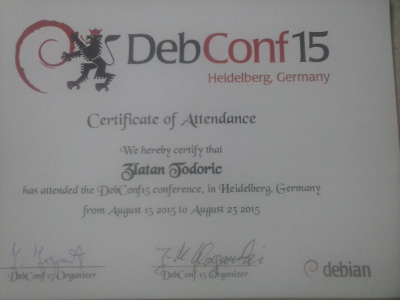
Zlatan Todori : The big life adventure called DebConf15

By the help of sponsorship I managed again to attend the conference where Debian family gathers. This is going to be a mix without any particular order of everything, anything and nothing else ;) attendance pic I arrived to Heidelberg Main Train Station around 9am on 15th August and almost right away found Debian people so it made my trip to hostel easier. After arrival I checked in but needed to wait for 3 hours to get the key (it seems that SA will not have that problem at all, which is already an improvement). Although waiting was 3 hours long, it wasn't actually difficult at all as I started hugging and saying hi to many old (the super old super friend of mine - moray, or how I call him, "doc") and new friends. I just must say - if you know or don't know Rhonda, try to get somehow into her hugs. With her hug I acknowledged that I really did arrive to reunion. Read more (14 min remaining to read)

Dimitri John Ledkov: Go enjoy Python3

Given a string, get a truncated string of length up to 12.

The task is ambiguous, as it doesn't say anything about whether or not 12 should include terminating null character or not. None the less, let's see how one would achieve this in various languages.
Let's start with python3

import sys
print(sys.argv[1][:12])

Simple enough, in essence given first argument, print it up to length 12. As an added this also deals with unicode correctly that is if passed arg is , it will correctly print . (note these are just random Unicode strings to me, no idea what they stand for).

In C things are slightly more verbose, but in essence, I am going to use strncpy function:

#include <stdio.h>
#include <string.h>
void main(int argc, char *argv[])
char res[12];
strncpy(res,argv[1],12);
printf("%s\n",res);

This treats things as byte-array instead of unicode, thus for unicode test it will end up printing just . But it is still simple enough.
Finally we have Go
package main

import "os"
import "fmt"
import "math"

func main()
fmt.Printf("%s\n", os.Args[1][:int(math.Min(12, float64(len(os.Args[1]))))])

This similarly treats argument as a byte array, and one needs to cast the argument to a rune to get unicode string handling. But there are quite a few caveats. One cannot take out of bounds slices. Thus a na ve os.Args[1][:12] can result in a runtime panic that slice bounds are out of range. Or if a string is known at compile time, a compile time error. Hence one needs to calculate length, and do a min comparison. And there lies the next caveat, math.Min() is only defined for float64 type, and slice indexes can only be integers and thus we end up writing ]))))])...

12 points for python3, 8 points for C, and Go receives nul points Eurovision style.

EDIT: Andreas R ssland and James Hunt are full of win. Both suggesting fmt.Printf("%.12s\n", os.Args[1]) for go. I like that a lot, as it gives simplicity & readability without compromising the default safety against out of bounds access. Hence the scores are now: 14 points for Go, 12 points for python3 and 8 points for C.

EDIT2: I was pointed out much better C implementation by Keith Thompson - http://pastebin.com/5i7rFmMQ in essence it uses strncat() which has much better null termination semantics. And Ben posted a C implementation which handles wide characters http://www.decadent.org.uk/ben/blog/truncating-a-string-in-c.html. I regret to inform you that this blog post got syndicated onto hacker news and has now become the top viewed post on my blog of all time, overnight. In retrospect, I regret awarding points at the end of the blog post, as that's just was merely an expression of opinion and is highly subjective measure. But this problem statement did originate from me reviewing go code that did "if/then/else" comparison and got it wrong to truncate a string and I thought surely one can just do [:12] which has lead me down the rabbit hole of discovering a lot about Go; it's compile and runtime out of bounds access safeguards; lack of universal Min() function; runes vs strings handling and so on. I'm only a beginner go programmer and I am very sorry for wasting everyone's time on this. I guess people didn't have much to do on a Throwback Thursday.

The postings on this site are my own and don't necessarily represent Intel s positions, strategies, or opinions.

25 August 2015

Richard Hartmann: Tor-enabled Debian mirror, part 2

Well, that was quite some feedback to my last post; via blog, email, irc, and in person. I actually think this may be the most feedback I ever got to any single blog post. If you are still waiting for a reply after this new post, I will get back to you. To handle common question/information at once: So this whole thing is a lot easier now:
# apt-get install torsocks apt-transport-tor
# mv /etc/apt/sources.list /etc/apt/sources.list--backup2
# > /etc/apt/sources.list << EOF
deb tor+http://vwakviie2ienjx6t.onion/debian/ unstable main contrib non-free
deb tor+http://earthqfvaeuv5bla.onion/debian/ unstable main contrib non-free
EOF
# apt-get update
# apt-get install vcsh

Richard Hartmann: Tor-enabled Debian mirror

During Jacob Applebaum's talk at DebConf15, he noted that Debian should TLS-enable all services, especially the mirrors. His reasoning was that when a high-value target downloads a security update for package foo, an adversary knows that they are still using a vulnerable version of foo and try to attack before the security update has been installed. In this specific case, TLS is not of much use though. If the target downloads 4.7 MiB right after a security update with 4.7 MiB has been released, or downloads from security.debian.org, it's still obvious what's happening. Even padding won't help much as the 5 MiB download will also be suspicious. The mere act of downloading anything from the mirrors after an update has been released is reason enough to try an attack. The solution, is, of course, Tor. weasel was nice enough to set up a hidden service on Debian's infrastructure; initally we agreed that he would just give me a VM and I would do the actual work, but he went the full way on his own. Thanks :) This service is not redundant, it uses a key which is stored on the local drive, the .onion will change, and things are expected to break. But at least this service exists now and can be used, tested, and put under some load:
http://vwakviie2ienjx6t.onion/

I couldn't get apt-get to be content with a .onion in /etc/apt/sources.list and Acquire::socks::proxy "socks://127.0.0.1:9050"; in /etc/apt/apt.conf, but the torify wrapper worked like a charm. What follows is, to the best of my knowledge, the first ever download from Debian's "official" Tor-enabled mirror:
~ # apt-get install torsocks
~ # mv /etc/apt/sources.list /etc/apt/sources.list.backup
~ # echo 'deb http://vwakviie2ienjx6t.onion/debian/ unstable main non-free contrib' > /etc/apt/sources.list
~ # torify apt-get update
Get:1 http://vwakviie2ienjx6t.onion unstable InRelease [215 kB]
Get:2 http://vwakviie2ienjx6t.onion unstable/main amd64 Packages [7548 kB]
Get:3 http://vwakviie2ienjx6t.onion unstable/non-free amd64 Packages [91.9 kB]
Get:4 http://vwakviie2ienjx6t.onion unstable/contrib amd64 Packages [58.5 kB]
Get:5 http://vwakviie2ienjx6t.onion unstable/main i386 Packages [7541 kB]
Get:6 http://vwakviie2ienjx6t.onion unstable/non-free i386 Packages [85.4 kB]
Get:7 http://vwakviie2ienjx6t.onion unstable/contrib i386 Packages [58.1 kB]
Get:8 http://vwakviie2ienjx6t.onion unstable/contrib Translation-en [45.7 kB]
Get:9 http://vwakviie2ienjx6t.onion unstable/main Translation-en [5060 kB]
Get:10 http://vwakviie2ienjx6t.onion unstable/non-free Translation-en [80.8 kB]
Fetched 20.8 MB in 2min 0s (172 kB/s)
Reading package lists... Done
~ # torify apt-get install vim
Reading package lists... Done
Building dependency tree       
Reading state information... Done
The following extra packages will be installed:
  vim-common vim-nox vim-runtime vim-tiny
Suggested packages:
  ctags vim-doc vim-scripts cscope indent
The following packages will be upgraded:
  vim vim-common vim-nox vim-runtime vim-tiny
5 upgraded, 0 newly installed, 0 to remove and 661 not upgraded.
Need to get 0 B/7719 kB of archives.
After this operation, 2048 B disk space will be freed.
Do you want to continue? [Y/n] 
Retrieving bug reports... Done
Parsing Found/Fixed information... Done
Reading changelogs... Done
(Reading database ... 316427 files and directories currently installed.)
Preparing to unpack .../vim-nox_2%3a7.4.826-1_amd64.deb ...
Unpacking vim-nox (2:7.4.826-1) over (2:7.4.712-3) ...
Preparing to unpack .../vim_2%3a7.4.826-1_amd64.deb ...
Unpacking vim (2:7.4.826-1) over (2:7.4.712-3) ...
Preparing to unpack .../vim-tiny_2%3a7.4.826-1_amd64.deb ...
Unpacking vim-tiny (2:7.4.826-1) over (2:7.4.712-3) ...
Preparing to unpack .../vim-runtime_2%3a7.4.826-1_all.deb ...
Unpacking vim-runtime (2:7.4.826-1) over (2:7.4.712-3) ...
Preparing to unpack .../vim-common_2%3a7.4.826-1_amd64.deb ...
Unpacking vim-common (2:7.4.826-1) over (2:7.4.712-3) ...
Processing triggers for man-db (2.7.0.2-5) ...
Processing triggers for mime-support (3.58) ...
Processing triggers for desktop-file-utils (0.22-1) ...
Processing triggers for hicolor-icon-theme (0.13-1) ...
Setting up vim-common (2:7.4.826-1) ...
Setting up vim-runtime (2:7.4.826-1) ...
Processing /usr/share/vim/addons/doc
Setting up vim-nox (2:7.4.826-1) ...
Setting up vim (2:7.4.826-1) ...
Setting up vim-tiny (2:7.4.826-1) ...
~ # 

More services will follow. noodles, weasel, and me agreed that the project as a whole should aim to Tor-enable the complete package lifecycle, package information, and the website. Maybe a more secure install option on the official images which, amongst others, sets up apt, apt-listbugs, dput, reportbug, et al up to use Tor without further configuration could even be a realistic stretch goal.

24 August 2015

Jonathan McDowell: Random post-DebConf 15 thoughts

There are a bunch of things I mean to blog about, but as I have just got fully home from Heidelberg and DebConf15 this afternoon that seems most appropriate to start with. It s a bit of a set of disjoint thoughts, but I figure I should write them down while they re in my head. DebConf is an interesting conference. It s the best opportunity the Debian project has every year to come together and actually spend a decent amount of time with each other. As a result it s a fairly full on experience, with lots of planned talks as a basis and a wide range of technical discussions and general social interaction filling in whatever gaps are available. I always find it a thoroughly enjoyable experience, but equally I m glad to be home and doing delightfully dull things like washing my clothes and buying fresh milk. I have always been of the opinion that the key aspect of DebConf is the face time. It was thus great to see so many people there - we were told several times that this was the largest DebConf so far (~ 570 people IIRC). That s good in the sense that it meant I got to speak to a lot of people (both old friends and new), but does mean that there are various people I know I didn t spend enough, or in some cases any, time with. My apologies, but I think many of us were in the same situation. I don t feel it made the conference any less productive for me - I managed to get a bunch of hacking done, discuss a number of open questions in person with various people and get pulled into various interesting discussions I hadn t expected. In short, a typical DebConf. Also I d like to say that the venue worked out really well. I ll admit I was dubious when I heard it was in a hostel, but it was well located (about a 30 minute walk into town, and a reasonable bus service available from just outside the door), self-contained with decent facilities (I m a big believer in having DebConf talks + accommodation be as close as possible to each other) and the room was much better than expected (well, aside from the snoring but I can t blame the DebConf organisers for that). One of the surprising and interesting things for me that was different from previous DebConfs was the opportunity to have more conversations with a legal leaning. I expect to go to DebConf and do OpenPGP/general crypto related bits. I wasn t expecting affirmation about the things I have learnt on my course over the past year, in terms of feeling that I could use that knowledge in the process of helping Debian. It provided me with some hope that I ll be able to tie my technology and law skills together in a way that I will find suitably entertaining (as did various conversations where people expressed significant interest in the crossover). Next year is in Cape Town, South Africa. It s a long way (though I suppose no worse than Portland and I get to stay in the same time zone), and a quick look at flights indicates they re quite expensive at the moment. The bid presentation did look pretty good though so as soon as the dates are confirmed (I believe this will happen as soon as there are signed contracts in place) I ll take another look at flights. In short, excellent DebConf, thanks to the organisers, lovely to see everyone I managed to speak to, apologies to those of you I didn t manage to speak to. Hopefully see you in Cape Town next year.

Next.

Previous.