Search Results: "jan"

1 February 2017

Iustin Pop: The snow is gone

Almost all traces of the snow are gone. After a very dry December, January was an awesome month. Lots of snow, even in the city, that held for (I think) three weeks very rare for Z rich. This happened because the temperature never went above -5 C, even during the day proper winter for the city! It was awesome to bike in these conditions. At first fresh snow (best! but slow), then packed snow, it never actually became dangerous ice. And then, at the end of last week, temperatures started climbing. First near zero, then 1-2 C above, then it finally started going warm (above freezing even during the night). And the snow started melting a bit, then more, and then it started raining. And it rained for three days. The worst thing, seeing snow being rained upon. Dirty grey snow, slowly melting away I don't like this picture. At least now the snow is gone, and the streets are almost dry, and we can look to either some more snow (I wish ) or spring. I'd rather take -2 C global average temperatures than +2 C. I'm not sure what -5 would mean, but compared to no winter

Antoine Beaupr : My free software activities, January 2017

manpages.debian.org launched The debmans package I had so lovingly worked on last month is now officially abandoned. It turns out that another developer, Michael Stapelberg wrote his own implementation from scratch, called debiman. Both software share a similar design: they are both static site generators that parse an existing archive and call another tool to convert manpages into HTML. We even both settled on the same converter (mdoc). But while I wrote debmans in Python, debiman is written in Go. debiman also seems much faster, being written with concurrency in mind from the start. Finally, debiman is more feature complete: it properly deals with conflicting packages, localization and all sorts redirections. Heck, it even has a pretty logo, how can I compete? While debmans was written first and was in the process of being deployed, I had to give it up. It was a frustrating experience because I felt I wasted a lot of time working on software that ended up being discarded, especially because I put so much work on it, creating extensive documentation, an almost complete test suite and even filing a detailed core infrastructure best practices report In the end, I think that was the right choice: debiman seemed clearly superior and the best tool should win. Plus, it meant less work for me: Michael and Javier (the previous manpages.debian.org maintainer) did all the work of putting the site online. I also learned a lot about the CII best practices program, flask, click and, ultimately, the Go programming language itself, which I'll refer to as Golang for brievity. debiman definitely brought Golang into the spotlight for me. I had looked at Go before, but it seemed to be yet another language. But seeing Michael beat me to rebuilding the service really made me look at it again more seriously. While I really appreciate Python and I will probably still use it as my language of choice for GUI work and smaller scripts, but for daemons, network programs and servers, I will seriously consider Golang in the future. The site is now online at https://manpages.debian.org/. I even got credited in the about page which makes up for the disappointment.

Wallabako downloads Wallabag articles on my Kobo e-reader This obviously brings me to the latest project I worked on, Wallabako, my first Golang program ever. Wallabako is basically a client for the Wallabag application, which is a free software "read it later" service, an alternative to the likes of Pocket, Pinboard or Evernote. Back in April, I had looked downloading my "unread articles" into my new ebook reader, going through convoluted ways like implementing OPDS support into Wallabag, which turned out to be too difficult. Instead, I used this as an opportunity to learn Golang. After reading the quite readable golang specification over the weekend, I found the language to be quite elegant and simple, yet very powerful. Golang feels like C, but built with concurrency and memory (and to a certain extent, type) safety in mind, along with a novel approach to OO programming. The fact that everything can be compiled in one neat little static binary was also a key feature in selecting golang for this project, as I do not have much control over the platform my E-Reader is running: it is a Linux machine running under the ARM architecture, but beyond that, there isn't much available. I couldn't afford to ship a Python interpreter in there and while there are solutions there like pyinstaller, I felt that it may be so easy to deploy on ARM. The borg team had trouble building a ARM binary, restoring to tricks like building on a Raspberry PI or inside an emulator. In comparison, the native go compiler supports cross-compilation out of the box through a simple environment variable. So far Wallabako works amazingly well: when I "bag" a new article in Wallabag, either from my phone or my web browser, it will show up on my ebook reader then next time I open the wifi. I still need to "tap" the screen to fake the insertion of the USB cable, but we're working on automating that. I also need to make the installation of the software much easier and improve the documentation, because so far it's unlikely that someone unfamiliar with Kobo hardware hacking will be able to install it.

Other work According to Github, I filed a bunch of bugs all over the place (25 issues in 16 repositories), sent patches everywhere (13 pull requests in 6 repositories), and tried to fix everythin (created 38 commits in 7 repositories). Note that excludes most of my work, which happens on Gitlab. January was still a very busy month, especially considering I had an accident which kept me mostly offline for about a week. Here are some details on specific projects.

Stressant and a new computer I revived the stressant project and got a new computer. This is be covered in a separate article.

Linkchecker forked After much discussions, it was decided to fork the linkchecker project, which now lives in its own organization. I still have to write community guidelines and figure out the best way to maintain a stable branch, but I am hopeful that the community will pick up the project as multiple people volunteer to co-maintain the project. There has already been pull requests and issues reported, so that's a good sign.

Feed2tweet refresh I re-rolled my pull requests to the feed2tweet project: last time they were closed before I had time to rebase them. The author was okay with me re-submitting them, but he hasn't commented, reviewed or merged the patches yet so I am worried they will be dropped again. At that point, I would more likely rewrite this from scratch than try to collaborate with someone that is clearly not interested in doing so...

Debian uploads

Debian Long Term Support (LTS) This is my 10th month working on Debian LTS, started by Raphael Hertzog at Freexian. I took two months off last summer, which means it's actually been a year of work on the LTS project. This month I worked on a few issues, but they were big issues, so they took a lot of time. I have done a lot of work trying to backport the heading sanitization patches for CVE-2016-8743. The full report explain all the gritty details, but I ran out of time and couldn't upload the final version either. The issue mostly affects Apache servers in proxy configurations so it's not so severe as to warrant an immediate upload anyways. A lot of my time was spent battling the tiff package. The report mentions fixes for 15 CVEs and I uploaded the result in the DLA-795-1 advisory. I also worked on a small update to graphics magic for CVE-2016-9830 that is still pending because the issue is minor and we're waiting for more to pile up. See the full report for details. Finally, there was a small discussion surrounding tools to use when building and testing update to LTS packages. The resulting conversation was interesting, but it showed that we have a big documentation problem in the Debian project. There are a lot of tools, and the documentation is old and distributed everywhere. Every time I want to contribute something to the documentation, I never know where to start or go. This is why I wrote a separate debian development guide instead of contributing to existing documentation...

31 January 2017

Raphaël Hertzog: My Free Software Activities in January 2017

My monthly report covers a large part of what I have been doing in the free software world. I write it for my donors (thanks to them!) but also for the wider Debian community because it can give ideas to newcomers and it s one of the best ways to find volunteers to work with me on projects that matter to me. Debian LTS I was allocated 10 hours to work on security updates for Debian 7 Wheezy. During this time I did the following: Debian packaging With the deep freeze approaching, I made some last-minute updates: Misc work Sponsorship. I sponsored a new asciidoc upload demoting a dependency into a recommends (#850301). I sponsored a new upstream version of dolibarr. Discussions. I seconded quite a few changes prepared by Russ Allbery on debian-policy. I helped Scott Kitterman with #849584 about a misunderstanding of how the postfix service files are supposed to work. I discussed in #849913 about a regression in building of cross-compilers, and made a patch to avoid the problem. In the end, Guillem developed a better fix. Bugs. I investigated #850236 where a django test failed during the first week after each leap year. I filed #853224 on desktop-base about multiple small problems in the maintainer scripts. Thanks See you next month for a new summary of my activities.

No comment Liked this article? Click here. My blog is Flattr-enabled.

Chris Lamb: Free software activities in January 2017

Here is my monthly update covering what I have been doing in the free software world (previous month):
Reproducible builds

Whilst anyone can inspect the source code of free software for malicious flaws, most software is distributed pre-compiled to end users. The motivation behind the Reproducible Builds effort is to permit verification that no flaws have been introduced either maliciously or accidentally during this compilation process by promising identical results are always generated from a given source, thus allowing multiple third-parties to come to a consensus on whether a build was compromised. (I have previously been awarded a grant from the Core Infrastructure Initiative to fund my work in this area.) This month I:
I also made the following changes to our tooling:
diffoscope

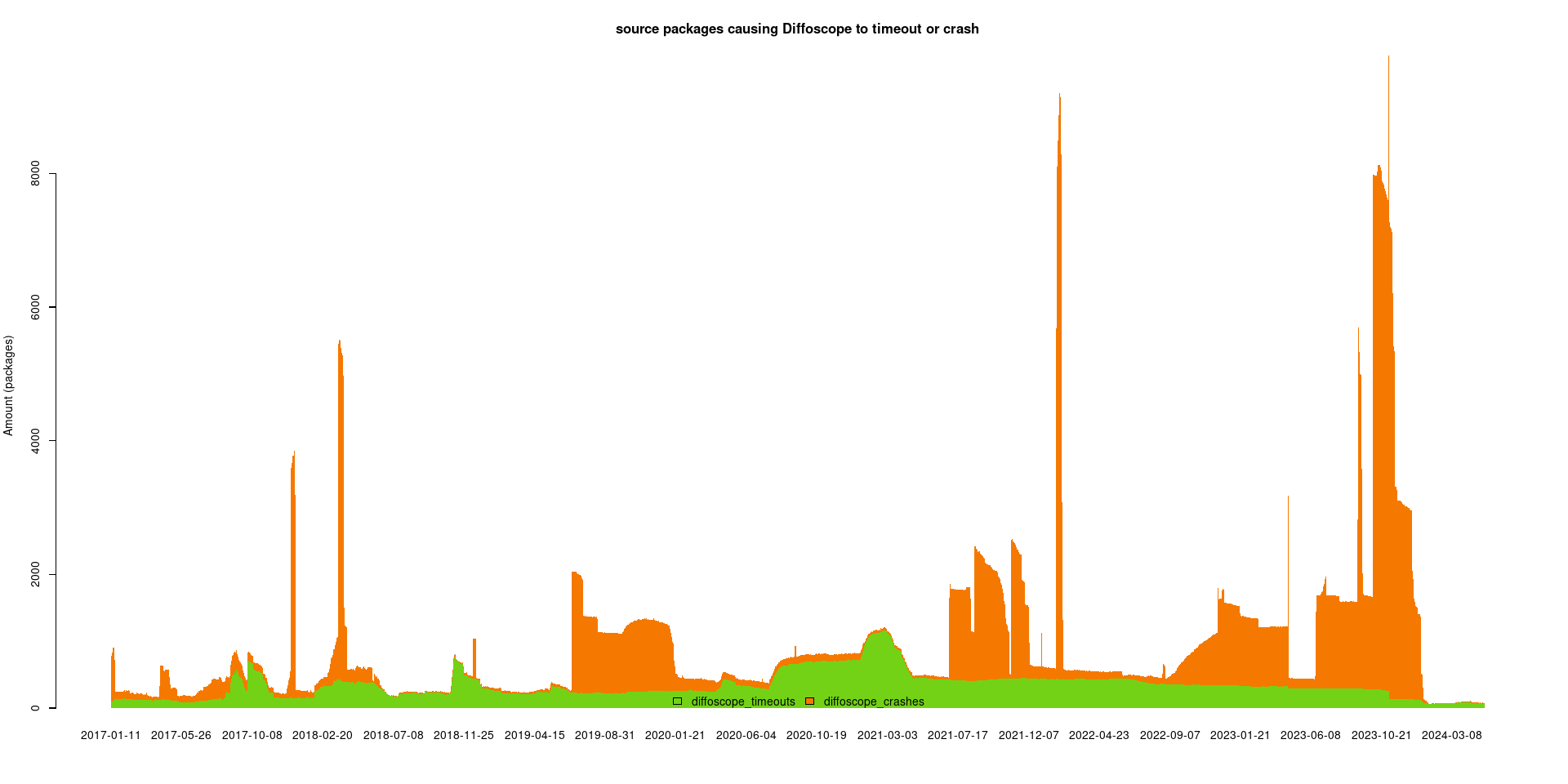
diffoscope is our in-depth and content-aware diff utility that can locate and diagnose reproducibility issues.

  • Comparators:
    • Display magic file type when we know the file format but can't find file-specific details. (Closes: #850850).
    • Ensure our "APK metadata" file appears first, fixing non-deterministic tests. (998b288)
    • Fix APK extration with absolute filenames. (Closes: #850485).
    • Don't error if directory containing ELF debug symbols already exists. (Closes: #850807).
    • Support comparing .ico files (Closes: #850730).
    • If we don't have a tool (eg. apktool), don't blow up when attempting to unpack it.
  • Output formats:
    • Add Markdown output format. (Closes: #848141).
    • Add RestructuredText output format.
    • Use an optimised indentation routine throughout all presenters.
    • Move text presenter to use the Visitor pattern.
    • Correctly escape value of href="" elements (re. #849411).
  • Tests:
    • Prevent FTBFS by loading fixtures as UTF-8 in case surrounding terminal is not Unicode-aware. (Closes: #852926).
    • Skip tests if binutils can't handle the object file format. (Closes: #851588).
    • Actually compare the output of text/ReST/Markdown formats to fixtures.
    • Add tests for: Comparing two empty directories, HTML output, image.ICOImageFile, --html-dir, --text-color & no arguments (beyond the filenames) emits the text output.
  • Profiling:
    • Count the number of calls, not just the total time.
    • Skip as much profiling overhead when not enabled for a ~2% speedup.
  • Misc:
    • Alias an expensive Config() lookup for a 10% optimisation.
    • Avoid expensive regex creation until we actually need it, speeding up diff parsing by 2X.
    • Use Pythonic logging functions based on __name__, etc.
    • Drop milliseconds from logging output.

buildinfo.debian.net

buildinfo.debian.net is my experiment into how to process, store and distribute .buildinfo files after the Debian archive software has processed them.

  • Store files directly onto S3.
  • Drop big unique_together index to save disk space.
  • Show SHA256 checksums where space permits.


Debian LTS

This month I have been paid to work 12.75 hours on Debian Long Term Support (LTS). In that time I did the following:
  • "Frontdesk" duties, triaging CVEs, etc.
  • Issued DLA 773-1 for python-crypto fixing a vulnerability where calling AES.new with an invalid parameter could crash the Python interpreter.
  • Issued DLA 777-1 for libvncserver addressing two heap-based buffer overflow attacks based on invalid FramebufferUpdate data.
  • Issued DLA 778-1 for pcsc-lite correcting a use-after-free vulnerability.
  • Issued DLA 795-1 for hesiod which fixed a weak SUID check as well as removed the hard-coding of a fallback domain if the configuration file could not be found.
  • Issued DLA 810-1 for libarchive fixing a heap buffer overflow.

Uploads
  • python-django:
    • 1:1.10.5-1 New upstream stable release.
    • 1:1.11~alpha1-1 New upstream experimental release.
  • gunicorn (19.6.0-10) Moved debian/README.Debian to debian/NEWS so that the recent important changes will be displayed to users when upgrading to stretch.
  • redis:
    • 3:3.2.6-2 & 4:4.0-rc2-2 Tidy patches and rename RunTimeDirectory to RuntimeDirectory in .service files. (Closes: #850534)
    • 3:3.2.6-3 Remove a duplicate redis-server binary by symlinking /usr/bin/redis-check-rdb. This was found by the dedup service.
    • 3:3.2.6-4 Expand the documentation in redis-server.service and redis-sentinel.service regarding the default hardening options and how, in most installations, they can be increased.
    • 3:3.2.6-5, 3:3.2.6-6, 4:4.0-rc2-3 & 4:4.0-rc2-4 Add taskset calls to try and avoid build failures due to parallelism in upstream test suite.

I also made the following non-maintainer uploads:
  • cpio:
    • 2.12+dfsg-1 New upstream release (to experimental), refreshing all patches, etc.
    • 2.12+dfsg-2 Add missing autoconf to Build-Depends.
  • xjump (2.7.5-6.2) Make the build reproducible by passing -n to gzip calls in debian/rules. (Closes: #777354)
  • magicfilter (1.2-64.1) Make the build reproducible by passing -n to gzip calls in debian/rules. (Closes: #777478)


Reproducible builds folks: Reproducible Builds: week 92 in Stretch cycle

Here's what happened in the Reproducible Builds effort between Sunday January 22 and Saturday January 28 2017: Media coverage Upcoming Events Reproducible work in other projects John Gilmore wrote an interesting mail about how Cygnus.com worked on reproducible builds in the early 1990s. It's eye opening to see how the dealt with basically the very same problems we're dealing with today, how they solved them and then to realize that most of this has been forgotten and bit-rotted in the last 20 years. How will we prevent history repeating itself here? Toolchain development and fixes Christoph Biedl wrote a mail describing an interesting problem in to the way binNMUs are done in Debian. Guillem Jover made a number of changes to dpkg that affect the Reproducible Builds effort within Debian: Packages reviewed and fixed, and bugs filed Chris Lamb: Dhole: Reviews of unreproducible packages 17 package reviews have been added, 4 have been updated and 6 have been removed in this week, adding to our knowledge about identified issues. 2 issue types have been added: 1 issue type has been removed: Weekly QA work During our reproducibility testing, the following FTBFS bugs have been detected and reported by: diffoscope development reprotest development buildinfo.debian.net development tests.reproducible-builds.org Misc. This week's edition was written by Chris Lamb and Holger Levsen & reviewed by a bunch of Reproducible Builds folks on IRC & the mailing lists.

29 January 2017

Reproducible builds folks: Reproducible Builds: week 91 in Stretch cycle

What happened in the Reproducible Builds effort between Sunday January 15 and Saturday January 21 2017: Media Coverage Upcoming Events Toolchain development and fixes Ximin Luo continued work on data formats, code, and test cases for SOURCE_PREFIX_MAP. He also continued to talk with the rustc team on the topic. Chris Lamb submitted a patch to implement SOURCE_DATE_EPOCH for wordwarvi, a game which gave extra points to people who built it from source within one hour. This fixes Debian #786593. Launchpad bug 1657704 was filed for them to start accepting buildinfo files. Bugs filed Reviews of unreproducible packages 10 package reviews have been added, 149 have been updated and 153 have been removed in this week, adding to our knowledge about identified issues. 2 issue types have been updated: Weekly QA work During our reproducibility testing, the following FTBFS bugs have been detected and reported by: diffoscope development diffoscope 69 was uploaded to unstable by Chris Lamb. It included contributions from: Further development continued in Git, and will be released as version 70 next week: reproducible-builds.org website development tests.reproducible-builds.org Misc. This week's edition was written by Ximin Luo, Vagrant Cascadian, Holger Levsen & Chris Lamb and reviewed by a bunch of Reproducible Builds folks on IRC & the mailing lists.

28 January 2017

Noah Meyerhans: Call for testing: Stretch cloud images on AWS

Following up on Steve McIntyre's writeup of the Debian Cloud Sprint that took place in Seattle this past November, I'm pleased to announce the availability of preliminary Debian stretch AMIs for Amazon EC2. Pre-generated images are available in all public AWS regions, or you can use FAI with the fai-cloud-images configuration tree to generate your own images. The pre-generated AMIs were created on 25 January, shortly after Linux 4.9 entered stretch, and their details follow:
ami-6d017002 ap-south-1
ami-cc5540a8 eu-west-2
ami-43401925 eu-west-1
ami-870edfe9 ap-northeast-2
ami-812266e6 ap-northeast-1
ami-932e4aff sa-east-1
ami-34ce7350 ca-central-1
ami-9f6dd8fc ap-southeast-1
ami-829295e1 ap-southeast-2
ami-42448a2d eu-central-1
ami-98c9348e us-east-1
ami-57361332 us-east-2
ami-03386563 us-west-1
ami-7a27991a us-west-2
As with the current jessie images, these use a default username of 'admin', with access controlled by the ssh key named in the ec2 run-instances invocation. They're intended to provide a reasonably complete Debian environment without too much bloat. IPv6 addressing should be supported in an appropriately configured VPC environment. These images were build using Thomas Lange's FAI, which has been used for over 15 years for provisioning all sorts of server, workstation, and VM systems, but which only recently was adapted for use generating cloud disk images. It has proven to be well suited to this task though, and image creation is straightforward and flexible. I'll describe in a followup post the steps you can follow to create and customize your own AMIs based on our recipes. In the meantime, please do test these images! You can submit bug reports to the cloud.debian.org metapackage, and feedback is welcome via the debian-cloud mailing list or #debian-cloud on IRC.

27 January 2017

Rhonda D'Vine: Icona Pop

Last fall I went to a Silent Disco event. You get wireless headphones, a DJane and a DJ were playing music on different channels, and you enjoy the time with people around who can't hear what you hear. It's a pretty funny experience, and it was one of the last warm sunny days. There I heard a song that was just in the mood for the moment, and made me looking up the band to listen more closely to them. The band was Icona Pop, they have a mood enlighening pop sound that cheers you up. Here are the songs I want to present you today: Like always, enjoy!

/music permanent link Comments: 4 Flattr this

26 January 2017

Joey Hess: badUSB

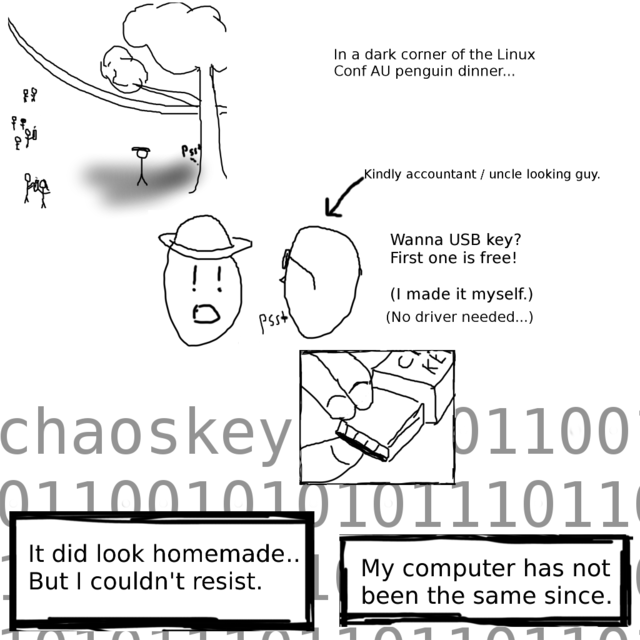
3 panel comic: 1. In a dark corner of the Linux Conf AU penguin dinner. 2. (Kindly accountant / uncle looking guy) Wanna USB key? First one is free! (I made it myself.) (No driver needed..) 3. It did look homemade, but I couldn't resist... My computer has not been the same since This actually happened.
Jan 19 00:05:10 darkstar kernel: usb 2-2: Product: ChaosKey-hw-1.0-sw-1.6.
In real life, my hat is uglier, and Keithp is more kindly looking. gimp source

24 January 2017

Shirish Agarwal: Budget and Economics 101

The Budget The story which I wanted to share is there are few friends (from Debian as well as elsewhere) who shared that they didn t get the whole demonetisation play or what the Government is/was trying to do. As budget is just round the corner (India will be presenting its yearly budget on 1st of February), thought it is prudent to share at least some basics, ideas and theories of what goals the Finance Minister would be looking at when presenting his budget. I would NOT talk of Inflation targeting or some such exotica as those topics would require their own blog-posts altogether. I would mainly be talking a bit about Taxation and in that Personal Income Tax. I would also not use words like Receivables and like which thought bit more accurate are not used in everyday language. Just like Private Companies and increasingly public utilities, The Government of the day has two-three different aims when it is presenting a budget a. The first is to give an update about how things went last year. Did all the incomes that were projected, did it happen or was there a short-fall ? If there was a short-fall what were the reasons for the shortfall. Similarly, did all the budgeted expenditure earmarked for the year was spent and were it spent under the heads they were supposed to ? If not what went wrong there ? There is usually a tussle between Planned and Unplanned expenditure and one of the hallmarks of good governance is that unplanned expenditure is kept at minimum, while planned expenditure and projects completion or/and assets coming on-line were within the estimated time-frames. So these updates are given to the Parliament and hence public at large. The second and the more interesting part are the plans for the immediate future, 1 year down-the-line. Based on the performance last year, a bit of crystal-ball gazing of external and internal conditions of the country, the Finance Minister along with her/his colleagues of Finance Ministry. Trivia There hasn t been a female finance minister till date in India. The Finance Ministry as a whole also holds consultations with most sections of the society before sharing/putting his Fiscal Policy (Planned Expenditure) for debate and passage in form of the Budget. While the budget itself is a technical exercise, it is also a Political exercise as both the budget and the finance bill (which contains the taxation proposals) need to be passed in Lok Sabha (Lower house). After passing scrutiny of Lok Sabha (Lower House having people s representatives directly elected) and Rajya Sabha (Upper House, indirectly elected), the taxation proposals becomes the law. It isn t that simple but for our understanding, keeping it simple. This Political model of governance with two houses is modeled under the British (Westminister) model since 1947. The Government, just like any other Organization gives a similar Profit and Loss Account and a Balance Sheet.

How A country's budget is made.

How A country s budget is made. A representational and simplified version of how things flow was made using Graphviz. Click on it to see image in detail.

I am a newbie to graphviz. The graph was made like this
graph Budget
subgraph tier1
node [color="limegreen",style="filled",group="tier1"]
Country_Budget

......
Country_Budget -- Profit_and_Loss_Account [type=s];
It might be possible to make the graph much better than it is currently . The Profit and Loss Account of the Government tells what Incomes it is projected to earn in the upcoming year and whatever Expenditures it hopes to do this year. The Income and Expenditure independently can be bifurcated into two, Revenue Income and Capital Income and Revenue Expenditure and Capital Expenditure.
Indian Railways EMU local train

Indian Railways EMU local train

The simplest example of such planned expenditure which comes to my mind is the Indian Railways Budget which is all planned expenditure. As can be seen even with ample funds Railways were able to spent only 50% of the total amount disbursed last year. Similarly income generation for Railways was far below the target. Examples of Revenue Income include taxes of all sorts, while Capital Income are rare, like divestment/stake sale of a company owned by the Government. These are usually one-off events. Examples of Capital Expenditure is when the Government makes a road, makes a bridge etc. Usually large expenditures come under Capital Expenditure while salaries to Government employees and routine expenditures are known as Revenue Expenditure. There was a statement by the present Government that the last 6-7 years the budgets has been more or less static as far as numbers are concerned. This hampers Government s ability to take up any new work. The Revenue income earned by the Government can again be bifurcated primarily into two Direct Taxes and Indirect Taxes.
INR 2000 Rupees

INR 2000 Rupees

Direct Taxes are those which the Government earns through Personal Income Tax and Corporate Tax. As only 1 percent of Indians pay Personal income tax, the rest Government tries to raise by Hence the Government of the day is in fix. It needs to have more money if it wants to invest into infrastructure, defence spending, social spending such as health and education and so on and so forth. It cannot Another point is that unlike China which is a Large State-backed Enterprises Export-led Economy which has its own problems, India s economy is much more consumption-based, hence any large tinkering upwards may possibly stall whatever little spending the middle-class does, similar to the stall in consumer durables which has been happening over the last few years. There are a couple of short-term solutions that the Government may do While both seem to be attractive ways, but both have their disadvantages also, both have costs associated for them. In the first one, like any other scheme, when any scheme is launched, it needs to be underwritten by GOI which means even if it s not a success they would have to service all and any obligations towards investors. Also they have to be careful how much they are borrowing as excessive borrowing for today could lead to a Greece-like meltdown situation, whether internal or external borrowers. With external borrowers they also usually like to have a guarantee that the Rupee will not slide beyond a point otherwise the Government will have to pay all and any losses but this is going beyond what I wanted to share. Printing excess money in the system could lead to loss in the value of the money itself as well as leading to inflationary pressures which leads to more problems for the poor and greater inequality between the classes among other things. So while the Government may use all of the above ways in varying degrees, the present Government had the idea that if we were to reduce black money or hidden economy (AFAIK no country can claim to completely eliminate it) we would be able to raise the finance we need without a major cost associated to it. For instance, I was reading that even in Canada, it is expected that 20% of black money/shadow economy works and that assessment is by their own taxation authorities. So While doing demonetization, it came out with an equivalent Black Money Declaration Scheme (IDS). The idea is simple, even if 1 percent of the population comes in the traditional tax net the Government of the day would be able to enhance budgets to various expenditure. Now while the idea is good in theory, implementation has been the Achilees heel. While the Government s expected something like 15% of the whole economy was black money or shadow money, almost 95% of the money in circulation came back in Banks during demonetization ( These are unofficial figures, Finance Ministry/RBI would be disclosing the real figures on 1st of February 2017 so we will know). It is suspected that 10% of money in Banks is black money. There are considerable costs to search analyze, prove in the court of law that it is so. There are and would be considerable costs to train new officers as existing Income Tax Officers are already burdened with Advance Tax being paid by Corporates and small business-man paying round the year (every 3 months), The existing Income Tax Officers already have their hands full. Also till Governments don t fix up realty sector/real-estate sector and other places where the black money/shadow economy may prevail. Hence all the training, salary, buildings where new Income Tax Officers could work, infrastructure, new buildings where suspect cases have to be tried and lawyers for those. As have shared a few times on this blog, India has almost 29 million court cases pending in the lower judiciary alone. Unless any such cases are not successfully tried within time by the Government, it would be a waste. Now whether the Government knew of these issues or not would probably be never known. Lastly, there is a voluntary part that the Government hopes, that they will by themselves join the mainstream tax-paying public. This might happen but any such happening will happen over years. People make their own choices. And unless there are not any stick and carrot approach to the Government s Policies people will tend to go back to their old ways. I would share an example from the demonetisation process which would help prove my point During demonetization, there was a great push towards doing digital transaction either via smartphones or greater usage of debit and credit cards etc. For the first 60 days till 31st December 2016, you could do digital transactions without paying any transaction fee. During that period, I used my Debit card to shop, to eat at restaurants or/and even small shops. But come 1st January 2017, the charges for digital transactions are anything between 1.5% to 3% of transactions. Naturally, I stopped using them and use them very sparingly where cash won t work. So at the end, while the Government made the whole demonetization drive to drive out shadow economy, terror financing etc. While terror financing has been hurt quite a bit, the same cannot be said of the shadow/black economy. It seems that the Government would need to close many more doors and windows before people join the mainstream. While Politically it was risky, socially it was also a bit risky move as it was uncertain how and where things will move. Venezuela tried the same thing and fell flat on its face. All said and done, if and when people become part of the tax-paying class/people, The most optimistic idea that the Government has that everybody will go cashless and it would be far easier to find out who s not paying taxes. As shared before, I don t think this will happen unless the charges for cashless is at 0.05% or something similar. Even IF people do join the mainstream, it is very much possible that the present Govt. will not enjoy fruits of this labour as fruits might come in 2018/19 or even later even if they do come. So whether the decision had the right affect or not, we may never come to know. Governments tend to tinker around with the figures as well. But I hope some idea of how things happen is known now.
Filed under: Miscellenous Tagged: #demonetization, #Government Budget, #graphviz, #Limitations, #Profit and Loss Account, #Taxation

19 January 2017

Daniel Pocock: Which movie most accurately forecasts the Trump presidency?

Many people have been scratching their heads wondering what the new US president will really do and what he really stands for. His alternating positions on abortion, for example, suggest he may simply be telling people what he thinks is most likely to win public support from one day to the next. Will he really waste billions of dollars building a wall? Will Muslims really be banned from the US? As it turns out, several movies provide a thought-provoking insight into what could eventuate. What's more, these two have a creepy resemblance to the Trump phenomenon and many of the problems in the world today. Countdown to Looking Glass On the classic cold war theme of nuclear annihilation, Countdown to Looking Glass is probably far more scary to watch on Trump eve than in the era when it was made. Released in 1984, the movie follows a series of international crises that have all come to pass: the assassination of a US ambassador in the middle east, a banking crisis and two superpowers in an escalating conflict over territory. The movie even picked a young Republican congressman for a cameo role: he subsequently went on to become speaker of the house. To relate it to modern times, you may need to imagine it is China, not Russia, who is the adversary but then you probably won't be able to sleep after watching it. cleaning out the swamp? The Omen Another classic is The Omen. The star of this series of four horror movies, Damien Thorn, appears to have a history that is eerily reminiscent of Trump: born into a wealthy family, a series of disasters befall every honest person he comes into contact with, he comes to control a vast business empire acquired by inheritance and as he enters the world of politics in the third movie of the series, there is a scene in the Oval Office where he is flippantly advised that he shouldn't lose any sleep over any conflict of interest arising from his business holdings. Did you notice Damien Thorn and Donald Trump even share the same initials, DT?

18 January 2017

Reproducible builds folks: Reproducible Builds: week 90 in Stretch cycle

What happened in the Reproducible Builds effort between Sunday January 8 and Saturday January 14 2017: Upcoming Events Reproducible work in other projects Reproducible Builds have been mentioned in the FSF high-priority project list. The F-Droid Verification Server has been launched. It rebuilds apps from source that were built by f-droid.org and checks that the results match. Bernhard M. Wiedemann did some more work on reproducibility for openSUSE. Bootstrappable.org (unfortunately no HTTPS yet) was launched after the initial work was started at our recent summit in Berlin. This is another topic related to reproducible builds and both will be needed in order to perform "Diverse Double Compilation" in practice in the future. Toolchain development and fixes Ximin Luo researched data formats for SOURCE_PREFIX_MAP and explored different options for encoding a map data structure in a single environment variable. He also continued to talk with the rustc team on the topic. Daniel Shahaf filed #851225 ('udd: patches: index by DEP-3 "Forwarded" status') to make it easier to track our patches. Chris Lamb forwarded #849972 upstream to yard, a Ruby documentation generator. Upstream has fixed the issue as of release 0.9.6. Alexander Couzens (lynxis) has made mksquashfs reproducible and is looking for testers. It compiles on BSD systems such as FreeBSD, OpenBSD and NetBSD. Bugs filed Chris Lamb: Lucas Nussbaum: Nicola Corna: Reviews of unreproducible packages 13 package reviews have been added and 13 have been removed in this week, adding to our knowledge about identified issues. 1 issue type has been added: Weekly QA work During our reproducibility testing, the following FTBFS bugs have been detected and reported by: diffoscope development Bugs in diffoscope in the last year Many bugs were opened in diffoscope during the past few weeks, which probably is a good sign as it shows that diffoscope is much more widely used than a year ago. We have been working hard to squash many of them in time for Debian stable, though we will see how that goes in the end reproducible-website development tests.reproducible-builds.org Misc. This week's edition was written by Ximin Luo, Chris Lamb and Holger Levsen and reviewed by a bunch of Reproducible Builds folks on IRC & the mailing lists.

Jan Wagner: Migrating Gitlab non-packaged PostgreSQL into omnibus-packaged

With the release of Gitlab 8.15 it was announced that PostgreSQL needs to be upgraded. As I migrated from a source installation I used to have an external PostgreSQL database instead of using the one shiped with the omnibus package.
So I decided to do the data migration into the omnibus PostgreSQL database now which I skipped before. Let's have a look into the databases:
$ sudo -u postgres psql -d template1
psql (9.2.18)  
Type "help" for help.
gitlabhq_production=# \l  
                                             List of databases
         Name                  Owner         Encoding   Collate    Ctype           Access privileges
-----------------------+-------------------+----------+---------+---------+---------------------------------
 gitlabhq_production     git                 UTF8       C.UTF-8   C.UTF-8  
 gitlab_mattermost       git                 UTF8       C.UTF-8   C.UTF-8  
gitlabhq_production=# \q  
Dumping the databases and stop PostgreSQL. Maybe you need to adjust database names and users for your needs.
$ su postgres -c "pg_dump gitlabhq_production -f /tmp/gitlabhq_production.sql" && \
su postgres -c "pg_dump gitlab_mattermost -f /tmp/gitlab_mattermost.sql" && \  
/etc/init.d/postgresql stop
Activate PostgreSQL shipped with Gitlab Omnibus
$ sed -i "s/^postgresql\['enable'\] = false/#postgresql\['enable'\] = false/g" /etc/gitlab/gitlab.rb && \
sed -i "s/^#mattermost\['enable'\] = true/mattermost\['enable'\] = true/" /etc/gitlab/gitlab.rb && \  
gitlab-ctl reconfigure  
Testing if the connection to the databases works
$ su - git -c "psql --username=gitlab  --dbname=gitlabhq_production --host=/var/opt/gitlab/postgresql/"
psql (9.2.18)  
Type "help" for help.
gitlabhq_production=# \q  
$ su - git -c "psql --username=gitlab  --dbname=mattermost_production --host=/var/opt/gitlab/postgresql/"
psql (9.2.18)  
Type "help" for help.
mattermost_production=# \q  
Ensure pg_trgm extension is enabled
$ sudo gitlab-psql -d gitlabhq_production -c 'CREATE EXTENSION IF NOT EXISTS "pg_trgm";'
$ sudo gitlab-psql -d mattermost_production -c 'CREATE EXTENSION IF NOT EXISTS "pg_trgm";'
Adjust permissions in the database dumps. Indeed please verify that users and databases might need to be adjusted too.
$ sed -i "s/OWNER TO git;/OWNER TO gitlab;/" /tmp/gitlabhq_production.sql && \
sed -i "s/postgres;$/gitlab-psql;/" /tmp/gitlabhq_production.sql  
$ sed -i "s/OWNER TO git;/OWNER TO gitlab_mattermost;/" /tmp/gitlab_mattermost.sql && \
sed -i "s/postgres;$/gitlab-psql;/" /tmp/gitlab_mattermost.sql  
(Re)import the data
$ sudo gitlab-psql -d gitlabhq_production -f /tmp/gitlabhq_production.sql
$ sudo gitlab-psql -d gitlabhq_production -c 'REVOKE ALL ON SCHEMA public FROM "gitlab-psql";' && \
sudo gitlab-psql -d gitlabhq_production -c 'GRANT ALL ON SCHEMA public TO "gitlab-psql";'  
$ sudo gitlab-psql -d mattermost_production -f /tmp/gitlab_mattermost.sql
$ sudo gitlab-psql -d mattermost_production -c 'REVOKE ALL ON SCHEMA public FROM "gitlab-psql";' && \
sudo gitlab-psql -d mattermost_production -c 'GRANT ALL ON SCHEMA public TO "gitlab-psql";'  
Make use of the shipped PostgreSQL
$ sed -i "s/^gitlab_rails\['db_/#gitlab_rails\['db_/" /etc/gitlab/gitlab.rb && \
sed -i "s/^mattermost\['sql_/#mattermost\['sql_/" /etc/gitlab/gitlab.rb && \  
gitlab-ctl reconfigure  
Now you should be able to connect to all the Gitlab services again. Optionally remove the external database
apt-get remove postgresql postgresql-client postgresql-9.4 postgresql-client-9.4 postgresql-client-common postgresql-common  
Maybe you also want to purge the old database content
apt-get purge postgresql-9.4  

Norbert Preining: Debian/TeX Live January 2017

As the freeze of the next release is closing in, I have updated a bunch of packages around TeX: All of the TeX Live packages (binaries and arch independent ones) and tex-common. I might see whether I get some updates of ConTeXt out, too.
texlive2016-debian The changes in the binaries are mostly cosmetic: one removal of a non-free (unclear-free) file, and several upstream patches got cherrypicked (dvips, tltexjp contact email, upmendex, dvipdfmx). I played around with including LuaTeX v1.0, but that breaks horribly with the current packages in TeX Live, so I refrained from it. The infrastructure package tex-common got a bugfix for updates from previous releases, and for the other packages there is the usual bunch of updates and new packages. Enjoy! New packages arimo, arphic-ttf, babel-japanese, conv-xkv, css-colors, dtxdescribe, fgruler, footmisx, halloweenmath, keyfloat, luahyphenrules, math-into-latex-4, mendex-doc, missaali, mpostinl, padauk, platexcheat, pstring, pst-shell, ptex-fontmaps, scsnowman, stanli, tinos, undergradmath, yaletter. Updated packages acmart, animate, apxproof, arabluatex, arsclassica, babel-french, babel-russian, baskervillef, beamer, beebe, biber, biber.x86_64-linux, biblatex, biblatex-apa, biblatex-chem, biblatex-dw, biblatex-gb7714-2015, biblatex-ieee, biblatex-philosophy, biblatex-sbl, bidi, calxxxx-yyyy, chemgreek, churchslavonic, cochineal, comicneue, cquthesis, csquotes, ctanify, ctex, cweb, dataref, denisbdoc, diagbox, dozenal, dtk, dvipdfmx, dvipng, elocalloc, epstopdf, erewhon, etoolbox, exam-n, fbb, fei, fithesis, forest, glossaries, glossaries-extra, glossaries-french, gost, gzt, historische-zeitschrift, inconsolata, japanese-otf, japanese-otf-uptex, jsclasses, latex-bin, latex-make, latexmk, lt3graph, luatexja, markdown, mathspec, mcf2graph, media9, mendex-doc, metafont, mhchem, mweights, nameauth, noto, nwejm, old-arrows, omegaware, onlyamsmath, optidef, pdfpages, pdftools, perception, phonrule, platex-tools, polynom, preview, prooftrees, pst-geo, pstricks, pst-solides3d, ptex, ptex2pdf, ptex-fonts, qcircuit, quran, raleway, reledmac, resphilosophica, sanskrit, scalerel, scanpages, showexpl, siunitx, skdoc, skmath, skrapport, smartdiagram, sourcesanspro, sparklines, tabstackengine, tetex, tex, tex4ht, texlive-scripts, tikzsymbols, tocdata, uantwerpendocs, updmap-map, uplatex, uptex, uptex-fonts, withargs, wtref, xcharter, xcntperchap, xecjk, xellipsis, xepersian, xint, xlop, yathesis.

16 January 2017

Raphaël Hertzog: Freexian s report about Debian Long Term Support, December 2016

A Debian LTS logoLike each month, here comes a report about the work of paid contributors to Debian LTS. Individual reports In December, about 175 work hours have been dispatched among 14 paid contributors. Their reports are available: Evolution of the situation The number of sponsored hours did not increase but a new silver sponsor is in the process of joining. We are only missing another silver sponsor (or two to four bronze sponsors) to reach our objective of funding the equivalent of a full time position. The security tracker currently lists 31 packages with a known CVE and the dla-needed.txt file 27. The situation improved a little bit compared to last month. Thanks to our sponsors New sponsors are in bold.

No comment Liked this article? Click here. My blog is Flattr-enabled.

15 January 2017

Dirk Eddelbuettel: Rcpp 0.12.9: Next round

Yesterday afternoon, the nineth update in the 0.12.* series of Rcpp made it to the CRAN network for GNU R. Windows binaries have by now been generated; and the package was updated in Debian too. This 0.12.9 release follows the 0.12.0 release from late July, the 0.12.1 release in September, the 0.12.2 release in November, the 0.12.3 release in January, the 0.12.4 release in March, the 0.12.5 release in May, the 0.12.6 release in July, the 0.12.7 release in September, and the 0.12.8 release in November --- making it the thirteenth release at the steady bi-montly release frequency. Rcpp has become the most popular way of enhancing GNU R with C or C++ code. As of today, 906 packages on CRAN depend on Rcpp for making analytical code go faster and further. That is up by sixthythree packages over the two months since the last release -- or about a package a day! Some of the changes in this release are smaller and detail-oriented. We did squash one annoying bug (stemming from the improved exception handling) in Rcpp::stop() that hit a few people. Nathan Russell added a sample() function (similar to the optional one in RcppArmadillo; this required a minor cleanup by for small number of other packages which used both namespaces 'opened'. Date and Datetime objects now have format() methods and << output support. We now have coverage reports via covr as well. Last but not least James "coatless" Balamuta was once more tireless on documentation and API consistency --- see below for more details.

Changes in Rcpp version 0.12.9 (2017-01-14)
  • Changes in Rcpp API:
    • The exception stack message is now correctly demangled on all compiler versions (Jim Hester in #598)
    • Date and Datetime object and vector now have format methods and operator<< support (#599).
    • The size operator in Matrix is explicitly referenced avoiding a g++-6 issues (#607 fixing #605).
    • The underlying date calculation code was updated (#621, #623).
    • Addressed improper diagonal fill for non-symmetric matrices (James Balamuta in #622 addressing #619)
  • Changes in Rcpp Sugar:
    • Added new Sugar function sample() (Nathan Russell in #610 and #616).
    • Added new Sugar function Arg() (James Balamuta in #626 addressing #625).
  • Changes in Rcpp unit tests
    • Added Environment::find unit tests and an Environment::get(Symbol) test (James Balamuta in #595 addressing issue #594).
    • Added diagonal matrix fill tests (James Balamuta in #622 addressing #619)
  • Changes in Rcpp Documentation:
    • Exposed pointers macros were included in the Rcpp Extending vignette (MathurinD; James Balamuta in #592 addressing #418).
    • The file Rcpp.bib move to directory bib which is guaranteed to be present (#631).
  • Changes in Rcpp build system
    • Travis CI now also calls covr for coverage analysis (Jim Hester in PR #591)

Thanks to CRANberries, you can also look at a diff to the previous release. As always, even fuller details are on the Rcpp Changelog page and the Rcpp page which also leads to the downloads page, the browseable doxygen docs and zip files of doxygen output for the standard formats. A local directory has source and documentation too. Questions, comments etc should go to the rcpp-devel mailing list off the R-Forge page.

This post by Dirk Eddelbuettel originated on his Thinking inside the box blog. Please report excessive re-aggregation in third-party for-profit settings.

14 January 2017

Jamie McClelland: What's Up with WhatsApp?

Despite my jaded feelings about corporate Internet services in general, I was suprised to learn that WhatsApp's end-to-end encryption was a lie. In short, it is possible to send an encrypted message to a user that is intercepted and effectively de-crypted without the sender's knowledge. However, I was even more surprised to read Open Whisper Systems critique of the original story, claiming that it is not a backdoor because the WhatsApp sender's client is always notified when a message is de-crypted. The Open Whisper Systems post acknowledges that the WhatsApp sender can choose to disable these notifications, but claims that is not such a big deal because the WhatsApp server has no way to know which clients have this feature enabled and which do not, so intercepting a message is risky because it could result in the sender realizing it. However, there is a fairly important piece of information missing, namely: as far as I can tell, the setting to notify users about key changes is disabled by default. So, using the default installation, your end-to-end encrypted message could be intercepted and decrypted without you or the party you are communicating with knowing it. How is this not a back door? And yes, if the interceptor can't tell whether or not the sender has these notifications turned on, the interceptor runs the risk of someone knowing they have intercepted the message. Great. That's better than nothing. Except that there is strong evidence that many powerful governments on this planet routinely risk exposure in their pursuit of compromising our ability to communicate securely. And... not to mention non-governmental (or governmental) adversaries for whom exposure is not a big deal. Furthermore a critical reason for end-to-end encrption is so that your provider does not have the technical capacity to intercept your communications. That's simply not true of WhatsApp. It is true of Signal and OMEMO, which requires the active participation of the sender to compromise the communication. Why in the world would you distribute a client that not only has the ability to surpress such warnings, but has it enabled by default? Some may argue that users regularly dismiss notifications like "fingerprint has changed" and that this problem is the achilles heal of secure communications. I agree. But... there is still a monumental difference between a user absent-mindedly dismissing an important security warning and never seeing the warning in the first place. This flaw in WhatsApp is a critical reminder that secure communications doesn't just depend on a good protocol or technology, but on trust in the people who design and maintain our systems.

12 January 2017

Ben Hutchings: Debian LTS work, December 2016

I was assigned 13.5 hours of work by Freexian's Debian LTS initiative and carried over 2 from November. I worked only 10 hours, so I carry over 5.5 hours. As for the last few months, I spent all of this time working on the linux (kernel) package. I backported several security fixes and did some testing of the more invasive changes. I also added the option to mitigate security issues in the performance events (perf) subsystem by disabling use by unprivileged users. This feature comes from Grsecurity and has been included in Debian unstable and Android kernels for a while. However, for Debian 7 LTS it has to be explicitly enabled by setting sysctl kernel.perf_event_paranoid=3. I uploaded these changes as linux 3.2.84-1 and then (on 1st January) issued DLA 722-1.

Ritesh Raj Sarraf: Laptop Mode Tools 1.71

I am pleased to announce the 1.71 release of Laptop Mode Tools. This release includes some new modules, some bug fixes, and there are some efficiency improvements too. Many thanks to our users; most changes in this release are contributions from our users. A filtered list of changes in mentioned below. For the full log, please refer to the git repository. Source tarball, Feodra/SUSE RPM Packages available at:
https://github.com/rickysarraf/laptop-mode-tools/releases Debian packages will be available soon in Unstable. Homepage: https://github.com/rickysarraf/laptop-mode-tools/wiki
Mailing List: https://groups.google.com/d/forum/laptop-mode-tools
1.71 - Thu Jan 12 13:30:50 IST 2017
    * Fix incorrect import of os.putenv
    * Merge pull request #74 from Coucouf/fix-os-putenv
    * Fix documentation on where we read battery capacity from
    * cpuhotplug: allow disabling specific cpus
    * Merge pull request #78 from aartamonau/cpuhotplug
    * runtime-pm: refactor listed_by_id()
    * wireless-power: Use iw and fallback to iwconfig if it not available
    * Prefer available AC supply information over battery state to determine ON_AC
    * On startup, we want to force the full execution of LMT.
    * Device hotplugs need a forced execution for LMT to apply the proper settings
    * runtime-pm: Refactor list_by_type()
    * kbd-backlight: New module to control keyboard backlight brightness
    * Include Transmit power saving in wireless cards
    * Don't run in a subshell
    * Try harder to check battery charge
    * New module: vgaswitcheroo
    * Revive bluetooth module. Use rfkill primarily. Also don't unload (incomplete list of) kernel modules
What is Laptop Mode Tools
Description: Tools for Power Savings based on battery/AC status
 Laptop mode is a Linux kernel feature that allows your laptop to save
 considerable power, by allowing the hard drive to spin down for longer
 periods of time. This package contains the userland scripts that are
 needed to enable laptop mode.
 .
 It includes support for automatically enabling laptop mode when the
 computer is working on batteries. It also supports various other power
 management features, such as starting and stopping daemons depending on
 power mode, automatically hibernating if battery levels are too low, and
 adjusting terminal blanking and X11 screen blanking
 .
 laptop-mode-tools uses the Linux kernel's Laptop Mode feature and thus
 is also used on Desktops and Servers to conserve power

Categories:

Keywords:

Like:

Next.

Previous.