Search Results: "hug"

28 October 2016

Matthew Garrett: Of course smart homes are targets for hackers

The Wirecutter, an in-depth comparative review site for various electrical and electronic devices, just published an opinion piece on whether users should be worried about security issues in IoT devices. The summary: avoid devices that don't require passwords (or don't force you to change a default and devices that want you to disable security, follow general network security best practices but otherwise don't worry - criminals aren't likely to target you.

This is terrible, irresponsible advice. It's true that most users aren't likely to be individually targeted by random criminals, but that's a poor threat model. As I've mentioned before, you need to worry about people with an interest in you. Making purchasing decisions based on the assumption that you'll never end up dating someone with enough knowledge to compromise a cheap IoT device (or even meeting an especially creepy one in a bar) is not safe, and giving advice that doesn't take that into account is a huge disservice to many potentially vulnerable users.

Of course, there's also the larger question raised by the last week's problems. Insecure IoT devices still pose a threat to the wider internet, even if the owner's data isn't at risk. I may not be optimistic about the ease of fixing this problem, but that doesn't mean we should just give up. It is important that we improve the security of devices, and many vendors are just bad at that.

So, here's a few things that should be a minimum when considering an IoT device:
  • Does the vendor publish a security contact? (If not, they don't care about security)
  • Does the vendor provide frequent software updates, even for devices that are several years old? (If not, they don't care about security)
  • Has the vendor ever denied a security issue that turned out to be real? (If so, they care more about PR than security)
  • Is the vendor able to provide the source code to any open source components they use? (If not, they don't know which software is in their own product and so don't care about security, and also they're probably infringing my copyright)
  • Do they mark updates as fixing security bugs? (If not, they care more about hiding security issues than fixing them)
  • Has the vendor ever threatened to prosecute a security researcher? (If so, again, they care more about PR than security)
  • Does the vendor provide a public minimum support period for the device? (If not, they don't care about security or their users)

    I've worked with big name vendors who did a brilliant job here. I've also worked with big name vendors who responded with hostility when I pointed out that they were selling a device with arbitrary remote code execution. Going with brand names is probably a good proxy for many of these requirements, but it's insufficient.

    So here's my recommendations to The Wirecutter - talk to a wide range of security experts about the issues that users should be concerned about, and figure out how to test these things yourself. Don't just ask vendors whether they care about security, ask them what their processes and procedures look like. Look at their history. And don't assume that just because nobody's interested in you, everybody else's level of risk is equal.


  • comment count unavailable comments

    27 October 2016

    Russ Allbery: DocKnot 1.00

    I'm a bit of a perfectionist about package documentation, and I'm also a huge fan of consistency. As I've slowly accumulated more open source software packages (alas, fewer new ones these days since I have less day-job time to work on them), I've developed a standard format for package documentation files, particularly the README in the package and the web pages I publish. I've iterated on these, tweaking them and messing with them, trying to incorporate all my accumulated wisdom about what information people need. Unfortunately, this gets very tedious, since I have dozens of packages at this point and rarely want to go through the effort of changing every one of them every time I come up with a better way of phrasing something or change some aspect of my standard package build configuration. I also have the same information duplicated in multiple locations (the README and the web page for the package). And there's a lot of boilerplate that's common for all of my packages that I don't want to keep copying (or changing when I do things like change all eyrie.org URLs to HTTPS). About three years ago, I started seriously brainstorming ways of automating this process. I made a start on it during one self-directed day at my old job at Stanford, but only got it far enough to generate a few basic files. Since then, I keep thinking about it, keep wishing I had it, and keep not putting the work into finishing it. During this vacation, after a week and a half of relaxing and reading, I finally felt like doing a larger development project and finally started working on this for long enough to build up some momentum. Two days later, and this is finally ready for an initial release. DocKnot uses metadata (which I'm putting in docs/metadata) that's mostly JSON plus some documentation fragments and generates README, the web page for the package (in thread, the macro language I use for all my web pages), and (the other thing I've wanted to do and didn't want to tackle without this tool) README.md, a Markdown version of README that will look nice on GitHub. The templates that come with the package are all rather specific to me, particularly the thread template which would be unusable by anyone else. I have no idea if anyone else will want to use this package (and right now the metadata format is entirely undocumented). But since it's a shame to not release things as free software, and since I suspect I may need to upload it to Debian since, technically, this tool is required to "build" the README file distributed with my packages, here it is. I've also uploaded it to CPAN (it's my first experiment with the App::* namespace for things that aren't really meant to be used as a standalone Perl module). You can get the latest version from the DocKnot distribution page (which is indeed generated with DocKnot). Also now generated with DocKnot are the rra-c-util and C TAP Harness distribution pages. Let me know if you see anything weird; there are doubtless still a few bugs.

    25 October 2016

    Russ Allbery: Review: Lord of Emperors

    Review: Lord of Emperors, by Guy Gavriel Kay
    Series: Sarantine Mosaic #2
    Publisher: Eos
    Copyright: 2000
    Printing: February 2001
    ISBN: 0-06-102002-8
    Format: Mass market
    Pages: 560
    Lord of Emperors is the second half of a work that began with Sailing to Sarantium and is best thought of as a single book split for publishing reasons. You want to read the two together and in order. As is typical for this sort of two-part work, it's difficult to review the second half without spoilers. I'll be more vague about the plot and the characters than normal, and will mark one bit that's arguably a bit of a spoiler (although I don't think it would affect the enjoyment of the book). At the end of Sailing to Sarantium, we left Crispin in the great city, oddly and surprisingly entangled with some frighteningly powerful people and some more mundane ones (insofar as anyone is mundane in a Guy Gavriel Kay novel, but more on that in a bit). The opening of Lord of Emperors takes a break from the city to introduce a new people, the Bassanids, and a new character, Rustem of Karakek. While Crispin is still the heart of this story, the thread that binds the entirety of the Sarantine Mosaic together, Rustem is the primary protagonist for much of this book. I had somehow forgotten him completely since my first read of this series many years ago. I have no idea how. I mentioned in my review of the previous book that one of the joys of reading this series is competence porn: watching the work of someone who is extremely good at what they do, and experiencing vicariously some of the passion and satisfaction they have for their work. Kay's handling of Crispin's mosaics is still the highlight of the series for me, but Rustem's medical practice (and Strumosus, and the chariot races) comes close. Rustem is a brilliant doctor by the standards of the time, utterly frustrated with the incompetence of the Sarantine doctors, but also weaving his own culture's belief in omens and portents into his actions. He's more reserved, more laconic than Crispin, but is another character with focused expertise and a deep internal sense of honor, swept unexpectedly into broader affairs and attempting to navigate them by doing the right thing in each moment. Kay fills this book with people like that, and it's compelling reading. Rustem's entrance into the city accidentally sets off a complex chain of events that draws together all of the major characters of Sailing to Sarantium and adds a few more. The stakes are no less than war and control of major empires, and here Kay departs firmly from recorded history into his own creation. I had mentioned in the previous review that Justinian and Theodora are the clear inspirations for this story; that remains true, and many other characters are easy to map, but don't expect history to go here the way that it did in our world. Kay's version diverges significantly, and dramatically. But one of the things I love the most about this book is its focus on the individual acts of courage, empathy, and ethics of each of the characters, even when those acts do not change the course of empires. The palace intrigue happens, and is important, but the individual acts of Kay's large cast get just as much epic narrative attention even if they would never appear in a history book. The most globally significant moment of the book is not the most stirring; that happens slightly earlier, in a chariot race destined to be forgotten by history. And the most touching moment of the book is a moment of connection between two people who would never appear in history, over the life of a third, that matters so much to the reader only because of the careful attention to individual lives and personalities Kay has shown over the course of a hundreds of pages. A minor spoiler follows in the next paragraph, although I don't think it affects the reading of the book. One brilliant part of Kay's fiction is that he doesn't have many villains, and goes to some lengths to humanize the actions of nearly everyone in the book. But sometimes the author's deep dislike of one particular character shows through, and here it's Pertennius (the clear analogue of Procopius). In a way, one could say the entirety of the Sarantine Mosaic is a rebuttal of the Secret History. But I think Kay's contrast between Crispin's art (and Scortius's, and Strumosus's) and Pertennius's history has a deeper thematic goal. I came away from this book feeling like the Sarantine Mosaic as a whole stands in contrast to a traditional history, stands against a reduction of people to dates and wars and buildings and governments. Crispin's greatest work attempts to capture emotion, awe, and an inner life. The endlessly complex human relationships shown in this book running beneath the political events occasionally surface in dramatic upheavals, but in Kay's telling the ones that stay below the surface are just as important. And while much of the other art shown in this book differs from Crispin's in being inherently ephemeral, it shares that quality of being the art of life, of complexity, of people in dynamic, changing, situational understanding of the world, exercising competence in some area that may or may not be remembered. Kay raises to the level of epic the bits of history that don't get recorded, and, in his grand and self-conscious fantasy epic style, encourages the reader to feel those just as deeply as the ones that will have later historical significance. The measure of people, their true inner selves, is often shown in moments that Pertennius would dismiss and consider unworthy of recording in his history. End minor spoiler. I think Lord of Emperors is the best part of the Sarantine Mosaic duology. It keeps the same deeply enjoyable view of people doing things they are extremely good at while correcting some of the structural issues in the previous book. Kay continues to use a large cast, and continues to cut between viewpoint characters to show each event from multiple angles, but he has a better grasp of timing and order here than in Sailing to Sarantium. I never got confused about the timeline, thanks in part to more frequent and more linear scene cuts. And Lord of Emperors passes, with flying colors, the hardest test of a novel with a huge number of viewpoint characters: when Kay cuts to a new viewpoint, my reaction is almost always "yes, I wanted to see what they were thinking!" and almost never "wait, no, go back!". My other main complaint about Sailing to Sarantium was the treatment of women, specifically the irresistibility of female sexual allure. Kay thankfully tones that down a lot here. His treatment of women is still a bit odd one notices that five women seem to all touch the lives of the same men, and little room is left for Platonic friendship between the genders but they're somewhat less persistently sexualized. And the women get a great deal of agency in this book, and a great deal of narrative respect. That said, Lord of Emperors is also emotionally brutal. It's beautifully done, and entirely appropriate to the story, and Kay does provide a denouement that takes away a bit of the sting. But it's still very hard to read in spots if you become as invested in the characters and in the world as I do. Kay is writing epic that borders on tragedy, and uses his full capabilities as a writer to make the reader feel it. I love it, but it's not a book that I want to read too often. As with nearly all Kay, the Sarantine Mosaic as a whole is intentional, deliberate epic writing, wearing its technique on its sleeve and making no apologies. There is constant foreshadowing, constant attempts to draw larger conclusions or reveal great principles of human nature, and a very open, repeated stress on the greatness and importance of events while they're being described. This works for me, but it doesn't work for everyone. If it doesn't work for you, the Sarantine Mosaic is unlikely to change your mind. But if you're in the mood for that type of story, I think this is one of Kay's best, and Lord of Emperors is the best half of the book. Rating: 10 out of 10

    22 October 2016

    Matthew Garrett: Fixing the IoT isn't going to be easy

    A large part of the internet became inaccessible today after a botnet made up of IP cameras and digital video recorders was used to DoS a major DNS provider. This highlighted a bunch of things including how maybe having all your DNS handled by a single provider is not the best of plans, but in the long run there's no real amount of diversification that can fix this - malicious actors have control of a sufficiently large number of hosts that they could easily take out multiple providers simultaneously.

    To fix this properly we need to get rid of the compromised systems. The question is how. Many of these devices are sold by resellers who have no resources to handle any kind of recall. The manufacturer may not have any kind of legal presence in many of the countries where their products are sold. There's no way anybody can compel a recall, and even if they could it probably wouldn't help. If I've paid a contractor to install a security camera in my office, and if I get a notification that my camera is being used to take down Twitter, what do I do? Pay someone to come and take the camera down again, wait for a fixed one and pay to get that put up? That's probably not going to happen. As long as the device carries on working, many users are going to ignore any voluntary request.

    We're left with more aggressive remedies. If ISPs threaten to cut off customers who host compromised devices, we might get somewhere. But, inevitably, a number of small businesses and unskilled users will get cut off. Probably a large number. The economic damage is still going to be significant. And it doesn't necessarily help that much - if the US were to compel ISPs to do this, but nobody else did, public outcry would be massive, the botnet would not be much smaller and the attacks would continue. Do we start cutting off countries that fail to police their internet?

    Ok, so maybe we just chalk this one up as a loss and have everyone build out enough infrastructure that we're able to withstand attacks from this botnet and take steps to ensure that nobody is ever able to build a bigger one. To do that, we'd need to ensure that all IoT devices are secure, all the time. So, uh, how do we do that?

    These devices had trivial vulnerabilities in the form of hardcoded passwords and open telnet. It wouldn't take terribly strong skills to identify this at import time and block a shipment, so the "obvious" answer is to set up forces in customs who do a security analysis of each device. We'll ignore the fact that this would be a pretty huge set of people to keep up with the sheer quantity of crap being developed and skip straight to the explanation for why this wouldn't work.

    Yeah, sure, this vulnerability was obvious. But what about the product from a well-known vendor that included a debug app listening on a high numbered UDP port that accepted a packet of the form "BackdoorPacketCmdLine_Req" and then executed the rest of the payload as root? A portscan's not going to show that up[1]. Finding this kind of thing involves pulling the device apart, dumping the firmware and reverse engineering the binaries. It typically takes me about a day to do that. Amazon has over 30,000 listings that match "IP camera" right now, so you're going to need 99 more of me and a year just to examine the cameras. And that's assuming nobody ships any new ones.

    Even that's insufficient. Ok, with luck we've identified all the cases where the vendor has left an explicit backdoor in the code[2]. But these devices are still running software that's going to be full of bugs and which is almost certainly still vulnerable to at least half a dozen buffer overflows[3]. Who's going to audit that? All it takes is one attacker to find one flaw in one popular device line, and that's another botnet built.

    If we can't stop the vulnerabilities getting into people's homes in the first place, can we at least fix them afterwards? From an economic perspective, demanding that vendors ship security updates whenever a vulnerability is discovered no matter how old the device is is just not going to work. Many of these vendors are small enough that it'd be more cost effective for them to simply fold the company and reopen under a new name than it would be to put the engineering work into fixing a decade old codebase. And how does this actually help? So far the attackers building these networks haven't been terribly competent. The first thing a competent attacker would do would be to silently disable the firmware update mechanism.

    We can't easily fix the already broken devices, we can't easily stop more broken devices from being shipped and we can't easily guarantee that we can fix future devices that end up broken. The only solution I see working at all is to require ISPs to cut people off, and that's going to involve a great deal of pain. The harsh reality is that this is almost certainly just the tip of the iceberg, and things are going to get much worse before they get any better.

    Right. I'm off to portscan another smart socket.

    [1] UDP connection refused messages are typically ratelimited to one per second, so it'll take almost a day to do a full UDP portscan, and even then you have no idea what the service actually does.

    [2] It's worth noting that this is usually leftover test or debug code, not an overtly malicious act. Vendors should have processes in place to ensure that this isn't left in release builds, but ha well.

    [3] My vacuum cleaner crashes if I send certain malformed HTTP requests to the local API endpoint, which isn't a good sign

    comment count unavailable comments

    Russell Coker: Another Broken Nexus 5

    In late 2013 I bought a Nexus 5 for my wife [1]. It s a good phone and I generally have no complaints about the way it works. In the middle of 2016 I had to make a warranty claim when the original Nexus 5 stopped working [2]. Google s warranty support was ok, the call-back was good but unfortunately there was some confusion which delayed replacement. Once the confusion about the IMEI was resolved the warranty replacement method was to bill my credit card for a replacement phone and reverse the charge if/when they got the original phone back and found it to have a defect covered by warranty. This policy meant that I got a new phone sooner as they didn t need to get the old phone first. This is a huge benefit for defects that don t make the phone unusable as you will never be without a phone. Also if the user determines that the breakage was their fault they can just refrain from sending in the old phone. Today my wife s latest Nexus 5 developed a problem. It turned itself off and went into a reboot loop when connected to the charger. Also one of the clips on the rear case had popped out and other clips popped out when I pushed it back in. It appears (without opening the phone) that the battery may have grown larger (which is a common symptom of battery related problems). The phone is slightly less than 3 years old, so if I had got the extended warranty then I would have got a replacement. Now I m about to buy a Nexus 6P (because the Pixel is ridiculously expensive) which is $700 including postage. Kogan offers me a 3 year warranty for an extra $108. Obviously in retrospect spending an extra $100 would have been a benefit for the Nexus 5. But the first question is whether new phone going to have a probability greater than 1/7 of failing due to something other than user error in years 2 and 3? For an extended warranty to provide any benefit the phone has to have a problem that doesn t occur in the first year (or a problem in a replacement phone after the first phone was replaced). The phone also has to not be lost, stolen, or dropped in a pool by it s owner. While my wife and I have a good record of not losing or breaking phones the probability of it happening isn t zero. The Nexus 5 that just died can be replaced for 2/3 of the original price. The value of the old Nexus 5 to me is less than 2/3 of the original price as buying a newer better phone is the option I want. The value of an old phone to me decreases faster than the replacement cost because I don t want to buy an old phone. For an extended warranty to be a good deal for me I think it would have to cost significantly less than 1/10 of the purchase price due to the low probability of failure in that time period and the decreasing value of a replacement outdated phone. So even though my last choice to skip an extended warranty ended up not paying out I expect that overall I will be financially ahead if I keep self-insuring, and I m sure that I have already saved money by self-insuring all my previous devices.

    19 October 2016

    Raphaël Hertzog: Freexian s report about Debian Long Term Support, September 2016

    A Debian LTS logoLike each month, here comes a report about the work of paid contributors to Debian LTS. Individual reports In September, about 152 work hours have been dispatched among 13 paid contributors. Their reports are available: Evolution of the situation The number of sponsored hours reached 172 hours per month thanks to maxcluster GmbH joining as silver sponsor and RHX Srl joining as bronze sponsor. We only need a couple of supplementary sponsors now to reach our objective of funding the equivalent of a full time position. The security tracker currently lists 39 packages with a known CVE and the dla-needed.txt file 34. It s a small bump compared to last month but almost all issues are affected to someone. Thanks to our sponsors New sponsors are in bold.

    No comment Liked this article? Click here. My blog is Flattr-enabled.

    16 October 2016

    Steinar H. Gunderson: backup.sh opensourced

    It's been said that backup is a bit like flossing; everybody knows you should do it, but nobody does it. If you want to start flossing, an immediate question is what kind of dental floss to get and conversely, for backup, which backup software do you want to rely on? I had some criteria: I looked at basically everything that existed in Debian and then some, and all of them failed. But Samfundet had its own script that's basically just a simple wrapper around tar and ssh, which has worked for 15+ years without a hitch (including several restores), so why not use it? All the authors agreed to a GPLv2+ licensing, so now it's time for backup.sh to meet the world. It does about the simplest thing you can imagine: ssh to the server and use GNU tar to tar down every filesystem that has the dump bit set in fstab. Every 30 days, it does a full backup; otherwise, it does an incremental backup using GNU tar's incremental mode (which makes sure you will also get information about file deletes). It doesn't do inter-file diffs (so if you have huge files that change only a little bit every day, you'll get blowup), and you can't do single-file restores without basically scanning through all the files; tar isn't random-access. So it doesn't do much fancy, but it works, and it sends you a nice little email every day so you can know your backup went well. (There's also a less frequently used mode where the backed-up server encrypts the backup using GnuPG, so you don't even need to trust the backup server.) It really takes fifteen minutes to set up, so now there's no excuse. :-) Oh, and the only good dental floss is this one. :-)

    11 October 2016

    Vincent Sanders: The pine stays green in winter... wisdom in hardship.

    In December 2015 I saw the kickstarter for the Pine64. The project seemed to have a viable hardware design and after my experience with the hikey I decided it could not be a great deal worse.

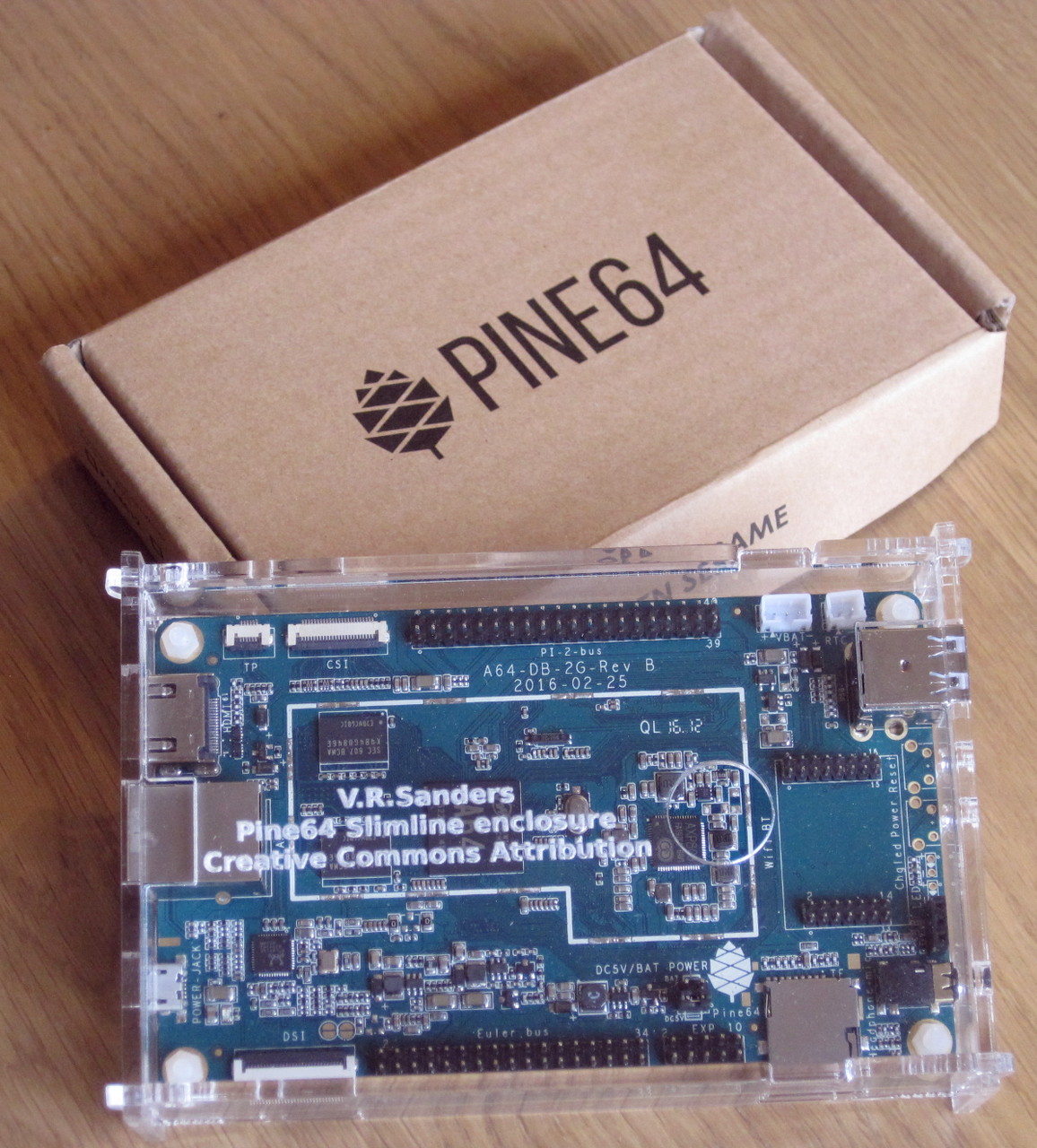
    Pine64 board in my case design
    The system I acquired comprises of:
    Hardware based kickstarter projects are susceptible to several issues and the usual suspects occurred causing delays:
    My personal view is that PINE 64 inc. handled it pretty well, much better than several other projects I have backed and as my Norman Douglas quotation suggests I think they have gained some wisdom from this.

    I received my hardware at the beginning of April only a couple of months after their initial estimated shipping date which as these things go is not a huge delay. I understand some people who had slightly more complex orders were just receiving their orders in late June which is perhaps unfortunate but still well within kickstarter project norms.

    As an aside: I fear that many people simply misunderstand the crowdfunding model for hardware projects and fail to understand that they are not buying a finished product, on the other side of the debate I think many projects need to learn expectation management much better than they do. Hyping the product to get interest is obviously the point of the crowdfunding platform, but over promising and under delivering always causes unhappy customers.

    Pine64 board dimensions
    Despite the delays in production and shipping the information available for the board was (and sadly remains) inadequate. As usual I wanted to case my board and there were no useful dimension drawings so I had to make my own from direct measurements together with a STL 3D model.

    Also a mental sigh for "yet another poor form factor decision" so another special case size and design. After putting together a design and fabricating with the laser cutter I moved on to the software.

    Once more this is where, once again, the story turns bleak. We find a very pretty website but no obvious link to the software (hint scroll to the bottom and find the "support" wiki link) once you find the wiki you will eventually discover that the provided software is either an Android 5.1.1 image (which failed to start on my board) or relies on some random guy from the forums who has put together his own OS images using a hacked up Allwinner Board Support Package (BSP) kernel.

    Now please do not misunderstand me, I think the work by Simon Eisenmann (longsleep) to get a working kernel and Lenny Raposo to get viable OS images is outstanding and useful. I just feel that Allwinner and vendors like Pine64 Inc. should have provided something much, much better than they have. Even the efforts to get mainline support for this hardware are all completely volunteer community efforts and are are making slow progress as a result.

    Assuming I wanted to run a useful OS on this hardware and not just use it as a modern work of art I installed a basic Debian arm64 using Lenny Raposo's pine64 pro site downloads. I was going to use the system for compiling and builds so used the "Debian Base" image to get a minimal setup. After generating unique ssh keys, renaming the default user and checking all the passwords and permissions I convinced myself the system was reasonably trustworthy.

    The standard Debian Jessie OS runs as expected with few surprises. The main concern I have is that there are a number of unpackaged scripts installed (prefixed with pine64_) which perform several operations from reporting system health (using sysfs entries) to upgrading the kernel and bootloader.

    While I understand these scripts have been provided for the novice users to reduce support burden, doing even more of the vendors job, I would much rather have had proper packages for these scripts, kernel and bootloader which apt could manage. This would have reduced image creation to a simple debootstrap giving much greater confidence in the images provenance.

    The 3.10 based kernel is three years old at the time of writing and lacks a great number of features for the aarch64 ARM processors introduced since release. However I was pleasantly surprised at kvm apparently being available.

    # dmesg grep -i kvm
    [ 7.592896] kvm [1]: Using HYP init bounce page @b87c4000
    [ 7.593361] kvm [1]: interrupt-controller@1c84000 IRQ25
    [ 7.593778] kvm [1]: timer IRQ27
    [ 7.593801] kvm [1]: Hyp mode initialized successfully

    I installed the libvirt packages (and hence all their dependencies like qemu) and created a bridge ready for the virtual machines.

    I needed access to storage for the host disc images and while I could have gone the route of using USB attached SATA as with the hikey I decided to try and use network attached storage instead. Initially I investigated iSCSI but it seems the Linux target (iSCSI uses initiator for client and target for server) support is either old, broken or unpackaged.

    I turned to network block device (nbd) which is packaged and seems to have reasonable stability out of the box on modern distributions. This appeared to work well, indeed over the gigabit Ethernet interface I managed to get a sustained 40 megabytes a second read and write rate in basic testing. This is better performance than a USB 2.0 attached SSD on the hikey

    I fired up the guest and perhaps I should have known better than to expect a 3.10 vendor kernel to cope. The immediate hard crashes despite tuning many variables convinced me that virtualisation was not viable with this kernel.

    So abandoning that approach I attempted to run the CI workload directly on the system. To my dismay this also proved problematic. The processor has the bad habit of throttling due to thermal issues (despite a substantial heatsink) and because the storage is network attached throttling the CPU also massively impacts I/O.

    The limitations meant that the workload caused the system to move between high performance and almost no progress on a roughly ten second cycle. This caused a simple NetSurf recompile CI job to take over fifteen minutes. For comparison the same task takes the armhf builder (CubieTruck) four minutes and a 64 bit x86 build which takes around a minute.

    If the workload is tuned to a single core which does not trip thermal throttling the build took seven minutes. which is almost identical to the existing single core virtual machine instance running on the hikey.

    In conclusion the Pine64 is an interesting bit of hardware with fatally flawed software offering. Without Simon and Lenny providing their builds to the community the device would be practically useless rather than just performing poorly. There appears to have been no progress whatsoever on the software offering from Pine64 in the six months since I received the device and no prospect of mainline Allwinner support for the SoC either.

    Effectively I have spent around 50usd (40 for the board and 10 for the enclosure) on a failed experiment. Perhaps in the future the software will improve sufficiently for it to become useful but I do not hold out much hope that this will come from Pine64 themselves.

    3 October 2016

    Markus Koschany: My Free Software Activities in September 2016

    Welcome to gambaru.de. Here is my monthly report that covers what I have been doing for Debian. If you re interested in Android, Java, Games and LTS topics, this might be interesting for you. Debian Android Debian Games Debian Java Debian LTS This was my eight month as a paid contributor and I have been paid to work 12,25 hours on Debian LTS, a project started by Rapha l Hertzog. In that time I did the following: Non-maintainer uploads Misc

    Kees Cook: security things in Linux v4.7

    Previously: v4.6. Onward to security things I found interesting in Linux v4.7: KASLR text base offset for MIPS Matt Redfearn added text base address KASLR to MIPS, similar to what s available on x86 and arm64. As done with x86, MIPS attempts to gather entropy from various build-time, run-time, and CPU locations in an effort to find reasonable sources during early-boot. MIPS doesn t yet have anything as strong as x86 s RDRAND (though most have an instruction counter like x86 s RDTSC), but it does have the benefit of being able to use Device Tree (i.e. the /chosen/kaslr-seed property) like arm64 does. By my understanding, even without Device Tree, MIPS KASLR entropy should be as strong as pre-RDRAND x86 entropy, which is more than sufficient for what is, similar to x86, not a huge KASLR range anyway: default 8 bits (a span of 16MB with 64KB alignment), though CONFIG_RANDOMIZE_BASE_MAX_OFFSET can be tuned to the device s memory, giving a maximum of 11 bits on 32-bit, and 15 bits on EVA or 64-bit. SLAB freelist ASLR Thomas Garnier added CONFIG_SLAB_FREELIST_RANDOM to make slab allocation layouts less deterministic with a per-boot randomized freelist order. This raises the bar for successful kernel slab attacks. Attackers will need to either find additional bugs to help leak slab layout information or will need to perform more complex grooming during an attack. Thomas wrote a post describing the feature in more detail here: Randomizing the Linux kernel heap freelists. (SLAB is done in v4.7, and SLUB in v4.8.) eBPF JIT constant blinding Daniel Borkmann implemented constant blinding in the eBPF JIT subsystem. With strong kernel memory protections (CONFIG_DEBUG_RODATA) in place, and with the segregation of user-space memory execution from kernel (i.e SMEP, PXN, CONFIG_CPU_SW_DOMAIN_PAN), having a place where user-space can inject content into an executable area of kernel memory becomes very high-value to an attacker. The eBPF JIT was exactly such a thing: the use of BPF constants could result in the JIT producing instruction flows that could include attacker-controlled instructions (e.g. by directing execution into the middle of an instruction with a constant that would be interpreted as a native instruction). The eBPF JIT already uses a number of other defensive tricks (e.g. random starting position), but this added randomized blinding to any BPF constants, which makes building a malicious execution path in the eBPF JIT memory much more difficult (and helps block attempts at JIT spraying to bypass other protections). Elena Reshetova updated a 2012 proof-of-concept attack to succeed against modern kernels to help provide a working example of what needed fixing in the JIT. This serves as a thorough regression test for the protection. The cBPF JITs that exist in ARM, MIPS, PowerPC, and Sparc still need to be updated to eBPF, but when they do, they ll gain all these protections immediatley. Bottom line is that if you enable the (disabled-by-default) bpf_jit_enable sysctl, be sure to set the bpf_jit_harden sysctl to 2 (to perform blinding even for root). fix brk ASLR weakness on arm64 compat There have been a few ASLR fixes recently (e.g. ET_DYN, x86 32-bit unlimited stack), and while reviewing some suggested fixes to arm64 brk ASLR code from Jon Medhurst, I noticed that arm64 s brk ASLR entropy was slightly too low (less than 1 bit) for 64-bit and noticeably lower (by 2 bits) for 32-bit compat processes when compared to native 32-bit arm. I simplified the code by using literals for the entropy. Maybe we can add a sysctl some day to control brk ASLR entropy like was done for mmap ASLR entropy. LoadPin LSM LSM stacking is well-defined since v4.2, so I finally upstreamed a small LSM that implements a protection I wrote for Chrome OS several years back. On systems with a static root of trust that extends to the filesystem level (e.g. Chrome OS s coreboot+depthcharge boot firmware chaining to dm-verity, or a system booting from read-only media), it s redundant to sign kernel modules (you ve already got the modules on read-only media: they can t change). The kernel just needs to know they re all coming from the correct location. (And this solves loading known-good firmware too, since there is no convention for signed firmware in the kernel yet.) LoadPin requires that all modules, firmware, etc come from the same mount (and assumes that the first loaded file defines which mount is correct , hence load pinning ). That s it for v4.7. Prepare yourself for v4.8 next!

    2016, Kees Cook. This work is licensed under a Creative Commons Attribution-ShareAlike 3.0 License.
    Creative Commons License

    26 September 2016

    Kees Cook: security things in Linux v4.3

    When I gave my State of the Kernel Self-Protection Project presentation at the 2016 Linux Security Summit, I included some slides covering some quick bullet points on things I found of interest in recent Linux kernel releases. Since there wasn t a lot of time to talk about them all, I figured I d make some short blog posts here about the stuff I was paying attention to, along with links to more information. This certainly isn t everything security-related or generally of interest, but they re the things I thought needed to be pointed out. If there s something security-related you think I should cover from v4.3, please mention it in the comments. I m sure I haven t caught everything. :) A note on timing and context: the momentum for starting the Kernel Self Protection Project got rolling well before it was officially announced on November 5th last year. To that end, I included stuff from v4.3 (which was developed in the months leading up to November) under the umbrella of the project, since the goals of KSPP aren t unique to the project nor must the goals be met by people that are explicitly participating in it. Additionally, not everything I think worth mentioning here technically falls under the kernel self-protection ideal anyway some things are just really interesting userspace-facing features. So, to that end, here are things I found interesting in v4.3: CONFIG_CPU_SW_DOMAIN_PAN Russell King implemented this feature for ARM which provides emulated segregation of user-space memory when running in kernel mode, by using the ARM Domain access control feature. This is similar to a combination of Privileged eXecute Never (PXN, in later ARMv7 CPUs) and Privileged Access Never (PAN, coming in future ARMv8.1 CPUs): the kernel cannot execute user-space memory, and cannot read/write user-space memory unless it was explicitly prepared to do so. This stops a huge set of common kernel exploitation methods, where either a malicious executable payload has been built in user-space memory and the kernel was redirected to run it, or where malicious data structures have been built in user-space memory and the kernel was tricked into dereferencing the memory, ultimately leading to a redirection of execution flow. This raises the bar for attackers since they can no longer trivially build code or structures in user-space where they control the memory layout, locations, etc. Instead, an attacker must find areas in kernel memory that are writable (and in the case of code, executable), where they can discover the location as well. For an attacker, there are vastly fewer places where this is possible in kernel memory as opposed to user-space memory. And as we continue to reduce the attack surface of the kernel, these opportunities will continue to shrink. While hardware support for this kind of segregation exists in s390 (natively separate memory spaces), ARM (PXN and PAN as mentioned above), and very recent x86 (SMEP since Ivy-Bridge, SMAP since Skylake), ARM is the first upstream architecture to provide this emulation for existing hardware. Everyone running ARMv7 CPUs with this kernel feature enabled suddenly gains the protection. Similar emulation protections (PAX_MEMORY_UDEREF) have been available in PaX/Grsecurity for a while, and I m delighted to see a form of this land in upstream finally. To test this kernel protection, the ACCESS_USERSPACE and EXEC_USERSPACE triggers for lkdtm have existed since Linux v3.13, when they were introduced in anticipation of the x86 SMEP and SMAP features. Ambient Capabilities Andy Lutomirski (with Christoph Lameter and Serge Hallyn) implemented a way for processes to pass capabilities across exec() in a sensible manner. Until Ambient Capabilities, any capabilities available to a process would only be passed to a child process if the new executable was correctly marked with filesystem capability bits. This turns out to be a real headache for anyone trying to build an even marginally complex least privilege execution environment. The case that Chrome OS ran into was having a network service daemon responsible for calling out to helper tools that would perform various networking operations. Keeping the daemon not running as root and retaining the needed capabilities in children required conflicting or crazy filesystem capabilities organized across all the binaries in the expected tree of privileged processes. (For example you may need to set filesystem capabilities on bash!) By being able to explicitly pass capabilities at runtime (instead of based on filesystem markings), this becomes much easier. For more details, the commit message is well-written, almost twice as long as than the code changes, and contains a test case. If that isn t enough, there is a self-test available in tools/testing/selftests/capabilities/ too. PowerPC and Tile support for seccomp filter Michael Ellerman added support for seccomp to PowerPC, and Chris Metcalf added support to Tile. As the seccomp maintainer, I get excited when an architecture adds support, so here we are with two. Also included were updates to the seccomp self-tests (in tools/testing/selftests/seccomp), to help make sure everything continues working correctly. That s it for v4.3. If I missed stuff you found interesting, please let me know! I m going to try to get more per-version posts out in time to catch up to v4.8, which appears to be tentatively scheduled for release this coming weekend.

    2016, Kees Cook. This work is licensed under a Creative Commons Attribution-ShareAlike 3.0 License.
    Creative Commons License

    25 September 2016

    Vincent Sanders: I'll huff, and I'll puff, and I'll blow your house in

    Sometimes it really helps to have a different view on a problem and after my recent writings on my Public Suffix List (PSL) library I was fortunate to receive a suggestion from my friend Enrico Zini.

    I had asked for suggestions on reducing the size of the library further and Enrico simply suggested Huffman coding. This was a technique I had learned about long ago in connection with data compression and the intervening years had made all the details fuzzy which explains why it had not immediately sprung to mind.

    A small subset of the Public Suffix List as stored within libnspslHuffman coding named for David A. Huffman is an algorithm that enables a representation of data which is very efficient. In a normal array of characters every character takes the same eight bits to represent which is the best we can do when any of the 256 values possible is equally likely. If your data is not evenly distributed this is not the case for example if the data was english text then the value is fifteen times more likely to be that for e than k.

    every step of huffman encoding tree build for the example string tableSo if we have some data with a non uniform distribution of probabilities we need a way the data be encoded with fewer bits for the common values and more bits for the rarer values. To be efficient we would need some way of having variable length representations without storing the length separately. The term for this data representation is a prefix code and there are several ways to generate them.

    Such is the influence of Huffman on the area of prefix codes they are often called Huffman codes even if they were not created using his algorithm. One can dream of becoming immortalised like this, to join the ranks of those whose names are given to units or whole ideas in a field must be immensely rewarding, however given Huffman invented his algorithm and proved it to be optimal to answer a question on a term paper in his early twenties I fear I may already be a bit too late.

    The algorithm itself is relatively straightforward. First a frequency analysis is performed, a fancy way of saying count how many of each character is in the input data. Next a binary tree is created by using a priority queue initialised with the nodes sorted by frequency.

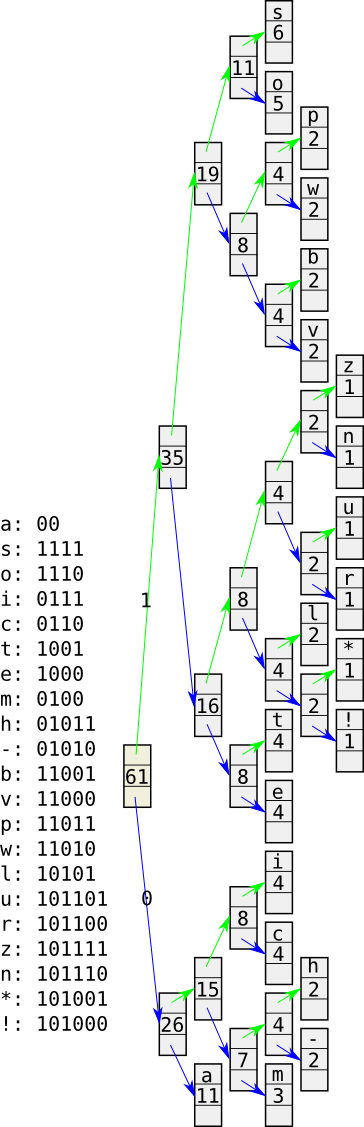
    The resulting huffman tree and the binary representation of the input symbols
    The two least frequent items count is summed together and a node placed in the tree with the two original entries as child nodes. This step is repeated until a single node exists with a count value equal to the length of the input.

    To encode data once simply walks the tree outputting a 0 for a left node or 1 for right node until reaching the original value. This generates a mapping of values to bit output, the input is then simply converted value by value to the bit output. To decode the data the data is used bit by bit to walk the tree to arrive at values.

    If we perform this algorithm on the example string table *!asiabvcomcoopitamazonawsarsaves-the-whalescomputebasilicata we can reduce the 488 bits (61 * 8 bit characters) to 282 bits or 40% reduction. Obviously in a real application the huffman tree would need to be stored which would probably exceed this saving but for larger data sets it is probable this technique would yield excellent results on this kind of data.

    Once I proved this to myself I implemented the encoder within the existing conversion program. Although my perl encoder is not very efficient it can process the entire PSL string table (around six thousand labels using 40KB or so) in less than a second, so unless the table grows massively an inelegant approach will suffice.

    The resulting bits were packed into 32bit values to improve decode performance (most systems prefer to deal with larger memory fetches less frequently) and resulted in 18KB of output or 47% of the original size. This is a great improvement in size and means the statically linked test program is now 59KB and is actually smaller than the gzipped source data.

    $ ls -alh test_nspsl
    -rwxr-xr-x 1 vince vince 59K Sep 25 23:58 test_nspsl
    $ ls -al public_suffix_list.dat.gz
    -rw-r--r-- 1 vince vince 62K Sep 1 08:52 public_suffix_list.dat.gz

    To be clear the statically linked program can determine if a domain is in the PSL with no additional heap allocations and includes the entire PSL ordered tree, the domain label string table and the huffman decode table to read it.

    An unexpected side effect is that because the decode loop is small it sits in the processor cache. This appears to cause the string comparison function huffcasecmp() (which is not locale dependant because we know the data will be limited ASCII) performance to be close to using strcasecmp() indeed on ARM32 systems there is a very modest improvement in performance.

    I think this is as much work as I am willing to put into this library but I am pleased to have achieved a result which is on par with the best of breed (libpsl still has a data representation 20KB smaller than libnspsl but requires additional libraries for additional functionality) and I got to (re)learn an important algorithm too.

    Julian Andres Klode: Introducing TrieHash, a order-preserving minimal perfect hash function generator for C(++)

    Abstract I introduce TrieHash an algorithm for constructing perfect hash functions from tries. The generated hash functions are pure C code, minimal, order-preserving and outperform existing alternatives. Together with the generated header files,they can also be used as a generic string to enumeration mapper (enums are created by the tool). Introduction APT (and dpkg) spend a lot of time in parsing various files, especially Packages files. APT currently uses a function called AlphaHash which hashes the last 8 bytes of a word in a case-insensitive manner to hash fields in those files (dpkg just compares strings in an array of structs). There is one obvious drawback to using a normal hash function: When we want to access the data in the hash table, we have to hash the key again, causing us to hash every accessed key at least twice. It turned out that this affects something like 5 to 10% of the cache generation performance. Enter perfect hash functions: A perfect hash function matches a set of words to constant values without collisions. You can thus just use the index to index into your hash table directly, and do not have to hash again (if you generate the function at compile time and store key constants) or handle collision resolution. As #debian-apt people know, I happened to play a bit around with tries this week before guillem suggested perfect hashing. Let me tell you one thing: My trie implementation was very naive, that did not really improve things a lot Enter TrieHash Now, how is this related to hashing? The answer is simple: I wrote a perfect hash function generator that is based on tries. You give it a list of words, it puts them in a trie, and generates C code out of it, using recursive switch statements (see code generation below). The function achieves competitive performance with other hash functions, it even usually outperforms them. Given a dictionary, it generates an enumeration (a C enum or C++ enum class) of all words in the dictionary, with the values corresponding to the order in the dictionary (the order-preserving property), and a function mapping strings to members of that enumeration. By default, the first word is considered to be 0 and each word increases a counter by one (that is, it generates a minimal hash function). You can tweak that however:
    = 0
    WordLabel ~ Word
    OtherWord = 9
    
    will return 0 for an unknown value, map Word to the enum member WordLabel and map OtherWord to 9. That is, the input list functions like the body of a C enumeration. If no label is specified for a word, it will be generated from the word. For more details see the documentation C code generation
    switch(string[0]   32)  
    case 't':
        switch(string[1]   32)  
        case 'a':
            switch(string[2]   32)  
            case 'g':
                return Tag;


    return Unknown;
    Yes, really recursive switches they directly represent the trie. Now, we did not really do a straightforward translation, there are some optimisations to make the whole thing faster and easier to look at: First of all, the 32 you see is used to make the check case insensitive in case all cases of the switch body are alphabetical characters. If there are non-alphabetical characters, it will generate two cases per character, one upper case and one lowercase (with one break in it). I did not know that lowercase and uppercase characters differed by only one bit before, thanks to the clang compiler for pointing that out in its generated assembler code! Secondly, we only insert breaks only between cases. Initially, each case ended with a return Unknown, but guillem (the dpkg developer) suggested it might be faster to let them fallthrough where possible. Turns out it was not faster on a good compiler, but it s still more readable anywhere. Finally, we build one trie per word length, and switch by the word length first. Like the 32 trick, his gives a huge improvement in performance. Digging into the assembler code The whole code translates to roughly 4 instructions per byte:
    1. A memory load,
    2. an or with 32
    3. a comparison, and
    4. a conditional jump.
    (On x86, the case sensitive version actually only has a cmp-with-memory and a conditional jump). Due to https://gcc.gnu.org/bugzilla/show_bug.cgi?id=77729 this may be one instruction more: On some architectures an unneeded zero-extend-byte instruction is inserted this causes a 20% performance loss. Performance evaluation I run the hash against all 82 words understood by APT in Packages and Sources files, 1,000,000 times for each word, and summed up the average run-time:
    host arch Trie TrieCase GPerfCase GPerf DJB
    plummer ppc64el 540 601 1914 2000 1345
    eller mipsel 4728 5255 12018 7837 4087
    asachi arm64 1000 1603 4333 2401 1625
    asachi armhf 1230 1350 5593 5002 1784
    barriere amd64 689 950 3218 1982 1776
    x230 amd64 465 504 1200 837 693
    Suffice to say, GPerf does not really come close. All hosts except the x230 are Debian porterboxes. The x230 is my laptop with a a Core i5-3320M, barriere has an Opteron 23xx. I included the DJB hash function for another reference. Source code The generator is written in Perl, licensed under the MIT license and available from https://github.com/julian-klode/triehash I initially prototyped it in Python, but guillem complained that this would add new build dependencies to dpkg, so I rewrote it in Perl. Benchmark is available from https://github.com/julian-klode/hashbench Usage See the script for POD documentation.
    Filed under: General

    19 September 2016

    Mike Gabriel: Rocrail changed License to some dodgy non-free non-License

    The Background Story A year ago, or so, I took some time to search the internet for Free Software that can be used for controlling model railways via a computer. I was happy to find Rocrail [1] being one of only a few applications available on the market. And even more, I was very happy when I saw that it had been licensed under a Free Software license: GPL-3(+). A month ago, or so, I collected my old M rklin (Digital) stuff from my parents' place and started looking into it again after +15 years, together with my little son. Some weeks ago, I remembered Rocrail and thought... Hey, this software was GPLed code and absolutely suitable for uploading to Debian and/or Ubuntu. I searched for the Rocrail source code and figured out that it got hidden from the web some time in 2015 and that the license obviously has been changed to some non-free license (I could not figure out what license, though). This made me very sad! I thought I had found a piece of software that might be interesting for testing with my model railway. Whenever I stumble over some nice piece of Free Software that I plan to use (or even only play with), I upload this to Debian as one of the first steps. However, I highly attempt to stay away from non-free sofware, so Rocrail has become a no-option for me back in 2015. I should have moved on from here on... Instead... Proactively, I signed up with the Rocrail forum and asked the author(s) if they see any chance of re-licensing the Rocrail code under GPL (or any other FLOSS license) again [2]? When I encounter situations like this, I normally offer my expertise and help with such licensing stuff for free. My impression until here already was that something strange must have happened in the past, so that software developers choose GPL and later on stepped back from that decision and from then on have been hiding the source code from the web entirely. Going deeper... The Rocrail project's wiki states that anyone can request GitBlit access via the forum and obtain the source code via Git for local build purposes only. Nice! So, I asked for access to the project's Git repository, which I had been granted. Thanks for that. Trivial Source Code Investigation... So far so good. I investigated the source code (well, only the license meta stuff shipped with the source code...) and found that the main COPYING files (found at various locations in the source tree, containing a full version of the GPL-3 license) had been replaced by this text:
    Copyright (c) 2002 Robert Jan Versluis, Rocrail.net
    All rights reserved.
    Commercial usage needs permission.
    
    The replacement happened with these Git commits:
    commit cfee35f3ae5973e97a3d4b178f20eb69a916203e
    Author: Rob Versluis <r.j.versluis@rocrail.net>
    Date:   Fri Jul 17 16:09:45 2015 +0200
        update copyrights
    commit df399d9d4be05799d4ae27984746c8b600adb20b
    Author: Rob Versluis <r.j.versluis@rocrail.net>
    Date:   Wed Jul 8 14:49:12 2015 +0200
        update licence
    commit 0daffa4b8d3dc13df95ef47e0bdd52e1c2c58443
    Author: Rob Versluis <r.j.versluis@rocrail.net>
    Date:   Wed Jul 8 10:17:13 2015 +0200
        update
    
    Getting in touch again, still being really interested and wanting to help... As I consider such a non-license as really dangerous when distributing any sort of software, be it Free or non-free Software, I posted the below text on the Rocrail forum:
    Hi Rob,
    I just stumbled over this post [3] [link reference adapted for this
    blog post), which probably is the one you have referred to above.
    It seems that Rocrail contains features that require a key or such
    for permanent activation.  Basically, this is allowed and possible
    even with the GPL-3+ (although Free Software activists will  not
    appreciate that). As the GPL states that people can share the source
    code, programmers can  easily deactivate license key checks (and
    such) in the code and re-distribute that patchset as they  like.
    Furthermore, the current COPYING file is really non-protective at
    all. It does not really protect   you as copyright holder of the
    code. Meaning, if people crash their trains with your software, you  
    could actually be legally prosecuted for that. In theory. Or in the
    U.S. ( ;-) ). Main reason for  having a long long license text is to
    protect you as the author in case your software causes t trouble to
    other people. You do not have any warranty disclaimer in your COPYING
    file or elsewhere. Really not a good idea.
    In that referenced post above, someone also writes about the nuisance
    of license discussions in  this forum. I have seen various cases
    where people produced software and did not really care for 
    licensing. Some ended with a letter from a lawyer, some with some BIG
    company using their code  under their copyright holdership and their
    own commercial licensing scheme. This is not paranoia,  this is what
    happens in the Free Software world from time to time.
    A model that might be much more appropriate (and more protective to
    you as the author), maybe, is a  dual release scheme for the code. A
    possible approach could be to split Rocrail into two editions:  
    Community Edition and Professional/Commercial Edition. The Community
    Edition must be licensed in a  way that it allows re-using the code
    in a closed-source, non-free version of Rocrail (e.g.   MIT/Expat
    License or Apache2.0 License). Thus, the code base belonging to the
    community edition  would be licensed, say..., as Apache-2.0 and for
    the extra features in the Commercial Edition, you  may use any
    non-free license you want (but please not that COPYING file you have
    now, it really  does not protect your copyright holdership).
    The reason for releasing (a reduced set of features of a) software as
    Free Software is to extend  the user base. The honey jar effect, as
    practise by many huge FLOSS projects (e.g. Owncloud,  GitLab, etc.).
    If people could install Rocrail from the Debian / Ubuntu archives
    directly, I am  sure that the user base of Rocrail will increase.
    There may also be developers popping up showing  an interest in
    Rocrail (e.g. like me). However, I know many FLOSS developers (e.g.
    like me) that  won't waste their free time on working for a non-free
    piece of software (without being paid).
    If you follow (or want to follow) a business model with Rocrail, then
    keep some interesting  features in the Commercial Edition and don't
    ship that source code. People with deep interest may  opt for that.
    Furthermore, another option could be dual licensing the code. As the
    copyright holder of Rocrail  you are free to juggle with licenses and
    apply any license to a release you want. For example, this  can be
    interesing for a free-again Rocrail being shipped via Apple's iStore. 
    Last but not least, as you ship the complete source code with all
    previous changes as a Git project  to those who request GitBlit
    access, it is possible to obtain all earlier versions of Rocrail. In 
    the mail I received with my GitBlit credentials, there was some text
    that  prohibits publishing the  code. Fine. But: (in theory) it is
    not forbidden to share the code with a friend, for local usage.  This
    friend finds the COPYING file, frowns and rewinds back to 2015 where
    the license was still  GPL-3+. GPL-3+ code can be shared with anyone
    and also published, so this friend could upload the  2015-version of
    Rocrail to Github or such and start to work on a free fork. You also
    may not want  this.
    Thanks for working on this piece of software! It is highly
    interesing, and I am still sad, that it  does not come with a free
    license anymore. I won't continue this discussion and move on, unless
    you  are interested in any of the above information and ask for more
    expertise. Ping me here or directly  via mail, if needed. If the
    expertise leads to parts of Rocrail becoming Free Software again, the 
    expertise is offered free of charge ;-).
    light+love
    Mike
    
    Wow, the first time I got moderated somewhere... What an experience! This experience now was really new. My post got immediately removed from the forum by the main author of Rocrail (with the forum's moderator's hat on). The new experience was: I got really angry when I discovererd having been moderated. Wow! Really a powerful emotion. No harassment in my words, no secrets disclosed, and still... my free speech got suppressed by someone. That feels intense! And it only occurred in the virtual realm, not face to face. Wow!!! I did not expect such intensity... The reason for wiping my post without any other communication was given as below and quite a statement to frown upon (this post has also been "moderately" removed from the forum thread [2] a bit later today):
    Mike,
    I think its not a good idea to point out a way to get the sources back to the GPL periode.
    Therefore I deleted your posting.
    
    (The phpBB forum software also allows moderators to edit posts, so the critical passage could have been removed instead, but immediately wiping the full message, well...). Also, just wiping my post and not replying otherwise with some apology to suppress my words, really is a no-go. And the reason for wiping the rest of the text... Any Git user can easily figure out how to get a FLOSS version of Rocrail and continue to work on that from then on. Really. Now the political part of this blog post... Fortunately, I still live in an area of the world where the right of free speech is still present. I found out: I really don't like being moderated!!! Esp. if what I share / propose is really noooo secret at all. Anyone who knows how to use Git can come to the same conclusion as I have come to this morning. [Off-topic, not at all related to Rocrail: The last votes here in Germany indicate that some really stupid folks here yearn for another this time highly idiotic wind of change, where free speech may end up as a precious good.] To other (Debian) Package Maintainers and Railroad Enthusiasts... With this blog post I probably close the last option for Rocrail going FLOSS again. Personally, I think that gate was already closed before I got in touch. Now really moving on... Probably the best approach for my new train conductor hobby (as already recommended by the woman at my side some weeks back) is to leave the laptop lid closed when switching on the train control units. I should have listened to her much earlier. I have finally removed the Rocrail source code from my computer again without building and testing the application. I neither have shared the source code with anyone. Neither have I shared the Git URL with anyone. I really think that FLOSS enthusiasts should stay away from this software for now. For my part, I have lost my interest in this completely... References light+love,
    Mike

    17 September 2016

    Jonas Meurer: apache rewritemap querystring

    Apache2: Rewrite REQUEST_URI based on a bulk list of GET parameters in QUERY_STRING Recently I searched for a solution to rewrite a REQUEST_URI based on GET parameters in QUERY_STRING. To make it even more complicated, I had a list of ~2000 parameters that have to be rewritten like the following:
    if % QUERY_STRING  starts with one of <parameters>:
        rewrite % REQUEST_URI  from /new/ to /old/
    
    Honestly, it took me several hours to find a solution that was satisfying and scales well. Hopefully, this post will save time for others with the need for a similar solution. Research and first attempt: RewriteCond % QUERY_STRING ... After reading through some documentation, particularly Manipulating the Query String, the following ideas came to my mind at first:
    RewriteCond % REQUEST_URI  ^/new/
    RewriteCond % QUERY_STRING  ^(param1)(.*)$ [OR]
    RewriteCond % QUERY_STRING  ^(param2)(.*)$ [OR]
    ...
    RewriteCond % QUERY_STRING  ^(paramN)(.*)$
    RewriteRule /new/ /old/?%1%2 [R,L]
    
    or instead of an own RewriteCond for each parameter:
    RewriteCond % QUERY_STRING  ^(param1 param2 ... paramN)(.*)$
    

    There has to be something smarter ... But with ~2000 parameters to look up, neither of the solutions seemed particularly smart. Both scale really bad and probably it's rather heavy stuff for Apache to check ~2000 conditions for every ^/new/ request. Instead I was searching for a solution to lookup a string from a compiled list of strings. RewriteMap seemed like it might be what I was searching for. I read the Apache2 RewriteMap documentation here and here and finally found a solution that worked as expected, with one limitation. But read on ... The solution: RewriteMap and RewriteCond $ mapfile:% QUERY_STRING ... Finally, the solution was to use a RewriteMap with all parameters that shall be rewritten and check given parameters in the requests against this map within a RewriteCond. If the parameter matches, the simple RewriteRule applies. For the inpatient, here's the rewrite magic from my VirtualHost configuration:
    RewriteEngine On
    RewriteMap RewriteParams "dbm:/tmp/rewrite-params.map"
    RewriteCond % REQUEST_URI  ^/new/
    RewriteCond $ RewriteParams:% QUERY_STRING NOT_FOUND  !=NOT_FOUND
    RewriteRule ^/new/ /old/ [R,L]
    

    A more detailed description of the solution First, I created a RewriteMap at /tmp/rewrite-params.txt with all parameters to be rewritten. A RewriteMap requires two field per line, one with the origin and the other one with the replacement part. Since I use the RewriteMap merely for checking the condition, not for real string replacement, the second field doesn't matter to me. I ended up putting my parameters in both fields, but you could choose every random value for the second field: /tmp/rewrite-params.txt:
    param1 param1
    param2 param2
    ...
    paramN paramN
    
    Then I created a DBM hash map file from that plain text map file, as DBM maps are indexed, while TXT maps are not. In other words: with big maps, DBM is a huge performance boost:
    httxt2dbm -i /tmp/rewrite-params.txt -o /tmp/rewrite-params.map
    

    Now, let's go through the VirtualHost configuration rewrite magic from above line by line. First line should be clear: it enables the Apache Rewrite Engine:
    RewriteEngine On
    
    Second line defines the RewriteMap that I created above. It contains the list of parameters to be rewritten:
    RewriteMap RewriteParams "dbm:/tmp/rewrite-params.map"
    
    The third line limits the rewrites to REQUEST_URIs that start with /new/. This is particularly required to prevent rewrite loops. Without that condition, queries that have been rewritten to /old/ would go through the rewrite again, resulting in an endless rewrite loop:
    RewriteCond % REQUEST_URI  ^/new/
    
    The fourth line is the core condition: it checks whether QUERY_STRING (the GET parameters) is listed in the RewriteMap. A fallback value 'NOT_FOUND' is defined if the lookup didn't match. The condition is only true, if the lookup was successful and the QUERY_STRING was found within the map:
    RewriteCond $ RewriteParams:% QUERY_STRING NOT_FOUND  !=NOT_FOUND
    
    The last line is a simple RewriteRule from /new/ to /old/. It is executed only if all previous conditions are met. The flags are R for redirect (issuing a HTTP redirect to browser) and L for last (causing mod_rewrite to stop processing immediately after that rule):
    RewriteRule ^/new/ /old/ [R,L]
    

    Known issues A big limitation of this solution (compared to the ones above) is, that it looks up the whole QUERY_STRING in RewriteMap. Therefore, it works only if param is the only GET parameter. In case of additional GET parameters, the second rewrite condition fails and nothing is rewritten even if the first GET parameter is listed in RewriteMap. If anyone comes up with a solution to this limitation, I would be glad to learn about it :)

    16 September 2016

    Steinar H. Gunderson: BBR opensourced

    This is pretty big stuff for anyone who cares about TCP. Huge congrats to the team at Google.

    13 September 2016

    John Goerzen: Two Boys, An Airplane, Plus Hundreds of Old Computers

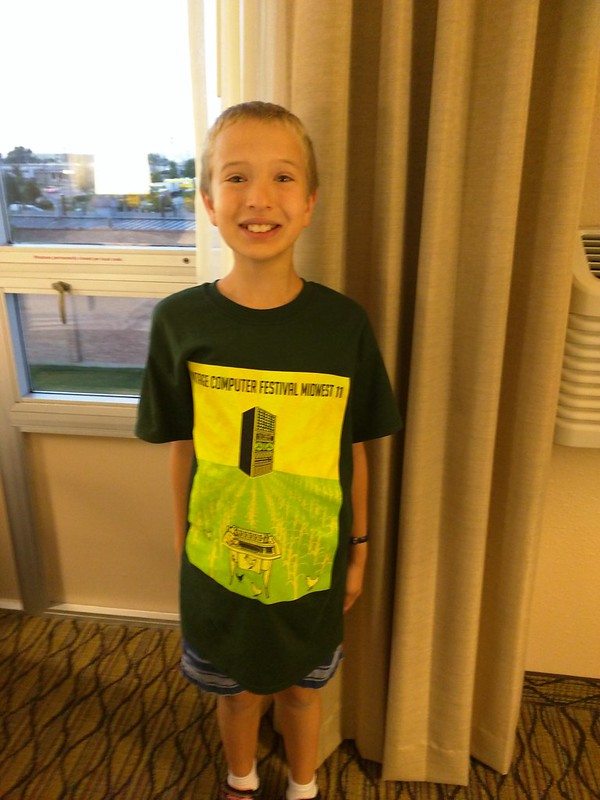
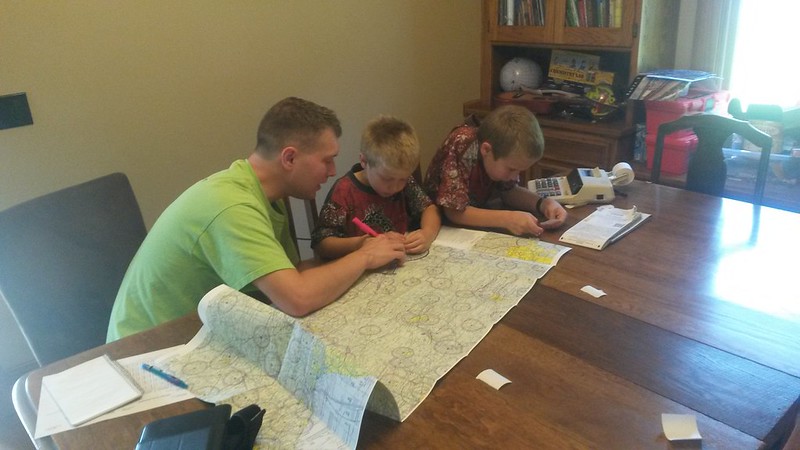
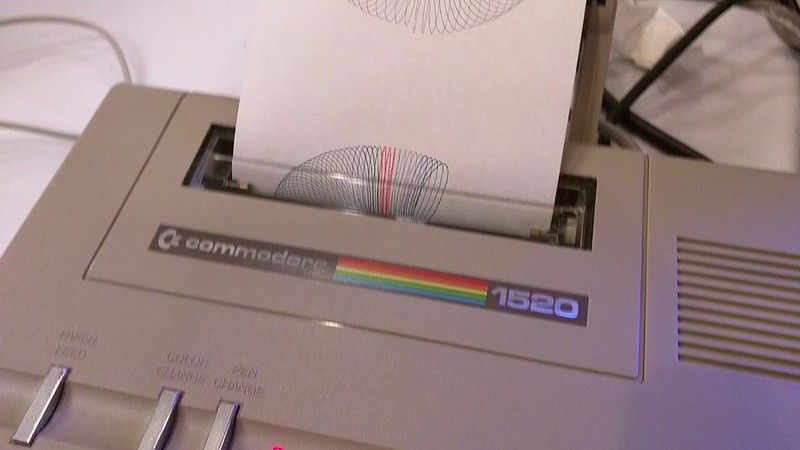
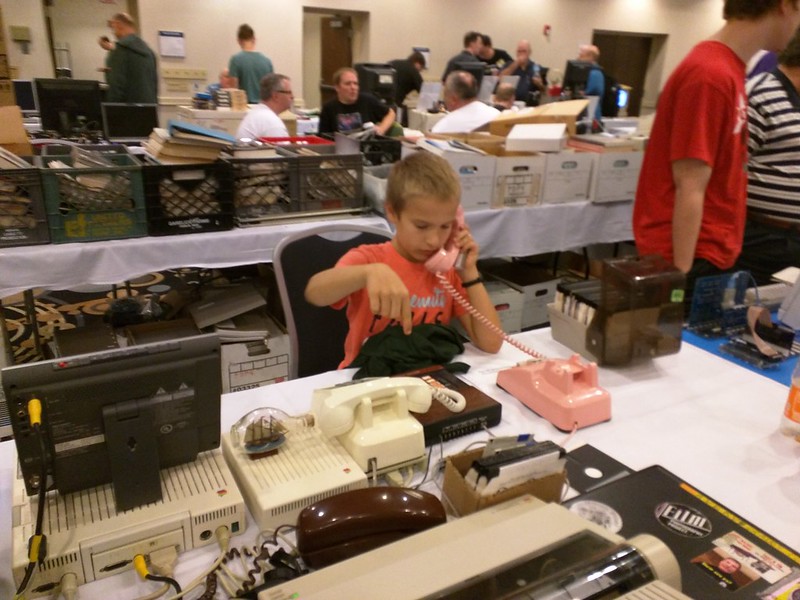
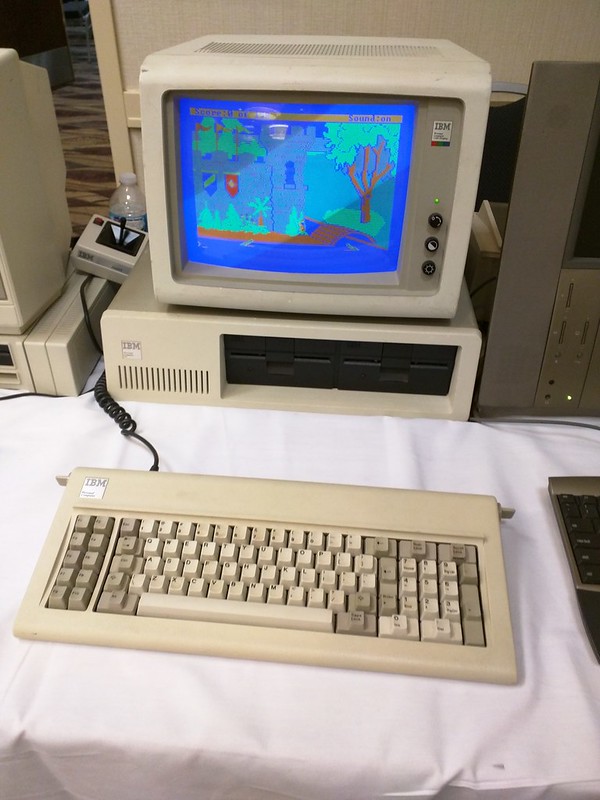
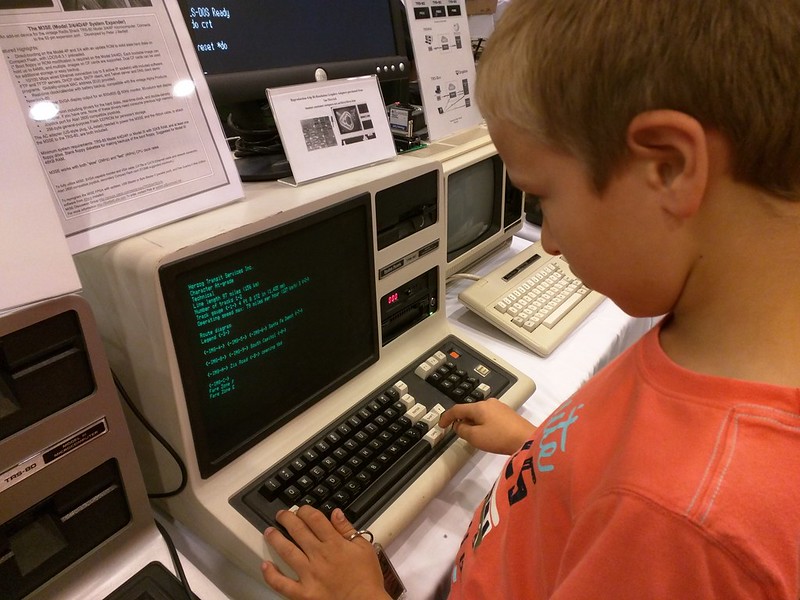
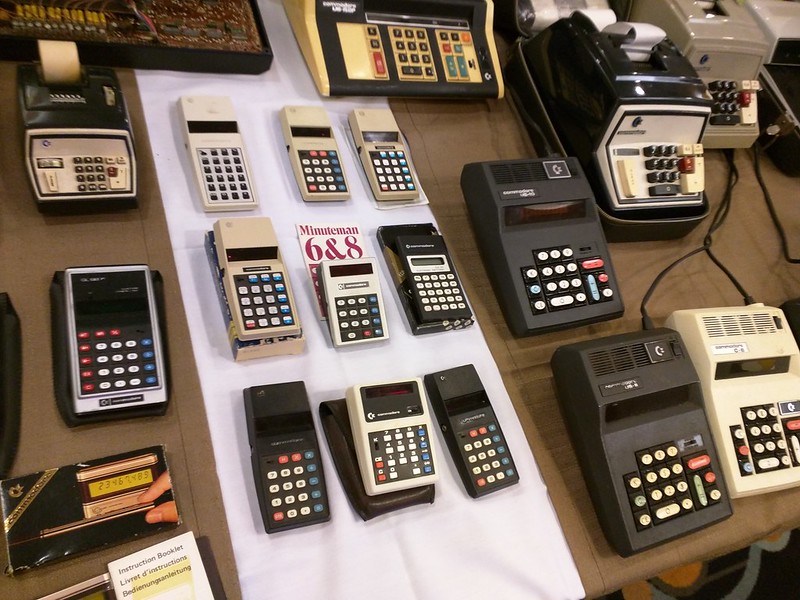
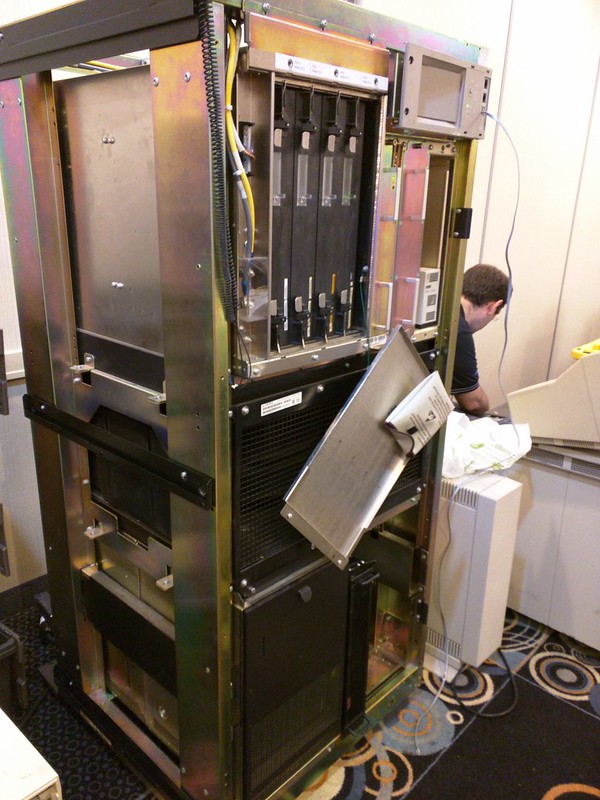
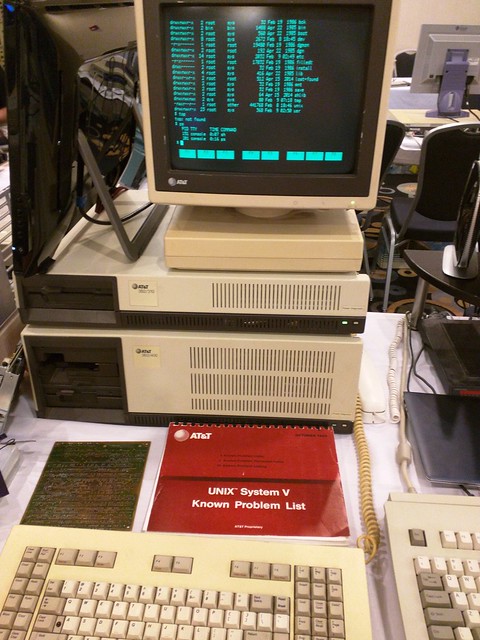
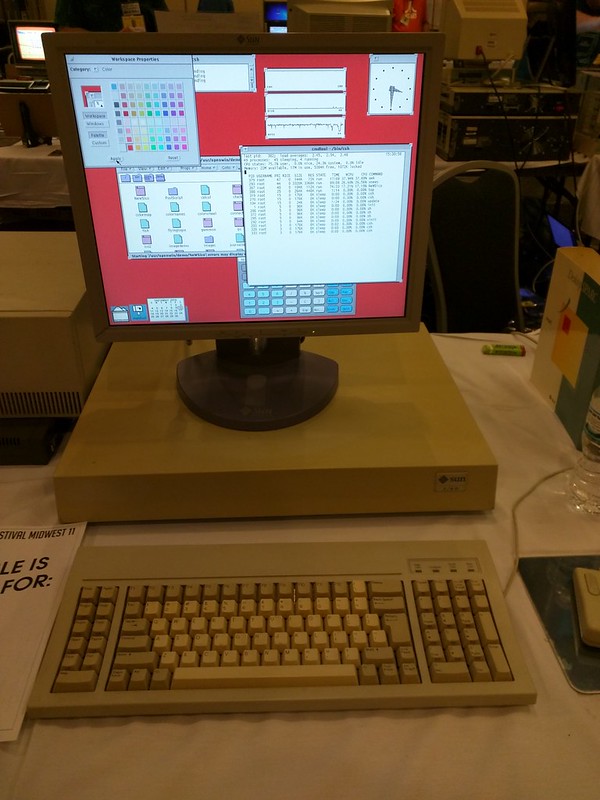
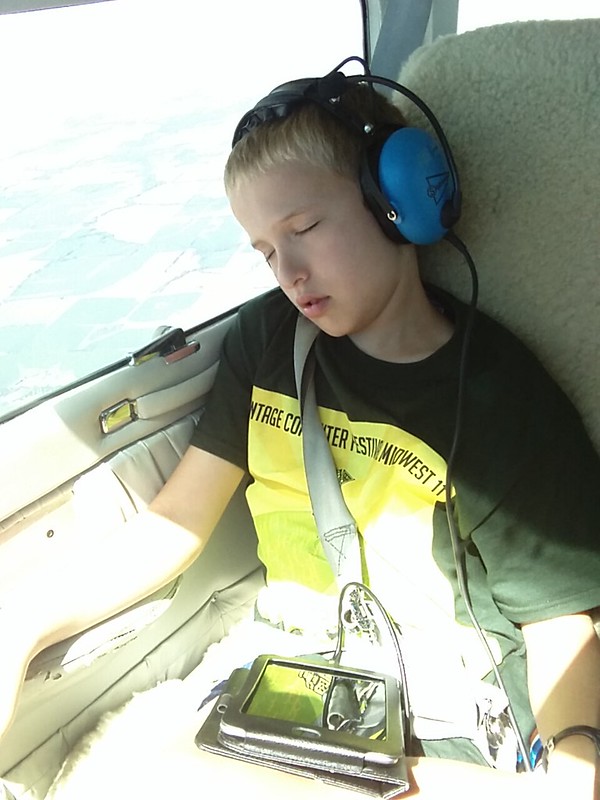
    Was there anything you didn t like about our trip? Jacob s answer: That we had to leave so soon! That s always a good sign. When I first heard about the Vintage Computer Festival Midwest, I almost immediately got the notion that I wanted to go. Besides the TRS-80 CoCo II up in my attic, I also have fond memories of an old IBM PC with CGA monitor, a 25MHz 486, an Alpha also in my attic, and a lot of other computers along the way. I didn t really think my boys would be interested. But I mentioned it to them, and they just lit up. They remembered the Youtube videos I d shown them of old line printers and punch card readers, and thought it would be great fun. I thought it could be a great educational experience for them too and it was. It also turned into a trip that combined being a proud dad with so many of my other interests. Quite a fun time. IMG_20160911_061456 (Jacob modeling his new t-shirt) Captain Jacob Chicago being not all that close to Kansas, I planned to fly us there. If you re flying yourself, solid flight planning is always important. I had already planned out my flight using electronic tools, but I always carry paper maps with me in the cockpit for backup. I got them out and the boys and I planned out the flight the old-fashioned way. Here s Oliver using a scale ruler (with markings for miles corresponding to the scale of the map) and Jacob doing calculating for us. We measured the entire route and came to within one mile of the computer s calculation for each segment those boys are precise! 20160904_175519 We figured out how much fuel we d use, where we d make fuel stops, etc. The day of our flight, we made it as far as Davenport, Iowa when a chance of bad weather en route to Chicago convinced me to land there and drive the rest of the way. The boys saw that as part of the exciting adventure! Jacob is always interested in maps, and had kept wanting to use my map whenever we flew. So I dug an old Android tablet out of the attic, put Avare on it (which has aviation maps), and let him use that. He was always checking it while flying, sometimes saying this over his headset: DING. Attention all passengers, this is Captain Jacob speaking. We are now 45 miles from St. Joseph. Our altitude is 6514 feet. Our speed is 115 knots. We will be on the ground shortly. Thank you. DING Here he is at the Davenport airport, still busy looking at his maps: IMG_20160909_183813 Every little airport we stopped at featured adults smiling at the boys. People enjoyed watching a dad and his kids flying somewhere together. Oliver kept busy too. He loves to help me on my pre-flight inspections. He will report every little thing to me a scratch, a fleck of paint missing on a wheel cover, etc. He takes it seriously. Both boys love to help get the plane ready or put it away. The Computers Jacob quickly gravitated towards a few interesting things. He sat for about half an hour watching this old Commodore plotter do its thing (click for video): VID_20160910_142044 His other favorite thing was the phones. Several people had brought complete analog PBXs with them. They used them to demonstrate various old phone-related hardware; one had several BBSs running with actual modems, another had old answering machines and home-security devices. Jacob learned a lot about phones, including how to operate a rotary-dial phone, which he d never used before! IMG_20160910_151431 Oliver was drawn more to the old computers. He was fascinated by the IBM PC XT, which I explained was just about like a model I used to get to use sometimes. They learned about floppy disks and how computers store information. IMG_20160910_195145 He hadn t used joysticks much, and found Pong ( this is a soccer game! ) interesting. Somebody has also replaced the guts of a TRS-80 with a Raspberry Pi running a SNES emulator. This had thoroughly confused me for a little while, and excited Oliver. Jacob enjoyed an old TRS-80, which, through a modern Ethernet interface and a little computation help in AWS, provided an interface to Wikipedia. Jacob figured out the text-mode interface quickly. Here he is reading up on trains. IMG_20160910_140524 I had no idea that Commodore made a lot of adding machines and calculators before they got into the home computer business. There was a vast table with that older Commodore hardware, too much to get on a single photo. But some of the adding machines had their covers off, so the boys got to see all the little gears and wheels and learn how an adding machine can do its printing. IMG_20160910_145911 And then we get to my favorite: the big iron. Here is a VAX a working VAX. When you have a computer that huge, it s easier for the kids to understand just what something is. IMG_20160910_125451 When we encountered the table from the Glenside Color Computer Club, featuring the good old CoCo IIs like what I used as a kid (and have up in my attic), I pointed out to the boys that we have a computer just like this that can do these things and they responded wow! I think they are eager to try out floppy disks and disk BASIC now. Some of my favorites were the old Unix systems, which are a direct ancestor to what I ve been working with for decades now. Here s AT&T System V release 3 running on its original hardware: IMG_20160910_144923 And there were a couple of Sun workstations there, making me nostalgic for my college days. If memory serves, this one is actually running on m68k in the pre-Sparc days: IMG_20160910_153418 Returning home After all the excitement of the weekend, both boys zonked out for awhile on the flight back home. Here s Jacob, sleeping with his maps still up. IMG_20160911_132952 As we were nearly home, we hit a pocket of turbulence, the kind that feels as if the plane is dropping a bit (it s perfectly normal and safe; you ve probably felt that on commercial flights too). I was a bit concerned about Oliver; he is known to get motion sick in cars (and even planes sometimes). But what did I hear from Oliver? Whee! That was fun! It felt like a roller coaster! Do it again, dad!

    12 September 2016

    Keith Packard: hopkins

    Hopkins Trailer Brake Controller in Subaru Outback My minivan transmission gave up the ghost last year, so I bought a Subaru outback to pull my t@b travel trailer. There isn't a huge amount of space under the dash, so I didn't want to mount a trailer brake controller in the 'usual' spot, right above my right knee. Instead, I bought a Hopkins InSIGHT brake controller, 47297. That comes in three separate pieces which allows for very flexible mounting options. I stuck the 'main' box way up under the dash on the left side of the car. There was a nice flat spot with plenty of space that was facing the right direction: The next trick was to mount the display and control boxes around the storage compartment in the center console: Routing the cables from the controls over to the main unit took a piece of 14ga solid copper wire to use as a fishing line. The display wire was routed above the compartment lid, the control wire was routed below the lid. I'm not entirely happy with the wire routing; I may drill some small holes and then cut the wires to feed them through.

    10 September 2016

    Sylvain Le Gall: Release of OASIS 0.4.7

    I am happy to announce the release of OASIS v0.4.7. Logo OASIS small OASIS is a tool to help OCaml developers to integrate configure, build and install systems in their projects. It should help to create standard entry points in the source code build system, allowing external tools to analyse projects easily. This tool is freely inspired by Cabal which is the same kind of tool for Haskell. You can find the new release here and the changelog here. More information about OASIS in general on the OASIS website. Pull request for inclusion in OPAM is pending. Here is a quick summary of the important changes: Features: This version contains a lot of changes and is the achievement of a huge amount of work. The addition of OMake as a plugin is a huge progress. The overall work has been targeted at making OASIS more library like. This is still a work in progress but we made some clear improvement by getting rid of various side effect (like the requirement of using "chdir" to handle the "-C", which leads to propage ~ctxt everywhere and design OASISFileSystem). I would like to thanks again the contributor for this release: Spiros Eliopoulos, Paul Snively, Jeremie Dimino, Christopher Zimmermann, Christophe Troestler, Max Mouratov, Jacques-Pascal Deplaix, Geoff Shannon, Simon Cruanes, Vladimir Brankov, Gabriel Radanne, Evgenii Lepikhin, Petter Urkedal, Gerd Stolpmann and Anton Bachin.

    3 September 2016

    Iustin Pop: Nationalpark Bike Marathon 2016

    Nationalpark Bike Marathon 2016 report: gravity rules! "Marathon" is a bit of a misnomer, since I did the short route, not the medium nor the long one. But hey, it's the official name! Setup This race has four possible lengths: "Valader" which is full round-trip Scuol-Scuol (137km/4'026m), "Jauer" (Fuldera-Scuol, 103km/2'934m), "Livignasco" (Livigno-Scuol, 66km/1'871m) and "Put r" (S-chanf to Scuol, 47Km/1'051m). After many debates, I settled on the Livignasco route, as that was what I was reasonably confident to be able to do. The only problem was that this route (and all the longer ones, of course) were going over Pass Chaschauna, which is a quite hard climb. My bike shop person, who did the full length a number of times, just said when hearing the route I was planning: "Chaschauna is a bitch " Bad language, proper characterisation. The route choice also impacts the logistics: except for the full route, the question is where to sleep the night before? One can sleep either at the start place, or sleep in Scuol itself and take the official shuttle to the start place, but this means waking up much earlier. I decided to sleep in Livigno, as with a 7:45 start this would allow me to sleep until ~6:30, have a quick breakfast and be in time for the race. Problem #1 So on Friday (26th) I drove to Scuol, picked up my start number, and then drove over to Livigno and checked in to the hotel. Speaking of picking up the start number, I saw this at the start area: While picking up my start number: the race is so fast that an STI is needed as pacer?? An STI needed as pacer? How fast are these people, I wondered? Day of the race My plan to have a relaxing sleep until relatively late failed. I went to sleep with difficulties: late dinner due to my late arrival in Livigno, and then I was stressed enough about not missing the race that at 05:05 I already woke up, and was checking the clock every five minutes. Finally at 05:30 I gave up and got out of bed, with only about 6 hours of sleep. Problem #2. The other problem was that I na vely thought the hotel will have breakfast from 07:00 or even 07:30. Hah, as if this was Switzerland. The hotel had breakfast from 08:00, no reason to hurry, right? So I had a poor man's breakfast in the room, some energy bars and an ice tea. Problem #3. At least I had time to grab this picture from the hotel room: Good morning Livigno! Not bad. On to the race! But before that, remember to fill my hydration pack with 3L of water, and put it in my not-so-light backpack. Of course I had tools and some spare parts with me, what if something happens? Problem #4, over-planning. The race The setup at the start was pretty easy. Wait near the start until 07:45, then go. For me, not too in front, of course: Ready for the start! Pass Chaschauna About 3 kilometres of easy/flat road, and then it starts. Pass Chaschauna, killing your legs softly Already climbing  on foot! But not everybody. But at least the pictures were nice! The climb is hard, but the view is worth it! Still climbing So high already! Good legs :) Looking back: it's been a loong way up I can see the top!  and the remaining steep meters to climb :( The climb is difficult. It was around 22% for most of the time, and very few people were able to bike up. Not only the absolute meters were the problem, but also the fact that the ground was quite loose, and pushing the bike, or rather climbing up while pushing the bike, was difficult to do in bike shoes with cleats. Proper hiking shoes would have been much more adequate. Maybe this is why despite the effort, some people biked as much as possible? I was careful not to over-exert myself and walked almost all the way up. Hence the pictures But at last, reached the top of the pass, and was very happy to be done with it. The GPX file from my Garmin says it took only 4 minutes (1.2km) after the race start to actually start climbing (it was not obvious we were climbing so early), and then 1h:20m/8Km to get from 1'817m altitude to the highest point at 2'658m. 8Km in 1h:20m, faster than walking pace but quite slower than running pace (on flat terrain, of course). At the top of the pass I was quite happy: Finally at the top! Clipping in and Go! Smilling and happy! And then the descent started: I wonder how steep it will be going down This was an easy section :/ All the way leading to the race I kept thinking only about climbing Chaschauna, and not about going down on it. It was quite an experience, which I won't forget soon. The trail was already well travelled, which means that besides the loose ground in form of large clumps of dried earth, there was a layer of fine, somewhat moist earth, about 3-5 centimetres deep, which made the downhill "interesting". Coupled with what was a much steeper trail than going up I saw most of the time ~33% it's no surprise that many, or even most, of the people were walking their bikes down. The GPX track says that the trail goes 319m down in 1Km (so a 31.9% over one entire kilometre), then another 130m over the next 1.4Km (9.28%), and then (not sure if this is the pass per se or after) another longer segment of ~260m over 3Km (8.56%). The first steep segment needs lots of skill and concentration, the others are normal gradients. But at least things go fast. What took uphill took ~40 minutes for the last 450m up, downhill it took only 15 minutes! Falling I was able, thanks to recent training, to bike down the trail, or at least I thought so. So on the steep segment I was struggling to bike down and keep control of my bike, putting one leg down on some sections but in general being "on the bike", being hit by the dirt I was throwing in the air despite the mud-guards, being careful but at the same time enjoying this difficult section. That is, right up to the point where I got, I think, too comfortable. After the second-to-last curve, the rear wheel slides, I lose balance and fall in the (thankfully soft) dirt a bit more forcefully than I should have, the bike also sliding along in the dirt. No damage to myself, just some trivial scratches; the bike seems a bit shaken (fork was turned 180 , full of dirt, etc.). I get again on the bike and I continue down; however, something seems off: the rear brake level doesn't have a return anymore, I have to push it to go back. Still usable, but strange. So I continue the other two segment of this descent, and over these ~4-5Km I feel the brake issue going worse and worse: it's actually hard to push the brake lever back, and even pressing it doesn't seem to have much effect. And then the realisation dawns on my: I have hydraulic brakes, and the worsening thing leads me to think my brake hose has been punctured (by what? I fell in loose dirt) and I'm losing the brake fluid with every press. Now, on flat road, biking with only the front brake is tricky but doable. On an MTB course, having only one brake is not a smart thing . Not easy, not smart, and definitely dangerous. It also felt very strange to not have both brakes, and then I realised how much I work with the brakes in unison. I knew that there are repair posts in the race, but I didn't know if they can fix such things (and doing a brake fluid refill how complicated is it, how much time does it take?). Anyway, I resolved to try and continue if the terrain allows until I reach the first repair post, and stop if it gets too steep. It would be pretty sad to have to abort the race after only 10Km, right? The terrain did cooperate: up and down, so I was able to bleed speed easily, and even though through forest, the visibility was good enough that I could plan ahead. It was strangely lonely at this time: I was going slowly and thus not reaching from behind anyone, but also not being reached by riders from behind. I did enjoy it a bit, the quietness of the forest, just interrupted by the squeaking of my front brake And then I finally see the sign for "Repair: 1Km". Yaaay! maybe I don't have to quit the race. And then, about 100m further on, another sign: "Danger! Steep descent". Uh-oh tantalisingly close Let's go slow. And yes, here I was overtaken by 3-4 other cyclists. This was the single moment in the race where I did have a moment of real fear: at one point, I was going down with the remaining brake as pressed as I could without compromising stability, and I was still gaining speed. Not smart, and as I was debating how to fall to stop my descent, the terrain started to get less steep, and I finally reached the repair station, at kilometre 21. Difficult repairs There was another person being serviced for a flat rear tire, so I wait in line and discuss with him my problem. Upon hearing I only had the front brake, he said: "Wow, how did you manage to descend this last segment?" "Well, slowly ". My turn came up, I explain my problem and my theory, and the repair guy gives me one look, the bike one look, but doesn't look at the brake hose. Instead, he looks once at the brake lever, sees that another cable guide on my handle bar was bent during the fall and actually was mechanically interfering with the brake lever, unbends that thing, and says "here you go". I was stunned. 15 seconds of looking at the problem without stress, and the problem was solved. I could have done this myself if I took the time to look and think, and not hurry. And I could have enjoyed all the downhill on the pass, with two functioning brakes. Some lessons have to be learned the hard way, and this was one. I got off easy though, as I didn't have a real accident while biking with only one brake. And they say you get wiser as you get older Anyway, brake repaired, I stopped at the Sanit r tent to have my scratches disinfected, and onwards. The following few kilometres until S-chanf I enjoyed very much. S-chanf And then, 2 hours 10 minutes into the race, I exit the forest trail, reach S-chanf, and start climbing and descending and climbing and descending. In the sun, which now (after 10 AM) is not that light anymore. The initial climb at S-chanf, while not much, took away my remaining short-term reserves. The route is 50m ascent, then down and then another 50m ascent, and after a bit of flat another 75m ascent I was getting tired, despite eating energy bars and drinking water (and juice at stops). This goes one for an entire hour, during which I cover about 23Km, so not a bad speed everything considered. But getting more and more tired. There were also some very nice segments, along the river, in the shade of the forest. Some fast downhill, some fast flat. I got overtaken by quite a few real racers, that were going so fast I couldn't keep up with them as in I didn't dare ride that fast even when I had the energy. Clearly they were from the longer segments, and boy were they fast! A number of couples (or pairs?) one woman one man, a number of bigger groups, all going as if they had E-bikes or super-powers, not just biking along tired like me Last climb And then, the last big climb: half an hour of going about 300m up (absolute values, so cumulative number would probably be higher), in the sun, over about 6Km, so only 5% average gradient. But I was tired and even resorted to walking on some portions At least I could take some pictures again: Much later, climbing again. Or have pictures taken: A bit of a smile left. Yes, that's a smile, not a grimace! Nice views: Look, nice castle! Stopping for a picture, and not because I was *dead tired* :) At one point, in a bit of a shade, I stop to catch my breath. Somebody else stopped as well and, seeing as I was checking my GPS, asks: I got overtaken by a lot of cyclists here, although many of them were from S-chanf route (based on the number colour). Sad The thing is, besides the climbing and the sun, this and the previous part was a very nice route: through small towns, high above the valley, beautiful landscapes, etc. Just enjoying it was hard, since I wasn't a) trained well enough and b) prepared well enough. Last segment, last downhill In any case, after that hard half hour, it's flat (or rather said, average gradient zero): Flat route, good pavement. Can catch my breath, and take a another picture. Good road, good views, but I'm on the last virtual bar of my battery, so the remaining 15Km I do in 40 minutes, also "eating" the last ascent meters still about 300 left, I think, but up/down/up/down, so you could reuse kinetic energy to gain potential one. The only question I had now was, the route was at this moment about 400m higher (in absolute altitude) than the finish point, so when do we lose that altitude? The answer was a very very nice answer: in the last 5Km, for an average gradient of 8%, just perfect. I was tired however, so I couldn't really enjoy or go fast here, but it was a good feeling. Finish! And then, entering Scuol, not really believing I'm near the finish, that I will be able to actually stop and relax. My finish picture doesn't do justice to how happy I was at that moment: At the finish, happy happy happy! However, after passing the finish line, it was a bit weird. I just stop now? What next? So weird to just walk, not push pedals, and not go up. Or down. The funny thing here was that I thought I didn't use much of my water (hydration pack) during the race. But soon after finishing, I drank the equivalent of about two glasses (let's say 0.5L) and it was over. So I did manage to drink 2.5L during the race, plus the sport drinks at the stops. Time for stats: my Garmin says 67.07Km, 4h:29m, average speed 15.0kph (hah), 1'615m elevation gain. Official numbers say 66Km, 1'871m elevation, and thus 14.22kph. Ranking-wise: Sigh, could have done better. I was aiming for somewhere around last 33%, not last 25% :-P First classed was ~66% faster than me Going to the train station was hard as in difficult to move my legs. Took one nice picture of Scuol though, so was able to think a bit: After the race: Scuol is not so bad And then the long way back to Livigno. Took me 4 h to bike to Scuol, and about 3 hours to go back via public transport. At least I ate a sandwich in the meantime. Then reached Livigno, which was also looking nice: Took me almost as long by public transport as by bike, but finally back in Livigno. Also nice! Then got on my bike, which at this point was magically light and easy to ride (it seems I was at least partially recovered), rode to the hotel, packed my stuff, and drove home. On the highway I had my first real meal for that day, but I was quite tired so didn't feel like the achievement it should have been Lessons The biggest takeaway from this race was the huge learning experience I got. The race was itself awesome, but the learning even more so. First, for this particular race, it's much better to sleep in Scuol and (if not doing the whole route) take the shuttle to the actual start. Yes, one has to wake up earlier, but you have assured breakfast via the organisers (++++!), and after the race you don't have to get even more tired by taking the train and the bus and Second, I need better logistics: I don't need to carry that heavy load (spare tube, pump, tools, jacket in case it's cold) when the race is well organised. The water in the hydration pack was useful, but carrying it up Chaschauna was a pain. Not sure what I'll do next; it's possible to survive only on water/drinks from the food posts (basically 2.5-2.8L is equivalent to only 4 750ml bottles, and there were I think about 6 stops?), but the hydration pack is so easy to use Keeping one's head cool and not stress about things also would help: had I looked at my brake lever in peace, I could have solved it myself, and not ride ~10Km with only one brake. Also, losing some weight (as in losing fat, not having a lighter bike) would definitely help. I could stand to lose 5Kg easily, probably 10Kg, and that would bring me more in line with other people in the race (at least looking at the pictures). And hey, my Watts/Kg would improve magically! And last but most important, I need better training. Training on how to use my energy, training longer rides so that my body gets used to it and doesn't bonk after 3 hours, training training training. Which I like, but the problem is time to do it Also, in case anybody wonders: yes, I do recommend this race! It was definitely fun, and the route itself is very nice, nicer than the pictures here show. Closing words: gravity rules. Up or down, it's hard and punishing. Still: Ride on!

    Next.

    Previous.